
Liquid Milk Market in India: Industry Trends, Share, Size, Growth, Opportunity and Forecast 2026-2034
Liquid Milk Market in India Size, Share, Trends & Forecast (2026-2034)
The liquid milk market in India reached INR 11.20 Trillion in 2025 and is projected to reach INR 32.50 Trillion by 2034, growing at a CAGR of 12.19% during 2026-2034. The market is driven by rising organized retail penetration, expanding cold-chain infrastructure, growing health and nutrition awareness among urban consumers, and continued government support for dairy cooperative development. Maharashtra leads regional demand at 20.8% share in 2025, followed by Karnataka at 11.7% and Tamil Nadu at 10.2%, reflecting the strength of established state-level cooperative dairy networks. This report presents a detailed view of milk market size in India, current milk market share in India, and the broader trends shaping the Indian milk market.
Market Snapshot
|
Metric |
Value |
|
Market Size (2025) |
INR 11.20 Trillion |
|
Forecast Market Size (2034) |
INR 32.50 Trillion |
|
CAGR (2026-2034) |
12.19% |
|
Base Year |
2025 |
|
Historical Period |
2020-2025 |
|
Forecast Period |
2026-2034 |
|
Leading Region |
Maharashtra (20.8%, 2025) |
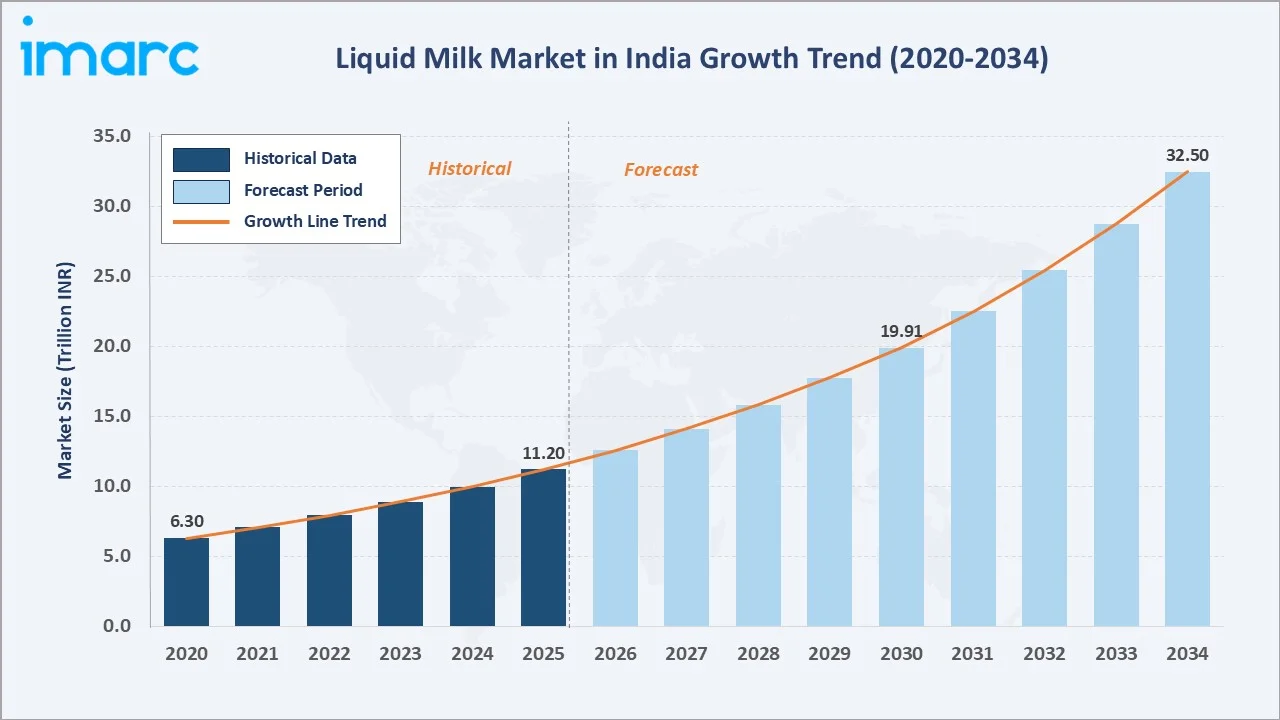
The market expanded from an estimated INR 6.30 Trillion in 2020 to INR 11.20 Trillion in 2025, nearly doubling over five years on the back of rising organized retail penetration, cold-chain expansion, and increasing consumer preference for packaged over loose milk. It is anchored at INR 19.91 Trillion in 2030 and is forecast to reach INR 32.50 Trillion by 2034, as regional cooperatives and private dairy processors continue to scale procurement and processing capacity across India.
To get more information on this market, Request Sample
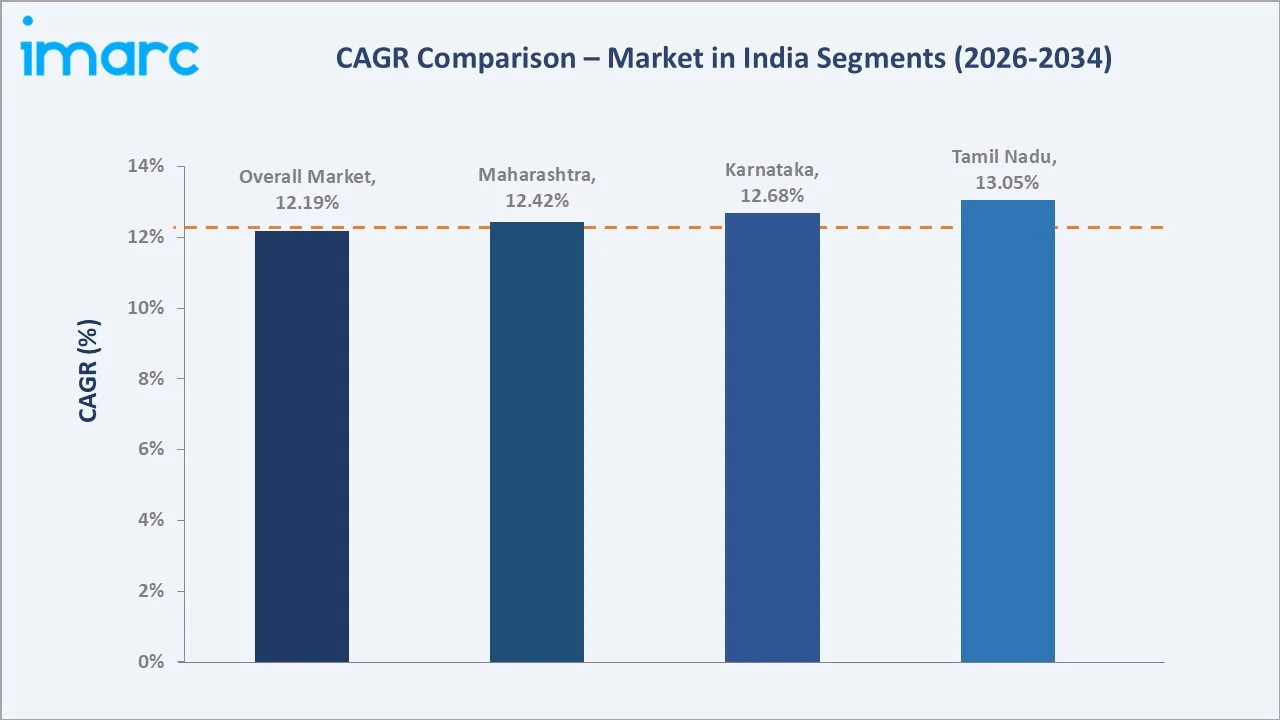
The market's historical CAGR of approximately 12.2% during 2020-2025 is expected to be followed by a broadly similar forecast-period trajectory, with the 2026-2030 phase and the 2030-2034 phase both contributing meaningfully to overall value growth as organized-channel penetration deepens across India's leading dairy-producing states.
Executive Summary
The India liquid milk market reached INR 11.20 Trillion in 2025, representing one of the country's largest and most essential food and beverage categories, underpinned by the fundamental role of milk in Indian dietary habits and its position within the broader dairy value chain. The market is projected to reach INR 32.50 Trillion by 2034, delivering a 12.19% CAGR over the forecast period. This growth trajectory underscores the scale of the milk market in India and the expanding footprint of the Indian milk market across both organized and cooperative channels.
Maharashtra at 20.8% dominates through its large urban consumer base and mature cooperative dairy infrastructure. Karnataka at 11.7% leads through the Karnataka Milk Federation's extensive procurement and distribution network under the Nandini brand. Tamil Nadu at 10.2% reflects strong private dairy player presence alongside cooperative distribution reaching both metro and semi-urban markets.
Key Market Insights
|
Insight |
Data |
|
Leading Region |
Maharashtra - 20.8% share (2025) |
|
Second-Leading Region |
Karnataka - 11.7% market share (2025) |
|
Third-Leading Region |
Tamil Nadu - 10.2% market share (2025) |
|
Market Opportunity |
Cold-chain digitization; fortified and value-added milk; quick-commerce dairy delivery; tier-2/3 organized retail expansion; two-wheeler-based last-mile milk distribution |
Key Analytical Observations Supporting the Above Data:
- Maharashtra at 20.8%: Maharashtra dominates as it combines India's largest metropolitan consumption base with a long-established cooperative dairy network, particularly across Mumbai, Pune, and Nagpur, supporting sustained organized-channel demand for packaged liquid milk.
- Karnataka at 11.7%: Karnataka leads through the Karnataka Cooperative Milk Producers Federation's (Nandini) extensive procurement infrastructure and strong brand loyalty across both urban and rural consumer segments statewide.
- Tamil Nadu at 10.2%: Tamil Nadu's position reflects the strength of large private dairy players alongside cooperative distribution networks reaching both metropolitan Chennai and semi-urban consumer bases across the state.
Liquid Milk Market Overview
The India liquid milk market encompasses the procurement, chilling, pasteurization, packaging, and distribution of fresh liquid milk sold through organized retail, cooperative outlets, and traditional trade channels across the country. The market spans standardized, toned, double-toned, and full-cream milk variants sold in pouches, cartons, and bulk formats to households, hotels, restaurants, and institutional buyers.
The ecosystem integrates dairy farmers and milk procurement cooperatives, chilling and cold-storage infrastructure providers, liquid milk processing and packaging plants, cold-chain logistics operators, organized and traditional retail channels, and regulatory bodies including the Food Safety and Standards Authority of India (FSSAI) and state dairy development boards. Macroeconomic factors including rising disposable incomes, urbanization, cold-chain infrastructure investment, and growing health consciousness continue to shape category growth.
Market Dynamics
To evaluate market opportunities, Request Sample
Market Drivers
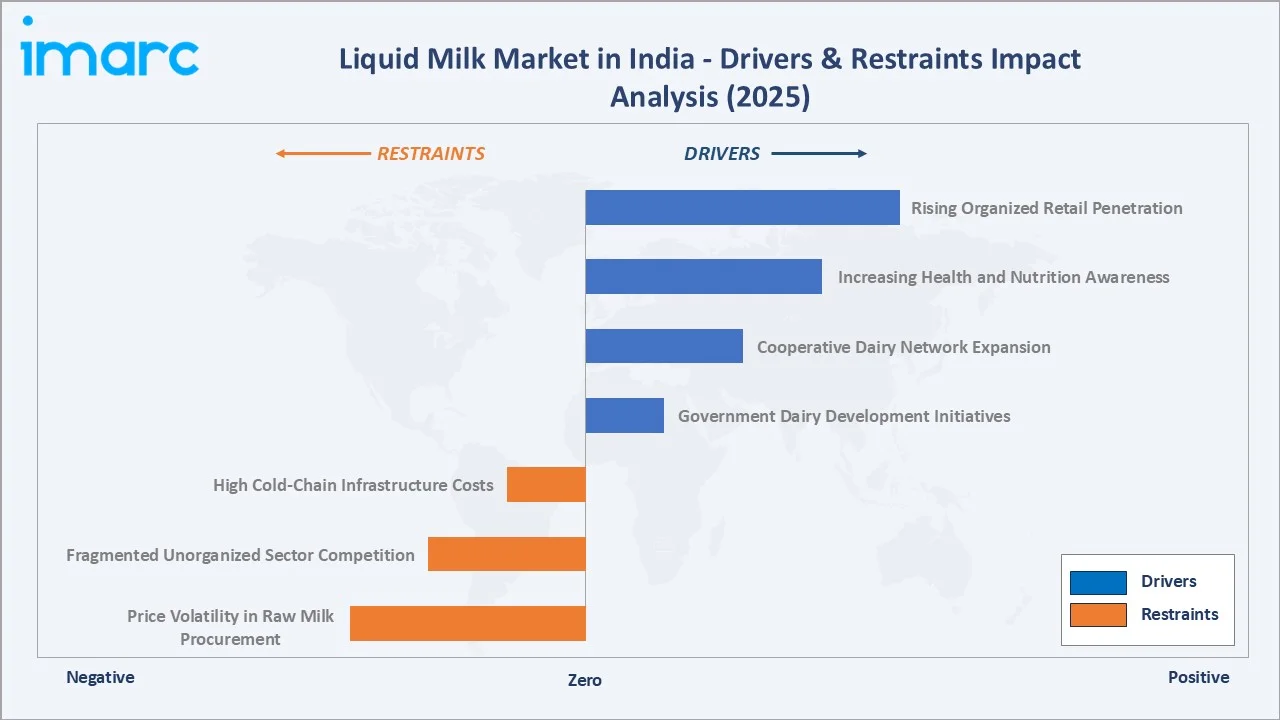
- Rising Organized Retail Penetration: Expansion of modern trade, quick-commerce platforms, and cold-chain logistics is shifting consumer purchases from loose, unpackaged milk toward branded, packaged liquid milk, improving traceability and driving category value growth. Organized retail chains are increasingly dedicating dedicated dairy aisles and refrigerated display units to packaged milk brands. This structural channel shift is expected to continue supporting premiumization and higher per-unit realizations across urban India.
- Increasing Health and Nutrition Awareness: Growing consumer focus on protein intake and balanced nutrition is boosting demand for standardized, fortified, and value-added liquid milk variants across urban and semi-urban India. Fitness-conscious consumers are increasingly incorporating milk into daily protein routines. Fortified milk products enriched with vitamins and minerals are gaining traction among health-focused younger demographics.
- Cooperative Dairy Network Expansion: State-level cooperatives such as GCMMF and KMF continue to expand procurement and processing capacity, strengthening supply chains and enabling wider distribution reach into tier-2 and tier-3 cities. These cooperatives are also investing in automated processing lines to improve output consistency. Continued farmer-member growth is expanding the raw milk procurement base available to organized processors.
- Government Dairy Development Initiatives: Public programs supporting rural milk procurement infrastructure, cold-chain subsidies, and farmer income schemes are strengthening raw milk availability and supporting downstream liquid milk processing capacity. Initiatives under the National Dairy Development Board continue to fund village-level cooling infrastructure. These schemes are also improving farmer incomes, which sustains long-term raw milk supply growth.
Market Restraints
- Price Volatility in Raw Milk Procurement: Fluctuating fodder costs and seasonal supply variability create raw milk price volatility, compressing processor margins and complicating retail pricing strategy. Processors often absorb short-term cost spikes to avoid frequent retail price changes that could affect consumer demand. This margin pressure is particularly acute for smaller regional dairies with limited pricing power.
- Fragmented Unorganized Sector Competition: A large share of milk in India is still sold through unorganized, loose-milk channels, limiting the addressable market for organized, packaged liquid milk players. Price-sensitive rural and semi-urban consumers often continue to prefer loose milk due to lower per-litre costs. Converting this segment to packaged formats remains a slow, capital-intensive process for organized players.
- High Cold-Chain Infrastructure Costs: Establishing and maintaining cold-chain logistics across geographically dispersed rural and semi-urban markets requires significant capital investment, restraining smaller players' expansion. Reliable electricity access remains inconsistent in several rural procurement zones, adding further infrastructure cost. These capital requirements can delay market entry for new regional processors seeking to scale operations.
Market Opportunities
- Cold-Chain Digitization: IoT-enabled cold-chain monitoring and digital traceability systems present a significant opportunity for processors to reduce spoilage losses and improve quality assurance. Real-time temperature tracking can help identify supply chain inefficiencies before they affect product quality. Early adopters of these systems are likely to gain a meaningful cost and quality advantage over competitors.
- Quick-Commerce Dairy Delivery: The rapid growth of quick-commerce platforms offering 10–15-minute delivery is opening a fast-growing distribution channel for fresh packaged milk in metro and tier-1 markets. This channel particularly appeals to time-constrained urban consumers seeking daily fresh milk delivery. Processors partnering early with these platforms may secure durable shelf-space advantages.
Market Challenges
- Regional Cooperative Market Share Pressure from Private Dairies: Private dairy companies expanding aggressively into traditionally cooperative-dominated states are increasing competitive intensity and pricing pressure on established regional cooperatives. This is compelling cooperatives to modernize marketing and product portfolios more rapidly than historical norms. Sustained competitive pressure could gradually erode cooperative market share in select high-growth states.
- Consumer Price Sensitivity Limiting Premiumization: Despite rising health awareness, a large portion of Indian consumers remain highly price-sensitive, limiting the pace at which processors can shift portfolios toward higher-margin fortified and value-added milk variants. This constrains average realization growth even as volume demand expands steadily. Balancing affordability with premiumization remains an ongoing strategic challenge for most processors.
Emerging Market Trends
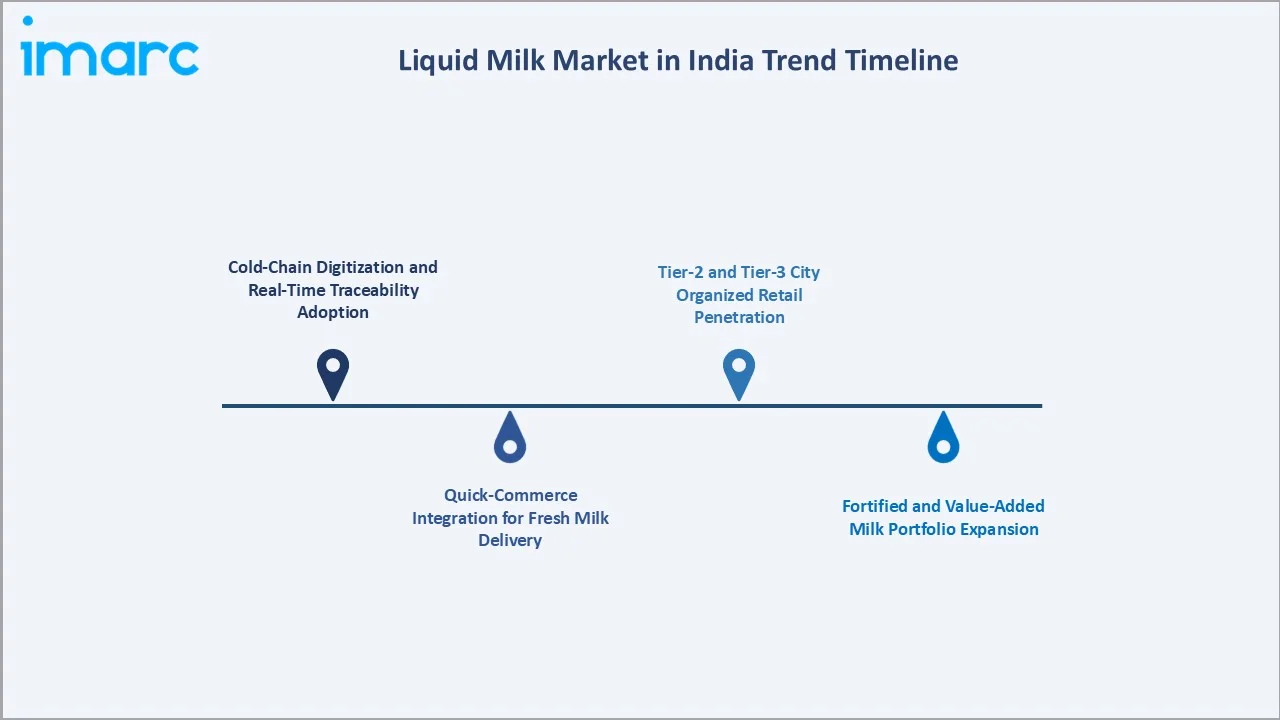
1. Cold-Chain Digitization and Real-Time Traceability Adoption
Processors are increasingly deploying IoT-enabled temperature monitoring and digital traceability systems across procurement and distribution networks to reduce spoilage and strengthen quality assurance. This is driving integration of sensor-based cold-chain infrastructure across chilling centers, transport vehicles, and retail cold-storage points. As consumers grow more quality-conscious, digital traceability is emerging as a meaningful brand differentiator for premium liquid milk offerings.
2. Quick-Commerce Integration for Fresh Milk Delivery
Quick-commerce platforms offering rapid grocery delivery are integrating fresh packaged milk into their core daily-essentials catalog, creating a fast-growing distribution channel in metro and tier-1 cities. This design can enhance consumer convenience and daily purchase frequency for packaged milk brands. As urban lifestyles increasingly favor on-demand delivery, quick-commerce is emerging as a structurally important channel for future category growth.
3. Fortified and Value-Added Milk Portfolio Expansion
Processors are expanding fortified, high-protein, and value-added liquid milk portfolios as OEMs shift consumer offerings toward nutrition-differentiated products. These variants improve category margins and appeal to health-focused urban consumers. As manufacturers seek higher-value product mixes, demand is rising for suppliers offering fortification technology and specialized packaging solutions.
4. Tier-2 and Tier-3 City Organized Retail Penetration
Organized retail and modern trade expansion into tier-2 and tier-3 cities is emerging as these markets generate substantial untapped liquid milk demand, particularly in Northern and Eastern India. Their rapid urbanization creates large-scale distribution opportunities for compact, cost-efficient cold-chain logistics. As processors expand geographic reach, they benefit from first-mover advantages, improved brand recall, and wider market penetration.
Industry Value Chain Analysis
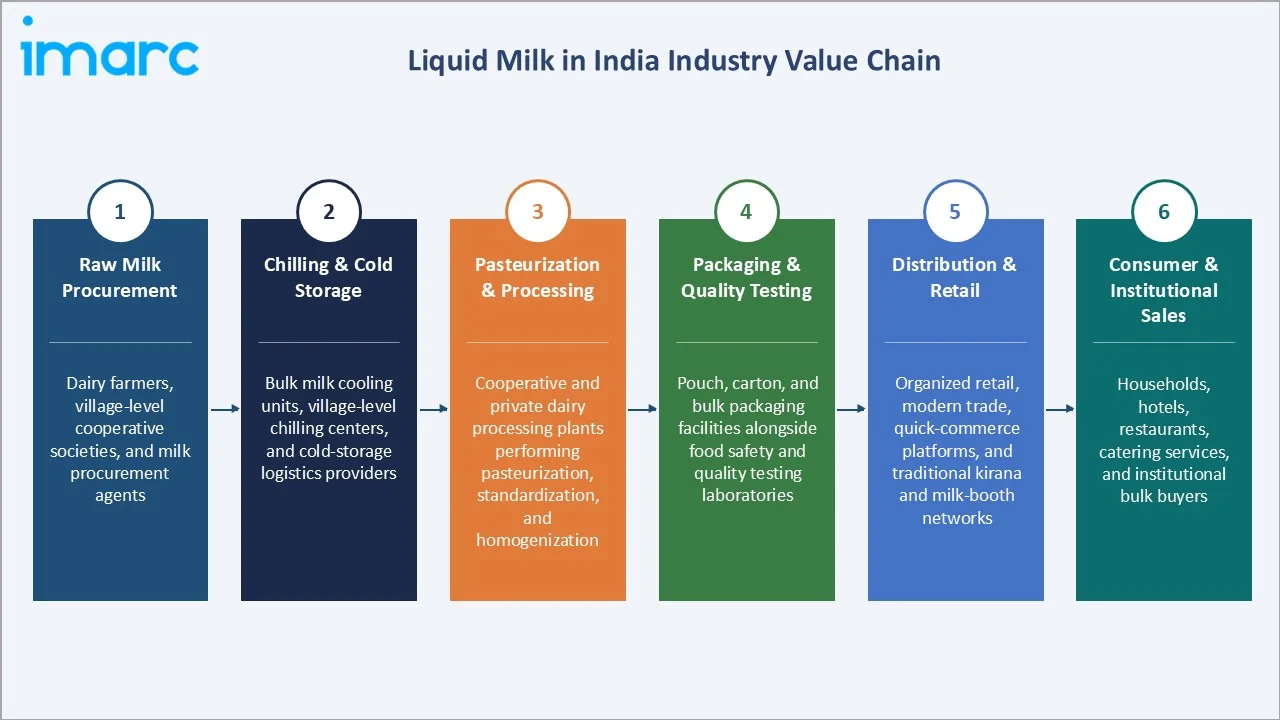
The India liquid milk value chain integrates raw milk procurement from dairy farmers and cooperatives, chilling and cold-storage infrastructure, pasteurization and processing, packaging and quality testing, distribution through organized and traditional retail, and final sale to household and institutional consumers. The value chain's commercial architecture continues to consolidate toward integrated cooperative and private processor models that combine procurement, processing, and distribution under unified quality and branding standards.
|
Stage |
Key Participants |
|
Raw Milk Procurement |
Dairy farmers, village-level cooperative societies, and milk procurement agents |
|
Chilling & Cold Storage |
Bulk milk cooling units, village-level chilling centers, and cold-storage logistics providers |
|
Pasteurization & Processing |
Cooperative and private dairy processing plants performing pasteurization, standardization, and homogenization |
|
Packaging & Quality Testing |
Pouch, carton, and bulk packaging facilities alongside food safety and quality testing laboratories |
|
Distribution & Retail |
Organized retail, modern trade, quick-commerce platforms, and traditional kirana and milk-booth networks |
|
Consumer & Institutional Sales |
Households, hotels, restaurants, catering services, and institutional bulk buyers |
The raw milk procurement tier remains the value chain's most commercially critical stage, given India's highly fragmented smallholder dairy farming base. The distribution and retail tier is experiencing the value chain's most rapid transformation as quick-commerce and organized modern trade progressively displace traditional unorganized retail for packaged liquid milk.
Technology Landscape in the Liquid Milk Industry
Pasteurization and Ultra-High Temperature (UHT) Processing Technology
Pasteurization and UHT processing technologies offer extended shelf life, improved microbial safety, and consistent product quality for packaged liquid milk. These technologies enable longer-distance distribution, reduced spoilage losses, and improved cold-chain flexibility, making them increasingly preferred by processors serving geographically dispersed markets. Their compatibility with both refrigerated and ambient distribution formats is accelerating adoption across the industry.
Cold-Chain Monitoring and IoT Traceability Technology
Cold-chain monitoring and IoT-enabled traceability technology offer real-time temperature tracking, reduced spoilage, and improved quality assurance across the supply chain. These systems provide processors with precise visibility into procurement-to-retail logistics, making them suitable for large-scale cooperative and private dairy operations. Their cost-effectiveness at scale is supporting wider adoption across mid-sized and large processors alike.
Automated Packaging and Filling Technology
Automated pouch and carton filling technology offers high-throughput, hygienic, and consistent packaging for liquid milk at scale. This technology enables processors to meet rising organized retail volume requirements while maintaining strict food safety standards. As demand grows for packaged milk formats, automated filling lines are becoming a standard capital investment for mid-to-large dairy processors.
The report covers the following segments:
|
Segment Category |
Leading Segment |
Market Share |
Year |
|
Region |
Maharashtra |
20.8% |
2025 |

Regional Market Insights
Regional performance varies significantly across India, shaped by cooperative dairy infrastructure maturity, urbanization levels, and consumer purchasing power. The table below summarizes the 2025 regional market breakup across the fifteen states covered in this report.
|
Region |
Share (2025) |
Key Liquid Milk Market Drivers & Characteristics |
|
Maharashtra |
20.80% |
Driven by dense urban consumption in Mumbai and Pune, mature cooperative dairy infrastructure, and strong organized retail penetration |
|
Karnataka |
11.70% |
Supported by the Karnataka Milk Federation's extensive procurement network and strong Nandini brand loyalty across urban and rural markets |
|
Tamil Nadu |
10.20% |
Driven by strong private dairy players and cooperative distribution reaching both metro Chennai and semi-urban consumer bases |
|
Uttar Pradesh |
9.10% |
Supported by India's largest population base, expanding cold-chain infrastructure, and growing organized retail presence |
|
Gujarat |
7.80% |
Anchored by GCMMF's (Amul) home-state cooperative dominance and well-established rural procurement networks |
|
Andhra Pradesh & Telangana |
7.10% |
Driven by expanding urban consumption in Hyderabad and growing private dairy investment across the region |
|
Rajasthan |
6.40% |
Supported by the Rajasthan Cooperative Dairy Federation's (Saras) three-tier procurement structure and steady rural milk production base |
|
Madhya Pradesh |
5.80% |
Driven by expanding cooperative milk procurement and rising organized retail presence across Bhopal and Indore |
|
West Bengal |
5.10% |
Supported by growing urban demand in Kolkata alongside gradual cold-chain and organized distribution expansion |
|
Kerala |
4.20% |
Anchored by Milma's (Kerala Cooperative Milk Marketing Federation) strong regional brand presence and dense consumer distribution network |
|
Punjab |
3.10% |
Driven by high per-capita milk production and Verka's established cooperative procurement and distribution infrastructure |
|
Orissa |
2.60% |
Supported by growing cooperative procurement under Omfed and gradual expansion of urban organized retail channels |
|
Haryana |
2.40% |
Supported by strong dairy farming traditions and proximity to Delhi-NCR's organized retail and institutional demand |
|
Bihar |
1.90% |
Driven by expanding cooperative procurement under Sudha (COMFED) and rising rural-to-urban milk supply chain investment |
|
Delhi |
1.70% |
Anchored by high organized retail penetration and dense institutional demand despite limited local production base |
Maharashtra, at 20.8%, leads through its combination of India's largest metropolitan consumer base and long-established cooperative dairy networks. Karnataka, at 11.7%, reflects the Karnataka Milk Federation's deep rural procurement reach and strong consumer brand loyalty.
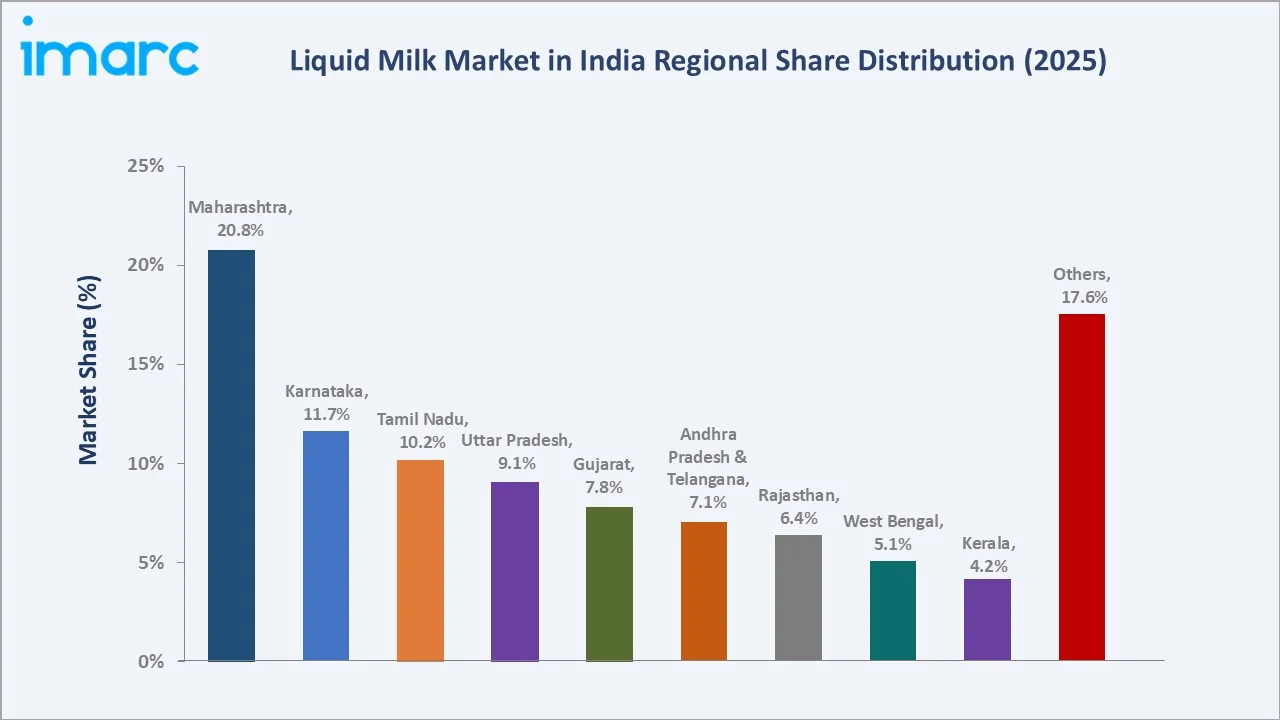
Tamil Nadu, at 10.2%, benefits from a strong private dairy sector alongside cooperative distribution. Uttar Pradesh, at 9.1%, and Gujarat, at 7.8%, represent large, structurally growing markets driven respectively by population scale and cooperative dominance.
Competitive Landscape
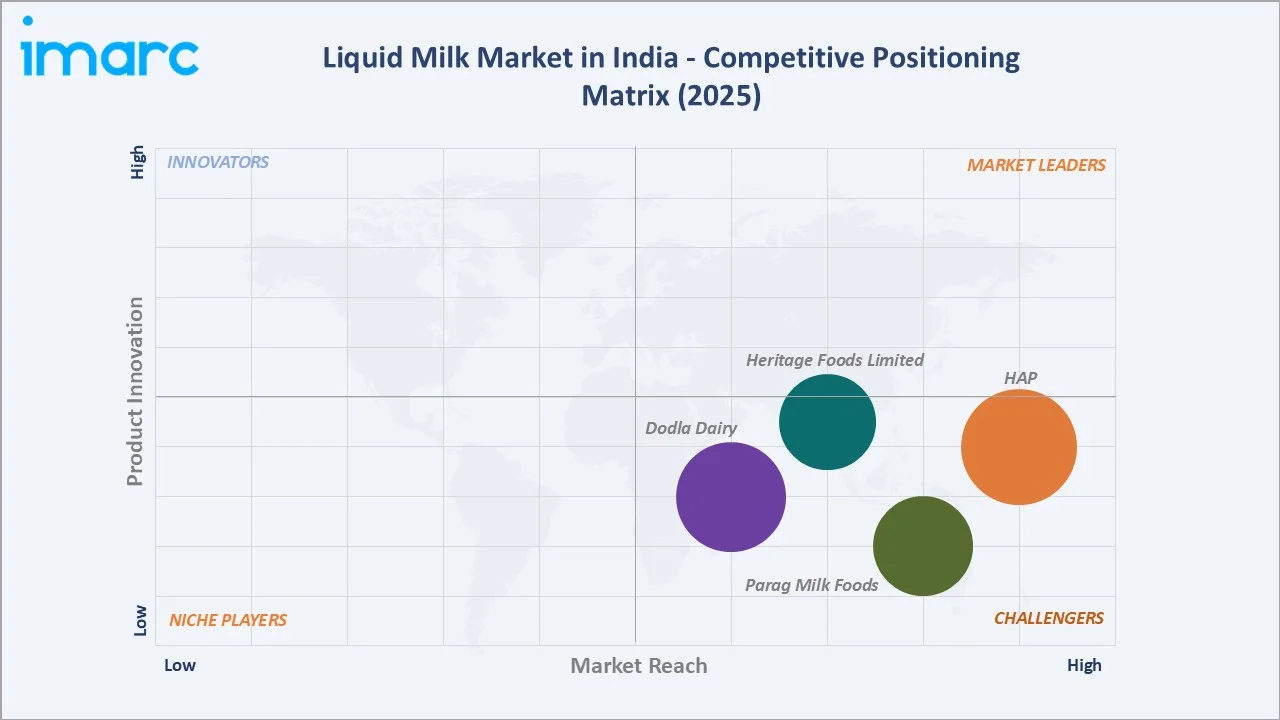
The India liquid milk market competitive landscape features a mix of large-scale cooperative federations and private dairy companies competing on distribution reach, brand trust, and product freshness. The market is moderately fragmented, with regional cooperatives retaining strong home-state positions while private players expand aggressively into new geographies.
|
Company Name |
Key Products |
Market Position |
Core Strength |
|
HAP |
Arokya, Hatsun Milk |
Strong Challenger |
South India's largest private dairy with extensive fresh milk distribution |
|
Parag Milk Foods |
Gowardhan, Pride of Cows |
Challenger |
Farm-to-home model with premium positioning in select urban markets |
|
Heritage Foods Limited |
Gold Milk, Super Gold Milk, Toned Milk, Full Cream Milk, Slim Milk, Cow Milk, A2 Full Cream Milk |
Strong Challenger |
Branded dairy across Telangana, Andhra Pradesh, Tamil Nadu, and Karnataka, backed by processing network and a farmer base |
|
Dodla Dairy |
Full Cream Milk, Full Cream Milk Gold, Tea Magic Milk, Standardised Milk, Standardised Milk Gold, Cow Milk, Toned Milk, Double Toned Milk |
Challenger |
Integrated South India dairy model spanning liquid milk, value-added products, and cattle feed, with expanding operations into Maharashtra, East India, and East Africa |
Key players include HAP, Parag Milk Foods, Heritage Foods Limited, Dodla Dairy, and others.
Key Company Profiles
Parag Milk Foods
Parag Milk Foods is a leading private dairy company known for its farm-to-home premium milk model and diversified branded portfolio spanning mass-market and premium dairy segments.
- Key Products: Gowardhan and Go milk variants, and Pride of Cows premium farm-to-home milk.
- Strategic Focus: Strengthening its premium positioning through the Pride of Cows farm-to-home subscription model while expanding Gowardhan and Go's mass-market retail presence. The company continues to invest in brand-building initiatives across television, digital, and influencer channels to build category visibility. Parag Milk Foods is also broadening its new-age product mix, including sports nutrition and protein-led offerings, to diversify beyond core liquid milk.
HAP
HAP is South India's largest private dairy company, operating an extensive fresh milk procurement and distribution network under brands including Arokya and Hatsun, with a strong presence across Tamil Nadu and neighboring states.
- Key Products: Arokya Milk and Hatsun-branded liquid milk variants.
- Recent Developments: In January 2025, Hatsun Agro Product Ltd (HAP) acquired Milk Mantra Dairy Pvt. Ltd. and its Milky Moo brand, strengthening its presence in the Eastern Indian dairy market. The acquisition gives HAP access to Milk Mantra’s established market presence, distribution and milk-procurement network, along with two processing facilities in Odisha.
- Strategic Focus: Expanding fresh milk distribution reach across South India while strengthening farmer procurement relationships to secure long-term supply. The company continues to invest in cold-chain logistics to support same-day fresh milk delivery. Hatsun Agro is also pursuing selective geographic expansion into neighboring states to diversify its regional revenue base.
Market Concentration Analysis
The India liquid milk market is moderately fragmented at the national level, with the key players collectively accounting for a substantial share of organized packaged milk revenue. Regional cooperatives retain strong home-state dominance, while private players compete for share in urban and semi-urban markets. Market concentration is expected to remain broadly stable over the forecast period as cooperative federations defend home-state positions even as private players expand geographic reach.
Future Market Outlook (2026-2034)
The India liquid milk market is projected to grow from INR 11.20 Trillion in 2025 to INR 32.50 Trillion by 2034, delivering a 12.19% CAGR over the forecast period. The market's anchor value of INR 19.91 Trillion in 2030 represents an industry at a significant scale-up inflection point, as cold-chain digitization, quick-commerce integration, and fortified milk portfolio expansion converge to reshape category economics. Organized retail penetration is expected to continue displacing unorganized loose-milk sales, particularly across tier-2 and tier-3 cities, while cooperative federations and private processors alike scale processing and distribution capacity to meet rising demand.
Research Methodology
Primary Research
Primary research comprised structured interviews with industry stakeholders across dairy cooperatives, private processors, cold-chain logistics providers, and organized retail chains, capturing current procurement, processing, and distribution trends across India's leading liquid milk markets.
Secondary Research
Secondary research encompassed cooperative federation annual reports, National Dairy Development Board publications, state dairy development board data, FSSAI regulatory filings, and industry association reports covering milk procurement, processing capacity, and regional market trends across India.
Forecasting Models
Market revenue forecasts were developed using a combined bottom-up and top-down estimation approach: (i) state-wise milk procurement and processing capacity trends; (ii) organized versus unorganized channel penetration rates by region; (iii) per-capita milk consumption trends adjusted for urbanization and income growth; (iv) historical CAGR triangulation against announced cooperative and private processor capacity expansion plans.
Liquid Milk Market in India Report Coverage:
| Report Features | Details |
|---|---|
| Base Year of the Analysis | 2025 |
| Historical Period | 2020-2025 |
| Forecast Period | 2026-2034 |
| Units | INR Trillion, Million Litres |
| Regions Covered | Maharashtra, Uttar Pradesh, Andhra Pradesh and Telangana, Tamil Nadu, Gujarat, Rajasthan, Karnataka, Madhya Pradesh, West Bengal, Bihar, Delhi, Kerala, Punjab, Orissa, Haryana |
| Companies Covered | HAP, Parag Milk Foods, Heritage Foods Limited, Dodla Dairy, etc. |
| Customization Scope | 10% Free Customization |
| Post-Sale Analyst Support | 10-12 Weeks |
| Delivery Format | PDF and Excel through Email (We can also provide the editable version of the report in PPT/Word format on special request) |
Key Benefits for Stakeholders:
- IMARC’s report offers a comprehensive quantitative analysis of various market segments, historical and current market trends, market forecasts, and dynamics of the liquid milk market in India from 2020-2034.
- The research study provides the latest information on the market drivers, challenges, and opportunities in the liquid milk market in India.
- Porter's five forces analysis assist stakeholders in assessing the impact of new entrants, competitive rivalry, supplier power, buyer power, and the threat of substitution. It helps stakeholders to analyze the level of competition within the liquid milk industry in India and its attractiveness.
- Competitive landscape allows stakeholders to understand their competitive environment and provides an insight into the current positions of key players in the market.
Frequently Asked Questions About the Liquid Milk Market in India Report
The India liquid milk market reached INR 11.20 Trillion in 2025, driven by Maharashtra's leading 20.8% regional share, Karnataka's cooperative-led 11.7% share, Tamil Nadu's private-dairy-supported 10.2% share, and continued organized retail and cold-chain infrastructure expansion across the country.
The liquid milk market grows at 12.19% CAGR during 2026-2034, reaching INR 32.50 Trillion by 2034. This growth reflects rising organized retail and quick-commerce penetration, growing health and nutrition awareness, cooperative dairy network expansion, and continued government dairy development support.
Maharashtra leads at 20.8%, driven by its large metropolitan consumer base and mature cooperative dairy infrastructure. Karnataka follows at 11.7% through the Karnataka Milk Federation's extensive procurement reach, and Tamil Nadu ranks third at 10.2% through strong private dairy player presence.
The liquid milk market is projected to reach approximately INR 19.91 Trillion by 2030, with cold-chain digitization becoming a standard capability for large processors, quick-commerce dairy delivery gaining mainstream urban adoption, and fortified milk variants expanding meaningfully within processor portfolios.
Leading companies include HAP, Parag Milk Foods, Heritage Foods Limited, Dodla Dairy, and others.
Key drivers include rising organized retail penetration, increasing health and nutrition awareness, cooperative dairy network expansion, and continued government dairy development initiatives supporting rural procurement infrastructure and farmer incomes.
Two priority investment opportunities stand out: cold-chain digitization and IoT-enabled traceability systems for processors, and quick-commerce dairy delivery partnerships targeting fast-growing metro and tier-1 city demand for fresh packaged milk.
Need more help?
- Speak to our experienced analysts for insights on the current market scenarios.
- Include additional segments and countries to customize the report as per your requirement.
- Gain an unparalleled competitive advantage in your domain by understanding how to utilize the report and positively impacting your operations and revenue.
- For further assistance, please connect with our analysts.
 Request Customization
 Speak to an Analyst
 Request Brochure
 Inquire Before Buying
Benefits of Customization
- Personalize this research
- Triangulate with your data
- Get data as per your format and definition
- Gain a deeper dive into a specific application, geography, customer, or competitor
- Any level of personalization
Get in Touch With Us
UNITED STATES
Phone: +1-201-971-6302
INDIA
Phone: +91-120-433-0800
UNITED KINGDOM
Phone: +44-753-714-6104
Email: [email protected]
Client Testimonials




.webp)




.webp)













Related Reports

Choose your plan
*Please note that the prices mentioned below are starting prices for each bundle type. Kindly contact our team for further details.*
Single User License
- 1 User License, Access on 2 Devices
- PDF Report + Excel Dataset (Password Protected)
- Lifetime Access
- No Printing Rights
- 10% Free Report Customization
- 10–12 Weeks of Analyst Support
Five User License
- Access for 5 Users, 2 Devices per User
- PDF Report + Excel Dataset (Password Protected)
- Lifetime Access
- Dedicated Account Manager
- 12–14 Weeks of Analyst Support
- No Printing Rights
- 15% Free Report Customization
- 25% Discount on Your Next Purchase
Corporate User License
- Unlimited User Access (Within Your Organization)
- PDF Report + Excel Dataset
- Lifetime Access
- Dedicated Account Manager
- 14–20 Weeks of Analyst Support
- No Printing Rights
- 20% Free Report Customization
- 30% Discount on Your Next Purchase
Essential Insights
What's included:
3 reports
- Lifetime Access
- PDF Reports
- Excel Datasets
- 2 Weeks of Free Analyst Support
- 2 User Licenses
- Access on 2 Devices
- Printing Rights
- Complimentary PowerPoint (PPT) Version
- Complimentary License Upgrade
Professional Access
What's included:
5 reports
- Lifetime Access
- PDF Reports
- Excel Datasets
- 8 Weeks of Free Analyst Support
- 2 User Licenses
- Access on 2 Devices
- Printing Rights
- Complimentary PowerPoint (PPT) Version
- Complimentary License Upgrade
Business Advantage
What's included:
8 reports
- Lifetime Access
- PDF Reports
- Excel Datasets
- 14 Weeks of Free Analyst Support
- 2 User Licenses
- Access on 2 Devices
- Printing Rights
- Complimentary PowerPoint (PPT) Version
- Complimentary License Upgrade
Enterprise Intelligence
What's included:
10 reports
- Lifetime Access
- PDF Reports
- Excel Datasets
- 20 Weeks of Free Analyst Support
- 2 User Licenses
- Access on 2 Devices
- Printing Rights
- Complimentary PowerPoint (PPT) Version
- Complimentary License Upgrade