
Malaysia Confectionery Market Size, Share, Trends and Forecast by Product Type, Age Group, Price Point, Distribution Channel, and Region, 2026-2034
Malaysia Confectionery Market Size, Share, Trends & Forecast (2026-2034)
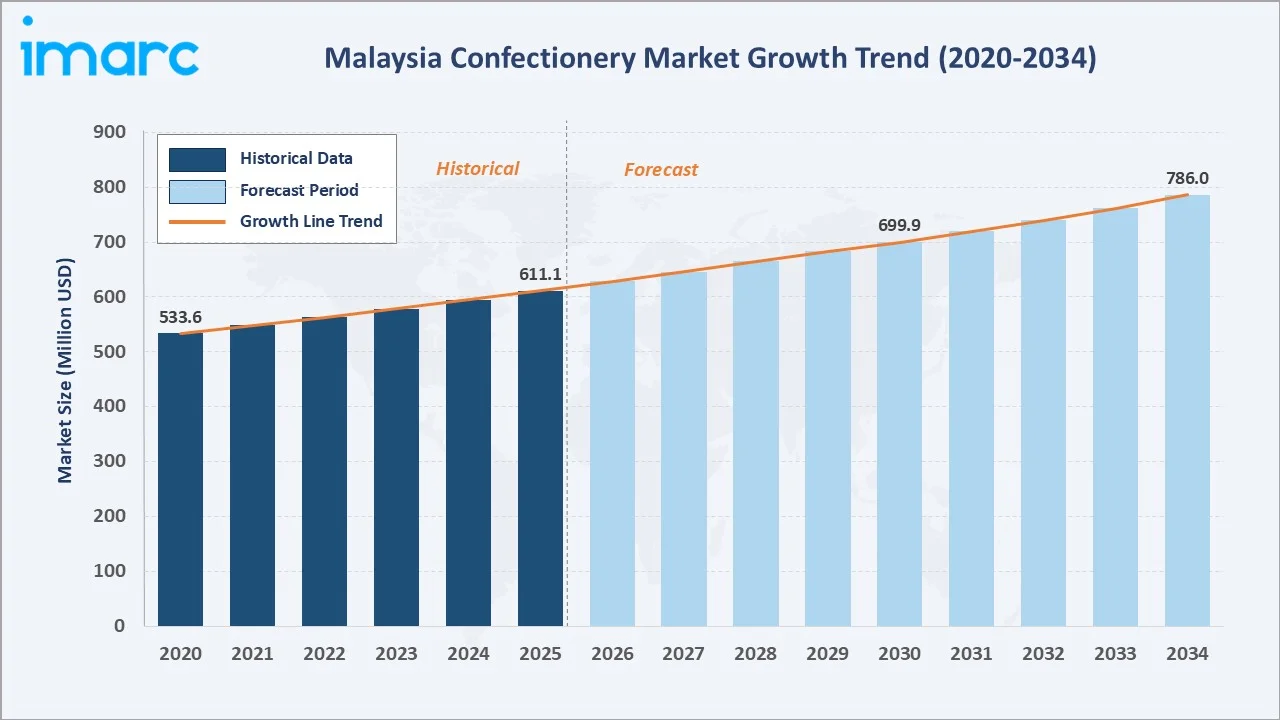
The Malaysia confectionery market reached USD 611.1 Million in 2025 and is projected to reach USD 786.0 Million by 2034, exhibiting a steady CAGR of 2.75% during 2026-2034. The market benefits from rising urbanization, a rebounding tourism sector generating confectionery gifting demand, and the progressive premiumization of adult confectionery consumption driven by Malaysia’s growing middle class. Malaysia’s domestic tourism remained strong in the third quarter of 2025, with 72.6 million domestic visitors, up 9.6% year-on-year, while tourism expenditure reached RM29.8 billion, increasing 16.7%. This growth is supporting the Malaysia confectionery market by increasing consumer spending at tourist destinations, retail outlets, convenience stores, hotels, and foodservice establishments, thereby strengthening demand for chocolates, candies, traditional sweets, and other confectionery products. The adult age group leads at 56.7%, the mid-range price point dominates at 48.6%, and Selangor accounts for the largest regional share at 28.7%.
Market Snapshot
|
Metric |
Value |
|
Market Size (2025) |
USD 611.1 Million |
|
Forecast Market Size (2034) |
USD 786.0 Million |
|
CAGR (2026-2034) |
2.75% |
|
Base Year |
2025 |
|
Historical Period |
2020-2025 |
|
Forecast Period |
2026-2034 |
|
Dominant Age Group |
Adult – 56.7% (2025) |
|
Dominant Price Point |
Mid-range – 48.6% (2025) |
|
Leading Region |
Selangor – 28.7% (2025) |
The Malaysia confectionery market grew from USD 533.6 Million in 2020 to USD 611.1 Million in 2025, expanding despite COVID-19’s 2020-2021 disruption to retail channels and gifting occasions. Recovery was driven by Malaysia’s robust modern trade infrastructure, the growth of online confectionery commerce, and the strategic expansion of halal-certified confectionery exports to Gulf Cooperation Council (GCC) and ASEAN markets. The market is projected to reach USD 699.9 Million by 2030 and USD 786.0 Million by 2034.
To get more information on this market, Request Sample
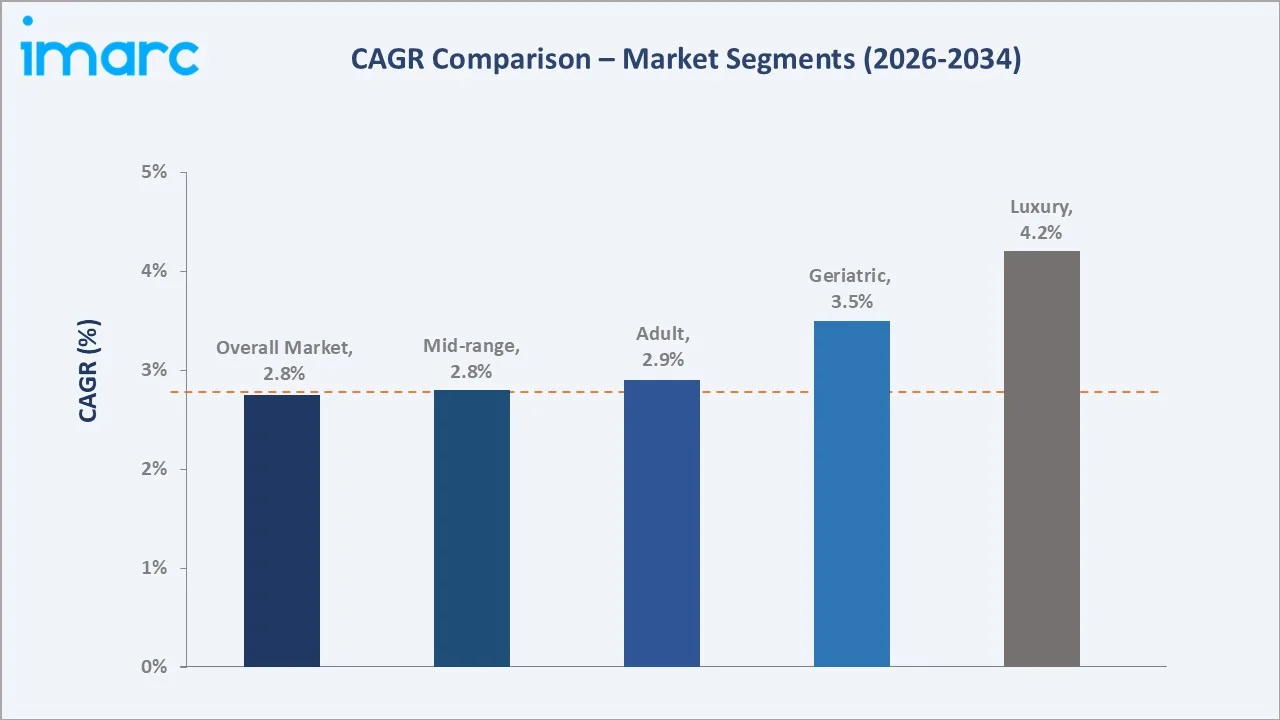
Luxury price points grow fastest at ~4.20% CAGR through premium gifting, imported chocolates, and tourism retail demand. The geriatric age group grows at ~3.50% CAGR through medicated confectionery, sugar-free options, and health-functional candy. The adult age group grows at ~2.90% CAGR through premiumization and gifting consumption. The mid-range price point grows at ~2.80% CAGR, sustained by mainstream modern trade and everyday consumption.
Executive Summary
Malaysia confectionery market presents a stable, diversified growth opportunity anchored in the country’s role as Southeast Asia’s halal confectionery production hub, its multicultural gifting traditions, and its position as a major tourist destination generating confectionery souvenir and gifting demand. Malaysia’s confectionery market is structurally distinguished from peer ASEAN markets by three unique characteristics: halal certification as a global competitive differentiator, the tourism-gifting linkage, and multicultural festive demand cycles.
The adult age group’s 56.7% market share reflects Malaysia’s demographic profile, combined with the structural shift in confectionery consumption from a childhood treat to an adult social and gifting product category driven by chocolate premiumization, gourmet candy, and beverage-paired confectionery trends. Mid-range price point’s 48.6% dominance reflects the Malaysian middle class’s sweet spot between economic necessity and aspirational quality. Selangor’s 28.7% regional leadership reflects both its status as Malaysia’s most populous state and the concentration of Malaysia’s confectionery manufacturing infrastructure in Shah Alam, Rawang, and Petaling Jaya.
Key Market Insights
|
Insight |
Data |
|
Dominant Age Group |
Adult – 56.7% share (2025) |
|
Dominant Price Point |
Mid-range – 48.6% share (2025) |
|
Leading Region |
Selangor – 28.7% share (2025) |
|
Market Opportunity |
Halal functional confectionery for elderly segment; premium gifting chocolate for Malaysia’s expanding luxury tourism corridor; reduced-sugar and plant-based confectionery for health-conscious adult consumers; export-oriented halal gummy and jelly candy for OIC market expansion |
Key Analytical Observations:
- Adult Age Group at 56.7% (2025): Malaysia’s adult confectionery segment, encompassing consumers aged 18 and above, commands market majority through three concurrent demand drivers such as gifting culture, social and out-of-home consumption, and health-driven functional consumption.
- Mid-range Price Point at 48.6% (2025): Mid-range confectionery represents Malaysia’s mainstream commercial confectionery market anchored by Cadbury Dairy Milk bars and slabs, Nestlé KitKat, Ferrero Rocher standard boxes, and premium gummy candy packs.
- Selangor at 28.7% (2025): Selangor leads due to its large urban population, strong retail infrastructure, and high concentration of supermarkets, convenience stores, and foodservice outlets. Higher disposable incomes and strong demand for premium, imported, and innovative confectionery products further support its market dominance.
Malaysia Confectionery Market Overview
The Malaysia confectionery market encompasses a wide range of products, including chocolates, sugar confectionery, gums, candies, toffees, and other sweet snacks. The market serves consumers across supermarkets, hypermarkets, convenience stores, specialty outlets, and online retail channels. The Malaysia confectionery market is driven by rising consumer spending, expanding Malaysia confectionery import and Malaysia confectionery export activities, and growing demand from the Malaysia baking mixes market for chocolate, cocoa, and confectionery-based ingredients. Macroeconomic factors include rising disposable incomes, urbanization, economic growth, inflation trends, and expanding tourism, which influence consumer spending on confectionery products.
Market Dynamics
To evaluate market opportunities, Request Sample
Market Drivers
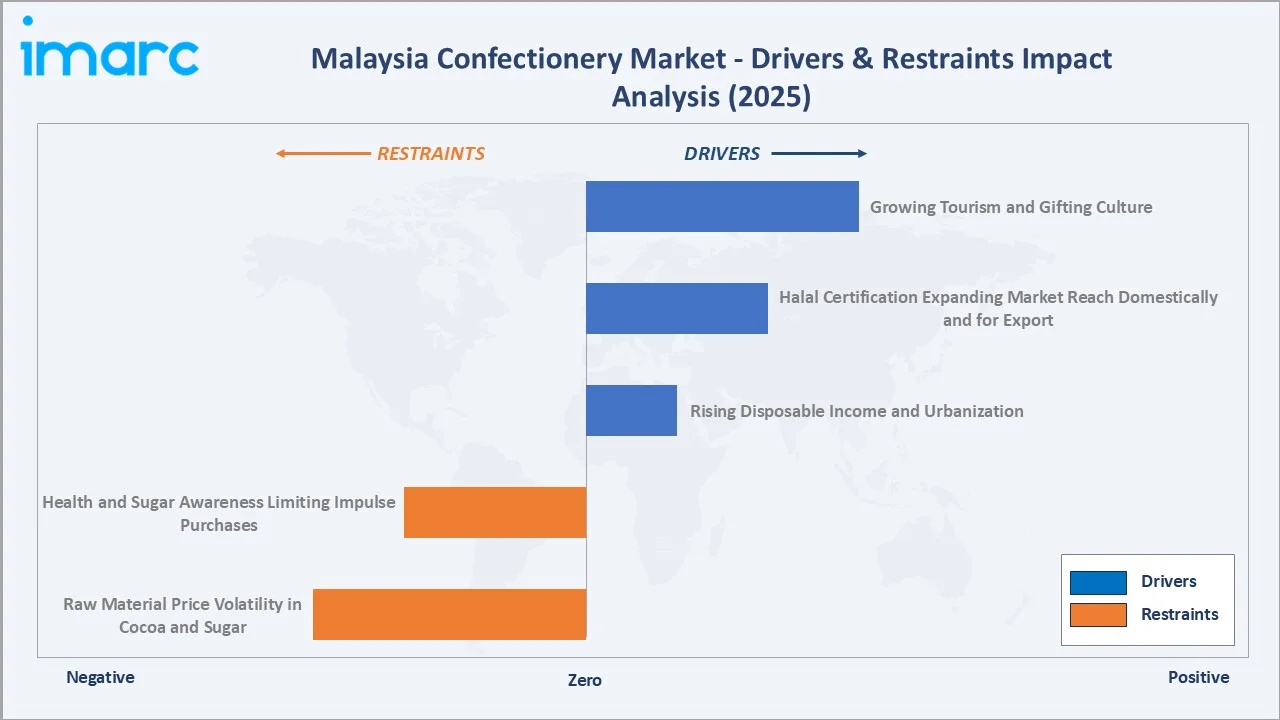
- Growing Tourism and Gifting Culture: Malaysia’s domestic tourism remained robust in the third quarter of 2025, with 72.6 million visitors, up 9.6% year-on-year. Domestic tourism expenditure also increased significantly, rising 16.7% year-on-year to RM29.8 billion during the quarter. Malaysia’s position as one of Southeast Asia’s most visited countries creates a structurally growing premium confectionery market anchored in the globally universal practice of purchasing food gifts when visiting foreign destinations. Malaysia’s halal confectionery is uniquely positioned as a universally acceptable gift for visitors from Muslim-majority countries who constitute the largest segments of Malaysia’s inbound tourist market, as halal-certified Malaysian confectionery products can be shared within Islamic dietary restrictions without concern.
- Halal Certification Expanding Market Reach Domestically and for Export: Halal certification is expanding the Malaysia confectionery market by strengthening consumer trust and ensuring products meet the dietary requirements of Malaysia’s large Muslim population. It also improves the export potential of locally manufactured confectionery products across Muslim-majority markets in Southeast Asia and the Middle East. Growing investment in halal-compliant production, ingredients, and certification is further helping manufacturers broaden their domestic and international customer base.
- Rising Disposable Income and Urbanization: In 2025, Malaysia’s GDP reached RM2.03 trillion at current prices and RM1.74 trillion at constant prices. Meanwhile, Gross National Income (GNI) per capita rose to RM57,200, compared with RM54,870 in 2024, reflecting both economic recovery and sustained growth that has expanded the middle-class consumer segment capable of trading up from economy to mid-range confectionery. Malaysia’s urban population has access to modern retail environments where mid-range confectionery is prominently merchandised through confectionery aisles, end-cap displays, and checkout impulse purchase zones that systematically capture spontaneous confectionery spend.
Market Restraints
- Health and Sugar Awareness Limiting Impulse Purchases: Growing awareness of obesity, diabetes, and the health effects of excessive sugar consumption is encouraging Malaysian consumers to reduce confectionery intake. Increasing preference for low-sugar, sugar-free, and healthier snacks is particularly affecting traditional chocolates and candies. Greater attention to nutrition labels and ingredient transparency is also reducing impulse purchases, potentially limiting volume growth in the Malaysia confectionery market.
- Raw Material Price Volatility in Cocoa and Sugar: Fluctuating cocoa and sugar prices increase production costs for confectionery manufacturers, creating pressure on profit margins and retail pricing. Supply disruptions, adverse weather conditions, and dependence on imported cocoa further expose Malaysian producers to global commodity price movements. Higher input costs may lead to price increases or smaller product sizes, potentially limiting consumer demand in the Malaysia confectionery market.
Market Opportunities
- Functional and Health-Positioned Confectionery Innovation: Malaysia’s dual challenge of high sugar consumption and rising health consciousness creates a market demand gap for confectionery products that deliver perceived health benefits alongside enjoyment, where functional candy (vitamin C gummies, probiotic confectionery, collagen-infused sweets, mineral-enriched lollipops) can capture consumer spend from both traditional confectionery and health supplement categories.
- Export Expansion to GCC and ASEAN Halal Markets: Malaysia’s established halal certification ecosystem can strengthen product credibility and facilitate access to Muslim consumer markets. Manufacturers can capitalize on this advantage by expanding distribution partnerships and developing premium, halal-certified chocolates, candies, and snack products tailored to regional preferences.
Market Challenges
- Intense Competition from Domestic and International Brands: The market faces strong competition from established global confectionery companies and local manufacturers offering products across multiple price points. High brand loyalty and frequent product launches make it challenging for smaller companies to gain shelf space and maintain market share.
- Supply Chain Dependence on Imported Ingredients: Malaysia’s confectionery industry relies on internationally sourced ingredients and inputs, exposing manufacturers to exchange-rate movements, shipping disruptions, and global supply shortages. Such disruptions can affect production planning, inventory management, and product pricing.
Emerging Market Trends
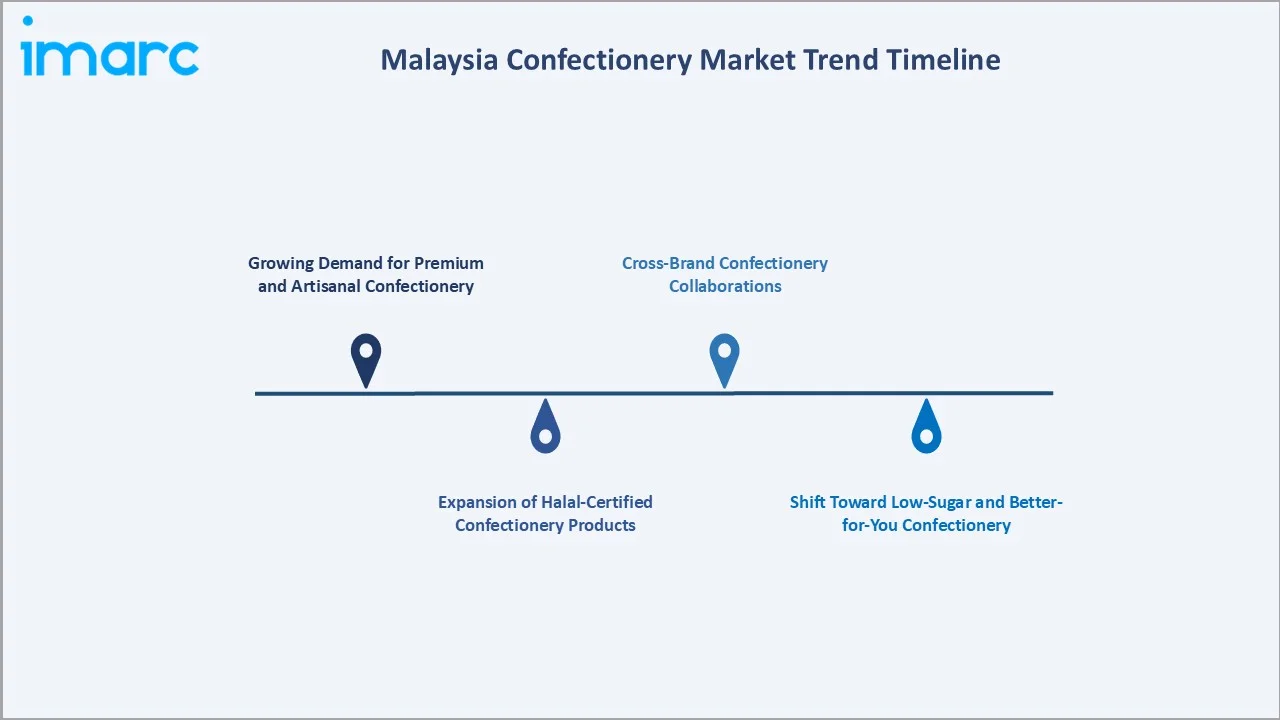
1. Growing Demand for Premium and Artisanal Confectionery
Malaysian consumers are increasingly exploring premium chocolates, artisanal candies, and specialty confectionery with distinctive flavors and high-quality ingredients. Rising disposable incomes and gifting occasions are supporting premiumization. Manufacturers are introducing sophisticated packaging and limited-edition products to strengthen product differentiation. Demand is particularly visible across urban retail and specialty stores. Premium offerings also provide manufacturers with opportunities to achieve higher margins.
2. Expansion of Halal-Certified Confectionery Products
Halal certification is becoming increasingly important for confectionery manufacturers targeting domestic and international Muslim consumers. Companies are strengthening ingredient traceability and halal-compliant production processes. Malaysia’s established halal ecosystem supports the development of products suitable for export markets. Manufacturers are also expanding halal-certified chocolate, candy, and snack portfolios. This trend is strengthening Malaysia’s position as a potential halal confectionery production and export hub.
3. Cross-Brand Confectionery Collaborations
Partnerships between established food brands are emerging as a key trend, enabling manufacturers to combine familiar flavors and textures into differentiated confectionery products. In August 2026, Cadbury and Biscoff collaborated to launch a new confectionery product that combines the smooth, creamy taste of Cadbury milk chocolate with the distinctive crunch and flavor of Biscoff biscuits, bringing together two well-known food brands in a single offering. Such collaborations help generate consumer interest, strengthen brand visibility, and encourage trial through limited-edition and novelty offerings.
4. Shift Toward Low-Sugar and Better-for-You Confectionery
Growing health awareness is encouraging demand for reduced sugar, sugar-free, portion-controlled, and clean-label confectionery. Manufacturers are experimenting with alternative sweeteners and natural ingredients while maintaining traditional taste and texture. Products incorporating nuts, fruits, and functional ingredients are also gaining attention. Clearer nutritional labeling influences product development strategies. This trend is creating opportunities for healthier alternatives within established confectionery categories.
Industry Value Chain Analysis
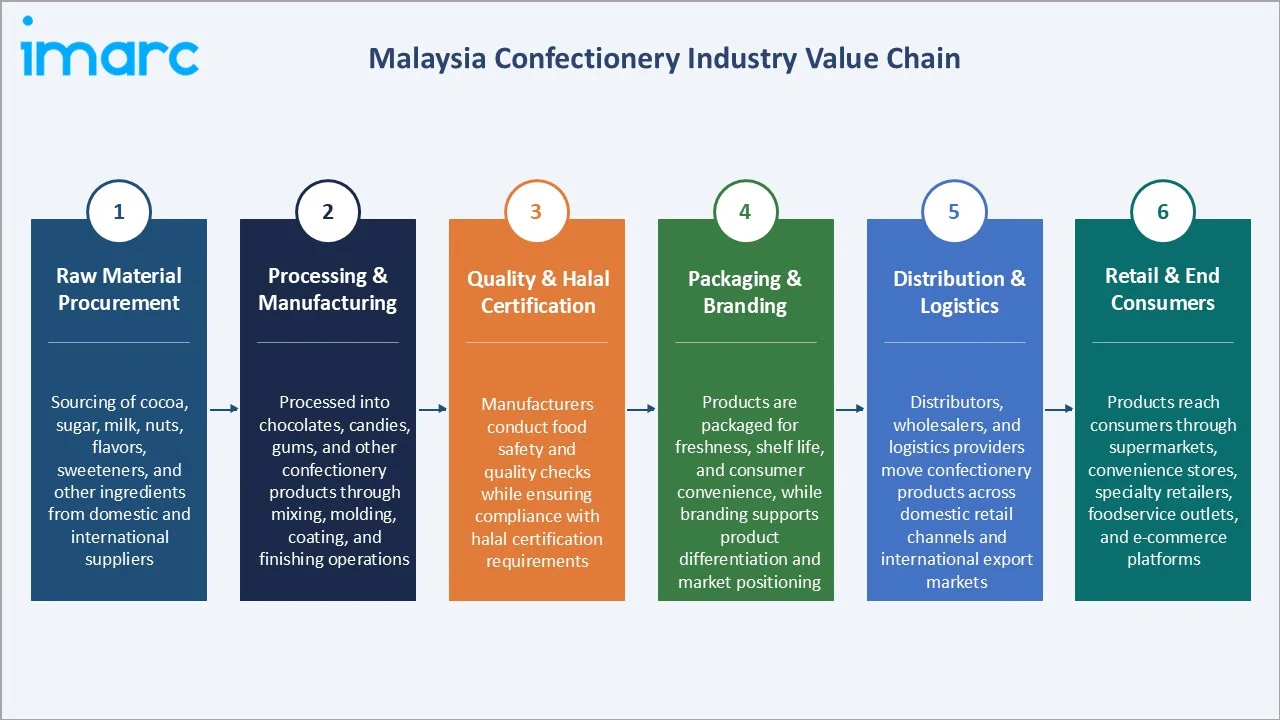
Malaysia confectionery value chain integrates domestic raw material procurement, manufacturing and processing, halal certification compliance, packaging, multi-channel distribution, and consumer retail, with the halal certification requirement creating unique value chain governance requirements at each stage.
|
Stage |
Key Participants & Malaysia Dynamics |
|
Raw Material Procurement |
Sourcing of cocoa, sugar, milk, nuts, flavors, sweeteners, and other ingredients from domestic and international suppliers. |
|
Processing & Manufacturing |
Processed into chocolates, candies, gums, and other confectionery products through mixing, molding, coating, and finishing operations. |
|
Quality & Halal Certification |
Manufacturers conduct food safety and quality checks while ensuring compliance with halal certification requirements. |
|
Packaging & Branding |
Products are packaged for freshness, shelf life, and consumer convenience, while branding supports product differentiation and market positioning. |
|
Distribution & Logistics |
Distributors, wholesalers, and logistics providers move confectionery products across domestic retail channels and international export markets. |
|
Retail & End Consumers |
Products reach consumers through supermarkets, convenience stores, specialty retailers, foodservice outlets, and e-commerce platforms. |
Processing & manufacturing is the most value-added stage, as it transforms basic ingredients such as cocoa, sugar, and milk into differentiated, higher-value confectionery products. Product formulation, flavor innovation, manufacturing technology, and quality control significantly enhance the final product’s commercial value and profitability.
Technology Landscape in the Malaysia Confectionery Industry
Automated Confectionery Processing Technology
Automated mixing, tempering, molding, depositing, coating, and cooling systems are improving production efficiency across confectionery manufacturing. These technologies enable consistent product quality while reducing manual handling and production losses. High-speed processing lines support large-scale chocolate and candy production. Automated controls also improve temperature and ingredient precision. The technology supports higher throughput and greater manufacturing flexibility.
Advanced Chocolate Tempering and Enrobing Technology
Modern tempering systems precisely control heating and cooling to achieve the desired texture, appearance, and stability of chocolate products. Automated enrobing equipment provides uniform chocolate coatings for biscuits, wafers, nuts, and other confectionery. Continuous monitoring helps minimize quality variations. These systems also enable manufacturers to handle multiple product formats. Their adoption supports premium and innovative chocolate production.
Smart Packaging and Modified Atmosphere Technology
Advanced packaging solutions are being used to protect confectionery from moisture, oxygen, heat, and external contamination. High-barrier films, modified atmosphere packaging, and improved sealing technologies help extend product shelf life. Smart labels and QR codes can provide product, ingredient, and traceability information. Packaging automation further improves production speed and consistency. Sustainable packaging innovation is also gaining importance.
Market Segmentation Analysis
The report covers the following segments:
|
Segment Category |
Leading Segment |
Market Share |
Year |
|
Product Type |
🔒 |
🔒 |
2025 |
|
Age Group |
Adult |
56.7% |
2025 |
|
Price Point |
Mid-range |
48.6% |
2025 |
|
Distribution Channel |
🔒 |
🔒 |
2025 |
|
Region |
Selangor |
28.7% |
2025 |

By Age Group
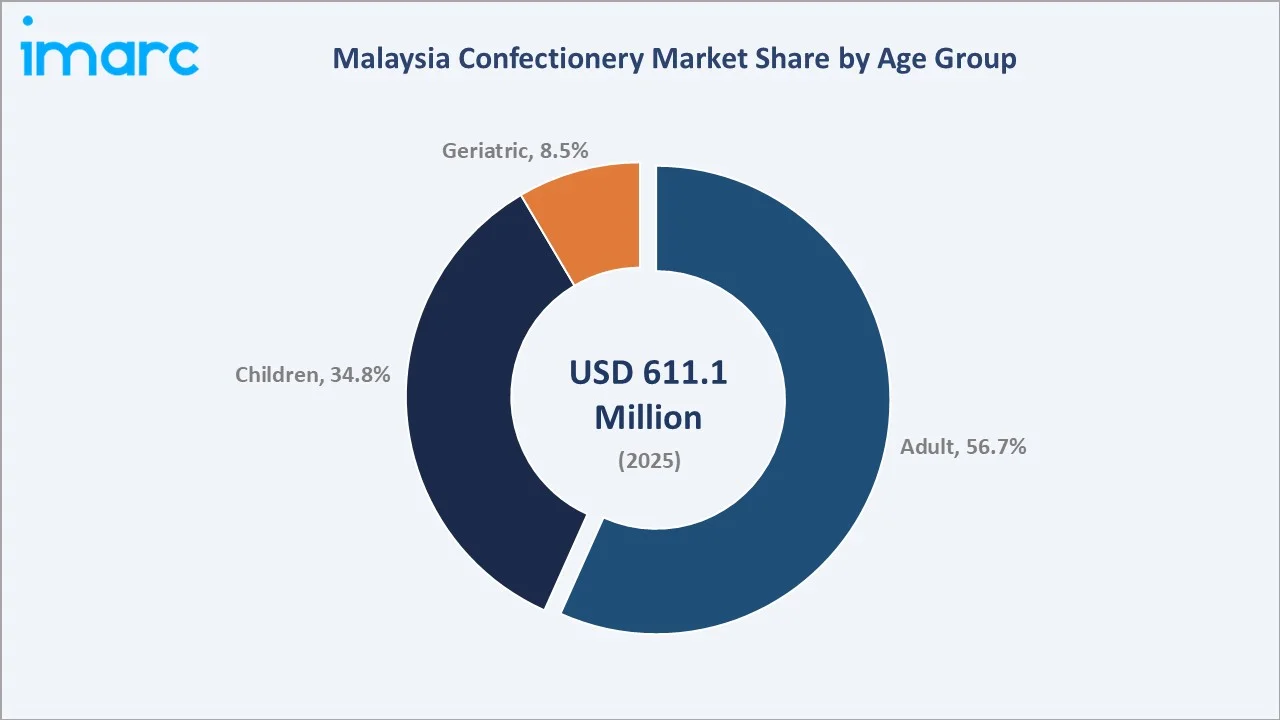
The adult age group leads at 56.7% (2025) through festive gifting occasions, social consumption, and functional candy demand.
To access detailed market analysis, Request Sample
Children at 34.8% drive impulse and novelty confectionery consumption through school canteen and pocket money purchases. Geriatrics at 8.5%, growing at ~3.50% CAGR through medicated and sugar-free confectionery demand from Malaysia’s aging population.
By Price Point
Mid-range leads at 48.6% (2025) as Malaysia’s mainstream commercial confectionery market is served by established international and domestic brands through modern trade.
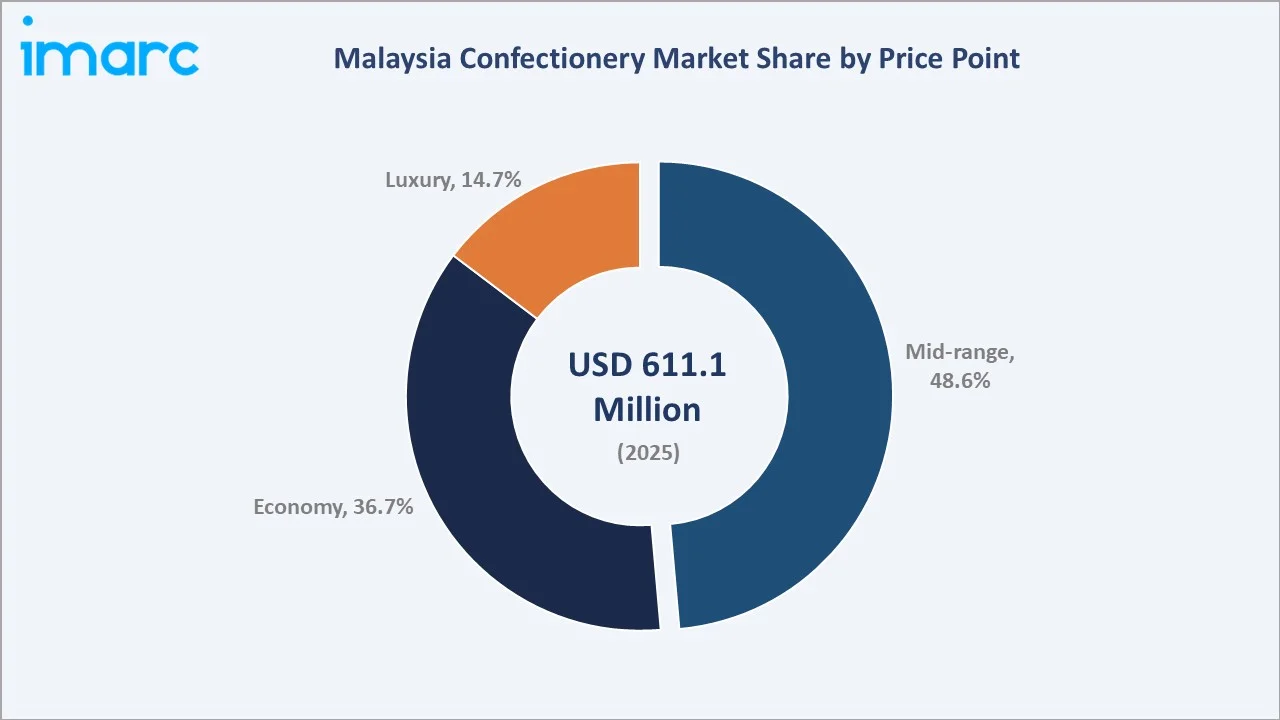
Economy at 36.7% serves the mass-market rural and lower-income urban segment through traditional trade distribution. Luxury at 14.7%, growing fastest at ~4.20% CAGR, through premium tourism gifting, corporate hamper procurement, and artisanal confectionery boutique development.
Regional Market Insights
|
Region |
Share (2025) |
Key Confectionery Market Drivers & Characteristics |
|
Selangor |
28.7% |
Large urban consumer base, strong modern retail network, and high demand for premium and imported confectionery. |
|
W.P. Kuala Lumpur |
23.6% |
High purchasing power, tourism activity, and concentration of supermarkets, malls, and specialty confectionery outlets. |
|
Johor |
18.9% |
Growing urbanization, cross-border trade, and expanding retail and foodservice sectors support confectionery consumption. |
|
Sarawak |
11.7% |
Increasing retail penetration and demand for affordable chocolates, candies, and packaged sweet products drive the market. |
|
Others |
17.1% |
Expanding distribution networks, rising incomes, and improving access to organized retail support confectionery demand. |
Selangor leads with a 28.7% share in 2025, supported by its large urban population, developed retail infrastructure, and strong consumer spending. W.P. Kuala Lumpur accounts for 23.6%, driven by high purchasing power, tourism activity, and widespread availability of premium and imported confectionery products.
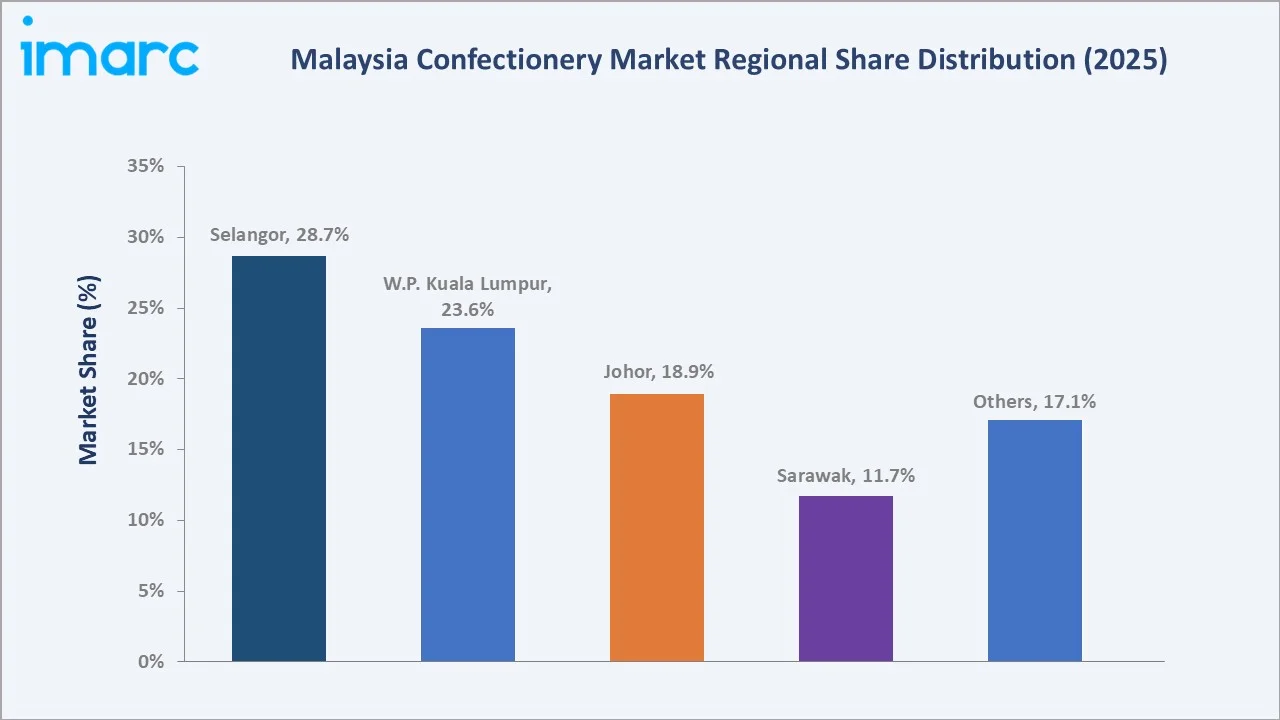
Johor represents 18.9% of the market, benefiting from urban development, cross-border commercial activity, and expanding modern retail. Sarawak holds an 11.7% share, supported by improving retail penetration and demand for packaged chocolates and sugar confectionery. Other regions collectively account for 17.1%, reflecting growing consumption across emerging urban and semi-urban areas.
Competitive Landscape
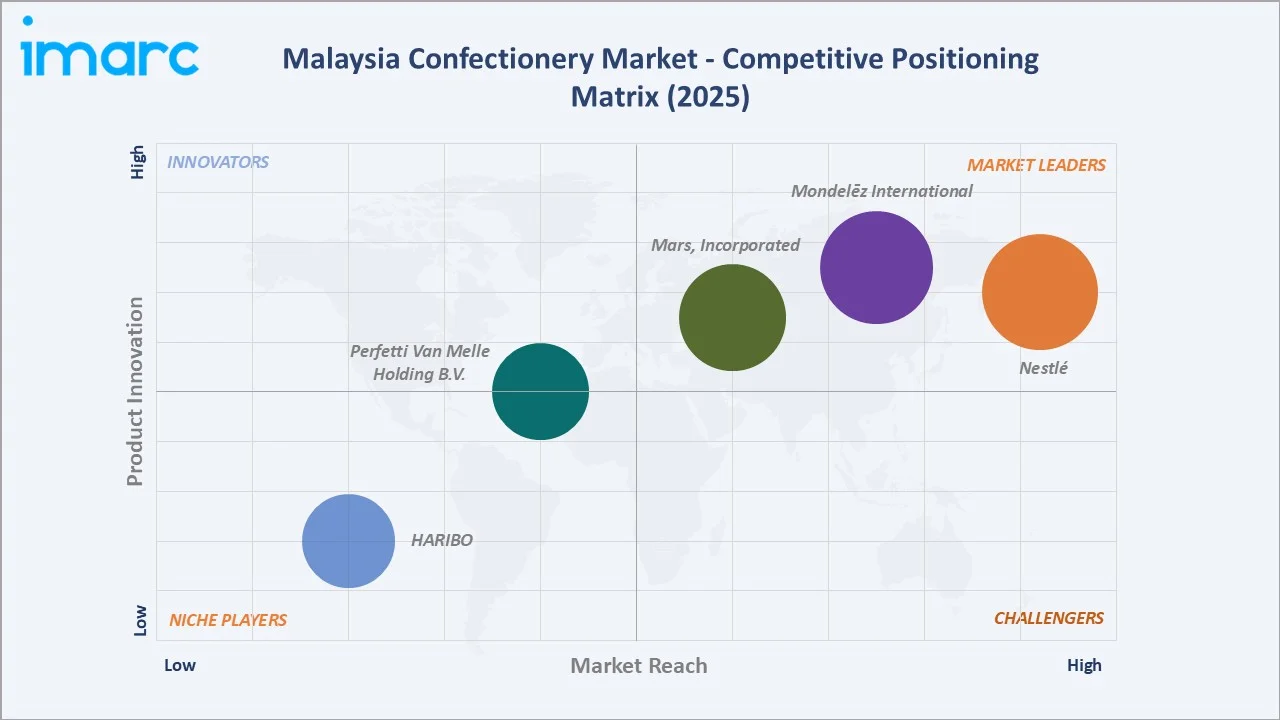
The Malaysia confectionery market is moderately concentrated, comprising multinational confectionery companies alongside established domestic manufacturers and regional brands. Competition centers on product innovation, pricing, halal certification, flavor localization, premiumization, distribution reach, and brand positioning, with companies increasingly expanding through modern retail and e-commerce channels.
|
Company |
Key Brands |
Market Position |
Core Strength |
|
Nestlé |
KitKat, Smarties, Aero, Milkybar |
Market Leader |
Nestlé dominates the Malaysian confectionery market, primarily driven by the massive success of KIT KAT. |
|
Mondelēz International |
5 STAR, CADBURY DAIRY MILK, CADBURY, OREO, TIGER, TRISCUIT, TOBLERONE |
Market Leader |
Mondelēz International is a dominant force in the Malaysian confectionery and snacking market. All domestically produced items are halal-certified by JAKIM. |
|
Mars, Incorporated |
GALAXY, M&M'S, MARS, CELEBRATIONS, BOUNTY, MILKY WAY, TWIX, SNICKERS |
Market Leader |
Mars, Incorporated drive a massive share of the country's sugar and chocolate confectionery market with various brands. |
|
Perfetti Van Melle Holding B.V. |
Chupa Chups, Alpenliebe, Mentos |
Established Player |
Perfetti Van Melle Holding B.V. plays a prominent role in the Malaysian confectionery market, primarily operating as a leading supplier of sugar confectionery. |
|
HARIBO |
HARIBO |
Niche Player |
Haribo plays a major role in the Malaysian confectionery market by acting as the leading premium imported fruit gummy brand. |
Malaysia confectionery competitive landscape is defined by the coexistence of global multinational brands with strong domestically owned manufacturers and a growing premium import confectionery tier serving Malaysia’s increasingly internationally-oriented urban consumer.
Key Company Profiles
Nestlé
Nestlé is a major participant in the Malaysia confectionery market, offering a broad portfolio of chocolate and confectionery products through well-established brands and nationwide distribution. The company benefits from strong brand recognition, extensive retail presence, and localized product offerings suited to Malaysian consumer preferences. Its confectionery operations are supported by modern manufacturing, quality control, and halal compliance capabilities. Nestlé also focuses on product innovation, portion control, and premium offerings to strengthen its position across mass and value-added confectionery segments.
- Key Brands: KitKat, Smarties, Aero, Milkybar.
- Strategic Focus: Strengthening chocolates through continuous product innovation, localization, and strong halal positioning. The company emphasizes locally manufactured, 100% halal-certified confectionery.
Mondelēz International
Mondelēz International is a major participant in the Malaysia confectionery market and operates locally through entities including Mondelēz Malaysia and Cadbury Confectionery Malaysia. Its Malaysian confectionery presence is anchored by Cadbury, with local chocolate manufacturing operations. All brands produced by the company in Malaysia are halal-certified, supporting strong alignment with domestic consumer requirements. The company combines global brand strength, local manufacturing, established distribution, and consumer-focused product development to maintain its presence in Malaysia’s confectionery sector.
- Key Brands: 5 STAR, CADBURY DAIRY MILK, CADBURY, OREO, TIGER, TRISCUIT, TOBLERONE.
- Key Developments: In August 2026, Cadbury and Biscoff joined forces to introduce a new confectionery product that combines the creamy taste of Cadbury milk chocolate with the signature crunch and caramelized flavor of Biscoff biscuits in a single offering.
- Strategic Focus: Strengthening its Cadbury-led confectionery portfolio through consumer-focused innovation, strong retail execution, and halal-certified local production. The company emphasizes adapting products to local preferences while improving manufacturing and supply-chain efficiency through digital capabilities.
Market Concentration Analysis
The Malaysia confectionery market is moderately concentrated, with leading multinational companies maintaining strong positions through established brands and extensive distribution networks. Large players benefit from economies of scale, strong marketing capabilities, broad product portfolios, and prominent retail shelf presence. Domestic manufacturers compete through localized flavors, halal-certified products, premium offerings, and competitive pricing. Brand loyalty and high marketing expenditure create notable entry barriers for smaller companies. However, e-commerce and specialty retail channels are improving market access for emerging and artisanal brands. Overall, competition remains strong, with product innovation, halal compliance, premiumization, and distribution reach serving as major differentiating factors.
Investment & Growth Opportunities
Highest Growth Segments
Luxury price point (~4.20% CAGR) and geriatric age group (~3.50% CAGR) represent Malaysia’s confectionery market’s highest-growth investment vectors through 2034, driven by tourism-linked premium gifting and Malaysia’s aging population, respectively.
Investment Themes
- Halal Functional Confectionery: Investment opportunities are emerging in halal-certified confectionery enriched with functional ingredients such as vitamins, minerals, protein, fiber, and reduced-sugar formulations. Such products can address growing demand for permissible, convenient, and health-oriented snacks in Malaysia and wider halal export markets.
- Premium Chocolate Gifting for Tourism: Malaysia’s expanding tourism sector creates opportunities for investment in premium chocolates positioned as gifts, souvenirs, and travel retail products. Manufacturers can leverage Malaysian cocoa, local flavors, premium packaging, and culturally inspired designs to differentiate offerings for domestic and international tourists.
Future Market Outlook (2026-2034)
The Malaysia confectionery market is projected to grow from USD 611.1 Million in 2025 to USD 786.0 Million by 2034, delivering a steady 2.75% CAGR that reflects the structural characteristics of a mature but diversifying consumer goods market supported by Malaysia’s unique halal export positioning, multicultural festive demand, and progressive premiumization. The anchor value of USD 699.9 Million in 2030 is consistent with the 2020-2025 growth rate and confirms Malaysia’s confectionery market’s structural stability anchored in durable cultural consumption patterns rather than speculative growth trends.
First, Malaysia’s confectionery market’s most unique structural growth driver is the halal certification framework’s role as a global export credential that transforms Malaysia from a pure domestic confectionery market into a halal confectionery production hub. Second, Malaysia’s multicultural festive calendar and gifting culture create a structurally recurring annual confectionery demand cycle that is economically resilient and demographically self-renewing. Third, Malaysia’s food tourism positioning as Southeast Asia’s premier food destination creates a growing premium confectionery purchase channel from the tourism segment that augments traditional retail confectionery demand.
Research Methodology
Primary Research
Primary research comprised in-depth interviews with confectionery company management in Malaysia, hypermarket confectionery buyers, independent confectionery distributors across Malaysia’s five regions, confectionery export advisors, and consumer focus groups capturing multi-ethnic consumer perspectives.
Secondary Research
Secondary research encompassed a comprehensive review of government publications, trade statistics, industry associations, company annual reports, regulatory databases, and credible industry sources related to the Malaysia confectionery market. The research focused on market trends, consumer behavior, halal certification, confectionery trade, competitive developments, pricing trends, and distribution dynamics.
Forecasting Models
Forecasting models were developed using historical Malaysia confectionery market data (2020-2025), Malaysia GDP per capita growth projection, tourism arrivals growth, halal export market growth trajectory for Malaysian confectionery, demographic aging projection, modern trade expansion, and competitive pricing dynamics under cocoa commodity price normalization assumptions.
Malaysia Confectionery Market Report Coverage:
| Report Features | Details |
|---|---|
| Base Year of the Analysis | 2025 |
| Historical Period | 2020-2025 |
| Forecast Period | 2026-2034 |
| Units | Million USD |
| Scope of the Report |
Exploration of Historical Trends and Market Outlook, Industry Catalysts and Challenges, Segment-Wise Historical and Future Market Assessment:
|
| Product Types Covered | Hard-Boiled Sweets, Mints, Gums and Jellies, Chocolate, Caramels and Toffees, Medicated Confectionery, Fine Bakery Wares, Others |
| Age Groups Covered | Children, Adult, Geriatric |
| Price Points Covered | Economy, Mid-Range, Luxury |
| Distribution Channels Covered | Supermarkets and Hypermarkets, Convenience Stores, Pharmaceutical and Drug Stores, Online Stores, Others |
| Regions Covered | Selangor, W.P. Kuala Lumpur, Johor, Sarawak and Others |
| Companies Covered | Nestlé, Mondelēz International, Mars, Incorporated, Perfetti Van Melle Holding B.V., HARIBO, etc. |
| Customization Scope | 10% Free Customization |
| Post-Sale Analyst Support | 10-12 Weeks |
| Delivery Format | PDF and Excel through Email (We can also provide the editable version of the report in PPT/Word format on special request) |
Key Benefits for Stakeholders:
- IMARC’s industry report offers a comprehensive quantitative analysis of various market segments, historical and current market trends, market forecasts, and dynamics of the Malaysia confectionery market from 2020-2034.
- The research report provides the latest information on the market drivers, challenges, and opportunities in the Malaysia confectionery market.
- Porter's five forces analysis assist stakeholders in assessing the impact of new entrants, competitive rivalry, supplier power, buyer power, and the threat of substitution. It helps stakeholders to analyze the level of competition within the Malaysia confectionery industry and its attractiveness.
- Competitive landscape allows stakeholders to understand their competitive environment and provides an insight into the current positions of key players in the market.
Frequently Asked Questions About the Malaysia Confectionery Market Report
The Malaysia confectionery market reached USD 611.1 Million in 2025, driven by post-COVID recovery in Malaysia’s modern trade retail channels, the rebound of international tourism generating premium confectionery gifting and souvenir demand, local flavor limited editions sustaining media engagement and tourist purchases, and the growth of online confectionery commerce.
The market grows at a 2.75% CAGR, reaching USD 786.0 Million by 2034, supported by premiumization, product innovation, halal-certified offerings, and expanding modern retail and e-commerce channels.
Adults lead at 56.7% (2025) through Malaysia’s multicultural festive gifting traditions, Malaysia’s cafe and social dining culture creating adult confectionery pairing occasions, and the functional confectionery category serving adult health management needs.
Mid-range leads at 48.6% (2025) as Malaysia’s mainstream commercial confectionery market is anchored by Cadbury Dairy Milk, Ferrero Rocher standard boxes, KitKat multi-packs, and multi-pack gummy candy served through Malaysia’s extensive hypermarket and supermarket modern trade network.
Selangor leads at 28.7% through Malaysia’s most populous state, combining the Klang Valley metropolitan area’s consumers, concentration of Malaysia’s major confectionery manufacturing, and Malaysia’s highest concentration of modern trade confectionery retail.
Leading companies include Nestlé, Mondelēz International, Mars, Incorporated, Perfetti Van Melle Holding B.V., and HARIBO, among others.
The market is projected to reach USD 699.9 Million by 2030, driven by rising demand for premium and halal-certified products, expanding modern retail and e-commerce channels, tourism growth, and continuous flavor and product innovation.
Top investment opportunities include halal functional confectionery, premium Malaysian confectionery souvenirs for tourism, halal gummy manufacturing for OIC export, reduced-sugar and plant-based confectionery, and e-commerce confectionery subscription and gifting.
Need more help?
- Speak to our experienced analysts for insights on the current market scenarios.
- Include additional segments and countries to customize the report as per your requirement.
- Gain an unparalleled competitive advantage in your domain by understanding how to utilize the report and positively impacting your operations and revenue.
- For further assistance, please connect with our analysts.
 Request Customization
 Speak to an Analyst
 Request Brochure
 Inquire Before Buying
Benefits of Customization
- Personalize this research
- Triangulate with your data
- Get data as per your format and definition
- Gain a deeper dive into a specific application, geography, customer, or competitor
- Any level of personalization
Get in Touch With Us
UNITED STATES
Phone: +1-201-971-6302
INDIA
Phone: +91-120-433-0800
UNITED KINGDOM
Phone: +44-753-714-6104
Email: [email protected]
Client Testimonials




.webp)




.webp)













Related Reports

Choose your plan
*Please note that the prices mentioned below are starting prices for each bundle type. Kindly contact our team for further details.*
Single User License
- 1 User License, Access on 2 Devices
- PDF Report + Excel Dataset (Password Protected)
- Lifetime Access
- No Printing Rights
- 10% Free Report Customization
- 10–12 Weeks of Analyst Support
Five User License
- Access for 5 Users, 2 Devices per User
- PDF Report + Excel Dataset (Password Protected)
- Lifetime Access
- Dedicated Account Manager
- 12–14 Weeks of Analyst Support
- No Printing Rights
- 15% Free Report Customization
- 25% Discount on Your Next Purchase
Corporate User License
- Unlimited User Access (Within Your Organization)
- PDF Report + Excel Dataset
- Lifetime Access
- Dedicated Account Manager
- 14–20 Weeks of Analyst Support
- No Printing Rights
- 20% Free Report Customization
- 30% Discount on Your Next Purchase
Essential Insights
What's included:
3 reports
- Lifetime Access
- PDF Reports
- Excel Datasets
- 2 Weeks of Free Analyst Support
- 2 User Licenses
- Access on 2 Devices
- Printing Rights
- Complimentary PowerPoint (PPT) Version
- Complimentary License Upgrade
Professional Access
What's included:
5 reports
- Lifetime Access
- PDF Reports
- Excel Datasets
- 8 Weeks of Free Analyst Support
- 2 User Licenses
- Access on 2 Devices
- Printing Rights
- Complimentary PowerPoint (PPT) Version
- Complimentary License Upgrade
Business Advantage
What's included:
8 reports
- Lifetime Access
- PDF Reports
- Excel Datasets
- 14 Weeks of Free Analyst Support
- 2 User Licenses
- Access on 2 Devices
- Printing Rights
- Complimentary PowerPoint (PPT) Version
- Complimentary License Upgrade
Enterprise Intelligence
What's included:
10 reports
- Lifetime Access
- PDF Reports
- Excel Datasets
- 20 Weeks of Free Analyst Support
- 2 User Licenses
- Access on 2 Devices
- Printing Rights
- Complimentary PowerPoint (PPT) Version
- Complimentary License Upgrade