
Malaysia Construction Equipment Market Size, Share, Trends and Forecast by Solution Type, Equipment Type, Type, Application, Industry, and States, 2026-2034
Malaysia Construction Equipment Market Summary:
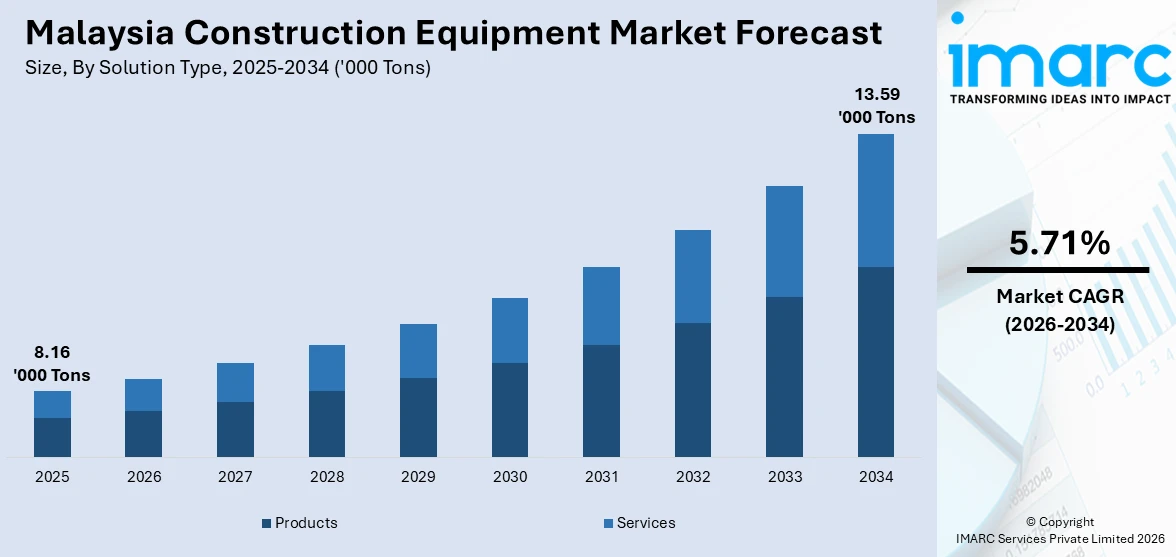
The Malaysia construction equipment market size reached 8.16 Thousand Units in 2025 and is projected to reach 13.59 Thousand Units by 2034, growing at a compound annual growth rate of 5.71% from 2026-2034.
Rapid urbanization, growing industrial activity, and extensive infrastructure upgrade are all driving strong momentum in the Malaysian construction equipment market. Massive government-led projects including digital infrastructure, flood mitigation systems, and transportation networks are generating a steady demand for a variety of construction equipment. Malaysia is becoming a more dynamic and competitive market within the larger Southeast Asian construction landscape as a result of growing foreign direct investment inflows into manufacturing facilities, logistics hubs, and data center campuses.
Key Takeaways and Insights:
- By Solution Type: Products dominate the market with a share of 72.4% in 2025, driven by the continuous procurement of earthmoving, material handling, and road construction machinery to support national infrastructure expansion and industrial development programs.
- By Equipment Type: Heavy construction equipment leads the market with a share of 64.8% in 2025, owing to widespread deployment across mega-scale transportation corridors, high-rise developments, and large-volume earthwork operations requiring superior load capacity and operational efficiency.
- By Type: Excavator dominates the market with a share of 29.6% in 2025, reflecting versatile utilization across earthmoving, trenching, demolition, and material loading activities essential to residential, commercial, and civil engineering construction throughout Malaysia.
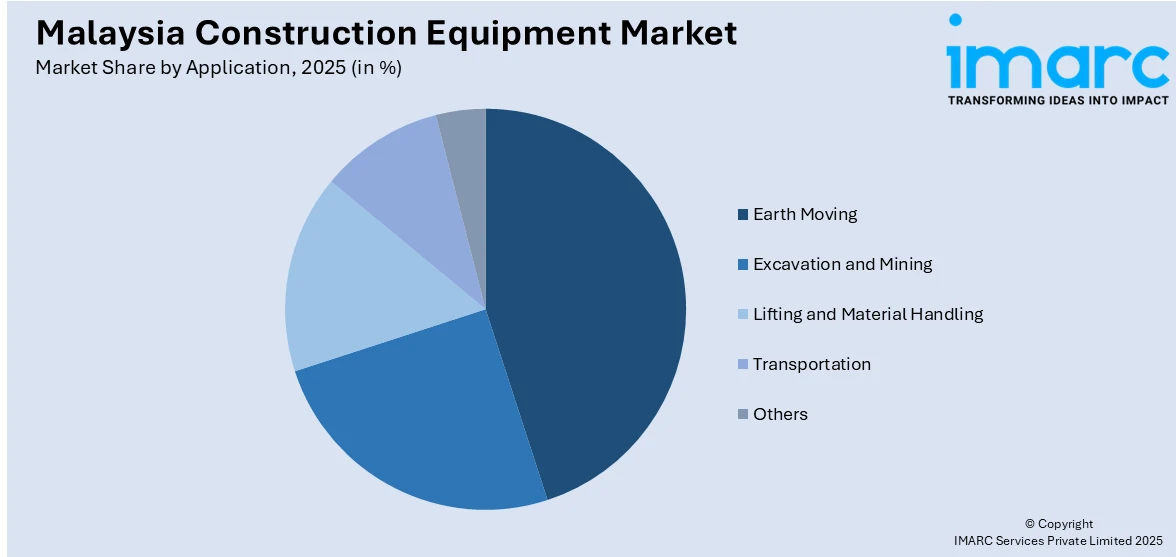
- By Application: Earth moving represents the biggest segment with a market share of 33.7% in 2025, underpinned by extensive land preparation, grading, and excavation requirements for highway construction, urban development, flood mitigation, and industrial site preparation nationwide.
- By Industry: Construction and infrastructure exhibits a clear dominance in the market with 38.5% share in 2025, driven by sustained public expenditure on transportation networks, utility upgrades, and smart city developments alongside expanding private residential and commercial project pipelines.
- By States: Selangor represents the largest state with 27.9% share in 2025, propelled by concentrated construction activities across the Greater Kuala Lumpur corridor, advanced manufacturing clusters, data center campuses, and ongoing transit-oriented residential developments.
- Key Players: In order to improve equipment performance, operational efficiency, and customer satisfaction across a range of construction applications, key players in the Malaysian construction equipment market are diversifying their product portfolios, integrating cutting-edge telematics and automation technologies, fortifying dealer networks, and investing in after-sales support.
To get more information on this market Request Sample
Growing foreign investment, government-led infrastructure projects, and urbanization are all contributing to Malaysia's construction equipment market's steady expansion. Due to the nation's commitment to innovative transportation projects including mass rapid transit systems, rail lines, and interstate highways, there is a continuing need for heavy gear and earthmoving equipment. At the same time, the rapid expansion of data center campuses, particularly in Johor and Selangor, is creating new possibilities for the deployment of construction equipment in site preparation, foundation work, and facility building. The construction of warehouses and logistics parks is being driven by the expansion of the industrial sector under strategic frameworks, which raises the need for material handling equipment. The market's diverse growth trajectory and long-term potential within the Southeast Asian construction equipment market share are further highlighted by investments in smart city projects, port modernization initiatives, and renewable energy infrastructure, all of which are supporting equipment procurement pipelines.
Malaysia Construction Equipment Market Trends:
Rising Adoption of Electric and Hydrogen-Powered Construction Equipment
Malaysia’s commitment to achieving carbon neutrality by 2050 is accelerating the transition toward sustainable construction machinery. Equipment manufacturers are increasingly introducing battery-electric and alternative fuel-powered models to align with green building mandates and environmental regulations. Contractors are actively seeking zero-emission machinery to comply with evolving sustainability standards on urban construction sites. In 2025, HD Hyundai Construction Equipment launched its HW155H hydrogen fuel cell-powered wheeled excavator concept, signaling a broader industry shift toward cleaner operational technologies that reduce emissions while maintaining productivity across Malaysian construction projects.
Surge in Data Center Construction Driving Equipment Demand
With significant investment from international technology companies and hyperscale operators, Malaysia is quickly becoming a regional hub for data centers. Large-scale data center campus building necessitates substantial foundation work, site preparation, and the deployment of heavy gear, which increases equipment demand in several states. Timelines for facility creation are speeding up due to growing cloud computing use, workloads using artificial intelligence, and digital transformation projects. In addition to meeting conventional construction demand, the development of digital infrastructure is generating long-term cycles for the purchase of earthmoving, lifting, and material handling equipment, expanding the equipment market's growth base in the context of the country's changing economic environment.
Integration of Telematics and Digital Twin Technologies in Construction Machinery
Telematics, fleet management systems, and digital twin platforms that provide remote monitoring, predictive maintenance, and operational optimization are becoming increasingly popular in Malaysia's construction equipment sector. By lowering downtime, increasing fuel economy, and prolonging equipment lifecycles, these technologies assist contractors and support the expansion of the Malaysian construction equipment industry. In keeping with the industry's increasing digitalization trajectory, Zoomlion Malaysia launched a three-dimensional digital twin platform specifically designed for the ready-mix concrete sector. This platform allows operators to build digital replicas of concrete plants for real-time monitoring and performance optimization.
Market Outlook 2026-2034:
With a strong industrial expansion and an ambitious infrastructure modernization program, the Malaysian construction equipment market is expected to rise steadily throughout the course of the projected period. Long-term equipment demand throughout the earthmoving, lifting, and road construction categories is still anchored by government mega-projects including the Pan Borneo Highway, East Coast Rail Link, and MRT Circle Line. The market size was estimated at 8.16 Thousand Units in 2025 and is expected to reach 13.59 Thousand Units by 2034, reflecting a compound annual growth rate of 5.71% over the forecast period 2026-2034. While the growing industrial sector is driving demand for material handling gear, growing data center expenditures, renewable energy projects, and smart city efforts are broadening the channels through which equipment is purchased. Additionally, the outlook for the countrywide deployment of compact and heavy construction equipment is strengthened by the private sector's confidence in residential and mixed-use developments along important metropolitan corridors.
Malaysia Construction Equipment Market Report Segmentation:
|
Segment Category |
Leading Segment |
Market Share |
|
Solution Type |
Products |
72.4% |
|
Equipment Type |
Heavy Construction Equipment |
64.8% |
|
Type |
Excavator |
29.6% |
|
Application |
Earth Moving |
33.7% |
|
Industry |
Construction and Infrastructure |
38.5% |
|
States |
Selangor |
27.9% |
Solution Type Insights:
- Products
- Services
Products dominate with a market share of 72.4% of the total Malaysia construction equipment market in 2025.
Products account for the majority of the Malaysia construction equipment market, reflecting sustained capital expenditure on new machinery acquisition across earthmoving, road construction, material handling, and lifting categories. The dominance of physical equipment procurement is driven by ongoing mega infrastructure projects, expanding industrial zones, and accelerating urbanization that necessitate fleet expansion and equipment modernization. The strong demand environment across residential, commercial, and civil engineering construction segments continues to propel new equipment purchases, as contractors prioritize fleet upgrades to meet growing project volumes and increasingly complex operational requirements throughout the nation.
The products segment benefits from growing investments in specialized machinery tailored to diverse construction applications, including compact excavators for urban sites and heavy-duty cranes for elevated infrastructure works. Equipment manufacturers are strengthening dealer networks and after-sales service capabilities to capture rising replacement demand and support fleet lifecycle management. The integration of advanced telematics, fuel-efficient engines, and operator-assist technologies into new product lines is further stimulating procurement as contractors seek to enhance productivity, reduce operational costs, and comply with evolving environmental regulations governing construction equipment operations across Malaysian project sites.
Equipment Type Insights:
- Heavy Construction Equipment
- Compact Construction Equipment
Heavy construction equipment leads with a share of 64.8% of the total Malaysia construction equipment market in 2025.
Heavy construction equipment maintains a commanding presence in the Malaysian market, driven by large-scale infrastructure developments requiring substantial earthmoving, lifting, and material transport capabilities. The deployment of heavy excavators, bulldozers, cranes, and loaders across highway construction, rail corridor development, and port expansion projects sustains consistent demand volumes. The scale and complexity of ongoing national transportation and connectivity projects necessitate continuous heavy machinery deployment, with extensive tunneling, bridge construction, and track-laying operations reinforcing procurement cycles across multiple Malaysian states and diverse geographic terrains throughout the forecast period.
Heavy construction equipment demand is further reinforced by growing mining operations, energy infrastructure projects, and flood mitigation programs requiring high-capacity machinery for excavation and material movement. The segment benefits from established procurement channels maintained by leading global manufacturers who offer comprehensive product portfolios, financing solutions, and localized service support. Growing adoption of hydraulic efficiency improvements, intelligent machine control systems, and real-time performance monitoring technologies is enhancing the operational value proposition of heavy equipment, encouraging fleet renewal and expansion among contractors engaged in Malaysia's pipeline of multi-year civil engineering and transportation infrastructure projects.
Type Insights:
- Loader
- Cranes
- Forklift
- Excavator
- Dozers
- Others
Excavator exhibits a clear dominance with 29.6% share of the total Malaysia construction equipment market in 2025.
Excavators represent the most widely utilized equipment category in Malaysia, deployed extensively across earthmoving, trenching, demolition, foundation work, and material loading applications spanning residential, commercial, and civil engineering projects. Their operational versatility and adaptability to diverse terrain conditions make them indispensable across construction, mining, and infrastructure development activities. The growing scale and complexity of national development programs, including large agricultural estates, industrial facilities, and transportation corridors, continue to drive substantial excavator deployment, reinforcing the segment's position as the backbone of construction equipment fleets operating across the Malaysian construction landscape.
Excavator demand is further sustained by rising investments in housing developments, port expansion programs, and highway modernization initiatives that require continuous digging, grading, and site preparation operations. The growing availability of compact and mini excavators is broadening deployment across space-constrained urban construction sites, complementing the heavy excavator fleet utilized on larger infrastructure projects. Manufacturers are increasingly integrating GPS-guided machine control, auto-idle functions, and enhanced hydraulic systems to improve precision, fuel efficiency, and operator productivity, reinforcing the excavator segment's dominant position within the Malaysia construction equipment market throughout the forecast period.
Application Insights:
To get more information on this market Request Sample
- Excavation and Mining
- Lifting and Material Handling
- Earth Moving
- Transportation
- Others
Earth Moving prevails the market with 33.7% share of the total Malaysia construction equipment market in 2025.
Earth moving activities account for the largest application segment, reflecting the extensive land preparation, grading, excavation, and fill operations required across Malaysia's expanding infrastructure portfolio. Highway construction, urban development, industrial site preparation, and flood mitigation programs generate sustained demand for earthmoving equipment including excavators, bulldozers, wheel loaders, and motor graders. The nation's ongoing commitment to upgrading federal road networks, constructing new transportation corridors, and developing industrial zones ensures a continuous pipeline of earthmoving projects that sustain machinery procurement across national transportation networks and supporting development corridors throughout diverse geographic regions.
The earth moving segment continues to benefit from accelerating construction activity in secondary cities and emerging industrial zones where greenfield site development requires substantial soil excavation, leveling, and compaction operations. Growing investments in data center campus construction, renewable energy installations, and logistics park development are creating additional earthmoving demand beyond traditional infrastructure applications. The adoption of advanced machine control systems, integrated GPS guidance, and automated grading technologies is improving operational efficiency and accuracy in earthmoving operations, enabling contractors to complete land preparation activities faster while reducing material waste and rework across Malaysian construction project sites.
Industry Insights:
- Oil and Gas
- Construction and Infrastructure
- Manufacturing
- Mining
- Others
Construction and infrastructure holds the largest share with 38.5% of the total Malaysia construction equipment market in 2025.
The construction and infrastructure industry drives the highest equipment demand in Malaysia, supported by an extensive pipeline of government-funded mega projects and private sector developments. Transportation corridors, public transit systems, flood defense networks, and urban renewal initiatives collectively generate substantial requirements for diverse construction machinery categories. The robust investment environment, characterized by steadily rising project approvals and expanding foreign and domestic capital inflows, continues to underpin construction activity and consequent equipment procurement across the nation, ensuring a diversified and resilient demand base spanning multiple infrastructure subsectors and geographic regions.
The construction and infrastructure sector benefits from long-duration project timelines that provide stable, multi-year equipment demand visibility for manufacturers and dealers. Ongoing projects such as mass rapid transit developments, interstate highway upgrades, and port modernization programs create layered procurement cycles spanning earthmoving, lifting, road construction, and material handling categories. Growing emphasis on industrialized building systems, prefabricated construction methods, and modular assembly techniques is introducing new equipment requirements, including specialized crane configurations and precision material handling solutions that complement traditional construction machinery deployment across Malaysian infrastructure development programs.
States Insights:
- Selangor
- W.P. Kuala Lumpur
- Johor
- Sarawak
- Others
Selangor represents the leading region with 27.9% share of the total Malaysia construction equipment market in 2025.
Selangor commands the largest share of Malaysia's construction equipment market, driven by concentrated development activities across the Greater Kuala Lumpur metropolitan corridor encompassing Shah Alam, Petaling, and Cyberjaya districts. The state's integrated highway networks, advanced manufacturing clusters, and growing data center ecosystem sustain continuous equipment demand. As the primary hub for construction activity in Malaysia, Selangor benefits from a convergence of public infrastructure investment, private commercial development, and industrial expansion that collectively generate the highest concentration of equipment deployment and procurement volumes nationwide.
Selangor's construction equipment demand is further reinforced by ongoing transit-oriented development around upcoming MRT stations, residential township expansions, and technology park construction catering to multinational semiconductor and electronics firms. The state's mature logistics infrastructure, proximity to Port Klang, and availability of skilled labor attract sustained investment in warehousing, distribution center construction, and industrial facility development. Growing data center campus construction in Cyberjaya and surrounding zones is generating incremental demand for earthmoving, foundation, and heavy lifting equipment, diversifying the equipment procurement landscape beyond traditional residential and commercial construction activities within the state.
Market Dynamics:
Growth Drivers:
Why is the Malaysia Construction Equipment Market Growing?
Government-Led Mega Infrastructure Projects Anchoring Long-Term Equipment Demand
The Malaysian government’s sustained commitment to transformative infrastructure development serves as the primary catalyst for construction equipment market expansion. Multi-billion-dollar transportation projects including the MRT Circle Line, East Coast Rail Link, Pan Borneo Highway, and Johor-Singapore Rapid Transit System create extensive, multi-year demand for heavy earthmoving equipment, cranes, tunnel boring machinery, and road construction apparatus. These projects span multiple states and require continuous procurement of diverse equipment categories throughout their extended construction timelines. The national infrastructure agenda extends beyond transportation, encompassing flood mitigation systems, port modernization programs, and utility network upgrades that collectively broaden the equipment demand base. Public infrastructure investments are further reinforced by strategic frameworks such as the 12th Malaysia Plan and the Construction 4.0 Strategic Plan, which prioritize modernization and digitalization.
Rapid Expansion of Data Center and Digital Infrastructure Construction
Malaysia’s emergence as a premier regional data center hub is creating substantial new demand streams for construction equipment across multiple categories. The construction of large-scale hyperscale and colocation data center campuses requires extensive earthmoving for site preparation, heavy foundation work, structural steel erection, and precision equipment installation, driving procurement of excavators, cranes, loaders, and material handling machinery. Global technology firms and data center operators are investing billions into Malaysian facilities, attracted by competitive land costs, robust connectivity infrastructure, and favorable government incentives including tax holidays and streamlined approvals. Johor and Selangor are leading the data center construction surge, with combined announced capacity exceeding several gigawatts. The digital infrastructure construction boom complements traditional civil engineering demand, providing equipment suppliers with diversified revenue streams and reducing cyclical dependence on conventional construction sectors. The sustained data center investment pipeline ensures ongoing equipment demand across earthmoving, lifting, and specialized construction categories throughout the forecast period.
Expanding Manufacturing Sector and Industrial Park Development
Malaysia’s strategic push to modernize and expand its manufacturing capabilities under the New Industrial Master Plan 2030 is generating significant construction equipment demand through new factory construction, warehouse development, and industrial park establishment. The plan targets establishing 3,000 smart factories by 2030 through Industry 4.0 adoption, necessitating extensive construction activity for greenfield industrial facility development, logistics center construction, and supporting infrastructure establishment across designated economic zones. The electrical and electronics sector, semiconductor manufacturing, and automotive components production are driving facility construction in industrial parks near Penang, Kulai, and Selangor, creating sustained demand for earthmoving, material handling, and compact construction equipment. Rising foreign direct investment inflows, improved supply chain connectivity, and enhanced regulatory frameworks supporting manufacturing expansion collectively sustain the construction equipment market’s growth trajectory, as each new manufacturing facility and logistics hub requires comprehensive site development, structural construction, and supporting infrastructure that drives diverse equipment category demand.

Market Restraints:
Skilled Labor Shortages Constraining Equipment Utilization and Project Timelines
Malaysia’s construction sector faces persistent shortages of skilled equipment operators, maintenance technicians, and site supervisors, constraining the effective deployment and utilization of construction machinery. The gap between labor demand and qualified workforce availability leads to extended project timelines, increased operational costs, and suboptimal equipment productivity. Vocational training programs have yet to keep pace with the rapid expansion of construction activity, particularly in specialized areas such as crane operation, hydraulic system maintenance, and telematics-enabled equipment management. These workforce constraints limit the pace at which new equipment can be productively absorbed into construction operations.
Rising Material Costs and Global Trade Uncertainties Affecting Equipment Affordability
Fluctuations in raw material prices, shipping costs, and currency exchange rates create uncertainty in construction equipment pricing, affecting procurement decisions and budget planning for contractors and developers. Global trade tensions and tariff volatility introduce additional cost pressures on imported machinery components and finished equipment, potentially dampening demand growth. These economic headwinds particularly affect small and medium-sized contractors with limited financial buffers, who may defer equipment purchases or opt for rental alternatives, slowing new machinery sales volumes within the Malaysian market during periods of elevated cost uncertainty.
High Capital Costs of Electric and Advanced Technology Equipment
The transition toward electric, hydrogen-powered, and digitally advanced construction equipment presents significant affordability challenges for Malaysian contractors. Battery-electric excavators and zero-emission machinery carry substantially higher upfront costs compared to conventional diesel-powered equivalents, limiting adoption rates despite long-term operational savings. The limited availability of charging infrastructure at construction sites, combined with concerns regarding battery performance in tropical conditions and extended operating hours, further constrains the pace of electrification. These cost and infrastructure barriers slow the market’s transition toward sustainable construction equipment technologies, particularly among smaller operators.
Competitive Landscape:
The Malaysia construction equipment market features a competitive landscape characterized by the presence of established global manufacturers alongside emerging regional challengers and local distributors. Market leaders maintain dominance through comprehensive product portfolios spanning earthmoving, material handling, road construction, and lifting equipment categories, supported by extensive dealer networks and after-sales service infrastructure. Competition is intensifying as manufacturers invest in advanced telematics, fuel-efficient engines, and operator-assist technologies to differentiate their offerings and capture market share. Strategic partnerships between global equipment manufacturers and local distributors are strengthening market penetration, particularly in underserved regions such as East Malaysia. The growing presence of equipment manufacturers from East Asia, who are transitioning from product exports to localized operations with dedicated subsidiaries and service centers, is reshaping competitive dynamics. Equipment rental and leasing services are expanding, providing alternative access models that complement traditional equipment sales and broaden market participation across diverse contractor segments.
Malaysia Construction Equipment Market Report Coverage:
|
Report Features |
Details |
|
Base Year of the Analysis |
2025 |
|
Historical Period |
2020-2025 |
|
Forecast Period |
2026-2034 |
|
Units |
Thousand Units |
|
Scope of the Report |
Exploration of Historical Trends and Market Outlook, Industry Catalysts and Challenges, Segment-Wise Historical and Future Market Assessment:
|
|
Solution Types Covered |
Products, Services |
|
Equipment Types Covered |
Heavy Construction Equipment, Compact Construction Equipment |
|
Types Covered |
Loader, Cranes, Forklift, Excavator, Dozers, Others |
|
Applications Covered |
Excavation and Mining, Lifting and Material Handling, Earth Moving, Transportation, Others |
|
Industries Covered |
Oil and Gas, Construction and Infrastructure, Manufacturing, Mining, Others |
|
States Covered |
Selangor, W.P. Kuala Lumpur, Johor, Sarawak, Others |
|
Customization Scope |
10% Free Customization |
|
Post-Sale Analyst Support |
10-12 Weeks |
|
Delivery Format |
PDF and Excel through Email (We can also provide the editable version of the report in PPT/Word format on special request) |
Frequently Asked Questions About the Malaysia Construction Equipment Market Report
The Malaysia construction equipment market reached a volume of 8.16 Thousand Units in 2025.
The Malaysia construction equipment market is expected to grow at a compound annual growth rate of 5.71% from 2026-2034 to reach 13.59 Thousand Units by 2034.
Products dominated the market with a share of 72.4%, driven by sustained capital expenditure on machinery acquisition across earthmoving, road construction, material handling, and lifting categories supporting national infrastructure development and industrial expansion.
Key factors driving the Malaysia construction equipment market include government-led mega infrastructure projects, rapid data center expansion, rising foreign direct investment, growing manufacturing activity, urbanization, and increasing adoption of advanced construction technologies.
Major challenges include skilled labor shortages constraining equipment utilization, rising material costs and trade uncertainties affecting equipment affordability, high capital costs of electric and advanced technology equipment, and limited charging infrastructure for zero-emission machinery.
Need more help?
- Speak to our experienced analysts for insights on the current market scenarios.
- Include additional segments and countries to customize the report as per your requirement.
- Gain an unparalleled competitive advantage in your domain by understanding how to utilize the report and positively impacting your operations and revenue.
- For further assistance, please connect with our analysts.
 Request Customization
 Speak to an Analyst
 Request Brochure
 Inquire Before Buying
Benefits of Customization
- Personalize this research
- Triangulate with your data
- Get data as per your format and definition
- Gain a deeper dive into a specific application, geography, customer, or competitor
- Any level of personalization
Get in Touch With Us
UNITED STATES
Phone: +1-201-971-6302
INDIA
Phone: +91-120-433-0800
UNITED KINGDOM
Phone: +44-753-714-6104
Email: [email protected]
Client Testimonials




.webp)




.webp)













Related Reports

Choose your plan
*Please note that the prices mentioned below are starting prices for each bundle type. Kindly contact our team for further details.*
Single User License
- 1 User License, Access on 2 Devices
- PDF Report + Excel Dataset (Password Protected)
- Lifetime Access
- No Printing Rights
- 10% Free Report Customization
- 10–12 Weeks of Analyst Support
Five User License
- Access for 5 Users, 2 Devices per User
- PDF Report + Excel Dataset (Password Protected)
- Lifetime Access
- Dedicated Account Manager
- 12–14 Weeks of Analyst Support
- No Printing Rights
- 15% Free Report Customization
- 25% Discount on Your Next Purchase
Corporate User License
- Unlimited User Access (Within Your Organization)
- PDF Report + Excel Dataset
- Lifetime Access
- Dedicated Account Manager
- 14–20 Weeks of Analyst Support
- No Printing Rights
- 20% Free Report Customization
- 30% Discount on Your Next Purchase
Essential Insights
What's included:
3 reports
- Lifetime Access
- PDF Reports
- Excel Datasets
- 2 Weeks of Free Analyst Support
- 2 User Licenses
- Access on 2 Devices
- Printing Rights
- Complimentary PowerPoint (PPT) Version
- Complimentary License Upgrade
Professional Access
What's included:
5 reports
- Lifetime Access
- PDF Reports
- Excel Datasets
- 8 Weeks of Free Analyst Support
- 2 User Licenses
- Access on 2 Devices
- Printing Rights
- Complimentary PowerPoint (PPT) Version
- Complimentary License Upgrade
Business Advantage
What's included:
8 reports
- Lifetime Access
- PDF Reports
- Excel Datasets
- 14 Weeks of Free Analyst Support
- 2 User Licenses
- Access on 2 Devices
- Printing Rights
- Complimentary PowerPoint (PPT) Version
- Complimentary License Upgrade
Enterprise Intelligence
What's included:
10 reports
- Lifetime Access
- PDF Reports
- Excel Datasets
- 20 Weeks of Free Analyst Support
- 2 User Licenses
- Access on 2 Devices
- Printing Rights
- Complimentary PowerPoint (PPT) Version
- Complimentary License Upgrade