
Malaysia Retail Market Size, Share, Trends and Forecast by Product, Distribution Channel, and States, 2026-2034
Malaysia Retail Market Summary:
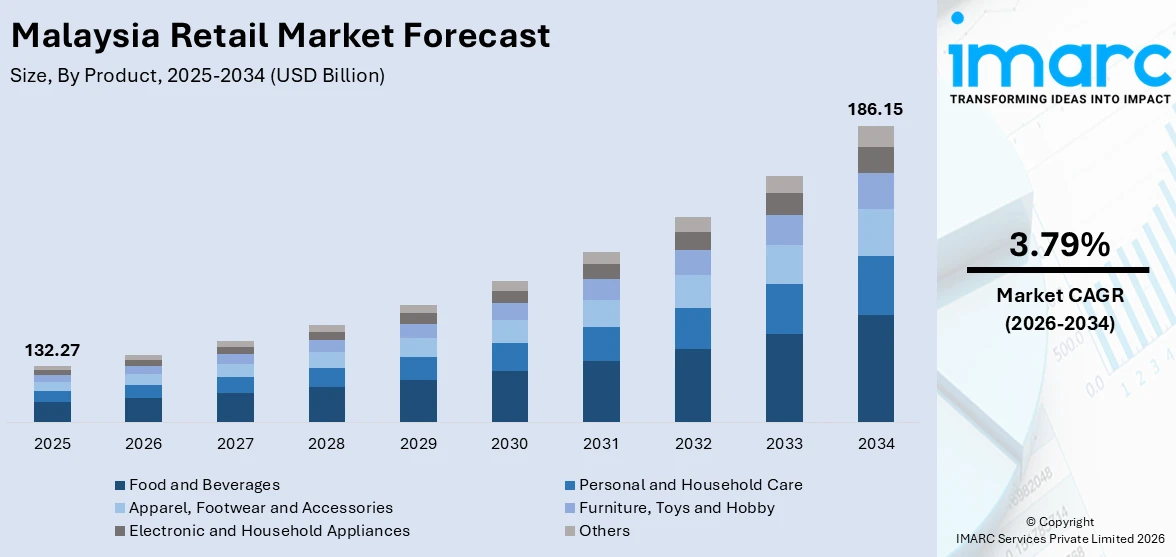
The Malaysia retail market size was valued at USD 132.27 Billion in 2025 and is projected to reach USD 186.15 Billion by 2034, growing at a compound annual growth rate of 3.79% from 2026-2034.
The market is driven by the rising disposable income, urbanization, and the growing middle class, which in turn drive the consumer spending. The digital payment systems and the omnichannel retail approach further boost the growth of the market. The growing health awareness and the demand for halal products shape the product development, whereas the tourism receipts and economic reforms increase the purchasing power. These factors together drive the continuous growth of the Malaysia retail market share.
Key Takeaways and Insights:
- By Product: Food and beverages dominate the market with a share of 41.2% in 2025, driven by the essential nature of everyday grocery consumption, expanding food delivery ecosystems, and growing demand for halal-certified offerings.
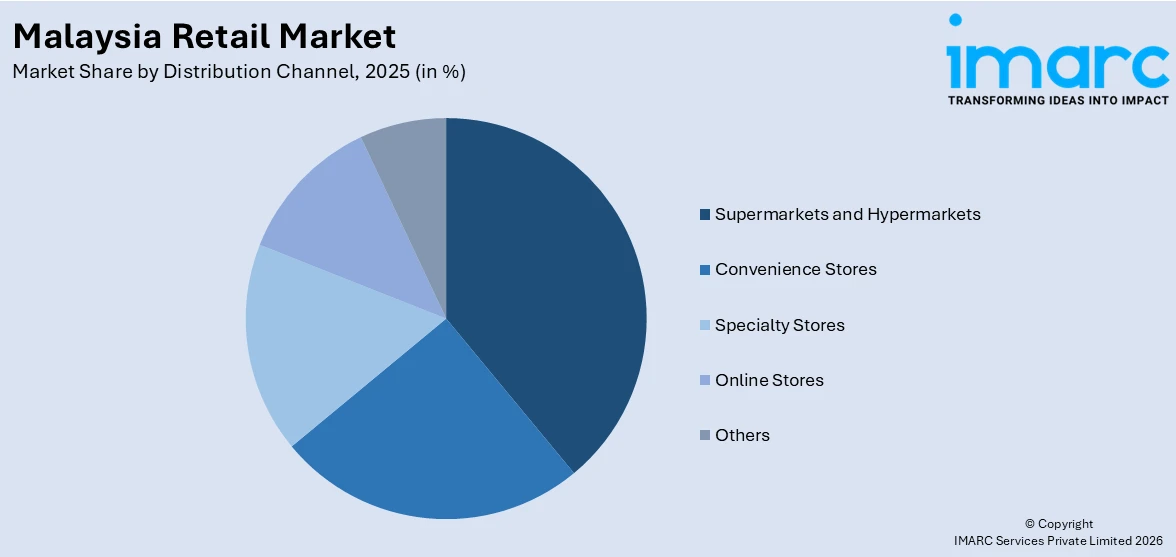
- By Distribution Channel: Supermarkets and hypermarkets lead the market with a share of 38.7% in 2025, owing to their wide product assortment depth, one-stop shopping convenience, and competitive pricing through private-label expansion.
- By States: Selangor represents the market with a share of 24.8% in 2025, driven by concentration of Malaysia's most densely populated urban centres including the Greater Klang Valley and the highest household income levels nationally.
- Key Players: The Malaysia retail market exhibits moderate to high competitive intensity, with multinational retail corporations competing alongside well-established domestic chains across multiple formats and price segments. The landscape also features rapidly expanding e-commerce platforms intensifying competition for consumer attention.
To get more information on this market Request Sample
The Malaysia retail market is propelled by a confluence of structural and cyclical growth factors that collectively shape the consumer landscape. Rising household incomes, bolstered by minimum wage increases and civil-service salary enhancements, have expanded purchasing power across both urban and semi-urban populations. In July 2025, PayNet, Alipay⁺, and Weixin Pay expanded DuitNow QR acceptance to over 2.5 million merchants, boosting cross-border tourist spending and enhancing retailer access to international consumers. Rapid urbanization continues to drive demand for organized retail formats, as a growing share of consumers gravitates toward modern shopping environments offering convenience, variety, and value. The adoption of digital wallets and e-payment services has significantly altered the behavior of transactions, allowing for a seamless cashless experience that enhances engagement in both offline and online retail. Furthermore, the multicultural nature of Malaysia's consumers drives the demand for specialized product categories such as halal products, health and wellness products, and imported premium products.
Malaysia Retail Market Trends:
Omnichannel Integration and Unified Commerce
Malaysian consumers increasingly expect seamless experiences across physical stores, mobile applications, and online platforms. Retailers are responding by integrating their digital and brick-and-mortar operations into unified commerce ecosystems where inventory, pricing, promotions, and customer data flow freely across all touchpoints. According to reports, in August 2025, 52% of Malaysian businesses already offer unified systems integrating online and offline channels, with another 26% planning implementation within 12 months. This convergence enables capabilities such as click-and-collect fulfilment, in-store digital kiosks for extended assortments, and app-based loyalty programmes that personalize offers in real time.
Rise of Experiential Retail and Shoppertainment
Retailers in Malaysia are incorporating experiential features into shopping malls, including indoor adventure zones, pop-up event venues, artisanal food halls, wellness facilities, and interactive brand showrooms to enhance visitor engagement and diversify in-mall experiences. In December 2024, WCT Malls launched ESCAPE Theme Parks and new interactive attractions like a laser‑tag arena and indoor ice‑skating rink at Paradigm Mall Petaling Jaya and Paradigm Mall Johor Bahru, underscoring the shift toward immersive retail‑tainment experiences. This retail-tainment approach responds to shifting shopper expectations, particularly among younger demographics who prioritize experiences over mere product acquisition.
Growing Consumer Focus on Sustainability and Ethical Sourcing
Malaysian consumers are demonstrating increasing awareness and preference for brands and retailers that embed eco-friendly practices and responsible sourcing into their operations. This shift is influencing product assortments across grocery, fashion, and personal care categories, with retailers expanding offerings of sustainably sourced goods, biodegradable packaging, and ethically produced merchandise. In April 2025, Watsons Malaysia launched the Naturals by Watsons Pop‑Up Cafe, an immersive eco‑conscious experience built with recycled materials and refill stations to promote sustainable beauty and reduce plastic waste. Retailers adopt sustainability through energy-efficient stores, reducing food waste with dynamic pricing, and transparently showcasing eco-friendly practices.
Market Outlook 2026-2034:
The Malaysia retail market revenue is expected to grow steadily over the forecast period due to the rising spending power of consumers, urbanization, and overall adoption of digital transformation in the retail sector. The overall growth of the market revenue will be driven by the rising adoption of convenience store chains, modernization of supermarkets and hypermarkets, and the rapidly growing e-commerce platforms. The initiatives of the government to develop the domestic consumption sector, tourism infrastructure, and digital economy development are expected to further catalyze the growth of market revenue over the forecast period. The market generated a revenue of USD 132.27 Billion in 2025 and is projected to reach a revenue of USD 186.15 Billion by 2034, growing at a compound annual growth rate of 3.79% from 2026-2034.
Malaysia Retail Market Report Segmentation:
|
Segment Category |
Leading Segment |
Market Share |
|
Product |
Food and Beverages |
41.2% |
|
Distribution Channel |
Supermarkets and Hypermarkets |
38.7% |
|
States |
Selangor |
24.8% |
Product Insights:
- Food and Beverages
- Personal and Household Care
- Apparel, Footwear and Accessories
- Furniture, Toys and Hobby
- Electronic and Household Appliances
- Others
Food and beverages dominate with a market share of 41.2% of the total Malaysia retail market in 2025.
The food and beverages command the largest share of the Malaysia retail market, reflecting essential grocery consumption. Growth is driven by modern grocery infrastructure, hypermarkets, and supermarkets offering fresh, packaged, halal-certified, organic, and health-focused products, meeting rising consumer wellness awareness and evolving dietary preferences across all income levels. In March 2025, Grab acquired the 19‑store Everrise supermarket chain to bolster its grocery retail footprint and digitise on‑demand grocery delivery services across Malaysia.
The growth trend of this segment is further supported by the quick growth of food delivery services and quick commerce services, which have increased the addressable market beyond the current in-store sales. The offering of premium and specialty foods, such as imported gourmet foods and ready-to-eat meal solutions, is further gaining popularity among the middle-class consumers in urban areas. The use of loyalty programs and personalized promotions in the grocery retail market is also driving repeat business and increasing basket size.
Distribution Channel Insights:
Access the comprehensive market breakdown Request Sample
- Supermarkets and Hypermarkets
- Convenience Stores
- Specialty Stores
- Online Stores
- Others
Supermarkets and hypermarkets lead with a share of 38.7% of the total Malaysia retail market in 2025.
Supermarkets and hypermarkets are the most prominent distribution channel in the Malaysia retail industry, as they provide a wide range of products in categories such as groceries, essentials, clothing, electronics, and personal care. These stores have the advantage of being located in prime locations, with efficient supply chain management, and they also enjoy cost advantages due to economies of scale. The introduction of private labels further enhances their value-for-money offerings.
The retailing industry is experiencing a rapid modernization process with the integration of digital technology such as AI-based demand forecasting, automated inventory management, and comprehensive e-commerce platforms that support click and collect and home delivery. Supermarkets and hypermarkets are distinguishing themselves through well-designed product offerings based on local preferences, in-store dining, and gamified loyalty programs. These efforts leverage data analytics to deliver personalized promotions, drive engagement, boost retention, and optimize efficiency in the rapidly changing retail environment.
States Insights:
- Selangor
- W.P. Kuala Lumpur
- Johor
- Sarawak
- Others
Selangor dominates with a market share of 24.8% of the total Malaysia retail market in 2025.
Selangor leads the Malaysia retail market by state, which is a natural reflection of the fact that it is the most populous and developed state in the country. The state itself comprises the Greater Klang Valley, which is the main commercial and retail hub of Malaysia, where the greatest number of shopping malls, hypermarkets, convenience store chains, and specialty retail outlets are located and where most of the organized retailing is done.
The retail dominance of the state is further complemented by the highest average household incomes in the country, a substantial and growing middle-class population, and superior transportation and logistics infrastructure that facilitates easy supply chain operations. Selangor is also aided by its proximity to Kuala Lumpur and international airports, which attracts substantial tourist spending. The continued development of new residential townships and mixed-use commercial projects further expands the retail catchment area and creates opportunities for growth.
Market Dynamics:
Growth Drivers:
Why is the Malaysia Retail Market Growing?
Rising Disposable Incomes and Expanding Middle-Class Consumer Base
The sustained increase in household disposable incomes across Malaysia serves as a fundamental catalyst for retail market growth. Government-led wage enhancement initiatives, including minimum wage adjustments and public sector salary revisions, have directly bolstered purchasing power for a broad segment of the population. As per sources, Malaysia’s Budget 2025 raised the national minimum wage from RM1,500 to RM1,700 effective February 2025, increasing consumer income and supporting spending capacity. Moreover, the expanding middle class, characterized by higher education levels and aspirational consumption patterns, is driving demand across premium and value retail segments simultaneously.
Accelerating Digital Payment Adoption and E-Commerce Penetration
The proliferation of digital wallets, mobile payment solutions, and cashless transaction systems has brought about a paradigm shift in the consumer purchasing behavior of Malaysia. The ease of transaction offered by e-payment solutions has reduced transaction barriers and made it possible to integrate online and offline retail channels seamlessly. This has led to the development of e-commerce platforms, social commerce, and quick commerce, which have expanded the reach of retailers beyond the boundaries of physical stores. The integration of digital payments with loyalty rewards and instalment payment options has created a cycle of increasing consumer engagement.
Robust Tourism Inflows and Government Economic Reform Initiatives
Malaysia's position as a leading tourism destination in Southeast Asia generates significant incremental retail spending from international visitors, particularly in key commercial centres and lifestyle shopping destinations. According to reports, in January 2025, the government launched the Visit Malaysia 2026 campaign to strengthen tourism and stimulate sectors including retail and hospitality. Moreover, government-led tourism promotion campaigns are designed to attract higher visitor volumes and extend average trip durations, directly benefiting retail sectors including fashion, electronics, and duty-free goods. Broader government economic initiatives aimed at stimulating domestic consumption, supporting small and medium enterprise development, and enhancing digital economy infrastructure create a favourable operating environment that provides a stabilizing foundation for sustained retail market expansion.

Market Restraints:
What Challenges the Malaysia Retail Market is Facing?
Rising Operational Costs and Margin Pressures
Retailers in Malaysia face mounting operational cost pressures stemming from higher electricity tariffs, increased minimum wage requirements, and escalating rental costs in prime commercial locations. These cumulative cost increases erode profit margins, particularly for small and medium-sized retail operators that lack the scale efficiencies enjoyed by larger chains, limiting reinvestment capacity.
Intensifying Competition of Cross-Border E-Commerce
The rising number of cheap imported products via cross-border e-commerce platforms has created a substantial hindrance to local retailers. Foreign vendors, taking advantage of cheaper production costs and competitive pricing, are gradually gaining market share in product segments such as electronics, apparel, and homeware, compelling local retailers to shift focus to service differentiation.
Consumer Confidence Volatility and Economic Uncertainty
Volatility in consumer confidence levels due to global trade tensions, geopolitical instability, and inflationary pressures in the domestic economy has created a constant hindrance to retail market development. As consumer confidence declines, consumers cut back on discretionary spending, focusing instead on essential purchases, resulting in lower foot traffic in non-grocery retail formats and lower average transaction values across lifestyle segments.
Competitive Landscape:
The Malaysia retail market has a moderately concentrated competitive environment with the coexistence of global retail conglomerates, established local chains, and growing online retail players. Large-format retailers lead the hypermarket and supermarket market through their strong store networks, supply chain optimization, and private label offerings catering to budget-conscious consumers. Convenience store chains are rapidly expanding their store footprint in prime sites by using food-service hybrid concepts to capture daily shopping baskets. The online retail market is highly competitive, with online marketplaces using promotional activities and logistics investments to acquire new customers. Specialty retailers differentiate themselves through expert curation and experiential retail formats.
Recent Developments:
- In October 2025, Soch entered Malaysia with three franchise stores in Klang, Johor Bahru, and Kuala Lumpur. Soch partnered with Venturist Sdn. Bhd. to offer their collections according to the tropical climate and culture of Malaysia, while they have also planned to open more stores in the coming years along with e-commerce services.
- In August 2025, U Mobile collaborated with Malaysia Retail Chain Association to speed up the digitalization of the retail industry in Malaysia, aiming at more than 600 brands and 40,000 outlets with 5G payment and smart inventory systems. This collaboration marked the launch of ULTRA5G at Berjaya Times Square in Kuala Lumpur.
Malaysia Retail Market Report Coverage:
|
Report Features |
Details |
|
Base Year of the Analysis |
2025 |
|
Historical Period |
2020-2025 |
|
Forecast Period |
2026-2034 |
|
Units |
Billion USD |
|
Scope of the Report |
Exploration of Historical Trends and Market Outlook, Industry Catalysts and Challenges, Segment-Wise Historical and Future Market Assessment:
|
|
Products Covered |
Food and Beverages, Personal and Household Care, Apparel, Footwear and Accessories, Furniture, Toys and Hobby, Electronic and Household Appliances, Others |
|
Distribution Channels Covered |
Supermarkets and Hypermarkets, Convenience Stores, Specialty Stores, Online Stores, Others |
|
States Covered |
Selangor, W.P. Kuala Lumpur, Johor, Sarawak, Others |
|
Customization Scope |
10% Free Customization |
|
Post-Sale Analyst Support |
10-12 Weeks |
|
Delivery Format |
PDF and Excel through Email (We can also provide the editable version of the report in PPT/Word format on special request) |
Frequently Asked Questions About the Malaysia Retail Market Report
The Malaysia retail market size was valued at USD 132.27 Billion in 2025.
The Malaysia retail market is expected to grow at a compound annual growth rate of 3.79% from 2026-2034 to reach USD 186.15 Billion by 2034.
Food and beverages held the largest Malaysia retail market share, driven by the essential nature of grocery consumption, expanding modern retail infrastructure, rising demand for halal-certified and health-focused products, and the growth of food delivery platforms.
Key factors driving the Malaysia retail market include rising disposable incomes and expanding middle-class population, accelerating digital payment adoption and e-commerce penetration, robust tourism inflows, government economic reform initiatives, and increasing urbanization.
Major challenges include rising operational costs from higher utility tariffs and wage mandates, intensifying competition from cross-border e-commerce platforms offering low-cost imports, consumer confidence volatility driven by global trade tensions, regulatory compliance burdens, and the widening technology gap between large-scale operators and smaller independent retailers.
Need more help?
- Speak to our experienced analysts for insights on the current market scenarios.
- Include additional segments and countries to customize the report as per your requirement.
- Gain an unparalleled competitive advantage in your domain by understanding how to utilize the report and positively impacting your operations and revenue.
- For further assistance, please connect with our analysts.
 Request Customization
 Speak to an Analyst
 Request Brochure
 Inquire Before Buying
Benefits of Customization
- Personalize this research
- Triangulate with your data
- Get data as per your format and definition
- Gain a deeper dive into a specific application, geography, customer, or competitor
- Any level of personalization
Get in Touch With Us
UNITED STATES
Phone: +1-201-971-6302
INDIA
Phone: +91-120-433-0800
UNITED KINGDOM
Phone: +44-753-714-6104
Email: [email protected]
Client Testimonials




.webp)




.webp)













Related Reports

Choose your plan
*Please note that the prices mentioned below are starting prices for each bundle type. Kindly contact our team for further details.*
Single User License
- 1 User License, Access on 2 Devices
- PDF Report + Excel Dataset (Password Protected)
- Lifetime Access
- No Printing Rights
- 10% Free Report Customization
- 10–12 Weeks of Analyst Support
Five User License
- Access for 5 Users, 2 Devices per User
- PDF Report + Excel Dataset (Password Protected)
- Lifetime Access
- Dedicated Account Manager
- 12–14 Weeks of Analyst Support
- No Printing Rights
- 15% Free Report Customization
- 25% Discount on Your Next Purchase
Corporate User License
- Unlimited User Access (Within Your Organization)
- PDF Report + Excel Dataset
- Lifetime Access
- Dedicated Account Manager
- 14–20 Weeks of Analyst Support
- No Printing Rights
- 20% Free Report Customization
- 30% Discount on Your Next Purchase
Essential Insights
What's included:
3 reports
- Lifetime Access
- PDF Reports
- Excel Datasets
- 2 Weeks of Free Analyst Support
- 2 User Licenses
- Access on 2 Devices
- Printing Rights
- Complimentary PowerPoint (PPT) Version
- Complimentary License Upgrade
Professional Access
What's included:
5 reports
- Lifetime Access
- PDF Reports
- Excel Datasets
- 8 Weeks of Free Analyst Support
- 2 User Licenses
- Access on 2 Devices
- Printing Rights
- Complimentary PowerPoint (PPT) Version
- Complimentary License Upgrade
Business Advantage
What's included:
8 reports
- Lifetime Access
- PDF Reports
- Excel Datasets
- 14 Weeks of Free Analyst Support
- 2 User Licenses
- Access on 2 Devices
- Printing Rights
- Complimentary PowerPoint (PPT) Version
- Complimentary License Upgrade
Enterprise Intelligence
What's included:
10 reports
- Lifetime Access
- PDF Reports
- Excel Datasets
- 20 Weeks of Free Analyst Support
- 2 User Licenses
- Access on 2 Devices
- Printing Rights
- Complimentary PowerPoint (PPT) Version
- Complimentary License Upgrade