
Malaysia Smart City Development Market Size, Share, Trends and Forecast by Application Area, Technology, and States, 2026-2034
Malaysia Smart City Development Market Summary:
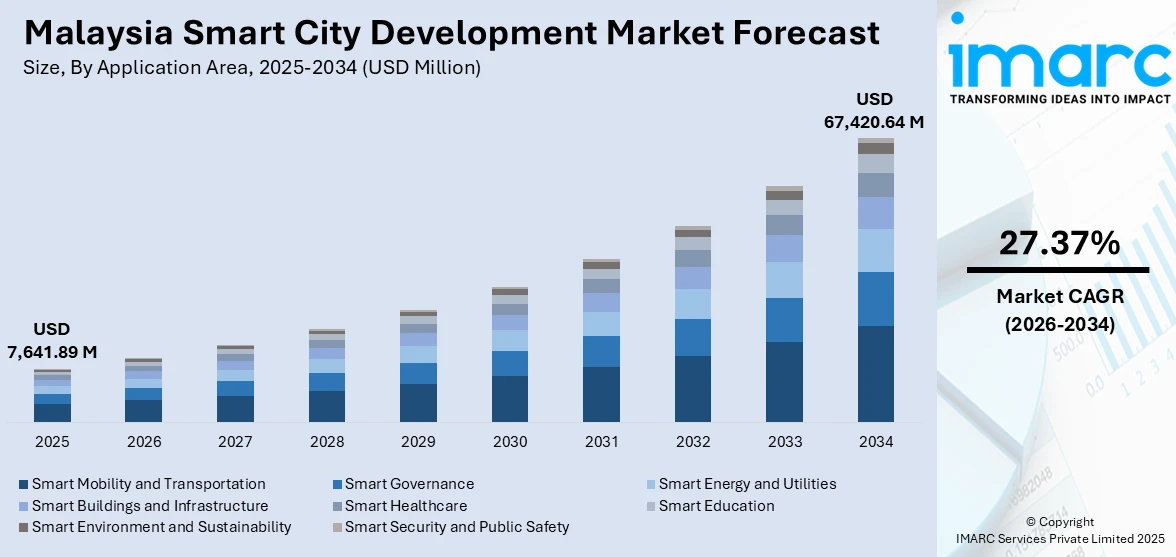
The Malaysia smart city development market size was valued at USD 7,641.89 Million in 2025 and is projected to reach USD 67,420.64 Million by 2034, growing at a compound annual growth rate of 27.37% from 2026-2034.
The Malaysia smart city development market is gaining significant momentum, as the government accelerates digital transformation and urban modernization initiatives across the nation. Supported by the Malaysia Smart City Framework and the Malaysia Digital Economy Blueprint, authorities are integrating advanced technologies into urban planning, transportation, energy management, and public services. Increasing urbanization is driving demand for intelligent infrastructure that improves service delivery, reduces congestion, and enhances environmental sustainability.
Key Takeaways and Insights:
- By Application Area: Smart mobility and transportation dominate the market with a share of 26.8% in 2025, owing to the government’s emphasis on intelligent transport systems, real-time traffic analytics, and integrated public transit networks that address growing urban congestion across major metropolitan areas.
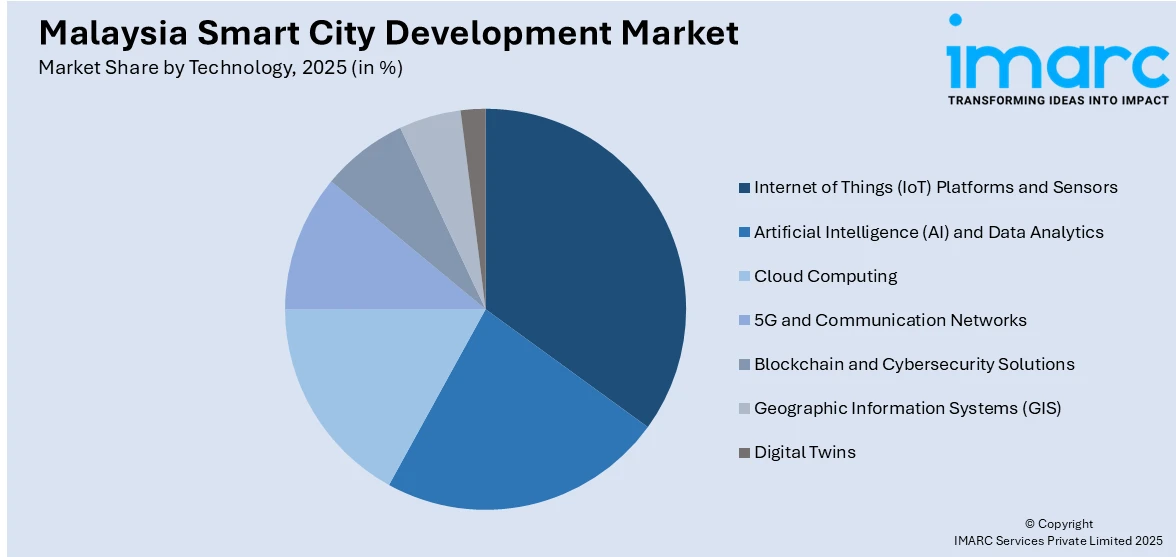
- By Technology: Internet of Things (IoT) platforms and sensors lead the market with a share of 34.6% in 2025, driven by widespread deployment of connected devices for urban monitoring, environmental sensing, and infrastructure management that form the foundational data layer for smart city operations.
- By States: Selangor represents the largest state with 38.2% share in 2025, supported by the concentration of digital infrastructure, data center investments, technology corridors, and the state’s proactive Smart Selangor initiative, positioning it as ASEAN’s digital hub.
- Key Players: Key players drive the Malaysia smart city development market by advancing IoT platforms, expanding cloud infrastructure, deploying artificial intelligence (AI)-powered urban management systems, and forming strategic partnerships with government agencies to accelerate digital transformation and sustainable urban development across the nation.
To get more information on this market Request Sample
The Malaysia smart city development market is poised for strong growth, driven by increasing urbanization, government initiatives, and rising demand for sustainable and technology-driven infrastructure solutions. In 2024, Malaysia's urban population, as a percentage of the total population, was reported at 79.2%, according to the World Bank collection of development indicators. Rapid digital transformation across urban centers, including enhanced IoT integration, AI-enabled traffic management, and smart energy systems, is creating significant investment opportunities for public and private stakeholders. Government policies provide regulatory support and funding incentives, encouraging the adoption of innovative solutions in mobility, public safety, and utilities management. Moreover, heightened awareness about environmental sustainability and efficient resource utilization is prompting cities to implement energy-efficient buildings, smart grids, and waste management technologies, which further boost market potential. Collaborations between technology providers, urban planners, and local authorities are expected to accelerate project execution.
Malaysia Smart City Development Market Trends:
Proliferation of Digital Twin Technology for Urban Planning
Malaysia is increasingly adopting digital twin technology to create virtual replicas of urban environments, enabling data-driven decision-making in city planning and resource management. For instance, in October 2025, the Penang Island City Council (MBPP) introduced its Virtual Island of Penang (VIP) platform, utilizing real-time data, satellite imagery, and AI to enhance urban management. The RM30 million platform represented a digital twin of Penang Island, incorporating real-time systems that could map all structures, roads, and trees. These initiatives are strengthening the market growth through enhanced simulation capabilities and predictive analytics for sustainable urban expansion.
Expansion of AI-Driven Urban Governance Platforms
AI is being embedded into municipal governance systems to optimize public service delivery, resource allocation, and citizen engagement. The Smart City Expo Kuala Lumpur 2025, held in September 2025, gathered over 10,700 participants and 146 speakers addressing AI-driven governance, digital transformation, and citizen-focused innovation. AI-enabled urban governance platforms are improving real-time decision-making across traffic management, waste collection, and public safety systems. Municipalities are increasingly leveraging predictive analytics to anticipate service demand and reduce operational inefficiencies. These advancements are strengthening data-driven planning and accelerating the market growth.
Surge in Hyperscale Data Center Investments Supporting Smart Infrastructure
Malaysia is experiencing unprecedented growth in data center capacity, creating the digital backbone essential for smart city applications. The country attracted over RM86 Billion in data center investments in 2024, establishing Malaysia as Southeast Asia’s leading data center hub. These hyperscale facilities support cloud computing, AI workloads, and real-time data processing required for smart mobility, energy management, and digital public services. As connectivity, latency, and data sovereignty capabilities improve, data centers are becoming a critical enabler of scalable smart city infrastructure across Malaysia.
Market Outlook 2026-2034:
The Malaysia smart city development market is positioned for accelerated expansion, underpinned by sustained government commitment, growing digital infrastructure, and rising demand for intelligent urban solutions. The market generated a revenue of USD 7,641.89 Million in 2025 and is projected to reach a revenue of USD 67,420.64 Million by 2034, growing at a compound annual growth rate of 27.37% from 2026-2034. Nationwide 5G deployment is expected to catalyze coordinated urban innovation. Continued investments in IoT ecosystems, cloud computing, and sustainable urban technologies are poised to drive higher revenue streams and position Malaysia as a regional smart city leader. Additionally, increasing public–private partnerships (PPPs) and pilot smart city projects across transportation, energy, and governance are expected to accelerate commercialization and long-term market scalability.
Malaysia Smart City Development Market Report Segmentation:
|
Segment Category |
Leading Segment |
Market Share |
|
Application Area |
Smart Mobility and Transportation |
26.8% |
|
Technology |
Internet of Things (IoT) Platforms and Sensors |
34.6% |
|
States |
Selangor |
38.2% |
Application Area Insights:
- Smart Governance
- Smart Mobility and Transportation
- Smart Energy and Utilities
- Smart Buildings and Infrastructure
- Smart Healthcare
- Smart Education
- Smart Environment and Sustainability
- Smart Security and Public Safety
Smart mobility and transportation dominate with a share of 26.8% of the total Malaysia smart city development market in 2025.
Smart mobility and transportation lead the Malaysia smart city development market, as the government prioritizes intelligent transport solutions to address escalating urban congestion and improve commuter experiences. The Malaysian Intelligent Transport System Blueprint has laid the groundwork for integrating IoT-enabled traffic monitoring, real-time analytics, and connected vehicle technologies across major corridors. The government allocated RM95 Billion in its 2024 budget for infrastructure development, representing a 12% increase from 2023, with substantial portions directed towards smart transportation systems.
Additionally, PPPs are accelerating the deployment of smart mobility and transportation solutions, with collaborations involving technology providers, telecom operators, and local authorities. Initiatives, such as smart traffic signals, integrated fare payment systems, and mobility-as-a-service (MaaS) platforms, are improving multimodal connectivity across urban centers. The growing adoption of electric vehicles (EVs), supported by charging infrastructure and smart grid integration, further strengthens the smart transportation ecosystem. These developments not only enhance traffic efficiency and safety but also support Malaysia’s broader sustainability goals by reducing emissions and fuel consumption.
Technology Insights:
Access the comprehensive market breakdown Request Sample
- Internet of Things (IoT) Platforms and Sensors
- Artificial Intelligence (AI) and Data Analytics
- Cloud Computing
- 5G and Communication Networks
- Blockchain and Cybersecurity Solutions
- Geographic Information Systems (GIS)
- Digital Twins
Internet of Things (IoT) platforms and sensors lead the market with a revenue share of 34.6% of the total Malaysia smart city development market in 2025.
Internet of Things (IoT) platforms and sensors form the critical data infrastructure enabling smart city applications across Malaysia, ranging from environmental monitoring and waste management to energy optimization and public safety surveillance. These technologies facilitate scalable digital ecosystems that improve urban resilience, departmental interoperability, and smooth data aggregation. Municipalities can increase service reliability, plan infrastructure upgrades effectively, and react to incidents more quickly by utilizing cloud computing, edge analytics, and AI-enabled insights.
The proliferation of connected devices is transforming urban governance by providing real-time insights into city operations and enabling predictive maintenance of critical infrastructure. As of April 2024, Malaysia deployed a total of 7,065 5G sites, creating a robust high-speed backbone for IoT sensor networks. Smart street lighting systems, intelligent parking solutions, and water quality monitoring sensors are being deployed across pilot cities, including Putrajaya, Cyberjaya, and Penang, enabling municipal authorities to optimize resource utilization and enhance citizen services through data-driven decision-making.
States Insights:
- Selangor
- W.P. Kuala Lumpur
- Johor
- Sarawak
- Others
Selangor represents the leading region with a 38.2% share of the total Malaysia smart city development market in 2025.
Selangor leads the smart city development market in Malaysia, due to the presence of digital infrastructure, zones of technological innovation, and state-level digital economy programs. The development of smart transportation systems, smart grid solutions, and digital governance has been encouraged due to the presence of several contributing factors like high-urban density, advanced broadband penetration, and the concentration of numerous business and industrial hubs. The development of smart cities has been given a boost due to state-level incentives for digital transformation and innovation-driven investments.
Moreover, the region has access to a well-skilled workforce, supportive startup ecosystem, and synergies between universities, technology sectors, and municipal bodies. This promotes ongoing innovation in smart city initiatives. Initiatives in smart surveillance systems, optimized traffic systems, digital public services, and command centers are being rolled out across districts in populated cities within Selangor. Supportive regulatory environment and funding initiatives facilitate smart city projects that incorporate innovations like AI, big data analytics, and automation technologies, in pursuit of enhanced operational efficiency within growing cities.

Market Dynamics:
Growth Drivers:
Why is the Malaysia Smart City Development Market Growing?
Strong Government Policy Frameworks and Strategic Investment
Strategic investments and effective policy frameworks constitute key drivers of the Malaysia smart city development market growth. An effective policy ensures proper and effective implementation of relevant plans and programs by ensuring they are aligned with the country’s development plans and goals. The implementation of IoT, AI, and smart mobility solutions is ensured through strategic investments, which boost infrastructure, service, and technology development. The government allocated RM15.1 Million to the Housing and Local Government Ministry in Budget 2025 for smart city development, which indicates the government’s commitment to supporting smart city development, enabling citizen-centric solutions, data-driven municipal services, and experimental approaches. Moreover, incentives provided to support PPPs facilitate the effective implementation of smart city development, and federal and state initiatives aligned with smart cities expansion efforts improve the resilience and competitiveness of cities in Malaysia.
Rapid 5G Deployment and Digital Infrastructure Expansion
The nationwide rollout of 5G infrastructure is establishing the high-speed, low-latency connectivity backbone essential for real-time smart city applications, including autonomous transport, traffic management, remote healthcare, and environmental monitoring. Growing digital investments are fueling the expansion of urban technology ecosystems, attracting both domestic and international players to develop cloud, AI, and data center infrastructure in Malaysia. This robust digital foundation enables municipalities to implement connected sensors, intelligent transportation systems, and AI-powered governance platforms at scale, improving service delivery and urban management. The development of smart grids, integrated public services, and predictive maintenance systems is enhancing operational efficiency and citizen experience. With strategic support from government policies and private sector participation, Malaysia’s digital infrastructure is accelerating the transformation of cities into intelligent, data-driven urban environments capable of supporting sustainable growth and innovative, technology-enabled solutions across multiple sectors.
Focus on Sustainability and Energy Efficiency
Sustainability initiatives and energy efficiency programs are increasingly fueling the growth of the Malaysia smart city development market. Municipalities are deploying smart grids, intelligent lighting, and energy management systems to optimize resource consumption and reduce carbon emissions. IoT sensors and data analytics enable monitoring of water usage, waste management, and air quality, supporting environmentally conscious decision-making. Integrating renewable energy sources with smart infrastructure further strengthens resilience and reduces operational costs. Government incentives for green building and energy-efficient technologies encourage private sector participation, while public awareness campaigns drive adoption of sustainable practices among citizens. By embedding sustainability into smart city planning, Malaysia is not only addressing environmental challenges but also creating cost-effective, resilient, and eco-friendly urban ecosystems that enhance quality of life and support long-term economic growth.
Market Restraints:
What Challenges the Malaysia Smart City Development Market is Facing?
Cybersecurity Vulnerabilities in Interconnected Urban Systems
The increasing integration of IoT devices, sensors, and digital platforms into urban infrastructure creates an expansive attack surface that exposes smart city ecosystems to cybersecurity threats. The vast volume of diverse data generated by interconnected systems creates opportunities for malicious activities, including data theft, ransomware attacks, and device hijacking. Reliance on outdated legacy systems and insufficient interoperability standards between different technology vendors continues to pose significant risks to the integrity and resilience of smart city operations.
Persistent Digital Divide Between Urban and Rural Areas
Despite high overall internet penetration, a significant digital divide persists between urban and rural communities in Malaysia, limiting the equitable distribution of smart city benefits. This gap in connectivity and digital literacy creates challenges for nationwide smart city implementation and risks exacerbating socioeconomic disparities between well-connected urban centers and underserved regions. Unequal connectivity and limited digital skills in rural regions pose a key obstacle to nationwide smart city adoption.
High Implementation Costs and Skilled Workforce Shortages
The substantial capital investment required to deploy intelligent transport systems, advanced communication infrastructure, IoT networks, and AI-powered platforms presents financial constraints, particularly for smaller municipalities and local authorities with limited budgets. Additionally, Malaysia faces a shortage of skilled professionals in areas, such as cloud security, AI engineering, and data analytics. This talent gap pushes up project costs, extends implementation timelines, and forces reliance on foreign expertise, creating a drag on the pace and scale of smart city deployments across the country.
Competitive Landscape:
The Malaysia smart city development market is characterized by a dynamic, competitive environment where global technology providers, regional system integrators, and local solution developers are collaborating to deliver comprehensive urban digitalization solutions. Companies are focusing on expanding IoT platforms, strengthening cloud infrastructure, and developing AI-powered analytics tools tailored to Malaysian municipal requirements. Strategic partnerships between the public and private sectors are accelerating innovation, with technology firms working closely with government agencies to co-develop pilot projects and scalable solutions. Competition is further intensified by multinational hyperscalers establishing cloud regions and data center campuses in Malaysia, while domestic firms are leveraging local expertise and regulatory familiarity to capture value in specialized verticals, such as smart governance, environmental monitoring, and public safety systems.
Recent Developments:
- In June 2025, Prime Minister Datuk Seri Anwar Ibrahim launched the Kota MADANI smart city project in Putrajaya’s Precinct 19, a RM4 Billion public-private partnership developed by Putrajaya Holdings. The development would feature 10,000 residential units for over 30,000 residents, integrating AI, smart digital infrastructure, green mobility systems, vertical schools, and automated waste disposal to serve as a national model for sustainable urban development.
Malaysia Smart City Development Market Report Coverage:
|
Report Features |
Details |
|
Base Year of the Analysis |
2025 |
|
Historical Period |
2020-2025 |
|
Forecast Period |
2026-2034 |
|
Units |
Million USD |
|
Scope of the Report |
Exploration of Historical Trends and Market Outlook, Industry Catalysts and Challenges, Segment-Wise Historical and Future Market Assessment:
|
|
Application Areas Covered |
Smart Governance, Smart Mobility and Transportation, Smart Energy and Utilities, Smart Buildings and Infrastructure, Smart Healthcare, Smart Education, Smart Environment and Sustainability, Smart Security and Public Safety |
|
Technologies Covered |
Internet of Things (IoT) Platforms and Sensors, Artificial Intelligence (AI) and Data Analytics, Cloud Computing, 5G and Communication Networks, Blockchain and Cybersecurity Solutions, Geographic Information Systems (GIS), Digital Twins |
|
States Covered |
Selangor, W.P. Kuala Lumpur, Johor, Sarawak, Others |
|
Customization Scope |
10% Free Customization |
|
Post-Sale Analyst Support |
10-12 Weeks |
|
Delivery Format |
PDF and Excel through Email (We can also provide the editable version of the report in PPT/Word format on special request) |
Frequently Asked Questions About the Malaysia Smart City Development Market Report
The Malaysia smart city development market size was valued at USD 7,641.89 Million in 2025.
The Malaysia smart city development market is expected to grow at a compound annual growth rate of 27.37% from 2026-2034 to reach USD 67,420.64 Million by 2034.
Smart mobility and transportation dominated the market with a share of 26.8%, driven by intelligent transport system investments, real-time traffic analytics deployment, connected public transit networks, and government-led urban mobility modernization programs across major Malaysian cities.
Key factors driving the Malaysia smart city development market include strong government policy frameworks, rapid 5G infrastructure deployment, accelerating urbanization, growing digital investment inflows, and rising demand for sustainable and intelligent urban management solutions.
Major challenges include cybersecurity vulnerabilities in interconnected urban systems, persistent digital divide between urban and rural areas, high implementation costs, skilled workforce shortages, and interoperability issues between diverse technology platforms and legacy municipal systems.
Need more help?
- Speak to our experienced analysts for insights on the current market scenarios.
- Include additional segments and countries to customize the report as per your requirement.
- Gain an unparalleled competitive advantage in your domain by understanding how to utilize the report and positively impacting your operations and revenue.
- For further assistance, please connect with our analysts.
 Request Customization
 Speak to an Analyst
 Request Brochure
 Inquire Before Buying
Benefits of Customization
- Personalize this research
- Triangulate with your data
- Get data as per your format and definition
- Gain a deeper dive into a specific application, geography, customer, or competitor
- Any level of personalization
Get in Touch With Us
UNITED STATES
Phone: +1-201-971-6302
INDIA
Phone: +91-120-433-0800
UNITED KINGDOM
Phone: +44-753-714-6104
Email: [email protected]
Client Testimonials




.webp)




.webp)













Related Reports

Choose your plan
*Please note that the prices mentioned below are starting prices for each bundle type. Kindly contact our team for further details.*
Single User License
- 1 User License, Access on 2 Devices
- PDF Report + Excel Dataset (Password Protected)
- Lifetime Access
- No Printing Rights
- 10% Free Report Customization
- 10–12 Weeks of Analyst Support
Five User License
- Access for 5 Users, 2 Devices per User
- PDF Report + Excel Dataset (Password Protected)
- Lifetime Access
- Dedicated Account Manager
- 12–14 Weeks of Analyst Support
- No Printing Rights
- 15% Free Report Customization
- 25% Discount on Your Next Purchase
Corporate User License
- Unlimited User Access (Within Your Organization)
- PDF Report + Excel Dataset
- Lifetime Access
- Dedicated Account Manager
- 14–20 Weeks of Analyst Support
- No Printing Rights
- 20% Free Report Customization
- 30% Discount on Your Next Purchase
Essential Insights
What's included:
3 reports
- Lifetime Access
- PDF Reports
- Excel Datasets
- 2 Weeks of Free Analyst Support
- 2 User Licenses
- Access on 2 Devices
- Printing Rights
- Complimentary PowerPoint (PPT) Version
- Complimentary License Upgrade
Professional Access
What's included:
5 reports
- Lifetime Access
- PDF Reports
- Excel Datasets
- 8 Weeks of Free Analyst Support
- 2 User Licenses
- Access on 2 Devices
- Printing Rights
- Complimentary PowerPoint (PPT) Version
- Complimentary License Upgrade
Business Advantage
What's included:
8 reports
- Lifetime Access
- PDF Reports
- Excel Datasets
- 14 Weeks of Free Analyst Support
- 2 User Licenses
- Access on 2 Devices
- Printing Rights
- Complimentary PowerPoint (PPT) Version
- Complimentary License Upgrade
Enterprise Intelligence
What's included:
10 reports
- Lifetime Access
- PDF Reports
- Excel Datasets
- 20 Weeks of Free Analyst Support
- 2 User Licenses
- Access on 2 Devices
- Printing Rights
- Complimentary PowerPoint (PPT) Version
- Complimentary License Upgrade