
Malaysia Travel and Hospitality Market Size, Share, Trends and Forecast by Tourism Type, Hospitality Type, Price Tier, Distribution Channel, and State, 2026-2034
Malaysia Travel and Hospitality Market Summary:
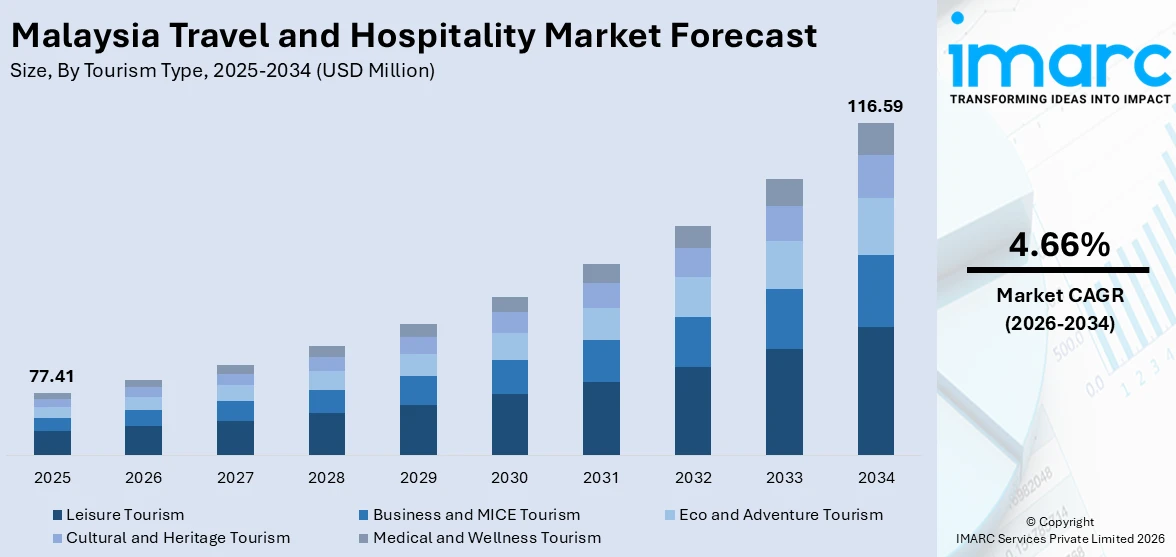
The Malaysia travel and hospitality market size was valued at USD 77.41 Million in 2025 and is projected to reach USD 116.59 Million by 2034, growing at a compound annual growth rate of 4.66% from 2026-2034.
The Malaysia travel and hospitality market appears to be rising at a robust pace as the country aims to further consolidate its stand as a leading tourism hub within Southeast Asia through concerted and inclusive tourism drives, widening international air route access, and widening diversity within the tourism experience. The widening arrival base from traditional source markets, widening domestic traveller demand, and rising interest in experience and wellness-focused tourism seem to be widening the revenue inflow base, while advancements in digital booking systems, rising investment in hospitality infrastructure, and widening scope for eco-cultural tourism seem to be reshaping the competitiveness for market share within the Malaysia travel and hospitality market.
Key Takeaways and Insights:
-
By Tourism Type: Leisure tourism dominates the market with a share of 58.4% in 2025, driven by Malaysia's rich cultural diversity, pristine beaches, tropical rainforests, and world-renowned culinary heritage that continue to attract a broad spectrum of regional and international visitors seeking immersive travel experiences.
-
By Hospitality Type: Hotels and resorts hold the largest market share at 46.7% in 2025, supported by a well-established network of international and domestic hospitality brands offering diverse accommodation options spanning urban business hotels, beachfront resorts, and heritage properties across key tourism destinations.
-
By Price Tier: Mid-scale leads the market with a share of 44.2% in 2025, reflecting strong demand from value-conscious travelers who seek quality accommodations with modern amenities at competitive price points, particularly among regional tourists and the growing domestic travel segment.
-
By Distribution Channel: Online travel agencies (OTAs) account for the largest share of 52.6% in 2025, underscoring the widespread digital adoption among travelers who increasingly rely on aggregated platforms for seamless booking, price comparison, and access to curated travel packages across Malaysia's diverse hospitality landscape.
-
By State: Selangor leads the market with a share of 31.5% in 2025, driven by its strategic proximity to Kuala Lumpur, well-developed transportation infrastructure, concentration of theme parks and shopping destinations, and the presence of a robust business travel ecosystem that supports year-round visitor flows.
-
Key Players: The Malaysia travel and hospitality market exhibits strong competitive intensity, with established international hotel chains competing alongside domestic hospitality groups, boutique operators, and online travel platforms across diverse accommodation segments and price tiers.
To get more information on this market Request Sample
The Malaysian travel and hospitality market is developing dynamically with the increasing need to position itself on the global tourism map as a pre-eminent tourism hub in Southeast Asia. Several promotional campaigns by the government to boost tourism, along with the relaxation of visa norms, have led to an increase in the overall international tourist inflow into the country and reinforced the global tourism profile too. In May 2025, Tourism Malaysia entered into a strategic collaboration with Agoda, a major digital travel platform, to co‑develop targeted digital campaigns aimed at showcasing Malaysia’s diverse attractions and experiences to a global audience in support of Visit Malaysia 2026. The diverse cultural quotient of the country, consisting of international influences such as Malay, Chinese, and Indian cultures, combined with those of the aboriginal population, indeed presents a unique tourism proposition with the presence of areas with historical significance and globally renowned culinary delights.
Malaysia Travel and Hospitality Market Trends:
Rising Demand for Experiential and Cultural Tourism
Malaysia is seeing a remarkable shift towards experiential tourism, which helps tourists experience the authentic culture of the region instead of enjoying the regular tourist attractions and delights. Heritage sites, traditional crafts, culinary trails, and homestays are experiencing significant growth, particularly among both domestic and international tourists. For example, the Malaysian homestay programme, a key experiential tourism product, saw tourist participation nearly double between 2019 and 2023, underscoring strong post‑pandemic interest in immersive cultural stays. The rich ethnic diversity, cultural events, and festivals, as well as living heritage, help Malaysia carve out a niche position with respect to offering highly personalized tourist experiences, which fit well with the current traveler profile, thus creating opportunities for the Malaysia travel and hospitality industry.
Accelerating Digital Transformation Across Travel Ecosystems
Digital adoption within Malaysia's travel and hospitality sector is intensifying, with hotels, airlines, and tourism operators increasingly leveraging artificial intelligence, mobile platforms, and data analytics to enhance guest experiences and operational efficiency. Smart tourism technologies, including contactless check-ins, AI-powered concierge services, and personalized recommendation engines, are transforming how travelers discover, book, and navigate destinations. For instance, the national carrier Malaysian airlines has strengthened its digital transformation efforts through an expanded strategic commercial partnership with Google to integrate AI and data‑driven innovation into marketing and customer engagement, reinforcing digital service delivery across the travel experience. The proliferation of online travel agency platforms and direct digital booking channels is reshaping distribution dynamics, enabling broader global visibility while empowering hospitality providers to optimize revenue management strategies.
Growing Emphasis on Sustainable and Eco-Conscious Travel
Sustainability is emerging as a defining theme across Malaysia's travel and hospitality landscape, with both operators and travelers placing greater emphasis on environmentally responsible practices. Eco-tourism destinations in Sabah, Sarawak, and island retreats are adopting green certifications, renewable energy solutions, and wildlife conservation programs to align with global environmental standards. For example, Ascott Malaysia became the first hotel chain in the country to receive Global Sustainable Tourism Council (GSTC) certification across all 14 of its operating properties in 2024, underscoring a strengthened commitment to environmental stewardship and operational sustainability. Hospitality providers are integrating sustainable design principles, waste reduction initiatives, and community-centered tourism models that benefit local populations while preserving natural ecosystems, reflecting a broader market transition toward responsible and regenerative travel practices.
Market Outlook 2026-2034:
The Malaysia travel and hospitality market is poised for sustained expansion over the forecast period, underpinned by large-scale government tourism campaigns, rising international visitor arrivals, and strategic infrastructure investments in transportation and hospitality. The diversification of tourism offerings across leisure, medical, business, and eco-adventure segments is expected to broaden the revenue base and enhance destination competitiveness. Continued digital transformation, coupled with increasing luxury hospitality pipeline development and growing regional air connectivity, will further strengthen Malaysia's position as a preferred destination. The market generated a revenue of USD 77.41 Million in 2025 and is projected to reach a revenue of USD 116.59 Million by 2034, growing at a compound annual growth rate of 4.66% from 2026-2034.
Malaysia Travel and Hospitality Market Report Segmentation:
|
Segment Category |
Leading Segment |
Market Share |
|
Tourism Type |
Leisure Tourism |
58.4% |
|
Hospitality Type |
Hotels and Resorts |
46.7% |
|
Price Tier |
Mid Scale |
44.2% |
|
Distribution Channel |
Online Travel Agencies (OTAs) |
52.6% |
|
State |
Selangor |
31.5% |
Tourism Type Insights:
- Leisure Tourism
- Business and MICE Tourism
- Eco and Adventure Tourism
- Cultural and Heritage Tourism
- Medical and Wellness Tourism
The leisure tourism dominates with a market share of 58.4% of the total Malaysia travel and hospitality market in 2025.
Leisure tourism in Malaysia can be sustained due to the country’s richness in diverse choices of natural and cultural attractions. These range from tropical island breaks and clean shorelines to World Heritage Sites and towns, and rainforest environments. It has the potential for varied regional short-haul and international long-haul visitor arrivals in pursuit of cheap yet good holiday experiences. As part of Visit Malaysia 2026 promotional efforts, Malaysia Airports launched the ShopLAH campaign to boost tourism spending through enhanced airport retail experiences, integrated dining, cultural storytelling, and a new Tourist Privilege Card offering discounts and rewards for travellers, reinforcing shopping as a key driver of the overall tourism experience and encouraging longer stays.
Government initiatives like promotional campaigns as well as visa liberalization measures for some key source markets have resulted in an increased inflow of leisure tourists. Developments to integrated resorts, theme parks, and waterfront tourism precincts are likely to provide an infrastructure boost to destinations, which could provide additional leisure options to tourists. Developments to festival tourism, culinary trails, as well as community-based ecotourism projects, can provide Malaysia with more differentiation opportunities from its neighboring nations.
Hospitality Type Insights:
- Hotels and Resorts
- Boutique and Luxury Accommodations
- Budget and Mid-Scale Hotels
- Homestays
- Serviced Apartments
The hotels and resorts leads with a share of 46.7% of the total Malaysia travel and hospitality market in 2025.
The hotels and resorts segment forms the core part of the hospitality industry in Malaysia. The segment includes services ranging from international chain hotels to resort properties owned and operated by locals. The hotels and resorts sector experience robust demand from both leisure and business segments. The hotels located in the cities form a part of the segment catering to business and MICE segments. The expansion of luxury hotels, especially in prime tourist locations, has increased the average daily rate in Malaysia.
For example, the international hotel operators are now actively seeking expansion through hotel management contracts, thereby increasing the scope of hotel development in Malaysia with the support of global brand recognition and loyalty program solutions. At the same time, the local hotel operators are looking for investment in hotel upgrades, wellness facilities, and digital guest engagement solutions to keep the business going. The increasing wave of resorts in growing destinations in East Malaysia is providing more diversification in the segment with the attraction of eco-friendly and adventurous travelers seeking immersive experiences in nature.
Price Tier Insights:
- Economy
- Mid Scale
- Luxury
The mid-scale dominates with a market share of 44.2% of the total Malaysia travel and hospitality market in 2025.
The hotels within the mid-scale hospitality segment survive on the basic advantage of offering quality accommodations with basic facilities within the reach of a majority of both domestic and international travelers. The hospitality segment appeals majorly to regional tourists from neighboring Southeast Asian countries as well as the burgeoning middle-class tourists of Malaysia. The rise of branded hotels within the mid-scale hotel segment in various secondary cities is thereby expanding the scope of hospitality services.
Demand from business travelers participating in events or conferences held outside normal luxury destinations will further support mid-scale occupancy levels. The inclusion of technology-enabled services is raising the quality of services delivered to consumers within this category. The upgrade of old independent properties to branded mid-scale properties under franchise and management contracts is raising service levels within this category, thereby making it a significant growth engine for the hospitality industry in Malaysia.
Distribution Channel Insights:
Access the comprehensive market breakdown Request Sample
- Online Travel Agencies (OTAs)
- Direct Booking
- B2B/Wholesale Channels
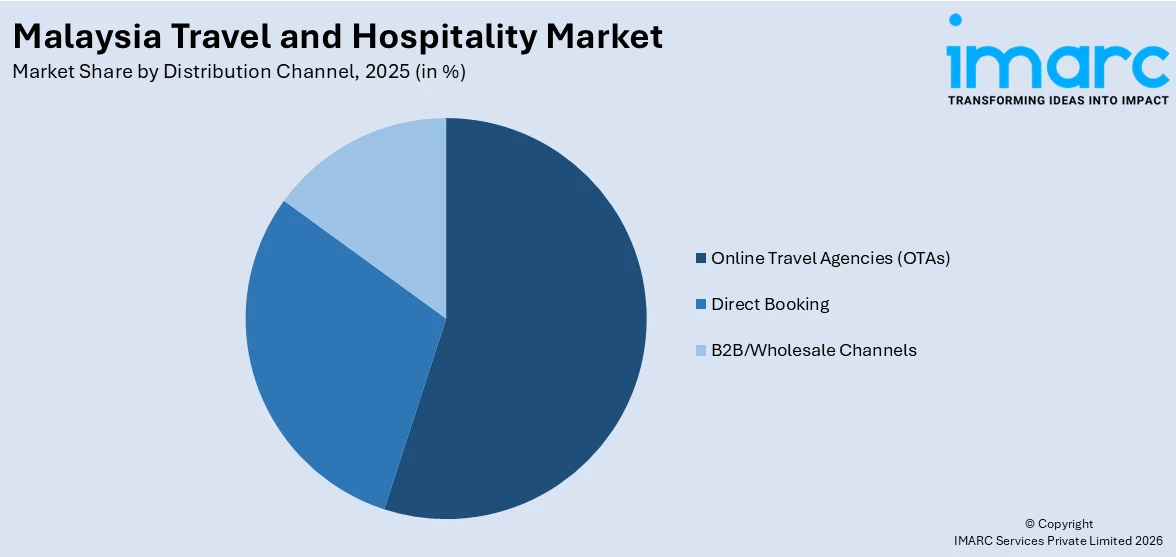
The online travel agencies (OTAs) leads with a share of 52.6% of the total Malaysia travel and hospitality market in 2025.
The online travel agencies have managed to create a strong foothold in providing a comprehensive travel experience to travelers in the country’s travel distribution chain. The one-stop approach to online travel agencies has provided a convenient mode of online booking for travelers, resulting in a significant rise in the number of travelers opting for online channels rather than traditional routes to plan their travel. The widespread availability of internet connectivity accompanied by high smartphone penetration has provided a push to online travel platforms for travelers intending to visit Malaysia.
These platforms offer critical global exposure for an independent hotel, allowing it to effectively compete against other established brands for international tourist bookings. In addition, there is an increasing trend in the adoption of AI for enhanced personalization within online travel platforms, which is leading to improved booking conversion rates for them. However, for many hotel operators, the commissions levied by these online travel platforms for bookings made through their portals are incentivizing the adoption of hotel booking and reservation systems of their own.
State Insights:
- Selangor
- W.P. Kuala Lumpur
- Johor
- Sarawak
- Others
Selangor exhibits a clear dominance with a 31.5% share of the total Malaysia travel and hospitality market in 2025.
Selangor's dominant position in the Malaysia travel and hospitality market is anchored by its strategic location surrounding the federal capital, housing the country's primary international airport and serving as a gateway for the majority of international visitor arrivals. The state's well-developed urban infrastructure, concentration of theme parks, shopping destinations, and event venues supports sustained visitor flows across leisure, business, and MICE segments. Selangor consistently records the highest domestic tourism arrivals among all Malaysian states, reflecting strong demand from both inter-state travelers and day-trippers from the greater Kuala Lumpur metropolitan area.
The state's emerging community-based and eco-tourism initiatives, particularly in rural districts such as Kuala Selangor and Sabak Bernam, are diversifying the visitor experience beyond urban-centric offerings. Public-private partnerships for tourism development, targeted digital marketing campaigns, and a growing pipeline of branded hotel properties are further reinforcing Selangor's competitive position. The state's proximity to major transportation corridors, including upcoming cross-border rail connectivity, is expected to sustain its leadership in capturing tourism demand across domestic and international segments over the forecast period.

Market Dynamics:
Growth Drivers:
Why is the Malaysia Travel and Hospitality Market Growing?
Government-Led Tourism Campaigns and Visa Liberalization
The Malaysian government has placed tourism at the center of its economic growth strategy, implementing comprehensive national campaigns designed to elevate the country's global tourism profile. These initiatives encompass targeted international marketing missions, strategic partnerships with airlines and hospitality operators, and the allocation of substantial budgetary resources toward tourism promotion and infrastructure modernization. Under the Visit Malaysia Year 2026 (VM2026) campaign, the government has outlined key strategies to attract 43 million visitors in 2025 and 47 million by 2026, focusing on stronger branding, aggressive international marketing, and tactical cooperation with airlines and travel partners to boost tourist arrivals and spending. Complementing these campaigns, the government has introduced visa-free entry provisions for visitors from several high-volume source markets, significantly reducing barriers to travel and enabling spontaneous cross-border tourism. These coordinated policy measures are creating a virtuous cycle of rising arrivals, increased tourism receipts, and expanded hospitality investment.
Strategic Infrastructure Development and Connectivity Enhancement
Malaysia is investing heavily in transportation and tourism infrastructure to accommodate growing visitor volumes and enhance destination accessibility. Major projects including cross-border rail connectivity, airport expansion programs, and highway network upgrades are strengthening both domestic and international travel corridors. For example, Malaysia’s flagship East Coast Rail Link (ECRL) project reached over 88.08% completion by late 2025, and is on track to begin operations by January 2027, improving connectivity between the east coast and major urban centers while broadening access for leisure and business travellers. The development of integrated tourism precincts, convention centers, and waterfront attractions in key cities is creating new demand nodes for hospitality services. Enhanced air connectivity, driven by the expansion of low-cost carrier networks and the introduction of new international flight routes, is broadening Malaysia's reach into previously underserved source markets. Improved last-mile connectivity further elevates the overall visitor experience, making Malaysia an increasingly accessible destination.
Diversification of Tourism Offerings and Niche Segment Growth
Malaysia is actively diversifying its tourism portfolio beyond traditional leisure travel to capture emerging demand segments that offer higher per-visitor spending and longer average stays. Medical and wellness tourism has become a significant growth vertical, with internationally accredited healthcare facilities providing quality treatments at competitive prices. In 2025, Malaysia’s healthcare tourism sector drew an estimated 1.6 million international patients and generated RM2.72 billion in revenue, reinforcing the country’s strong positioning as a value‑driven medical travel destination and underpinning expansion into broader wellness services. The country's expanding MICE infrastructure is positioning it as a preferred destination for international conferences and business events that generate substantial ancillary hospitality demand. Simultaneously, the growing focus on halal-friendly tourism, adventure and eco-tourism experiences, and cultural heritage circuits are attracting niche traveler demographics, building a more resilient, year-round revenue base.
Market Restraints:
What Challenges the Malaysia Travel and Hospitality Market is Facing?
Intensifying Regional Competition for Tourist Arrivals
Malaysia faces growing competitive pressure from neighboring Southeast Asian destinations that are aggressively promoting their tourism sectors with similar value propositions. Countries offering comparable tropical experiences, cultural diversity, and competitive pricing are actively targeting the same source markets, making it increasingly challenging for Malaysia to differentiate its offerings and maintain market share. This heightened rivalry requires sustained investment in destination marketing and unique tourism product development to remain competitive.
Vulnerability to Global Economic Fluctuations and Currency Volatility
The Malaysia travel and hospitality market remains exposed to macroeconomic uncertainties in key source markets, where economic slowdowns or currency depreciation can directly reduce discretionary travel spending. Dependence on a concentrated set of regional source markets amplifies this vulnerability, as downturns in any major origin country can significantly impact visitor volumes and tourism receipts. Exchange rate fluctuations also affect the perceived affordability of Malaysian travel experiences for international visitors.
Workforce Shortages and Service Quality Gaps in Hospitality
The hospitality sector in Malaysia continues to grapple with skilled labor shortages, particularly in frontline service roles and specialized hospitality management positions. High employee turnover rates and migration of trained professionals to competing industries or neighboring countries create persistent service quality challenges. These workforce constraints can affect guest satisfaction levels and limit the ability of hospitality operators to fully capitalize on the rising demand from both domestic and international travelers.
Competitive Landscape:
The Malaysia travel and hospitality market is characterized by a dynamic competitive landscape where international hotel chains, regional hospitality groups, and independent operators vie for market share across multiple price tiers and destination segments. Competition is intensifying as global brands expand their presence through management contracts and franchise models, while domestic operators invest in property upgrades and digital transformation to enhance guest experiences and operational efficiency. The market is also shaped by the growing influence of online travel platforms that have democratized distribution and enabled smaller operators to access international visitor pools. Strategic partnerships between hospitality companies and tourism promotion bodies, alongside public-private collaborations for destination development, are becoming critical differentiators. The expanding luxury hospitality pipeline and the emergence of boutique and lifestyle accommodation concepts are further diversifying the competitive arena, prompting established players to continuously innovate their service offerings, loyalty programs, and sustainability practices to maintain relevance in an evolving marketplace.
Recent Developments:
-
In January 2025, Malaysia kicked off its Visit Malaysia 2026 tourism campaign, unveiling the official logo, theme song “Surreal Experiences,” and airline tie‑ins with Malaysia Airlines, AirAsia and Batik Air to boost inbound travel and global visibility. The initiative aims to attract millions of visitors ahead of 2026.
Malaysia Travel and Hospitality Market Report Coverage:
|
Report Features |
Details |
|
Base Year of the Analysis |
2025 |
|
Historical Period |
2020-2025 |
|
Forecast Period |
2026-2034 |
|
Units |
Million USD |
|
Scope of the Report |
Exploration of Historical Trends and Market Outlook, Industry Catalysts and Challenges, Segment-Wise Historical and Future Market Assessment:
|
|
Tourism Types Covered |
Leisure Tourism, Business and MICE Tourism, Eco and Adventure Tourism, Cultural and Heritage Tourism, Medical and Wellness Tourism |
|
Hospitality Types Covered |
Hotels and Resorts, Boutique and Luxury Accommodations, Budget and Mid-Scale Hotels, Homestays, Serviced Apartments |
|
Price Tiers Covered |
Economy, Mid Scale, Luxury |
|
Distribution Channels Covered |
Online Travel Agencies (OTAs), Direct Booking, B2B/Wholesale Channels |
|
States Covered |
Selangor, W.P. Kuala Lumpur, Johor, Sarawak, Others |
|
Customization Scope |
10% Free Customization |
|
Post-Sale Analyst Support |
10-12 Weeks |
|
Delivery Format |
PDF and Excel through Email (We can also provide the editable version of the report in PPT/Word format on special request) |
Frequently Asked Questions About the Malaysia Travel and Hospitality Market Report
The Malaysia travel and hospitality market size was valued at USD 77.41 Million in 2025.
The Malaysia travel and hospitality market is expected to grow at a compound annual growth rate of 4.66% from 2026-2034 to reach USD 116.59 Million by 2034.
Leisure tourism, holding the largest share of 58.4%, remains the dominant segment in Malaysia's travel and hospitality market, driven by the country's diverse natural attractions, rich cultural heritage, and affordability that attract a broad mix of regional and international visitors.
Key factors driving the Malaysia travel and hospitality market include government-led tourism campaigns, visa liberalization for major source markets, strategic infrastructure investments, expanding digital booking ecosystems, growing medical and wellness tourism, and the diversification of hospitality offerings across luxury and eco-tourism segments.
Major challenges include intensifying competition from neighboring Southeast Asian tourism destinations, vulnerability to global economic fluctuations affecting key source markets, skilled workforce shortages in the hospitality sector, and the need to balance rapid tourism growth with environmental sustainability.
Need more help?
- Speak to our experienced analysts for insights on the current market scenarios.
- Include additional segments and countries to customize the report as per your requirement.
- Gain an unparalleled competitive advantage in your domain by understanding how to utilize the report and positively impacting your operations and revenue.
- For further assistance, please connect with our analysts.
 Request Customization
 Speak to an Analyst
 Request Brochure
 Inquire Before Buying
Benefits of Customization
- Personalize this research
- Triangulate with your data
- Get data as per your format and definition
- Gain a deeper dive into a specific application, geography, customer, or competitor
- Any level of personalization
Get in Touch With Us
UNITED STATES
Phone: +1-201-971-6302
INDIA
Phone: +91-120-433-0800
UNITED KINGDOM
Phone: +44-753-714-6104
Email: [email protected]
Client Testimonials




.webp)




.webp)













Related Reports

Choose your plan
*Please note that the prices mentioned below are starting prices for each bundle type. Kindly contact our team for further details.*
Single User License
- 1 User License, Access on 2 Devices
- PDF Report + Excel Dataset (Password Protected)
- Lifetime Access
- No Printing Rights
- 10% Free Report Customization
- 10–12 Weeks of Analyst Support
Five User License
- Access for 5 Users, 2 Devices per User
- PDF Report + Excel Dataset (Password Protected)
- Lifetime Access
- Dedicated Account Manager
- 12–14 Weeks of Analyst Support
- No Printing Rights
- 15% Free Report Customization
- 25% Discount on Your Next Purchase
Corporate User License
- Unlimited User Access (Within Your Organization)
- PDF Report + Excel Dataset
- Lifetime Access
- Dedicated Account Manager
- 14–20 Weeks of Analyst Support
- No Printing Rights
- 20% Free Report Customization
- 30% Discount on Your Next Purchase
Essential Insights
What's included:
3 reports
- Lifetime Access
- PDF Reports
- Excel Datasets
- 2 Weeks of Free Analyst Support
- 2 User Licenses
- Access on 2 Devices
- Printing Rights
- Complimentary PowerPoint (PPT) Version
- Complimentary License Upgrade
Professional Access
What's included:
5 reports
- Lifetime Access
- PDF Reports
- Excel Datasets
- 8 Weeks of Free Analyst Support
- 2 User Licenses
- Access on 2 Devices
- Printing Rights
- Complimentary PowerPoint (PPT) Version
- Complimentary License Upgrade
Business Advantage
What's included:
8 reports
- Lifetime Access
- PDF Reports
- Excel Datasets
- 14 Weeks of Free Analyst Support
- 2 User Licenses
- Access on 2 Devices
- Printing Rights
- Complimentary PowerPoint (PPT) Version
- Complimentary License Upgrade
Enterprise Intelligence
What's included:
10 reports
- Lifetime Access
- PDF Reports
- Excel Datasets
- 20 Weeks of Free Analyst Support
- 2 User Licenses
- Access on 2 Devices
- Printing Rights
- Complimentary PowerPoint (PPT) Version
- Complimentary License Upgrade