
Marine Electric Vehicle Market Size, Share, Trends and Forecast by Vehicle Type, Propulsion Type, Application, and Region, 2026-2034
Marine Electric Vehicle Market Size, Share, Trends & Forecast (2026-2034)
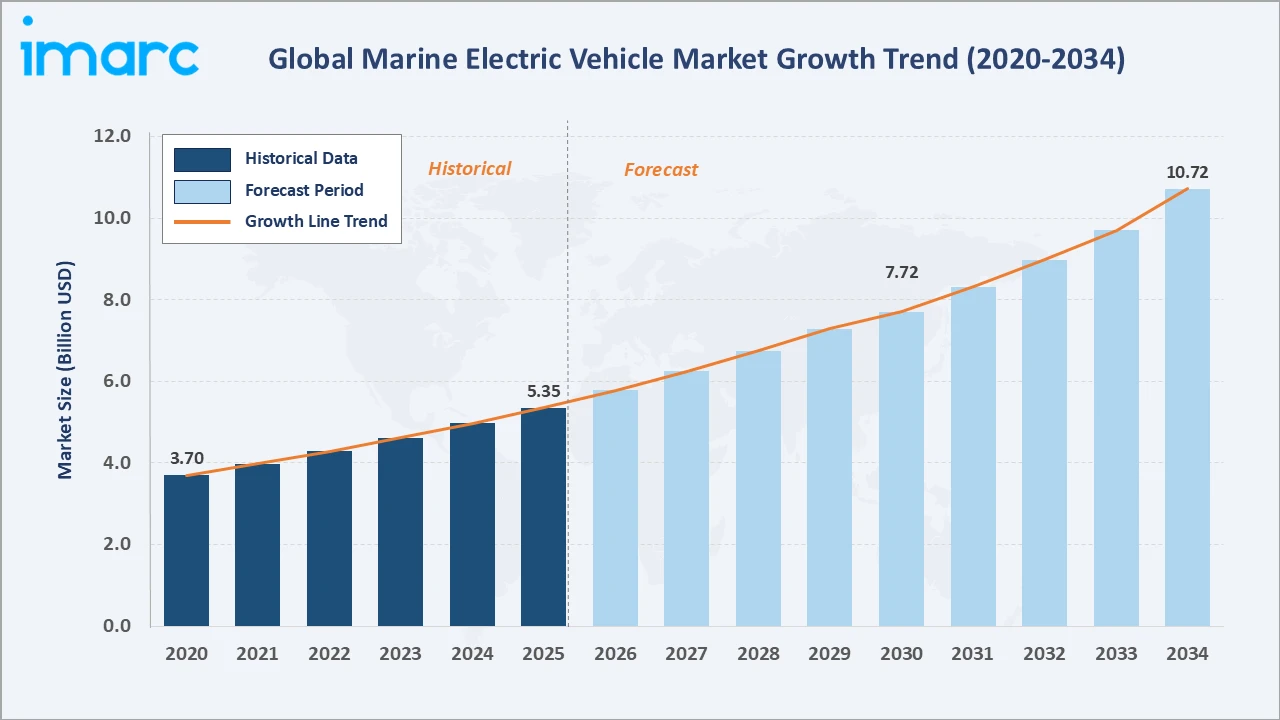
The global marine electric vehicle market reached USD 5.35 Billion in 2025 and is projected to reach USD 10.72 Billion by 2034, growing at a CAGR of 7.63% during 2026-2034. The market is driven by rising environmental awareness, stringent emission regulations, and continuous advancements in marine battery technology. Increasing adoption of hybrid and battery-electric propulsion across commercial and defense fleets is reducing operational costs and reliance on fossil fuels. This shift toward cleaner maritime transportation is encouraging shipbuilders and operators to accelerate fleet electrification, expand charging infrastructure, and invest in higher energy-density battery systems. Military Vehicle leads at 34.8%. Hybrid Electric Vehicle leads propulsion at 44.2%. North America commands 36.9% of the global market share.
Market Snapshot
|
Metric |
Value |
|
Market Size (2025) |
USD 5.35 Billion |
|
Forecast Market Size (2034) |
USD 10.72 Billion |
|
CAGR (2026-2034) |
7.63% |
|
Base Year |
2025 |
|
Historical Period |
2020-2025 |
|
Forecast Period |
2026-2034 |
|
Dominant Vehicle Type |
Military Vehicle (34.8%, 2025) |
|
Dominant Propulsion Type |
Hybrid Electric Vehicle (44.2%, 2025) |
|
Leading Region |
North America (36.9%, 2025) |
The global marine electric vehicle market expanded from USD 3.70 Billion in 2020 to USD 5.35 Billion in 2025, anchored at USD 7.72 Billion in 2030, and forecast to reach USD 10.72 Billion by 2034. Growing environmental awareness and tightening emission standards have driven sustained investment in electric propulsion across commercial, defense, and recreational marine fleets, with momentum reinforced by expanding battery and charging infrastructure since 2022.
To get more information on this market, Request Sample
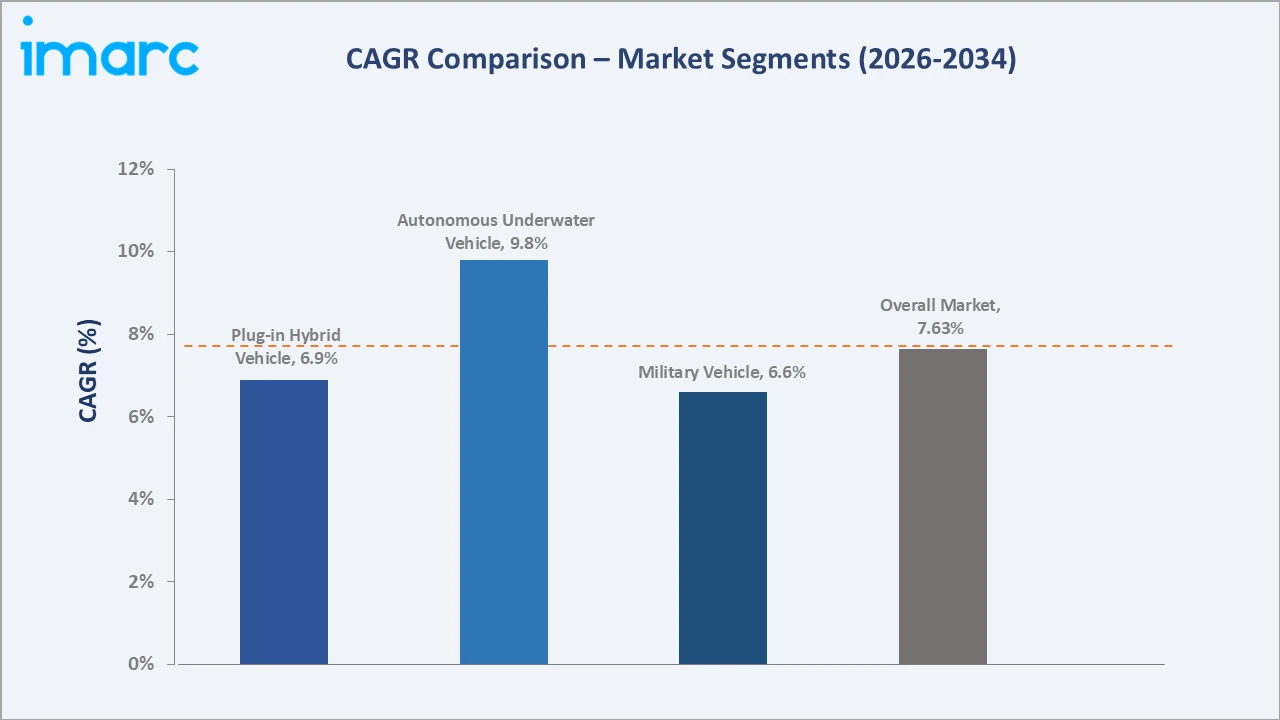
Autonomous Underwater Vehicles grow fastest at ~9.8% CAGR as defense and research demand for uncrewed electric platforms accelerates. Battery Electric Vehicle propulsion grows at ~8.6% CAGR, supported by improving energy density and expanding shore-charging networks across major ports.
Executive Summary
The global marine electric vehicle market reached USD 5.35 Billion in 2025, representing a key intersection of maritime transportation, clean energy, and defense modernization. The market encompasses electric propulsion systems, marine battery packs, charging infrastructure, and vessel integration across military, commercial, and recreational applications.
Military Vehicle at 34.8% dominates through sustained defense electrification budgets. Hybrid Electric Vehicle at 44.2% leads propulsion through its balance of range and emission reduction. North America, at 36.9%, leads through strong naval electrification programs and expanding commercial ferry adoption, supported by robust government funding for clean maritime infrastructure.
Key Market Insights
|
Insight |
Data |
|
Dominant Vehicle Type |
Military Vehicle - 34.8% share (2025) |
|
Dominant Propulsion Type |
Hybrid Electric Vehicle - 44.2% market share (2025) |
|
Leading Region |
North America - 36.9% market share |
|
Market Opportunity |
Autonomous underwater electrification; naval fleet modernization; port shore-power expansion; solid-state marine batteries; electric ferry retrofitting; sustainable tourism vessels |
Key Analytical Observations Supporting the Above Data:
- Military Vehicle at 34.8%: The military vehicle segment dominates due to sustained defense modernization budgets, rising geopolitical tensions, and growing investment in fuel-efficient, lower-signature naval platforms across major maritime forces.
- Hybrid Electric Vehicle at 44.2%: Hybrid propulsion leads technology adoption because it balances extended range with onboard power reliability, allowing operators to reduce emissions without compromising operational endurance at sea.
- North America at 36.9%: North America dominates the market due to strong naval electrification investment, robust charging infrastructure development, and growing adoption of electric ferries and workboats across coastal regions.
Marine Electric Vehicle Market Overview
The global marine electric vehicle market encompasses the design, manufacturing, and deployment of electric and hybrid-electric propulsion systems across on-water and underwater vessels. The market spans battery systems, electric motors, charging infrastructure, and vessel integration for military, commercial, and recreational applications.
Macroeconomic factors include rising defense modernization budgets, tightening maritime emission regulations, and growing investment in sustainable coastal infrastructure. In addition, advancements in battery energy density and expanding shore-power networks are accelerating electric vessel adoption worldwide.
Market Dynamics
To evaluate market opportunities, Request Sample
Market Drivers
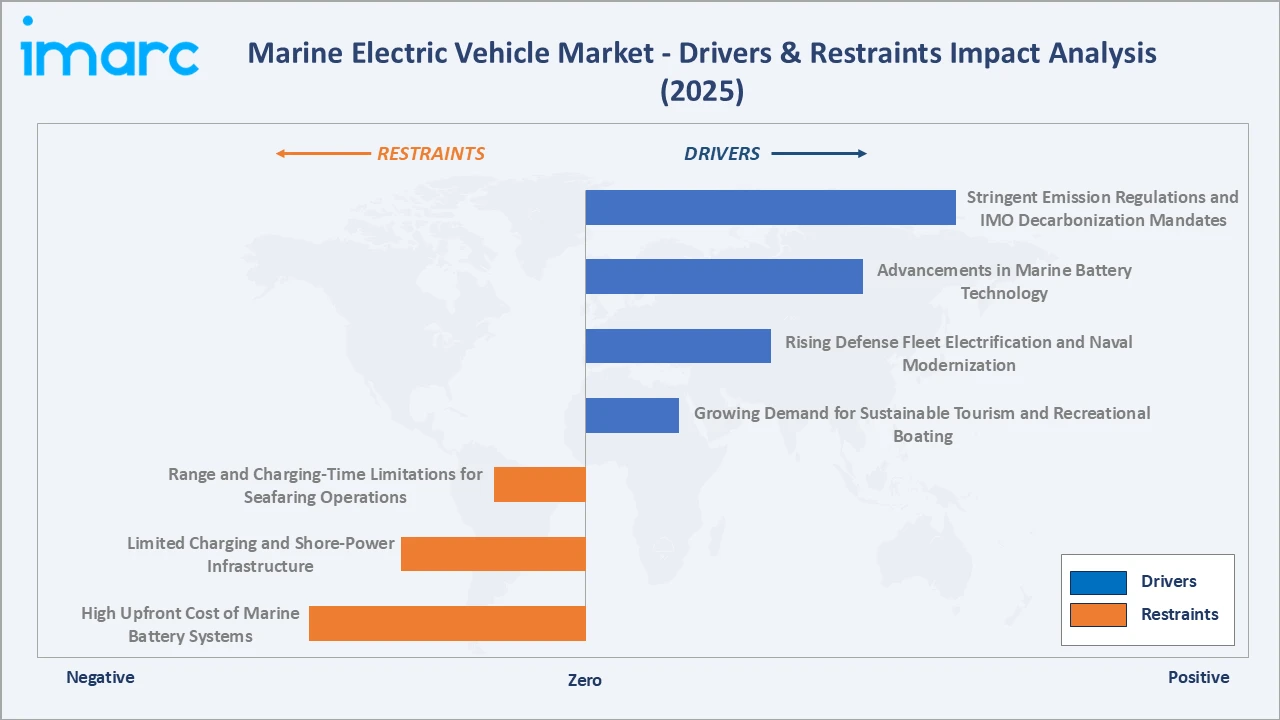
- Stringent Emission Regulations and IMO Decarbonization Mandates: Tightening international and national emission standards are pushing vessel operators toward electric and hybrid-electric propulsion. Regulatory bodies are setting progressively stricter limits on greenhouse gas and sulphur emissions from marine transportation, compelling shipowners and defense agencies to invest in cleaner propulsion technologies. This regulatory pressure is a primary catalyst accelerating fleet electrification across commercial, defense, and recreational vessel categories worldwide.
- Advancements in Marine Battery Technology: Continuous improvements in battery energy density, charging speed, and cycle life are making electric vessels increasingly practical for a wider range of applications. Higher-capacity lithium-ion and emerging solid-state battery systems are extending vessel range and reducing charging downtime, enhancing the commercial viability of electric propulsion for ferries, workboats, and leisure craft alike.
- Rising Defense Fleet Electrification and Naval Modernization: Growing geopolitical tensions and defense budgets are driving naval forces to modernize fleets with electric and hybrid-electric propulsion for improved fuel efficiency, reduced acoustic signature, and lower long-term operating costs. This trend is particularly strong in the military vehicle segment, which continues to represent the largest share of market value.
- Growing Demand for Sustainable Tourism and Recreational Boating: Increasing consumer preference for quiet, emission-free leisure boating is driving adoption of electric vessels in tourism and recreational markets. Operators of wildlife tours, harbor cruises, and private yachts are increasingly favoring electric propulsion for its lower noise, reduced environmental impact, and improved passenger experience.
Market Restraints
- High Upfront Cost of Marine Battery Systems: The high capital cost of marine-grade battery packs, electric propulsion systems, and vessel retrofitting limits adoption among small and medium-scale operators. Long payback periods and significant financing requirements can discourage new entrants, particularly in price-sensitive commercial and recreational boating segments.
- Limited Charging and Shore-Power Infrastructure: The uneven availability of high-power charging and shore-power infrastructure at ports and marinas constrains electric vessel operations, especially for longer routes. Insufficient charging networks increase operational planning complexity and can limit the practical range of electric and hybrid-electric vessels.
- Range and Charging-Time Limitations for Seafaring Operations: Battery weight and energy density constraints continue to limit the range and payload capacity of electric vessels on long-distance seafaring routes. Extended charging times relative to conventional refueling can also reduce vessel utilization rates for commercial and defense operators.
Market Opportunities
- Autonomous Underwater Vehicle Electrification: Growing demand for uncrewed electric platforms in deep-sea exploration, defense surveillance, and offshore energy inspection is creating significant opportunities for autonomous underwater vehicle manufacturers and battery system providers.
- Port Shore-Power and Fast-Charging Infrastructure Expansion: Increasing investment in shore-power and fast-charging infrastructure at ports and marinas is expanding the addressable market for charging equipment providers and enabling broader adoption of electric vessels across commercial fleets.
Market Challenges
- Battery Weight and Energy Density Constraints: Achieving sufficient range and payload capacity for large seafaring vessels remains challenging given current marine battery weight-to-energy ratios, requiring continued innovation in lightweight, high-density energy storage.
- Dependence on Critical Battery Raw Material Supply Chains: Reliance on lithium, cobalt, and nickel supply chains exposes marine battery manufacturers to price volatility and geopolitical supply risk, which can affect production costs and delivery timelines.
Emerging Market Trends
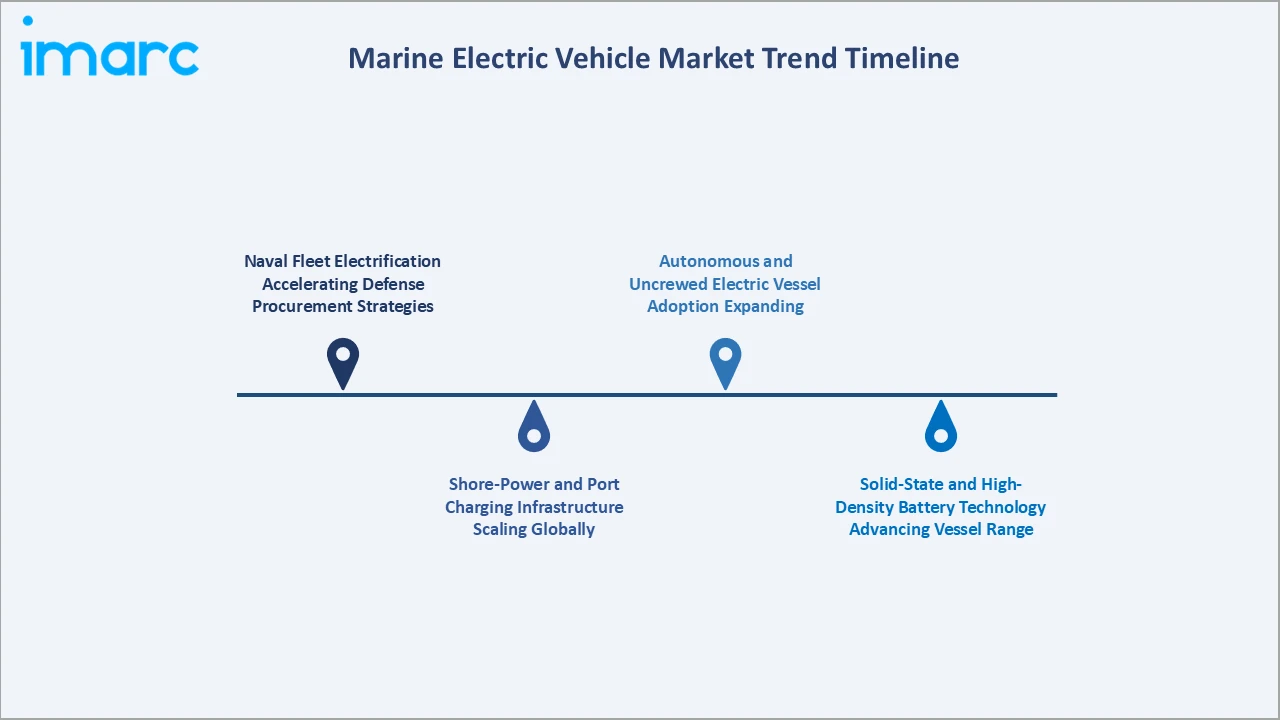
1. Naval Fleet Electrification Accelerating Defense Procurement Strategies
Naval forces worldwide are increasingly incorporating electric and hybrid-electric propulsion into new vessel procurement and retrofit programs. This shift reduces fuel logistics burdens, lowers acoustic signature for stealth operations, and supports long-term operating cost reduction, making electrification a growing priority within defense modernization strategies.
2. Shore-Power and Port Charging Infrastructure Scaling Globally
Ports and marinas are expanding shore-power and fast-charging infrastructure to support growing electric vessel fleets. This infrastructure buildout reduces vessel idle time, supports longer operating routes, and is becoming a key enabler of commercial electric ferry and workboat adoption.
3. Autonomous and Uncrewed Electric Vessel Adoption Expanding
Adoption of autonomous underwater and surface vessels is expanding across defense, research, and offshore energy applications. Electric propulsion suits these platforms well due to lower maintenance needs and quieter operation, supporting extended, uncrewed deployments in sensitive or hard-to-reach environments.
4. Solid-State and High-Density Battery Technology Advancing Vessel Range
Emerging solid-state and high-density battery chemistries are improving vessel range and reducing charging times compared to conventional lithium-ion systems. As these technologies mature and scale, they are expected to further improve the commercial viability of electric propulsion for larger vessels.
Industry Value Chain Analysis
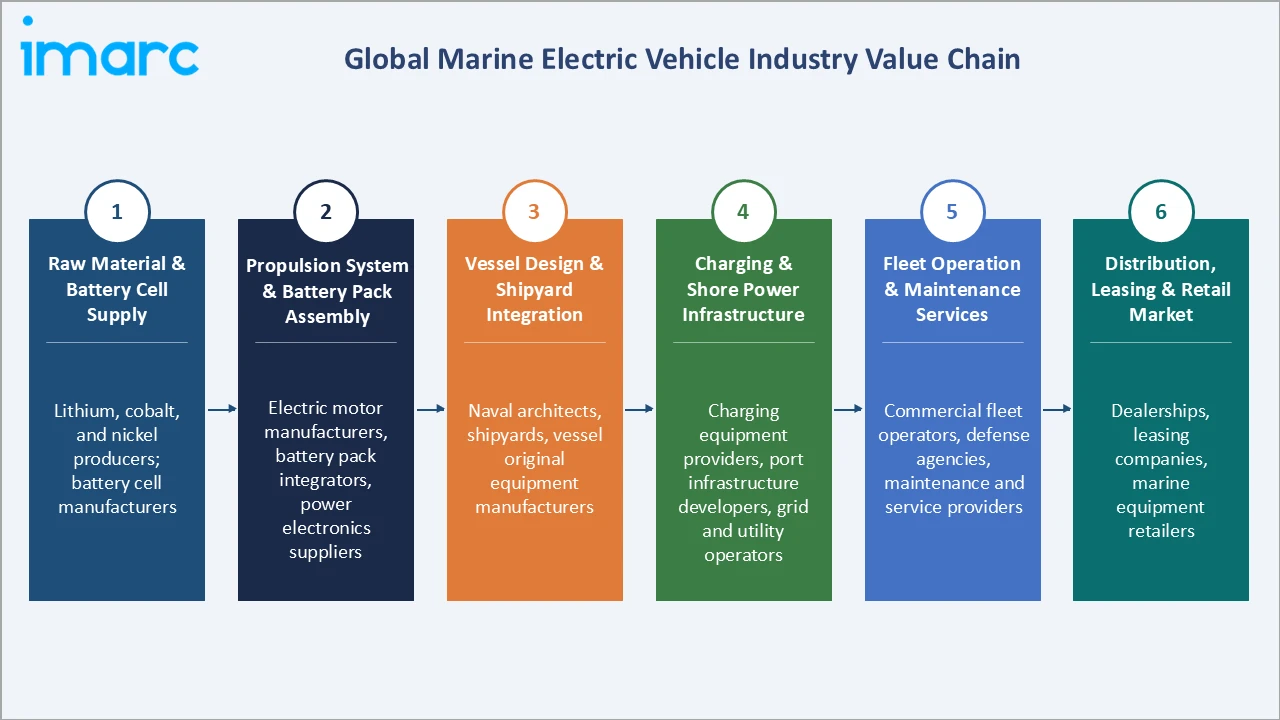
The marine electric vehicle value chain integrates raw material and battery cell supply, propulsion system and battery pack assembly, vessel design and shipyard integration, charging and shore power infrastructure, fleet operation and maintenance, and distribution and retail market supply.
|
Stage |
Key Participants |
|
Raw Material & Battery Cell Supply |
Lithium, cobalt, and nickel producers; battery cell manufacturers |
|
Propulsion System & Battery Pack Assembly |
Electric motor manufacturers, battery pack integrators, power electronics suppliers |
|
Vessel Design & Shipyard Integration |
Naval architects, shipyards, vessel original equipment manufacturers |
|
Charging & Shore Power Infrastructure |
Charging equipment providers, port infrastructure developers, grid and utility operators |
|
Fleet Operation & Maintenance Services |
Commercial fleet operators, defense agencies, maintenance and service providers |
|
Distribution, Leasing & Retail Market |
Dealerships, leasing companies, marine equipment retailers |
The propulsion system and battery pack assembly stage is the value chain's most technically complex and commercially differentiated phase. Charging and shore power infrastructure development increasingly determines the practical range and utilization of electric vessels across commercial and defense fleets.
Technology Landscape in the Marine Electric Vehicle Industry
Lithium-ion and Solid-State Marine Battery Systems
Lithium-ion battery systems remain the dominant energy storage technology for marine electric vehicles, offering a proven balance of energy density, cycle life, and safety for maritime applications. Emerging solid-state battery systems are beginning to enter marine applications, promising higher energy density and improved safety. These advancements are gradually extending vessel range and reducing charging times across commercial and defense fleets.
Electric and Hybrid-Electric Propulsion Systems
Electric and hybrid-electric propulsion systems combine battery power with electric motors and, in hybrid configurations, auxiliary combustion or fuel-cell generators. These systems enable flexible operation across varying range and power requirements, supporting adoption across military, commercial, and recreational vessel categories seeking to balance emission reduction with operational endurance.
Autonomous Navigation and Energy Management Software
Autonomous navigation and energy management software enable optimized routing, battery usage, and predictive maintenance for electric vessels. These systems use real-time sensor data to manage power distribution and extend battery life, supporting safer and more efficient operation of both crewed and uncrewed marine electric platforms.
Market Segmentation Analysis
The report covers the following segments:
|
Segment Category |
Leading Segment |
Market Share |
Year |
|
Vehicle Type |
Military Vehicle |
34.8% |
2025 |
|
Propulsion Type |
Hybrid Electric Vehicle |
44.2% |
2025 |
|
Application |
🔒 |
🔒 |
2025 |
|
Region |
North America |
36.9% |
2025 |

By Vehicle Type
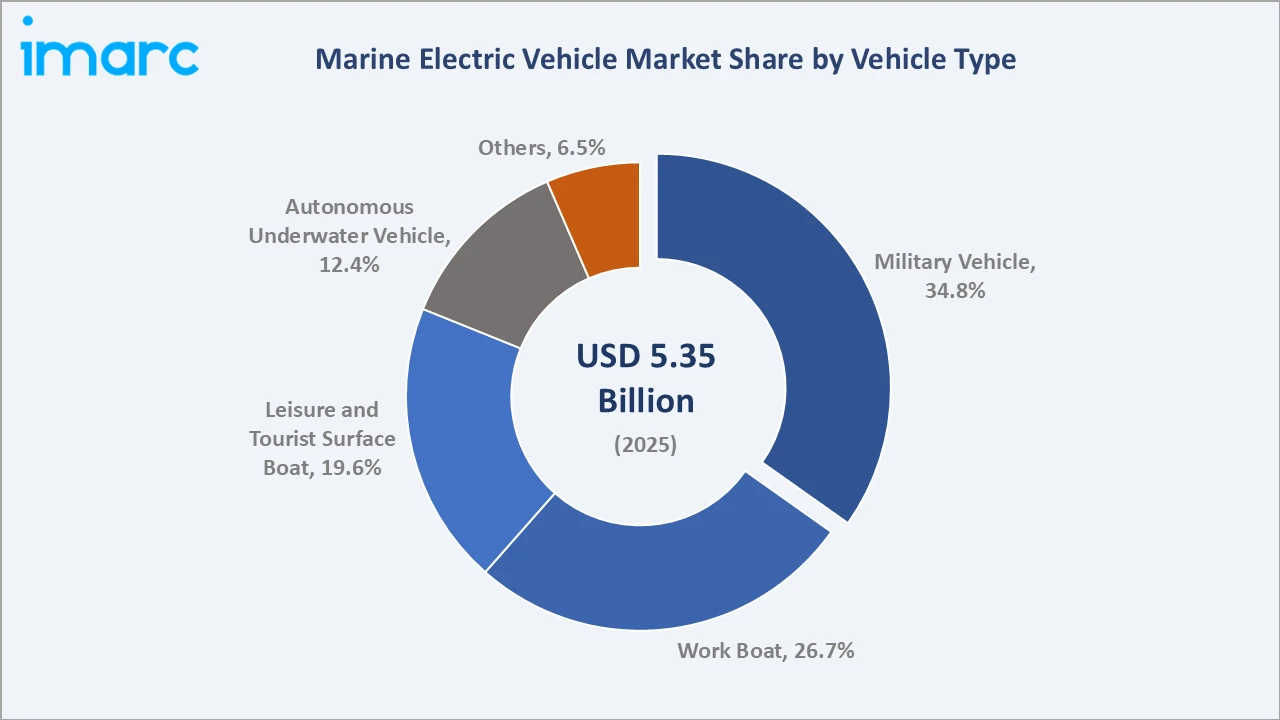
Military vehicle leads at 34.8% (2025). The military vehicle segment encompasses electric and hybrid-electric naval surface craft, patrol boats, and support vessels adopted for fuel efficiency, reduced acoustic signature, and lower long-term operating costs across defense fleets.
To access detailed market analysis, Request Sample
Work Boat at 26.7% and Leisure and Tourist Surface Boat at 19.6% together reflect strong commercial and tourism electrification. Autonomous Underwater Vehicle, at 12.4%, is the fastest-growing category through rising defense and research investment in uncrewed electric platforms.
By Propulsion Type
Hybrid electric vehicles lead propulsion at 44.2% (2025). The hybrid segment combines battery power with auxiliary generation, offering extended range and operational flexibility that suits diverse vessel categories transitioning away from fully conventional propulsion.
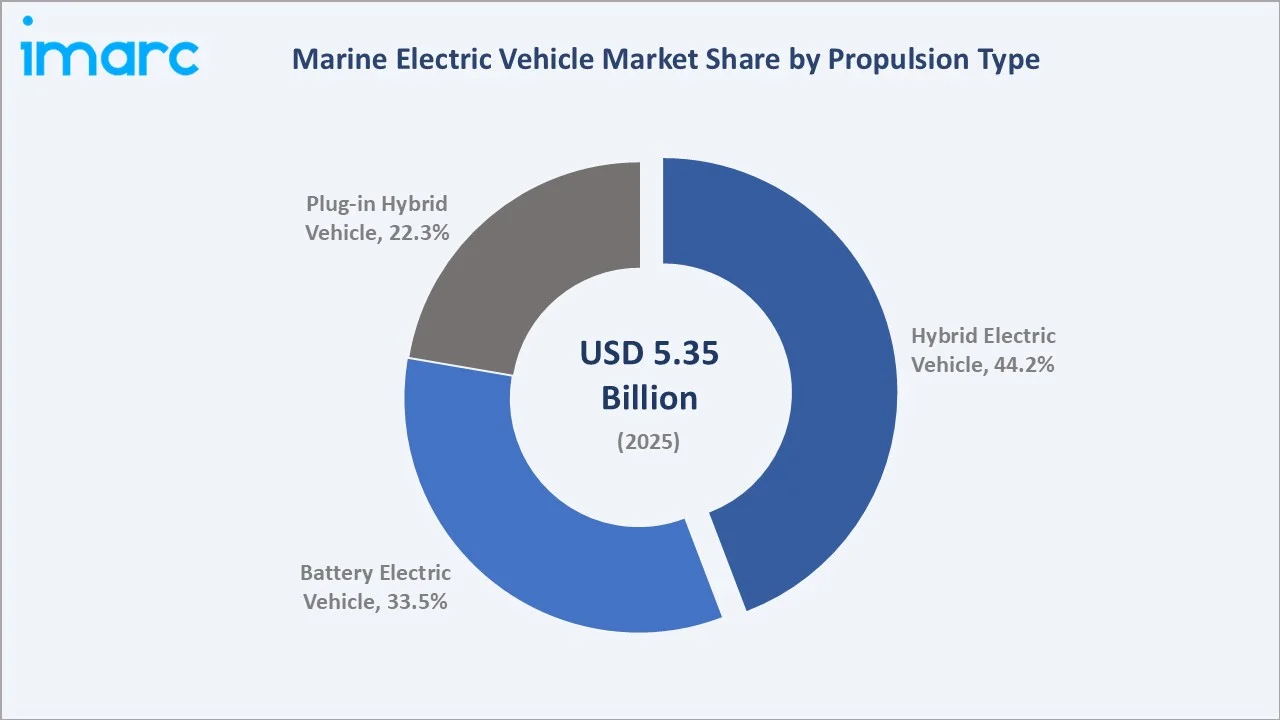
Battery Electric Vehicle at 33.5% is growing fastest at ~8.6% CAGR, supported by improving battery energy density and expanding shore-charging networks. Plug-in Hybrid Vehicle, at 22.3%, appeals to operators seeking flexible range extension alongside emission reduction.
Regional Market Insights
|
Region |
Share (2025) |
Key Marine Electric Vehicle Market Drivers & Characteristics |
|
North America |
36.9% |
Driven by strong naval electrification programs, ferry fleet modernization, and robust charging infrastructure investment. |
|
Europe |
29.4% |
Driven by stringent IMO and EU emission regulations, and strong adoption of hybrid ferries and recreational electric boats. |
|
Asia-Pacific |
24.8% |
Driven by expanding shipbuilding capacity, growing coastal tourism, and government support for green maritime transport. |
|
Latin America |
4.9% |
Supported by growing port modernization and increasing adoption of electric tourism and workboats. |
|
Middle East and Africa |
4.0% |
Driven by rising investment in sustainable coastal transport and naval fleet upgrades. |
North America's 36.9% market leadership is anchored by sustained naval electrification budgets and expanding commercial ferry and workboat adoption across U.S. and Canadian coastal waters.
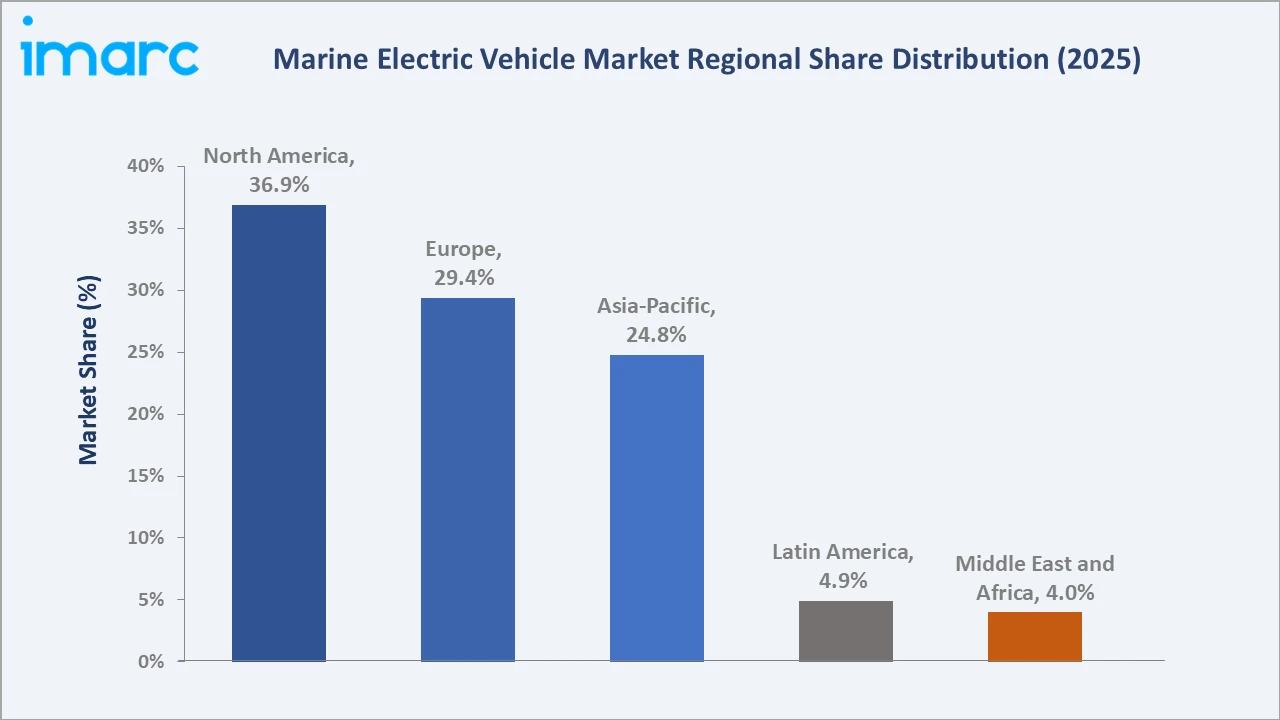
Europe's 29.4% reflects strict emission regulation and mature ferry electrification. Asia-Pacific's 24.8% is supported by expanding shipbuilding capacity, while the Middle East and Africa, at 4.0%, is among the fastest-growing regions by CAGR.
Competitive Landscape
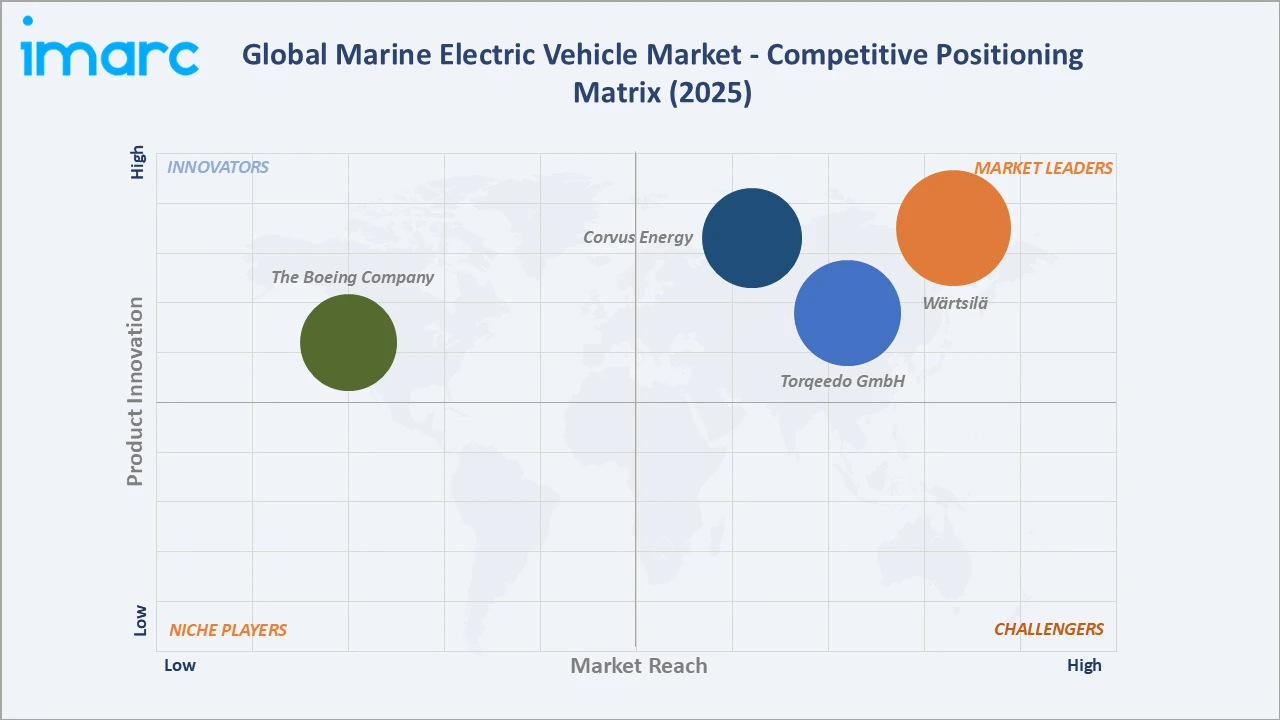
The global marine electric vehicle market competitive landscape encompasses four distinct tiers: marine battery and energy storage manufacturers, electric propulsion system providers, vessel and submersible original equipment manufacturers, and specialized electric boat builders.
|
Company Name |
Key Products |
Market Position |
Core Strength |
|
Corvus Energy |
Orca Energy, Blue Whale ESS |
Market Leader |
Corvus Energy plays a central role in the marine electric vehicle market by providing marine battery energy storage systems for hybrid and fully electric vessels across commercial and offshore fleets. |
|
Wärtsilä |
Hybrid propulsion & energy solutions |
Market Leader |
Wärtsilä plays a central role by providing integrated hybrid and electric propulsion, energy storage, and power management systems for a broad range of commercial vessels. |
|
Torqeedo GmbH |
Deep Blue, Cruise |
Market Leader |
Torqeedo plays a central role by providing electric outboard and inboard propulsion systems for recreational, tourism, and light commercial marine vehicles. |
|
The Boeing Company |
Echo Voyager autonomous undersea systems |
Established Player |
Boeing plays a central role by providing autonomous underwater vehicle platforms supporting defense and offshore energy applications. |
Battery and propulsion technology concentration among a small group of specialized manufacturers sustains a competitive advantage through engineering depth and integration expertise. Consolidation reflects operator preference for integrated propulsion and energy storage suppliers, reducing coordination complexity across vessel electrification projects.
Key Company Profiles
Corvus Energy
Corvus Energy is a leading provider of marine battery energy storage systems for the global marine electric vehicle market. The company specializes in high-capacity lithium-ion systems for hybrid and fully electric commercial and offshore vessels.
- Key Products: Orca Energy, Blue Whale NxtGen energy storage systems.
- Recent Developments: In May 2026, Corvus Energy and BYD Energy Storage signed a strategic cooperation agreement to co-develop next-generation lithium iron phosphate marine battery systems, building on a memorandum of understanding signed in December 2025. Corvus was also selected to supply battery systems for seven new hybrid-electric ferries under Scotland's CMAL fleet renewal programme.
- Strategic Focus: Focuses on scalable marine battery systems, safety certification, and energy density improvements for large commercial and offshore vessel fleets.
Wärtsilä
Wärtsilä is a prominent technology provider in the marine electric vehicle market, specializing in hybrid and electric propulsion, energy storage, and power management solutions for commercial and passenger vessels.
- Key Products: Hybrid propulsion systems, marine energy storage and power management solutions.
- Recent Developments: In July 2026, Wärtsilä was selected to supply hybrid-electric propulsion systems for new Finnlines RoPax ferries under the Grimaldi Group newbuild programme, following its 2025 contract to expand the marine battery hybrid system aboard the Wasaline ferry Aurora Botnia to 12.6 MWh, the largest in operation.
- Strategic Focus: Centered on integrated hybrid propulsion, fleet decarbonization solutions, and shore-power compatible vessel systems.
Torqeedo GmbH
Torqeedo is a leading manufacturer of electric propulsion systems for recreational, tourism, and light commercial marine vehicles, offering a broad range of outboard and inboard electric motor solutions.
- Key Products: Deep Blue, Cruise, and Travel electric propulsion series.
- Recent Developments: In November 2025, Torqeedo unveiled upgraded Cruise electric outboard motors and new Deep Blue G3N system components at Metstrade 2025, expanding its high-power propulsion platform for OEMs and commercial fleet operators.
- Strategic Focus: Focuses on compact, high-efficiency electric propulsion for leisure boating and tourism-oriented vessel operators.
Market Concentration Analysis
The global marine electric vehicle market is moderately fragmented, with battery and propulsion technology suppliers holding a stronger concentration than vessel operators. No single company holds a dominant global share, though a small group of specialized manufacturers accounts for a meaningful portion of marine battery and propulsion system supply. Market concentration is gradually increasing at the technology platform tier through partnerships and capacity expansion.
Investment & Growth Opportunities
Highest Growth Segments
Autonomous Underwater Vehicle (~9.8% CAGR), Battery Electric Vehicle propulsion (~8.6% CAGR), and electric workboat and ferry retrofitting represent the highest-growth marine electric vehicle investment vectors through 2034, supported by defense modernization and port electrification programs.
Emerging Investment Opportunities
Naval fleet electrification programs represent the largest near-term marine electric vehicle opportunity. Battery and propulsion technology suppliers that establish preferred-supplier relationships with defense procurement agencies and commercial shipbuilders are positioned for above-market revenue growth as electrification budgets expand.
Investment Themes
- Marine battery capacity expansion for defense and commercial fleets: Companies investing in marine-certified battery manufacturing capacity are positioned to capture growing demand from both naval modernization and commercial vessel electrification programs through 2026-2030.
- Port charging and shore-power infrastructure development: Investment in fast-charging and shore-power infrastructure at ports and marinas creates a recurring revenue opportunity as electric vessel fleets scale globally.
Future Market Outlook (2026-2034)
The global marine electric vehicle market is projected to grow from USD 5.35 Billion in 2025 to USD 10.72 Billion by 2034, delivering a 7.63% CAGR over the forecast period. The market's anchor value of USD 7.72 Billion in 2030 represents a period of accelerating fleet electrification as naval modernization programs mature, battery technology costs decline, and shore-power infrastructure expands across major ports.
Three structural forces define marine electric vehicle market growth through 2034. Emission regulation as a policy imperative across major maritime nations creates sustained, budget-committed electrification demand. Defense modernization continues to reinforce military vehicle segment leadership. Battery technology cost reduction is making electric propulsion commercially accessible across a widening range of vessel categories and applications.
Research Methodology
Primary Research
Primary research comprised structured interviews with industry stakeholders including naval procurement officials, propulsion system engineers, marine battery manufacturers, and commercial fleet operators.
Secondary Research
Secondary research encompassed marine electrification publications, defense procurement data, port infrastructure statistics, company annual reports, and marine battery technology reviews.
Forecasting Models
Market revenue forecasts were developed using a segment bottom-up model: (i) propulsion and battery system component; (ii) vessel integration component; (iii) charging infrastructure and services component.
Marine Electric Vehicle Market Report Scope:
| Report Features | Details |
|---|---|
| Base Year of the Analysis | 2025 |
| Historical Period | 2020-2025 |
| Forecast Period | 2026-2034 |
| Units | Billion USD |
| Scope of the Report | Exploration of Historical Trends and Market Outlook, Industry Catalysts and Challenges, Segment-Wise Historical and Predictive Market Assessment:
|
| Vehicle Types Covered | Military Vehicle, Work Boat, Leisure and Tourist Surface Boat, Autonomous Underwater Vehicle, Others |
| Propulsion Types Covered | Battery Electric Vehicle, Plug-in Hybrid Vehicle, Hybrid Electric Vehicle |
| Applications Covered | On-Water Applications, Underwater Applications |
| Regions Covered | Asia Pacific, Europe, North America, Latin America, Middle East and Africa |
| Countries Covered | United States, Canada, Germany, France, United Kingdom, Italy, Spain, Russia, China, Japan, India, South Korea, Australia, Indonesia, Brazil, Mexico |
| Companies Covered | Corvus Energy, Wärtsilä, Torqeedo GmbH, The Boeing Company, etc. |
| Customization Scope | 10% Free Customization |
| Post-Sale Analyst Support | 10-12 Weeks |
| Delivery Format | PDF and Excel through Email (We can also provide the editable version of the report in PPT/Word format on special request) |
Key Benefits for Stakeholders:
- IMARC’s industry report offers a comprehensive quantitative analysis of various market segments, historical and current market trends, market forecasts, and dynamics of the marine electric vehicle market from 2020-2034.
- The research report provides the latest information on the market drivers, challenges, and opportunities in the global marine electric vehicle market.
- The study maps the leading, as well as the fastest-growing, regional markets. It further enables stakeholders to identify the key country-level markets within each region.
- Porter's five forces analysis assist stakeholders in assessing the impact of new entrants, competitive rivalry, supplier power, buyer power, and the threat of substitution. It helps stakeholders to analyze the level of competition within the marine electric vehicle industry and its attractiveness.
- Competitive landscape allows stakeholders to understand their competitive environment and provides an insight into the current positions of key players in the market.
Frequently Asked Questions About the Marine Electric Vehicle Market Report
The global marine electric vehicle market reached USD 5.35 Billion in 2025. The market is driven by rising environmental awareness, stringent emission regulations, and continuous advancements in marine battery technology across commercial, defense, and recreational applications.
The market grows at 7.63% CAGR during 2026-2034, reaching USD 10.72 Billion by 2034. Autonomous Underwater Vehicle grows fastest at ~9.8% CAGR through rising defense and research investment.
Military Vehicle leads at 34.8% through sustained defense modernization budgets and growing investment in fuel-efficient, lower-signature naval platforms.
Hybrid Electric Vehicle leads at 44.2% through its balance of extended range and onboard power reliability across diverse vessel categories.
North America leads at 36.9% through strong naval electrification programs and expanding commercial ferry and workboat adoption.
Leading companies Corvus Energy, Wärtsilä, Torqeedo GmbH, and The Boeing Company among others.
The market is projected to reach approximately USD 7.72 Billion by 2030, with naval electrification programs, autonomous underwater vehicle deployment, and port charging infrastructure scaling toward maturity.
Rising defense surveillance needs, offshore energy inspection demand, and deep-sea research investment are driving strong growth in electrified autonomous underwater vehicle deployment.
Need more help?
- Speak to our experienced analysts for insights on the current market scenarios.
- Include additional segments and countries to customize the report as per your requirement.
- Gain an unparalleled competitive advantage in your domain by understanding how to utilize the report and positively impacting your operations and revenue.
- For further assistance, please connect with our analysts.
 Request Customization
 Speak to an Analyst
 Request Brochure
 Inquire Before Buying
Benefits of Customization
- Personalize this research
- Triangulate with your data
- Get data as per your format and definition
- Gain a deeper dive into a specific application, geography, customer, or competitor
- Any level of personalization
Get in Touch With Us
UNITED STATES
Phone: +1-201-971-6302
INDIA
Phone: +91-120-433-0800
UNITED KINGDOM
Phone: +44-753-714-6104
Email: [email protected]
Client Testimonials




.webp)




.webp)













Related Reports

Choose your plan
*Please note that the prices mentioned below are starting prices for each bundle type. Kindly contact our team for further details.*
Single User License
- 1 User License, Access on 2 Devices
- PDF Report + Excel Dataset (Password Protected)
- Lifetime Access
- No Printing Rights
- 10% Free Report Customization
- 10–12 Weeks of Analyst Support
Five User License
- Access for 5 Users, 2 Devices per User
- PDF Report + Excel Dataset (Password Protected)
- Lifetime Access
- Dedicated Account Manager
- 12–14 Weeks of Analyst Support
- No Printing Rights
- 15% Free Report Customization
- 25% Discount on Your Next Purchase
Corporate User License
- Unlimited User Access (Within Your Organization)
- PDF Report + Excel Dataset
- Lifetime Access
- Dedicated Account Manager
- 14–20 Weeks of Analyst Support
- No Printing Rights
- 20% Free Report Customization
- 30% Discount on Your Next Purchase
Essential Insights
What's included:
3 reports
- Lifetime Access
- PDF Reports
- Excel Datasets
- 2 Weeks of Free Analyst Support
- 2 User Licenses
- Access on 2 Devices
- Printing Rights
- Complimentary PowerPoint (PPT) Version
- Complimentary License Upgrade
Professional Access
What's included:
5 reports
- Lifetime Access
- PDF Reports
- Excel Datasets
- 8 Weeks of Free Analyst Support
- 2 User Licenses
- Access on 2 Devices
- Printing Rights
- Complimentary PowerPoint (PPT) Version
- Complimentary License Upgrade
Business Advantage
What's included:
8 reports
- Lifetime Access
- PDF Reports
- Excel Datasets
- 14 Weeks of Free Analyst Support
- 2 User Licenses
- Access on 2 Devices
- Printing Rights
- Complimentary PowerPoint (PPT) Version
- Complimentary License Upgrade
Enterprise Intelligence
What's included:
10 reports
- Lifetime Access
- PDF Reports
- Excel Datasets
- 20 Weeks of Free Analyst Support
- 2 User Licenses
- Access on 2 Devices
- Printing Rights
- Complimentary PowerPoint (PPT) Version
- Complimentary License Upgrade