
Metabolic Dysfunction-Associated Steatohepatitis Market Size, Epidemiology, In-Market Drugs Sales, Pipeline Therapies, and Regional Outlook 2026-2036
Market Overview:
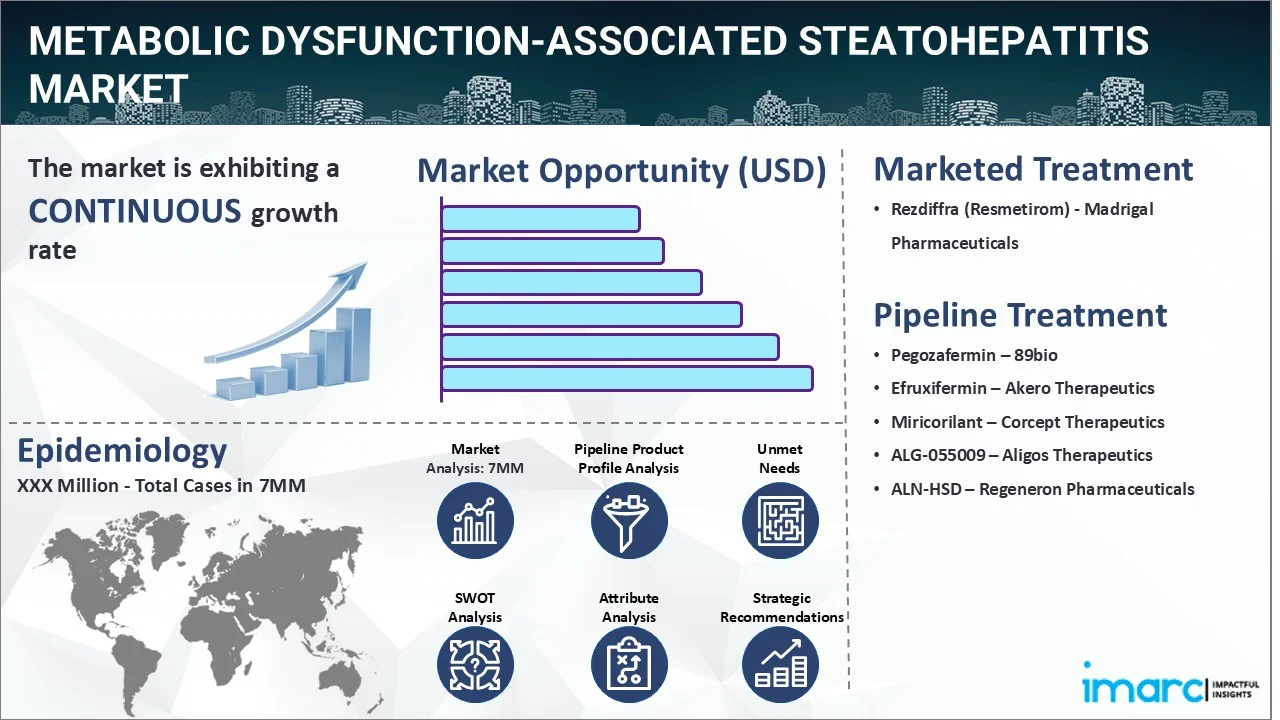
The 7 major metabolic dysfunction-associated steatohepatitis markets reached a value of USD 3,106.9 Million in 2025. Looking forward, IMARC Group expects the 7MM to reach USD 25,824.7 Million by 2036, exhibiting a growth rate (CAGR) of 21.29% during 2026-2036.
|
Report Attribute
|
Key Statistics
|
|---|---|
| Base Year | 2025 |
| Forecast Years | 2026-2036 |
| Historical Years |
2020-2025
|
|
Market Size in 2025
|
USD 3,106.9 Million |
|
Market Forecast in 2036
|
USD 25,824.7 Million |
|
Market Growth Rate 2026-2036
|
21.29% |
The metabolic dysfunction-associated steatohepatitis market has been comprehensively analyzed in IMARC's new report titled "Metabolic Dysfunction-Associated Steatohepatitis Market Size, Epidemiology, In-Market Drugs Sales, Pipeline Therapies, and Regional Outlook 2026-2036". MASH is a liver condition in which fat levels start accumulating inside the liver, this causes inflammation leading to liver damage. It is caused due to metabolic disorders associated with elevated blood sugar, obesity, and high blood cholesterol. It is a form of fatty liver disease, but it doesn't require extensive alcohol consumption. There may be no immediate signs of MASH at presentation, and then it may be two weeks or longer for the symptoms to start showing up throughout the remaining duration of the illness. Moderate MASH is associated with pain in the right upper quadrant; fatigue; weakness; anorexia; weight loss occurring for no apparent reason. Symptoms can worsen considerably in advanced cases, including easy bruising or bleeding, jaundice due to liver failure, swollen lymph nodes, continuing itching, an enlargement of the liver or spleen, mental confusion, drowsiness, and slurred speech. Diagnosing MASH involves clinical assessments, family history, blood tests, and liver stiffness measurements. Imaging techniques like abdominal ultrasounds and CT scans are used by doctors to confirm the presence of fat in the liver.
To get more information on this market Request Sample
The rising rate of metabolic syndrome, a condition characterized by obesity, hypertension, and high cholesterol that leads to fat deposition in the liver, inflammation, and scarring is driving the market for metabolic dysfunction-associated steatohepatitis. The other support factor for the market growth is the action of THR-beta agonists, such as resmetirom, that can reverse the course of the disease by regulating lipid metabolism in the liver. The increasing use of dietary supplements such as vitamin E, omega-3 fatty acids, and silymarin, said to help ameliorate disease symptoms and improve liver health, further drives market growth. Moreover, the increased acceptance of bypass surgery for the severely obese is another key driver. It has a profound effect on gut hormones, such as glucagon-like peptide-1, that improve insulin sensitivity and inhibit liver inflammation. Also, increasing awareness of stem cell therapy is going to give momentum to the entire metabolic dysfunction-associated steatohepatitis market in the forecast period, together with a probability of regenerating liver tissue, lessening fibrosis, and improving liver function.
IMARC Group's new report provides an exhaustive analysis of the metabolic dysfunction-associated steatohepatitis market in the United States, EU4 (Germany, Spain, Italy and France), United Kingdom and Japan. This includes treatment practices, in-market, and pipeline drugs, share of individual therapies, market performance across the seven major markets, market performance of key companies and their drugs, etc. The report also provides the current and future patient pool across the seven major markets. According to the report the United States has the largest patient pool for metabolic dysfunction-associated steatohepatitis and also represents the largest market for its treatment. Furthermore, the current treatment practice/algorithm, market drivers, challenges, opportunities, reimbursement scenario and unmet medical needs, etc. have also been provided in the report. This report is a must-read for manufacturers, investors, business strategists, researchers, consultants, and all those who have any kind of stake or are planning to foray into the metabolic dysfunction-associated steatohepatitis market in any manner.
Recent Developments:
- In September 2025, Roche announced the acquisition of 89bio in a deal valued at up to US$ 3.5 Billion, aiming to strengthen its presence in metabolic dysfunction-associated steatohepatitis (MASH) through 89bio’s late-stage candidate Pegozafermin, which is expected to deliver best-in-disease efficacy and compete in the rapidly growing MASH treatment landscape.
- In August 2025, Novo Nordisk received accelerated approval from the U.S. Food and Drug Administration for Wegovy to treat patients with metabolic dysfunction-associated steatohepatitis (MASH) and moderate-to-advanced liver fibrosis, based on Phase III data demonstrating improvements in liver scarring and disease resolution.
- In January 2025, Akero Therapeutics, Inc. publicly disclosed the topline early results week 96 of SYMMETRY, a Phase 2b clinical trial evaluating the safety and effectiveness of efruxifermin (EFX), its lead product candidate, in patients diagnosed with Child-Pugh Class A, or compensated cirrhosis (F4), which is attributed to metabolic dysfunction-associated steatohepatitis (MASH). Among patients with baseline and week 96 biopsies (n=134), 39% of those treated with 50mg EFX (n=46) (p=0.009) showed cirrhosis reversal with no worsening of MASH, compared to 15% who received placebo (n=47).
Drugs:
Rezdiffra is administered to the patient with metabolic dysfunction-associated steatohepatitis and with moderate to severe liver fibrosis, in conjunction with diet and exercise. Rezdiffra works as a partial agonist of the thyroid hormone receptor beta, which is predominantly expressed by the cells in the liver, and regulates the genes that function in lipid metabolism. This therefore results in decreasing intrahepatic triglycerides and enhances liver health due to the reduced liver fat.
Pegozafermin, developed by 89bio, acts by mimicking the naturally occurring protein fibroblast growth factor 21 (FGF21) which predominantly targets the liver. The medicine has anti-inflammatory and anti-fibrotic properties that reduce liver fat accumulation, enhance insulin sensitivity, and lower triglyceride levels, assisting in the treatment of metabolic dysfunction-associated steatohepatitis by targeting key drivers of hepatic fibrosis and inflammation. Its mechanism includes processes such as enhanced adiponectin synthesis and enhanced free fatty acid management in the liver.
Efruxifermin, developed by Akero Therapeutics, mimics the natural activity of the metabolic hormone fibroblast growth factor 21 (FGF21), binding to its receptors in the cells of the liver and adipose tissue to alter metabolic pathways, thus reducing hepatic fat accumulation, inflammation, and fibrosis, all of which are hallmarks of MASH. Essentially, it functions as an FGF21 agonist, increasing insulin sensitivity and lipid profiles while addressing many elements of MASH disease progression via a whole-body approach.
Miricorilant is a drug developed by Corcept Therapeutics, which acts as a selective glucocorticoid receptor modulator (SGRM) and mineralocorticoid receptor antagonist. It mainly works through interaction with these receptors in the liver, thereby reducing the buildup of hepatic fat and probably improving metabolic indicators, thus becoming a potential therapy for metabolic dysfunction-associated steatohepatitis.
ALG-055009 is the best-in-class thyroid hormone receptor beta agonist intended for use in the management of metabolic dysfunction-associated steatohepatitis. It achieves its effect through the inhibition of APOC3, the protein that influences lipid metabolism. The inhibition of APOC3 by ALG-055009 restores the normal lipid metabolism and reduces liver fat accumulation to enhance insulin sensitivity, thereby minimizing inflammation and fibrosis.
Time Period of the Study
- Base Year: 2025
- Historical Period: 2020-2025
- Market Forecast: 2026-2036
Countries Covered
- United States
- Germany
- France
- United Kingdom
- Italy
- Spain
- Japan
Analysis Covered Across Each Country
- Historical, current, and future epidemiology scenario
- Historical, current, and future performance of the metabolic dysfunction-associated steatohepatitis market
- Historical, current, and future performance of various therapeutic categories in the market
- Sales of various drugs across the metabolic dysfunction-associated steatohepatitis market
- Reimbursement scenario in the market
- In-market and pipeline drugs
Competitive Landscape:
This report also provides a detailed analysis of the current metabolic dysfunction-associated steatohepatitis marketed drugs and late-stage pipeline drugs.
In-Market Drugs
- Drug Overview
- Mechanism of Action
- Regulatory Status
- Clinical Trial Results
- Drug Uptake and Market Performance
Late-Stage Pipeline Drugs
- Drug Overview
- Mechanism of Action
- Regulatory Status
- Clinical Trial Results
- Drug Uptake and Market Performance
| Drugs | Company Name |
|---|---|
| Rezdiffra (Resmetirom) | Madrigal Pharmaceuticals |
| Pegozafermin | 89bio |
| Efruxifermin | Akero Therapeutics |
| Miricorilant | Corcept Therapeutics |
| ALG-055009 | Aligos Therapeutics |
| ALN-HSD | Regeneron Pharmaceuticals |
*Kindly note that the drugs in the above table only represent a partial list of marketed/pipeline drugs, and the complete list has been provided in the report.
Key Questions Answered in this Report:
Market Insights
- How has the metabolic dysfunction-associated steatohepatitis market performed so far and how will it perform in the coming years?
- What are the markets shares of various therapeutic segments in 2025 and how are they expected to perform till 2036?
- What was the country-wise size of the metabolic dysfunction-associated steatohepatitis market across the seven major markets in 2025 and what will it look like in 2036?
- What is the growth rate of the metabolic dysfunction-associated steatohepatitis market across the seven major markets and what will be the expected growth over the next ten years?
- What are the key unmet needs in the market?
Epidemiology Insights
- What is the number of prevalent cases (2020-2036) of metabolic dysfunction-associated steatohepatitis across the seven major markets?
- What is the number of prevalent cases (2020-2036) of metabolic dysfunction-associated steatohepatitis by age across the seven major markets?
- What is the number of prevalent cases (2020-2036) of metabolic dysfunction-associated steatohepatitis by gender across the seven major markets?
- How many patients are diagnosed (2020-2036) with metabolic dysfunction-associated steatohepatitis across the seven major markets?
- What is the size of the metabolic dysfunction-associated steatohepatitis patient pool (2020-2025) across the seven major markets?
- What would be the forecasted patient pool (2026-2036) across the seven major markets?
- What are the key factors driving the epidemiological trend of metabolic dysfunction-associated steatohepatitis?
- What will be the growth rate of patients across the seven major markets?
Metabolic Dysfunction-Associated Steatohepatitis: Current Treatment Scenario, Marketed Drugs and Emerging Therapies
- What are the current marketed drugs and what are their market performance?
- What are the key pipeline drugs and how are they expected to perform in the coming years?
- How safe are the current marketed drugs and what are their efficacies?
- How safe are the late-stage pipeline drugs and what are their efficacies?
- What are the current treatment guidelines for metabolic dysfunction-associated steatohepatitis drugs across the seven major markets?
- Who are the key companies in the market and what are their market shares?
- What are the key mergers and acquisitions, licensing activities, collaborations, etc. related to the metabolic dysfunction-associated steatohepatitis market?
- What are the key regulatory events related to the metabolic dysfunction-associated steatohepatitis market?
- What is the structure of clinical trial landscape by status related to the metabolic dysfunction-associated steatohepatitis market?
- What is the structure of clinical trial landscape by phase related to the metabolic dysfunction-associated steatohepatitis market?
- What is the structure of clinical trial landscape by route of administration related to the metabolic dysfunction-associated steatohepatitis market?
Need more help?
- Speak to our experienced analysts for insights on the current market scenarios.
- Include additional segments and countries to customize the report as per your requirement.
- Gain an unparalleled competitive advantage in your domain by understanding how to utilize the report and positively impacting your operations and revenue.
- For further assistance, please connect with our analysts.
 Inquire Before Buying
 Speak to an Analyst
 Request Brochure
 Request Customization
Benefits of Customization
- Personalize this research
- Triangulate with your data
- Get data as per your format and definition
- Gain a deeper dive into a specific application, geography, customer, or competitor
- Any level of personalization
Get in Touch With Us
UNITED STATES
Phone: +1-201-971-6302
INDIA
Phone: +91-120-433-0800
UNITED KINGDOM
Phone: +44-753-714-6104
Email: [email protected]
Client Testimonials




.webp)




.webp)













Related Reports

Choose your plan
*Please note that the prices mentioned below are starting prices for each bundle type. Kindly contact our team for further details.*
Single User License
- 1 User License, Access on 2 Devices
- PDF Report + Excel Dataset (Password Protected)
- Lifetime Access
- No Printing Rights
- 10% Free Report Customization
- 10–12 Weeks of Analyst Support
Five User License
- Access for 5 Users, 2 Devices per User
- PDF Report + Excel Dataset (Password Protected)
- Lifetime Access
- Dedicated Account Manager
- 12–14 Weeks of Analyst Support
- No Printing Rights
- 15% Free Report Customization
- 25% Discount on Your Next Purchase
Corporate User License
- Unlimited User Access (Within Your Organization)
- PDF Report + Excel Dataset
- Lifetime Access
- Dedicated Account Manager
- 14–20 Weeks of Analyst Support
- No Printing Rights
- 20% Free Report Customization
- 30% Discount on Your Next Purchase
Essential Insights
What's included:
3 reports
- Lifetime Access
- PDF Reports
- Excel Datasets
- 2 Weeks of Free Analyst Support
- 2 User Licenses
- Access on 2 Devices
- Printing Rights
- Complimentary PowerPoint (PPT) Version
- Complimentary License Upgrade
Professional Access
What's included:
5 reports
- Lifetime Access
- PDF Reports
- Excel Datasets
- 8 Weeks of Free Analyst Support
- 2 User Licenses
- Access on 2 Devices
- Printing Rights
- Complimentary PowerPoint (PPT) Version
- Complimentary License Upgrade
Business Advantage
What's included:
8 reports
- Lifetime Access
- PDF Reports
- Excel Datasets
- 14 Weeks of Free Analyst Support
- 2 User Licenses
- Access on 2 Devices
- Printing Rights
- Complimentary PowerPoint (PPT) Version
- Complimentary License Upgrade
Enterprise Intelligence
What's included:
10 reports
- Lifetime Access
- PDF Reports
- Excel Datasets
- 20 Weeks of Free Analyst Support
- 2 User Licenses
- Access on 2 Devices
- Printing Rights
- Complimentary PowerPoint (PPT) Version
- Complimentary License Upgrade