
Methyl Acetate Market Size, Share, Trends and Forecast by Purity, End Use, and Region, 2026-2034
Methyl Acetate Market Size, Share, Trends & Forecast (2026-2034)
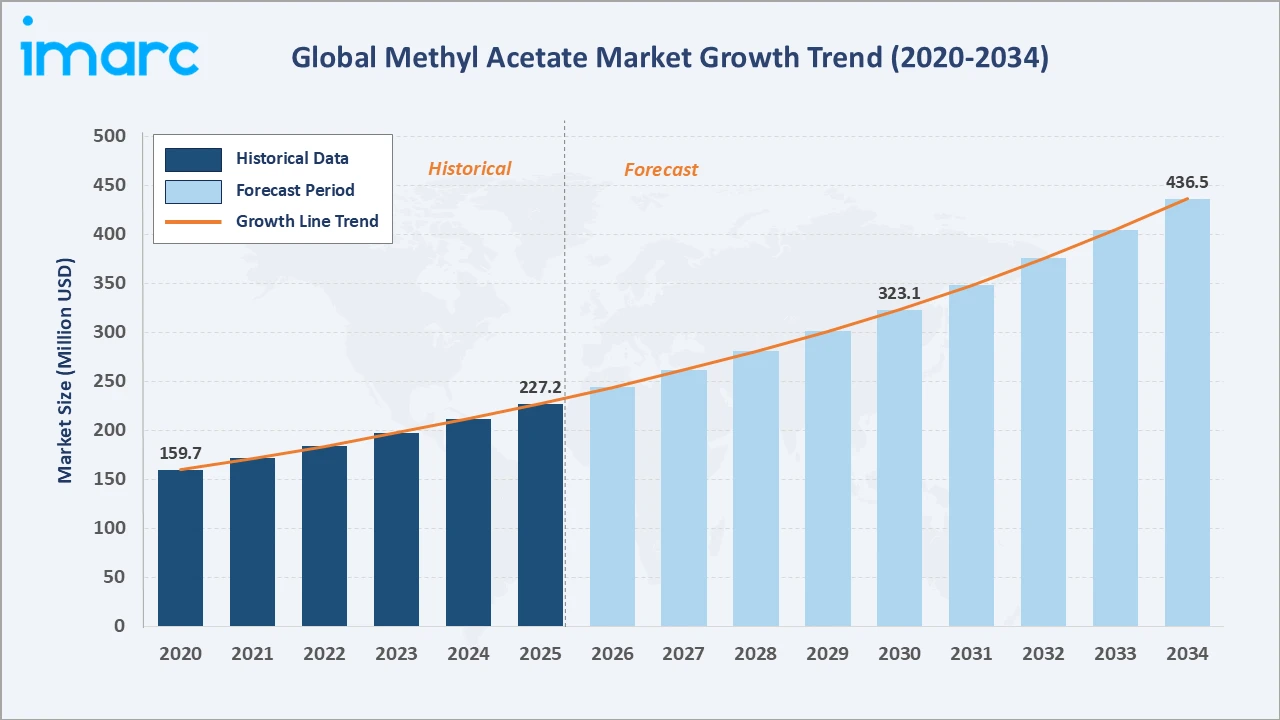
The methyl acetate market was valued at USD 227.2 Million in 2025 and is projected to reach USD 436.5 Million by 2034, exhibiting a CAGR of 7.30% during 2026-2034. Rising paints and coatings consumption, expanding printing ink applications, and tightening low-VOC solvent regulations are the primary factors driving the methyl acetate market growth.
99.9% purity leads the purity segment at 44.3% in 2025, paints and coatings dominate the end use segment at 48.4%, and Asia-Pacific commands 41.2% of the regional share.
Market Snapshot
|
Metric |
Value |
|
Market Size (2025) |
USD 227.2 Million |
|
Forecast Market Size (2034) |
USD 436.5 Million |
|
CAGR (2026-2034) |
7.30% |
|
Base Year |
2025 |
|
Historical Period |
2020-2025 |
|
Forecast Period |
2026-2034 |
|
Largest Region |
Asia-Pacific (41.2%, 2025) |
|
Second Largest Region |
Europe (25.8%, 2025) |
|
Leading Purity |
99.9% Purity (44.3%, 2025) |
|
Leading End Use |
Paints and Coatings (48.4%, 2025) |
The methyl acetate market expanded from USD 159.7 Million in 2020 to USD 227.2 Million in 2025, driven by steady recovery in industrial manufacturing, rising coatings consumption, and broader adoption of low-toxicity solvents across end-use sectors. Anchored at USD 323.1 Million in 2030, the forecast to USD 436.5 Million by 2034 is supported by accelerating high-purity grade demand, expanding personal care applications, and continued growth in Asia-Pacific manufacturing capacity.
To get more information on this market, Request Sample
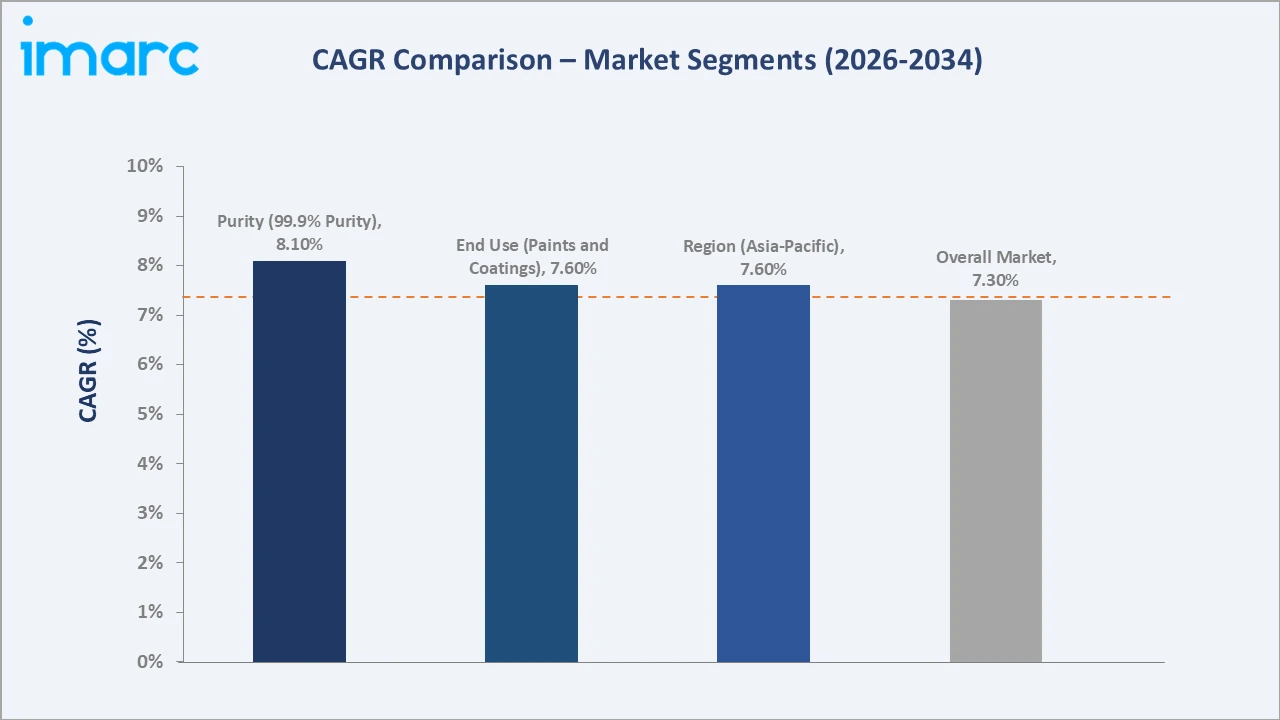
CAGR trajectories across purity and end use sub-segments show personal care industry and 99.9% purity expanding faster than the overall 7.30% market CAGR, driven by premium formulation requirements, stricter purity specifications, and rising demand for high-performance solvent-grade methyl acetate.
Executive Summary
The methyl acetate market is on a steady growth trajectory, expanding from USD 159.7 Million in 2020 to USD 436.5 Million by 2034. The market has evolved from a commodity industrial solvent into a purity-graded specialty chemical serving coatings, printing, and personal care formulators. Affordable methanol and acetic acid feedstock availability, combined with methyl acetate's low-toxicity and fast-evaporation profile, continue to support broad-based adoption across manufacturing sectors.
99.9% purity leads the purity segment at 44.3% in 2025, supported by rising demand from high-specification coatings and personal care formulators requiring low-impurity solvent grades. Paints and coatings dominate the end use segment at 48.4%, fueled by construction activity and industrial finishing applications. Asia-Pacific commands 41.2% of the regional share, led by expanding chemical manufacturing capacity, large-scale construction activity, and growing personal care production across China and India.
Key Market Insights
|
Insight |
Data |
|
Leading Purity |
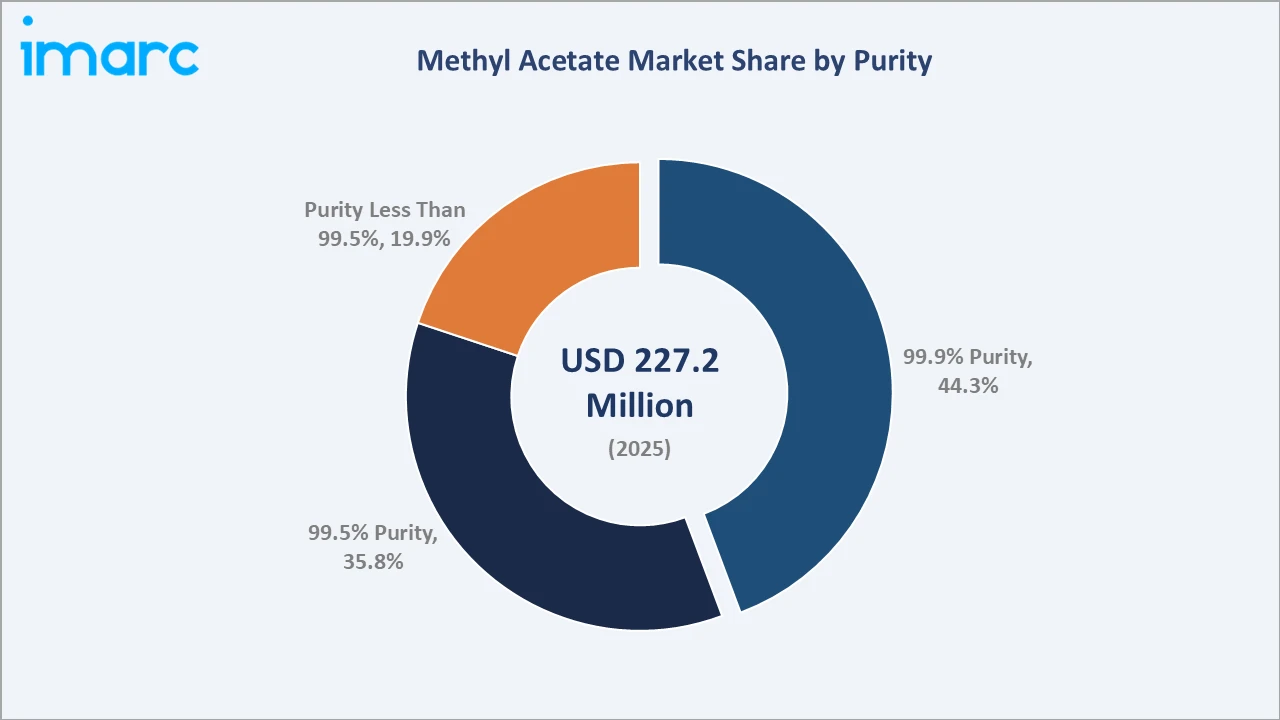
99.9% Purity - 44.3% share (2025) |
|
Second Largest Purity |
99.5% Purity - 35.8% share (2025) |
|
Leading End Use |
Paints and Coatings - 48.4% share (2025) |
|
Second Largest End Use |
Inks - 23.7% share (2025) |
|
Leading Region |
Asia-Pacific - 41.2% share (2025) |
|
Top Companies |
BASF SE, Celanese Corporation, Eastman Chemical Company, Wacker Chemie AG |
Key Analytical Observations Supporting the Above Data:
- 99.9% purity dominance at 44.3% is supported by rising demand from electronics-grade cleaning, pharmaceutical processing, and premium coatings that require minimal impurity content in the solvent stream.
- 99.5% purity at 35.8% remains the standard industrial workhorse grade, balancing cost efficiency with adequate performance for general paints, coatings, and ink formulations.
- Paints and coatings leadership at 48.4% is reinforced by rising construction and industrial finishing activity. As per the United States Census Bureau, in May 2026, the projected seasonally adjusted yearly rate of public construction spending reached USD 541.2 Billion, 0.5 percent (±1.5 percent) higher than the revised April figure of USD 538.6 Billion.
- Inks share at 23.7% benefits from continued packaging and commercial printing demand, where methyl acetate's fast evaporation rate supports high-speed press operations.
- Asia-Pacific leadership at 41.2% is anchored by China, India, and Southeast Asia, supported by large-scale chemical manufacturing capacity and expanding downstream coatings and personal care production.
Methyl Acetate Market Overview
Methyl acetate is a colorless, fast-evaporating ester produced through the esterification of methanol and acetic acid, valued across industrial and consumer applications for its low toxicity and favorable solvency profile. Its rapid drying characteristics and compatibility with a wide range of formulations make it a preferred solvent in coatings, inks, adhesives, and personal care products.
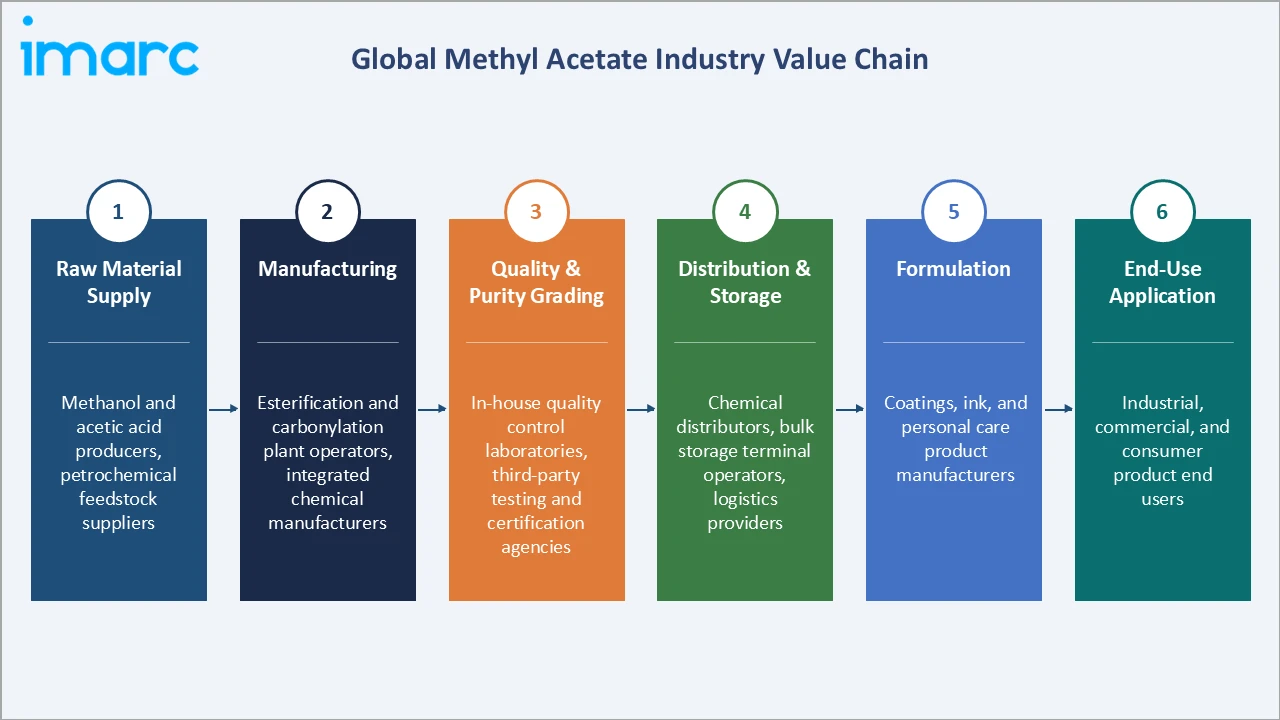
The methyl acetate ecosystem integrates upstream methanol and acetic acid producers, esterification and carbonylation plant operators, coatings and ink formulators, personal care manufacturers, chemical distributors, and regulatory bodies overseeing solvent safety and emissions standards. Together, these participants enable the reliable, compliant supply of methyl acetate across paints, printing, and personal care value chains worldwide.
Market Dynamics
To evaluate market opportunities, Request Sample
Market Drivers
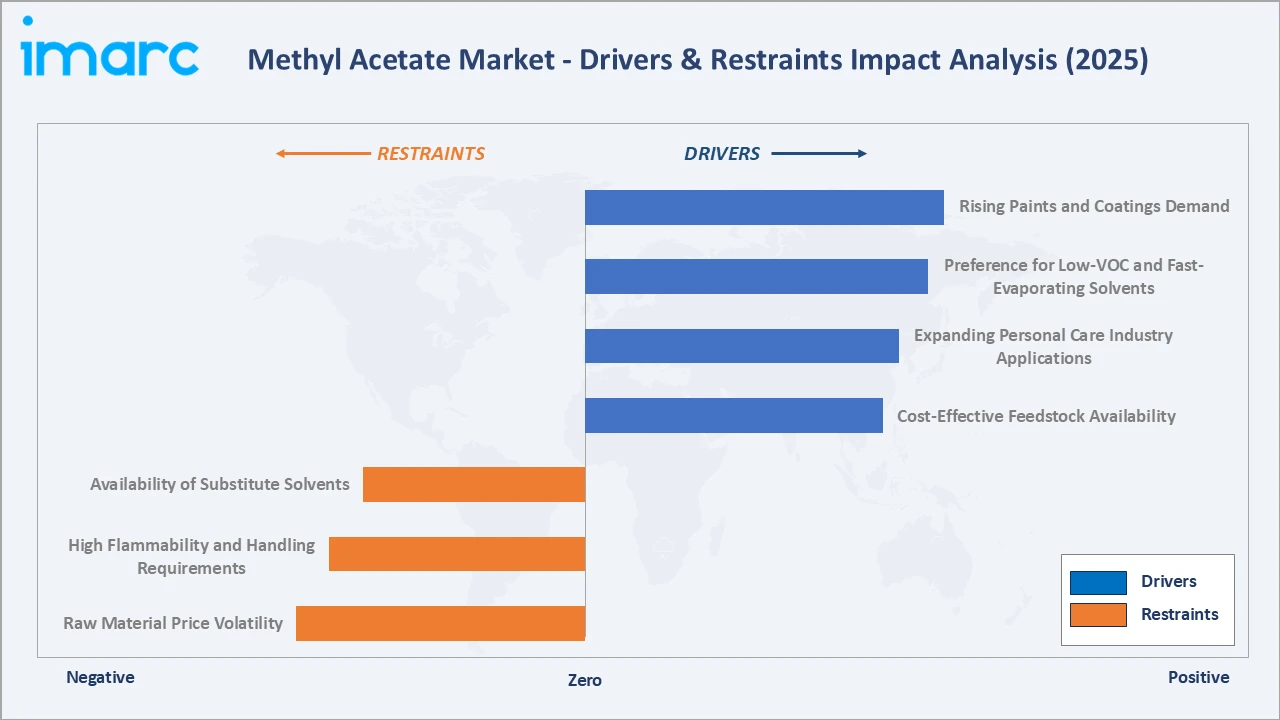
- Rising Paints and Coatings Demand: Sustained construction activity and industrial finishing requirements are driving consistent consumption of methyl acetate as a fast-drying solvent in coating formulations.
- Expanding Personal Care Industry Applications: As per IMARC Group, the global cosmetics market size was valued at USD 439.1 Billion in 2025. Growing consumer demand for cosmetics, fragrances, and personal care products is increasing the use of methyl acetate as a solvent in formulations. Its fast evaporation, low odor, and effective solvency make it well suited for a wide range of beauty and personal care applications.
- Cost-Effective Feedstock Availability: Widely available methanol and acetic acid feedstocks support stable production economics, enabling manufacturers to scale capacity with rising downstream demand.
- Preference for Low-VOC and Fast-Evaporating Solvents: Manufacturers are increasingly adopting methyl acetate as a solvent that supports lower VOC formulations while delivering rapid drying performance across coatings, inks, and specialty chemical applications.
Market Restraints
- Raw Material Price Volatility: Methyl acetate production costs remain sensitive to upstream feedstock pricing. Fluctuations in methanol and acetic acid prices can affect manufacturing margins and create uncertainty in procurement and pricing strategies across the supply chain.
- High Flammability and Handling Requirements: Methyl acetate's low flash point necessitates specialized storage and handling infrastructure, increasing compliance costs for manufacturers and formulators.
- Availability of Substitute Solvents: Alternative esters and low-VOC solvent chemistries compete for formulation share, moderating methyl acetate's addressable market in price-sensitive segments.
Market Opportunities
- High-Purity Grade Expansion: Rising demand for 99.9% purity material in electronics, pharmaceutical, and premium personal care formulations creates opportunities for higher-margin specialty grades.
- Bio-Based and Renewable Feedstock Development: Growing interest in renewable methanol and bio-based acetic acid pathways enables manufacturers to develop lower-carbon methyl acetate grades.
Market Challenges
- Fragmented Regional Regulatory Standards: Differing VOC exemption and chemical safety classifications across regions create compliance complexity for manufacturers supplying multiple geographic markets.
- Energy-Intensive Production Processes: Esterification and carbonylation processes require significant energy input, exposing producers to margin pressure during periods of elevated energy costs.
Emerging Market Trends
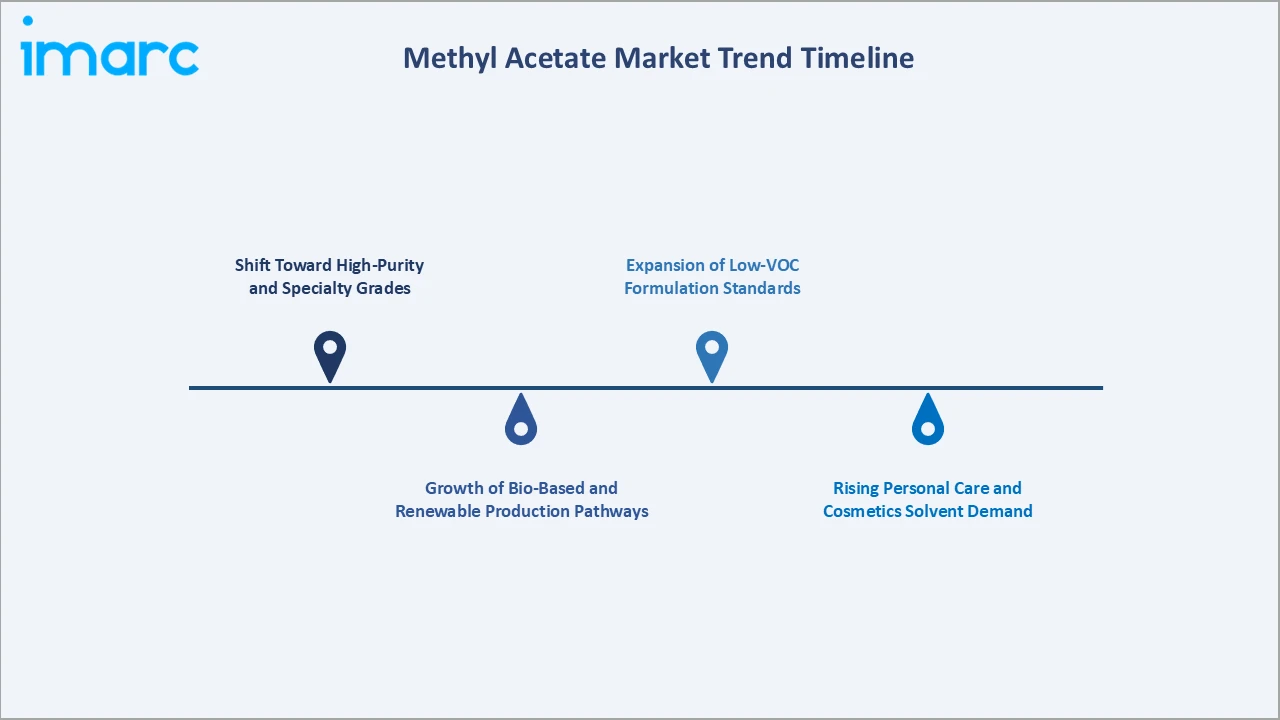
1. Shift Toward High-Purity and Specialty Grades
Formulators across electronics, pharmaceutical, and premium personal care applications are increasingly specifying 99.9% purity methyl acetate, prompting manufacturers to expand dedicated high-purity production and quality-testing capacity.
2. Growth of Bio-Based and Renewable Production Pathways
Manufacturers are investing in renewable methanol and bio-based acetic acid feedstocks to reduce the carbon footprint of methyl acetate production. This shift supports sustainability objectives while helping manufacturers meet evolving environmental regulations and customer demand for greener chemical products.
3. Expansion of Low-VOC Formulation Standards
Regulatory bodies across North America, Europe, and Asia-Pacific continue to tighten VOC emissions standards, reinforcing methyl acetate's position as a compliant, exempt-status solvent alternative in coatings and cleaning formulations.
4. Rising Personal Care and Cosmetics Solvent Demand
Growing consumer preference for biodegradable, low-toxicity ingredients is expanding methyl acetate's use in nail care, fragrance, and cosmetic product formulations across developed and emerging markets alike.
Industry Value Chain Analysis
The methyl acetate value chain spans six stages, from feedstock supply through end use application. Manufacturing and quality grading capture the highest value-add, while distribution and storage infrastructure increasingly determine sustainable competitive position given the compound's flammability profile.
|
Stage |
Key Players / Examples |
|
Raw Material Supply |
Methanol and acetic acid producers, petrochemical feedstock suppliers |
|
Manufacturing |
Esterification and carbonylation plant operators, integrated chemical manufacturers |
|
Quality & Purity Grading |
In-house quality control laboratories, third-party testing and certification agencies |
|
Distribution & Storage |
Chemical distributors, bulk storage terminal operators, logistics providers |
|
Formulation |
Coatings, ink, and personal care product manufacturers |
|
End Use Application |
Industrial, commercial, and consumer product end users |
Vertically integrated producers, especially those with direct access to methanol and acetic acid feedstocks, are positioned to capture greater value than formulators reliant on third-party solvent supply.
Technology Landscape in the Methyl Acetate Industry
Esterification and Carbonylation Process Innovation
Manufacturers are refining continuous esterification and carbonylation processes to improve conversion efficiency and reduce byproduct formation. These process upgrades support higher yields per unit of methanol and acetic acid feedstock, improving overall production economics across both industrial and specialty grades.
Purity Enhancement and Quality Control Technologies
Advanced distillation and moisture-control systems are enabling producers to consistently achieve 99.9% purity specifications required by electronics, pharmaceutical, and premium personal care customers. In-line analytical monitoring is reducing batch-to-batch variability and shortening quality release cycles.
Sustainable and Bio-Based Production Methods
Interest in renewable methanol and bio-based acetic acid feedstocks is growing as manufacturers respond to customer sustainability requirements. Early-stage bio-based methyl acetate production pathways are being piloted to reduce lifecycle carbon intensity while maintaining solvent performance.
Market Segmentation Analysis
The report covers the following segments:
|
Segment Category |
Leading Segment |
Market Share |
Year |
|
Purity |
99.9% Purity |
44.3% |
2025 |
|
End Use |
Paints and Coatings |
48.4% |
2025 |
|
Region |
Asia-Pacific |
41.2% |
2025 |

By Purity
99.9% purity commands a 44.3% share in 2025, driven by rising specification requirements from electronics cleaning, pharmaceutical processing, and premium coatings and personal care formulators. The segment benefits from manufacturers' continued investment in advanced distillation and quality-control capacity.
To access detailed market analysis, Request Sample
99.5% purity holds a 35.8% share in 2025 and remains the standard industrial workhorse grade for general paints, coatings, and ink applications.
By End Use
Paints and coatings lead the end use segment with a 48.4% share in 2025, supported by sustained construction activity, industrial finishing requirements, and methyl acetate's fast-drying, low-toxicity solvency profile. The segment continues to benefit from regulatory tailwinds favoring VOC-exempt solvent alternatives.
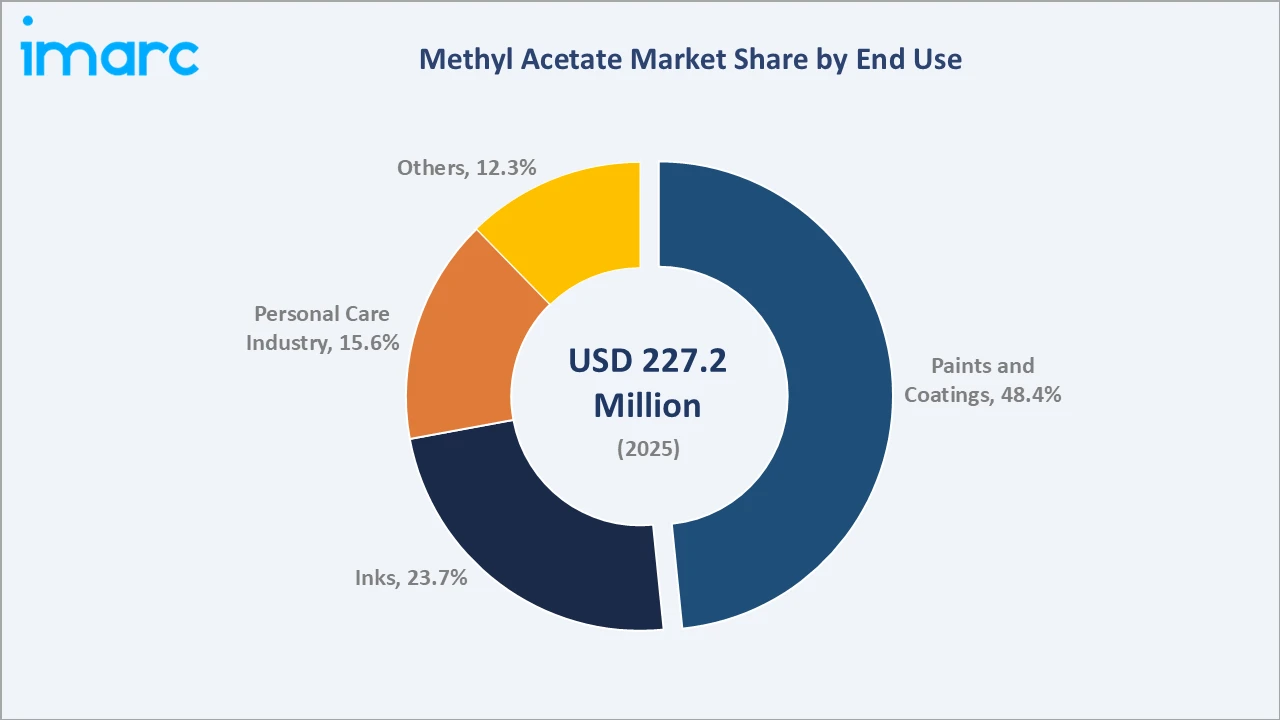
Inks account for 23.7% of end use demand in 2025, reflecting sustained packaging and commercial printing activity. The segment also benefits from methyl acetate's fast evaporation rate and compatibility with a wide range of printing formulations.
Regional Market Insights
|
Region |
Share (2025) |
Key Growth Drivers |
|
Asia-Pacific |
41.2% |
Large chemical manufacturing base and growing downstream coatings and personal care production |
|
Europe |
25.8% |
Established coatings industry and strict low-VOC regulatory standards |
|
North America |
20.4% |
Advanced industrial coatings sector and strong regulatory support for VOC-exempt solvents |
|
Latin America |
6.7% |
Growing construction and automotive coatings activity and rising personal care consumption |
|
Middle East and Africa |
5.9% |
Expanding petrochemical feedstock access and rising construction investment |
Asia-Pacific at 41.2% in 2025 leads the regional landscape, anchored by China, India, and Southeast Asia. Large-scale chemical manufacturing capacity, expanding construction activity, and growing downstream coatings and personal care production support sustained regional leadership through the forecast period.
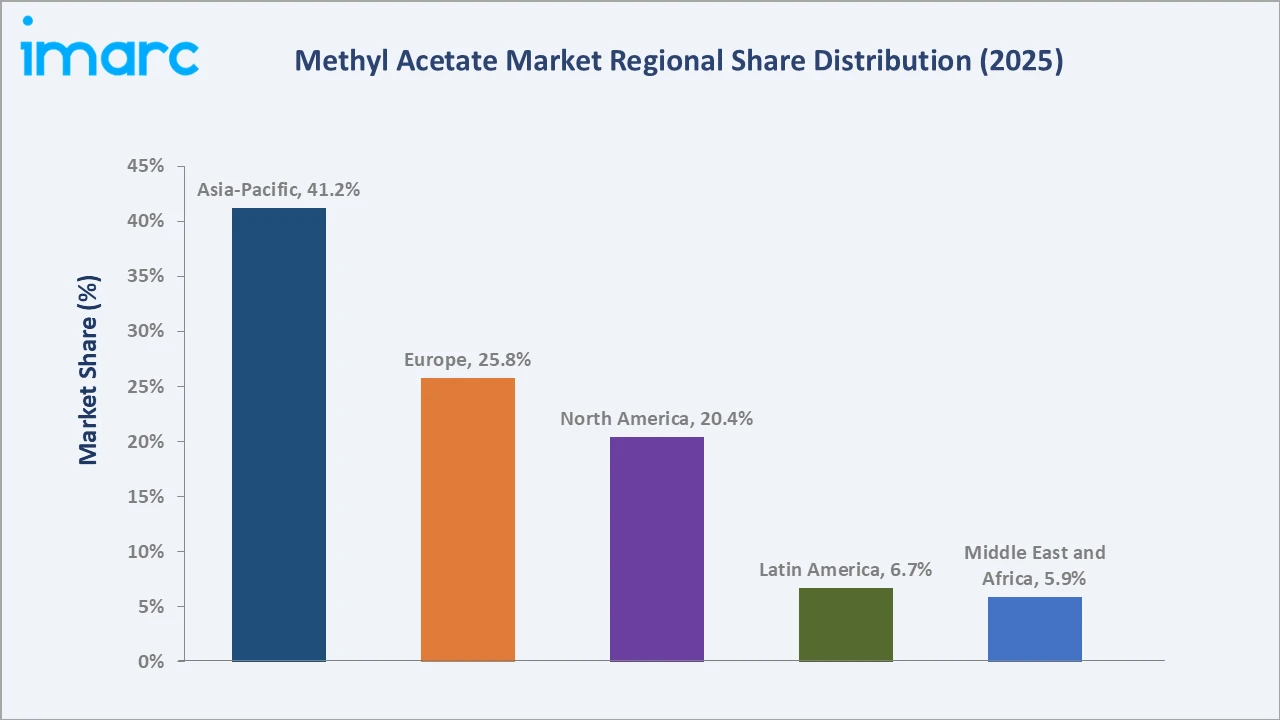
Middle East and Africa, while currently the smallest regional segment at 5.9%, is the fastest growing region. Growing petrochemical feedstock access, rising construction and infrastructure investment, and emerging personal care manufacturing are accelerating regional expansion through 2034.
Competitive Landscape
The methyl acetate market is moderately fragmented, with large integrated chemical producers leading on feedstock access and production scale, while specialty and regional manufacturers compete on purity grades and application-specific formulation support. Feedstock integration, production scale, and purity-grade capability form the key competitive moats in this market.
|
Company Name |
Brand / Key Product |
Position |
Strategic Focus |
|
BASF SE |
Methyl acetate 70% |
Leader |
Global scale production with integrated feedstock access |
|
Celanese Corporation |
Methyl Acetate 99.5% |
Leader |
Vertically integrated acetyl chain producer with specialty grade capacity |
|
Eastman Chemical Company |
Eastman Methyl Acetate - High Purity |
Leader |
Specialty materials producer focused on sustainable, low-VOC solutions |
|
Wacker Chemie AG |
Wacker Chemie Methyl Acetate (MetAc) 99.5% |
Challenger |
Technology-driven producer focused on high-purity grade offerings |
Key players include BASF SE, Celanese Corporation, Eastman Chemical Company, and Wacker Chemie AG, among others.
-by-ishita-trivedi.webp)
Key Company Profiles
BASF SE
BASF SE is a global chemical company headquartered in Ludwigshafen, Germany, with operations spanning chemicals, materials, industrial solutions, and additional business segments worldwide.
- Product Portfolio: Methyl acetate 70% and related intermediate chemicals supplied for industrial and coatings applications.
- Recent Developments: BASF SE continues to strengthen its solvent and intermediates portfolio through process optimization, supply chain efficiency improvements, and investments in sustainable chemical production.
- Strategic Focus: Expanding sustainable solvent production, improving operational efficiency, and strengthening supply reliability for coatings, chemical, and industrial applications.
Celanese Corporation
Celanese Corporation is a global chemical and specialty materials company headquartered in Irving, Texas, United States, with operations spanning its engineered materials and acetyl chain businesses.
- Product Portfolio: Methyl Acetate 99.5% and related acetyl chain products supplied to industrial and specialty formulators.
- Recent Developments: The firm continues to optimize its global production network and cost structure to support its acetyl chain business.
- Strategic Focus: Strengthening the acetyl chain business through operational efficiency, expanding specialty chemical offerings, and ensuring reliable supply to coatings, adhesives, and industrial solvent markets.
Eastman Chemical Company
Eastman Chemical Company is a global specialty materials company headquartered in Kingsport, Tennessee, United States, operating through its advanced materials, chemical intermediates, and fibers segments.
- Product Portfolio: Eastman Methyl Acetate - High Purity, supplied for coatings and ink formulation applications.
- Recent Developments: The firm continues to expand its portfolio of sustainable, low-emission solvent solutions for global customers.
- Strategic Focus: Advancing sustainable solvent technologies, expanding high-purity chemical offerings, and strengthening its position in coatings, inks, and specialty industrial applications.
Market Concentration Analysis
The methyl acetate market is moderately concentrated, with the top five producers, including BASF SE, Celanese Corporation, Eastman Chemical Company, and Wacker Chemie AG, accounting for a meaningful share of global production through integrated feedstock access.
Barriers to entry include significant capital investment in esterification and carbonylation infrastructure, the need for reliable methanol and acetic acid feedstock access, and compliance with regional VOC and chemical safety regulations. These factors favor established, well-capitalized producers with integrated production networks.
Consolidation is expected to continue gradually as larger producers expand high-purity grade capacity and smaller regional players focus on niche, application-specific formulations. Strategic partnerships between producers and downstream coatings and personal care formulators are reinforcing competitive positioning across purity-graded segments of the market.
Investment & Growth Opportunities
Fastest-Growing Segments
Personal care industry and 99.9% purity segments are expanding fastest, driven by rising specification requirements and growing global demand for biodegradable, low-toxicity cosmetic solvents. Growing preference for premium formulations and higher-quality solvent performance continues to support demand across both segments.
Emerging Markets
Middle East and Africa is the fastest growing region, anchored by expanding petrochemical feedstock access and rising construction investment. Latin America represents significant untapped opportunity for producers able to build regional distribution and application support capabilities.
Venture & Investment Trends
Investment activity is concentrated in high-purity production capacity expansion, renewable feedstock development, and downstream application partnerships with coatings and personal care formulators. Capital is also flowing into quality-control and analytical testing infrastructure that supports consistent 99.9% purity grade supply.
Future Market Outlook (2026-2034)
The methyl acetate market is forecast to expand from USD 227.2 Million in 2025 to USD 436.5 Million by 2034 at a CAGR of 7.30%, adding roughly USD 209.3 Million in incremental market value over the forecast period.
Four forces will shape the market through 2034: tightening low-VOC solvent regulations; rising demand for high-purity grades from electronics, pharmaceutical, and personal care formulators; deeper integration with downstream coatings and ink manufacturers; and gradual adoption of bio-based feedstock pathways.
By 2034, the methyl acetate market is expected to be defined by greater purity-grade differentiation, with 99.9% purity material accounting for a meaningfully higher share of overall demand. Regulatory support for VOC-exempt solvents, expanding personal care applications, and sustained Asia-Pacific manufacturing growth are expected to further accelerate market expansion.
Research Methodology
Primary Research
Primary research included structured interviews with chemical manufacturing executives, coatings and personal care formulators, chemical distributors, and regulatory specialists, validating market sizing, purity-grade demand, and end use application trends.
Secondary Research
Secondary sources included regulatory publications from the United States Environmental Protection Agency and European Chemicals Agency, government energy and urbanization data, industry association publications, and company annual reports and investor presentations from listed chemical producers.
Forecasting Models
Market forecasts used top-down and bottom-up models combining feedstock production capacity, downstream application demand, purity-grade mix evolution, and regional regulatory scenarios. Sensitivity analysis addressed feedstock price volatility, regulatory pace, and substitute solvent adoption.
Methyl Acetate Market Report Scope:
| Report Features | Details |
|---|---|
| Base Year of the Analysis | 2025 |
| Historical Period | 2020-2025 |
| Forecast Period | 2026-2034 |
| Units | Million USD |
| Scope of the Report | Exploration of Historical Trends and Market Outlook, Industry Catalysts and Challenges, Segment-Wise Historical and Future Market Assessment:
|
| Purities Covered | Purity Less Than 99.5%, 99.5% Purity, 99.9% Purity |
| End Uses Covered | Paints and Coatings, Inks, Personal Care Industry, Others |
| Regions Covered | Asia Pacific, Europe, North America, Latin America, Middle East and Africa |
| Countries Covered | United States, Canada, Germany, France, United Kingdom, Italy, Spain, China, Japan, India, South Korea, Australia, Indonesia, Brazil, Mexico |
| Companies Covered | BASF SE, Celanese Corporation, Eastman Chemical Company, Wacker Chemie AG, etc. |
| Customization Scope | 10% Free Customization |
| Post-Sale Analyst Support | 10-12 Weeks |
| Delivery Format | PDF and Excel through Email (We can also provide the editable version of the report in PPT/Word format on special request) |
Key Benefits for Stakeholders:
- IMARC's report offers a comprehensive quantitative analysis of various market segments, historical and current market trends, market forecasts, and dynamics of the methyl acetate market from 2020-2034.
- The research study provides the latest information on the market drivers, challenges, and opportunities in the global methyl acetate market.
- The study maps the leading, as well as the fastest-growing, regional markets. It further enables stakeholders to identify the key country-level markets within each region.
- Porter's five forces analysis assists stakeholders in assessing the impact of new entrants, competitive rivalry, supplier power, buyer power, and the threat of substitution. It helps stakeholders to analyze the level of competition within the methyl acetate industry and its attractiveness.
- The competitive landscape allows stakeholders to understand their competitive environment and provides insight into the current positions of key players in the market.
Frequently Asked Questions About the Methyl Acetate Market Report
The methyl acetate market was valued at USD 227.2 Million in 2025, driven by demand from paints, coatings, inks, and personal care formulators.
The market is projected to grow at a CAGR of 7.30% from 2026-2034, reaching USD 436.5 Million, supported by high-purity grade demand and personal care growth.
99.9% purity leads at 44.3% in 2025, driven by electronics, pharmaceutical, and premium coatings demand. Its consistent quality and low impurity levels make it suitable for demanding industrial processes.
Paints and coatings dominate at 48.4% in 2025, fueled by construction and finishing activity. Ongoing infrastructure development and manufacturing activity continue to support segment demand.
Asia-Pacific commands 41.2% share in 2025, led by large-scale chemical manufacturing capacity and expanding coatings and personal care production in China and India.
Leading players include BASF SE, Celanese Corporation, Eastman Chemical Company, and Wacker Chemie AG, among others.
Personal care industry accounts for 15.6% of end use demand in 2025 and is among the fastest-growing segments, driven by biodegradable, low-toxicity solvent demand.
Raw material price volatility tied to feedstock costs, high flammability handling requirements, and competition from substitute solvents are the primary market restraints.
Need more help?
- Speak to our experienced analysts for insights on the current market scenarios.
- Include additional segments and countries to customize the report as per your requirement.
- Gain an unparalleled competitive advantage in your domain by understanding how to utilize the report and positively impacting your operations and revenue.
- For further assistance, please connect with our analysts.
 Request Customization
 Speak to an Analyst
 Request Brochure
 Inquire Before Buying
Benefits of Customization
- Personalize this research
- Triangulate with your data
- Get data as per your format and definition
- Gain a deeper dive into a specific application, geography, customer, or competitor
- Any level of personalization
Get in Touch With Us
UNITED STATES
Phone: +1-201-971-6302
INDIA
Phone: +91-120-433-0800
UNITED KINGDOM
Phone: +44-753-714-6104
Email: [email protected]
Client Testimonials




.webp)




.webp)













Related Reports

Choose your plan
*Please note that the prices mentioned below are starting prices for each bundle type. Kindly contact our team for further details.*
Single User License
- 1 User License, Access on 2 Devices
- PDF Report + Excel Dataset (Password Protected)
- Lifetime Access
- No Printing Rights
- 10% Free Report Customization
- 10–12 Weeks of Analyst Support
Five User License
- Access for 5 Users, 2 Devices per User
- PDF Report + Excel Dataset (Password Protected)
- Lifetime Access
- Dedicated Account Manager
- 12–14 Weeks of Analyst Support
- No Printing Rights
- 15% Free Report Customization
- 25% Discount on Your Next Purchase
Corporate User License
- Unlimited User Access (Within Your Organization)
- PDF Report + Excel Dataset
- Lifetime Access
- Dedicated Account Manager
- 14–20 Weeks of Analyst Support
- No Printing Rights
- 20% Free Report Customization
- 30% Discount on Your Next Purchase
Essential Insights
What's included:
3 reports
- Lifetime Access
- PDF Reports
- Excel Datasets
- 2 Weeks of Free Analyst Support
- 2 User Licenses
- Access on 2 Devices
- Printing Rights
- Complimentary PowerPoint (PPT) Version
- Complimentary License Upgrade
Professional Access
What's included:
5 reports
- Lifetime Access
- PDF Reports
- Excel Datasets
- 8 Weeks of Free Analyst Support
- 2 User Licenses
- Access on 2 Devices
- Printing Rights
- Complimentary PowerPoint (PPT) Version
- Complimentary License Upgrade
Business Advantage
What's included:
8 reports
- Lifetime Access
- PDF Reports
- Excel Datasets
- 14 Weeks of Free Analyst Support
- 2 User Licenses
- Access on 2 Devices
- Printing Rights
- Complimentary PowerPoint (PPT) Version
- Complimentary License Upgrade
Enterprise Intelligence
What's included:
10 reports
- Lifetime Access
- PDF Reports
- Excel Datasets
- 20 Weeks of Free Analyst Support
- 2 User Licenses
- Access on 2 Devices
- Printing Rights
- Complimentary PowerPoint (PPT) Version
- Complimentary License Upgrade