
Mexico Abrasives Market Size, Share, Trends and Forecast by Product Type, Material Type, End-Use, and Region, 2026-2034
Mexico Abrasives Market Size, Share, Trends & Forecast (2026-2034)
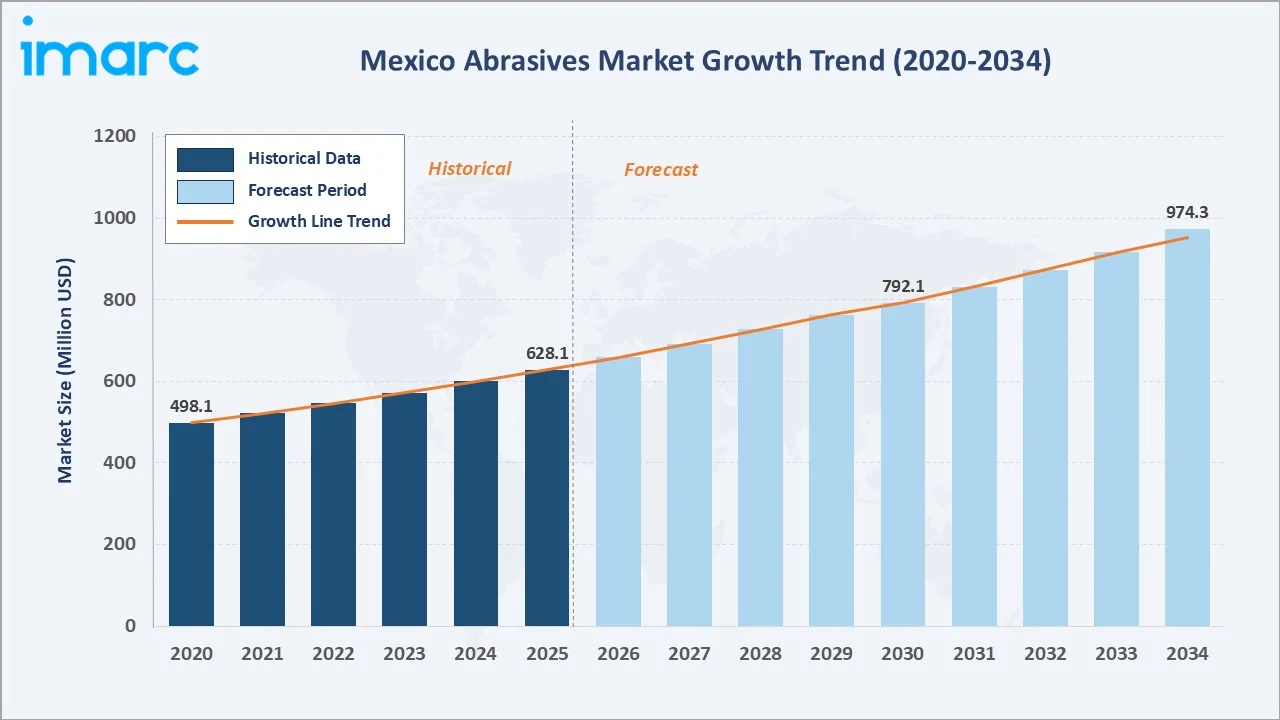
The Mexico abrasives market size increased from USD 628.1 Million in 2025 to USD 658.0 Million in 2026 and is projected to reach USD 974.3 Million by 2034, growing at a CAGR of 4.75% during 2026-2034. Expanding metal fabrication activity, robust automotive production, and accelerating infrastructure investments drive consistent demand. Bonded abrasives hold the leading product-type share at 42.8% in 2025, while synthetic abrasives dominate the material-type segment with a 78.5% share.
Market Snapshot
|
Metric |
Value |
|
Base Year Market Size (2025) |
USD 628.1 Million |
|
Market Size (2026) |
USD 658.0 Million |
|
Forecast Market Size (2034) |
USD 974.3 Million |
|
CAGR (2026-2034) |
4.75% |
|
Base Year |
2025 |
|
Historical Period |
2020-2025 |
|
Forecast Period |
2026-2034 |
Central Mexico leads regionally, holding a 42.9% market share in 2025, anchored by the Bajío automotive manufacturing corridor, which hosts major OEM and supplier clusters across Guanajuato, Querétaro, Aguascalientes, and San Luis Potosí. The region benefits from Mexico’s strong automotive base, supporting steady demand for bonded, coated, and superabrasives used in grinding, cutting, polishing, deburring, and surface finishing operations.
To get more information on this market, Request Sample
Mexico’s abrasives market rests on three structural pillars: nearshoring-driven manufacturing expansion, the country’s deep integration in North American automotive supply chains, and sustained public infrastructure spending. Each pillar independently increases demand for bonded, coated, and super-abrasive products, collectively sustaining above-average sector growth through 2034.
Executive Summary
The Mexico abrasives market is experiencing accelerated expansion, driven by the convergence of nearshoring investments, automotive sector growth, and expanding metal fabrication capacity. The market grew from USD 628.1 Million in 2025 to USD 658.0 Million in 2026 and is forecast to reach USD 974.3 Million by 2034, growing at a CAGR of 4.75%. This trajectory is anchored by Mexico’s emergence as a preferred manufacturing destination following global supply chain realignments post-2020.
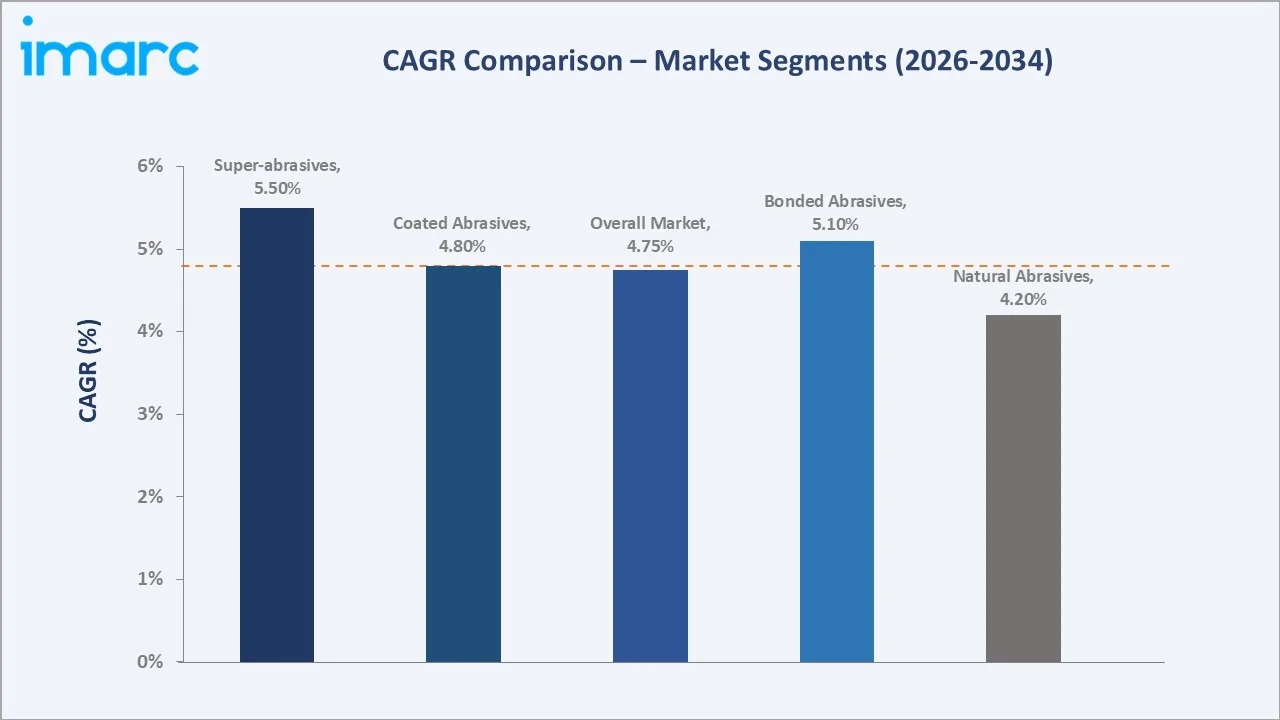
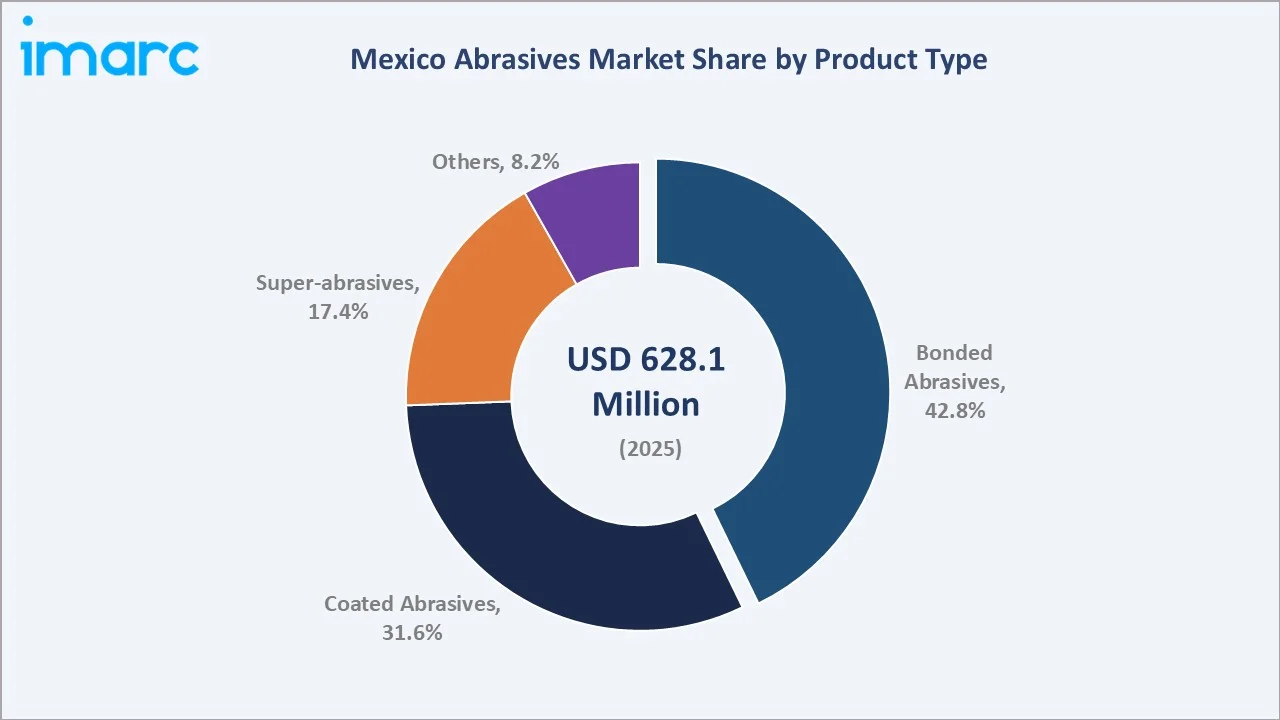
Bonded abrasives dominate the product type segment with a 42.8% share in 2025, encompassing grinding wheels, cutting discs, and honing sticks, widely used in automotive and metal fabrication applications. Coated abrasives represent 31.6%, serving surface finishing requirements across construction, furniture, and precision engineering sectors. Super-abrasives at 17.4% are the fastest-growing category, driven by demand for diamond and CBN tools in precision machining.
Central Mexico leads regionally at 42.9%, anchored by the Bajio industrial corridor’s dense cluster of automotive OEMs and Tier-1 suppliers. Northern Mexico accounts for 31.4%, sustained by the maquiladora manufacturing base and proximity to US industrial markets. Leading global vendors dominate the market through established distribution and technical service networks.
Key Market Insights
|
Insight |
Data |
|
Largest Product Type |
Bonded Abrasives – 42.8% share (2025) |
|
Fastest Growing Product Type |
Super-abrasives – ~5.5% CAGR (2026-2034) |
|
Largest Material Type |
Synthetic Abrasives – 78.5% share (2025) |
|
Fastest Growing Material Type |
Synthetic Abrasives – ~4.9% CAGR (2026-2034) |
|
Leading Region |
Central Mexico – 42.9% share (2025) |
|
Top Companies |
3M Company, Saint-Gobain Group, Robert Bosch GmbH, Klingspor AG |
Key Analytical Observations Supporting the Above Data:
- Bonded abrasives account for 42.8% of Mexico’s abrasives market in 2025. This dominance reflects the capital-intensive automotive manufacturing sector, where grinding wheels and cutting tools are essential for engine block machining, transmission component finishing, and brake system production.
- Synthetic abrasives at 78.5% share (2025) dominate the material segment due to their consistent quality, controlled grit size distribution, and superior hardness compared to natural alternatives. Silicon carbide and aluminum oxide synthetic abrasives offer performance advantages in high-speed automated grinding applications that are critical to Mexico’s precision manufacturing environment.
- Super-abrasives’ 17.4% share (2025) is growing fastest as aerospace, electronics, and precision automotive component production demand diamond and cubic boron nitride (CBN) tools capable of machining hardened steels and composite materials at tolerances within 5 microns.
- Central Mexico’s 42.9% share (2025) reflects the Bajio region’s status as Mexico’s primary automotive and industrial manufacturing hub, with states including Guanajuato, Aguascalientes, and Queretaro hosting major OEM plants from General Motors, Volkswagen, Honda, and Toyota.
Mexico Abrasives Market Overview
Abrasives encompass materials and tools used for cutting, grinding, polishing, and surface finishing across industrial and consumer applications. Mexico’s abrasives market spans bonded products (grinding wheels, cutting wheels, mounted points), coated products (sandpaper, abrasive belts, fiber discs), super-abrasives (diamond wheels, CBN tools), and specialty abrasive compounds, serving automotive, metal fabrication, construction, electronics, and machinery sectors.
Macroeconomic drivers include Mexico’s nearshoring-driven foreign direct investment (FDI) inflows, which reached USD 40,871 million in 2025, as multinational manufacturers relocated production from Asia to Mexico to serve North American markets. The US-Mexico-Canada Agreement (USMCA) automotive content rules, requiring 75% North American content for duty-free treatment, are compelling automotive OEMs to deepen their Mexican manufacturing presence, directly expanding abrasive demand across Tier-1 and Tier-2 supply chains.
Market Dynamics
To evaluate market opportunities, Request Sample
Market Drivers
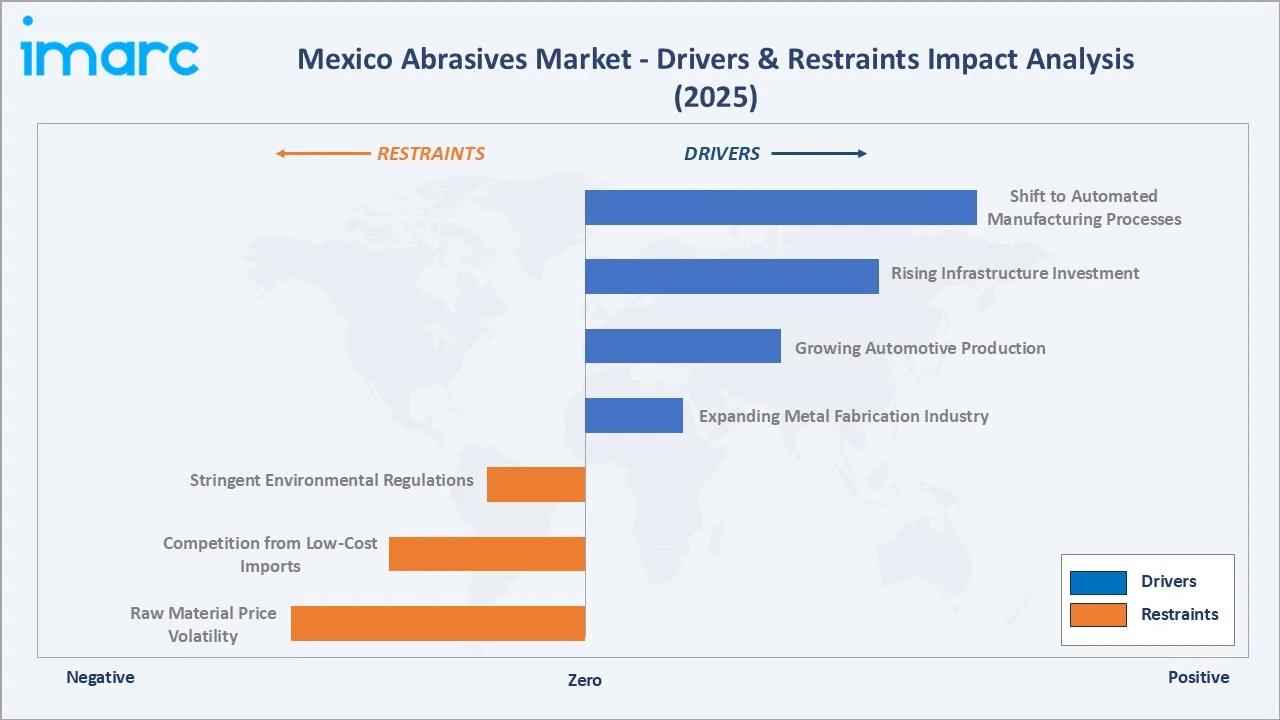
- Expanding Metal Fabrication Industry: The rapid expansion of metalworking and fabrication activities is fueling consistent demand for abrasives in Mexico. The global metal fabrication equipment market reached USD 76.4 Billion in 2025. Mexico is witnessing increased adoption of surface finishing, grinding, and cutting tools to support automotive, machinery, and infrastructure sectors. The rise in precision engineering and automated manufacturing has further accelerated the consumption of coated and bonded abrasives.
- Growing Automotive Production: Mexico is the seventh-largest vehicle manufacturer globally, contributing 3.8% to its national GDP. Each vehicle requires approximately 150–300 abrasive tool applications during manufacturing, from engine block honing to body panel finishing. USMCA content requirements are incentivizing further localization of component manufacturing, extending the automotive abrasive demand chain.
- Rising Infrastructure Investment: Mexico’s National Infrastructure Plan allocates significant capital to highway, rail, port, and energy infrastructure. Construction abrasives, including diamond blades for concrete cutting and surface preparation products, are integral to these projects. In 2024, the construction sector generated around USD 11.5 billion, accounting for 7.2% of the country’s total economic output, sustaining demand for heavy-duty abrasive products.
- Shift to Automated Manufacturing Processes: Industry 4.0 adoption is accelerating in Mexico’s industrial sector, with automated grinding cells and CNC machining centers replacing manual abrasive operations. Automated systems demand precision, consistent-quality abrasive tools compatible with high-speed spindles and robotic toolchangers, favoring premium coated and super-abrasive products.
Market Restraints
- Raw Material Price Volatility: Key inputs, including aluminum oxide, silicon carbide, and synthetic diamond, are subject to global commodity price fluctuations. Aluminum oxide feedstock prices increased by ~22% between 2022 and 2024 due to energy cost pressures in China, the dominant production source. This volatility compresses manufacturer margins and complicates pricing strategies.
- Competition from Low-Cost Imports: Chinese abrasive imports capture an estimated 25–30% of Mexico’s low-to-mid tier market by volume, competing aggressively on price in commodity grinding wheel and sandpaper segments. Anti-dumping measures provide partial protection, but enforcement gaps allow continued import pressure on domestic manufacturers.
- Stringent Environmental Regulations: Mexico’s evolving environmental standards are increasing compliance costs for abrasive manufacturers. The transition to water-based and low-VOC bonding systems requires capital investment in reformulation and production equipment upgrades, creating barriers for smaller domestic producers.
Market Opportunities
- Nearshoring-Driven FDI Expansion: The relocation of electronics, semiconductor assembly, and medical device manufacturing to Mexico creates new demand for precision abrasives beyond traditional automotive applications. Semiconductor packaging requires ultra-fine polishing abrasives, while medical device manufacturing demands biocompatible surface finishing solutions.
- Super-abrasives for Precision Machining: As Mexico’s manufacturing mix shifts toward higher-value precision components, demand for diamond and CBN tools is accelerating. Super-abrasives enable machining of hardened materials at tight tolerances impossible with conventional abrasives, positioning this segment for above-market growth through 2034.
Market Challenges
- Skilled Labor Availability: Advanced abrasive application, particularly in precision grinding and super-abrasive tool operation, requires trained machinists. Mexico’s technical workforce development has not kept pace with the rapid adoption of manufacturing technologies, creating productivity constraints in secondary industrial cities.
- Logistics and Supply Chain Complexity: Mexico’s abrasives distribution network faces infrastructure limitations in secondary industrial cities. Just-in-time manufacturing requirements demand rapid abrasive replenishment, but logistics delays in non-primary markets create inventory management challenges for industrial buyers.
Emerging Market Trends
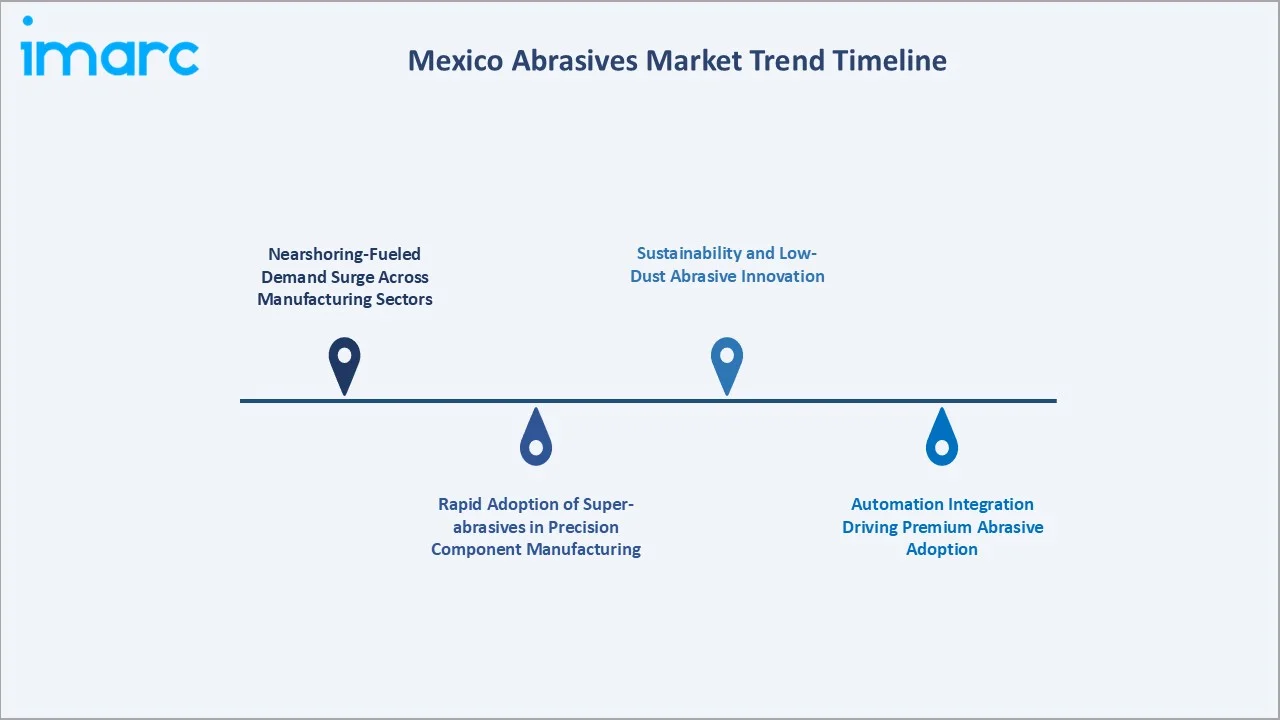
1. Nearshoring-Fueled Demand Surge Across Manufacturing Sectors
Mexico received record FDI of USD 40,871 million in 2025, with significant portions directed toward electronics, automotive, and industrial manufacturing facilities in the Bajio and northern border regions. Each new manufacturing facility represents a sustained abrasive procurement stream across its operational lifecycle. Nearshoring is forecasted to drive 15–20% incremental abrasive demand growth in Central and Northern Mexico through 2028, as new facilities ramp to full production capacity.
2. Rapid Adoption of Super-abrasives in Precision Component Manufacturing
Mexico’s precision machining sector is transitioning toward super-abrasive tools as component complexity increases. Diamond dressing tools, CBN grinding wheels, and polycrystalline diamond (PCD) inserts enable machining of hardened steel, cemented carbide, and ceramic components with surface finishes below Ra 0.1 microns. Global super-abrasive producers, including Element Six, are expanding their Mexico distribution partnerships to capture this high-growth segment.
3. Automation Integration Driving Premium Abrasive Adoption
CNC grinding machines and robotic abrasive finishing systems require consistent, precision-engineered abrasive products with tight dimensional and hardness tolerances. This automation wave is shifting abrasive procurement from commodity to specification-grade products, supporting average selling price improvement even in mature coated and bonded abrasive segments. Automated abrasive consumption per unit of manufacturing output typically increases 20–35% versus manual processes.
4. Sustainability and Low-Dust Abrasive Innovation
Environmental compliance requirements and worker health regulations are creating demand for low-dust, water-resistant abrasive products. Ceramic aluminum oxide abrasives offer longer life and reduced dust generation compared to conventional products. Major manufacturers, including 3M and Saint-Gobain, are expanding their ceramic grain abrasive portfolios, targeting Mexico’s regulated automotive and aerospace manufacturing environments.
Industry Value Chain Analysis
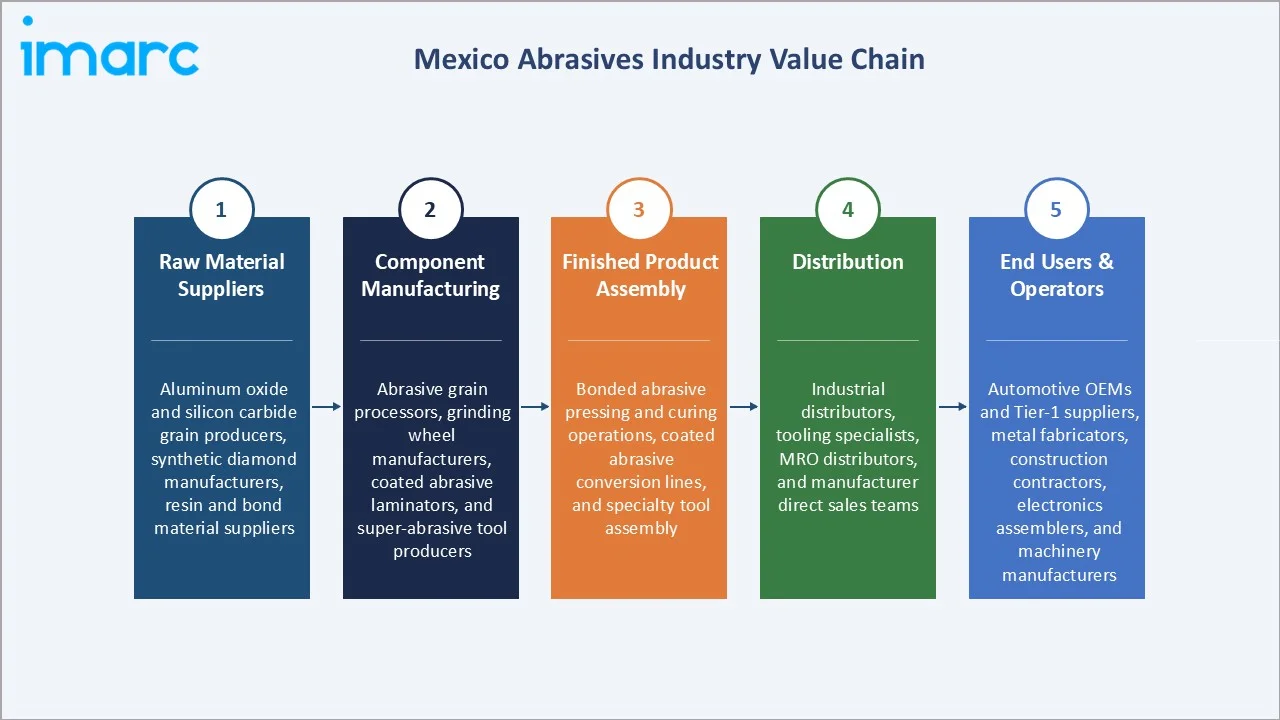
Mexico’s abrasives value chain spans mineral and synthetic grain production through end-user industrial processing, with each stage occupied by specialized manufacturers, distributors, and service providers whose performance directly influences product quality, cost competitiveness, and supply reliability.
|
Stage |
Key Players / Examples |
|
Raw Material Suppliers |
Aluminum oxide and silicon carbide grain producers, synthetic diamond manufacturers, resin and bond material suppliers |
|
Component Manufacturing |
Abrasive grain processors, grinding wheel manufacturers, coated abrasive laminators, and super-abrasive tool producers |
|
Finished Product Assembly |
Bonded abrasive pressing and curing operations, coated abrasive conversion lines, and specialty tool assembly |
|
Distribution |
Industrial distributors, tooling specialists, MRO distributors, and manufacturer direct sales teams |
|
End Users & Operators |
Automotive OEMs and Tier-1 suppliers, metal fabricators, construction contractors, electronics assemblers, and machinery manufacturers |
Technology Landscape in the Mexico Abrasives Industry
Conventional Bonded Abrasives – Vitrified and Resinoid Grinding Wheels
Vitrified and resinoid-bonded grinding wheels form the backbone of Mexico’s existing abrasive infrastructure, accounting for the majority of bonded product installations across automotive and general metal fabrication. Leading vendors offer precision grinding wheels optimized for Mexican manufacturing conditions, with formulations compatible with high-speed CNC grinding centers operating at surface speeds of 80–120 m/s. Vitrified bonds offer superior porosity for chip clearance in cylindrical and surface grinding, while resinoid bonds provide the flexibility required for cut-off and rough grinding applications.
Coated Abrasives – Ceramic Grain and Zirconia Alumina
Ceramic aluminum oxide and zirconia alumina coated abrasives represent the performance frontier in Mexico’s surface finishing and metal removal market. 3M’s Cubitron II precision-shaped grain technology delivers self-sharpening fracture mechanics that maintain consistent cutting rates 2–3 times the tool life of conventional alumina products, reducing downtime for abrasive changes in high-volume automotive bodywork and structural steel fabrication.
Super-abrasives – Diamond and CBN Tools
Diamond and cubic boron nitride (CBN) super-abrasive tools represent the highest-performance and highest-value segment of Mexico’s abrasives market. Diamond wheels enable precision grinding of cemented carbide, ceramic, and glass materials used in aerospace and medical device manufacturing, while CBN wheels are the preferred solution for hardened steel machining in automotive gear, camshaft, and crankshaft production.
Non-Woven Abrasives and Surface Conditioning Products
Non-woven abrasive products, including 3M’s Scotch-Brite and Mirka’s MIRLON range, address surface conditioning, deburring, and finishing applications where controlled material removal and scratch-pattern uniformity are critical. Mexico’s growing stainless steel fabrication sector for food processing equipment, medical devices, and architectural applications drives demand for non-woven products that produce consistent, controlled surface finishes without creating deep scratch patterns requiring additional finishing steps.
Market Segmentation Analysis
The report covers the following segments:
|
Segment Category |
Leading Segment |
Market Share |
Year |
|
Product Type |
Bonded Abrasives |
42.8% |
2025 |
|
Material Type |
Synthetic Abrasives |
78.5% |
2025 |
|
End-Use |
🔒 |
🔒 |
2025 |
|
Region |
Central Mexico |
42.9% |
2025 |

By Product Type
Bonded abrasives dominate with a 42.8% share in 2025. This segment encompasses grinding wheels, cutting discs, mounted points, and honing tools used across automotive engine and transmission manufacturing, metal fabrication, and precision machining. Mexico’s automotive production base represents a structural demand anchor for bonded abrasive products, particularly vitrified grinding wheels for crankshaft, camshaft, and gear finishing operations.
To access detailed market analysis, Request Sample
Super-abrasives at 17.4% share (2025) are expected to be the fastest-growing product segment, driven by Mexico’s expanding precision component manufacturing in aerospace, medical devices, and advanced automotive applications. Diamond grinding wheels and CBN tools enable the processing of hardened materials that conventional abrasives cannot machine economically.
By Material Type
Synthetic abrasives command a dominant 78.5% share in 2025. This segment encompasses silicon carbide, aluminum oxide, ceramic aluminum oxide, synthetic diamond, and cubic boron nitride (CBN) materials, valued for their consistent quality, controlled hardness, and suitability for high-speed automated grinding. Synthetic abrasives enable the performance predictability required by precision manufacturing environments, where tool life consistency directly impacts production scheduling and quality control outcomes.
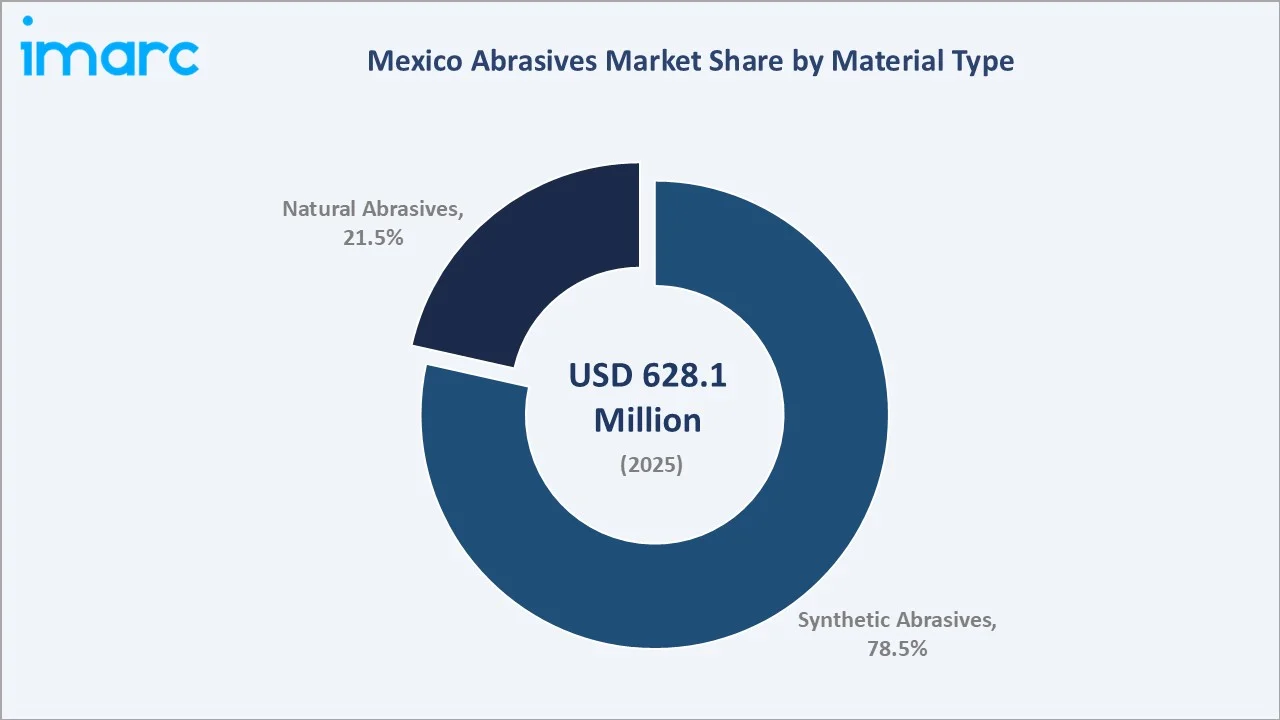
Natural abrasives represent 21.5% of the market, including flint, garnet, emery, and corundum products primarily used in lower-precision surface preparation applications, wood finishing, and artisanal metalworking. The natural segment’s share is projected to decline gradually through 2034 as synthetic alternatives become more cost-competitive across broader application tiers.
Regional Market Insights
Central Mexico’s market leadership (42.9%, 2025) reflects the Bajio industrial corridor’s established status as Mexico’s primary manufacturing hub. The region’s automotive, aerospace, and electronics manufacturing clusters generate concentrated, high-volume abrasive demand that supports distributors and service networks unavailable in secondary markets.
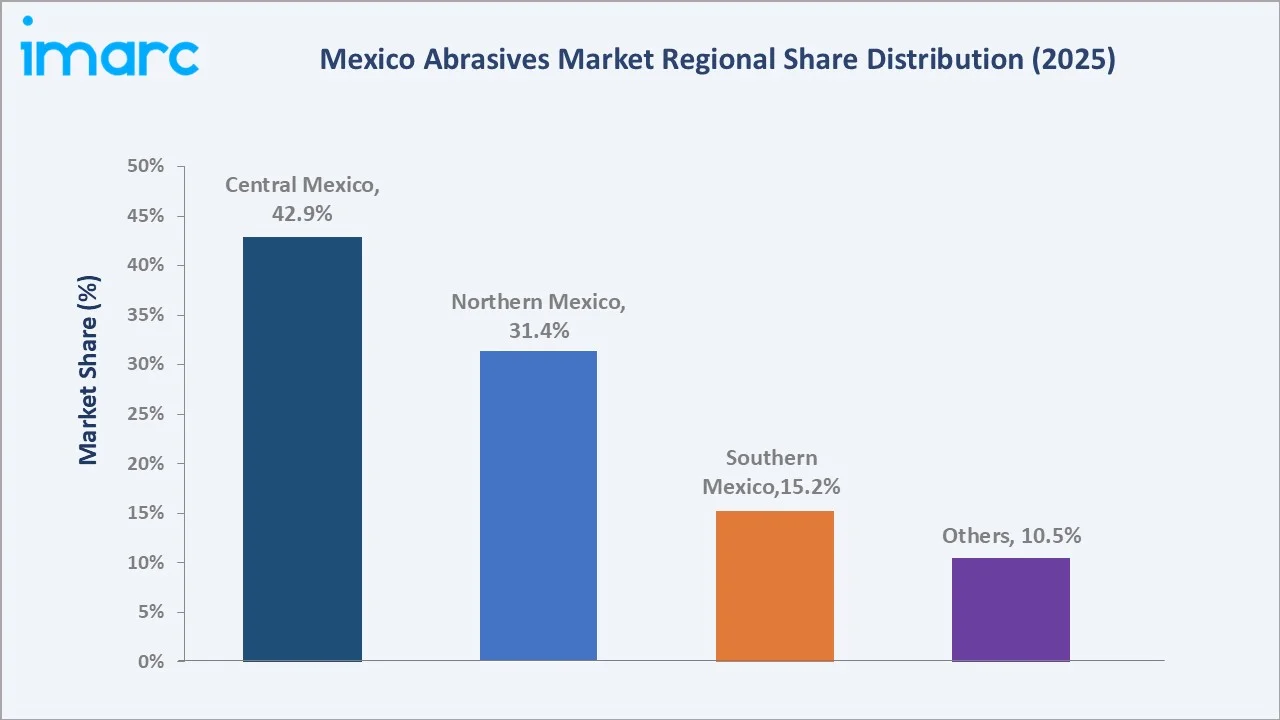
Northern Mexico at 31.4% represents a strong second market driven by the maquiladora manufacturing ecosystem. Monterrey serves as an industrial hub for steel production and metal fabrication, while border cities including Ciudad Juárez and Tijuana host extensive electronics and automotive component assembly operations that generate continuous abrasive demand.
|
Region |
Share (2025) |
Key Growth Drivers |
|
Central Mexico |
42.9% |
Bajio automotive corridor with multiple OEM plants; aerospace manufacturing in Queretaro; nearshoring-driven FDI attracting electronics and precision manufacturing |
|
Northern Mexico |
31.4% |
Maquiladora manufacturing base in Monterrey, Juarez, and Tijuana; US-adjacent location for cross-border automotive and electronics supply chains; strong metal fabrication activity |
|
Southern Mexico |
15.2% |
Emerging construction and infrastructure projects; growing light manufacturing; Interoceanic Corridor development driving industrial expansion in Oaxaca and Veracruz |
|
Others |
10.5% |
Remaining states with diverse light manufacturing, artisanal metalworking, and construction activities, growing with regional economic development programs |
Competitive Landscape
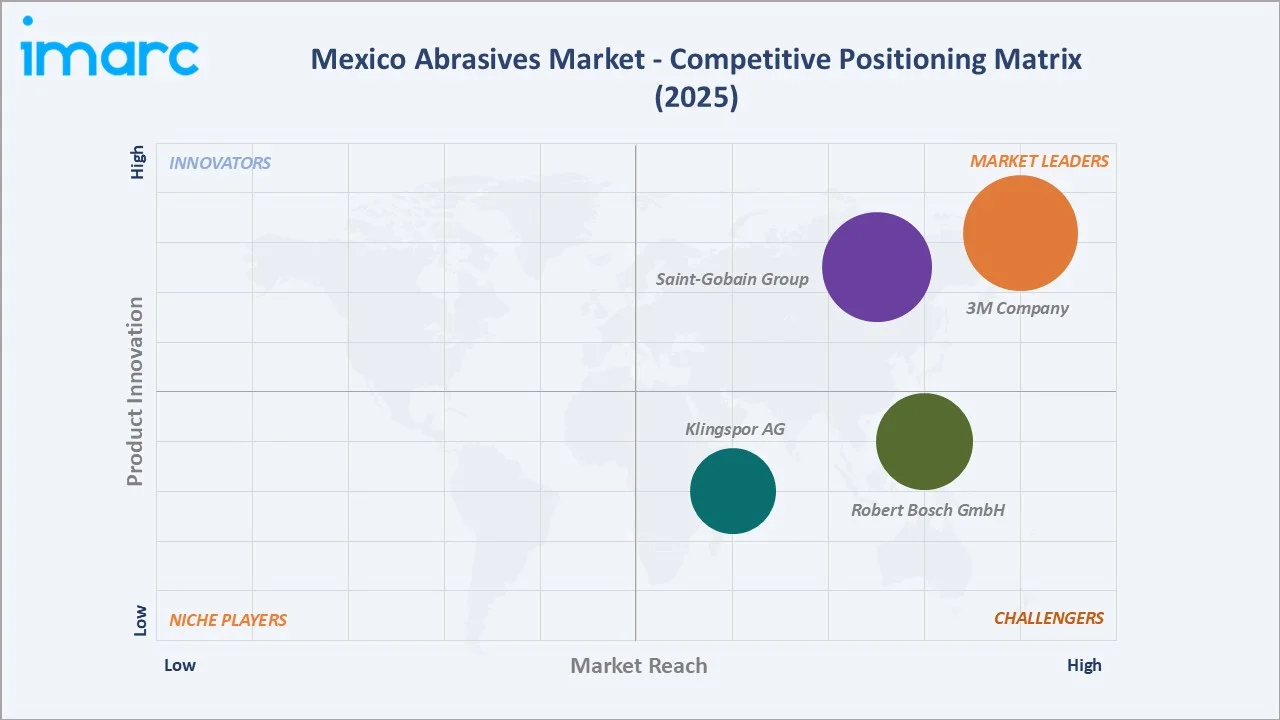
Mexico’s abrasives market exhibits moderate concentration, with the top vendors collectively holding approximately 45–50% of market revenue in 2025. Below the top tier, a competitive mid-market of regional distributors and specialty abrasive importers serves cost-sensitive SME manufacturing customers.
|
Company Name |
Brand Name |
Market Position |
Core Strength |
|
3M Company |
3M Abrasives, Cubitron |
Market Leader |
Ceramic grain technology; broad product portfolio; automotive OEM approvals; technical service network |
|
Saint-Gobain Group |
Norton, Winter |
Market Leader |
Super-abrasive expertise; grinding wheel breadth; strong automotive and aerospace segment focus |
|
Robert Bosch GmbH |
Bosch |
Strong Challenger |
Power tool and abrasive integration; coated abrasive range; distribution through hardware retail |
|
Klingspor AG |
Klingspor |
Challenger |
Coated abrasive specialization; competitive pricing; broad SKU portfolio for metalworking and woodworking |
Global OEMs dominate hyperscale and large industrial contracts through established supply chains, comprehensive product portfolios, and certified service networks. Regional distributors serve the enterprise and mid-market segments with cost-competitive products tailored to Mexican operating conditions.
Key Company Profiles
3M Company
3M Company is one of the global leaders in abrasive technology, known for its proprietary 3M’s Cubitron II precision-shaped grain technology that outperforms conventional aluminum oxide abrasives in metal removal rate and tool life. 3M maintains a strong Mexico market presence through direct automotive OEM relationships and an extensive industrial distribution network.
- Product Portfolio: Cubitron II grinding discs and belts, Scotch-Brite non-woven abrasives, Imperial lapping films, Trizact precision abrasive films, and diamond microfinishing products.
- Recent Developments: In April 2026, 3M Company reported Q1 2026 GAAP sales of USD 6.0 billion, up 1.3% year-on-year, with GAAP operating margin improving to 23.2%. Adjusted sales rose 3.9%, adjusted EPS increased 14% to USD 2.14, and the company reiterated its full-year 2026 guidance.
- Strategic Focus: Ceramic grain abrasive adoption in automotive and aerospace segments; Cubitron II technology differentiation; sustainability through longer-life products that reduce total abrasive waste per unit of manufactured output.
Saint-Gobain Group
Saint-Gobain Group’s subsidiary Saint-Gobain Abrasives operates through the Norton and Winter brands globally. Saint-Gobain is the leading supplier of bonded and super-abrasive products to Mexico’s precision manufacturing, automotive, and aerospace sectors.
- Product Portfolio: Norton grinding wheels, Norton abrasive belts and discs, Winter diamond and CBN super-abrasives, and Norton Quantum3 advanced bonded abrasives.
- Recent Developments: In August 2025, Saint-Gobain Abrasives published the world’s first Environmental Product Declarations (EPDs) for abrasive products, covering selected Norton cutting and grinding discs. The products contain at least 14% recycled materials and provide verified environmental-impact data to help customers choose lower-carbon, sustainability-aligned abrasive solutions.
- Strategic Focus: Super-abrasive technology leadership for precision grinding; Norton Quantum3 adoption in automotive drivetrain manufacturing; sustainability through reduced energy consumption per grinding operation.
Market Concentration Analysis
Mexico’s abrasives market exhibits moderate concentration. The top global OEMs hold approximately 45–50% of total revenue in 2025. Below the top tier, a competitive mid-market of 20–25 specialized importers and regional distributors serves the SME manufacturing and construction segments with cost-competitive products, primarily sourced from China, Taiwan, and Eastern Europe.
Consolidation is occurring primarily through technology differentiation rather than M&A. Leading vendors are investing in ceramic grain, super-abrasive, and specialty coating technologies that create defensible performance advantages over commodity imports. This technology gap naturally widens as Mexico’s manufacturing base shifts toward higher-value precision production.
Investment & Growth Opportunities
Fastest Growing Segments
Super-abrasives (~5.5% CAGR) and coated abrasives for automated systems (~5.2% CAGR) represent the highest-growth investment vectors through 2034. Together, these subcategories address a combined addressable market of approximately USD 220 Million by 2030 within Mexico’s abrasives ecosystem, as precision manufacturing deepens across automotive, aerospace, and medical device sectors.
Emerging Market Expansion
Southern Mexico and the Interoceanic Corridor region collectively represent an incremental USD 75+ Million abrasive opportunity by 2034, as manufacturing investment follows infrastructure development. Entry strategies include local stocking partnerships with regional industrial distributors, technical training programs for end-user production engineers, and targeted marketing toward construction and light manufacturing customers.
Venture and Institutional Investment Trends
- Government infrastructure programs, including the Tren Maya, Interoceanic Corridor, and highway expansion projects, will drive construction abrasive demand growth estimated at 6–8% annually through 2028, sustaining diamond blade and concrete cutting product categories.
- Abrasive-as-a-Service models are emerging in precision manufacturing segments, where vendors offer integrated grinding process management under outcome-based contracts. These models improve customer retention and command pricing premiums of 15–25% over transactional tool sales.
Future Market Outlook (2026-2034)
Mexico’s abrasives market is positioned for sustained growth through 2034. From a base of USD 628.1 Million in 2025 and USD 658.0 Million in 2026, the market is projected to reach USD 974.3 Million by 2034, representing total incremental value creation of USD 346.2 Million at a CAGR of 4.75%. This growth is structurally supported by Mexico’s deepening integration into North American manufacturing supply chains and its ongoing transition toward higher-value industrial output.
The technology transition from conventional to advanced abrasives will define the market’s composition by 2034. Bonded abrasives’ share is expected to remain stable at approximately 41–43%, while super-abrasives are projected to grow from 17.4% in 2025 to approximately 22–24% by 2034. This technology shift creates replacement demand opportunities for premium abrasive vendors and positions technical service capability as a key competitive differentiator.
Research Methodology
Primary Research
Primary research comprised structured interviews with over 80 industry participants in 2024–2025, including manufacturing plant procurement managers, abrasive distributors, OEM application engineers, and market analysts across Mexico, the United States, and Europe. Expert input validated market sizing, technology adoption rates, and regional demand patterns.
Secondary Research
Secondary research encompassed vendor annual reports, INEGI industrial production statistics, AMIA automotive production data, international trade data (SE and SAT import/export records for HS code 6804–6806 abrasive products), and industry publications (Abrasives World, Modern Machine Shop, Grinding & Surface Finishing).
Forecasting Models
Market size estimations were derived using top-down and bottom-up forecasting, incorporating industrial production indices, manufacturing value-added growth rates, abrasive intensity per unit of output by end-use sector, and vendor revenue disclosures. A base-case CAGR of 4.75% reflects consensus estimates validated against manufacturing capacity expansion announcements and abrasive procurement trend data from 2020 to 2025.
Mexico Abrasives Market Report Coverage:
| Report Features | Details |
|---|---|
| Base Year of the Analysis | 2025 |
| Historical Period | 2020-2025 |
| Forecast Period | 2026-2034 |
| Units | Million USD |
| Scope of the Report | Exploration of Historical Trends and Market Outlook, Industry Catalysts and Challenges, Segment-Wise Historical and Future Market Assessment:
|
| Product Types Covered | Bonded Abrasives, Coated Abrasives, Super-abrasives, Others |
| Material Types Covered | Natural Abrasives, Synthetic Abrasives |
| End-Uses Covered | Machinery, Metal Fabrication, Automotive, Electronics, Construction, Others |
| Regions Covered | Northern Mexico, Central Mexico, Southern Mexico, Others |
| Companies Covered | 3M Company, Saint-Gobain Group, Robert Bosch GmbH, Klingspor AG, etc. |
| Customization Scope | 10% Free Customization |
| Post-Sale Analyst Support | 10-12 Weeks |
| Delivery Format | PDF and Excel through Email (We can also provide the editable version of the report in PPT/Word format on special request) |
Key Benefits for Stakeholders:
- IMARC’s industry report offers a comprehensive quantitative analysis of various market segments, historical and current market trends, market forecasts, and dynamics of the Mexico abrasives market from 2020-2034.
- The research report provides the latest information on the market drivers, challenges, and opportunities in the Mexico abrasives market.
- Porter's five forces analysis assist stakeholders in assessing the impact of new entrants, competitive rivalry, supplier power, buyer power, and the threat of substitution. It helps stakeholders to analyze the level of competition within the Mexico abrasives industry and its attractiveness.
- Competitive landscape allows stakeholders to understand their competitive environment and provides an insight into the current positions of key players in the market.
Frequently Asked Questions About the Mexico Abrasives Market Report
The Mexico abrasives market size is estimated at USD 658.0 Million in 2026 and is projected to reach USD 974.3 Million by 2034, growing at a CAGR of 4.75% during 2026-2034.
Bonded abrasives lead with a 42.8% market share in 2025, driven by demand from automotive manufacturing, metal fabrication, and precision machining applications that require grinding wheels, cutting discs, and honing tools.
Synthetic abrasives dominate with a 78.5% share in 2025, reflecting the performance and consistency advantages of aluminum oxide, silicon carbide, and ceramic grain products in high-speed automated manufacturing environments.
Central Mexico leads with a 42.9% share in 2025, anchored by the Bajio automotive manufacturing corridor hosting major OEM plants from General Motors, Volkswagen, Honda, and Toyota, alongside aerospace and precision manufacturing clusters in Queretaro and Aguascalientes.
Some of the leading companies include 3M Company, Saint-Gobain Group, Robert Bosch GmbH, and Klingspor AG, competing on product technology, application expertise, and distribution network depth.
Super-abrasives are growing at the fastest rate (~5.5% CAGR), driven by Mexico’s expanding aerospace, medical device, and precision automotive manufacturing sectors.
Nearshoring is a major structural tailwind for Mexico’s abrasives market. Record FDI in 2025 attracted electronics, semiconductor, and advanced manufacturing facilities to Mexico, each generating sustained abrasive demand.
Key challenges include raw material price volatility (particularly aluminum oxide and silicon carbide feedstocks), competition from low-cost Chinese abrasive imports, and a skilled labor shortage in advanced abrasive applications.
Need more help?
- Speak to our experienced analysts for insights on the current market scenarios.
- Include additional segments and countries to customize the report as per your requirement.
- Gain an unparalleled competitive advantage in your domain by understanding how to utilize the report and positively impacting your operations and revenue.
- For further assistance, please connect with our analysts.
 Request Customization
 Speak to an Analyst
 Request Brochure
 Inquire Before Buying
Benefits of Customization
- Personalize this research
- Triangulate with your data
- Get data as per your format and definition
- Gain a deeper dive into a specific application, geography, customer, or competitor
- Any level of personalization
Get in Touch With Us
UNITED STATES
Phone: +1-201-971-6302
INDIA
Phone: +91-120-433-0800
UNITED KINGDOM
Phone: +44-753-714-6104
Email: [email protected]
Client Testimonials




.webp)




.webp)













Related Reports

Choose your plan
*Please note that the prices mentioned below are starting prices for each bundle type. Kindly contact our team for further details.*
Single User License
- 1 User License, Access on 2 Devices
- PDF Report + Excel Dataset (Password Protected)
- Lifetime Access
- No Printing Rights
- 10% Free Report Customization
- 10–12 Weeks of Analyst Support
Five User License
- Access for 5 Users, 2 Devices per User
- PDF Report + Excel Dataset (Password Protected)
- Lifetime Access
- Dedicated Account Manager
- 12–14 Weeks of Analyst Support
- No Printing Rights
- 15% Free Report Customization
- 25% Discount on Your Next Purchase
Corporate User License
- Unlimited User Access (Within Your Organization)
- PDF Report + Excel Dataset
- Lifetime Access
- Dedicated Account Manager
- 14–20 Weeks of Analyst Support
- No Printing Rights
- 20% Free Report Customization
- 30% Discount on Your Next Purchase
Essential Insights
What's included:
3 reports
- Lifetime Access
- PDF Reports
- Excel Datasets
- 2 Weeks of Free Analyst Support
- 2 User Licenses
- Access on 2 Devices
- Printing Rights
- Complimentary PowerPoint (PPT) Version
- Complimentary License Upgrade
Professional Access
What's included:
5 reports
- Lifetime Access
- PDF Reports
- Excel Datasets
- 8 Weeks of Free Analyst Support
- 2 User Licenses
- Access on 2 Devices
- Printing Rights
- Complimentary PowerPoint (PPT) Version
- Complimentary License Upgrade
Business Advantage
What's included:
8 reports
- Lifetime Access
- PDF Reports
- Excel Datasets
- 14 Weeks of Free Analyst Support
- 2 User Licenses
- Access on 2 Devices
- Printing Rights
- Complimentary PowerPoint (PPT) Version
- Complimentary License Upgrade
Enterprise Intelligence
What's included:
10 reports
- Lifetime Access
- PDF Reports
- Excel Datasets
- 20 Weeks of Free Analyst Support
- 2 User Licenses
- Access on 2 Devices
- Printing Rights
- Complimentary PowerPoint (PPT) Version
- Complimentary License Upgrade