
Mexico Advertising Market Size, Share, Trends and Forecast by Type and Region, 2026-2034
Mexico Advertising Market Size, Share, Trends & Forecast (2026-2034)
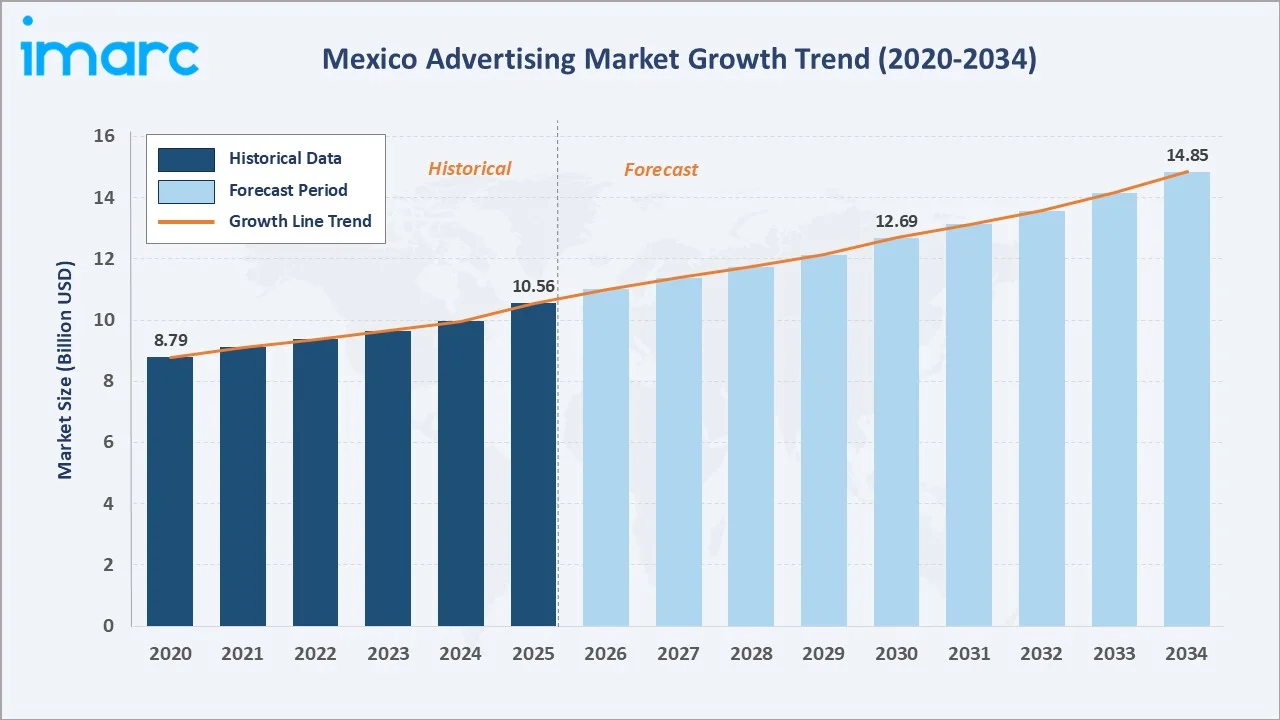
The Mexico advertising market reached USD 10.56 Billion in 2025 and is projected to reach USD 14.85 Billion by 2034, growing at a CAGR of 3.74% during 2026-2034. The market is driven by rapid digital adoption, rising smartphone penetration, and evolving consumer media habits. Internet advertising leads at 29.6%, followed by television at 24.8%. Central Mexico commands 47.3% of regional share.
Market Snapshot
|
Metric |
Value |
|
Market Size (2025) |
USD 10.56 Billion |
|
Forecast Market Size (2034) |
USD 14.85 Billion |
|
CAGR (2026-2034) |
3.74% |
|
Base Year |
2025 |
|
Historical Period |
2020-2025 |
|
Forecast Period |
2026-2034 |
|
Dominant Type |
Internet Advertising (29.6%, 2025) |
|
Dominant Region |
Central Mexico (47.3%, 2025) |
The Mexico advertising market expanded from USD 8.79 Billion in 2020 to USD 10.56 Billion in 2025, anchored at USD 12.69 Billion in 2030, and forecast to reach USD 14.85 Billion by 2034. COVID-19 accelerated digital advertising adoption, triggering a structural shift away from traditional media toward programmatic and social platforms.
To get more information on this market, Request Sample
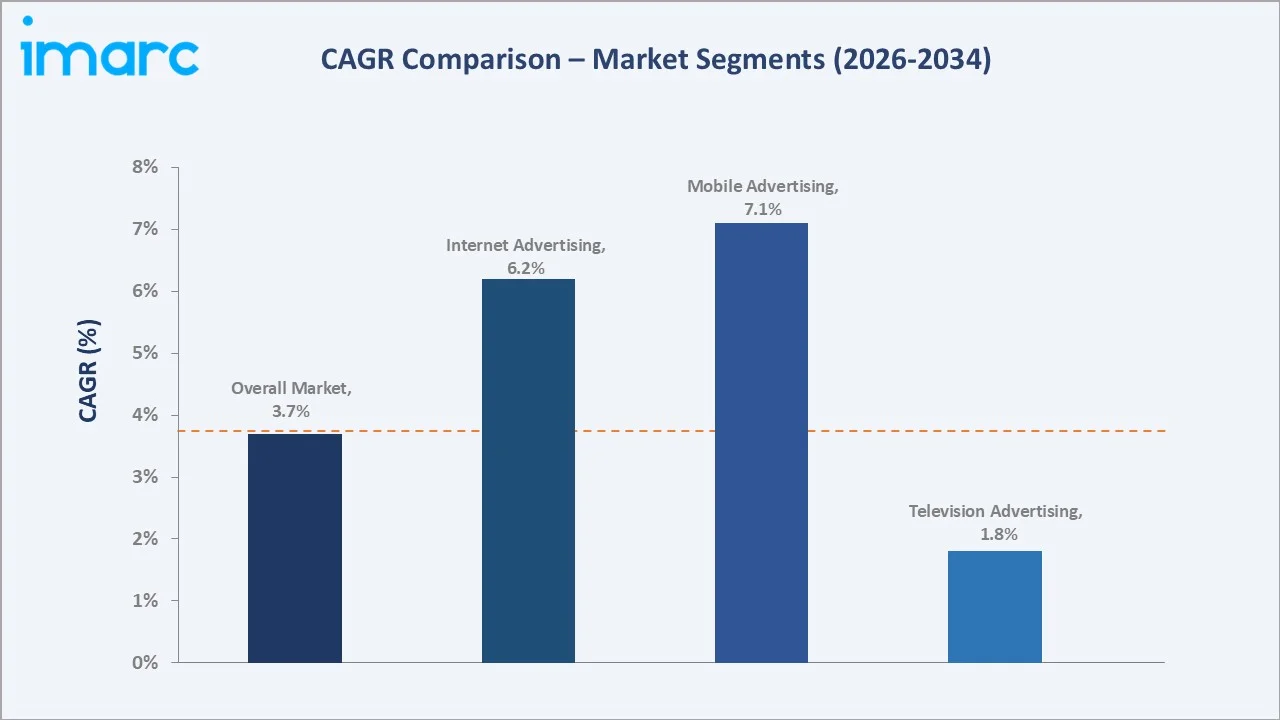
Internet advertising grows fastest, driven by programmatic video and mobile-first consumption. Mobile advertising reflects Mexico's expanding smartphone base and data plan affordability, enabling continuous audience engagement across social and streaming channels.
Executive Summary
The Mexico advertising market reached USD 10.56 Billion in 2025, representing a key advertising ecosystem in Latin America. The market encompasses television, internet, mobile, outdoor, print, radio, and cinema advertising across all major media platforms and formats serving brands and agencies.
Internet advertising at 29.6% dominates through programmatic targeting, search, display, and video formats. Television at 24.8% retains strength through broad national reach. Central Mexico, at 47.3%, leads through its concentration of media companies, headquarters, and consumer spending power.
Key Market Insights
|
Insight |
Data |
|
Dominant Type |
Internet Advertising – 29.6% share (2025) |
|
Second Segment |
Television Advertising – 24.8% market share (2025) |
|
Leading Region |
Central Mexico – 47.3% market share |
|
Market Opportunity |
Programmatic video; influencer marketing; connected TV; AI-driven targeting; e-commerce advertising; out-of-home digital expansion |
Key Analytical Observations Supporting the Above Data:
- Internet Advertising at 29.6%: Internet advertising dominates due to the rapid shift of brands and agencies toward digital-first strategies. Programmatic platforms, social media advertising, and search engine marketing enable precise targeting, real-time optimization, and measurable return on investment, making digital the preferred channel for advertisers.
- Television Advertising at 24.8%: Television retains strong market presence owing to its wide national reach, high-impact format, and strong viewership for sports, entertainment, and telenovela content. Grupo Televisa and TV Azteca continue to command significant advertiser investment.
- Central Mexico at 47.3%: Central Mexico dominates due to the concentration of corporate headquarters, media agencies, major retailers, and the largest urban consumer base in Mexico City, driving the majority of national advertising budgets and campaign activity.
Mexico Advertising Market Overview
The Mexico advertising market encompasses television, digital, mobile, outdoor, print, radio, and cinema advertising, spanning all media platforms and formats. The market includes media planning and buying, creative production, programmatic technology, and performance measurement services.
Macroeconomic factors include increasing consumer spending, urbanization, expanding middle-class demographics, and growing digital infrastructure. Government regulatory reforms, including the transfer of oversight to the Agency for Digital Transformation (ATD), are shaping advertising compliance and operational norms.
Market Dynamics
To evaluate market opportunities, Request Sample
Market Drivers
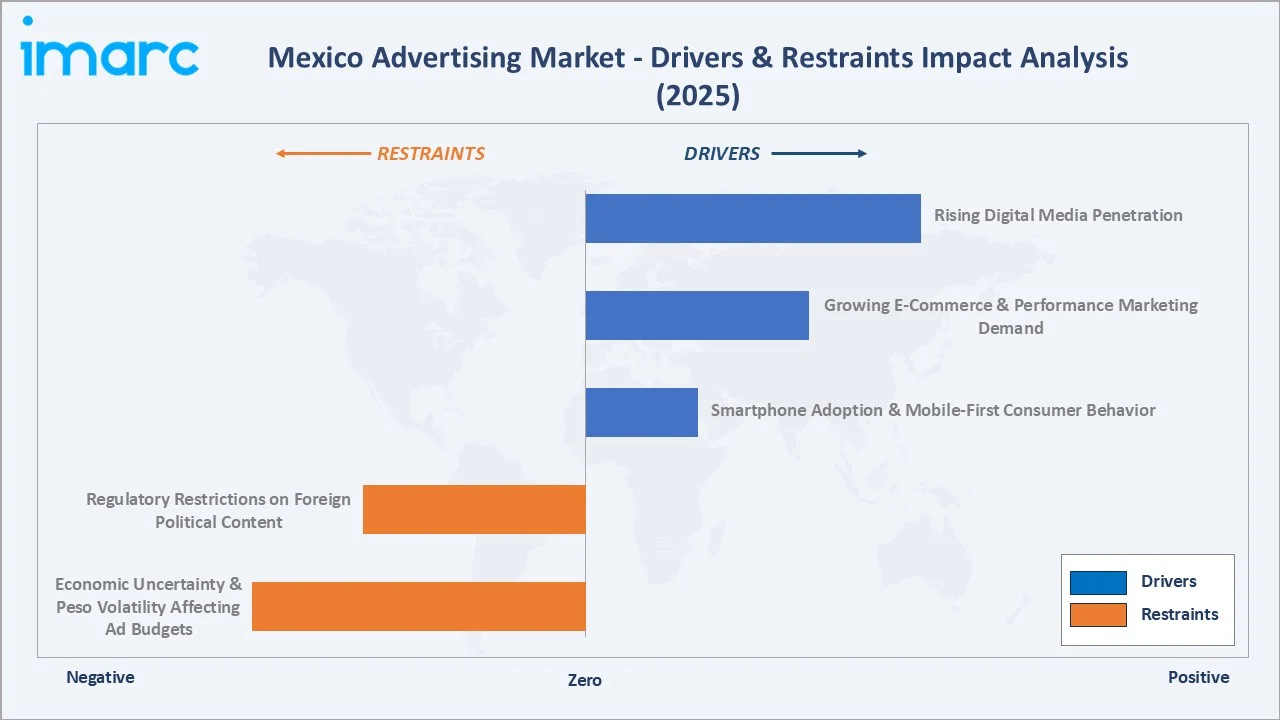
- Rising Digital Media Penetration: Digital media penetration is expanding advertising reach across Mexico. Increasing internet access, affordable smartphones, and widespread social media usage are shifting ad budgets from traditional to digital channels. Programmatic platforms, search, video, and social advertising offer advertisers precise targeting and real-time performance measurement, driving sustained growth.
- Growing E-Commerce and Performance Marketing Demand: The rapid expansion of e-commerce in Mexico is creating strong demand for performance marketing solutions. Brands are increasing investment in search advertising, affiliate marketing, and social commerce to capture online shoppers. This shift toward measurable, conversion-focused advertising formats is accelerating digital ad spend across categories.
- Smartphone Adoption and Mobile-First Consumer Behavior: Mexico's expanding smartphone user base and affordable mobile data plans are driving mobile advertising growth. Consumers increasingly access social media, video streaming, and digital content via mobile devices, enabling continuous audience engagement at key decision-making moments.
- Increasing Foreign Direct Investment Stimulating Brand Advertising: Growing foreign direct investment in Mexico's manufacturing, automotive, and consumer goods sectors is generating increased demand for brand advertising. Multinational companies entering the Mexican market are increasing their advertising investment to establish brand awareness and capture market share.
Market Restraints
- Regulatory Restrictions on Foreign Political Content: New regulatory reforms under the Federal Telecommunications Law restrict foreign political advertising on Mexican broadcast media, imposing fines up to 5% of broadcaster revenues for non-compliance, creating complexity for international advertisers operating in Mexico.
- Economic Uncertainty and Peso Volatility Affecting Ad Budgets: Economic uncertainty, inflation, and fluctuations in the Mexican peso create pressure on advertising budgets. During periods of economic slowdown, both local and international advertisers reduce discretionary marketing spend, disproportionately affecting traditional media channels.
- Ad Fraud and Brand Safety Challenges in Digital Channels: Ad fraud, invalid traffic, and brand safety risks in programmatic and digital advertising are limiting advertiser confidence. Concerns over non-human traffic, viewability standards, and ad misplacement are driving increased scrutiny and cost in digital campaign management.
Market Opportunities
- Connected TV and Video Streaming Advertising: The rise of connected TV and streaming platform adoption in Mexico creates significant advertising opportunities. As audiences migrate to streaming services, advertisers can leverage addressable TV advertising and data-driven audience targeting to reach cord-cutting consumers effectively.
- Influencer Marketing and Creator Economy Expansion: Mexico's growing influencer marketing ecosystem, supported by a highly engaged social media audience, offers brands an effective channel for authentic consumer engagement. Investment in micro-influencer campaigns and brand partnerships is expanding across consumer goods, fashion, food, and financial services.
Market Challenges
- Fragmentation Across Digital Platforms Complicating Media Planning: The proliferation of digital platforms, social networks, and streaming services is fragmenting audience attention and complicating media planning. Advertisers must allocate budgets across increasing channels, requiring more sophisticated audience data and cross-platform measurement capabilities.
- Talent and Skills Gap in Digital Advertising Expertise: A shortage of skilled digital marketing professionals in programmatic advertising, data analytics, and performance marketing is limiting the ability of agencies and brands to maximize digital advertising effectiveness across Mexico's rapidly evolving market.
Emerging Market Trends
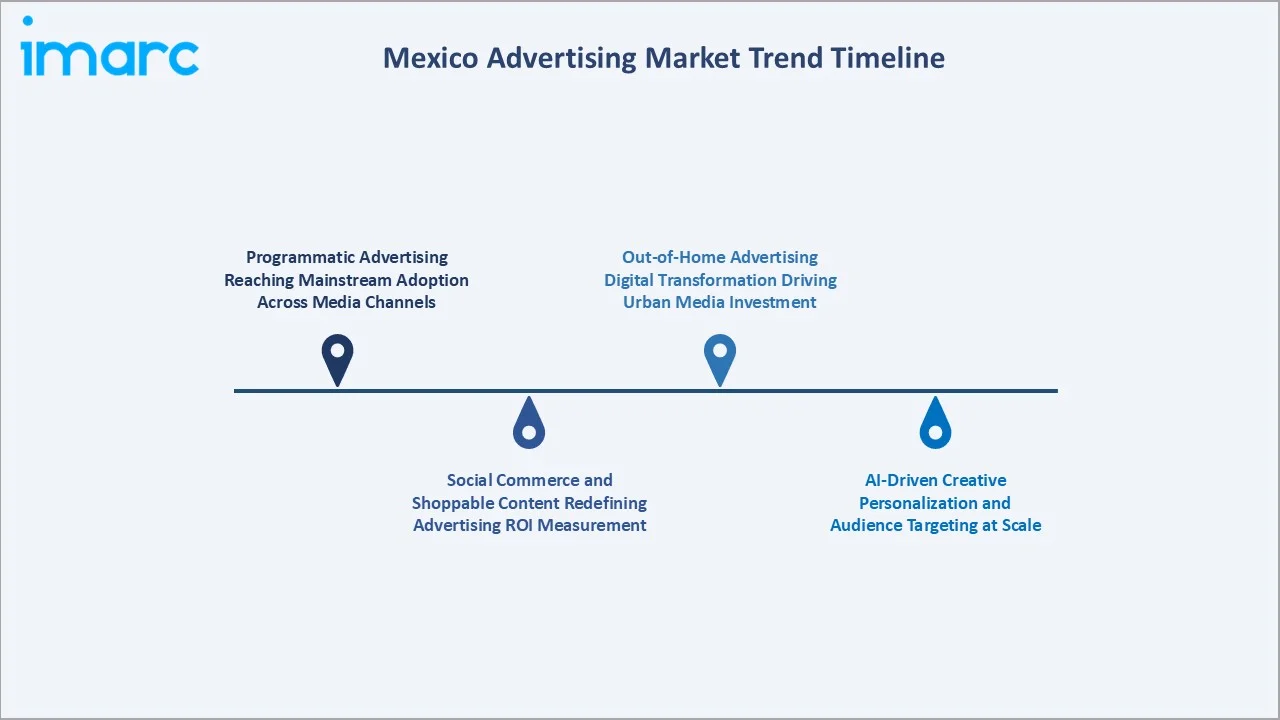
1. Programmatic Advertising Reaching Mainstream Adoption Across Media Channels
Programmatic advertising is achieving mainstream adoption across digital display, video, mobile, and connected TV channels in Mexico. Automated buying platforms enable real-time audience targeting, dynamic creative optimization, and performance tracking. Agencies and brands are shifting traditional direct-buy budgets to programmatic as data infrastructure and inventory quality improve.
2. Social Commerce and Shoppable Content Redefining Advertising ROI Measurement
Social commerce integration is transforming advertising into a direct revenue channel. Platforms including Instagram, TikTok, and Facebook are enabling shoppable posts, live commerce, and in-app purchasing, allowing advertisers to track return on ad spend from content to transaction and redefining campaign performance metrics.
3. AI-Driven Creative Personalization and Audience Targeting at Scale
Artificial intelligence is enabling personalized creative delivery and precision audience targeting across advertising channels. AI-powered tools automate dynamic creative generation, optimize bidding strategies, and identify high-value audience segments in real time. Advertisers using AI-based optimization are achieving meaningful improvements in campaign efficiency and conversion rates.
4. Out-of-Home Advertising Digital Transformation Driving Urban Media Investment
Digital out-of-home advertising is expanding rapidly across Mexico's urban centers, transportation hubs, and commercial zones. Programmatic digital billboard buying, real-time content management, and audience attribution tools are making out-of-home advertising more measurable and flexible, attracting increased investment from brands.
Industry Value Chain Analysis
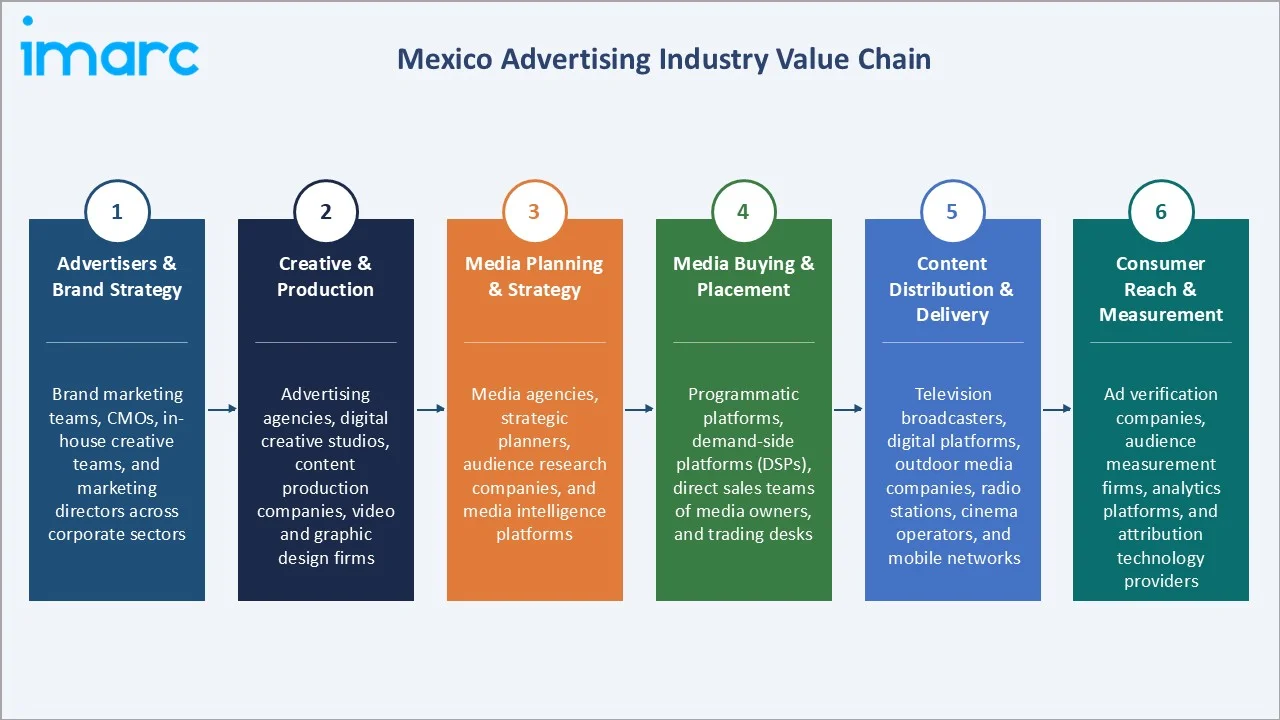
The advertising industry value chain integrates advertiser brief and strategy, creative development and production, media planning, media buying and placement, content distribution and delivery, and consumer reach and campaign measurement.
|
Stage |
Key Participants |
|
Advertisers & Brand Strategy |
Brand marketing teams, CMOs, in-house creative teams, and marketing directors across corporate sectors |
|
Creative & Production |
Advertising agencies, digital creative studios, content production companies, video and graphic design firms |
|
Media Planning & Strategy |
Media agencies, strategic planners, audience research companies, and media intelligence platforms |
|
Media Buying & Placement |
Programmatic platforms, demand-side platforms (DSPs), direct sales teams of media owners, and trading desks |
|
Content Distribution & Delivery |
Television broadcasters, digital platforms, outdoor media companies, radio stations, cinema operators, mobile networks |
|
Consumer Reach & Measurement |
Ad verification companies, audience measurement firms, analytics platforms, and attribution technology providers |
The media buying and placement stage is the most commercially differentiated phase of the advertising value chain. Programmatic platforms capture technology fees on managed inventory at scale. The measurement and analytics layer creates the performance accountability framework that justifies advertising investment.
Technology Landscape in the Mexico Advertising Industry
Programmatic Advertising and Real-Time Bidding Technology
Programmatic advertising and real-time bidding technology enable automated buying and selling of digital advertising inventory across web, mobile, and video platforms. These systems use audience data, machine learning algorithms, and real-time auctions to deliver ads at optimized costs. Adoption in Mexico continues to expand as digital inventory quality and data infrastructure improve.
Artificial Intelligence and Data Analytics Platforms
AI and data analytics platforms are enabling advanced audience segmentation, creative personalization, and campaign performance optimization. Machine learning algorithms analyze user behavior, purchase intent signals, and contextual data to improve ad targeting efficiency. AI-powered creative testing and dynamic content generation are becoming core capabilities for leading advertisers in Mexico.
Digital Out-of-Home and Connected TV Technology
Digital out-of-home and connected TV technologies are expanding premium advertising inventory beyond traditional screens. Programmatic DOOH enables real-time content management, audience targeting, and campaign flexibility across outdoor digital displays. Connected TV platforms are enabling addressable advertising to reach streaming audiences with targeted content and interactive formats.
Market Segmentation Analysis
The report covers the following segments:
|
Segment Category |
Leading Segment |
Market Share |
Year |
|
Type |
Internet Advertising |
29.6% |
2025 |
|
Region |
Central Mexico |
47.3% |
2025 |

By Type
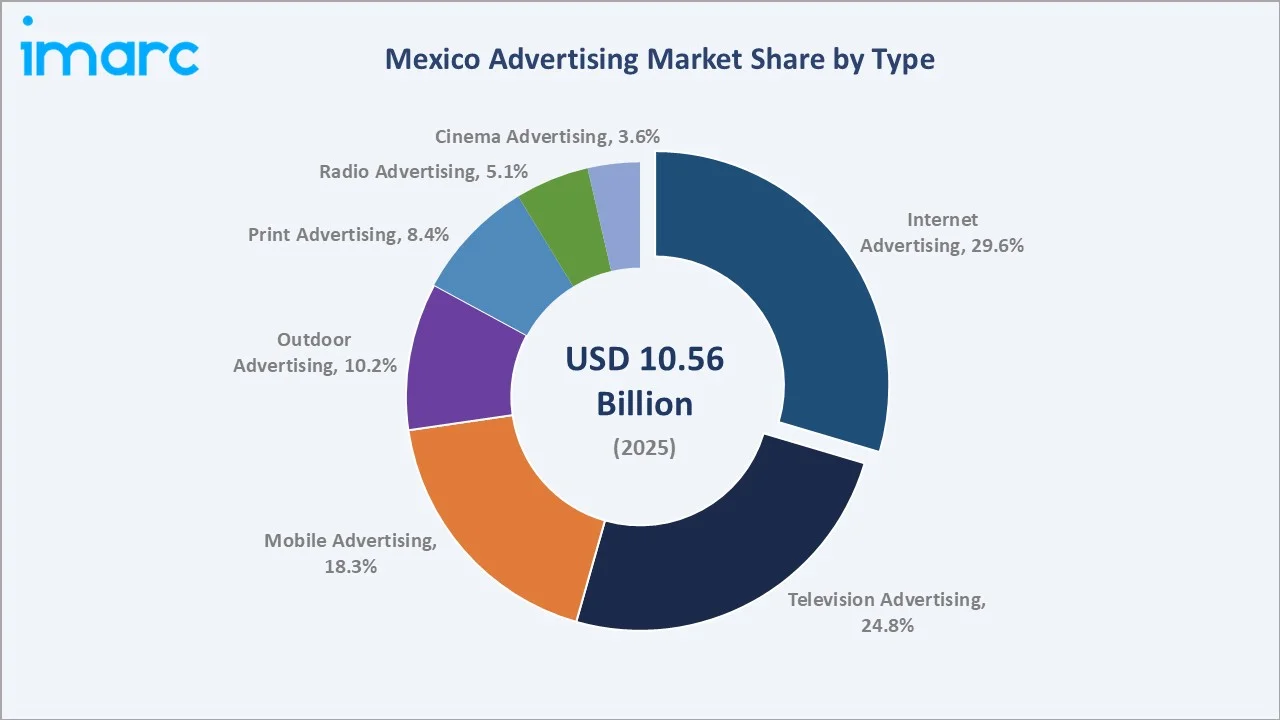
Internet advertising leads at 29.6% (2025). The internet advertising segment encompasses search advertising, display advertising, video advertising, classified advertising, and social media advertising. Programmatic platforms and social media channels continue to attract increasing budget allocations from brands across consumer goods, retail, financial services, and technology sectors.
To access detailed market analysis, Request Sample
Television advertising at 24.8% retains strong market position through national broadcast reach. Mobile advertising at 18.3% reflects Mexico's expanding smartphone penetration and mobile content consumption. Outdoor advertising at 10.2%, print at 8.4%, radio at 5.1%, and cinema at 3.6% complete the diversified media mix.
Regional Market Insights
|
Region |
Share (2025) |
Key Mexico Advertising Market Drivers & Characteristics |
|
Central Mexico |
47.3% |
Driven by concentration of corporate headquarters, media agencies, large retail chains, and the highest consumer spending power centered in Mexico City. |
|
Northern Mexico |
28.5% |
Driven by manufacturing sector growth, nearshoring activity, border trade, and strong consumer purchasing power in Monterrey, Tijuana, and Ciudad Juárez. |
|
Southern Mexico |
15.2% |
Driven by growing retail expansion, tourism advertising, and increasing digital connectivity investment in Jalisco, Oaxaca, and the Yucatán Peninsula. |
|
Others |
9.0% |
Driven by rural digitization, regional media investment, and growing penetration of mobile internet advertising in underserved and emerging regional markets. |
Central Mexico's 47.3% market leadership is anchored by Mexico City's position as the country's commercial, media, and cultural capital. Northern Mexico's 28.5% reflects the industrial expansion driven by nearshoring trends, manufacturing sector advertising, and higher-income consumer demographics.
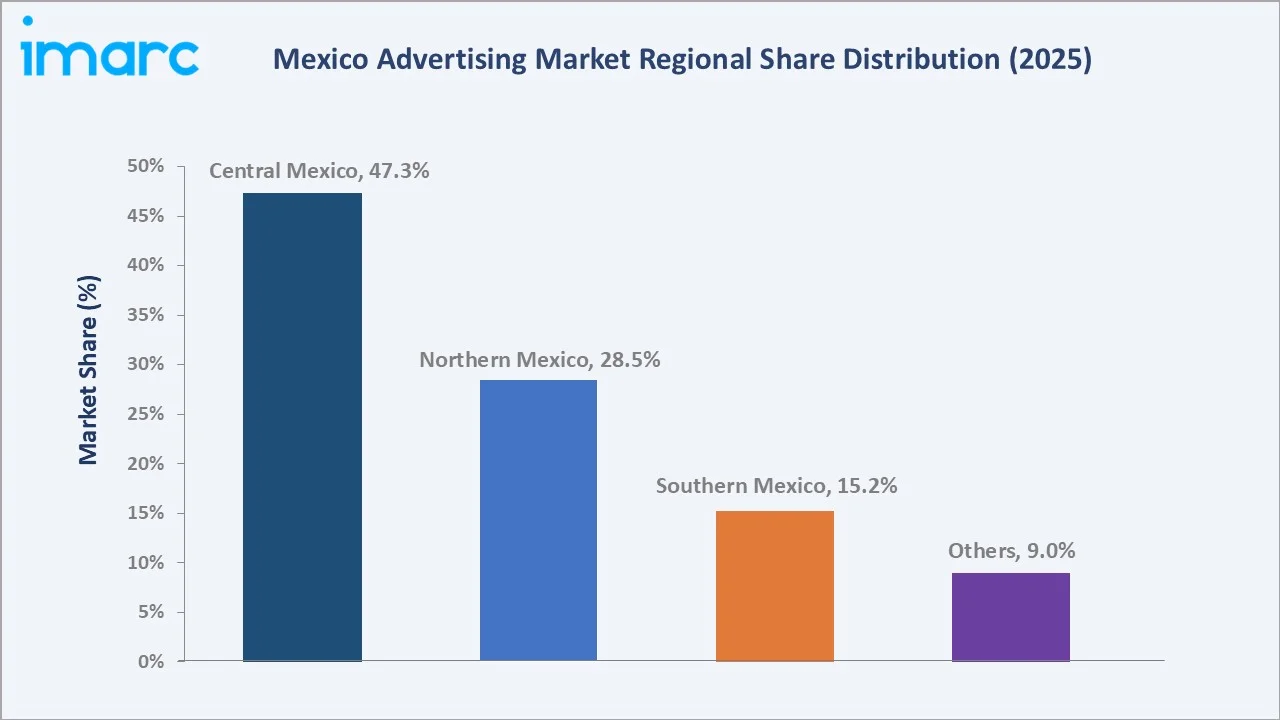
Southern Mexico's 15.2% reflects expanding retail penetration and tourism-related advertising investment. The Others segment at 9.0% captures the gradual expansion of digital advertising into rural and emerging regional markets as mobile internet connectivity improves.
Competitive Landscape
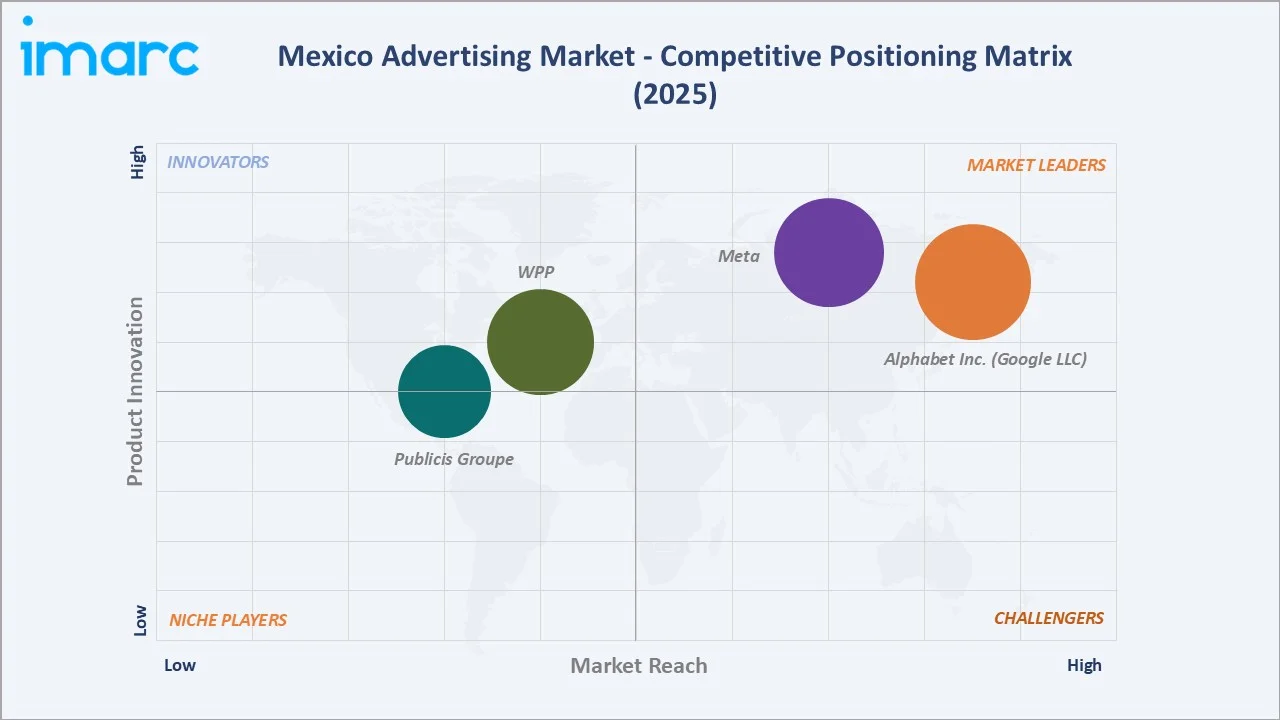
The Mexico advertising market competitive landscape encompasses global digital platforms, national media owners, international advertising holding groups, and regional creative and media agencies. The market is structured across platform technology, content distribution, and agency service tiers.
|
Company Name |
Key Products |
Market Position |
Core Strength |
|
Alphabet Inc. (Google LLC) |
Google Ads, YouTube Advertising, Display & Video 360 |
Market Leader |
Alphabet dominates digital advertising in Mexico through Google Search, YouTube video, and programmatic display, capturing the largest share of digital advertising spend through data-driven targeting and measurement. |
|
Meta |
Facebook Ads, Instagram Ads, |
Market Leader |
Meta plays a central role in Mexico's advertising market through Facebook and Instagram's massive user bases, offering precise demographic and interest-based targeting across social and mobile formats. |
|
WPP |
Mindshare, GroupM, |
Established Player |
WPP México operates the country's largest advertising holding group, providing integrated media planning, creative, digital, and performance marketing services to multinational and domestic clients. |
|
Publicis Groupe |
Leo Burnett, DigitasLBi |
Established Player |
Publicis Groupe México delivers integrated creative, media, and digital advertising solutions, leveraging its data intelligence platform to enable targeted performance marketing campaigns. |
The competitive landscape is defined by global digital platforms capturing increasing share of advertising budgets, traditional media owners adapting to digital convergence, and global holding groups providing integrated agency services across creative, media, and data disciplines.
Key Company Profiles
Alphabet Inc. (Google LLC)
Alphabet Inc., through Google LLC, is the leading digital advertising platform in Mexico, operating Google Search, YouTube, Google Display Network, and programmatic infrastructure serving advertisers across all sectors and budget levels.
- Key Products: Google Ads, YouTube Advertising, Display & Video 360, Google Marketing Platform.
- Recent Developments: In 2025, Google introduced new AI-powered enhancements to Performance Max campaigns, including expanded campaign controls, deeper reporting, and improved automation across Search, YouTube, Display, Discover, Gmail, and Maps. These capabilities were made available to advertisers globally, including businesses operating in Mexico, helping improve cross-channel campaign performance.
- Strategic Focus: Focuses on AI-driven advertising automation, YouTube video monetization growth, and programmatic platform expansion for advertisers in Mexico's rapidly digitalizing advertising market.
Meta
Meta Platforms Inc. operates Facebook, Instagram, and WhatsApp in Mexico, providing social media advertising solutions enabling brands to reach Mexico's large active social media user base with targeted content and commerce-integrated formats.
- Key Products: Facebook Ads Manager, Instagram Ads, WhatsApp Business API, Reels Advertising.
- Recent Developments: In October 2025, Meta introduced new generative AI capabilities for Advantage+ catalog ads, allowing advertisers to generate multiple creative variations and optimize campaigns using AI-driven text and image enhancements across Facebook and Instagram.
- Strategic Focus: Centers on social commerce integration, Reels video advertising growth, and AI-powered audience targeting to capture increasing digital ad budgets from brands across retail, consumer goods, and financial services.
Market Concentration Analysis
The Mexico advertising market is moderately concentrated at the media owner tier, with Grupo Televisa and TV Azteca collectively commanding the majority of broadcast television advertising revenue. Digital advertising is highly concentrated, with Alphabet and Meta together capturing an estimated 55–65% of digital advertising investment. Agency services are moderately fragmented, with global holding groups including WPP, Publicis, and Dentsu competing alongside independent local agencies.
Investment & Growth Opportunities
Highest Growth Segments
Mobile advertising (~7.1% CAGR), internet advertising (~6.2% CAGR), connected TV advertising (~12% CAGR from emerging base), digital out-of-home (~9.5% CAGR), influencer marketing (~15% CAGR from expanding base), and programmatic video (~10% CAGR) represent the highest-growth Mexico advertising investment vectors through 2034.
Emerging Investment Opportunities
The nearshoring-driven expansion of Mexico's manufacturing sector represents a significant advertising opportunity, as multinational brands entering the Mexican market increase investment in brand awareness and consumer marketing campaigns targeted at Mexico's growing industrial workforce and urban consumer base.
Investment Themes
- Programmatic technology platform investment capturing automated buying fee revenue at scale: Programmatic advertising platforms in Mexico benefit from increasing digital ad budget allocation, growing publisher inventory quality, and improving audience data infrastructure. Investment in DSP technology and publisher partnerships positions platforms to capture increasing share of digital advertising spend.
- Connected TV and streaming advertising infrastructure development: Connected TV advertising in Mexico is emerging as a high-value premium inventory segment. Investment in addressable TV technology, content streaming platform advertising capabilities, and cross-screen audience measurement infrastructure is positioned to capture the growing share of television viewing shifting to streaming platforms.
Future Market Outlook (2026-2034)
The Mexico advertising market is projected to grow from USD 10.56 Billion in 2025 to USD 14.85 Billion by 2034, delivering a 3.74% CAGR over the forecast period. The market anchor value of USD 12.69 Billion in 2030 reflects sustained digital advertising growth, expanding mobile penetration, and increasing brand investment across all media channels.
Three structural forces define Mexico advertising market growth through 2034. Digital media adoption is accelerating as internet penetration expands to underserved regions, creating new addressable advertising audiences. The nearshoring investment wave is increasing multinational brand entry into Mexico, expanding the advertiser base. AI and data technology maturation is improving advertising efficiency and enabling new performance marketing capabilities.
Research Methodology
Primary Research
Primary research comprised structured interviews with 50+ industry stakeholders (2025) including Chief Marketing Officers, Media Directors, Digital Advertising Heads, agency Managing Directors, and regional advertising market specialists across Mexico's major media centers.
Secondary Research
Secondary research encompassed Mexican advertising industry publications, IFT/ATD regulatory filings, digital advertising association data, company annual reports, media measurement reports, and programmatic advertising technology reviews. Over 60 secondary sources were reviewed.
Forecasting Models
Market revenue forecasts were developed using a segment bottom-up model integrating television, digital, mobile, outdoor, print, radio, and cinema components, calibrated against macro advertising spend indicators and regional economic growth trajectories.
Mexico Advertising Market Report Coverage:
| Report Features | Details |
|---|---|
| Base Year of the Analysis | 2025 |
| Historical Period | 2020-2025 |
| Forecast Period | 2026-2034 |
| Units | Billion USD |
| Scope of the Report |
Exploration of Historical Trends and Market Outlook, Industry Catalysts and Challenges, Segment-Wise Historical and Future Market Assessment:
|
| Types Covered |
|
| Regions Covered | Northern Mexico, Central Mexico, Southern Mexico, Others |
| Companies Covered | Alphabet Inc. (Google LLC), Meta, WPP, Publicis Groupe, etc. |
| Customization Scope | 10% Free Customization |
| Post-Sale Analyst Support | 10-12 Weeks |
| Delivery Format | PDF and Excel through Email (We can also provide the editable version of the report in PPT/Word format on special request) |
Key Benefits for Stakeholders:
- IMARC’s industry report offers a comprehensive quantitative analysis of various market segments, historical and current market trends, market forecasts, and dynamics of the Mexico advertising market from 2020-2034.
- The research report provides the latest information on the market drivers, challenges, and opportunities in the Mexico advertising market.
- Porter's five forces analysis assists stakeholders in assessing the impact of new entrants, competitive rivalry, supplier power, buyer power, and the threat of substitution. It helps stakeholders to analyze the level of competition within the Mexico advertising industry and its attractiveness.
- Competitive landscape allows stakeholders to understand their competitive environment and provides an insight into the current positions of key players in the market.
Frequently Asked Questions About the Mexico Advertising Market Report
The Mexico advertising market reached USD 10.56 Billion in 2025. The market is driven by rapid digital adoption, rising smartphone penetration, growing e-commerce, and increasing programmatic advertising adoption. Television advertising retains strong investment, while digital formats are capturing increasing share of total advertising budgets.
The market grows at 3.74% CAGR during 2026-2034, reaching USD 14.85 Billion by 2034. Mobile advertising grows fastest at approximately 7.1% CAGR through expanding smartphone penetration, while internet advertising grows at approximately 6.2% CAGR through programmatic and social media expansion.
Internet advertising leads at 29.6% through programmatic targeting, search, display, and video formats. The segment's growth reflects the structural shift of advertising budgets from traditional to digital media as brands prioritize measurable, data-driven campaign performance.
Central Mexico leads at 47.3% through the concentration of corporate headquarters, media agencies, major national retailers, and Mexico City's position as the country's dominant commercial and consumer spending center.
Leading companies include Alphabet Inc. (Google LLC), Meta, WPP, and Publicis Groupe, among others.
The market is projected to reach approximately USD 12.69 Billion by 2030, with digital advertising achieving mainstream dominance, connected TV emerging as a significant premium inventory channel, and programmatic automation becoming the standard buying approach across multiple media formats.
Key growth drivers include rising digital media penetration, growing e-commerce and performance marketing demand, increasing smartphone adoption, nearshoring-driven brand investment, and AI-powered advertising technology maturation enabling more efficient campaign delivery and measurement.
Need more help?
- Speak to our experienced analysts for insights on the current market scenarios.
- Include additional segments and countries to customize the report as per your requirement.
- Gain an unparalleled competitive advantage in your domain by understanding how to utilize the report and positively impacting your operations and revenue.
- For further assistance, please connect with our analysts.
 Request Customization
 Speak to an Analyst
 Request Brochure
 Inquire Before Buying
Benefits of Customization
- Personalize this research
- Triangulate with your data
- Get data as per your format and definition
- Gain a deeper dive into a specific application, geography, customer, or competitor
- Any level of personalization
Get in Touch With Us
UNITED STATES
Phone: +1-201-971-6302
INDIA
Phone: +91-120-433-0800
UNITED KINGDOM
Phone: +44-753-714-6104
Email: [email protected]
Client Testimonials




.webp)




.webp)













Related Reports

Choose your plan
*Please note that the prices mentioned below are starting prices for each bundle type. Kindly contact our team for further details.*
Single User License
- 1 User License, Access on 2 Devices
- PDF Report + Excel Dataset (Password Protected)
- Lifetime Access
- No Printing Rights
- 10% Free Report Customization
- 10–12 Weeks of Analyst Support
Five User License
- Access for 5 Users, 2 Devices per User
- PDF Report + Excel Dataset (Password Protected)
- Lifetime Access
- Dedicated Account Manager
- 12–14 Weeks of Analyst Support
- No Printing Rights
- 15% Free Report Customization
- 25% Discount on Your Next Purchase
Corporate User License
- Unlimited User Access (Within Your Organization)
- PDF Report + Excel Dataset
- Lifetime Access
- Dedicated Account Manager
- 14–20 Weeks of Analyst Support
- No Printing Rights
- 20% Free Report Customization
- 30% Discount on Your Next Purchase
Essential Insights
What's included:
3 reports
- Lifetime Access
- PDF Reports
- Excel Datasets
- 2 Weeks of Free Analyst Support
- 2 User Licenses
- Access on 2 Devices
- Printing Rights
- Complimentary PowerPoint (PPT) Version
- Complimentary License Upgrade
Professional Access
What's included:
5 reports
- Lifetime Access
- PDF Reports
- Excel Datasets
- 8 Weeks of Free Analyst Support
- 2 User Licenses
- Access on 2 Devices
- Printing Rights
- Complimentary PowerPoint (PPT) Version
- Complimentary License Upgrade
Business Advantage
What's included:
8 reports
- Lifetime Access
- PDF Reports
- Excel Datasets
- 14 Weeks of Free Analyst Support
- 2 User Licenses
- Access on 2 Devices
- Printing Rights
- Complimentary PowerPoint (PPT) Version
- Complimentary License Upgrade
Enterprise Intelligence
What's included:
10 reports
- Lifetime Access
- PDF Reports
- Excel Datasets
- 20 Weeks of Free Analyst Support
- 2 User Licenses
- Access on 2 Devices
- Printing Rights
- Complimentary PowerPoint (PPT) Version
- Complimentary License Upgrade