
Mexico Application Processor Market Size, Share, Trends and Forecast by Device Type, Core Type, and Region, 2026-2034
Mexico Application Processor Market Size, Share, Trends & Forecast (2026-2034)
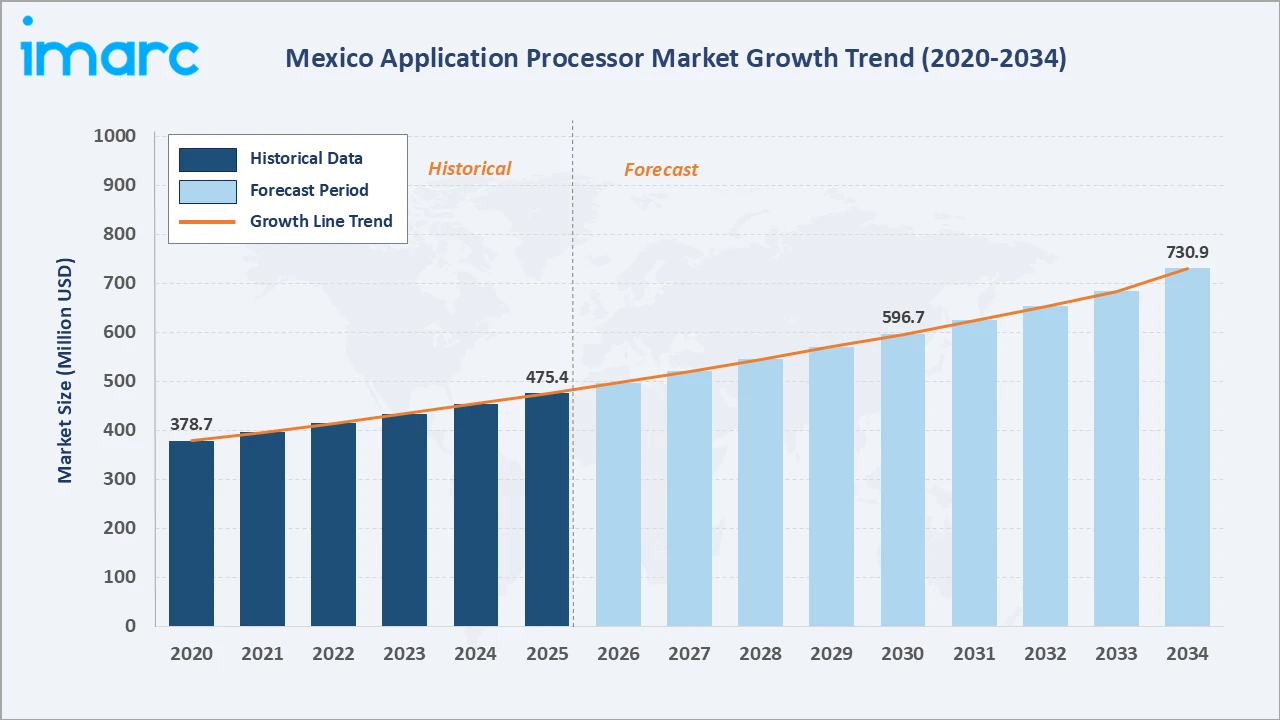
The Mexico application processor market reached USD 475.4 Million in 2025 and is projected to reach USD 730.9 Million by 2034, exhibiting a CAGR of 4.65% during 2026-2034. Rising smartphone penetration and 5G infrastructure rollout and the growth of automotive ADAS and infotainment electronics across Mexico's world-class auto manufacturing corridor are the primary growth catalysts. By the end of 2025, GSMA Intelligence recorded around 145 million cellular mobile connections in Mexico, representing nearly 110% of the population. At the same time, network quality has improved significantly, with about 98.5% of mobile connections classified as broadband, covering 3G, 4G, and 5G networks. Mobile phones lead the device type at 58.7%, octa-core dominates the core type at 47.8%, and Central Mexico accounts for the largest regional share at 42.3%.
Market Snapshot
|
Metric |
Value |
|
Market Size (2025) |
USD 475.4 Million |
|
Forecast Market Size (2034) |
USD 730.9 Million |
|
CAGR (2026-2034) |
4.65% |
|
Base Year |
2025 |
|
Historical Period |
2020-2025 |
|
Forecast Period |
2026-2034 |
|
Dominant Device Type |
Mobile Phones (58.7%, 2025) |
|
Dominant Core Type |
Octa-Core (47.8%, 2025) |
|
Leading Region |
Central Mexico (42.3%, 2025) |
The Mexico application processor market demonstrated consistent growth, rising from USD 378.7 Million in 2020 to USD 475.4 Million in 2025, driven by expanding smartphone adoption, government digital inclusion initiatives, and the emergence of Mexico's electronics manufacturing sector. The market is projected to reach USD 596.7 Million by 2030 and USD 730.9 Million by 2034, supported by 5G network expansion, increasing multi-core processor adoption in mid-range devices, automotive processor demand from Mexico's auto OEM ecosystem, and the progressive integration of AI inference capabilities into mobile application processors consumed by Mexico's digitally mobile consumer population.
To get more information on this market, Request Sample
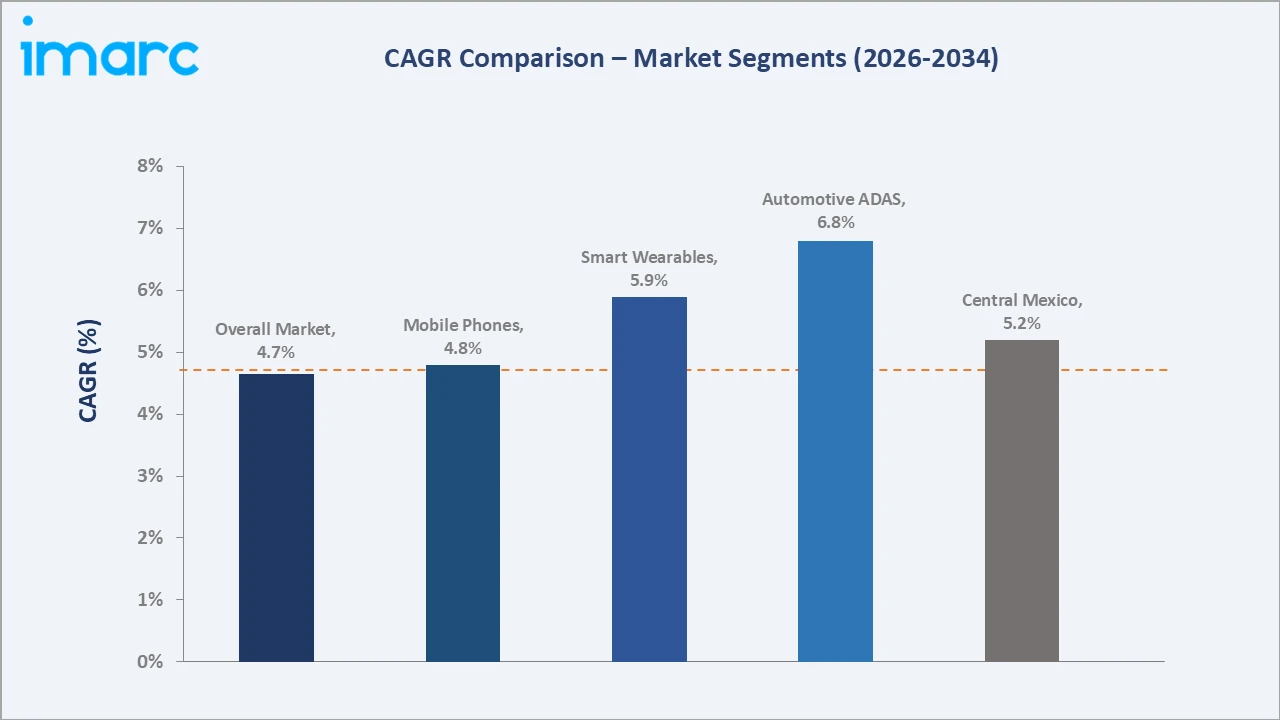
Mobile phones grow at ~4.8% CAGR through continued smartphone upgrade cycles driven by 5G device adoption and AI-integrated handset demand. Automotive ADAS and infotainment devices grow at ~6.8% CAGR, fueled by Mexico's automotive manufacturing output and EV expansion. Octa-core type grows at ~5.5% CAGR as mid-to-premium smartphone penetration deepens across Mexico's urban markets and Central Mexico leads regional growth at ~5.2% CAGR.
Executive Summary
The Mexico application processor market is expanding at a steady pace, underpinned by structural demand drivers including Mexico's young digital-first population and the progressive upgrade of its telecommunications infrastructure toward 5G. Market value stood at USD 475.4 Million in 2025 and is forecast to reach USD 730.9 Million by 2034, reflecting a 4.65% CAGR. Mexico represents Latin America's second-largest application processor market, positioned at the convergence of North American technology demand, nearshoring electronics manufacturing investment, and a population increasingly consuming smartphones, connected devices, and automotive electronics.
Mobile phones lead at 58.7% (2025), reflecting the dominance of smartphone-related processor demand in Mexico's consumer electronics market. Octa-core type command 47.8% of core type (2025), reflecting the industry-wide migration toward multi-core architectures in mid-range and premium smartphones. Central Mexico commands 42.3% of market revenue (2025), driven by the highest concentration of consumer electronics demand and the presence of major technology companies, data centers, and auto electronics manufacturing in the Bajío region.
Key Market Insights
|
Insight |
Data |
|
Dominant Device Type |
Mobile Phones – 58.7% share (2025) |
|
Dominant Core Type |
Octa-Core – 47.8% share (2025) |
|
Leading Region |
Central Mexico – 42.3% share (2025) |
|
Market Opportunity |
5G octa-core smartphone upgrade cycle; ADAS processors via auto nearshoring; AI-integrated mobile SoCs |
Key Analytical Observations Supporting the Above Data:
- Mobile Phones at 58.7% (2025): Smartphones are the dominant consumer of application processors in Mexico, driven by one of Latin America's highest prepaid mobile subscriber bases.
- Octa-Core at 47.8% (2025): The rapid migration of Mexico's smartphone market from entry-level quad-core devices toward mid-range octa-core processors reflects rising consumer expectations for multi-application performance, AI photography features, and gaming capability in the premium smartphone price tier that represents the highest volume segment in Mexico.
- Central Mexico at 42.3% (2025): Mexico City, Guadalajara (Silicon Valley of Mexico), and Toluca collectively anchor Central Mexico's technology demand and semiconductor-intensive manufacturing activity. Mexico City's high consumer population provides the highest-density consumer electronics retail market in Latin America, concentrating smartphone and tablet application processor demand.
Mexico Application Processor Market Overview
The Mexico application processor market encompasses the design, import, distribution, and integration of semiconductor processors used across consumer electronics, automotive, and industrial computing applications. The market is predominantly served by imported application processors from global fabless chip designers whose products are manufactured before being integrated into finished devices. Mexico's electronics import ecosystem provides tariff-advantaged access to application processors from North American and global suppliers. Macroeconomic factors include Mexico’s rising internet penetration, expanding smartphone usage, and growing adoption of digital services across retail, banking, education, and entertainment. Increasing disposable income, urbanization, and business digitalization are further supporting demand for advanced mobile devices, thereby driving the Mexico application processor market.
Market Dynamics
To evaluate market opportunities, Request Sample
Market Drivers
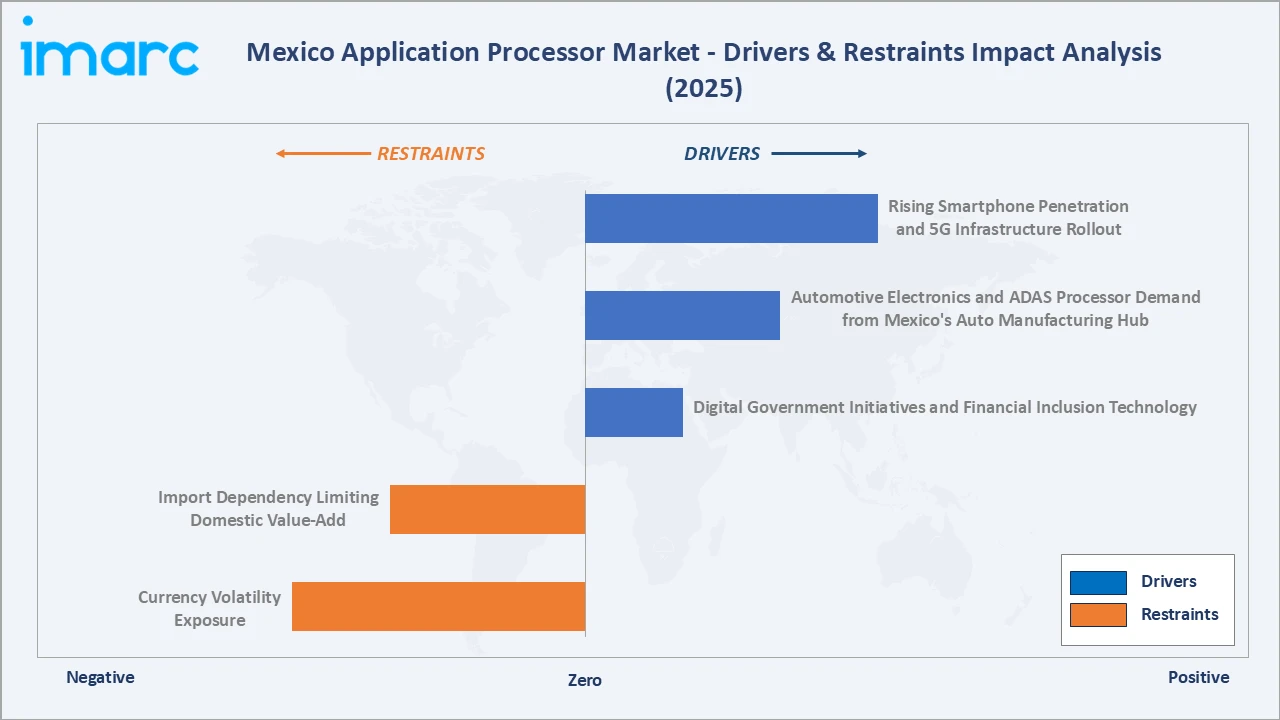
- Rising Smartphone Penetration and 5G Infrastructure Rollout: According to GSMA Intelligence, Mexico had 145 million cellular mobile connections by the end of 2025, equal to 110% of the total population, indicating extensive multi-SIM usage among both personal and professional users. Network performance is also strengthening, with around 98.5% of mobile connections classified as broadband, including 3G, 4G, and 5G services. The 5G spectrum auction outcomes and major carrier network investment commitments are driving a consumer device upgrade cycle from 4G to 5G-capable smartphones, requiring application processors with integrated 5G modems. This upgrade cycle directly increases average application processor selling prices as consumers shift from quad-core to octa-core, AI-integrated devices.
- Automotive Electronics and ADAS Processor Demand from Mexico's Auto Manufacturing Hub: Mexico produces around 4 million vehicles annually, of which approximately 3.5 million are shipped to international markets. Nearly 80% of these vehicle exports are destined for the United States. As automotive OEMs increase ADAS content per vehicle in compliance with US and international safety standards, and as EV production accelerates in Mexico, demand for automotive-grade application processors grows commensurately through Mexico's deeply embedded Tier 1 automotive supplier network.
- Digital Government Initiatives and Financial Inclusion Technology: Mexico's government digital transformation programs are driving connectivity investment in underserved regions, expanding the total addressable market for low-cost smartphones and connected devices powered by affordable application processors. Digital financial services adoption is also accelerating smartphone adoption among Mexico's previously underbanked population.
Market Restraints
- Import Dependency Limiting Domestic Value-Add: High import dependency limiting domestic value addition in semiconductor design, fabrication, and advanced packaging. Since most application processors and key chip components are sourced from overseas suppliers, local manufacturers remain exposed to price volatility, currency fluctuations, and supply chain disruptions. This dependence also restricts technology transfer and slows the development of a strong domestic semiconductor ecosystem.
- Currency Volatility Exposure: Currency volatility exposure increases the cost uncertainty of imported chips, wafers, and semiconductor components, which are largely priced in US dollars. Fluctuations in the Mexican peso can raise procurement costs for device manufacturers and reduce profit margins. This also makes long-term pricing, inventory planning, and investment decisions more challenging for local electronics and automotive companies.
Market Opportunities
- AI-Integrated Application Processor Upgrade Cycle: The integration of Neural Processing Units (NPUs) and on-device AI inference capabilities into mid-range application processors is creating a compelling consumer upgrade narrative for Mexico's smartphone market. AI features, including computational photography, real-time translation, health monitoring in wearables, and generative AI assistants, are driving consumer willingness to upgrade to AI-capable devices powered by next-generation application processors.
- Smart Wearables Expansion in Mexico's Health and Fitness Market: Mexico's growing health and fitness awareness is creating a rapidly expanding market for wearable-grade application processors. Smart wearables are driven by Apple Watch penetration in premium segments, Samsung Galaxy Watch adoption in Android mid-tier, and affordable Xiaomi Mi Band and Amazfit penetration in the mass market.
Market Challenges
- Semiconductor Supply Chain Concentration Risk: Mexico's application processor market is exposed to concentration risk from global semiconductor supply chain disruptions. Geopolitical tensions could create significant supply disruptions that would impact smartphone and automotive electronics production globally, with direct effects on Mexico's consumer electronics availability and automotive manufacturing throughput.
- Competition from Grey Market and Parallel Import Devices: Mexico's application processor market faces competitive pressure from grey market and parallel import devices, primarily smartphones entering through informal cross-border channels from China and the United States, that compete with formally imported devices at aggressive price points. Grey market penetration distorts official application processor market size estimates and creates pricing pressure that compresses formal channel margins.
Emerging Market Trends
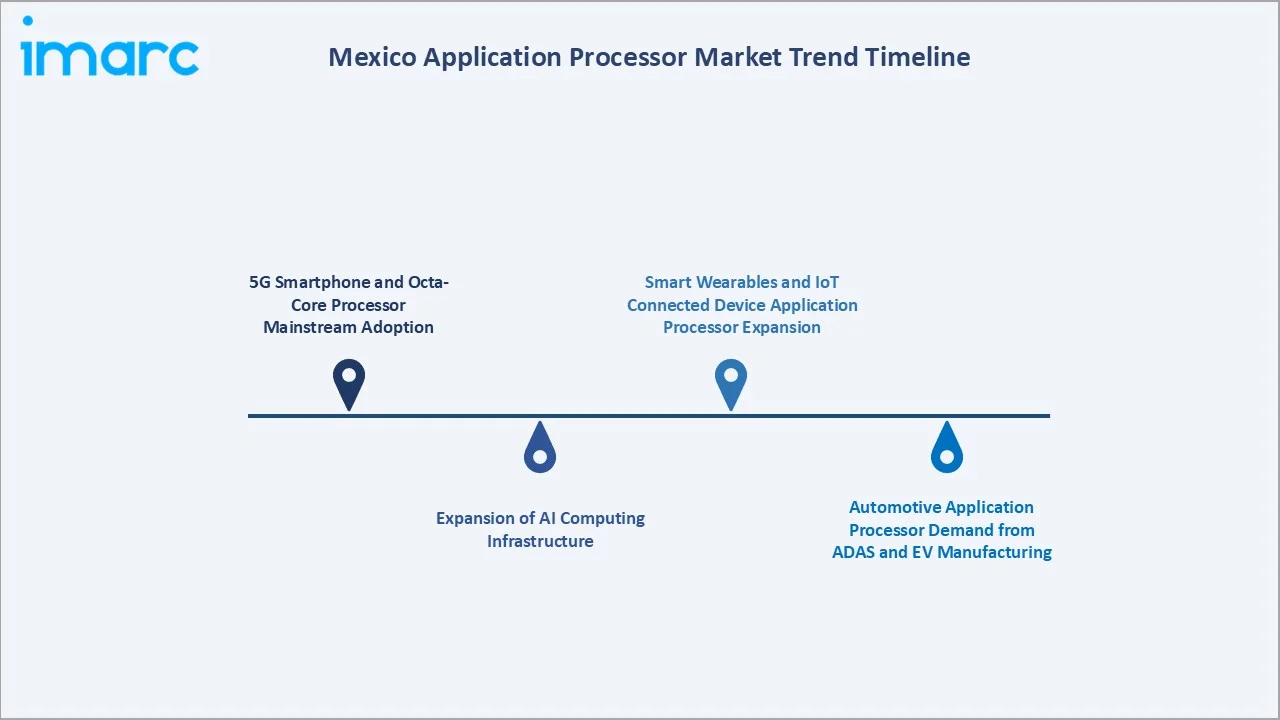
1. 5G Smartphone and Octa-Core Processor Mainstream Adoption
Mexico's 5G network expansion is the most immediate catalyst for application processor technology upgrades across Mexico's consumer electronics market. As 5G coverage expands from the largest cities to Tier 2 urban centers through 2026, consumer demand for 5G-capable smartphones is generating a sustained upgrade cycle that is shifting Mexico's AP demand mix from quad-core to octa-core architectures and increasing average selling prices per processor unit.
2. Expansion of AI Computing Infrastructure
Mexico is witnessing growing investments in AI-ready data centers and high-performance computing infrastructure, driven by the rapid adoption of artificial intelligence across industries. In July 2026, Bleeding Edge launched Mexico’s first next-generation AI Factory at its Querétaro campus. The company also introduced the country’s first Neocloud platform powered by NVIDIA Blackwell technology. These launches address the growing “compute crunch,” a global shortage of processing capacity caused by the rapid adoption of AI across industries. The deployment of AI factories and advanced Neocloud platforms is increasing demand for high-performance application processors, AI accelerators, and edge computing chips, encouraging wider adoption of AI-enabled devices and strengthening Mexico's position as an emerging regional hub for AI computing.
3. Automotive Application Processor Demand from ADAS and EV Manufacturing
Mexico's position as a major automotive manufacturing hub is increasingly translating into demand for automotive-grade application processors as ADAS content per vehicle increases. Mexico’s electrified vehicle market achieved a new milestone in March 2026, with sales reaching 16,374 units. This represented a 33.9% year-on-year increase compared to March 2025. The EV transition accelerates this trend, as EVs require 2-5x more semiconductor content per vehicle than combustion engine equivalents.
4. Smart Wearables and IoT Connected Device Application Processor Expansion
Mexico's smart wearables market, encompassing smartwatches, fitness trackers, hearables, and smart glasses, is in an early-to-mid stage growth trajectory that represents a significant application processor demand growth vector through 2034. Affordable fitness bands from Xiaomi and Amazfit using ultra-low-power dual-core processors, mid-tier Samsung Galaxy Watch devices using wearable chips, and premium Apple Watch Series using wearable SoC are all expanding Mexico's wearable AP addressable market.
Industry Value Chain Analysis
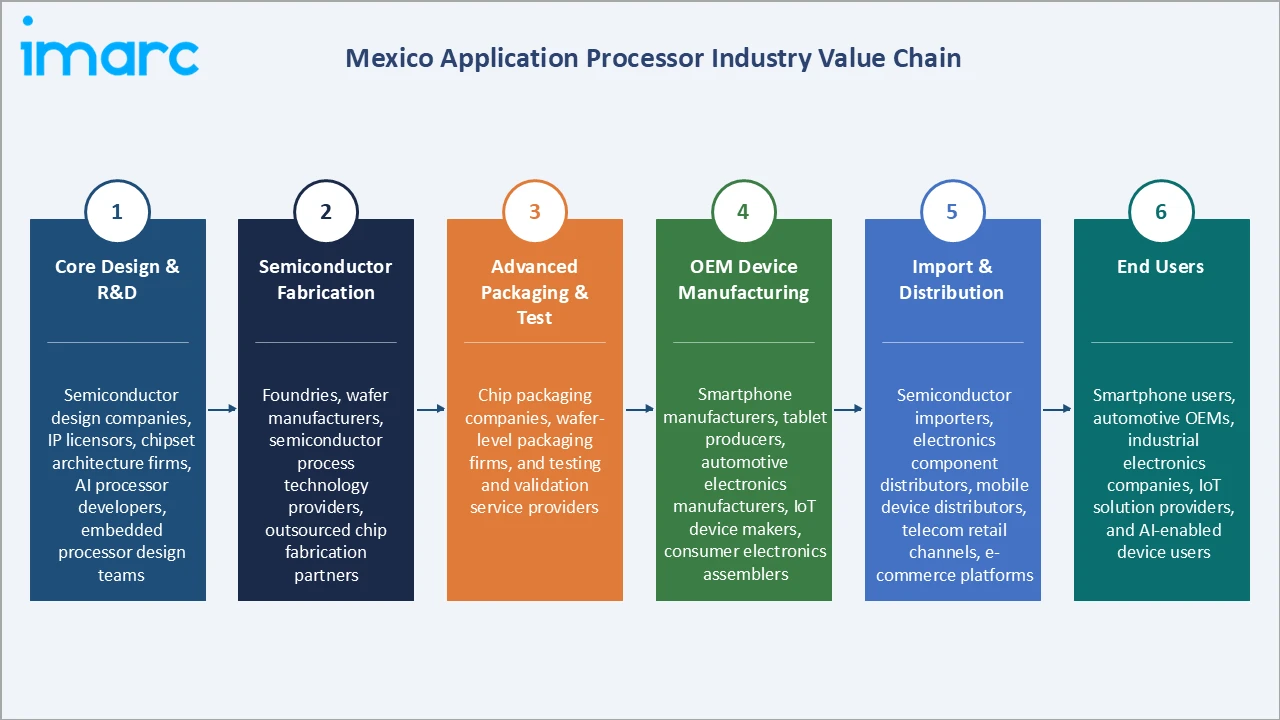
The Mexico application processor market value chain spans Core design and R&D, semiconductor fabrication, advanced packaging and test, OEM device manufacturing, import and distribution into Mexico's electronics retail channel, and end user consumption across consumer electronics, automotive, and industrial applications.
|
Stage |
Key Participants |
|
Core Design & R&D |
Semiconductor design companies, IP licensors, chipset architecture firms, AI processor developers, embedded processor design teams |
|
Semiconductor Fabrication |
Foundries, wafer manufacturers, semiconductor process technology providers, outsourced chip fabrication partners |
|
Advanced Packaging & Test |
Chip packaging companies, wafer-level packaging firms, and testing and validation service providers |
|
OEM Device Manufacturing |
Smartphone manufacturers, tablet producers, automotive electronics manufacturers, IoT device makers, consumer electronics assemblers |
|
Import & Distribution |
Semiconductor importers, electronics component distributors, mobile device distributors, telecom retail channels, e-commerce platforms |
|
End Users |
Smartphone users, automotive OEMs, industrial electronics companies, IoT solution providers, and AI-enabled device users |
Core design and R&D represent the highest value-creating stage in Mexico's application processor value chain, despite being geographically concentrated in the United States and Taiwan. Companies that control processor IP capture the largest proportion of application processor gross margin, while Mexico's role in the value chain centers on final device distribution and consumption.
Technology Landscape in the Mexico Application Processor Industry
Advanced Process Node Technology
Advanced process node technology enables the adoption of smaller semiconductor nodes (such as 5 nm and below) that deliver higher performance with lower power consumption. This supports the growing demand for AI-enabled smartphones, connected vehicles, and edge computing devices in the country. As Mexico expands its electronics manufacturing and automotive sectors, demand is increasing for application processors built on advanced nodes to improve computing efficiency, battery life, and on-device AI capabilities.
AI Neural Engine and On-Device Intelligence Integration
AI integration into application processors, through dedicated NPU cores capable of executing transformer-based neural network models locally, is the defining technology trend reshaping Mexico's application processor demand profile. For Mexico's mobile consumer market, where mobile data costs and coverage limitations make offline AI capability valuable, on-device AI represents a compelling feature differentiation that is driving upgrade intent among Mexico's smartphone users.
Automotive SoC Technology for ADAS and Connected Vehicle Applications
Automotive SoC technology supports advanced driver-assistance systems, infotainment, vehicle connectivity, and real-time data processing. As Mexico’s automotive sector shifts toward electric, connected, and software-defined vehicles, demand is rising for high-performance processors that can manage sensors, cameras, navigation, and in-vehicle AI functions. This is strengthening the role of application processors in next-generation mobility and automotive electronics manufacturing.
Market Segmentation Analysis
The report covers the following segments:
|
Segment Category |
Leading Segment |
Market Share |
Year |
|
Device Type |
Mobile Phones |
58.7% |
2025 |
|
Core Type |
Octa-Core |
47.8% |
2025 |
|
Region |
Central Mexico |
42.3% |
2025 |

By Device Type
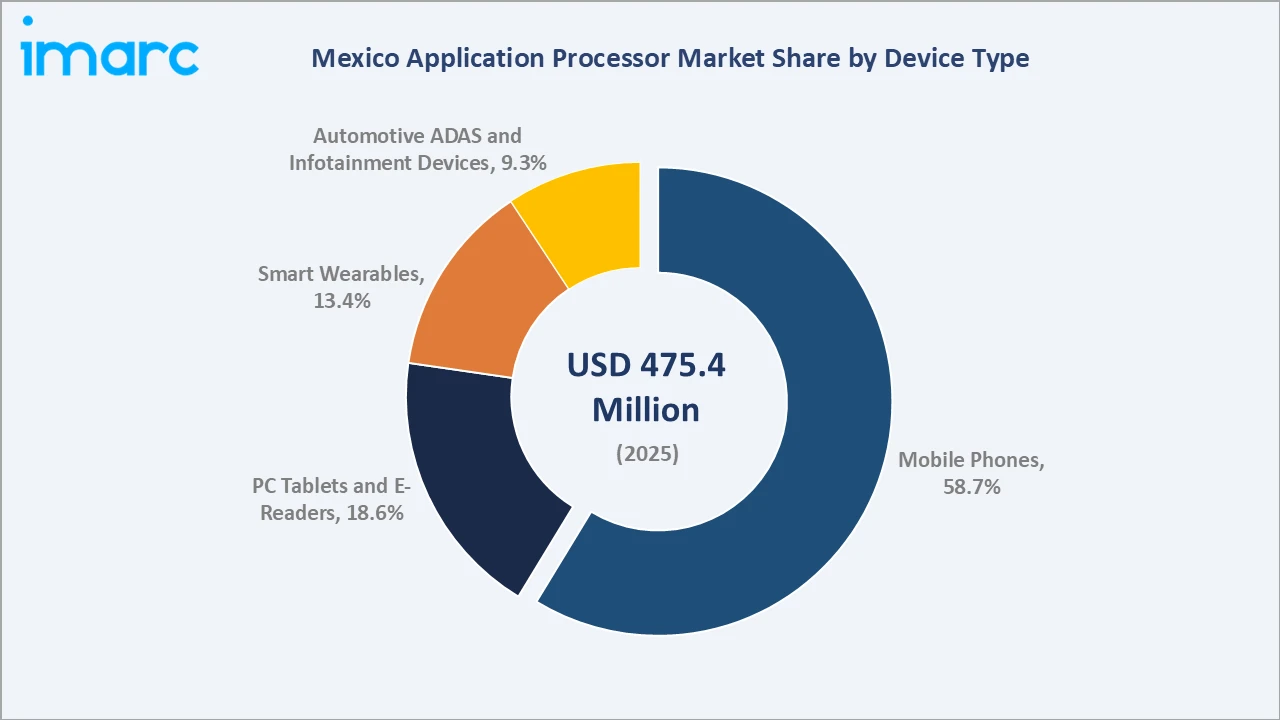
Mobile phones lead at 58.7% (2025), driven by Mexico's large and growing smartphone user base. Mexico's smartphone market is primarily served by the mid-range Android segment, where application processors define the competitive technology standard. The premium Apple iPhone segment, while smaller in volume, contributes disproportionately to application processor revenue. Mobile phones are projected to grow at ~4.8% CAGR through 2034, supported by the 5G upgrade cycle and AI feature-driven replacement demand.
To access detailed market analysis, Request Sample
PC tablets and e-readers at 18.6% (2025) reflect the growing enterprise and education tablet market in Mexico, driven by Mexico's national digital education infrastructure investment and increasing enterprise mobility deployment. Smart wearables at 13.4% (2025) are expanding as smartwatch and fitness band adoption grows across Mexico's health-conscious urban demographic. Automotive ADAS and infotainment devices at 9.3% (2025), while the smallest segment by current share, is the fastest-growing at ~6.8% CAGR through 2034, powered by Mexico's automotive manufacturing sector's rapid ADAS content integration requirements.
By Core Type
Octa-core leads at 47.8% (2025), reflecting the widespread adoption of 8-core SoC architectures in Mexico's mainstream mid-range smartphone segment. Octa-core designs deliver the optimal balance of AI processing performance, gaming capability, and battery life that Mexico's mobile consumers demand in the premium device tier.
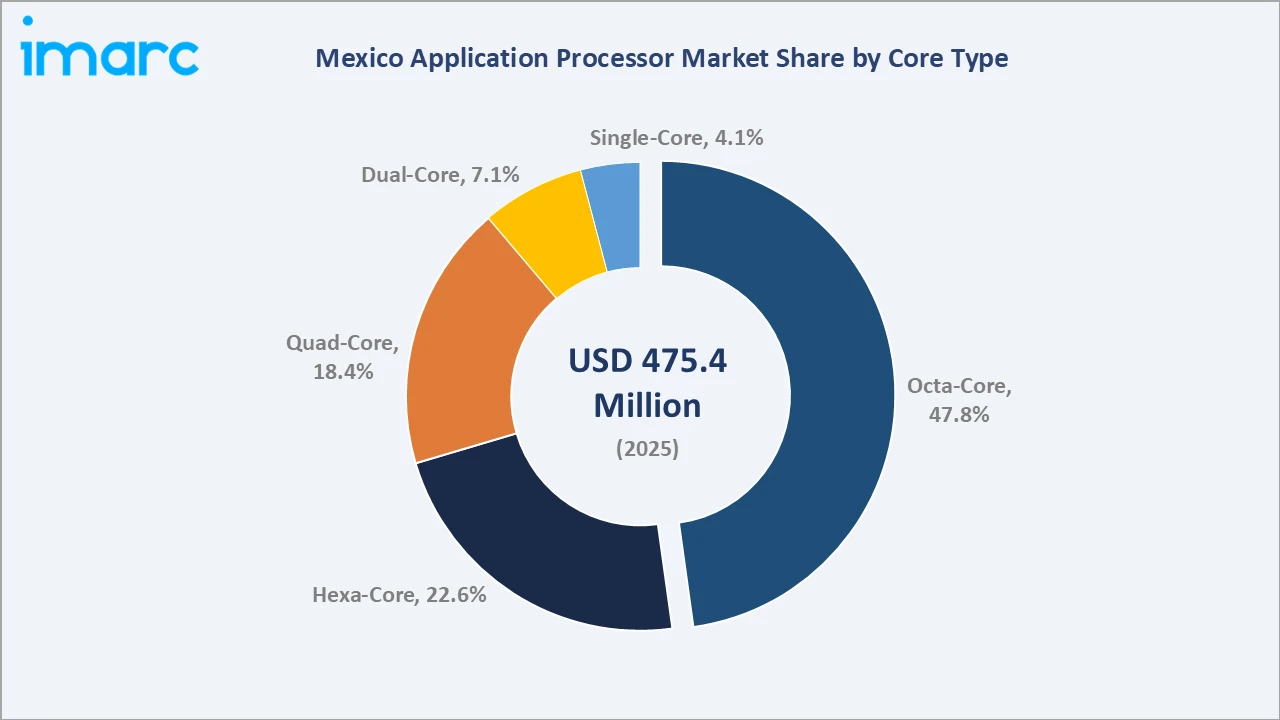
Hexa-core at 22.6% (2025) serves the upper-entry-level smartphone tier and select tablet applications requiring a performance step above quad-core. Quad-core at 18.4% (2025) remains relevant in affordable smartphones and long-battery-life e-readers where moderate processing power and power efficiency are prioritized over peak performance. Dual-core at 7.1% and single-core at 4.1% collectively represent the entry-level feature-phone-transitional segment, driven by very affordable Mexico-market smartphones targeting first-time smartphone buyers in semi-rural and lower-income urban demographics.
Regional Market Insights
|
Region |
Share (2025) |
Key Mexico Application Processor Market Drivers & Characteristics |
|
Central Mexico |
42.3% |
Driven by the highest consumer electronics demand density, major technology company operations, and the automotive electronics manufacturing corridor. |
|
Northern Mexico |
30.8% |
Supported by a dominant automotive manufacturing hub, US-border electronics assembly activity, and a technology entrepreneurship ecosystem driving institutional application processor consumption. |
|
Southern Mexico |
16.7% |
Driven by growing smartphone penetration from digital inclusion programs, lower average selling price demand, and the technology sector generating above-average regional technology consumption growth. |
|
Others |
10.2% |
Supported by growing electronics assembly activity, electronics manufacturing clusters and US-border proximity driving technology demand above regional population weight. |
Central Mexico's 42.3% dominance reflects Mexico City's unparalleled concentration of consumer electronics retail and Guadalajara's position as Mexico's technology hub. Northern Mexico follows with 30.8%, driven by its automotive manufacturing base, US-border electronics assembly, and growing industrial processor demand.
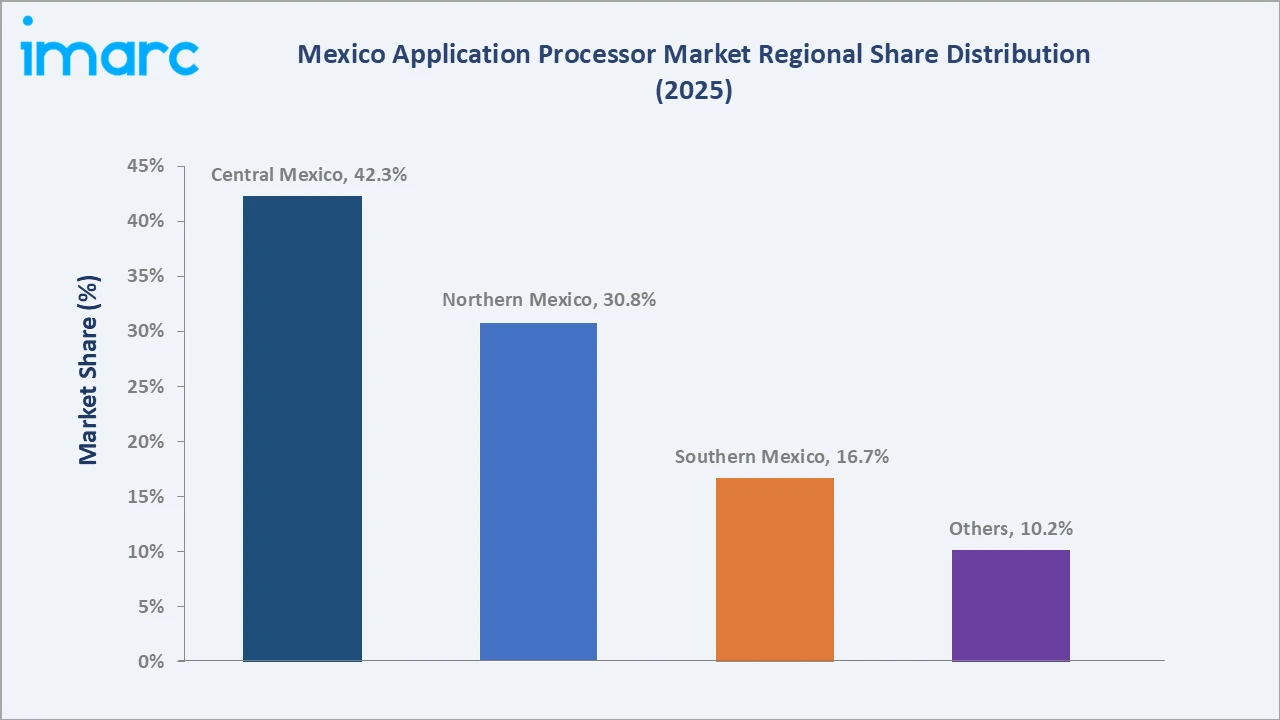
Southern Mexico accounts for 16.7%, supported by rising smartphone penetration, digital inclusion initiatives, and demand for affordable devices. Other regions hold 10.2%, benefiting from emerging electronics assembly clusters and localized technology adoption.
Competitive Landscape
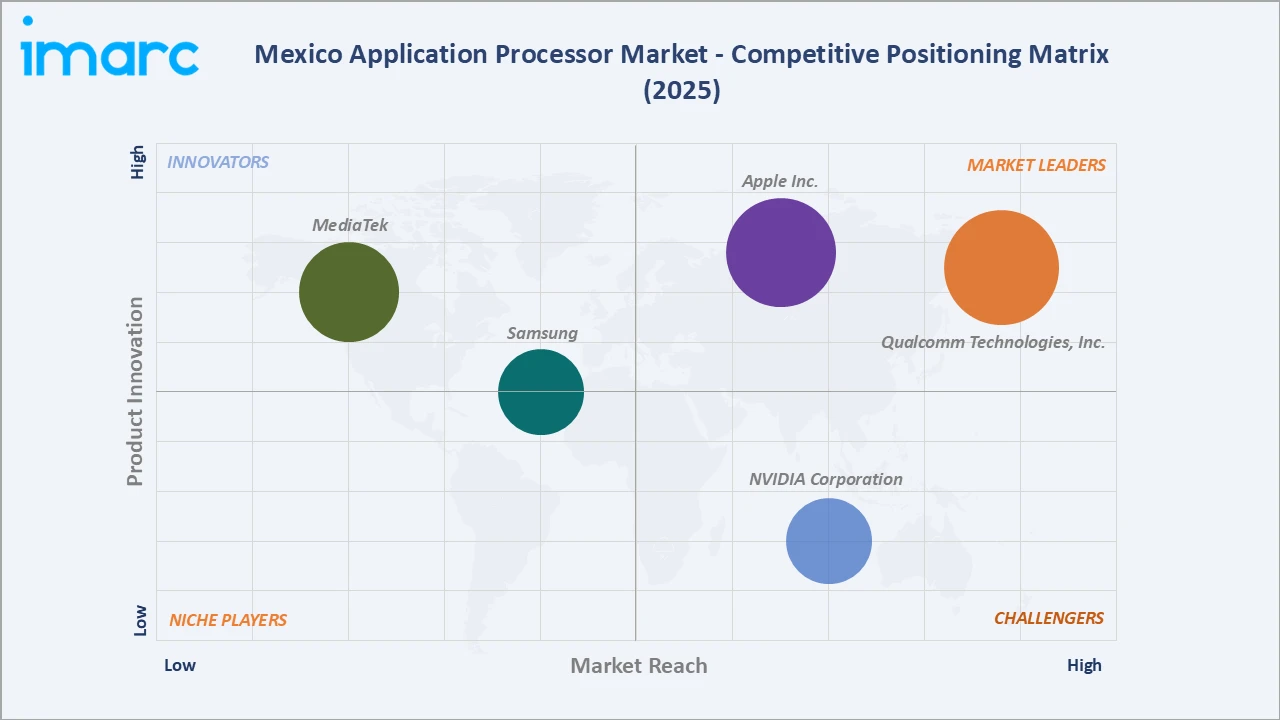
The Mexico application processor market is highly concentrated among a small number of global fabless semiconductor companies and integrated device manufacturers whose processor designs define the competitive landscape for smartphones, tablets, wearables, and automotive electronics across Mexico. Competition is driven by AI integration performance, process node advancement, 5G modem integration efficiency, power consumption optimization, and ecosystem support for OEM device development.
|
Company |
Key Products |
Market Position |
Core Strength |
|
Qualcomm Technologies, Inc. |
Snapdragon 8 Series, Snapdragon 7 Series, Snapdragon 6 Series, Snapdragon 4 Series, Snapdragon 2 Series |
Market Leader |
Qualcomm Technologies, Inc. plays a multifaceted role in Mexico's application processor ecosystem, spanning semiconductor engineering, supply chain integration, and regional market enablement. |
|
Apple Inc. |
Apple A series, Apple silicon |
Market Leader |
Apple Inc.'s role in Mexico’s application processor landscape primarily revolves around demand generation and consumer integration rather than semiconductor manufacturing. |
|
MediaTek |
MediaTek Dimensity |
Innovator |
MediaTek is the driving force behind Mexico’s accessible technology landscape, serving as the primary supplier of application processors for entry-to-mid-tier smartphones, tablets, and IoT devices. |
|
Samsung |
Exynos 1680, Exynos 2600, Exynos 1330 |
Established Player |
Samsung’s role in Mexico's application processor market revolves entirely around device consumption and regional electronics assembly, rather than local silicon fabrication. |
|
NVIDIA Corporation |
Jetson |
Challenger |
In Mexico, NVIDIA Corporation is not primarily known for producing consumer mobile application processors. Instead, its core role revolves around AI acceleration hardware, autonomous machine SoCs, and powering massive industrial AI factories located across the country. |
Companies are intensifying investment in AI-integrated processor portfolios, automotive-grade SoC development, and 5G modem integration capabilities to capture Mexico's accelerating technology upgrade cycle. The market is expected to see growing competition in the mid-range Android AP segment, while the automotive AP segment witnesses increasing participation as Mexico's auto electronics content intensifies through 2034.
Key Company Profiles
Qualcomm Technologies, Inc.
Qualcomm Technologies, Inc. is one of the leading suppliers of application processors in the Mexico market through its Snapdragon mobile platforms, serving smartphones, tablets, automotive systems, and IoT devices. The company benefits from strong demand for premium and mid-range Android smartphones from major OEMs operating in Mexico, while its processors support advanced AI, 5G connectivity, high-performance gaming, and energy-efficient computing. Qualcomm is also expanding its presence in Mexico's growing automotive electronics ecosystem by supplying Snapdragon Digital Chassis platforms for connected and software-defined vehicles. Its continued focus on on-device AI, advanced process node technologies, and 5G innovation strengthens its competitive position in the Mexico application processor market.
- Key Products: Snapdragon 8 Series, Snapdragon 7 Series, Snapdragon 6 Series, Snapdragon 4 Series, Snapdragon 2 Series.
- Strategic Focus: Focused on strengthening its position in Mexico through advanced Snapdragon platforms for smartphones, connected devices, and automotive applications. The company emphasizes 5G integration, on-device AI, high-performance graphics, and energy-efficient processing to support rising demand for premium mobile experiences.
Apple Inc.
Apple Inc. is a key participant in the Mexico application processor market through its proprietary A-series and Apple silicon used across iPhones, iPads, and Mac devices sold in the country. The company’s processors are positioned in the premium segment, offering high performance, energy efficiency, advanced graphics, and on-device AI capabilities. Apple benefits from strong demand for high-end smartphones, tablets, and laptops among urban consumers and enterprise users in Mexico. Its vertically integrated hardware-software ecosystem strengthens its competitive position in the market.
- Key Products: Apple A series, Apple silicon.
- Strategic Focus: Focused on strengthening its premium device ecosystem in Mexico through its proprietary application processors. The company emphasizes high-performance computing, energy efficiency, advanced graphics, and on-device AI to enhance iPhone, iPad, and Mac user experiences. Its strategy centers on vertical hardware-software integration, premium positioning, and ecosystem lock-in across devices and services.
Market Concentration Analysis
The Mexico application processor market is highly concentrated. This extreme concentration reflects the dominance of three processor architectures, Qualcomm Technologies, Inc., Apple Inc., and MediaTek, across the mobile phone segment that represents 58.7% of total market demand. The automotive segment is comparatively fragmented, competing across different automotive application domains. The tablet and wearables segments follow a similar concentration pattern to mobile phones, with Apple dominating the premium tier. The market is expected to remain highly concentrated through 2034, with the primary competitive battleground shifting from raw performance toward AI integration quality, 5G modem efficiency, and automotive-grade reliability certifications as Mexico's application processor demand mix evolves toward higher-value applications.
Investment & Growth Opportunities
Highest Growth Segments
Automotive ADAS and infotainment application processors (~6.8% CAGR), smart wearables application processors (~5.9% CAGR), 5G octa-core mid-range mobile application processors (~5.5% CAGR), AI-NPU-integrated mobile application processor upgrades (~7%+ CAGR from emerging base), and USMCA electronics assembly-driven institutional AP demand (~5.0% CAGR) represent Mexico application processor market's highest-growth investment vectors through 2034.
Investment Themes
- Automotive processor localization: Localizing automotive processor supply and integration can attract investment as Mexico expands its role in connected, electric, and software-defined vehicle manufacturing.
- AI-driven mid-range smartphone upgrade cycle: Growing demand for AI-enabled mid-range smartphones creates opportunities for investment in affordable, power-efficient application processors with on-device AI capabilities.
Future Market Outlook (2026-2034)
The Mexico application processor market is projected to grow from USD 475.4 Million in 2025 to USD 730.9 Million by 2034, delivering a 4.65% CAGR over the forecast period. The market's anchor value of USD 596.7 Million in 2030 marks a significant milestone in Mexico's digital economy development, representing a significant increase from the 2020 market value.
Three structural forces will define Mexico's application processor market growth trajectory through 2034. First, Mexico's demographic and digital adoption dynamics will provide a durable, compounding demand foundation. Second, the nearshoring acceleration will reshape Mexico's role in the global application processor value chain. Third, automotive electronics intensification through Mexico's world-class automotive manufacturing ecosystem will provide a growing, high-value application processor demand stream that diversifies Mexico's AP market beyond consumer smartphones and tablets.
Research Methodology
Primary Research
Primary research comprised in-depth interviews with semiconductor company Mexico representatives, consumer electronics distributors, smartphone OEM regional sales managers, automotive Tier 1 supplier procurement executives, electronics manufacturing company operations managers, and independent technology industry analysts covering Mexico and Latin America. These discussions validated market size estimates, assessed technology adoption trajectories, evaluated competitive dynamics, and provided insights into nearshoring electronics trends, 5G network deployment timelines, and automotive electronics content evolution.
Secondary Research
Secondary research encompassed company annual reports, IFT (Federal Telecommunications Institute) spectrum and connectivity reports, INEGI (National Institute of Statistics and Geography) consumer electronics data, industry association publications, semiconductor trade press, automotive industry production data, and credible market intelligence sources covering Mexico's electronics and semiconductor market.
Forecasting Models
Forecasting models were developed using historical Mexico application processor market trends, smartphone shipment data, automotive production statistics, electronics manufacturing investment data, 5G subscriber growth projections, GDP per capita growth scenarios, and macroeconomic indicators. Both top-down and bottom-up approaches were applied and validated through primary research. Market projections incorporated technology generation transitions, automotive electronics content growth scenarios, nearshoring investment trajectories, and AI feature adoption rates to generate reliable forecasts through 2034.
Mexico Application Processor Market Report Coverage:
| Report Features | Details |
|---|---|
| Base Year of the Analysis | 2025 |
| Historical Period | 2020-2025 |
| Forecast Period | 2026-2034 |
| Units | Million USD |
| Scope of the Report |
Exploration of Historical Trends and Market Outlook, Industry Catalysts and Challenges, Segment-Wise Historical and Future Market Assessment:
|
| Device Types Covered | Mobile Phones, PC Tablets and E-Readers, Smart Wearables, Automotive ADAS and Infotainment Devices |
| Core Types Covered | Octa-Core, Hexa-Core, Quad-Core, Dual-Core, Single-Core |
| Regions Covered | Northern Mexico, Central Mexico, Southern Mexico, Others |
| Companies Covered | Qualcomm Technologies, Inc., Apple Inc., MediaTek, Samsung, and NVIDIA Corporation, etc. |
| Customization Scope | 10% Free Customization |
| Post-Sale Analyst Support | 10-12 Weeks |
| Delivery Format | PDF and Excel through Email (We can also provide the editable version of the report in PPT/Word format on special request) |
Key Benefits for Stakeholders:
- IMARC’s industry report offers a comprehensive quantitative analysis of various market segments, historical and current market trends, market forecasts, and dynamics of the Mexico application processor market from 2020-2034.
- The research report provides the latest information on the market drivers, challenges, and opportunities in the Mexico application processor market.
- Porter's five forces analysis assist stakeholders in assessing the impact of new entrants, competitive rivalry, supplier power, buyer power, and the threat of substitution. It helps stakeholders to analyze the level of competition within the Mexico application processor industry and its attractiveness.
- Competitive landscape allows stakeholders to understand their competitive environment and provides an insight into the current positions of key players in the market.
Frequently Asked Questions About the Mexico Application Processor Market Report
The Mexico application processor market reached USD 475.4 Million in 2025, driven by rising smartphone penetration, 5G network infrastructure rollout, electronics nearshoring investment, and growing automotive ADAS processor demand from Mexico's world-class automotive manufacturing sector.
The market grows at 4.65% CAGR during 2026-2034, reaching USD 730.9 Million by 2034. The CAGR reflects steady consumer smartphone upgrade dynamics, 5G device penetration, AI-NPU processor integration in mid-range devices, automotive electronics intensification, and nearshoring electronics manufacturing demand growth across the forecast period.
Mobile phones lead at 58.7% (2025), driven by Mexico's smartphone user base and the dominance of mid-range Android device demand. The 5G smartphone upgrade cycle is sustaining above-market growth in this segment through 2028.
Octa-core dominates at 47.8% (2025), reflecting the widespread adoption of 8-core SoC architectures in Mexico's mainstream mid-range smartphone segment.
Central Mexico leads at 42.3% (2025), anchored by Mexico City's consumer population, Guadalajara's Silicon Valley of Mexico technology ecosystem, and the Bajío region's automotive and electronics manufacturing concentration that generates both consumer and institutional application processor demand at Mexico's highest regional density.
Leading companies include Qualcomm Technologies, Inc., Apple Inc., MediaTek, Samsung, and NVIDIA Corporation, among others.
The market is projected to reach approximately USD 596.7 Million by 2030, driven by 5G octa-core smartphone penetration across Mexico's Tier 1 and Tier 2 urban markets, automotive ADAS processor demand growth through Mexico's OEM manufacturing corridor, electronics nearshoring institutional demand, and AI-NPU-integrated wearables market expansion.
Top growth opportunities include automotive ADAS AP through nearshoring, AI-NPU-integrated mid-range mobile AP upgrade cycle, 5G octa-core mainstream adoption, smart wearables expansion, and electronics assembly-driven institutional AP demand from Mexico's growing EMS sector.
Need more help?
- Speak to our experienced analysts for insights on the current market scenarios.
- Include additional segments and countries to customize the report as per your requirement.
- Gain an unparalleled competitive advantage in your domain by understanding how to utilize the report and positively impacting your operations and revenue.
- For further assistance, please connect with our analysts.
 Request Customization
 Speak to an Analyst
 Request Brochure
 Inquire Before Buying
Benefits of Customization
- Personalize this research
- Triangulate with your data
- Get data as per your format and definition
- Gain a deeper dive into a specific application, geography, customer, or competitor
- Any level of personalization
Get in Touch With Us
UNITED STATES
Phone: +1-201-971-6302
INDIA
Phone: +91-120-433-0800
UNITED KINGDOM
Phone: +44-753-714-6104
Email: [email protected]
Client Testimonials




.webp)




.webp)













Related Reports

Choose your plan
*Please note that the prices mentioned below are starting prices for each bundle type. Kindly contact our team for further details.*
Single User License
- 1 User License, Access on 2 Devices
- PDF Report + Excel Dataset (Password Protected)
- Lifetime Access
- No Printing Rights
- 10% Free Report Customization
- 10–12 Weeks of Analyst Support
Five User License
- Access for 5 Users, 2 Devices per User
- PDF Report + Excel Dataset (Password Protected)
- Lifetime Access
- Dedicated Account Manager
- 12–14 Weeks of Analyst Support
- No Printing Rights
- 15% Free Report Customization
- 25% Discount on Your Next Purchase
Corporate User License
- Unlimited User Access (Within Your Organization)
- PDF Report + Excel Dataset
- Lifetime Access
- Dedicated Account Manager
- 14–20 Weeks of Analyst Support
- No Printing Rights
- 20% Free Report Customization
- 30% Discount on Your Next Purchase
Essential Insights
What's included:
3 reports
- Lifetime Access
- PDF Reports
- Excel Datasets
- 2 Weeks of Free Analyst Support
- 2 User Licenses
- Access on 2 Devices
- Printing Rights
- Complimentary PowerPoint (PPT) Version
- Complimentary License Upgrade
Professional Access
What's included:
5 reports
- Lifetime Access
- PDF Reports
- Excel Datasets
- 8 Weeks of Free Analyst Support
- 2 User Licenses
- Access on 2 Devices
- Printing Rights
- Complimentary PowerPoint (PPT) Version
- Complimentary License Upgrade
Business Advantage
What's included:
8 reports
- Lifetime Access
- PDF Reports
- Excel Datasets
- 14 Weeks of Free Analyst Support
- 2 User Licenses
- Access on 2 Devices
- Printing Rights
- Complimentary PowerPoint (PPT) Version
- Complimentary License Upgrade
Enterprise Intelligence
What's included:
10 reports
- Lifetime Access
- PDF Reports
- Excel Datasets
- 20 Weeks of Free Analyst Support
- 2 User Licenses
- Access on 2 Devices
- Printing Rights
- Complimentary PowerPoint (PPT) Version
- Complimentary License Upgrade