
Mexico Automotive Radar Market Size, Share, Trends and Forecast by Range, Vehicle Type, Application, and Region, 2026-2034
Mexico Automotive Radar Market Size, Share, Trends & Forecast (2026-2034)
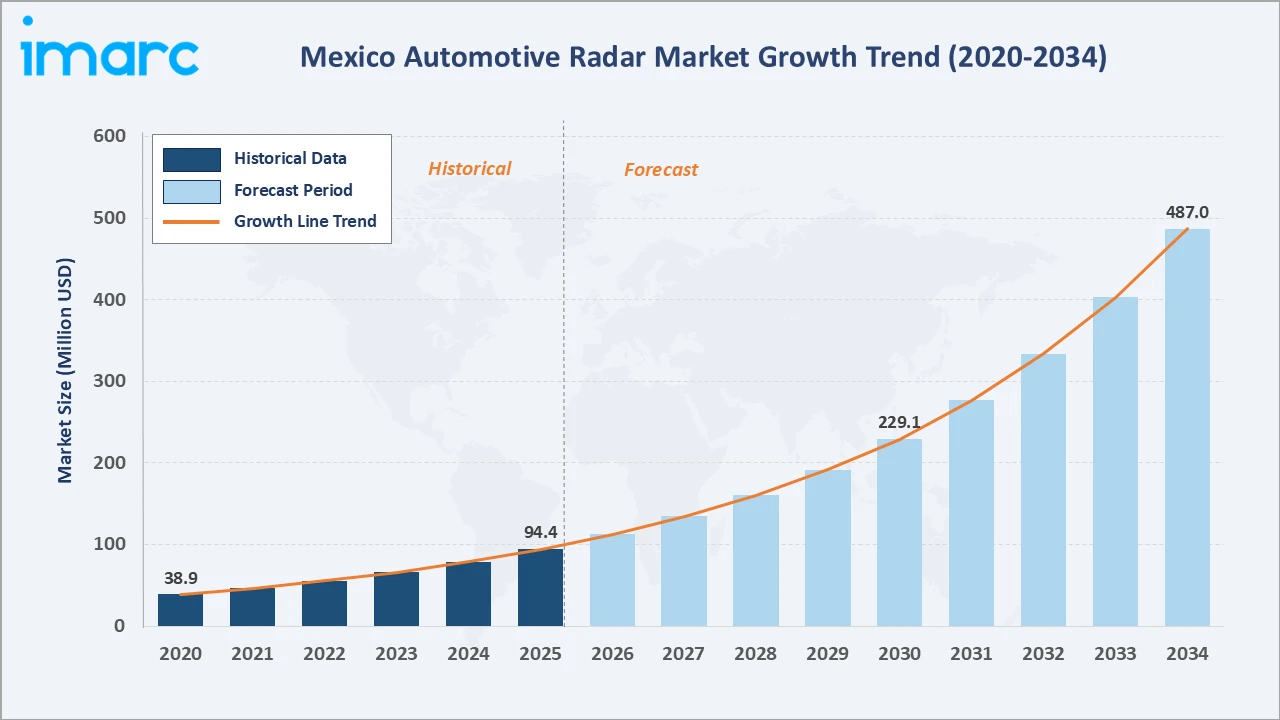
The Mexico automotive radar market grew from USD 94.4 Million in 2025 to USD 112.8 Million in 2026 and is projected to reach USD 487.0 Million by 2034, exhibiting a CAGR of 19.39% during 2026-2034. Mexico's light vehicle production reached 3.95 Million units in 2025, reinforcing the country's position as a top global manufacturing hub and widening the production base for radar-equipped vehicle platforms. Rising nearshoring investment, expanding Tier-1 supplier footprints, and tightening regional safety expectations are the primary drivers shaping market growth.
Medium and short range leads the range segment at 61.8%, passenger cars dominate the vehicle type segment at 76.4%, and Northern Mexico commands 42.7% regional share.
Market Snapshot
|
Metric |
Value |
|
Base Year Market Size (2025) |
USD 94.4 Million |
| Market Size (2026) | USD 112.8 Million |
|
Forecast Market Size (2034) |
USD 487.0 Million |
|
CAGR (2026-2034) |
19.39% |
|
Base Year |
2025 |
|
Historical Period |
2020-2025 |
|
Forecast Period |
2026-2034 |
|
Largest Region |
Northern Mexico (42.7%, 2025) |
|
Second Largest Region |
Central Mexico (31.4%, 2025) |
|
Leading Range |
Medium and Short Range (61.8%, 2025) |
|
Leading Vehicle Type |
Passenger Cars (76.4%, 2025) |
The Mexico automotive radar market expanded from USD 38.9 Million in 2020 to USD 94.4 Million in 2025 and an estimated USD 112.8 Million in 2026, driven by increasing radar attach rates on new vehicle platforms and expanding Tier-1 supplier capacity across the country. Anchored at USD 229.1 Mlilion in 2030, the forecast USD 487.0 Million by 2034 is supported by accelarating adoption of long range radar, broader commercial vehicle safety mandates, and deepening integration with sensor fusion architectures.
To get more information on this market, Request Sample
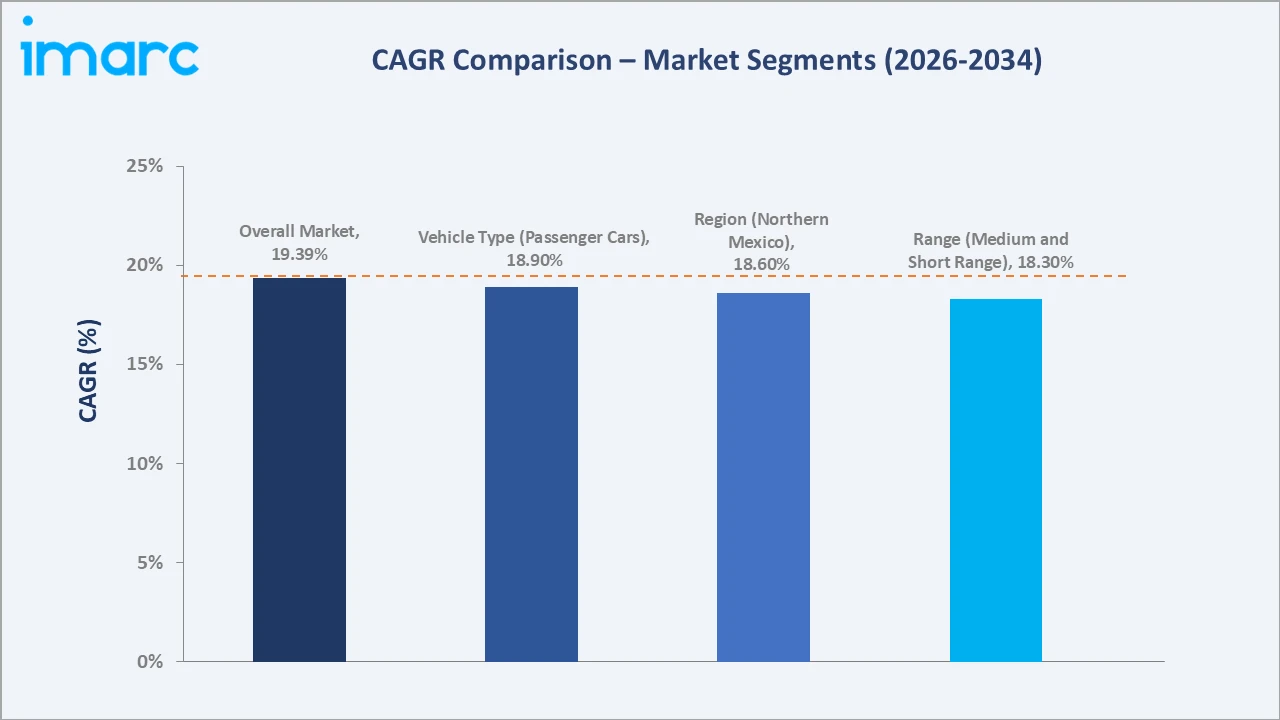
CAGR trajectories across range and vehicle type sub-segments show long range and commercial vehicles expanding faster than the overall 19.39% market CAGR, driven by highway-oriented autonomous features, fleet safety regulation, and rising radar content per vehicle across Mexico's manufacturing corridors.
Executive Summary
The Mexico automotive radar market which increased from USD 94.4 Million in 2025 to an estimated USD 112.8 Million in 2026, is projected to reach USD 487.0 Million by 2034, at a CAGR of 19.39%. The industry has moved from limited premium-trim availability to broader deployment across passenger and commercial platforms, supported by nearshoring-led assembly growth and rising safety content per vehicle.
Medium and short range leads the range segment at 61.8% in 2025, supported by parking assistance and blind-spot monitoring demand. Passenger cars command 76.4% of the vehicle type segment, driven by higher vehicle production volumes, increasing ADAS integration, and growing consumer preference for enhanced safety features. Northern Mexico leads regional share at 42.7%, fueled by its strong automotive manufacturing base, proximity to United States supply chains, and concentration of vehicle assembly facilities.
Key Market Insights
|
Insight |
Data |
|
Leading Range |
Medium and Short Range - 61.8% share (2025) |
|
Second Largest Range |
Long Range - 38.2% share (2025) |
|
Leading Vehicle Type |
Passenger Cars - 76.4% share (2025) |
|
Second Largest Vehicle Type |
Commercial Vehicles - 23.6% share (2025) |
|
Leading Region |
Northern Mexico - 42.7% share (2025) |
|
Second Largest Region |
Central Mexico - 31.4% share (2025) |
|
Top Companies |
Robert Bosch GmbH, AUMOVIO, Denso Corporation, Magna International Inc., Valeo SE |
Key Analytical Observations Supporting the Above Data:
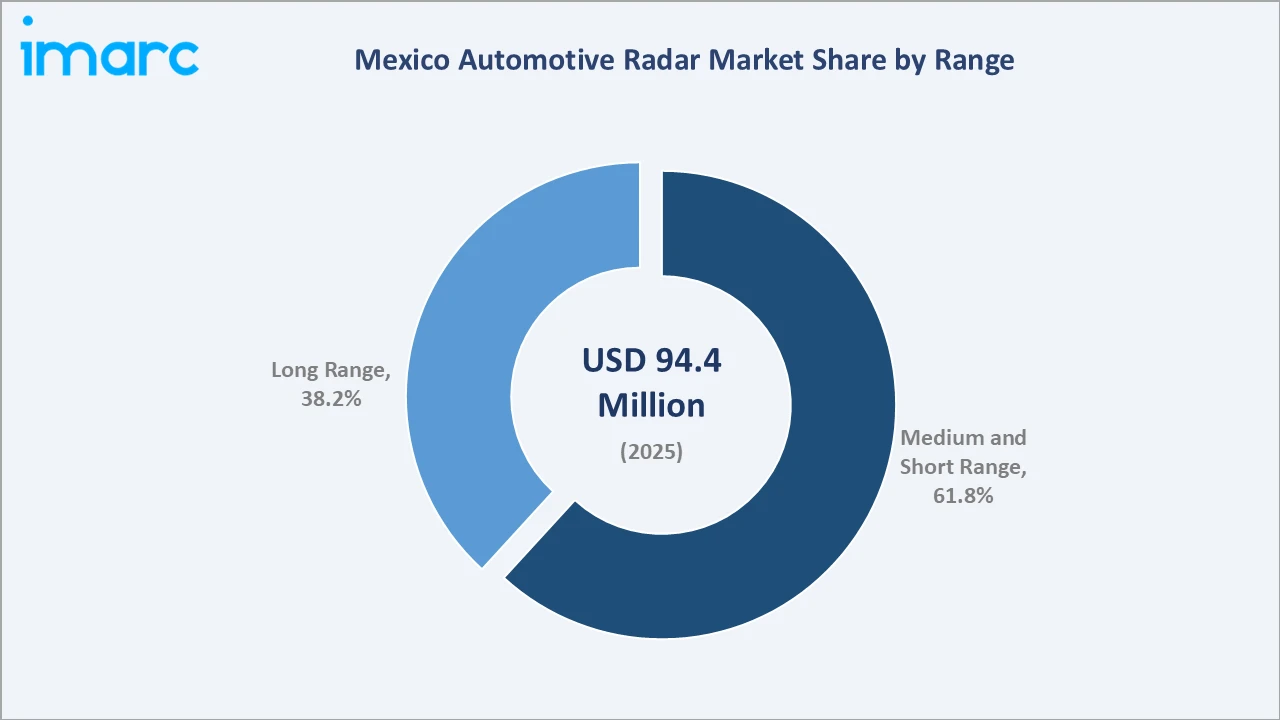
- Medium and short range dominance at 61.8% is supported by widespread parking-assist, blind-spot monitoring, and cross-traffic alert deployment across entry and mid-segment passenger vehicles built in Mexico.
- Long range at 38.2% is gaining ground as automakers expand adaptive cruise control, automatic emergency braking, and highway driving assistance features across a wider range of vehicle models.
- Passenger cars leadership at 76.4% reflects the concentration of light-vehicle assembly in Mexico and the steady rise of factory-fitted driver assistance packages across mainstream models.
- Commercial vehicles at 23.6% are gaining radar content as fleet operators adopt collision-mitigation and blind-spot systems to meet logistics safety expectations.
- Northern Mexico at 42.7% dominates regional share, anchored by dense Tier-1 supplier clusters, established OEM assembly plants, and proximity to United States export corridors.
Mexico Automotive Radar Market Overview
Automotive radar refers to sensor technology that uses radio waves to detect the distance, speed, and angle of objects around a vehicle, enabling functions such as adaptive cruise control, blind-spot detection, automatic emergency braking, and parking assistance. In Mexico, the market spans medium and short range and long range radar modules integrated across passenger cars and commercial vehicles.
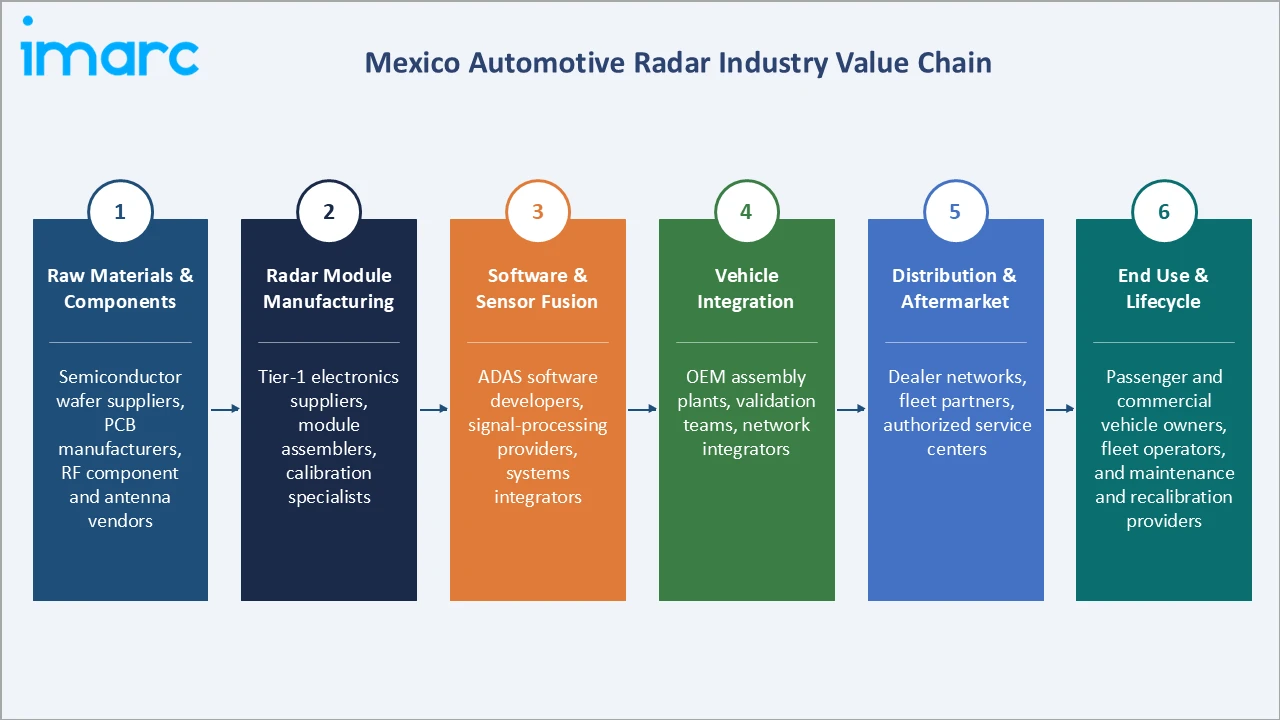
Mexico's ecosystem integrates semiconductor and component suppliers, Tier-1 radar module manufacturers, OEMs, software and sensor-fusion providers, and regulatory bodies overseeing vehicle safety standards. Together, these participants enable the design, calibration, and deployment of radar-based safety systems within an expanding North American manufacturing and export corridor.
Market Dynamics
To evaluate market opportunities, Request Sample
Market Drivers
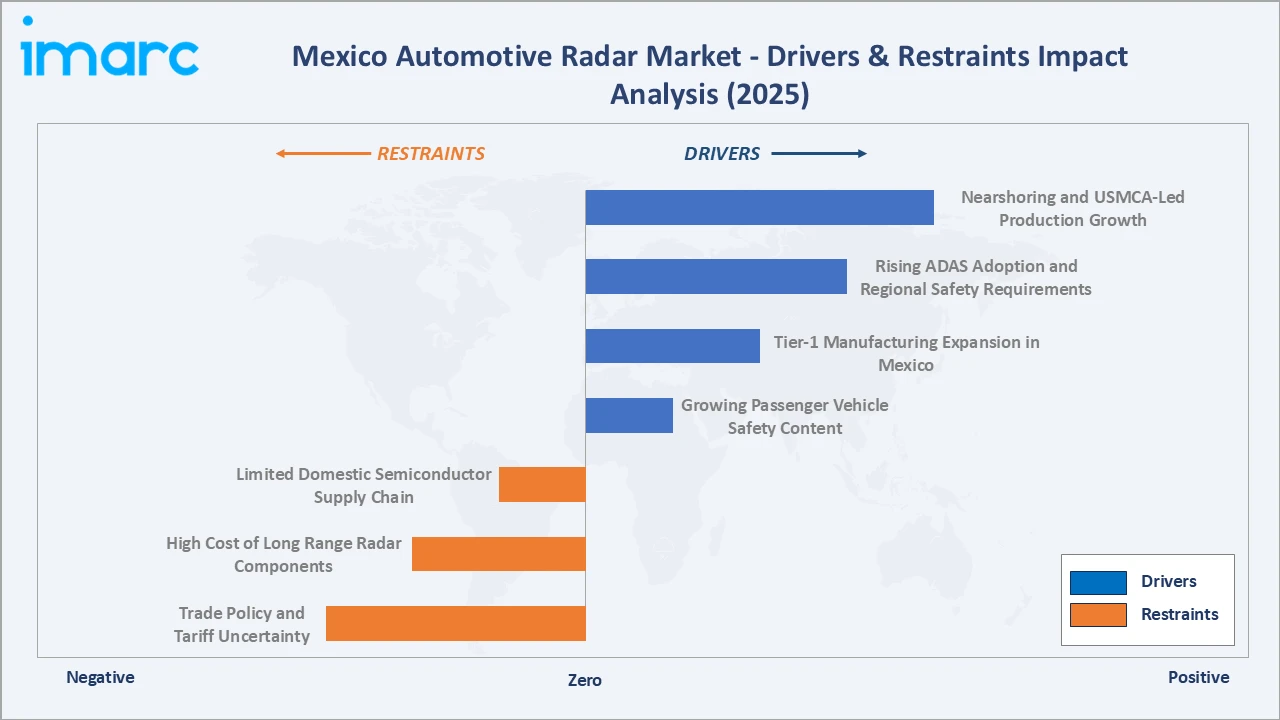
- Nearshoring and USMCA-Led Production Growth: The relocation of North American supply chains toward Mexico is expanding light-vehicle assembly volumes, creating a wider base of new platforms for radar-based safety content.
- Rising ADAS Adoption and Regional Safety Requirements: Increasing integration of ADAS across new vehicle models, supported by evolving vehicle safety standards and growing consumer awareness, is driving demand for automotive radar sensors in Mexico.
- Tier-1 Manufacturing Expansion in Mexico: Global radar and electronics suppliers continue to scale engineering and production capacity in the country, shortening supply chains for OEM assembly plants.
- Growing Passenger Vehicle Safety Content: Consumer and fleet demand for factory-fitted driver assistance features is lifting radar attach rates across mainstream and premium trims alike.
Market Restraints
- Trade Policy and Tariff Uncertainty: Mexico imposed new duties of up to 50% on passenger vehicles imported from non-free-trade-agreement countries, effective January 1, 2026, adding cost and planning uncertainty across regional supply chains.
- High Cost of Long Range Radar Components: Advanced long range and 4D imaging radar modules carry higher bill-of-materials costs, limiting near-term adoption in price-sensitive vehicle segments.
- Limited Domestic Semiconductor Supply Chain: Mexico's radar component ecosystem remains reliant on imported semiconductors and RF modules, exposing manufacturers to global supply volatility.
Market Opportunities
- Commercial Fleet Safety Retrofitting: Growing logistics and freight activity is creating opportunities for aftermarket and factory-fitted radar systems across commercial vehicle fleets.
- Software-Defined Radar and Sensor Fusion Platforms: Rising demand for centralized, upgradable ADAS architectures is opening new value pools for software-enabled radar platforms.
Market Challenges
- Price Sensitivity in Entry-Level Vehicle Segment: Cost-conscious buyers in the entry-level segment continue to limit voluntary uptake of radar-based safety packages beyond regulatory minimums.
- Talent and Technical Capability Gaps: Scaling radar calibration, software validation, and systems-integration capabilities requires a specialized workforce that remains constrained in parts of the country.
Emerging Market Trends
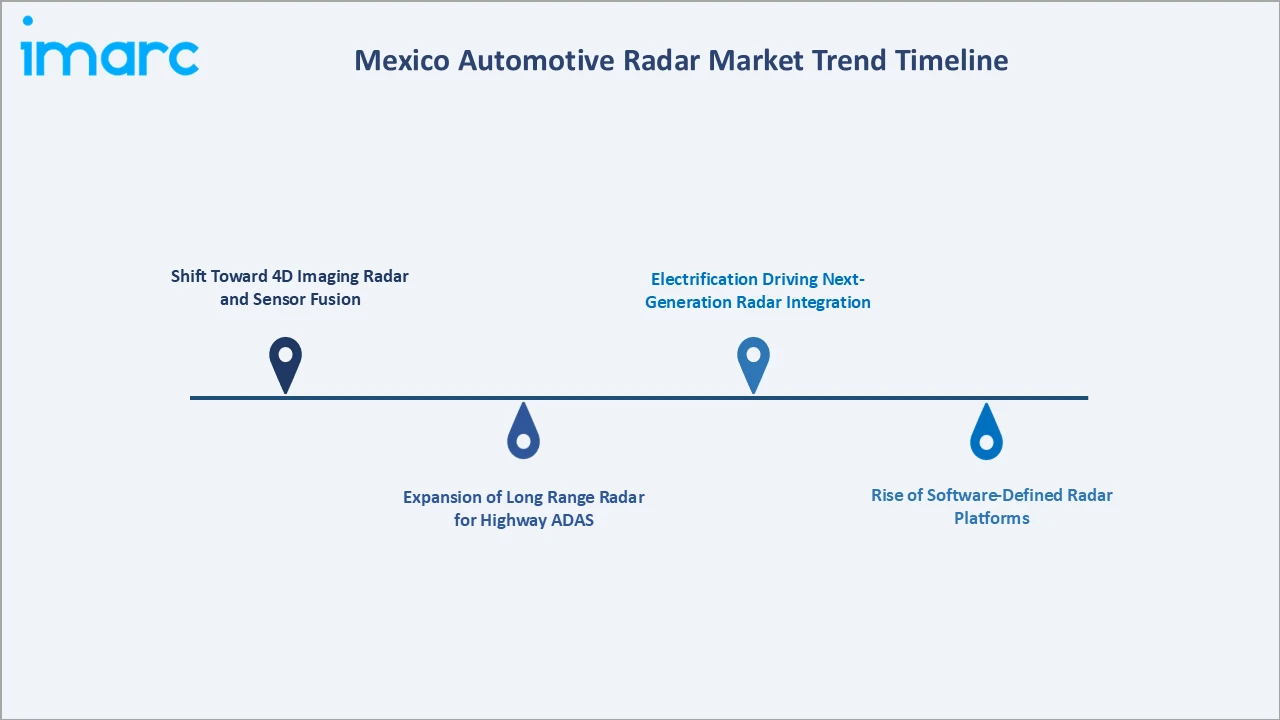
1. Shift Toward 4D Imaging Radar and Sensor Fusion
Suppliers are transitioning from conventional radar toward 4D imaging radar that adds elevation data, improving object classification. Combined with camera and ultrasonic inputs, sensor fusion is enabling more reliable perception for mid-segment vehicles built in Mexico.
2. Expansion of Long Range Radar for Highway ADAS
Adaptive cruise control and highway collision-avoidance features are pushing long range radar deployment beyond premium models. Lower module costs and modular platforms are enabling broader adoption across passenger and commercial vehicle lines.
3. Electrification Driving Next-Generation Radar Integration
The growing production of electric and hybrid vehicles is accelerating the integration of advanced radar systems to support ADAS and future autonomous driving capabilities. Manufacturers are adopting scalable radar platforms that meet evolving safety requirements while improving vehicle performance and energy efficiency.
4. Rise of Software-Defined Radar Platforms
Modular, over-the-air upgradable radar software is gaining traction as OEMs seek to extend feature sets after vehicle launch. This trend is reshaping how Tier-1 suppliers structure long-term platform contracts with automakers in Mexico.
Industry Value Chain Analysis
The Mexico automotive radar value chain spans six stages from component supply through end-user engagement and lifecycle management. Radar module manufacturing, software integration, and vehicle assembly capture the highest value-add, while calibration and aftermarket service capabilities increasingly determine sustainable competitive position.
|
Stage |
Key Players / Examples |
|
Raw Materials & Components |
Semiconductor wafer suppliers, PCB manufacturers, RF component vendors, and antenna and connector suppliers |
|
Radar Module Manufacturing |
Tier-1 automotive electronics suppliers, radar module assemblers, and calibration and testing specialists |
|
Software & Sensor Fusion |
ADAS software developers, signal-processing providers, and systems integrators enabling object detection algorithms |
|
Vehicle Integration |
OEM assembly plants, systems validation teams, and in-vehicle network integrators |
|
Distribution & Aftermarket |
Dealer networks, fleet channel partners, and authorized service and calibration centers |
|
End Use & Lifecycle |
Passenger and commercial vehicle owners, fleet operators, and maintenance and recalibration providers |
Vertically integrated suppliers, particularly those combining proprietary radar chipsets, software stacks, and direct OEM relationships, are positioned to capture greater value than partners reliant on third-party component sourcing.
Technology Landscape in the Mexico Automotive Radar Industry
Millimeter-Wave Radar Chipsets and Signal Processing
Modern radar modules increasingly rely on compact millimeter-wave chipsets that combine transmit, receive, and signal-processing functions on a single package. These systems support higher resolution object detection while reducing module size and cost for mass-market platforms.
Sensor Fusion, AI, and Object Classification
AI and machine learning (ML) models are being layered onto radar data streams to improve object classification, reduce false alerts, and support fusion with camera and ultrasonic inputs. This is enabling more dependable perception across varied Mexican road and weather conditions.
Software-Defined and Modular Radar Platforms
Centralized domain-controller architectures are allowing radar functionality to be updated through software after vehicle production, supporting scalable feature rollouts across passenger and commercial vehicle platforms manufactured in Mexico.
Market Segmentation Analysis
The report covers the following segments:
|
Segment Category |
Leading Segment |
Market Share |
Year |
|
Range |
Medium and Short Range |
61.8% |
2025 |
|
Vehicle Type |
Passenger Cars |
76.4% |
2025 |
|
Application |
🔒 |
🔒 |
2025 |
|
Region |
Northern Mexico |
42.7% |
2025 |

By Range
Medium and short range commands a 61.8% majority share in 2025, driven by widespread parking assistance, blind-spot monitoring, and cross-traffic alert deployment across entry and mid-segment vehicles. The segment benefits from lower module cost and simpler integration across a broad range of trims.
To access detailed market analysis, Request Sample
Long range at 38.2% in 2025 supports adaptive cruise control and highway collision-avoidance features. The segment is expanding at a faster pace than the overall market as highway-oriented ADAS becomes standard on more vehicle lines.
By Vehicle Type
Passenger cars dominate with 76.4% share in 2025, reflecting the concentration of light-vehicle assembly in Mexico and rising factory-fitted radar content across mainstream and premium trims.
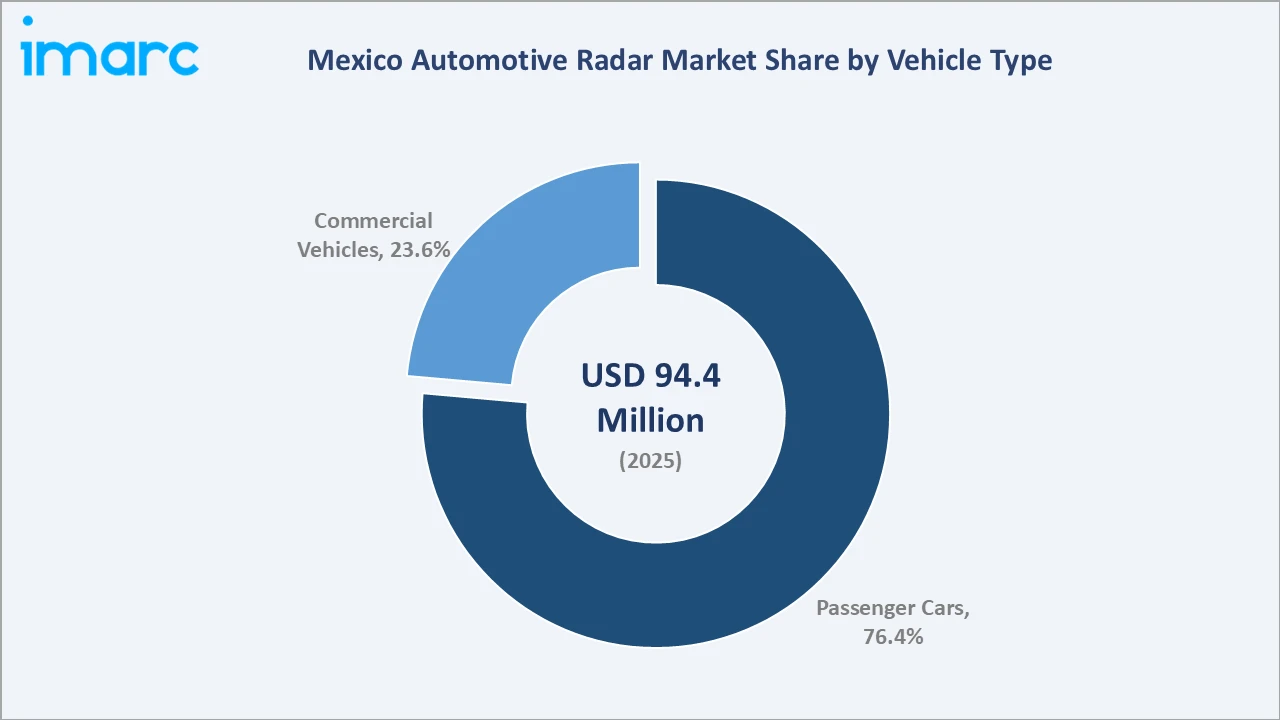
Commercial vehicles at 23.6% are expanding through fleet-safety adoption and growing logistics activity, supported by collision-mitigation and blind-spot systems tailored to trucks and vans.
Regional Market Insights
|
Region |
Share (2025) |
Key Growth Drivers |
|
Northern Mexico |
42.7% |
Dense concentration of OEM assembly plants, established Tier-1 supplier clusters, and proximity to major export corridors |
|
Central Mexico |
31.4% |
Growing industrial parks, expanding component manufacturing base, and rising OEM investment in the region |
|
Southern Mexico |
15.8% |
Emerging manufacturing corridors, new supplier investment, and expanding logistics and infrastructure development |
|
Others |
10.1% |
Distributed light-vehicle assembly activity and gradual expansion of regional supplier networks |
Northern Mexico at 42.7% in 2025 leads the regional landscape, anchored by established OEM assembly plants and dense Tier-1 supplier clusters positioned close to United States export routes. Sustained investment and manufacturing scale support continued regional leadership.
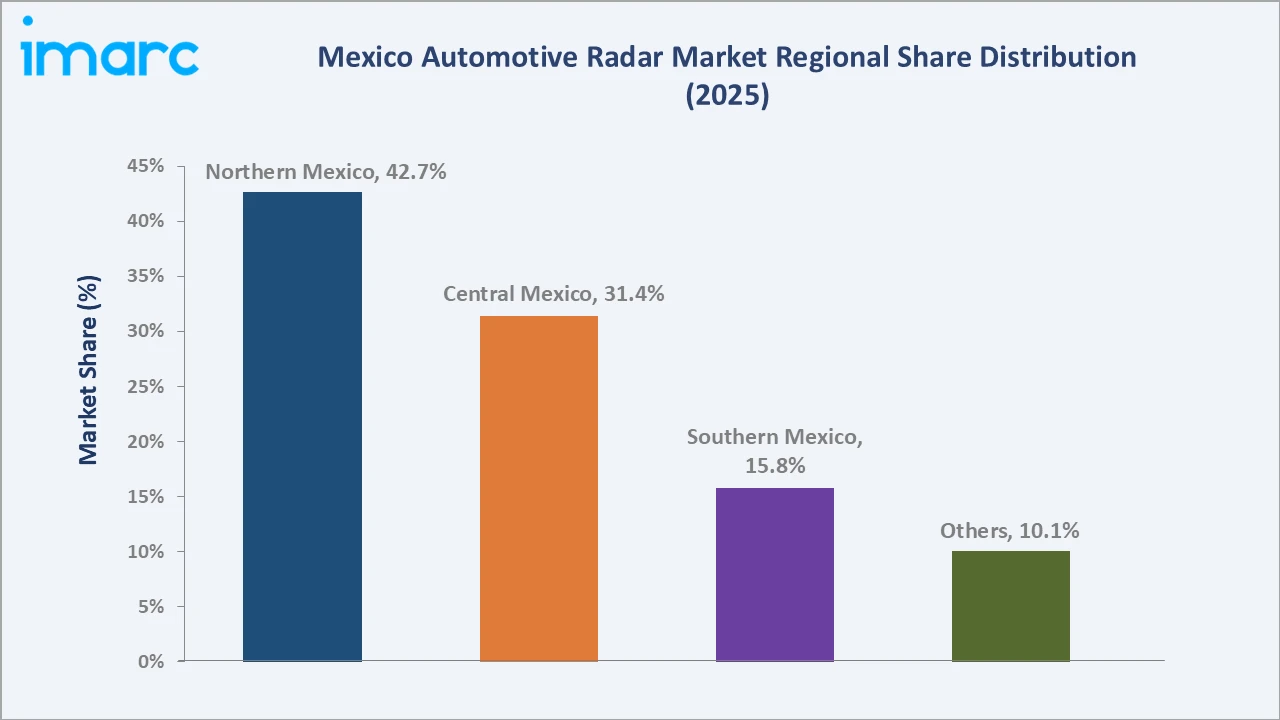
Southern Mexico at 15.8% is the fastest growing region. Expanding industrial parks, new supplier investment, and improving logistics infrastructure are accelerating regional growth through 2034.
Competitive Landscape
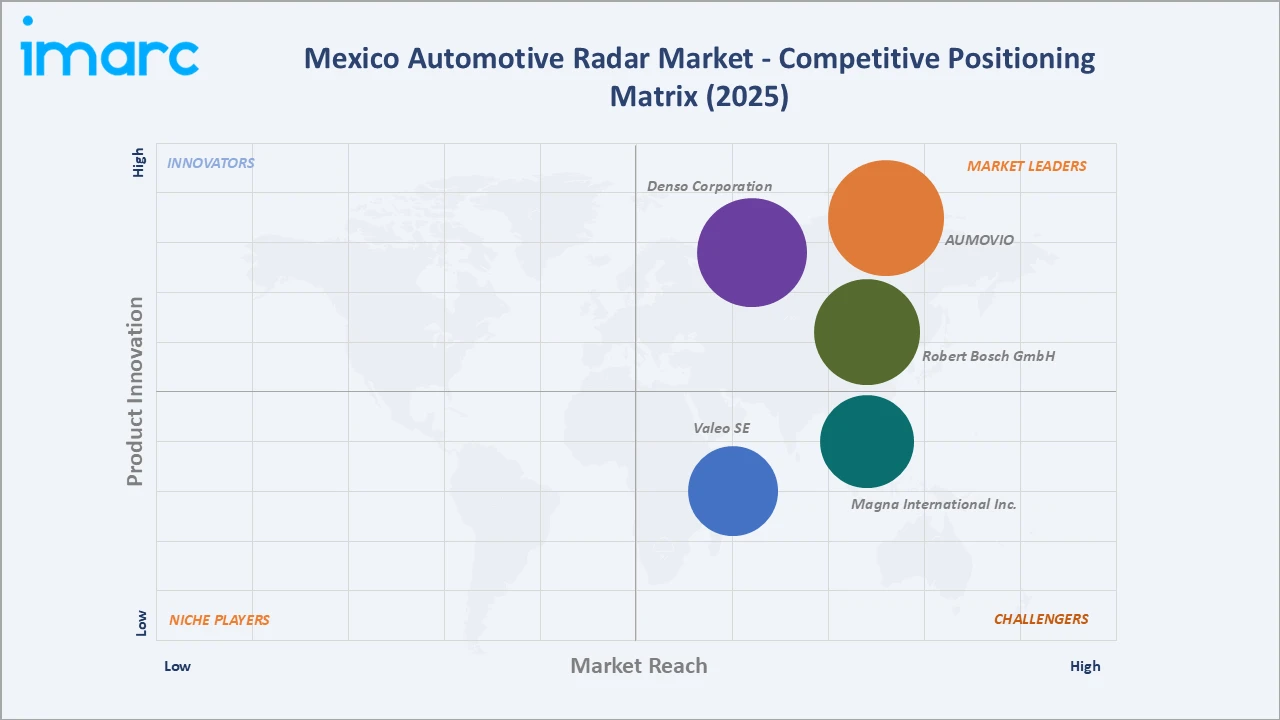
The Mexico automotive radar market is moderately concentrated, with established global Tier-1 suppliers leading technology depth and manufacturing scale while regional players compete on cost and localized service. Brand strength, technology portfolio, manufacturing footprint, and OEM relationships form the key competitive moats.
|
Company Name |
Brand / Key Product |
Position |
Strategic Focus |
|
Robert Bosch GmbH |
Bosch Radar Gen 7 Premium |
Leader |
Technology-driven radar and ADAS supplier with broad multi-regional manufacturing presence |
|
AUMOVIO |
Xelve |
Leader |
Independent mobility electronics company scaling radar production and software-defined platforms |
|
Denso Corporation |
Denso Global Safety Package 3 |
Leader |
Sensor and electronics supplier expanding high-frequency radar and safety system capabilities |
|
Magna International Inc. |
Radar Portfolio, Cameras |
Challenger |
System-level integrator emphasizing radar and camera fusion for mass-market ADAS adoption |
|
Valeo SE |
Valeo High Definition Radar Sensor |
Challenger |
Scalable sensor supplier expanding high-resolution and mid-range radar solutions across vehicle segments |
Key players include Robert Bosch GmbH, AUMOVIO, Denso Corporation, Magna International Inc., and Valeo SE, among others.
Key Company Profiles
Robert Bosch GmbH
Robert Bosch GmbH is a German multinational engineering and technology company headquartered in Gerlingen, and one of the largest Tier-1 automotive suppliers globally. The firm supplies radar sensors and driver assistance systems to OEMs manufacturing in Mexico as part of its broader North American mobility solutions business.
- Product Portfolio: Bosch Radar Gen 7 Premium, part of a broader short, medium, and long range radar portfolio supporting adaptive cruise control, automatic emergency braking, and parking assistance functions.
- Recent Developments: The company continues to expand its automotive radar portfolio through ongoing product enhancements, software advancements, and collaborations with vehicle manufacturers to support evolving ADAS and vehicle safety requirements.
- Strategic Focus: Expanding next-generation radar technologies, strengthening ADAS capabilities, and supporting OEM demand through scalable automotive sensing solutions.
AUMOVIO
AUMOVIO is a German mobility electronics company that operates as an independent business. The company supplies sensor solutions, including radar systems, alongside display, braking, and software platforms for passenger and commercial vehicles.
- Product Portfolio: Xelve, a scalable radar-based ADAS and automated driving system portfolio supporting driving, parking, and safety functions across vehicle segments.
- Recent Developments: The company continues to expand its radar production capacity and broaden its software-defined vehicle platform offerings to support growing regional ADAS demand.
- Strategic Focus: Scaling radar production, advancing software-defined radar platforms, and strengthening ADAS capabilities to support evolving OEM requirements.
Denso Corporation
Denso Corporation is a Japanese multinational automotive components manufacturer supplying sensors, electronics, and safety systems to OEMs worldwide, including manufacturers with assembly operations in Mexico.
- Product Portfolio: Denso Global Safety Package 3, a millimeter-wave radar and vision-sensor suite supporting long range highway detection and mid-range object recognition for driver assistance applications.
- Recent Developments: The company continues to invest in next-generation radar and sensor technology and collaborates with automakers to enhance safety and driver assistance capabilities.
- Strategic Focus: Expanding high-frequency radar and safety system capabilities.
Market Concentration Analysis
The Mexico automotive radar market is moderately concentrated, with the top five suppliers, Robert Bosch GmbH, AUMOVIO, Denso Corporation, Magna International Inc., and Valeo SE, accounting for a significant share of radar module supply to OEM assembly plants across the country.
Barriers to entry include high capital requirements for radar chipset and module manufacturing, the need for established OEM validation processes, and the technical complexity of sensor fusion software. These factors favor well-capitalized incumbents with existing platform relationships.
Consolidation is expected to continue as smaller suppliers partner with or are acquired by larger Tier-1 players seeking to broaden their radar and software portfolios. Strategic partnerships with OEMs and semiconductor providers are further reinforcing competitive positioning across the market.
Investment & Growth Opportunities
Fastest-Growing Segments
Long range is expanding the fastest among range segments, driven by highway ADAS adoption and rising content per vehicle. Commercial vehicles represent the next-fastest vehicle type, supported by fleet-safety mandates and expanding logistics activity.
Emerging Markets
Southern Mexico is the fastest growing region, anchored by expanding industrial parks, new supplier investment, and improving logistics infrastructure. The region represents meaningful untapped opportunity for suppliers able to establish early manufacturing and service presence.
Venture & Investment Trends
Investment activity is concentrated in radar chipset development, sensor fusion software platforms, and calibration and testing infrastructure. Capital is also flowing into localized component manufacturing that aligns with nearshoring-driven supply chain strategies.
Future Market Outlook (2026-2034)
The Mexico automotive radar market is projected to grow from USD 94.4 Million in 2025 to USD 112.8 Million in 2026, reaching USD 487.0 Million by 2034, registering a CAGR of 19.39% during 2026–2034.
Four forces will shape the market through 2034: continued nearshoring-driven vehicle production growth; the rise of long range and 4D imaging radar; deeper integration with software-defined and centralized ADAS architectures; and tightening regional safety expectations across passenger and commercial vehicle segments.
By 2034, the Mexico automotive radar market is expected to be defined by broader radar penetration across mid-segment and commercial vehicles, with long range and sensor-fusion-enabled systems accounting for a meaningfully higher share of overall demand.
Research Methodology
Primary Research
Primary research included structured interviews with Tier-1 supplier executives, OEM procurement leads, radar component vendors, and regulatory specialists, validating market sizing, regional demand, and segment mix evolution.
Secondary Research
Secondary sources included Mexico's National Institute of Statistics and Geography production data, industry association reports, Latin NCAP protocol publications, and annual reports and investor presentations from listed automotive suppliers.
Forecasting Models
Market forecasts used top-down and bottom-up models combining vehicle production volumes, radar attach-rate trends, average selling price evolution, and regulatory transition scenarios across the forecast period.
Mexico Automotive Radar Market Report Coverage:
| Report Features | Details |
|---|---|
| Base Year of the Analysis | 2025 |
| Historical Period | 2020-2025 |
| Forecast Period | 2026-2034 |
| Units | Million USD |
| Scope of the Report |
Exploration of Historical Trends and Market Outlook, Industry Catalysts and Challenges, Segment-Wise Historical and Future Market Assessment:
|
| Ranges Covered | Long Range, Medium and Short Range |
| Vehicle Types Covered | Passenger Cars, Commercial Vehicles |
| Applications Covered | Adaptive Cruise Control (ACC), Autonomous Emergency Braking (AEB), Blind Spot Detection (BSD), Forward Collision Warning (FCW), Intelligent Park Assist, Others |
| Regions Covered | Northern Mexico, Central Mexico, Southern Mexico, Others |
| Companies Covered | Robert Bosch GmbH, AUMOVIO, Denso Corporation, Magna International Inc., Valeo SE, etc. |
| Customization Scope | 10% Free Customization |
| Post-Sale Analyst Support | 10-12 Weeks |
| Delivery Format | PDF and Excel through Email (We can also provide the editable version of the report in PPT/Word format on special request) |
Key Benefits for Stakeholders:
- IMARC’s industry report offers a comprehensive quantitative analysis of various market segments, historical and current market trends, market forecasts, and dynamics of the Mexico automotive radar market from 2020-2034.
- The research report provides the latest information on the market drivers, challenges, and opportunities in the Mexico automotive radar market.
- Porter's five forces analysis assist stakeholders in assessing the impact of new entrants, competitive rivalry, supplier power, buyer power, and the threat of substitution. It helps stakeholders to analyze the level of competition within the Mexico automotive radar industry and its attractiveness.
- Competitive landscape allows stakeholders to understand their competitive environment and provides an insight into the current positions of key players in the market.
Frequently Asked Questions About the Mexico Automotive Radar Market Report
The Mexico automotive radar market size is estimated at USD 112.8 Million in 2026, driven by nearshoring-led vehicle production growth and rising demand for driver assistance systems.
The market is projected to grow at a CAGR of 19.39% from 2026-2034, reaching USD 487.0 Million, supported by rising radar attach rates and long range adoption.
Medium and short range leads at 61.8% in 2025, driven by parking assistance and blind-spot monitoring. The segment also benefits from broad integration across mass-market vehicle platforms.
Passenger cars dominate at 76.4% in 2025, reflecting the concentration of light-vehicle assembly. Rising adoption of ADAS features across passenger vehicle models continues to support segment leadership.
Northern Mexico commands 42.7% in 2025, led by dense OEM assembly plants and Tier-1 supplier clusters positioned near export corridors.
Leading players include Robert Bosch GmbH, AUMOVIO, Denso Corporation, Magna International Inc., and Valeo SE, among others.
Advances in 4D imaging radar, sensor fusion, and software-defined platforms are enabling more accurate object detection and scalable feature upgrades across vehicle platforms.
Commercial vehicles are expected to grow fastest among vehicle types, supported by expanding fleet-safety mandates and logistics sector growth.
Need more help?
- Speak to our experienced analysts for insights on the current market scenarios.
- Include additional segments and countries to customize the report as per your requirement.
- Gain an unparalleled competitive advantage in your domain by understanding how to utilize the report and positively impacting your operations and revenue.
- For further assistance, please connect with our analysts.
 Request Customization
 Speak to an Analyst
 Request Brochure
 Inquire Before Buying
Benefits of Customization
- Personalize this research
- Triangulate with your data
- Get data as per your format and definition
- Gain a deeper dive into a specific application, geography, customer, or competitor
- Any level of personalization
Get in Touch With Us
UNITED STATES
Phone: +1-201-971-6302
INDIA
Phone: +91-120-433-0800
UNITED KINGDOM
Phone: +44-753-714-6104
Email: [email protected]
Client Testimonials




.webp)




.webp)













Related Reports

Choose your plan
*Please note that the prices mentioned below are starting prices for each bundle type. Kindly contact our team for further details.*
Single User License
- 1 User License, Access on 2 Devices
- PDF Report + Excel Dataset (Password Protected)
- Lifetime Access
- No Printing Rights
- 10% Free Report Customization
- 10–12 Weeks of Analyst Support
Five User License
- Access for 5 Users, 2 Devices per User
- PDF Report + Excel Dataset (Password Protected)
- Lifetime Access
- Dedicated Account Manager
- 12–14 Weeks of Analyst Support
- No Printing Rights
- 15% Free Report Customization
- 25% Discount on Your Next Purchase
Corporate User License
- Unlimited User Access (Within Your Organization)
- PDF Report + Excel Dataset
- Lifetime Access
- Dedicated Account Manager
- 14–20 Weeks of Analyst Support
- No Printing Rights
- 20% Free Report Customization
- 30% Discount on Your Next Purchase
Essential Insights
What's included:
3 reports
- Lifetime Access
- PDF Reports
- Excel Datasets
- 2 Weeks of Free Analyst Support
- 2 User Licenses
- Access on 2 Devices
- Printing Rights
- Complimentary PowerPoint (PPT) Version
- Complimentary License Upgrade
Professional Access
What's included:
5 reports
- Lifetime Access
- PDF Reports
- Excel Datasets
- 8 Weeks of Free Analyst Support
- 2 User Licenses
- Access on 2 Devices
- Printing Rights
- Complimentary PowerPoint (PPT) Version
- Complimentary License Upgrade
Business Advantage
What's included:
8 reports
- Lifetime Access
- PDF Reports
- Excel Datasets
- 14 Weeks of Free Analyst Support
- 2 User Licenses
- Access on 2 Devices
- Printing Rights
- Complimentary PowerPoint (PPT) Version
- Complimentary License Upgrade
Enterprise Intelligence
What's included:
10 reports
- Lifetime Access
- PDF Reports
- Excel Datasets
- 20 Weeks of Free Analyst Support
- 2 User Licenses
- Access on 2 Devices
- Printing Rights
- Complimentary PowerPoint (PPT) Version
- Complimentary License Upgrade