
Mexico Automotive Sensors Market Size, Share, Trends and Forecast by Type, Vehicle Type, Sales Channel, Application, and Region, 2026-2034
Mexico Automotive Sensors Market Size, Share, Trends & Forecast (2026-2034)
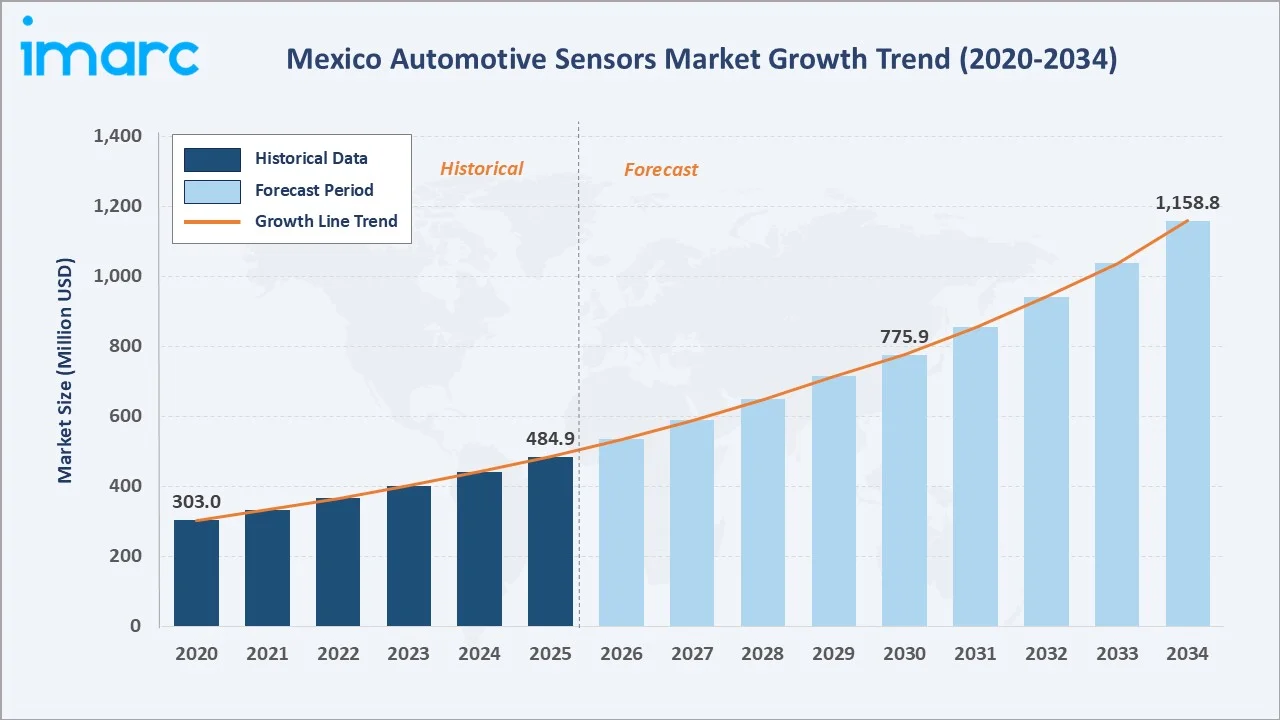
The Mexico automotive sensors market reached USD 484.9 Million in 2025 and is projected to reach USD 1,158.8 Million by 2034, growing at a CAGR of 9.86% during 2026-2034. Growth is driven by rising EV adoption, expanding aftermarket service networks, stricter safety regulations, and increasing integration of ADAS and connected-vehicle technologies across Mexico's automotive manufacturing base.
Passenger cars dominate vehicle type demand at 72.6%, OEM leads sales channel at 68.9%, and Northern Mexico commands the largest regional share at 44.2%, reflecting the concentration of automotive assembly plants along the border corridor.
Market Snapshot
|
Metric |
Value |
|
Market Size (2025) |
USD 484.9 Million |
|
Forecast Market Size (2034) |
USD 1,158.8 Million |
|
CAGR (2026-2034) |
9.86% |
|
Base Year |
2025 |
|
Historical Period |
2020-2025 |
|
Forecast Period |
2026-2034 |
|
Dominant Vehicle Type |
Passenger Cars (72.6%, 2025) |
|
Dominant Sales Channel |
OEM (68.9%, 2025) |
|
Leading Region |
Northern Mexico (44.2%, 2025) |
The market expanded steadily from an estimated USD 303.0 Million in 2020 to USD 484.9 Million in 2025, supported by rising EV penetration and growing local sensor assembly capacity, and is forecast to reach USD 1,158.8 Million by 2034.
To get more information on this market, Request Sample
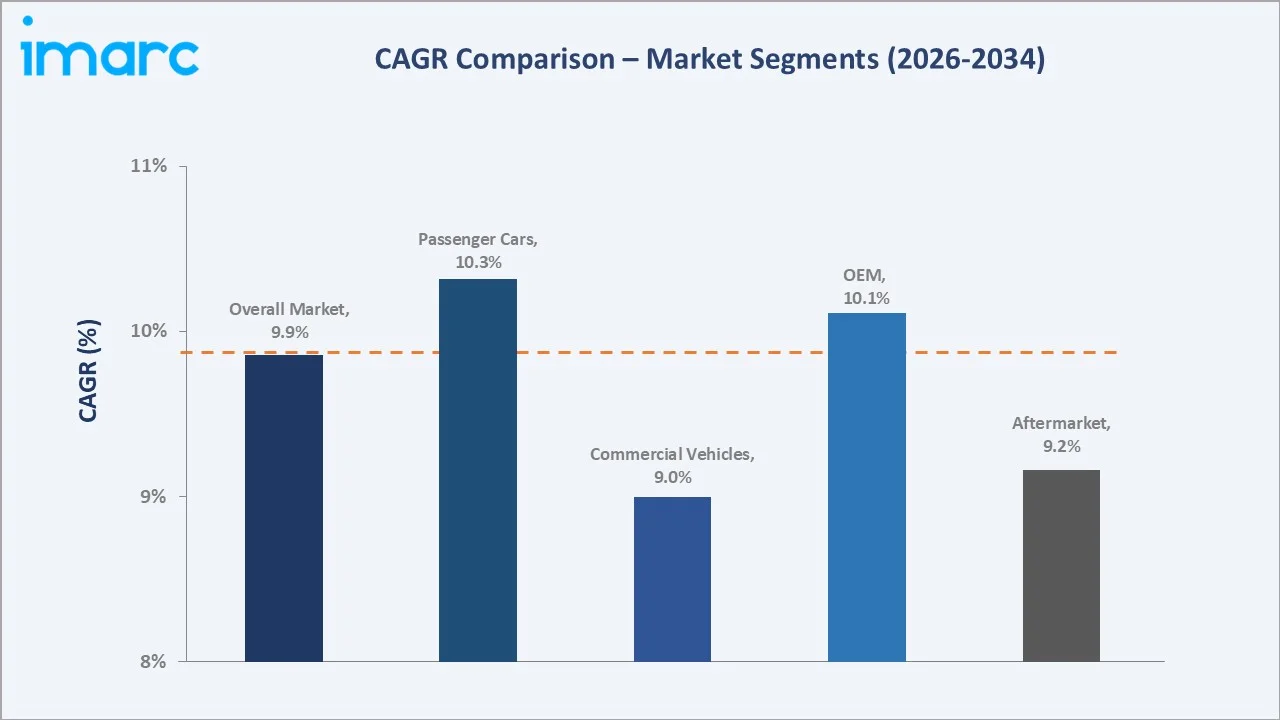
Passenger cars grow fastest at an estimated ~10.3% CAGR as EV and connected-feature adoption accelerates unit sensor content, while the OEM channel expands at ~10.1% CAGR through direct integration during vehicle assembly.
Executive Summary
The Mexico automotive sensors market reached USD 484.9 Million in 2025, reflecting the country's growing role as a nearshoring-driven automotive manufacturing hub with rising EV, ADAS, and safety-sensor content per vehicle. The market is projected to reach USD 1,158.8 Million by 2034.
Passenger cars at 72.6% dominate through rising EV model availability and consumer demand for connected features. OEM at 68.9% leads through direct sensor integration during assembly. Northern Mexico at 44.2% leads through its concentrated border-region assembly and export base.
Key Market Insights
|
Insight |
Data |
|
Dominant Vehicle Type |
Passenger Cars - 72.6% share (2025) |
|
Dominant Sales Channel |
Original Equipment Manufacturer (OEM) - 68.9% share (2025) |
|
Leading Region |
Northern Mexico - 44.2% share (2025) |
|
Market Opportunity |
EV sensor integration; ADAS sensor scale-up; aftermarket network expansion; local sensor manufacturing |
Key Analytical Observations Supporting The Above Data:
- Passenger Cars at 72.6%: Passenger cars dominate as rising EV and connected-vehicle penetration in personal transport drives sustained demand for powertrain, safety, and body-electronics sensors across Mexico's high-volume assembly plants.
- Original Equipment Manufacturer (OEM) at 68.9%: OEM leads the sales channel mix as automakers integrate sensors directly during vehicle assembly to meet safety mandates, emission norms, and ADAS feature requirements demanded by global export markets.
- Northern Mexico at 44.2%: Northern Mexico leads regionally due to its dense cluster of automotive assembly and export-oriented manufacturing plants along the US border, supported by established supplier and logistics infrastructure.
Mexico Automotive Sensors Market Overview
The Mexico automotive sensors market covers the design, manufacture, and supply of sensors used across passenger cars and commercial vehicles, including powertrain, chassis, body-electronics, safety, and telematics applications.
The ecosystem integrates sensor manufacturers, semiconductor suppliers, Tier-1 automotive component makers, vehicle OEMs, aftermarket distributors, and regulatory bodies overseeing vehicle safety and emission standards. Macroeconomic factors include rising EV adoption, urbanization, and nearshoring-driven manufacturing investment. As reported EV and plug-in hybrid sales in Mexico rose 84% in 2024, intensifying automaker demand for battery-management, thermal, and drivetrain-monitoring sensors across new vehicle platforms.
Market Dynamics
To evaluate market opportunities, Request Sample
Market Drivers
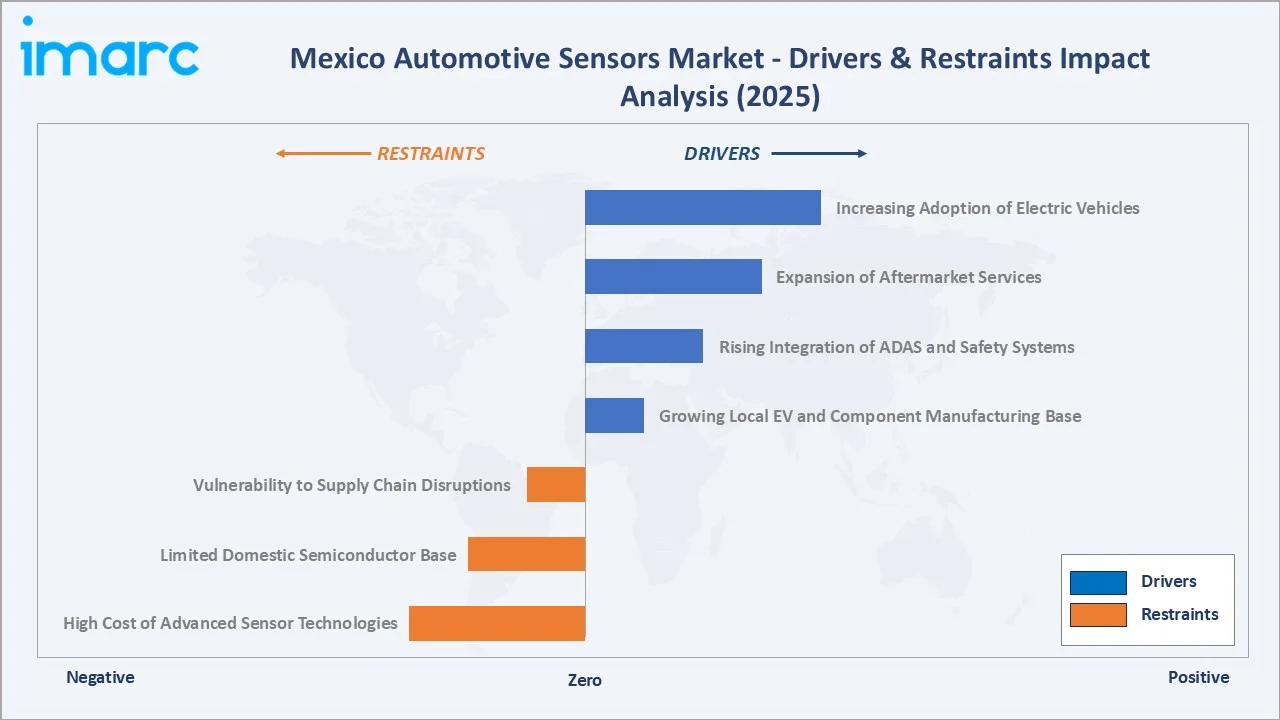
- Increasing Adoption of Electric Vehicles: Rising EV and PHEV sales are driving demand for battery-management, thermal-regulation, and drivetrain-monitoring sensors, as automakers integrate advanced sensing to optimize performance, efficiency, and safety across electrified platforms. Automakers are also adding redundant sensor arrays to meet functional-safety requirements for high-voltage battery packs. As EV model availability expands across price segments, sensor content per vehicle is rising faster than overall unit production growth. This trend is expected to strengthen further as charging infrastructure and consumer confidence in EVs continue to improve nationwide.
- Expansion of Aftermarket Services: Growing vehicle density and urbanization are increasing the need for sensor diagnostics, maintenance, and replacement, with expanding independent garage networks improving the availability of aftermarket sensor components nationwide. Rising vehicle age across the on-road fleet is also increasing replacement demand for wear-sensitive sensors such as oxygen and speed sensors. Improved access to diagnostic tools and training is enabling smaller repair shops to service increasingly sensor-dense vehicles. This is gradually shifting a larger share of sensor revenue toward the aftermarket channel over time.
- Rising Integration of ADAS and Safety Systems: Growing consumer demand for parking assistance, tire-pressure monitoring, and driver-assistance features is increasing radar, lidar, and ultrasonic sensor adoption across new passenger and commercial vehicle models. Regulatory momentum toward mandatory safety features in several export markets is further pushing OEMs to standardize ADAS sensor packages. Vehicle manufacturers are increasingly bundling multiple safety sensors into single modules to reduce cost and simplify assembly. This bundling trend is expected to accelerate ADAS sensor penetration across mid-range vehicle trims.
- Growing Local EV and Component Manufacturing Base: Expanding local assembly and precision-component manufacturing, supported by nearshoring investment, is strengthening in-country sensor integration at multiple stages of vehicle production and export-oriented supply chains. Global suppliers are increasingly co-locating design and testing facilities alongside assembly plants to shorten development cycles. This localization is also reducing lead times for custom sensor calibration required by different OEM platforms. Continued investment in local technical training programs is expected to further support this manufacturing base expansion.
Market Restraints
- High Cost of Advanced Sensor Technologies: Advanced radar, lidar, and multi-sensor ADAS modules carry high development and component costs, limiting adoption among cost-sensitive vehicle segments and slowing broader market penetration. Precision calibration requirements for these sensors add further cost throughout the assembly and testing stages. Smaller vehicle manufacturers often struggle to justify the upfront investment required for advanced sensor integration. As a result, adoption remains concentrated among premium and mid-to-high trim vehicle segments in the near term.
- Limited Domestic Semiconductor Base: Mexico's automotive sensor industry remains dependent on imported semiconductor components, exposing manufacturers to currency fluctuation, tariff changes, and cross-border supply chain complexity. This dependence also extends production lead times when global semiconductor demand outpaces available supply. Building a more robust domestic fabrication base would require significant capital investment and specialized technical expertise. Until such capacity develops, import dependence is likely to remain a structural feature of the market.
- Vulnerability to Supply Chain Disruptions: Automotive sensor production remains sensitive to global chip shortages and component supply disruptions, which can delay vehicle assembly schedules and constrain sensor procurement volumes. Concentration of semiconductor fabrication in a small number of global regions increases exposure to geopolitical and logistical risks. Manufacturers are increasingly diversifying supplier bases and building safety stock to mitigate these risks. However, such measures add inventory carrying costs that can affect overall sensor pricing.
Market Opportunities
- EV Sensor Platform Localization: Localizing production of battery-management and thermal sensors for EV platforms can reduce import dependence and create new supply opportunities as regional EV assembly expands. Suppliers that establish early local calibration and testing capacity can secure long-term OEM partnerships. Government incentives supporting EV component manufacturing further strengthen the business case for localization. This opportunity is expected to grow in parallel with rising EV production volumes over the forecast period.
- Smart and Wireless Sensor Adoption: Rising interest in connected-vehicle diagnostics is opening opportunities for wireless and IoT-enabled sensor modules across new passenger and fleet vehicle platforms. Fleet operators are particularly interested in predictive-maintenance capabilities that reduce vehicle downtime and servicing costs. Suppliers offering integrated software and sensor bundles are well positioned to capture this demand. As connectivity infrastructure improves nationwide, adoption of these smart sensor modules is expected to accelerate.
Market Challenges
- Currency and Tariff Exposure: Reliance on imported semiconductor components exposes manufacturers to peso volatility and cross-border tariff changes, complicating cost planning and pricing strategy. Sudden currency swings can compress supplier margins on fixed-price OEM contracts. Companies must increasingly hedge input costs or renegotiate contract terms to manage this exposure. Continued trade policy uncertainty adds further complexity to long-term investment planning.
- Skilled Workforce Availability: Scaling advanced sensor assembly and testing operations requires specialized technical talent, which remains limited relative to the pace of manufacturing capacity expansion. Competition for qualified engineers and technicians is intensifying as more suppliers establish local operations. Companies are increasingly investing in training partnerships with technical institutes to build a sustainable talent pipeline. Until this pipeline matures, workforce availability is likely to remain a constraint on capacity expansion.
Emerging Market Trends
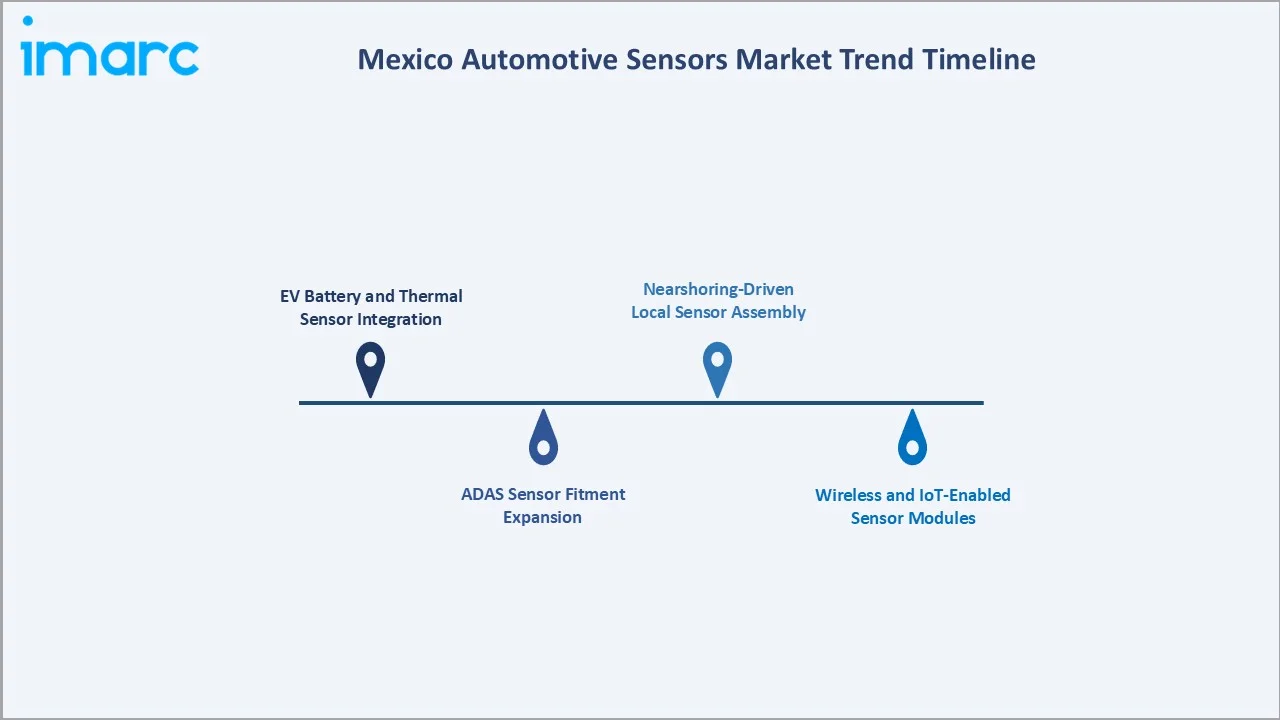
1. EV Battery and Thermal Sensor Integration
Automakers are integrating advanced battery-management and thermal sensors into new EV platforms assembled in Mexico, supporting safety, range optimization, and compliance with rising electrification targets.
2. ADAS Sensor Fitment Expansion
Radar, lidar, and ultrasonic sensor fitment is expanding across mid-range passenger vehicles as consumer demand for parking assistance and collision-warning features grows across the domestic market.
3. Wireless and IoT-Enabled Sensor Modules
Connected-vehicle platforms are driving adoption of wireless, IoT-enabled sensor modules that support real-time diagnostics, predictive maintenance, and remote fleet monitoring for commercial vehicle operators.
4. Nearshoring-Driven Local Sensor Assembly
Nearshoring investment is encouraging global suppliers to expand local sensor assembly and testing facilities in Mexico, strengthening supply chain resilience and reducing cross-border logistics dependency.
Industry Value Chain Analysis
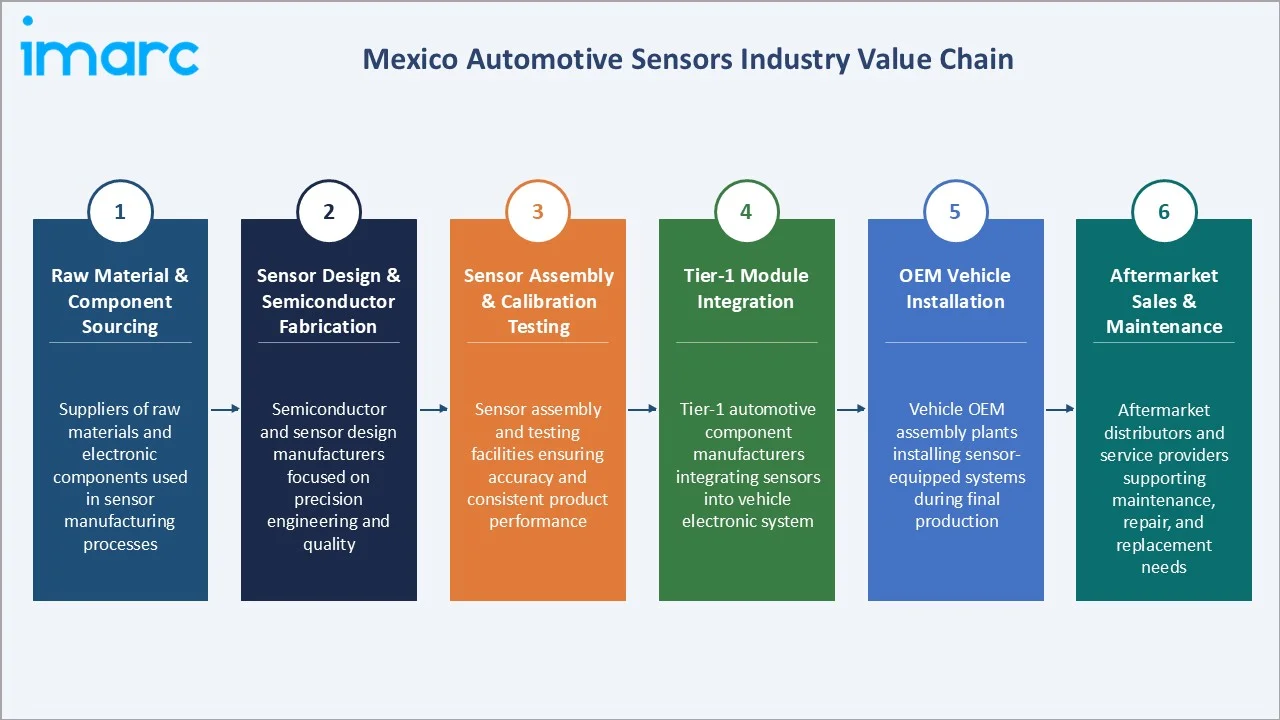
The Mexico automotive sensors value chain integrates raw material and semiconductor sourcing, sensor design and fabrication, assembly and calibration testing, Tier-1 module integration, OEM vehicle installation, and aftermarket sales and maintenance.
|
Stage |
Key Participants |
|
Raw Material & Component Sourcing |
Suppliers of raw materials and electronic components used in sensor manufacturing processes |
|
Sensor Design & Semiconductor Fabrication |
Semiconductor and sensor design manufacturers focused on precision engineering and quality |
|
Sensor Assembly & Calibration Testing |
Sensor assembly and testing facilities ensuring accuracy and consistent product performance |
|
Tier-1 Module Integration |
Tier-1 automotive component manufacturers integrating sensors into vehicle electronic system |
|
OEM Vehicle Installation |
Vehicle OEM assembly plants installing sensor-equipped systems during final production |
|
Aftermarket Sales & Maintenance |
Aftermarket distributors and service providers supporting maintenance, repair, and replacement needs |
The sensor assembly and calibration testing stage is the value chain's most technically critical segment, ensuring compliance with OEM quality and safety specifications before Tier-1 module integration.
Technology Landscape in the Mexico Automotive Sensors Industry
MEMS Sensor Technology
MEMS sensor technology offers compact size, low power consumption, and high reliability for pressure, motion, and inertial-measurement applications, supporting widespread adoption across powertrain and safety systems.
Radar and Lidar Sensor Technology
Radar and lidar sensors enable accurate object detection and distance measurement, supporting ADAS features such as adaptive cruise control, collision warning, and automated parking assistance.
Smart and Wireless Sensor Technology
Smart and wireless sensor technology enables real-time data transmission and remote diagnostics, supporting connected-vehicle platforms and predictive maintenance capabilities for fleet and passenger vehicle operators.
Market Segmentation Analysis
The report covers the following segments:
|
Segment Category |
Leading Segment |
Market Share |
Year |
|
Type |
🔒 |
🔒 |
2025 |
|
Vehicle Type |
Passenger Cars |
72.6% |
2025 |
|
Sales Channel |
Original Equipment Manufacturer (OEM) |
68.9% |
2025 |
|
Application |
🔒 |
🔒 |
2025 |
|
Region |
Northern Mexico |
44.2% |
2025 |

By Vehicle Type
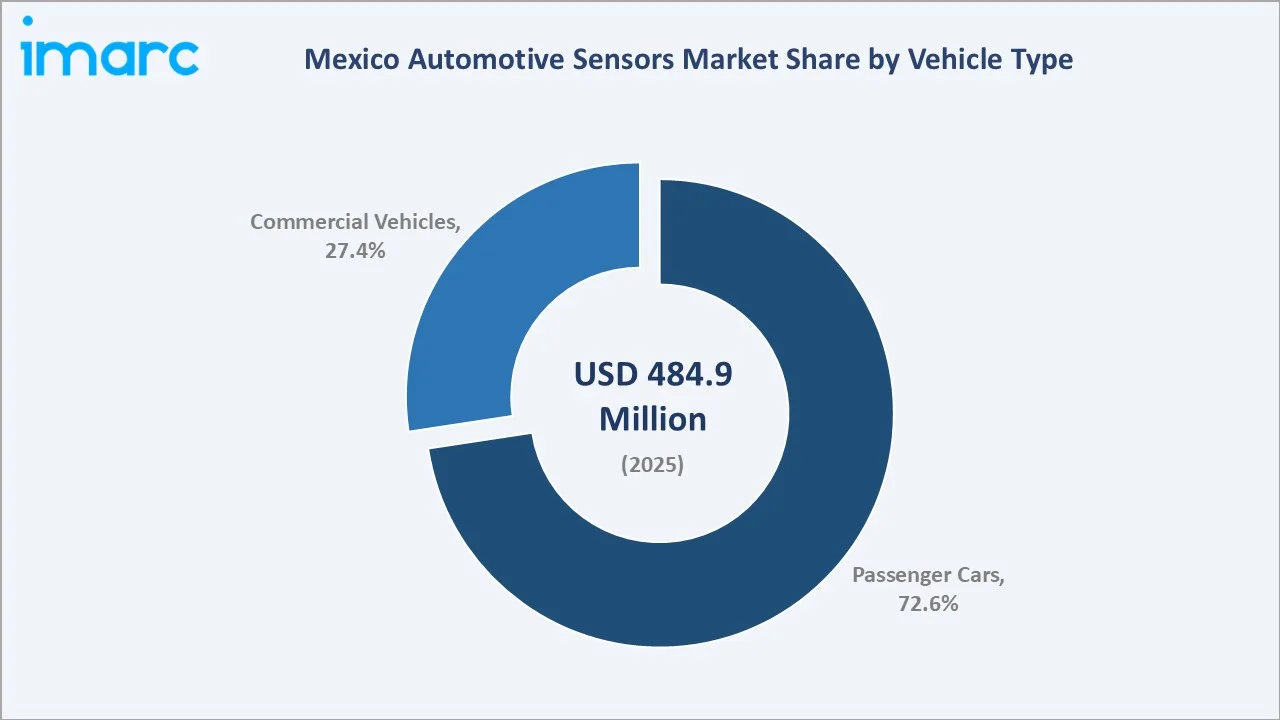
Passenger cars lead the vehicle type segment at 72.6% in 2025, reflecting high personal-vehicle ownership growth, expanding EV model availability, and rising consumer demand for connected and safety-enabled features.
To access detailed market analysis, Request Sample
Commercial vehicles account for 27.4% of the market, supported by fleet electrification, logistics sector growth, and tightening emission and safety compliance requirements for trucks and buses operating across trade corridors.
By Sales Channel
Original Equipment Manufacturer (OEM) leads the sales channel segment at 68.9% in 2025, as automakers embed sensors directly during vehicle assembly to satisfy safety mandates and export-market compliance requirements.
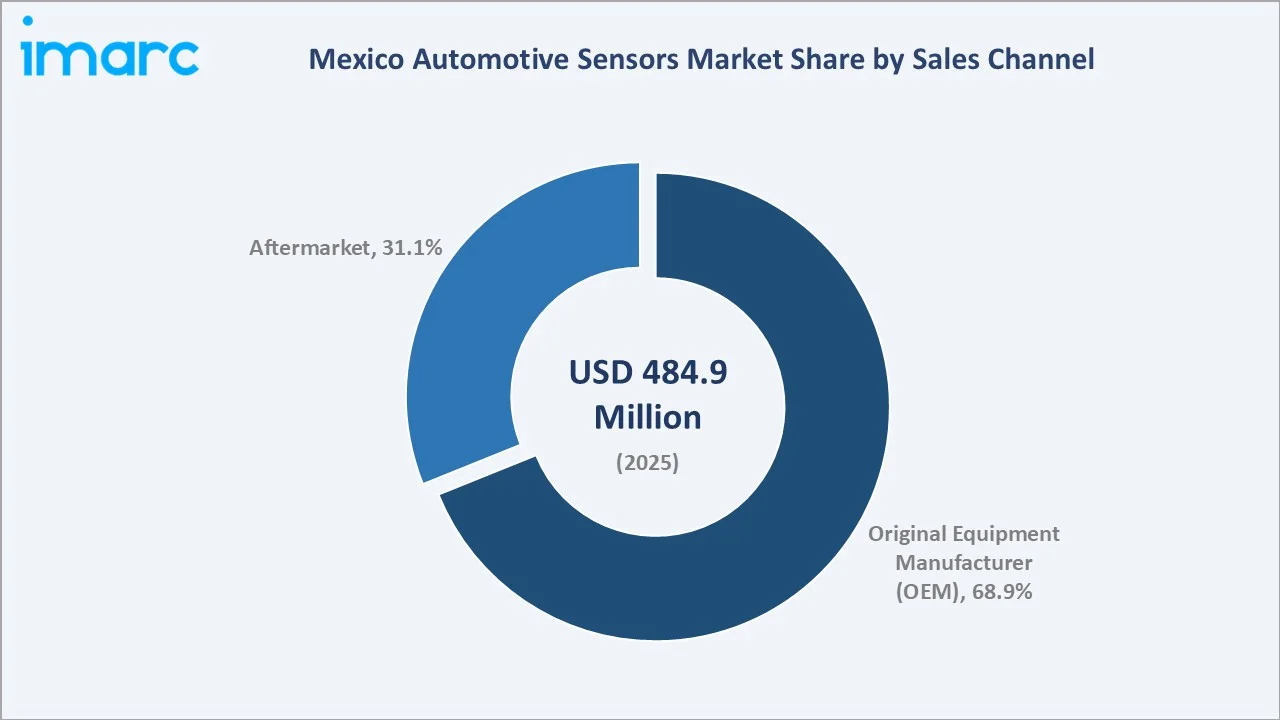
Aftermarket accounts for 31.1% of the market, driven by growing vehicle parc, rising urban vehicle density, and expanding independent garage networks improving access to replacement and upgraded sensor components.
Regional Market Insights
|
Region |
Share (2025) |
Key Market Characteristics |
|
Northern Mexico |
44.2% |
Supported by a strong concentration of automotive manufacturing activity and established supply chain infrastructure |
|
Central Mexico |
33.5% |
Driven by steady vehicle production growth and expanding regional manufacturing investment |
|
Southern Mexico |
15.1% |
Reflects a developing manufacturing base with growing infrastructure and investment activity |
|
Others |
7.2% |
Represents smaller regional markets with early-stage automotive sensor demand |
Northern Mexico leads regionally at 44.2%, driven by its concentration of automotive assembly plants, established supplier networks, and proximity to US export markets along the border manufacturing corridor.
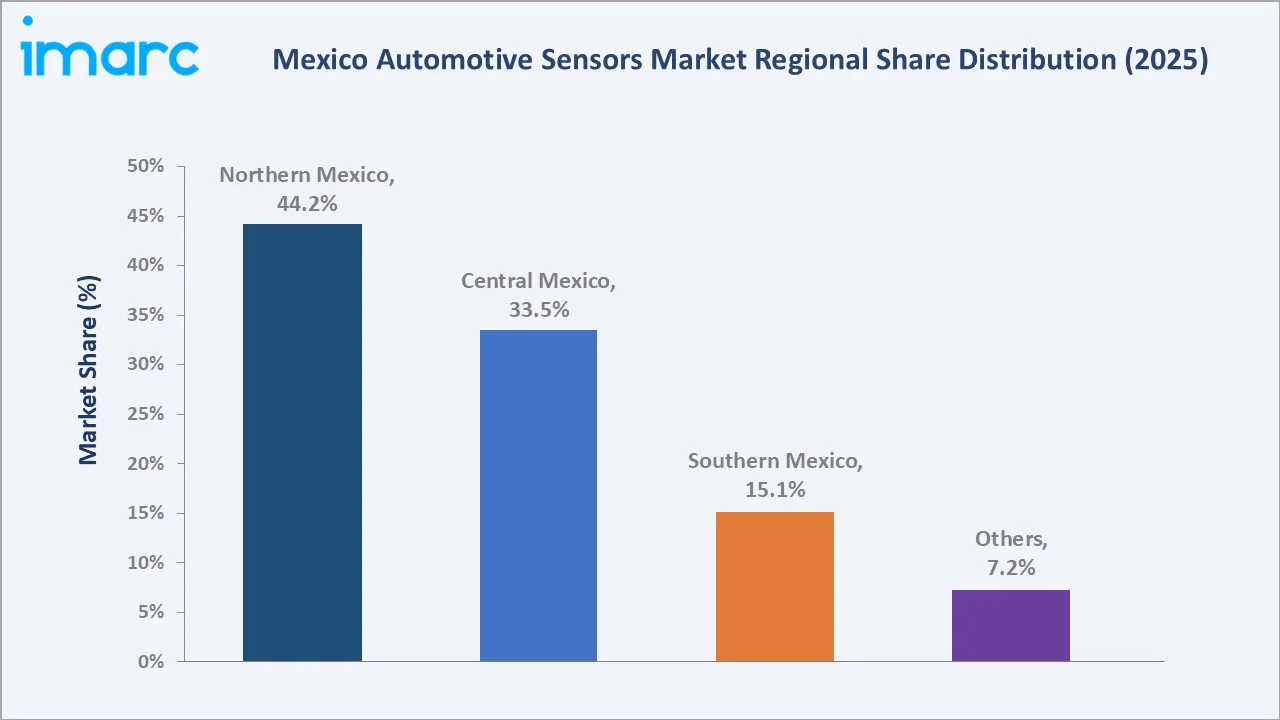
Central Mexico follows at 33.5%, supported by long-established OEM manufacturing hubs and growing EV assembly investment. Southern Mexico, at 15.1%, and Others, at 7.2%, represent earlier-stage but expanding automotive sensor markets.
Competitive Landscape
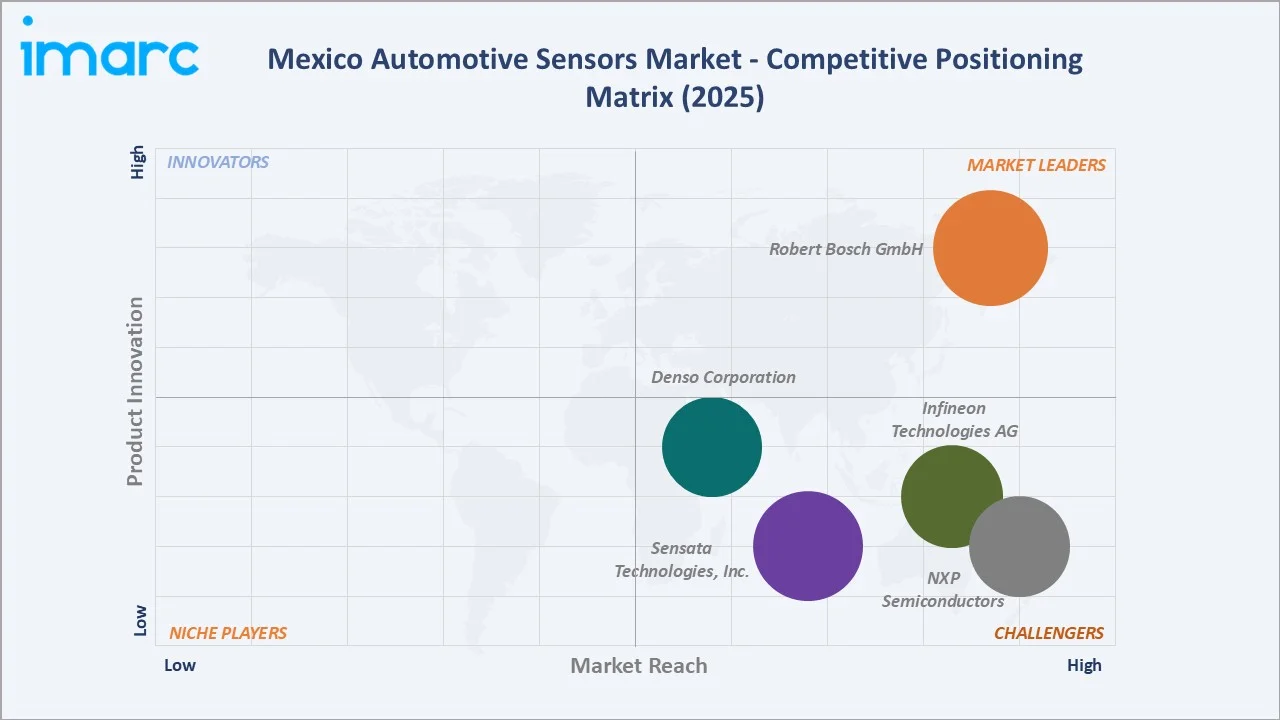
The Mexico automotive sensors market competitive landscape is moderately consolidated, led by global Tier-1 automotive component and semiconductor manufacturers operating local assembly and distribution facilities across the country.
|
Company Name |
Key Products |
Market Position |
Core Strength |
|
Robert Bosch GmbH |
Pressure sensors, MEMS sensors, Temperature sensors, Speed sensors |
Market Leader |
Global Tier-1 leader in automotive sensing and safety-systems technology |
|
Denso Corporation |
Temperature and emission sensors |
Strong Challenger |
Deep OEM integration and advanced thermal-management sensor technology |
|
Sensata Technologies, Inc. |
Gas Detection Sensors & Systems, Position Sensors & Encoders, Pressure Sensors, Temperature Sensors, Force Sensors |
Strong Challenger |
Specialized sensing solutions for harsh automotive operating environments |
|
Infineon Technologies AG |
Magnetic sensors, Current sensors, Gas sensors, Pressure sensors, Radar sensors, Magnetic Speed sensors, Temperature sensors, Battery sensors |
Strong Challenger |
Leading automotive semiconductor and sensor-chip manufacturing capability |
|
NXP Semiconductors |
Pressure and magnetic sensors |
Challenger |
Strong ADAS and connected-vehicle semiconductor sensor portfolio |
Key players include Robert Bosch GmbH, Denso Corporation, Sensata Technologies, Inc., Infineon Technologies AG, NXP Semiconductors, and others.
Key Company Profiles
Robert Bosch GmbH
Robert Bosch GmbH is a Germany-based global technology supplier with an established presence in the Mexico automotive sensors market through its powertrain, safety, and driver-assistance sensor portfolio.
- Key Products: Pressure sensors, MEMS sensors, Temperature sensors, Speed sensors
- Strategic Focus: Strengthening local production capacity for ADAS and safety sensors to support nearshoring-driven automotive manufacturing growth in Mexico.
Denso Corporation
Denso Corporation is a Japan-based automotive technology company with a significant presence in the Mexico automotive sensors market through its thermal, emission, and powertrain sensor technologies.
- Key Products: Temperature and emission sensors
- Strategic Focus: Scaling local sensor production to strengthen OEM partnerships and support Mexico's expanding automotive export manufacturing base.
Market Concentration Analysis
The Mexico automotive sensors market is moderately concentrated, with the top 5–6 key players together accounting for a substantial share of OEM sensor supply, while smaller regional distributors continue to serve the growing aftermarket segment. Competition is driven by technological innovation, product reliability, pricing strategies, and the ability to meet stringent automotive quality and safety standards. Global sensor manufacturers continue to strengthen their presence through long-term partnerships with vehicle OEMs and Tier 1 suppliers, supported by local manufacturing and engineering capabilities.
Additionally, the growing adoption of ADAS, vehicle electrification, and connected vehicle technologies is encouraging market participants to expand their sensor portfolios and invest in advanced sensing solutions, intensifying competition across both OEM and aftermarket channels.
Investment & Growth Opportunities
Highest Growth Segments
Passenger car sensor demand (~10.3% CAGR), OEM channel integration (~10.1% CAGR), and EV battery-management sensor platforms represent the highest-growth investment vectors through 2034, supported by sustained EV adoption momentum.
Emerging Investment Opportunities
Local sensor assembly and calibration-testing facilities represent an emerging investment opportunity, as nearshoring investment encourages suppliers to reduce cross-border logistics dependency and strengthen in-country supply chain resilience.
Investment Themes
- Local EV Sensor Manufacturing Scale-Up: Investment in local battery-management and thermal sensor assembly can capture rising EV production demand while reducing import dependence.
- ADAS Sensor Supply Chain Localization: Expanding radar, lidar, and ultrasonic sensor assembly capacity in Mexico can support growing OEM demand for safety-feature integration.
Future Market Outlook (2026-2034)
The Mexico automotive sensors market is projected to grow from USD 484.9 Million in 2025 to USD 1,158.8 Million by 2034, delivering a 9.86% CAGR as EV adoption, ADAS integration, and aftermarket expansion continue accelerating sensor demand.
Rising nearshoring investment is expected to strengthen local sensor assembly capacity, while growing EV and connected-vehicle penetration will sustain demand for battery-management, safety, and telematics sensor technologies through the forecast period.
Research Methodology
Primary Research
Primary research comprised structured interviews with automotive OEM engineers, Tier-1 sensor suppliers, and aftermarket distributors across Mexico's key automotive manufacturing regions.
Secondary Research
Secondary research encompassed company reports, Electro Movilidad Asociación EV sales data, World Data Atlas urbanization statistics, and automotive industry trade publications covering Mexico's sensor and component supply chains.
Forecasting Models
Market revenue forecasts were developed using a production-based bottom-up model incorporating vehicle production volumes by type, average sensor content per vehicle, and channel-wise pricing trends across the forecast period.
Mexico Automotive Sensors Market Report Coverage:
| Report Features | Details |
|---|---|
| Base Year of the Analysis | 2025 |
| Historical Period | 2020-2025 |
| Forecast Period | 2026-2034 |
| Units | Million USD |
| Scope of the Report |
Exploration of Historical Trends and Market Outlook, Industry Catalysts and Challenges, Segment-Wise Historical and Future Market Assessment:
|
| Types Covered | Level/Position Sensors, Temperature Sensors, Pressure Sensors, Speed Sensors, Gas Sensors, Magnetic Sensors, Others |
| Vehicle Types Covered | Passenger Cars, Commercial Vehicles |
| Sales Channels Covered | Original Equipment Manufacturer (OEM), Aftermarket |
| Applications Covered | Powertrain, Chassis, Vehicle Body Electronics, Safety and Security, Telematics, Others |
| Regions Covered | Northern Mexico, Central Mexico, Southern Mexico, Others |
| Companies Covered | Robert Bosch GmbH, Denso Corporation, Sensata Technologies Inc., Infineon Technologies AG, NXP Semiconductors, etc. |
| Customization Scope | 10% Free Customization |
| Post-Sale Analyst Support | 10-12 Weeks |
| Delivery Format | PDF and Excel through Email (We can also provide the editable version of the report in PPT/Word format on special request) |
Key Benefits for Stakeholders:
- IMARC’s industry report offers a comprehensive quantitative analysis of various market segments, historical and current market trends, market forecasts, and dynamics of the Mexico automotive sensors market from 2020-2034.
- The research report provides the latest information on the market drivers, challenges, and opportunities in the Mexico automotive sensors market.
- Porter's five forces analysis assist stakeholders in assessing the impact of new entrants, competitive rivalry, supplier power, buyer power, and the threat of substitution. It helps stakeholders to analyze the level of competition within the Mexico automotive sensors industry and its attractiveness.
- Competitive landscape allows stakeholders to understand their competitive environment and provides an insight into the current positions of key players in the market.
Frequently Asked Questions About the Mexico Automotive Sensors Market Report
The Mexico automotive sensors market reached USD 484.9 Million in 2025, driven by passenger cars leading vehicle type demand at 72.6% and OEM leading the sales channel at 68.9%.
The market is projected to grow at a CAGR of 9.86% during 2026-2034, reaching USD 1,158.8 Million by 2034.
Passenger cars lead at 72.6% in 2025, supported by rising EV adoption and growing demand for connected and safety-enabled vehicle features.
Original Equipment Manufacturer (OEM) leads at 68.9%, as automakers integrate sensors directly during vehicle assembly to meet safety and compliance requirements.
Northern Mexico leads at 44.2%, driven by its concentration of automotive assembly plants and proximity to US export markets.
Leading companies include Robert Bosch GmbH, Denso Corporation, Sensata Technologies, Inc., Infineon Technologies AG, NXP Semiconductors, and others.
Key drivers include rising EV adoption, aftermarket service expansion, growing ADAS integration, and expanding local vehicle and component manufacturing.
Key restraints include the high cost of advanced sensor technologies, limited domestic semiconductor manufacturing, and vulnerability to global supply chain disruptions.
Need more help?
- Speak to our experienced analysts for insights on the current market scenarios.
- Include additional segments and countries to customize the report as per your requirement.
- Gain an unparalleled competitive advantage in your domain by understanding how to utilize the report and positively impacting your operations and revenue.
- For further assistance, please connect with our analysts.
 Request Customization
 Speak to an Analyst
 Request Brochure
 Inquire Before Buying
Benefits of Customization
- Personalize this research
- Triangulate with your data
- Get data as per your format and definition
- Gain a deeper dive into a specific application, geography, customer, or competitor
- Any level of personalization
Get in Touch With Us
UNITED STATES
Phone: +1-201-971-6302
INDIA
Phone: +91-120-433-0800
UNITED KINGDOM
Phone: +44-753-714-6104
Email: [email protected]
Client Testimonials




.webp)




.webp)













Related Reports

Choose your plan
*Please note that the prices mentioned below are starting prices for each bundle type. Kindly contact our team for further details.*
Single User License
- 1 User License, Access on 2 Devices
- PDF Report + Excel Dataset (Password Protected)
- Lifetime Access
- No Printing Rights
- 10% Free Report Customization
- 10–12 Weeks of Analyst Support
Five User License
- Access for 5 Users, 2 Devices per User
- PDF Report + Excel Dataset (Password Protected)
- Lifetime Access
- Dedicated Account Manager
- 12–14 Weeks of Analyst Support
- No Printing Rights
- 15% Free Report Customization
- 25% Discount on Your Next Purchase
Corporate User License
- Unlimited User Access (Within Your Organization)
- PDF Report + Excel Dataset
- Lifetime Access
- Dedicated Account Manager
- 14–20 Weeks of Analyst Support
- No Printing Rights
- 20% Free Report Customization
- 30% Discount on Your Next Purchase
Essential Insights
What's included:
3 reports
- Lifetime Access
- PDF Reports
- Excel Datasets
- 2 Weeks of Free Analyst Support
- 2 User Licenses
- Access on 2 Devices
- Printing Rights
- Complimentary PowerPoint (PPT) Version
- Complimentary License Upgrade
Professional Access
What's included:
5 reports
- Lifetime Access
- PDF Reports
- Excel Datasets
- 8 Weeks of Free Analyst Support
- 2 User Licenses
- Access on 2 Devices
- Printing Rights
- Complimentary PowerPoint (PPT) Version
- Complimentary License Upgrade
Business Advantage
What's included:
8 reports
- Lifetime Access
- PDF Reports
- Excel Datasets
- 14 Weeks of Free Analyst Support
- 2 User Licenses
- Access on 2 Devices
- Printing Rights
- Complimentary PowerPoint (PPT) Version
- Complimentary License Upgrade
Enterprise Intelligence
What's included:
10 reports
- Lifetime Access
- PDF Reports
- Excel Datasets
- 20 Weeks of Free Analyst Support
- 2 User Licenses
- Access on 2 Devices
- Printing Rights
- Complimentary PowerPoint (PPT) Version
- Complimentary License Upgrade