
Mexico Blankets and Quilts Market Size, Share, Trends and Forecast by Product Type, Material, Application, Distribution Channel, and Region, 2026-2034
Mexico Blankets and Quilts Market Size, Share, Trends & Forecast (2026-2034)
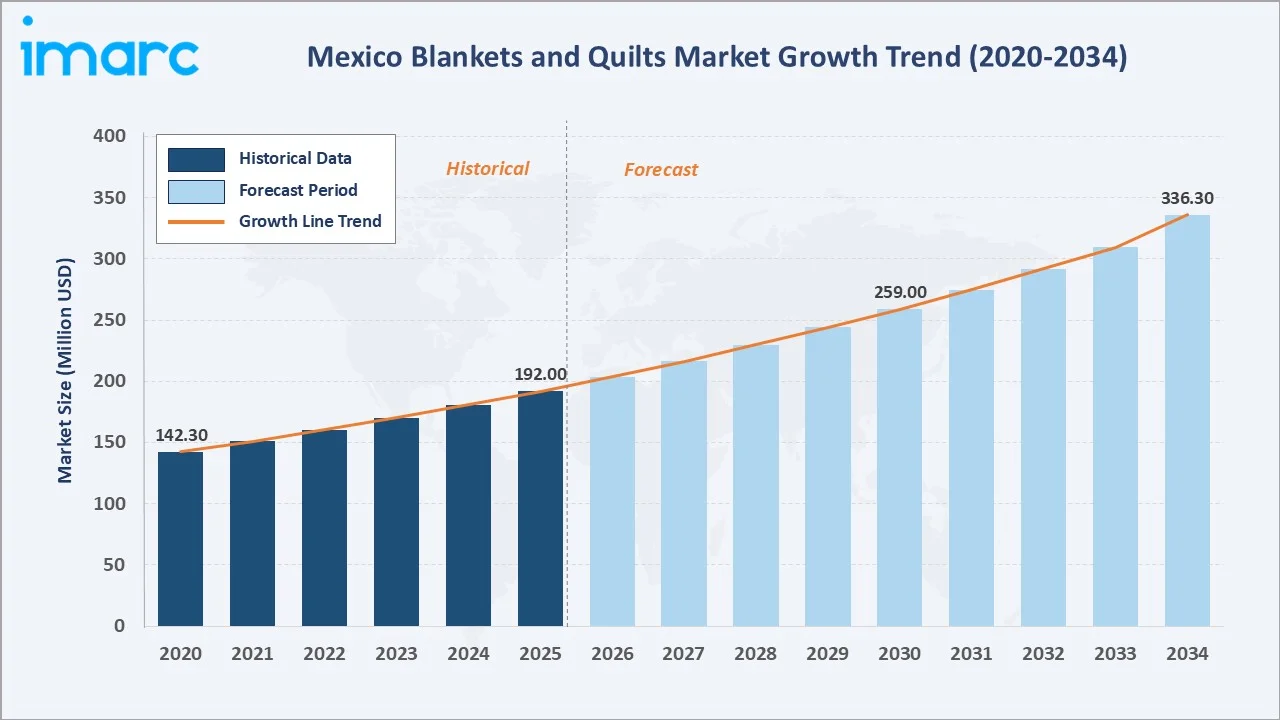
The Mexico blankets and quilts market grew from USD 142.3 Million in 2020 to USD 192.0 Million in 2025. It is estimated at USD 203.8 Million in 2026 and is projected to reach USD 336.3 Million by 2034, growing at a CAGR of 6.17% during 2026-2034. The market is driven by rising urbanization, growing hospitality sector demand, and expanding e-commerce penetration across the mexico textile fabrics market. Household segment leads at 72.4%. Offline distribution dominates at 67.3%. Central Mexico commands 42.6% of the regional market share.
Market Snapshot
|
Metric |
Value |
|
Base Year Market Size (2025) |
USD 192.0 Million |
|
Market Size (2026) |
USD 203.8 Million |
|
Forecast Market Size (2034) |
USD 336.3 Million |
|
CAGR (2026-2034) |
6.17% |
|
Base Year |
2025 |
|
Historical Period |
2020-2025 |
|
Forecast Period |
2026-2034 |
|
Dominant Application |
Household (72.4%, 2025) |
|
Dominant Distribution Channel |
Offline (67.3%, 2025) |
|
Leading Region |
Central Mexico (42.6%, 2025) |
The Mexico blankets and quilts market size increased from USD 142.3 Million in 2020 to USD 192.0 Million in 2025 and is estimated to reach USD 203.8 Million in 2026. The market is further expected to grow to USD 259.0 Million by 2030 and USD 336.3 Million by 2034. The market reflects steady household consumption growth alongside a rising commercial segment driven by Mexico's expanding hospitality industry.
To get more information on this market, Request Sample
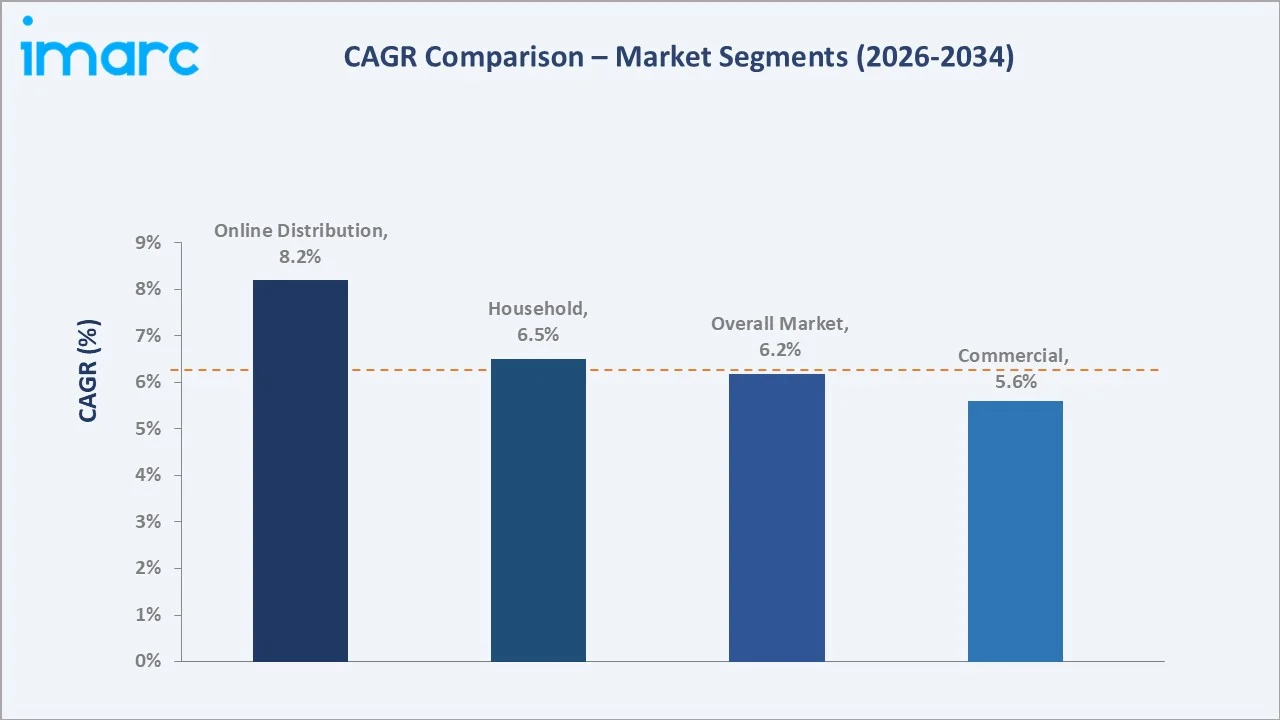
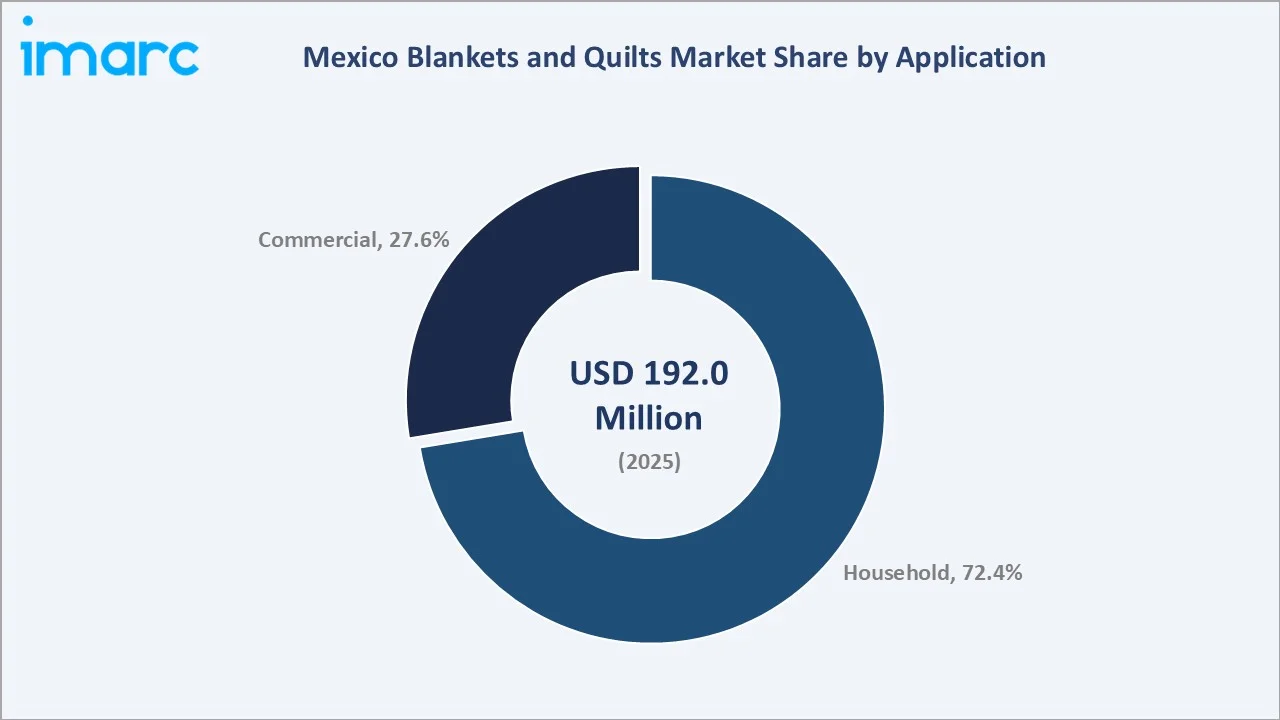
The Household segment grows at approximately 6.5% CAGR driven by residential construction and premiumization of home textiles. The Online distribution channel grows fastest at approximately 8.2% CAGR through digital retail platform expansion. The Commercial segment grows at 5.6% CAGR, supported by Mexico's hotel and tourism sector expansion.
Executive Summary
The Mexico blankets and quilts market expanded from USD 192.0 Million in 2025 to an estimated USD 203.8 Million in 2026, positioning it as one of Latin America's growing home textile markets by value. The market's scale is underpinned by Mexico's large consumer base, the expansion of modern retail infrastructure, and rising demand for premium and artisanal bedding products. The market is projected to reach USD 336.3 Million by 2034. The Household segment at 72.4% leads through residential demand. Offline at 67.3% reflects the dominance of traditional retail. Central Mexico leads regionally at 42.6%.
Key Market Insights
|
Insight |
Data |
|
Dominant Application |
Household – 72.4% share (2025) |
|
Dominant Distribution Channel |
Offline – 67.3% market share (2025) |
|
Leading Region |
Central Mexico – 42.6% share (2025) |
|
Market Opportunity |
E-commerce growth, artisanal premium segment, hotel & hospitality sector expansion |
Key Analytical Observations Supporting the Above Data:
- Household at 72.4%: The household segment dominates due to steady demand from Mexico's expanding urban residential population, rising middle-class income, and preference for comfortable home bedding products.
- Offline at 67.3%: Offline channels dominate due to established retail chains, consumer preference for tactile product evaluation, and widespread availability through department stores and specialty textile shops.
- Central Mexico at 42.6%: Central Mexico dominates regionally due to higher population density, greater purchasing power in Mexico City metropolitan area, and concentration of modern retail infrastructure.
Mexico Blankets and Quilts Market Overview
Mexico blankets and quilts market is commercially positioned at the intersection of a growing middle-class consumer base, a vibrant artisanal textile tradition, and expanding modern retail and e-commerce channels. The mexico textile fabrics market represents a broader ecosystem within which blankets and quilts hold a significant product category. The market's structure is characterized by coexistence of traditional artisanal production and modern mass manufacturing.
The market integrates domestic manufacturing, import of raw materials, multi-brand retail, e-commerce, and artisanal craftsmanship. Macroeconomic factors include urbanization, a growing middle-class population, and rising consumer spending on home furnishings and lifestyle products.
Market Dynamics
To evaluate market opportunities, Request Sample
Market Drivers
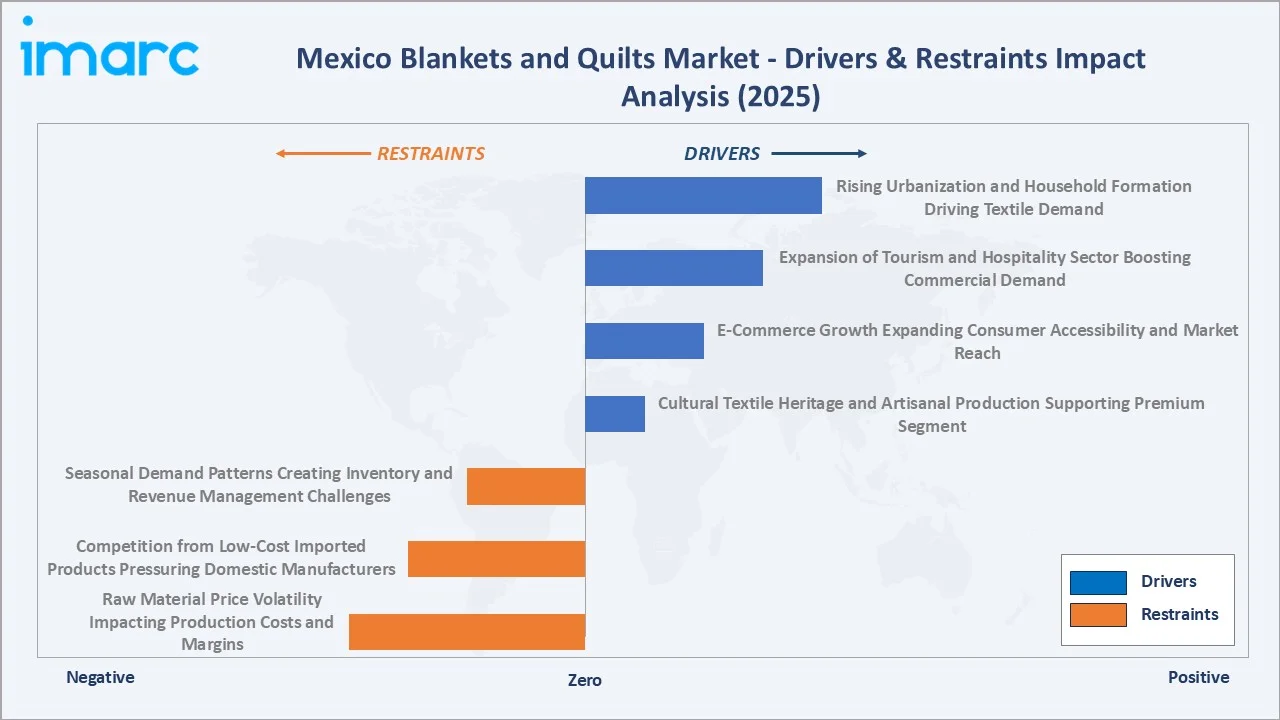
- Rising Urbanization and Household Formation Driving Textile Demand: Rapid urbanization and sustained household formation rates are generating steady demand for home textiles including blankets and quilts. Growing residential infrastructure development, rising disposable incomes among urban populations, and increasing consumer preference for quality home furnishings are supporting segment growth and product premiumization within the bedding and home textile category.
- Expansion of Tourism and Hospitality Sector Boosting Commercial Demand: The growing hospitality and tourism industry is creating sustained commercial procurement demand for blankets and quilts across hotels, resorts, and hospitality establishments. Expansion of accommodation capacity in key tourism destinations is driving bulk procurement by commercial buyers. This commercial demand stream provides a stable and recurring revenue opportunity for market participants.
- E-Commerce Growth Expanding Consumer Accessibility and Market Reach: The rapid growth of e-commerce platforms and digital retail channels is expanding the accessibility of blankets and quilts to consumers across urban and secondary markets. Online channels enable manufacturers and brands to reach a wider consumer base, offer broader product assortments, and implement targeted digital marketing strategies. Growing internet penetration and mobile commerce adoption are further accelerating online channel development within the home textile market.
- Cultural Textile Heritage and Artisanal Production Supporting Premium Segment: A strong cultural heritage in traditional textile craftsmanship is creating a distinctive premium product segment within the blankets and quilts market. Artisanal and handcrafted products with regional design identities are attracting consumer interest both in domestic and export markets. Growing consumer appreciation for culturally authentic, sustainably produced textiles is supporting premium pricing and demand growth in the artisanal segment.
Market Restraints
- Raw Material Price Volatility Impacting Production Costs and Margins: Fluctuations in prices of key raw materials including natural fibers, synthetic materials, and filling components create margin pressure on manufacturers. Global commodity price cycles, currency exchange rate movements, and supply chain disruptions make cost management and retail pricing challenging, particularly for small and medium-sized producers operating with limited hedging capacity.
- Competition from Low-Cost Imported Products Pressuring Domestic Manufacturers: Influx of competitively priced imported blankets and quilts from major textile manufacturing regions creates significant price-based competition for domestic producers. Imported products frequently undercut locally manufactured alternatives on price, limiting the ability of domestic manufacturers to maintain market share without substantial investment in product differentiation, quality positioning, and brand development.
- Seasonal Demand Patterns Creating Inventory and Revenue Management Challenges: Demand for blankets and quilts exhibits seasonal fluctuations tied to climate conditions and regional weather patterns. Pronounced demand cycles create challenges in production planning, inventory management, and working capital allocation across the year. Revenue variability associated with seasonal demand patterns can limit investment capacity and create operational cash flow management challenges for market participants.
Market Opportunities
- Sustainable and Eco-Certified Product Lines Addressing Consumer Preferences: Growing consumer demand for sustainable, eco-certified, and ethically produced textiles presents a significant market development opportunity. Brands investing in recycled materials, organic certifications, and transparent supply chain practices can access premium market segments and export opportunities.
- Commercial Sector Supply Partnerships Providing Stable Revenue Streams: Expanding commercial hospitality and healthcare infrastructure creates growing institutional procurement opportunities for blankets and quilts. Building long-term supply partnerships with commercial buyers across hospitality, healthcare, and institutional markets offers manufacturers stable and predictable revenue.
Market Challenges
- Maintaining Quality Consistency Across Production Scale and Distribution: Scaling manufacturing capacity while maintaining consistent product quality standards presents a key operational challenge for producers. Transitioning from smaller-scale to higher-volume production without compromising product integrity requires capital investment and quality management capability development.
- Distribution Infrastructure Gaps Limiting Reach in Secondary Markets: Underdeveloped distribution infrastructure in rural and secondary markets restricts the geographic reach of blanket and quilt brands. High logistics costs and limited retail penetration in lower-density areas constrain market expansion potential and require investment in distribution network development.
Emerging Market Trends
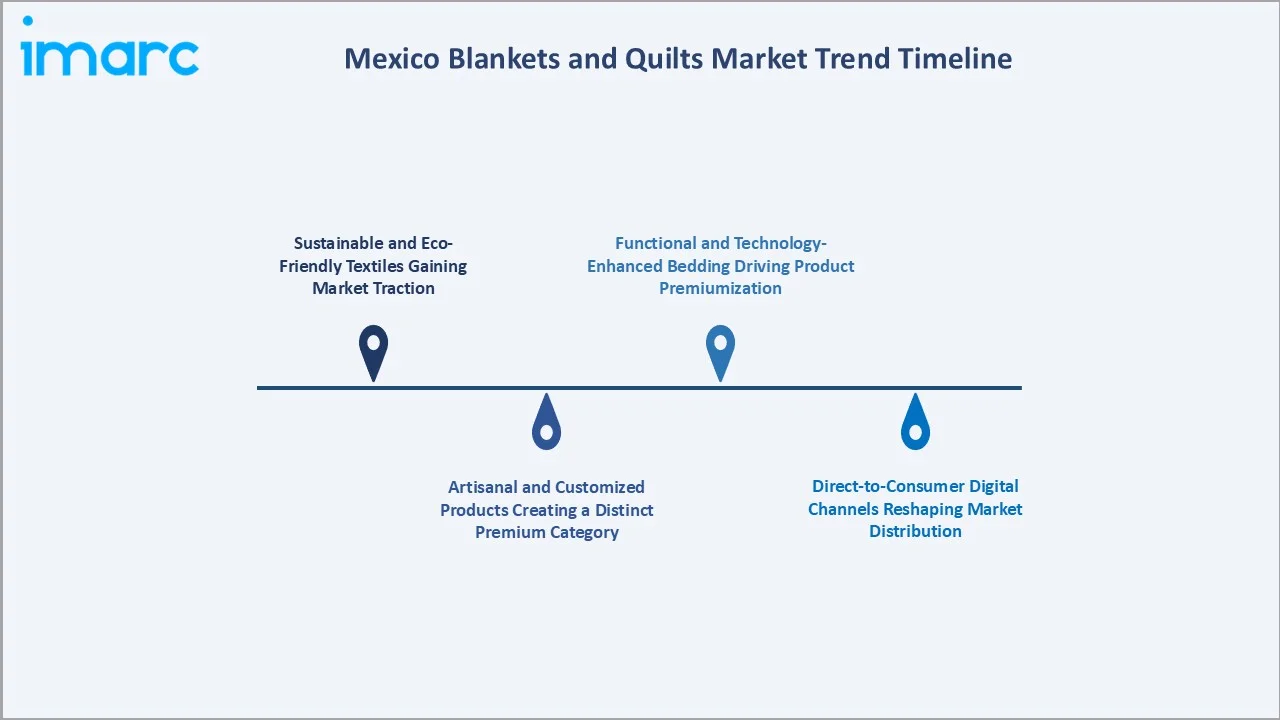
1. Sustainable and Eco-Friendly Textiles Gaining Market Traction
Rising consumer awareness around environmental responsibility is driving increasing demand for sustainable, eco-certified, and responsibly sourced blankets and quilts. Manufacturers adopting recycled fiber inputs, organic material certifications, and environmentally responsible production processes are gaining a competitive advantage in the premium segment, with sustainability credentials becoming an important differentiator across the broader mexico textile fabrics market.
2. Functional and Technology-Enhanced Bedding Driving Product Premiumization
Innovation in textile technology is enabling integration of functional performance features including temperature-regulating materials, antimicrobial treatments, and moisture-management fabrics. These value-added product attributes are supporting premiumization in the household segment and expanding the commercial blanket and quilt market. Technology-enhanced bedding products are gaining acceptance among health-conscious and quality-focused consumer segments.
3. Artisanal and Customized Products Creating a Distinct Premium Category
Consumer preference for personalized and artisanal products is establishing a distinct premium category within the home textile market. Traditional production techniques, craft-based design aesthetics, and product customization capabilities are differentiating artisanal offerings from mass-manufactured alternatives. This trend supports higher price positioning and drives brand loyalty among consumers prioritizing quality and craftsmanship.
4. Direct-to-Consumer Digital Channels Reshaping Market Distribution
The growth of direct-to-consumer e-commerce platforms is fundamentally reshaping distribution dynamics within the home textile and bedding market. D2C digital channels enable brands to engage consumers directly, improve margin structures, and build customer relationships independent of traditional retail intermediaries. The online distribution channel is expected to grow at approximately 8.2% CAGR through 2034, driven by increasing digital purchasing adoption.
Industry Value Chain Analysis
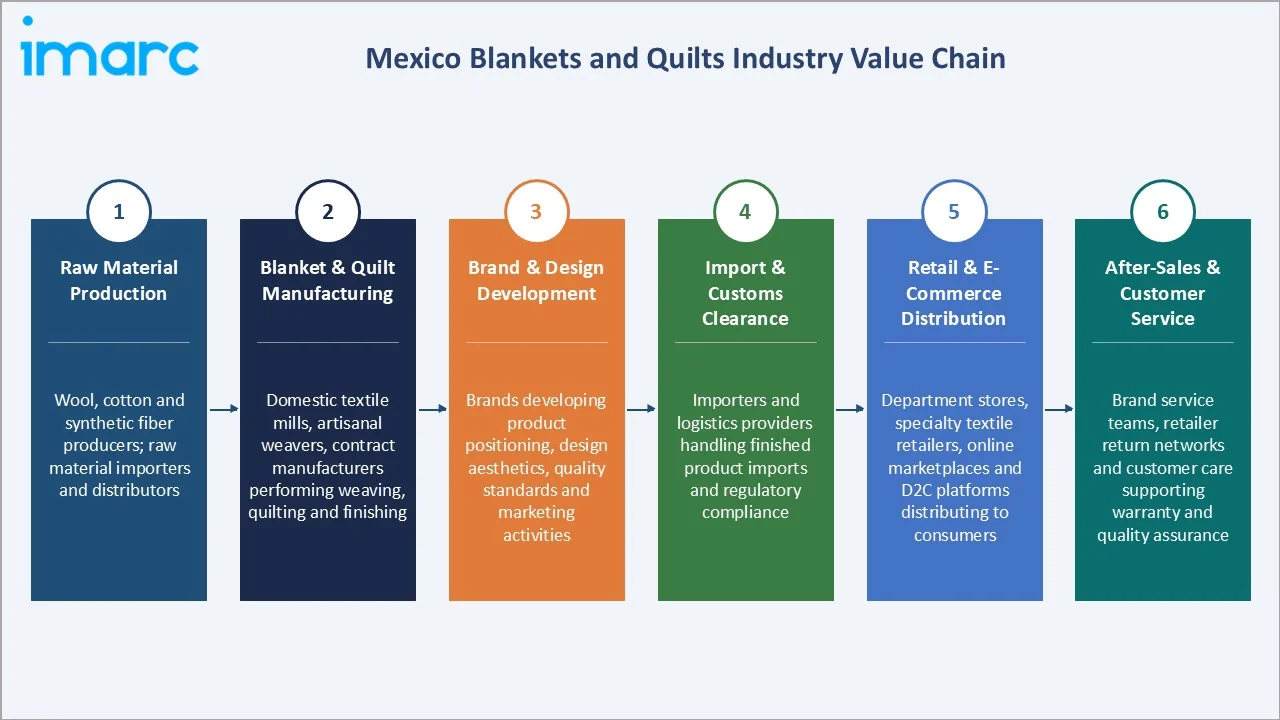
The blankets and quilts industry value chain encompasses raw material sourcing and processing, textile manufacturing, brand and design development, distribution logistics, and retail to end consumers. The value chain supports both mass-market manufacturing and premium artisanal production pathways, reflecting the structural diversity of participants and production models within the market.
|
Stage |
Key Participants |
|
Raw Material Production |
Wool, cotton and synthetic fiber producers; raw material importers and distributors |
|
Blanket & Quilt Manufacturing |
Domestic textile mills, artisanal weavers, contract manufacturers performing weaving, quilting and finishing |
|
Brand & Design Development |
Brands developing product positioning, design aesthetics, quality standards and marketing activities |
|
Import & Customs Clearance |
Importers and logistics providers handling finished product imports and regulatory compliance |
|
Retail & E-Commerce Distribution |
Department stores, specialty textile retailers, online marketplaces and D2C platforms distributing to consumers |
|
After-Sales & Customer Service |
Brand service teams, retailer return networks and customer care supporting warranty and quality assurance |
Manufacturing and distribution stages represent the most commercially significant value-adding activities, where product quality standards, brand positioning investment, and retail channel partnerships collectively determine competitive strength and market positioning within the mexico textile fabrics market ecosystem.
Technology Landscape in the Mexico Blankets and Quilts Industry
Advanced Weaving and Quilting Technologies
Modern automated weaving and quilting machinery enables efficient, high-quality production of blankets and quilts at competitive cost levels. Computerized jacquard looms and precision quilting machines improve pattern consistency and production throughput. These technologies enable manufacturers to offer greater design variety, meet quality standards for commercial buyers, and compete effectively against imported products within the domestic market.
Sustainable and Eco-Friendly Material Technologies
Innovation in fiber technology, including development of recycled polyester, organic cotton cultivation, and eco-certified wool processing, is transforming the raw material landscape. Sustainable material technologies reduce environmental impact and support certification requirements for access to premium consumer and export markets. Adoption of these materials is becoming an important differentiator as consumer and regulatory expectations around environmental responsibility increase.
Digital Design and Customization Tools
Digital design software and computer-aided textile design tools are enabling brands to rapidly develop new patterns, colorways, and product configurations. These technologies reduce design cycle times, support mass customization for commercial buyers, and enable artisanal producers to scale unique design capabilities. Integration of digital tools with production equipment is improving manufacturing flexibility and supporting faster product innovation cycles.
Market Segmentation Analysis
The report covers the following segments:
|
Segment Category |
Leading Segment |
Market Share |
Year |
|
Application |
Household |
72.4% |
2025 |
|
Product Type |
🔒 |
🔒 |
2025 |
|
Material |
🔒 |
🔒 |
2025 |
|
Distribution Channel |
Offline |
67.3% |
2025 |
|
Region |
Central Mexico |
42.6% |
2025 |

By Application
Household leads at 72.4% (2025), growing at approximately 6.5% CAGR through 2034. The household segment represents the dominant demand driver, underpinned by steady household formation rates, rising home ownership, and growing consumer preference for quality and aesthetically appealing home textiles. Rising disposable incomes and premiumization trends are supporting segment value expansion.
To access detailed market analysis, Request Sample
Commercial at 27.6% is growing at approximately 5.6% CAGR, driven by expanding hospitality, hotel, resort, and healthcare sector procurement demand. Commercial buyers represent a structurally growing segment as the service economy and tourism industry continue to expand, supporting steady volume procurement growth.
By Distribution Channel
Offline leads at 67.3% (2025). The offline channel encompasses the established retail network including department stores, specialty textile retailers, and supermarkets. Consumer preference for in-store product evaluation and the depth of established retail infrastructure support offline channel dominance across the mexico textile fabrics market.
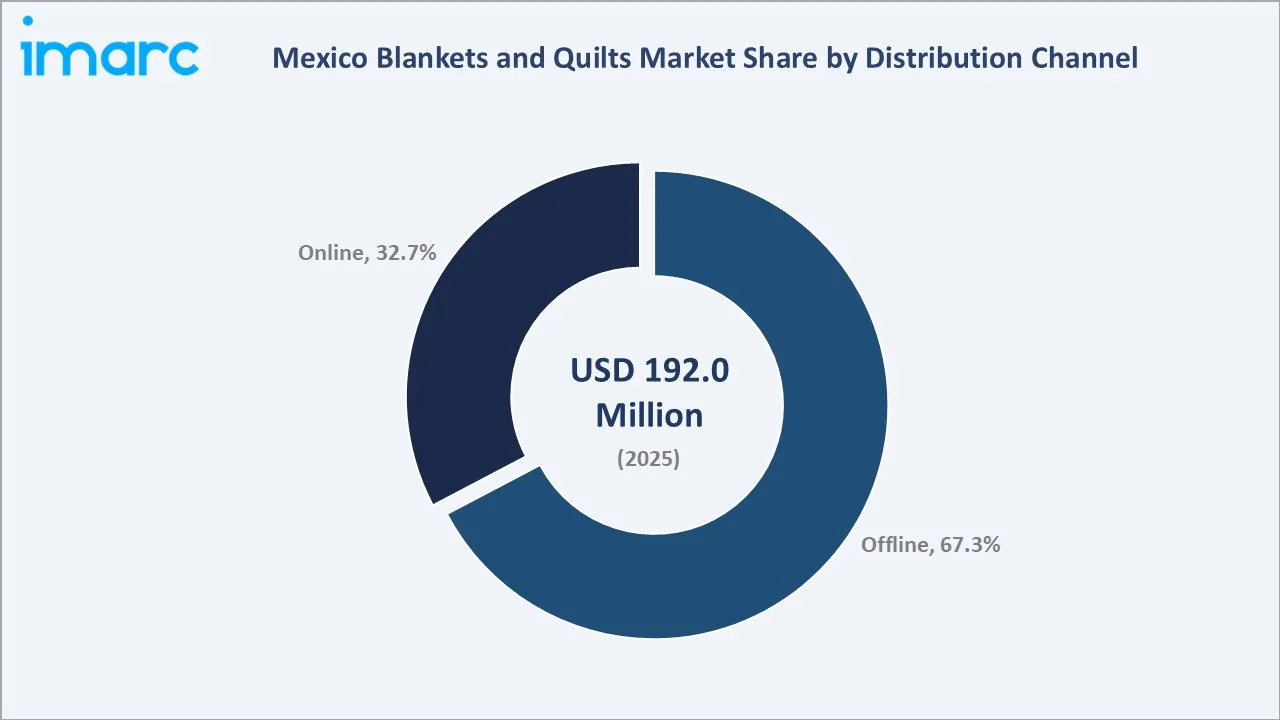
Online at 32.7% grows fastest at approximately 8.2% CAGR through e-commerce platform expansion, D2C brand growth, and increasing digital purchasing adoption. Growing internet penetration, mobile commerce adoption, and increasing consumer comfort with online textile purchasing are supporting rapid channel expansion.
Regional Market Insights
|
Region |
Share (2025) |
Key Drivers & Characteristics |
|
Central Mexico |
42.6% |
Mexico City metropolitan concentration, higher urban income, modern retail density, and strong household formation rates. |
|
Northern Mexico |
29.8% |
Industrial growth, cross-border commerce with the US, higher disposable incomes in border cities, and commercial hospitality demand. |
|
Southern Mexico |
17.4% |
Artisanal textile production heritage, growing tourism in Yucatan and Oaxaca, and rising mid-market household demand. |
|
Others |
10.2% |
Emerging consumption in smaller states, rural household demand, and increasing retail penetration in secondary cities. |
Central Mexico's 42.6% market leadership reflects Mexico City's role as the country's primary consumer market, concentration of major retail chains, and the region's higher average household income supporting stronger per-capita textile spending. Northern Mexico's 29.8% reflects industrial prosperity, cross-border commercial activity, and strong commercial bedding demand from the region's expanding hospitality sector.
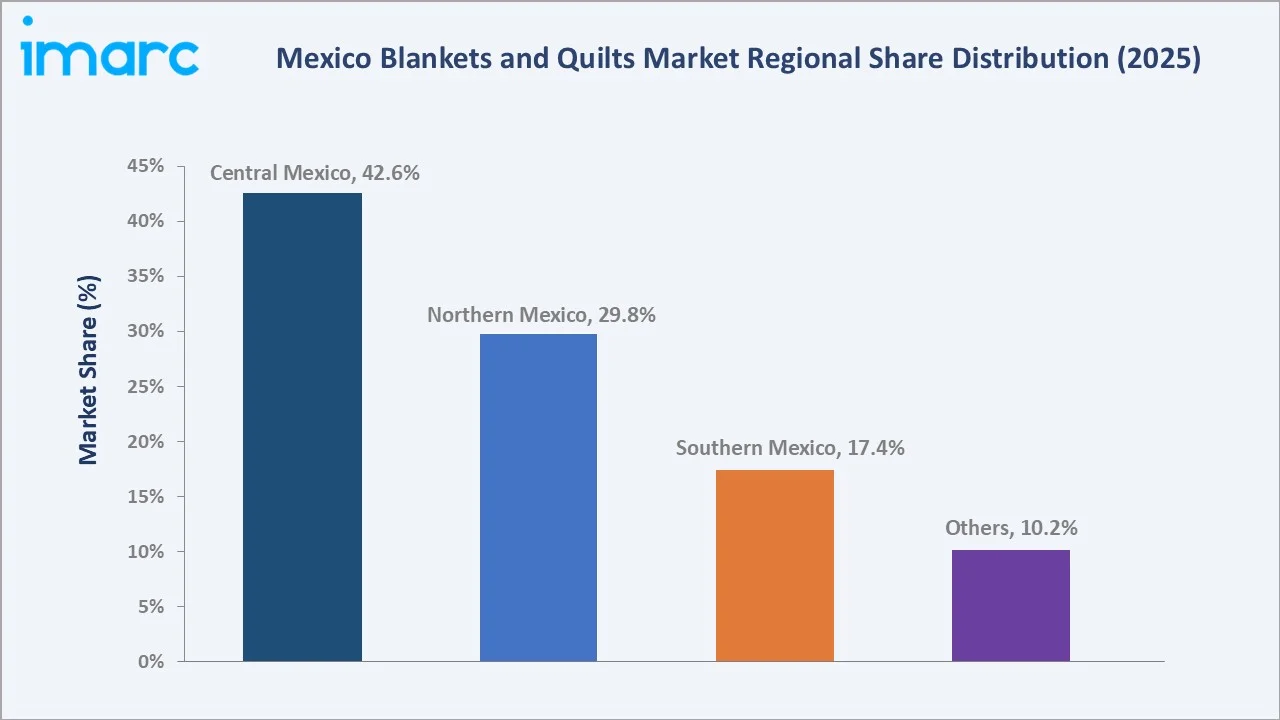
Southern Mexico's 17.4% reflects Oaxaca's and Chiapas's distinctive artisanal textile heritage, growing eco-tourism driving premium blanket demand, and Yucatan's expanding hotel sector. The Others category at 10.2% represents emerging consumption markets across smaller states, with growth driven by increasing retail penetration and rising household income levels creating first-time branded textile purchase demand.
Competitive Landscape
The Mexico blankets and quilts market competitive landscape reflects a combination of domestic manufacturers, international brands, and artisanal producers. Competition is intensifying due to growing e-commerce adoption, premiumization trends, and increased consumer awareness of product quality and sustainability.
|
Company |
Key Products |
Market Position |
Core Strength |
| Grupo Kaltex S.A. de C.V. | Blankets, quilts, home textiles, woven fabrics | Market Leader | Mexico's largest vertically integrated textile group with extensive domestic manufacturing and distribution capabilities. |
| American Textile Company | Tranquility, AllerEase | Innovator | Specializes in innovation-driven textile products including temperature-regulating and hypoallergenic bedding solutions. |
| WestPoint Home LLC | Blankets, quilts | Strong Challenger | Established brand with strong retail relationships and diverse product offerings across price tiers. |
| Berkshire Blanket & Home Co. | Soft-texture blankets, premium quilts | Innovator | Known for soft-texture and innovative fabric technologies in the premium blanket segment. |
| Pacific Coast Feather Company | Down quilts, feather-filled comforters | Niche Player | Specializes in premium down and feather-filled quilts and comforters for the luxury bedding segment. |
The competitive landscape's most commercially significant dynamic is the balance between domestic manufacturers, who benefit from proximity to local consumers and established retail relationships, and international brands offering premium product innovation and global sourcing capabilities. Artisanal producers represent a distinctive competitive segment targeting cultural and sustainability-conscious consumers.
Key Company Profiles
Grupo Kaltex S.A. de C.V.
Grupo Kaltex S.A. de C.V. is one of Mexico's largest textile manufacturing conglomerates and a leading player in the domestic blankets and home textiles market.
- Key Products: Blankets, quilts, home textiles, and woven fabrics across mass-market and mid-range price segments.
- Strategic Focus: Maintaining domestic market leadership through vertical integration, sustainable production investments, and expansion into premium and artisanal product categories.
American Textile Company
American Textile Company is a recognized innovator in the functional and premium home textile market, known for incorporating advanced fabric technologies in blankets and bedding products.
- Key Products: Temperature-regulating blankets, hypoallergenic quilts, and functional bedding products incorporating proprietary fabric technologies.
- Recent Developments: In August 2026, American Textile Company marked 32 years of partnership with El Salvador-based Confecciones del Valle, whose manufacturing operation now employs more than 350 people and produces millions of bedding products annually for major North American retailers, reinforcing ATC’s regional manufacturing and supply capabilities.
- Strategic Focus: Product innovation and functional differentiation targeting health-conscious and premium consumers in Mexico's urban markets.
Market Concentration Analysis
Mexico blankets and quilts market is moderately concentrated at the mass-market segment, with a mix of domestic manufacturers and international brands competing across price tiers. Grupo Kaltex S.A. de C.V. holds the strongest domestic manufacturing position, while international brands compete effectively in premium and design segments. The artisanal segment remains highly fragmented, comprising thousands of small-scale producers across traditional textile regions.
Market concentration is evolving through two dynamics: consolidation among larger domestic manufacturers seeking scale advantages through investment in modern production equipment, and fragmentation at the premium artisanal end driven by growing consumer demand for unique, culturally authentic products. E-commerce is accelerating both dynamics by lowering barriers to market entry for artisanal brands while enabling established players to reach wider consumer audiences.
Investment & Growth Opportunities
Highest Growth Segments
Online distribution channel (~8.2% CAGR through e-commerce expansion), Household application segment (~6.5% CAGR through residential growth), and Commercial application segment (~5.6% CAGR through hospitality sector expansion), represent Mexico's highest-growth investment vectors through 2034.
Emerging Investment Opportunities
Mexico's artisanal and eco-certified blanket market, growing at an estimated 10-12% annually, represents one of the highest-CAGR niche segments. The premium artisanal segment's growth is driven by domestic premiumization, international tourist demand, and growing export interest in culturally distinctive Mexican textile products.
Investment Themes
- E-commerce platform investment and D2C brand development for the Online distribution channel's fastest-growing segment: Mexico's growing digital consumer base and improving logistics infrastructure create significant investment opportunities in online-first blanket and quilt brands.
- Artisanal textile cluster development and fair-trade certification for premium export market access: Investment in artisanal production capacity, quality certification, and international market development offers access to premium pricing and cultural authenticity premiums in both domestic and export markets.
Future Market Outlook (2026-2034)
The Mexico blankets and quilts market is projected to grow from USD 192.0 Million in 2025 to USD 203.8 Million in 2026, reaching USD 336.3 Million by 2034, registering a CAGR of 6.17% during 2026-2034.
The market's anchor value of USD 259.0 Million in 2030 represents the Mexico blankets and quilts industry at a structural inflection point where e-commerce channels become a primary distribution pathway, artisanal premium segment gains significant consumer recognition, and commercial hospitality demand reaches structural significance within the market.
Three structural forces define Mexico blankets and quilts market growth through 2034: Mexico's urbanization and household income growth creating sustained household consumption demand; the country's expanding hospitality sector creating growing commercial demand; and digital commerce maturation creating geographic market democratization across previously underserved regional markets within the broader mexico textile fabrics market.
Research Methodology
Primary Research
Primary research comprised structured interviews with Mexico blankets and quilts market stakeholders, including retail directors, brand managers, textile manufacturers, e-commerce category managers, and consumer survey data from blanket and quilt buyers across Central, Northern, and Southern Mexico.
Secondary Research
Secondary research encompassed Mexico textile industry trade data, company annual reports, import-export statistics, market research publications, hospitality industry reports, and consumer spending data. Over 45 secondary sources were reviewed across the mexico textile fabrics market research process.
Forecasting Models
Market revenue forecasts were developed using a household formation and income-based consumer demand model: Mexico's urban population by income segment multiplied by home textile purchase frequency and average transaction value per segment, creating total market revenue estimates by segment and region aggregation.
Mexico Blankets and Quilts Market Report Coverage:
| Report Features | Details |
|---|---|
| Base Year of the Analysis | 2025 |
| Historical Period | 2020-2025 |
| Forecast Period | 2026-2034 |
| Units | Million USD |
| Scope of the Report |
Exploration of Historical Trends and Market Outlook, Industry Catalysts and Challenges, Segment-Wise Historical and Future Market Assessment:
|
| Product Types Covered |
|
| Materials Covered | Natural Fibers, Synthetic Fibers, Blended Fabrics |
| Applications Covered | Household, Commercial |
| Distribution Channels Covered | Online, Offline |
| Regions Covered | Northern Mexico, Central Mexico, Southern Mexico, Others |
| Companies Covered | Grupo Kaltex S.A. de C.V., American Textile Company, WestPoint Home LLC, Berkshire Blanket & Home Co., Pacific Coast Feather Company, etc. |
| Customization Scope | 10% Free Customization |
| Post-Sale Analyst Support | 10-12 Weeks |
| Delivery Format | PDF and Excel through Email (We can also provide the editable version of the report in PPT/Word format on special request) |
Key Benefits for Stakeholders:
- IMARC’s industry report offers a comprehensive quantitative analysis of various market segments, historical and current market trends, market forecasts, and dynamics of the Mexico blankets and quilts market from 2020-2034.
- The research report provides the latest information on the market drivers, challenges, and opportunities in the Mexico blankets and quilts market.
- Porter's five forces analysis assist stakeholders in assessing the impact of new entrants, competitive rivalry, supplier power, buyer power, and the threat of substitution. It helps stakeholders to analyze the level of competition within the Mexico blankets and quilts industry and its attractiveness.
- Competitive landscape allows stakeholders to understand their competitive environment and provides an insight into the current positions of key players in the market.
Frequently Asked Questions About the Mexico Blankets and Quilts Market Report
Mexico blankets and quilts market size is estimated at USD 203.8 Million in 2026, driven by rising urbanization, expanding commercial hospitality demand, and growing e-commerce penetration across the mexico textile fabrics market. Growing middle-class consumer base and premiumization of home textiles further support market expansion.
Mexico blankets and quilts market grows at 6.17% CAGR during 2026-2034, reaching USD 336.3 Million by 2034. Overall growth is sustained by urbanization, household income growth, commercial hospitality expansion, and rapid digital commerce adoption enabling geographic market democratization.
Household leads at 72.4% through Mexico's large residential consumer base, steady household formation rates, and rising consumer preference for quality home textiles across all income levels.
Offline leads at 67.3% through Mexico's established retail network including department stores, specialty retailers, and supermarket chains offering widespread product availability. The Online channel is the fastest-growing segment at approximately 8.2% CAGR.
Central Mexico leads at 42.6% through Mexico City's large consumer market, higher average household income, concentration of modern retail infrastructure, and strong household formation driving consistent home textile demand.
Leading companies include Grupo Kaltex S.A. de C.V., American Textile Company, WestPoint Home LLC, Berkshire Blanket & Home Co., and Pacific Coast Feather Company, among others.
Mexico blankets and quilts market is projected to reach approximately USD 259.0 Million by 2030, with the household segment maintaining dominance, online distribution growing as digital commerce becomes the primary channel for urban consumers, and artisanal premium product demand gaining structural significance.
Three priority investment opportunities: e-commerce and D2C brand development capturing the fastest-growing distribution channel, artisanal and eco-certified textile investment addressing the premium consumer segment, and commercial hospitality sector partnerships providing stable long-term revenue streams for blanket and quilt suppliers.
Need more help?
- Speak to our experienced analysts for insights on the current market scenarios.
- Include additional segments and countries to customize the report as per your requirement.
- Gain an unparalleled competitive advantage in your domain by understanding how to utilize the report and positively impacting your operations and revenue.
- For further assistance, please connect with our analysts.
 Request Customization
 Speak to an Analyst
 Request Brochure
 Inquire Before Buying
Benefits of Customization
- Personalize this research
- Triangulate with your data
- Get data as per your format and definition
- Gain a deeper dive into a specific application, geography, customer, or competitor
- Any level of personalization
Get in Touch With Us
UNITED STATES
Phone: +1-201-971-6302
INDIA
Phone: +91-120-433-0800
UNITED KINGDOM
Phone: +44-753-714-6104
Email: [email protected]
Client Testimonials

.webp)



.webp)





Related Reports

Choose your plan
*Please note that the prices mentioned below are starting prices for each bundle type. Kindly contact our team for further details.*
Single User License
- 1 User License, Access on 2 Devices
- PDF Report + Excel Dataset (Password Protected)
- Lifetime Access
- No Printing Rights
- 10% Free Report Customization
- 10–12 Weeks of Analyst Support
Five User License
- Access for 5 Users, 2 Devices per User
- PDF Report + Excel Dataset (Password Protected)
- Lifetime Access
- Dedicated Account Manager
- 12–14 Weeks of Analyst Support
- No Printing Rights
- 15% Free Report Customization
- 25% Discount on Your Next Purchase
Corporate User License
- Unlimited User Access (Within Your Organization)
- PDF Report + Excel Dataset
- Lifetime Access
- Dedicated Account Manager
- 14–20 Weeks of Analyst Support
- No Printing Rights
- 20% Free Report Customization
- 30% Discount on Your Next Purchase
Essential Insights
What's included:
3 reports
- Lifetime Access
- PDF Reports
- Excel Datasets
- 2 Weeks of Free Analyst Support
- 2 User Licenses
- Access on 2 Devices
- Printing Rights
- Complimentary PowerPoint (PPT) Version
- Complimentary License Upgrade
Professional Access
What's included:
5 reports
- Lifetime Access
- PDF Reports
- Excel Datasets
- 8 Weeks of Free Analyst Support
- 2 User Licenses
- Access on 2 Devices
- Printing Rights
- Complimentary PowerPoint (PPT) Version
- Complimentary License Upgrade
Business Advantage
What's included:
8 reports
- Lifetime Access
- PDF Reports
- Excel Datasets
- 14 Weeks of Free Analyst Support
- 2 User Licenses
- Access on 2 Devices
- Printing Rights
- Complimentary PowerPoint (PPT) Version
- Complimentary License Upgrade
Enterprise Intelligence
What's included:
10 reports
- Lifetime Access
- PDF Reports
- Excel Datasets
- 20 Weeks of Free Analyst Support
- 2 User Licenses
- Access on 2 Devices
- Printing Rights
- Complimentary PowerPoint (PPT) Version
- Complimentary License Upgrade