
Mexico Buy Now Pay Later Market Size, Share, Trends and Forecast by Channel, Enterprise Size, End Use, and Region, 2026-2034
Mexico Buy Now Pay Later Market Size, Share, Trends & Forecast (2026-2034)
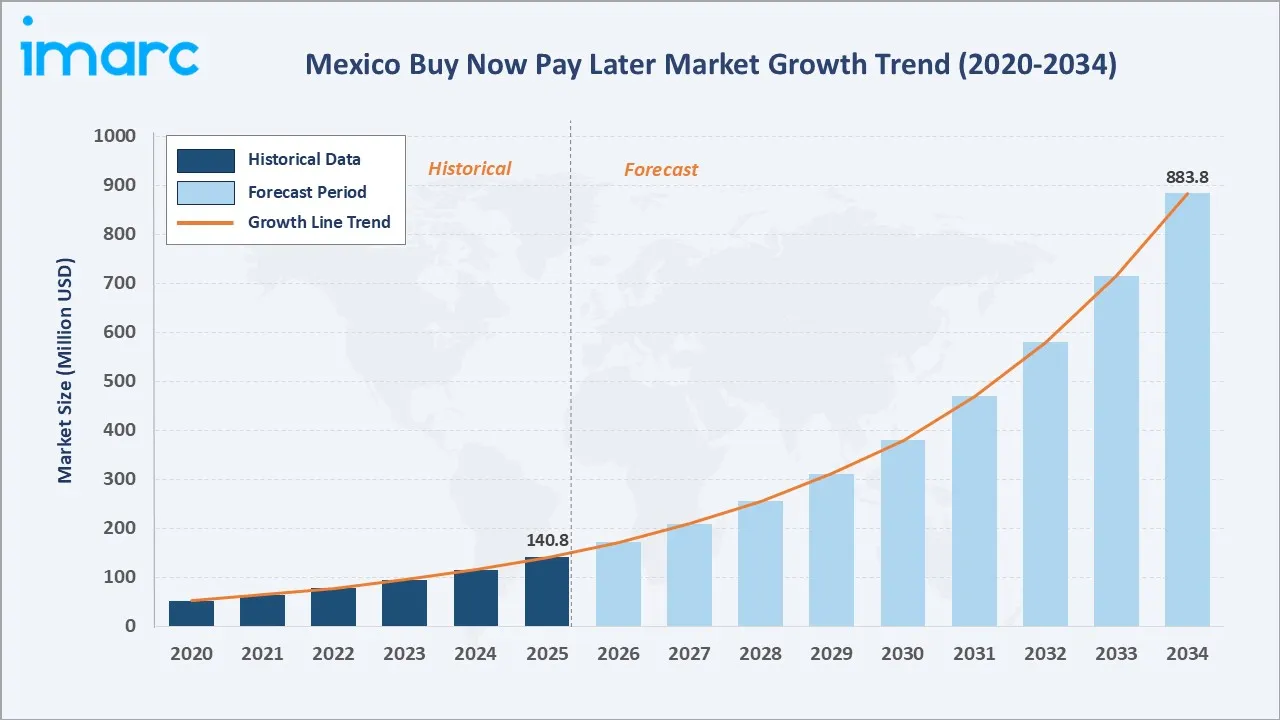
The Mexico buy now pay later market reached USD 140.8 Million in 2025 and is estimated at USD 171.7 Million in 2026. It is projected to reach USD 883.8 Million by 2034, growing at a CAGR of 21.96% during 2026-2034, supported by rapid e-commerce growth and low credit card penetration.
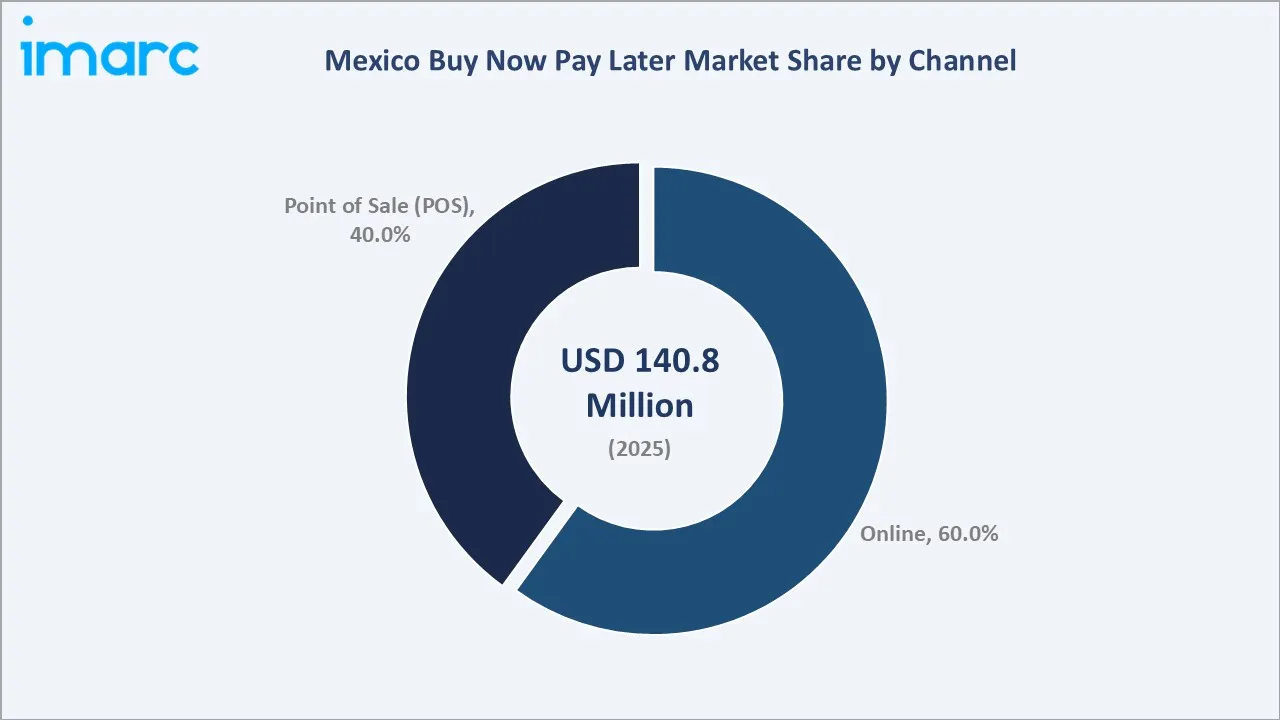
Rising smartphone adoption, merchant demand for higher checkout conversion, and growing acceptance of card-free installment payments are further supporting market growth. Online leads channels at 60.0%. Large enterprises lead enterprise size at 55.0%. Central Mexico commands 50.0% of the national market share.
Market Snapshot
|
Metric |
Value |
|
Base Year Market Size (2025) |
USD 140.8 Million |
|
Market Size (2026) |
USD 171.7 Million |
|
Forecast Market Size (2034) |
USD 883.8 Million |
|
CAGR (2026-2034) |
21.96% |
|
Base Year |
2025 |
|
Historical Period |
2020-2025 |
|
Forecast Period |
2026-2034 |
|
Dominant Channel |
Online (60.0%, 2025) |
|
Dominant Enterprise Size |
Large Enterprises (55.0%, 2025) |
|
Leading Region |
Central Mexico (50.0%, 2025) |
The Mexico buy now pay later market size increased from USD 52.2 Million in 2020 to USD 140.8 Million in 2025 and is estimated to reach USD 171.7 Million in 2026. The market is further expected to grow to USD 379.9 Million by 2030 and USD 883.8 Million by 2034.
To get more information on this market, Request Sample
The Mexico buy now pay later market combines a large underbanked population, fast-growing online retail, and a competitive fintech ecosystem. Domestic BNPL specialists, marketplace lenders, and super-app providers are embedding installment payments across online stores, supermarkets, travel platforms, and physical retail checkouts.
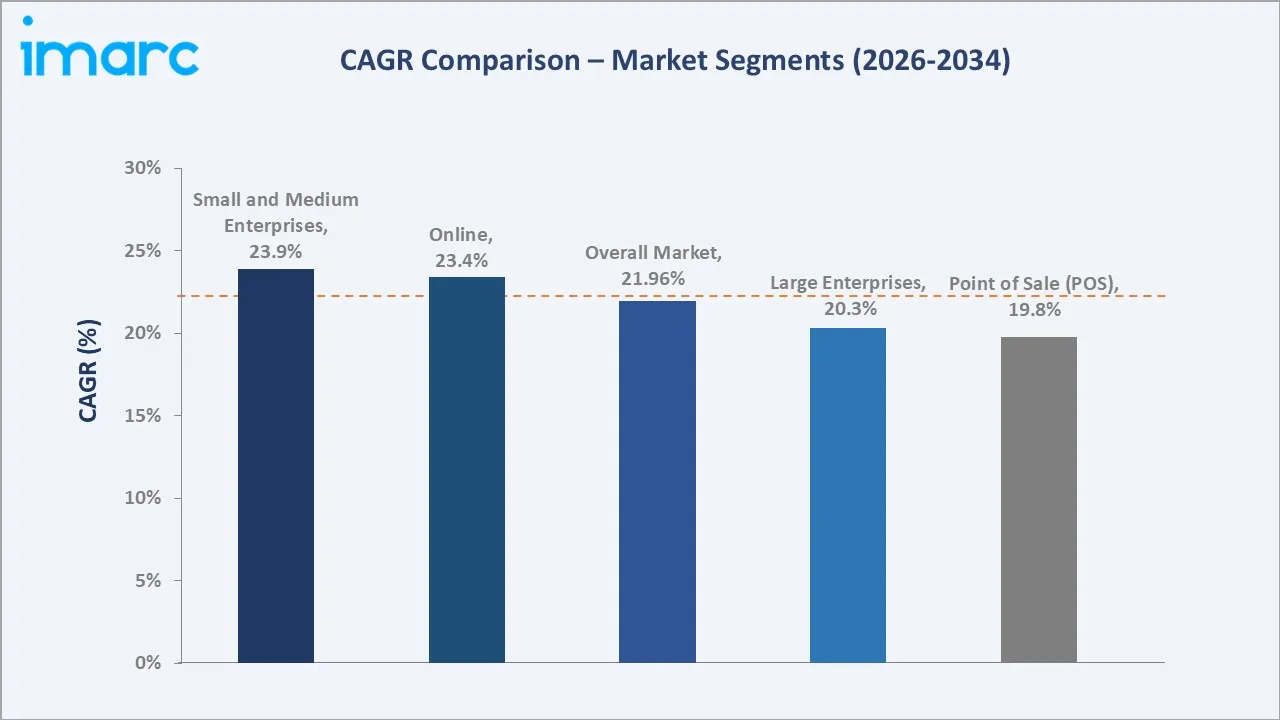
Small and medium enterprises grow fastest at ~23.9% CAGR as plug-in BNPL integrations through e-commerce platforms lower adoption barriers. The online channel advances at ~23.4% CAGR through marketplace expansion, while large enterprises grow at ~20.3% CAGR by extending installment options across omnichannel retail networks.
The point of sale (POS) channel grows at ~19.8% CAGR, supported by QR-based and app-based in-store checkout at supermarkets, department stores, and specialty retailers. In-store BNPL is gaining traction as consumers seek fortnightly payment flexibility for everyday purchases beyond online shopping.
Executive Summary
The Mexico buy now pay later market expanded from USD 140.8 Million in 2025 to an estimated USD 171.7 Million in 2026, reflecting strong demand for card-free installment payments. BNPL has shifted from a niche online payment option to a mainstream financing tool for millions of Mexican consumers.
Market growth is underpinned by limited access to formal credit, a young digital-native population, rising smartphone use, and rapid e-commerce adoption. Consumers value instant approval, transparent fortnightly installments, and the ability to make purchases without a credit card, while merchants benefit from higher conversion rates.
The market is projected to reach USD 883.8 Million by 2034. Online at 60.0% leads through marketplace and e-commerce checkout integration. Large enterprises at 55.0% reflect partnerships with major retailers and platforms. Central Mexico leads regionally at 50.0%.
Key Market Insights
|
Insight |
Data |
|
Dominant Channel |
Online - 60.0% share (2025) |
|
Dominant Enterprise Size |
Large Enterprises - 55.0% market share (2025) |
|
Leading Region |
Central Mexico - 50.0% share (2025) |
|
Market Opportunity |
In-store BNPL at supermarkets and department stores; plug-in BNPL for SME merchants; super-app embedded financing; BNPL for travel, healthcare, and education payments |
Key Analytical Observations Supporting the Above Data:
- Online at 60.0%: The online channel dominates as BNPL options are deeply integrated into marketplaces, retailer websites, and travel platforms. Seamless digital onboarding, instant credit decisions, and fortnightly payment plans at checkout make online BNPL the preferred choice for digitally active Mexican consumers.
- Large Enterprises at 55.0%: Large enterprises dominate as major marketplaces, supermarket chains, department stores, and airlines integrate BNPL across national online and in-store channels. Their high transaction volumes, broad customer bases, and promotional campaigns during sales events strengthen BNPL adoption at scale.
- Central Mexico at 50.0%: Central Mexico dominates regionally due to the dense population of Mexico City, the State of Mexico, Puebla, and Querétaro. Higher internet penetration, concentrated retail and e-commerce activity, and a large base of young urban consumers sustain strong BNPL usage in the region.
Mexico Buy Now Pay Later Market Overview
The Mexico buy now pay later market sits at the intersection of financial inclusion, digital commerce, and evolving consumer credit preferences. BNPL solutions allow shoppers to split purchases into fortnightly or monthly installments, often without a credit card, while merchants gain higher conversion rates and larger average baskets.
Consumer usage spans fashion, electronics, travel, groceries, and services, with fortnightly repayment schedules aligned to common salary cycles in Mexico. This alignment with household cash flow makes BNPL particularly attractive for budget-conscious shoppers managing purchases between paydays.
Mexico's BNPL ecosystem integrates domestic fintech lenders, marketplace credit providers, super-app platforms, international payment companies, merchants, and funding partners. Macroeconomic factors include a large underbanked population, expanding smartphone access, growing e-commerce penetration, and increasing comfort with digital financial services.
BNPL providers operate under a regulatory framework that includes SOFOM entities, fintech regulations, and consumer protection oversight. This structure supports responsible lending practices, while partnerships with banks and credit funds provide the capital needed to scale installment financing across online and physical retail channels.
Market Dynamics
To evaluate market opportunities, Request Sample
Market Drivers
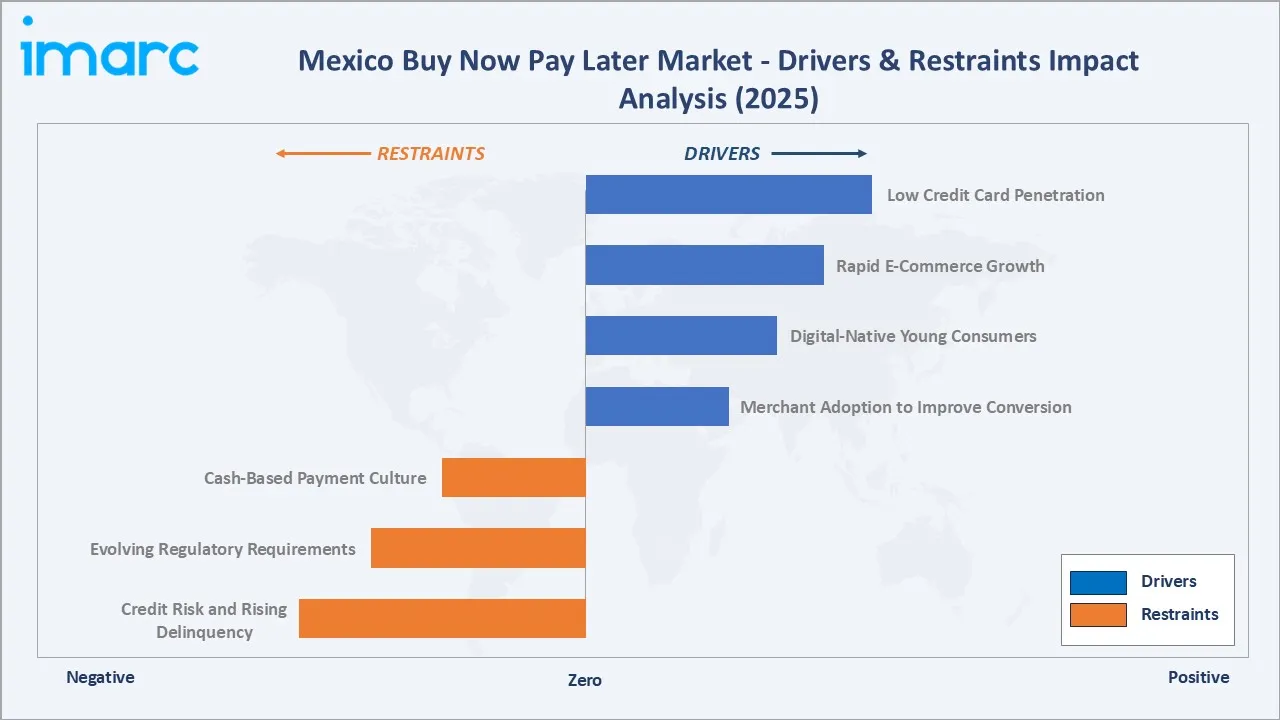
- Low Credit Card Penetration and Financial Inclusion Needs: A large share of Mexican adults lack access to credit cards or formal credit. BNPL fills this gap by offering card-free installment payments with simple digital onboarding, giving underbanked consumers a convenient alternative for purchasing goods and services.
- Rapid E-Commerce Growth: The expansion of online marketplaces, retailer websites, and mobile shopping is driving demand for flexible checkout options. BNPL integrations help consumers manage larger purchases, while seasonal sales events and promotional campaigns encourage first-time users to try installment payments.
- Digital-Native Young Consumers and Smartphone Adoption: Millennials and Gen Z shoppers increasingly prefer app-based, transparent payment solutions over traditional credit. High smartphone usage and comfort with mobile banking support adoption of BNPL apps that offer instant approval, spending visibility, and fortnightly repayment schedules.
- Merchant Adoption to Improve Conversion: Retailers and service providers are adopting BNPL to reduce cart abandonment, increase average order value, and attract new customer segments. Simple integrations with e-commerce platforms and payment gateways allow merchants of all sizes to offer installment payments quickly.
Market Restraints
- Credit Risk and Rising Delinquency: BNPL providers serve many thin-file and first-time borrowers, which increases exposure to late payments and defaults. Economic pressures on household budgets can affect repayment behavior, requiring providers to strengthen underwriting, credit limits, and collection practices.
- Evolving Regulatory and Consumer Protection Requirements: Growing attention to transparency, interest disclosure, and responsible lending is increasing compliance obligations for BNPL providers. Adapting to changing rules on credit reporting, data protection, and consumer rights can raise operating costs and slow product rollouts.
- Cash-Based Payment Culture and Limited Digital Literacy: Cash remains widely used in Mexico, especially in rural and semi-urban areas. Limited digital literacy, low trust in online credit, and uneven internet access restrict BNPL adoption among segments of the population that could benefit most.
Market Opportunities
- Expansion into Everyday and Essential Spending: BNPL is moving beyond fashion and electronics into groceries, healthcare, education, and travel. Integrating installment payments into recurring and essential purchases can broaden user bases, increase transaction frequency, and build long-term customer relationships for providers.
- SME Merchant Integration Through Platforms: Small and medium merchants represent a large untapped base for BNPL adoption. Plug-in integrations with e-commerce platforms, payment gateways, and point-of-sale terminals allow SMEs to offer installment payments easily, helping them compete with larger retailers.
Market Challenges
- Fraud Prevention and Identity Verification: Rapid digital onboarding increases exposure to identity fraud, synthetic profiles, and account takeovers. Providers must invest in biometric verification, device intelligence, and real-time fraud detection while maintaining fast approvals and a smooth customer experience.
- Funding Access and Cost of Capital: BNPL providers rely on bank credit lines, debt funds, and institutional partners to finance receivables. Changes in interest rates and funding conditions can affect pricing and expansion plans, making diversified funding sources important for sustained growth.
Emerging Market Trends
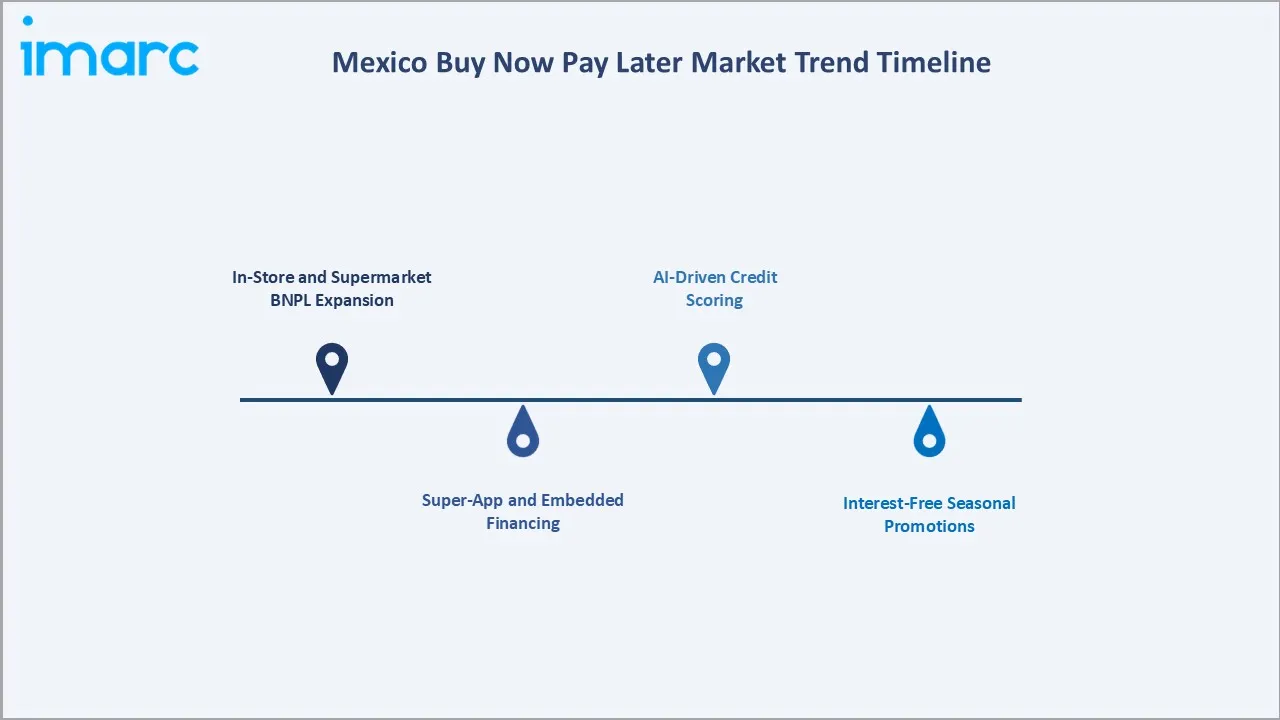
1. In-Store and Supermarket BNPL Expansion
BNPL is expanding from online checkouts into physical stores, supermarkets, and department stores through QR codes and mobile apps. Consumers can now split everyday purchases into fortnightly payments at the cashier, bringing installment financing into recurring household spending and strengthening omnichannel retail strategies.
2. Super-App and Embedded Financing Integration
Super-apps, marketplaces, and digital wallets are embedding BNPL directly into their platforms. Embedded financing allows users to access credit within apps they already use for shopping, mobility, and payments, increasing convenience and helping providers reach large user bases quickly.
3. AI-Driven Credit Scoring with Alternative Data
Providers are using artificial intelligence and alternative data, such as transaction history, device data, and repayment behavior, to assess creditworthiness. This approach enables instant decisions for thin-file consumers, supports dynamic credit limits, and helps manage risk as user bases expand.
4. Interest-Free Promotions and Seasonal Sales Campaigns
BNPL providers and merchants increasingly collaborate on interest-free installment promotions during major sales events and holiday seasons. These campaigns attract first-time users, raise purchase values, and position BNPL as a mainstream payment method alongside cards and digital wallets.
Industry Value Chain Analysis
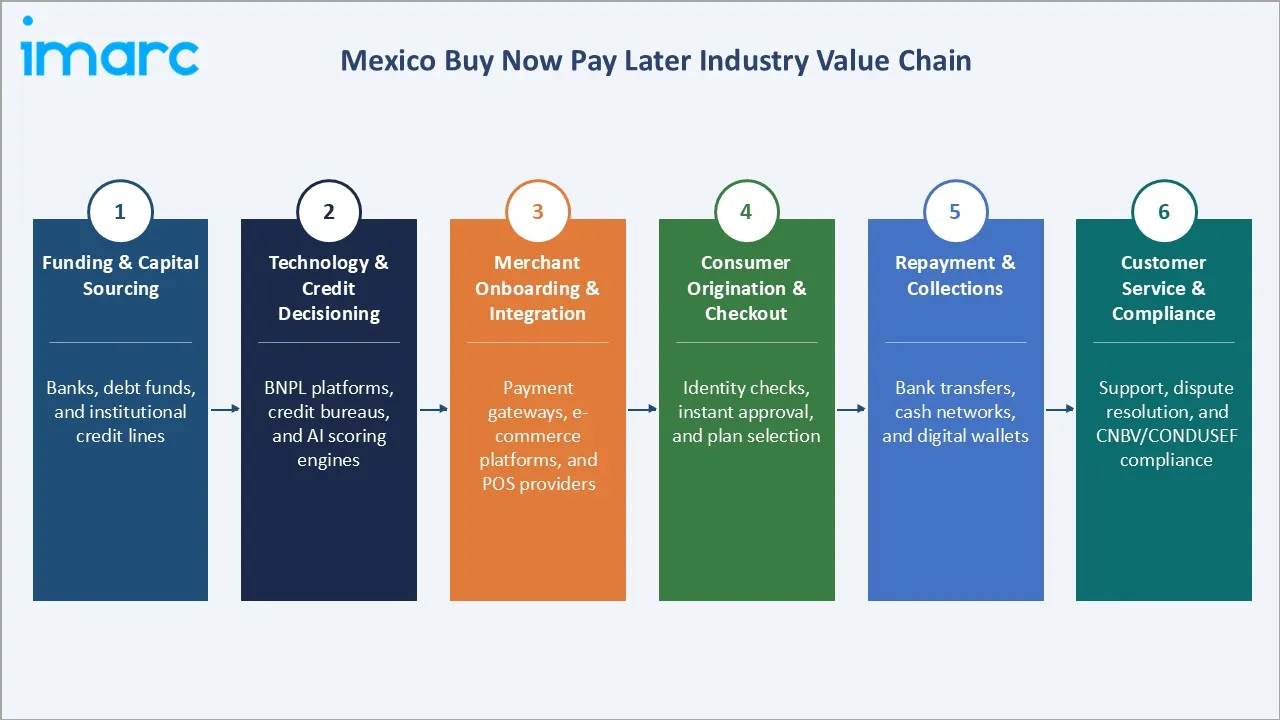
The Mexico buy now pay later value chain spans funding and capital sourcing, technology and credit decisioning, merchant onboarding, consumer origination, repayment, and compliance. Each stage requires close coordination between fintech providers, merchants, funding partners, and payment networks to deliver fast, reliable installment financing.
|
Stage |
Key Participants |
|
Funding & Capital Sourcing |
Banks, debt funds, venture lenders, and institutional investors providing credit lines to finance receivables |
|
Technology & Credit Decisioning |
BNPL platforms, credit bureaus, data providers, and AI scoring engines assessing risk in real time |
|
Merchant Onboarding & Integration |
Payment gateways, e-commerce platforms, and POS providers enabling BNPL at online and in-store checkouts |
|
Consumer Origination & Checkout |
BNPL apps and merchant checkouts handling identity verification, approval, and installment plan selection |
|
Repayment & Collections |
Bank transfers, cash payment networks, digital wallets, and collection teams managing installment repayments |
|
Customer Service & Compliance |
Support centers, dispute resolution teams, and compliance functions ensuring regulatory and consumer protection standards |
Technology and credit decisioning is the most consequential stage, as approval speed, risk accuracy, and fraud control determine both customer experience and portfolio quality. Merchant integration adds significant value by expanding acceptance points, while repayment and collections infrastructure shapes credit performance and long-term sustainability.
Funding partnerships also play a decisive role, as access to stable, diversified credit lines determines how quickly providers can scale approvals. Close coordination with payment networks and cash payment points further supports repayment convenience for consumers who still rely on cash in daily transactions.
Technology Landscape in the Mexico Buy Now Pay Later Industry
AI and Alternative Data Credit Scoring
Machine learning models analyze alternative data, including transaction patterns, device signals, and repayment history, to approve customers without traditional credit histories. These models enable instant decisions, personalized credit limits, and continuous risk monitoring, helping providers serve underbanked consumers responsibly while controlling delinquency levels.
Payment Integration, APIs and QR-Based In-Store Checkout
Open APIs, plug-ins, and software development kits allow BNPL providers to integrate quickly with e-commerce platforms and payment gateways. QR-based and app-based checkout solutions extend installment payments to physical stores, while real-time settlement systems support fast merchant payouts and smooth customer experiences.
Digital Identity, Fraud Prevention and Open Finance
Biometric verification, facial recognition, and device intelligence secure digital onboarding and reduce identity fraud. Open finance frameworks and secure data-sharing standards are expected to improve credit assessments, while encrypted payment infrastructure and real-time fraud analytics protect consumers and providers across digital channels.
Market Segmentation Analysis
The report covers the following segments:
|
Segment Category |
Leading Segment |
Market Share |
Year |
|
Channel |
Online |
60.0% |
2025 |
|
Enterprise Size |
Large Enterprises |
55.0% |
2025 |
|
End Use |
🔒 |
🔒 |
2025 |
|
Region |
Central Mexico |
50.0% |
2025 |

By Channel
Online leads at 60.0% (2025). The segment benefits from BNPL integration across marketplaces, retailer websites, airline platforms, and mobile shopping apps. Instant digital approval, transparent installment plans, and promotional campaigns during major sales events make online BNPL the most widely used channel.
To access detailed market analysis, Request Sample
Point of sale (POS) holds 40.0% and is growing as BNPL providers expand into supermarkets, department stores, and specialty retailers. QR-based and app-based in-store checkout allows customers to split purchases into fortnightly payments at the cashier without needing a credit card.
Channel preferences vary by purchase type and consumer profile. Digitally active younger shoppers favor online BNPL for fashion, electronics, and travel, while in-store BNPL increasingly serves families making recurring household purchases, supporting a more balanced channel mix over the forecast period.
By Enterprise Size
Large enterprises lead at 55.0% (2025). Major marketplaces, supermarket chains, department stores, and airlines integrate BNPL across national online and physical channels. Their high transaction volumes, established customer bases, and co-marketing campaigns with providers drive large-scale BNPL adoption.
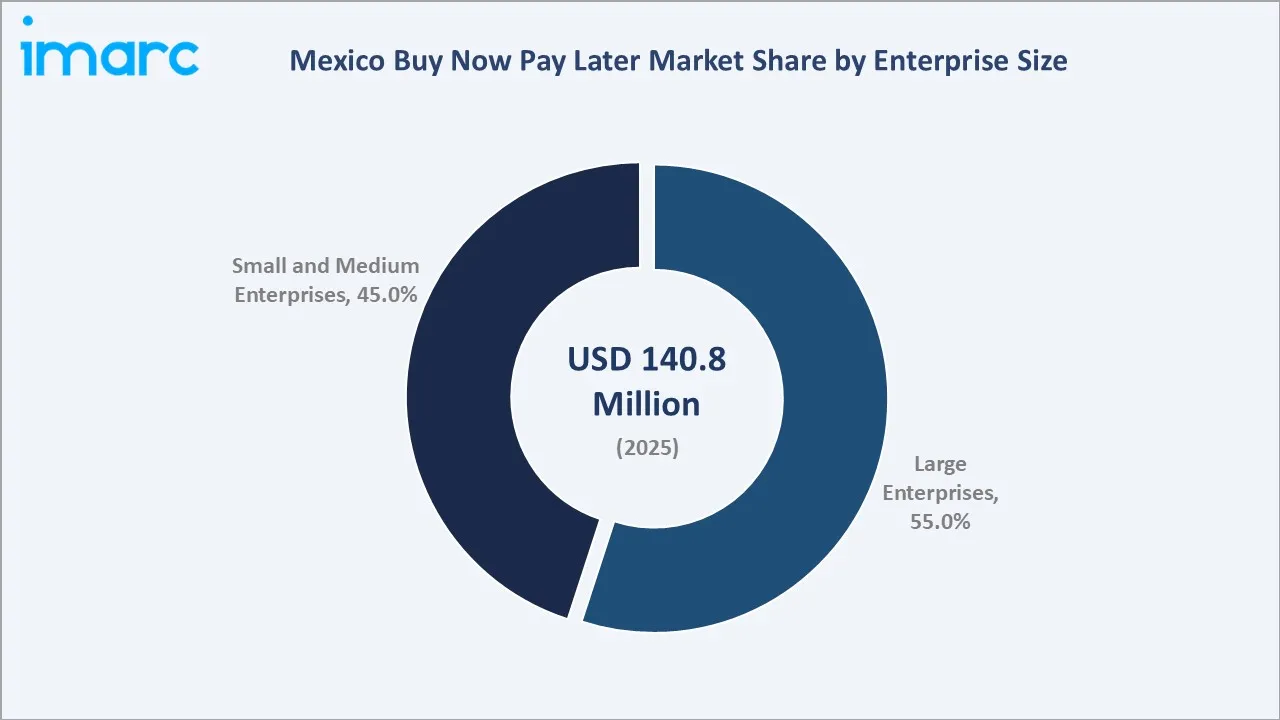
Small and medium enterprises hold 45.0% and grow fastest at ~23.9% CAGR. Plug-in BNPL integrations through e-commerce platforms, payment gateways, and POS terminals let SMEs offer installment payments with minimal setup, helping them increase conversion and compete with larger retailers.
Platform-based distribution is reshaping enterprise-level adoption, as e-commerce builders and payment providers increasingly bundle BNPL options for their merchant networks. This lowers integration barriers, accelerates SME onboarding, and extends installment payments to independent stores across Mexico.
Regional Market Insights
|
Region |
Share (2025) |
Key Mexico Buy Now Pay Later Market Drivers & Characteristics |
|
Central Mexico |
50.0% |
Driven by the dense populations of Mexico City, the State of Mexico, Puebla, and Querétaro, and concentrated e-commerce activity. |
|
Northern Mexico |
30.0% |
Supported by higher incomes in Monterrey, Tijuana, and Chihuahua, strong digital adoption, and close links with US e-commerce trends. |
|
Southern Mexico |
15.0% |
Gradual growth supported by rising smartphone use, expanding retail chains, and improving internet access in Mérida and Cancún. |
|
Others |
5.0% |
Smaller urban centers where digital wallets and in-store BNPL are expanding access to installment payments. |
Central Mexico's 50.0% market leadership reflects the Mexico City metropolitan area's large consumer base, the highest concentration of online shoppers and retail chains, and strong fintech presence. Northern Mexico's 30.0% reflects industrial prosperity, higher purchasing power, and early adoption of digital payment solutions.
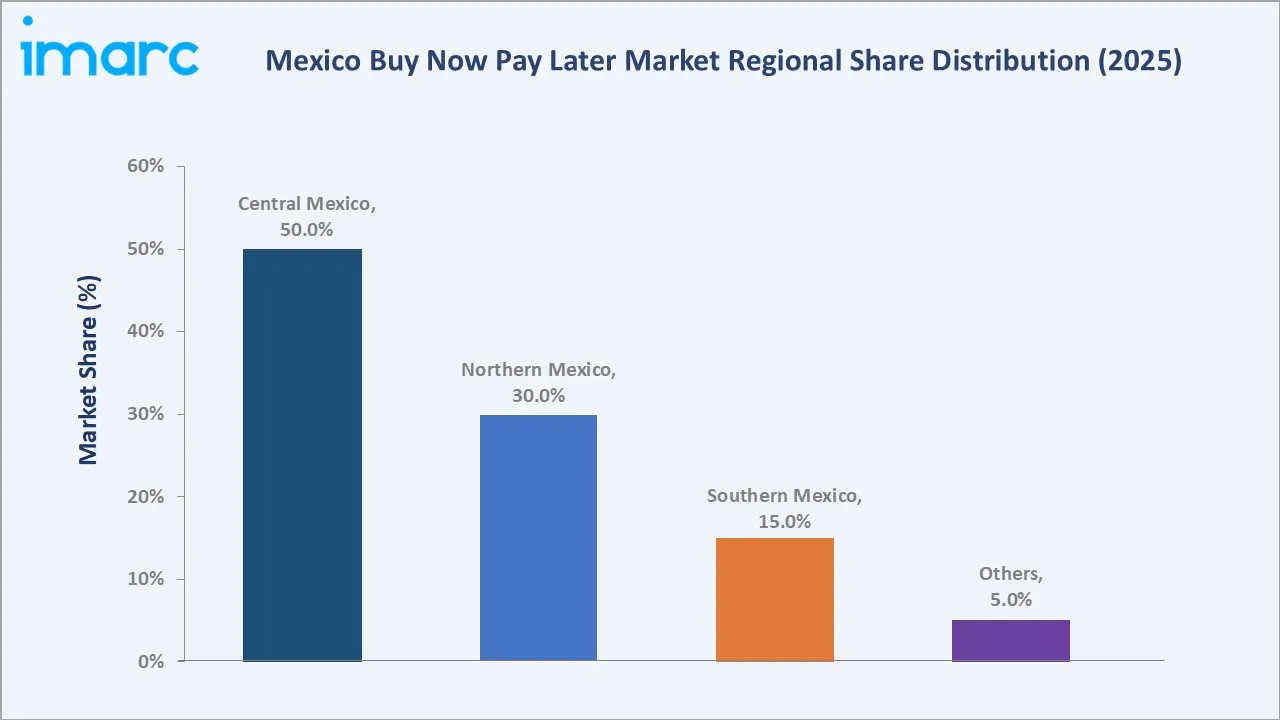
Southern Mexico's 15.0% share is growing as smartphone penetration, retail expansion, and tourism-led commerce create demand for flexible payments. Others, at 5.0%, represent emerging markets where digital wallets, in-store BNPL, and improving connectivity are gradually widening access to installment financing.
Regional adoption is also shaped by banking infrastructure and payment habits. Areas with lower bank branch density and higher cash usage show strong potential for app-based BNPL, while metropolitan regions lead in online usage, larger transaction values, and multi-provider competition.
Competitive Landscape
The Mexico buy now pay later market competitive landscape is moderately concentrated, combining domestic BNPL specialists, marketplace credit providers, super-app platforms, and international payment companies. Competition is intensifying through merchant partnerships, in-store expansion, AI-based underwriting, and promotional interest-free installment campaigns.
|
Company |
Key Brands |
Market Position |
Core Strength |
| Kueski | Kueski Pay, Kueski Cash | Market Leader | Leading BNPL provider with wide merchant reach across online and in-store checkouts. |
| MercadoLibre, Inc. | Mercado Pago, Meses sin Tarjeta | Market Leader | Marketplace-embedded card-free installments backed by a large digital user base. |
| APLAZO | APLAZO | Market Leader | Fortnightly BNPL with strong retail partnerships and in-store checkout capabilities. |
| DiDi Global Inc. | DiDi Paga Después, DiDi Card | Strong Challenger | Super-app BNPL integrated with mobility, delivery, and merchant partners. |
| Klarna Bank AB | Klarna | Innovator | Global BNPL leader offering flexible installment and pay-later options online. |
| Atrato | Atrato Pago | Innovator | Long-term consumer credit for online and in-store retail purchases. |
| Nelo Mobile S.A. de C.V. | Nelo | Niche Player | App-based BNPL focused on young, digitally active Mexican shoppers. |
The competitive landscape's most significant dynamic is the race for merchant distribution. Providers compete to integrate with marketplaces, supermarkets, airlines, and e-commerce platforms, while differentiating on approval speed, repayment flexibility, credit limits, and in-app shopping experiences that encourage repeat usage.
Strategic priorities across leading participants include expanding in-store acceptance, deepening partnerships with major retailers, strengthening AI-based risk models, launching interest-free promotional plans, and building broader financial ecosystems that combine BNPL with personal loans, digital wallets, and cards.
Key Company Profiles
Kueski
Kueski is a leading Mexican fintech company offering buy now pay later and digital credit solutions. Its Kueski Pay service lets consumers split purchases into fortnightly installments without a credit card across a wide network of online and physical merchants.
- Key Brands: Kueski Pay, Kueski Cash, among others.
- Recent Developments: In April 2026, Kueski partnered with Grupo Comercial Chedraui to integrate Kueski Pay into the supermarket chain’s national online store. The alliance lets customers split everyday grocery purchases into fortnightly installments without needing a credit or debit card.
- Strategic Focus: Extending fortnightly BNPL into recurring and essential spending categories through retail partnerships and omnichannel checkout integrations.
APLAZO
APLAZO is a Mexican buy now pay later platform enabling consumers to pay for online and in-store purchases in fortnightly installments without a credit card, serving retailers, e-commerce merchants, and international platforms.
- Key Brands: APLAZO.
- Recent Developments: In November 2025, Walmart de México and APLAZO announced a strategic alliance integrating APLAZO as a payment method within Cashi, Walmart de México's digital payments app, enabling accessible, card-free installment payments, primarily for online purchases.
- Strategic Focus: Expanding BNPL acceptance through large retail partnerships, digital wallet integrations, and cross-border e-commerce collaborations.
DiDi Global Inc.
DiDi Global Inc. is a mobility technology platform that operates in Mexico through its super-app, offering ride-hailing, food delivery, and financial services, including the DiDi Paga Después buy now pay later solution and credit products.
- Key Brands: DiDi Paga Después, DiDi Card, DiDi Préstamos.
- Recent Developments: In September 2026, Shein announced an alliance with DiDi to integrate DiDi Paga Después as a payment method on its platform in Mexico, allowing customers to pay in fortnightly or monthly installments and defer purchases for up to 12 months.
- Strategic Focus: Leveraging its super-app user base to expand embedded BNPL across e-commerce marketplaces and merchant partnerships.
Market Concentration Analysis
The Mexico buy now pay later market is moderately concentrated, with a few domestic BNPL specialists and marketplace credit providers accounting for a significant share of transaction volumes. A growing number of super-apps, international players, and smaller fintech startups compete for merchant partnerships and new users.
Market concentration is evolving through two opposing forces. Leading providers are consolidating positions through exclusive retail partnerships, in-store expansion, and ecosystem products. At the same time, new entrants and embedded finance offerings from super-apps increase fragmentation by widening consumer choice.
Entry barriers remain moderate to high, as success depends on underwriting capability, access to funding, merchant distribution, regulatory compliance, and brand trust. New entrants often target specific niches or partner with platforms, while established providers rely on scale and data advantages to defend their positions.
Investment & Growth Opportunities
Highest Growth Segments
Small and medium enterprises (~23.9% CAGR through plug-in platform integrations), the online channel (~23.4% CAGR through marketplace expansion), large enterprises (~20.3% CAGR through omnichannel retail partnerships), and point of sale (~19.8% CAGR through in-store QR checkout) represent the highest-growth investment vectors through 2034.
Emerging Investment Opportunities
Everyday essentials represent an emerging opportunity, as supermarkets, pharmacies, and service providers adopt BNPL for recurring purchases. Healthcare, education, and travel payments further broaden opportunities, allowing providers to increase transaction frequency and build long-term customer relationships beyond discretionary retail.
Embedded finance partnerships add further investment potential. Super-apps, digital wallets, and e-commerce platforms increasingly seek BNPL capabilities to enhance user engagement, creating demand for white-label credit infrastructure, API-based integrations, and risk management services from specialized fintech providers.
Investment Themes
- In-store BNPL expansion in Northern and Central Mexico: Combining QR-based checkout, mobile app approvals, and partnerships with supermarket and department store chains can capture high-frequency household spending while extending installment financing to consumers who prefer shopping in physical stores.
- AI-driven underwriting and fraud prevention platforms: Investments in alternative data scoring, biometric identity verification, and real-time fraud analytics can improve approval rates for thin-file consumers, strengthen portfolio quality, and support responsible scaling of BNPL services across Mexico.
Future Market Outlook (2026-2034)
The Mexico buy now pay later market is projected to grow from USD 140.8 Million in 2025 to USD 171.7 Million in 2026, reaching USD 883.8 Million by 2034, registering a CAGR of 21.96% during 2026-2034. The anchor value of USD 379.9 Million in 2030 marks a structural inflection point.
By 2030, BNPL is expected to become a standard checkout option across major online and physical retailers, in-store usage will expand significantly, and embedded financing within super-apps and wallets will strengthen adoption among younger and underbanked consumers.
Three structural forces define market growth through 2034 financial inclusion needs expanding the user base, e-commerce and omnichannel retail growth widening acceptance points, and advances in AI-based credit scoring enabling responsible scaling of installment financing across consumer segments.
Over the forecast period, providers that combine wide merchant distribution with strong risk management and transparent pricing are expected to gain share. Investments in in-store acceptance, open finance capabilities, and diversified funding will be critical for capturing demand from both first-time and repeat BNPL users.
Research Methodology
Primary Research
Primary research comprised structured interviews with Mexico buy now pay later industry stakeholders, including BNPL providers, fintech executives, merchant payment managers, e-commerce platform operators, funding partners, and payment processors, along with consumer feedback from BNPL users across Northern, Central, and Southern Mexico.
Secondary Research
Secondary research encompassed central bank and regulatory publications, financial inclusion surveys, e-commerce and digital payments statistics, company websites, press releases, investor presentations, industry association publications, and trade press coverage. Over 50 secondary sources were reviewed.
Forecasting Models
Market revenue forecasts were developed using a transaction-based model combining BNPL gross merchandise value by channel, merchant adoption rates, average transaction values, and provider revenue rates. Enterprise-level adoption and regional usage data were used to validate the aggregated forecast.
Mexico Buy Now Pay Later Market Report Coverage:
| Report Features | Details |
|---|---|
| Base Year of the Analysis | 2025 |
| Historical Period | 2020-2025 |
| Forecast Period | 2026-2034 |
| Units | Million USD |
| Scope of the Report |
Exploration of Historical Trends and Market Outlook, Industry Catalysts and Challenges, Segment-Wise Historical and Future Market Assessment:
|
| Channels Covered | Online, Point of Sale (POS) |
| Enterprise Sizes Covered | Large Enterprises, Small and Medium Enterprises |
| End Uses Covered | Consumer Electronics, Fashion and Garment, Healthcare, Leisure and Entertainment, Retail, Others |
| Regions Covered | Northern Mexico, Central Mexico, Southern Mexico, and Others |
| Companies Covered | Kueski, MercadoLibre, Inc., APLAZO, DiDi Global Inc., Klarna Bank AB, Atrato, Nelo Mobile S.A. de C.V., etc. |
| Customization Scope | 10% Free Customization |
| Post-Sale Analyst Support | 10-12 Weeks |
| Delivery Format | PDF and Excel through Email (We can also provide the editable version of the report in PPT/Word format on special request) |
Key Benefits for Stakeholders:
- IMARC’s industry report offers a comprehensive quantitative analysis of various market segments, historical and current market trends, market forecasts, and dynamics of the Mexico buy now pay later market from 2020-2034.
- The research report provides the latest information on the market drivers, challenges, and opportunities in the Mexico buy now pay later market.
- Porter's Five Forces analysis assists stakeholders in assessing the impact of new entrants, competitive rivalry, supplier power, buyer power, and the threat of substitution. It helps stakeholders to analyze the level of competition within the Mexico buy now pay later industry and its attractiveness.
- Competitive landscape allows stakeholders to understand their competitive environment and provides an insight into the current positions of key players in the market.
Frequently Asked Questions About the Mexico Buy Now Pay Later Market Report
The Mexico buy now pay later market size is estimated at USD 171.7 Million in 2026, driven by low credit card penetration, rapid e-commerce growth, and rising smartphone adoption. Merchant demand for higher conversion and consumer preference for card-free installments further support market expansion.
The Mexico buy now pay later market grows at a 21.96% CAGR during 2026-2034, reaching USD 883.8 Million by 2034. Growth is sustained by financial inclusion needs, digital-native consumers, in-store BNPL expansion, and embedded financing within super-apps.
Online leads at 60.0% through deep integration with marketplaces, retailer websites, and travel platforms, supported by instant digital approval and promotional installment campaigns.
Large enterprises lead at 55.0% as major marketplaces, supermarket chains, department stores, and airlines integrate BNPL across national online and in-store channels.
Central Mexico leads at 50.0% through the dense population of Mexico City and surrounding states, concentrated e-commerce activity, and a strong base of young urban consumers.
Leading companies include Kueski, MercadoLibre, Inc., APLAZO, DiDi Global Inc., Klarna Bank AB, Atrato, and Nelo Mobile S.A. de C.V., among others.
The Mexico buy now pay later market is projected to reach approximately USD 379.9 Million by 2030, with BNPL becoming a standard checkout option, in-store usage expanding, and super-app embedded financing strengthening adoption.
Three priority investment opportunities include in-store BNPL expansion in Northern and Central Mexico, AI-driven underwriting and fraud prevention platforms, and embedded BNPL infrastructure for super-apps and SME merchant platforms.
Need more help?
- Speak to our experienced analysts for insights on the current market scenarios.
- Include additional segments and countries to customize the report as per your requirement.
- Gain an unparalleled competitive advantage in your domain by understanding how to utilize the report and positively impacting your operations and revenue.
- For further assistance, please connect with our analysts.
 Request Customization
 Speak to an Analyst
 Request Brochure
 Inquire Before Buying
Benefits of Customization
- Personalize this research
- Triangulate with your data
- Get data as per your format and definition
- Gain a deeper dive into a specific application, geography, customer, or competitor
- Any level of personalization
Get in Touch With Us
UNITED STATES
Phone: +1-201-971-6302
INDIA
Phone: +91-120-433-0800
UNITED KINGDOM
Phone: +44-753-714-6104
Email: [email protected]
Client Testimonials
















Related Reports

Choose your plan
*Please note that the prices mentioned below are starting prices for each bundle type. Kindly contact our team for further details.*
Single User License
- 1 User License, Access on 2 Devices
- PDF Report + Excel Dataset (Password Protected)
- Lifetime Access
- No Printing Rights
- 10% Free Report Customization
- 10–12 Weeks of Analyst Support
Five User License
- Access for 5 Users, 2 Devices per User
- PDF Report + Excel Dataset (Password Protected)
- Lifetime Access
- Dedicated Account Manager
- 12–14 Weeks of Analyst Support
- No Printing Rights
- 15% Free Report Customization
- 25% Discount on Your Next Purchase
Corporate User License
- Unlimited User Access (Within Your Organization)
- PDF Report + Excel Dataset
- Lifetime Access
- Dedicated Account Manager
- 14–20 Weeks of Analyst Support
- No Printing Rights
- 20% Free Report Customization
- 30% Discount on Your Next Purchase
Essential Insights
What's included:
3 reports
- Lifetime Access
- PDF Reports
- Excel Datasets
- 2 Weeks of Free Analyst Support
- 2 User Licenses
- Access on 2 Devices
- Printing Rights
- Complimentary PowerPoint (PPT) Version
- Complimentary License Upgrade
Professional Access
What's included:
5 reports
- Lifetime Access
- PDF Reports
- Excel Datasets
- 8 Weeks of Free Analyst Support
- 2 User Licenses
- Access on 2 Devices
- Printing Rights
- Complimentary PowerPoint (PPT) Version
- Complimentary License Upgrade
Business Advantage
What's included:
8 reports
- Lifetime Access
- PDF Reports
- Excel Datasets
- 14 Weeks of Free Analyst Support
- 2 User Licenses
- Access on 2 Devices
- Printing Rights
- Complimentary PowerPoint (PPT) Version
- Complimentary License Upgrade
Enterprise Intelligence
What's included:
10 reports
- Lifetime Access
- PDF Reports
- Excel Datasets
- 20 Weeks of Free Analyst Support
- 2 User Licenses
- Access on 2 Devices
- Printing Rights
- Complimentary PowerPoint (PPT) Version
- Complimentary License Upgrade