
Mexico Carbon Black Market Size, Share, Trends and Forecast by Type, Grade, Application, and Region, 2026-2034
Mexico Carbon Black Market Size, Share, Trends & Forecast (2026-2034)
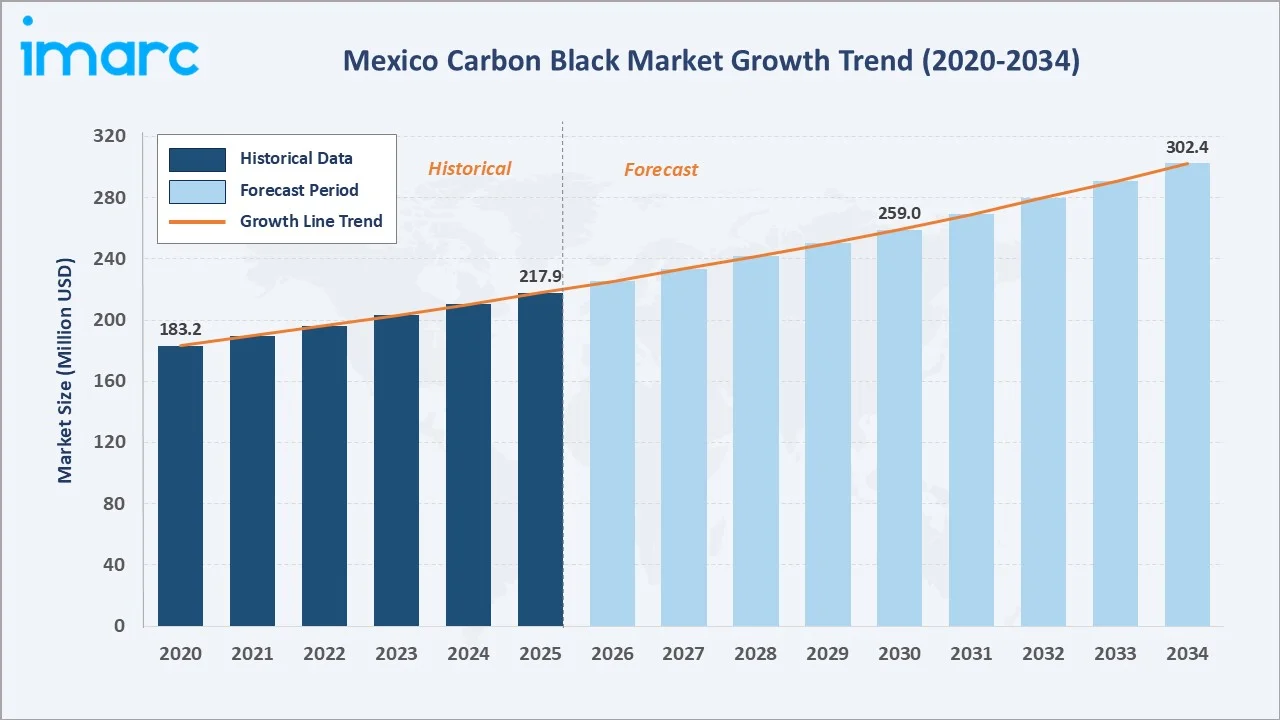
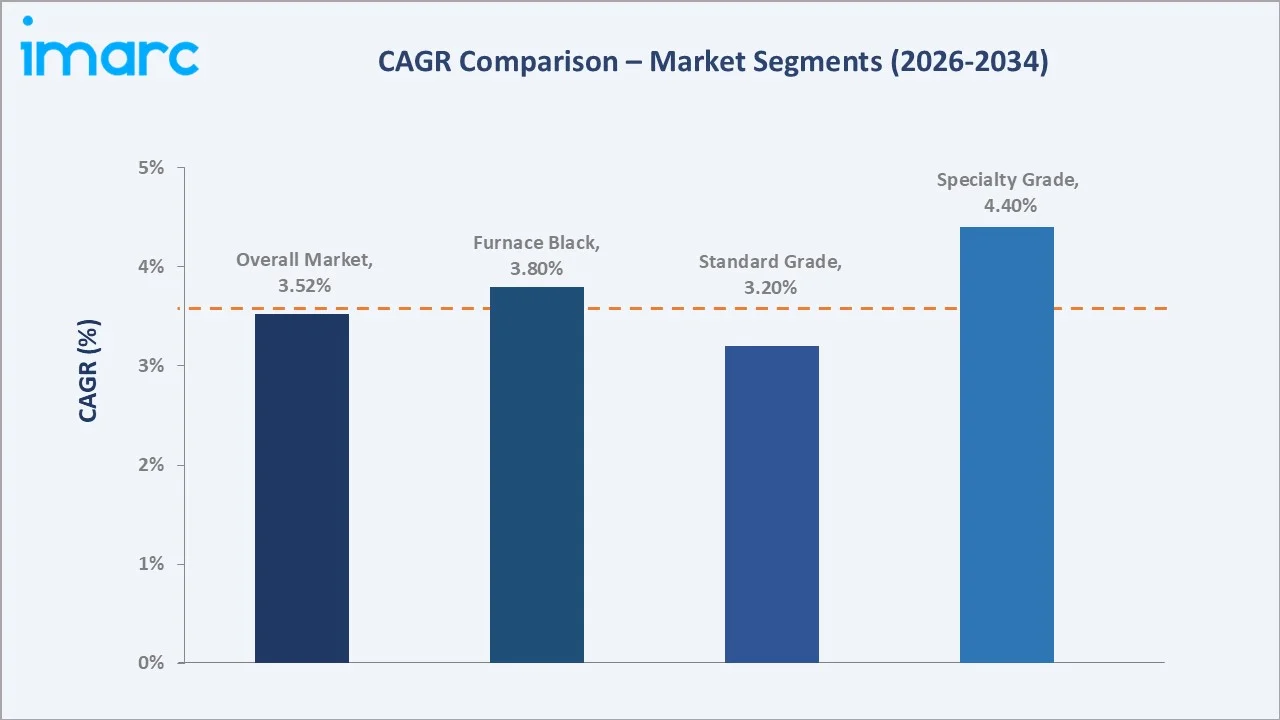
The Mexico carbon black market grew from USD 217.9 Million in 2025 to USD 225.5 Million in 2026 and is projected to reach USD 302.4 Million by 2034, growing at a CAGR of 3.52% during 2026-2034. The market is driven by growing automotive sector demand, expanding tire and rubber manufacturing, and increased use of carbon black across plastics, coatings, and electronics industries.
USMCA trade benefits, sustained industrial growth in Northern Mexico, and ongoing investments in specialty and green carbon black production further support market expansion through the forecast period. Furnace black leads at 82.6% of total type share; standard grade commands 78.5% of grade share; Northern Mexico accounts for 47.6% of regional demand.
Market Snapshot
|
Metric |
Value |
|
Base Year Market Size (2025) |
USD 217.9 Million |
|
Market Size (2026) |
USD 225.5 Million |
|
Forecast Market Size (2034) |
USD 302.4 Million |
|
CAGR (2026-2034) |
3.52% |
|
Base Year |
2025 |
|
Historical Period |
2020-2025 |
|
Forecast Period |
2026-2034 |
|
Dominant Type |
Furnace Black (82.6%, 2025) |
|
Dominant Grade |
Standard Grade (78.5%, 2025) |
|
Leading Region |
Northern Mexico (47.6%, 2025) |
The Mexico carbon black market reached USD 183.2 Million in 2020, growing steadily to USD 217.9 Million in 2025, driven by sustained automotive, tire, and rubber sector demand. The market is projected to reach USD 225.5 Million in 2026, advancing to USD 259.0 by 2030 and USD 302.4 Million by 2034.
To get more information on this market, Request Sample
Furnace black dominates the type segment at 82.6% through its cost efficiency and superior reinforcing properties for tire and rubber applications. Standard grade leads at 78.5%, serving the high-volume automotive and tire manufacturing base that defines Mexico's industrial demand profile.
Executive Summary
The Mexico carbon black market expanded from USD 217.9 Million in 2025 to USD 225.5 Million in 2026, with the market projected to reach USD 302.4 Million by 2034. Growth is underpinned by Mexico's position as a leading automotive manufacturing hub under the USMCA framework, driving sustained demand for tire and rubber-grade carbon black.
Furnace black leads at 82.6% of total type share; standard grade commands 78.5% of grade share; Northern Mexico accounts for 47.6% of regional demand.
Key Market Insights
|
Insight |
Data |
|
Dominant Type |
Furnace Black – 82.6% share (2025) |
|
Dominant Grade |
Standard Grade – 78.5% market share (2025) |
|
Leading Region |
Northern Mexico – 47.6% share (2025) |
|
Market Opportunity |
Green/recovered carbon black adoption; EV-grade specialty carbon black; USMCA-driven export growth |
Key Analytical Observations Supporting the Above Data:
- Furnace Black at 82.6%: Furnace black dominates through its oil-furnace production process, delivering optimal reinforcement, abrasion resistance, and cost efficiency for tire and rubber applications across Mexico's automotive manufacturing sector.
- Standard Grade at 78.5%: Standard grade leads because it serves the high-volume automotive and tire manufacturing base, offering reliable reinforcing properties and competitive pricing for mass industrial applications.
- Northern Mexico at 47.6%: Northern Mexico dominates regionally due to concentration of automotive, tire, and rubber manufacturing in Monterrey, Saltillo, and Tamaulipas, directly linked to USMCA-driven US-Mexico automotive supply chains.
Mexico Carbon Black Market Overview
Mexico carbon black market is structurally anchored in the automotive and tire manufacturing sectors, which collectively account for the majority of domestic consumption. Mexico's role as a leading global vehicle manufacturing hub, with over 3 million units produced annually, creates a stable and growing demand base for carbon black.
Mexico carbon black ecosystem integrates domestic producers, international importers, chemical distributors, and industrial end-users. Cabot Corporation's NHUMO facility in Altamira and growing imports from global majors serve the diverse needs of tire, rubber, plastics, and specialty applications.
Market Dynamics
To evaluate market opportunities, Request Sample
Market Drivers
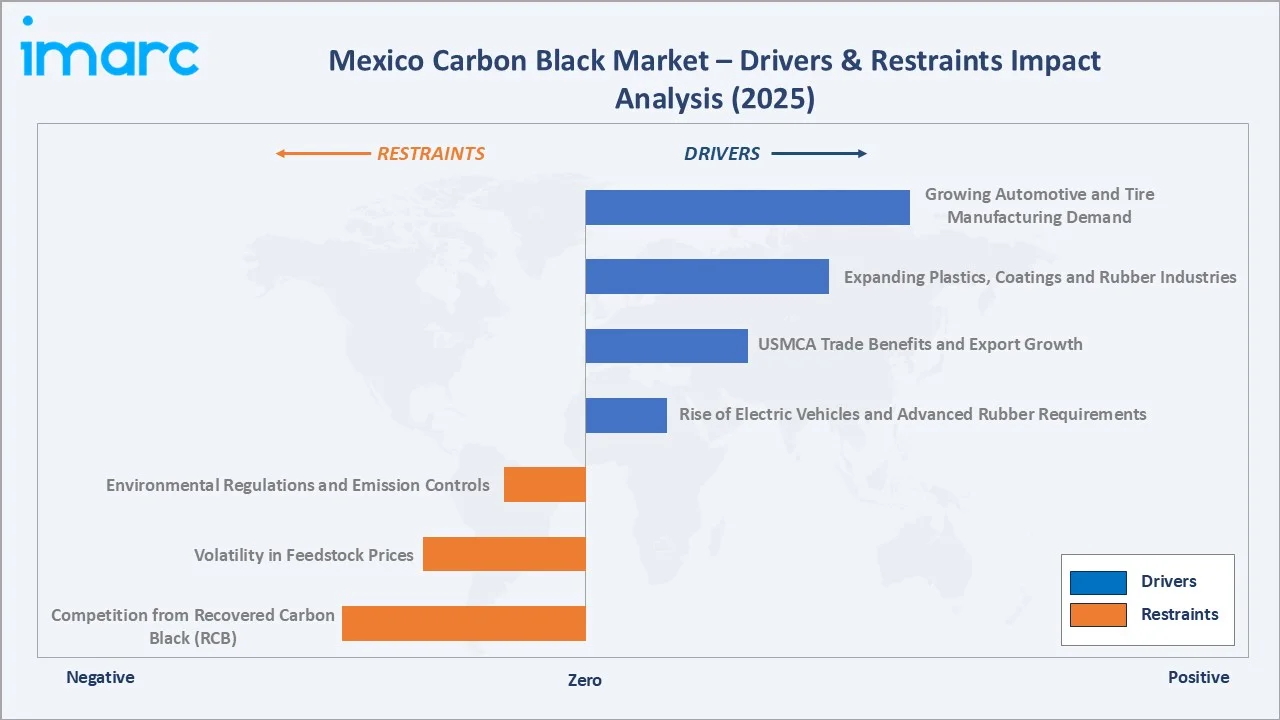
- Growing Automotive and Tire Manufacturing Demand: Mexico's position as a top-five global automotive manufacturer creates sustained demand for carbon black in tire and rubber production. USMCA agreements support vehicle export growth, driving tire manufacturers to expand capacity and increase carbon black procurement across Northern Mexico's industrial corridor.
- Expanding Plastics, Coatings and Rubber Industries: Beyond tires, growing plastics, coatings, printing inks, and specialty rubber sectors create expanding application demand for carbon black. Industrial diversification in the Bajío region and Central Mexico is broadening the carbon black consumption base beyond automotive.
- USMCA Trade Benefits and Export Growth: The United States-Mexico-Canada Agreement (USMCA) creates competitive advantages for Mexico-based manufacturers, boosting cross-border automotive supply chains. This drives production scale and operational investment, supporting long-term carbon black demand from both domestic and export-oriented industrial operations.
- Rise of Electric Vehicles and Advanced Rubber Requirements: Growing EV production in Mexico is creating demand for specialty carbon black grades used in battery components, conductive rubber, and high-performance materials. This trend is expanding the market beyond traditional tire-grade applications into higher-value specialty segments.
Market Restraints
- Environmental Regulations and Emission Controls: Stringent SEMARNAT environmental regulations governing carbon black manufacturing emissions are increasing compliance costs for producers. Pressure to adopt cleaner production technologies and reduce particulate emissions is adding capital expenditure requirements, potentially limiting production capacity expansion.
- Volatility in Feedstock Prices: Carbon black production depends heavily on oil-derived feedstocks including furnace oil, anthracene oil, and natural gas. Global crude oil price volatility directly impacts production costs and manufacturer margins, creating pricing uncertainty and limiting long-term investment planning for market participants.
- Competition from Recovered Carbon Black (rCB): Emerging recovered carbon black technology, which recycles carbon black from end-of-life tires, is gaining traction as a sustainable alternative. As rCB quality improves and regulatory support increases, it poses a competitive challenge to virgin carbon black producers in standard-grade applications.
Market Opportunities
- Specialty Grade Carbon Black Growth: Growing demand for specialty carbon blacks in electronics, high-performance coatings, lithium-ion battery components, and conductive plastics presents a premium market opportunity, offering higher margins than standard rubber-grade products.
- Green Carbon Black and Sustainability Transition: Increasing ESG focus among global automotive OEMs and tire manufacturers is creating demand for sustainably produced carbon black. Investment in oil-alternative feedstocks and recovered carbon black integration presents growth opportunities for forward-thinking producers.
Market Challenges
- High Capital Intensity of Carbon Black Manufacturing: Establishing and maintaining carbon black production facilities requires significant capital investment in specialized equipment, environmental controls, and feedstock infrastructure, creating barriers to entry and expansion for smaller or new market participants.
- Supply Chain Dependence on Imported Specialty Grades: Mexico's domestic production, primarily standard furnace black through Cabot NHUMO, is insufficient to meet growing specialty grade demand. Dependence on imports for specialty carbon black creates supply vulnerability and pricing exposure for downstream industrial users.
Emerging Market Trends
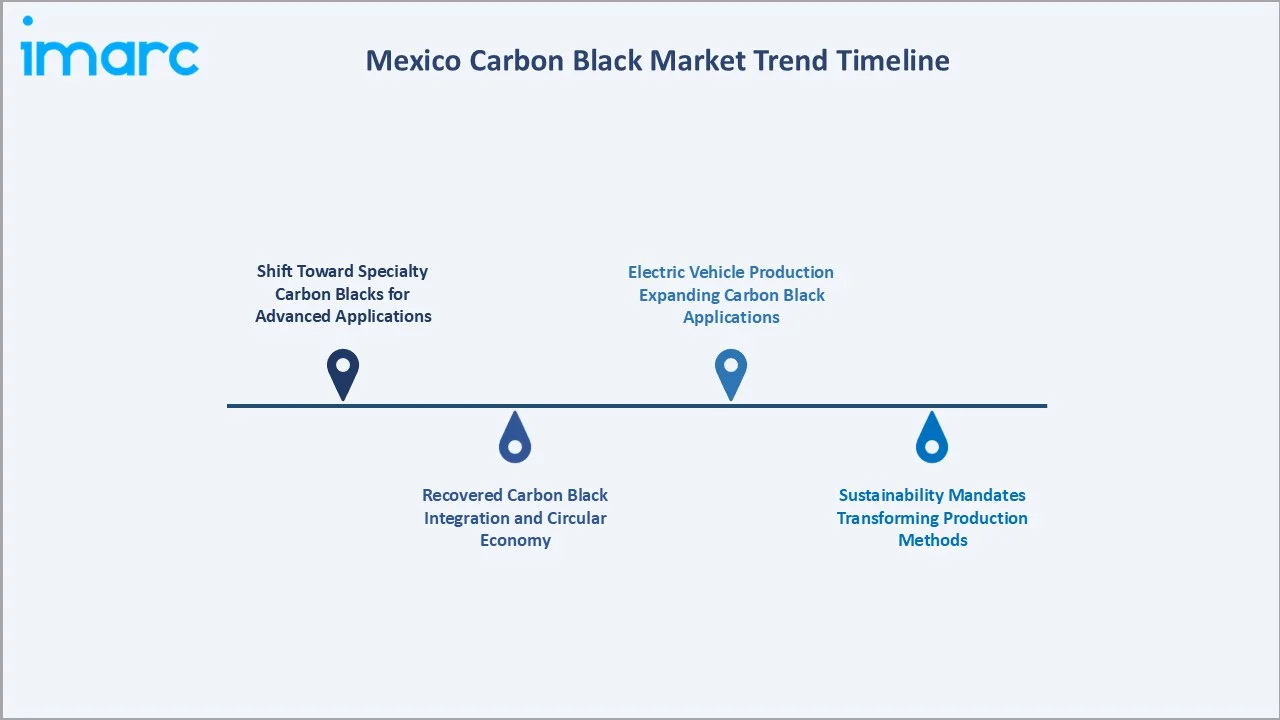
1. Shift Toward Specialty Carbon Blacks for Advanced Applications
Growing electronics, battery, and conductive materials applications are driving increasing demand for specialty carbon black grades beyond traditional tire and rubber uses. Manufacturers with specialty grade capabilities are gaining premium market positioning in Mexico's evolving industrial landscape.
2. Recovered Carbon Black Integration and Circular Economy
Recovered carbon black (rCB) from tire pyrolysis is gaining acceptance as a sustainable alternative in certain rubber and non-tire applications. Mexico's expanding tire recycling infrastructure and global OEM sustainability commitments are accelerating rCB adoption and creating new market dynamics.
3. Electric Vehicle Production Expanding Carbon Black Applications
Mexico's growing EV manufacturing sector, supported by USMCA incentives, is expanding carbon black applications into battery electrodes, conductive gaskets, and high-performance rubber. This shift diversifies demand from traditional tire-grade carbon black into higher-margin specialty segments.
4. Sustainability Mandates Transforming Production Methods
Global automotive OEM sustainability commitments are pressuring Mexican tire and rubber manufacturers to source carbon black from environmentally responsible producers. This trend is driving investment in alternative feedstocks and cleaner production technologies within Mexico's carbon black supply chain.
Industry Value Chain Analysis
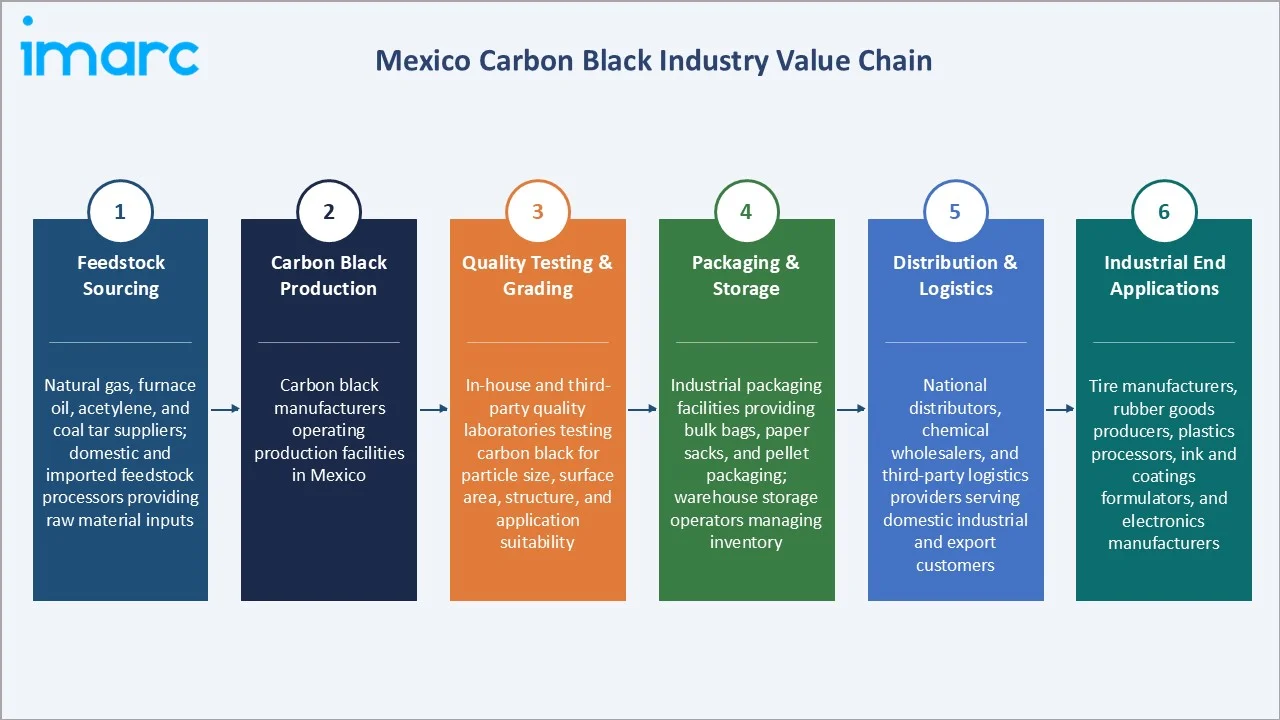
Mexico carbon black value chain begins with feedstock sourcing from domestic and imported petroleum-derived raw materials, proceeding through carbon black production, quality grading, packaging, and distribution to end-use industrial sectors.
|
Stage |
Key Participants |
|
Feedstock Sourcing |
Natural gas, furnace oil, acetylene, and coal tar suppliers; domestic and imported feedstock processors providing raw material inputs |
|
Carbon Black Production |
Carbon black manufacturers operating production facilities in Mexico |
|
Quality Testing & Grading |
In-house and third-party quality laboratories testing carbon black for particle size, surface area, structure, and application suitability |
|
Packaging & Storage |
Industrial packaging facilities providing bulk bags, paper sacks, and pellet packaging; warehouse storage operators managing inventory |
|
Distribution & Logistics |
National distributors, chemical wholesalers, and third-party logistics providers serving domestic industrial and export customers |
|
Industrial End Applications |
Tire manufacturers, rubber goods producers, plastics processors, ink and coatings formulators, and electronics manufacturers |
The carbon black production and quality testing stage is Mexico's value chain's most commercially critical segment, where feedstock combustion process control and particle characterisation determine product grade suitability for high-value tire, specialty, and industrial applications.
Technology Landscape in the Mexico Carbon Black Industry
Furnace Black and Thermal Black Production Technologies
Furnace black technology, using partial combustion of petroleum feedstocks in a closed reactor, dominates Mexico's carbon black production at 82.6% market share. Continuous process improvements in reactor design and feedstock management are enhancing production efficiency, product consistency, and environmental performance at existing facilities.
Specialty Carbon Black and Surface Treatment Technologies
Advanced surface treatment and oxidation technologies are enabling producers to develop higher-value specialty carbon black grades with modified surface chemistry for applications in coatings, inks, electronics, and conductive rubber. These technologies expand the addressable market beyond standard furnace black grades.
Recovered Carbon Black and Green Production Technologies
Pyrolysis-based recovered carbon black technologies are emerging as a sustainable complement to virgin carbon black production. Investment in rCB processing infrastructure in Mexico is supported by growing OEM sustainability mandates and circular economy initiatives targeting end-of-life tire recovery and carbon material recycling.
Market Segmentation Analysis
The report covers the following segments:
|
Segment Category |
Leading Segment |
Market Share |
Year |
|
Type |
Furnace Black |
82.6% |
2025 |
|
Grade |
Standard Grade |
78.5% |
2025 |
|
Application |
🔒 |
🔒 |
2025 |
|
Region |
Northern Mexico |
47.6% |
2025 |

By Type
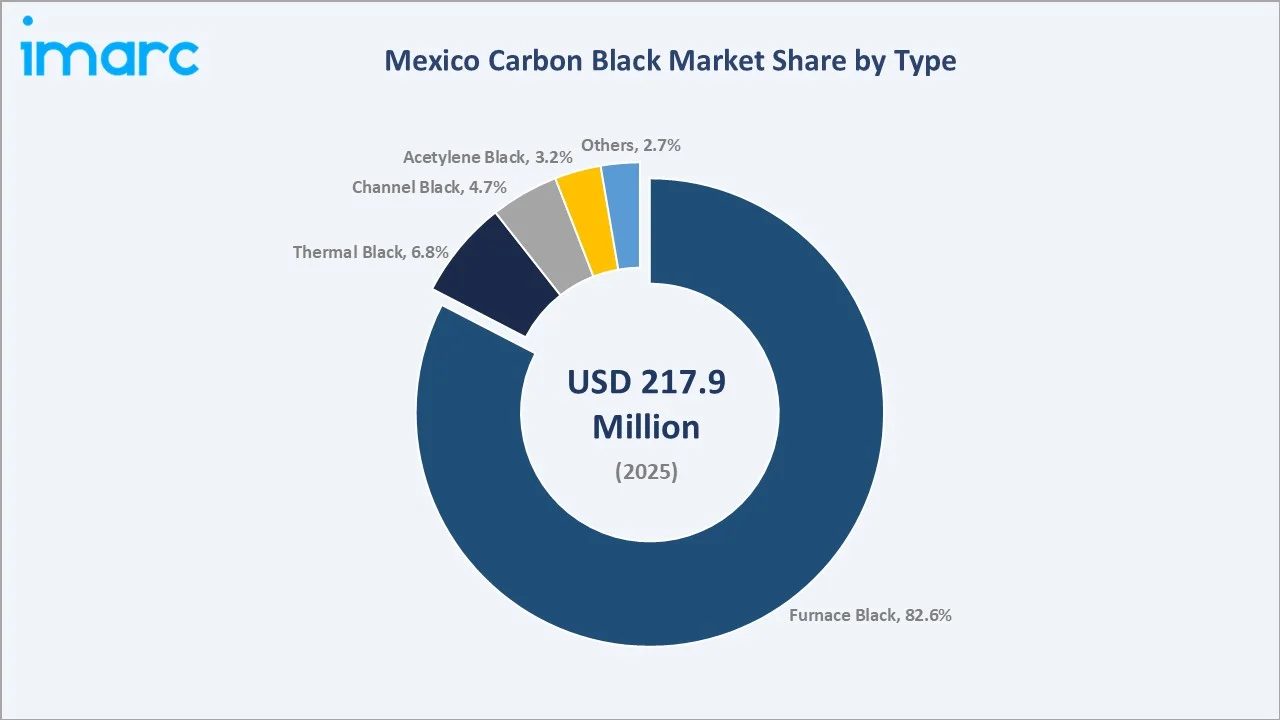
Furnace black leads at 82.6% (2025). The furnace black segment dominates Mexico's carbon black market by serving tire, rubber, plastics, and coatings sectors through its superior reinforcing properties, versatile particle size range, and cost-efficient production process aligned with domestic manufacturing demand.
To access detailed market analysis, Request Sample
Thermal black at 6.8% serves specialty rubber and insulation applications requiring larger particle size. Channel black (4.7%) and acetylene black (3.2%) serve niche electronics and battery applications. Others (2.7%) include lamp black and vegetable-derived carbon black for specialty uses.
By Grade
Standard grade leads at 78.5% (2025). Standard grade carbon black dominates by serving Mexico's large-scale automotive, tire, and rubber manufacturing base, where high-volume reinforcing carbon black is required at competitive prices. Domestic production from Cabot NHUMO primarily serves this segment.
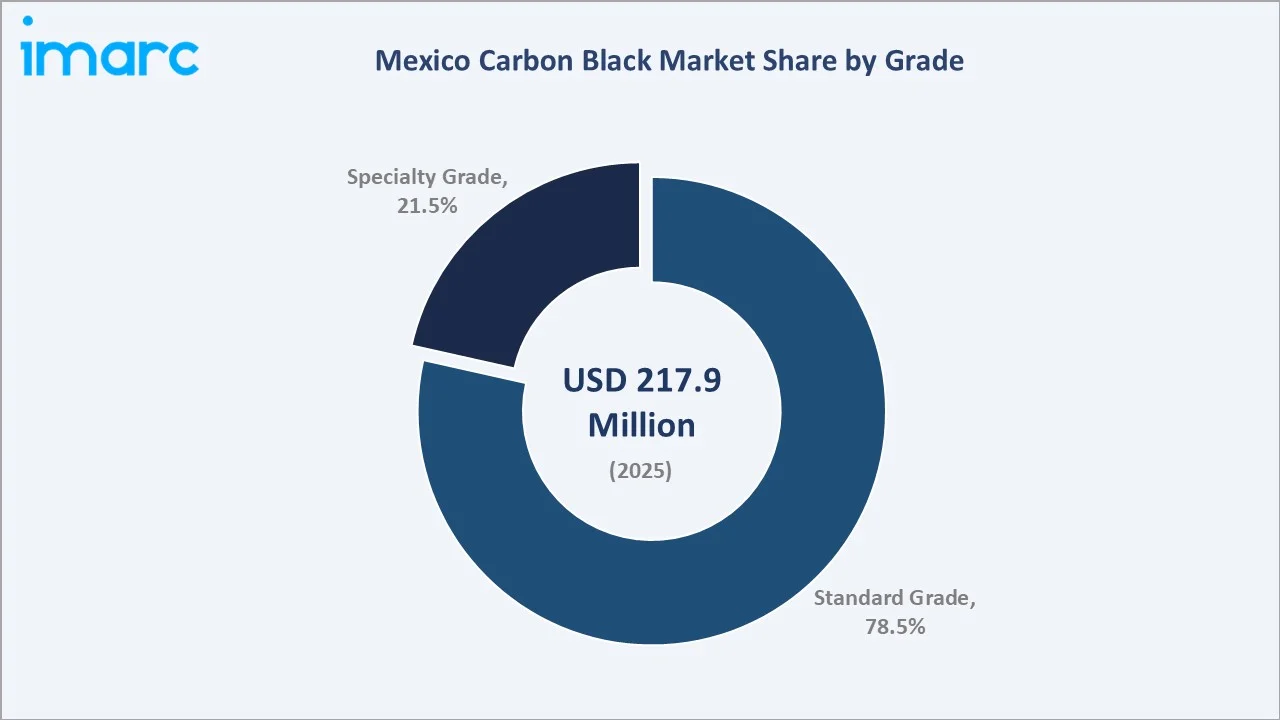
Specialty grade at 21.5% is the fastest-growing segment, driven by rising demand from electronics, conductive rubber, coatings, inks, and EV battery applications. Growing investment in specialty-grade supply capability is being driven by global OEM and Tier-1 supplier demand in Mexico.
Regional Market Insights
|
Region |
Share (2025) |
Key Mexico Carbon Black Market Drivers & Characteristics |
|
Northern Mexico |
47.6% |
Driven by concentration of automotive, tire manufacturing, and rubber processing industries in Monterrey and Tamaulipas; strong USMCA-linked export orientation. |
|
Central Mexico |
34.8% |
Mexico City and Bajío region host plastics, coatings, and chemicals industries; growing demand from electronics and specialty rubber applications. |
|
Southern Mexico |
13.2% |
Emerging industrial clusters in Veracruz and Oaxaca; growing construction, rubber goods, and packaging sectors driving incremental demand. |
|
Others |
4.4% |
Border regions and smaller industrial centres with niche applications in local rubber goods, plastics, and import-distribution activities. |
Northern Mexico's 47.6% market leadership reflects Monterrey's automotive manufacturing cluster, Saltillo's vehicle assembly operations, and Tamaulipas's tire production base, creating the highest carbon black demand concentration of any Mexican region.
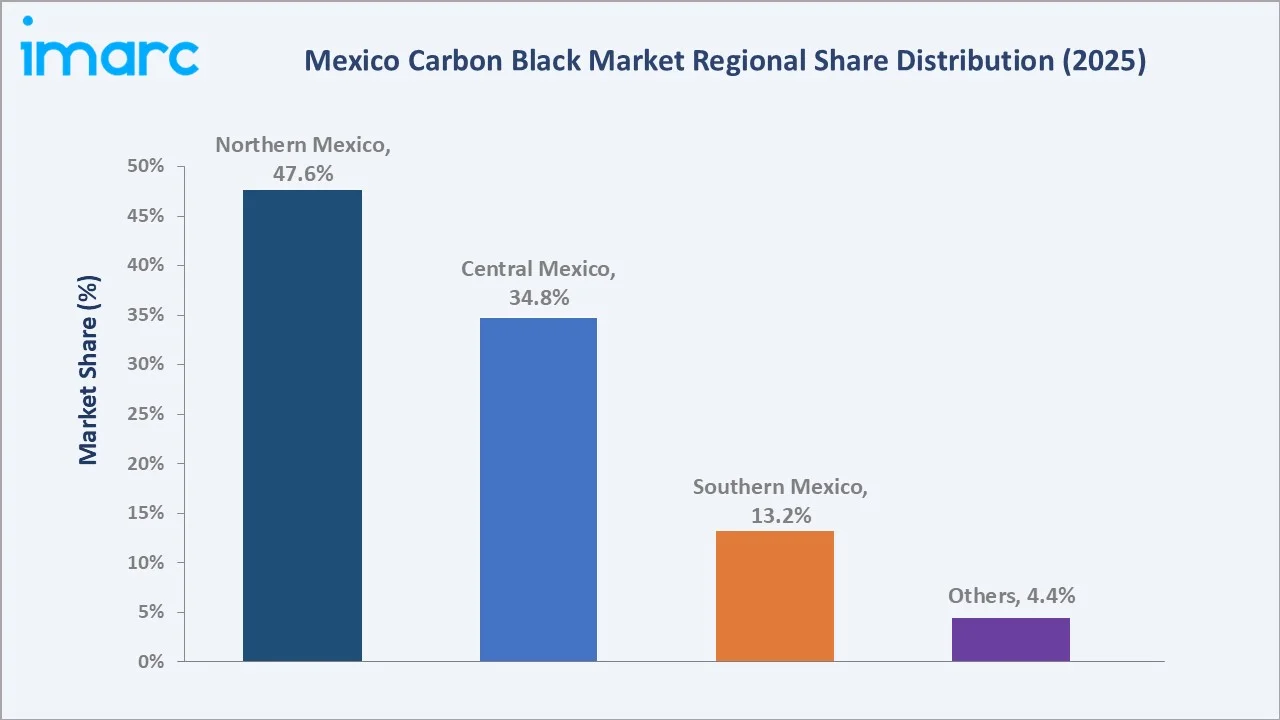
Central Mexico's 34.8% reflects the Bajío region's growing automotive and chemicals industries, Mexico City's plastics and coatings sectors, and Querétaro's aerospace and advanced manufacturing base driving diverse carbon black application demand.
Competitive Landscape
Mexico carbon black market competitive landscape is defined by Cabot Corporation's dominant domestic production through the NHUMO Altamira facility, supplemented by imports from global majors serving specialty and supplemental standard grade requirements.
| Company | Key Products | Market Position | Core Strength |
|---|---|---|---|
| Cabot Corporation | NHUMO Rubber Blacks, Specialty Blacks | Market Leader | Dominant production leader in Mexico through NHUMO plant in Altamira; acquisition of Bridgestone Mexico Carbon Manufacturing strengthens capacity and supply reliability. |
| Aditya Birla Management Corporation Pvt. Ltd. | Furnace Blacks, Specialty Grades | Strong Challenger | Birla Carbon operating under Aditya Birla Group; global carbon black footprint serving Mexican industrial and tire markets through export supply and established distributor networks. |
| Tokai Carbon Co., Ltd. | Rubber Carbon Black, Carbon Graphite | Regional Player | Japanese precision manufacturer serving Mexican automotive and rubber sectors through import and distribution; growing specialty material applications. |
| Omsk Carbon Group | Furnace Black, Rubber Grade CB | Niche Player | Russian-origin carbon black producer with growing export presence; competitive standard grade supply serving Mexican rubber and plastics manufacturers. |
Key players include Cabot Corporation, Aditya Birla Management Corporation Pvt. Ltd., Tokai Carbon Co., Ltd., Omsk Carbon Group, and others.
Key Company Profiles
Cabot Corporation
Cabot Corporation is a leading global specialty chemicals and performance materials company, and the dominant carbon black producer in Mexico through its NHUMO facility in Altamira, Tamaulipas, with annual production capacity of 140,000 metric tons.
- Key Products: Rubber Blacks (NHUMO), Specialty Blacks, Conductive Carbon Blacks, Cabot XC72, Sterling V.
- Recent Developments: In February 2026, Cabot completed the acquisition of Bridgestone's Mexico Carbon Manufacturing (MXCB) facility in Altamira for USD 70 million, adding 35,000 tonnes of annual capacity and expanding its reinforcing carbon product range and North American supply capability.
- Strategic Focus: Strengthening domestic production leadership through capacity expansion, developing specialty and conductive carbon black grades for EV and electronics markets, and deepening supply relationships with Mexican and North American tire and automotive manufacturers under USMCA.
Aditya Birla Management Corporation Pvt. Ltd.
Birla Carbon, part of the Aditya Birla Group, is one of the world's largest carbon black producers, serving Mexico's tire, rubber, and specialty markets through international supply channels and established distributor partnerships across the region.
- Key Products: BIRLACARB grades (rubber blacks), specialty carbon blacks, Micronex (conductive grades).
- Strategic Focus: Leveraging global production scale and Aditya Birla Group resources to expand specialty grade presence in Mexico; advancing sustainable carbon black solutions and green production certifications to meet growing OEM sustainability requirements from Mexico's automotive sector.
Market Concentration Analysis
Mexico carbon black market is moderately concentrated, with Cabot Corporation commanding dominant domestic production through its NHUMO Altamira facility, supplemented by imports from other key players serving specialty and supplementary standard grade demand.
Market concentration is evolving toward greater domestic production consolidation following Cabot's 2026 acquisition of the Bridgestone MXCB facility, reinforcing Cabot's leadership while creating opportunities for specialty-focused importers to serve the growing premium segment.
Investment & Growth Opportunities
Highest Growth Segments
Specialty carbon black (~4.4% CAGR), acetylene black for EV batteries, and recovered carbon black represent the highest-growth opportunity segments in Mexico through 2034, driven by electronics, EV manufacturing expansion, and circular economy mandates.
Emerging Investment Opportunities
Mexico's growing EV manufacturing sector, specialty carbon black import substitution opportunity, and recovered carbon black infrastructure investment represent the market's highest-potential commercial themes through the forecast period.
Investment Themes
- Specialty and conductive carbon black manufacturing investment to serve Mexico's growing EV, electronics, and advanced rubber sectors, reducing import dependence and capturing premium margin opportunities.
- Recovered carbon black processing facility development aligned with global OEM sustainability mandates and Mexico's expanding tire recycling infrastructure under circular economy policy frameworks.
Future Market Outlook (2026-2034)
The Mexico carbon black market is projected to grow from USD 225.5 Million in 2026 to USD 302.4 Million by 2034 at a CAGR of 3.52%, driven by sustained automotive production growth, tire manufacturing expansion, and diversification into specialty carbon black applications across electronics and EV sectors.
Three structural forces define Mexico carbon black market growth through 2034: USMCA-driven automotive production expansion sustaining standard-grade demand; EV manufacturing growth creating specialty carbon black requirements; and sustainability mandates accelerating recovered carbon black and green production investment.
Research Methodology
Primary Research
Primary research comprised structured interviews with Mexico carbon black market participants including producers, distributors, tire and rubber manufacturers, automotive OEM procurement teams, and specialty chemical industry executives across the value chain.
Secondary Research
Secondary research encompassed Mexico carbon black import-export data, SEMARNAT environmental reports, automotive industry production statistics, company annual reports, chemical industry association publications, and global carbon black market research databases.
Forecasting Models
Market revenue forecasts were developed using automotive production volume models, feedstock price scenario analysis, and demand-supply equilibrium frameworks calibrated against verified historical market performance data from 2020-2025.
Mexico Carbon Black Market Report Coverage:
| Report Features | Details |
|---|---|
| Base Year of the Analysis | 2025 |
| Historical Period | 2020-2025 |
| Forecast Period | 2026-2034 |
| Units | Million USD |
| Scope of the Report |
Exploration of Historical Trends and Market Outlook, Industry Catalysts and Challenges, Segment-Wise Historical and Future Market Assessment:
|
| Types Covered | Furnace Black, Channel Black, Thermal Black, Acetylene Black, Others |
| Grades Covered | Standard Grade, Specialty Grade |
| Applications Covered | Tire, Non-Tire Rubber, Plastics, Inks and Coatings, Others |
| Regions Covered | Northern Mexico, Central Mexico, Southern Mexico, and Others |
| Companies Covered | Cabot Corporation, Aditya Birla Management Corporation Pvt. Ltd., Tokai Carbon Co., Ltd., Omsk Carbon Group, etc. |
| Customization Scope | 10% Free Customization |
| Post-Sale Analyst Support | 10-12 Weeks |
| Delivery Format | PDF and Excel through Email (We can also provide the editable version of the report in PPT/Word format on special request) |
Key Benefits for Stakeholders:
- IMARC’s industry report offers a comprehensive quantitative analysis of various market segments, historical and current market trends, market forecasts, and dynamics of the Mexico carbon black market from 2020-2034.
- The research report provides the latest information on the market drivers, challenges, and opportunities in the Mexico carbon black market.
- Porter's Five Forces analysis assists stakeholders in assessing the impact of new entrants, competitive rivalry, supplier power, buyer power, and the threat of substitution. It helps stakeholders to analyze the level of competition within the Mexico carbon black industry and its attractiveness.
- Competitive landscape allows stakeholders to understand their competitive environment and provides an insight into the current positions of key players in the market.
Frequently Asked Questions About the Mexico Carbon Black Market Report
Mexico carbon black market size reached USD 225.5 Million in 2026, driven by growing automotive, tire, and rubber manufacturing sectors, along with expanding plastics, coatings, and electronics applications across Northern and Central Mexico industrial regions.
Mexico carbon black market grows at 3.52% CAGR during 2026-2034, reaching USD 302.4 Million by 2034, supported by sustained automotive manufacturing growth, EV sector expansion, and specialty carbon black demand from electronics and advanced rubber applications.
Furnace black leads at 82.6% (2025) through its dominant position in tire and rubber reinforcement applications, cost-efficient oil furnace production process, and alignment with Mexico's large-scale automotive and tire manufacturing sector needs.
Standard grade leads at 78.5% (2025) by serving the high-volume automotive and tire manufacturing base, offering reliable reinforcing properties and competitive pricing for mass industrial applications across Mexico's production facilities.
Northern Mexico leads at 47.6% (2025) through concentration of automotive, tire, and rubber manufacturing in Monterrey, Saltillo, and Tamaulipas, directly linked to USMCA-driven US-Mexico automotive supply chains and Cabot's Altamira production facility.
Leading companies include Cabot Corporation, Aditya Birla Management Corporation Pvt. Ltd., Tokai Carbon Co., Ltd., Omsk Carbon Group, and others.
Mexico carbon black market is projected to reach approximately USD 259.0 Million by 2030, with specialty grade and EV-related carbon black applications growing faster than the overall market as Mexico's automotive sector transitions toward electric vehicle production.
Need more help?
- Speak to our experienced analysts for insights on the current market scenarios.
- Include additional segments and countries to customize the report as per your requirement.
- Gain an unparalleled competitive advantage in your domain by understanding how to utilize the report and positively impacting your operations and revenue.
- For further assistance, please connect with our analysts.
 Request Customization
 Speak to an Analyst
 Request Brochure
 Inquire Before Buying
Benefits of Customization
- Personalize this research
- Triangulate with your data
- Get data as per your format and definition
- Gain a deeper dive into a specific application, geography, customer, or competitor
- Any level of personalization
Get in Touch With Us
UNITED STATES
Phone: +1-201-971-6302
INDIA
Phone: +91-120-433-0800
UNITED KINGDOM
Phone: +44-753-714-6104
Email: [email protected]
Client Testimonials



















Related Reports

Choose your plan
*Please note that the prices mentioned below are starting prices for each bundle type. Kindly contact our team for further details.*
Single User License
- 1 User License, Access on 2 Devices
- PDF Report + Excel Dataset (Password Protected)
- Lifetime Access
- No Printing Rights
- 10% Free Report Customization
- 10–12 Weeks of Analyst Support
Five User License
- Access for 5 Users, 2 Devices per User
- PDF Report + Excel Dataset (Password Protected)
- Lifetime Access
- Dedicated Account Manager
- 12–14 Weeks of Analyst Support
- No Printing Rights
- 15% Free Report Customization
- 25% Discount on Your Next Purchase
Corporate User License
- Unlimited User Access (Within Your Organization)
- PDF Report + Excel Dataset
- Lifetime Access
- Dedicated Account Manager
- 14–20 Weeks of Analyst Support
- No Printing Rights
- 20% Free Report Customization
- 30% Discount on Your Next Purchase
Essential Insights
What's included:
3 reports
- Lifetime Access
- PDF Reports
- Excel Datasets
- 2 Weeks of Free Analyst Support
- 2 User Licenses
- Access on 2 Devices
- Printing Rights
- Complimentary PowerPoint (PPT) Version
- Complimentary License Upgrade
Professional Access
What's included:
5 reports
- Lifetime Access
- PDF Reports
- Excel Datasets
- 8 Weeks of Free Analyst Support
- 2 User Licenses
- Access on 2 Devices
- Printing Rights
- Complimentary PowerPoint (PPT) Version
- Complimentary License Upgrade
Business Advantage
What's included:
8 reports
- Lifetime Access
- PDF Reports
- Excel Datasets
- 14 Weeks of Free Analyst Support
- 2 User Licenses
- Access on 2 Devices
- Printing Rights
- Complimentary PowerPoint (PPT) Version
- Complimentary License Upgrade
Enterprise Intelligence
What's included:
10 reports
- Lifetime Access
- PDF Reports
- Excel Datasets
- 20 Weeks of Free Analyst Support
- 2 User Licenses
- Access on 2 Devices
- Printing Rights
- Complimentary PowerPoint (PPT) Version
- Complimentary License Upgrade