
Mexico Consumer Lending Market Size, Share, Trends and Forecast by Type, Application, and Region, 2026-2034
Mexico Consumer Lending Market Size, Share, Trends & Forecast (2026-2034)
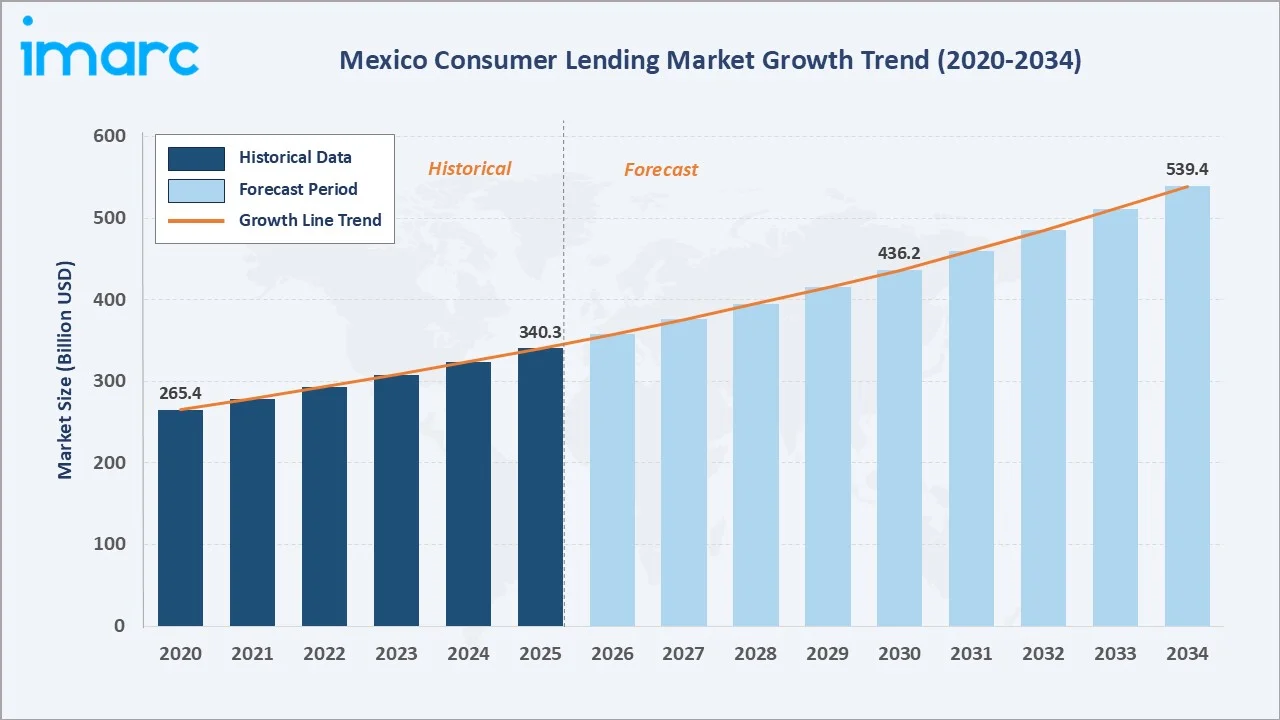
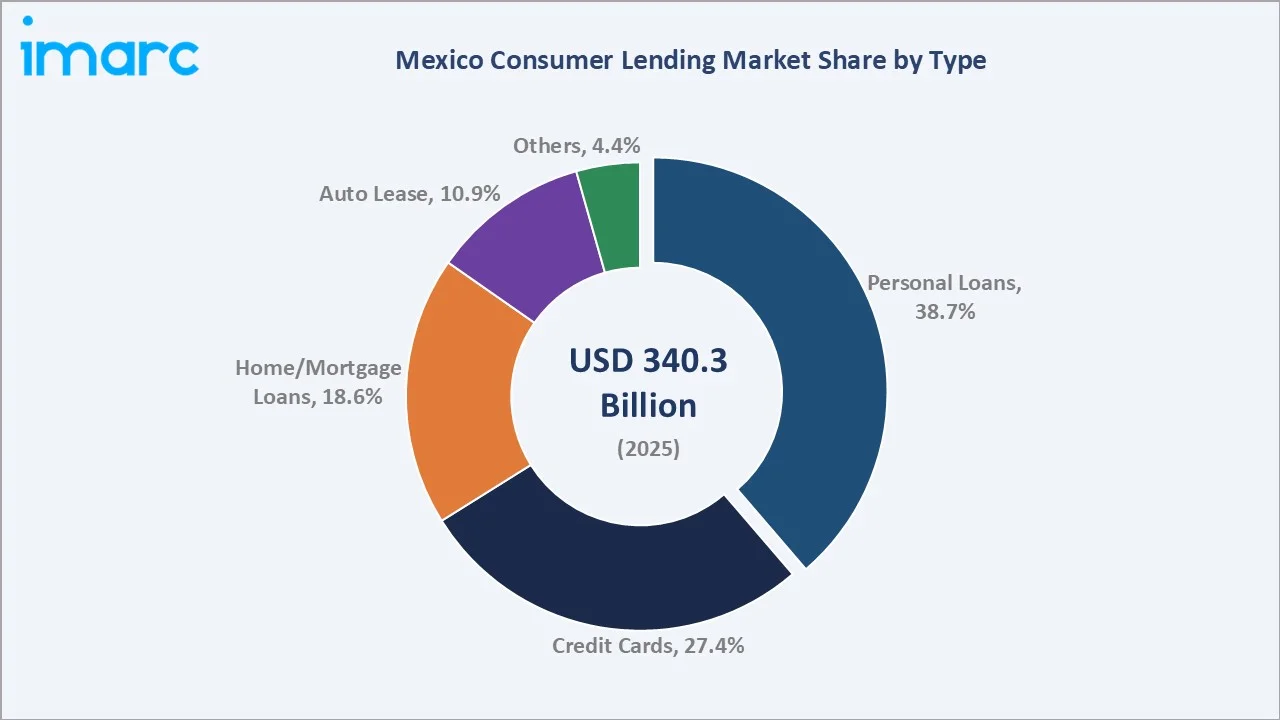
The Mexico consumer lending market size increased from USD 340.3 Billion in 2025 to USD 362.5 Billion in 2026 and is projected to reach USD 539.4 Billion by 2034, growing at a CAGR of 5.09% during 2026-2034. The market is driven by rising household consumption, expanding digital banking and fintech adoption, and increasing access to personal loans, credit cards, and BNPL solutions among underbanked consumers. By the end of 2024, Mexico’s banking loan portfolio for micro, small, and medium enterprises (MSMEs) stood at 565.4 billion Mexican pesos, accounting for 13.04% of total outstanding commercial loans. The portfolio expanded by 40.660 billion pesos from 2023 to 2024, reflecting stronger credit flow to smaller businesses. This is driving the market by expanding the borrower base, strengthening demand for working capital and business loans, and encouraging banks and fintech lenders to develop more flexible credit products for underserved MSMEs. Personal loans lead at 38.7%. Individual use leads the application at 63.2%. Central Mexico leads regionally at 45.1%.
Market Snapshot
|
Metric |
Value |
|
Base Year Market Size (2025) |
USD 340.3 Billion |
| Market Size (2026) | USD 362.5 Billion |
|
Forecast Market Size (2034) |
USD 539.4 Billion |
|
CAGR (2026-2034) |
5.09% |
|
Base Year |
2025 |
|
Historical Period |
2020-2025 |
|
Forecast Period |
2026-2034 |
|
Dominant Type |
Personal Loans (38.7%, 2025) |
|
Dominant Application |
Individual Use (63.2%, 2025) |
|
Leading Region |
Central Mexico (45.1%, 2025) |
The Mexico consumer lending market grew from USD 265.4 billion in 2020 to USD 340.3 billion in 2025 and an estimated USD 362.5 Billion in 2026, reflecting steady expansion in household borrowing and improved credit accessibility. The market is projected to reach USD 436.2 billion by 2030, driven by rising disposable incomes, increasing financial inclusion, and rapid digital lending adoption. Continued growth in personal loans, credit cards, auto financing, and BNPL solutions is expected to support market expansion. By 2034, the market is forecast to attain USD 539.4 billion, underpinned by fintech innovation, expanding banking penetration, and sustained consumer spending across Mexico.
To get more information on this market, Request Sample
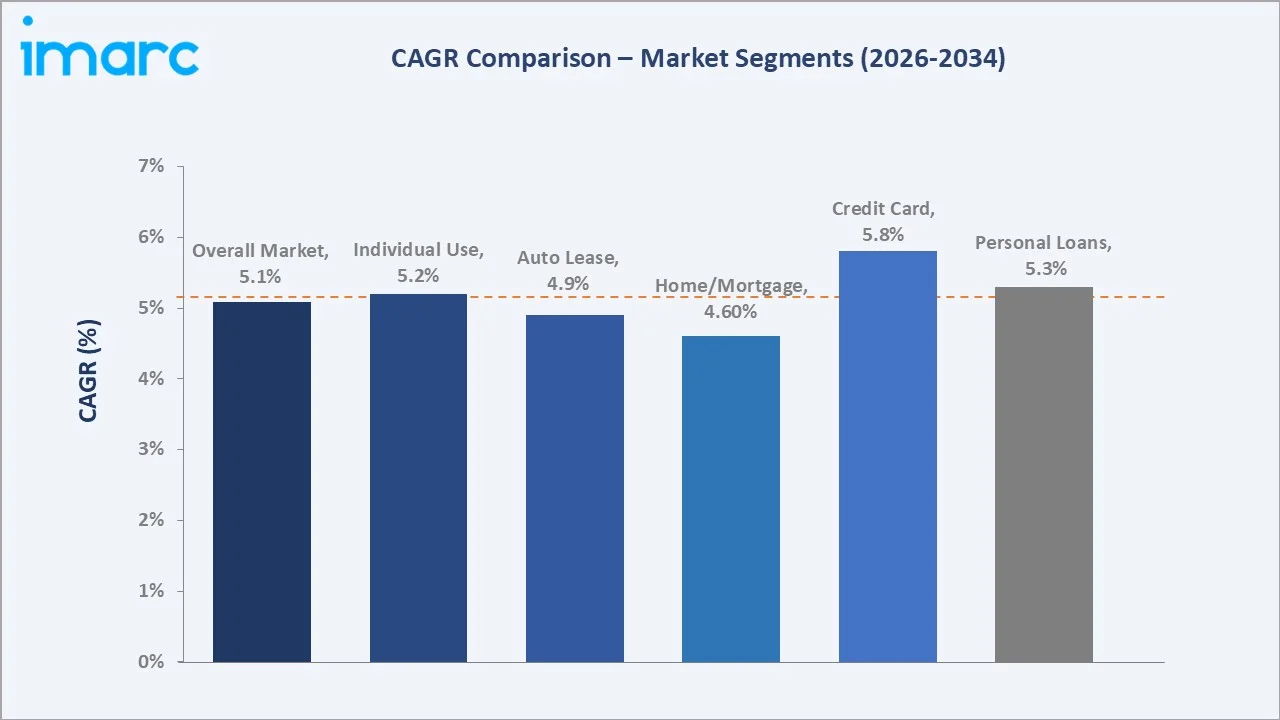
Credit card grows fastest at ~5.8% CAGR through fintech BNPL and neobank digital credit. Personal loans grow at ~5.3% CAGR through payroll and digital. Individual use grows at ~5.2% CAGR through fintech personal loans and BNPL digital individual consumers.
Executive Summary
The Mexico consumer lending market is entering a more mature growth phase, supported by expanding access to formal credit, rising digital lending penetration, and stronger consumer demand for flexible financing. Banks, fintech platforms, and non-bank lenders are increasingly serving households through personal loans, credit cards, auto loans, payroll loans, and buy-now-pay-later products. Growth is also supported by Mexico’s large underbanked population, which creates room for alternative credit scoring, mobile-first loan origination, and embedded finance models. At the same time, lenders are focusing on risk-based pricing, faster approvals, and data-driven underwriting to manage credit quality. Over the forecast period, increasing e-commerce activity, MSME-linked household income growth, and wider financial inclusion are expected to strengthen consumer borrowing across urban and semi-urban markets. Personal loans at 38.7% lead through payroll-deducted and digital. Individual use at 63.2% leads through personal consumption. Central Mexico leads regionally at 45.1%.
Key Market Insights
|
Insight |
Data |
|
Dominant Type |
Personal Loans - 38.7% share (2025) |
|
Dominant Application |
Individual Use - 63.2% market share (2025) |
|
Leading Region |
Central Mexico - 45.1% share (2025) |
|
Market Opportunity |
Fintech BNPL unbanked; Mexico digital credit; mortgage expansion; open banking; AI credit scoring unbanked; payroll-deducted consumer loan |
Key Analytical Observations Supporting The Above Data:
- Personal Loans at 38.7%: Personal loans dominate due to their broad use for household expenses, debt consolidation, medical needs, education, travel, and small-ticket emergencies. Their flexible repayment structures, faster approvals, and growing availability through banks and fintech platforms continue to strengthen adoption among salaried and self-employed borrowers.
- Individual Use at 63.2%: Individual use dominates as households increasingly rely on credit for personal expenses, lifestyle purchases, education, healthcare, travel, and emergency funding. Rising digital loan access, flexible repayment options, and wider credit card and personal loan adoption further strengthen individual borrowing demand.
- Central Mexico at 45.1%: Central Mexico dominates regionally due to its high population density, strong urban consumer base, and concentration of banking, retail, and fintech activity in major cities such as Mexico City. Higher income levels, stronger employment opportunities, and wider access to formal credit channels further support consumer lending growth in the region.
Mexico Consumer Lending Market Overview
.webp)
The Mexico consumer lending market encompasses personal loans, credit cards, auto loans, payroll loans, point-of-sale financing, and buy-now-pay-later solutions. It serves individual borrowers, households, self-employed consumers, and small business-linked borrowers seeking flexible credit access. The market includes banks, fintech lenders, credit unions, non-bank financial institutions, and retail-linked financing providers. It is increasingly shaped by digital onboarding, alternative credit scoring, mobile lending platforms, and embedded finance models across urban and semi-urban Mexico. Macroeconomic factors include rising household income, employment growth, urbanization, and expanding consumer spending across Mexico.
Market Dynamics
To evaluate market opportunities, Request Sample
Market Drivers
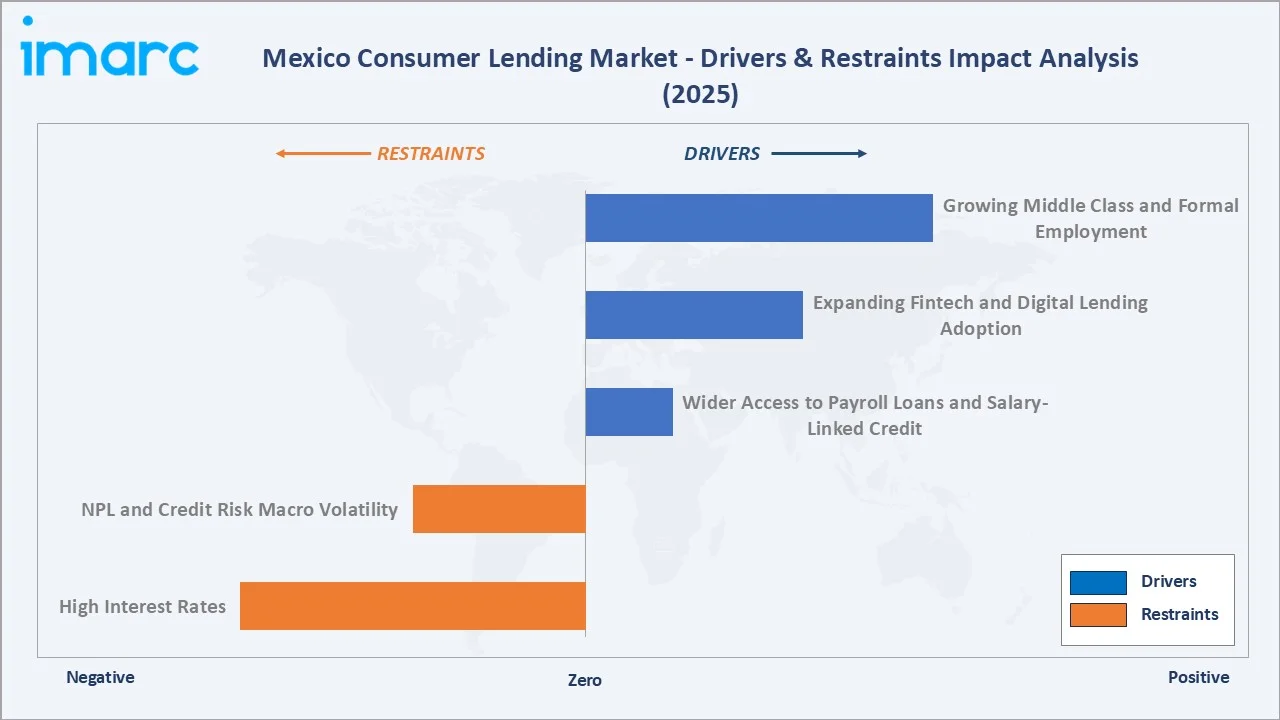
- Growing Middle Class and Formal Employment: Mexico’s middle class is projected to expand steadily, with an additional 3.8 million households expected to enter the middle-income segment by 2030. A growing middle class and expanding formal employment are increasing household purchasing power and improving consumers' eligibility for regulated credit products. Stable salaries and documented income enable banks and fintech lenders to offer larger loan amounts, competitive interest rates, and longer repayment tenures. As more workers enter the formal economy, demand for personal loans, payroll loans, credit cards, and auto financing continues to rise, supporting sustained growth in Mexico's consumer lending market.
- Expanding Fintech and Digital Lending Adoption: Expanding fintech and digital lending adoption is making credit faster, more accessible, and less dependent on traditional bank branches. Mobile apps, digital onboarding, and automated approvals are enabling lenders to reach underbanked and younger borrowers. Fintech platforms also use alternative credit scoring to assess thin-file customers, widening the eligible borrower base. This is boosting demand for personal loans, BNPL, credit cards, and short-term digital credit products across Mexico.
- Wider Access to Payroll Loans and Salary-Linked Credit: Wider access to payroll loans and salary-linked credit offers lenders a more secure repayment channel through regular wage deductions. These products are attractive to salaried employees because they provide faster approval, predictable repayment terms, and easier access to formal credit. For banks and non-bank lenders, salary-linked loans reduce default risk and support larger lending volumes. As formal employment expands, demand for payroll-based personal loans is expected to strengthen across Mexico.
Market Restraints
- High Interest Rates: A 2024 National Survey on Business Financing (ENAFIN), conducted by Mexico’s National Institute of Statistics and Geography (INEGI), highlights that among the 280,047 companies surveyed, 16.1% said they did not apply for credit because financing costs were too high, while 45.5% stated they would consider seeking financing if interest rates were lower. High interest rates increase borrowing costs for personal loans, credit cards, auto loans, and other consumer credit products. Higher monthly repayment burdens reduce loan affordability, especially for middle- and low-income borrowers. They also make lenders more cautious in approving unsecured credit due to higher default risk. As a result, credit demand may weaken, and borrowers may delay discretionary purchases financed through loans.
- NPL and Credit Risk Macro Volatility: NPL and credit risk from macro volatility are hampering the Mexico consumer lending market by making lenders more cautious in approving unsecured loans. Fluctuations in inflation, interest rates, employment, and household income can weaken borrowers’ repayment capacity and increase delinquency risk. As non-performing loans rise, banks and fintech lenders may tighten underwriting standards, reduce loan limits, or increase pricing. This limits credit availability for lower-income and thin-file borrowers, slowing overall market expansion.
Market Opportunities
- Growth of Payroll-Deducted Digital Loans: The growth of payroll-deducted digital loans combines the security of salary-linked repayments with the convenience of digital loan origination. Lenders can use automated income verification and digital onboarding to approve loans more quickly while reducing operational costs and credit risk. This model also expands access to affordable credit for formally employed consumers who may have limited borrowing history. As digital banking adoption and formal employment continue to rise, payroll-linked lending is expected to become a key driver of sustainable portfolio growth.
- Expansion into Underbanked Semi-Urban and Rural Consumers: Around 66 million Mexicans, representing nearly 51% of the population, remain unbanked, creating significant opportunities for almost 1,000 fintech startups to expand cross-border payments, remittances, and digital financial services. Expansion into underbanked semi-urban and rural consumers, widening the addressable borrower base beyond major cities. Digital onboarding, mobile lending apps, and alternative credit scoring can help lenders serve consumers with limited formal credit history. This enables access to personal loans, small-ticket credit, BNPL, and emergency financing for underserved households.
Market Challenges
- Informal Employment Restricting Credit Eligibility: Informal employment is challenging as many workers lack documented income, payroll records, or formal credit histories needed for loan approval. This limits lenders’ ability to assess repayment capacity and increases perceived credit risk. As a result, informal workers may face lower loan limits, higher interest rates, or rejection from formal credit channels. This restricts market penetration among a large consumer base and slows financial inclusion.
- Weak Financial Literacy Among New Borrowers: Weak financial literacy among new borrowers is challenging as consumers may not fully understand interest rates, repayment terms, fees, or penalties. This increases the risk of overborrowing, missed payments, and rising delinquencies. For lenders, poor borrower awareness can raise collection costs and credit losses. It may also attract stricter regulatory scrutiny, making responsible lending and consumer education essential for sustainable market growth.
Emerging Market Trends
1. BNPL Expansion Targeting the Underbanked Consumer Base
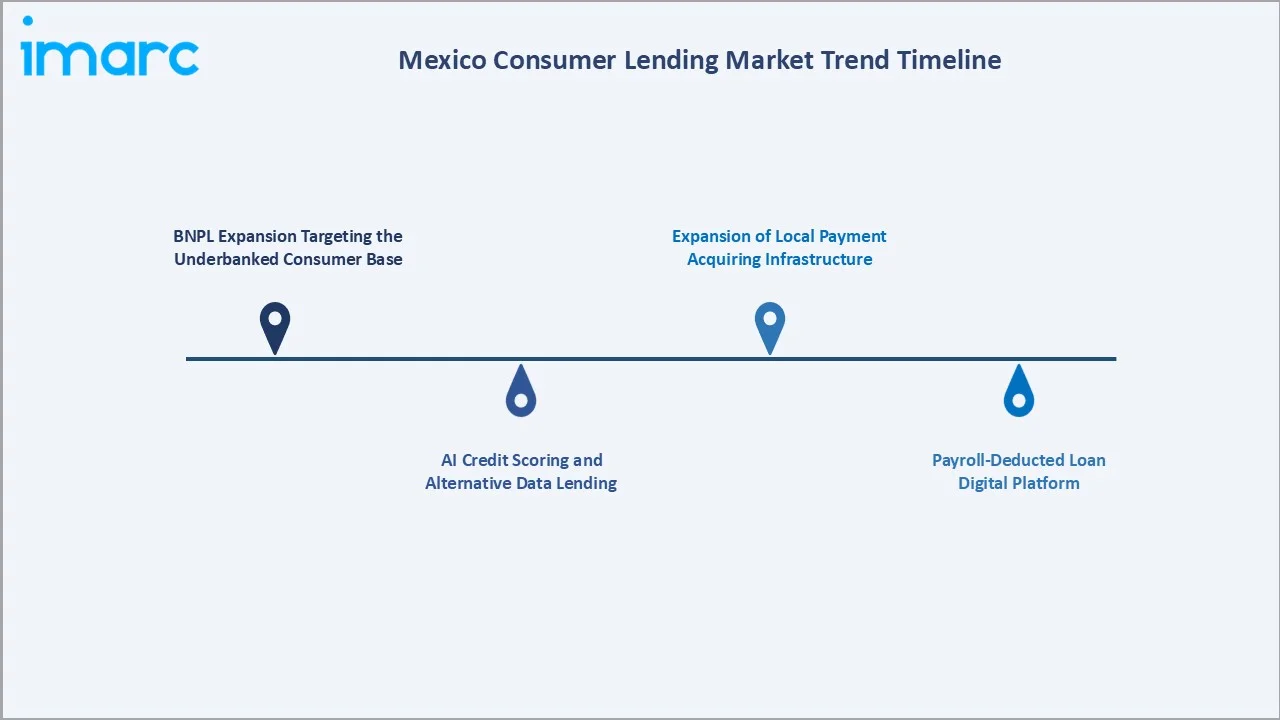
BNPL expansion targeting underbanked consumers is emerging as it offers interest-free installment credit without requiring a traditional credit card. This model helps fintech lenders and merchants reach consumers with limited access to formal financial products. In June 2025, EBANX merchants launched Aplazo in Mexico. Aplazo is a risk-free Buy Now, Pay Later (BNPL) solution that allows consumers to split purchases into interest-free installments without requiring a credit card. The solution also helps merchants increase average ticket sizes by 35% and reach underserved consumers, as 70% of Aplazo users lack access to other financial products. As digital commerce grows, BNPL is becoming an important embedded lending channel for financial inclusion and retail-driven credit growth.
2. AI Credit Scoring and Alternative Data Lending
AI credit scoring and alternative data lending are emerging as lenders seek to assess borrowers beyond traditional credit bureau records. Fintech platforms are using data such as mobile usage, digital payments, transaction history, employment patterns, and e-commerce behavior to evaluate thin-file and underbanked consumers. This improves loan approval speed, expands access to formal credit, and enables more personalized risk-based pricing. The trend is also helping lenders reduce manual underwriting costs while improving portfolio monitoring and fraud detection.
3. Expansion of Local Payment Acquiring Infrastructure
Expansion of local payment acquiring infrastructure, improving digital payment acceptance and transaction reliability for merchants. Local acquiring enables higher approval rates, faster settlement, and richer transaction-level data, which can support better credit underwriting. In April 2026, Nuvei launched direct acquiring in Mexico, allowing businesses to process card payments locally through its licensed payment infrastructure. This move supports Nuvei’s strategy of operating directly within domestic payment ecosystems, helping merchants improve approval rates, gain better transaction visibility, and simplify cross-market payment management through a single platform. As payment infrastructure becomes more localized, it strengthens embedded finance, BNPL, and data-driven lending opportunities across Mexico.
4. Payroll-Deducted Loan Digital Platform
Payroll-deducted loan digital platforms combine salary-linked repayment security with fast digital access. These platforms allow borrowers to apply online, receive quicker approvals, and repay loans directly through payroll deductions. For lenders, this reduces default risk, improves collection efficiency, and supports more predictable cash flows. The trend is gaining traction among formally employed consumers seeking convenient, lower-risk personal credit solutions.
Industry Value Chain Analysis
Mexico consumer lending value chain integrates capital funding and liquidity, customer acquisition and distribution, credit assessment and underwriting, loan origination and disbursement, loan servicing and portfolio management, and collections, recovery and refinancing.
|
Stage |
Key Participants |
|
Capital Funding and Liquidity |
Commercial banks, depositors, institutional investors, capital markets, development finance institutions |
|
Customer Acquisition and Distribution |
Bank branches, fintech platforms, digital channels, brokers, retailers, payroll partners |
|
Credit Assessment and Underwriting |
Credit bureaus, AI/analytics providers, KYC/AML providers, risk management teams, and underwriting departments |
|
Loan Origination and Disbursement |
Banks, NBFCs, fintech lenders, BNPL providers, payment gateways, core lending platforms |
|
Loan Servicing and Portfolio Management |
Loan servicing companies, CRM providers, payment processors, customer support teams, and portfolio managers |
|
Collections, Recovery and Refinancing |
Collection agencies, legal service providers, debt buyers, refinancing lenders, credit monitoring and recovery specialists |
Credit assessment and underwriting are the most value-added stage in the Mexico consumer lending value chain. This stage determines borrower eligibility, loan pricing, credit limits, and repayment terms using credit bureau data, AI-driven risk models, and alternative data analytics. Accurate underwriting helps lenders minimize defaults, improve portfolio quality, and accelerate loan approvals while expanding access to thin-file and underbanked consumers. As digital lending grows, advanced underwriting capabilities have become a key competitive differentiator for banks and fintech lenders.
Technology Landscape in the Mexico Consumer Lending Industry
Credit Scoring and AI Technology
Credit scoring and AI technology enable faster, more accurate borrower assessment. Lenders are using machine learning models, credit bureau data, transaction history, and alternative data to evaluate thin-file and underbanked customers. This improves approval speed, supports risk-based pricing, and reduces manual underwriting costs. AI also helps strengthen fraud detection, portfolio monitoring, and early warning systems for delinquency risk.
Cashback and Rewards Management Technology
Cashback and rewards management technology helps lenders link credit products with personalized incentives and usage-based benefits. Digital rewards engines track customer spending, calculate cashback, and automate redemption within cards or lending apps. In May 2026, Uber, Klar, and Mastercard launched the Uber Card operated by Klar in Mexico, making the country Uber’s first global market for a fully integrated financial product within its mobility and delivery ecosystem. The co-branded credit card targets Uber’s 25 million annual active users in Mexico by offering cashback rewards, interest-free installments, and credit lines of up to MX$250,000 (US$14,453). This improves customer engagement, repeat usage, and card activation rates.
Data Analytics for Portfolio Monitoring and Collections
Data analytics for portfolio monitoring and collections helps lenders track borrower behavior, repayment patterns, and early delinquency signals in real time. Advanced analytics enables lenders to segment customers by risk, prioritize collections, and design personalized repayment solutions. It also improves portfolio quality by identifying stress indicators before loans become non-performing. As lending volumes grow, analytics-driven monitoring is becoming essential for reducing losses and improving collection efficiency.
Market Segmentation Analysis
The report covers the following segments:
|
Segment Category |
Leading Segment |
Market Share |
Year |
|
Type |
Personal Loans |
38.7% |
2025 |
|
Application |
Individual Use |
63.2% |
2025 |
|
Region |
Central Mexico |
45.1% |
2025 |

By Type
Personal loans lead at 38.7% (2025), through payroll-deducted loans, unsecured personal loans, digital personal loans, and government employee loans. Credit cards at 27.4% grow fastest at ~5.8% CAGR, supporting everyday purchases, online transactions, emergency spending, and interest-free installment options. Rising digital payments, cashback rewards, and fintech-bank card partnerships are further boosting card adoption across Mexico.
To access detailed market analysis, Request Sample
Home/mortgage loans at 18.6% reflect growing demand for residential property ownership, supported by urbanization, rising household incomes, and expanded access to long-term housing finance. Auto lease at 10.9%. Others at 4.4% include student loans, microfinance, and personal credit lines.
By Application
Individual use leads at 63.2% (2025), through personal consumption loans, education and healthcare finance, travel credit card spending, and individual digital fintech.
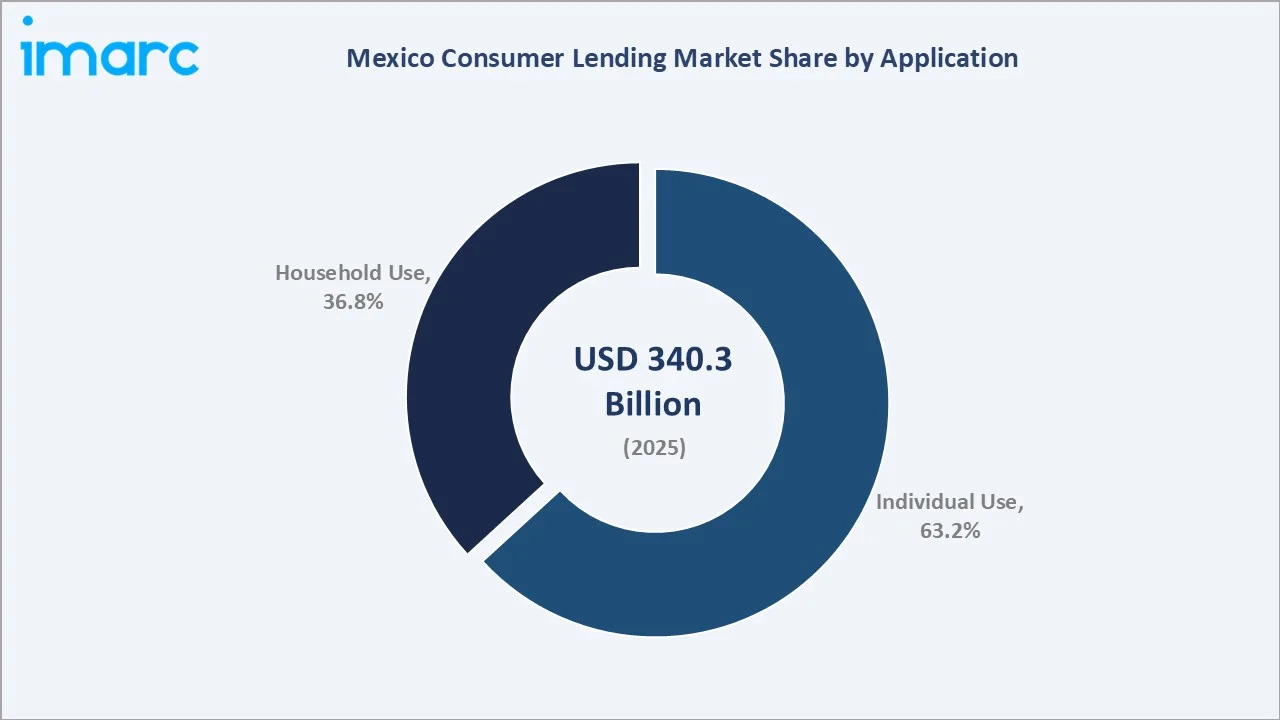
Household use at 36.8% reflects home mortgage, auto lease for household transportation, durable goods, and home improvement credit.
Regional Market Insights
|
Region |
Share (2025) |
Key Mexico Consumer Lending Market Drivers & Characteristics |
|
Central Mexico |
45.1% |
Driven by high population density, strong banking penetration, higher formal employment, and the concentration of financial institutions, fintech companies, and digital lending platforms in Mexico City and surrounding states. |
|
Northern Mexico |
31.8% |
Reflects robust consumer credit demand supported by export-oriented industries, higher household incomes, cross-border trade activity, and widespread use of payroll loans, credit cards, and auto financing. |
|
Southern Mexico |
18.9% |
Reflects gradually expanding financial inclusion, rising smartphone adoption, growing fintech presence, and increasing access to personal loans and digital consumer credit in underserved communities. |
|
Others |
4.2% |
Others, including the Bajío region, the Yucatán Peninsula, and the Gulf Coast, contribute through expanding regional banking networks, SME development, tourism-led economic activity, and increasing adoption of digital lending solutions. |
Central Mexico's 45.1% dominance is supported by the country's largest concentration of population, formal employment, financial institutions, and corporate activity, particularly in Mexico City and the surrounding metropolitan areas. Northern Mexico's 31.8% follows with strong lending demand driven by higher household incomes, export-oriented manufacturing, and cross-border economic integration with the United States, resulting in significant use of personal loans, credit cards, and auto financing.
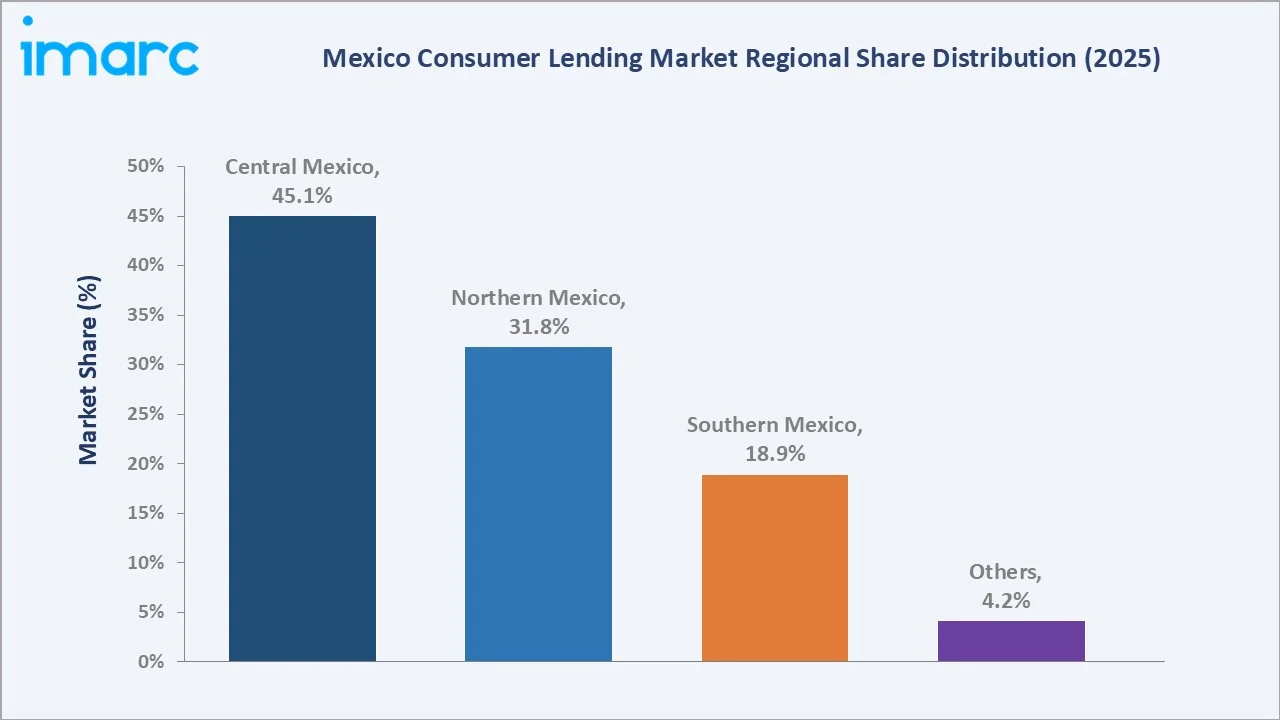
Southern Mexico's 18.9% is witnessing steady growth as financial inclusion initiatives, fintech expansion, and digital lending platforms improve access to formal credit for previously underserved consumers. Others at 4.2% include the Bajío region, Yucatán Peninsula, and Gulf Coast, which are emerging as attractive lending markets due to expanding banking networks, SME development, tourism, and rising adoption of digital financial services.
Competitive Landscape
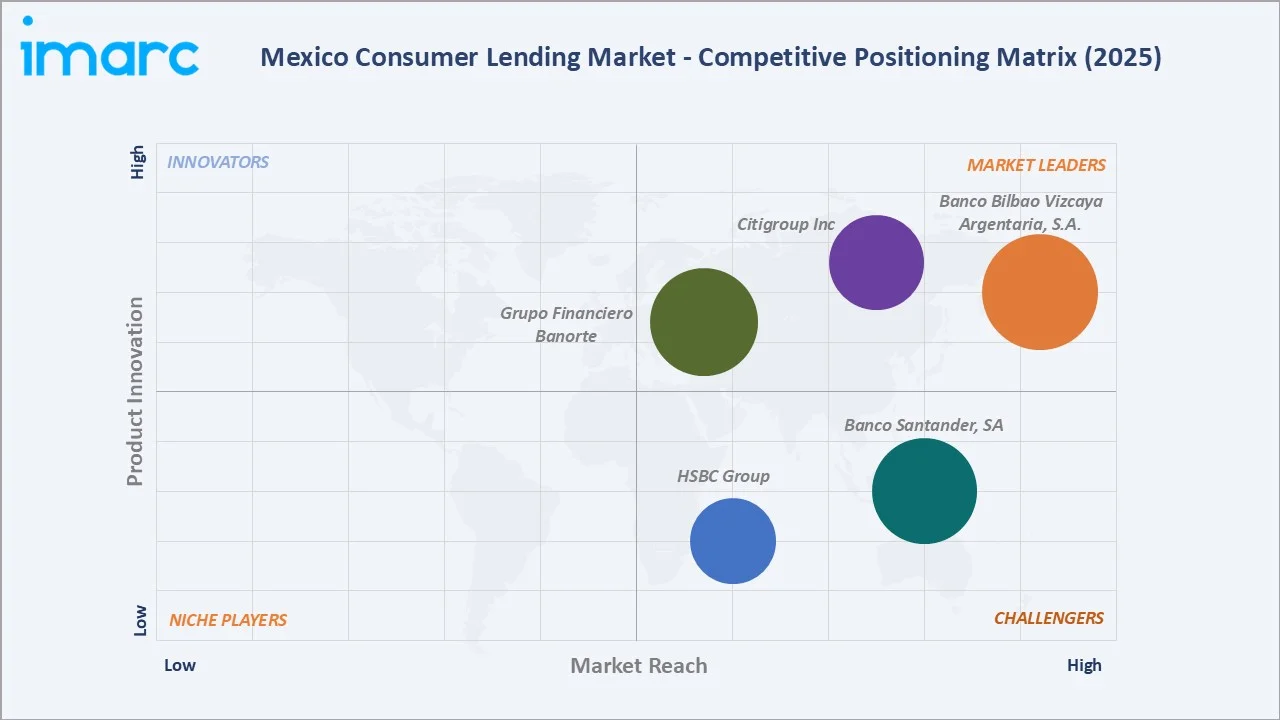
The Mexico consumer lending market is moderately competitive, with banks, fintech lenders, NBFCs, credit unions, payroll lenders, and BNPL providers competing across product segments. Traditional banks lead in credit cards, mortgages, auto loans, and payroll-linked lending due to strong funding access and branch networks. Fintech firms are gaining share through app-based onboarding, faster approvals, alternative credit scoring, and embedded finance partnerships.
|
Company |
Key Services |
Market Position |
Core Strength |
|
Banco Bilbao Vizcaya Argentaria, S.A. |
Mortgages, Auto Financing, Credit Cards, and Personal Loans |
Market Leader |
Banco Bilbao Vizcaya Argentaria, S.A. operates as the leading financial institution in Mexico through its subsidiary, BBVA México. It holds a massive market share in the country, playing a critical role in consumer lending across mortgages, auto financing, credit cards, and personal loans. |
|
Citigroup Inc |
Credit Cards, Checking Accounts, Mortgage, Personal Loans |
Market Leader |
Citigroup Inc. is in the final stages of a complete exit from Mexico's consumer lending market. The bank previously operated its consumer lending, including credit cards, mortgages, and personal loans, through its iconic subsidiary Banamex. |
|
Grupo Financiero Banorte |
Credit And Debit Cards, Mortgages, Car Loans, Payroll and Personal Loans, Payroll Dispersion Accounts, Car, Home and Life Insurance |
Market Leader |
Grupo Financiero Banorte is one of Mexico's largest financial groups and the country’s largest domestically controlled bank. It plays a crucial role in domestic consumer lending, acting as a primary driver of retail financial inclusion, auto finance, and payroll lending across the Mexican economy. |
|
Banco Santander, SA |
Fast Online Loan, Car loan, Santander Personal Loan, Sustainable Consumption Loan, Salary Advance Loan |
Strong Challenger |
Banco Santander, SA operates as a leading universal bank in Mexico, primarily driving consumer lending through its local subsidiary, Banco Santander México. Its role is foundational, focusing on expanding consumer access to credit, auto loans, mortgages, and digital banking services for millions of individuals across the country. |
|
HSBC Group |
HSBC Premier Mortgage, HSBC Premier Visa Infinite Debit Card, Loans |
Strong Challenger |
HSBC Group's role in Mexico's consumer lending sector (operated primarily via HSBC México) focuses on high-net-worth premier clients and formal-economy workers to balance profitability with controlled risk. |
Competition is intensifying as payment companies, retailers, and digital platforms enter lending through co-branded cards, BNPL, and installment credit. Key players are focusing on risk-based pricing, digital servicing, loyalty rewards, and underbanked consumer acquisition to strengthen market presence.
Key Company Profiles
Banco Bilbao Vizcaya Argentaria, S.A.
Banco Bilbao Vizcaya Argentaria, S.A. (BBVA), through BBVA México, is one of the largest financial institutions in Mexico and a leading provider of consumer lending products. The bank offers a comprehensive portfolio that includes personal loans, credit cards, payroll loans, mortgages, auto loans, and digital credit solutions for retail customers. Leveraging its extensive branch network alongside advanced digital banking platforms, BBVA serves millions of consumers across the country.
- Key Services: Mortgages, Auto Financing, Credit Cards, and Personal Loans.
- Recent Developments: In May 2025, BBVA Chair Carlos Torres Vila announced an expanded investment plan for Mexico at the RNCR, committing more than 100 billion pesos by 2030, or around €4.57 billion. He described the investment as a long-term commitment to Mexico and to the bank’s more than 30 million customers in the country.
- Strategic Focus: Expanding digital-first credit products, strengthening mobile banking adoption, and improving customer personalization. The bank is investing in data analytics, AI-based underwriting, and automated loan approval systems to accelerate credit access while managing risk.
Grupo Financiero Banorte
Grupo Financiero Banorte is one of Mexico’s largest domestically owned financial institutions and a leading provider of consumer lending solutions. The company offers a broad portfolio that includes personal loans, payroll loans, credit cards, mortgages, auto loans, and consumer financing through its nationwide branch and digital banking network. Banorte serves retail customers, businesses, and government entities, leveraging strong domestic market presence and an expanding digital ecosystem.
- Key Services: Credit And Debit Cards, Mortgages, Car Loans, Payroll and Personal Loans, Payroll Dispersion Accounts, Car, Home and Life Insurance.
- Recent Developments: In January 2024, Grupo Financiero Banorte launched bineo, a new digital bank designed to offer savings accounts and personal loans. Through this platform, Banorte aims to expand its digital customer base by attracting 2.8 million new clients over the next five years.
- Strategic Focus: Strengthening its domestic retail banking franchise through digital transformation and customer-centric credit products. The bank is expanding personal loans, payroll loans, credit cards, mortgages, and auto financing while improving mobile and online lending capabilities.
Market Concentration Analysis
The Mexico consumer lending market is moderately concentrated, with major banks holding strong positions in credit cards, payroll loans, mortgages, and personal lending. Large banks benefit from broad branch networks, low-cost funding, trusted brands, and established risk management systems. However, fintech lenders, BNPL platforms, digital banks, and payroll-deducted loan providers are gradually reducing concentration by targeting younger and underbanked borrowers. Competition is especially increasing in unsecured personal loans, app-based credit, and embedded finance. Overall, the market remains bank-led but is becoming more fragmented as digital lending adoption expands.
Investment & Growth Opportunities
Highest Growth Segments
Credit card BNPL (~5.8% CAGR), personal loans digital (~5.3% CAGR through fintech), Northern Mexico payroll (~5.5% CAGR), open banking API (~7% CAGR from growing base), microfinance digital (~6% CAGR), and AI credit scoring unbanked (~8% CAGR from emerging) represent Mexico consumer lending highest-growth investment vectors through 2034.
Investment Themes
- Fintech BNPL digital personal loan: Investment in BNPL and digital personal lending platforms is accelerating as consumers seek instant, app-based credit with simplified onboarding, flexible repayment options, and embedded finance integrated into e-commerce and digital ecosystems.
- AI credit scoring for the unbanked: AI-powered credit scoring using alternative data such as payment behavior, mobile usage, and transaction history is creating opportunities to extend formal credit to underbanked and thin-file consumers while improving lending accuracy and reducing default risk.
Future Market Outlook (2026-2034)
Mexico consumer lending market is projected to grow from USD 340.3 Billion in 2025 to USD 362.5 Billion in 2026, reaching USD 539.4 Billion by 2034, delivering a 5.09% CAGR over the forecast period through growing middle class formal employment, housing mortgage structural demand, fintech BNPL and neobank disruption, open banking API, and AI credit scoring for unbanked. The market's anchor value of USD 436.2 Billion in 2030 represents Mexico consumer lending at the fintech mainstream and open banking inflection.
Three structural forces define Mexico consumer lending growth through 2034. First, expanding middle-class incomes, formal employment, and urbanization are increasing demand for personal loans, credit cards, mortgages, and other retail credit products. Second, rapid fintech innovation, AI-driven credit scoring, open banking, and mobile-first lending platforms are broadening access to credit, particularly for underbanked consumers. Third, the expansion of embedded finance, BNPL solutions, payroll-linked lending, and digital payment ecosystems is transforming how consumers access and use credit, creating a more inclusive and technology-driven lending market.
Research Methodology
Primary Research
Primary research comprised interviews with banks, fintech lenders, NBFCs, credit bureaus, payment processors, and industry experts operating in Mexico’s consumer lending ecosystem. It included discussions with loan officers, risk managers, digital lending platforms, and collection agencies to understand borrower demand, underwriting practices, credit risk, and product adoption. Consumer-side inputs were gathered from salaried workers, digital borrowers, credit card users, and underbanked households.
Secondary Research
Secondary research encompassed company reports, bank disclosures, fintech announcements, regulatory publications, industry databases, and government statistics. It also reviewed data on consumer credit, digital payments, financial inclusion, interest rates, and household borrowing trends in Mexico. Public sources, news releases, and market intelligence platforms were used to track product launches, partnerships, and competitive activity.
Forecasting Models
Forecasting models combined historical consumer lending trends with macroeconomic indicators, including GDP growth, inflation, policy interest rates, employment, disposable income, and household consumption. The analysis incorporated lending penetration, digital credit adoption, financial inclusion, and fintech expansion to estimate future demand. Market forecasts also considered regulatory developments, credit risk trends, and evolving consumer borrowing behavior across lending segments. A triangulation approach using primary research, secondary data, and statistical modeling was applied to ensure robust and reliable market projections through 2034.
Mexico Consumer Lending Market Report Coverage:
| Report Features | Details |
|---|---|
| Base Year of the Analysis | 2025 |
| Historical Period | 2020-2025 |
| Forecast Period | 2026-2034 |
| Units | Billion USD |
| Scope of the Report | Exploration of Historical Trends and Market Outlook, Industry Catalysts and Challenges, Segment-Wise Historical and Future Market Assessment:
|
| Types Covered | Personal Loans, Credit Card, Auto Lease, Home/ Mortgage Loans, Others |
| Applications Covered | Individual Use, Household Use |
| Regions Covered | Northern Mexico, Central Mexico, Southern Mexico, Others |
| Companies Covered | Banco Bilbao Vizcaya Argentaria, S.A., Citigroup Inc, Grupo Financiero Banorte, Banco Santander, SA, HSBC Group, etc. |
| Customization Scope | 10% Free Customization |
| Post-Sale Analyst Support | 10-12 Weeks |
| Delivery Format | PDF and Excel through Email (We can also provide the editable version of the report in PPT/Word format on special request) |
Key Benefits for Stakeholders:
- IMARC’s industry report offers a comprehensive quantitative analysis of various market segments, historical and current market trends, market forecasts, and dynamics of the Mexico consumer lending market from 2020-2034.
- The research report provides the latest information on the market drivers, challenges, and opportunities in the Mexico consumer lending market.
- Porter's five forces analysis assist stakeholders in assessing the impact of new entrants, competitive rivalry, supplier power, buyer power, and the threat of substitution. It helps stakeholders to analyze the level of competition within the Mexico consumer lending industry and its attractiveness.
- Competitive landscape allows stakeholders to understand their competitive environment and provides an insight into the current positions of key players in the market.
Frequently Asked Questions About the Mexico Consumer Lending Market Report
The Mexico consumer lending market size is estimated at USD 362.5 Billion in 2026, driven by rising household income, expanding middle-class credit demand, and growing use of personal loans, credit cards, payroll loans, and mortgages. Rapid fintech adoption, BNPL growth, digital lending platforms, and AI-based credit assessment are further expanding access to formal credit among underbanked consumers.
The Mexico consumer lending market grows at 5.09% CAGR during 2026-2034, reaching USD 539.4 Billion by 2034. The CAGR reflects growing middle class, mortgage, fintech BNPL neobank, open banking CNBV, and AI credit scoring structural demand.
Personal loans lead at 38.7% due to their flexible use for emergencies, household expenses, debt consolidation, education, and small purchases. Faster digital approvals and wider fintech participation are further boosting adoption among salaried and underbanked consumers.
Individual use leads at 63.2% as consumers increasingly rely on credit for daily expenses, education, healthcare, home improvement, travel, and debt consolidation. Rising financial inclusion, digital lending platforms, and easier access to personal credit continue to support strong demand from individual borrowers.
Central Mexico leads at 45.1% due to its high population density, strong formal employment base, and concentration of banks, fintech firms, and financial institutions. Mexico City and surrounding states drive strong demand for personal loans, credit cards, mortgages, and digital lending products.
Leading companies include Banco Bilbao Vizcaya Argentaria, S.A., Citigroup Inc, Grupo Financiero Banorte, Banco Santander, SA, and HSBC Group, among others.
The market is projected to reach approximately USD 436.2 Billion by 2030, driven by rising household borrowing, expanding middle-class incomes, and increasing demand for personal loans, credit cards, mortgages, and digital lending products. Continued fintech innovation, financial inclusion initiatives, and AI-enabled credit assessment are expected to sustain long-term market growth.
Three priority investment opportunities are emerging in Mexico's consumer lending market. First, fintech-led BNPL and digital personal lending platforms offer strong growth potential as consumers increasingly prefer instant, app-based credit solutions. Second, AI-powered credit scoring and alternative data analytics enable lenders to profitably serve underbanked and thin-file borrowers while improving risk management. Third, payroll-linked digital lending and embedded finance partnerships with e-commerce, mobility, and payment platforms are creating scalable distribution channels and expanding access to consumer credit across Mexico.
Need more help?
- Speak to our experienced analysts for insights on the current market scenarios.
- Include additional segments and countries to customize the report as per your requirement.
- Gain an unparalleled competitive advantage in your domain by understanding how to utilize the report and positively impacting your operations and revenue.
- For further assistance, please connect with our analysts.
 Request Customization
 Speak to an Analyst
 Request Brochure
 Inquire Before Buying
Benefits of Customization
- Personalize this research
- Triangulate with your data
- Get data as per your format and definition
- Gain a deeper dive into a specific application, geography, customer, or competitor
- Any level of personalization
Get in Touch With Us
UNITED STATES
Phone: +1-201-971-6302
INDIA
Phone: +91-120-433-0800
UNITED KINGDOM
Phone: +44-753-714-6104
Email: [email protected]
Client Testimonials




.webp)




.webp)













Related Reports

Choose your plan
*Please note that the prices mentioned below are starting prices for each bundle type. Kindly contact our team for further details.*
Single User License
- 1 User License, Access on 2 Devices
- PDF Report + Excel Dataset (Password Protected)
- Lifetime Access
- No Printing Rights
- 10% Free Report Customization
- 10–12 Weeks of Analyst Support
Five User License
- Access for 5 Users, 2 Devices per User
- PDF Report + Excel Dataset (Password Protected)
- Lifetime Access
- Dedicated Account Manager
- 12–14 Weeks of Analyst Support
- No Printing Rights
- 15% Free Report Customization
- 25% Discount on Your Next Purchase
Corporate User License
- Unlimited User Access (Within Your Organization)
- PDF Report + Excel Dataset
- Lifetime Access
- Dedicated Account Manager
- 14–20 Weeks of Analyst Support
- No Printing Rights
- 20% Free Report Customization
- 30% Discount on Your Next Purchase
Essential Insights
What's included:
3 reports
- Lifetime Access
- PDF Reports
- Excel Datasets
- 2 Weeks of Free Analyst Support
- 2 User Licenses
- Access on 2 Devices
- Printing Rights
- Complimentary PowerPoint (PPT) Version
- Complimentary License Upgrade
Professional Access
What's included:
5 reports
- Lifetime Access
- PDF Reports
- Excel Datasets
- 8 Weeks of Free Analyst Support
- 2 User Licenses
- Access on 2 Devices
- Printing Rights
- Complimentary PowerPoint (PPT) Version
- Complimentary License Upgrade
Business Advantage
What's included:
8 reports
- Lifetime Access
- PDF Reports
- Excel Datasets
- 14 Weeks of Free Analyst Support
- 2 User Licenses
- Access on 2 Devices
- Printing Rights
- Complimentary PowerPoint (PPT) Version
- Complimentary License Upgrade
Enterprise Intelligence
What's included:
10 reports
- Lifetime Access
- PDF Reports
- Excel Datasets
- 20 Weeks of Free Analyst Support
- 2 User Licenses
- Access on 2 Devices
- Printing Rights
- Complimentary PowerPoint (PPT) Version
- Complimentary License Upgrade