
Mexico Digital OOH Advertising Market Size, Share, Trends and Forecast by Format Type, Application, End Use Industry, and Region, 2026-2034
Mexico Digital OOH Advertising Market Size, Share, Trends & Forecast (2026-2034)
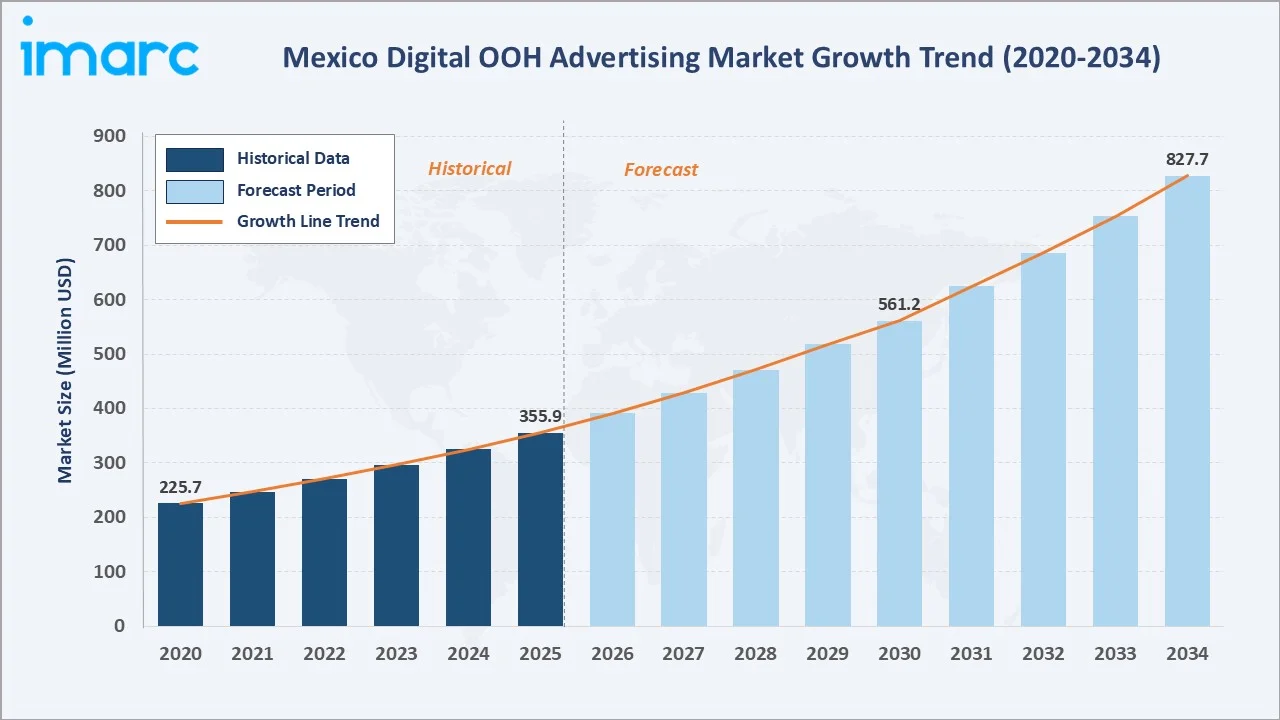
The Mexico digital OOH advertising market reached USD 355.9 Million in 2025 and is projected to reach USD 827.7 Million by 2034, growing at a CAGR of 9.54% during 2026-2034. Rising urbanization, smartphone penetration, improved digital infrastructure, growing demand for real-time audience analytics, and programmatic ad buying are propelling market growth.
Digital Billboards dominate at 43.8%, Outdoor application leads at 72.4%, and Central Mexico commands 46.3% regional share.
Market Snapshot
|
Metric |
Value |
|
Market Size (2025) |
USD 355.9 Million |
|
Forecast Market Size (2034) |
USD 827.7 Million |
|
CAGR (2026-2034) |
9.54% |
|
Base Year |
2025 |
|
Historical Period |
2020-2025 |
|
Forecast Period |
2026-2034 |
|
Dominant Format Type |
Digital Billboards (43.8%, 2025) |
|
Dominant Application |
Outdoor (72.4%, 2025) |
|
Leading Region |
Central Mexico (46.3%, 2025) |
The market expanded from USD 225.7 Million in 2020 to USD 355.9 Million in 2025, growing 58% in five years, anchored at USD 561.2 Million in 2030 and forecast to reach USD 827.7 Million by 2034. Programmatic adoption and smart-city LED infrastructure investment underpin the structural demand trajectory across urban corridors.
To get more information on this market, Request Sample
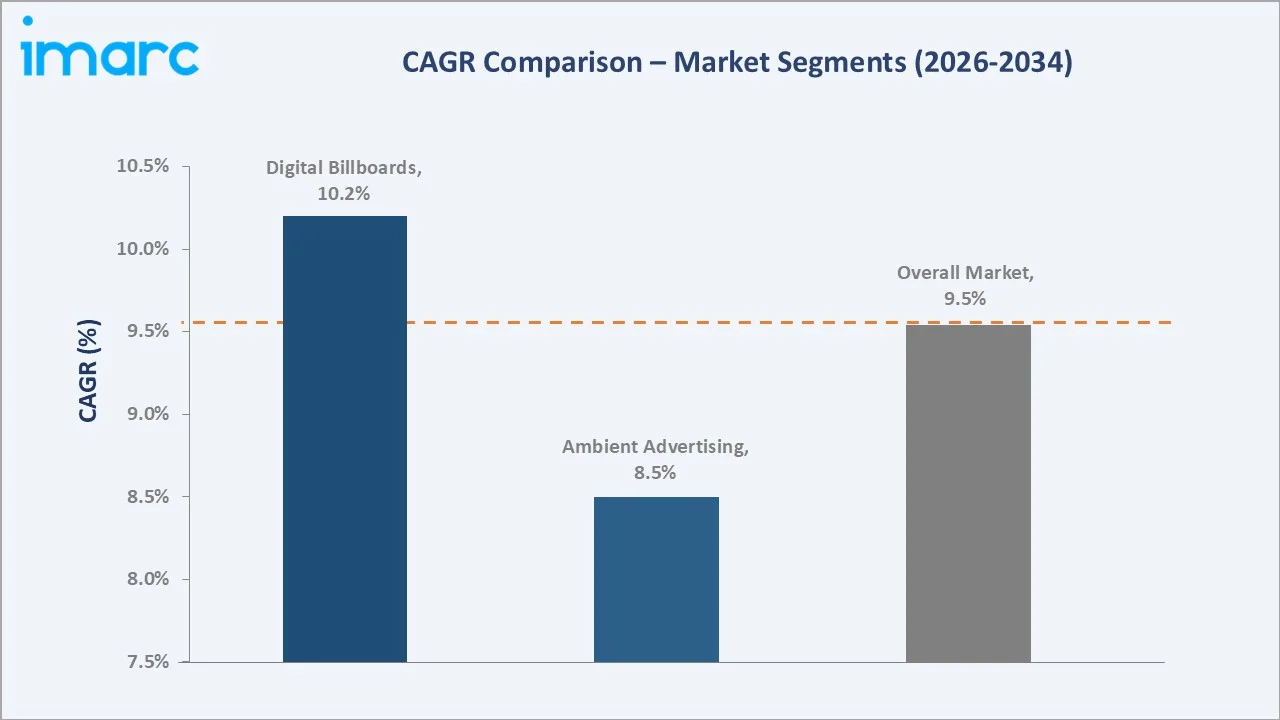
Digital Billboards grow at ~10.2% CAGR as programmatic integration and LED screen deployment accelerate across premium metropolitan corridors. Indoor application grows at ~9.2% CAGR driven by retail media network expansion at shopping centers, airports, and transit hubs.
Executive Summary
The Mexico digital OOH advertising market reached USD 355.9 Million in 2025, representing one of Latin America's highest-growth advertising technology markets driven by accelerating digital infrastructure, urbanization, and programmatic DOOH adoption across transit hubs, retail environments, and commercial corridors. The market is projected to reach USD 827.7 Million by 2034.
Digital Billboards at 43.8% dominate through high visibility, dynamic content capability, and advertiser ROI across premium outdoor placements in Mexico City, Guadalajara, and Monterrey. Outdoor application at 72.4% leads through transit corridors, street furniture, and billboard networks. Central Mexico at 46.3% commands regional leadership through economic concentration and advertising spend density.
Key Market Insights
|
Insight |
Data |
|
Dominant Format Type |
Digital Billboards - 43.8% share (2025) |
|
Dominant Application |
Outdoor - 72.4% market share (2025) |
|
Leading Region |
Central Mexico - 46.3% market share (2025) |
|
Market Opportunity |
Programmatic DOOH; AI-driven dynamic content; smart-city LED networks; transit advertising expansion; retail media convergence |
Key Analytical Observations Supporting the Above Data:
- Digital Billboards at 43.8%: Digital billboards dominate through premium outdoor placements at major intersections and transit nodes, superior daypart targeting versus static formats, and strong ROI for retail, FMCG, and telecom advertisers across Mexico's top metropolitan areas.
- Outdoor at 72.4%: Outdoor dominates as the established DOOH deployment environment encompassing roadside billboards, transit shelters, and street furniture in high-density urban corridors, capturing the largest share of advertiser spend and media owner inventory.
- Central Mexico at 46.3%: Central Mexico leads through Mexico City's status as the country's largest advertising market, Guadalajara's growing DOOH penetration, and concentration of premium digital inventory serving national and multinational brand advertisers.
Mexico Digital OOH Advertising Market Overview
The Mexico digital OOH advertising market encompasses the planning, procurement, and deployment of digitally connected out-of-home advertising formats across billboards, transit media, ambient environments, and indoor venues. The market integrates media owners, programmatic technology platforms, demand-side platforms, creative technology providers, and brand advertisers across retail, financial services, telecom, entertainment, and public sector verticals.
The ecosystem integrates global OOH media owners, domestic operators, programmatic supply-side platforms, data analytics providers, LED screen manufacturers, and regulatory bodies governing outdoor advertising. Macroeconomic factors include urbanization, rising smartphone penetration, improved 4G/5G connectivity, and brands' shift toward measurable, data-driven media strategies.
Market Dynamics
To evaluate market opportunities, Request Sample
Market Drivers
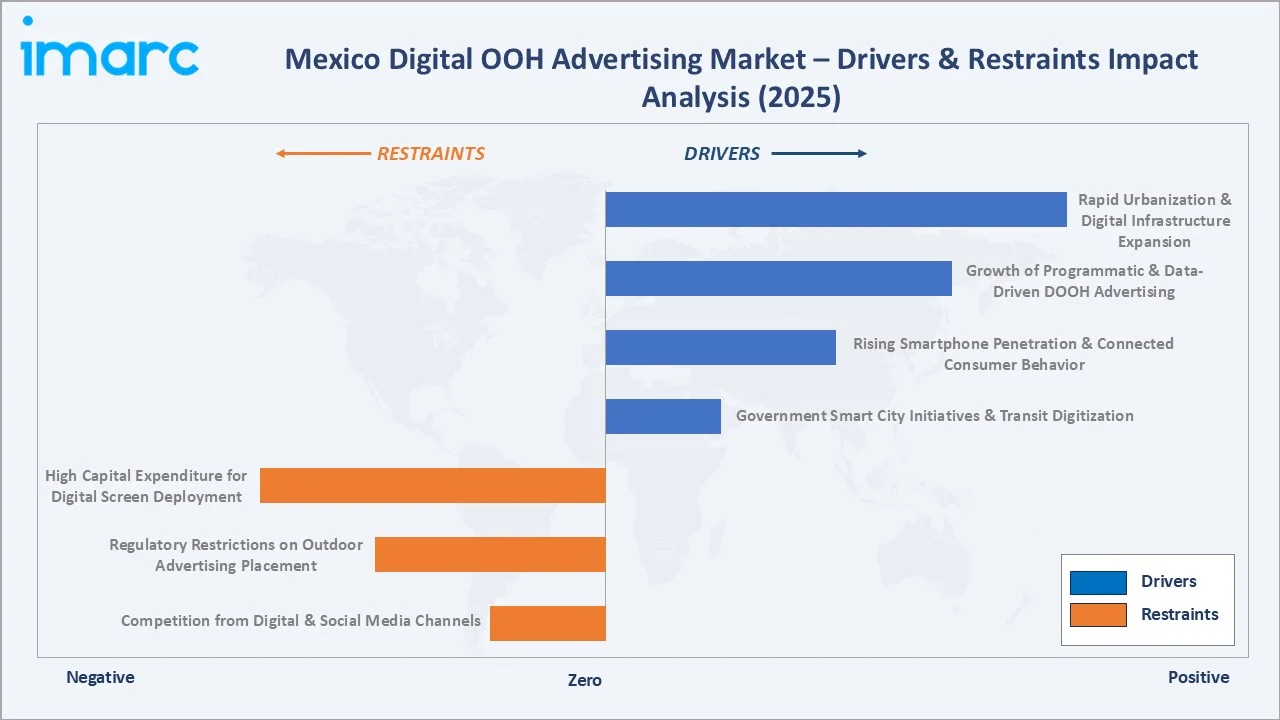
- Rapid Urbanization & Digital Infrastructure Expansion: Mexico's expanding urban population creates denser audience environments that amplify DOOH reach and campaign impact. Investment in transit infrastructure, retail developments, and smart-city programs is accelerating digital screen deployment at high-traffic locations, creating premium placement opportunities that drive advertiser demand for digital OOH formats.
- Growth of Programmatic & Data-Driven DOOH Advertising: Programmatic platforms enable automated, data-driven campaign delivery optimizing messaging by location, time, and audience demographics. Vistar Media's partnership with PRODOOH in April 2024 introduced programmatic DOOH to Latin America beginning in Mexico, demonstrating how automation is attracting digital advertising budgets into DOOH at scale.
- Rising Smartphone Penetration & Connected Consumer Behavior: Growing smartphone penetration enables DOOH campaigns to integrate with mobile retargeting, QR codes, and location-based audience triggers. As consumers spend more time in public spaces with mobile devices, DOOH becomes a compelling channel for reach and frequency building alongside digital media strategies.
- Government Smart City Initiatives & Transit Digitization: Federal and municipal government investment in smart-city infrastructure is digitizing transit hubs and urban public spaces across Mexico's major cities. Transit digitization programs in Mexico City and Monterrey are creating new premium DOOH inventory, expanding the addressable network for media owners and advertisers.
Market Restraints
- High Capital Expenditure for Digital Screen Deployment: The transition from static to digital OOH requires substantial investment in LED hardware, connectivity infrastructure, content management systems, and power supply. High upfront capital expenditure limits the pace of digital screen rollout, particularly outside Mexico's primary metropolitan markets, constraining addressable inventory growth.
- Regulatory Restrictions on Outdoor Advertising Placement: Municipal and federal regulations governing outdoor advertising size, illumination, and location restrict digital billboard deployment in certain corridors and heritage zones. Permitting complexity and zoning restrictions can delay network expansion, creating operational challenges for media owners seeking to scale digital OOH infrastructure.
- Competition from Digital & Social Media Advertising Channels: Digital and social media platforms compete for brand budgets that could otherwise be allocated to DOOH. As digital platforms offer granular audience targeting and real-time performance attribution, some advertisers reallocate spend away from OOH, creating pricing pressure on media owners and limiting overall market growth velocity.
Market Opportunities
- Programmatic DOOH Scale-Up Across Secondary Cities: Programmatic DOOH infrastructure expansion into Mexico's secondary metropolitan markets including Puebla, Leon, Tijuana, and Queretaro is creating new inventory for advertisers seeking national reach at competitive CPM rates, opening growth avenues for both media owners and technology platform providers.
- Retail Media Indoor DOOH Convergence: Retail chains and shopping centers are deploying indoor digital screens as retail media networks, creating new in-store DOOH inventory. This convergence is attracting FMCG, consumer electronics, and financial services advertisers seeking point-of-purchase influence at high-traffic retail environments across Mexico's major metropolitan areas.
Market Challenges
- Audience Measurement Standardization Across DOOH Formats: The absence of standardized audience measurement metrics across digital billboard, transit, and indoor DOOH formats creates planning complexity for advertisers and agencies. Inconsistent measurement methodologies limit DOOH's comparability with digital media, requiring the industry to develop unified attribution and ROI reporting standards to sustain advertiser investment growth.
- Content Relevance & Creative Optimization at Scale: Delivering contextually relevant, real-time creative across diverse DOOH screens, formats, and locations requires sophisticated content management infrastructure and data integration. As programmatic buying scales, advertisers face growing complexity in optimizing dynamic creative content efficiently across fragmented digital OOH inventory pools.
Emerging Market Trends
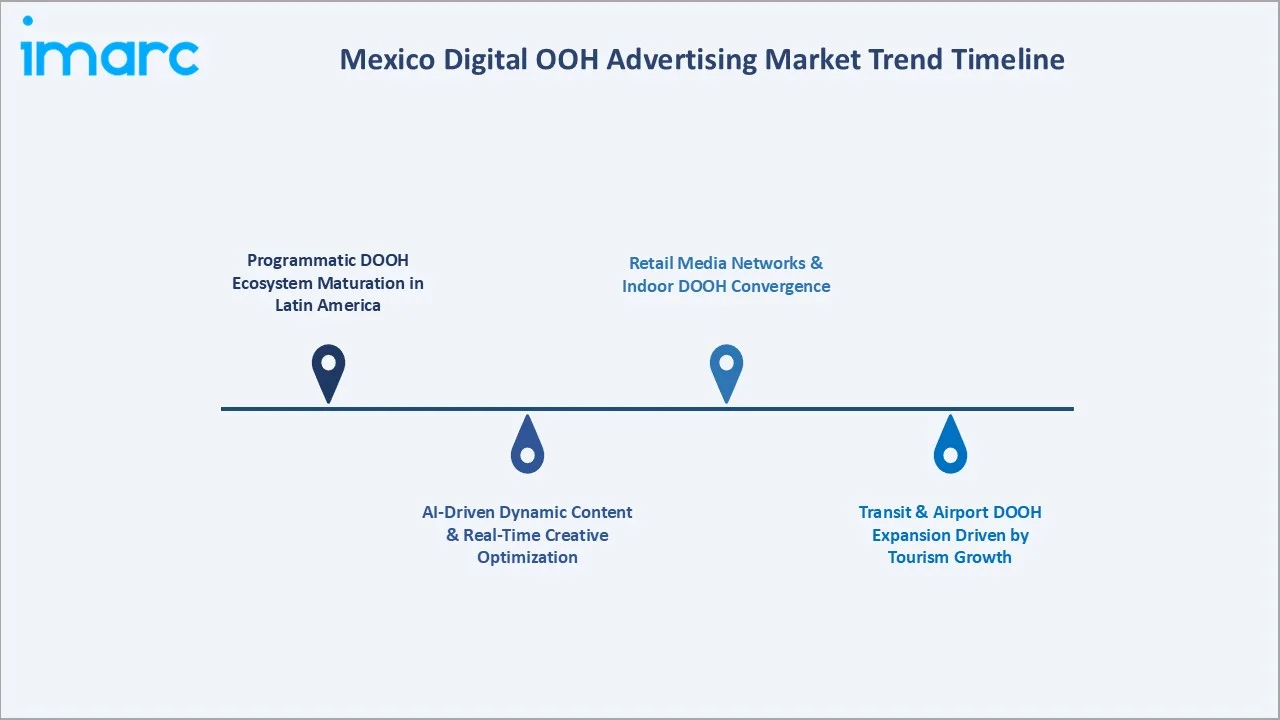
1. Programmatic DOOH Ecosystem Maturation in Latin America
Mexico is emerging as Latin America's programmatic DOOH pioneer following Vistar Media and PRODOOH's 2024 partnership, which introduced demand-side platform access for automated DOOH buying across the country. As SSP-DSP integrations deepen, programmatic DOOH is shifting from niche to mainstream buying methodology, enabling more advertisers to access premium inventory through automated platforms.
2. AI-Driven Dynamic Content & Real-Time Creative Optimization
AI-powered content management systems are enabling DOOH screens to dynamically adapt creative based on real-time signals including weather, footfall, time-of-day, and audience demographic data. This capability is transforming DOOH from static digital signage into a responsive, contextually relevant advertising medium that improves campaign performance and advertiser ROI.
3. Transit & Airport DOOH Expansion Driven by Tourism Growth
Mexico received 45.04 million international tourists in 2024, a 7.4% annual increase, amplifying demand for premium airport and transit DOOH formats. Monterrey International Airport's installation of 29 Direct View LED video walls in 2024 exemplifies the accelerating transit digitization investment creating high-value OOH inventory at airports and transportation hubs.
4. Retail Media Networks & Indoor DOOH Convergence
Retail chains and shopping centers are deploying indoor digital screens as retail media networks, creating new in-store DOOH inventory attracting FMCG and consumer electronics advertisers. The convergence of retail media and indoor DOOH is expanding the application segment beyond traditional outdoor environments, driving Indoor's faster growth relative to the overall market.
Industry Value Chain Analysis
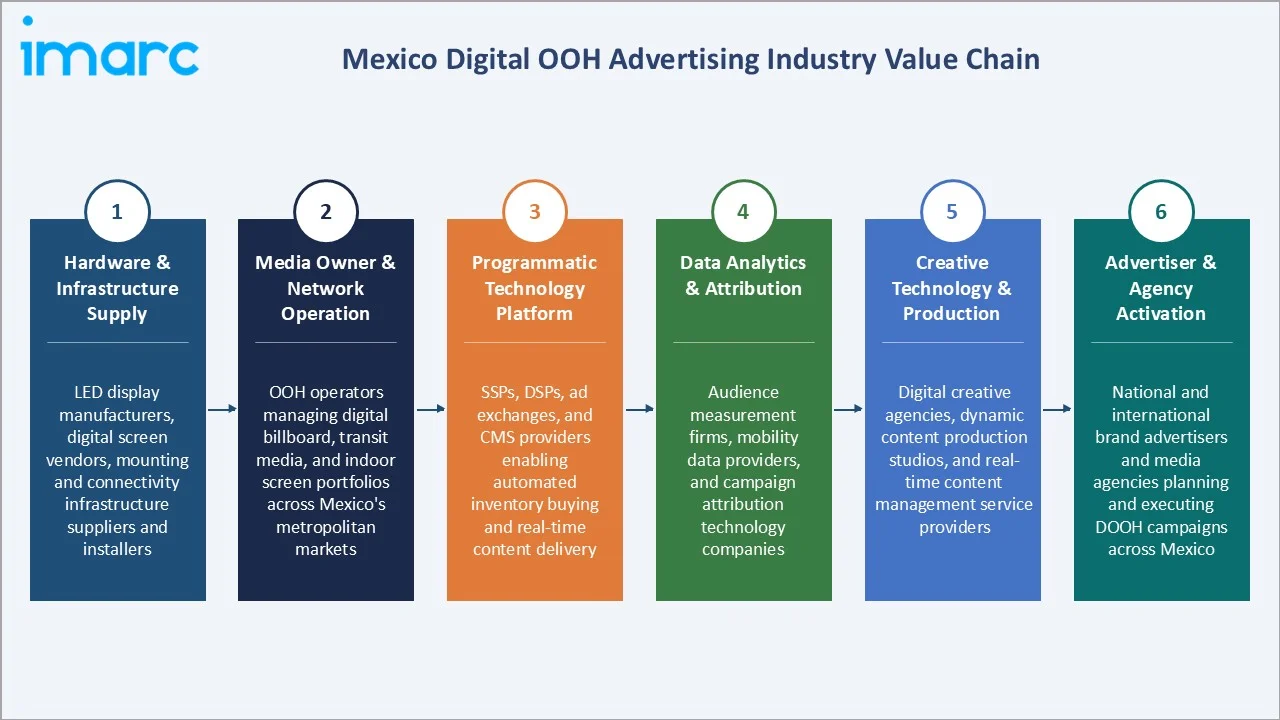
The Mexico digital OOH advertising value chain integrates hardware supply, media owner inventory management, programmatic technology, data analytics, brand activation, and regulatory compliance across urban and transit environments. The commercial architecture is consolidating toward integrated programmatic ecosystems combining inventory, data, and measurement in unified platforms.
|
Stage |
Key Participants |
|
Hardware & Infrastructure Supply |
LED display manufacturers, digital screen vendors, mounting and connectivity infrastructure suppliers and installers |
|
Media Owner & Network Operation |
OOH operators managing digital billboard, transit media, and indoor screen portfolios across Mexico's metropolitan markets |
|
Programmatic Technology Platform |
SSPs, DSPs, ad exchanges, and CMS providers enabling automated inventory buying and real-time content delivery |
|
Data Analytics & Attribution |
Audience measurement firms, mobility data providers, and campaign attribution technology companies |
|
Creative Technology & Production |
Digital creative agencies, dynamic content production studios, and real-time content management service providers |
|
Advertiser & Agency Activation |
National and international brand advertisers and media agencies planning and executing DOOH campaigns across Mexico |
The media owner and network operation tier remains the value chain's most commercially critical stage, as premium outdoor inventory scarcity creates durable competitive advantages for established operators. The programmatic technology platform tier is experiencing the most rapid transformation as SSP-DSP integration progressively automates inventory buying across Mexico's digital OOH networks.
Technology Landscape in the Mexico Digital OOH Advertising Industry
Programmatic DOOH Technology
Programmatic DOOH technology enables automated, auction-based buying of outdoor digital inventory through demand-side platforms integrated with supply-side platforms. In Mexico, programmatic DOOH adoption is accelerating as Vistar Media, PRODOOH, and JCDecaux integrate DSP-SSP technology, enabling brands to deliver targeted campaigns across digital billboard and transit screen networks with measurable attribution.
AI-Powered Content Management Systems
AI-powered CMS platforms enable real-time dynamic content delivery based on audience, weather, and contextual data signals. These systems allow advertisers to automate creative rotation, optimize daypart messaging, and maximize relevance across digital screen networks. AI-driven CMS adoption is expanding across Mexico's leading DOOH operators, improving campaign measurability and advertiser ROI.
LED & Direct View Display Technology
Advanced LED and Direct View LED display technology enables higher-resolution, higher-brightness, and energy-efficient digital OOH screens suited to Mexico's varied outdoor conditions. In May 2024, Monterrey International Airport collaborated with Peerless-AV, Absen, and POP Media Technology to install 29 Direct View LED video walls, demonstrating growing adoption of premium LED technology in transit environments.
Market Segmentation Analysis
The report covers the following segments:
|
Segment Category |
Leading Segment |
Market Share |
Year |
|
Format Type |
Digital Billboards |
43.8% |
2025 |
|
Application |
Outdoor |
72.4% |
2025 |
|
End Use Industry |
🔒 |
🔒 |
2025 |
|
Region |
Central Mexico |
46.3% |
2025 |

By Format Type
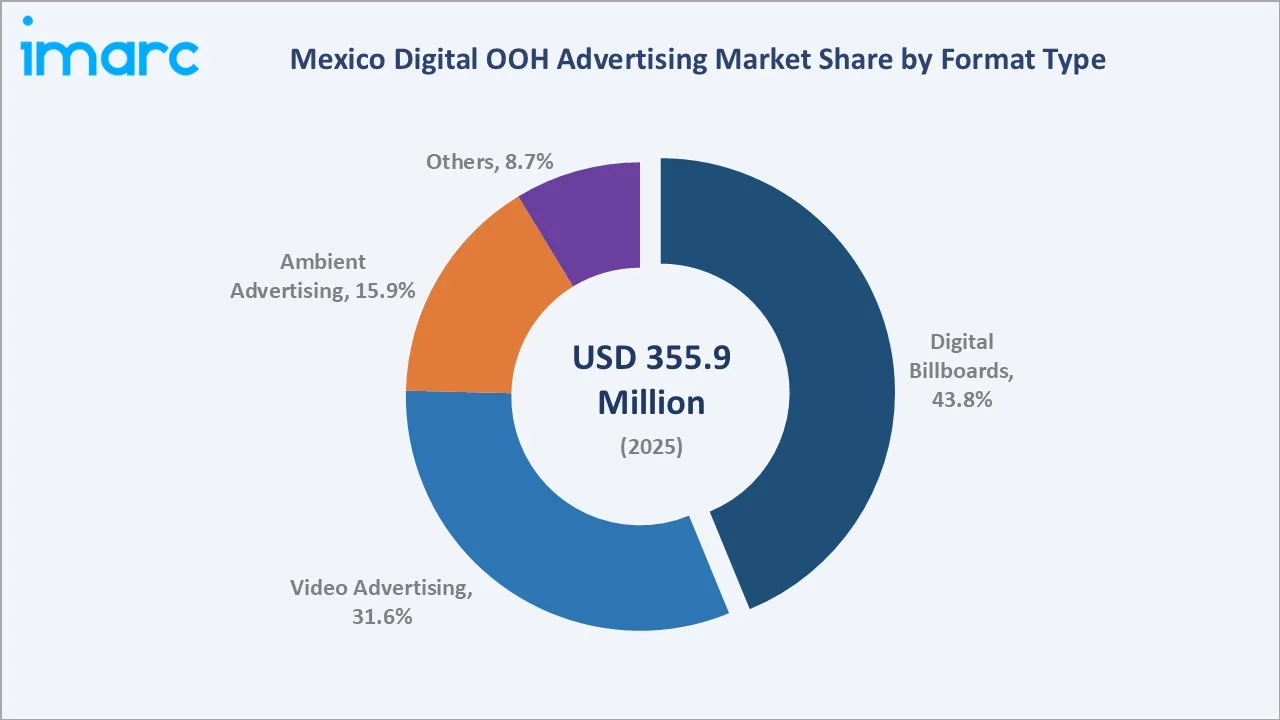
Digital Billboards lead at 43.8% in 2025, dominating through premium outdoor placement at major intersections, highway corridors, and transit nodes across Mexico's key metropolitan markets. High advertiser ROI, dynamic content capability, and superior visibility drive digital billboard share leadership in the format type segment.
To access detailed market analysis, Request Sample
Video Advertising at 31.6% captures transit hub screens, shopping center displays, and retail corridor environments where dynamic video content drives engagement. Ambient Advertising at 15.9% encompasses digitally enabled street furniture and experiential installations. Others at 8.7% includes indoor venues, stadium screens, and specialized location-based digital formats.
By Application
Outdoor application leads at 72.4% through the established roadside billboard network, transit shelter media, and street furniture inventory representing the core of Mexico's DOOH ecosystem. Outdoor DOOH captures the highest advertiser spend through premium visibility at high-traffic urban locations across all major cities.
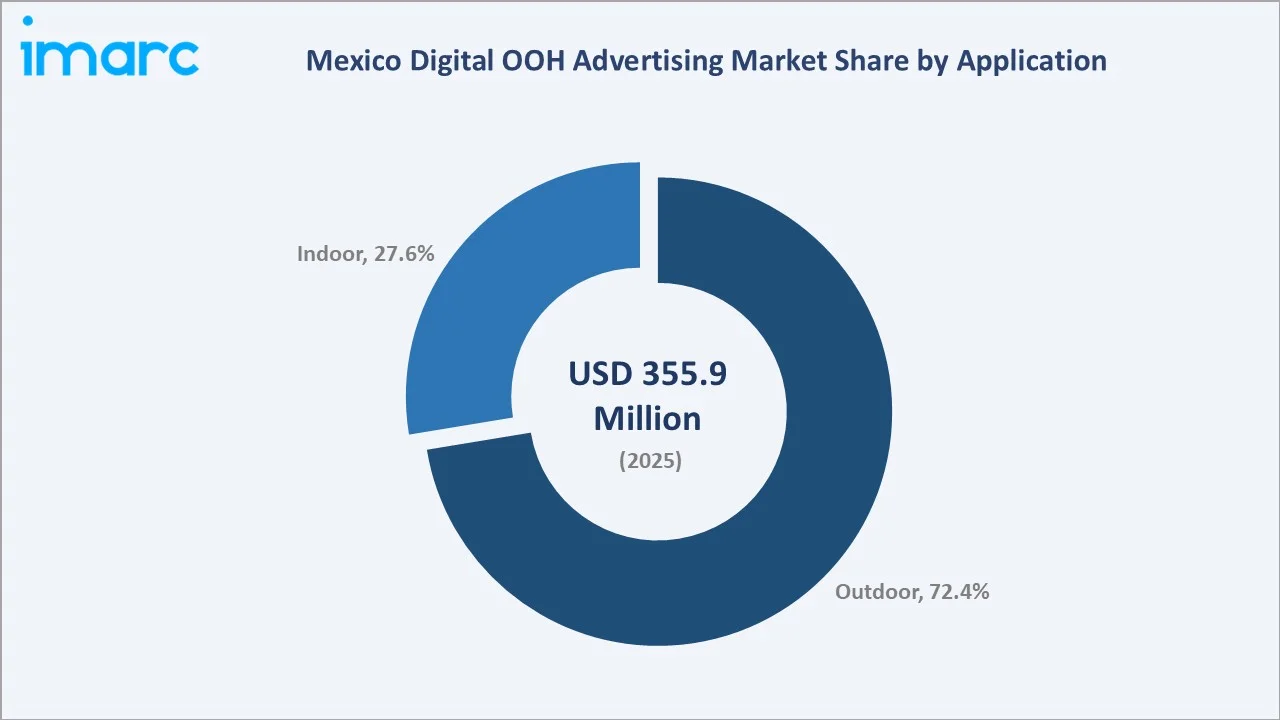
Indoor application at 27.6% encompasses retail media networks, airport screens, transit station displays, and corporate venue digital screens. Indoor DOOH is the faster-growing application segment as retail media convergence and transit digitization expand addressable inventory beyond traditional outdoor environments.
Regional Market Insights
|
Region |
Share (2025) |
Key Digital OOH Market Drivers & Characteristics |
|
Central Mexico |
46.3% |
Driven by Mexico City's dominant advertising market, premium digital inventory concentration, and high national brand advertiser demand |
|
Northern Mexico |
27.8% |
Supported by Monterrey's industrial hub, growing transit and retail DOOH investment, and cross-border commerce activity |
|
Southern Mexico |
15.4% |
Driven by Cancun tourism sector, resort corridor digital expansion, and increasing DOOH adoption in secondary metropolitan areas |
|
Others |
10.5% |
Emerging with secondary city digitization, regional media owner screen investment, and urbanization-driven audience expansion |
Central Mexico, at 46.3%, leads through Mexico City's position as Latin America's largest single-city advertising market, supported by high advertiser demand, premium digital billboard networks, and concentration of media agency headquarters. The region is also the primary adoption market for programmatic DOOH platforms and data-driven campaign measurement tools.
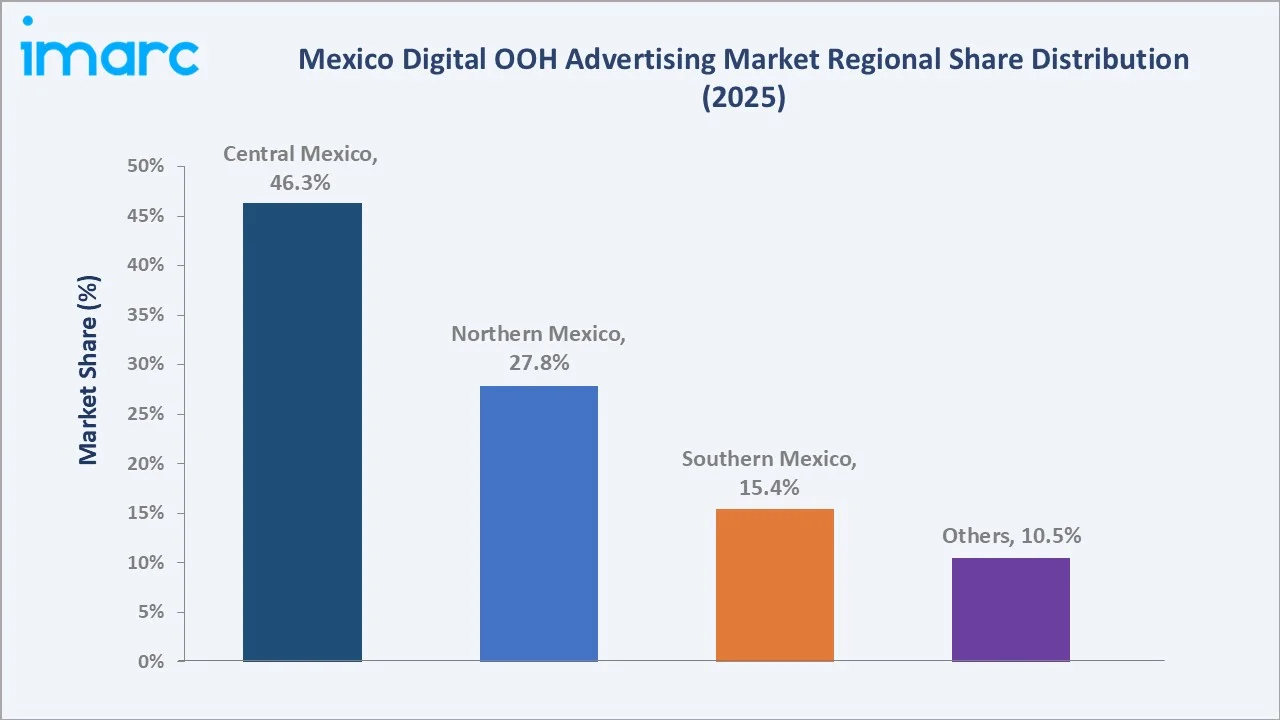
Northern Mexico, at 27.8%, reflects Monterrey's industrial and commercial base with growing transit and retail DOOH investment. Southern Mexico, at 15.4%, is expanding through Cancun's tourism sector and resort corridor digital screen growth. Others, at 10.5%, captures secondary cities undergoing early-stage DOOH adoption driven by urbanization and infrastructure investment.
Competitive Landscape
The Mexico digital OOH advertising market competitive landscape features a moderately concentrated structure with global media owners, domestic operators, and programmatic technology companies competing across inventory, data, and platform dimensions.
|
Company Name |
Key Products |
Market Position |
Core Strength |
|
Alegra Medios |
Digital Screens, Billboards, Transit Routes |
Emerging Player |
Alegra Medios is a Mexico-focused OOH specialist, offering programmatic and conventional digital screens, billboard, transit, and airport advertising. |
|
AdQuick |
OOH Planning & Buying Platform, Programmatic DOOH DSP, Digital Billboards, Transit Advertising, Airport Advertising, Campaign Measurement & Attribution Tools |
Established Player |
AdQuick provides an all-in-one programmatic OOH platform connecting advertisers, enabling campaign planning, buying, and real-time performance measurement within a single dashboard |
|
BM Outdoor Media |
Billboards, Digital Billboards, Airport Advertising, Bus Advertising, Transit Advertising, Wallscapes |
Emerging Player |
BM Outdoor Media is a Mexico and LATAM-focused OOH agency, offering extensive coverage across digital billboards, transit media, and airport advertising with data-driven, programmatic DOOH capabilities |
Key players include Alegra Medios, AdQuick, BM Outdoor Media, and others.
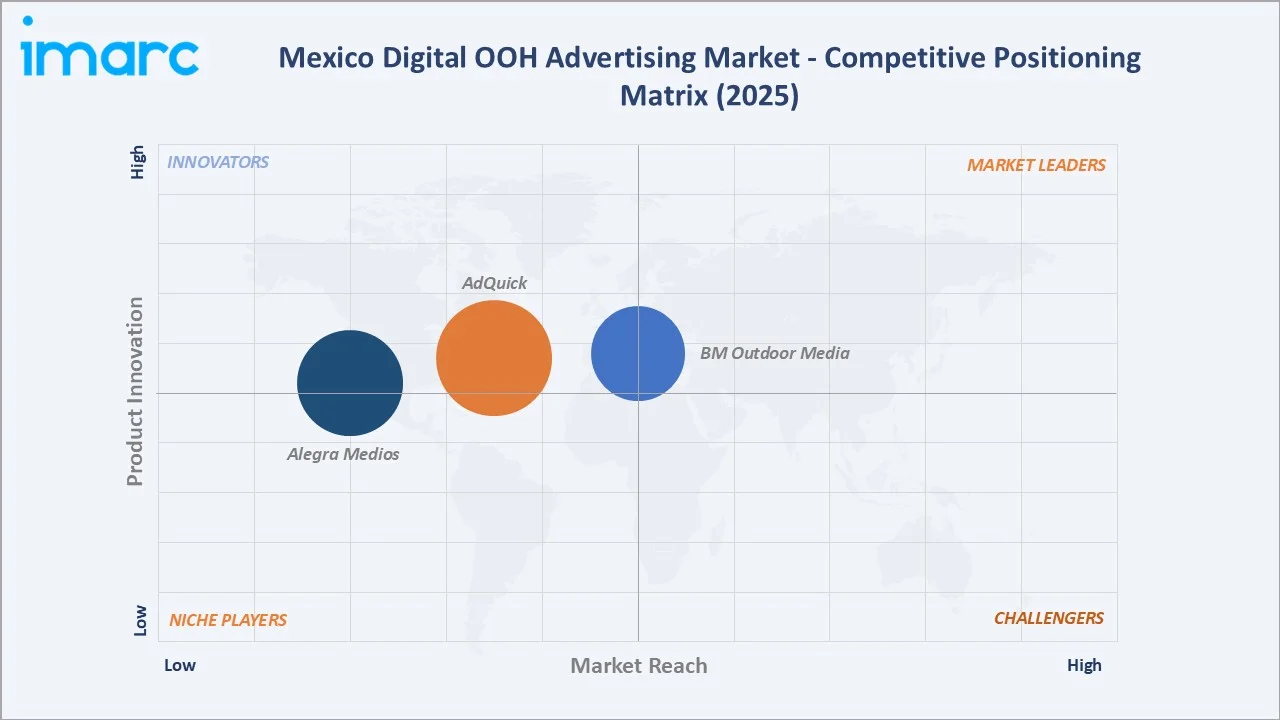
Key Company Profiles
BM Outdoor Media
BM Outdoor Media is a Mexico and LATAM-focused outdoor advertising agency, offering extensive coverage across digital billboards, transit media, and airport advertising with data-driven and programmatic DOOH capabilities across Mexico's major metropolitan markets.
- Key Products: Billboards, Digital Billboards, Airport Advertising, Bus Advertising, Transit Advertising, Wallscapes.
- Strategic Focus: Expanding digital billboard inventory across Mexico's secondary metropolitan markets, integrating programmatic DOOH buying with geolocation and real-time audience analytics, and strengthening cross-border OOH campaign execution across Mexico and broader LATAM markets.
AdQuick
AdQuick is a US-headquartered all-in-one programmatic OOH technology platform connecting advertisers and agencies, including active DOOH inventory in Mexico City and other major Mexican markets, enabling end-to-end campaign planning, buying, and real-time performance measurement.
- Key Products: OOH Planning & Buying Platform, Programmatic DOOH DSP, Digital Billboards, Transit Advertising, Airport Advertising, Campaign Measurement & Attribution Tools.
- Strategic Focus: Expanding programmatic DOOH infrastructure across Latin America including Mexico, enhancing AI-driven campaign planning and real-time attribution capabilities, and deepening integration with media owners to provide advertisers with transparent, data-driven OOH inventory access through a single unified platform.
Market Concentration Analysis
The Mexico digital OOH advertising market exhibits moderate concentration with the top two players collectively accounting for 40-50% of premium DOOH inventory revenue. Programmatic technology companies are increasing competitive fragmentation in the technology layer, enabling more advertisers to access inventory through automated platforms at lower entry barriers.
Market concentration is expected to decline over the forecast period as programmatic adoption expands the advertiser base beyond traditional large-budget brands, domestic media owners digitize secondary-city inventory, and modern technology entrants compete on data, targeting, and measurement capabilities across Mexico's evolving DOOH ecosystem.
Investment & Growth Opportunities
Highest Growth Segments
Video Advertising (~9.8% CAGR), Indoor application (~9.2% CAGR), programmatic DOOH technology (~12-15% CAGR from smaller base), transit digital screen networks (~11% CAGR), and retail media indoor DOOH convergence (~13% CAGR) represent the highest-growth investment vectors through 2034.
Emerging Investment Opportunities
Retail media indoor DOOH networks represent Mexico's highest per-unit emerging DOOH opportunity, as major retail chains deploy digital screens creating new CPG and FMCG advertising inventory at point-of-purchase environments. Transit digitization programs across Mexico City's metro system and Monterrey's BRT network are creating government-backed DOOH inventory expansion at scale through 2034.
Investment Themes
- Programmatic DOOH infrastructure as competitive moat: The programmatic technology stack - DSP, SSP, CMS, and audience data integration - represents the primary competitive differentiator in Mexico's evolving DOOH market. Early-movers establishing programmatic capabilities create durable advertiser relationships and inventory access advantages that are difficult for late entrants to replicate at scale.
- Secondary city DOOH digitization: Mexico's secondary metropolitan markets including Puebla, Leon, Tijuana, and Queretaro represent significant untapped DOOH inventory opportunity. Digital screen investment in these markets captures advertisers seeking national DOOH reach at competitive CPM rates, driven by urbanization-led audience expansion beyond primary markets.
Future Market Outlook (2026-2034)
The Mexico digital OOH advertising market is projected to grow from USD 355.9 Million in 2025 to USD 827.7 Million by 2034, delivering a 9.54% CAGR over the forecast period. The market's anchor value of USD 561.2 Million in 2030 represents an inflection point where programmatic DOOH will have become the dominant buying methodology for premium outdoor inventory.
Three structural forces define Mexico digital OOH market growth through 2034. Urbanization continues compounding the addressable audience in metropolitan areas, creating denser DOOH deployment environments. Programmatic maturation expands the advertiser base by lowering campaign entry barriers. Retail media convergence creates a new indoor DOOH inventory category at scale across major retail chains.
Research Methodology
Primary Research
Primary research comprised structured interviews with 40+ industry stakeholders in 2025, including media owners, programmatic platform operators, brand advertisers, media agency planners, and outdoor advertising regulatory contacts across Mexico's primary and secondary metropolitan markets.
Secondary Research
Secondary research encompassed company annual reports, INEGI demographic and urbanization data, World Out of Home Organization congress proceedings, IMARC market data, Vistar Media and PRODOOH partnership announcements, JCDecaux Mexico campaign performance publications, and Mexico tourism data. Over 45 secondary sources reviewed and triangulated.
Forecasting Models
Market revenue forecasts developed using advertising spend bottom-up model: (i) Mexico DOOH addressable audience by metropolitan area; (ii) average digital OOH CPM by format type and application; (iii) programmatic adoption rate multiplier by year; (iv) regional market development rate by urbanization index and digital infrastructure penetration score.
Mexico Digital OOH Advertising Market Report Coverage:
| Report Features | Details |
|---|---|
| Base Year of the Analysis | 2025 |
| Historical Period | 2020-2025 |
| Forecast Period | 2026-2034 |
| Units | Million USD |
| Scope of the Report | Exploration of Historical Trends and Market Outlook, Industry Catalysts and Challenges, Segment-Wise Historical and Future Market Assessment:
|
| Format Types Covered | Digital Billboards, Video Advertising, Ambient Advertising, Others |
| Applications Covered | Outdoor, Indoor |
| End Use Industries Covered | Retail, Recreation, Banking, Transportation, Education, Others |
| Regions Covered | Northern Mexico, Central Mexico, Southern Mexico, Others |
| Companies Covered | Alegra Medios, AdQuick, BM Outdoor Media, etc. |
| Customization Scope | 10% Free Customization |
| Post-Sale Analyst Support | 10-12 Weeks |
| Delivery Format | PDF and Excel through Email (We can also provide the editable version of the report in PPT/Word format on special request) |
Key Benefits for Stakeholders:
- IMARC’s industry report offers a comprehensive quantitative analysis of various market segments, historical and current market trends, market forecasts, and dynamics of the Mexico digital OOH advertising market from 2020-2034.
- The research report provides the latest information on the market drivers, challenges, and opportunities in the Mexico digital OOH advertising market.
- Porter's five forces analysis assist stakeholders in assessing the impact of new entrants, competitive rivalry, supplier power, buyer power, and the threat of substitution. It helps stakeholders to analyze the level of competition within the Mexico digital OOH advertising industry and its attractiveness.
- Competitive landscape allows stakeholders to understand their competitive environment and provides an insight into the current positions of key players in the market.
Frequently Asked Questions About the Mexico Digital OOH Advertising Market Report
The Mexico digital OOH advertising market reached USD 355.9 Million in 2025, driven by digital billboard dominance at 43.8%, outdoor application leadership at 72.4%, and Central Mexico commanding 46.3% regional share through Mexico City's premium DOOH inventory and high advertiser demand concentration.
The market grows at 9.54% CAGR during 2026-2034, reaching USD 827.7 Million by 2034. Growth reflects programmatic DOOH adoption, urbanization-driven audience expansion, transit digitization, retail media convergence, and secondary city DOOH infrastructure investment across Mexico.
Digital Billboards lead at 43.8%, capturing premium outdoor placements at major intersections, highway corridors, and transit nodes. Digital Billboards grow at ~10.2% CAGR through programmatic integration, dynamic content capability, and premium advertiser ROI in Mexico's top urban markets.
Outdoor application leads at 72.4% through the established roadside billboard and transit shelter network, representing the core of Mexico's DOOH ecosystem. Indoor application at 27.6% is the fastest-growing segment, driven by retail media network expansion and transit station digitization programs.
Central Mexico leads at 46.3% through Mexico City's position as Latin America's largest single-city advertising market, combined with Guadalajara's growing DOOH penetration and concentration of national brand advertiser headquarters and media agency operations.
Leading companies include Alegra Medios, AdQuick, BM Outdoor Media, and others.
The Mexico digital OOH advertising market is projected to reach approximately USD 561.2 Million by 2030, with programmatic DOOH becoming the dominant buying methodology, transit digitization completing primary metro networks, and retail media indoor DOOH achieving mainstream adoption across major retail chains.
Need more help?
- Speak to our experienced analysts for insights on the current market scenarios.
- Include additional segments and countries to customize the report as per your requirement.
- Gain an unparalleled competitive advantage in your domain by understanding how to utilize the report and positively impacting your operations and revenue.
- For further assistance, please connect with our analysts.
 Request Customization
 Speak to an Analyst
 Request Brochure
 Inquire Before Buying
Benefits of Customization
- Personalize this research
- Triangulate with your data
- Get data as per your format and definition
- Gain a deeper dive into a specific application, geography, customer, or competitor
- Any level of personalization
Get in Touch With Us
UNITED STATES
Phone: +1-201-971-6302
INDIA
Phone: +91-120-433-0800
UNITED KINGDOM
Phone: +44-753-714-6104
Email: [email protected]
Client Testimonials




.webp)




.webp)













Related Reports

Choose your plan
*Please note that the prices mentioned below are starting prices for each bundle type. Kindly contact our team for further details.*
Single User License
- 1 User License, Access on 2 Devices
- PDF Report + Excel Dataset (Password Protected)
- Lifetime Access
- No Printing Rights
- 10% Free Report Customization
- 10–12 Weeks of Analyst Support
Five User License
- Access for 5 Users, 2 Devices per User
- PDF Report + Excel Dataset (Password Protected)
- Lifetime Access
- Dedicated Account Manager
- 12–14 Weeks of Analyst Support
- No Printing Rights
- 15% Free Report Customization
- 25% Discount on Your Next Purchase
Corporate User License
- Unlimited User Access (Within Your Organization)
- PDF Report + Excel Dataset
- Lifetime Access
- Dedicated Account Manager
- 14–20 Weeks of Analyst Support
- No Printing Rights
- 20% Free Report Customization
- 30% Discount on Your Next Purchase
Essential Insights
What's included:
3 reports
- Lifetime Access
- PDF Reports
- Excel Datasets
- 2 Weeks of Free Analyst Support
- 2 User Licenses
- Access on 2 Devices
- Printing Rights
- Complimentary PowerPoint (PPT) Version
- Complimentary License Upgrade
Professional Access
What's included:
5 reports
- Lifetime Access
- PDF Reports
- Excel Datasets
- 8 Weeks of Free Analyst Support
- 2 User Licenses
- Access on 2 Devices
- Printing Rights
- Complimentary PowerPoint (PPT) Version
- Complimentary License Upgrade
Business Advantage
What's included:
8 reports
- Lifetime Access
- PDF Reports
- Excel Datasets
- 14 Weeks of Free Analyst Support
- 2 User Licenses
- Access on 2 Devices
- Printing Rights
- Complimentary PowerPoint (PPT) Version
- Complimentary License Upgrade
Enterprise Intelligence
What's included:
10 reports
- Lifetime Access
- PDF Reports
- Excel Datasets
- 20 Weeks of Free Analyst Support
- 2 User Licenses
- Access on 2 Devices
- Printing Rights
- Complimentary PowerPoint (PPT) Version
- Complimentary License Upgrade