
Mexico Driver Assistance Systems Market Size, Share, Trends and Forecast by Type, Technology, Vehicle Type, and Region, 2026-2034
Mexico Driver Assistance Systems Market Size, Share, Trends & Forecast (2026-2034)
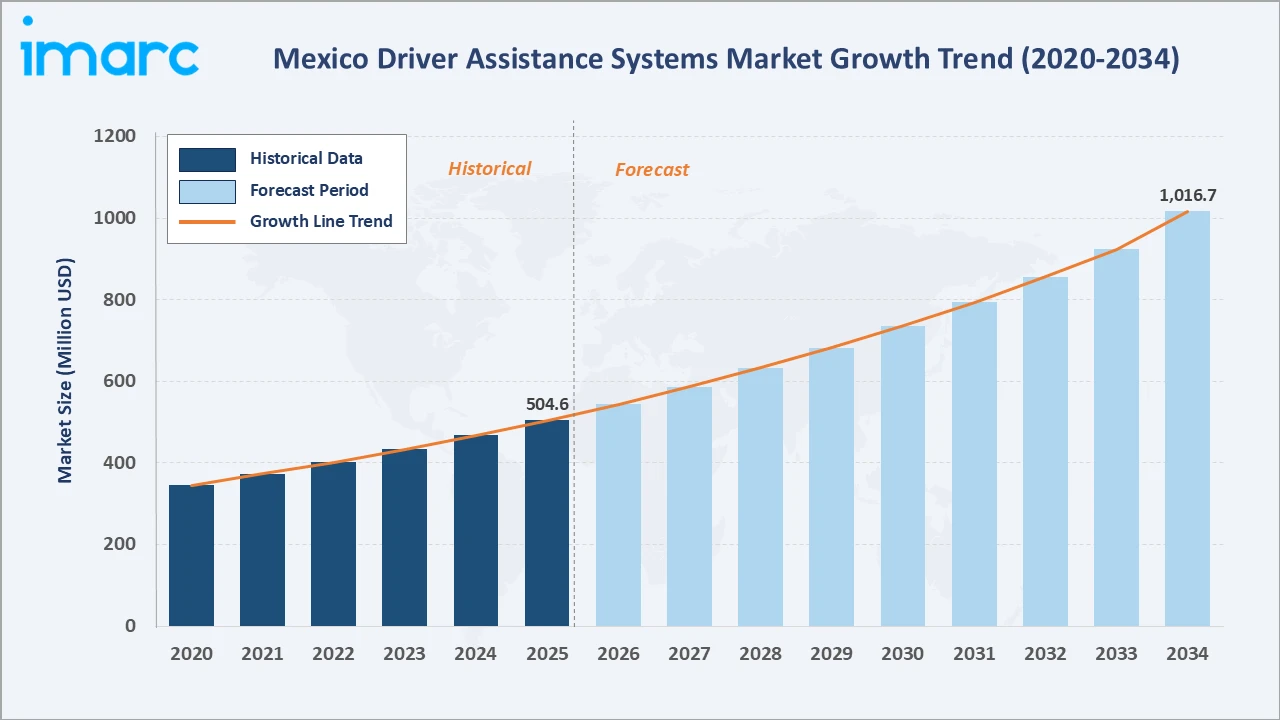
The Mexico driver assistance systems market grew from USD 504.6 Million in 2025 to USD 544.2 Million in 2026 and is projected to reach USD 1,016.7 Million by 2034, exhibiting a CAGR of 7.85% during 2026-2034. Rising adoption of advanced safety technologies in passenger vehicles, expanding automotive manufacturing in key industrial states, and tightening vehicular safety regulations are the primary forces shaping market growth.
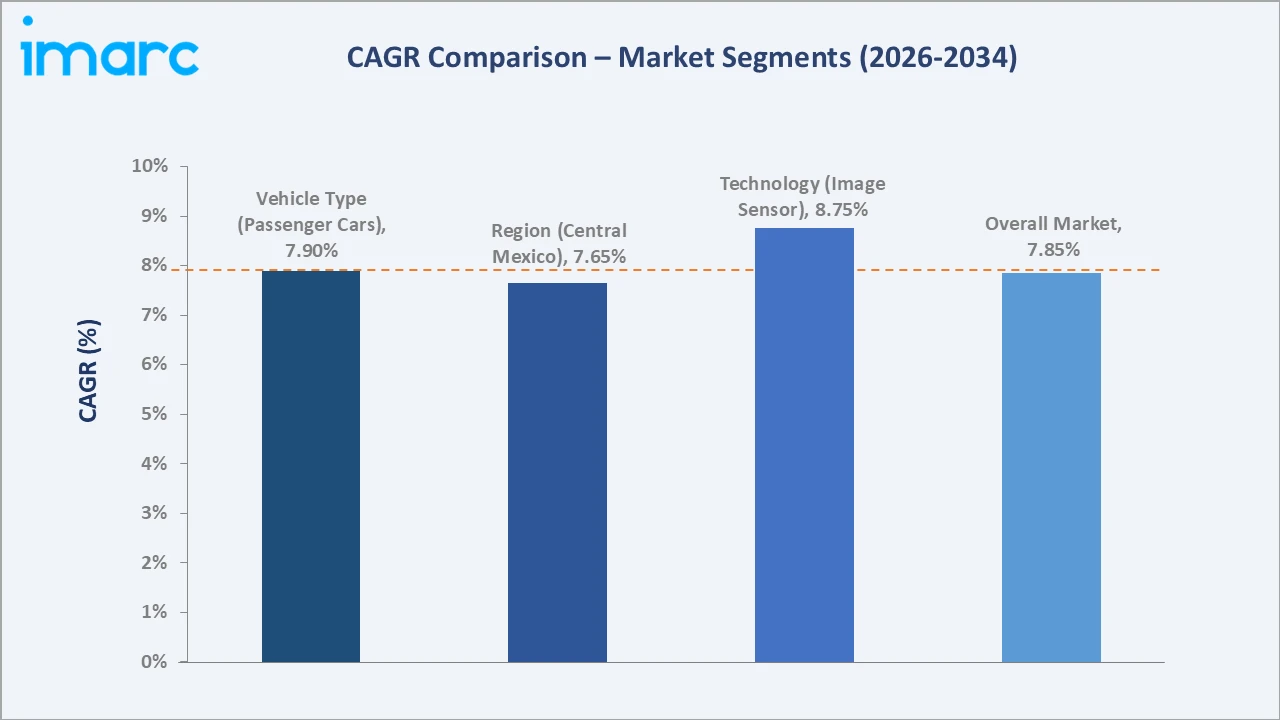
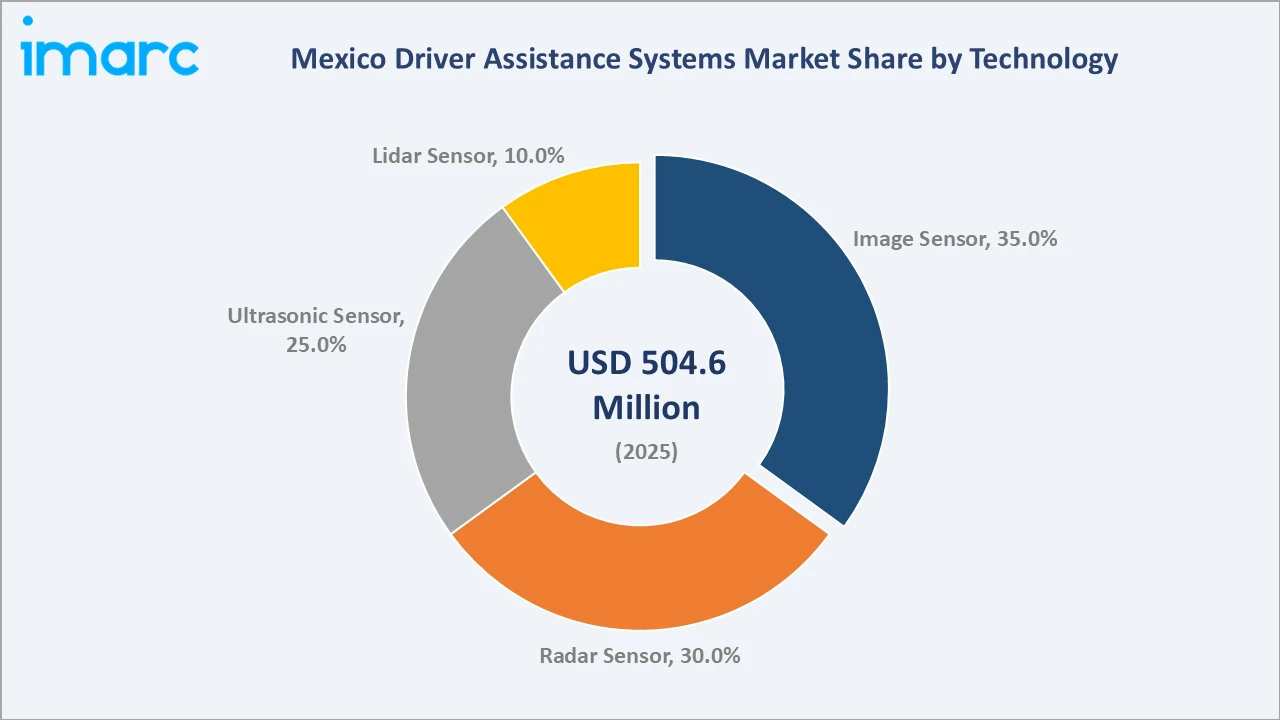
Image sensor leads the technology segment at 35.0%, passenger cars dominate the vehicle type segment at 75.0%, and Central Mexico commands 50.0% of regional share.
Market Snapshot
| Metric | Value |
|---|---|
| Base Year Market Size (2025) | USD 504.6 Million |
| Market Size (2026) | USD 544.2 Million |
| Forecast Market Size (2034) | USD 1,016.7 Million |
| CAGR (2026-2034) | 7.85% |
| Base Year | 2025 |
| Historical Period | 2020-2025 |
| Forecast Period | 2026-2034 |
| Largest Region | Central Mexico (50.0%, 2025) |
| Second Largest Region | Northern Mexico (30.0%, 2025) |
| Leading Technology | Image Sensor (35.0%, 2025) |
| Leading Vehicle Type | Passenger Cars (75.0%, 2025) |
The Mexico driver assistance systems market size increased from USD 345.8 Million in 2020 to USD 504.6 Million in 2025 and is estimated to reach USD 544.2 Million in 2026. The market is further expected to grow to USD 736.4 Million by 2030 and USD 1,016.7 Million by 2034. The market reflects Mexico's growing automotive sector, rising consumer demand for safety-equipped vehicles, and increasing integration of advanced sensor technologies across OEM assembly lines.
To get more information on this market, Request Sample
CAGR trajectories across technology, vehicle type, and regional sub-segments show lidar sensor and Southern Mexico expanding faster than the overall 7.85% market CAGR, driven by technology investment, expanding safety regulations, and growing automotive production volumes across Mexico's key industrial corridors.
Executive Summary
The Mexico driver assistance systems market expanded from USD 504.6 Million in 2025 to an estimated USD 544.2 Million in 2026, positioning it among Latin America's leading automotive electronics segments by absolute size. Growth is underpinned by Mexico's expanding role as a major automotive assembly hub, rising demand for safety-equipped vehicles, and increasing adoption of ADAS technologies across passenger and commercial vehicle programs.
Image sensor commands 35.0% technology share, reflecting its cost-effectiveness and widespread deployment in camera-based driver assistance applications, including lane departure warning and forward collision detection systems. Passenger cars represent 75.0% of vehicle type share, anchored by high-volume OEM production concentrated in Mexico's industrial corridors. Central Mexico leads regional share at 50.0%, driven by proximity to major automotive assembly plants.
Key Market Insights
| Insight | Data |
|---|---|
| Leading Technology | Image Sensor – 35.0% share (2025) |
| Second Largest Technology | Radar Sensor – 30.0% share (2025) |
| Leading Vehicle Type | Passenger Cars – 75.0% share (2025) |
| Second Largest Vehicle Type | Light Commercial Vehicles – 17.0% share (2025) |
| Leading Region | Central Mexico – 50.0% share (2025) |
| Second Largest Region | Northern Mexico – 30.0% share (2025) |
| Top Companies | Robert Bosch GmbH, Aumovio SE, Aptiv PLC |
Key Analytical Observations Expanding On the Data Above:
- Image sensor dominance at 35.0% reflects its broad deployment across camera-based ADAS applications, including forward collision warning, lane departure alert, and traffic sign recognition, making it the most commercially accessible technology in Mexico's OEM supply base.
- Radar sensor share at 30.0% is driven by its operational reliability across varied lighting and weather conditions, making it the preferred technology for adaptive cruise control and blind spot detection applications in Mexican-assembled vehicles.
- Passenger cars leadership at 75.0% is anchored by the high volume of passenger vehicles produced in Mexico, where leading OEMs are increasingly incorporating driver assistance systems as standard or optional equipment across mainstream and premium vehicle segments.
- Light commercial vehicles at 17.0% reflect growing adoption of driver assistance technologies in delivery vans and light trucks, driven by fleet safety requirements and increasing regulatory emphasis on commercial vehicle road safety.
- Central Mexico at 50.0% leads regional share due to its concentration of major automotive OEM assembly operations, supported by a dense Tier-1 supplier ecosystem and well-developed logistics infrastructure.
Mexico Driver Assistance Systems Market Overview
Driver assistance systems refer to electronic technologies that assist vehicle operators in driving and parking, encompassing sensors, cameras, radar, lidar, and processing units that enable functions such as collision warning, lane keeping, adaptive cruise control, and parking assistance. These systems form the foundation of the broader automotive safety ecosystem, spanning component suppliers, OEMs, software developers, regulatory bodies, and end users across the automotive value chain.
Mexico's strategic position within the USMCA trade framework facilitates efficient integration of imported sensor components and software systems into locally assembled vehicles, supporting the growth of driver assistance system deployment across the country.
Market Dynamics
To evaluate market opportunities, Request Sample
Market Drivers
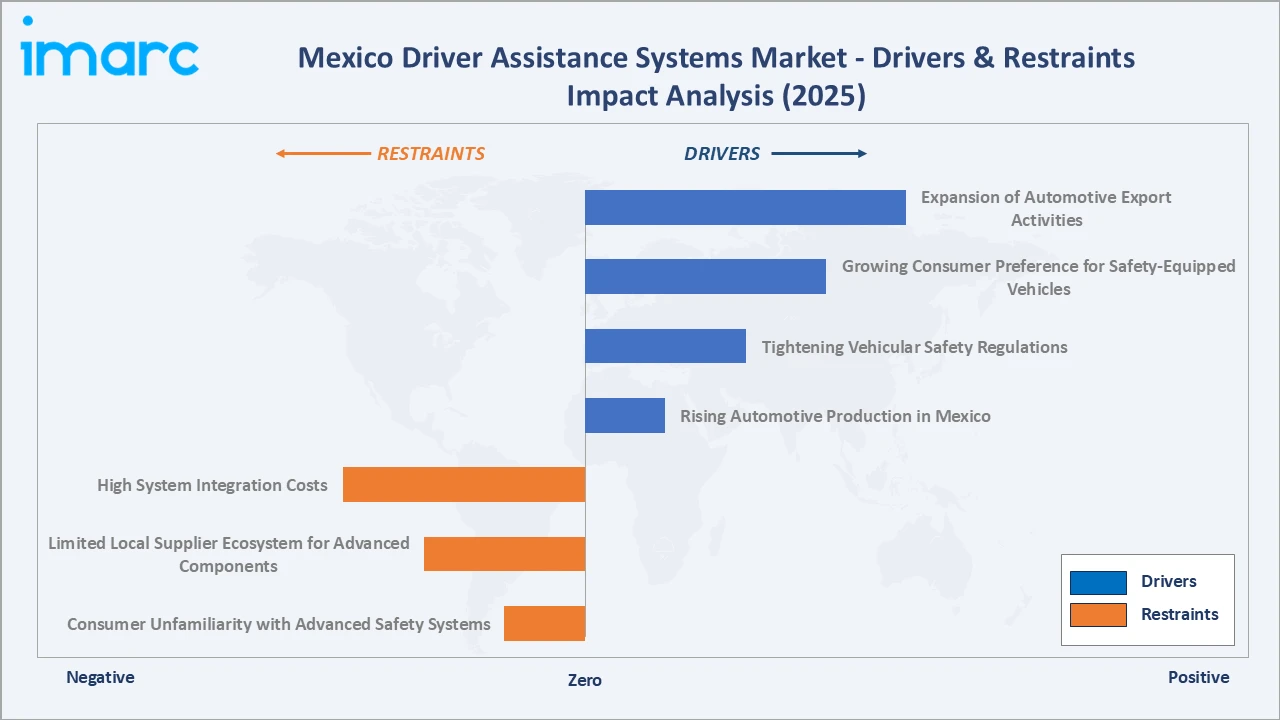
- Rising Automotive Production in Mexico: Mexico produced 3.98 Million vehicles in 2024, sustaining a substantial addressable market for driver assistance system integration. Increasing vehicle production is creating opportunities for the integration of advanced safety technologies, including collision warning, lane departure alert, and automatic emergency braking systems, across passenger and commercial vehicle segments.
- Tightening Vehicular Safety Regulations: Evolving Mexican and North American regulatory frameworks are progressively mandating advanced safety features in new vehicles, compelling automakers to incorporate driver assistance technologies such as forward collision warning, automatic emergency braking, and lane departure alert systems across their vehicle lineups.
- Growing Consumer Preference for Safety-Equipped Vehicles: Rising awareness of road safety benefits and increasing insurance incentives for safety-equipped vehicles are expanding consumer demand for advanced driver assistance features, particularly in the passenger car segment, which dominates vehicle sales in Mexico.
- Expansion of Automotive Export Activities: Mexico's strong position as an automotive manufacturing and export hub is encouraging vehicle manufacturers to align locally produced models with international safety standards. This is supporting the incorporation of advanced driver assistance systems to meet evolving requirements across export markets.
Market Restraints
- High System Integration Costs: The complexity of integrating driver assistance systems into vehicle architectures imposes significant engineering and component costs, limiting adoption primarily to premium and mid-range vehicle segments and creating cost barriers for value-segment OEM programs.
- Limited Local Supplier Ecosystem for Advanced Components: Specialized semiconductors, sensor arrays, and processing units required for driver assistance systems are predominantly sourced from global suppliers, creating supply chain dependencies and cost pressures for Mexico-based OEM assembly operations.
- Consumer Unfamiliarity with Advanced Safety Systems: A portion of the Mexican vehicle-buying population remains unfamiliar with the operational characteristics and benefits of driver assistance features, potentially slowing adoption rates in value-conscious consumer segments.
Market Opportunities
- OEM Localization of ADAS Components: Growing government support for near-shoring and automotive supply chain localization creates opportunities for ADAS sensor and component manufacturers to establish or expand production facilities within Mexico, supporting cost reduction and faster time-to-market for OEM programs.
- Expansion of Connectivity-Enabled Safety Systems: The increasing deployment of connected vehicle platforms in Mexico creates opportunities for cloud-integrated driver assistance features that enable over-the-air updates, real-time traffic data integration, and vehicle-to-everything communication capabilities.
Market Challenges
- Cybersecurity Risks in Connected ADAS Platforms: Increasing connectivity in driver assistance systems creates potential vulnerabilities requiring robust cybersecurity architectures that add engineering complexity and cost to system development and certification processes.
- Infrastructure Compatibility for Cooperative ADAS: Advanced driver assistance applications that rely on road infrastructure signals and mapping accuracy face challenges in regions where road quality, digital mapping coverage, and connectivity infrastructure are inconsistent.
Emerging Market Trends
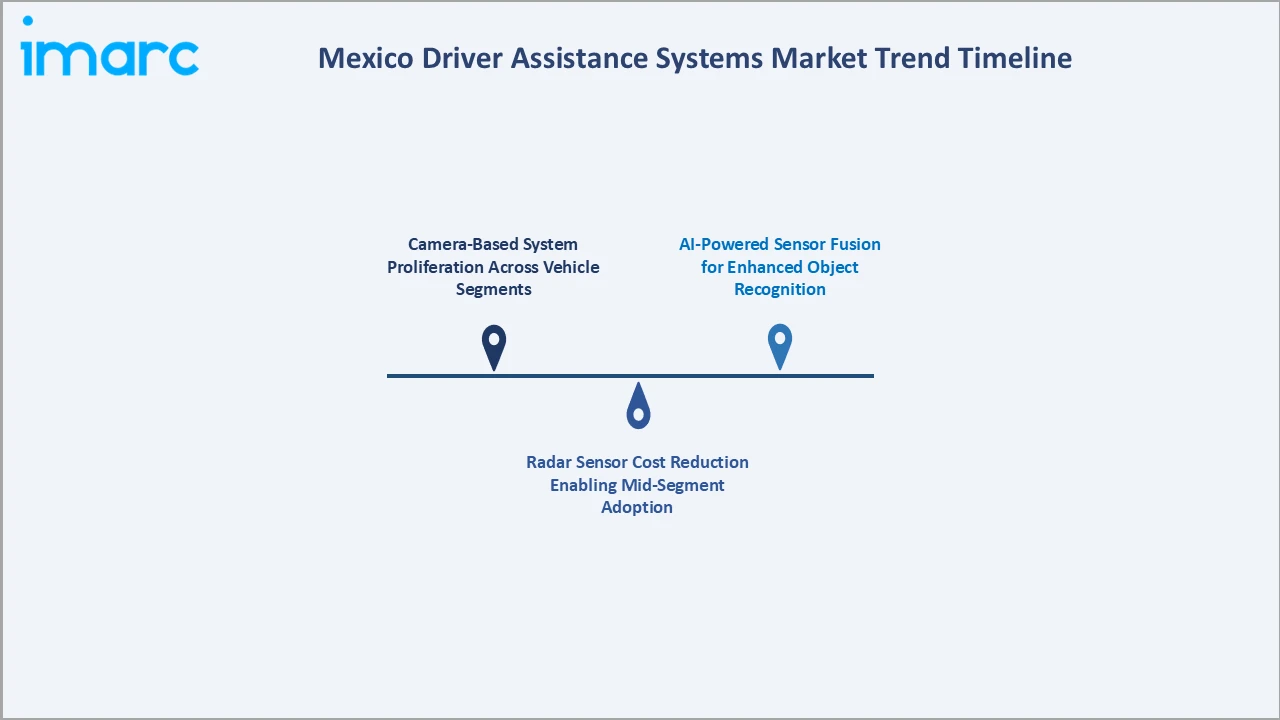
1. Camera-Based System Proliferation Across Vehicle Segments
Camera-based driver assistance systems, encompassing forward-facing, surround-view, and interior cabin monitoring cameras, are increasingly deployed across mainstream passenger vehicle segments in Mexico. The declining cost of image sensor modules and the broad versatility of camera systems across multiple ADAS applications are accelerating adoption.
2. Radar Sensor Cost Reduction Enabling Mid-Segment Adoption
Progressive cost reductions in automotive radar modules are enabling deployment of radar-based ADAS functions, including adaptive cruise control and blind spot detection, in mid-segment passenger cars and light commercial vehicles in Mexico. As production volumes scale and semiconductor integration improves, radar unit costs continue to decline, supporting broader OEM program adoption across price segments.
3. AI-Powered Sensor Fusion for Enhanced Object Recognition
AI-powered sensor fusion platforms, combining data from camera, radar, and ultrasonic sensors to improve object detection and classification accuracy, are gaining traction in premium and mid-tier vehicle programs assembled in Mexico. These systems enable vehicles to interpret complex driving environments more reliably, supporting faster hazard identification and improved real-time decision-making under varying road and traffic conditions.
Industry Value Chain Analysis
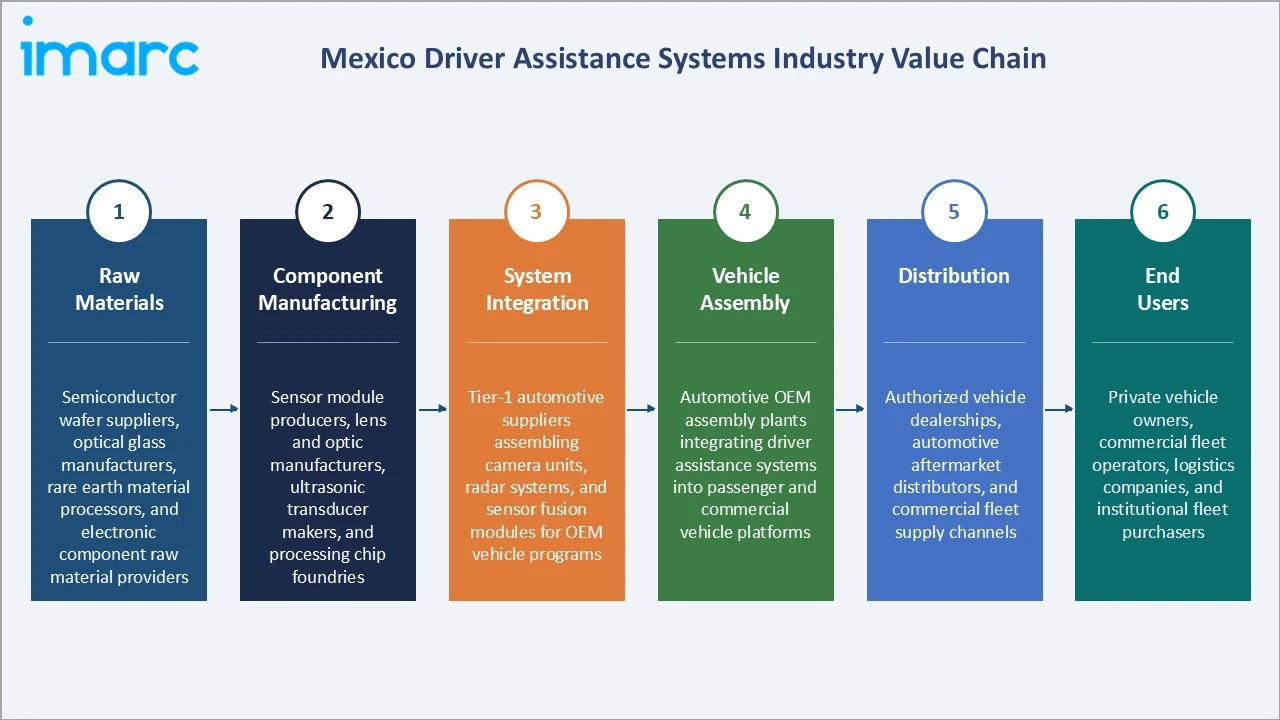
The Mexico driver assistance systems value chain spans six stages, from raw material supply through end-user deployment. Component manufacturing and system integration stages capture the highest value-add, while OEM vehicle assembly serves as the primary deployment platform.
| Stage | Key Players / Examples |
|---|---|
| Raw Materials | Semiconductor wafer suppliers, optical glass manufacturers, rare earth material processors, and electronic component raw material providers supporting sensor module production |
| Component Manufacturing | Sensor module producers, lens and optic manufacturers, radar transceiver suppliers, ultrasonic transducer makers, and processing chip foundries |
| System Integration | Tier-1 automotive suppliers assembling camera units, radar systems, and sensor fusion modules for integration into OEM vehicle programs |
| Vehicle Assembly | Automotive OEM assembly plants integrating driver assistance systems into passenger and commercial vehicle platforms across key production states |
| Distribution | Authorized vehicle dealerships, automotive aftermarket distributors, and commercial fleet supply channels serving the domestic and export vehicle markets |
| End Users | Private vehicle owners, commercial fleet operators, logistics companies, and institutional fleet purchasers across Mexico's diverse road transport sectors |
Vertically integrated Tier-1 suppliers controlling component manufacturing and system integration are positioned to capture greater margin than single-stage operators dependent on external sensor module supply and OEM program approvals.
Technology Landscape in the Mexico Driver Assistance Systems Industry
Image Sensors
Image sensors capture visual information surrounding the vehicle and support driver assistance functions such as lane detection, object recognition, traffic sign identification, and pedestrian monitoring. Improvements in image resolution, light sensitivity, and real-time processing are enhancing detection accuracy and supporting the integration of camera-based technologies across modern vehicle platforms.
Ultrasonic Sensors
Ultrasonic sensors serve primarily low-speed parking assistance and obstacle detection applications. While mature in terms of technology, the widespread deployment of parking sensors across mainstream vehicle segments sustains stable demand. The technology is increasingly complemented by camera-based surround-view systems in premium applications while remaining the dominant solution for cost-effective parking assistance in entry-level vehicles.
Lidar Technology
Lidar sensors provide high-resolution three-dimensional environmental mapping, enabling precise object detection and classification for advanced ADAS applications. These capabilities support accurate distance measurement and improved vehicle perception, particularly in complex traffic conditions and low-visibility environments.
Market Segmentation Analysis
The report covers the following segments:
| Segment Category | Leading Segment | Market Share | Year |
|---|---|---|---|
| Type | 🔒 | 🔒 | 2025 |
| Technology | Image Sensor | 35.0% | 2025 |
| Vehicle Type | Passenger Cars | 75.0% | 2025 |
| Region | Central Mexico | 50.0% | 2025 |

By Technology
Image sensor commands a 35.0% majority share in 2025, driven by its cost-effectiveness, broad application versatility, and widespread adoption across OEM ADAS programs in Mexico's high-volume passenger vehicle assembly operations.
To access detailed market analysis, Request Sample
Radar sensor holds 30.0% share, the second-largest technology segment, supported by its operational reliability in adverse weather conditions and regulatory preference for radar-based safety functions in key ADAS applications.
By Vehicle Type
Passenger cars represent 75.0% of the vehicle type segment in 2025, directly reflecting Mexico's production profile as a major assembler of passenger vehicles for both domestic sale and North American export. The widespread adoption of ADAS requirements in export-oriented passenger vehicle programs drives demand for driver assistance systems across the full technology spectrum.
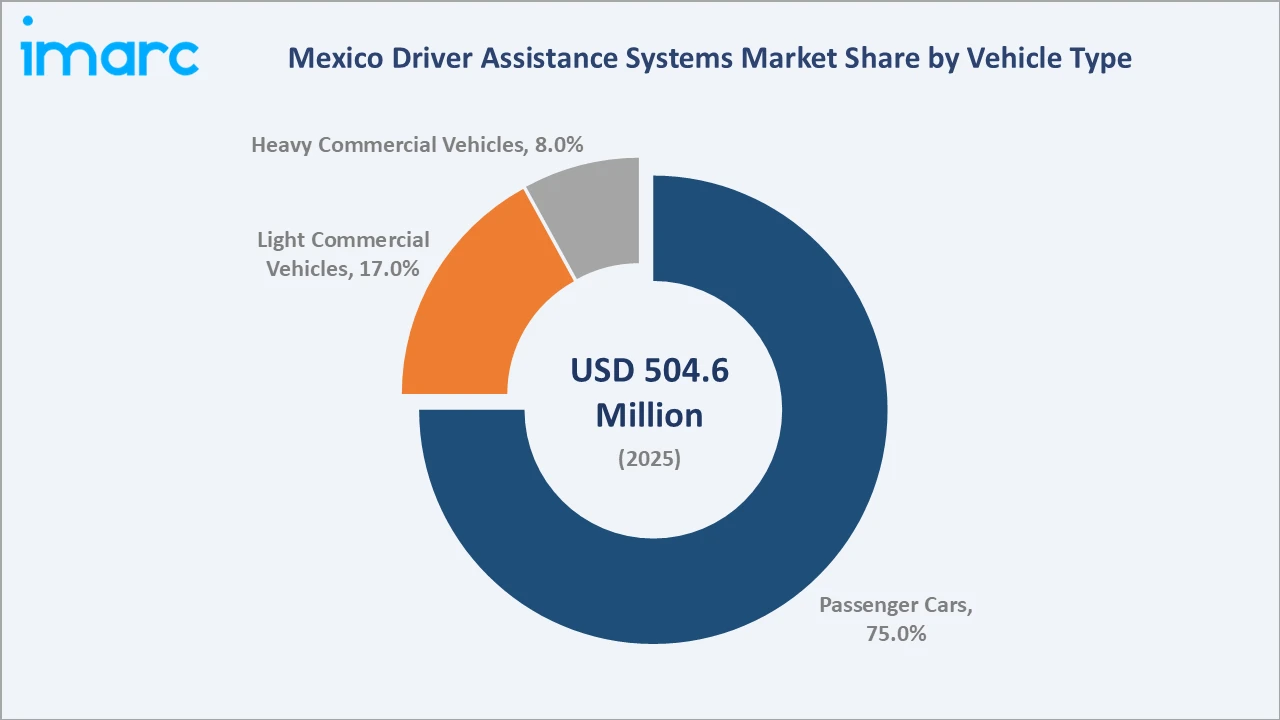
Light commercial vehicles at 17.0% represent the second-largest segment, supported by growing fleet safety requirements and increasing regulatory emphasis on commercial vehicle road safety in Mexico.
Regional Market Insights
| Region | Share (2025) | Key Growth Drivers |
|---|---|---|
| Central Mexico | 50.0% | Concentration of major automotive assembly plants, established Tier-1 supplier networks, strong demand for passenger vehicle safety systems, and proximity to key OEM production corridors in Guanajuato, Querétaro, and Mexico City |
| Northern Mexico | 30.0% | Large-scale automotive manufacturing clusters in Monterrey, Saltillo, and Ciudad Juárez, cross-border supply chain integration, and growing deployment of safety systems in export-oriented vehicles |
| Southern Mexico | 15.0% | Expanding light commercial vehicle fleets, infrastructure development, rising awareness of driver safety technologies, and growing aftermarket demand for safety features |
| Others | 5.0% | Emerging automotive service sectors, increasing connectivity adoption, and gradual expansion of organized vehicle sales channels across less industrialized regions |
Central Mexico at 50.0% in 2025 leads the regional landscape, anchored by its dense concentration of automotive OEM assembly operations and the supporting Tier-1 supplier base that enables efficient driver assistance system integration across high-volume vehicle programs.
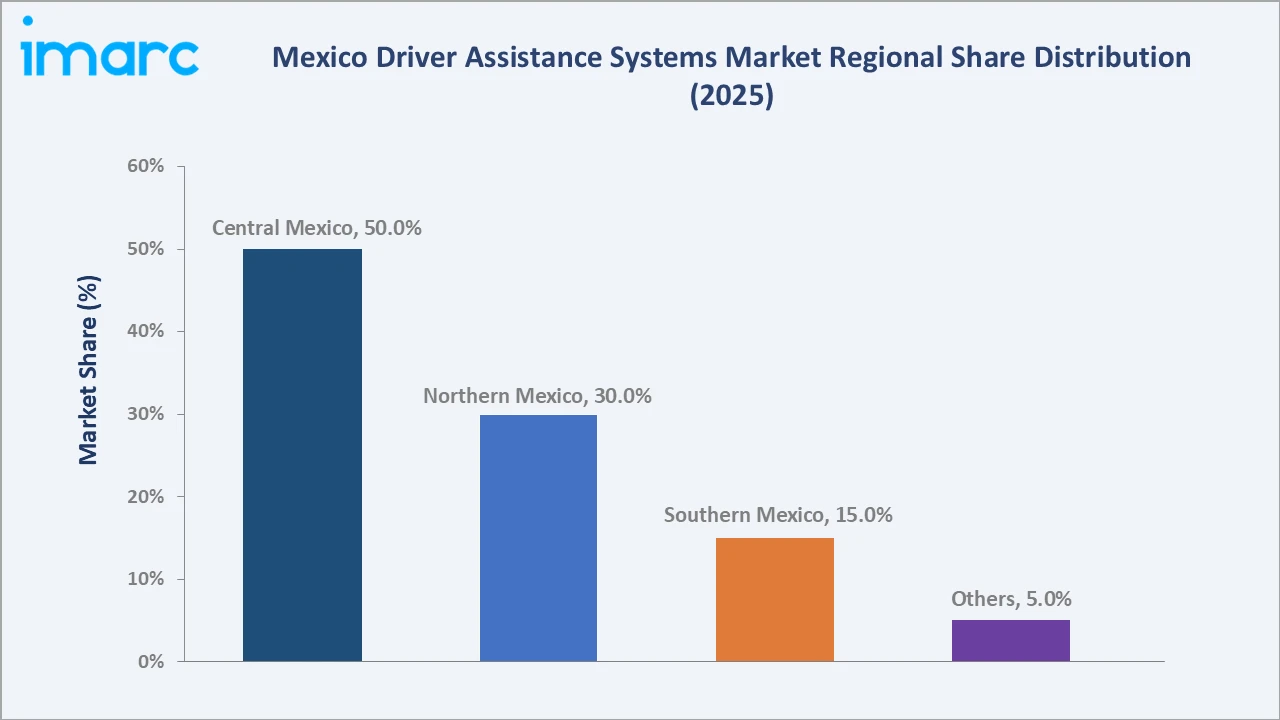
Southern Mexico, while currently the third-largest regional contributor at 15.0%, is expanding as commercial fleet operators and aftermarket channels extend driver assistance system coverage into less industrialized southern states, supported by infrastructure development and rising regulatory emphasis on road safety.
Competitive Landscape
The Mexico driver assistance systems market is moderately concentrated, with global Tier-1 automotive suppliers and specialized ADAS technology companies competing on technology depth, OEM relationship strength, sensor performance, and supply chain reliability. Scale, certified processing capability, and established OEM program integration form the key competitive differentiators across the industry.
| Company Name | Brand / Key Product | Position | Strategic Focus |
|---|---|---|---|
| Robert Bosch GmbH | Bosch Mobility | Leader | Expanding ADAS sensor and processing system capabilities through continuous technology investment and global supply chain scale |
| Aumovio SE | Aumovio | Leader | Advancing integrated automotive safety system platforms through sensor hardware and software development across global OEM markets |
| Aptiv PLC | Aptiv Gen 6 ADAS Platform | Challenger | Developing advanced electrical architecture and safety system integration aligned with software-defined vehicle technology trends |
Key players include Robert Bosch GmbH, Aumovio SE, and Aptiv PLC, among others.
Key Company Profiles
Robert Bosch GmbH
Robert Bosch GmbH is a German multinational engineering and technology company headquartered in Gerlingen, Germany. The company is one of the world's largest suppliers of automotive components, with an extensive ADAS portfolio spanning radar, camera, ultrasonic, and lidar sensor systems deployed across global OEM assembly operations including Mexico.
- Product Portfolio: Comprehensive portfolio of automotive sensors, driver assistance control units, and camera systems for OEM and aftermarket ADAS applications across global vehicle platforms.
- Recent Developments: The company continues to advance its ADAS sensor and processing system capabilities, expanding its global supply partnerships and deepening integration with major automotive OEMs across North American assembly operations.
- Strategic Focus: Strengthening ADAS technology offerings through ongoing innovation, sensor development, and deeper partnerships across global automotive supply chains.
Aumovio SE
Aumovio SE is a German automotive technology company headquartered in Frankfurt, Germany. The company supplies ADAS sensors, camera systems, radar modules, and electronic control units to automotive OEMs globally, with significant supply operations serving Mexico's automotive assembly sector.
- Product Portfolio: Integrated automotive safety systems portfolio encompassing radar sensors, camera modules, electronic control units, and software platforms for driver assistance applications.
- Recent Developments: The firm continues to develop integrated safety system platforms and expand sensor hardware and software capabilities in support of global OEM programs.
- Strategic Focus: Developing integrated vehicle safety solutions through advancements in sensor technologies and software capabilities while expanding engagement with global automotive manufacturers.
Aptiv PLC
Aptiv PLC is an automotive technology company headquartered in Switzerland. The company specializes in vehicle connectivity, electrical architecture, and advanced safety systems, supplying ADAS solutions and high-voltage components to global OEMs including those operating in Mexico.
- Product Portfolio: Advanced vehicle connectivity systems, electrical architecture solutions, and driver assistance safety components for OEM vehicle programs across global markets.
- Recent Developments: The company continues to advance its software-defined vehicle and electrical architecture capabilities, targeting next-generation ADAS integration requirements across its global OEM customer base.
- Strategic Focus: Strengthening vehicle electrical systems and safety technology integration to support the transition toward software-defined automotive platforms.
Market Concentration Analysis
The Mexico driver assistance systems market is moderately concentrated, with the leading tier of operators accounting for a substantial share of overall system supply to Mexico's OEM assembly operations. The market's concentration reflects the technology intensity and OEM qualification requirements that favor established global suppliers with proven deployment records.
Barriers to entry include significant capital requirements for ADAS sensor development and OEM program qualification, the need for demonstrated functional safety certification, technical expertise in complex sensor system integration, and the sustained engineering investment required to maintain competitive performance against established global suppliers.
Consolidation is progressing as global ADAS suppliers strengthen their Mexico-specific supply capabilities through local engineering support offices, inventory management, and OEM program management resources. Strategic partnerships between technology-focused ADAS suppliers and Mexico-based assembly operations are emerging as a key mechanism for deepening integration and securing longer-term supply positions.
Investment & Growth Opportunities
Fastest-Growing Segments
Lidar sensor is expanding fastest among technology sub-segments, driven by improving cost accessibility and growing awareness of its superior three-dimensional mapping accuracy. Increasing integration of Lidar technology in advanced vehicle platforms is further supporting demand for precise object detection, obstacle identification, and real-time environmental perception.
Emerging Markets
Southern Mexico is the fastest-growing regional market, supported by expanding light commercial vehicle operations, improving road infrastructure, and rising awareness of driver safety technologies. The region represents significant opportunity for ADAS suppliers and aftermarket distributors able to establish service and distribution networks ahead of regulatory mandate implementation across southern states.
Venture & Investment Trends
Investment activity in Mexico's ADAS sector is concentrated in OEM supplier near-shoring initiatives, local sensor module assembly operations, software-defined vehicle platform development, and aftermarket ADAS retrofit systems. Capital is also flowing into connected vehicle infrastructure supporting cooperative ADAS functions and over-the-air update capabilities for deployed vehicle fleets.
Future Market Outlook (2026-2034)
The Mexico driver assistance systems market is projected to grow from USD 504.6 Million in 2025 to USD 544.2 Million in 2026, reaching USD 1,016.7 Million by 2034, registering a CAGR of 7.85% during 2026-2034.
Four forces will shape the market through 2034 progressive North American regulatory mandates for forward collision warning and automatic emergency braking in new vehicles; improving economics of radar and lidar sensor deployment as production volumes scale; expansion of AI-powered sensor fusion platforms enabling superior ADAS performance at lower cost; and growing integration of ADAS with vehicle electrification programs across Mexico's OEM assembly base.
By 2034, the Mexico driver assistance systems market is expected to be characterized by widespread deployment of multi-sensor ADAS across mainstream vehicle segments, broader software-defined vehicle architectures enabling over-the-air safety system updates, and growing aftermarket ADAS retrofit activity serving Mexico's large existing vehicle fleet.
Research Methodology
Primary Research
Primary research included structured discussions with automotive OEM procurement managers, Tier-1 ADAS supplier representatives, automotive electronics distributors, and industry regulatory officials, validating market sizing, segment mix, and regional demand patterns across Mexico's driver assistance systems ecosystem.
Secondary Research
Secondary sources included Mexican automotive industry association publications, INEGI automotive production data, North American Free Trade and USMCA compliance documents, and public disclosures from listed automotive OEMs and Tier-1 suppliers with Mexico-based manufacturing or supply operations.
Forecasting Models
Market forecasts used top-down and bottom-up models combining Mexico vehicle production projections, ADAS adoption rate assumptions by vehicle segment and price point, regulatory timeline analysis, and technology cost trajectory modeling. Scenario analysis addressed regulatory implementation pace, technology cost reduction rates, and OEM ADAS program ramp-up timelines.
Mexico Driver Assistance Systems Market Report Coverage:
| Report Features | Details |
|---|---|
| Base Year of the Analysis | 2025 |
| Historical Period | 2020-2025 |
| Forecast Period | 2026-2034 |
| Units | Million USD |
| Scope of the Report |
Exploration of Historical Trends and Market Outlook, Industry Catalysts and Challenges, Segment-Wise Historical and Future Market Assessment:
|
| Types Covered | Blind Spot Detection, Adaptive Cruise Control, Lane Departure Warning System, Night Vision, Adaptive Front Lighting, Intelligent Parking Assist System, Others |
| Technologies Covered | Ultrasonic Sensor, Image Sensor, Lidar Sensor, Radar Sensor |
| Vehicle Types Covered | Passenger Cars, Light Commercial Vehicles, Heavy Commercial Vehicles |
| Regions Covered | Northern Mexico, Central Mexico, Southern Mexico, Others |
| Companies Covered | Robert Bosch GmbH, Aumovio SE, Aptiv PLC, etc. |
| Customization Scope | 10% Free Customization |
| Post-Sale Analyst Support | 10-12 Weeks |
| Delivery Format | PDF and Excel through Email (We can also provide the editable version of the report in PPT/Word format on special request) |
Key Benefits for Stakeholders:
- IMARC’s industry report offers a comprehensive quantitative analysis of various market segments, historical and current market trends, market forecasts, and dynamics of the Mexico driver assistance systems market from 2020-2034.
- The research report provides the latest information on the market drivers, challenges, and opportunities in the Mexico driver assistance systems market.
- Porter's five forces analysis assist stakeholders in assessing the impact of new entrants, competitive rivalry, supplier power, buyer power, and the threat of substitution. It helps stakeholders to analyze the level of competition within the Mexico driver assistance systems industry and its attractiveness.
- Competitive landscape allows stakeholders to understand their competitive environment and provides an insight into the current positions of key players in the market.
Frequently Asked Questions About the Mexico Driver Assistance Systems Market Report
The Mexico driver assistance systems market size is estimated at USD 544.2 Million in 2026, driven by expanding automotive production, tightening safety regulations, and growing OEM integration of camera and radar-based safety systems.
The market is projected to grow at a CAGR of 7.85% from 2026-2034, reaching USD 1,016.7 Million, supported by regulatory mandates and expanding ADAS adoption across passenger and commercial vehicle programs.
Image sensor dominates the market at 35.0% share in 2025, driven by its broad versatility across camera-based ADAS applications and cost-effectiveness for high-volume OEM assembly programs in Mexico.
Passenger cars represent 75.0% of the vehicle type segment in 2025, driven by Mexico's high-volume passenger vehicle assembly operations and growing OEM integration of safety features across mainstream segments.
Central Mexico commands 50.0% of regional share in 2025, led by its concentration of major automotive OEM assembly operations, Tier-1 supplier networks, and established industrial infrastructure.
Southern Mexico is the fastest-growing region, driven by expanding commercial vehicle fleets, infrastructure development, and rising awareness of driver safety technologies among fleet operators and aftermarket buyers.
Key players include Robert Bosch GmbH, Aumovio SE, and Aptiv PLC, among others.
Key drivers include Mexico's expanding automotive production base, tightening North American safety regulations, growing consumer preference for safety-equipped vehicles, and efficient USMCA supply chain integration.
Key trends include proliferation of camera-based ADAS across vehicle segments, radar cost reductions enabling mid-segment adoption, AI-powered sensor fusion deployment, and regulatory push for forward collision warning mandates.
Need more help?
- Speak to our experienced analysts for insights on the current market scenarios.
- Include additional segments and countries to customize the report as per your requirement.
- Gain an unparalleled competitive advantage in your domain by understanding how to utilize the report and positively impacting your operations and revenue.
- For further assistance, please connect with our analysts.
 Request Customization
 Speak to an Analyst
 Request Brochure
 Inquire Before Buying
Benefits of Customization
- Personalize this research
- Triangulate with your data
- Get data as per your format and definition
- Gain a deeper dive into a specific application, geography, customer, or competitor
- Any level of personalization
Get in Touch With Us
UNITED STATES
Phone: +1-201-971-6302
INDIA
Phone: +91-120-433-0800
UNITED KINGDOM
Phone: +44-753-714-6104
Email: [email protected]
Client Testimonials























Related Reports

Choose your plan
*Please note that the prices mentioned below are starting prices for each bundle type. Kindly contact our team for further details.*
Single User License
- 1 User License, Access on 2 Devices
- PDF Report + Excel Dataset (Password Protected)
- Lifetime Access
- No Printing Rights
- 10% Free Report Customization
- 10–12 Weeks of Analyst Support
Five User License
- Access for 5 Users, 2 Devices per User
- PDF Report + Excel Dataset (Password Protected)
- Lifetime Access
- Dedicated Account Manager
- 12–14 Weeks of Analyst Support
- No Printing Rights
- 15% Free Report Customization
- 25% Discount on Your Next Purchase
Corporate User License
- Unlimited User Access (Within Your Organization)
- PDF Report + Excel Dataset
- Lifetime Access
- Dedicated Account Manager
- 14–20 Weeks of Analyst Support
- No Printing Rights
- 20% Free Report Customization
- 30% Discount on Your Next Purchase
Essential Insights
What's included:
3 reports
- Lifetime Access
- PDF Reports
- Excel Datasets
- 2 Weeks of Free Analyst Support
- 2 User Licenses
- Access on 2 Devices
- Printing Rights
- Complimentary PowerPoint (PPT) Version
- Complimentary License Upgrade
Professional Access
What's included:
5 reports
- Lifetime Access
- PDF Reports
- Excel Datasets
- 8 Weeks of Free Analyst Support
- 2 User Licenses
- Access on 2 Devices
- Printing Rights
- Complimentary PowerPoint (PPT) Version
- Complimentary License Upgrade
Business Advantage
What's included:
8 reports
- Lifetime Access
- PDF Reports
- Excel Datasets
- 14 Weeks of Free Analyst Support
- 2 User Licenses
- Access on 2 Devices
- Printing Rights
- Complimentary PowerPoint (PPT) Version
- Complimentary License Upgrade
Enterprise Intelligence
What's included:
10 reports
- Lifetime Access
- PDF Reports
- Excel Datasets
- 20 Weeks of Free Analyst Support
- 2 User Licenses
- Access on 2 Devices
- Printing Rights
- Complimentary PowerPoint (PPT) Version
- Complimentary License Upgrade