
Mexico Enterprise Content Management Market Size, Share, Trends and Forecast by Component, Deployment Mode, Enterprise Size, End Use Industry, and Region, 2026-2034
Mexico Enterprise Content Management Market Size, Share, Trends & Forecast (2026-2034)
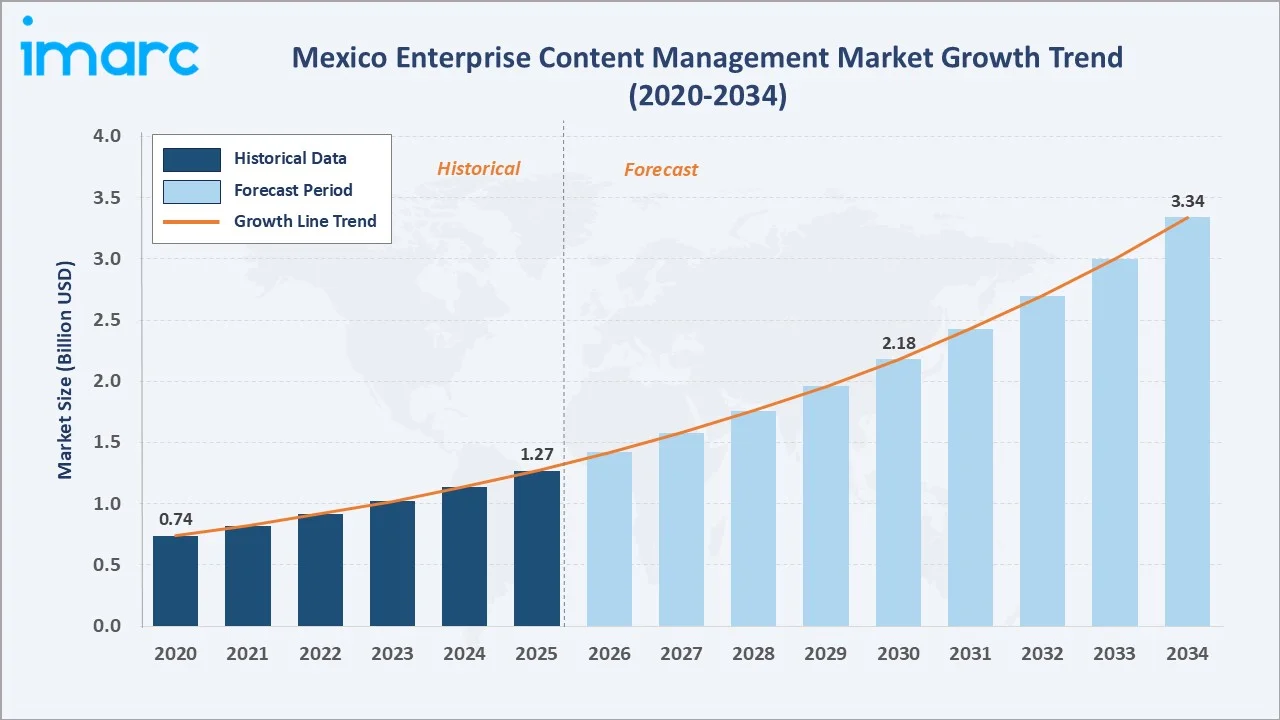
The Mexico enterprise content management market grew from USD 1.27 Billion in 2025 to USD 1.42 Billion in 2026 and is projected to reach USD 3.34 Billion by 2034, growing at a CAGR of 11.33% during 2026-2034. Rising cloud adoption and stricter digital record-keeping needs are driving market growth, reinforced by the launch of the AWS Mexico (Central) Region in January 2025, backed by planned investment of more than USD 5 Billion over 15 years.
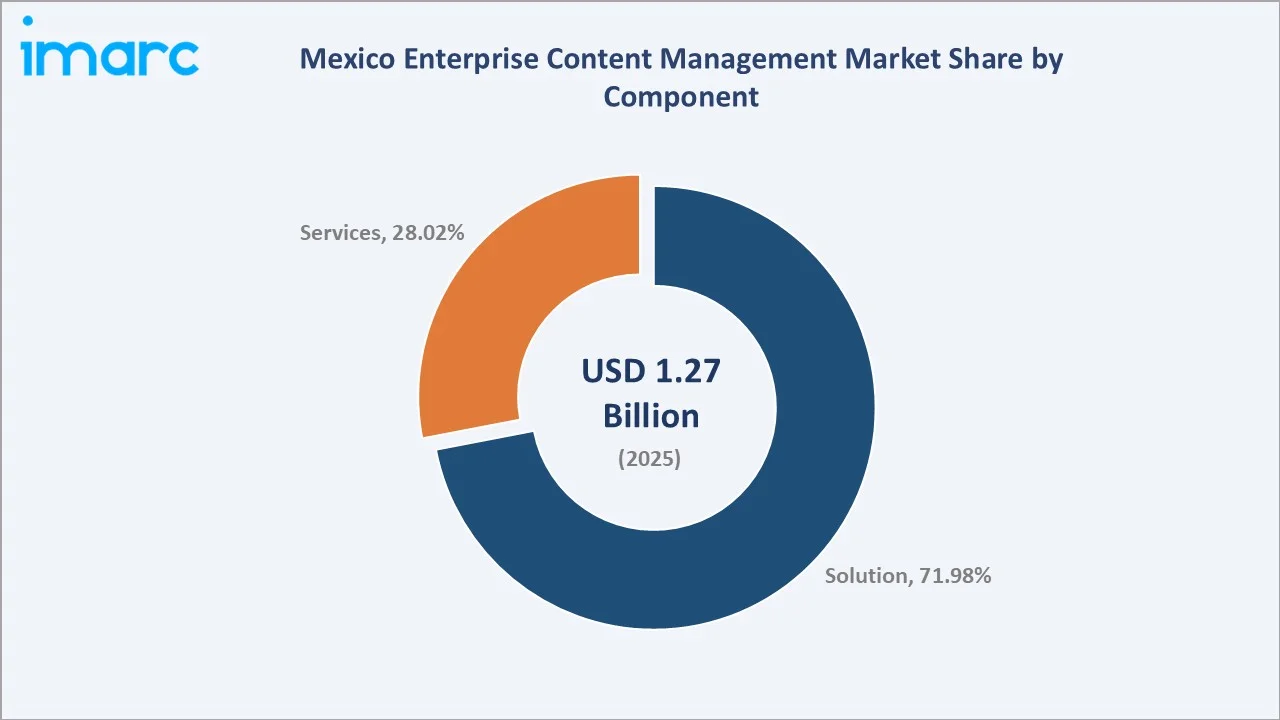
Solution leads the component segment at 71.98%, large enterprises dominate the enterprise size segment at 56.97%, and Central Mexico commands 46.3% regional share.
Market Snapshot
|
Metric |
Value |
|
Base Year Market Size (2025) |
USD 1.27 Billion |
|
Market Size (2026) |
USD 1.42 Billion |
|
Forecast Market Size (2034) |
USD 3.34 Billion |
|
CAGR (2026-2034) |
11.33% |
|
Base Year |
2025 |
|
Historical Period |
2020-2025 |
|
Forecast Period |
2026-2034 |
|
Largest Region |
Central Mexico (46.3%, 2025) |
|
Second Largest Region |
Northern Mexico (30.2%, 2025) |
|
Leading Component |
Solution (71.98%, 2025) |
|
Leading Enterprise Size |
Large Enterprises (56.97%, 2025) |
The Mexico enterprise content management market size increased from USD 0.74 Billion in 2020 to USD 1.27 Billion in 2025 and is estimated to reach USD 1.42 Billion in 2026. The market is further expected to grow to USD 2.18 Billion by 2030 and USD 3.34 Billion by 2034. Growth is supported by wider digitization of business records, rising compliance needs across regulated industries, faster cloud migration, and broader adoption among smaller firms.
To get more information on this market, Request Sample
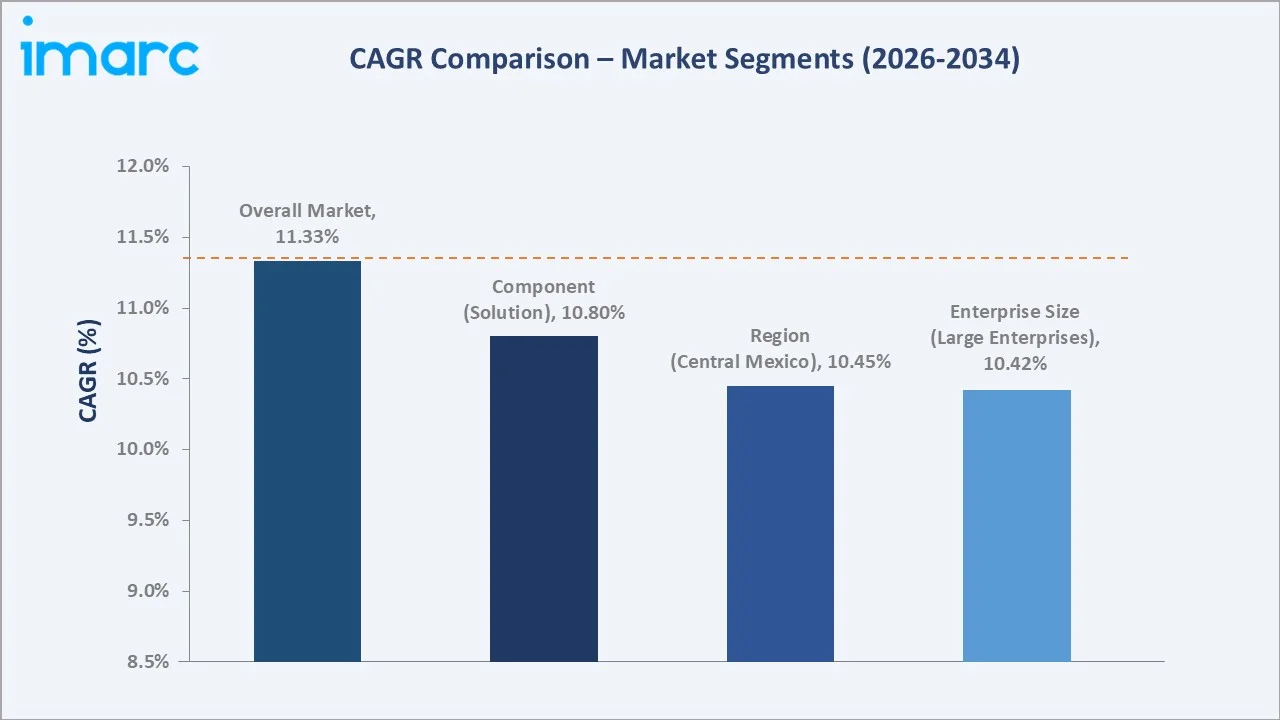
CAGR trajectories across component and enterprise size sub-segments, together with regional patterns, show services, small and medium-sized enterprises, and Northern Mexico expanding faster than the overall 11.33% market CAGR. Rising demand for implementation support, affordable cloud subscriptions, and industrial expansion explain this pattern.
Executive Summary
The Mexico enterprise content management market expanded from USD 1.27 Billion in 2025 to an estimated USD 1.42 Billion in 2026. The industry has moved from basic document storage toward integrated platforms that combine capture, workflow, records management, and collaboration. Cloud delivery, hybrid work, and digital tax compliance are pushing organizations of every size to manage content more effectively.
Solution dominates the component segment at 71.98% in 2025, driven by the broad adoption of integrated content management platforms that support document capture, storage, workflow automation, records management, and collaboration. Large enterprises account for 56.97% of the enterprise size segment, fueled by their extensive content volumes, complex information workflows, and greater requirements for centralized governance and compliance. Central Mexico commands 46.3% of regional share, led by its concentration of corporate headquarters and public institutions.
Key Market Insights
|
Insight |
Data |
|
Leading Component |
Solution - 71.98% share (2025) |
|
Second Largest Component |
Services - 28.02% share (2025) |
|
Leading Enterprise Size |
Large Enterprises - 56.97% share (2025) |
|
Second Largest Enterprise Size |
Small and Medium-sized Enterprises - 43.03% share (2025) |
|
Leading Region |
Central Mexico - 46.3% share (2025) |
|
Second Largest Region |
Northern Mexico - 30.2% share (2025) |
|
Top Companies |
Microsoft, Open Text Corporation, IBM, Oracle Corporation, Hyland Software, Inc. |
Key Analytical Observations Expanding On the Data Above:
- Solution dominance at 71.98% is supported by demand for document management, records management, and workflow platforms that act as the central content repository for enterprises.
- Services share at 28.02% reflects rising need for implementation, migration, integration, and managed support as organizations move content from legacy systems to modern platforms.
- Large enterprises leadership at 56.97% is driven by high document volumes, complex compliance needs, and the budgets required for enterprise-wide deployments across multiple business units.
- Small and medium-sized enterprises share at 43.03% is widening as cloud subscriptions lower entry costs. Growing availability of scalable, subscription-based solutions is also enabling smaller businesses to adopt content management capabilities without significant upfront infrastructure investments.
- Central Mexico at 46.3% leads regional share, anchored by Mexico City's dense base of corporate offices, financial institutions, and federal agencies.
Mexico Enterprise Content Management Market Overview
Enterprise content management refers to the strategies and software used to capture, store, manage, preserve, and deliver documents and other business content across an organization. It helps enterprises improve information access, reduce paperwork, and stay compliant with record-keeping and privacy rules.
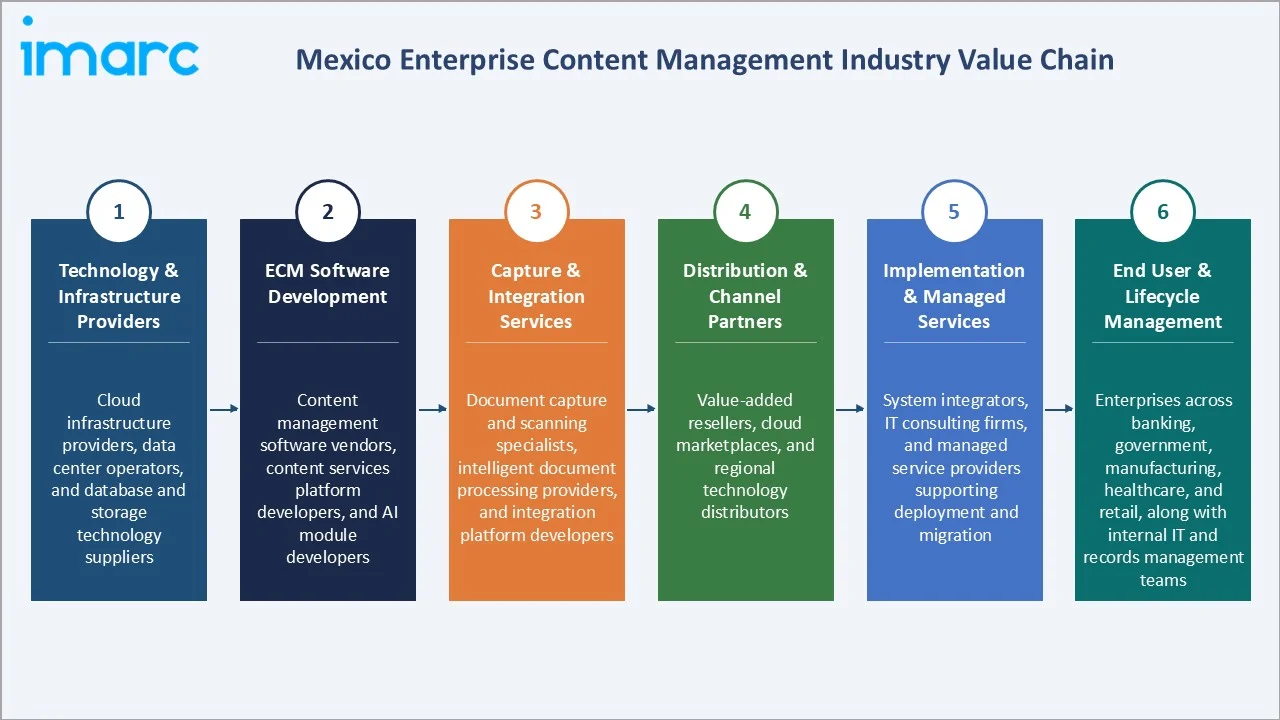
The Mexican ecosystem brings together software vendors, cloud infrastructure providers, system integrators, capture and AI tool developers, regulators, and end-user organizations across banking, government, manufacturing, healthcare, and retail. Nearshoring-linked business activity and ongoing digital government initiatives continue to shape demand across the country.
Market Dynamics
To evaluate market opportunities, Request Sample
Market Drivers
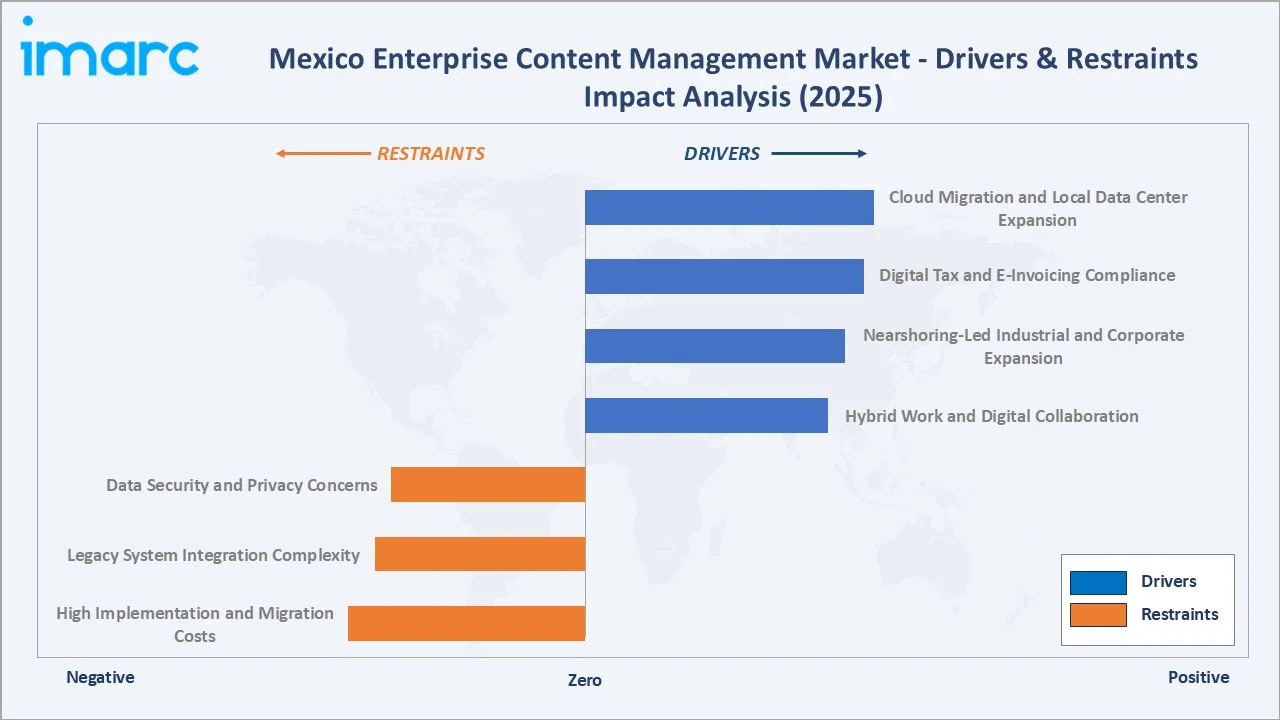
- Cloud Migration and Local Data Center Expansion: Organizations are moving content repositories to cloud platforms to cut infrastructure costs, improve access, and scale storage as document volumes grow. New in-country cloud capacity is also easing data residency concerns for regulated industries.
- Digital Tax and E-Invoicing Compliance: Mexico's electronic invoicing regime requires companies to issue, store, and retrieve digital fiscal documents, creating steady demand for structured content repositories. According to the Servicio de Administración Tributaria (SAT), more than 10.3 Billion electronic invoices were issued in Mexico in 2023.
- Nearshoring-Led Industrial and Corporate Expansion: New manufacturing plants, logistics hubs, and regional offices generate large volumes of contracts, supplier records, and quality documents that require controlled storage and quick retrieval.
- Hybrid Work and Digital Collaboration: Distributed teams rely on shared, version-controlled content and secure external sharing, encouraging firms to replace email attachments and file servers with integrated content platforms.
Market Restraints
- High Implementation and Migration Costs: Licensing, customization, and content migration expenses can be significant, which slows adoption among cost-sensitive organizations and extends payback periods.
- Legacy System Integration Complexity: Many organizations still run older ERP systems, file servers, and paper-based processes, making integration with modern content platforms time-consuming and technically demanding.
- Data Security and Privacy Concerns: Worries about unauthorized access, data leakage, and cross-border data storage continue to make some organizations cautious about moving sensitive content to the cloud.
Market Opportunities
- AI-Powered Document Processing: Growing interest in automated classification, data extraction, and document summarization creates room for vendors to offer intelligent capture and AI add-ons on top of core content platforms.
- Digital Adoption among Small and Medium-sized Enterprises: Affordable subscription models and simplified cloud tools present a large untapped opportunity among smaller firms that still manage records on paper or basic file shares.
Market Challenges
- Shortage of Skilled Content Management Professionals: Limited availability of specialists in information governance, integration, and platform administration can delay projects and raise delivery costs.
- Low User Adoption and Change Resistance: Employees used to paper files and personal folders often resist new workflows, reducing the value organizations gain from content management investments.
Emerging Market Trends
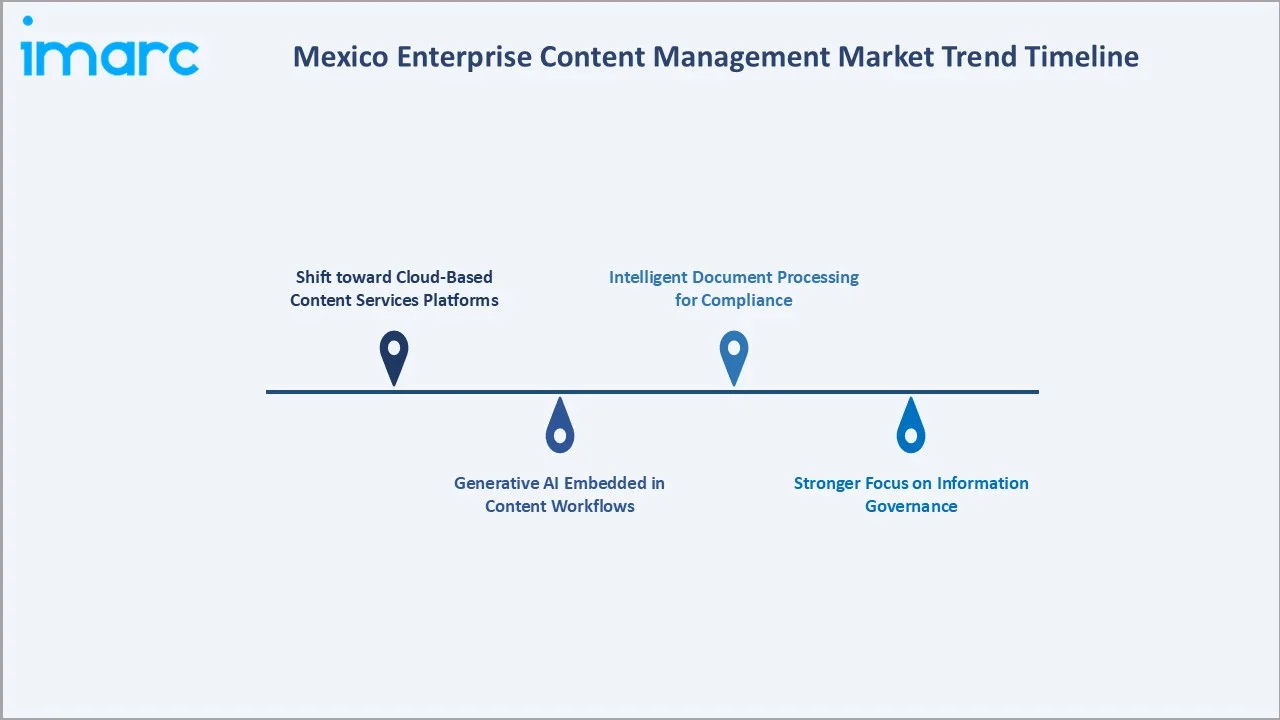
1. Shift toward Cloud-Based Content Services Platforms
Organizations are replacing monolithic on-premises repositories with cloud-based content services that connect to productivity suites, ERP, and CRM applications. This shift supports faster deployment, simpler upgrades, and flexible scaling.
2. Generative AI Embedded in Content Workflows
Vendors are adding AI assistants that summarize documents, answer questions, and automate tagging within content repositories. These capabilities are improving information retrieval, reducing manual content processing, and enabling employees to access relevant information more efficiently.
3. Intelligent Document Processing for Compliance
Enterprises are applying intelligent capture to extract data from invoices, contracts, and identity documents. This reduces manual entry and improves audit readiness for tax and regulatory reviews.
4. Stronger Focus on Information Governance
Organizations are paying closer attention to retention policies, access controls, and audit trails as privacy expectations rise. Governance features are therefore becoming a key buying criterion in platform selection.
Industry Value Chain Analysis
The Mexico enterprise content management market value chain spans six stages, from technology and infrastructure providers through end-user adoption and lifecycle support. Software development, integration, and implementation services capture the highest value-add, while governance and security capabilities increasingly shape long-term competitive position.
|
Stage |
Key Players / Examples |
|
Technology & Infrastructure Providers |
Cloud infrastructure providers, data center operators, and database and storage technology suppliers |
|
ECM Software Development |
Content management software vendors, content services platform developers, and AI module developers |
|
Capture & Integration Services |
Document capture and scanning specialists, intelligent document processing providers, and integration platform developers |
|
Distribution & Channel Partners |
Value-added resellers, cloud marketplaces, and regional technology distributors |
|
Implementation & Managed Services |
System integrators, IT consulting firms, and managed service providers supporting deployment and migration |
|
End User & Lifecycle Management |
Enterprises across banking, government, manufacturing, healthcare, and retail, along with internal IT and records management teams |
Vendors offering integrated platforms with native AI, capture, and governance capabilities are positioned to capture greater value than providers that depend on third-party components.
Technology Landscape in the Mexico Enterprise Content Management Industry
Cloud-Native Content Services
Cloud-native architectures and open APIs allow content platforms to integrate with ERP, CRM, and collaboration tools, supporting faster rollouts, automatic updates, and scalable storage for growing document volumes.
AI and Intelligent Document Processing
Machine learning (ML), optical character recognition, and generative AI are being used to classify documents, extract key data, and summarize content, reducing manual effort and improving search accuracy.
Workflow Automation and Low-Code Tools
Low-code workflow designers and robotic process automation help organizations automate approvals, onboarding, and case management, cutting turnaround times across document-heavy processes.
Security and Records Governance
Encryption, role-based access, retention scheduling, and audit trails help organizations protect sensitive content and demonstrate compliance with privacy and record-keeping obligations.
Market Segmentation Analysis
The report covers the following segments:
|
Segment Category |
Leading Segment |
Market Share |
Year |
|
Component |
Solution |
71.98% |
2025 |
|
Deployment Mode |
Cloud-based |
60.92% |
2025 |
|
Enterprise Size |
Large Enterprises |
56.97% |
2025 |
|
End Use Industry |
Banking Financial Services and Insurance (BFSI) |
18.98% |
2025 |
|
Region |
Central Mexico |
46.3% |
2025 |

By Component
Solution commands a 71.98% majority share in 2025, driven by demand for document management, records management, enterprise search, and workflow software that forms the core of content operations. The segment benefits from expanding cloud subscriptions and growing interest in AI-enabled features.
To access detailed market analysis, Request Sample
Services at 28.02% in 2025 include consulting, implementation, integration, migration, and managed support. The segment is gaining relevance as organizations seek expert help to modernize legacy repositories and improve user adoption.
By Enterprise Size
Large enterprises lead with 56.97% share in 2025, reflecting high content volumes, multi-site operations, and strict governance needs across banking, government, and manufacturing organizations.
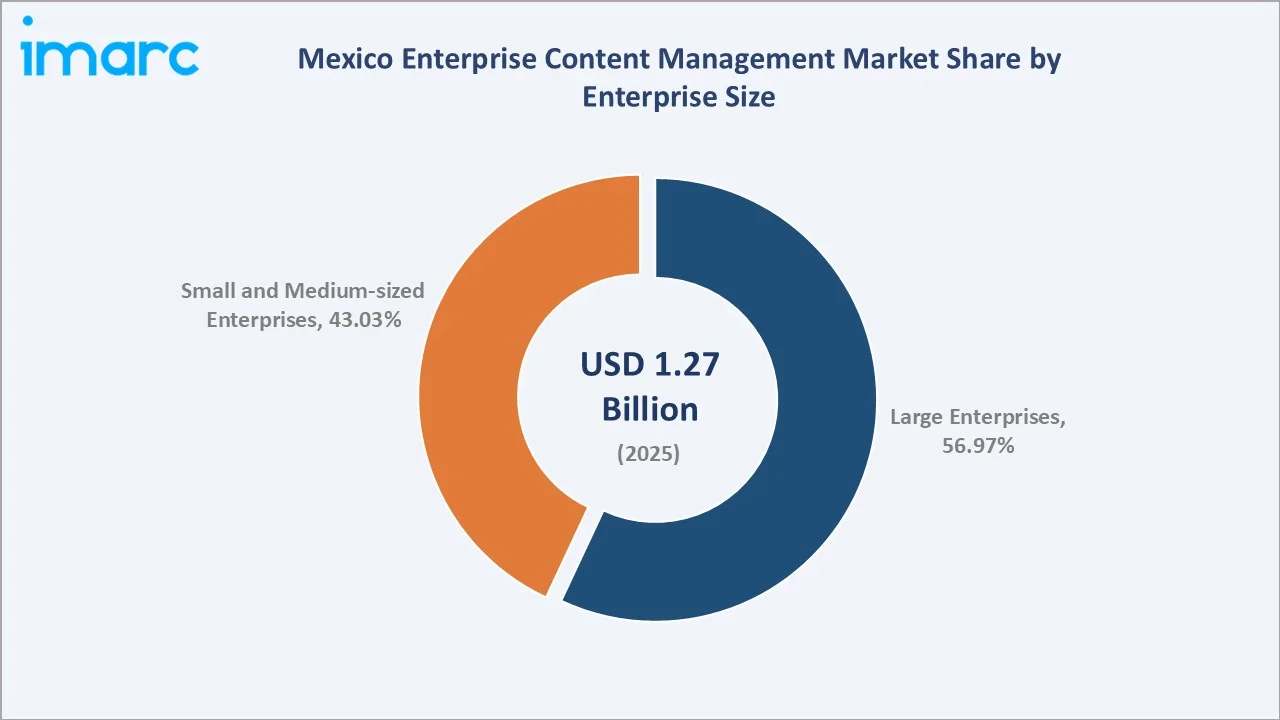
Small and medium-sized enterprises at 43.03% represent a fast-expanding customer base, supported by affordable cloud plans and simpler tools that require limited in-house IT resources.
Regional Market Insights
|
Region |
Share (2025) |
Key Growth Drivers |
|
Central Mexico |
46.3% |
Dense concentration of corporate headquarters, financial institutions, and government agencies, supported by strong digital infrastructure |
|
Northern Mexico |
30.2% |
Strong manufacturing and export activity, expanding industrial parks, and rising need for supplier and quality documentation |
|
Southern Mexico |
14.5% |
Growing public sector digitization, expanding tourism and energy activity, and improving connectivity |
|
Others |
9.0% |
Gradual digital adoption among regional businesses and growing use of cloud-based tools |
Central Mexico at 46.3% in 2025 leads the regional landscape, anchored by Mexico City's role as the country's business and administrative center. A high concentration of large enterprises, banks, and federal institutions supports sustained regional leadership.
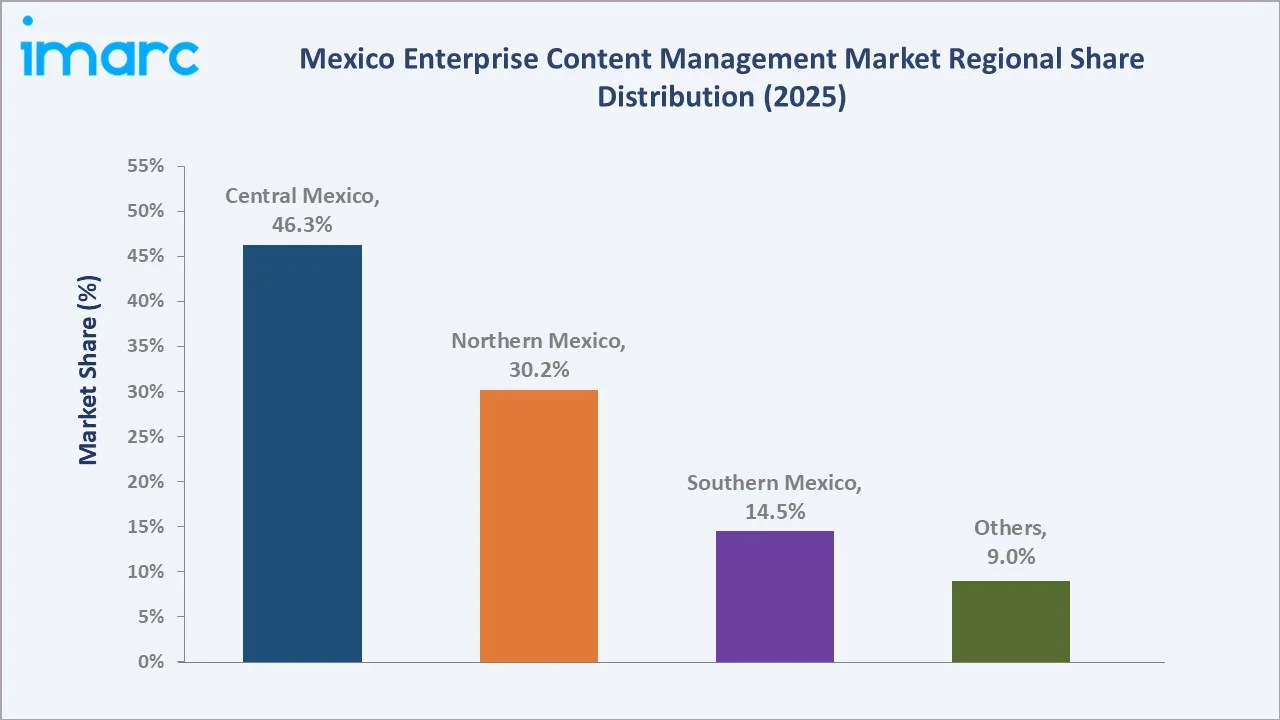
Northern Mexico, at 30.2% share, is expanding at the fastest pace as manufacturing and logistics investment in industrial states lifts demand for controlled documentation and cross-border compliance content.
Competitive Landscape
The Mexico enterprise content management market is moderately concentrated, with global software providers leading enterprise deployments while specialized vendors compete on vertical solutions, ease of use, and cloud-native design. Integration depth, AI capability, and governance features form the key competitive differentiators across the industry.
|
Company Name |
Brand / Key Product |
Position |
Strategic Focus |
|
Microsoft |
SharePoint |
Leader |
Expanding cloud-based content and collaboration capabilities with integrated AI features |
|
Open Text Corporation |
OpenText Content Management |
Leader |
Strengthening information management offerings through AI integration and cloud delivery |
|
IBM |
IBM Content Cortex |
Leader |
Enhancing content platforms with AI-driven insights and flexible hybrid deployment |
|
Oracle Corporation |
Oracle WebCenter Content |
Challenger |
Integrating content management with enterprise applications and cloud infrastructure |
|
Hyland Software, Inc. |
OnBase |
Challenger |
Expanding content services adoption across document-intensive industries through cloud offerings |
Key players include Microsoft, Open Text Corporation, IBM, Oracle Corporation, and Hyland Software, Inc., among others.
Key Company Profiles
Microsoft
Microsoft is a global technology company headquartered in Redmond, Washington, United States, offering cloud-based content management and collaboration solutions used by organizations across Mexico.
- Product Portfolio: SharePoint, OneDrive, Microsoft Teams, and Microsoft Purview, covering content collaboration, storage, and information governance.
- Recent Developments: The company continues to enhance its content and collaboration platform with AI-assisted features, strengthening search, security, and governance capabilities for enterprise users.
- Strategic Focus: Broadening cloud-based content and collaboration capabilities while embedding AI features across its productivity ecosystem.
Open Text Corporation
Open Text Corporation is an information management company headquartered in Waterloo, Ontario, Canada, providing enterprise content management platforms to large organizations in Mexico and globally.
- Product Portfolio: OpenText Content Management and OpenText Documentum Content Management, covering document management, records governance, and enterprise application integration.
- Recent Developments: The company continues to add AI-driven capabilities to its content platforms while focusing its portfolio on core information management offerings.
- Strategic Focus: Advancing information management solutions by combining AI capabilities with cloud-based delivery.
IBM
IBM is a global technology and consulting company headquartered in Armonk, New York, United States, providing content management software and services to enterprises in Mexico and worldwide.
- Product Portfolio: IBM Content Cortex, which unifies capabilities from IBM FileNet Content Manager, IBM Content Manager OnDemand, and IBM Content Manager Enterprise Edition.
- Recent Developments: The company continues to modernize its content services portfolio with AI-ready capabilities, supporting governed use of enterprise content across hybrid environments.
- Strategic Focus: Strengthening content platforms through AI-driven insights and adaptable hybrid deployment options.
Market Concentration Analysis
The Mexico enterprise content management market is moderately concentrated, with leading global software providers accounting for a significant share of enterprise deployments, reflecting the scale, integration depth, and support capabilities required to serve large organizations.
Barriers to entry include high development costs, the need for security and compliance certifications, and the partner networks required to deliver complex implementations. These factors favor established vendors with proven platforms and existing customer relationships.
Consolidation is gradually increasing as larger vendors acquire capture, AI, and workflow specialists to broaden their portfolios. Partnerships between software vendors, cloud providers, and local system integrators are further shaping competitive positioning across the market.
Investment & Growth Opportunities
Fastest-Growing Segments
Services are expanding fastest within the component segment, driven by migration, integration, and managed support needs. Small and medium-sized enterprises are also growing quickly as cloud subscriptions make enterprise-grade content tools more affordable.
Emerging Markets
Northern Mexico is the fastest growing region, supported by manufacturing investment, expanding industrial parks, and rising cross-border documentation needs. The region offers strong opportunity for vendors able to serve industrial and logistics workflows.
Venture & Investment Trends
Investment activity is concentrated in cloud infrastructure, AI-driven document processing, and workflow automation. Capital is also flowing into governance and security tools that help organizations meet evolving data protection requirements in Mexico.
Future Market Outlook (2026-2034)
The Mexico enterprise content management market is projected to grow from USD 1.27 Billion in 2025 to USD 1.42 Billion in 2026, reaching USD 3.34 Billion by 2034, registering a CAGR of 11.33% during 2026-2034.
Four forces will shape the market through 2034: continued cloud migration across enterprises of all sizes; deeper integration of generative AI into content workflows; stronger information governance driven by privacy expectations; and rising digitization among small and medium-sized enterprises.
By 2034, enterprise content management in Mexico is expected to be defined by cloud-native, AI-assisted platforms that link content directly to business processes. Continued digital tax compliance and industrial growth are expected to further accelerate the evolution of the market.
Research Methodology
Primary Research
Primary research included structured interviews with content management software vendors, system integrators, cloud service providers, and IT decision-makers at end-user organizations, validating market sizing, segment mix, and regional demand patterns.
Secondary Research
Secondary sources included publications from INEGI, the Servicio de Administración Tributaria, the Secretaría de Economía, and the Diario Oficial de la Federación, along with annual reports, press releases, and investor presentations from listed technology providers.
Forecasting Models
Market forecasts used top-down and bottom-up models combining software spending trends, cloud adoption rates, enterprise counts, and macroeconomic variables. Scenario analysis addressed regulatory developments, technology adoption pace, and investment trends.
Mexico Enterprise Content Management Market Report Coverage:
| Report Features | Details |
|---|---|
| Base Year of the Analysis | 2025 |
| Historical Period | 2020-2025 |
| Forecast Period | 2026-2034 |
| Units | Billion USD |
| Scope of the Report | Exploration of Historical Trends and Market Outlook, Industry Catalysts and Challenges, Segment-Wise Historical and Future Market Assessment:
|
| Components Covered |
|
| Deployment Modes Covered | On-premises, Cloud-based |
| Enterprise Sizes Covered | Small and Medium-sized Enterprises, Large Enterprises |
| End Use Industries Covered | Telecom and IT, Banking Financial Services and Insurance (BFSI), Retail, Education, Manufacturing, Media and Entertainment, Government, Healthcare, Others |
| Regions Covered | Northern Mexico, Central Mexico, Southern Mexico, Others |
| Companies Covered | Microsoft, Open Text Corporation, IBM, Oracle Corporation, Hyland Software, Inc., etc. |
| Customization Scope | 10% Free Customization |
| Post-Sale Analyst Support | 10-12 Weeks |
| Delivery Format | PDF and Excel through Email (We can also provide the editable version of the report in PPT/Word format on special request) |
Frequently Asked Questions About the Mexico Enterprise Content Management Market Report
The Mexico enterprise content management market size is estimated at USD 1.42 Billion in 2026, driven by cloud adoption, digital compliance needs, and growing demand for organized and secure business content.
The market is projected to grow at a CAGR of 11.33% from 2026-2034, reaching USD 3.34 Billion, supported by cloud migration and wider use of AI in content workflows.
Solution holds the largest share of the component segment at 71.98% in 2025, driven by strong demand for document management, records management, enterprise search, and workflow software.
Large enterprises hold the largest share of the enterprise size segment at 56.97% in 2025, reflecting high document volumes, multi-site operations, and strict content governance requirements.
Central Mexico commands 46.3% share in 2025, led by Mexico City's concentration of corporate headquarters, financial institutions, and federal agencies that manage large volumes of business content.
Northern Mexico is the fastest growing region, supported by manufacturing and logistics investment that increases demand for supplier records, quality documentation, and cross-border compliance content.
Leading players include Microsoft, Open Text Corporation, IBM, Oracle Corporation, and Hyland Software, Inc., among others.
AI is being applied to document classification, data extraction, search, and summarization, helping organizations reduce manual effort, speed decisions, and improve access to information stored in repositories.
Key challenges include high implementation costs, legacy system integration complexity, data security concerns, limited skilled professionals, and user resistance to new digital workflows within organizations.
Need more help?
- Speak to our experienced analysts for insights on the current market scenarios.
- Include additional segments and countries to customize the report as per your requirement.
- Gain an unparalleled competitive advantage in your domain by understanding how to utilize the report and positively impacting your operations and revenue.
- For further assistance, please connect with our analysts.
 Request Customization
 Speak to an Analyst
 Request Brochure
 Inquire Before Buying
Benefits of Customization
- Personalize this research
- Triangulate with your data
- Get data as per your format and definition
- Gain a deeper dive into a specific application, geography, customer, or competitor
- Any level of personalization
Get in Touch With Us
UNITED STATES
Phone: +1-201-971-6302
INDIA
Phone: +91-120-433-0800
UNITED KINGDOM
Phone: +44-753-714-6104
Email: [email protected]
Client Testimonials




.webp)




.webp)













Related Reports

Choose your plan
*Please note that the prices mentioned below are starting prices for each bundle type. Kindly contact our team for further details.*
Single User License
- 1 User License, Access on 2 Devices
- PDF Report + Excel Dataset (Password Protected)
- Lifetime Access
- No Printing Rights
- 10% Free Report Customization
- 10–12 Weeks of Analyst Support
Five User License
- Access for 5 Users, 2 Devices per User
- PDF Report + Excel Dataset (Password Protected)
- Lifetime Access
- Dedicated Account Manager
- 12–14 Weeks of Analyst Support
- No Printing Rights
- 15% Free Report Customization
- 25% Discount on Your Next Purchase
Corporate User License
- Unlimited User Access (Within Your Organization)
- PDF Report + Excel Dataset
- Lifetime Access
- Dedicated Account Manager
- 14–20 Weeks of Analyst Support
- No Printing Rights
- 20% Free Report Customization
- 30% Discount on Your Next Purchase
Essential Insights
What's included:
3 reports
- Lifetime Access
- PDF Reports
- Excel Datasets
- 2 Weeks of Free Analyst Support
- 2 User Licenses
- Access on 2 Devices
- Printing Rights
- Complimentary PowerPoint (PPT) Version
- Complimentary License Upgrade
Professional Access
What's included:
5 reports
- Lifetime Access
- PDF Reports
- Excel Datasets
- 8 Weeks of Free Analyst Support
- 2 User Licenses
- Access on 2 Devices
- Printing Rights
- Complimentary PowerPoint (PPT) Version
- Complimentary License Upgrade
Business Advantage
What's included:
8 reports
- Lifetime Access
- PDF Reports
- Excel Datasets
- 14 Weeks of Free Analyst Support
- 2 User Licenses
- Access on 2 Devices
- Printing Rights
- Complimentary PowerPoint (PPT) Version
- Complimentary License Upgrade
Enterprise Intelligence
What's included:
10 reports
- Lifetime Access
- PDF Reports
- Excel Datasets
- 20 Weeks of Free Analyst Support
- 2 User Licenses
- Access on 2 Devices
- Printing Rights
- Complimentary PowerPoint (PPT) Version
- Complimentary License Upgrade