
Mexico Geyser Market Size, Share, Trends and Forecast by Type of Geyser, Capacity, Energy Source, Application, and Region, 2026-2034
Mexico Geyser Market Size, Share, Trends & Forecast (2026-2034)
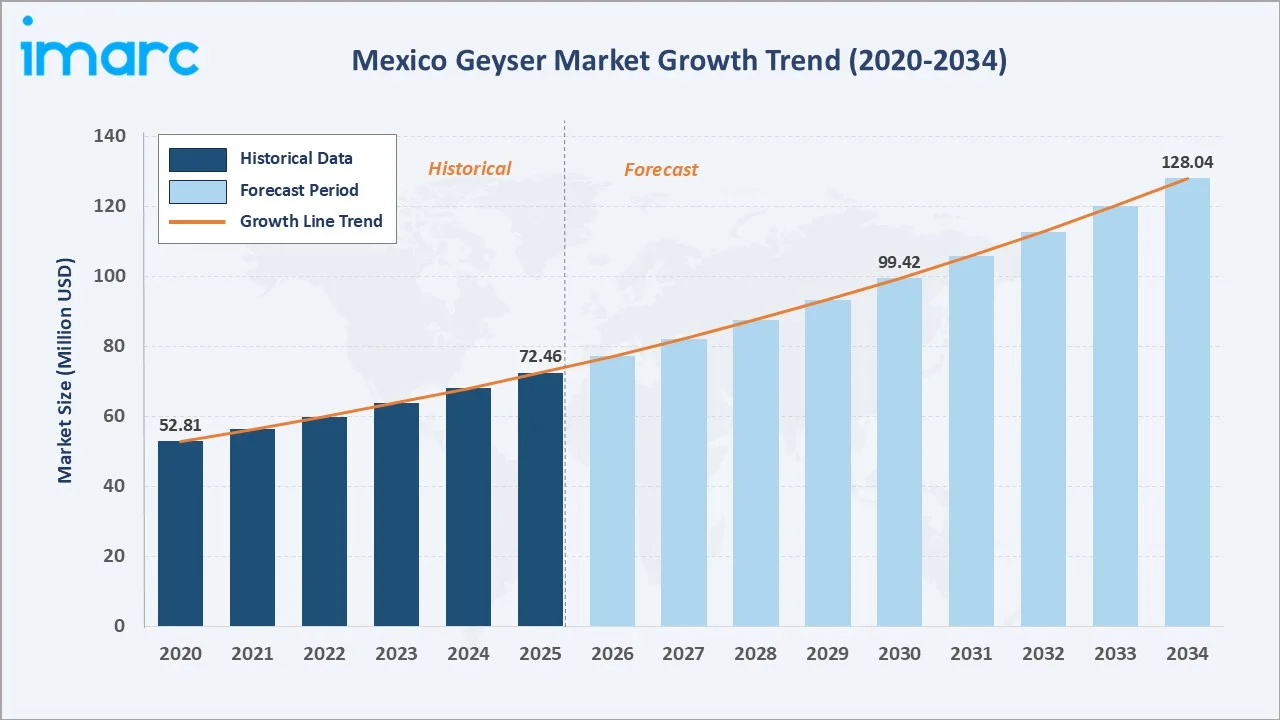
The Mexico geyser market was valued at USD 72.46 Million in 2025 and is projected to reach USD 128.04 Million by 2034, exhibiting a CAGR of 6.53% during 2026-2034. Rising residential construction activity, stricter energy-efficiency regulations, expanding solar water heater penetration, and growing urbanization across metropolitan areas are the primary drivers shaping market growth.
Storage water heaters lead the type of geyser segment at 39.7%, electric leads the energy source segment at 46.3%, and Central Mexico commands 42.8% regional share.
Market Snapshot
|
Metric |
Value |
|
Market Size (2025) |
USD 72.46 Million |
|
Forecast Market Size (2034) |
USD 128.04 Million |
|
CAGR (2026-2034) |
6.53% |
|
Base Year |
2025 |
|
Historical Period |
2020-2025 |
|
Forecast Period |
2026-2034 |
|
Largest Region |
Central Mexico (42.8%, 2025) |
|
Second Largest Region |
Northern Mexico (28.6%, 2025) |
|
Leading Type of Geyser |
Storage Water Heaters (39.7%, 2025) |
|
Leading Energy Source |
Electric (46.3%, 2025) |
The Mexico geyser market expanded from USD 52.81 Million in 2020 to USD 72.46 Million in 2025, supported by widening residential energy upgrades, growing awareness of energy efficiency, and rising demand for solar and instant water heaters. Anchored at USD 99.42 Million in 2030, the forecast to USD 128.04 Million by 2034 reflects accelerating adoption of heat pump water heaters, continued solar energy integration, and supportive regulatory frameworks promoting sustainable water heating solutions.
To get more information on this market, Request Sample
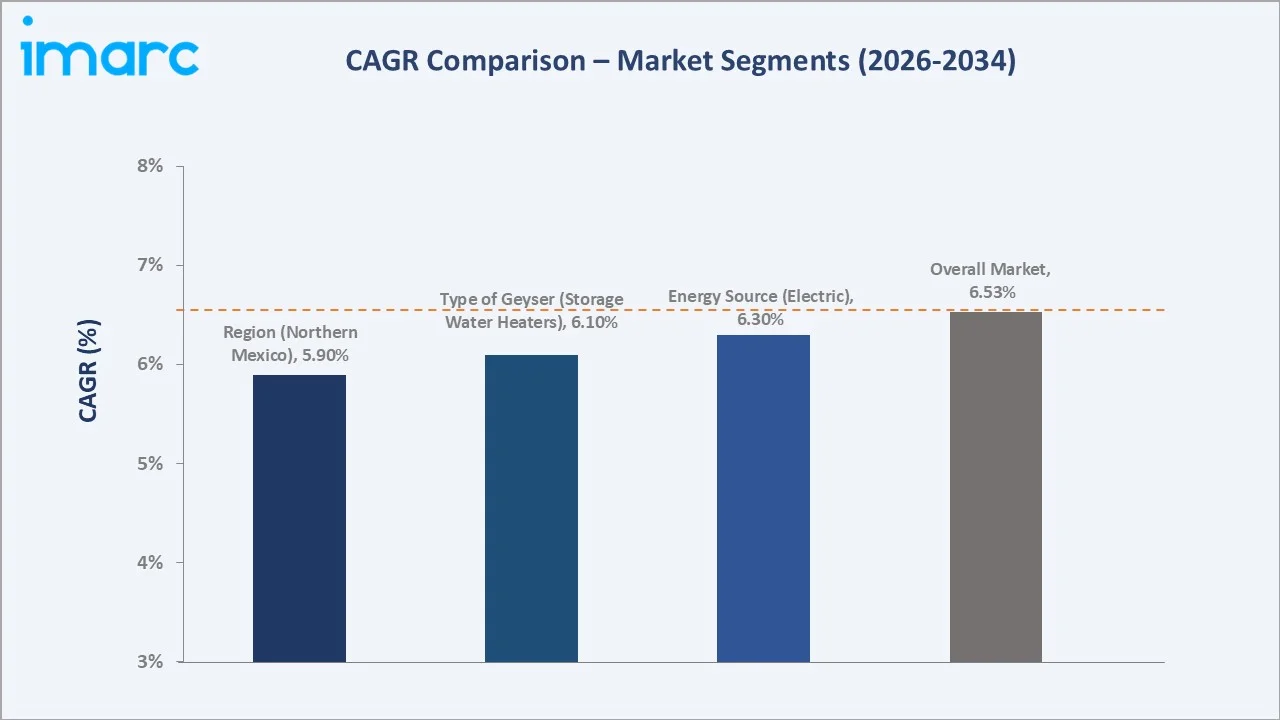
CAGR trajectories across type of geyser and energy source sub-segments show solar water heaters and heat pump water heaters expanding faster than the overall 6.53% market CAGR, driven by government incentive programs, falling equipment costs, and increasing environmental consciousness among Mexican consumers.
Executive Summary
The Mexico geyser market is on a steady growth trajectory from USD 52.81 Million in 2020 to USD 128.04 Million by 2034. The market has evolved from predominantly traditional gas and storage water heater deployments toward a diversified portfolio spanning instant, solar, and heat pump technologies. Rising construction activity, tightening energy-efficiency mandates, and a growing middle class with increasing disposable income are reshaping consumer preferences across all major segments.
Storage water heaters dominate the type of geyser segment at 39.7% in 2025, supported by widespread familiarity, cost accessibility, and compatibility with existing household plumbing infrastructure. Electric leads the energy source segment at 46.3%, driven by reliable grid connectivity across urban centers and competitive installation costs. Central Mexico commands 42.8% of the regional share, anchored by high population density, robust construction pipelines, and a large concentration of urban household consumers in the country.
Key Market Insights
|
Insight |
Data |
|
Leading Type of Geyser |
Storage Water Heaters – 39.7% share (2025) |
|
Second Largest Type of Geyser |
Instant Water Heaters – 28.4% share (2025) |
|
Leading Energy Source |
Electric – 46.3% share (2025) |
|
Second Largest Energy Source |
Gas – 31.8% share (2025) |
|
Leading Region |
Central Mexico – 42.8% share (2025) |
|
Second Largest Region |
Northern Mexico – 28.6% share (2025) |
|
Top Companies |
Grupo Rotoplas S.A.B. de C.V., Paloma Rheem Holdings Co., LTD., Ariston Holding N.V., Robert Bosch GmbH |
Key Analytical Observations Supporting the Above Data:
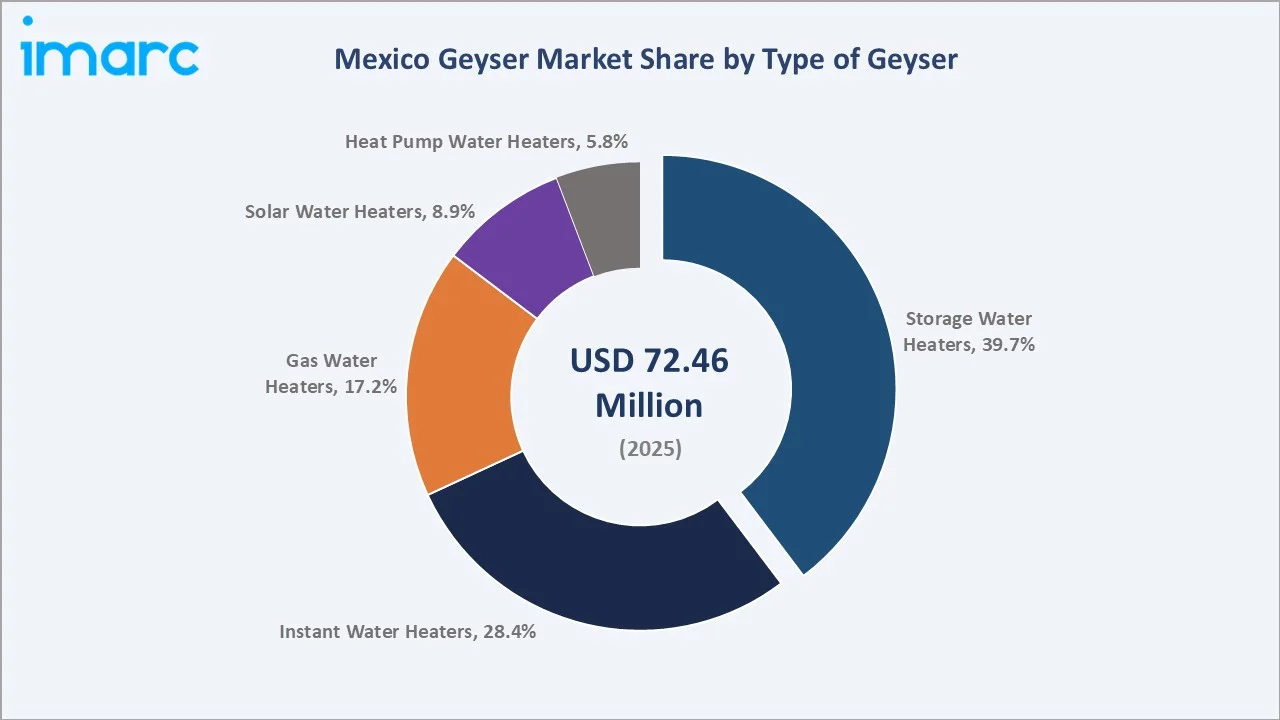
- Storage water heaters dominance at 39.7% is supported by broad consumer familiarity, lower initial purchase costs, and widespread availability across both urban and rural retail networks. The segment benefits from compatibility with existing plumbing systems and the growing trend toward larger household sizes requiring high-capacity water storage.
- Instant water heaters at 28.4% are gaining traction in urban apartments and compact housing units where space constraints limit installation of storage tanks. The segment is supported by energy-on-demand appeal and growing awareness of reduced standby heat losses.
- Electric leadership at 46.3% reflects broad urban grid connectivity, straightforward installation logistics, and the rising availability of energy-efficient electric geyser models compliant with NOM standards.
- Gas at 31.8% remains strong in regions with established natural gas pipeline infrastructure, particularly in Northern Mexico and parts of Central Mexico, where gas remains the cost-effective energy option for large-family households.
- Central Mexico at 42.8% leads the regional landscape, driven by the Mexico City metropolitan area's dense residential and commercial construction activity and a high concentration of urban middle-class consumers in the country.
Mexico Geyser Market Overview
A geyser is a water-heating appliance that heats and stores or instantly delivers hot water for residential, commercial, and industrial applications, providing a reliable hot water supply for everyday use. The Mexico geyser market encompasses the design, manufacture, distribution, and installation of water heating systems for residential, commercial, and industrial end uses.
The market ecosystem integrates raw material and component suppliers, geyser manufacturers, distribution channels including hardware retailers and plumbing distributors, professional installation services, regulatory bodies, and subsidy program administrators. Together these stakeholders enable efficient delivery of water heating solutions across a geographically diverse and rapidly urbanizing national market. Macroeconomic influences include the pace of residential construction, natural gas and electricity tariff trends, government energy transition targets, and consumer credit availability for household appliance purchases.
Market Dynamics
To evaluate market opportunities, Request Sample
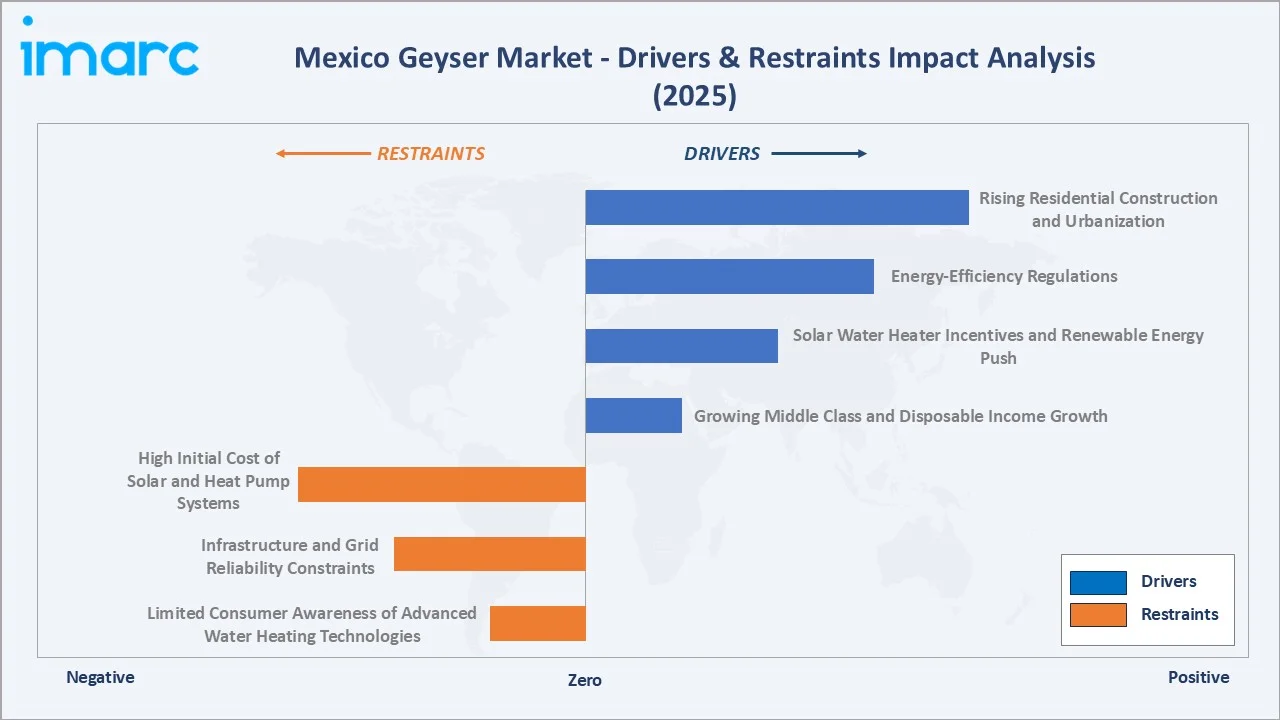
Market Drivers
- Rising Residential Construction and Urbanization: Mexico's sustained housing construction activity is directly expanding the addressable demand base for water heaters. As of June 2026, Mexico attained 274,000 homes in construction via the federal government’s Vivienda para el Bienestar initiative, highlighting an important achievement in President Claudia Sheinbaum’s goal to broaden access to affordable housing and mitigate the nation’s housing shortfall. New residential units require water heating installations, making construction volume a primary demand driver across storage and instant geyser categories.
- Energy-Efficiency Regulations: Stricter energy-efficiency regulations for water heaters are raising minimum performance standards, encouraging consumers and businesses to replace older, inefficient units with modern, energy-efficient models. This regulatory push is accelerating product replacement cycles and supporting demand across residential and commercial markets.
- Solar Water Heater Incentives and Renewable Energy Push: Federal and state-level clean-energy initiatives are accelerating adoption of solar water heaters, particularly among middle-income and lower-middle-income households seeking to reduce monthly energy expenditure.
- Growing Middle Class and Disposable Income Growth: Expanding urban middle-class households with rising discretionary income are increasingly investing in higher-quality and energy-efficient water heating solutions, driving premiumization trends across the instant and heat pump geyser categories.
Market Restraints
- High Initial Cost of Solar and Heat Pump Systems: Solar water heaters and heat pump water heaters carry significantly higher upfront investment than conventional electric and gas models, limiting uptake among price-sensitive consumer segments.
- Infrastructure and Grid Reliability Constraints: Uneven electricity grid reliability and natural gas infrastructure gaps in southern and remote regions limit the addressable market for electric and gas geysers, partially constraining overall market penetration outside established urban centers.
- Limited Consumer Awareness of Advanced Water Heating Technologies: Limited awareness of the long-term cost savings, energy efficiency, and environmental benefits of advanced water heating systems slows adoption, particularly among first-time buyers and households in less-developed markets.
Market Opportunities
- Heat Pump Water Heater Commercialization: As heat pump water heater costs decline and consumer awareness grows, manufacturers have the opportunity to position these high-efficiency products as the long-term replacement category for conventional electric storage units, particularly in areas with hot or warm climates that favor heat pump performance.
- Commercial and Hospitality Sector Demand: Mexico's growing hospitality, healthcare, and food service sectors represent strong demand drivers for high-capacity and continuous-supply water heating systems, offering premium revenue opportunities for manufacturers with commercial-grade product portfolios.
Market Challenges
- Competition from Informal and Low-Cost Imports: The availability of unbranded, low-cost water heaters through informal retail channels creates downward pricing pressure for branded manufacturers, particularly in the lower-tier storage and gas geyser segments.
- Fragmented Distribution and After-Sales Service Network: Expanding reliable installation, maintenance, and after-sales service across smaller cities and rural areas remains challenging, affecting customer confidence and limiting adoption of higher-value water heating systems.
Emerging Market Trends
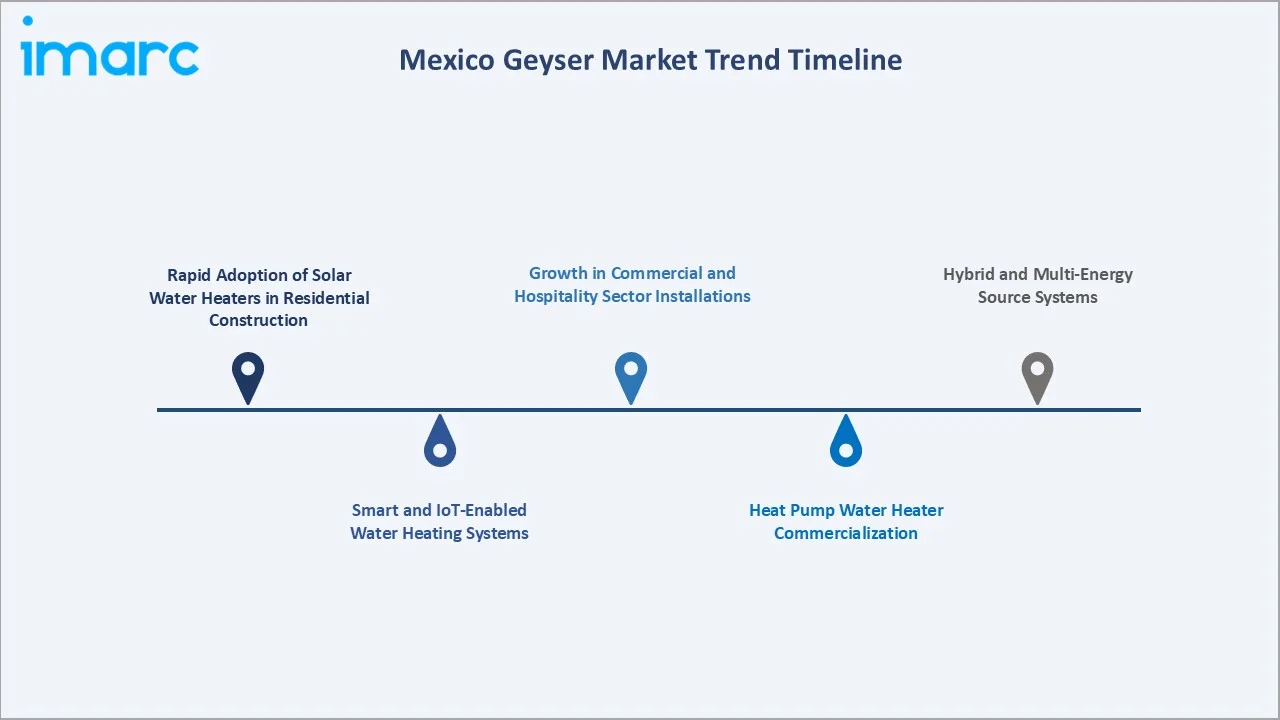
1. Rapid Adoption of Solar Water Heaters in Residential Construction
Solar water heaters are increasingly being integrated into new residential developments as standard or optional upgrades, supported by green building certification requirements. This trend is expected to accelerate through 2034 as NOM efficiency mandates tighten and solar component supply chains mature.
2. Smart and IoT-Enabled Water Heating Systems
Manufacturers are increasingly introducing Wi-Fi connected and app-controlled water heaters that enable remote temperature management, scheduling, and energy consumption monitoring. These smart systems appeal to urban, tech-savvy consumers and align with the broader smart-home adoption trend across Mexican middle-class households. IoT integration is also enabling predictive maintenance features, reducing service costs and extending product lifespans.
3. Heat Pump Water Heater Commercialization
Heat pump water heaters, which extract ambient air heat to warm water at significantly higher efficiency than conventional electric resistance systems, are gaining visibility in the Mexican market. Leading manufacturers are launching entry-level heat pump models targeting environmentally conscious urban consumers and commercial operators seeking to reduce energy costs and carbon footprints. Government procurement programs for public housing are also beginning to specify heat pump systems.
4. Growth in Commercial and Hospitality Sector Installations
Mexico's expanding hospitality sector, driven by growing domestic and international tourism, is generating strong demand for high-capacity water heating systems in hotels, resorts, and food service establishments. As per INEGI, the nation welcomed 47.79 Million international visitors in 2025, indicating a 6.1% yearly rise. This is driving demand for commercial-grade tankless and solar systems with higher flow rates and continuous supply capabilities, shifting manufacturer focus toward B2B revenue channels alongside traditional residential retail.
5. Hybrid and Multi-Energy Source Systems
Manufacturers are developing hybrid water heaters that combine solar collectors with electric or gas backup systems, providing reliable hot water supply regardless of weather conditions. These hybrid configurations are gaining acceptance among consumers seeking solar energy benefits without reliability trade-offs, positioning hybrid geysers as a mainstream mid-market category through the latter part of the forecast period.
Industry Value Chain Analysis
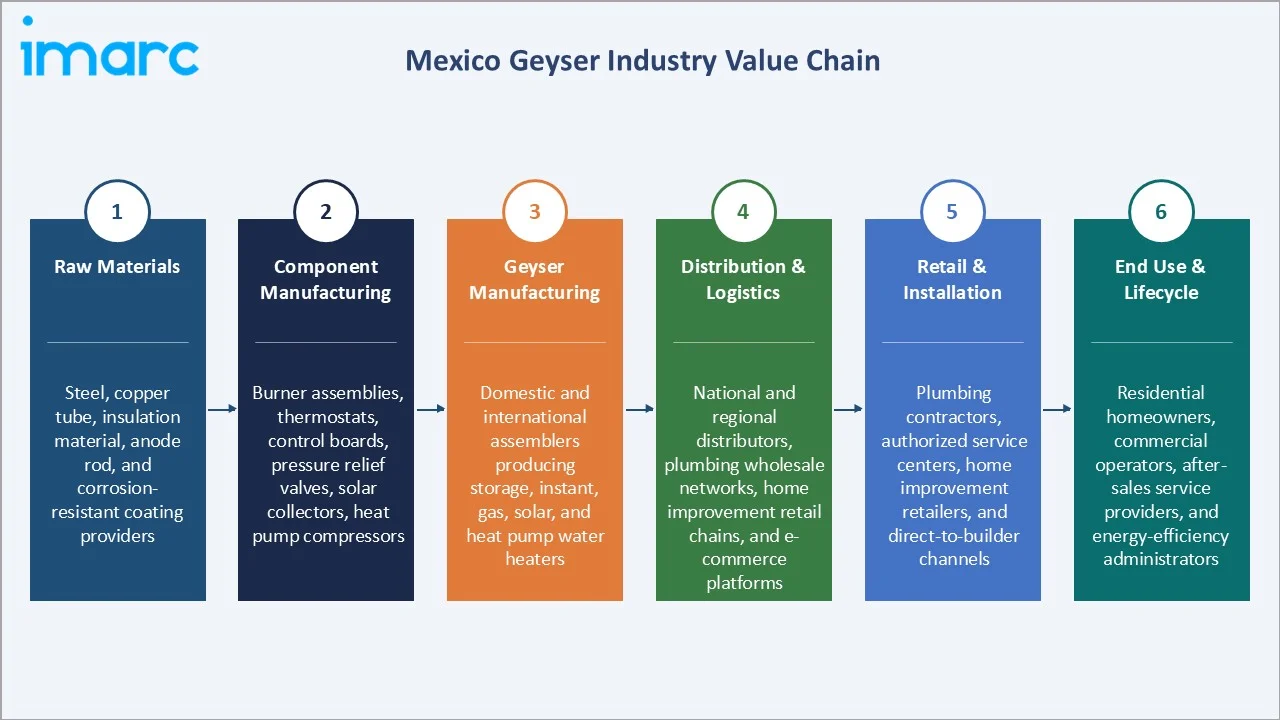
The Mexico geyser value chain spans six key stages from raw material sourcing through end-user lifecycle management. Manufacturing, distribution, and after-sales service capture the highest value-add, while regulatory compliance and energy certification capabilities increasingly define competitive differentiation among established market participants.
|
Stage |
Key Players / Examples |
|
Raw Materials |
Steel sheet and coil suppliers, copper tube manufacturers, insulation material producers, anode rod and corrosion-resistant coating providers supporting tank and heat exchanger fabrication |
|
Component Manufacturing |
Burner and combustion assembly manufacturers, thermostat and control board producers, pressure relief valve specialists, solar collector panel fabricators, and heat pump compressor suppliers |
|
Geyser Manufacturing |
Domestic and international geyser assemblers integrating components into storage, instant, gas, solar, and heat pump water heater units for residential and commercial applications |
|
Distribution & Logistics |
National and regional distributors, plumbing and hardware wholesale networks, home improvement retail chains, and e-commerce platforms delivering product to installer and retail channels |
|
Retail & Installation |
Plumbing contractors, authorized service centers, home improvement retailers, and direct-to-builder channels managing final product delivery and professional installation services |
|
End Use & Lifecycle |
Residential homeowners, commercial operators, hospitality facilities, healthcare institutions, after-sales service providers, and energy-efficiency program administrators overseeing product lifecycle and compliance |
Vertically integrated manufacturers that combine product design, component sourcing, manufacturing, and distribution are better positioned to capture greater value across the Mexico geyser market. Companies with strong dealer networks, after-sales service capabilities, and energy-efficient product portfolios hold a competitive advantage over players that rely heavily on third-party suppliers and external distribution channels.
Technology Landscape in the Mexico Geyser Industry
Energy-Efficient Electric and Gas Systems
Modern electric storage and tankless water heaters incorporate advanced resistance heating elements, precision thermostats, and improved tank insulation to minimize standby heat losses and optimize energy consumption. Gas-fired instantaneous systems deploy modulating burners and condensing heat exchangers that recover latent heat from flue gases, achieving greater thermal efficiencies in leading commercial models deployed across Mexican hospitality and healthcare facilities.
Solar Thermal and Photovoltaic-Assisted Heating
Flat-plate and evacuated-tube solar collectors are widely deployed in Mexican rooftop installations, converting solar irradiance to thermal energy for direct water heating applications. Advances in selective coating technologies and low-iron tempered glass have improved collector efficiency and durability. An emerging complementary approach uses photovoltaic panels to power electric water heaters, offering design flexibility in urban rooftop environments where thermal collector installation is constrained.
Smart Connectivity and IoT Integration
Wi-Fi enabled and app-controlled water heaters allow consumers to remotely set temperatures, schedule heating cycles, monitor real-time energy consumption, and receive maintenance alerts via smartphone. These smart capabilities reduce unnecessary energy use, support compliance with time-of-use electricity tariffs, and create additional value proposition layers for premium product positioning in the growing urban smart-home segment.
Market Segmentation Analysis
The report covers the following segments:
|
Segment Category |
Leading Segment |
Market Share |
Year |
|
Type of Geyser |
Storage Water Heaters |
39.7% |
2025 |
|
Capacity |
🔒 |
🔒 |
2025 |
|
Energy Source |
Electric |
46.3% |
2025 |
|
Application |
🔒 |
🔒 |
2025 |
|
Region |
Central Mexico |
42.8% |
2025 |

By Type of Geyser
Storage water heaters command a 39.7% majority share in 2025, driven by broad consumer familiarity, competitive pricing, and compatibility with diverse household configurations across urban and rural markets. The segment benefits from established installer networks and straightforward maintenance requirements.
To access detailed market analysis, Request Sample
Instant water heaters at 28.4% in 2025 are the second largest segment, gaining momentum in urban apartment markets where compact sizing and on-demand hot water generation reduce energy wastage.
By Energy Source
Electric dominates with a 46.3% share in 2025, supported by widespread grid connectivity across Mexican urban centers, competitive installation costs, and growing compatibility with smart home ecosystems. The segment includes both conventional resistance heating elements and newer heat pump configurations targeting higher-efficiency performance.
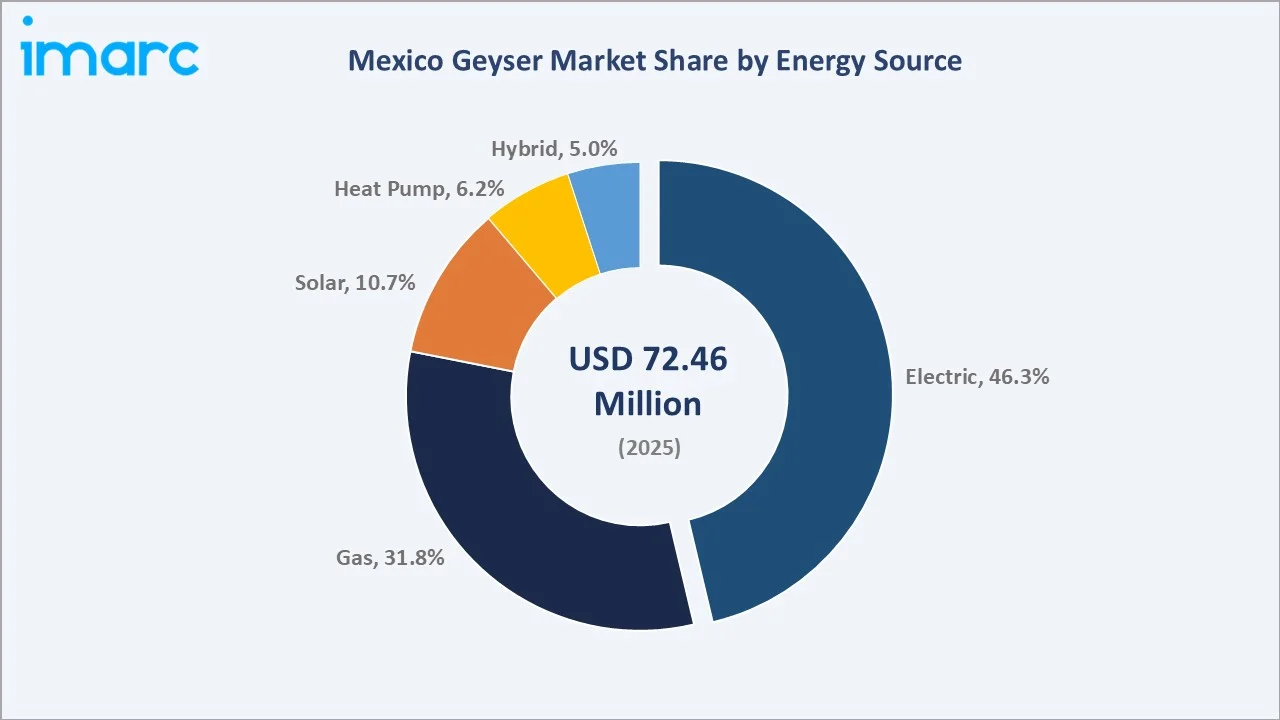
Gas at 31.8% maintains a strong position, particularly in Northern Mexico and parts of Central Mexico where natural gas distribution infrastructure is well-established and residential gas tariffs remain favorable.
Regional Market Insights
|
Region |
Share (2025) |
Key Growth Drivers |
|
Central Mexico |
42.8% |
Large urban population, high residential construction activity, strong consumer spending capacity, and dense retailer and installer network supporting broad product availability |
|
Northern Mexico |
28.6% |
Established natural gas infrastructure, strong industrial and commercial demand, high-income consumer segments, and proximity to United States supply chain networks |
|
Southern Mexico |
17.5% |
Rapid urbanization, expanding construction activity, high solar irradiance levels supporting solar water heater adoption, and increasing government infrastructure investment |
|
Others |
11.1% |
Rural electrification programs, affordable housing schemes, government-subsidized appliance upgrade initiatives, and growing rural-to-urban migration driving baseline demand |
Central Mexico at 42.8% in 2025 leads the regional landscape, anchored by the Mexico City metropolitan area's dense residential and commercial construction pipeline, a large middle-class consumer base in the country, and well-developed distributor and installer networks ensuring broad product availability across all geyser categories.
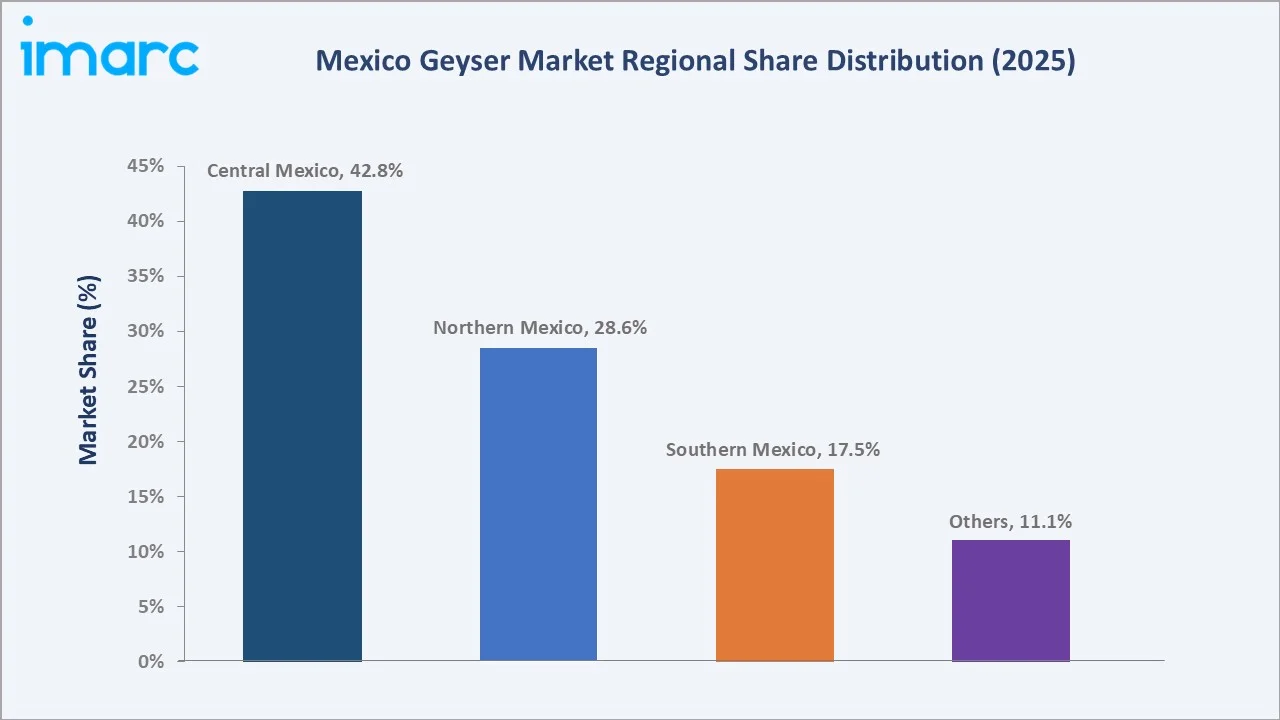
Northern Mexico at 28.6% maintains strong performance driven by established natural gas networks and high industrial and commercial demand, particularly in border metropolitan areas and industrial parks.
Competitive Landscape
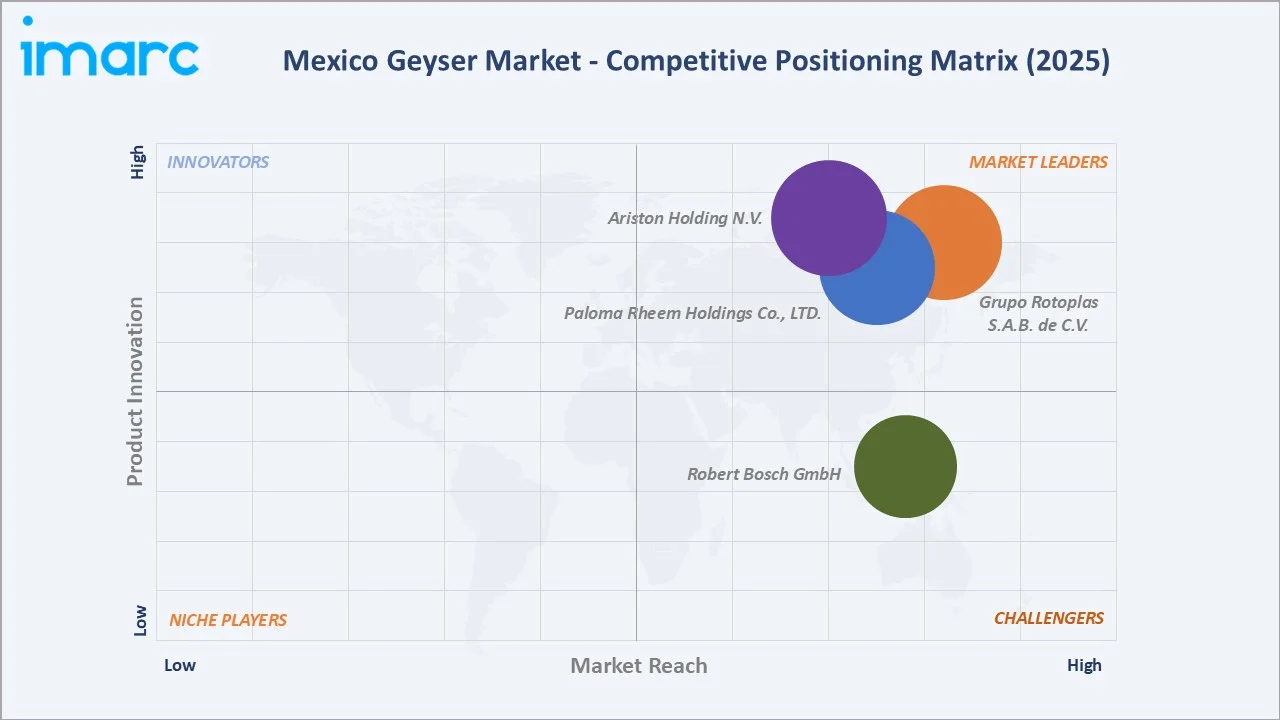
The Mexico geyser market is moderately fragmented, with established domestic manufacturers holding strong brand recognition alongside international players with advanced technology portfolios. Competitive differentiation is driven by product efficiency ratings, energy label compliance, distribution reach, brand trust, and after-sales service capability across a geographically diverse national market.
|
Company Name |
Brand / Key Product |
Position |
Strategic Focus |
|
Grupo Rotoplas S.A.B. de C.V. |
Rotoplas |
Leader |
Integrated water management solutions with broad residential distribution network |
|
Paloma Rheem Holdings Co., LTD. |
Rheem |
Leader |
Energy-efficient residential and commercial water heating with premium technology portfolio |
|
Ariston Holding N.V. |
Calorex, Cinsa |
Leader |
Expanding energy-efficient water heating solutions through innovation, premium products, and distribution |
|
Robert Bosch GmbH |
Bosch Home Comfort |
Challenger |
High-efficiency instant and condensing gas water heater systems for premium segments |
Key players include Grupo Rotoplas S.A.B. de C.V., Paloma Rheem Holdings Co., LTD., Ariston Holding N.V., and Robert Bosch GmbH, among others.
Key Company Profiles
Grupo Rotoplas S.A.B. de C.V.
Grupo Rotoplas S.A.B. de C.V. is a publicly listed Mexican water solutions company headquartered in Mexico City. The company offers a comprehensive range of products and services for water storage, conduction, purification, and treatment, serving residential, commercial, and industrial customers across Latin America.
- Product Portfolio: Electric water heating products under the Rotoplas brand, distributed through an extensive network of hardware retailers, plumbing distributors, and home improvement chains across Mexico.
- Recent Developments: The company has continued to expand its water heating portfolio, strengthen its distribution network, and enhance energy-efficient product offerings to support evolving residential and commercial demand across Mexico.
- Strategic Focus: Comprehensive water management portfolio with broad national distribution coverage, growing subscription-based service model, and sustained focus on energy-efficient and sustainable water solutions aligned with Mexico's water access challenges.
Paloma Rheem Holdings Co., LTD.
Paloma Rheem Holdings Co., LTD. is a Japanese holding company that operates in both the air conditioning and water heating sectors. The group serves residential and commercial customers across multiple geographies and operates manufacturing facilities in key markets worldwide.
- Product Portfolio: Residential and commercial water heating solutions under the Rheem brand, covering electric storage, gas-fired instantaneous, solar, and heat pump water heaters across a wide range of capacities for the Mexican market.
- Recent Developments: The company has been expanding its product portfolio and strengthening its market presence across key global markets through strategic investments, technology partnerships, and manufacturing optimization initiatives.
- Strategic Focus: Broad portfolio of water heating and climate comfort solutions, with a focus on energy efficiency, product innovation, and expanding its global manufacturing and distribution capabilities across residential and commercial segments.
Robert Bosch GmbH
Robert Bosch GmbH is a multinational engineering and technology company headquartered in Germany. Its Home Comfort division develops and markets water heating solutions for residential and commercial customers, with an active presence in the Mexican market through a dedicated product range and service network.
- Product Portfolio: Residential and commercial water heating products under the Bosch Home Comfort brand.
- Recent Developments: The company has been strengthening its after-sales service infrastructure, expanding its certified technician network, and introducing connected and smart water heating solutions to meet the evolving needs of residential and commercial customers in Mexico.
- Strategic Focus: Premium positioning through technology-led product development, energy efficiency, and strong after-sales service, with a focus on both residential and commercial water heating segments in Mexico.
Market Concentration Analysis
The Mexico geyser market is moderately fragmented, with a mix of global water heating manufacturers, regional brands, and domestic suppliers competing across product categories. Competition is driven by product efficiency, pricing, distribution reach, after-sales service, and compliance with energy-efficiency standards.
Barriers to entry include the need for NOM compliance certification, established distribution and installer network access, brand recognition in a market where consumer trust significantly influences purchase decisions, and the capital requirements for local manufacturing or import logistics infrastructure. These factors favor well-established incumbents with extensive service networks and recognized brand equity.
Consolidation trends are gradual, with leading players periodically expanding product portfolios into adjacent technology categories, such as solar and heat pump water heaters rather than through significant merger and acquisition activity. Strategic partnerships with construction developers and energy efficiency program administrators are increasingly important mechanisms for sustainable competitive positioning.
Investment & Growth Opportunities
Fastest-Growing Segments
Solar water heaters are the fastest growing type of geyser category, driven by FIDE subsidy availability and declining collector costs. Heat pump water heaters represent the highest absolute growth rate by percentage trajectory, targeting premium efficiency-conscious consumers and commercial operators.
Emerging Markets
Southern Mexico is the fastest growing regional market, with rapid urbanization, expanding construction activity, and high solar irradiance levels creating conditions for accelerated solar water heater adoption. Targeted distribution network expansion represents significant untapped opportunity for manufacturers willing to invest in regional market development.
Venture & Investment Trends
Investment is concentrating in solar water heater production capacity expansion, heat pump technology localization, and smart-connected product development. Manufacturers are also investing in authorized installer training programs to capture government-subsidized demand. Strategic capital deployment in commercial segment capabilities, particularly for hospitality and healthcare facility installations, offers above-market return potential through the forecast period.
Future Market Outlook (2026-2034)
The Mexico geyser market is forecast to expand from USD 72.46 Million in 2025 to USD 128.04 Million by 2034 at a CAGR of 6.53%, adding approximately USD 55.58 Million in incremental market value over the forecast period.
Four forces will shape the market through 2034: a tightening NOM energy-efficiency regulatory framework driving replacement demand; accelerating solar and heat pump geyser adoption as equipment costs decline; deeper integration of smart control technology across the product range; and expanding commercial sector demand as Mexico's hospitality, healthcare, and food service industries continue to grow.
By 2034, the Mexico geyser market is expected to be characterized by wider adoption of energy-efficient water heating technologies, stronger penetration of smart and connected products, and increasing replacement demand across the residential and commercial sectors. Regulatory alignment, distribution network maturation, and consumer awareness improvements will collectively drive this structural market evolution.
Research Methodology
Primary Research
Primary research included structured interviews with geyser manufacturers, distributors, installers, housing construction developers, energy efficiency program administrators, and regulatory specialists. These interactions validated market sizing estimates, technology adoption trends, regional demand patterns, and competitive positioning assessments across the Mexico geyser market.
Secondary Research
Secondary research sources included publications from Mexico's Secretaría de Energía (SENER), Comisión Nacional para el Uso Eficiente de la Energía (CONUEE), Comisión Nacional de Vivienda (CONAVI), and INEGI. Additional sources encompassed company annual reports, trade association publications, industry conference proceedings, and retail market intelligence data.
Forecasting Models
Market forecasts applied top-down and bottom-up modeling approaches combining residential and commercial construction volume data, average water heater replacement cycles, technology adoption curves, energy price trajectories, policy scenario analysis, and macroeconomic growth projections. Segment-level forecasts were reconciled against overall market totals through iterative cross-validation with primary research findings.
Mexico Geyser Market Report Coverage:
| Report Features | Details |
|---|---|
| Base Year of the Analysis | 2025 |
| Historical Period | 2020-2025 |
| Forecast Period | 2026-2034 |
| Units | Million USD |
| Scope of the Report |
Exploration of Historical Trends and Market Outlook, Industry Catalysts and Challenges, Segment-Wise Historical and Future Market Assessment:
|
| Type of Geysers Covered | Storage Water Heaters, Instant Water Heaters, Heat Pump Water Heaters, Solar Water Heaters, Gas Water Heaters |
| Capacities Covered | Below 10 Liters, 10 to 25 Liters, 25 to 50 Liters, 50 to 100 Liters, Above 100 Liters |
| Energy Sources Covered | Electric, Gas, Solar, Heat Pump, Hybrid |
| Applications Covered | Residential, Commercial, Industrial, Hospitality, Healthcare |
| Regions Covered | Northern Mexico, Central Mexico, Southern Mexico, Others |
| Companies Covered | Grupo Rotoplas S.A.B. de C.V., Paloma Rheem Holdings Co., LTD., Ariston Holding N.V., Robert Bosch GmbH, etc. |
| Customization Scope | 10% Free Customization |
| Post-Sale Analyst Support | 10-12 Weeks |
| Delivery Format | PDF and Excel through Email (We can also provide the editable version of the report in PPT/Word format on special request) |
Key Benefits for Stakeholders:
- IMARC’s industry report offers a comprehensive quantitative analysis of various market segments, historical and current market trends, market forecasts, and dynamics of the Mexico geyser market from 2020-2034.
- The research report provides the latest information on the market drivers, challenges, and opportunities in the Mexico geyser market.
- Porter's five forces analysis assist stakeholders in assessing the impact of new entrants, competitive rivalry, supplier power, buyer power, and the threat of substitution. It helps stakeholders to analyze the level of competition within the Mexico geyser industry and its attractiveness.
- Competitive landscape allows stakeholders to understand their competitive environment and provides an insight into the current positions of key players in the market.
Frequently Asked Questions About the Mexico Geyser Market Report
The Mexico geyser market was valued at USD 72.46 Million in 2025, driven by residential construction growth, energy-efficiency regulations, and increasing adoption of solar and instant water heating solutions.
The market is projected to grow at a CAGR of 6.53% from 2026-2034, reaching USD 128.04 Million, supported by solar geyser adoption, heat pump expansion, and sustained residential construction activity.
Storage water heaters lead at 39.7% in 2025, driven by broad consumer familiarity, competitive pricing, and compatibility with existing residential plumbing infrastructure across urban and rural markets.
Electric dominates at 46.3% in 2025, supported by widespread grid connectivity, competitive installation costs, and growing integration with smart home systems in urban residential developments.
Central Mexico commands 42.8% in 2025, fueled by high population density, large residential construction volumes, and high consumer spending capacity concentration in the country.
Leading players include Grupo Rotoplas S.A.B. de C.V., Paloma Rheem Holdings Co., LTD., Ariston Holding N.V., and Robert Bosch GmbH, among others.
Key growth drivers include rising residential construction, increasing urbanization, growing consumer preference for energy-efficient water heating solutions, stricter energy-efficiency regulations, and expanding replacement demand for modern water heaters.
Key challenges include competition from low-cost informal imports, high upfront costs of solar and heat pump systems limiting mass-market adoption, and consumer awareness gaps for advanced water heating technologies in price-sensitive segments.
Need more help?
- Speak to our experienced analysts for insights on the current market scenarios.
- Include additional segments and countries to customize the report as per your requirement.
- Gain an unparalleled competitive advantage in your domain by understanding how to utilize the report and positively impacting your operations and revenue.
- For further assistance, please connect with our analysts.
 Request Customization
 Speak to an Analyst
 Request Brochure
 Inquire Before Buying
Benefits of Customization
- Personalize this research
- Triangulate with your data
- Get data as per your format and definition
- Gain a deeper dive into a specific application, geography, customer, or competitor
- Any level of personalization
Get in Touch With Us
UNITED STATES
Phone: +1-201-971-6302
INDIA
Phone: +91-120-433-0800
UNITED KINGDOM
Phone: +44-753-714-6104
Email: [email protected]
Client Testimonials




.webp)




.webp)













