
Mexico Glass Packaging Market Size, Share, Trends and Forecast by Product, End User, and Region, 2026-2034
Mexico Glass Packaging Market Size, Share, Trends & Forecast (2026-2034)
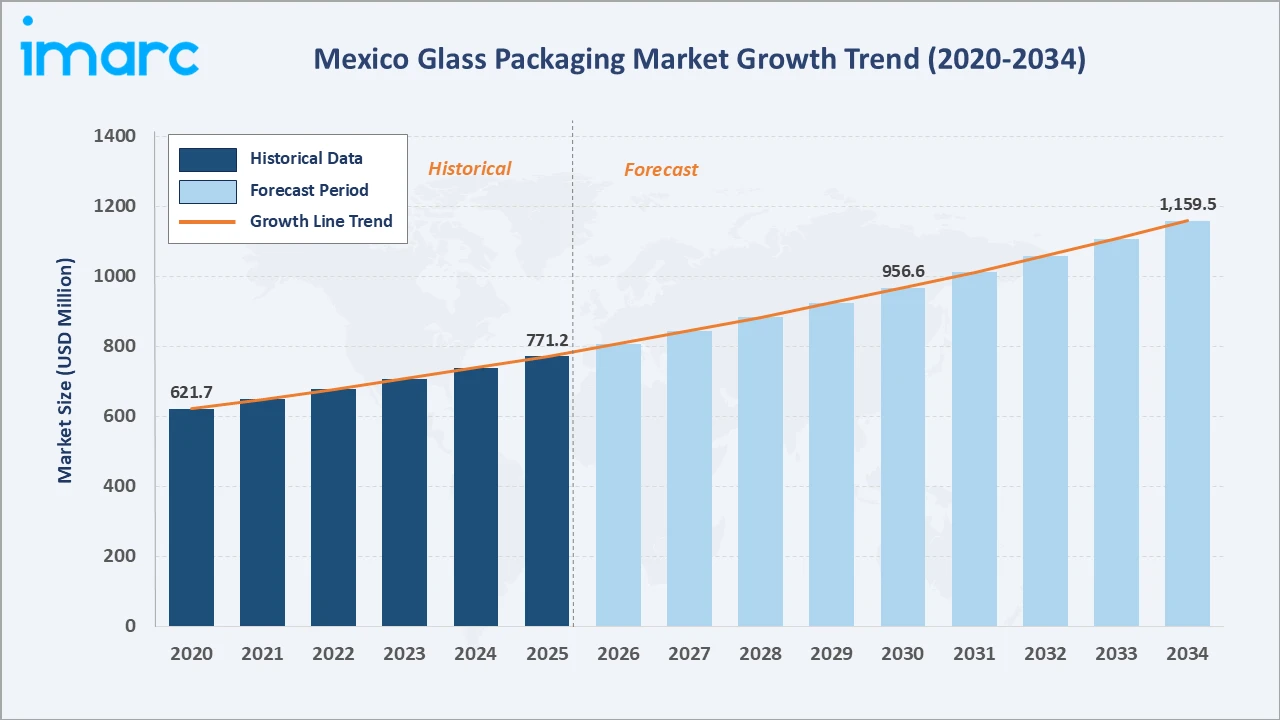
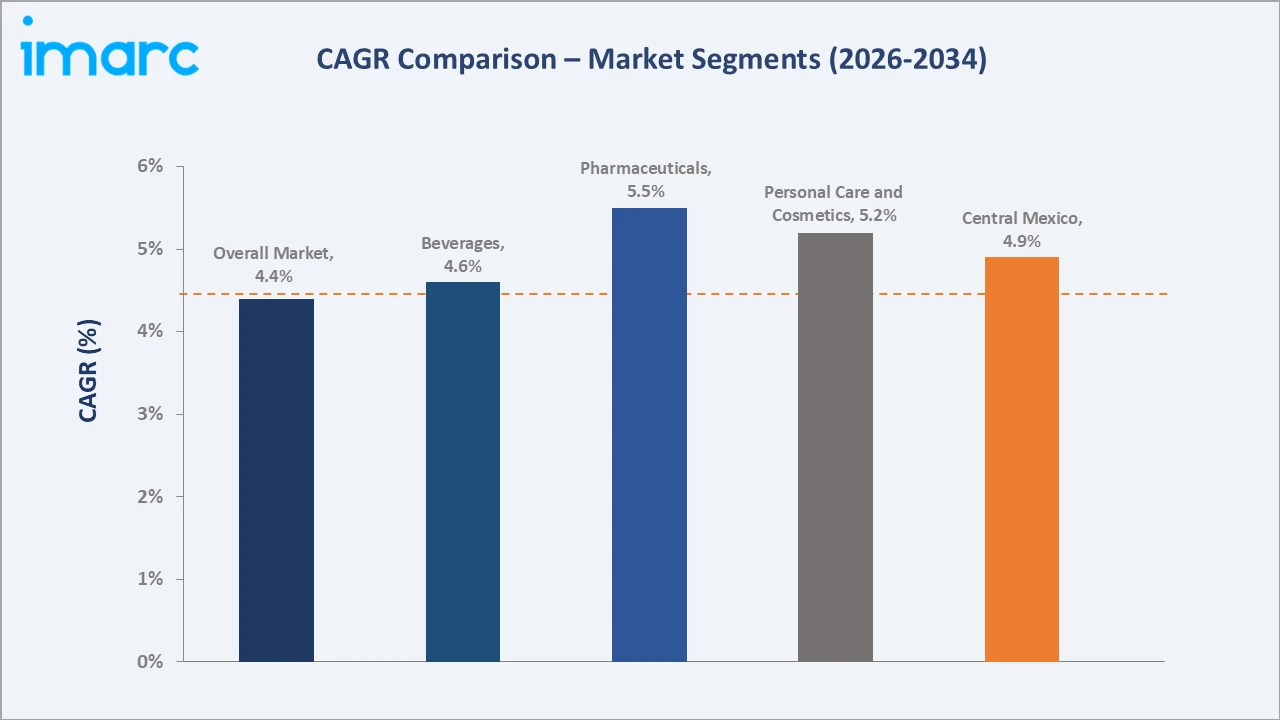
The Mexico glass packaging market reached USD 771.2 Million in 2025 and is projected to reach USD 1,159.5 Million by 2034, exhibiting a CAGR of 4.40% during 2026-2034. Mexico's booming tequila and spirits export industry, accelerating single-use plastic bans across Mexican states, and robust demand from the pharmaceutical and personal care sectors are the primary growth catalysts. Mexico, the world’s 14th-largest economy, remains a dynamic market with strong opportunities for alcoholic beverage imports. The country’s beverage industry recorded robust import activity in 2024, indicating steady market growth. Wine consumption has also exceeded 2.5 liters per capita, rising by around 60% over the past 15 years. This is driving the market by increasing demand for premium, recyclable, and visually appealing bottles used in wine, spirits, and other alcoholic beverages. Bottles lead product type at 56.8%, beverages dominate end user at 48.7%, and Central Mexico accounts for the largest regional share at 40.6%.
Market Snapshot
|
Metric |
Value |
|
Market Size (2025) |
USD 771.2 Million |
|
Forecast Market Size (2034) |
USD 1,159.5 Million |
|
CAGR (2026-2034) |
4.40% |
|
Base Year |
2025 |
|
Historical Period |
2020-2025 |
|
Forecast Period |
2026-2034 |
|
Dominant Product |
Bottles (56.8%, 2025) |
|
Dominant End User |
Beverages (48.7%, 2025) |
|
Leading Region |
Central Mexico (40.6%, 2025) |
The Mexico glass packaging market demonstrated consistent growth, rising from USD 621.7 Million in 2020 to USD 771.2 Million in 2025, reflecting Mexico's expanding beverage exports, particularly tequila and mezcal, and progressive regulatory actions banning single-use plastics across Mexican states. The market is projected to reach USD 956.6 Million by 2030 and USD 1,159.5 Million by 2034.
To get more information on this market, Request Sample
Bottles grow at ~4.8% CAGR through tequila export premium bottle demand and beverage sector recovery. Pharmaceuticals grow at ~5.5% CAGR, driven by Mexico's expanding generic drug manufacturing and vial and ampoule demand. Personal care and cosmetics grow at ~5.2% CAGR, reflecting rising consumer preferences for sustainable premium glass packaging in fragrance and skincare products sold through Mexico's expanding specialty retail channel.
Executive Summary
The Mexico glass packaging market is expanding steadily, driven by structural demand from the beverage, food, pharmaceutical, and personal care sectors, and supported by a progressive regulatory environment increasingly hostile to single-use plastics. Market value stood at USD 771.2 Million in 2025 and is forecast to reach USD 1,159.5 Million by 2034. Mexico's unique position as the sole source of tequila and mezcal, with tequila exports recording 495.8 million liters produced and 400.3 million liters exported in 2024, creates a structurally non-substitutable demand for premium glass bottles that anchors the beverages segment's continued dominance.
Bottles lead at 56.8% (2025), reflecting the dominance of beverage and food glass bottle demand across Mexico's consumer market and export channels. The beverages end user segment commands 48.7% (2025), reflecting tequila, beer, and non-alcoholic beverage brands' sustained commitment to glass's premium perception, product protection, and recyclability. Central Mexico accounts for 40.6% (2025), driven by major manufacturing concentration, consumer market density, and the presence of leading glass manufacturers.
Key Market Insights
|
Insight |
Data |
|
Dominant Product |
Bottles – 56.8% share (2025) |
|
Dominant End User |
Beverages – 48.7% share (2025) |
|
Leading Region |
Central Mexico – 40.6% share (2025) |
|
Market Opportunity |
Premium spirits bottles; pharmaceutical vials & ampoules; sustainable PCR-content cosmetic glass |
Key Analytical Observations Supporting the Above Data:
- Bottles at 56.8% (2025): Glass bottles are the dominant product form in Mexico's packaging market, serving the country's massive beverage export industry where tequila, mezcal, craft beer, and non-alcoholic beverages all rely on glass for its inert properties, premium perception, and recyclability.
- Beverages at 48.7% (2025): Mexico's beverages sector drives nearly half of all glass packaging demand, anchored by the global prestige of Mexican spirits. Mexico’s spirit production is creating immense and structurally captive demand for heavy, custom flint glass bottles that signal authenticity on US and international shelves.
- Central Mexico at 40.6% (2025): Mexico City's large consumer population, Guadalajara's FMCG manufacturing ecosystem, and Toluca's glass manufacturing concentration drive Central Mexico's leading regional position.
Mexico Glass Packaging Market Overview
The Mexico glass packaging market encompasses the design, manufacture, distribution, and sale of glass containers for beverage, food, pharmaceutical, personal care, and industrial applications. Product categories include glass bottles for beverages and spirits, glass jars and containers for food preservation, pharmaceutical vials and ampoules for injectable and liquid medicines, glass containers for cosmetics and fragrances, and specialty glass products. The market benefits from Mexico's unique competitive strengths: domestic silica sand reserves, a skilled glassmaking workforce, and a government regulatory environment increasingly supportive of glass as a sustainable packaging alternative to single-use plastics. Macroeconomic factors include Mexico’s large consumer base, rising disposable income, and expanding alcoholic beverage consumption. Strong beverage imports, premiumization, and growth in wine and spirits demand are supporting higher use of glass bottles and containers.
Market Dynamics
To evaluate market opportunities, Request Sample
Market Drivers
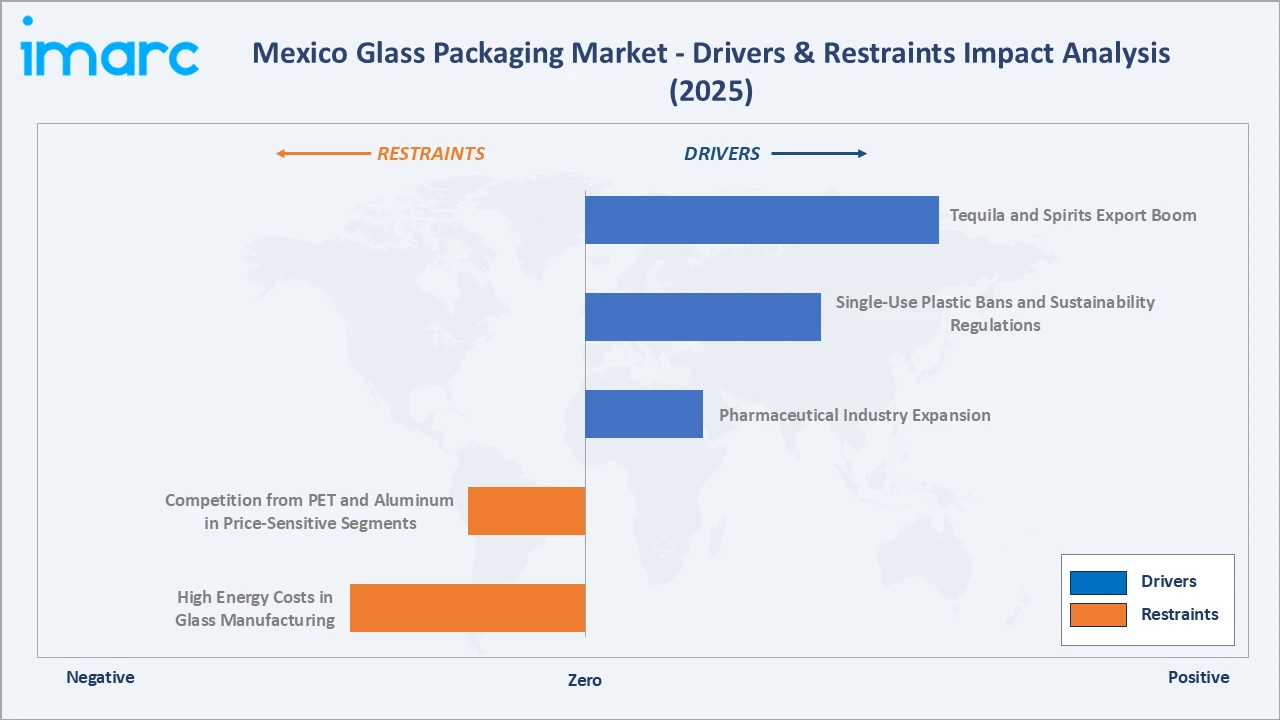
- Tequila and Spirits Export Boom: Mexico's agave spirits industry, producing 495.8 million liters of tequila and exporting 400.3 million liters in 2024, creates structurally captive demand for premium glass bottles. The inextricable association between Mexican spirits' authenticity and heavy-gauge, custom-designed glass bottles drives continuous innovation in bottle design, neck finish, and decoration that generates above-average revenue per container for glass manufacturers.
- Single-Use Plastic Bans and Sustainability Regulations: Mexico's state-level plastic packaging restrictions are creating a structural shift toward glass packaging in food, beverage, and personal care applications where glass offers an immediately available, consumer-preferred sustainable alternative. Recyclable glass containers supporting glass manufacturers' sustainability messaging to FMCG brand clients.
- Pharmaceutical Industry Expansion: Pharmaceutical industry expansion is increasing demand for vials, ampoules, bottles, and other sterile containers. Glass is widely preferred for pharmaceuticals due to its chemical stability, barrier protection, and suitability for sensitive formulations. Mexico is Latin America’s leading exporter of medical devices and ranks eighth worldwide, with a significant share of its production shipped to the United States. Rising medicine production, healthcare demand, and exports are further supporting the use of high-quality glass packaging in Mexico.
Market Restraints
- High Energy Costs in Glass Manufacturing: Glass melting requires sustained high-temperature furnace operation, making glass manufacturing one of the most energy-intensive industrial processes. Mexico's industrial electricity and natural gas prices have increased significantly, creating cost inflation pressure for glass manufacturers whose energy costs represent 25-35% of total production costs.
- Competition from PET and Aluminum in Price-Sensitive Segments: PET plastic and aluminum cans offer high cost and weight advantages over glass in price-sensitive beverage segments, particularly water, RTD tea, and affordable carbonated soft drinks. Aluminum can penetration in craft beer is also growing as smaller breweries favor the lower logistics costs of aluminum for multi-modal distribution.
Market Opportunities
- Premium Cosmetics and Perfume Glass Expansion: Premium cosmetics and perfume glass expansion presents an opportunity as beauty brands increasingly prefer glass bottles and jars for luxury positioning, product protection, and shelf appeal. Rising demand for fragrances, skincare, and premium personal care products is supporting customized, decorative, and recyclable glass packaging. This creates opportunities for manufacturers to offer high-value designs, lightweight formats, and sustainable premium packaging solutions.
- Recycled Glass Content and Circular Economy Positioning: Recycled glass content and circular economy positioning create an opportunity as brands seek more sustainable and low-carbon packaging solutions. Using cullet helps reduce raw material consumption, energy use, and emissions during glass production. This supports beverage, pharmaceutical, and cosmetics companies in meeting sustainability goals while strengthening consumer appeal for recyclable and eco-friendly packaging.
Market Challenges
- Breakage Risk During Storage and Logistics: Breakage risk during storage and transportation remains a key challenge due to the fragile nature of glass containers. Damage during handling increases product losses, replacement costs, and insurance expenses for manufacturers and beverage companies. These risks also encourage some end users to shift toward lighter and more impact-resistant packaging materials such as PET or aluminum, limiting glass packaging adoption in certain applications.
- Emission Reduction Pressure on Glass Manufacturers: Emission reduction pressure is challenging as glass manufacturing is highly energy-intensive and relies on high-temperature furnaces. Producers face rising pressure to reduce carbon emissions, adopt cleaner fuels, and increase recycled glass content, which can require significant capital investment. These compliance and modernization costs may increase production expenses and affect price competitiveness against lighter packaging materials such as plastic and aluminum.
Emerging Market Trends
.webp)
1. Tequila Export Premium Glass Bottle Innovation
The record tequila output of 495.8 million liters and exports of 400.3 million liters in 2024 have heightened demand for heavier, custom flint bottles that signal authenticity on US shelves. Export-grade spirits bottles must comply with stringent impact and top-load criteria, prompting mold workshops to expand design services, deeper punts, thicker heels, and refined neck finishes.
2. Growth of Returnable Glass Packaging Systems
The growth of returnable glass packaging systems is emerging as beverage companies expand reusable bottle programs to support sustainability goals and reduce packaging waste. Manufacturers are investing in returnable bottle production lines and collection infrastructure to improve circularity and lower lifecycle packaging costs. In July 2025, Grupo GEPP, PepsiCo’s exclusive bottler in Mexico, expanded its returnable PET and glass bottling lines in partnership with Sidel. The initiative supports GEPP’s target to increase returnable packaging solutions by 10% by 2030, while aligning with PepsiCo’s goals to reduce virgin plastic use, expand returnable packaging, and achieve net-zero emissions by 2040. This trend is strengthening demand for durable, refillable glass containers across the beverage industry.
3. Pharmaceutical Glass Specialization and Anti-Counterfeiting Innovation
Pharmaceutical glass specialization is emerging as medicine producers require high-quality vials, ampoules, and bottles for sensitive formulations. Demand is increasing for sterile, chemically stable, and tamper-evident glass packaging that protects product integrity. Anti-counterfeiting features such as serialization, track-and-trace labels, and smart packaging are gaining importance to prevent fake medicines. This is encouraging glass packaging manufacturers to offer more specialized, secure, and regulation-compliant solutions.
4. Hydrogen Furnace and Green Glass Manufacturing Investment
Hydrogen furnace and green glass manufacturing investment is emerging as glass producers seek to reduce carbon emissions from energy-intensive melting operations. Companies are exploring hydrogen, electric furnaces, and higher recycled glass use to lower fuel consumption and improve sustainability performance. This supports compliance with emission targets and helps brands source low-carbon glass packaging. In Mexico, such investments can strengthen competitiveness as beverage, cosmetics, and pharmaceutical customers increasingly prefer sustainable packaging suppliers.
Industry Value Chain Analysis
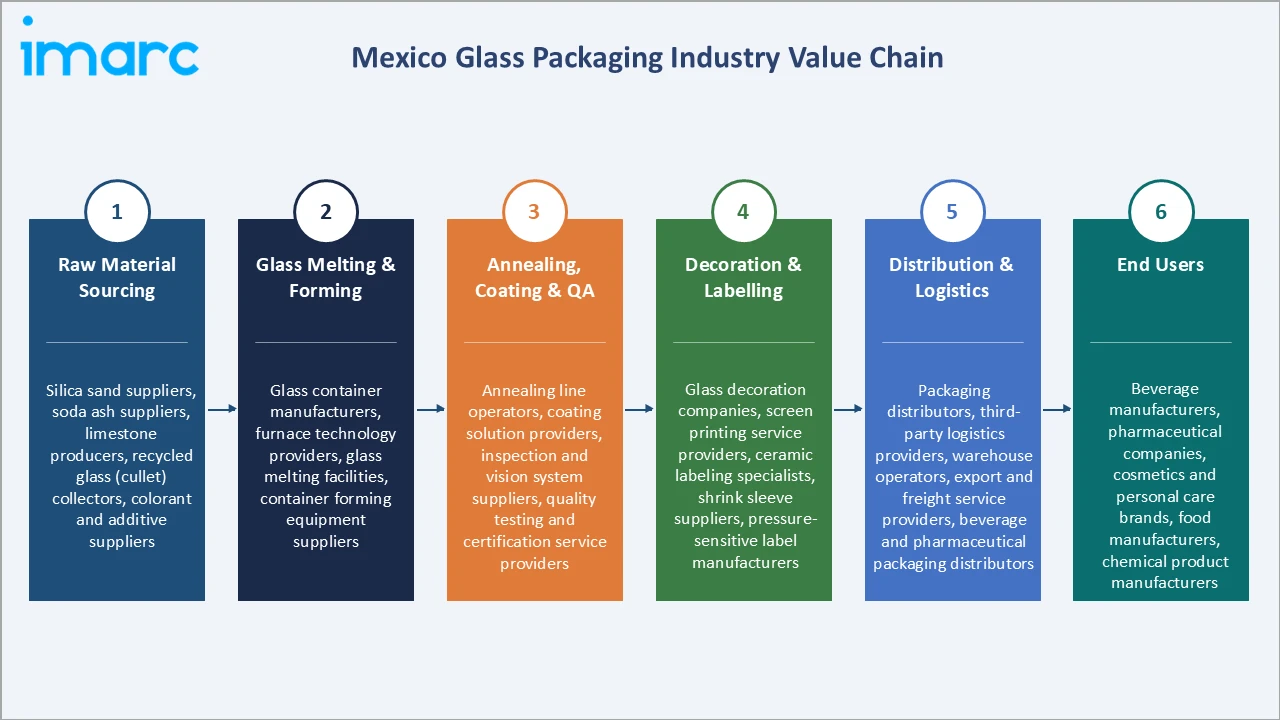
The Mexico glass packaging value chain integrates raw material sourcing, glass melting and forming operations, annealing, coating and QA, decoration and labelling services, multi-channel distribution to end user industries, and post-consumer recycling and cullet reintegration that closes the circular economy loop.
|
Stage |
Key Participants |
|
Raw Material Sourcing |
Silica sand suppliers, soda ash suppliers, limestone producers, recycled glass (cullet) collectors, colorant and additive suppliers |
|
Glass Melting & Forming |
Glass container manufacturers, furnace technology providers, glass melting facilities, container forming equipment suppliers |
|
Annealing, Coating & QA |
Annealing line operators, coating solution providers, inspection and vision system suppliers, quality testing and certification service providers |
|
Decoration & Labelling |
Glass decoration companies, screen printing service providers, ceramic labeling specialists, shrink sleeve suppliers, pressure-sensitive label manufacturers |
|
Distribution & Logistics |
Packaging distributors, third-party logistics providers, warehouse operators, export and freight service providers, beverage and pharmaceutical packaging distributors |
|
End Users |
Beverage manufacturers, pharmaceutical companies, cosmetics and personal care brands, food manufacturers, chemical product manufacturers |
Glass melting and forming is the highest-barrier and most capital-intensive stage of Mexico's glass packaging value chain, requiring billion-peso furnace investments with 10-15 year operational lifespans and specialized machine technology for forming operations.
Technology Landscape in the Mexico Glass Packaging Industry
Lightweight Glass Technology
Lightweighting is the defining manufacturing technology trend in Mexico's glass packaging sector. Modern lightweight glass bottles achieve weight reductions versus standard-weight equivalents without compromising drop resistance, internal pressure, and top-load performance. For Mexico's export-oriented beverage brands shipping to the United States, weight reduction directly translates to transport cost savings per case, creating a strong commercial incentive for continued lightweighting investment across both spirits and beer bottle ranges.
Hydrogen and Electrification Furnace Technology
Hydrogen blending in glass melting furnaces, replacing a portion of natural gas with green or grey hydrogen, is emerging as a near-term decarbonization pathway for Mexico's glass manufacturers. Full furnace electrification, using electric boosting or all-electric oxy-fuel furnaces, offers higher efficiency and zero direct combustion emissions but requires significant infrastructure investment in Mexico's industrial electricity grid connectivity.
Decoration and Surface Treatment Technologies
Advanced surface decoration technologies are a competitive differentiator for Mexico's premium glass packaging segment, particularly for tequila, mezcal, premium wine, and luxury personal care products. Ceramic applied colour labelling (ACL), acid etching for frosted finishes, digital glass printing for short-run custom designs, and luxury coating applications including gold leaf and mother-of-pearl finishes are deployed by Mexico's specialist glass decorators. These value-adding surface treatments command significant price premiums over undecorated glass, contributing to above-market revenue growth in the premium spirits and luxury cosmetics glass segments that are growing as a proportion of Mexico's overall glass packaging market.
Market Segmentation Analysis
The report covers the following segments:
|
Segment Category |
Leading Segment |
Market Share |
Year |
|
Product |
Bottles |
56.8% |
2025 |
|
End User |
Beverages |
48.7% |
2025 |
|
Region |
Central Mexico |
40.6% |
2025 |

By Product
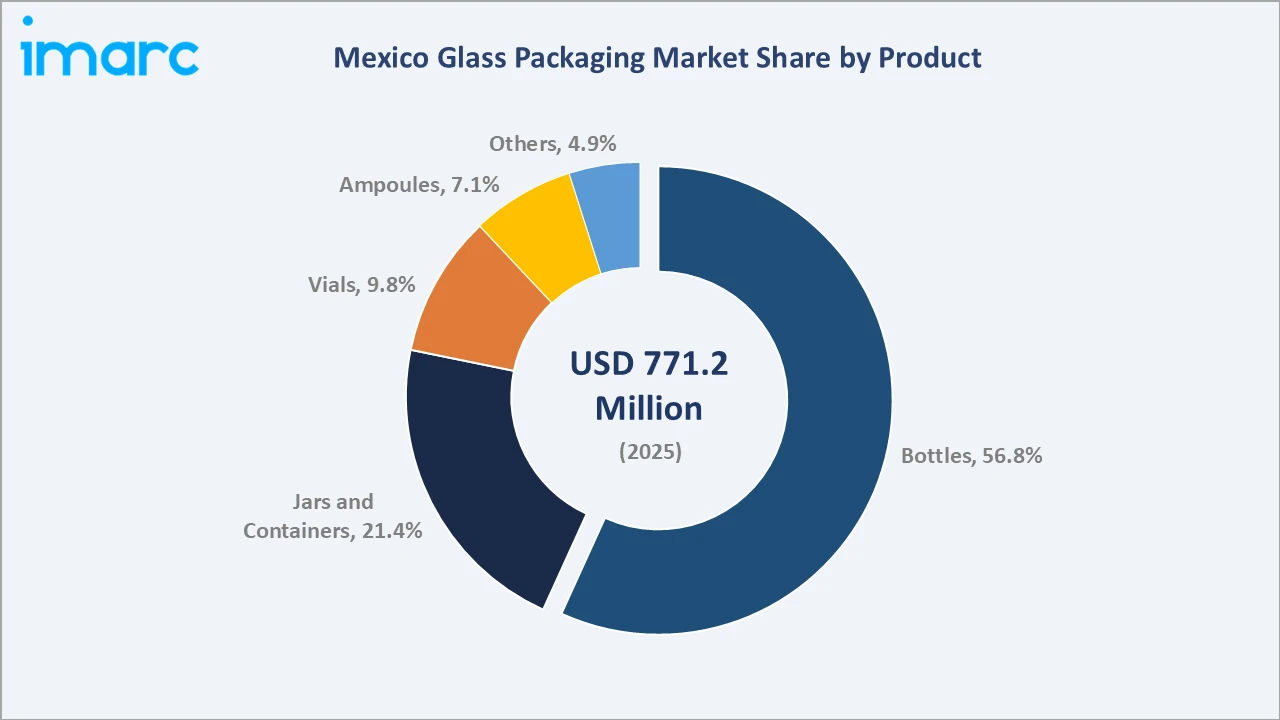
Bottles lead at 56.8% (2025), encompassing the full range of glass beverage bottles, from standard beer and water bottles to premium tequila and mezcal presentation bottles, as well as sauce, condiment, and oil bottles for food applications. The bottle segment is the primary beneficiary of Mexico's tequila and beer export boom, where glass's inert properties and premium perception are structurally preferred over alternatives. Bottles are projected to grow at ~4.8% CAGR through 2034.
To access detailed market analysis, Request Sample
Jars and containers at 21.4% (2025) serve Mexico's food preservation and condiment market, salsa, honey, jam, and pickled vegetables, where glass's hermetic seal and chemical inertness are highly valued. Vials at 9.8% and ampoules at 7.1% collectively represent the pharmaceutical glass segment, which is the fastest-growing product category at ~5.5% CAGR through 2034. Others at 4.9% include specialty glass such as wine decanters, oil diffusers, and artistic glass containers for the premium domestic and export market.
By End User
Beverages dominate at 48.7% (2025), reflecting Mexico's position as the largest tequila and mezcal producer and one of the largest beer producers, both industries structurally committed to glass for product quality, authenticity signaling, and brand differentiation.
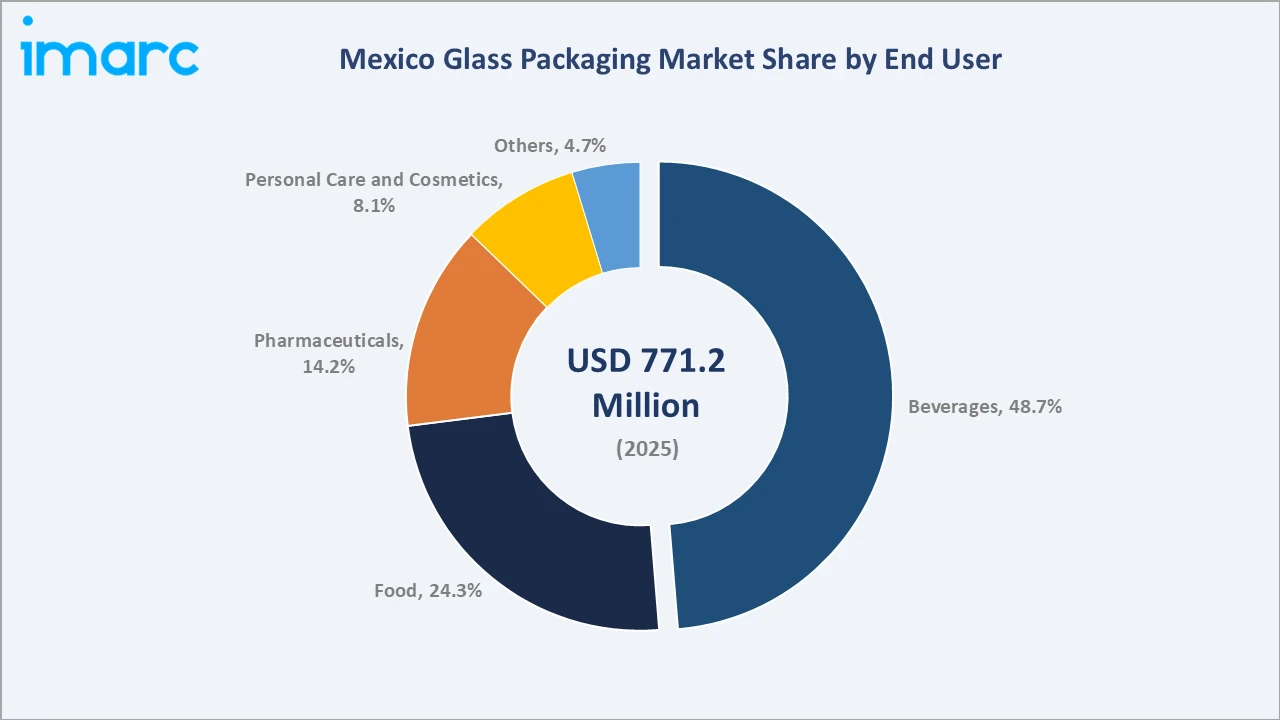
Food at 24.3% (2025) reflects glass's role in preserving and presenting Mexico's diverse culinary exports, including salsas, hot sauces, honey, preserved vegetables, and premium olive oil, where glass is the packaging standard for product quality and shelf life. Pharmaceuticals at 14.2% (2025) are the fastest-growing end user at ~5.5% CAGR through 2034, driven by Mexico's expanding pharmaceutical manufacturing sector and premium pharmaceutical glass investments. Personal care and cosmetics at 8.1% are growing at ~5.2% CAGR, driven by rising Mexican consumer spending on premium skincare, fragrance, and beauty products packaged in glass.
Regional Market Insights
|
Region |
Share (2025) |
Key Mexico Glass Packaging Market Drivers & Characteristics |
|
Central Mexico |
40.6% |
Driven by the highest FMCG consumer market density, flagship glass plant, major food and beverage brand operations, and pharmaceutical manufacturing are in the Mexico City corridor. |
|
Northern Mexico |
31.8% |
Supported by a dominant glass manufacturing base, beer manufacturing, auto and pharma industrial glass demand. |
|
Southern Mexico |
17.3% |
Agave spirit glass bottle demand is the primary growth driver, and growing artisanal mezcal premium packaging demand from small-batch producers. |
|
Others |
10.3% |
Driven by border manufacturing zones generating incremental glass demand from export-oriented food and beverage production. |
Central Mexico's 40.6% dominance reflects Mexico City's position as the largest consumer goods market in Latin America, Guadalajara's pharmaceutical and food manufacturing concentration, and its glass manufacturing base. Northern Mexico accounts for 31.8% of the market, driven by its well-established glass manufacturing industry, breweries, and export-oriented food, beverage, and pharmaceutical sectors.
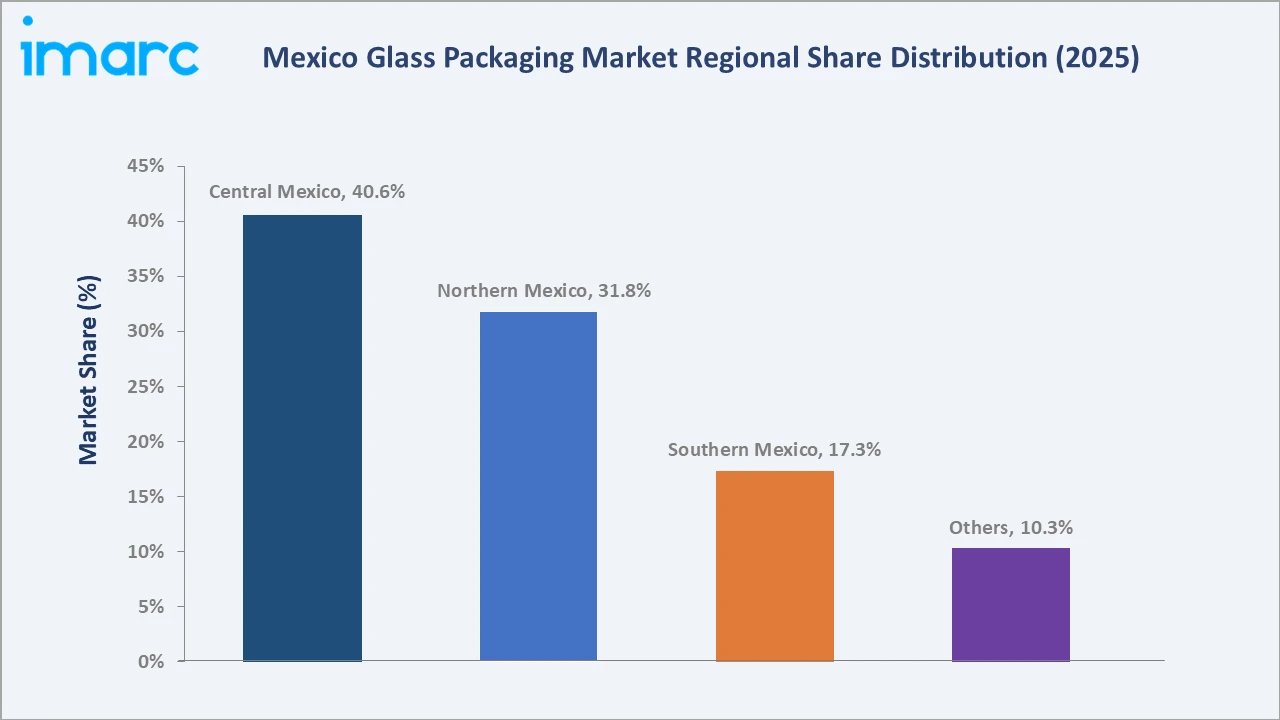
Southern Mexico holds 17.3%, benefiting from strong demand for premium glass bottles used in tequila, mezcal, and other agave-based spirits, along with the growth of artisanal beverage producers. Other regions contribute 10.3%, supported by border manufacturing zones, regional food processing industries, and expanding logistics networks.
Competitive Landscape
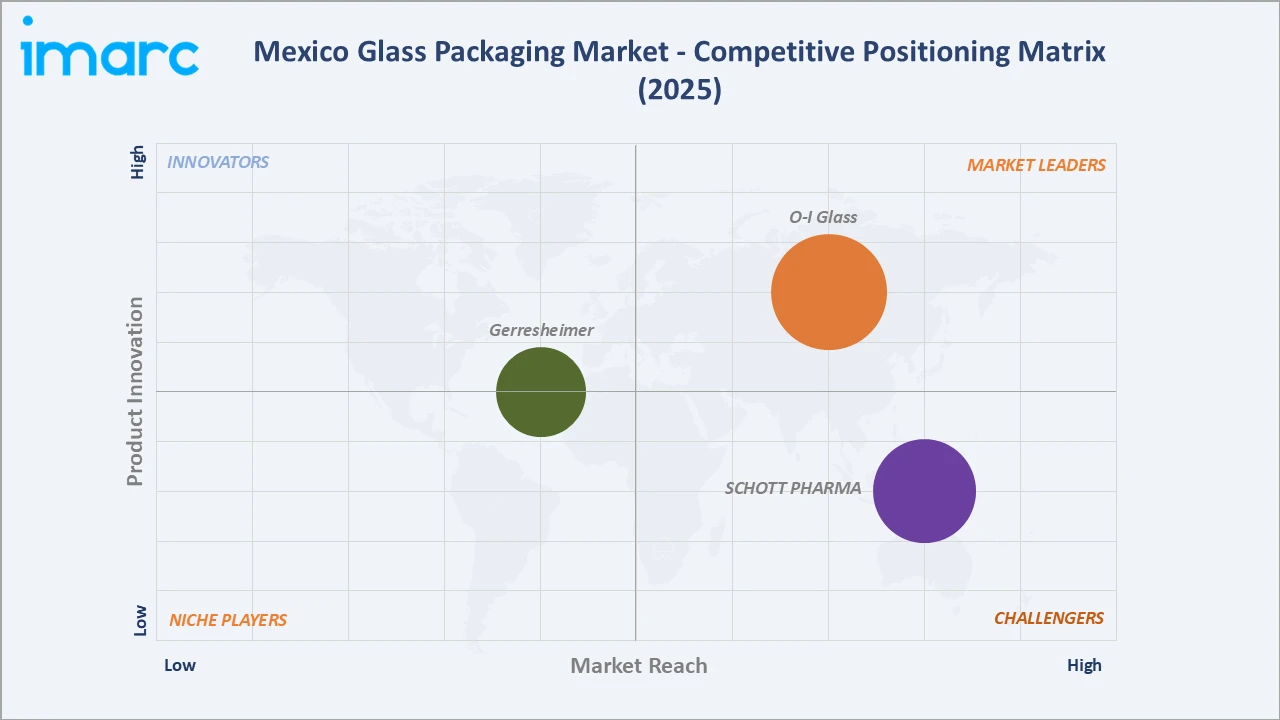
The Mexico glass packaging market is moderately concentrated. The competitive landscape is shaped by furnace capacity investment cycles, raw material access advantages, customer supply agreements with Mexico's major FMCG and pharmaceutical brands, and growing differentiation through sustainability credentials including lightweighting technology, PCR cullet content, and decarbonization initiatives.
|
Company |
Key Products |
Market Position |
Core Strength |
|
O-I Glass |
Beer Bottles, Wine Bottles, Food Jars, Spirits and Non-Alcoholic Glass |
Market Leader |
O-I Glass is a foundational pillar of Mexico's glass packaging industry, serving as a strategic supplier to the nation's massive beverage and food sectors. By operating multiple manufacturing facilities and investing in regional circular economy hubs, the company drives large-scale domestic production and recycling. |
|
Gerresheimer |
Pharmaceutical Vials, Ampoules, Cosmetic Glass, Glass for Food & Beverages |
Established Player |
Gerresheimer plays a critical role in Mexico's glass packaging industry by manufacturing high-purity Type I and Type III pharmaceutical glass and glass for food & beverages. |
|
SCHOTT PHARMA |
Pharmaceutical Glass Cartridges, Glass Syringes, Glass Vials, and Glass Ampoules |
Challenger |
SCHOTT Pharma is a premier supplier of drug containment systems in Mexico, operating primarily out of a major manufacturing hub. The company produces billions of high-quality vials, ampoules, and syringes using its glass, serving as the critical backbone for the local and regional pharmaceutical industries. |
Companies are intensifying investment in sustainable glass technology, lightweighting, PCR cullet integration, and hydrogen furnace trials, alongside pharmaceutical glass specialization and premium spirits bottle capability as Mexico's market evolves toward higher-value glass packaging applications through 2034.
Key Company Profiles
O-I Glass
O-I Glass is a leading global glass container manufacturer and a key participant in Mexico’s glass packaging market. The company supplies glass bottles and containers for beverages, food, spirits, beer, and other consumer goods applications. In Mexico, O-I benefits from strong demand from breweries, soft drink companies, food processors, and premium beverage brands. Its focus on recyclable glass, large-scale manufacturing, and customized container solutions supports its position in the country’s sustainable packaging ecosystem.
- Key Products: Beer Bottles, Wine Bottles, Food Jars, Spirits and Non-Alcoholic Glass.
- Strategic Focus: Centers on sustainable, recyclable, and high-volume glass container production for beverage and food customers. The company emphasizes lightweight glass, recycled content, furnace efficiency, and lower-carbon manufacturing to support customer sustainability goals. It also focuses on customized bottle designs and reliable supply for breweries, spirits producers, soft drink companies, and food processors across Mexico.
Gerresheimer
Gerresheimer is a global packaging and medical technology company serving the pharmaceutical, healthcare, and cosmetics industries. In the Mexico glass packaging market, the company is relevant through its specialized pharmaceutical glass products, including vials, ampoules, cartridges, and other high-quality containers for injectable and sensitive medicines. Gerresheimer’s focus on precision manufacturing, regulatory compliance, and safe drug delivery supports demand from Mexico’s growing pharmaceutical and medical device sectors. Its expertise in pharma-grade glass packaging strengthens its position in high-value, specialized packaging applications.
- Key Products: Pharmaceutical Vials, Ampoules, Cosmetic Glass, Glass for Food & Beverages.
- Strategic Focus: Centers on high-value pharmaceutical and healthcare packaging solutions. The company emphasizes sterile, safe, and regulatory-compliant glass containers such as vials, ampoules, and cartridges for injectable and sensitive medicines. It also focuses on precision manufacturing, anti-counterfeiting support, product quality, and reliable supply for Mexico’s expanding pharmaceutical and medical device industries.
Market Concentration Analysis
The Mexico glass packaging market is moderately concentrated in the bottle and container segments. The top three players, O-I Glass, Gerresheimer, and SCHOTT PHARMA, are estimated to control approximately 65-70% of total market revenue in 2025. The pharmaceutical glass segment is more globally concentrated, with Gerresheimer and SCHOTT Pharma collectively commanding the specialized manufacturing capabilities required for pharmaceutical glass. The market is expected to remain moderately concentrated through 2034.
Investment & Growth Opportunities
Highest Growth Segments
Pharmaceutical glass (vials and ampoules, ~5.5% CAGR), personal care and cosmetics glass (~5.2% CAGR), premium tequila and mezcal presentation bottle specialization (~5.8% CAGR niche), lightweight beverage glass technology (~6%+ from efficiency gains), and PCR-content recycled glass products (~7%+ CAGR from sustainability compliance demand) represent Mexico glass packaging market highest-growth investment vectors through 2034.
Investment Themes
- Pharmaceutical glass capacity: Mexico's expanding pharmaceutical manufacturing sector creates growing demand for glass vials and ampoules. Investment in Type I borosilicate and Type II soda-lime pharmaceutical glass manufacturing, combined with regulatory support, positions manufacturers to capture the above-market pharmaceutical glass growth through 2034.
- Sustainable glass and circular economy positioning: Brand owners across beverages, food, and personal care are committing to PCR content targets and carbon footprint reduction for packaging. Glass manufacturers with verified PCR cullet supply chains, lightweighting capability, and credible carbon measurement programs are gaining preferred supplier status with sustainability-committed FMCG brands, creating a competitive moat that non-sustainable players cannot replicate without substantial manufacturing transformation investment.
Future Market Outlook (2026-2034)
The Mexico glass packaging market is projected to grow from USD 771.2 Million in 2025 to USD 1,159.5 Million by 2034, delivering a 4.40% CAGR over the forecast period. The market's anchor value of USD 956.6 Million in 2030 marks the point at which Mexico's glass packaging market surpasses a high threshold for the first time, reflecting the sustained compounding of structural growth drivers including tequila export expansion, pharmaceutical glass investment, and single-use plastic substitution.
Three structural forces are expected to define Mexico's glass packaging market growth trajectory through 2034. First, Mexico's irreplaceable role as the world's sole authentic producer of tequila and mezcal will continue to generate structurally captive demand for premium glass bottles that neither PET, aluminum, nor any other packaging format can substitute. Second, Mexico's regulatory trajectory will continue creating structural tailwinds for glass packaging across food, beverage, and personal care applications. Third, pharmaceutical glass will emerge as an increasingly significant and high-value contributor to Mexico's glass packaging market through 2034, driven by the expansion of Mexico's pharmaceutical manufacturing export base, regulatory alignment with international standards, and the deep investments being made in Mexico's pharmaceutical glass supply chain.
Research Methodology
Primary Research
Primary research comprised in-depth interviews with glass packaging manufacturer executives, beverage and food company packaging procurement managers, pharmaceutical industry representatives, retail and distribution channel managers, recycling industry specialists, and independent packaging consultants operating in Mexico. These discussions validated market size estimates, assessed technology adoption trends, evaluated competitive dynamics, and provided insights into regulatory developments and sustainability investment plans across Mexico's glass packaging value chain.
Secondary Research
Secondary research encompassed company annual reports, industrial production data, regulatory publications, Tequila production data, pharmaceutical packaging standards, trade industry associations, export trade statistics, and credible market intelligence sources. These were used to analyze market trends, competitive positioning, end user demand dynamics, and regional glass packaging investment activity across Mexico.
Forecasting Models
Forecasting models were developed using historical Mexico glass packaging market trends, beverage export production data, pharmaceutical manufacturing growth projections, consumer goods market size trends, single-use plastic restriction timelines, and macroeconomic indicators. Both top-down and bottom-up approaches were applied and validated through primary research. Market projections incorporated sustainability regulatory scenarios, tequila export growth models, pharmaceutical glass investment pipelines, and competitive capacity expansion plans to generate reliable forecasts through 2034.
Mexico Glass Packaging Market Report Coverage:
| Report Features | Details |
|---|---|
| Base Year of the Analysis | 2025 |
| Historical Period | 2020-2025 |
| Forecast Period | 2026-2034 |
| Units | Million USD |
| Scope of the Report |
Exploration of Historical Trends and Market Outlook, Industry Catalysts and Challenges, Segment-Wise Historical and Future Market Assessment:
|
| Products Covered | Bottles, Jars and Container, Ampoules, Vials, Others |
| End Users Covered |
|
| Regions Covered | Northern Mexico, Central Mexico, Southern Mexico, Others |
| Companies Covered | O-I Glass, Gerresheimer, SCHOTT PHARMA, etc. |
| Customization Scope | 10% Free Customization |
| Post-Sale Analyst Support | 10-12 Weeks |
| Delivery Format | PDF and Excel through Email (We can also provide the editable version of the report in PPT/Word format on special request) |
Key Benefits for Stakeholders:
- IMARC’s industry report offers a comprehensive quantitative analysis of various market segments, historical and current market trends, market forecasts, and dynamics of the Mexico glass packaging market from 2020-2034.
- The research report provides the latest information on the market drivers, challenges, and opportunities in the Mexico glass packaging market.
- Porter's five forces analysis assist stakeholders in assessing the impact of new entrants, competitive rivalry, supplier power, buyer power, and the threat of substitution. It helps stakeholders to analyze the level of competition within the Mexico glass packaging industry and its attractiveness.
- Competitive landscape allows stakeholders to understand their competitive environment and provides an insight into the current positions of key players in the market.
Frequently Asked Questions About the Mexico Glass Packaging Market Report
The Mexico glass packaging market reached USD 771.2 Million in 2025, driven by Mexico's tequila and spirits export boom, progressive single-use plastic bans across Mexican states, and growing pharmaceutical and personal care glass packaging demand from domestic and multinational manufacturers.
The market grows at 4.40% CAGR during 2026-2034, reaching USD 1,159.5 Million by 2034. The CAGR reflects sustained tequila and spirits glass demand, pharmaceutical glass investment acceleration, single-use plastic substitution, and premium personal care glass growth.
Bottles lead at 56.8% (2025), reflecting Mexico's massive beverage export industry requiring premium glass bottles for tequila, mezcal, beer, and non-alcoholic products.
Beverages dominate at 48.7% (2025), anchored by Mexico's tequila production (495.8 million liters in 2024). Glass remains structurally indispensable for premium spirits where authenticity and product quality are paramount.
Central Mexico leads at 40.6% (2025), anchored by Mexico City's consumer market, Guadalajara's FMCG manufacturing, Toluca's glass manufacturing, and the Bajío corridor's beverage and pharmaceutical production concentration.
Leading companies include O-I Glass, Gerresheimer, and SCHOTT PHARMA, among others.
The market is projected to reach approximately USD 956.6 Million by 2030, driven by premium spirits glass volume expansion, pharmaceutical glass sector growth, single-use plastic substitution in food and beverage applications, and sustainable glass technology adoption.
Top opportunities include pharmaceutical vial and ampoule capacity, premium tequila and mezcal presentation bottle specialization, PCR-content sustainable glass for brand-owner sustainability compliance, lightweight beverage glass technology, and cosmetic glass expansion.
Need more help?
- Speak to our experienced analysts for insights on the current market scenarios.
- Include additional segments and countries to customize the report as per your requirement.
- Gain an unparalleled competitive advantage in your domain by understanding how to utilize the report and positively impacting your operations and revenue.
- For further assistance, please connect with our analysts.
 Request Customization
 Speak to an Analyst
 Request Brochure
 Inquire Before Buying
Benefits of Customization
- Personalize this research
- Triangulate with your data
- Get data as per your format and definition
- Gain a deeper dive into a specific application, geography, customer, or competitor
- Any level of personalization
Get in Touch With Us
UNITED STATES
Phone: +1-201-971-6302
INDIA
Phone: +91-120-433-0800
UNITED KINGDOM
Phone: +44-753-714-6104
Email: [email protected]
Client Testimonials




.webp)




.webp)













Related Reports

Choose your plan
*Please note that the prices mentioned below are starting prices for each bundle type. Kindly contact our team for further details.*
Single User License
- 1 User License, Access on 2 Devices
- PDF Report + Excel Dataset (Password Protected)
- Lifetime Access
- No Printing Rights
- 10% Free Report Customization
- 10–12 Weeks of Analyst Support
Five User License
- Access for 5 Users, 2 Devices per User
- PDF Report + Excel Dataset (Password Protected)
- Lifetime Access
- Dedicated Account Manager
- 12–14 Weeks of Analyst Support
- No Printing Rights
- 15% Free Report Customization
- 25% Discount on Your Next Purchase
Corporate User License
- Unlimited User Access (Within Your Organization)
- PDF Report + Excel Dataset
- Lifetime Access
- Dedicated Account Manager
- 14–20 Weeks of Analyst Support
- No Printing Rights
- 20% Free Report Customization
- 30% Discount on Your Next Purchase
Essential Insights
What's included:
3 reports
- Lifetime Access
- PDF Reports
- Excel Datasets
- 2 Weeks of Free Analyst Support
- 2 User Licenses
- Access on 2 Devices
- Printing Rights
- Complimentary PowerPoint (PPT) Version
- Complimentary License Upgrade
Professional Access
What's included:
5 reports
- Lifetime Access
- PDF Reports
- Excel Datasets
- 8 Weeks of Free Analyst Support
- 2 User Licenses
- Access on 2 Devices
- Printing Rights
- Complimentary PowerPoint (PPT) Version
- Complimentary License Upgrade
Business Advantage
What's included:
8 reports
- Lifetime Access
- PDF Reports
- Excel Datasets
- 14 Weeks of Free Analyst Support
- 2 User Licenses
- Access on 2 Devices
- Printing Rights
- Complimentary PowerPoint (PPT) Version
- Complimentary License Upgrade
Enterprise Intelligence
What's included:
10 reports
- Lifetime Access
- PDF Reports
- Excel Datasets
- 20 Weeks of Free Analyst Support
- 2 User Licenses
- Access on 2 Devices
- Printing Rights
- Complimentary PowerPoint (PPT) Version
- Complimentary License Upgrade