
Mexico Home Decor Market Size, Share, Trends and Forecast by Product Type, Distribution Channel, and Region, 2026-2034
Mexico Home Decor Market Size, Share, Trends & Forecast (2026-2034)
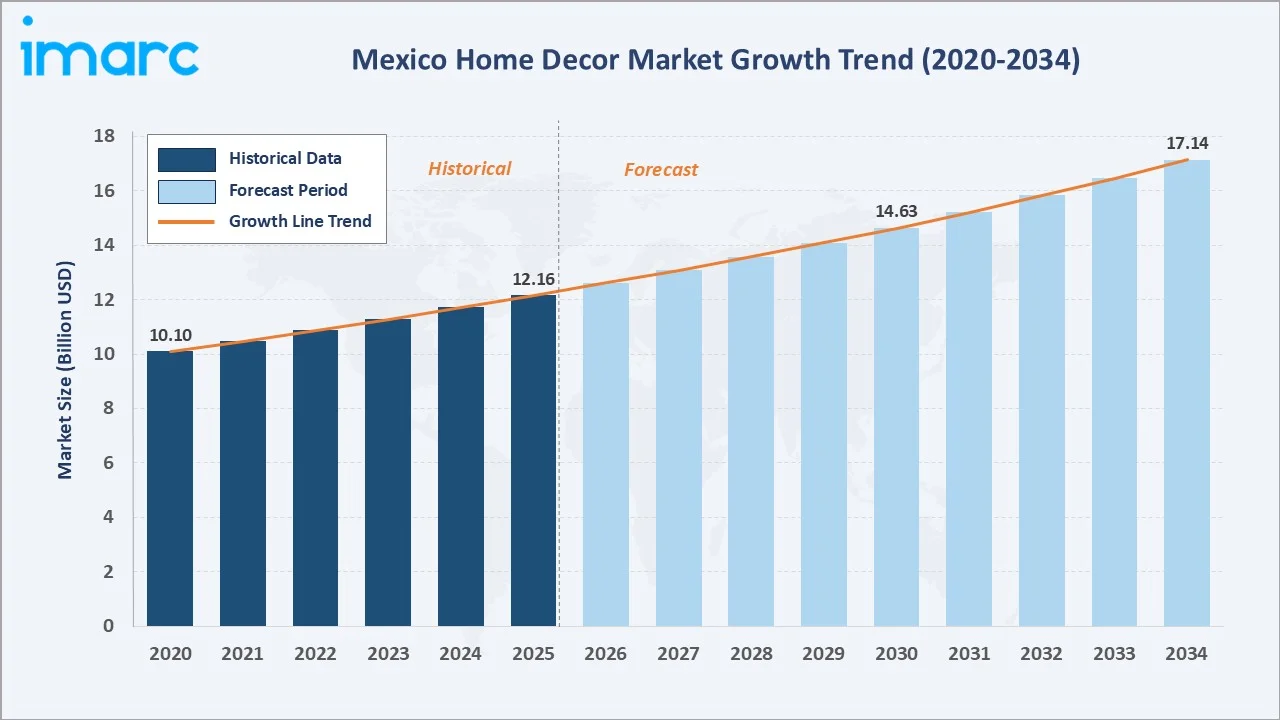
The Mexico home decor market grew from USD 12.16 Billion in 2025 to USD 12.74 Billion in 2026 and is projected to reach USD 17.14 Billion by 2034, exhibiting a CAGR of 3.77% during 2026-2034. Rising home construction is the leading growth driver, reinforced by the government's Vivienda para el Bienestar program, which targets 1.1 Million new homes through 2030. Increasing urbanization, expanding e-commerce, and a strong renovation culture further support market growth.
Home furniture leads the product type segment at 38.7%, home decor stores dominate the distribution channel segment at 35.6%, and Central Mexico commands a 44.1% regional share in 2025.
Market Snapshot
|
Metric |
Value |
|
Base Year Market Size (2025) |
USD 12.16 Billion |
| Market Size (2026) | USD 12.74 Billion |
|
Forecast Market Size (2034) |
USD 17.14 Billion |
|
CAGR (2026-2034) |
3.77% |
|
Base Year |
2025 |
|
Historical Period |
2020-2025 |
|
Forecast Period |
2026-2034 |
|
Largest Region |
Central Mexico (44.1%, 2025) |
|
Second Largest Region |
Northern Mexico (28.6%, 2025) |
|
Leading Product Type |
Home Furniture (38.7%, 2025) |
|
Leading Distribution Channel |
Home Decor Stores (35.6%, 2025) |
The Mexico home decor market expanded from USD 10.10 Billion in 2020 to USD 12.16 Billion in 2025 and an estimated USD 12.74 Billion in 2026, supported by steady urbanization, rising household formation, and a growing culture of interior upgrades. Anchored at USD 14.63 Billion in 2030, the forecast to USD 17.14 Billion by 2034 is underpinned by sustained housing construction, expanding online retail, and rising demand for premium and design-led furnishings.
To get more information on this market, Request Sample
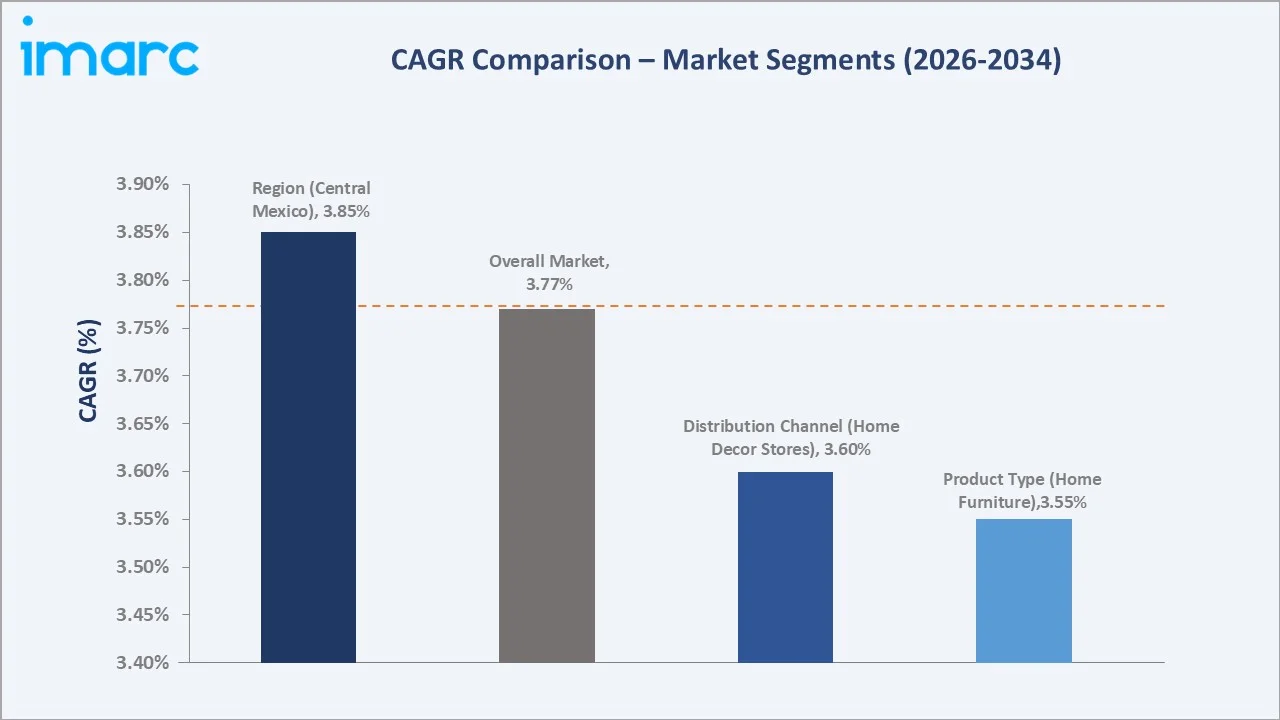
CAGR trajectories across product type and distribution channel sub-segments show online store, wall decor, and lighting expanding faster than the overall 3.77% market CAGR, driven by digital adoption, evolving design preferences, and rising spend on ambient and decorative elements.
Executive Summary
The Mexico home decor market is on a steady growth trajectory, rising from USD 10.10 Billion in 2020 to USD 12.74 Billion in 2026 and is projected to reach USD 17.14 Billion by 2034. The market has shifted from purely functional furnishing toward design-led, aspirational interiors across urban and suburban households. Affordable housing expansion, a growing middle class, and rising digital retail are encouraging consumers to invest in home aesthetics.
Home furniture dominates the product type segment at 38.7% in 2025, supported by new household formation and replacement demand. Home decor stores lead distribution channel at 35.6%, benefiting from consumers' preference to evaluate furniture quality, design, and comfort in person before purchase. Central Mexico commands a 44.1% regional share in 2025, led by Greater Mexico City, dense population, and the country's large base of urban consumers.
Key Market Insights
|
Insight |
Data |
|
Leading Product Type |
Home Furniture - 38.7% share (2025) |
|
Second Largest Product Type |
Home Textiles - 21.4% share (2025) |
|
Leading Distribution Channel |
Home Decor Stores - 35.6% share (2025) |
|
Second Largest Distribution Channel |
Supermarkets and Hypermarkets - 24.8% share (2025) |
|
Leading Region |
Central Mexico - 44.1% share (2025) |
|
Second Largest Region |
Northern Mexico - 28.6% share (2025) |
|
Top Companies |
El Puerto de Liverpool S.A.B. de C.V., Walmart, The Home Depot, Inc., Inditex |
Key Analytical Observations Expanding On The Data Above:
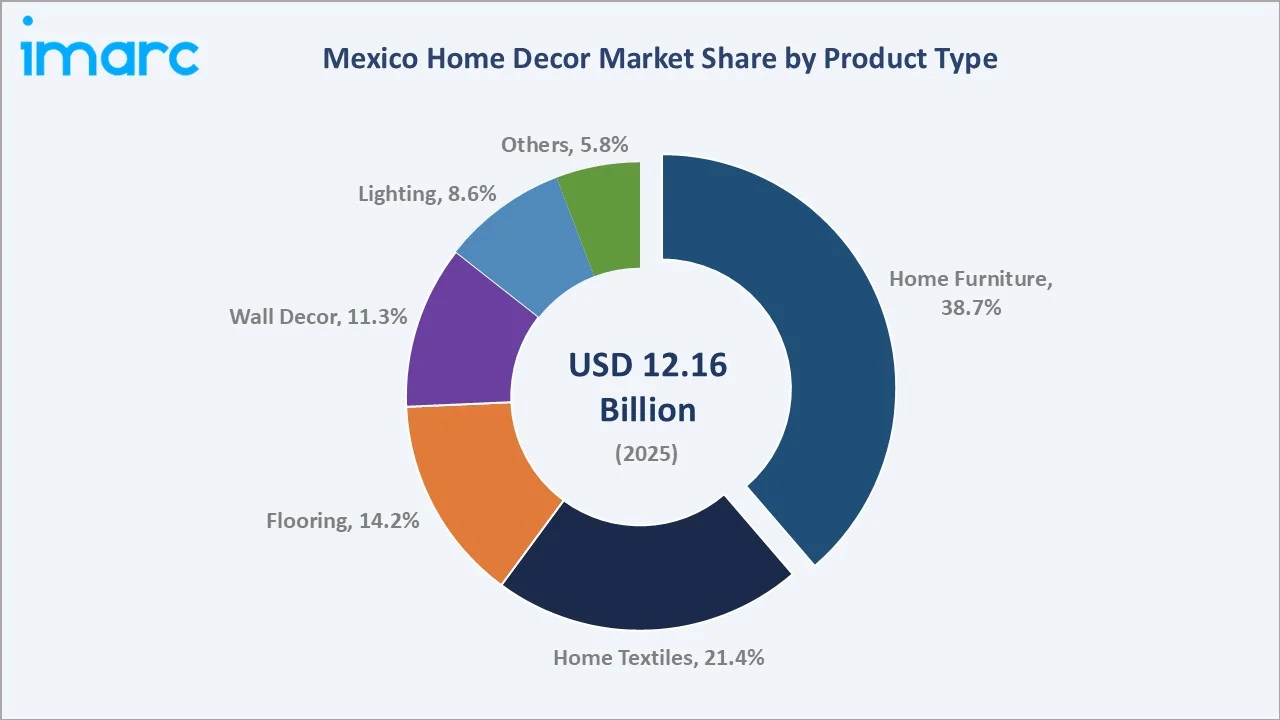
- Home furniture leadership at 38.7% reflects strong replacement demand, new household formation, and rising spending on living, dining, and bedroom furniture across urban and suburban homes.
- Home textiles at 21.4% is supported by frequent, lower-ticket refresh cycles in curtains, rugs, cushions, and bedding, along with growing interest in seasonal styling.
- Home decor stores at 35.6% dominate distribution through specialized assortments, in-store experience, and design guidance across department and dedicated decor formats.
- Supermarkets and hypermarkets share at 24.8% is supported by broad product availability, competitive pricing, and the convenience of one-stop shopping, making them a preferred channel for home decor purchases.
- Central Mexico dominance at 44.1% is anchored by Greater Mexico City, dense population, and a large concentration of households and modern retail.
Mexico Home Decor Market Overview
Home decor refers to the products and furnishings used to enhance the comfort, function, and visual appeal of residential and commercial interiors. The market spans home furniture, home textiles, flooring, wall decor, lighting, and other decorative accessories sold across physical and digital retail channels.
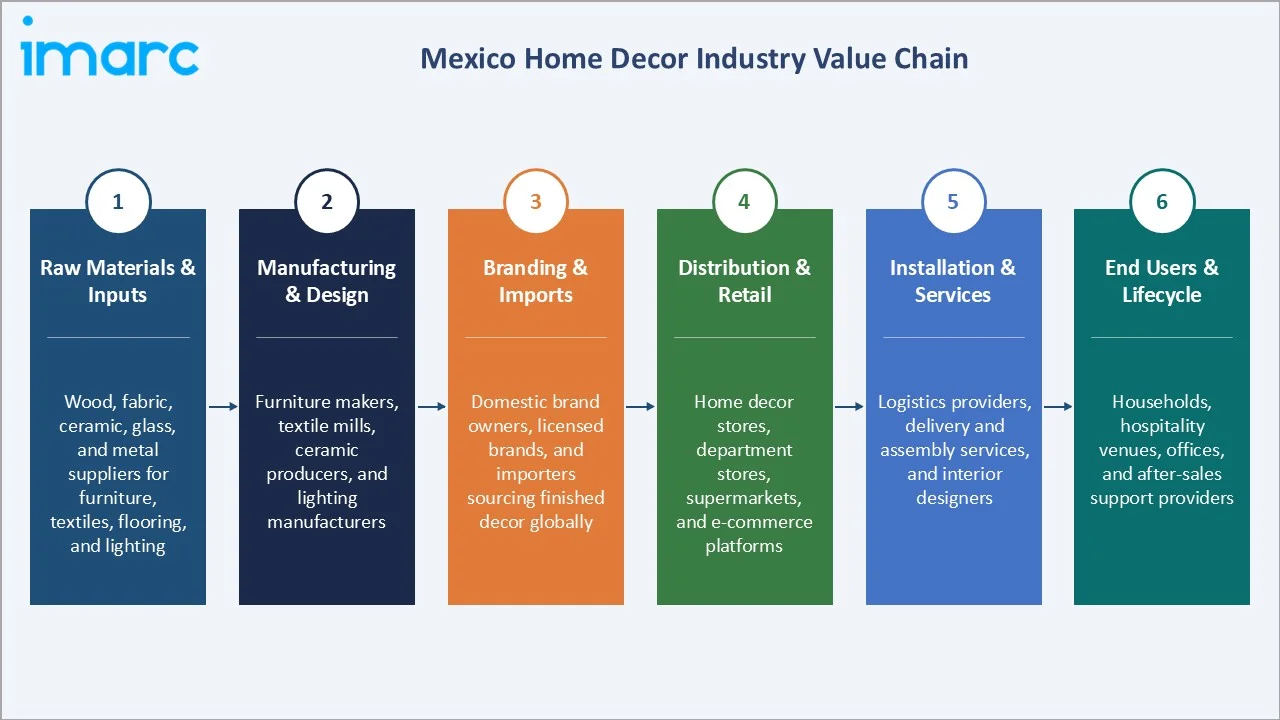
The Mexican ecosystem integrates raw material suppliers, furniture and textile manufacturers, importers and brand owners, home decor retailers, e-commerce platforms, interior designers, and logistics and installation providers. Together they deliver furnishing solutions across a wide range of price points and regional markets.
Market Dynamics
To evaluate market opportunities, Request Sample
Market Drivers
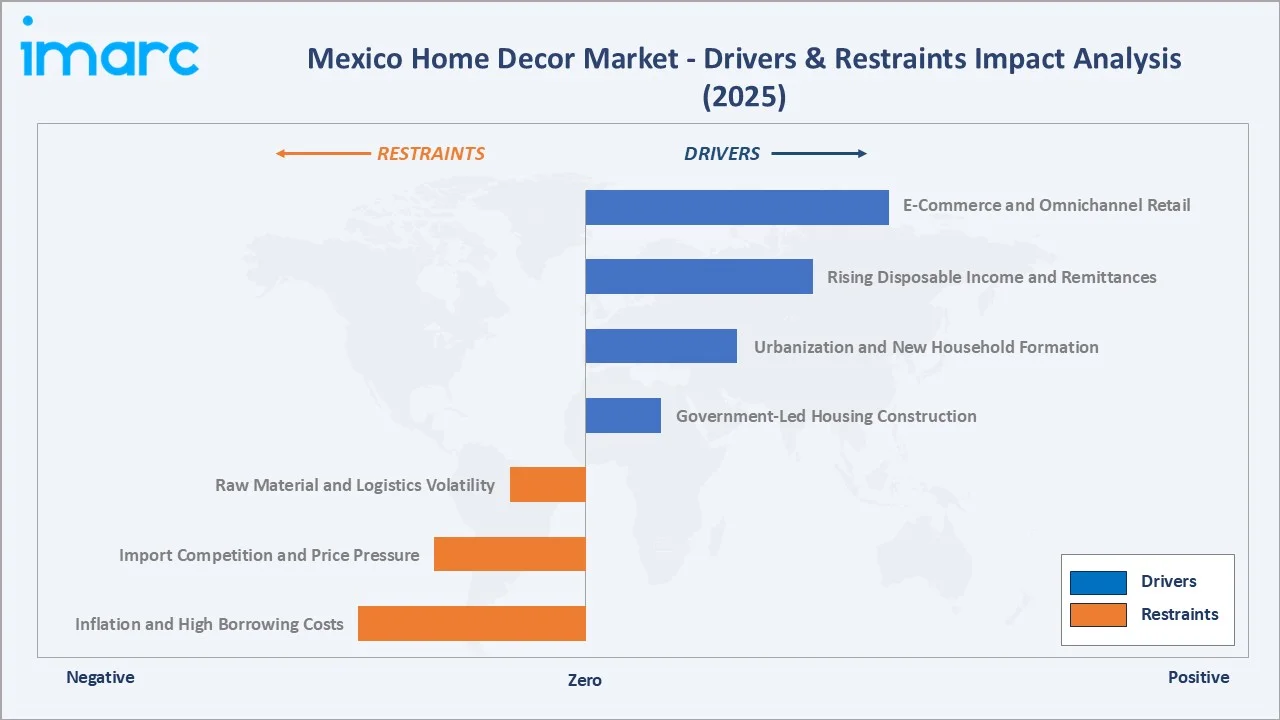
- Government-Led Housing Construction: Large-scale public housing programs and a structural housing deficit are expanding the base of newly built and improved homes, directly lifting demand for furniture, flooring, and decor across income segments.
- Urbanization and New Household Formation: Continued migration toward cities and the formation of younger, smaller households are increasing the number of homes that require furnishing. According to the World Bank collection of development indicators, urban population (% of total population) in Mexico was reported at 81.86 % in 2024.
- Rising Disposable Income and Remittances: Growing middle-class incomes and sustained remittance inflows are supporting higher discretionary spending on furniture, textiles, and decorative upgrades across households.
- E-Commerce and Omnichannel Retail: Wider internet access, improved last-mile logistics, and integrated digital payments are making furniture and decor more accessible, especially across tier-2 and tier-3 cities.
Market Restraints
- Inflation and High Borrowing Costs: Elevated prices and financing costs weigh on big-ticket furniture purchases. Higher interest rates also increase the cost of installment-based purchases, reducing affordability for price-sensitive consumers.
- Import Competition and Price Pressure: A high share of low-cost imported furniture and decor, particularly from Asia, intensifies price competition and pressures margins for domestic manufacturers and retailers.
- Raw Material and Logistics Volatility: Fluctuations in wood, textile, and metal input costs, along with currency and freight volatility, create planning uncertainty across the supply chain.
Market Opportunities
- Premium and Design-Led Furnishings: Rising aspiration for curated, aesthetic interiors is opening opportunities in premium furniture, designer textiles, and statement lighting for higher-income urban households.
- Sustainable and Locally Made Decor: Growing interest in eco-friendly materials and Mexican craftsmanship presents scope for certified wood, recycled textiles, and artisan-led decor lines.
Market Challenges
- Fragmented and Informal Retail: A large informal furniture and decor segment, including local workshops and unbranded outlets, limits pricing power and brand visibility for organized players.
- Regional Disparities in Demand: Uneven income levels and infrastructure across central, northern, and southern regions create wide variation in purchasing power and channel access.
Emerging Market Trends
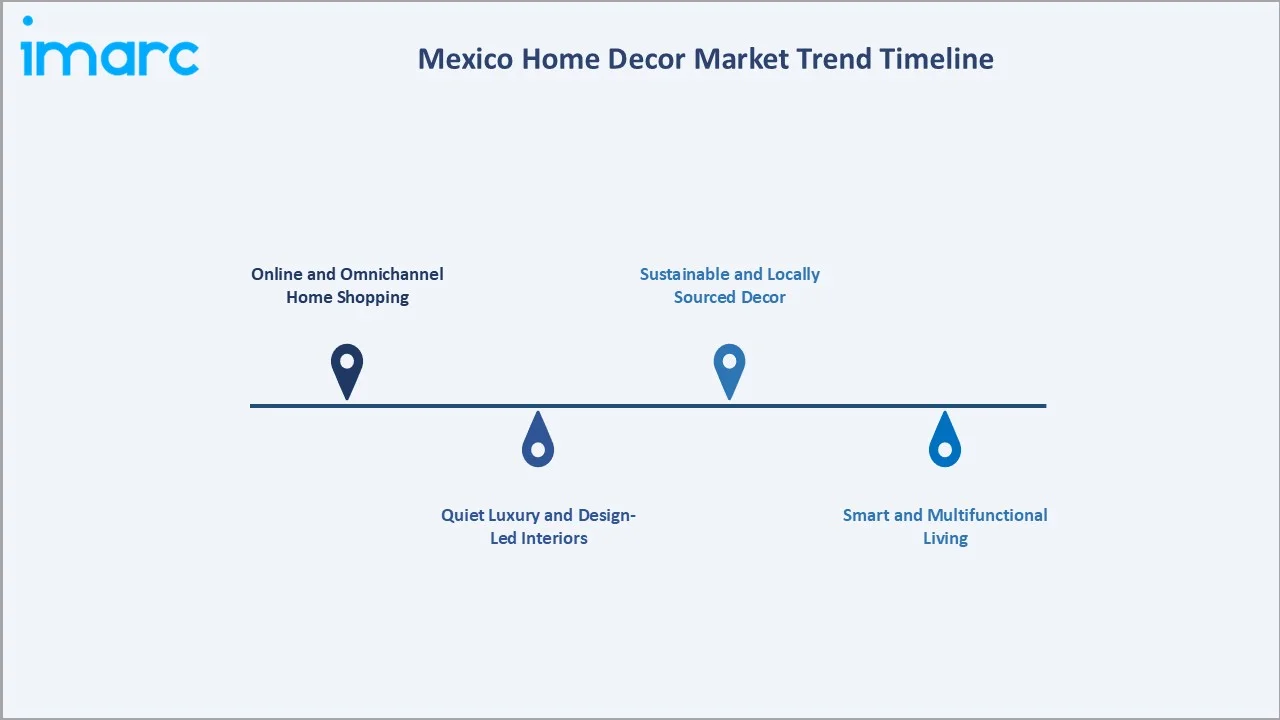
1. Online and Omnichannel Home Shopping
Consumers increasingly research, compare, and buy furniture and decor across digital and physical touchpoints. Retailers are expanding omnichannel capabilities through click-and-collect services, virtual product visualization tools, and integrated online-offline shopping experiences to enhance customer convenience and engagement.
2. Quiet Luxury and Design-Led Interiors
Demand is shifting toward understated, premium aesthetics built around neutral palettes, natural materials, and considered styling. This trend is lifting average ticket sizes in furniture and home textiles, particularly among urban, higher-income consumers.
3. Sustainable and Locally Sourced Decor
Eco-conscious buyers are favoring certified wood, recycled textiles, and artisan-made pieces. Brands are responding with transparent sourcing, durable materials, and Mexican-made collections that emphasize craftsmanship and provenance.
4. Smart and Multifunctional Living
Compact urban apartments are driving demand for modular, multifunctional furniture and connected lighting. Space-saving designs and adaptable layouts are becoming central to furnishing choices in dense metropolitan markets.
Industry Value Chain Analysis
The Mexico home decor value chain spans six stages from raw material supply through end-user engagement. Manufacturing, branding, and organized retail capture the highest value-add, while design services and after-sales support increasingly shape competitive position in this evolving market.
|
Stage |
Key Players / Examples |
|
Raw Materials & Inputs |
Wood, fabric, ceramic, glass, and metal suppliers providing inputs for furniture, textiles, flooring, and lighting |
|
Manufacturing & Design |
Furniture makers, textile mills, ceramic and tile producers, and lighting manufacturers across domestic and import-linked production |
|
Branding & Imports |
Domestic brand owners, licensed brands, and importers sourcing finished decor from global and regional suppliers |
|
Distribution & Retail |
Home decor stores, department stores, supermarkets and hypermarkets, gift shops, and e-commerce platforms |
|
Installation & Services |
Logistics providers, delivery and assembly services, interior designers, and fitting specialists |
|
End Users & Lifecycle |
Households, hospitality venues, offices, and after-sales and warranty support providers |
Vertically integrated players that combine in-house manufacturing, strong brands, and omnichannel retail are positioned to capture greater value than those reliant on third-party supply and single-channel distribution.
Technology Landscape in the Mexico Home Decor Industry
E-Commerce and Visualization Tools
Retailers are deploying augmented reality previews, room planners, and 3D product configurators that let shoppers visualize furniture and decor in their own spaces. These tools shorten decision cycles, reduce returns, and lift online conversion across furniture and decor categories.
Omnichannel and Last-Mile Logistics
Unified inventory, click-and-collect, and ship-from-store models are connecting physical outlets with digital storefronts. Improved last-mile delivery and assembly services are expanding furniture access beyond major metropolitan markets into tier-2 and tier-3 cities.
Smart and Connected Home Decor
Connected lighting, app-controlled fixtures, and energy-efficient solutions are entering mainstream assortments. These products blend aesthetics with convenience and lower running costs, appealing to younger, digitally engaged urban households.
Market Segmentation Analysis
The report covers the following segments:
|
Segment Category |
Leading Segment |
Market Share |
Year |
|
Product Type |
Home Furniture |
38.7% |
2025 |
|
Distribution Channel |
Home Decor Stores |
35.6% |
2025 |
|
Region |
Central Mexico |
44.1% |
2025 |

By Product Type
Home furniture commands a 38.7% majority share in 2025, driven by replacement demand, new household formation, and rising spend on living, dining, and bedroom pieces. The segment benefits from wide availability across organized and informal channels and broad price-point coverage.
To access detailed market analysis, Request Sample
Home textiles at 21.4% in 2025 cover curtains, rugs, cushions, bedding, and upholstery. The segment is supported by frequent, lower-ticket refresh cycles and growing interest in seasonal and design-led styling across households.
By Distribution Channel
Home decor stores dominate with 35.6% share in 2025, reflecting consumer preference for specialized assortments, in-store experience, and design guidance. Department stores and dedicated decor retailers remain central to mid and premium purchases.
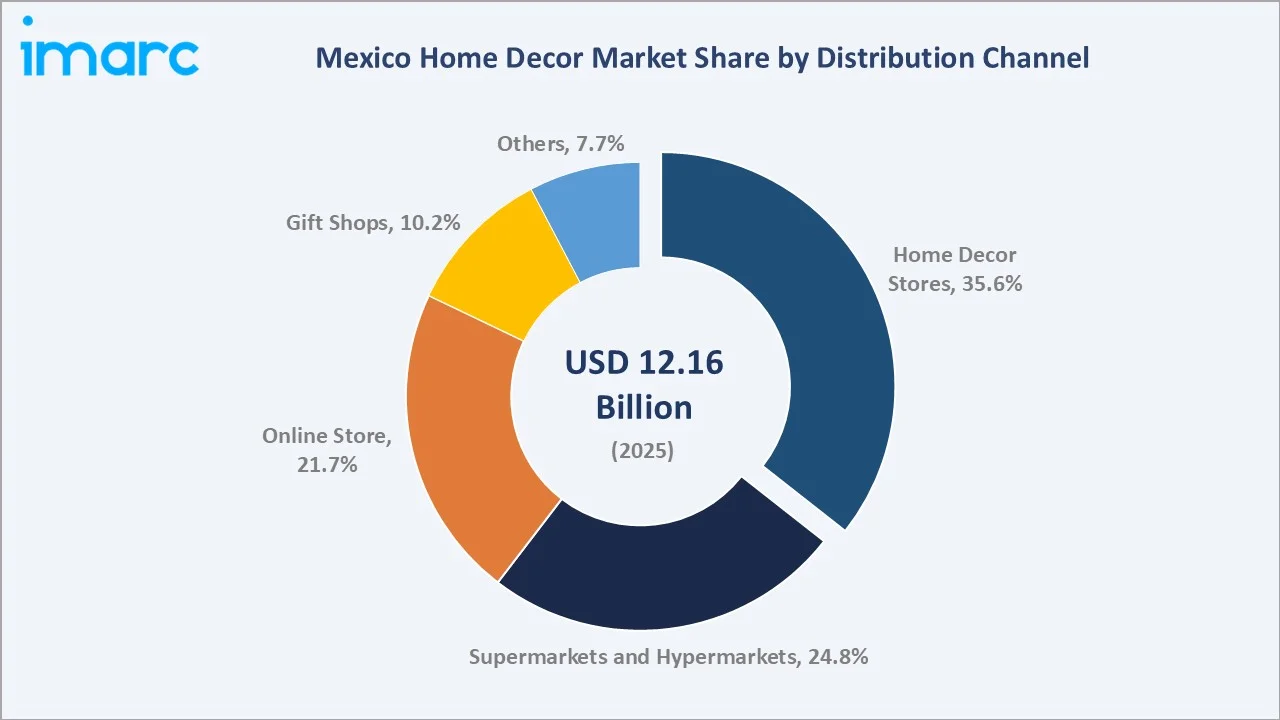
Supermarkets and hypermarkets at 24.8% provide accessible, value-oriented decor and basic furnishings within everyday shopping trips.
Regional Market Insights
|
Region |
Share (2025) |
Key Growth Drivers |
|
Central Mexico |
44.1% |
Large urban population, high consumer density, strong retail infrastructure, and the country's biggest concentration of households |
|
Northern Mexico |
28.6% |
Industrial and manufacturing growth, higher average incomes, nearshoring-driven housing, and strong cross-border retail influence |
|
Southern Mexico |
16.3% |
Emerging urban centers, tourism-linked demand, growing digital adoption, and rising tier-2 city participation |
|
Others |
11.0% |
Dispersed regional demand, expanding modern retail reach, and gradual formalization of furnishing purchases |
Central Mexico at 44.1% in 2025 leads the regional landscape, anchored by Greater Mexico City and surrounding states. A dense urban population and mature retail infrastructure support sustained leadership across both store-based and online channels.
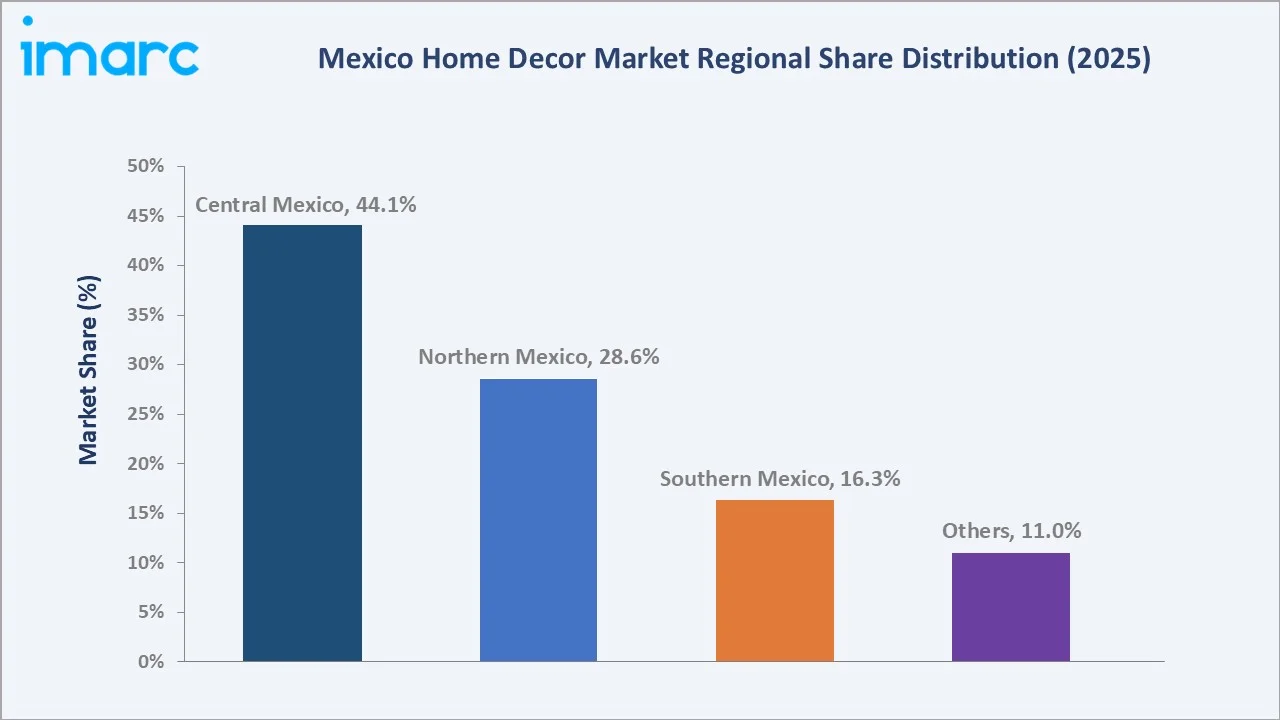
Northern Mexico at 28.6% is the fastest-growing region. Industrial expansion, nearshoring-driven housing, and higher average incomes are accelerating demand for furniture and premium decor through 2034.
Competitive Landscape
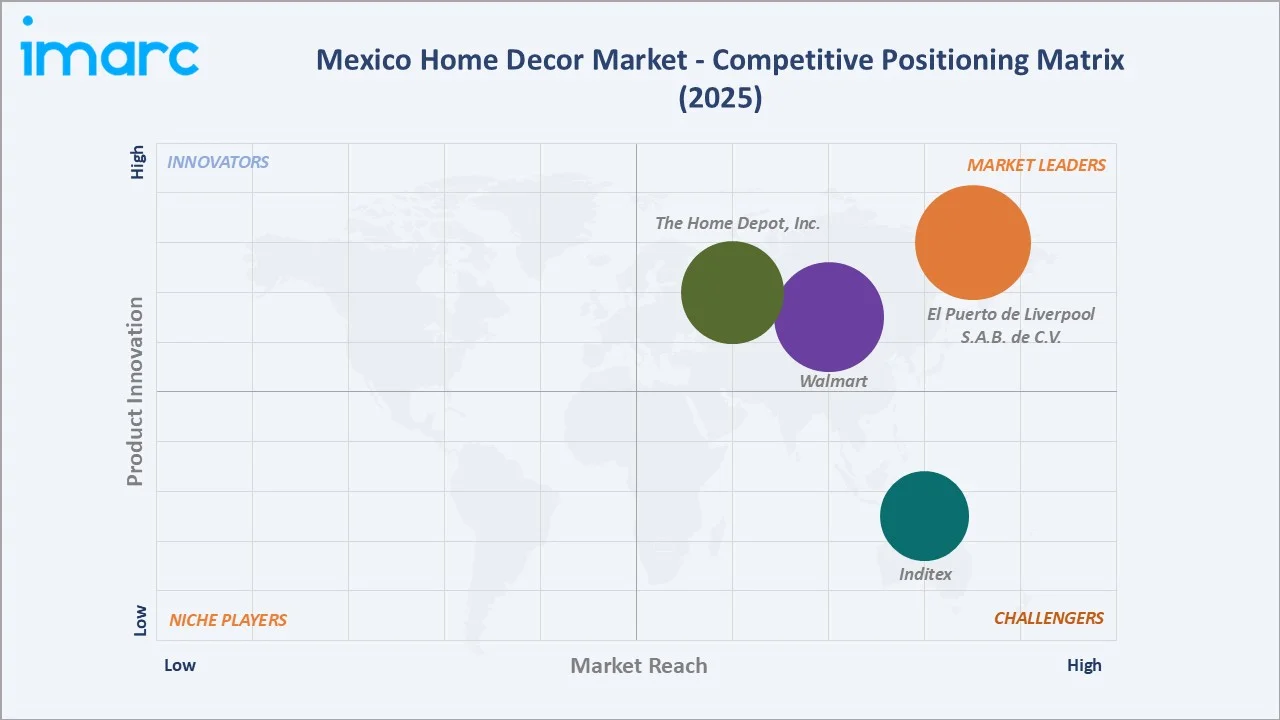
The Mexico home decor market is moderately fragmented, with large department stores and home improvement chains leading organized retail while specialized decor brands and a sizeable informal segment compete on price and regional reach. Brand strength, omnichannel capability, supply-chain scale, and design depth form the key competitive moats.
|
Company Name |
Brand / Key Product |
Position |
Strategic Focus |
|
El Puerto de Liverpool S.A.B. de C.V. |
Liverpool |
Leader |
Omnichannel department-store retail with broad home and decor assortments |
|
Walmart |
Bodega Aurrerá |
Leader |
Mass-market home goods at accessible price points across formats |
|
The Home Depot, Inc. |
The Home Depot México |
Leader |
Home improvement and decor retail with renovation-linked assortments |
|
Inditex |
Zara Home |
Challenger |
Fashion-led home textiles and decor with frequent collections |
Key players include El Puerto de Liverpool S.A.B. de C.V., Walmart, The Home Depot, Inc., and Inditex, among others.
Key Company Profiles
El Puerto de Liverpool S.A.B. de C.V.
El Puerto de Liverpool S.A.B. de C.V. is a leading retailer active in the Mexico home decor market, offering a broad range of furniture, home textiles, and decorative products through department stores and digital channels.
- Product Portfolio: Furniture for living, dining, and bedroom spaces, mattresses, home textiles and bed-and-bath linens, tableware, kitchenware, lighting, rugs, and decorative accessories.
- Recent Developments: The company has continued to enhance its home furnishing and decor offerings through store upgrades, digital commerce expansion, and improvements in customer experience initiatives across its retail network.
- Strategic Focus: Strengthening its position in home decor through omnichannel retail, broad assortments, and integrated delivery and design services.
Walmart
Walmart is a leading retailer active in the Mexico home decor market, offering affordable home goods, basic furniture, and decorative items through large-format stores and digital channels.
- Product Portfolio: Affordable furniture, mattresses, home textiles and linens, curtains, kitchenware, tableware, lighting, and everyday decorative items such as rugs and cushions.
- Recent Developments: The company has continued to invest in its omnichannel capabilities and broaden the availability of home goods across the country.
- Strategic Focus: Scaling accessible home goods through omnichannel retail and value-led assortments.
The Home Depot, Inc.
The Home Depot, Inc. is a leading company active in the market, offering a broad portfolio of products for home improvement, interior enhancement, renovation, and outdoor living projects through its extensive store network and digital platforms.
- Product Portfolio: Flooring, tiles, paint, lighting, ceiling fans, kitchen and bath fixtures, and decorative accents such as mirrors, shelves, curtains, and blinds for renovation and home improvement.
- Recent Developments: The company has continued to invest in its store and digital capabilities that support renovation and decor purchases.
- Strategic Focus: Growing renovation-led home decor demand through expanded assortments and omnichannel project support.
Market Concentration Analysis
The Mexico home decor market is moderately concentrated at the organized-retail level, with large department stores, home improvement chains, and mass retailers accounting for a significant share of branded furniture and decor sales, while a sizeable informal segment remains fragmented.
Barriers to entry include the need for scale in sourcing and logistics, omnichannel capability, brand investment, and the ability to serve diverse regional markets. These factors favor well-capitalized incumbents with established networks and integrated supply chains.
Consolidation is gradually advancing as organized retailers expand, global brands deepen their presence, and digital platforms capture share from informal channels. Partnerships across manufacturing, logistics, and design are further reinforcing competitive positioning.
Investment & Growth Opportunities
Fastest-Growing Segments
Online store is expanding the fastest among distribution channels, supported by wider assortments and improving logistics. Wall decor and lighting are the fastest-growing product types, driven by evolving design preferences and rising demand for ambient lighting.
Emerging Markets
Northern Mexico is the fastest-growing region, anchored by industrial growth, nearshoring-driven housing, and higher incomes. The market offers strong potential for premium and design-led furnishing.
Venture & Investment Trends
Investment is concentrated in e-commerce platforms, omnichannel logistics, and design-led and sustainable furnishing brands. Capital is also flowing into local manufacturing and last-mile delivery capacity that support the formal segment.
Future Market Outlook (2026-2034)
The Mexico home decor market is forecast to expand from USD 12.16 Billion in 2025 to USD 12.74 Billion in 2026, reaching USD 17.14 Billion by 2034, at a CAGR of 3.77%, adding roughly USD 4.98 Billion in incremental market value over the forecast period.
Four forces will shape the market through 2034: sustained housing construction and renovation; the rise of online and omnichannel retail; growing demand for premium, sustainable, and design-led furnishings; and the gradual formalization of informal furniture and decor channels.
By 2034, the market is expected to be defined by digitally enabled, design-conscious participation, with online retail and premium decor accounting for a higher share of overall activity. Housing policy, rising incomes, and omnichannel models are expected to further accelerate the evolution of organized home decor in Mexico.
Research Methodology
Primary Research
Primary research included structured interviews with retail executives, furniture and decor manufacturers, distributors, interior design professionals, and logistics providers, validating market sizing, regional demand, product mix, and channel evolution.
Secondary Research
Secondary sources included national statistics from INEGI, central bank data from Banco de México, retail and e-commerce association reports, government housing program publications, and annual reports and investor presentations from listed retailers.
Forecasting Models
Market forecasts used top-down and bottom-up models combining household counts, average spend per household, channel mix evolution, housing and construction trends, and macroeconomic variables. Scenario analysis addressed income growth, inflation, and digital adoption.
Mexico Home Decor Market Report Coverage:
| Report Features | Details |
|---|---|
| Base Year of the Analysis | 2025 |
| Historical Period | 2020-2025 |
| Forecast Period | 2026-2034 |
| Units | Billion USD |
| Scope of the Report |
Exploration of Historical Trends and Market Outlook, Industry Catalysts and Challenges, Segment-Wise Historical and Future Market Assessment:
|
| Product Types Covered | Home Furniture, Home Textiles, Flooring, Wall Decor, Lighting, Others |
| Distribution Channels Covered | Home Decor Stores, Supermarkets and Hypermarkets, Online Store, Gift Shops, Others |
| Regions Covered | Selangor, W.P. Kuala Lumpur, Johor, Sarawak, Others |
| Companies Covered | El Puerto de Liverpool S.A.B. de C.V., Walmart, The Home Depot Inc., Inditex, etc. |
| Customization Scope | 10% Free Customization |
| Post-Sale Analyst Support | 10-12 Weeks |
| Delivery Format | PDF and Excel through Email (We can also provide the editable version of the report in PPT/Word format on special request) |
Key Benefits for Stakeholders:
- IMARC’s industry report offers a comprehensive quantitative analysis of various market segments, historical and current market trends, market forecasts, and dynamics of the Mexico home decor market from 2020-2034.
- The research report provides the latest information on the market drivers, challenges, and opportunities in the Mexico home decor market.
- Porter's five forces analysis assist stakeholders in assessing the impact of new entrants, competitive rivalry, supplier power, buyer power, and the threat of substitution. It helps stakeholders to analyze the level of competition within the Mexico home decor industry and its attractiveness.
- Competitive landscape allows stakeholders to understand their competitive environment and provides an insight into the current positions of key players in the
Frequently Asked Questions About the Mexico Home Decor Market Report
The Mexico home decor market size is estimated at USD 12.74 Billion in 2026, driven by housing construction, urbanization, rising disposable income, and a growing culture of design-led interior upgrades.
The market is projected to grow at a 3.77% CAGR from 2026 to 2034, reaching USD 17.14 Billion, supported by housing expansion, e-commerce growth, and premium furnishing demand.
Home furniture leads at 38.7% in 2025, supported by replacement demand and new household formation.
Home decor stores dominate at 35.6% in 2025, fueled by wide product assortments, personalized design assistance, in-store product evaluation, and strong consumer preference for specialized home furnishing retailers.
Central Mexico commands 44.1% in 2025, led by Greater Mexico City, dense urban population, and the country's large base of households and modern retail infrastructure.
Leading players include El Puerto de Liverpool S.A.B. de C.V., Walmart, The Home Depot, Inc., and Inditex, among others.
Key drivers include government-led housing construction, rapid urbanization, rising remittances and disposable income, expanding e-commerce, and growing demand for renovation and interior upgrades.
Key challenges include inflation and high borrowing costs, import competition, raw material volatility, and a large informal retail segment that limits pricing power for organized brands.
E-commerce is expanding rapidly through wider assortments, visualization tools, and improved logistics, with online store the fastest-growing channel and omnichannel retail central to furniture and decor sales.
Need more help?
- Speak to our experienced analysts for insights on the current market scenarios.
- Include additional segments and countries to customize the report as per your requirement.
- Gain an unparalleled competitive advantage in your domain by understanding how to utilize the report and positively impacting your operations and revenue.
- For further assistance, please connect with our analysts.
 Request Customization
 Speak to an Analyst
 Request Brochure
 Inquire Before Buying
Benefits of Customization
- Personalize this research
- Triangulate with your data
- Get data as per your format and definition
- Gain a deeper dive into a specific application, geography, customer, or competitor
- Any level of personalization
Get in Touch With Us
UNITED STATES
Phone: +1-201-971-6302
INDIA
Phone: +91-120-433-0800
UNITED KINGDOM
Phone: +44-753-714-6104
Email: sales@imarcgroup.com
Client Testimonials




.webp)




.webp)













Related Reports

Choose your plan
*Please note that the prices mentioned below are starting prices for each bundle type. Kindly contact our team for further details.*
Single User License
- 1 User License, Access on 2 Devices
- PDF Report + Excel Dataset (Password Protected)
- Lifetime Access
- No Printing Rights
- 10% Free Report Customization
- 10–12 Weeks of Analyst Support
Five User License
- Access for 5 Users, 2 Devices per User
- PDF Report + Excel Dataset (Password Protected)
- Lifetime Access
- Dedicated Account Manager
- 12–14 Weeks of Analyst Support
- No Printing Rights
- 15% Free Report Customization
- 25% Discount on Your Next Purchase
Corporate User License
- Unlimited User Access (Within Your Organization)
- PDF Report + Excel Dataset
- Lifetime Access
- Dedicated Account Manager
- 14–20 Weeks of Analyst Support
- No Printing Rights
- 20% Free Report Customization
- 30% Discount on Your Next Purchase
Essential Insights
What's included:
3 reports
- Lifetime Access
- PDF Reports
- Excel Datasets
- 2 Weeks of Free Analyst Support
- 2 User Licenses
- Access on 2 Devices
- Printing Rights
- Complimentary PowerPoint (PPT) Version
- Complimentary License Upgrade
Professional Access
What's included:
5 reports
- Lifetime Access
- PDF Reports
- Excel Datasets
- 8 Weeks of Free Analyst Support
- 2 User Licenses
- Access on 2 Devices
- Printing Rights
- Complimentary PowerPoint (PPT) Version
- Complimentary License Upgrade
Business Advantage
What's included:
8 reports
- Lifetime Access
- PDF Reports
- Excel Datasets
- 14 Weeks of Free Analyst Support
- 2 User Licenses
- Access on 2 Devices
- Printing Rights
- Complimentary PowerPoint (PPT) Version
- Complimentary License Upgrade
Enterprise Intelligence
What's included:
10 reports
- Lifetime Access
- PDF Reports
- Excel Datasets
- 20 Weeks of Free Analyst Support
- 2 User Licenses
- Access on 2 Devices
- Printing Rights
- Complimentary PowerPoint (PPT) Version
- Complimentary License Upgrade