
Mexico Image Recognition Market Size, Share, Trends and Forecast by Component, Technology, Application, Deployment Type, End Use Industry, and Region, 2026-2034
Mexico Image Recognition Market Size, Share, Trends & Forecast (2026-2034)
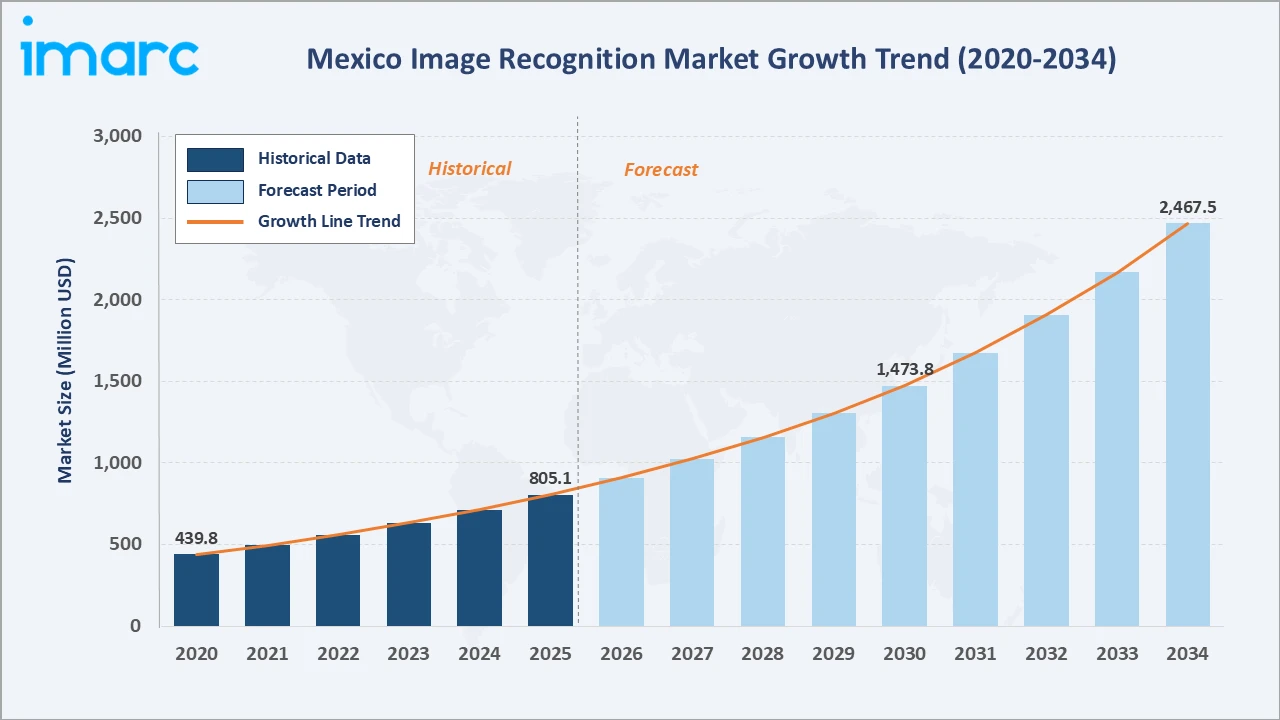
The Mexico image recognition market reached USD 805.1 Million in 2025 and is projected to reach USD 2,467.5 Million by 2034, growing at a CAGR of 12.85% during 2026-2034, driven by rising AI security adoption and e-commerce expansion.
Growth is reinforced by rising demand for smart retail analytics and mobile-based visual search. Cloud-based deployment leads at 68.9%, software leads component demand at 46.8%, and Central Mexico commands 41.7% of the national market share.
Market Snapshot
|
Metric |
Value |
|
Market Size (2025) |
USD 805.1 Million |
|
Forecast Market Size (2034) |
USD 2,467.5 Million |
|
CAGR (2026-2034) |
12.85% |
|
Base Year |
2025 |
|
Historical Period |
2020-2025 |
|
Forecast Period |
2026-2034 |
|
Dominant Deployment Type |
Cloud-based (68.9%, 2025) |
|
Dominant Component |
Software (46.8%, 2025) |
|
Leading Region |
Central Mexico (41.7%, 2025) |
The market expanded from an estimated USD 439.8 Million in 2020 to USD 805.1 Million in 2025, anchored at approximately USD 1,473.8 Million by 2030 and forecast to reach USD 2,467.5 Million by 2034 on sustained AI investment. This trajectory reflects a near six-fold expansion over the full forecast horizon, underscoring Mexico's transition from early-stage pilot deployments toward mainstream enterprise and government adoption of AI-powered image recognition technology.
To get more information on this market, Request Sample
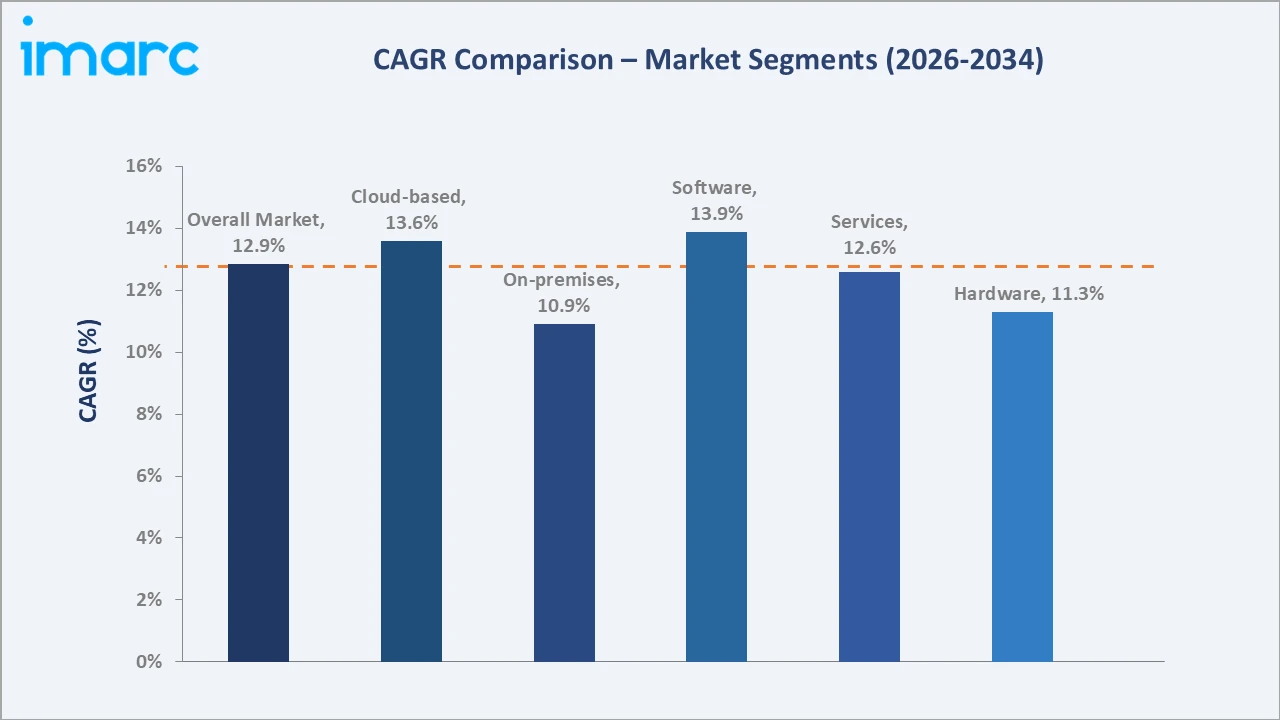
Cloud-based deployment grows fastest at approximately 13.6% CAGR as SMEs and mid-sized retailers favor subscription-based visual analytics. The software component grows at approximately 13.9% CAGR, reflecting rising demand for AI-enabled recognition algorithms and platforms.
Executive Summary
The Mexico image recognition market reached USD 805.1 Million in 2025, reflecting rapid adoption of AI-powered visual analytics across retail security, healthcare diagnostics, and smart city infrastructure. The market is projected to reach USD 2,467.5 Million by 2034.
Cloud-based deployment at 68.9% dominates through lower upfront cost and scalability for mid-sized enterprises. Software at 46.8% leads component demand through algorithm licensing, while Central Mexico at 41.7% leads regionally through its industrial and technology hub concentration.
Growth is further reinforced by expanding government digital identity programs, rising smartphone penetration, and increasing enterprise willingness to invest in AI-driven operational efficiency. Vendors that combine strong local partnerships with proven recognition accuracy are best positioned to capture share as adoption accelerates across new verticals.
Key Market Insights
|
Insight |
Data |
|
Dominant Deployment Type |
Cloud-based - 68.9% share (2025) |
|
Dominant Component |
Software - 46.8% market share (2025) |
|
Leading Region |
Central Mexico - 41.7% market share (2025) |
|
Market Opportunity |
Medical imaging AI; retail loss-prevention analytics; smart city surveillance; mobile visual search integration |
Key Analytical Observations Supporting the Above Data:
- Cloud-based at 68.9%: Cloud-based platforms dominate as they lower infrastructure investment, enable rapid scaling, and support remote video analytics deployment. Growing adoption among mid-sized Mexican retailers and hospitals for theft prevention and diagnostic imaging reinforces this segment's leadership.
- Software at 46.8%: Software leads as algorithm licensing, recognition engines, and analytics platforms represent the highest per-deployment value. Rising demand for facial, object, and pattern recognition software across banking, retail, and healthcare strengthens this segment's dominance.
- Central Mexico at 41.7%: Central Mexico dominates due to its concentration of financial institutions, retail headquarters, and technology infrastructure in and around Mexico City. Government digital initiatives and private-sector AI investment further reinforce the region's leading position.
- Emerging Opportunity Areas: Healthcare diagnostics and smart city surveillance represent the highest-value emerging opportunities, as hospitals and municipal governments increasingly commit multi-year budgets to AI-enabled imaging and public safety infrastructure across Mexico.
Mexico Image Recognition Market Overview
The Mexico image recognition market encompasses hardware, software, and services enabling automated visual identification and analysis, including facial recognition, object detection, and optical character recognition across retail, healthcare, banking, and government applications.
The ecosystem integrates camera and sensor manufacturers, AI algorithm developers, cloud infrastructure providers, systems integrators, and end-use enterprises. Government digital identity programs, rising e-commerce, and smart city investment are reshaping demand across Mexico's technology landscape. Enterprise adoption is increasingly shaped by regulatory expectations around biometric data handling, prompting vendors to invest in privacy-preserving architectures. Mexico's proximity to major North American technology hubs also supports faster localization of global recognition platforms for Spanish-language and regional compliance requirements.
Market Dynamics
To evaluate market opportunities, Request Sample
Market Drivers
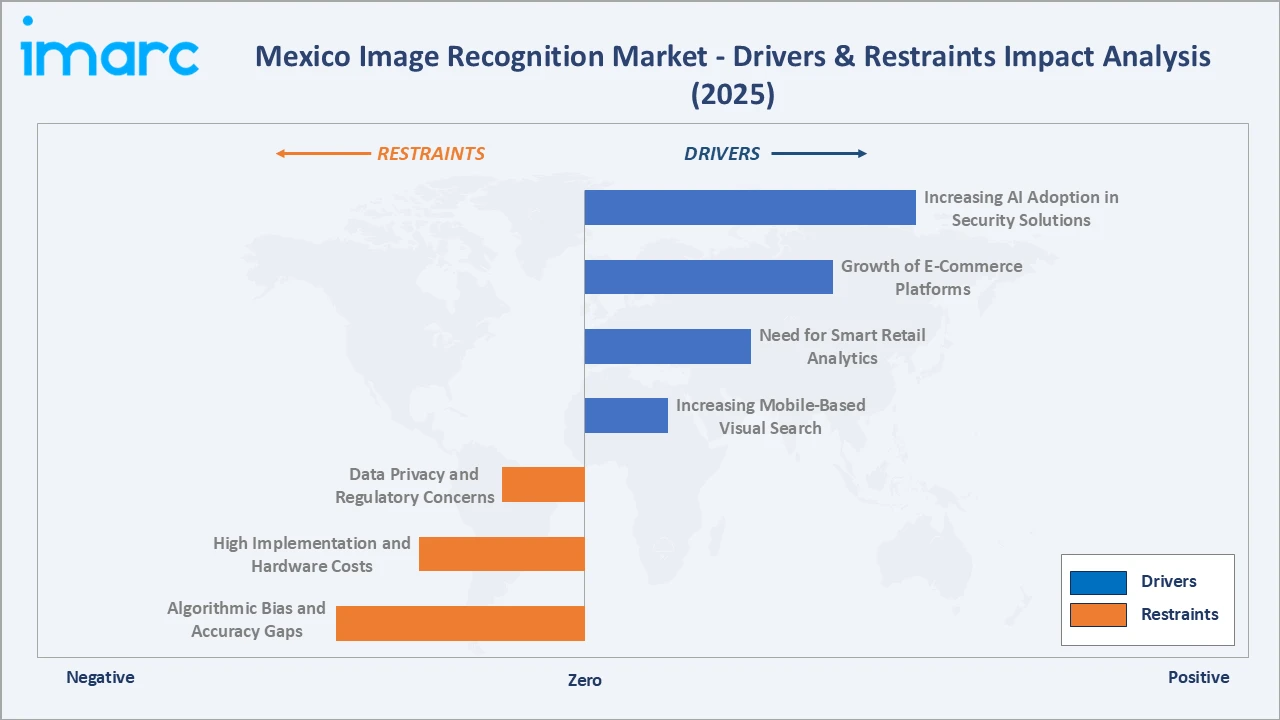
- Increasing AI Adoption in Security Solutions: Rising deployment of AI-driven surveillance across retail chains and government facilities strengthens theft prevention, access control, and public safety. Mexican SMEs report inventory losses of up to 15% from theft, driving demand for advanced visual analytics. Law enforcement agencies are also integrating recognition-enabled cameras into patrol vehicles and public spaces to accelerate suspect identification. As insurance providers increasingly reward businesses that deploy verified security technology, adoption is expected to broaden across mid-sized commercial properties nationwide.
- Growth of E-Commerce Platforms: Mexico's expanding e-commerce sector is driving demand for image-based product search, visual cataloguing, and fraud detection tools. Retailers increasingly integrate recognition technology to enhance personalization and streamline digital transactions. Marketplace platforms are deploying automated image moderation to verify listing authenticity and reduce counterfeit product circulation. Growing smartphone-based shopping behavior is further encouraging merchants to adopt visual search features that shorten the path between product discovery and purchase.
- Need for Smart Retail Analytics: Retailers are adopting image recognition for shelf monitoring, footfall analysis, and personalized marketing. Smart retail analytics help optimize inventory and enhance customer experience, encouraging wider technology adoption among mid-sized chains. Automated shelf-scanning cameras are reducing stockout incidents by flagging depleted inventory in real time, improving replenishment efficiency. Retailers are also using footfall heatmaps generated from recognition data to redesign store layouts and improve conversion rates.
- Increasing Mobile-Based Visual Search: Rising smartphone penetration is fueling mobile-based visual search adoption for shopping, navigation, and identification. Consumers increasingly rely on image-based queries, prompting platforms to integrate advanced recognition capabilities. Mobile banking applications are incorporating selfie-based verification to simplify onboarding and reduce fraudulent account creation. As 5G connectivity expands across Mexican cities, real-time mobile image processing is becoming faster and more reliable, further accelerating consumer adoption.
Market Restraints
- Data Privacy and Regulatory Concerns: Growing public concern over biometric data collection and facial recognition surveillance is prompting stricter data protection expectations, potentially slowing enterprise and government deployment across sensitive public-facing applications. Civil society groups have raised objections to large-scale surveillance programs, creating reputational risk for early adopters. Enterprises must now budget for consent management, data anonymization, and compliance auditing, adding cost and complexity to recognition deployments.
- High Implementation and Hardware Costs: High costs associated with cameras, sensors, and computing infrastructure limit adoption among smaller enterprises. Budget constraints particularly affect deployment in Southern Mexico and other developing regions with limited technology infrastructure. On-premises systems requiring dedicated servers and specialized GPUs raise capital expenditure well beyond what many SMEs can justify. Financing and leasing models remain underdeveloped in Mexico's technology sector, further restricting smaller operators' access to advanced recognition hardware.
- Algorithmic Bias and Accuracy Gaps: Recognition accuracy can vary across lighting conditions, image quality, and demographic groups, creating reliability concerns for security and identification applications. Addressing these gaps requires continuous algorithm refinement and testing investment. Inconsistent performance across varied skin tones and low-light urban environments has drawn scrutiny from regulators and civil rights advocates. Vendors must continually retrain models on diverse, regionally representative datasets to maintain accuracy and public trust.
Market Opportunities
- Medical Imaging and Diagnostics Expansion: AI-enabled diagnostic imaging in radiology and pathology offers significant growth potential as Mexican hospitals adopt automated anomaly detection to improve diagnostic accuracy and reduce interpretation time in under-resourced regions. Public health institutions are piloting AI-assisted screening programs for conditions such as diabetic retinopathy and tuberculosis to extend specialist-level diagnostics into rural clinics. As telemedicine adoption grows, image recognition is expected to become a core component of remote diagnostic workflows.
- Smart City Infrastructure Investment: Growing smart city investment across Mexican metropolitan areas creates opportunities for integrated surveillance, traffic monitoring, and public safety recognition systems, supporting long-term infrastructure-driven market expansion. Municipal governments are exploring public-private partnerships to fund large-scale camera network upgrades tied to recognition analytics platforms. Integration with traffic management and emergency response systems is expected to create recurring service and maintenance revenue for technology vendors.
Market Challenges
- Competitive Pricing Pressure: Rising competition from low-cost international and domestic technology providers pressures pricing and margins for established vendors serving the Mexican market, particularly in government and retail security segments. New entrants offering commoditized cloud recognition APIs are compressing software licensing fees across the mid-market segment. Established vendors are responding by bundling professional services and analytics dashboards to differentiate beyond core recognition accuracy.
- System Integration Complexity: Ensuring interoperability between recognition software and legacy CCTV or IT infrastructure across enterprises remains complex, requiring additional integration investment and specialized technical expertise from solution providers. Many Mexican enterprises operate analog or first-generation IP camera networks that require costly hardware upgrades before AI-based analytics can be deployed. This integration burden lengthens sales cycles and increases the total cost of ownership for prospective adopters.
Emerging Market Trends
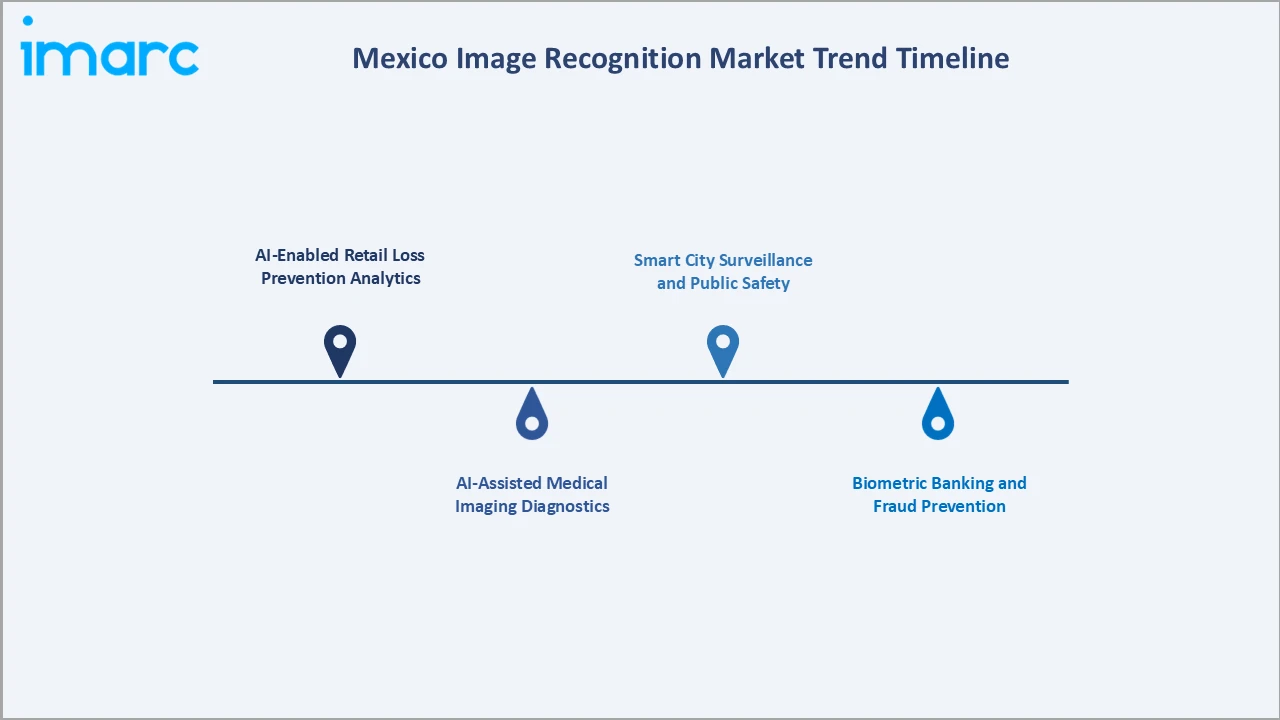
1. AI-Enabled Retail Loss Prevention Analytics
Retailers are deploying image recognition to identify suspicious behavior and repeat offenders in real time, reducing shrinkage. Declining hardware costs and cloud-based analytics platforms are making this technology accessible to mid-sized retail chains.
2. AI-Assisted Medical Imaging Diagnostics
Hospitals are integrating AI-enabled imaging to detect tumors, fractures, and retinal disorders with greater precision. This trend supports remote consultations and improves diagnostic speed in under-resourced rural healthcare facilities across Mexico.
3. Biometric Banking and Fraud Prevention
Financial institutions are adopting facial recognition for identity verification and fraud prevention, driven by regulatory mandates. Growing biometric enrollment across banking transactions and ATM authentication is expanding recognition technology's footprint in BFSI.
4. Smart City Surveillance and Public Safety
Municipal authorities are integrating facial recognition into public transport and surveillance networks to enhance safety and traffic management. This is part of a broader push to modernize urban infrastructure using digital technology.
Industry Value Chain Analysis
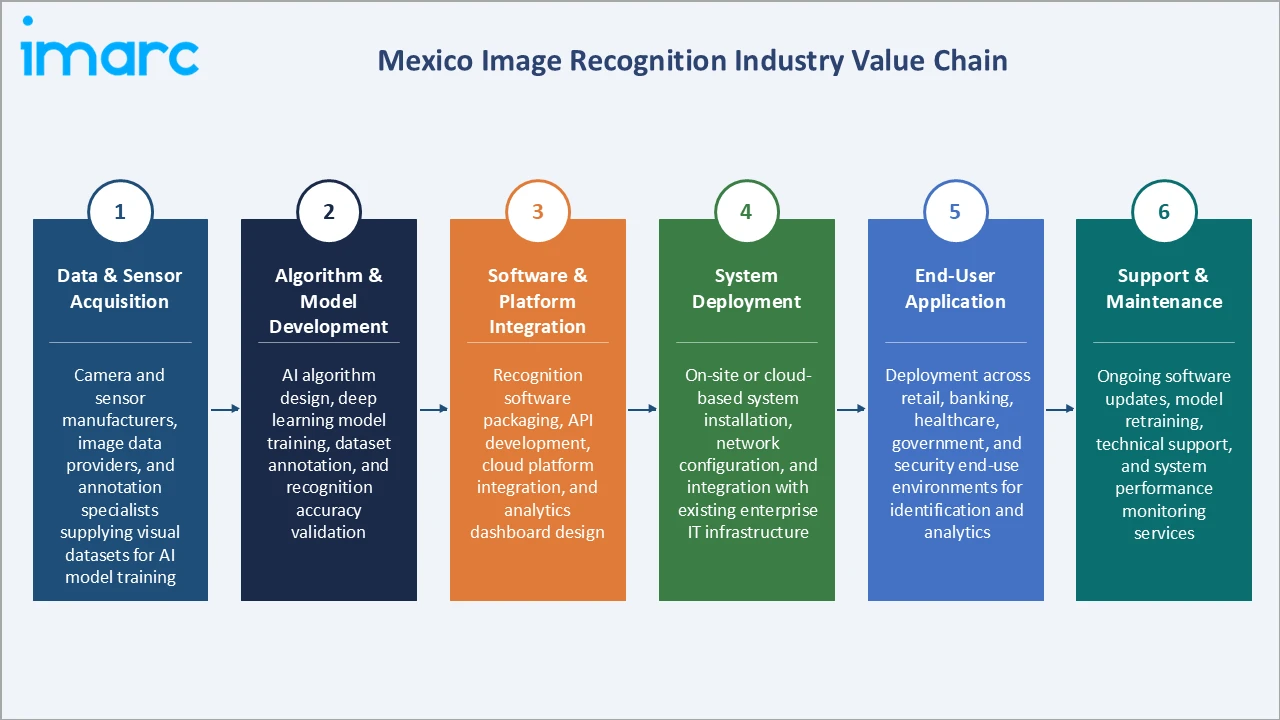
The Mexico image recognition value chain integrates sensor and camera hardware sourcing, AI algorithm and model development, software and platform integration, system deployment, end-user application, and ongoing support and maintenance services.
|
Stage |
Key Participants |
|
Data & Sensor Acquisition |
Camera and sensor hardware sourcing, image and video data capture, and raw dataset collection for AI model training |
|
Algorithm & Model Development |
AI algorithm design, deep learning model training, dataset annotation, and recognition accuracy validation |
|
Software & Platform Integration |
Recognition software packaging, API development, cloud platform integration, and analytics dashboard design |
|
System Deployment |
On-site or cloud-based system installation, network configuration, and integration with existing enterprise IT infrastructure |
|
End-User Application |
Deployment across retail, banking, healthcare, government, and security end-use environments for identification and analytics |
|
Support & Maintenance |
Ongoing software updates, model retraining, technical support, and system performance monitoring services |
The algorithm and model development stage is the value chain's most technically intensive segment, while system deployment and integration are experiencing the fastest growth as enterprises transition from pilot projects to full-scale rollouts. Vendors that control both algorithm development and cloud delivery infrastructure are best positioned to capture recurring subscription revenue, while hardware-focused participants face margin pressure as component costs decline industry-wide.
Technology Landscape in the Mexico Image Recognition Industry
Deep Learning-Based Recognition Algorithms
Deep learning-based recognition algorithms, particularly convolutional neural networks, offer high accuracy in facial, object, and pattern detection. Their ability to process large image datasets makes them the preferred technology for enterprise-grade recognition platforms. Continued advances in transformer-based vision models are further improving detection speed and accuracy across low-quality and low-light imagery.
Cloud-Based AI Vision Platforms
Cloud-based AI vision platforms provide scalable, subscription-priced recognition services accessible via API integration. These platforms lower technical barriers for mid-sized enterprises, accelerating adoption across Mexican retail, banking, and healthcare sectors.
Edge Computing for Real-Time Recognition
Edge computing enables real-time, low-latency image processing directly on cameras and local devices, reducing dependence on cloud connectivity. This supports security and surveillance applications requiring immediate identification in high-traffic public environments.
Multimodal Biometric Fusion
Multimodal biometric fusion combines facial, fingerprint, and behavioral data to improve identification accuracy and reduce false-match rates. Financial institutions and government agencies are increasingly adopting fusion-based systems to strengthen fraud prevention and identity assurance.
Market Segmentation Analysis
The report covers the following segments:
|
Segment Category |
Leading Segment |
Market Share |
Year |
|
Component |
Software |
46.8% |
2025 |
|
Technology |
🔒 |
🔒 |
2025 |
|
Application |
🔒 |
🔒 |
2025 |
|
Deployment Type |
Cloud-based |
68.9% |
2025 |
|
End Use Industry |
🔒 |
🔒 |
2025 |
|
Region |
Central Mexico |
41.7% |
2025 |

By Deployment Type
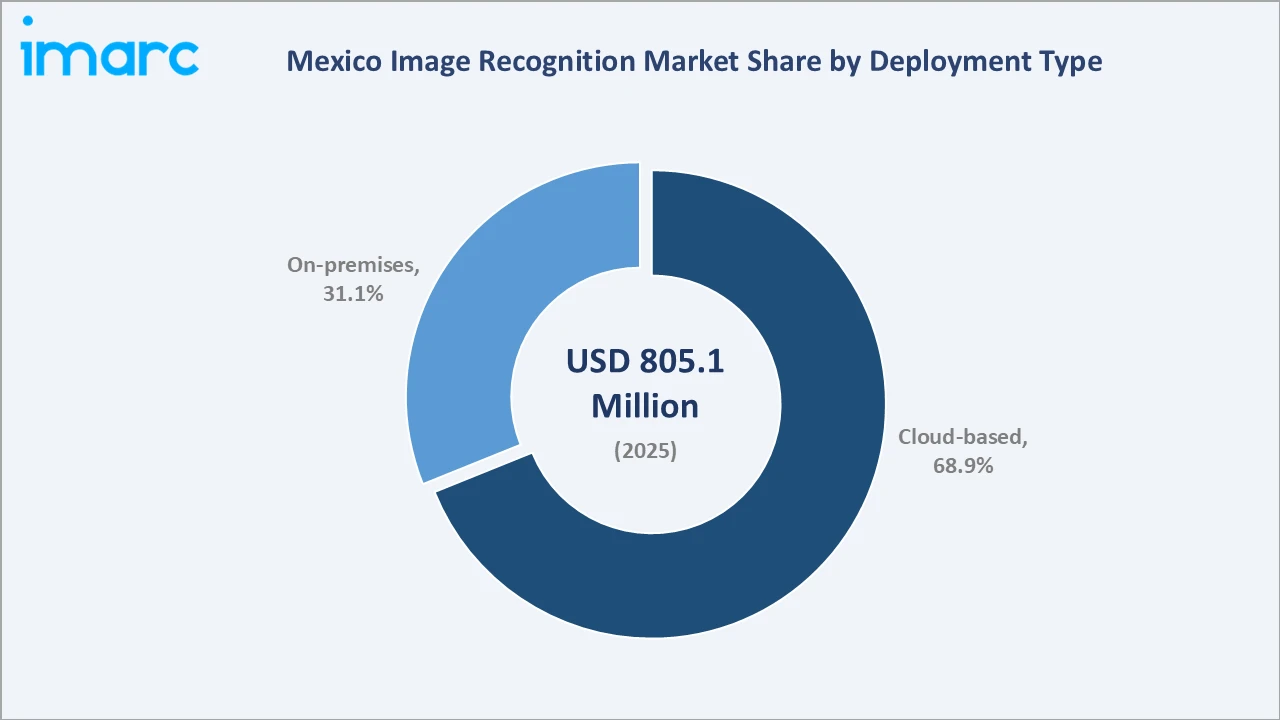
Cloud-based deployment leads at 68.9% in 2025, favored for its lower upfront investment, scalability, and ease of integration with existing enterprise IT and video infrastructure across retail and banking applications.
To access detailed market analysis, Request Sample
On-premises deployment at 31.1% remains relevant for government, defense, and high-security banking applications requiring strict data residency, low-latency processing, and greater control over sensitive biometric information.
By Component
Software leads at 46.8% in 2025, encompassing recognition algorithms, analytics platforms, and licensing revenue, the most commercially valuable and fastest-scaling category within the Mexico image recognition market.
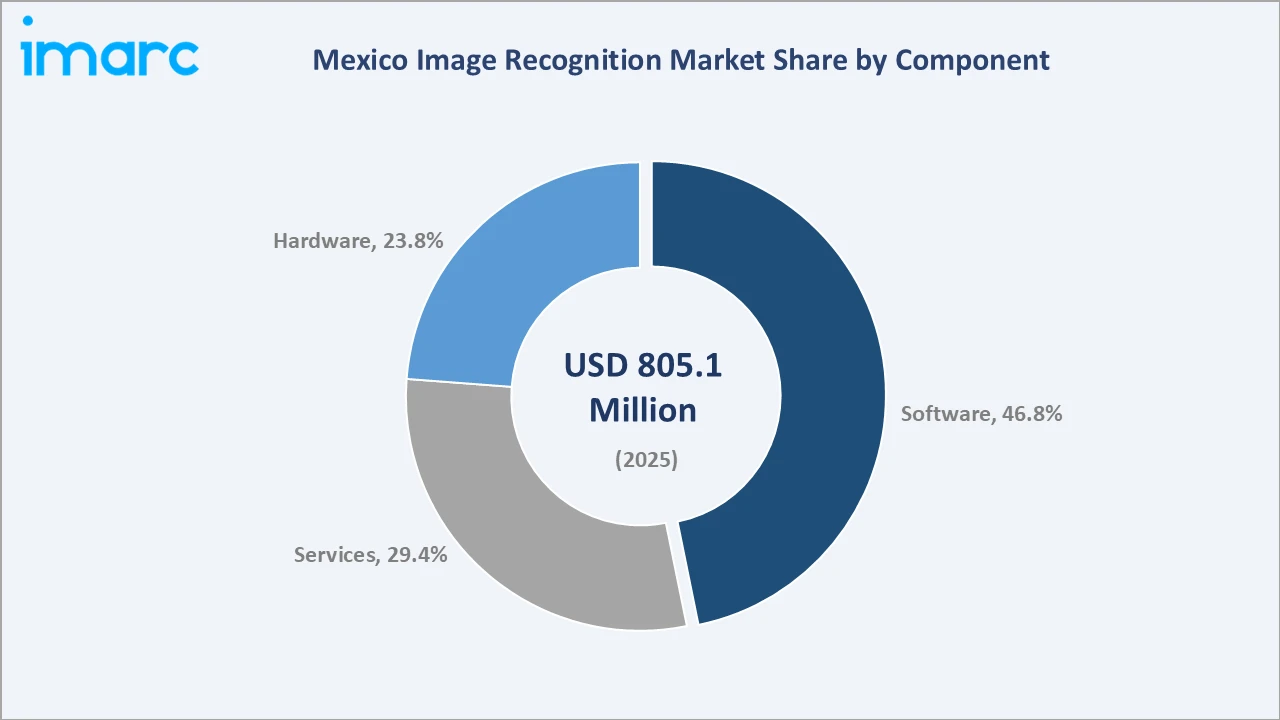
Services at 29.4% include consulting, integration, and maintenance support, while hardware at 23.8% covers cameras, sensors, and edge computing devices essential for image capture and on-site processing.
Regional Market Insights
|
Region |
Share (2025) |
Key Market Drivers & Characteristics |
|
Central Mexico |
41.7% |
Driven by concentration of financial institutions, retail headquarters, and technology infrastructure around Mexico City and its metropolitan area |
|
Northern Mexico |
29.6% |
Supported by manufacturing and border security demand, cross-border trade, and industrial automation investment near the US border |
|
Southern Mexico |
18.4% |
Growing through expanding tourism security needs, government digitalization, and gradual retail and healthcare technology adoption |
|
Others |
10.3% |
Emerging demand across remaining states supported by national digital identity and public safety initiatives |
Central Mexico, at 41.7%, leads through Mexico City's dense concentration of banking headquarters, retail chains, and technology investment. Northern Mexico, at 29.6%, benefits from manufacturing security and border-zone surveillance demand.
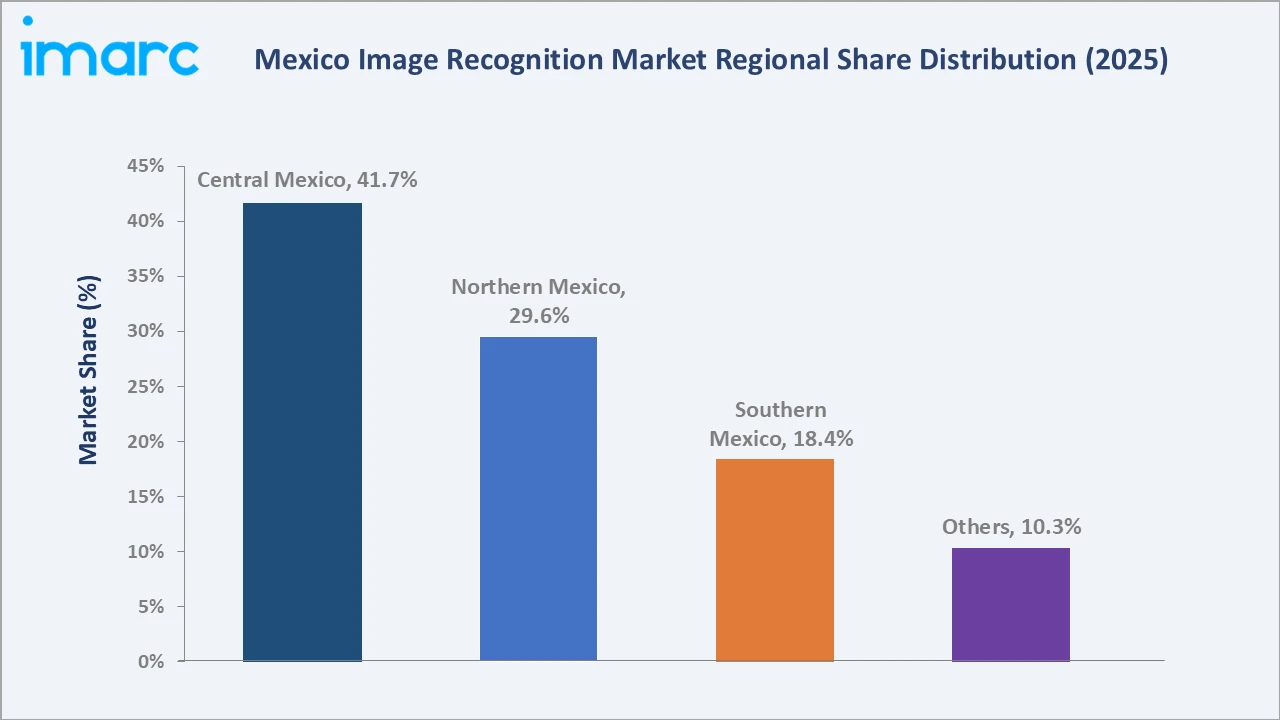
Southern Mexico, at 18.4%, and Others, at 10.3%, represent earlier-stage but growing markets, driven by tourism security requirements, government digitalization programs, and gradual enterprise technology adoption across smaller metropolitan areas. As connectivity infrastructure improves across Mexico's secondary cities, vendors are increasingly extending cloud-based recognition services beyond Central Mexico, narrowing the adoption gap between leading and emerging regions over the forecast period.
Competitive Landscape
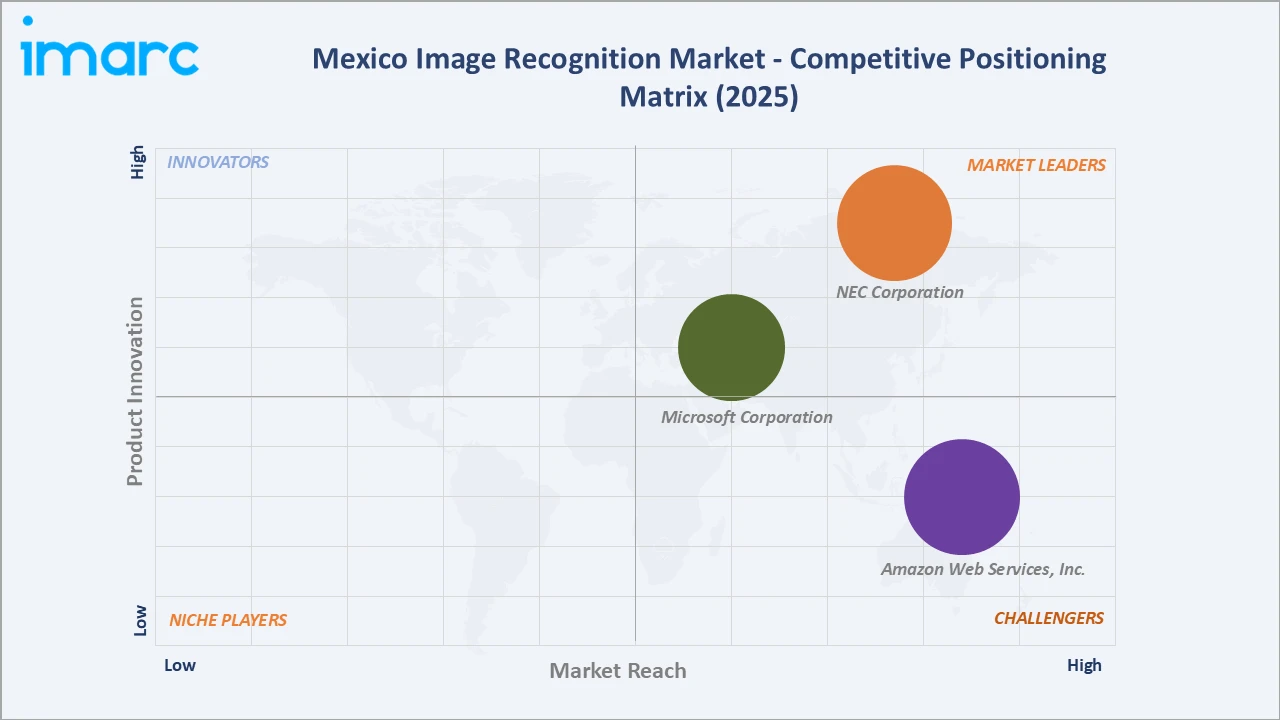
The Mexico image recognition market is moderately fragmented, comprising global technology leaders, specialized biometric vendors, and domestic security integrators competing across cloud platforms, software licensing, and government-focused surveillance deployments. Vendor selection is increasingly influenced by local support capability and proven regulatory compliance track record.
|
Company Name |
Key Products |
Market Position |
Core Strength |
|
NEC Corporation |
NeoFace Recognition Platform |
Market Leader |
Biometric accuracy leadership backed by top NIST benchmark rankings and global deployments |
|
Microsoft |
Azure AI Vision, Azure Face API |
Market Leader |
Cloud-scale enterprise reach through Azure's global data center and partner network |
|
Amazon Web Services, Inc. |
Amazon Rekognition |
Strong Challenger |
Scalable cloud API ecosystem enabling rapid integration for developers and enterprise clients |
Key players include NEC Corporation, Microsoft, Amazon Web Services, Inc., and others.
Key Company Profiles
NEC Corporation
NEC Corporation is a Japan-based technology company with a strong global presence in the facial and image recognition market through its NeoFace biometric platform, serving government, banking, and public security clients worldwide, including Latin America.
- Key Products: NeoFace Recognition, biometric identity platforms.
- Strategic Focus: Expanding AI-driven biometric platforms for government, aviation, and BFSI clients across Latin America, including Mexico's growing public security and border-control technology deployments.
Microsoft
Microsoft is a global technology company offering cloud-based image recognition through Azure AI Vision and Face API, with a significant presence in Mexico City supporting enterprise digital transformation across Latin America.
- Key Products: Azure AI Vision, Azure Face API, Azure Custom Vision.
- Strategic Focus: Expanding cloud-based AI vision services and generative AI integration for enterprise clients across Mexico's retail, banking, and healthcare sectors through Azure's regional infrastructure.
Market Concentration Analysis
The Mexico image recognition market is moderately fragmented, with global providers collectively holding a substantial share, while domestic integrators maintain strong government relationships. Market concentration is expected to remain moderate through the forecast period as new AI-focused entrants and regional systems integrators continue to compete for retail, banking, and public-sector image recognition deployment contracts across Mexico. Consolidation activity is likely to increase as larger vendors acquire specialized regional integrators to accelerate market entry, particularly in Southern Mexico and other regions where local relationships remain critical to winning government contracts.
Investment & Growth Opportunities
Highest Growth Segments
Cloud-based deployment (~13.6% CAGR), software components (~13.9% CAGR), medical imaging diagnostics, retail loss-prevention analytics, and biometric banking authentication represent the highest-growth investment vectors through 2034, supported by falling cloud compute costs and expanding enterprise AI budgets.
Emerging Investment Opportunities
Healthcare AI diagnostics represents the market's highest per-deployment value opportunity, as hospitals invest in imaging systems that reduce diagnostic error and support remote consultation across Mexico's under-resourced regions, with public-private financing models expected to accelerate rollout.
Investment Themes
- Localized AI model development: Vendors that build proprietary recognition algorithms tailored to Mexican regulatory and language requirements can achieve sustainable differentiation over competitors relying on imported, generic solutions.
- Cloud-native platform expansion: Investment in cloud-based SaaS recognition platforms targeting mid-sized retailers and hospitals captures the fastest-growing deployment segment, given lower adoption barriers relative to on-premises infrastructure.
- Privacy-by-design platform investment: Building compliance-ready recognition platforms with built-in consent management and audit trails positions vendors to win government and BFSI contracts as data protection enforcement strengthens across Mexico.
Future Market Outlook (2026-2034)
The Mexico image recognition market is projected to grow from USD 805.1 Million in 2025 to USD 2,467.5 Million by 2034, delivering a 12.85% CAGR. Cloud-based platforms and software licensing will anchor this expansion.
Three structural forces define growth through 2034: rising AI adoption across retail security, expanding healthcare diagnostic imaging, and government-led smart city and digital identity programs, together sustaining strong demand for recognition technology nationwide.
By 2034, cloud-native recognition platforms are expected to become the default deployment model across all but the most security-sensitive government applications, with edge computing and multimodal biometrics further improving accuracy and expanding addressable use cases.
Research Methodology
Primary Research
Primary research comprised structured interviews with industry stakeholders including technology officers, systems integrators, retail security leads, healthcare imaging specialists, and government procurement officials across Mexico's image recognition ecosystem, supplemented by vendor briefings and end-user surveys.
Secondary Research
Secondary research encompassed company annual reports, government digital initiative publications, industry association data, and prior IMARC Group market studies covering Mexico's technology and security sectors, alongside trade press coverage of recent vendor product launches.
Forecasting Models
Market revenue forecasts were developed using a bottom-up model incorporating deployment volumes by component and region, adoption rate assumptions by end-use sector, and historical growth trend extrapolation validated against secondary data sources and expert review.
Mexico Image Recognition Market Report Coverage:
| Report Features | Details |
|---|---|
| Base Year of the Analysis | 2025 |
| Historical Period | 2020-2025 |
| Forecast Period | 2026-2034 |
| Units | Million USD |
| Scope of the Report |
Exploration of Historical Trends and Market Outlook, Industry Catalysts and Challenges, Segment-Wise Historical and Future Market Assessment:
|
| Components Covered | Hardware, Software, Services |
| Technologies Covered | Object Detection, QR/Barcode Recognition, Facial Recognition, Pattern Recognition, Optical Character Recognition, Others |
| Applications Covered | Scanning and Imaging, Security and Surveillance, Image Searching, Augmented Reality, Marketing and Advertising, Others |
| Deployment Types Covered | On-Premises, Cloud-Based |
| End Use Industries Covered | BFSI, Media and Entertainment, IT and Telecom, Government, Healthcare, Transportation and Logistics, Others |
| Regions Covered | Northern Mexico, Central Mexico, Southern Mexico, Others |
| Companies Covered | NEC Corporation, Microsoft, Amazon Web Services, Inc., etc. |
| Customization Scope | 10% Free Customization |
| Post-Sale Analyst Support | 10-12 Weeks |
| Delivery Format | PDF and Excel through Email (We can also provide the editable version of the report in PPT/Word format on special request) |
Key Benefits for Stakeholders:
- IMARC’s industry report offers a comprehensive quantitative analysis of various market segments, historical and current market trends, market forecasts, and dynamics of the Mexico image recognition market from 2020-2034.
- The research report provides the latest information on the market drivers, challenges, and opportunities in the Mexico image recognition market.
- Porter's five forces analysis assist stakeholders in assessing the impact of new entrants, competitive rivalry, supplier power, buyer power, and the threat of substitution. It helps stakeholders to analyze the level of competition within the Mexico image recognition industry and its attractiveness.
- Competitive landscape allows stakeholders to understand their competitive environment and provides an insight into the current positions of key players in the market.
Frequently Asked Questions About the Mexico Image Recognition Market Report
The market reached USD 805.1 Million in 2025, driven by cloud-based deployment dominant at 68.9%, software leading components at 46.8%, and Central Mexico commanding the largest regional share at 41.7%.
The market grows at 12.85% CAGR during 2026-2034, reaching USD 2,467.5 Million by 2034, reflecting rising AI security adoption, e-commerce growth, and expanding smart retail and healthcare applications.
Cloud-based deployment leads at 68.9%, favored for lower upfront cost and scalability. This segment grows at approximately 13.6% CAGR through rising SME and mid-sized enterprise adoption.
Software leads at 46.8% through algorithm licensing and analytics platform demand, growing fastest at approximately 13.9% CAGR as enterprises scale AI-driven recognition capabilities.
Central Mexico leads at 41.7% through its concentration of financial institutions, retail headquarters, and technology infrastructure surrounding Mexico City.
Leading companies include NEC Corporation, Microsoft, Amazon Web Services, Inc., and others.
The market is projected to reach approximately USD 1,473.8 Million by 2030, with cloud-based platforms and AI-driven medical imaging adoption becoming standard across mid-sized enterprises and hospitals.
Priority opportunities include localized AI algorithm development, cloud-native SaaS recognition platforms, and healthcare diagnostic imaging expansion across under-resourced Mexican regions.
Key restraints include data privacy and regulatory concerns, high implementation and hardware costs, and algorithmic bias and accuracy gaps, which together can slow enterprise and government deployment across sensitive applications.
The market is moderately fragmented, with global technology leaders competing alongside domestic integrators such as Grupo Seguritech, which maintains strong government relationships across Mexico's public security sector.
Need more help?
- Speak to our experienced analysts for insights on the current market scenarios.
- Include additional segments and countries to customize the report as per your requirement.
- Gain an unparalleled competitive advantage in your domain by understanding how to utilize the report and positively impacting your operations and revenue.
- For further assistance, please connect with our analysts.
 Request Customization
 Speak to an Analyst
 Request Brochure
 Inquire Before Buying
Benefits of Customization
- Personalize this research
- Triangulate with your data
- Get data as per your format and definition
- Gain a deeper dive into a specific application, geography, customer, or competitor
- Any level of personalization
Get in Touch With Us
UNITED STATES
Phone: +1-201-971-6302
INDIA
Phone: +91-120-433-0800
UNITED KINGDOM
Phone: +44-753-714-6104
Email: [email protected]
Client Testimonials




.webp)




.webp)













Related Reports

Choose your plan
*Please note that the prices mentioned below are starting prices for each bundle type. Kindly contact our team for further details.*
Single User License
- 1 User License, Access on 2 Devices
- PDF Report + Excel Dataset (Password Protected)
- Lifetime Access
- No Printing Rights
- 10% Free Report Customization
- 10–12 Weeks of Analyst Support
Five User License
- Access for 5 Users, 2 Devices per User
- PDF Report + Excel Dataset (Password Protected)
- Lifetime Access
- Dedicated Account Manager
- 12–14 Weeks of Analyst Support
- No Printing Rights
- 15% Free Report Customization
- 25% Discount on Your Next Purchase
Corporate User License
- Unlimited User Access (Within Your Organization)
- PDF Report + Excel Dataset
- Lifetime Access
- Dedicated Account Manager
- 14–20 Weeks of Analyst Support
- No Printing Rights
- 20% Free Report Customization
- 30% Discount on Your Next Purchase
Essential Insights
What's included:
3 reports
- Lifetime Access
- PDF Reports
- Excel Datasets
- 2 Weeks of Free Analyst Support
- 2 User Licenses
- Access on 2 Devices
- Printing Rights
- Complimentary PowerPoint (PPT) Version
- Complimentary License Upgrade
Professional Access
What's included:
5 reports
- Lifetime Access
- PDF Reports
- Excel Datasets
- 8 Weeks of Free Analyst Support
- 2 User Licenses
- Access on 2 Devices
- Printing Rights
- Complimentary PowerPoint (PPT) Version
- Complimentary License Upgrade
Business Advantage
What's included:
8 reports
- Lifetime Access
- PDF Reports
- Excel Datasets
- 14 Weeks of Free Analyst Support
- 2 User Licenses
- Access on 2 Devices
- Printing Rights
- Complimentary PowerPoint (PPT) Version
- Complimentary License Upgrade
Enterprise Intelligence
What's included:
10 reports
- Lifetime Access
- PDF Reports
- Excel Datasets
- 20 Weeks of Free Analyst Support
- 2 User Licenses
- Access on 2 Devices
- Printing Rights
- Complimentary PowerPoint (PPT) Version
- Complimentary License Upgrade