
Mexico Mattress Market Size, Share, Trends and Forecast by Product, Distribution Channel, Size, Application, and Region, 2026-2034
Mexico Mattress Market Size, Share, Trends & Forecast (2026-2034)
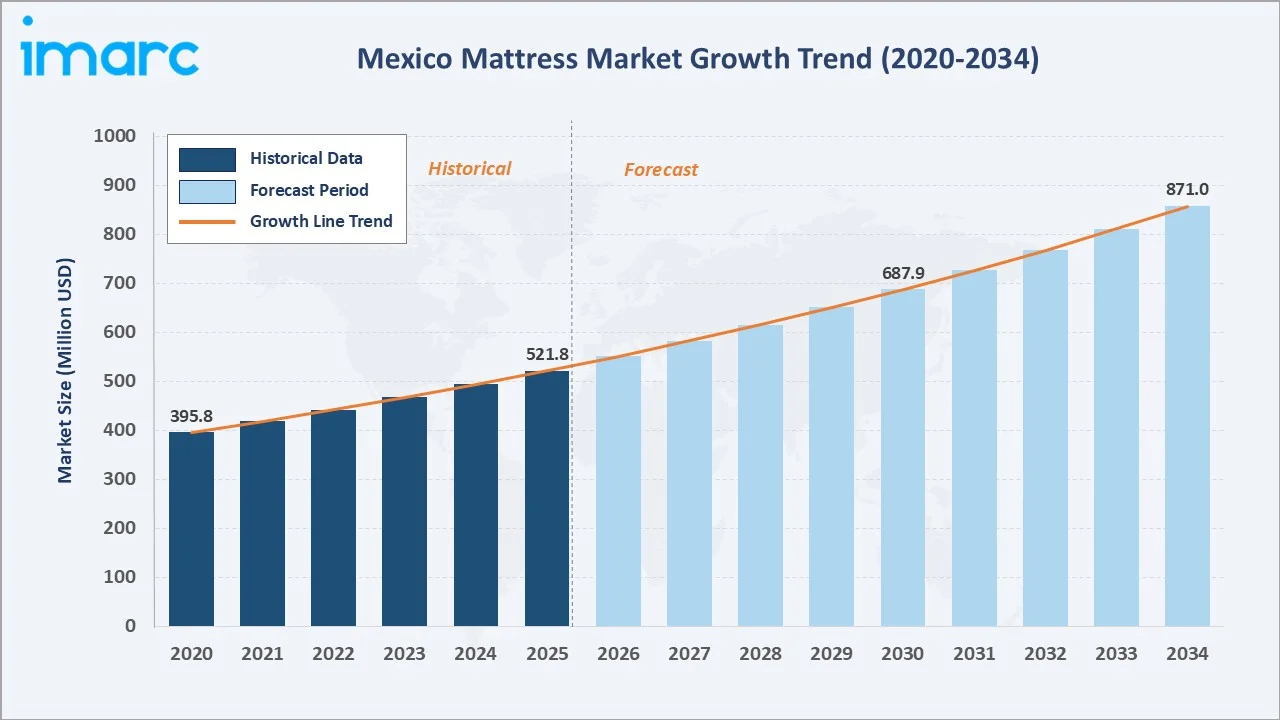
The Mexico mattress market grew from USD 521.8 Million in 2025 to USD 559.8 Million in 2026 and is projected to reach USD 871.0 Million by 2034, growing at a CAGR of 5.68% during 2026-2034. The market is driven by rising urbanization, expanding residential construction, and increasing consumer spending on home comfort and sleep wellness. By 2050, nearly 88% of Mexico’s population is projected to reside in urban areas, reflecting the country’s continued shift toward city-based living. As urban households upgrade bedrooms and prioritize comfort, demand for replacement, premium, and space-efficient mattresses is expected to rise. Innerspring mattresses lead the product at 46.8%. Offline distribution leads at 78.6%. Central Mexico leads regionally at 39.3%.
Market Snapshot
|
Metric |
Value |
|
Base Year Market Size (2025) |
USD 521.8 Million |
| Market Size (2026) | USD 559.8 Million |
|
Forecast Market Size (2034) |
USD 871.0 Million |
|
CAGR (2026-2034) |
5.68% |
|
Base Year |
2025 |
|
Historical Period |
2020-2025 |
|
Forecast Period |
2026-2034 |
|
Dominant Product |
Innerspring Mattresses (46.8%, 2025) |
|
Dominant Distribution Channel |
Offline Distribution (78.6%, 2025) |
|
Leading Region |
Central Mexico (39.3%, 2025) |
The Mexico mattress market expanded from USD 395.8 Million in 2020 to USD 521.8 Million in 2025 and an estimated USD 559.8 Million in 2026, supported by rising residential demand, replacement purchases, and improving consumer spending on home comfort. The market is expected to reach USD 687.9 Million by 2030 and further expand to USD 871.0 Million by 2034. Growth will be driven by urban housing development, hospitality expansion, e-commerce mattress sales, and increasing preference for premium and ergonomic sleep products.
To get more information on this market, Request Sample
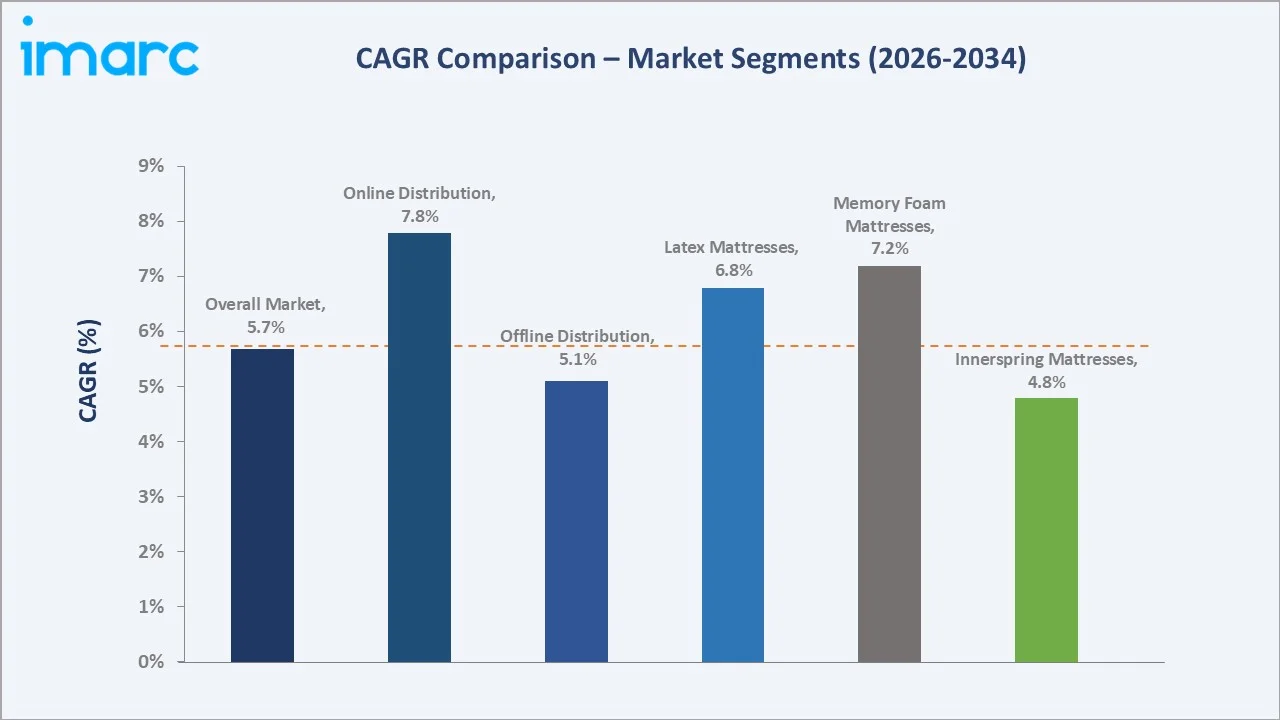
Memory foam mattresses grow fastest at ~7.2% CAGR through health-sleep awareness and online DTC. Online distribution grows at ~7.8% CAGR through Amazon Mexico. Latex mattresses grow at ~6.8% CAGR through organic certification and a premium hotel.
Executive Summary
The Mexico mattress market is growing steadily, supported by urbanization, housing development, and rising spending on home comfort. Demand is increasing for premium, ergonomic, and space-efficient mattresses as consumers focus more on sleep quality and wellness. E-commerce and omnichannel retail are improving product access and supporting replacement purchases. Hospitality expansion and furnished rental housing are also strengthening institutional demand. The market is expected to reach USD 871.0 Million by 2034, reflecting sustained long-term growth. Innerspring mattresses at 46.8% lead through value and mid-range mass market. Offline distribution at 78.6% leads through furniture stores. Central Mexico leads regionally at 39.3%.
Key Market Insights
|
Insight |
Data |
|
Dominant Product |
Innerspring Mattresses - 46.8% share (2025) |
|
Dominant Distribution Channel |
Offline Distribution - 78.6% market share (2025) |
|
Leading Region |
Central Mexico - 39.3% share (2025) |
|
Market Opportunity |
Memory foam hotel hospitality tourism; DTC online mattress; hybrid mattress premium; new housing replacement; IoT smart sleep mattress emerging |
Key Analytical Observations Supporting The Above Data:
- Innerspring Mattresses at 46.8%: Innerspring mattresses dominate due to their affordability, durability, wide availability, and strong consumer familiarity. Their suitability for mass-market households, hotels, and replacement demand further supports their leading position.
- Offline Distribution at 78.6%: Offline distribution dominates as consumers prefer testing comfort, firmness, and material quality before purchase. Strong retail presence through furniture stores, specialty mattress outlets, and department stores further supports offline sales.
- Central Mexico at 39.3%: Central Mexico dominates regionally due to its large urban population, higher household purchasing power, and strong concentration of retail stores, housing projects, and hospitality demand.
Mexico Mattress Market Overview
The Mexico mattress market encompasses innerspring, foam, latex, hybrid, orthopedic, and specialty mattresses used across residential, commercial, and hospitality sectors. It includes demand from new home purchases, replacement cycles, furnished apartments, hotels, hospitals, and rental housing. The market serves multiple price segments, from affordable mass-market products to premium sleep solutions focused on comfort, durability, and wellness. Distribution spans offline retail stores, furniture outlets, specialty mattress stores, department stores, and online platforms. Growth is supported by urbanization, rising disposable income, e-commerce expansion, and increasing consumer awareness of sleep quality. Macroeconomic factors include rising urbanization, expanding residential construction, and improving household spending on home comfort and furniture.
Market Dynamics
To evaluate market opportunities, Request Sample
Market Drivers
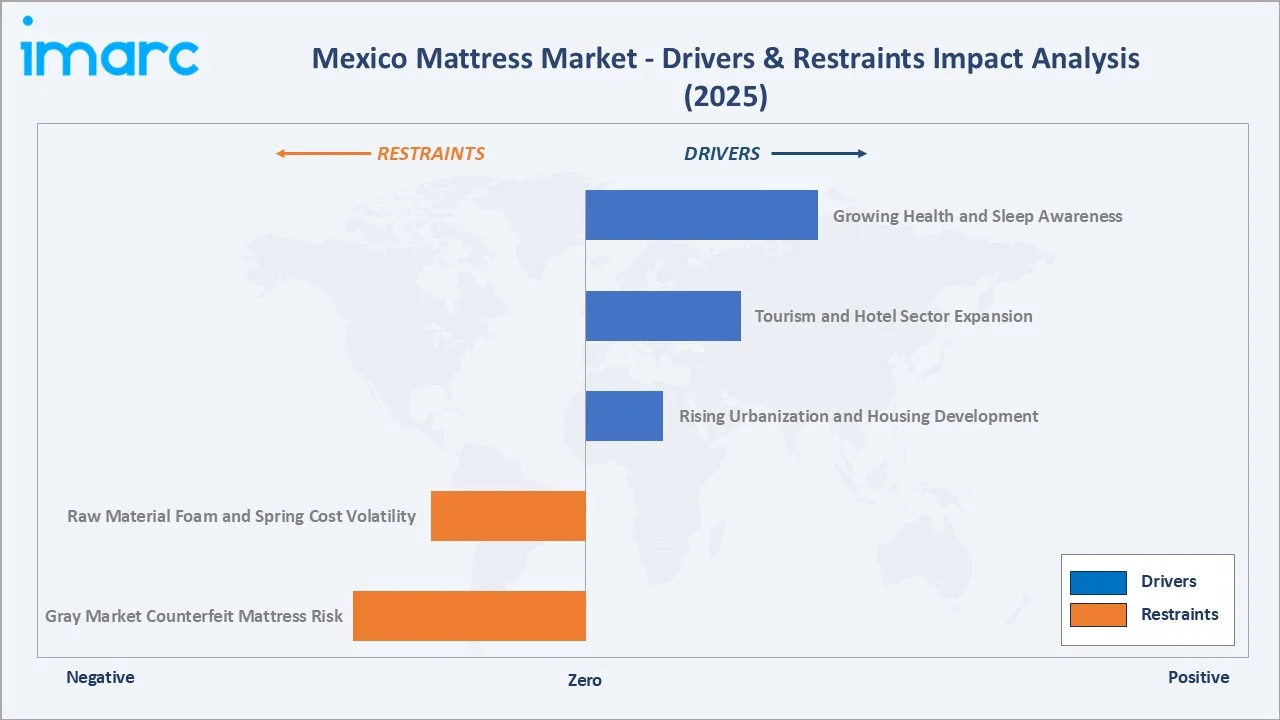
- Growing Health and Sleep Awareness: Growing health and sleep awareness is a major driver as consumers increasingly recognize the connection between quality sleep and overall physical and mental well-being. This has boosted demand for orthopedic, memory foam, hybrid, and ergonomic mattresses that provide improved comfort and spinal support. Rising awareness through healthcare professionals, digital media, and wellness campaigns is encouraging consumers to replace old mattresses more frequently. As a result, manufacturers are expanding premium product portfolios with sleep-enhancing features, supporting sustained market growth.
- Tourism and Hotel Sector Expansion: Tourism and hotel sector expansion is increasing demand for durable, comfortable, and frequently replaced mattresses across hotels, resorts, serviced apartments, and vacation rentals. Mexico recorded a 2.5% year-on-year increase in international air arrivals in February 2026, compared with February 2025. As tourist arrivals and hospitality investments rise, accommodation providers are upgrading bedding quality to improve guest experience and brand ratings. Premium and orthopedic mattresses are gaining traction in upscale hotels focused on wellness and comfort. This creates steady institutional demand alongside residential mattress sales.
- Rising Urbanization and Housing Development: Rising urbanization and housing development are increasing demand for new apartments, houses, rental units, and furnished residential spaces. By 2050, around 88% of Mexico’s population is expected to live in urban areas. As more people move to cities, household formation and bedroom furniture purchases continue to rise. Urban consumers also show a stronger preference for premium, space-efficient, and comfort-focused mattresses. Expanding real estate projects and home renovation activity further support replacement and first-time mattress purchases.
Market Restraints
- Raw Material Foam and Spring Cost Volatility: Raw material foam and spring cost volatility is increasing production costs for polyurethane foam, latex, steel coils, adhesives, and fabric components. Price fluctuations make it difficult for manufacturers to maintain stable margins, especially in the value and mid-range mattress segments. Rising input costs can lead to higher retail prices, reducing affordability for price-sensitive consumers. This also pressures smaller manufacturers and retailers that have limited ability to absorb cost increases or negotiate bulk procurement.
- Gray Market Counterfeit Mattress Risk: Gray market and counterfeit mattress risk increases the availability of low-cost, unbranded, or imitation products that compete with organized manufacturers. These products often lack quality assurance, durability, warranty support, and safety compliance, which can weaken consumer trust. Counterfeit and informal sales also pressure prices, making it harder for legitimate brands to maintain margins. This challenge is especially significant in price-sensitive segments where consumers may prioritize affordability over certified quality.
Market Opportunities
- Smart and Connected Mattresses: Smart and connected mattresses present a significant opportunity as consumers increasingly prioritize personalized sleep experiences and health monitoring. Mattresses equipped with sleep tracking, pressure sensing, temperature regulation, and app connectivity appeal to tech-savvy and higher-income households. Growing adoption of smart home devices and digital wellness solutions is encouraging manufacturers to introduce connected bedding products. As awareness of sleep health increases, demand for intelligent, value-added mattresses is expected to create new premium market opportunities.
- Rising Demand for Orthopedic and Premium Mattresses: Rising demand for orthopedic and premium mattresses creates a strong opportunity as consumers increasingly seek products that improve posture, spinal support, and sleep comfort. Growing health awareness, higher disposable incomes, and urban lifestyle changes are encouraging buyers to shift from basic mattresses to memory foam, hybrid, latex, and orthopedic models. Hotels and healthcare facilities are also adopting premium mattresses to enhance comfort and service quality. This trend allows manufacturers to expand higher-margin product lines and strengthen brand differentiation.
Market Challenges
- Environmental Concerns Related to Mattress Disposal and Recycling: Environmental concerns related to mattress disposal and recycling are challenging as used mattresses are bulky, difficult to transport, and often contain mixed materials such as foam, fabric, metal springs, and adhesives. Limited recycling infrastructure increases landfill pressure and raises concerns over waste management. Manufacturers may face growing pressure to adopt recyclable materials, take-back programs, and sustainable production practices. These requirements can increase operational costs, especially for smaller players, while also forcing brands to redesign products for circularity.
- Price-Sensitive Consumer Base Limiting Premium Product Adoption: A price-sensitive consumer base is limiting premium product adoption, as many households prioritize affordability over advanced comfort features. Higher-priced orthopedic, hybrid, latex, and smart mattresses may face slower adoption outside upper-income urban consumers. This limits manufacturers’ ability to scale premium product lines across mass-market segments. As a result, brands must balance innovation with competitive pricing, financing options, and value-focused product positioning.
Emerging Market Trends
1. Memory Foam Premium and Gel-Infused Premiumization
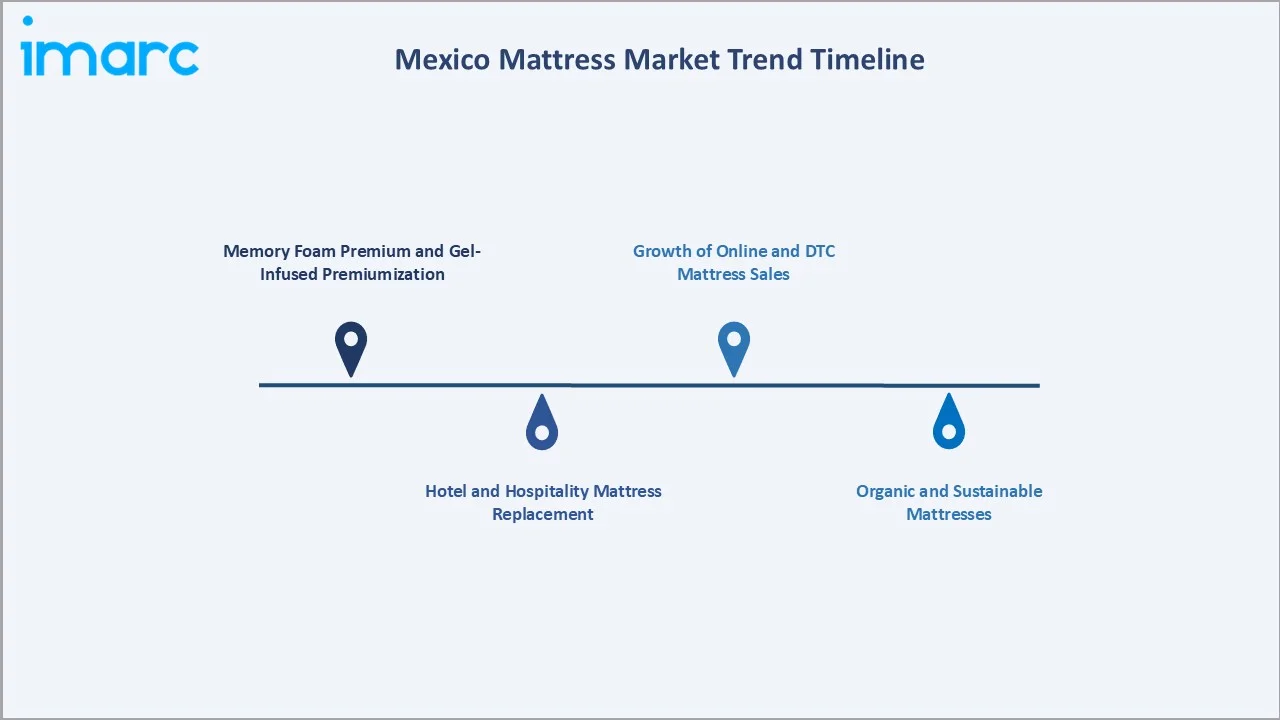
Memory foam premium and gel-infused premiumization are emerging as consumers seek improved comfort, pressure relief, and temperature regulation. Memory foam mattresses appeal to urban buyers looking for better body support and personalized sleep comfort. Gel-infused variants add cooling benefits, making them attractive in Mexico’s warmer regions and among consumers sensitive to heat retention. This trend is helping brands differentiate through premium features, higher margins, and wellness-focused positioning.
2. Hotel and Hospitality Mattress Replacement
Hotel and hospitality mattress replacement is emerging as hotels, resorts, serviced apartments, and vacation rentals upgrade bedding to improve guest comfort and satisfaction. According to SiteMinder’s Hotel Booking Trends report, which reviewed over 130 million global reservations, domestic travelers made up 55.64% of hotel check-ins in Mexico in 2025, up from 53.52% in 2024. Rising tourism and higher occupancy rates are encouraging hospitality operators to replace mattresses more frequently. This trend creates steady institutional demand beyond household purchases and supports higher-value sales for mattress manufacturers.
3. Organic and Sustainable Mattresses
Organic and sustainable mattresses are emerging as consumers become more conscious of health, indoor air quality, and environmental impact. Demand is rising for mattresses made with natural latex, organic cotton, bamboo fabrics, recycled fibers, and low-VOC materials. Brands are using eco-friendly certifications, recyclable packaging, and sustainable sourcing to differentiate premium products. This trend also supports circular economy initiatives as manufacturers explore mattress recycling, take-back programs, and greener production practices.
4. Growth of Online and DTC Mattress Sales
Growth of online and DTC mattress sales is emerging as consumers increasingly prefer the convenience of researching, comparing, and purchasing mattresses through digital platforms. Direct-to-consumer (DTC) brands are expanding by offering competitive pricing, trial periods, home delivery, and hassle-free returns, reducing reliance on traditional retail channels. The rapid growth of e-commerce, digital payments, and smartphone usage is further accelerating online mattress purchases. This trend is enabling manufacturers to reach a broader customer base while improving margins through direct customer engagement and data-driven marketing.
Industry Value Chain Analysis
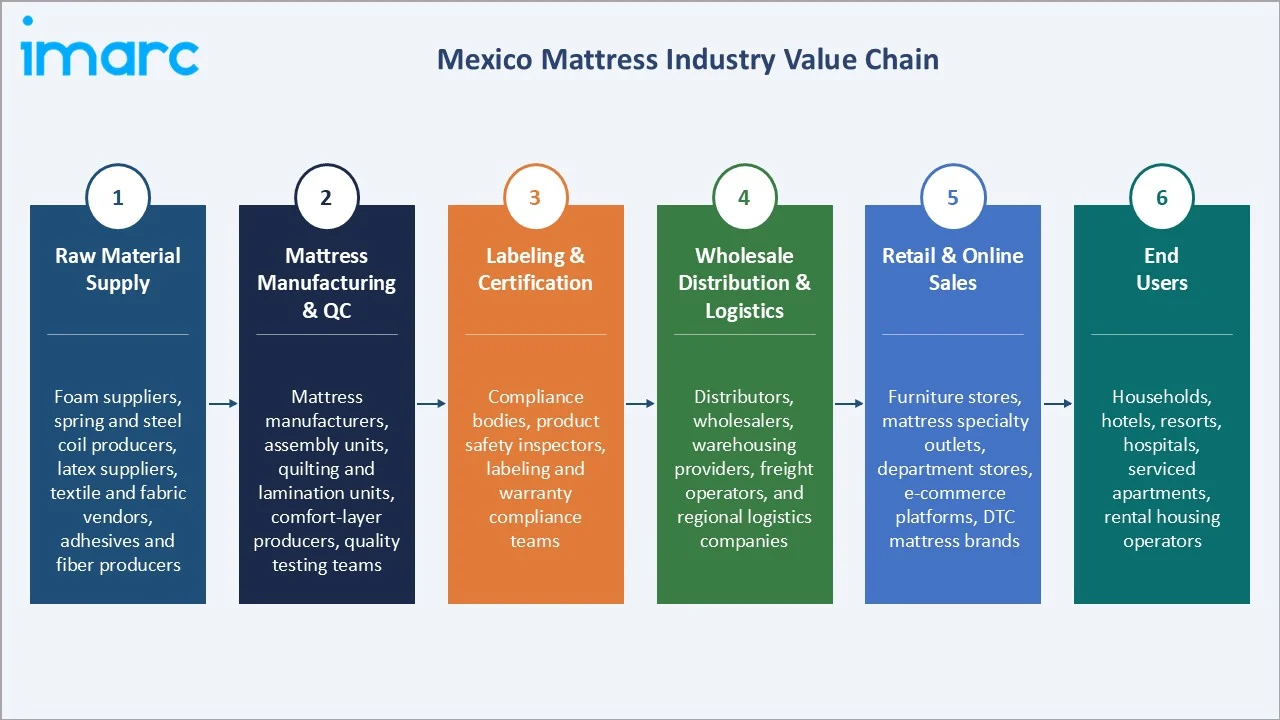
Mexico mattress value chain integrates raw material supply, mattress manufacturing & QC, labeling & certification, wholesale distribution & logistics, retail & online sales, and end users.
|
Stage |
Key Participants |
|
Raw Material Supply |
Foam suppliers, spring and steel coil producers, latex suppliers, textile and fabric vendors, adhesives and fiber producers |
|
Mattress Manufacturing & QC |
Mattress manufacturers, assembly units, quilting and lamination units, comfort-layer producers, quality testing teams |
|
Labeling & Certification |
Compliance bodies, product safety inspectors, labeling and warranty compliance teams |
|
Wholesale Distribution & Logistics |
Distributors, wholesalers, warehousing providers, freight operators, and regional logistics companies |
|
Retail & Online Sales |
Furniture stores, mattress specialty outlets, department stores, e-commerce platforms, DTC mattress brands |
|
End Users |
Households, hotels, resorts, hospitals, serviced apartments, rental housing operators |
Mattress manufacturing is the most value-added stage in the Mexico mattress value chain. This stage determines product quality, comfort, durability, and differentiation through innovations such as memory foam, hybrid construction, orthopedic support, cooling technologies, and sustainable materials. It is also where the highest value is created through branding, quality assurance, and premium feature integration, enabling manufacturers to command higher margins and strengthen market competitiveness.
Technology Landscape in the Mexico Mattress Industry
Foam and Comfort Layer Technology
Foam and comfort layer technology enables manufacturers to enhance pressure relief, spinal alignment, and overall sleep comfort. Advanced materials such as high-resilience foam, memory foam, gel-infused foam, and multi-layer cushioning improve durability while regulating temperature and minimizing motion transfer. These innovations allow brands to differentiate premium product offerings and cater to consumers seeking personalized sleep solutions. Continuous improvements in foam formulations and manufacturing processes are also supporting longer product life and higher customer satisfaction.
Coil and Support Technology
Coil and support technology improves firmness, durability, weight distribution, and spinal support. Innovations such as pocketed coils, zoned support systems, reinforced edges, and hybrid coil-foam designs help reduce motion transfer and enhance sleeping comfort. These technologies are especially important in premium, orthopedic, and hotel-grade mattresses where long-term performance is critical. As consumers seek better posture support and durability, advanced coil systems are becoming a key product differentiation tool.
Smart Mattress and Sleep-Tracking Technology
Smart mattress and sleep-tracking technology integrates sensors, mobile apps, and connected features into bedding products. These mattresses can monitor sleep duration, movement, heart rate, temperature, and pressure points, helping consumers personalize their sleep experience. Growing interest in wellness, smart homes, and digital health is supporting adoption among premium urban buyers. For manufacturers, this technology creates opportunities for product differentiation, recurring app-based engagement, and higher-margin mattress offerings.
Market Segmentation Analysis
The report covers the following segments:
|
Segment Category |
Leading Segment |
Market Share |
Year |
|
Product |
Innerspring Mattresses |
46.8% |
2025 |
|
Distribution Channel |
Offline Distribution |
78.6% |
2025 |
|
Size |
🔒 |
🔒 |
2025 |
|
Application |
🔒 |
🔒 |
2025 |
|
Region |
Central Mexico |
39.3% |
2025 |

By Product
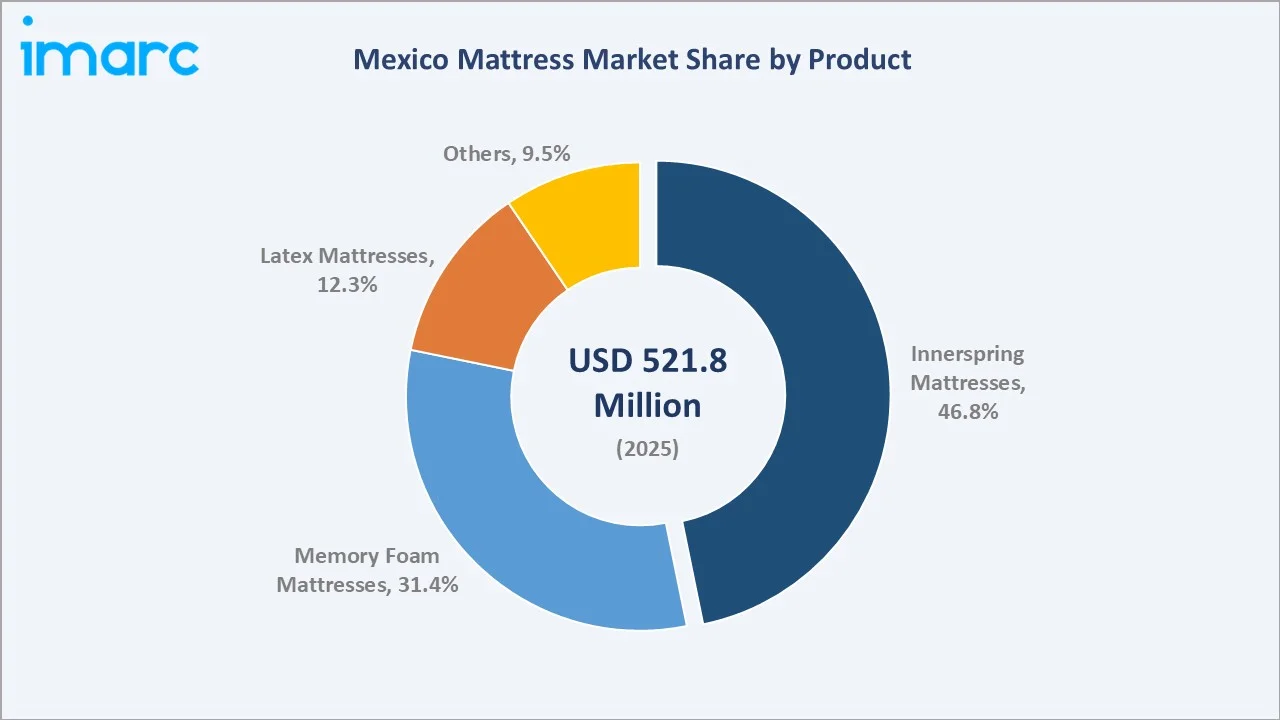
Innerspring mattresses lead at 46.8% (2025) due to their affordability, durability, and strong consumer familiarity. Their wide availability across offline retail channels and suitability for both household and hotel use support steady mass-market demand.
To access detailed market analysis, Request Sample
Memory foam mattresses at 31.4% grow fastest at ~7.2% CAGR through premium viscoelastic, gel-infused cooling memory foam, DTC online brands, and hotel hospitality upgrades. Latex mattresses at 12.3% grow at ~6.8% CAGR through natural latex, premium hotel, and organic consumer growth. Others at 9.5% include hybrid mattresses, waterbeds, and air adjustable mattresses.
By Distribution Channel
Offline distribution leads at 78.6% (2025), through department stores, general merchandise retailers, home improvement, furniture stores, and door-to-door salesforce.
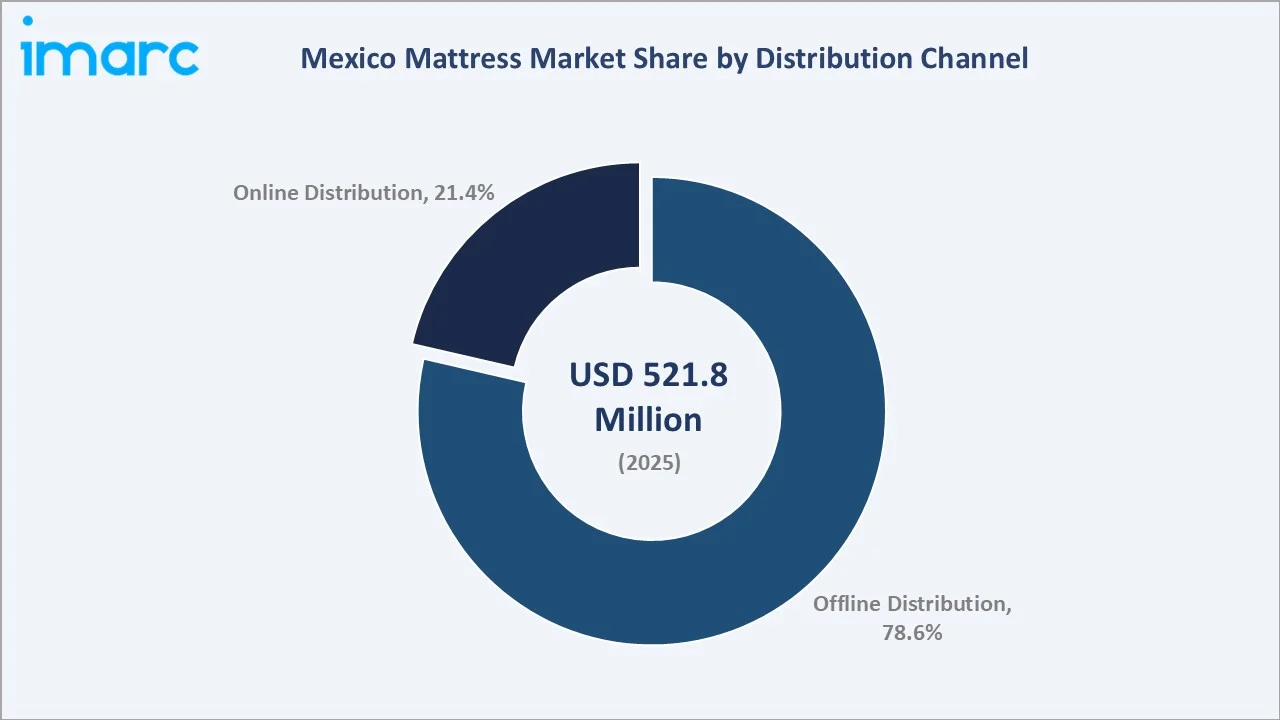
Online distribution at 21.4% grows fastest at ~7.8% CAGR through Amazon Mexico, brand DTC websites, and Hot Sale seasonal events.
Regional Market Insights
|
Region |
Share (2025) |
Key Mexico Mattress Market Drivers & Characteristics |
|
Central Mexico |
39.3% |
Supported by its large urban population, high household formation, dense retail network, expanding residential construction, and strong concentration of hotels and hospitality establishments. |
|
Northern Mexico |
32.8% |
Driven by higher disposable incomes, cross-border trade, industrial employment, and robust demand for premium and branded mattresses across major metropolitan areas. |
|
Southern Mexico |
18.1% |
Supported by growing tourism, improving housing development, expanding retail penetration, and rising consumer awareness of sleep health and comfort products. |
|
Others |
9.8% |
Other regions, including the Bajío region, Yucatán Peninsula, Gulf Coast, and Pacific Coast, contribute through ongoing urbanization, infrastructure development, tourism investments, and the expansion of organized retail and e-commerce channels. |
Central Mexico's 39.3% dominance is supported by high urbanization, strong housing activity, dense retail networks, and higher demand from Mexico City and surrounding metropolitan areas. Northern Mexico's 32.8% is due to higher incomes, industrial employment, cross-border trade, and a strong preference for branded and premium mattresses.
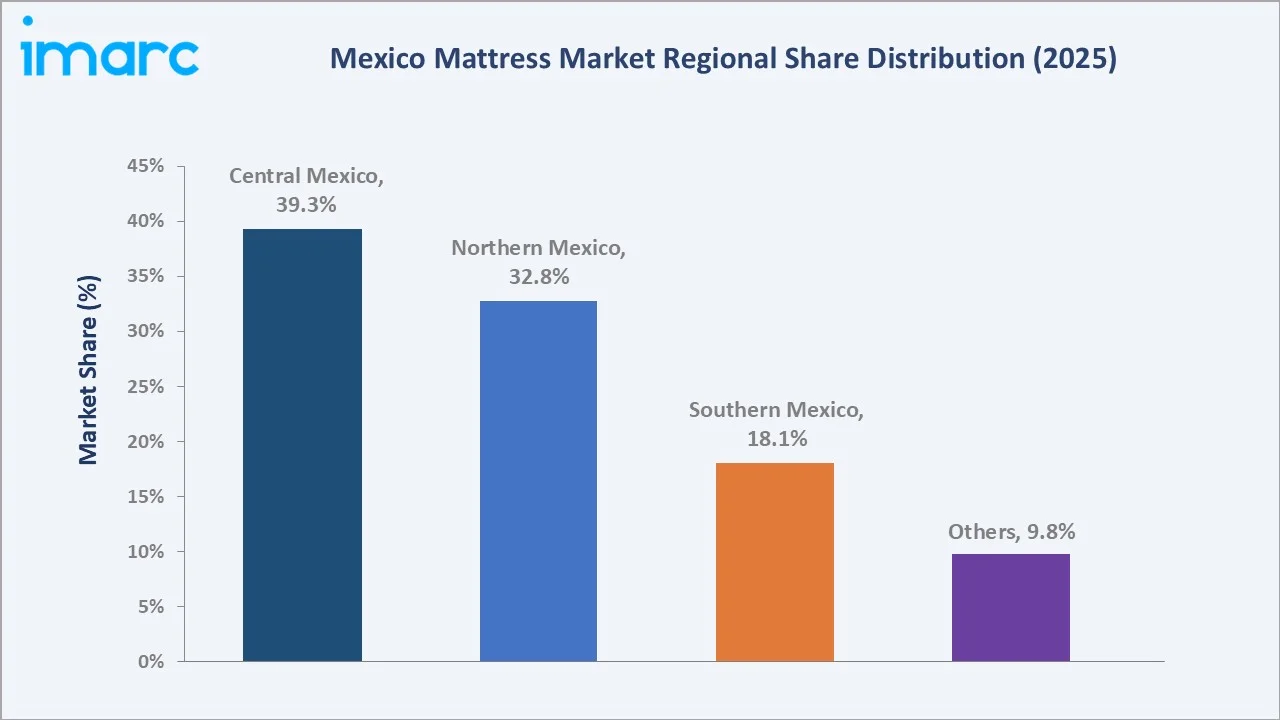
Southern Mexico's 18.1% is gaining traction through tourism-led hotel development, residential expansion, and improved retail access. Others at 9.8%, including the Bajío, Yucatán Peninsula, Gulf Coast, and Pacific Coast, contribute through urban growth, hospitality investments, and e-commerce penetration.
Competitive Landscape
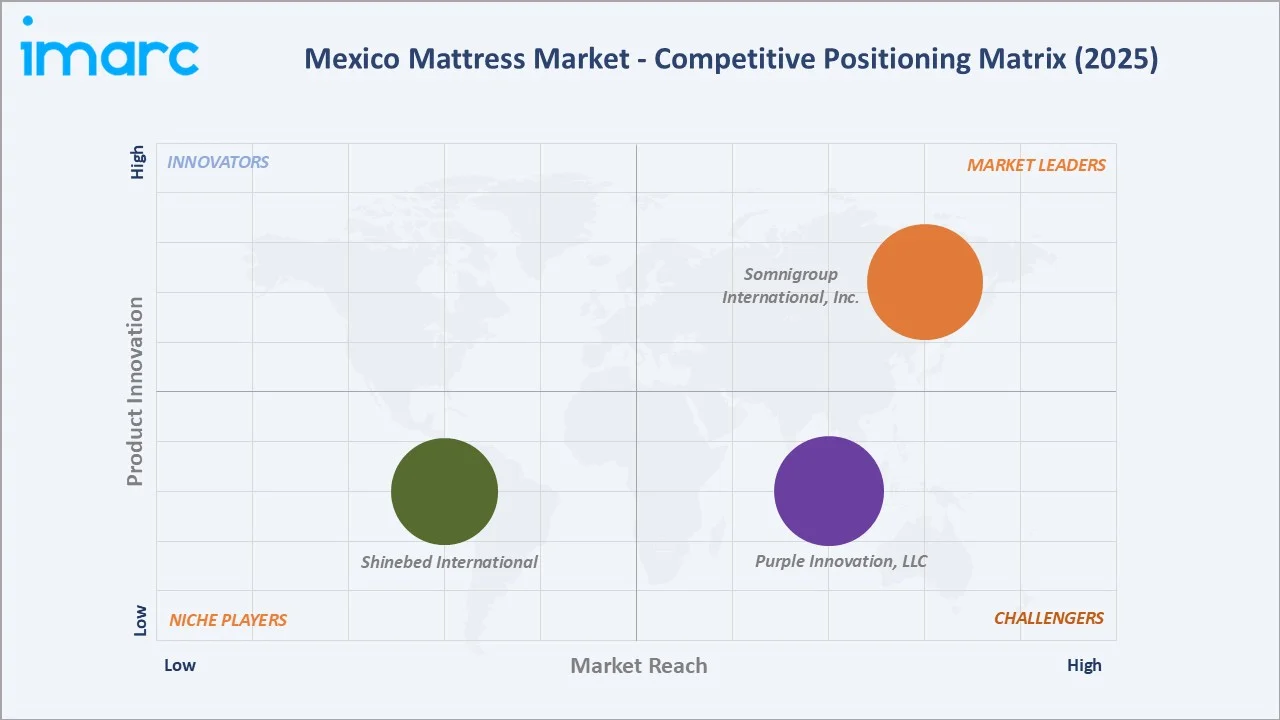
The Mexico mattress market is moderately competitive, with domestic manufacturers, international bedding brands, furniture retailers, and online mattress companies competing across price and comfort segments. Key players focus on product differentiation through innerspring, memory foam, hybrid, orthopedic, and cooling mattress technologies. Offline retail remains important, but e-commerce and DTC brands are increasing competition through home delivery, trial periods, and promotional pricing.
|
Company |
Key Brands |
Market Position |
Core Strength |
|
Somnigroup International, Inc. |
Tempur-Pedic, Sealy, Stearns & Foster |
Market Leader |
Somnigroup International, Inc. plays a dominant role in the Mexico mattress market, acting as a top-tier manufacturer and brand owner. Operating locally through subsidiaries like Tempur Sealy Mexico, the company drives industry trends by elevating consumer demand for premium, high-performance, and specialized mattresses. |
|
Purple Innovation, LLC |
Purple |
Strong Challenger |
Purple Innovation, LLC acts as an influential premium disruptor in the Mexican mattress market, driving competitors to innovate. Known for its proprietary Hyper-Elastic Polymer GelFlex Grid, the mattresses are highly sought after for their advanced cooling and pressure-relief technologies, specifically in the country's growing luxury and sleep-tech segments. |
|
Shinebed International |
Bedsure |
Niche Player |
Shinebed International, known for its brand, Bedsure, operates as a key global supplier and e-commerce innovator rather than a localized mattress manufacturer in Mexico. Their primary role in the Mexican and broader Latin American markets revolves around supplying mattress components, bedding accessories, and sleep solutions. |
Premiumization is rising in urban centers, while affordability remains critical for mass-market consumers. Companies are also strengthening hospitality supply, sustainable materials, and omnichannel distribution to capture long-term growth.
Key Company Profiles
Somnigroup International, Inc.
Somnigroup International, Inc. is a leading bedding products company and the parent organization of well-known mattress brands such as Tempur-Pedic, Sealy, and Stearns & Foster. The company develops and markets a broad portfolio of innerspring, memory foam, hybrid, and premium mattresses for residential and hospitality customers. In the Mexico mattress market, the company competes through premium sleep solutions, established brand recognition, and partnerships with furniture retailers, specialty mattress stores, and e-commerce channels.
- Key Brands: Tempur-Pedic, Sealy, Stearns & Foster.
- Strategic Focus: Strengthening its premium and branded mattress positioning in Mexico through Tempur-Pedic, Sealy, and Stearns & Foster offerings. The company emphasizes comfort innovation, memory foam, hybrid construction, ergonomic support, and cooling technologies to target urban and higher-income consumers.
Purple Innovation, LLC
Purple Innovation, LLC is a comfort technology company known for its proprietary GelFlex Grid mattress technology, which supports pressure relief, airflow, and adaptive comfort. In the Mexico mattress market, Purple competes mainly in the premium and online-focused bedding segment, appealing to consumers seeking innovative sleep solutions beyond traditional foam and innerspring products. The company’s portfolio includes mattresses, pillows, bases, and bedding accessories designed around cooling, support, and motion isolation.
- Key Brands: Purple.
- Strategic Focus: Focuses on differentiating itself in the Mexico mattress market through premium comfort technology, especially its GelFlex Grid design that supports airflow, pressure relief, and adaptive support. Its strategy emphasizes online and DTC sales, targeting urban consumers seeking innovative, cooling, and wellness-oriented mattresses.
Market Concentration Analysis
The Mexico mattress market shows moderate concentration, with a mix of global bedding brands, domestic manufacturers, regional producers, and private-label retailers. Large players compete through premium positioning, product innovation, and broad retail networks. However, the market also includes many local and informal manufacturers serving price-sensitive consumers with affordable innerspring and foam products. Offline retail remains fragmented, while online and DTC channels are increasing brand competition. Overall, concentration is higher in premium and branded segments, but the mass-market segment remains highly fragmented.
Investment & Growth Opportunities
Highest Growth Segments
Online DTC (~7.8% CAGR), memory foam (~7.2% CAGR through health awareness and hotel), latex (~6.8% CAGR through organic certification), Southern Mexico (~6.5% CAGR), hybrid mattress premium (~7% CAGR), and smart IoT mattress (~10% CAGR from emerging base) represent Mexico mattress highest-growth investment vectors through 2034.
Investment Themes
- Online DTC channel: Investment in direct-to-consumer (DTC) platforms enables mattress brands to reduce distribution costs, improve customer engagement, and drive sales through home delivery, sleep trials, and digital marketing.
- Hotel hospitality mattress replacement: Expanding hotel construction, tourism growth, and regular mattress replacement cycles create opportunities for manufacturers to supply durable, premium bedding solutions to the hospitality sector.
- Memory foam premium health upgrade: Rising consumer focus on sleep quality and spinal health is increasing demand for premium memory foam mattresses, encouraging investment in advanced comfort technologies and higher-margin product portfolios.
Future Market Outlook (2026-2034)
Mexico mattress market is projected to grow from USD 521.8 Million in 2025 to USD 559.8 Million in 2026 and is forecast to reach USD 871.0 Million by 2034, delivering a 5.68% CAGR over the forecast period through housing structural demand, memory foam health premiumization, hotel tourism expansion, online DTC disruption, and emerging smart IoT mattresses. The market's anchor value of USD 687.9 Million in 2030 represents Mexico mattress market at the memory foam mainstream and online inflection.
Three structural forces define Mexico mattress market growth through 2034. First, rapid urbanization, residential construction, and household formation are expanding demand for new mattresses across major metropolitan areas. Second, rising health awareness and increasing consumer focus on sleep quality are accelerating the shift toward orthopedic, memory foam, hybrid, and premium comfort mattresses. Third, the continued expansion of tourism, hospitality, e-commerce, and direct-to-consumer (DTC) sales channels is strengthening replacement demand while improving product accessibility across both urban and semi-urban markets.
Research Methodology
Primary Research
Primary research comprised interviews and discussions with mattress manufacturers, foam and spring suppliers, distributors, retailers, and hospitality procurement managers. It also included inputs from furniture stores, online mattress sellers, and industry experts to understand pricing, replacement cycles, product preferences, and regional demand. Consumer insights were gathered around sleep comfort, orthopedic needs, brand preference, and online purchase behavior.
Secondary Research
Secondary research encompassed company websites, annual reports, product catalogs, trade publications, government housing and tourism data, and industry databases. It also included a review of retail pricing, e-commerce listings, import-export trends, and mattress technology developments. Published reports on urbanization, hospitality growth, consumer spending, and sleep wellness were analyzed to assess demand patterns.
Forecasting Models
Forecasting models combined historical market performance with macroeconomic indicators such as urbanization, residential construction, disposable income, tourism growth, and consumer spending on home furnishings. Demand-side analysis incorporated mattress replacement cycles, hospitality procurement, and e-commerce penetration, while supply-side trends included manufacturing capacity and product innovation. Market estimates were validated using bottom-up and top-down approaches, supported by primary industry inputs. Scenario and sensitivity analyses were applied to account for raw material price fluctuations, changing consumer preferences, and economic conditions through 2034.
Mexico Mattress Market Report Coverage:
| Report Features | Details |
|---|---|
| Base Year of the Analysis | 2025 |
| Historical Period | 2020-2025 |
| Forecast Period | 2026-2034 |
| Units | Million USD |
| Scope of the Report |
Exploration of Historical Trends and Market Outlook, Industry Catalysts and Challenges, Segment-Wise Historical and Future Market Assessment:
|
| Products Covered | Innerspring Mattresses, Memory Foam Mattresses, Latex Mattresses, Others |
| Distribution Channels Covered | Online Distribution, Offline Distribution |
| Sizes Covered | Twin or Single Size, Twin or XL Size, Full or Double Size, Queen Size, King Size Mattress, Others |
| Applications Covered | Domestic, Commercial |
| Regions Covered | Northern Mexico, Central Mexico, Southern Mexico and Others. |
| Companies Covered | Somnigroup International Inc., Purple Innovation LLC, Shinebed International, etc. |
| Customization Scope | 10% Free Customization |
| Post-Sale Analyst Support | 10-12 Weeks |
| Delivery Format | PDF and Excel through Email (We can also provide the editable version of the report in PPT/Word format on special request) |
Key Benefits for Stakeholders:
- IMARC’s industry report offers a comprehensive quantitative analysis of various market segments, historical and current market trends, market forecasts, and dynamics of the Mexico mattress market from 2020-2034.
- The research report provides the latest information on the market drivers, challenges, and opportunities in the Mexico mattress market.
- Porter's five forces analysis assist stakeholders in assessing the impact of new entrants, competitive rivalry, supplier power, buyer power, and the threat of substitution. It helps stakeholders to analyze the level of competition within the Mexico mattress industry and its attractiveness.
- Competitive landscape allows stakeholders to understand their competitive environment and provides an insight into the current positions of key players in the market.
Frequently Asked Questions About the Mexico Mattress Market Report
The Mexico mattress market size is estimated at USD 559.8 Million in 2026, driven by rising urbanization, housing development, and growing consumer awareness of sleep health and comfort. Expanding tourism, hotel replacement demand, e-commerce growth, and increasing preference for orthopedic, memory foam, and premium mattresses further support market expansion.
The Mexico mattress market grows at 5.68% CAGR during 2026-2034, reaching USD 871.0 Million by 2034. The CAGR reflects sleep health premium, hotel tourism, online DTC disruption, and the growth of hybrid mattresses.
Innerspring mattresses lead at 46.8% due to their affordability, durability, and strong familiarity among consumers. Their wide availability through offline retail stores and suitability for both residential and hotel use support steady mass-market demand.
Offline distribution leads at 78.6% as consumers prefer to physically test mattress comfort, firmness, and size before making a purchase. Extensive networks of furniture stores, specialty mattress retailers, and department stores, along with in-store promotions and financing options, continue to make offline channels the preferred purchasing route.
Central Mexico leads at 39.3% due to its large urban population, strong housing development, and concentration of furniture and mattress retail networks. Demand is further supported by Mexico City and surrounding metropolitan areas, where household formation, premium bedding adoption, and hospitality activity remain strong.
Leading companies include Somnigroup International, Inc., Purple Innovation, LLC, and Shinebed International, among others.
The market is projected to reach approximately USD 687.9 Million by 2030, supported by urban housing growth, rising sleep health awareness, and expanding hospitality demand. Growth will also be driven by premium mattress adoption, replacement cycles, and wider offline and online retail availability.
Three priority investment opportunities in the Mexico mattress market include expanding online direct-to-consumer (DTC) sales, supported by rising e-commerce adoption and demand for convenient home delivery. Hospitality mattress replacement presents strong potential as hotel expansion and tourism growth increase institutional procurement of premium bedding products. Memory foam and orthopedic mattress premiumization offers attractive margins, driven by growing consumer awareness of sleep health, comfort, and wellness. Additionally, investments in sustainable materials and smart mattress technologies can help brands differentiate themselves in the evolving premium bedding segment.
Need more help?
- Speak to our experienced analysts for insights on the current market scenarios.
- Include additional segments and countries to customize the report as per your requirement.
- Gain an unparalleled competitive advantage in your domain by understanding how to utilize the report and positively impacting your operations and revenue.
- For further assistance, please connect with our analysts.
 Request Customization
 Speak to an Analyst
 Request Brochure
 Inquire Before Buying
Benefits of Customization
- Personalize this research
- Triangulate with your data
- Get data as per your format and definition
- Gain a deeper dive into a specific application, geography, customer, or competitor
- Any level of personalization
Get in Touch With Us
UNITED STATES
Phone: +1-201-971-6302
INDIA
Phone: +91-120-433-0800
UNITED KINGDOM
Phone: +44-753-714-6104
Email: [email protected]
Client Testimonials




.webp)




.webp)













Related Reports

Choose your plan
*Please note that the prices mentioned below are starting prices for each bundle type. Kindly contact our team for further details.*
Single User License
- 1 User License, Access on 2 Devices
- PDF Report + Excel Dataset (Password Protected)
- Lifetime Access
- No Printing Rights
- 10% Free Report Customization
- 10–12 Weeks of Analyst Support
Five User License
- Access for 5 Users, 2 Devices per User
- PDF Report + Excel Dataset (Password Protected)
- Lifetime Access
- Dedicated Account Manager
- 12–14 Weeks of Analyst Support
- No Printing Rights
- 15% Free Report Customization
- 25% Discount on Your Next Purchase
Corporate User License
- Unlimited User Access (Within Your Organization)
- PDF Report + Excel Dataset
- Lifetime Access
- Dedicated Account Manager
- 14–20 Weeks of Analyst Support
- No Printing Rights
- 20% Free Report Customization
- 30% Discount on Your Next Purchase
Essential Insights
What's included:
3 reports
- Lifetime Access
- PDF Reports
- Excel Datasets
- 2 Weeks of Free Analyst Support
- 2 User Licenses
- Access on 2 Devices
- Printing Rights
- Complimentary PowerPoint (PPT) Version
- Complimentary License Upgrade
Professional Access
What's included:
5 reports
- Lifetime Access
- PDF Reports
- Excel Datasets
- 8 Weeks of Free Analyst Support
- 2 User Licenses
- Access on 2 Devices
- Printing Rights
- Complimentary PowerPoint (PPT) Version
- Complimentary License Upgrade
Business Advantage
What's included:
8 reports
- Lifetime Access
- PDF Reports
- Excel Datasets
- 14 Weeks of Free Analyst Support
- 2 User Licenses
- Access on 2 Devices
- Printing Rights
- Complimentary PowerPoint (PPT) Version
- Complimentary License Upgrade
Enterprise Intelligence
What's included:
10 reports
- Lifetime Access
- PDF Reports
- Excel Datasets
- 20 Weeks of Free Analyst Support
- 2 User Licenses
- Access on 2 Devices
- Printing Rights
- Complimentary PowerPoint (PPT) Version
- Complimentary License Upgrade