
Mexico Paint Market Size, Share, Trends and Forecast by Technology, Type of Paint, Resin, End User, and Region, 2026-2034
Mexico Paint Market Size, Share, Trends & Forecast (2026-2034)
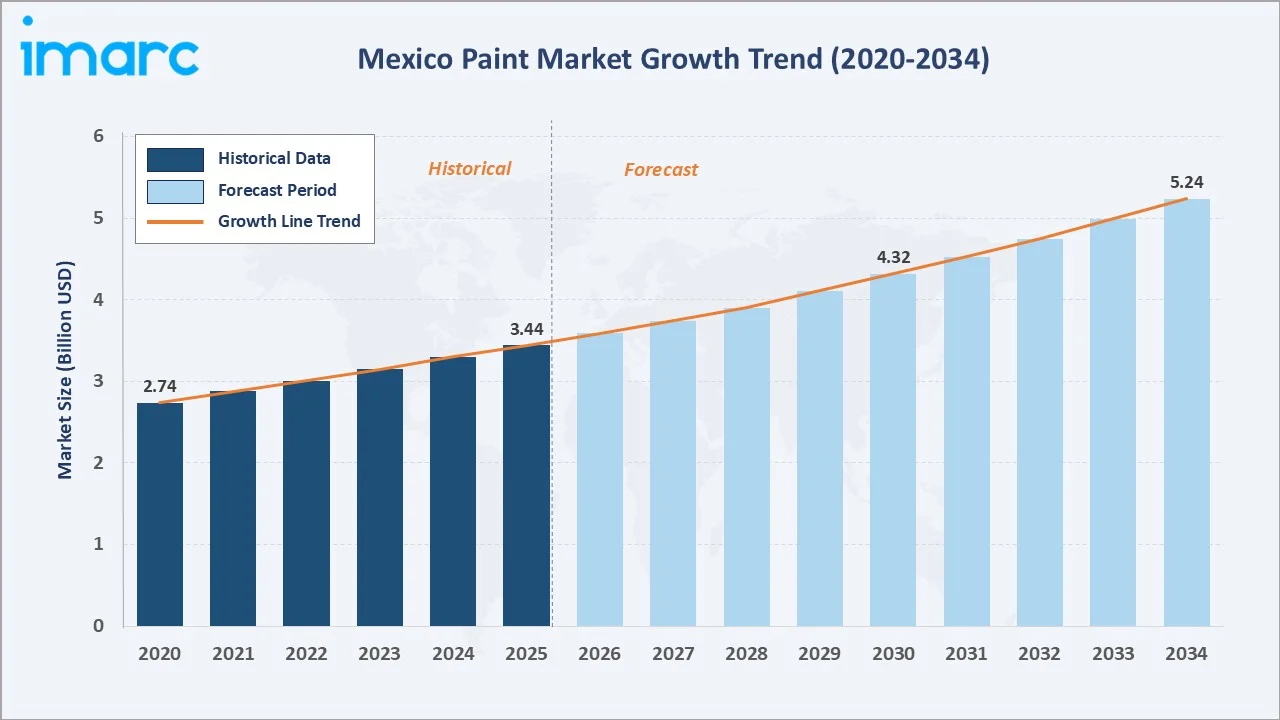
The Mexico paint market grew from USD 3.44 Billion in 2025 to USD 3.60 Billion in 2026 and is projected to reach USD 5.24 Billion by 2034, exhibiting a CAGR of 4.65% during 2026-2034. Mexico's ongoing construction boom, supported by federal infrastructure investment programs and the burgeoning real estate sector, forms the primary engine of paint demand.
Water-based commands a dominant 68.3% technology share, emulsion leads the type of paint segment at 41.8%, and Northern Mexico holds the largest regional share at 34.2%.
Market Snapshot
|
Metric |
Value |
|
Base Year Market Size (2025) |
USD 3.44 Billion |
| Market Size (2026) | USD 3.60 Billion |
|
Forecast Market Size (2034) |
USD 5.24 Billion |
|
CAGR (2026-2034) |
4.65% |
|
Base Year |
2025 |
|
Historical Period |
2020-2025 |
|
Forecast Period |
2026-2034 |
|
Largest Region |
Northern Mexico (34.2%, 2025) |
|
Second Largest Region |
Central Mexico (30.8%, 2025) |
|
Leading Technology |
Water-based (68.3%, 2025) |
|
Leading Type of Paint |
Emulsion (41.8%, 2025) |
The Mexico paint market expanded from USD 2.74 Billion in 2020 to USD 3.44 Billion in 2025 and an estimated USD 3.60 Billion in 2026, driven by urbanization, infrastructure modernization, and the expansion of the automotive supply chain. The market is anchored at USD 4.32 Billion in 2030, with the forecast to USD 5.24 Billion by 2034 supported by accelerating demand for eco-friendly formulations, the continued buildout of the Bajio industrial corridor, and growing adoption of premium decorative coatings across urban housing projects.
To get more information on this market, Request Sample
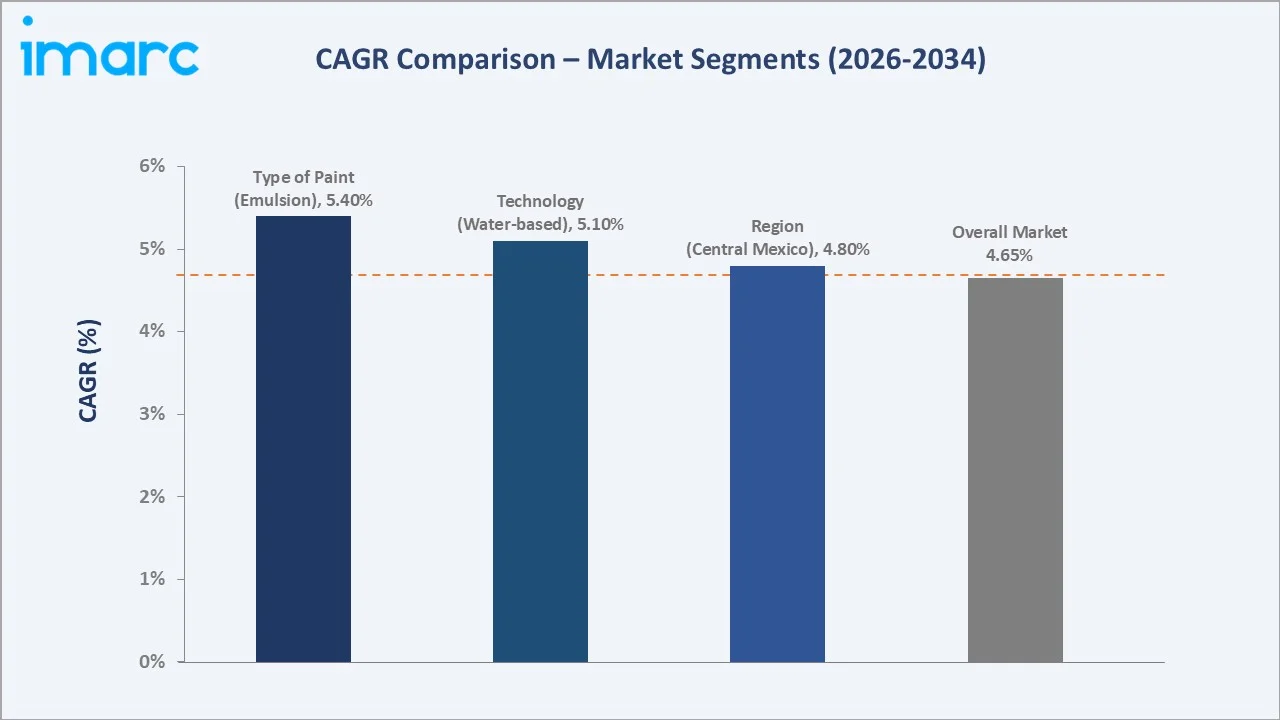
CAGR trajectories across technology and type of paint sub-segments show water-based and emulsion expanding faster than the overall 4.65% market CAGR, supported by tightening volatile organic compound (VOC) regulations, growing consumer preference for low-odor formulations, and active product innovation by leading manufacturers.
Executive Summary
The Mexico paint market is on a sustained growth trajectory from USD 2.74 Billion in 2020 to USD 3.60 Billion in 2026 and reaching USD 5.24 Billion by 2034. The market has progressed from volume-led, commodity-focused production to a more differentiated landscape centered on high-performance, low-VOC, and aesthetically specialized coatings. Rapid urbanization, the nearshoring-driven expansion of industrial activity, and a growing middle class investing in home improvement are redefining both demand patterns and competitive positioning across architectural and industrial paint categories.
On the basis of technology, water-based leads at 68.3% in 2025, underpinned by stricter environmental compliance requirements, growing retail availability of premium low-odor products, and active formulation innovation by both global multinationals and domestic players. Emulsion dominates the type of paint segment at 41.8%, reflecting broad residential and commercial applications. Northern Mexico commands 34.2% regional share, driven by maquiladora concentration, automotive supply chain density, and active construction along the United States-Mexico border corridor.
Key Market Insights
|
Insight |
Data |
|
Leading Technology |
Water-based - 68.3% share (2025) |
|
Second Largest Technology |
Solvent-based - 31.7% share (2025) |
|
Leading Type of Paint |
Emulsion - 41.8% share (2025) |
|
Second Largest Type of Paint |
Enamel - 25.6% share (2025) |
|
Leading Region |
Northern Mexico - 34.2% share (2025) |
|
Second Largest Region |
Central Mexico - 30.8% share (2025) |
|
Top Companies |
PPG Industries, Inc., The Sherwin-Williams Company, AkzoNobel N.V., Axalta Coating Systems Ltd. |
Key Analytical Observations Supporting the Above Data:
- Water-based at 68.3% is driven by tightening VOC emission regulations under Mexico's environmental standards, growing consumer preference for odorless interior coatings, and active formulation innovation by multinational producers expanding their eco-friendly product lines in the Mexican market.
- Solvent-based at 31.7% maintains relevance in industrial, marine, and heavy-duty protective coating applications where chemical resistance, durability, and adhesion on metal substrates continue to favor solvent-borne systems.
- Emulsion dominance at 41.8% reflects broad residential and light commercial applications. The segment benefits from strong demand for interior wall coatings, ease of application, low odor formulations, and increasing preference for durable, washable, and environmentally compliant paints.
- Enamel at 25.6% is sustained by demand from automotive refinishing, industrial machinery coating, and wood finishing applications, where hard, glossy surfaces with high chemical resistance are required.
- Northern Mexico at 34.2% leads regionally, anchored by industrial clusters in Monterrey, Chihuahua, and Tijuana, a dense maquiladora base requiring industrial maintenance coatings, and active residential construction driven by cross-border worker migration and urbanization.
Mexico Paint Market Overview
Paint is a protective and decorative coating applied to surfaces to enhance appearance, improve durability, and provide resistance against environmental, chemical, and physical damage. The Mexico paint market encompasses the manufacturing, distribution, and retail sale of architectural, industrial, and special-purpose coatings applied to surfaces including walls, floors, metals, wood, and automotive substrates.
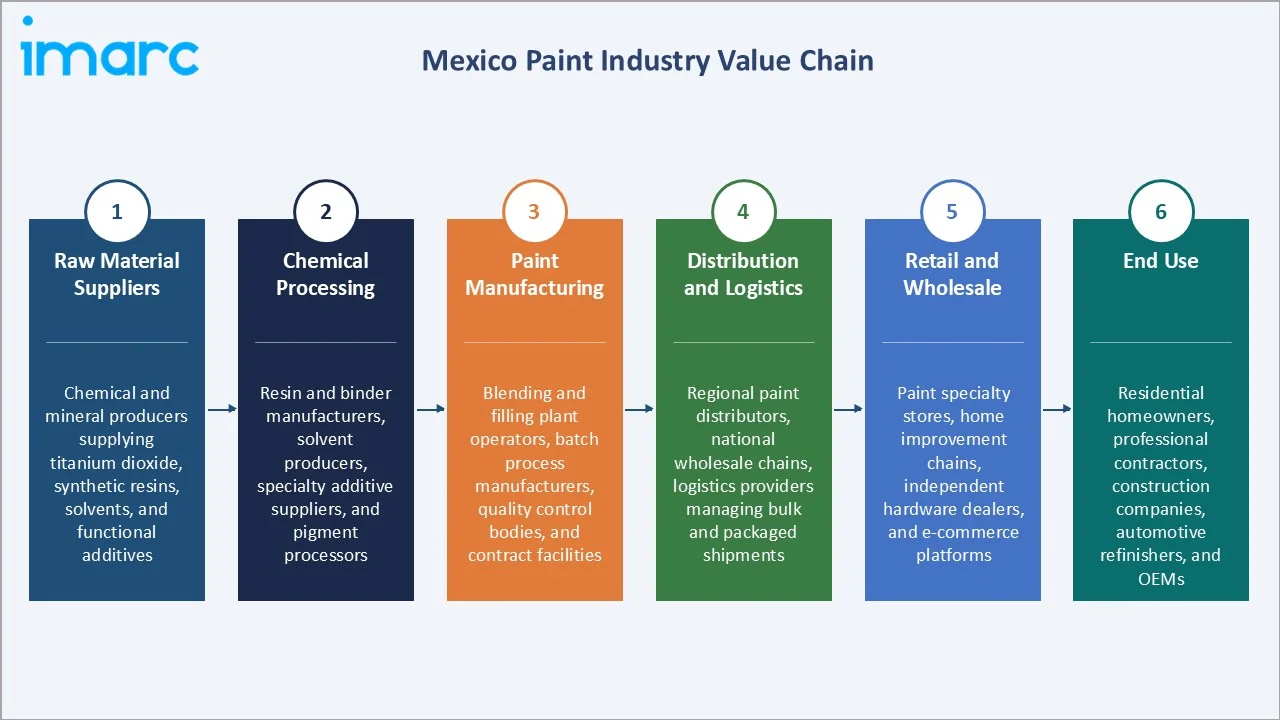
The ecosystem integrates raw material suppliers providing resins, pigments, solvents, and additives; paint manufacturers operating blending and filling plants; distributors and wholesalers; and end user segments spanning construction contractors, OEMs, automotive refinishers, and individual consumers. Regulatory bodies shape compliance requirements for VOC limits and hazardous material handling across the value chain.
Market Dynamics
To evaluate market opportunities, Request Sample
Market Drivers
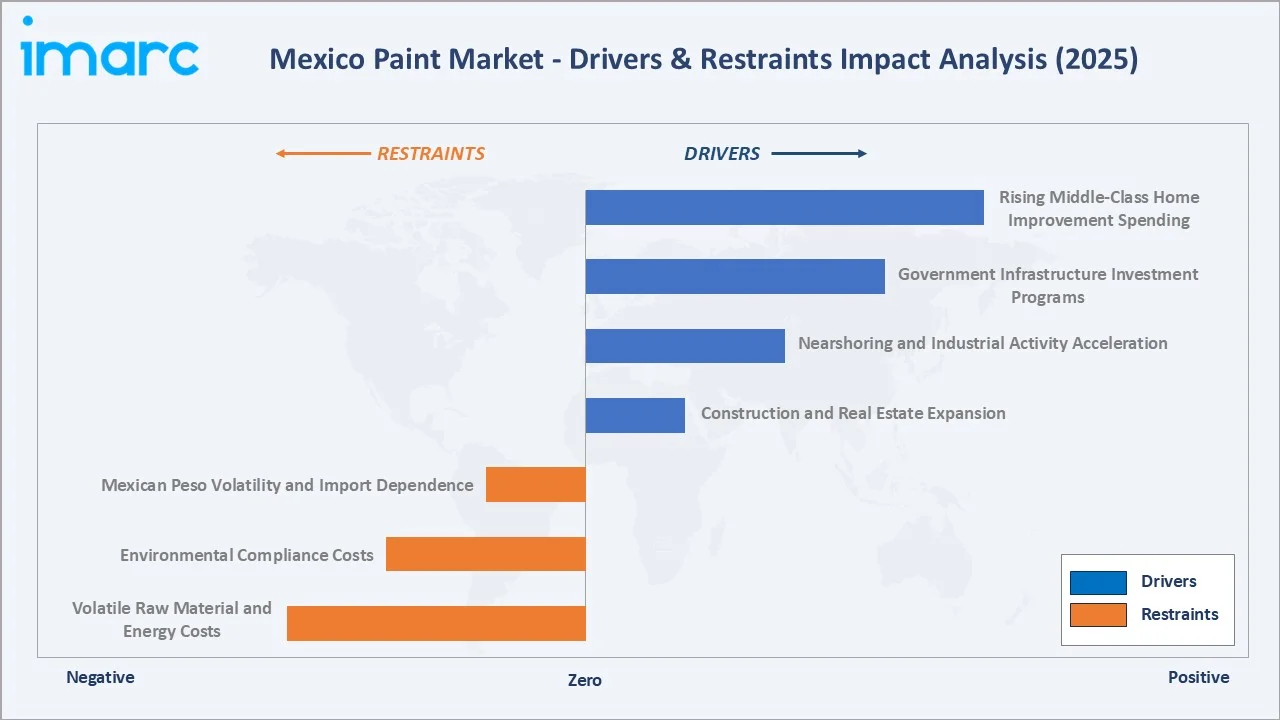
- Construction and Real Estate Expansion: As per IMARC Group, the Mexico real estate market size reached USD 168.9 Billion in 2025. Sustained residential and commercial construction activity across Mexico's major metropolitan areas, driven by urbanization, population growth, and demand for affordable housing, is generating consistent baseline demand for architectural coatings across interior, exterior, and specialty applications.
- Nearshoring and Industrial Activity Acceleration: The accelerating relocation of manufacturing operations from Asia to Mexico, particularly in the automotive, electronics, and aerospace sectors, is expanding demand for industrial maintenance, anti-corrosion, and high-performance protective coatings across new production facilities in the Bajio, Northern Mexico, and the Mexico City metropolitan region.
- Government Infrastructure Investment Programs: Federal investment in roads, public housing, airports, and energy infrastructure is generating direct demand for protective and decorative coatings in public-sector projects, sustaining off-cycle demand independent of residential market fluctuations.
- Rising Middle-Class Home Improvement Spending: Growing urban household incomes and expanding access to home improvement retail are driving increased per-unit paint consumption in the DIY and professional renovation segments, particularly for premium decorative and texture products.
Market Restraints
- Volatile Raw Material and Energy Costs: Paint manufacturers in Mexico face persistent margin pressure from price volatility in key raw materials, including titanium dioxide, petroleum-derived solvents, and synthetic resins.
- Environmental Compliance Costs: Tightening VOC emission standards and stricter hazardous material handling requirements are increasing formulation, testing, and compliance costs for solvent-based paint manufacturers. These evolving regulatory requirements are driving investments in product reformulation, cleaner production processes, and upgraded manufacturing facilities.
- Mexican Peso Volatility and Import Dependence: Significant dependence on imported raw materials, primarily priced in United States dollars, exposes domestic paint manufacturers to currency risk. Peso depreciation episodes directly translate into higher input costs, compressing margins and limiting capacity for promotional pricing and product development investment.
Market Opportunities
- Eco-Friendly and Low-VOC Product Premiumization: Growing regulatory pressure and consumer awareness around indoor air quality and environmental sustainability are creating a premium market segment for low-VOC, zero-VOC, and bio-based paint formulations across both retail and institutional channels, presenting margin expansion opportunities for manufacturers investing in green product lines.
- Industrial Coating Demand from Nearshoring Facilities: The continued influx of nearshoring investment in automotive, electronics, and logistics facilities across Northern Mexico and the Bajio corridor is generating strong incremental demand for industrial primers, anti-corrosion coatings, and high-performance floor systems in newly constructed manufacturing facilities.
Market Challenges
- Informal and Counterfeit Paint Market: A significant informal sector supplying substandard and uncertified paint products at lower price points continues to compete with formal manufacturers in price-sensitive residential and small contractor segments, constraining market formalization and premium segment penetration in lower-income urban and rural markets.
- Distribution Network Gaps in Southern and Rural Markets: Thin distribution infrastructure in Southern Mexico and non-metropolitan markets limits effective reach for branded paint manufacturers, reducing consistent product availability and brand visibility in high-growth rural construction segments.
Emerging Market Trends
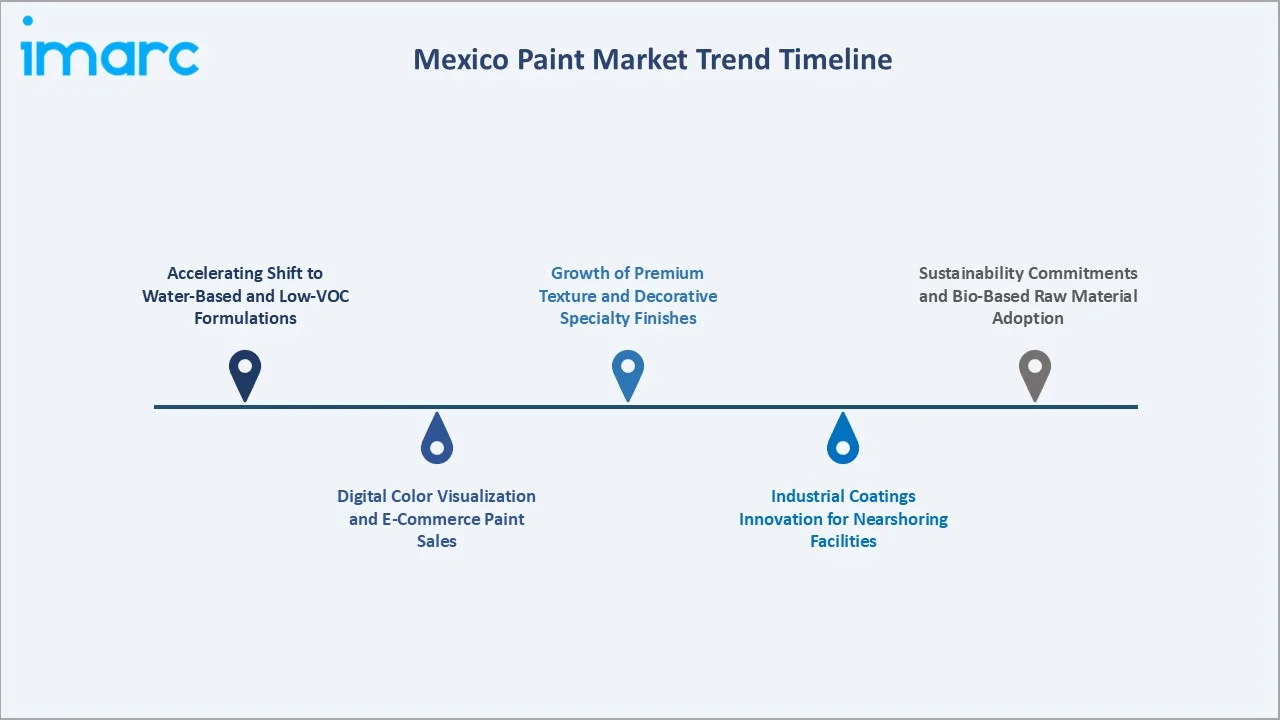
1. Accelerating Shift to Water-Based and Low-VOC Formulations
Growing emphasis on environmental sustainability, stricter emission requirements, and increasing consumer preference for healthier indoor environments are accelerating the adoption of water-based, low-VOC, and zero-VOC paint formulations. Manufacturers are expanding environment-friendly product portfolios through continuous formulation improvements, enhanced performance characteristics, and broader availability across residential, commercial, and industrial applications.
2. Digital Color Visualization and E-Commerce Paint Sales
AI-powered color visualization tools, augmented reality (AR) room simulations, and integrated online paint ordering platforms are reshaping the consumer purchase journey. Leading retailers and paint brands in Mexico are deploying mobile-first digital tools that allow consumers to visualize paint colors on uploaded room images.
3. Growth of Premium Texture and Decorative Specialty Finishes
Rising middle-class investment in home aesthetics and the growing influence of social media-driven interior design trends are accelerating adoption of specialty texture finishes, metallic effects, and artistic wall coating systems. Manufacturers are expanding premium decorative paint portfolios with a wider range of finishes, customizable color options, and enhanced durability to cater to evolving consumer preferences.
4. Industrial Coatings Innovation for Nearshoring Facilities
The nearshoring-driven buildout of automotive, electronics, and logistics facilities across Northern Mexico and the Bajio corridor is generating demand for high-performance industrial coatings with specialized anti-corrosion, chemical resistance, and thermal protection properties. Paint manufacturers are broadening their industrial product lines and technical sales capabilities to serve the growing base of international OEM and Tier-1 automotive suppliers establishing or expanding operations in Mexico.
5. Sustainability Commitments and Bio-Based Raw Material Adoption
Global paint manufacturers with Mexican operations are aligning local product development with corporate sustainability targets, investing in bio-based resin alternatives, renewable pigment sourcing, and recyclable packaging initiatives. These commitments are increasingly influencing institutional procurement decisions, particularly in government-funded construction and infrastructure projects.
Industry Value Chain Analysis
The Mexico paint market value chain spans six stages from raw material sourcing through end-use application and lifecycle management. Pigment and resin supply, paint formulation, and retail distribution capture the highest value, while logistics infrastructure and technical service capabilities increasingly determine competitive positioning among manufacturers targeting industrial and premium architectural segments.
|
Stage |
Key Players / Examples |
|
Raw Material Suppliers |
Chemical and mineral raw material producers supplying titanium dioxide pigments, synthetic resins, organic solvents, and functional additives to paint manufacturing facilities |
|
Chemical Processing |
Resin and binder manufacturers, solvent producers, specialty additive suppliers, and pigment processors enabling formulation of performance coatings and architectural products |
|
Paint Manufacturing |
Blending and filling plant operators, batch and continuous process manufacturers, quality control and certification bodies, and contract manufacturing facilities serving brand owners |
|
Distribution and Logistics |
Regional paint distributors, national wholesale chains, logistics providers managing bulk and packaged paint shipments, and specialized operators for temperature-sensitive formulations |
|
Retail and Wholesale |
Paint specialty stores, home improvement retail chains, independent hardware dealers, paint contractor supply outlets, and e-commerce platforms providing consumer and professional access |
|
End Use |
Residential homeowners, professional painting contractors, construction companies, automotive refinishers, industrial facility operators, and government procurement agencies |
Vertically integrated players controlling formulation, manufacturing, and retail distribution are positioned to capture greater value than pure-play manufacturers reliant on third-party distribution. Technical service capability and strong contractor relationships increasingly determine share in the industrial and specialty coating segments.
Technology Landscape in the Mexico Paint Industry
Advanced Resin and Binder Systems
Mexican paint manufacturers and their multinational partners are investing in next-generation acrylic, styrene-acrylic, and alkyd-modified resin systems that deliver enhanced adhesion, scrub resistance, and dirt-pickup resistance without compromising VOC compliance. Waterborne alkyd emulsions and hybrid binder systems are gaining traction as bridging technologies enabling performance parity with traditional solvent-borne coatings in demanding architectural applications.
Functional and Smart Coating Technologies
Thermal insulation coatings, anti-microbial surface treatments, and dirt-repellent nano-coating technologies are entering the premium residential and commercial architectural segment in Mexico. Smart coating systems with color-changing, self-cleaning, and photocatalytic properties are in early-stage market development, with lead applications in high-end hospitality, healthcare facilities, and institutional projects.
Digital Color Management and Tinting Systems
In-store computerized tinting systems linked to digital color management platforms are expanding in Mexican paint retail, enabling precise color matching and reducing the SKU burden for distributors. Integration of mobile AR color visualization tools with in-store tinting systems is improving the consumer selection experience and driving higher average transaction values across premium and specialty paint categories.
Market Segmentation Analysis
The report covers the following segments:
|
Segment Category |
Leading Segment |
Market Share |
Year |
|
Technology |
Water-based |
68.3% |
2025 |
|
Type of Paint |
Emulsion |
41.8% |
2025 |
|
Resin |
🔒 |
🔒 |
2025 |
|
End User |
🔒 |
🔒 |
2025 |
|
Region |
Northern Mexico |
34.2% |
2025 |

By Technology
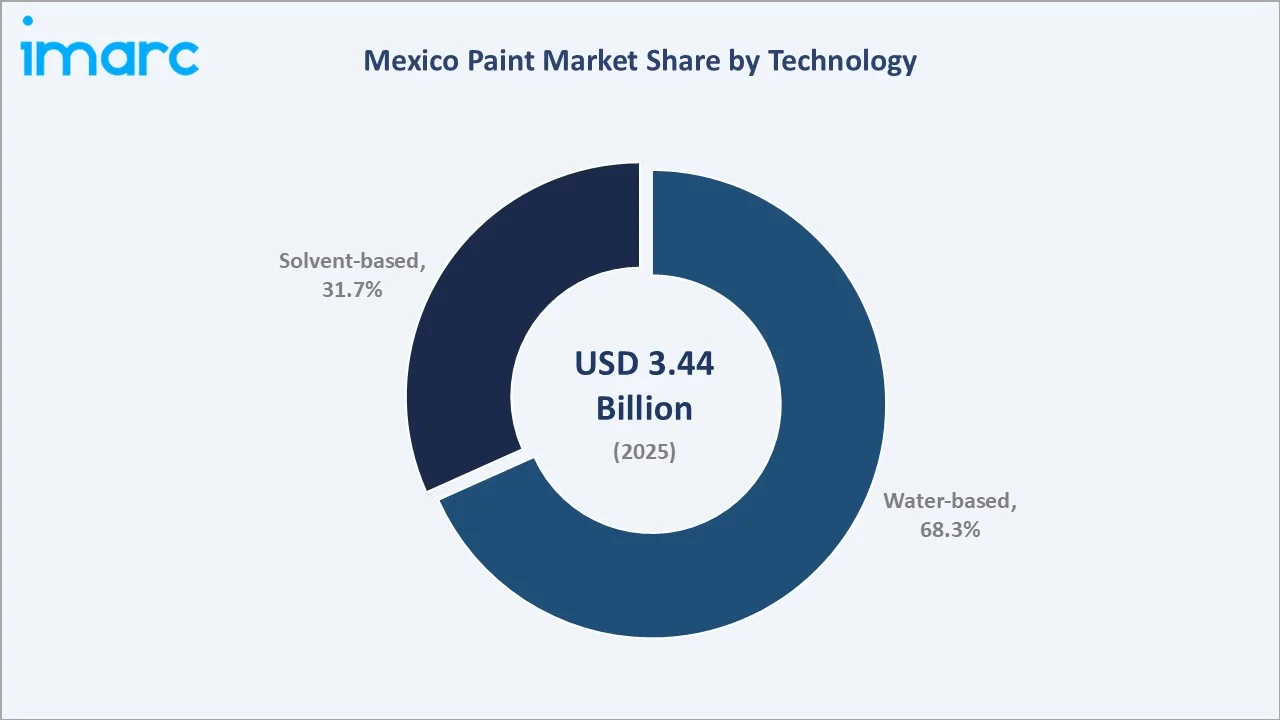
Water-based commands a 68.3% majority share in 2025, driven by tightening environmental regulations, growing consumer preference for low-odor interior coatings, and active product innovation across emulsion, primer, and texture product lines by both global multinationals and domestic producers.
To access detailed market analysis, Request Sample
Solvent-based at 31.7% in 2025 retains a significant share in industrial maintenance, automotive refinishing, marine, and heavy-duty protective coating applications where chemical resistance, hardness, and adhesion performance on challenging substrates continue to favor petroleum-derived solvent systems.
By Type of Paint
Emulsion holds the leading position with 41.8% share in 2025, reflecting its central role in interior and exterior wall coatings across residential, commercial, and institutional construction. Low cost, ease of application, fast drying, and compatibility with water-based primers support emulsion's dominant position and are sustained by Mexico's large-scale social housing construction programs.
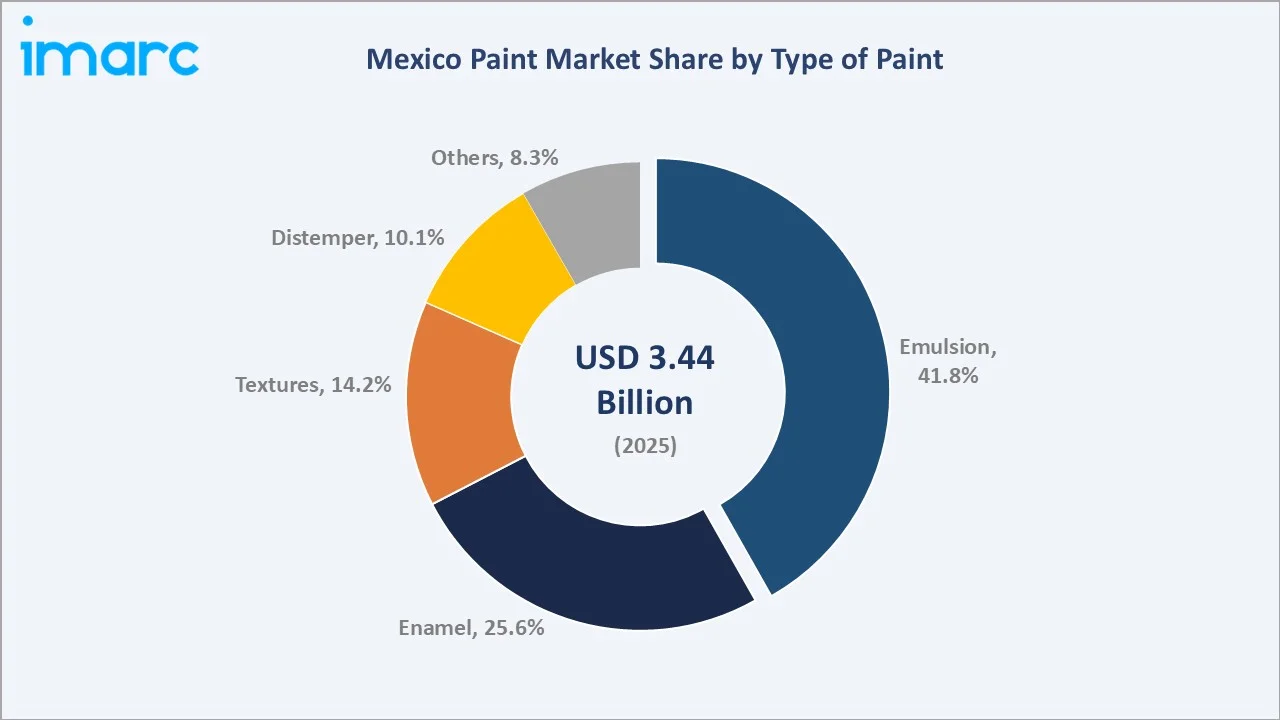
Enamel follows at 25.6%, driven by demand in wood finishing, metal surfaces, and applications requiring high gloss and chemical resistance.
Regional Market Insights
|
Region |
Share (2025) |
Key Growth Drivers |
|
Northern Mexico |
34.2% |
Large industrial base, active maquiladora sector, cross-border manufacturing activity, strong residential construction, and high automotive industry presence driving industrial coating demand |
|
Central Mexico |
30.8% |
Expanding industrial corridor in the Bajio region, high population density in greater Mexico City, growing commercial real estate development, and rising DIY home improvement spending |
|
Southern Mexico |
22.9% |
Growing infrastructure investment, urbanization in secondary cities, increasing social housing construction programs, and expanding distribution networks improving branded product availability |
|
Others |
12.1% |
Tourism-driven hospitality construction, coastal infrastructure maintenance, regional industrial projects, and growing residential development in emerging urban centers |
Northern Mexico at 34.2% in 2025 leads the regional landscape, anchored by industrial clusters in Monterrey, Chihuahua, and Tijuana. Dense maquiladora concentration requiring regular industrial maintenance coatings, active residential construction driven by industrial worker in-migration, and high per-capita construction activity in Mexico collectively sustain Northern Mexico's leadership across both architectural and industrial coating categories.
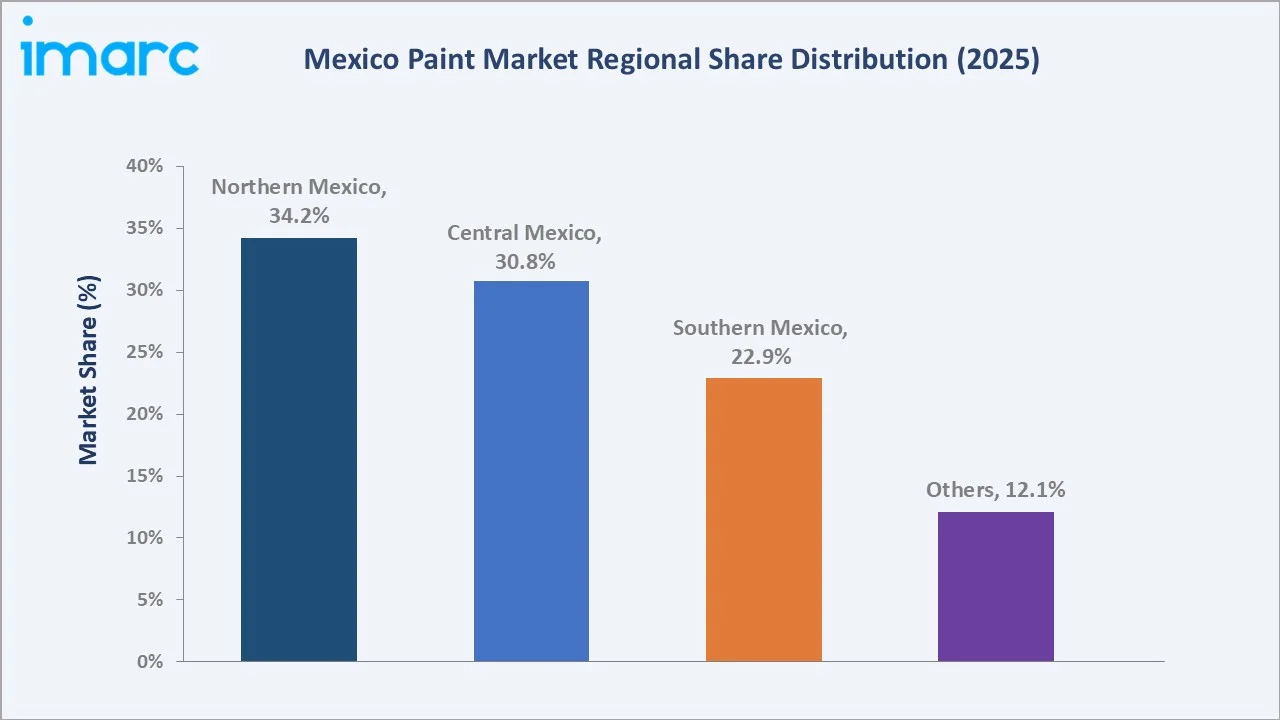
Central Mexico at 30.8% is the second largest region. The rapid expansion of the Bajio industrial corridor, anchored by automotive assembly and Tier-1 supplier clusters in Guanajuato, Queretaro, and Aguascalientes, is generating incremental industrial coating demand.
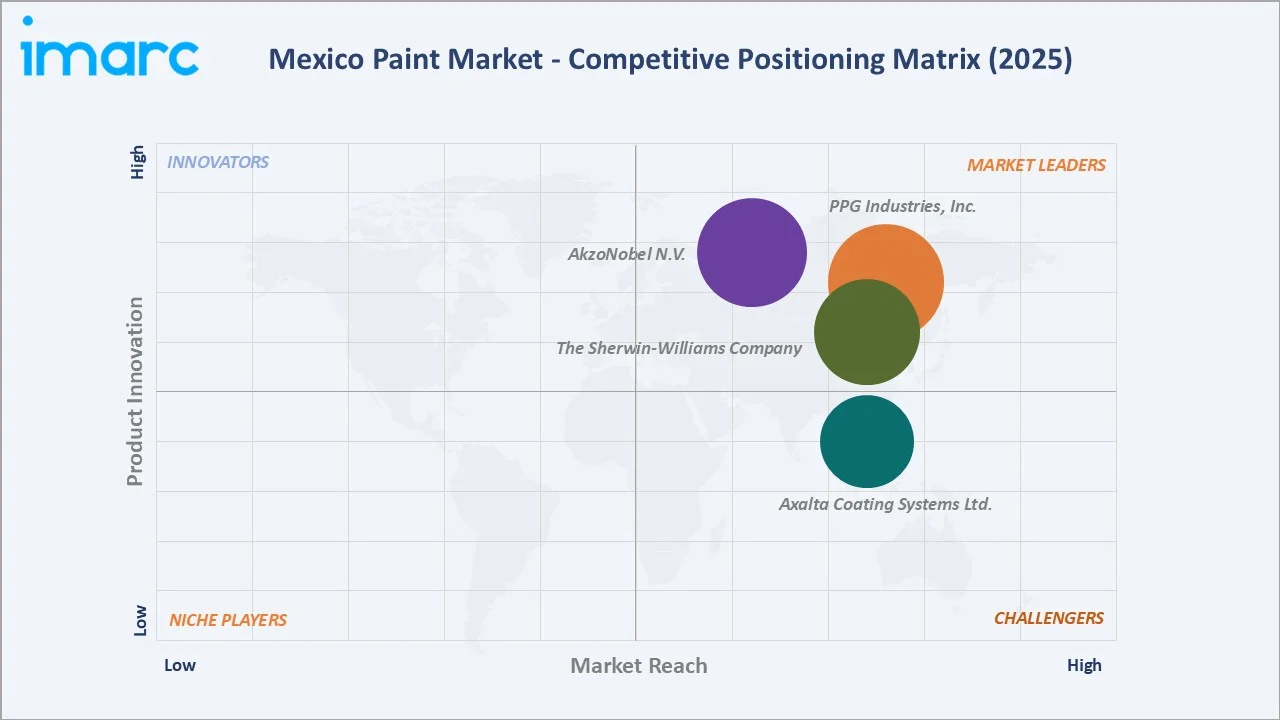
Competitive Landscape
The Mexico paint market is moderately concentrated, with leading multinational and domestic manufacturers leveraging extensive dealer networks, manufacturing capabilities, and sustained investments in product development.
|
Company Name |
Brand / Key Product |
Position |
Strategic Focus |
|
PPG Industries, Inc. |
Comex |
Leader |
Expanding premium coatings portfolio through innovation, sustainability, and strong distribution capabilities. |
|
The Sherwin-Williams Company |
Sherwin-Williams |
Leader |
Premium architectural and protective coatings with strong retail and professional contractor channel presence in Mexico |
|
AkzoNobel N.V. |
Dulux, Sikkens, Interpon |
Leader |
Broadening high-performance coatings portfolio through product innovation, customer-focused solutions, and strengthening distribution and technical support capabilities across Mexico |
|
Axalta Coating Systems Ltd. |
Spies Hecker, Cromax, Imron |
Challenger |
Leading automotive OEM and refinish coatings supplier with active technology launches and growing industrial coatings presence in Mexico |
Key players include PPG Industries, Inc., The Sherwin-Williams Company, AkzoNobel N.V., and Axalta Coating Systems Ltd., among others.
Key Company Profiles
PPG Industries, Inc.
PPG Industries, Inc. is one of the world's leading manufacturers of paints, coatings, and specialty materials, headquartered in Pittsburgh, Pennsylvania. The company serves customers in construction, consumer products, industrial, and transportation markets across several countries.
- Product Portfolio: Architectural and decorative coatings under the Comex brand; industrial maintenance and protective coatings; automotive OEM and refinish coating systems; specialty coatings for the construction and infrastructure sectors in Mexico.
- Recent Developments: PPG Industries, Inc. announced a USD 300 million investment in May 2024 to expand advanced manufacturing capabilities across North America, including a major upgrade to its San Juan del Rio, Mexico facility aimed at increasing production efficiency and supporting sustainable automotive coatings.
- Strategic Focus: Enhancing the premium coatings range via innovation, sustainability, and robust distribution strengths within architectural and industrial sectors in Mexico.
The Sherwin-Williams Company
The Sherwin-Williams Company is one of the largest manufacturers and distributors of paints, coatings, and related products in the world, headquartered in Cleveland, Ohio. The company serves professional contractors, industrial customers, and retail consumers through a broad network of company-operated stores and distributor partnerships.
- Product Portfolio: Premium interior and exterior architectural coatings; high-performance protective and industrial coatings; automotive refinish systems; specialty coatings for wood, metal, and concrete surfaces across residential, commercial, and industrial end markets in Mexico.
- Recent Developments: The Sherwin-Williams Company has continued to strengthen its presence in Mexico through expanded retail distribution and enhanced contractor service programs, investing in digital tools and technical support platforms to deepen penetration across architectural and industrial coating segments.
- Strategic Focus: Premium architectural and protective coatings with strong retail and professional contractor channel presence in Mexico, supported by a broad product portfolio and global innovation capabilities.
AkzoNobel N.V.
AkzoNobel N.V. is a leading global paints and coatings company headquartered in Amsterdam, the Netherlands. In Mexico, the firm operates across architectural, industrial, automotive refinish, and powder coating markets, maintaining manufacturing and processing facilities that serve both domestic and export customers.
- Product Portfolio: Dulux decorative and architectural coatings; Sikkens automotive refinish and industrial coating systems; Interpon powder coatings for architectural and industrial metal applications; specialty protective coatings for marine, infrastructure, and industrial maintenance markets across Mexico.
- Recent Developments: The company has been expanding its coatings portfolio, strengthening manufacturing capabilities, and enhancing sustainable product offerings to support evolving customer requirements across architectural and industrial applications.
- Strategic Focus: Expanding sustainable coatings portfolio through innovation, manufacturing efficiency, and strong distribution capabilities.
Market Concentration Analysis
The Mexico paint market exhibits moderate concentration, with PPG Industries, Inc., The Sherwin-Williams Company, and AkzoNobel N.V. collectively accounting for the largest share of formal market revenue across architectural and industrial categories.
Barriers to entry include high capital requirements for manufacturing scale, the cost of building a national distribution network, strong brand loyalty in the retail architectural segment, and technical support and specification-led selling capabilities required to penetrate OEM automotive and industrial accounts. These factors strongly favor established multinationals with integrated Mexican manufacturing, distribution, and technical service capabilities.
Consolidation is accelerating through portfolio expansion, strategic distribution partnerships, and investments in manufacturing modernization, while leading companies continue strengthening dealer networks, expanding premium product offerings, and enhancing technical support capabilities to reinforce long-term competitive positioning.
Investment & Growth Opportunities
Fastest-Growing Segments
Textures represent the fastest-growing type of paint category, driven by rising consumer demand for decorative finishes in urban residential renovation and commercial interior projects. Water-based continues to expand its share, supported by regulatory pressure, formulation innovation, and changing consumer preferences toward healthier indoor environments.
Emerging Markets
Central Mexico is the fastest-growing region, with the Bajio industrial corridor expansion and continued residential construction around the Mexico City metropolitan area driving above-average demand growth. Southern Mexico presents a significant underpenetrated opportunity for branded paint manufacturers able to build or extend distribution networks into secondary cities and rural construction markets benefiting from government infrastructure and social housing investment.
Venture & Investment Trends
Investment is increasingly focused on expanding domestic manufacturing capacity, modernizing production facilities, developing low-VOC and specialty coating formulations, strengthening dealer and retail distribution networks, and advancing digital color visualization and automated tinting technologies to enhance customer experience and operational efficiency.
Future Market Outlook (2026-2034)
The Mexico paint market is forecast to expand from USD 3.44 Billion in 2025 to an estimated USD 3.60 Billion in 2026 and further to USD 5.24 Billion by 2034 at a CAGR of 4.65%, adding approximately USD 1.80 Billion in incremental market value over the forecast period.
Four forces will shape the market through 2034: sustained nearshoring-driven industrial construction generating incremental demand for high-performance coatings; tightening environmental standards accelerating the transition to water-based and low-VOC formulations; digital tools reshaping the retail consumer purchase journey; and growing middle-class investment in home aesthetics supporting premiumization in the decorative coating segment.
By 2034, the Mexico paint market is expected to be defined by a higher share of water-based, eco-certified products; deeper integration of digital color management tools across retail and professional channels; stronger industrial coating demand concentrated in Northern Mexico and the Bajio corridor; and continued expansion of premium decorative coatings supported by rising renovation activity and consumer preference for high-performance, aesthetically advanced paint solutions.
Research Methodology
Primary Research
Primary research included structured interviews with paint manufacturing executives, regional distributor principals, construction material procurement managers, retail category buyers, and industrial coating specification engineers, validating market sizing, segment shares, regional demand patterns, and competitive positioning across architectural and industrial categories.
Secondary Research
Secondary sources included SEMARNAT environmental compliance publications, CMIC construction industry data, INEGI manufacturing and GDP statistics, press releases, investor presentations, and trade association publications from Mexico's paint and chemical manufacturing sectors.
Forecasting Models
Market forecasts used top-down and bottom-up models combining construction output data, industrial production indices, raw material price trend analysis, segment mix evolution, regulatory transition scenarios, and macroeconomic variables including GDP growth, urbanization rates, and housing formation trends. Scenario analysis addressed regulatory pae raw material cost trajectories, and nearshoring investment momentum.
Mexico Paint Market Report Coverage:
| Report Features | Details |
|---|---|
| Base Year of the Analysis | 2025 |
| Historical Period | 2020-2025 |
| Forecast Period | 2026-2034 |
| Units | Billion USD |
| Scope of the Report | Exploration of Historical Trends and Market Outlook, Industry Catalysts and Challenges, Segment-Wise Historical and Future Market Assessment:
|
| Technologies Covered | Water-based, Solvent-based |
| Types of Paint Covered | Emulsion, Enamel, Distemper, Textures, Others |
| Resins Covered | Acrylic, Alkyd, Polyurethane, Epoxy, Polyester, Others |
| End Users Covered |
|
| Regions Covered | Northern Mexico, Central Mexico, Southern Mexico, Others |
| Companies Covered | PPG Industries, Inc., The Sherwin-Williams Company, AkzoNobel N.V., Axalta Coating Systems Ltd., etc. |
| Customization Scope | 10% Free Customization |
| Post-Sale Analyst Support | 10-12 Weeks |
| Delivery Format | PDF and Excel through Email (We can also provide the editable version of the report in PPT/Word format on special request) |
Key Benefits for Stakeholders:
- IMARC’s industry report offers a comprehensive quantitative analysis of various market segments, historical and current market trends, market forecasts, and dynamics of the Mexico paint market from 2020-2034.
- The research report provides the latest information on the market drivers, challenges, and opportunities in the Mexico paint market.
- Porter's five forces analysis assist stakeholders in assessing the impact of new entrants, competitive rivalry, supplier power, buyer power, and the threat of substitution. It helps stakeholders to analyze the level of competition within the Mexico paint industry and its attractiveness.
- Competitive landscape allows stakeholders to understand their competitive environment and provides an insight into the current positions of key players in the market.
Frequently Asked Questions About the Mexico Paint Market Report
The Mexico paint market size is estimated at USD 3.60 Billion in 2026, driven by construction activity, industrial expansion, and growing demand for decorative architectural coatings across residential and commercial segments.
The market is projected to grow at a CAGR of 4.65% from 2026-2034, reaching USD 5.24 Billion, supported by nearshoring-driven industrial demand, eco-friendly formulation adoption, and rising middle-class home improvement spending.
Water-based leads at 68.3% in 2025, driven by tightening VOC regulations, consumer preference for low-odor products, and active product innovation by leading manufacturers.
Emulsion dominates at 41.8% in 2025, supported by broad residential and commercial applications. Its ease of application, quick drying time, and compatibility with a wide range of interior and exterior surfaces further strengthen its market position.
Northern Mexico commands 34.2% in 2025, anchored by industrial clusters, maquiladora activity, and active residential construction along the United States-Mexico border corridor.
Leading players include PPG Industries, Inc., The Sherwin-Williams Company, AkzoNobel N.V., and Axalta Coating Systems Ltd., among others.
Key drivers include construction and real estate expansion, nearshoring-driven industrial activity, federal infrastructure investment, rising middle-class home improvement spending, and accelerating adoption of eco-friendly low-VOC formulations.
Volatile raw material costs, tightening environmental compliance requirements, Mexican peso currency exposure, informal market competition from uncertified products, and thin distribution infrastructure in southern and rural markets represent the primary market challenges.
Need more help?
- Speak to our experienced analysts for insights on the current market scenarios.
- Include additional segments and countries to customize the report as per your requirement.
- Gain an unparalleled competitive advantage in your domain by understanding how to utilize the report and positively impacting your operations and revenue.
- For further assistance, please connect with our analysts.
 Request Customization
 Speak to an Analyst
 Request Brochure
 Inquire Before Buying
Benefits of Customization
- Personalize this research
- Triangulate with your data
- Get data as per your format and definition
- Gain a deeper dive into a specific application, geography, customer, or competitor
- Any level of personalization
Get in Touch With Us
UNITED STATES
Phone: +1-201-971-6302
INDIA
Phone: +91-120-433-0800
UNITED KINGDOM
Phone: +44-753-714-6104
Email: [email protected]
Client Testimonials




.webp)




.webp)













Related Reports

Choose your plan
*Please note that the prices mentioned below are starting prices for each bundle type. Kindly contact our team for further details.*
Single User License
- 1 User License, Access on 2 Devices
- PDF Report + Excel Dataset (Password Protected)
- Lifetime Access
- No Printing Rights
- 10% Free Report Customization
- 10–12 Weeks of Analyst Support
Five User License
- Access for 5 Users, 2 Devices per User
- PDF Report + Excel Dataset (Password Protected)
- Lifetime Access
- Dedicated Account Manager
- 12–14 Weeks of Analyst Support
- No Printing Rights
- 15% Free Report Customization
- 25% Discount on Your Next Purchase
Corporate User License
- Unlimited User Access (Within Your Organization)
- PDF Report + Excel Dataset
- Lifetime Access
- Dedicated Account Manager
- 14–20 Weeks of Analyst Support
- No Printing Rights
- 20% Free Report Customization
- 30% Discount on Your Next Purchase
Essential Insights
What's included:
3 reports
- Lifetime Access
- PDF Reports
- Excel Datasets
- 2 Weeks of Free Analyst Support
- 2 User Licenses
- Access on 2 Devices
- Printing Rights
- Complimentary PowerPoint (PPT) Version
- Complimentary License Upgrade
Professional Access
What's included:
5 reports
- Lifetime Access
- PDF Reports
- Excel Datasets
- 8 Weeks of Free Analyst Support
- 2 User Licenses
- Access on 2 Devices
- Printing Rights
- Complimentary PowerPoint (PPT) Version
- Complimentary License Upgrade
Business Advantage
What's included:
8 reports
- Lifetime Access
- PDF Reports
- Excel Datasets
- 14 Weeks of Free Analyst Support
- 2 User Licenses
- Access on 2 Devices
- Printing Rights
- Complimentary PowerPoint (PPT) Version
- Complimentary License Upgrade
Enterprise Intelligence
What's included:
10 reports
- Lifetime Access
- PDF Reports
- Excel Datasets
- 20 Weeks of Free Analyst Support
- 2 User Licenses
- Access on 2 Devices
- Printing Rights
- Complimentary PowerPoint (PPT) Version
- Complimentary License Upgrade