
Mexico Paints and Coatings Market Size, Share, Trends and Forecast by Product, Material, Application, and Region, 2026-2034
Mexico Paints and Coatings Market Size, Share, Trends & Forecast (2026-2034)
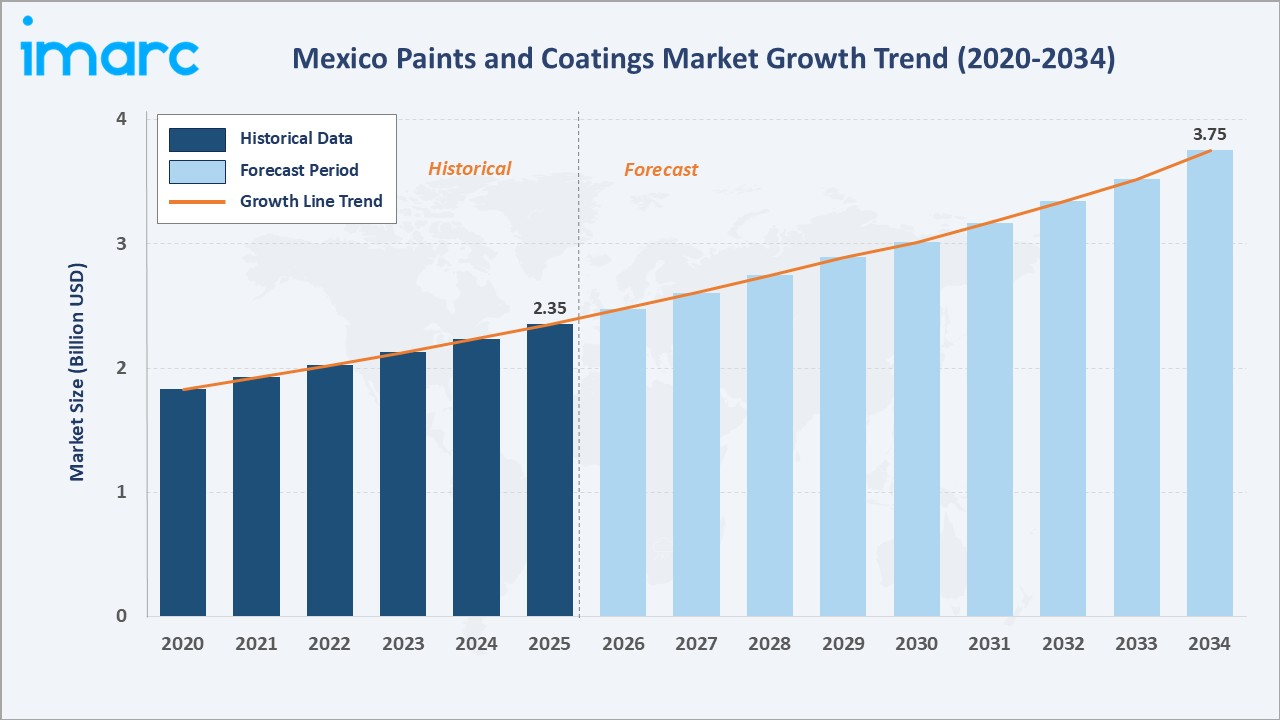
The Mexico paints and coatings market grew from USD 2.35 Billion in 2025 to USD 2.47 Billion in 2026 and is projected to reach USD 3.75 Billion by 2034, growing at a CAGR of 5.09% during 2026-2034. Construction activity contributes approximately 7% of Mexico's GDP, sustaining broad-based demand for architectural coatings. Architectural and decorative coatings dominate at 58.0% by application, acrylic leads at 38.0% by material, and Central Mexico commands the largest regional share at 52.0% in 2025, underpinned by Mexico City metropolitan area construction and the Bajio manufacturing corridor.
Market Snapshot
|
Metric |
Value |
|
Base Year Market Size (2025) |
USD 2.35 Billion |
|
Market Size (2026) |
USD 2.47 Billion |
|
Forecast Market Size (2034) |
USD 3.75 Billion |
|
CAGR (2026-2034) |
5.09% |
|
Base Year |
2025 |
|
Historical Period |
2020-2025 |
|
Forecast Period |
2026-2034 |
|
Dominant Material |
Acrylic (38.0%, 2025) |
|
Dominant Application |
Architectural and Decorative (58.0%, 2025) |
|
Leading Region |
Central Mexico (52.0%, 2025) |
The Mexico paints and coatings market grew from USD 1.83 Billion in 2020 to USD 2.35 Billion in 2025, and further to USD 2.47 Billion in 2026, reflecting sustained demand across residential, commercial, industrial, and automotive coating segments. The market is projected to reach USD 3.01 Billion by 2030 before reaching USD 3.75 Billion by 2034.
To get more information on this market, Request Sample
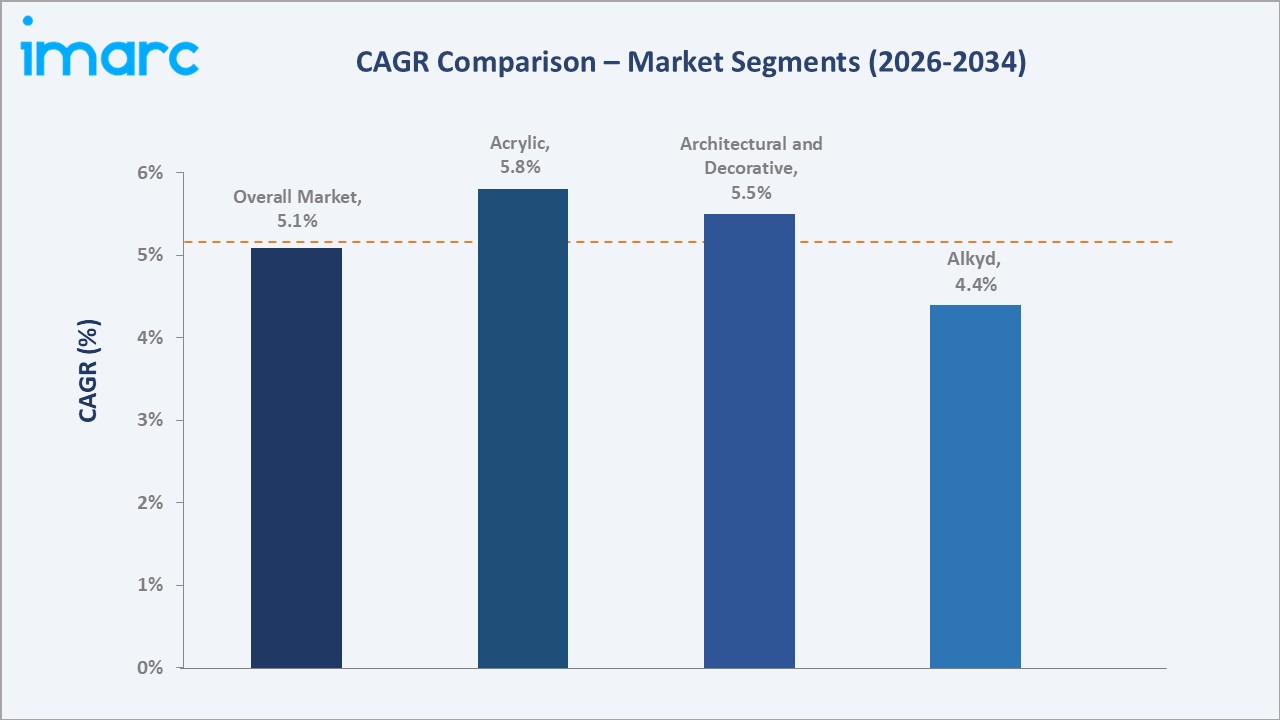
Acrylic-based coatings are projected to grow at approximately 5.80% CAGR, the highest among material segments, driven by increasing adoption of waterborne and low-VOC formulations. Architectural and decorative applications grow at approximately 5.50% CAGR, sustained by residential construction volumes.
Executive Summary
The Mexico paints and coatings market is on a consistent upward trajectory, supported by rapid urbanization, expanding residential and commercial construction, and growth in the country's automotive and industrial manufacturing base. The market growth reflects broad-based demand across all major coating application categories.
Acrylic-based formulations hold the dominant material position at 38.0% in 2025, driven by their versatility, durability, and alignment with the market's ongoing transition toward waterborne and low-VOC coatings. Architectural and decorative applications lead at 58.0%, underpinned by ongoing housing construction and urban renovation activity. Central Mexico commands 52.0% of the regional market, reflecting its dense population base, strong industrial activity, and construction momentum.
Key Market Insights
|
Insight |
Data |
|
Dominant Material |
Acrylic – 38.0% share (2025) |
|
Dominant Application |
Architectural and Decorative – 58.0% share (2025) |
|
Leading Region |
Central Mexico – 52.0% (2025) |
|
Key Market Opportunities |
Growing demand for eco-friendly, low-VOC, and waterborne formulations combined with Mexico's nearshoring-driven manufacturing expansion present significant growth opportunities across both architectural and industrial coating segments. |
Key Analytical Observations Supporting the Above Data:
- Acrylic at 38.0%: Acrylic dominates due to its broad performance profile across both architectural and industrial applications, strong compatibility with waterborne formulation trends, and cost-effectiveness at scale in Mexican production facilities.
- Architectural and Decorative at 58.0%: This segment leads because residential construction, urban renovation, and commercial real estate development represent the highest-volume end-use categories for paints, sustained by Mexico's urbanization rate exceeding 81.86% in 2024.
- Central Mexico at 52.0%: Central Mexico's leadership reflects the highest construction activity density across the Mexico City metropolitan area, the Bajio manufacturing corridor, and industrial investments.
Mexico Paints and Coatings Market Overview
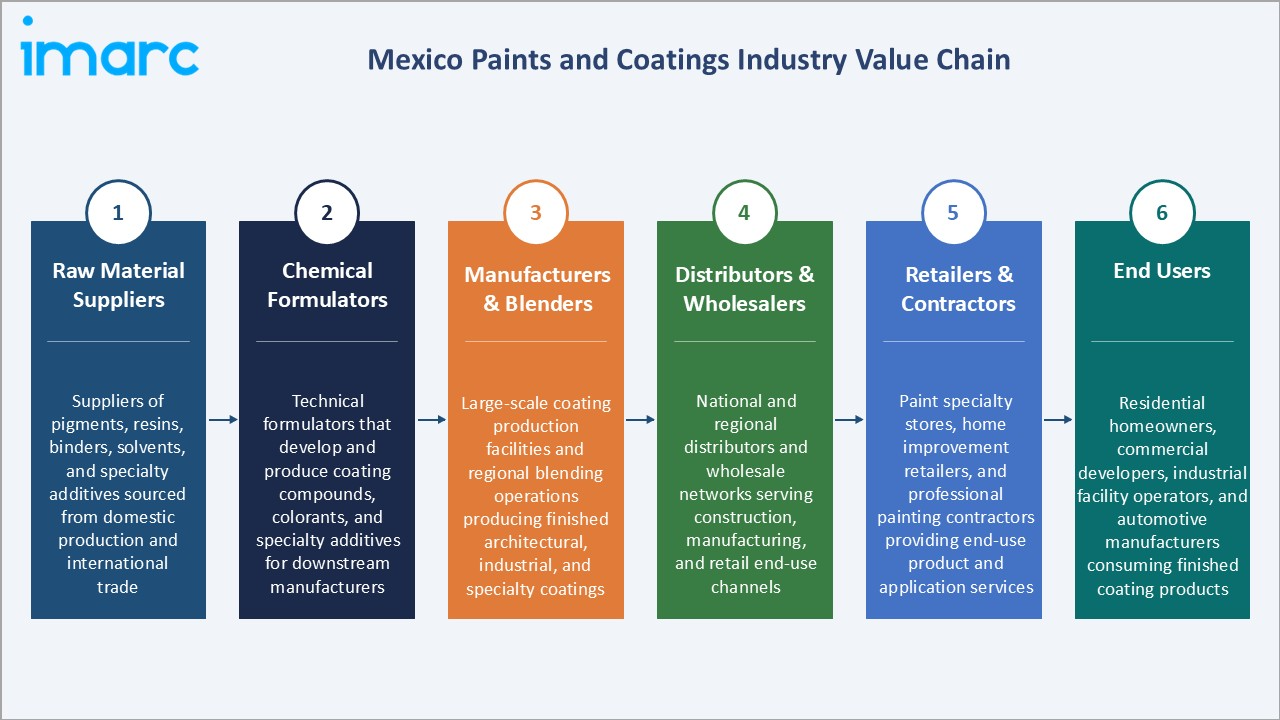
The Mexico paints and coatings market encompasses the production, distribution, and application of liquid, powder, and specialty coatings across residential, commercial, industrial, and automotive sectors. Core product categories include architectural decorative paints, automotive OEM and refinish coatings, industrial and protective coatings, marine coatings, and wood finishes. The market serves a broad ecosystem spanning raw material suppliers, chemical formulators, manufacturers, distributors, and end-use contractors and manufacturers.
Market Dynamics
To evaluate market opportunities, Request Sample
Market Drivers
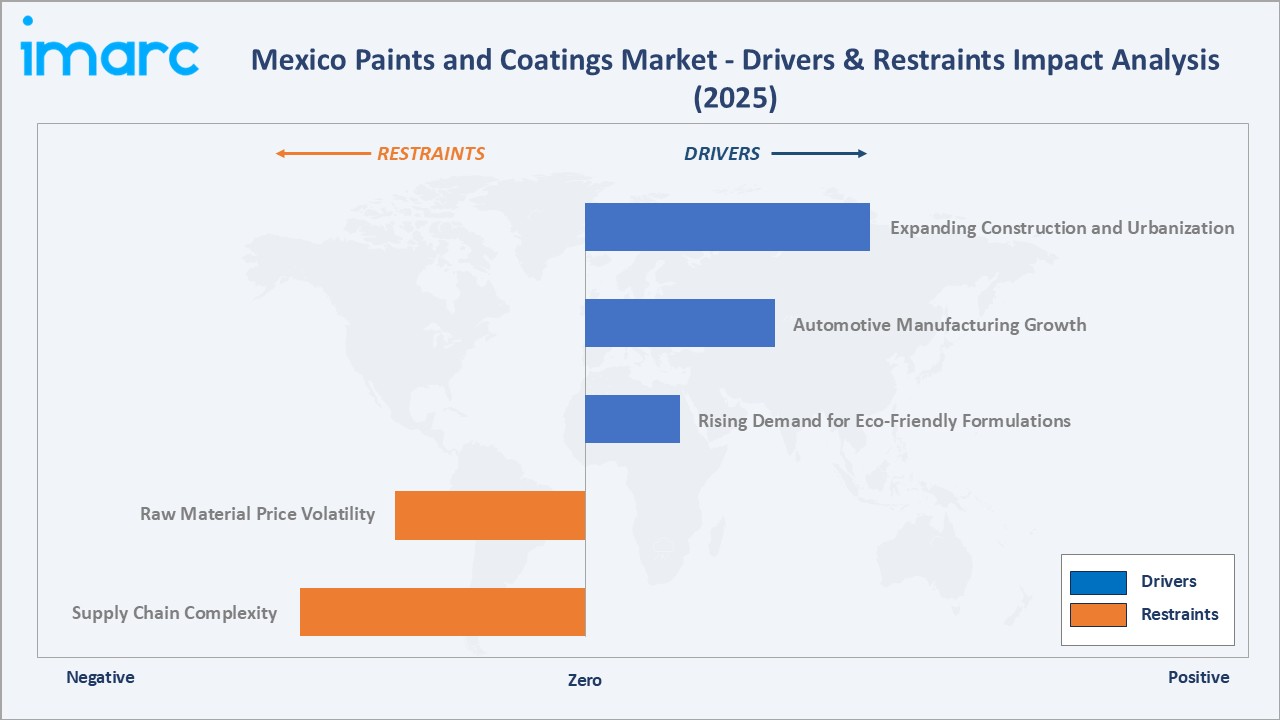
- Expanding Construction and Urbanization: Mexico's urbanization rate exceeded 81.86% in 2024, driving sustained residential and commercial construction demand. Housing construction activity generates consistent high-volume demand for interior and exterior architectural paints across all major regions.
- Automotive Manufacturing Growth: Mexico's automotive manufacturing sector produced over 2.64 million light vehicles between January and August 2026. This manufacturing scale drives sustained demand for automotive OEM coatings, e-coat primers, and refinish products.
- Rising Demand for Eco-Friendly Formulations: Adoption of low-VOC and waterborne coatings is accelerating, driven by multinational corporate sustainability commitments and evolving industry standards. This creates premium product growth opportunities and encourages investment in advanced waterborne technology.
Market Restraints
- Raw Material Price Volatility: Dependence on petrochemical feedstocks, including titanium dioxide, resins, and solvents, exposes coating manufacturers to price fluctuations that compress profit margins and limit the pace of capacity investment.
- Supply Chain Complexity: Reliance on imported specialty chemicals introduces lead time and logistics risks, particularly for smaller formulators without the procurement scale to manage supply disruptions effectively.
Market Opportunities
- Nearshoring-Driven Industrial Demand: Growing manufacturing relocation to Mexico is creating demand for high-performance industrial, protective, and anti-corrosion coatings, offering premium volume growth for technically advanced coating suppliers.
- Sustainable Coating Technologies: Investment in bio-based resins, waterborne formulations, and ultra-low-VOC technologies addresses regulatory requirements and multinational buyer specifications, creating a differentiated, margin-accretive product category.
Market Challenges
- Environmental Compliance Costs: Increasing requirements for VOC content reduction and hazardous material handling create ongoing compliance cost burdens, particularly for mid-tier manufacturers with limited research and development resources.
- Market Fragmentation and Pricing Pressure: Competition from regional and local formulators creates persistent pricing pressure in commodity architectural segments, limiting the ability of organized players to protect margins in volume-driven product lines.
Emerging Market Trends
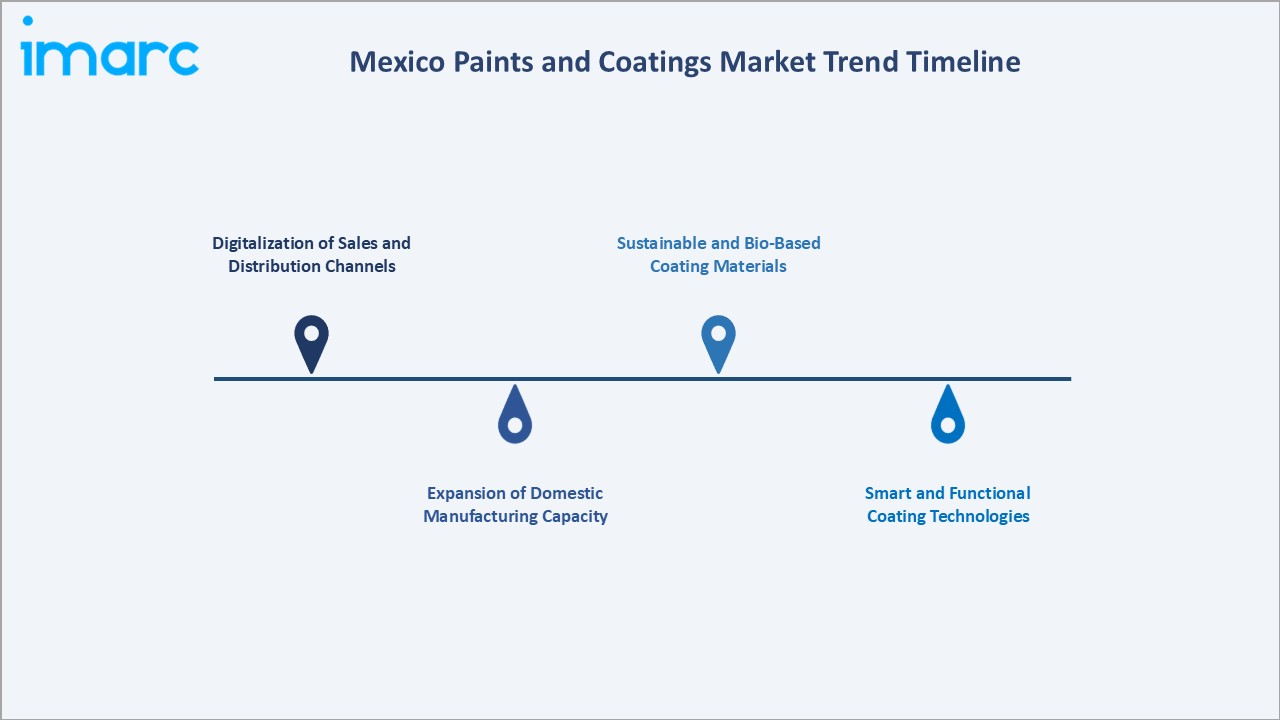
1. Digitalization of Sales and Distribution Channels
Paints and coatings manufacturers in Mexico are increasingly adopting digital platforms to streamline customer interactions, simplify product selection, and enhance ordering convenience. In May 2026, AkzoNobel Powder Coatings introduced the My Interpon Portal (MIP) in Mexico, offering customers a centralized digital platform to explore products, access technical information, place and track orders, and manage invoices. The launch is complemented by the Interpon Ready-to-Ship (RTS) range, comprising 54 popular powder coating products available from stock for delivery within two to three business days, catering to industrial and architectural applications.
2. Expansion of Domestic Manufacturing Capacity
In March 2024, WEG announced an investment of BRL100 Million to establish a new 5,300 m² industrial liquid paints factory in Mexico. The facility will expand production capacity, strengthen its presence in North and Central America, and address rising demand for efficient and sustainable coatings solutions. Such investments also support supply chain efficiency, expand export opportunities, and accelerate the adoption of efficient and sustainable industrial coatings.
3. Sustainable and Bio-Based Coating Materials
Investment in bio-based resins and sustainable raw material alternatives is growing as coating manufacturers seek to reduce dependence on petrochemical feedstocks. Bio-based acrylics and reformulated alkyds using renewable raw materials are entering the market, creating differentiated product offerings for environmentally conscious commercial and institutional buyers across Mexico.
4. Smart and Functional Coating Technologies
Advanced functional coatings with antimicrobial, thermal-insulating, and self-cleaning properties are growing in demand across healthcare, food processing, and commercial building segments. The global smart coatings market growth is creating significant opportunities for technically advanced formulators operating in Mexico's industrial and commercial segments.
Industry Value Chain Analysis
The Mexico paints and coatings value chain is structured across six integrated stages from raw material sourcing through end-use application. Each stage creates distinct value through processing, formulation, distribution, and application, with the greatest value addition occurring at the manufacturing and formulation stage where chemistry expertise, performance differentiation, and brand equity create durable competitive advantages.
|
Stage |
Description |
|
Raw Material Suppliers |
Suppliers of pigments, resins, binders, solvents, and specialty additives sourced from domestic production and international trade. |
|
Chemical Formulators |
Technical formulators that develop and produce coating compounds, colorants, and specialty additives for downstream manufacturers. |
|
Manufacturers & Blenders |
Large-scale coating production facilities and regional blending operations producing finished architectural, industrial, and specialty coatings. |
|
Distributors & Wholesalers |
National and regional distributors and wholesale networks serving construction, manufacturing, and retail end-use channels. |
|
Retailers & Contractors |
Paint specialty stores, home improvement retailers, and professional painting contractors providing end-use product and application services. |
|
End Users |
Residential homeowners, commercial developers, industrial facility operators, and automotive manufacturers consuming finished coating products. |
The manufacturing stage holds the greatest strategic significance, as large-scale producers benefit from economies of scale, proprietary formulation expertise, and brand recognition. The distribution stage is evolving as digital procurement and organized dealer networks improve supply chain efficiency across Mexico.
Technology Landscape in the Mexico Paints and Coatings Industry
Waterborne Technology
Waterborne coating technology represents the most significant ongoing technological transition, replacing solvent-borne systems across architectural and industrial segments. Advanced acrylic emulsion chemistries now deliver performance properties comparable to traditional solvent-borne coatings, enabling adoption in demanding commercial applications.
Powder Coating Systems
Thermosetting and thermoplastic powder coating technologies are expanding in industrial and architectural metal coating applications, offering zero-VOC formulations with superior corrosion resistance and film thickness uniformity. Electrostatic spray application achieves transfer efficiencies, significantly reducing material waste.
High-Solids and Radiation-Curing Coatings
UV-curable and electron beam (EB) curing technologies are gaining market share in wood finishing, plastic coating, and specialty industrial applications. These technologies enable near-instantaneous curing, reduce energy consumption, and produce durable coatings with minimal VOC emissions, bridging the transition toward fully sustainable formulations.
Smart and Functional Coating Technologies
Antimicrobial, self-cleaning, thermal-barrier, and corrosion-sensing coatings are creating new application opportunities in healthcare, food processing, and critical infrastructure. These high-value specialty coatings represent premium growth categories where technical differentiation rather than price competition drives market positioning and customer selection.
Market Segmentation Analysis
The report covers the following segments:
|
Segment Category |
Leading Segment |
Market Share |
Year |
|
Product |
🔒 |
🔒 |
2025 |
|
Material |
Acrylic |
38.0% |
2025 |
|
Application |
Architectural and Decorative |
58.0% |
2025 |
|
Region |
Central Mexico |
52.0% |
2025 |

By Material
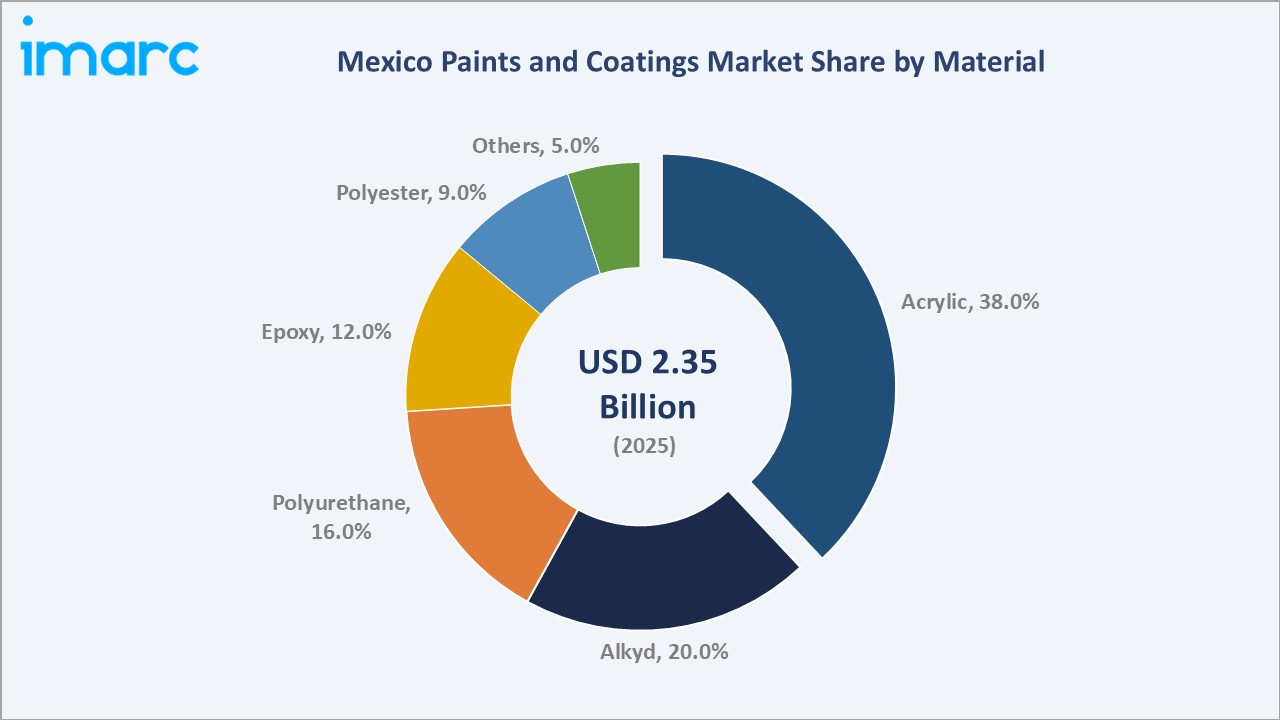
Acrylic leads by material at 38.0% in 2025, reflecting its dominant position across architectural, industrial, and automotive segments. Its superior weather resistance, broad color retention, and compatibility with waterborne formulation trends align with regulatory and commercial sustainability requirements.
To access detailed market analysis, Request Sample
Alkyd at 20.0% serves traditional solvent-borne applications in wood finishing, metal protection, and decorative enamels, with continued use in price-sensitive segments. Polyurethane at 16.0% commands a premium in industrial floor coatings, automotive refinish, and high-performance protective applications where superior flexibility and chemical resistance justify higher formulation costs. Epoxy at 12.0% serves industrial and infrastructure anti-corrosion markets. Polyester at 9.0% is primarily associated with powder coating formulations, while others at 5.0% include specialty chemistries such as silicone and fluoropolymer systems.
By Application
Architectural and decorative coatings lead at 58.0% in 2025, underpinned by Mexico's active residential construction sector and ongoing urban renovation activity. Construction commenced on 274,000 affordable homes across Mexico under the Housing for Well-Being program, which aims to build 1.8 million homes over six years and benefit nearly 7 million people, providing a consistent high-volume demand base for interior and exterior architectural paints.
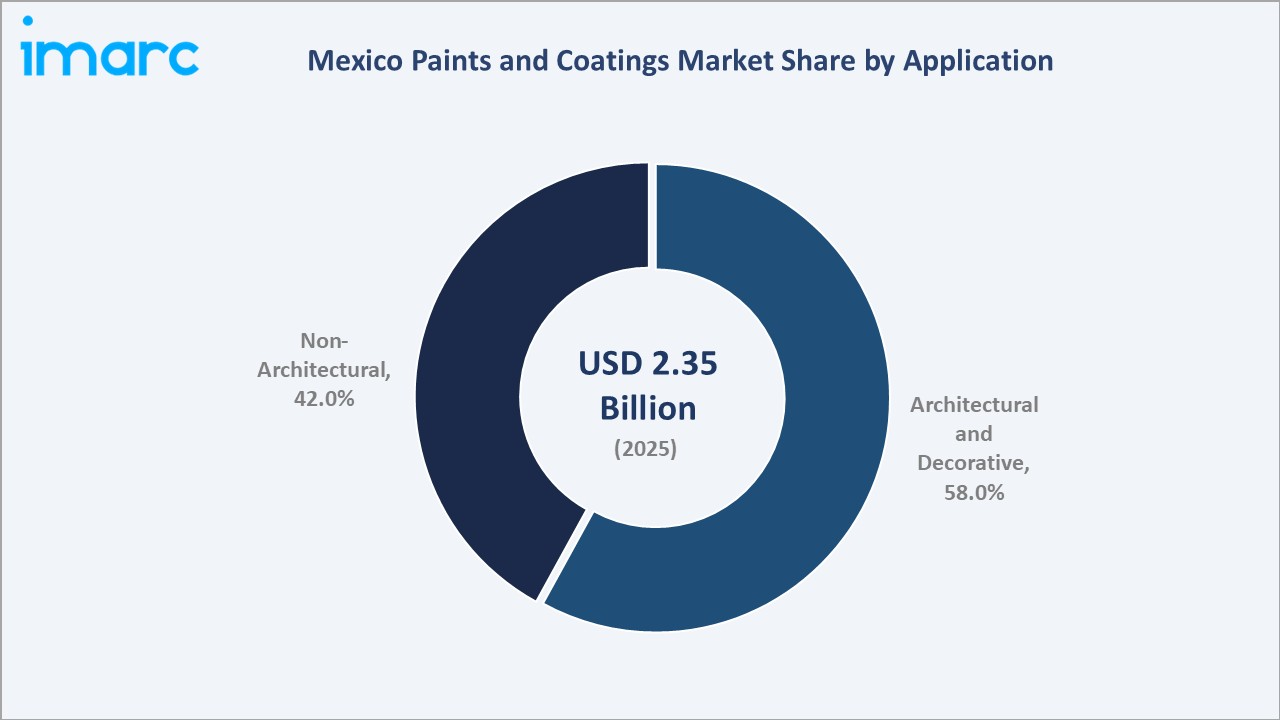
Non-architectural applications at 42.0% encompass automotive OEM and refinish coatings, general industrial, wood, marine, and protective coating applications. Mexico's position as the seventh-largest automotive producer globally makes automotive coatings a structurally significant sub-segment within non-architectural demand. Industrial coating growth is additionally supported by nearshoring-driven manufacturing investment across the Bajio corridor and Northern Mexico.
Regional Market Insights
|
Region |
Share (2025) |
Key Drivers & Characteristics |
|
Central Mexico |
52.0% |
Highest concentration of residential construction, industrial manufacturing, and commercial development, anchored by the Mexico City metropolitan area and the Bajio corridor. |
|
Northern Mexico |
28.0% |
Manufacturing concentration along the US border corridor, with high demand for industrial and automotive OEM coatings driven by automotive assembly and electronics manufacturing operations. |
|
Southern Mexico |
15.0% |
Growing residential and infrastructure construction activity, tourism facility development in coastal areas, and increasing demand for architectural coatings as regional urbanization accelerates. |
|
Others |
5.0% |
Remaining regional markets with emerging construction and industrial demand contributing incrementally to overall market growth. |
Central Mexico's dominant 52.0% regional share reflects the highest construction and industrial activity concentration across the country's economic core. Northern Mexico at 28.0% draws strength from the maquiladora manufacturing cluster and automotive assembly operations that generate consistent industrial coating demand.
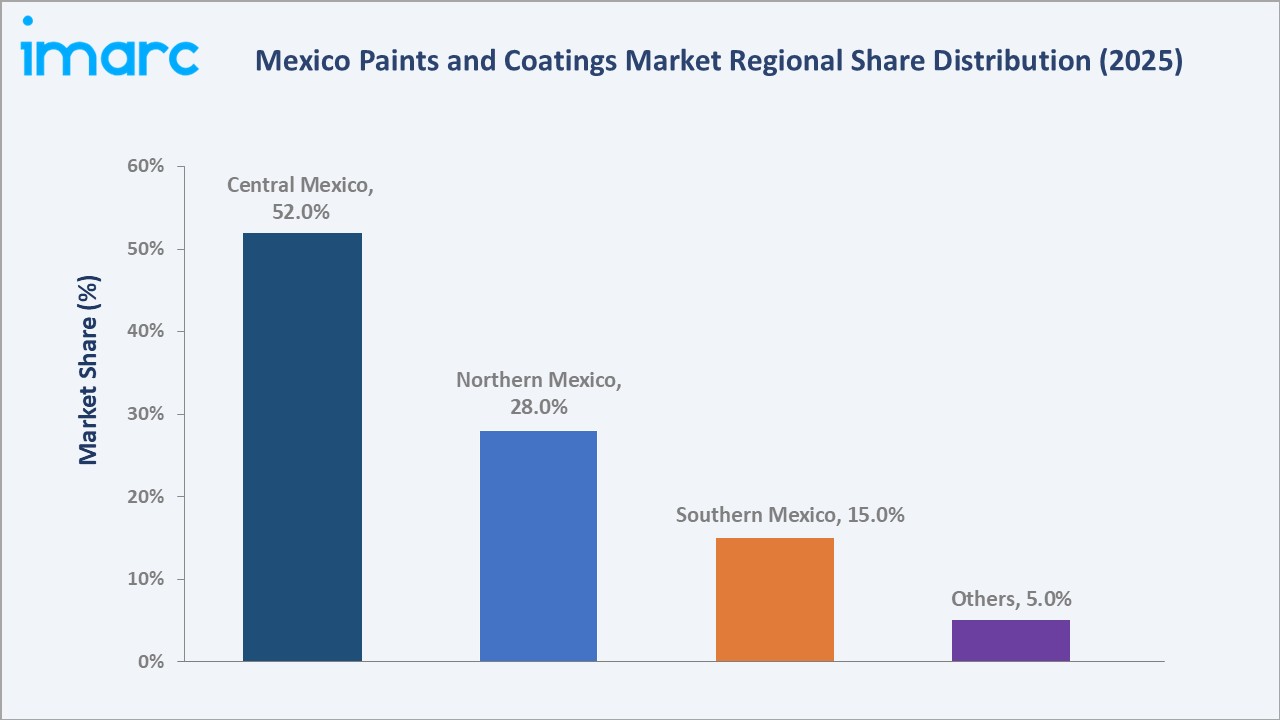
Southern Mexico at 15.0% is an emerging region with growing construction momentum driven by tourism development, infrastructure investment, and rising residential activity. Other regions account for 5.0%.
Competitive Landscape
The Mexico paints and coatings market is moderately concentrated in the premium architectural and industrial coating segments, where leading multinational players hold substantial combined market presence. The mass-market architectural segment remains more fragmented, with regional formulators competing primarily on price in localized distribution channels.
|
Company |
Key Offerings |
Market Position |
Core Strength |
| PPG Industries, Inc. | Architectural Coatings, Industrial Coatings, Industrial Powder Coatings, Packaging Coatings, Protective and Marine Coatings | Market Leader | PPG Industries, Inc. plays a major role in Mexico's paints and coatings market through an extensive network of manufacturing and automotive coating plants |
| The Sherwin-Williams Company | Interior Paint & Coatings, Exterior Paint & Coatings | Market Leader | The Sherwin-Williams Company operates in Mexico, providing architectural, industrial, and consumer paints and coatings. |
| Akzo Nobel N.V. | Alba, Armstead, Astral, Awlgrip, Bruguer, Cromadex, Cuprinol, Dulux, Flexa, Interlux, Nordsjö | Established Player | Akzo Nobel N.V. operates as a key manufacturer and supplier of paints, powder finishes, and industrial coatings across Mexico, supporting regional construction, appliances, automotive, and general manufacturing industries. |
| Jotun | Colors and Finishes | Established Player | Jotun operates in Mexico primarily focusing on high-performance colors and finishes. |
| Hempel A/S | Topaz Gloss Enamel, Hempalin Enamel 52140, Casa Diyar, Hempel's AntiFouling Globic 7000, Casa Stone Tex (HB), Hempel's Selladora | Innovator | Hempel A/S operates in Mexico, providing specialized paint and coating solutions across industrial, marine, energy, infrastructure, and decorative sectors. |
Competition in Mexico's paints and coatings market is intensifying as multinational players expand capacity and regional brands invest in product quality upgrades. Nearshoring-driven manufacturing expansion is creating new demand for industrial coatings that disproportionately benefits technically advanced multinational suppliers.
Key Company Profiles
PPG Industries, Inc.
PPG Industries, Inc. is a coatings and specialty materials company with a dominant market presence in Mexico, the country's most widely recognized architectural paint franchise. The company serves residential, commercial, industrial, and automotive markets with a broad product portfolio spanning architectural decorative paints, automotive OEM and refinish coatings, and industrial and protective coatings. Its extensive manufacturing and distribution infrastructure provides nationwide coverage.
- Key Offerings: Architectural Coatings, Industrial Coatings, Industrial Powder Coatings, Packaging Coatings, Protective and Marine Coatings.
- Strategic Focus: Strengthening architectural market leadership through distribution expansion, sustainable product development, and digital tools. The company focuses on waterborne formulation advancement and low-VOC product line development to address evolving consumer requirements.
The Sherwin-Williams Company
The Sherwin-Williams Company is a leader in the development, manufacture, and distribution of paints, coatings, and related products. The company serves residential, commercial, industrial, and automotive markets in Mexico through a broad product portfolio and strong professional contractor channel focus. Its technical service capabilities and product innovation pipeline support market positioning across premium and mid-market segments throughout Mexico.
- Key Offerings: Interior Paint & Coatings, Exterior Paint & Coatings.
- Strategic Focus: Expanding professional contractor relationships and industrial coating segment presence through technical differentiation, service capability, and sustainable product development.
Market Concentration Analysis
The Mexico paints and coatings market exhibits moderate concentration in the premium architectural and industrial coating segments, where leading multinational players hold substantial combined market presence through differentiated brand portfolios, extensive distribution networks, and significant production capacity advantages. Concentration in these segments has increased as multinational players invested in local manufacturing capacity, expanded distribution, and acquired regional brands over the past decade.
The mass-market architectural and regional industrial segments remain significantly more fragmented, with numerous small and mid-tier domestic formulators competing primarily on price in localized geographic markets. This fragmentation creates ongoing formalization opportunities for organized players with the brand equity, distribution scale, and product quality to displace informal competitors in price-sensitive volume channels.
Investment & Growth Opportunities
Highest Growth Segments
Architectural and decorative coatings at 58.0% represent the largest volume opportunity, sustained by Mexico's urbanization trend and housing construction. Eco-friendly and sustainable coating technologies represent the highest-margin growth opportunity as commercial and institutional buyers increasingly specify low-VOC and sustainable products.
Investment Themes
- Nearshoring-Driven Industrial Coating Demand: Mexico's attractiveness as a manufacturing hub is creating demand for high-performance industrial, protective, and anti-corrosion coatings in new facilities across electronics, aerospace, and automotive sectors. Investment in industrial coating production capacity offers superior volume growth and premium margin profiles through 2034.
- Sustainable and Low-VOC Coating Technologies: Investment in waterborne, powder, and radiation-curing formulation technologies addresses both regulatory compliance requirements and multinational buyer sustainability specifications. These product categories offer premium pricing power and growing long-term demand visibility across the forecast period.
Future Market Outlook (2026-2034)
The Mexico paints and coatings market grew from USD 2.35 Billion in 2025 to USD 2.47 Billion in 2026, reaching USD 3.75 Billion by 2034, exhibiting a CAGR of 5.09% during 2026-2034. The market is expected to reach approximately USD 3.01 Billion by 2030 as nearshoring-driven industrial expansion reaches peak construction activity and residential construction demand sustains broad-based volume growth across all regions.
Three structural forces will define Mexico's paints and coatings market through 2034. First, nearshoring-driven manufacturing investment will provide a sustained industrial coating demand base extending beyond traditional construction-driven demand cycles. Second, Mexico's continued urbanization will sustain architectural coating consumption at a scale requiring consistent investment in production and distribution infrastructure. Third, the progressive adoption of sustainable coating technologies, including waterborne, powder, and bio-based formulations, will gradually shift value toward higher-margin, technically differentiated products within the broader market through 2034.
Research Methodology
Primary Research
Primary research comprised structured consultations with coating manufacturing executives, construction and industrial procurement managers, automotive OEM supply chain officials, distributor networks, and professional coating contractors. These discussions validated market sizing estimates, assessed regional demand dynamics, and provided insights into competitive positioning and investment planning across Mexico.
Secondary Research
Secondary research drew on published company annual reports and investor presentations, industry association data, government trade and manufacturing statistics, and industry publications covering the Mexico paints and coatings sector. Historical market data spanning 2020 through 2025 was cross-validated across sources.
Forecasting Models
Market forecasts were developed using bottom-up and top-down modeling incorporating historical sector growth rates, construction activity projections, automotive production volume forecasts, industrial investment cycle analysis, capacity expansion announcements, and macroeconomic indicators including GDP growth and vehicle production benchmarks.
Mexico Paints and Coatings Market Report Coverage:
| Report Features | Details |
|---|---|
| Base Year of the Analysis | 2025 |
| Historical Period | 2020-2025 |
| Forecast Period | 2026-2034 |
| Units | Billion USD |
| Scope of the Report |
Exploration of Historical Trends and Market Outlook, Industry Catalysts and Challenges, Segment-Wise Historical and Future Market Assessment:
|
| Products Covered | Waterborne Coatings, Solvent-borne Coatings, Powder Coatings, High Solids/Radiation Curing, Others |
| Materials Covered | Acrylic, Alkyd, Polyurethane, Epoxy, Polyester, Others |
| Applications Covered |
|
| Regions Covered | Northern Mexico, Central Mexico, Southern Mexico, Others |
| Companies Covered | PPG Industries, Inc., The Sherwin-Williams Company, Akzo Nobel N.V., Jotun, Hempel A/S, etc. |
| Customization Scope | 10% Free Customization |
| Post-Sale Analyst Support | 10-12 Weeks |
| Delivery Format | PDF and Excel through Email (We can also provide the editable version of the report in PPT/Word format on special request) |
Key Benefits for Stakeholders:
- IMARC’s industry report offers a comprehensive quantitative analysis of various market segments, historical and current market trends, market forecasts, and dynamics of the Mexico paints and coatings market from 2020-2034.
- The research report provides the latest information on the market drivers, challenges, and opportunities in the Mexico paints and coatings market.
- Porter's five forces analysis assist stakeholders in assessing the impact of new entrants, competitive rivalry, supplier power, buyer power, and the threat of substitution. It helps stakeholders to analyze the level of competition within the Mexico paints and coatings industry and its attractiveness.
- Competitive landscape allows stakeholders to understand their competitive environment and provides an insight into the current positions of key players in the market.
Frequently Asked Questions About the Mexico Paints and Coatings Market Report
The Mexico paints and coatings market reached USD 2.47 Billion in 2026, driven by residential construction growth, automotive manufacturing demand, and rising adoption of eco-friendly coating formulations.
The market is projected to grow at a CAGR of 5.09% during 2026-2034, supported by nearshoring-driven industrial expansion, residential construction, and increasing adoption of sustainable coating technologies.
The market is projected to reach approximately USD 3.01 Billion by 2030, driven by peak nearshoring construction activity, residential housing demand, and growing industrial coating requirements.
The market is projected to reach USD 3.75 Billion by 2034, driven by sustained construction, automotive, and industrial growth alongside the shift toward premium sustainable coating formulations.
Acrylic leads with a 38.0% share in 2025, reflecting its versatility, performance advantages, and alignment with the transition to waterborne and low-VOC coating formulations across Mexico.
Architectural and decorative coatings lead with a 58.0% share in 2025, driven by residential construction, urban renovation, and commercial building activity across Mexico.
Central Mexico leads with a 52.0% share in 2025, reflecting the highest concentration of construction activity, industrial manufacturing, and population density.
Key players include PPG Industries, Inc., The Sherwin-Williams Company, Akzo Nobel N.V., Jotun, and Hempel A/S, among others.
Need more help?
- Speak to our experienced analysts for insights on the current market scenarios.
- Include additional segments and countries to customize the report as per your requirement.
- Gain an unparalleled competitive advantage in your domain by understanding how to utilize the report and positively impacting your operations and revenue.
- For further assistance, please connect with our analysts.
 Request Customization
 Speak to an Analyst
 Request Brochure
 Inquire Before Buying
Benefits of Customization
- Personalize this research
- Triangulate with your data
- Get data as per your format and definition
- Gain a deeper dive into a specific application, geography, customer, or competitor
- Any level of personalization
Get in Touch With Us
UNITED STATES
Phone: +1-201-971-6302
INDIA
Phone: +91-120-433-0800
UNITED KINGDOM
Phone: +44-753-714-6104
Email: [email protected]
Client Testimonials







Related Reports
Choose your plan
*Please note that the prices mentioned below are starting prices for each bundle type. Kindly contact our team for further details.*
Single User License
- 1 User License, Access on 2 Devices
- PDF Report + Excel Dataset (Password Protected)
- Lifetime Access
- No Printing Rights
- 10% Free Report Customization
- 10–12 Weeks of Analyst Support
Five User License
- Access for 5 Users, 2 Devices per User
- PDF Report + Excel Dataset (Password Protected)
- Lifetime Access
- Dedicated Account Manager
- 12–14 Weeks of Analyst Support
- No Printing Rights
- 15% Free Report Customization
- 25% Discount on Your Next Purchase
Corporate User License
- Unlimited User Access (Within Your Organization)
- PDF Report + Excel Dataset
- Lifetime Access
- Dedicated Account Manager
- 14–20 Weeks of Analyst Support
- No Printing Rights
- 20% Free Report Customization
- 30% Discount on Your Next Purchase
Essential Insights
What's included:
3 reports
- Lifetime Access
- PDF Reports
- Excel Datasets
- 2 Weeks of Free Analyst Support
- 2 User Licenses
- Access on 2 Devices
- Printing Rights
- Complimentary PowerPoint (PPT) Version
- Complimentary License Upgrade
Professional Access
What's included:
5 reports
- Lifetime Access
- PDF Reports
- Excel Datasets
- 8 Weeks of Free Analyst Support
- 2 User Licenses
- Access on 2 Devices
- Printing Rights
- Complimentary PowerPoint (PPT) Version
- Complimentary License Upgrade
Business Advantage
What's included:
8 reports
- Lifetime Access
- PDF Reports
- Excel Datasets
- 14 Weeks of Free Analyst Support
- 2 User Licenses
- Access on 2 Devices
- Printing Rights
- Complimentary PowerPoint (PPT) Version
- Complimentary License Upgrade
Enterprise Intelligence
What's included:
10 reports
- Lifetime Access
- PDF Reports
- Excel Datasets
- 20 Weeks of Free Analyst Support
- 2 User Licenses
- Access on 2 Devices
- Printing Rights
- Complimentary PowerPoint (PPT) Version
- Complimentary License Upgrade