
Mexico Peanut Butter Market Size, Share, Trends and Forecast by Product Type, Distribution Channel, and Region, 2026-2034
Mexico Peanut Butter Market Size, Share, Trends & Forecast (2026-2034)
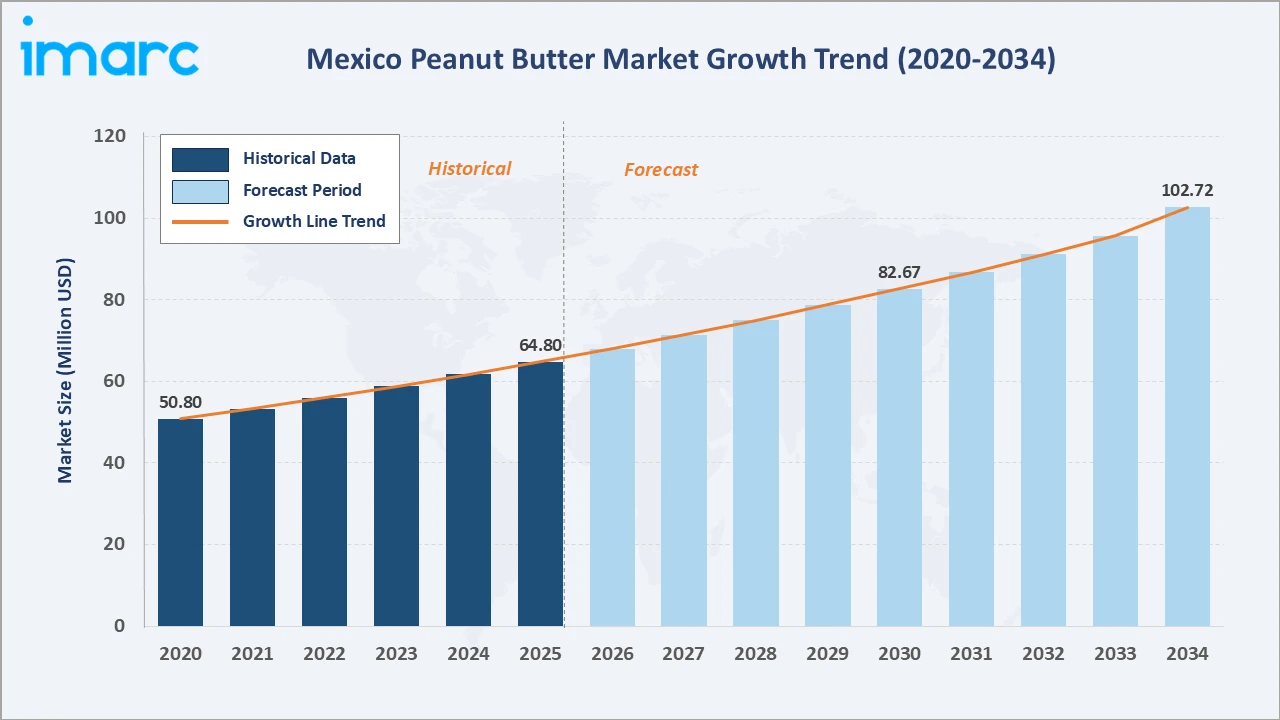
The Mexico peanut butter market grew from USD 64.80 Million in 2025 to USD 68.04 Million in 2026 and is projected to reach USD 102.72 Million by 2034, registering a CAGR of 4.99% during 2026-2034. The market is driven by rising demand for convenient and nutritious food products, growing health consciousness, and expanding retail and e-commerce distribution networks across Mexico.
Increased domestic peanut production, aggressive product launches by established international brands, and deepening penetration of modern trade formats are further supporting Mexico peanut butter market growth through the forecast period. Smooth peanut butter commands the largest product type share at 61.8%, while supermarkets and hypermarkets account for 46.7% of distribution. Central Mexico holds the dominant regional share at 44.8%.
Market Snapshot
| Metric | Value |
|---|---|
| Base Year Market Size (2025) | USD 64.80 Million |
| Market Size (2026) | USD 68.04 Million |
| Forecast Market Size (2034) | USD 102.72 Million |
| CAGR (2026-2034) | 4.99% |
| Base Year | 2025 |
| Historical Period | 2020-2025 |
| Forecast Period | 2026-2034 |
| Dominant Product Type | Smooth Peanut Butter (61.8%, 2025) |
| Leading Distribution Channel | Supermarkets & Hypermarkets (46.7%, 2025) |
| Leading Region | Central Mexico (44.8%, 2025) |
The Mexico peanut butter market size reached USD 50.80 Million in 2020 and expanded steadily to USD 64.80 Million in 2025, estimated to reach USD 68.04 Million in 2026 and USD 82.67 in 2030, and projected to attain USD 102.72 Million by 2034, at a CAGR of 4.99%.
To get more information on this market, Request Sample
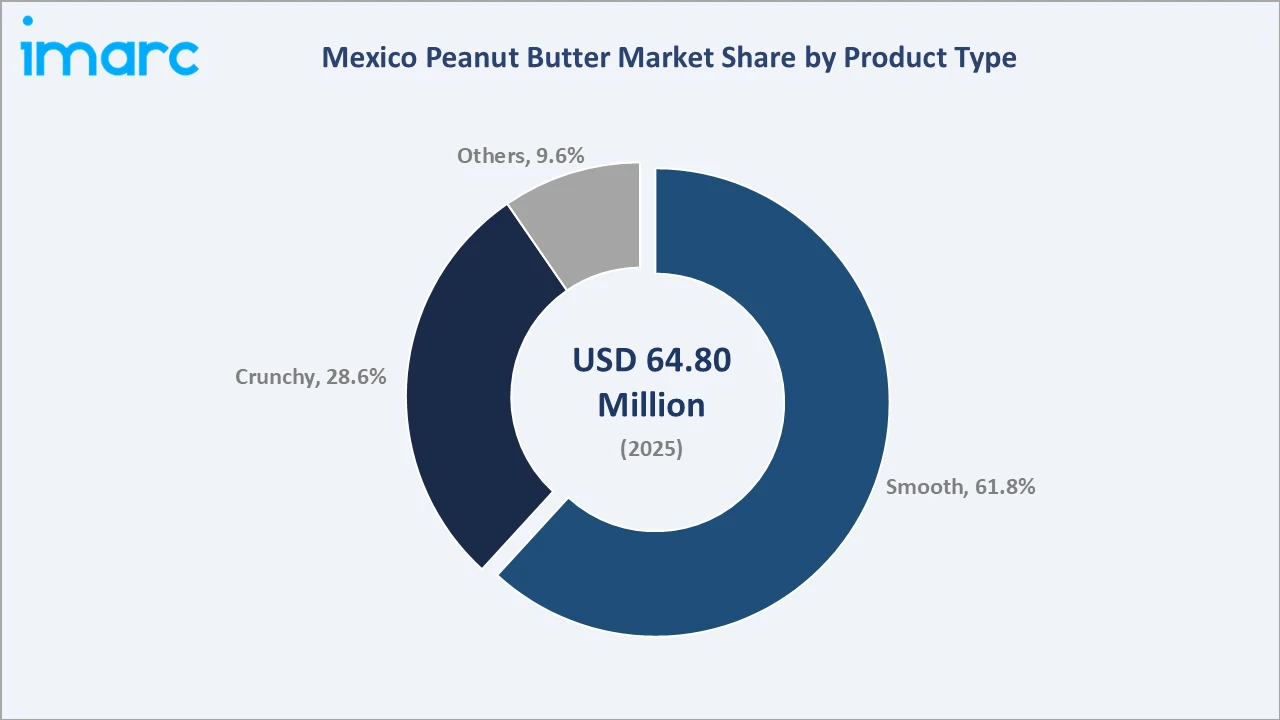
Smooth peanut butter dominates at 61.8% through broad consumer preference for creamy texture across all age groups, with premium and organic variants growing at above-market rates. Central Mexico leads regionally at 44.8%, driven by Mexico City's high urbanisation and retail density.
Executive Summary
The Mexico peanut butter market expanded from USD 64.80 Million in 2025 to an estimated USD 68.04 Million in 2026, positioning it as one of the fastest-growing packaged food spread categories in Mexico. The market is projected to reach USD 102.72 Million by 2034 at a CAGR of 4.99%, underpinned by health-conscious consumer behaviour and modern retail expansion.
Smooth peanut butter commands the largest product type share at 61.8%, while supermarkets and hypermarkets account for 46.7% of distribution. Central Mexico holds the dominant regional share at 44.8%, reflecting Mexico City's urban concentration and consumer purchasing power.
Key Market Insights
| Insight | Data |
|---|---|
| Dominant Product Type | Smooth Peanut Butter – 61.8% share (2025) |
| Leading Distribution Channel | Supermarkets & Hypermarkets – 46.7% market share (2025) |
| Leading Region | Central Mexico – 44.8% share (2025) |
| Market Opportunity | Organic & natural peanut butter; e-commerce D2C brand growth; flavoured specialty variants for health-conscious and younger consumer segments |
Key Analytical Observations Supporting the Above Data:
- Smooth Peanut Butter at 61.8%: The smooth segment dominates through versatile applications in sandwiches, baking, and direct consumption, with broad demographic appeal across all age groups. International brands including Jif and Skippy lead this segment through strong retail distribution and sustained brand equity.
- Supermarkets & Hypermarkets at 46.7%: Supermarkets and hypermarkets lead distribution through extensive product assortment, promotional pricing, and one-stop shopping convenience. Key chains including Walmart México, Chedraui, and Soriana collectively drive significant peanut butter sales volume.
- Central Mexico at 44.8%: Central Mexico dominates regionally due to Mexico City's high urbanisation, greater consumer disposable income, and well-developed modern retail infrastructure. The region records the highest per-capita peanut butter consumption in the country.
Mexico Peanut Butter Market Overview
Mexico peanut butter market is commercially positioned at a growing intersection of rising health consciousness, robust domestic peanut production, and strong consumer preference for convenient, protein-rich spreads. The market serves diverse consumer segments across urban and semi-urban geographies, from budget-conscious households to premium health-food buyers.
Mexico peanut butter ecosystem integrates domestic peanut processors, multinational brand manufacturers, national distributors, and modern retail networks. Growing e-commerce penetration and the rise of private-label brands are progressively reshaping the competitive landscape and expanding consumer access across all income segments.
Market Dynamics
To evaluate market opportunities, Request Sample
Market Drivers
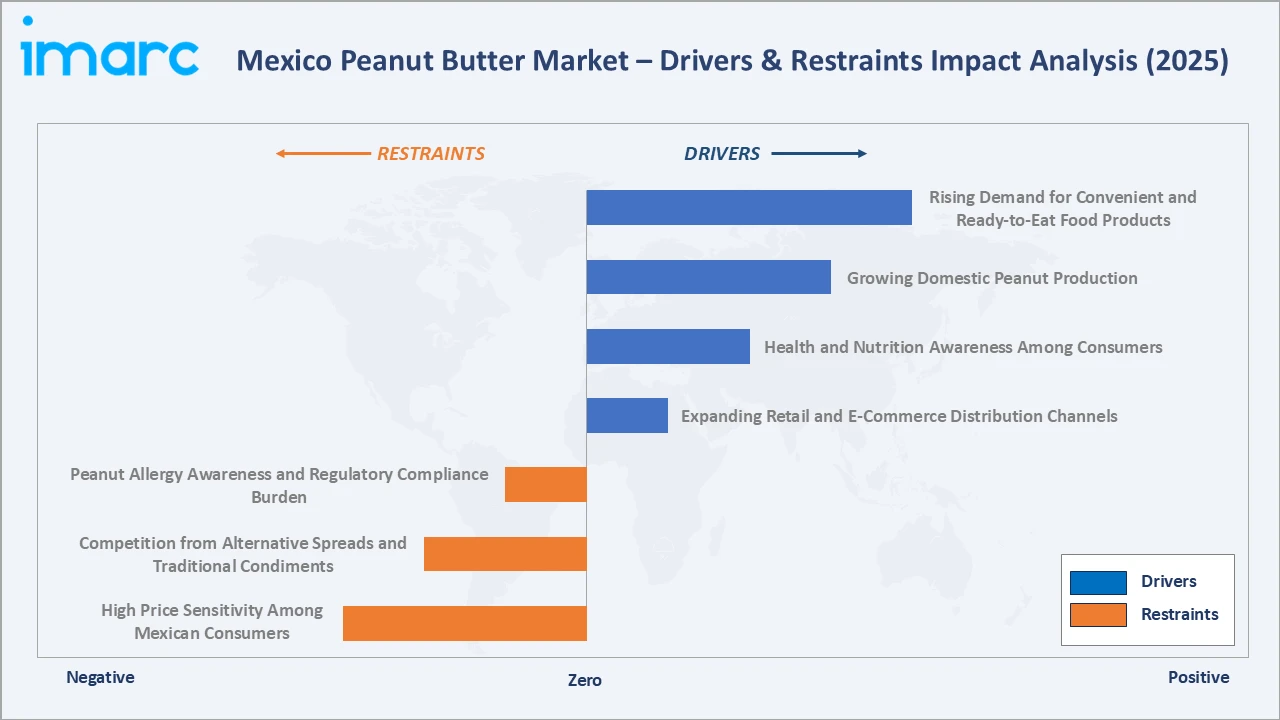
- Rising Demand for Convenient and Ready-to-Eat Food Products: The growing working population and time-pressed urban consumers are driving demand for nutritious, easy-to-consume food products. Peanut butter's versatility, long shelf life, and high protein content make it a preferred pantry staple across Mexican households. Increasing dual-income households and busy lifestyles are further reinforcing peanut butter adoption across key urban markets.
- Growing Domestic Peanut Production: Mexico's rising domestic peanut cultivation in states including Chihuahua, Sonora, and Jalisco is reducing import dependency and enabling competitive product pricing. Increased local supply supports cost-efficient manufacturing, benefiting both established and emerging peanut butter brands. Government agricultural support programmes are further incentivising domestic peanut production expansion and quality improvement.
- Health and Nutrition Awareness Among Consumers: Growing consumer awareness of peanut butter's protein content, healthy fats, and nutritional benefits is expanding its consumer base beyond traditional users. Fitness-oriented and health-conscious demographics are increasingly incorporating peanut butter into daily diets, smoothies, and meal plans. The shift toward natural and clean-label variants is further supporting premium segment growth.
- Expanding Retail and E-Commerce Distribution Channels: Proliferation of modern trade formats including supermarkets, hypermarkets, and digital marketplaces is improving product accessibility. Online grocery platforms including Mercado Libre, Amazon México, and Rappi are enabling brands to reach consumers in Tier-2 cities. Digital channel growth is creating new market penetration opportunities for domestic and international brands.
Market Restraints
- High Price Sensitivity Among Mexican Consumers: A large segment of Mexico's population remains price-sensitive, limiting the adoption of premium peanut butter products. Economic constraints restrict consumers from upgrading to higher-value organic or specialty peanut butter variants. Competitive pricing pressure from private-label alternatives further challenges branded manufacturers' ability to maintain premium price positioning.
- Competition from Alternative Spreads and Traditional Condiments: Peanut butter competes with well-established Mexican favourites including avocado-based spreads, fruit jams, and chocolate hazelnut spreads. Strong cultural preferences for traditional condiments limit mainstream peanut butter penetration in certain consumer segments. Regional food preferences create meaningful barriers to expanding peanut butter's consumer base.
- Peanut Allergy Awareness and Regulatory Compliance Burden: Growing awareness of peanut allergies and stringent COFEPRIS food labelling regulations create compliance requirements for manufacturers. Investment in allergen labelling, product segregation, and consumer education increases operational costs. Evolving NOM-051 labelling standards require ongoing product reformulation and packaging updates.
Market Opportunities
- Organic and Natural Peanut Butter Segment Growth: Rising consumer demand for clean-label, organic, and additive-free products creates premium market opportunities for specialty peanut butter brands. Health-conscious urban consumers willing to pay a price premium represent a high-value addressable market. The organic segment's above-average growth trajectory positions it as the highest-return investment category within Mexico's peanut butter market.
- Flavoured and Specialty Peanut Butter Innovation: Introduction of flavoured variants including chocolate-infused, honey-roasted, and chilli-spiced peanut butter offers product differentiation opportunities. Younger consumer demographics seeking novel taste experiences are driving demand for innovative formats. Specialty peanut butter targeting the gym and fitness community represents a rapidly expanding niche with strong repeat purchase potential.
Market Challenges
- Raw Material Price Volatility and Supply Chain Disruption: Fluctuations in peanut commodity prices, influenced by climate variability, drought conditions, and global supply chain disruptions, impact manufacturing costs and squeeze producer margins. Peanut butter manufacturers must develop agile procurement strategies and forward-contracting arrangements to manage commodity price exposure. Building strategic inventory buffers and diversifying supplier relationships remain critical operational priorities.
- Intense Competition from Private-Label and Artisanal Brands: Growing competition from private-label brands at lower price points challenges branded manufacturers' market share and pricing power. Emergence of artisanal and local peanut butter producers further fragments the competitive landscape. Branded manufacturers must invest in innovation, marketing, and consumer engagement to differentiate and justify premium positioning.
Emerging Market Trends
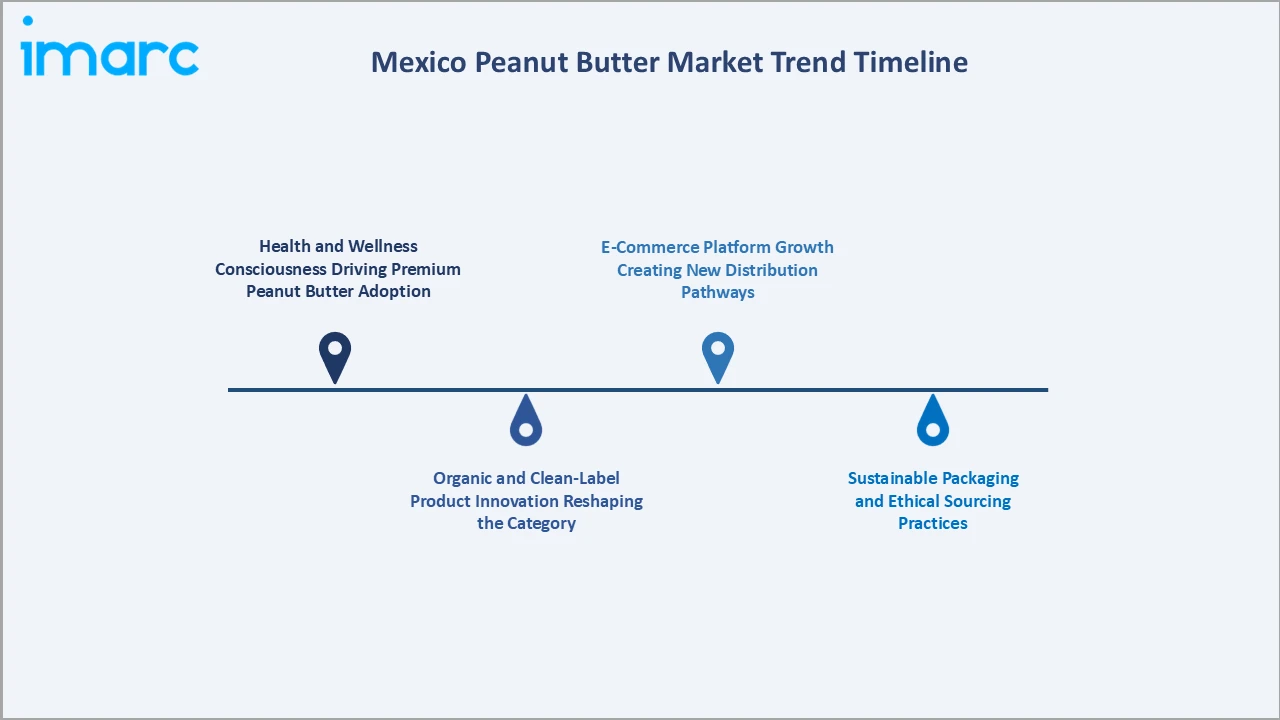
1. Health and Wellness Consciousness Driving Premium Peanut Butter Adoption
Health and wellness trend is accelerating demand for natural, sugar-free, and high-protein peanut butter variants across Mexico. Fitness enthusiasts, nutritionally aware millennials, and weight-management consumers are collectively driving premiumisation of the peanut butter segment.
2. E-Commerce Platform Growth Creating New Distribution Pathways
E-commerce channels including Mercado Libre, Amazon México, and Rappi are enabling brands to reach consumers in Tier-2 cities beyond the reach of traditional trade. Digital platforms are democratising access to premium peanut butter and enabling direct-to-consumer brand growth.
3. Organic and Clean-Label Product Innovation Reshaping the Category
Clean-label and organic peanut butter products with minimal ingredients are gaining strong consumer traction across Mexico's urban markets. Manufacturers are removing hydrogenated oils, artificial preservatives, and added sugars to meet growing demand for transparent, ingredient-conscious products.
4. Sustainable Packaging and Ethical Sourcing Practices
Sustainability in packaging and ethical peanut sourcing are increasingly influencing brand positioning and consumer purchase decisions. Manufacturers adopting recyclable packaging, reduced-plastic formats, and fair-trade sourcing practices are attracting environmentally conscious consumers and gaining retail shelf preference.
Industry Value Chain Analysis
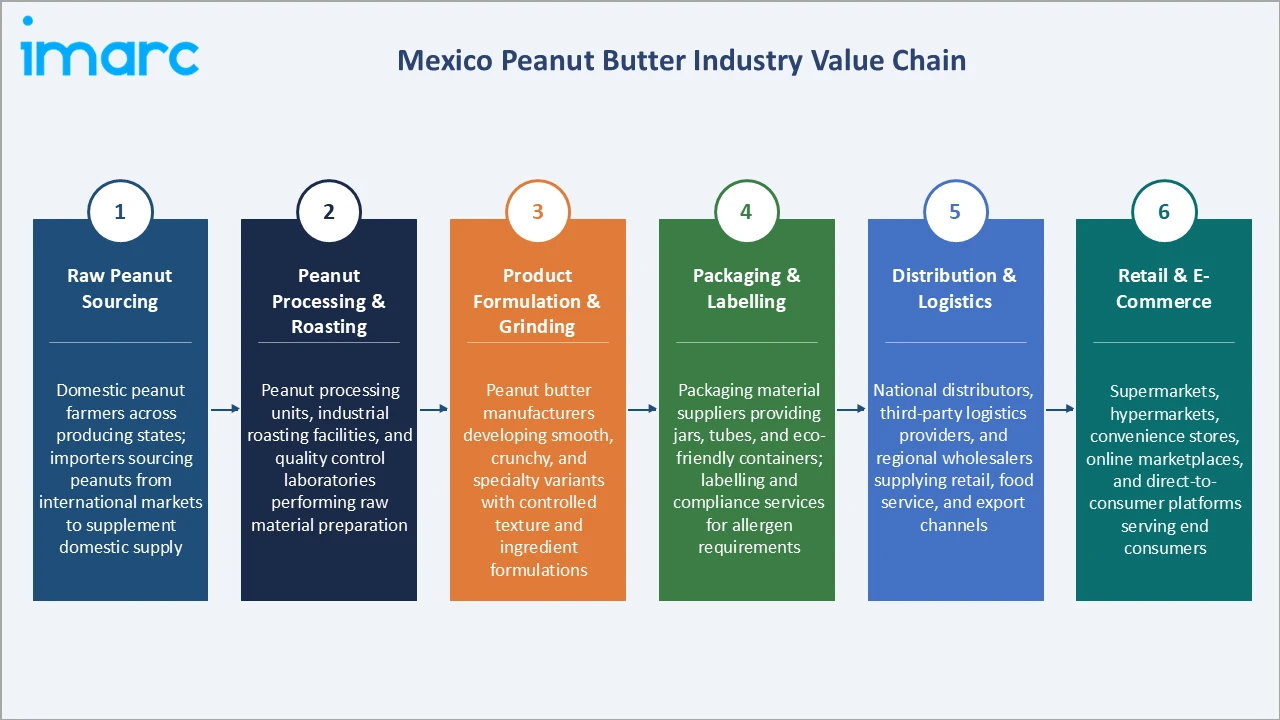
Mexico peanut butter value chain encompasses raw peanut sourcing from domestic farms, processing and roasting operations, product formulation, packaging, and retail distribution. The chain is anchored by domestic peanut cultivation in key producing states ensuring raw material supply reliability and enabling competitive product pricing.
| Stage | Key Participants |
|---|---|
| Raw Peanut Sourcing | Domestic peanut farmers across producing states; importers sourcing peanuts from international markets to supplement domestic supply |
| Peanut Processing & Roasting | Peanut processing units, industrial roasting facilities, and quality control laboratories performing raw material preparation |
| Product Formulation & Grinding | Peanut butter manufacturers developing smooth, crunchy, and specialty variants with controlled texture and ingredient formulations |
| Packaging & Labelling | Packaging material suppliers providing jars, tubes, and eco-friendly containers; labelling and compliance services for allergen requirements |
| Distribution & Logistics | National distributors, third-party logistics providers, and regional wholesalers supplying retail, food service, and export channels |
| Retail & E-Commerce | Supermarkets, hypermarkets, convenience stores, online marketplaces, and direct-to-consumer platforms serving end consumers |
The processing and manufacturing stage represents the value chain's most commercially critical segment, where peanuts are roasted, ground, and formulated into smooth or crunchy variants. Quality control, natural stabilisation, and packaging innovation at this stage determine product shelf life, texture consistency, and consumer acceptance.
Technology Landscape in the Mexico Peanut Butter Industry
Advanced Grinding and Roasting Technologies
Advanced stone-grinding and multi-stage roasting technologies enable precise texture control, enhancing both smooth and crunchy peanut butter consistency while preserving natural flavours and nutritional profiles. These technologies allow manufacturers to produce differentiated texture profiles tailored to specific consumer preferences.
Natural Stabilisation and Oil Separation Prevention
Innovation in natural stabilisers and emulsification technologies allows manufacturers to produce no-stir natural peanut butter without hydrogenated oils, meeting growing clean-label consumer expectations. These advances enable longer shelf stability while maintaining the all-natural ingredient positioning increasingly demanded by health-conscious buyers.
Packaging Innovation and Extended Shelf Life Technologies
Modified atmosphere packaging and oxygen-barrier container technologies are extending product shelf life while reducing preservative dependency. Sustainable packaging innovations including recyclable PET jars, squeezable tubes, and biodegradable options are addressing consumer demand for environmentally responsible packaging.
Market Segmentation Analysis
The report covers the following segments:
| Segment Category | Leading Segment | Market Share | Year |
|---|---|---|---|
| Product Type | Smooth Peanut Butter | 61.8% | 2025 |
| Distribution Channel | Supermarkets & Hypermarkets | 46.7% | 2025 |
| Region | Central Mexico | 44.8% | 2025 |

By Product Type
Smooth peanut butter leads at 61.8% (2025). The smooth segment serves Mexico's mainstream consumer market through its versatile applications in sandwiches, baking, smoothies, and as a direct spread. Its consistent creamy texture and ease of use drive broad demographic appeal across all age groups from children to adults.
To access detailed market analysis, Request Sample
Crunchy peanut butter at 28.6% is growing through consumer preference for textured spreads offering a distinct eating experience and perceived higher protein content. Others segment at 9.6% includes flavoured, organic, reduced-fat, and specialty variants gaining traction among health-oriented and premium consumers.
By Distribution Channel
Supermarkets and hypermarkets lead at 46.7% (2025). This channel dominates through extensive product assortment, promotional pricing visibility, and the convenience of one-stop grocery shopping. Key retail chains including Walmart México, Chedraui, and Soriana collectively account for the majority of modern trade peanut butter sales.
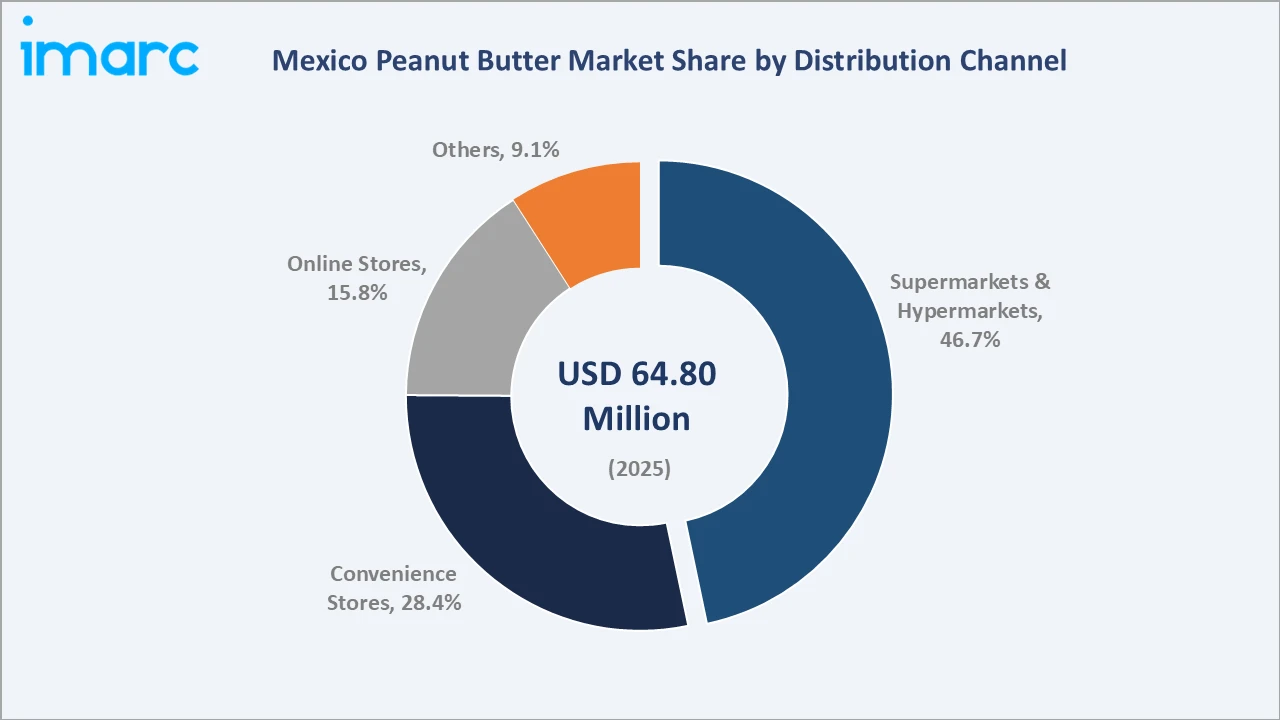
Convenience stores account for 28.4% through widespread geographic presence and impulse purchase behaviour. Online stores at 15.8% are the fastest-growing channel, driven by e-commerce adoption, home delivery growth, and digital-first consumer purchasing patterns.
Regional Market Insights
| Region | Share (2025) | Key Mexico Peanut Butter Market Drivers & Characteristics |
|---|---|---|
| Central Mexico | 44.8% | Driven by Mexico City metropolitan area's high urbanisation, concentrated modern retail infrastructure, and above-average consumer disposable income supporting premium peanut butter adoption. |
| Northern Mexico | 33.7% | Industrial cities including Monterrey and Guadalajara support strong working-class demand for convenient, protein-rich food products across supermarket and convenience store formats. |
| Southern Mexico | 16.5% | Emerging market with growing awareness of packaged food products; rising urbanisation and improving distribution networks are gradually expanding peanut butter penetration. |
| Others | 5.0% | Smaller regional markets with growing peanut butter consumption driven by tourism, cross-border trade influences, and gradual retail infrastructure development. |
Central Mexico's 44.8% market leadership reflects Mexico City's retail density, concentrated distribution hubs, and above-average consumer purchasing power within the Mexico peanut butter market. The region's well-developed cold-chain logistics infrastructure further supports efficient product supply and shelf availability.
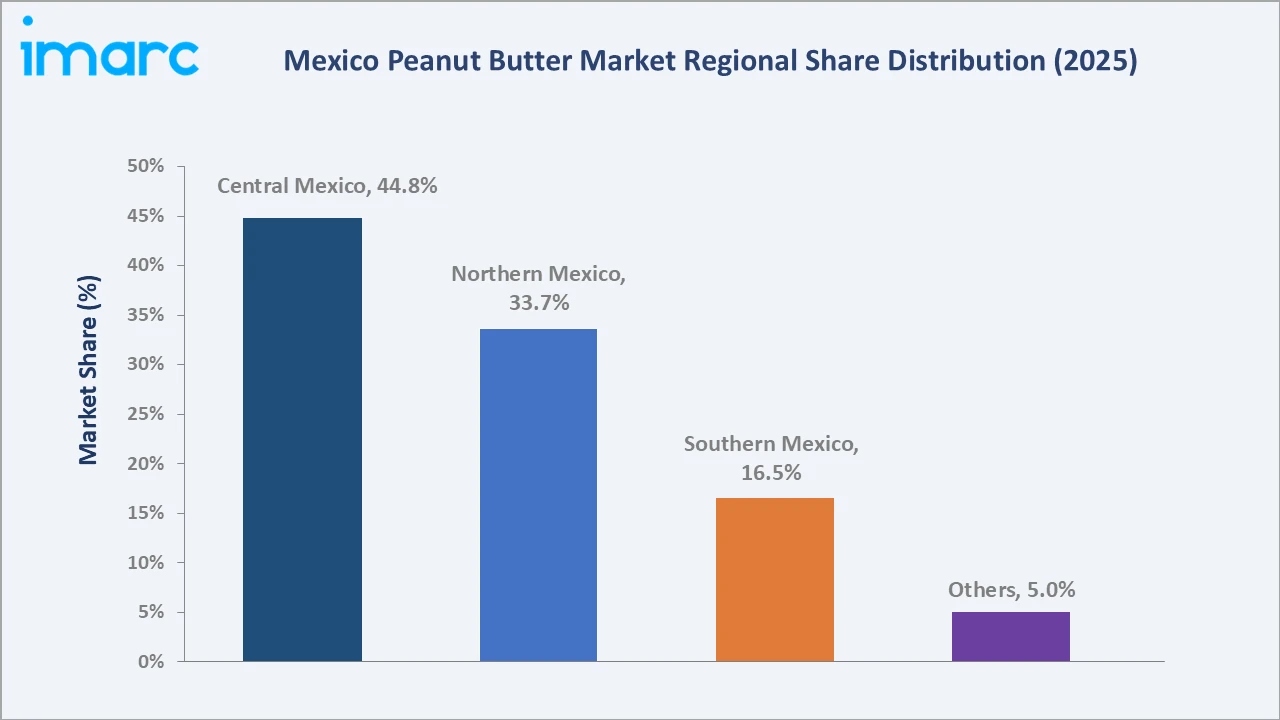
Northern Mexico's 33.7% reflects Monterrey's industrial economy and the growing middle-class consumer base across Guadalajara and Tijuana, supporting steady peanut butter market growth through modern retail and convenience store distribution channels.
Competitive Landscape
Mexico peanut butter market competitive landscape is characterised by the presence of multinational brand owners commanding dominant shelf presence alongside domestic regional players. The market is led by established global brands with deep distribution networks, supplemented by local manufacturers offering value-priced alternatives. The competitive landscape's most commercially significant dynamic is the increasing private-label penetration by major retailers offering comparable quality at lower price points, progressively challenging branded manufacturers' pricing power and requiring increased investment in product innovation and brand equity.
| Company | Key Brands | Market Position | Core Strength |
|---|---|---|---|
| The J.M. Smucker Company | Natural Peanut Butter, Organic Peanut Butter | Market Leader | Dominant brand recognition with Jif commanding strong shelf presence across Mexican supermarkets through established retail distribution partnerships and sustained consumer loyalty. |
| Hormel Foods Corporation | SKIPPY Creamy Peanut Butter, SKIPPY SUPER CHUNK Peanut Butter, SKIPPY Natural SUPER CHUNK Peanut Butter Spread, SKIPPY Creamy Peanut Butter Spread No Sugar Added | Strong Challenger | Leading global peanut butter brand with strong Mexico modern trade presence, recognised for consistent quality, innovative product formats, and broad consumer appeal. |
| Post Holdings, Inc. | Peter Pan | Niche Player | Established peanut butter brand with a century-long market heritage, Peter Pan commands strong consumer recognition through its broad product format portfolio spanning creamy, crunchy, and honey roast variants |
Key players include The J.M. Smucker Company, Hormel Foods Corporation, Post Holdings, Inc., and others.
Key Company Profiles
The J.M. Smucker Company
The J.M. Smucker Company is a leading American food and beverage company known for its iconic Jif peanut butter brand, which holds a strong market position in Mexico through established retail partnerships, consistent product quality, and sustained consumer brand loyalty.
- Key Brands: Natural Peanut Butter, Organic Peanut Butter
- Strategic Focus: Strengthening Jif brand equity through health-oriented product innovation, premiumisation of the natural and organic portfolio, and deepening retail distribution partnerships across supermarket and hypermarket chains in Mexico's major urban markets. The company is also expanding its digital marketing footprint to engage younger Mexican consumers through social media and influencer-led brand campaigns.
Hormel Foods Corporation
Hormel Foods Corporation is a multinational food company with a strong presence in Mexico through its Skippy brand, recognised for consistent quality, multiple format options, and strong consumer loyalty across urban Mexican markets, particularly in modern trade formats.
- Key Brands: SKIPPY Creamy Peanut Butter, SKIPPY SUPER CHUNK Peanut Butter, SKIPPY Natural SUPER CHUNK Peanut Butter Spread, SKIPPY Creamy Peanut Butter Spread No Sugar Added, and others
- Strategic Focus: Diversifying Skippy's peanut butter product formats through innovation including squeeze packs, protein-enriched variants, and flavoured line extensions to capture younger demographic segments and fitness-oriented consumers. Hormel is also strengthening e-commerce channel presence through strategic partnerships with online grocery platforms and direct-to-consumer digital marketing initiatives across Mexico.
Market Concentration Analysis
Mexico peanut butter market is moderately concentrated, with the top three players collectively accounting for an estimated 55-65% of the organised market through their brands through modern trade channels.
Market concentration is evolving through two competing forces: multinational brands' continued premium innovation and retail expansion versus growing private-label competition from major retailers and emerging artisanal domestic brands targeting organic and clean-label consumers. E-commerce channel growth is enabling new market entrants and further fragmenting the competitive landscape.
Investment & Growth Opportunities
Highest Growth Segments
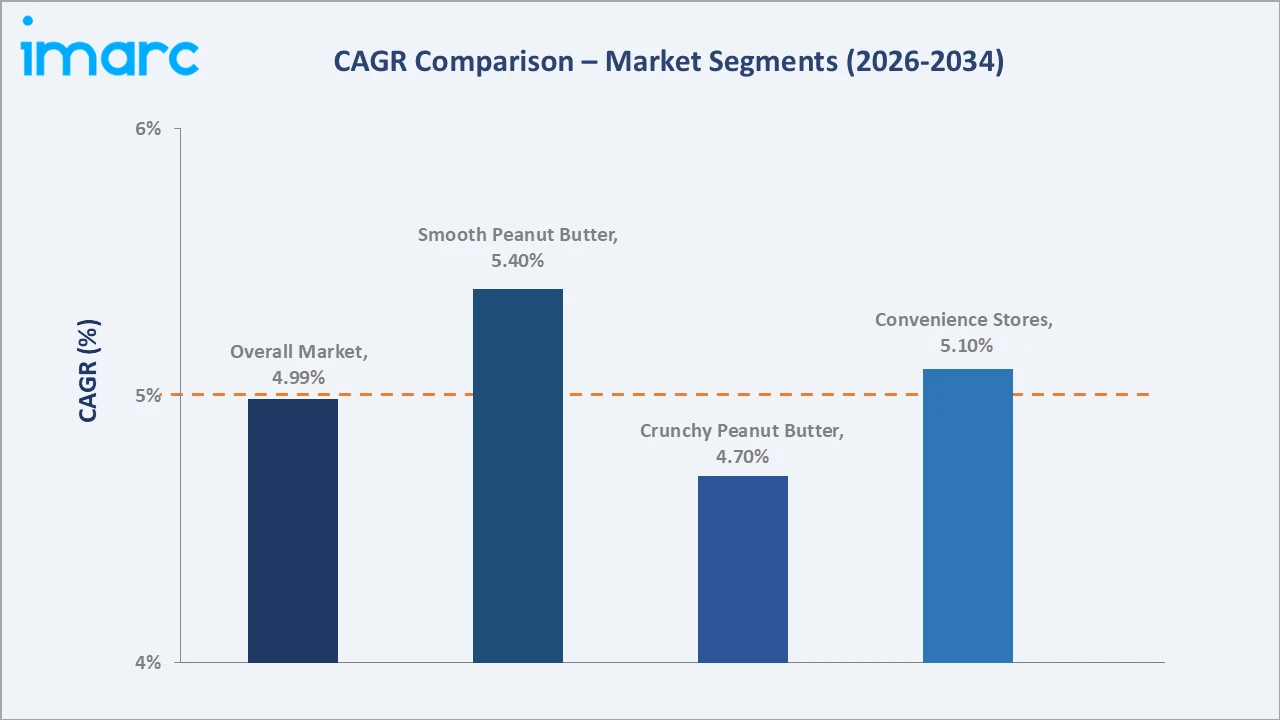
Crunchy Peanut Butter (~4.7% CAGR), convenience stores distribution channel (~5.1% CAGR), and flavoured specialty variants represent Mexico's highest-growth peanut butter segments through 2034, offering above-market returns for well-positioned manufacturers and investors.
Emerging Investment Opportunities
Mexico's growing e-commerce food market, expanding health-food retail segment, and increasing demand for private-label peanut butter products represent the market's most commercially dynamic investment themes with superior long-term return potential.
Investment Themes
- Organic and natural peanut butter manufacturing investment for Mexico's health-conscious premium consumer segment: Mexico's organic food market's above-average growth trajectory positions clean-label peanut butter as a high-return investment category with strong consumer demand.
- E-commerce and D2C peanut butter brand building for Mexico's growing digital food consumer base: Establishing direct-to-consumer peanut butter brands through social commerce, recipe marketing, and subscription models offers high-margin growth potential with lower capital requirements.
Future Market Outlook (2026-2034)
The Mexico peanut butter market is projected to grow from USD 64.80 Million in 2025 to USD 68.04 Million in 2026, reaching USD 82.67 Million by 2030 and USD 102.72 Million by 2034, registering a CAGR of 4.99% during the forecast period. Rising health awareness, retail infrastructure expansion, and domestic production growth underpin this growth trajectory.
Three structural forces define Mexico peanut butter market growth through 2034: Mexico's growing health and wellness consumer movement creating the fastest-growing premium segment; e-commerce channel growth democratising product access across underserved geographies; and domestic peanut production expansion steadily improving supply economics and product competitiveness.
Research Methodology
Primary Research
Primary research comprised structured interviews with Mexico peanut butter industry stakeholders including retail buyers, brand managers, distributors, peanut processors, and industry executives across the value chain, providing direct market intelligence and operational insights.
Secondary Research
Secondary research encompassed Mexico food trade data, USDA agricultural production statistics, company annual reports, COFEPRIS regulatory databases, industry association publications, and consumer survey data to build a comprehensive market intelligence foundation.
Forecasting Models
Market revenue forecasts were developed using consumer income stratification models, retail channel sales analytics, and demand-supply equilibrium frameworks calibrated against verified historical market performance data spanning the 2020-2025 base period.
Mexico Peanut Butter Market Report Coverage:
| Report Features | Details |
|---|---|
| Base Year of the Analysis | 2025 |
| Historical Period | 2020-2025 |
| Forecast Period | 2026-2034 |
| Units | Million USD |
| Scope of the Report |
Exploration of Historical Trends and Market Outlook, Industry Catalysts and Challenges, Segment-Wise Historical and Future Market Assessment:
|
| Product Types Covered | Smooth Peanut Butter, Crunchy Peanut Butter, Others |
| Distribution Channels Covered | Supermarkets and Hypermarkets, Convenience Stores, Online Stores, Others |
| Regions Covered | Northern Mexico, Central Mexico, Southern Mexico, Others |
| Companies Covered | The J.M. Smucker Company, Hormel Foods Corporation, Post Holdings Inc., etc. |
| Customization Scope | 10% Free Customization |
| Post-Sale Analyst Support | 10-12 Weeks |
| Delivery Format | PDF and Excel through Email (We can also provide the editable version of the report in PPT/Word format on special request) |
Key Benefits for Stakeholders:
- IMARC’s industry report offers a comprehensive quantitative analysis of various market segments, historical and current market trends, market forecasts, and dynamics of the Mexico peanut butter market from 2020-2034.
- The research report provides the latest information on the market drivers, challenges, and opportunities in the Mexico peanut butter market.
- Porter's five forces analysis assist stakeholders in assessing the impact of new entrants, competitive rivalry, supplier power, buyer power, and the threat of substitution. It helps stakeholders to analyze the level of competition within the Mexico peanut butter industry and its attractiveness.
- Competitive landscape allows stakeholders to understand their competitive environment and provides an insight into the current positions of key players in the market.
Frequently Asked Questions About the Mexico Peanut Butter Market Report
Mexico peanut butter market size reached USD 68.04 Million in 2026, driven by rising demand for convenient nutritious food products, growing health awareness among consumers, and expanding retail and e-commerce distribution networks across Mexico's major urban centres.
Mexico peanut butter market grows at a CAGR of 4.99% during 2026-2034, reaching USD 102.72 Million by 2034. Growth is sustained by health-consciousness trends, e-commerce expansion, domestic production improvements, and continued product innovation.
Smooth peanut butter leads at 61.8% (2025) through broad consumer preference for creamy texture across sandwiches, baking, smoothie applications, and direct consumption, supported by strong brand distribution and versatile usage occasions.
Supermarkets and hypermarkets lead at 46.7% (2025) through wide product assortment, promotional pricing, and consumer preference for one-stop grocery shopping at major chains including Walmart México, Chedraui, and Soriana.
Central Mexico leads at 44.8% (2025) through Mexico City's urban density, concentrated modern retail infrastructure, higher consumer purchasing power, and well-developed logistics supporting efficient product distribution.
Leading companies include The J.M. Smucker Company, Hormel Foods Corporation, Post Holdings, Inc., and others.
Mexico peanut butter market is projected to reach approximately USD 82.67 Million by 2030, with the organic and health-focused segment growing fastest as consumer wellness trends, e-commerce penetration, and domestic production scale continue to accelerate.
Need more help?
- Speak to our experienced analysts for insights on the current market scenarios.
- Include additional segments and countries to customize the report as per your requirement.
- Gain an unparalleled competitive advantage in your domain by understanding how to utilize the report and positively impacting your operations and revenue.
- For further assistance, please connect with our analysts.
 Request Customization
 Speak to an Analyst
 Request Brochure
 Inquire Before Buying
Benefits of Customization
- Personalize this research
- Triangulate with your data
- Get data as per your format and definition
- Gain a deeper dive into a specific application, geography, customer, or competitor
- Any level of personalization
Get in Touch With Us
UNITED STATES
Phone: +1-201-971-6302
INDIA
Phone: +91-120-433-0800
UNITED KINGDOM
Phone: +44-753-714-6104
Email: [email protected]
Client Testimonials




.webp)




.webp)













Related Reports

Choose your plan
*Please note that the prices mentioned below are starting prices for each bundle type. Kindly contact our team for further details.*
Single User License
- 1 User License, Access on 2 Devices
- PDF Report + Excel Dataset (Password Protected)
- Lifetime Access
- No Printing Rights
- 10% Free Report Customization
- 10–12 Weeks of Analyst Support
Five User License
- Access for 5 Users, 2 Devices per User
- PDF Report + Excel Dataset (Password Protected)
- Lifetime Access
- Dedicated Account Manager
- 12–14 Weeks of Analyst Support
- No Printing Rights
- 15% Free Report Customization
- 25% Discount on Your Next Purchase
Corporate User License
- Unlimited User Access (Within Your Organization)
- PDF Report + Excel Dataset
- Lifetime Access
- Dedicated Account Manager
- 14–20 Weeks of Analyst Support
- No Printing Rights
- 20% Free Report Customization
- 30% Discount on Your Next Purchase
Essential Insights
What's included:
3 reports
- Lifetime Access
- PDF Reports
- Excel Datasets
- 2 Weeks of Free Analyst Support
- 2 User Licenses
- Access on 2 Devices
- Printing Rights
- Complimentary PowerPoint (PPT) Version
- Complimentary License Upgrade
Professional Access
What's included:
5 reports
- Lifetime Access
- PDF Reports
- Excel Datasets
- 8 Weeks of Free Analyst Support
- 2 User Licenses
- Access on 2 Devices
- Printing Rights
- Complimentary PowerPoint (PPT) Version
- Complimentary License Upgrade
Business Advantage
What's included:
8 reports
- Lifetime Access
- PDF Reports
- Excel Datasets
- 14 Weeks of Free Analyst Support
- 2 User Licenses
- Access on 2 Devices
- Printing Rights
- Complimentary PowerPoint (PPT) Version
- Complimentary License Upgrade
Enterprise Intelligence
What's included:
10 reports
- Lifetime Access
- PDF Reports
- Excel Datasets
- 20 Weeks of Free Analyst Support
- 2 User Licenses
- Access on 2 Devices
- Printing Rights
- Complimentary PowerPoint (PPT) Version
- Complimentary License Upgrade