
Mexico Perfume Market Size, Share, Trends and Forecast by Perfume Type, Category, and Region, 2026-2034
Mexico Perfume Market Size, Share, Trends & Forecast (2026-2034)
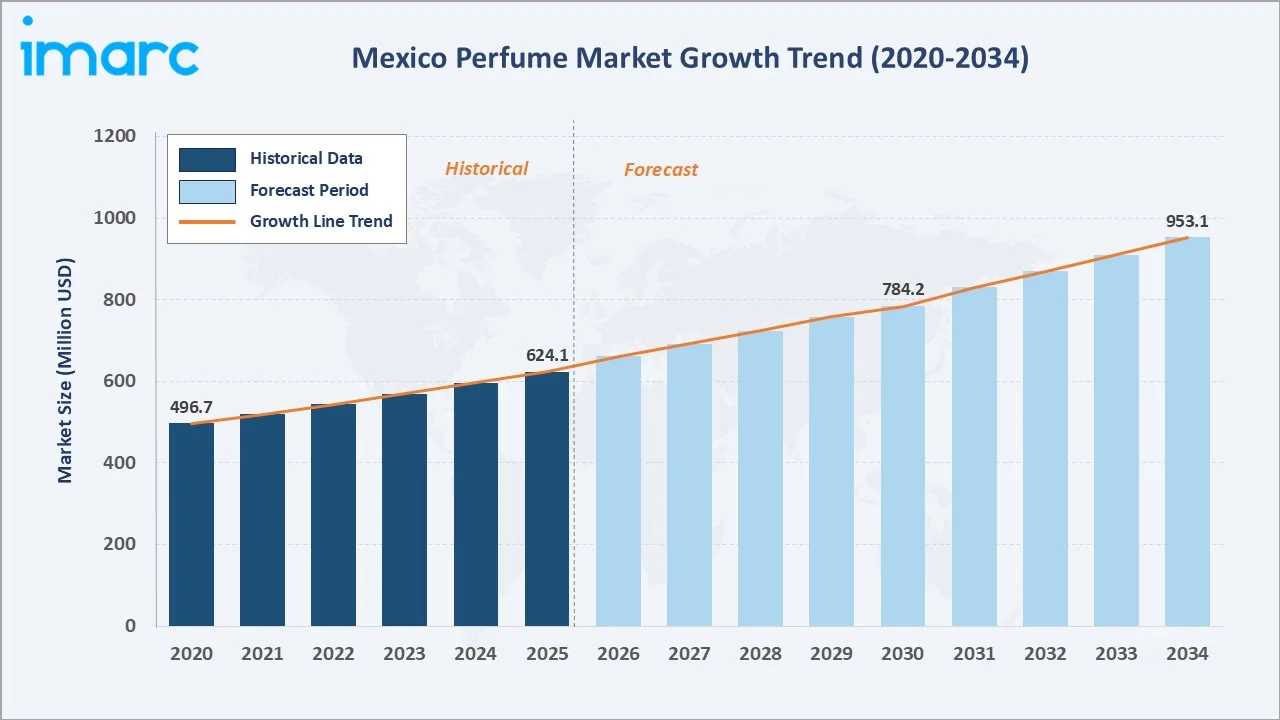
The Mexico perfume market grew from USD 624.1 Million in 2025 to USD 661.4 Million in 2026 and is projected to reach USD 953.1 Million by 2034, growing at a CAGR of 4.67% during 2026-2034. The market is witnessing steady expansion, fueled by rising disposable incomes, growing personal care consciousness, and the deepening penetration of international fragrance brands across modern retail and digital channels.
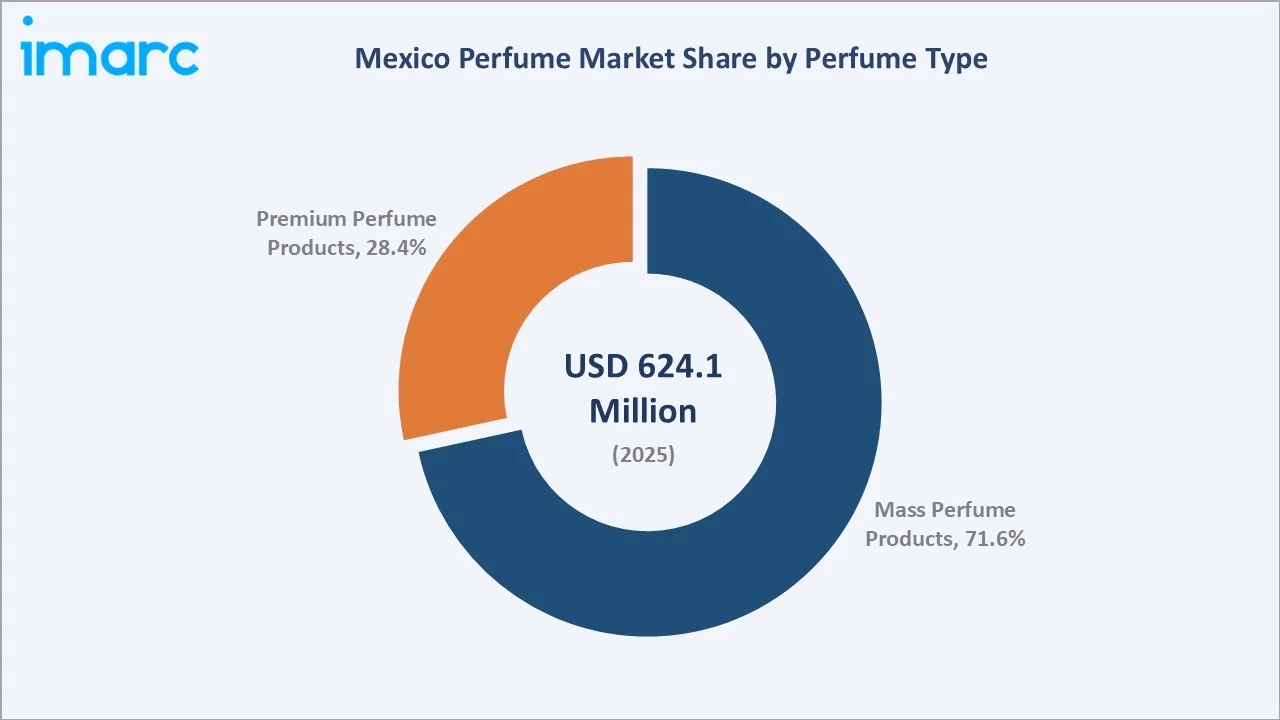
Mass perfume products prevail over the perfume type segment with 71.6% share, female fragrances lead the category at 48.7%, while Central Mexico commands 45.6% of the regional market.
Market Snapshot
|
Metric |
Value |
|
Base Year Market Size (2025) |
USD 624.1 Million |
|
Market Size (2026) |
USD 661.4 Million |
|
Forecast Market Size (2034) |
USD 953.1 Million |
|
CAGR (2026-2034) |
4.67% |
|
Base Year |
2025 |
|
Historical Period |
2020-2025 |
|
Forecast Period |
2026-2034 |
|
Largest Region |
Central Mexico (45.6%, 2025) |
|
Second Largest Region |
Northern Mexico (33.4%, 2025) |
|
Leading Perfume Type |
Mass Perfume Products (71.6%, 2025) |
|
Leading Category |
Female Fragrances (48.7%, 2025) |
The Mexico perfume market size increased from USD 496.7 Million in 2020 to USD 624.1 Million in 2025 and is estimated to reach USD 661.4 Million in 2026. The market is further expected to grow to USD 784.2 Million by 2030 and USD 953.1 Million by 2034. The market growth is directly driven by rising consumer spending on personal grooming, increasing demand for premium and branded fragrances, and the growing popularity of perfumes among younger consumers.
To get more information on this market, Request Sample
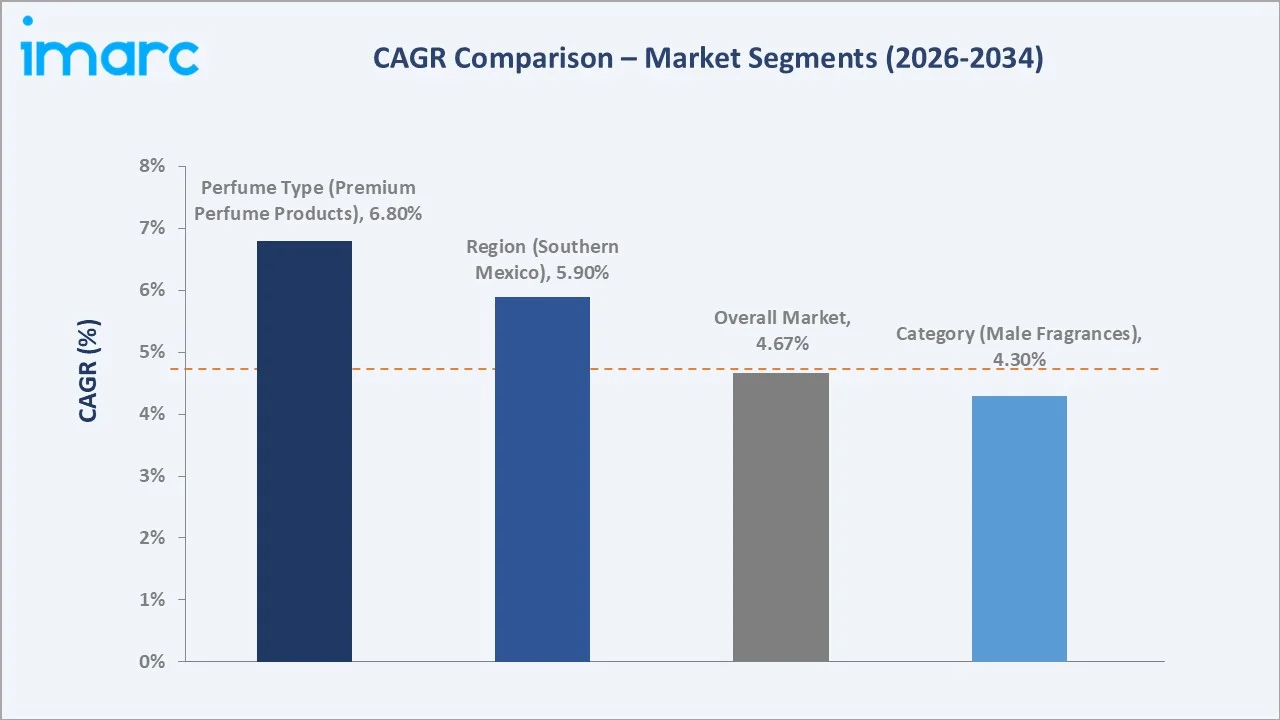
CAGR trajectories across perfume type and category sub-segments, along with regional patterns, show premium perfume products and unisex fragrances expanding faster than the overall 4.67% market CAGR, driven by evolving consumer preferences, rising affluence among urban millennials, and the growing influence of social media on fragrance discovery.
Executive Summary
The Mexico perfume market expanded from USD 624.1 Million in 2025 to an estimated USD 661.4 Million in 2026. The industry has evolved from largely informal sales and grey market imports to a structured retail landscape featuring department store chains, specialty beauty retailers, pharmacy chains, and a rapidly growing online channel.
Mass perfume products lead with a 71.6% share in 2025, supported by broad affordability and wide retail distribution. Female fragrances command 48.7% of the category split in 2025, anchored by well-established heritage brands and steady seasonal demand around key gifting events. Central Mexico dominates regionally at 45.6%, led by Mexico City's dense retail ecosystem and large urban consumer base.
Key Market Insights
|
Insight |
Data |
|
Leading Perfume Type |
Mass Perfume Products – 71.6% share (2025) |
|
Second Largest Perfume Type |
Premium Perfume Products – 28.4% share (2025) |
|
Leading Category |
Female Fragrances – 48.7% share (2025) |
|
Second Largest Category |
Male Fragrances – 38.5% share (2025) |
|
Leading Region |
Central Mexico – 45.6% share (2025) |
|
Second Largest Region |
Northern Mexico – 33.4% share (2025) |
|
Top Companies |
L'Oréal S.A., Coty Inc., Puig S.L., Revlon Group Holdings LLC |
Key Analytical Observations Expanding On the Data Above:
- Mass perfume products leadership at 71.6% is underpinned by broad affordability, wide distribution across pharmacies, supermarkets, and direct-sales channels, and consistent demand from middle-income consumers across urban and semi-urban areas.
- Premium perfume products at 28.4% reflect growing aspirational spending and the increasing presence of international luxury and prestige fragrance houses within Mexican department stores and specialty retailers.
- Female fragrances lead at 48.7% in 2025, supported by established brand loyalty, high gifting demand during Mother's Day and Valentine's Day, and the broader beauty category's strong female consumer orientation in Mexico.
- Male fragrances at 38.5% share are supported by rising interest in personal grooming, increasing fragrance usage among younger male consumers, and growing demand for everyday and premium scents.
- Central Mexico at 45.6% dominates the regional landscape, anchored by Mexico City's role as the country's commercial and retail hub, housing flagship stores of major domestic and international fragrance brands.
Mexico Perfume Market Overview
Perfume refers to fragrant liquid preparations containing essential oils, aroma compounds, fixatives, and solvents, applied to the body, clothing, or living spaces to produce a pleasant and lasting scent. Products in the Mexico perfume market range from mass-market eau de cologne and body mists to premium eau de parfum and luxury extrait de parfum formulations, spanning multiple price points and consumer occasions.
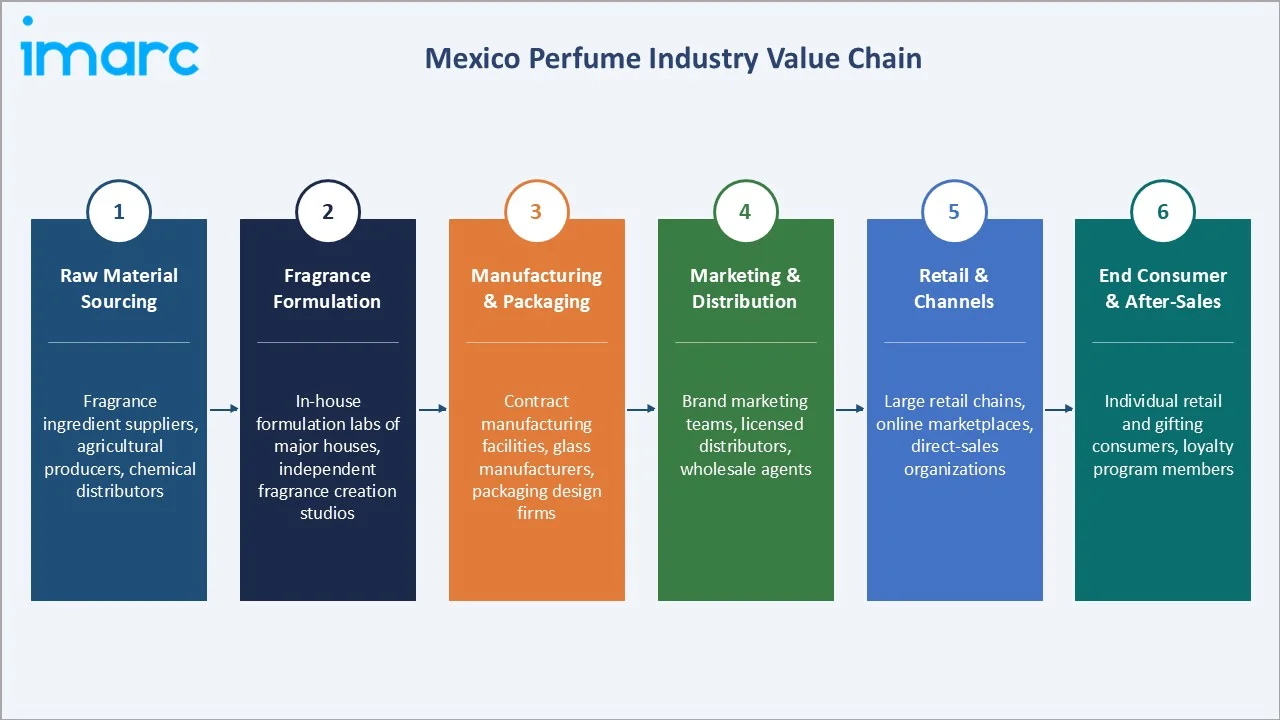
The Mexican fragrance ecosystem integrates raw material suppliers, including natural floral, citrus, and wood-based aromatic inputs alongside synthetic aroma chemicals, with fragrance formulation laboratories, international and domestic manufacturers, licensed importers, marketing distributors, and retail channels spanning department stores, pharmacy chains, specialty beauty stores, direct-sales networks, and e-commerce platforms.
Market Dynamics
To evaluate market opportunities, Request Sample
Market Drivers
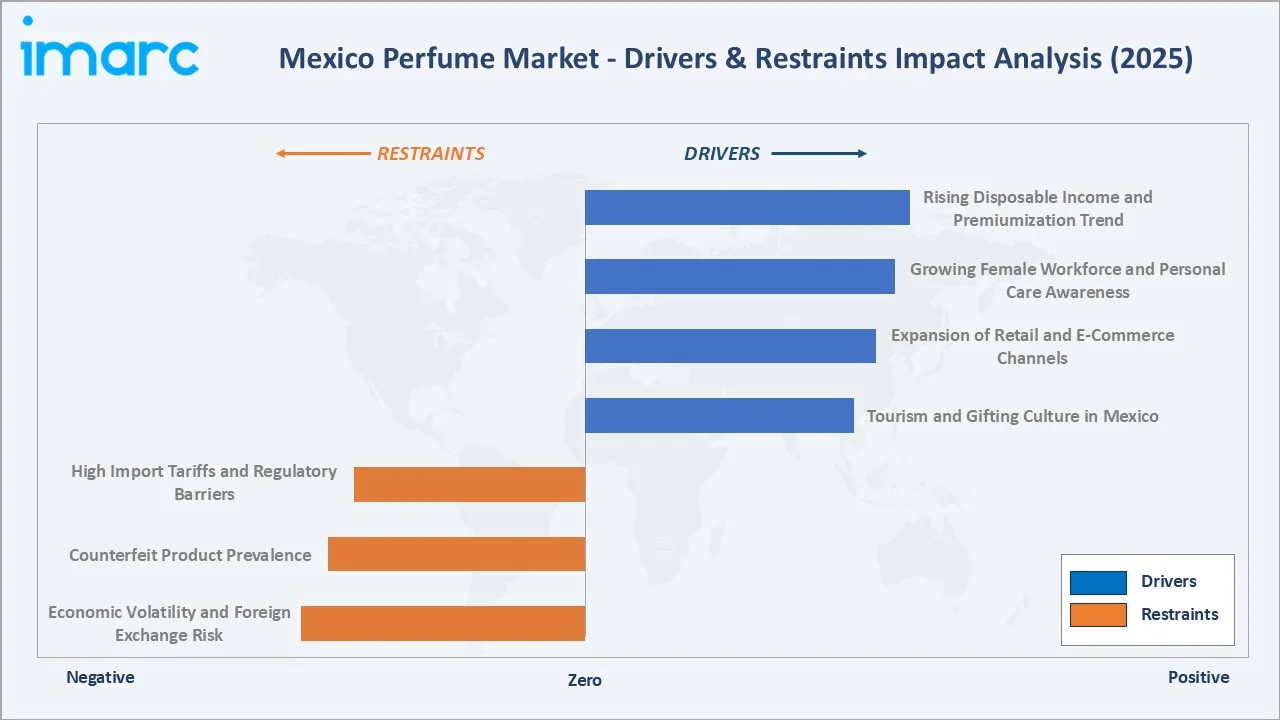
- Rising Disposable Income and Premiumization Trend: Expanding middle-class purchasing power across Mexico's urban centers is driving sustained demand for fragrances at multiple price tiers. Consumers are progressively trading up from basic body sprays to mid-range and premium eau de parfum formulations, supporting above-average growth in the premium segment.
- Growing Female Workforce and Personal Care Awareness: Mexico's increasing female labor force participation rate is translating into higher independent spending on personal care, beauty, and fragrance categories. According to INEGI's 2025 Intercensal Survey, women's economic participation in Mexico reached 41% in 2025, an increase of 2.2 percentage points from 2020.
- Expansion of Retail and E-Commerce Channels: The proliferation of specialty beauty retailers, pharmacy-based beauty counters, and online direct-to-consumer platforms is expanding fragrance accessibility across income groups and geographic markets.
- Tourism and Gifting Culture in Mexico: Mexico's large domestic tourism sector, combined with a strong cultural emphasis on gifting during festivals, Mother's Day, Valentine's Day, and Christmas, creates recurring high-demand cycles for premium and gift-packaged fragrances. In 2025, Mexico hosted a historic 47.79 Million foreign visitors. Duty-free and travel retail channels at major airports further boost premium fragrance exposure and trial.
Market Restraints
- High Import Tariffs and Regulatory Barriers: Mexico applies tariffs on imported fragrance products and cosmetics, increasing the landed cost of international brands and creating price competitiveness challenges for premium product tiers relative to regional alternatives.
- Counterfeit Product Prevalence: The prevalence of counterfeit and grey-market fragrances in Mexico's informal retail sector poses a significant challenge to established brands, eroding consumer confidence and compressing price realization for authentic products across mass and premium channels alike.
- Economic Volatility and Foreign Exchange Risk: Peso depreciation and macroeconomic volatility increase the cost of imported fragrance inputs and finished products, constraining consumer spending and compressing margins for importers and distributors during periods of currency weakness.
Market Opportunities
- Premiumization in Tier-2 Cities: Cities including Puebla, Querétaro, León, and Mérida are experiencing rapid retail expansion and rising middle-class income levels, creating significant untapped opportunity for fragrance brands targeting aspirational consumers outside major metropolitan centers.
- Growth of Direct-Sales and Social Commerce Models: Direct-sales networks have historically been a significant fragrance distribution channel in Mexico. The integration of social media, influencer marketing, and live-commerce into direct-sales models is opening new growth avenues for both established players and niche entrants.
Market Challenges
- Consumer Sensitivity to Price Points: The market is price-sensitive across mass and premium segments, with consumers frequently trading down during periods of economic stress. Maintaining brand equity while managing retail price positioning is an ongoing challenge for international fragrance brands operating in the market.
- Preference for Familiar Scent Profiles: Mexican consumers tend to favor well-known, recognizable fragrance families, particularly florals, orientals, and fresh aquatics, which can limit market acceptance for niche, unconventional, or experimental scent compositions introduced by emerging fragrance houses.
Emerging Market Trends
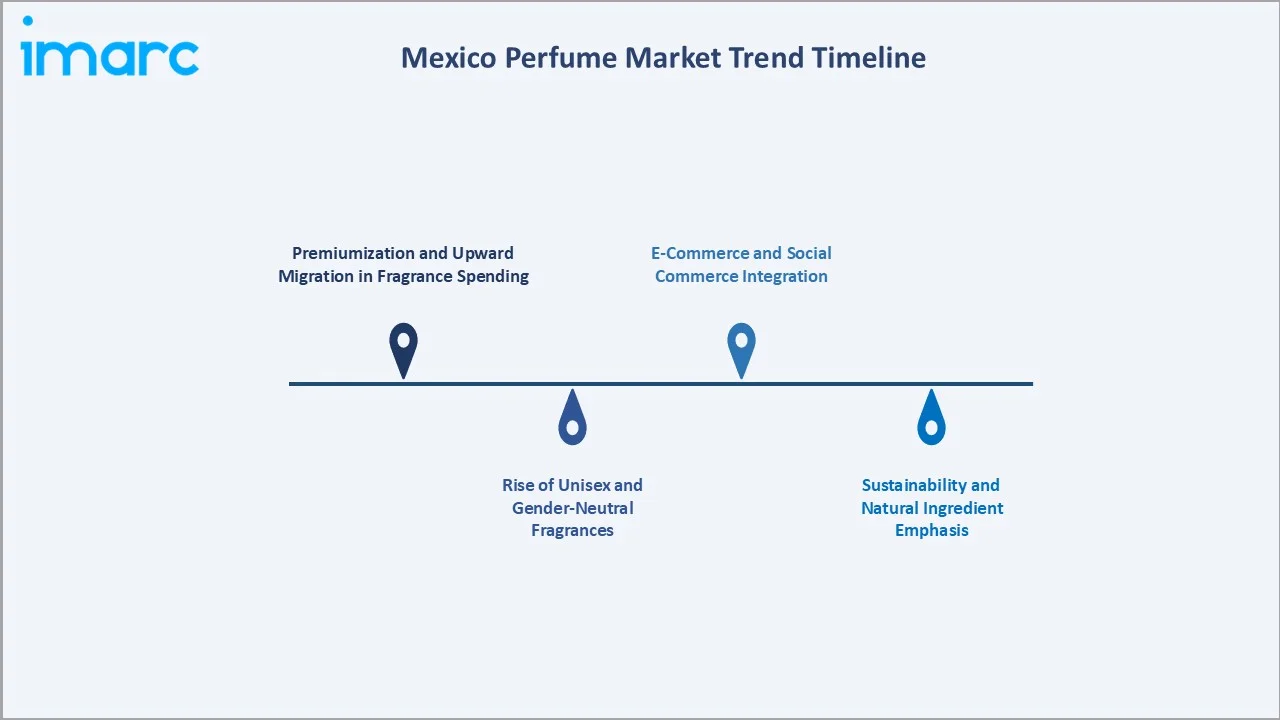
1. Premiumization and Upward Migration in Fragrance Spending
Mexico's growing urban middle class is increasingly purchasing mid-range and premium fragrances, shifting household fragrance budgets away from purely mass-market body sprays toward longer-lasting, higher-concentration eau de parfum formulations. Department stores and specialty beauty retailers are responding by expanding their prestige fragrance floor space.
2. Rise of Unisex and Gender-Neutral Fragrances
Younger Mexican consumers, particularly millennials and Gen Z, are driving meaningful growth in the unisex fragrance sub-segment. The trend reflects a broader shift toward inclusive beauty norms, and brands entering with gender-fluid positioning, whether through minimalist packaging or shared scent profiles, are gaining traction among urban, style-conscious consumers.
3. E-Commerce and Social Commerce Integration
Online fragrance retail in Mexico has expanded significantly, with digital platforms and brand direct-to-consumer websites accounting for a growing share of fragrance sales. Social media platforms are being used effectively by both established brands and indie fragrance labels to educate and engage consumers, creating a new discovery path for the category.
4. Sustainability and Natural Ingredient Emphasis
Consumer interest in natural, sustainably sourced fragrance ingredients is gradually entering the Mexico market, particularly among premium and niche brands targeting environmentally aware urban consumers. Certifications for vegan, cruelty-free, and eco-packaged fragrances are increasingly being adopted by brands seeking to differentiate within the premium channel.
Industry Value Chain Analysis
The Mexico perfume industry value chain spans six stages, from raw material sourcing through end consumer engagement and after-sales lifecycle management. Fragrance formulation, manufacturing and packaging, and retail distribution capture the highest value-add stages, while raw material sourcing and direct-sales channels provide critical upstream and downstream linkages.
|
Stage |
Key Players / Examples |
|
Raw Material Sourcing |
Fragrance ingredient suppliers, agricultural producers, chemical distributors |
|
Fragrance Formulation |
In-house formulation labs of major houses, independent fragrance creation studios |
|
Manufacturing & Packaging |
Contract manufacturing facilities, glass manufacturers, packaging design firms |
|
Marketing & Distribution |
Brand marketing teams, licensed distributors, wholesale agents |
|
Retail & Channels |
Large retail chains, online marketplaces, direct-sales organizations |
|
End Consumer & After-Sales |
Individual retail and gifting consumers, loyalty program members |
Vertically integrated global fragrance houses that control formulation, manufacturing, and retail distribution are positioned to capture the greatest margin concentration. Their integrated operating models also provide greater control over product quality, brand positioning, pricing, and supply chain efficiency.
Technology Landscape in the Mexico Perfume Industry
Fragrance Formulation and AI-Assisted Creation
AI and machine learning tools are increasingly being adopted by leading fragrance houses for scent development and consumer preference mapping. AI-assisted formulation tools analyze consumer feedback, purchasing patterns, and trend data to accelerate new fragrance development cycles while reducing dependence on lengthy traditional trial-and-error processes.
E-Commerce Personalization and Virtual Try-On
Digital retail platforms are deploying AI-powered fragrance recommendation engines and virtual try-on tools that help consumers navigate large fragrance portfolios without physical sampling. These technologies are particularly relevant for Mexico's growing online fragrance channel, reducing purchase hesitation and improving conversion rates.
Sustainable Formulation and Biotechnology
Advances in biotechnology are enabling fragrance producers to develop sustainably sourced alternatives to traditional natural ingredients, including lab-grown musks, bio-based aroma chemicals, and fermentation-derived fragrance molecules. These innovations reduce dependency on price-volatile natural inputs and align with growing consumer demand for sustainable beauty products.
Smart Packaging and Anti-Counterfeiting Technology
Brand owners are investing in smart packaging solutions, including QR-code authentication, NFC-enabled packaging, and serialized labeling, to combat Mexico's counterfeit fragrance challenge. These technologies allow consumers to verify product authenticity at point of purchase and support brands in protecting their intellectual property.
Market Segmentation Analysis
The report covers the following segments:
|
Segment Category |
Leading Segment |
Market Share |
Year |
|
Perfume Type |
Mass perfume products |
71.6% |
2025 |
|
Category |
Female fragrances |
48.7% |
2025 |
|
Region |
Central Mexico |
45.6% |
2025 |

By Perfume Type
Mass perfume products command a 71.6% majority share in 2025, driven by broad consumer accessibility, wide distribution across pharmacy chains, supermarkets, and direct-sales networks, and consistent demand from middle-income consumers across Mexico's urban and semi-urban markets.
To access detailed market analysis, Request Sample
Premium perfume products at 28.4% in 2025 are gaining momentum as urbanization deepens and aspirational spending on personal care rises. The segment is characterized by international prestige house brands, luxury gift sets, and a growing niche fragrance category catering to Mexico's style-conscious urban consumers.
By Category
Female fragrances lead the category split at 48.7% in 2025, reflecting Mexico's established female fragrance culture, high brand loyalty, and consistent seasonal demand during major gifting events.
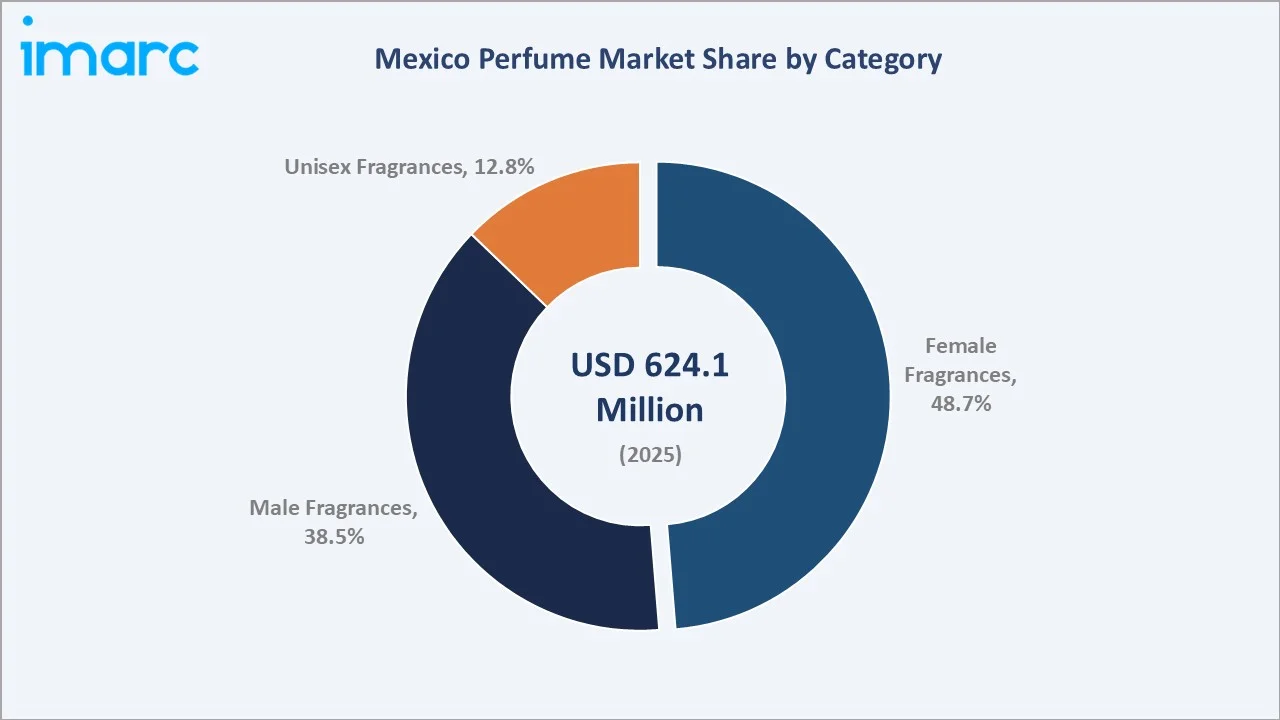
Male fragrances account for 38.5% in 2025, supported by growing male personal grooming awareness and the expanding presence of men's fragrance lines within mass and premium retail channels.
Regional Market Insights
|
Region |
Share (2025) |
Key Growth Drivers |
|
Central Mexico |
45.6% |
Large metropolitan consumer base, high retail concentration, strong gifting demand and seasonal purchase cycles |
|
Northern Mexico |
33.4% |
High per-capita incomes, cross-border retail influence, industrial city growth, expanding premium channel |
|
Southern Mexico |
16.0% |
Rising tourism demand, urban population growth, expanding formal retail, emerging gifting culture |
|
Others |
5.0% |
Rural and smaller urban market fragrance demand, direct-sales channel penetration, informal retail |
Central Mexico at 45.6% in 2025 dominates the regional landscape, anchored by Mexico City's position as the country's leading consumer market and commercial hub. The region benefits from the high concentration of modern retail formats, flagship fragrance stores, department store chains, and specialty beauty retailers, driving above-average per-capita fragrance spending and strong seasonal gifting cycles.
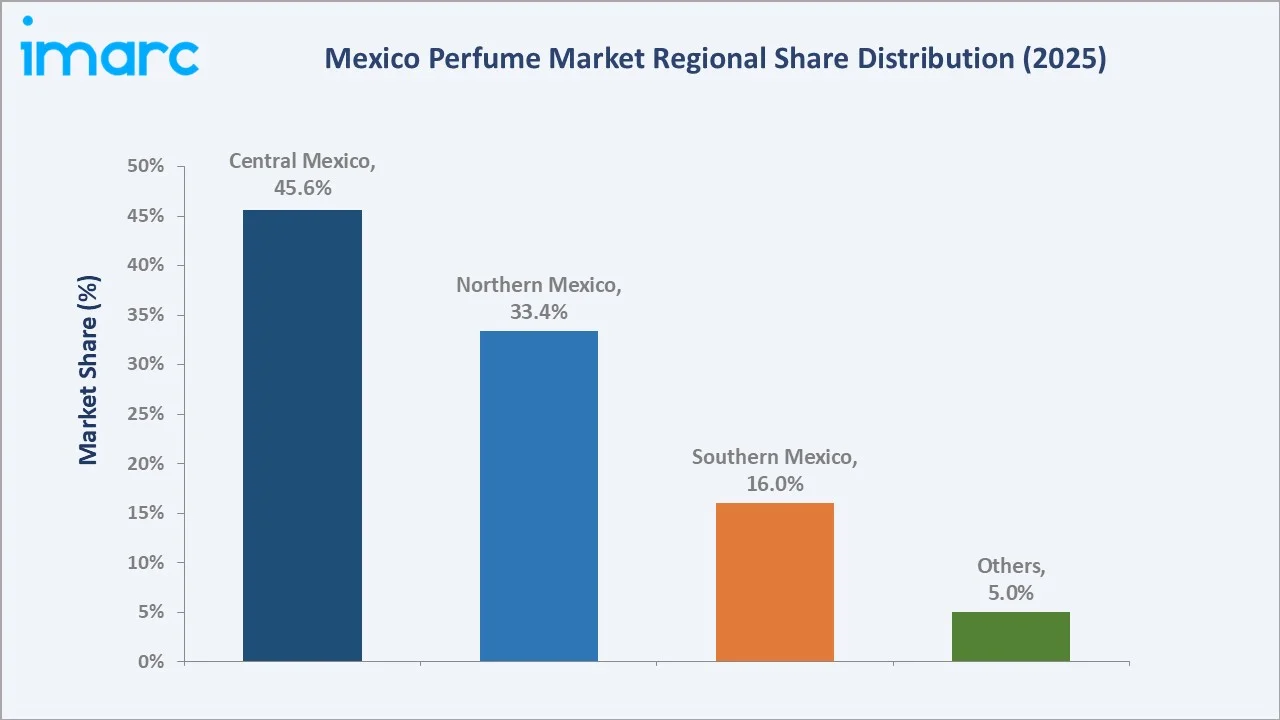
Northern Mexico follows at 33.4% in 2025, driven by high per-capita incomes in industrial cities, including Monterrey, alongside a growing urban consumer base and demand for premium fragrance products.
Competitive Landscape
The Mexico perfume market is moderately concentrated, with global fragrance and beauty conglomerates leading in terms of brand portfolio breadth, retail distribution, and marketing investment, while regional and domestic players compete through direct-sales models and price-accessible fragrance lines.
| Company Name | Brand / Key Product | Position | Strategic Focus |
|---|---|---|---|
| L'Oréal S.A. | Lancôme, Giorgio Armani Beauty, YSL Beauté | Leader | Expanding premium and luxury fragrance portfolio across department store and e-commerce channels |
| Coty Inc. | Marc Jacobs, Burberry, Calvin Klein, Hugo Boss | Leader | Leveraging licensed prestige fragrance portfolio and broadening direct-to-consumer digital channels |
| Puig S.L. | Carolina Herrera, Rabanne, Nina Ricci, Jean Paul Gaultier | Leader | Deepening distribution of prestige fragrance brands across Latin American retail networks |
| Revlon Group Holdings LLC | Charlie, Elizabeth Arden | Challenger | Maintaining accessible fragrance positioning within mass retail channels and expanding celebrity fragrance partnerships |
Key players include L'Oréal S.A., Coty Inc., Puig S.L., and Revlon Group Holdings LLC, among others.
Key Company Profiles
L'Oréal S.A.
L'Oréal S.A. is a French multinational beauty company headquartered in Clichy, France, and one of the world's largest personal care groups. Its L'Oréal Luxe division houses a significant portfolio of luxury and prestige fragrance brands distributed across several countries, including Mexico.
- Product Portfolio: Luxury and prestige fragrances under Lancôme, Giorgio Armani Beauty, and YSL Beauté, distributed through department stores, specialty retailers, and online platforms.
- Recent Developments: L'Oréal S.A. continues to strengthen its position in the global prestige beauty and fragrance market through innovation and strategic investments across its luxury division in key markets, including Mexico.
- Strategic Focus: Cultivating and expanding a diversified portfolio of luxury fragrance brands across premium retail touchpoints while deepening digital commerce capabilities and direct-to-consumer engagement globally.
Coty Inc.
Coty Inc. is a global beauty company headquartered in New York, United States, and one of the world's largest fragrance companies. It manages a broad licensed prestige fragrance portfolio spanning multiple brand tiers, with an established retail presence across Mexico through department stores and pharmacy chains.
- Product Portfolio: Licensed prestige fragrances including Marc Jacobs, Burberry, Calvin Klein, and Hugo Boss, distributed through selective retail channels and growing e-commerce platforms in several countries.
- Recent Developments: Coty Inc. has continued to focus on its core fragrance portfolio strategy, integrating its prestige and consumer beauty fragrance businesses to drive coordinated growth across its key licensed brands.
- Strategic Focus: Amplifying growth across its licensed prestige fragrance brands through integrated marketing, broadening distribution reach, and reinforcing its leadership position across multiple global fragrance price tiers.
Puig S.L.
Puig S.L. is a Spanish family-founded fashion and fragrance group headquartered in Barcelona, Spain. It operates as a leading global premium beauty company with prestige fragrance brands widely distributed across Mexico's department store and specialty retail channels.
- Product Portfolio: Prestige fragrance brands including Carolina Herrera, Rabanne, Nina Ricci, and Jean Paul Gaultier, with Carolina Herrera maintaining particularly strong consumer recognition in the Mexican market.
- Recent Developments: Puig S.L. has continued to build on its strong performance in the global fragrance market, with several of its brands consistently ranking among the top-selling fragrances worldwide across key retail markets including Mexico.
- Strategic Focus: Reinforcing the presence and commercial momentum of its prestige fragrance brands across regional retail networks while pursuing innovation in product development and consumer engagement across digital and physical channels.
Market Concentration Analysis
The Mexico perfume market exhibits moderate concentration, with global fragrance and beauty companies, including L'Oréal S.A., Coty Inc., Puig S.L., and Revlon Group Holdings LLC, collectively holding meaningful share through organized retail channels.
Barriers to premium fragrance market entry include the need for established brand equity, significant marketing investment, access to department store shelf space, and ongoing product development and licensing costs. These factors tend to favor established global fragrance groups, though digital channels have lowered barriers for niche and indie fragrance brands seeking to build direct relationships with Mexican consumers.
Consolidation within the global fragrance industry, particularly through licensing and acquisition activity among major beauty conglomerates, is gradually increasing the market share of established players. At the same time, the direct-sales channel provides an accessible route to market for regional beauty groups and emerging domestic fragrance brands targeting Mexico's large middle-income consumer base.
Investment & Growth Opportunities
Fastest-Growing Segments
Premium perfume products and unisex fragrances are the fastest-growing sub-segments in the Mexico perfume market. Premium products are benefiting from urbanization, aspirational consumer spending, and international brand entry into Mexico's department store ecosystem. Unisex fragrances are gaining traction among younger cohorts and digitally-engaged consumers, with social media serving as the primary awareness and discovery channel for gender-neutral fragrance concepts.
Emerging Markets
Southern Mexico represents the most significant emerging geographic opportunity for perfume market expansion. Expanding formal retail infrastructure, rising middle-class income levels, and growing consumer exposure to personal care and beauty brands are creating new demand pools outside Mexico's established urban centers.
Venture & Investment Trends
Investment activity in the Mexico fragrance market is focused on e-commerce infrastructure development, digital marketing capabilities, influencer partnership programs, and omnichannel retail integration. International fragrance houses are investing in Mexico City flagship store upgrades and travel retail partnerships at major international airports.
Future Market Outlook (2026-2034)
The Mexico perfume market is projected to grow from USD 624.1 Million in 2025 to USD 661.4 Million in 2026, reaching USD 953.1 Million by 2034, registering a CAGR of 4.67% during 2026-2034.
Four structural forces will shape the market through 2034: continued premiumization as Mexico's middle class grows and aspirational beauty spending deepens; digital commerce expansion enabling greater fragrance brand discovery and online purchase conversion; the rising importance of the unisex fragrance category as gender-inclusive consumer preferences become mainstream; and the geographic expansion of organized retail into Tier-2 and Tier-3 cities.
By 2034, the Mexico perfume market is expected to be defined by a more balanced product mix between mass and premium tiers, with premium's share growing as income levels rise and aspirational fragrance spending deepens. E-commerce and social commerce will account for a meaningfully larger share of fragrance sales, complementing rather than replacing physical retail channels.
Research Methodology
Primary Research
Primary research included structured discussions with fragrance retail executives, licensed importers, beauty category managers at major Mexican retail chains, direct-sales network managers, and fragrance industry specialists, validating market sizing, segment mix, and regional demand patterns specific to the Mexico perfume market.
Secondary Research
Secondary sources included trade association publications, COFEPRIS regulatory filings, Mexico's Instituto Nacional de Estadística y Geografía (INEGI) consumer spending data, industry trade publications covering the Latin American beauty and personal care sector, and annual reports and investor presentations from publicly listed fragrance and beauty companies with Mexico operations.
Forecasting Models
Market forecasts used top-down and bottom-up models combining consumer spending trends, retail channel growth rates, fragrance category penetration data, and macroeconomic variables including GDP growth, urban population expansion, and personal care expenditure trajectories. Scenario analysis addressed currency risk, regulatory changes, and competitive dynamics across mass and premium fragrance segments.
Mexico Perfume Market Report Coverage:
| Report Features | Details |
|---|---|
| Base Year of the Analysis | 2025 |
| Historical Period | 2020-2025 |
| Forecast Period | 2026-2034 |
| Units | Million USD |
| Scope of the Report |
Exploration of Historical Trends and Market Outlook, Industry Catalysts and Challenges, Segment-Wise Historical and Future Market Assessment:
|
| Perfume Types Covered | Premium Perfume Products, Mass Perfume Products |
| Categories Covered | Female Fragrances, Male Fragrances, Unisex Fragrances |
| Regions Covered | Northern Mexico, Central Mexico, Southern Mexico, Others |
| Companies Covered | L'Oréal S.A., Coty Inc., Puig S.L., Revlon Group Holdings LLC, etc. |
| Customization Scope | 10% Free Customization |
| Post-Sale Analyst Support | 10-12 Weeks |
| Delivery Format | PDF and Excel through Email (We can also provide the editable version of the report in PPT/Word format on special request) |
Key Benefits for Stakeholders:
- IMARC’s industry report offers a comprehensive quantitative analysis of various market segments, historical and current market trends, market forecasts, and dynamics of the Mexico perfume market from 2020-2034.
- The research report provides the latest information on the market drivers, challenges, and opportunities in the Mexico perfume market.
- Porter's five forces analysis assist stakeholders in assessing the impact of new entrants, competitive rivalry, supplier power, buyer power, and the threat of substitution. It helps stakeholders to analyze the level of competition within the Mexico perfume industry and its attractiveness.
- Competitive landscape allows stakeholders to understand their competitive environment and provides an insight into the current positions of key players in the market.
Frequently Asked Questions About the Mexico Perfume Market Report
The Mexico perfume market size is estimated at USD 661.4 Million in 2026, driven by rising disposable incomes, expanding retail channels, and growing consumer fragrance awareness across urban markets.
The market is projected to grow at a CAGR of 4.67% from 2026-2034, reaching USD 953.1 Million, supported by premiumization trends, e-commerce growth, and expanding retail distribution.
Mass perfume products lead the perfume type segment at 71.6% in 2025, driven by broad affordability, wide distribution across pharmacy and retail chains, and strong mass-market gifting demand in Mexico.
Female fragrances lead the category at 48.7% in 2025, supported by established brand loyalty, strong seasonal gifting demand, and a broad scent variety catering to diverse consumer preferences across Mexico.
Central Mexico commands 45.6% share in 2025, led by Mexico City’s strong retail infrastructure, high concentration of consumers, and presence of major fragrance brands and specialty retailers.
Leading players include L'Oréal S.A., Coty Inc., Puig S.L., and Revlon Group Holdings LLC, among others.
E-commerce is creating new fragrance discovery channels through social media, influencer-led recommendations, and online retail platforms, improving accessibility and enabling smaller niche brands to reach Mexican consumers directly.
Key challenges include counterfeit product prevalence in informal retail, currency volatility affecting import costs, price sensitivity among mass-market consumers, and the need to build consumer trust for new and niche fragrance brands.
Need more help?
- Speak to our experienced analysts for insights on the current market scenarios.
- Include additional segments and countries to customize the report as per your requirement.
- Gain an unparalleled competitive advantage in your domain by understanding how to utilize the report and positively impacting your operations and revenue.
- For further assistance, please connect with our analysts.
 Request Customization
 Speak to an Analyst
 Request Brochure
 Inquire Before Buying
Benefits of Customization
- Personalize this research
- Triangulate with your data
- Get data as per your format and definition
- Gain a deeper dive into a specific application, geography, customer, or competitor
- Any level of personalization
Get in Touch With Us
UNITED STATES
Phone: +1-201-971-6302
INDIA
Phone: +91-120-433-0800
UNITED KINGDOM
Phone: +44-753-714-6104
Email: [email protected]
Client Testimonials











Related Reports
Choose your plan
*Please note that the prices mentioned below are starting prices for each bundle type. Kindly contact our team for further details.*
Single User License
- 1 User License, Access on 2 Devices
- PDF Report + Excel Dataset (Password Protected)
- Lifetime Access
- No Printing Rights
- 10% Free Report Customization
- 10–12 Weeks of Analyst Support
Five User License
- Access for 5 Users, 2 Devices per User
- PDF Report + Excel Dataset (Password Protected)
- Lifetime Access
- Dedicated Account Manager
- 12–14 Weeks of Analyst Support
- No Printing Rights
- 15% Free Report Customization
- 25% Discount on Your Next Purchase
Corporate User License
- Unlimited User Access (Within Your Organization)
- PDF Report + Excel Dataset
- Lifetime Access
- Dedicated Account Manager
- 14–20 Weeks of Analyst Support
- No Printing Rights
- 20% Free Report Customization
- 30% Discount on Your Next Purchase
Essential Insights
What's included:
3 reports
- Lifetime Access
- PDF Reports
- Excel Datasets
- 2 Weeks of Free Analyst Support
- 2 User Licenses
- Access on 2 Devices
- Printing Rights
- Complimentary PowerPoint (PPT) Version
- Complimentary License Upgrade
Professional Access
What's included:
5 reports
- Lifetime Access
- PDF Reports
- Excel Datasets
- 8 Weeks of Free Analyst Support
- 2 User Licenses
- Access on 2 Devices
- Printing Rights
- Complimentary PowerPoint (PPT) Version
- Complimentary License Upgrade
Business Advantage
What's included:
8 reports
- Lifetime Access
- PDF Reports
- Excel Datasets
- 14 Weeks of Free Analyst Support
- 2 User Licenses
- Access on 2 Devices
- Printing Rights
- Complimentary PowerPoint (PPT) Version
- Complimentary License Upgrade
Enterprise Intelligence
What's included:
10 reports
- Lifetime Access
- PDF Reports
- Excel Datasets
- 20 Weeks of Free Analyst Support
- 2 User Licenses
- Access on 2 Devices
- Printing Rights
- Complimentary PowerPoint (PPT) Version
- Complimentary License Upgrade