
Mexico Polypropylene Market Size, Share, Trends and Forecast by Type, Process, Application, End User, and Region, 2026-2034
Mexico Polypropylene Market Size, Share, Trends & Forecast (2026-2034)
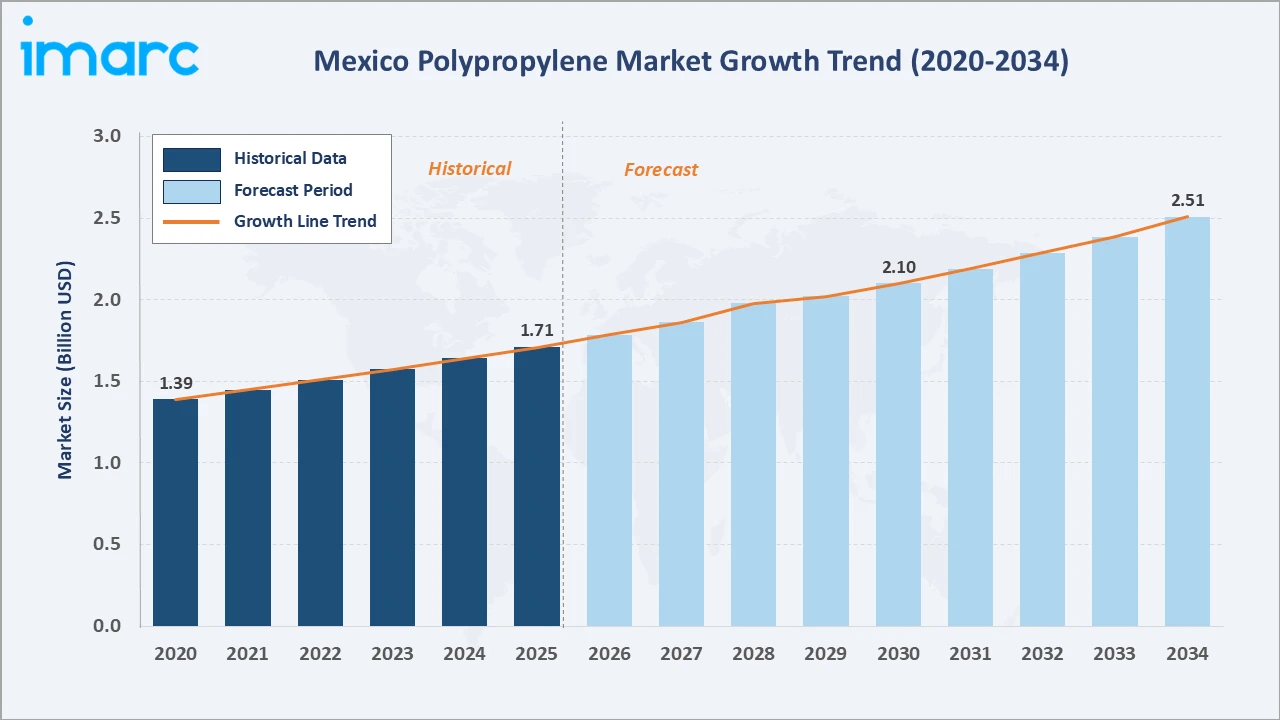
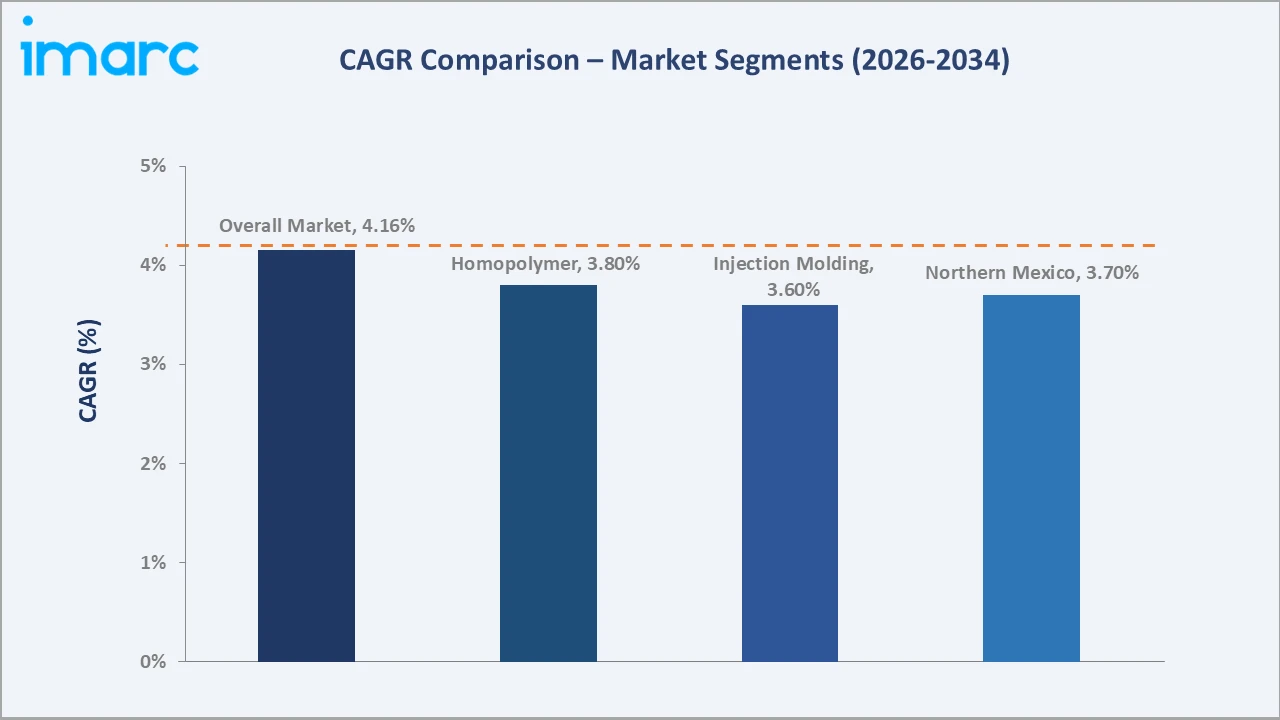
The Mexico polypropylene market reached USD 1.71 Billion in 2025 and is projected to reach USD 2.51 Billion by 2034, growing at a CAGR of 4.16% during 2026-2034. The market is driven by rising automotive production, expanding packaging applications, and growing nearshoring-linked manufacturing investment. Homopolymer PP dominates type share at 64.8%. Injection Molding leads process share at 38.6%. Northern Mexico commands the largest regional share at 42.6%.
Market Snapshot
|
Metric |
Value |
|
Market Size (2025) |
USD 1.71 Billion |
|
Forecast Market Size (2034) |
USD 2.51 Billion |
|
CAGR (2026-2034) |
4.16% |
|
Base Year |
2025 |
|
Historical Period |
2020-2025 |
|
Forecast Period |
2026-2034 |
|
Dominant Type |
Homopolymer (64.8%, 2025) |
|
Dominant Process |
Injection Molding (38.6%, 2025) |
|
Leading Region |
Northern Mexico (42.6%, 2025) |
The market expanded from USD 1.39 Billion in 2020 to USD 1.71 Billion in 2025, anchored at USD 2.10 Billion in 2030 and forecast to reach USD 2.51 Billion by 2034. Sustained nearshoring investment from North American and Asian manufacturers is structurally elevating PP demand above historical growth rates, with automotive, packaging, and construction sectors providing a diversified demand foundation.
To get more information on this market, Request Sample
Homopolymer PP grows steadily through the forecast period, driven by automotive tier-1 supplier procurement and rigid packaging expansion. Injection molding process adoption grows alongside Mexico's vehicle production scale and consumer goods manufacturing. Northern Mexico sustains regional leadership through maquiladora and OEM-linked compound procurement.
Executive Summary
The Mexico polypropylene market reached USD 1.71 Billion in 2025, representing a strategically important petrochemical material market underpinned by the country's role as the third-largest vehicle manufacturer in North America and a rapidly expanding consumer packaging ecosystem. The market is projected to reach USD 2.51 Billion by 2034.
Homopolymer PP at 64.8% dominates by serving high-volume, cost-sensitive automotive components, rigid packaging, and industrial applications. Injection Molding at 38.6% leads process applications due to its versatility for automotive parts, closures, crates, and consumer goods. Northern Mexico at 42.6% commands the largest regional share through its concentration of automotive OEMs and maquiladora industrial zones.
Key Market Insights
|
Insight |
Data |
|
Dominant Type |
Homopolymer – 64.8% share (2025) |
|
Dominant Process |
Injection Molding – 38.6% market share (2025) |
|
Leading Region |
Northern Mexico – 42.6% market share (2025) |
|
Market Opportunity |
Nearshoring industrial PP; mono-material recyclable packaging; EV-grade PP compounds; medical PP expansion |
Key Analytical Observations Supporting the Above Data:
- Homopolymer at 64.8%: Homopolymer PP dominates as it offers superior stiffness, heat resistance, and processability for high-volume applications such as automotive interior trim, rigid containers, and appliance components. Its cost competitiveness versus copolymer grades and broad compatibility with injection molding, extrusion, and blow molding processes makes it the preferred grade across Mexico's major manufacturing sectors. Demand is further reinforced by growing automotive parts export volumes under USMCA-aligned supply chains.
- Injection Molding at 38.6%: Injection molding leads as Mexico's automotive and consumer goods sectors require high-volume precision parts, including bumpers, dashboards, caps, closures, and crates. The process's ability to produce complex geometries with consistent quality and fast cycle times aligns with the demands of tier-1 automotive suppliers and FMCG manufacturers concentrated in Northern and Central Mexico. Expansion of automotive production capacity under OEM nearshoring investments continues to underpin injection molding PP demand growth.
- Northern Mexico at 42.6%: Northern Mexico dominates due to its high concentration of automotive OEMs, tier-1 suppliers, and maquiladora industrial zones in states including Nuevo León, Chihuahua, Coahuila, and Sonora. Major vehicle assembly plants by global OEMs generate structural PP compound procurement for interior and exterior vehicle components. Proximity to US markets, USMCA trade advantages, and established industrial infrastructure sustain Northern Mexico's leadership position through the forecast period.
Mexico Polypropylene Market Overview
The Mexico polypropylene market encompasses the production, import, compounding, distribution, and conversion of polypropylene resins across homopolymer and copolymer grades, serving diverse end-use industries including automotive, packaging, construction, medical, and consumer goods.
The ecosystem integrates global PP resin producers, domestic compounders and distributors, automotive OEM and tier-1 supplier procurement networks, packaging converters, pharmaceutical manufacturers, and regulatory bodies overseeing resin standards and packaging sustainability requirements. Macroeconomic factors include USMCA trade dynamics, nearshoring investment flows, fuel efficiency mandates, and sustainability-driven recyclability requirements.
Market Dynamics
To evaluate market opportunities, Request Sample
Market Drivers
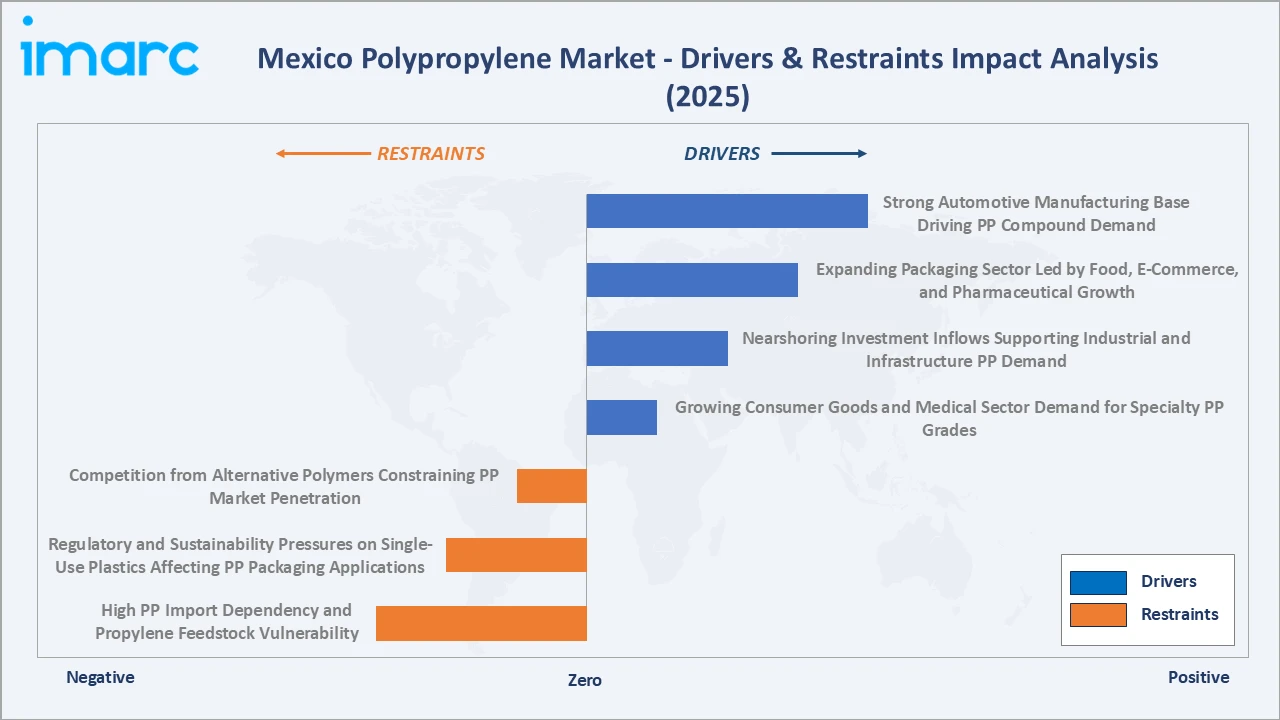
- Strong Automotive Manufacturing Base Driving PP Compound Demand: Mexico produces approximately 4 million light automobiles annually, establishing it as a top five global automotive manufacturing hub. Polypropylene plays a critical role in bumpers, dashboards, interior trim panels, battery housings, and under-hood components across all vehicle types. Growing OEM localization under USMCA and rising EV production are accelerating PP compound procurement by tier-1 suppliers across Northern Mexico. Advanced PP compound grades with enhanced thermal stability and dimensional precision are being increasingly specified for EV platform structural components.
- Expanding Packaging Sector Led by Food, E-Commerce, and Pharmaceutical Growth: Growth in food consumption, e-commerce, and pharmaceutical manufacturing is increasing demand for polypropylene packaging solutions in Mexico. Lightweight, durable, and versatile PP packaging is being adopted across rigid containers, flexible films, woven bags, and pharmaceutical packaging. The growing emphasis on recyclable and mono-material formats is also encouraging manufacturers to develop more sustainable PP packaging solutions.
- Nearshoring Investment Inflows Supporting Industrial and Infrastructure PP Demand: US and Asian manufacturers relocating production to Mexico are establishing new automotive component plants, electronics assembly facilities, and consumer goods factories, structurally elevating PP demand above historical growth rates. Industrial park construction, warehousing expansion, and infrastructure build-out are driving additional PP demand for pipes, geomembranes, and industrial components across Central and Northern Mexico. The country's strategic position as the preferred nearshoring destination in the Americas is expected to sustain elevated industrial PP procurement through the forecast period.
- Growing Consumer Goods and Medical Sector Demand for Specialty PP Grades: Rising disposable income and urbanization are expanding consumer goods production in Mexico, requiring higher volumes of injection-molded PP containers, crates, furniture components, and household appliances. The medical sector is adopting medical-grade PP for syringes, IV components, and sterile packaging as pharmaceutical manufacturing capacity expands in Querétaro and Jalisco. These sectors demand specialty PP grades offering enhanced clarity, sterilization resistance, and full regulatory compliance with FDA and COFEPRIS standards for healthcare applications.
Market Restraints
- High PP Import Dependency and Propylene Feedstock Vulnerability: Mexico lacks domestic large-scale propylene production capacity relative to its PP consumption, creating a structural import dependency on US Gulf Coast and Middle Eastern PP resin suppliers. Propylene price volatility, shipping cost fluctuations, and logistics constraints can disrupt PP resin supply to domestic converters and create significant margin pressure across the value chain. Currency depreciation of the Mexican peso against the US dollar further amplifies landed resin cost volatility for domestic PP converters.
- Competition from Alternative Polymers Constraining PP Market Penetration: Polyethylene terephthalate, high-density polyethylene, and polystyrene actively compete with PP across packaging, construction, and consumer goods applications in the Mexican market. In certain packaging formats, PET's superior optical clarity and HDPE's chemical resistance limit PP substitution opportunities. Rising sustainability standards in export-oriented sectors are also generating interest in bio-based alternative polymers that compete with conventional PP in premium applications.
- Regulatory and Sustainability Pressures on Single-Use Plastics Affecting PP Packaging Applications: Increasing regulatory attention on single-use plastic restrictions across Mexico's major metropolitan areas is creating compliance uncertainty for commodity PP packaging applications. Converters face capital investment requirements to reformulate packaging toward mono-material or certified recyclable PP formats that comply with evolving municipal and federal sustainability regulations. These pressures increase near-term operational complexity and require incremental investment that constrains short-term market expansion.
Market Opportunities
- Mono-material recyclable PP packaging solutions for food and consumer goods sectors aligned with brand-owner sustainability commitments and evolving municipal plastic regulation frameworks. Advanced thermoforming and extrusion technologies are enabling converters to produce innovative PP-based recyclable formats that meet both performance and circular economy requirements. Investment in certified post-consumer recycled content PP supply chains is creating differentiated product positioning for packaging converters in export-oriented markets.
- Specialty PP compound grades for electric vehicle battery enclosures, lightweight automotive structural components, and under-hood applications represent a growing premium market as Mexico's automotive sector transitions toward EV production. Long glass fiber PP and mineral-reinforced PP compounds offering structural performance at lower weight are being actively qualified by automotive tier-1 suppliers for next-generation EV platforms. This creates a high-value PP compound market above commodity resin applications.
Market Challenges
- Propylene feedstock price volatility and supply chain disruptions from US Gulf Coast production outages or shipping infrastructure constraints directly impact PP resin availability and landed cost for Mexican converters. Structural import dependency limits the ability of domestic converters to maintain stable procurement costs through commodity price cycles. Developing domestic propylene and PP production capacity remains a long-term structural requirement to reduce Mexico's feedstock vulnerability.
- Currency fluctuations affecting the import cost of PP resins priced in US dollars create margin compression for domestic Mexican converters operating in peso-denominated markets. Exchange rate volatility between the Mexican peso and the US dollar introduces significant pricing uncertainty that is difficult to fully pass through to end customers in competitive segments. Converters reliant on imported specialty PP grades face compounded cost pressure from both resin price cycles and currency movements.
Emerging Market Trends
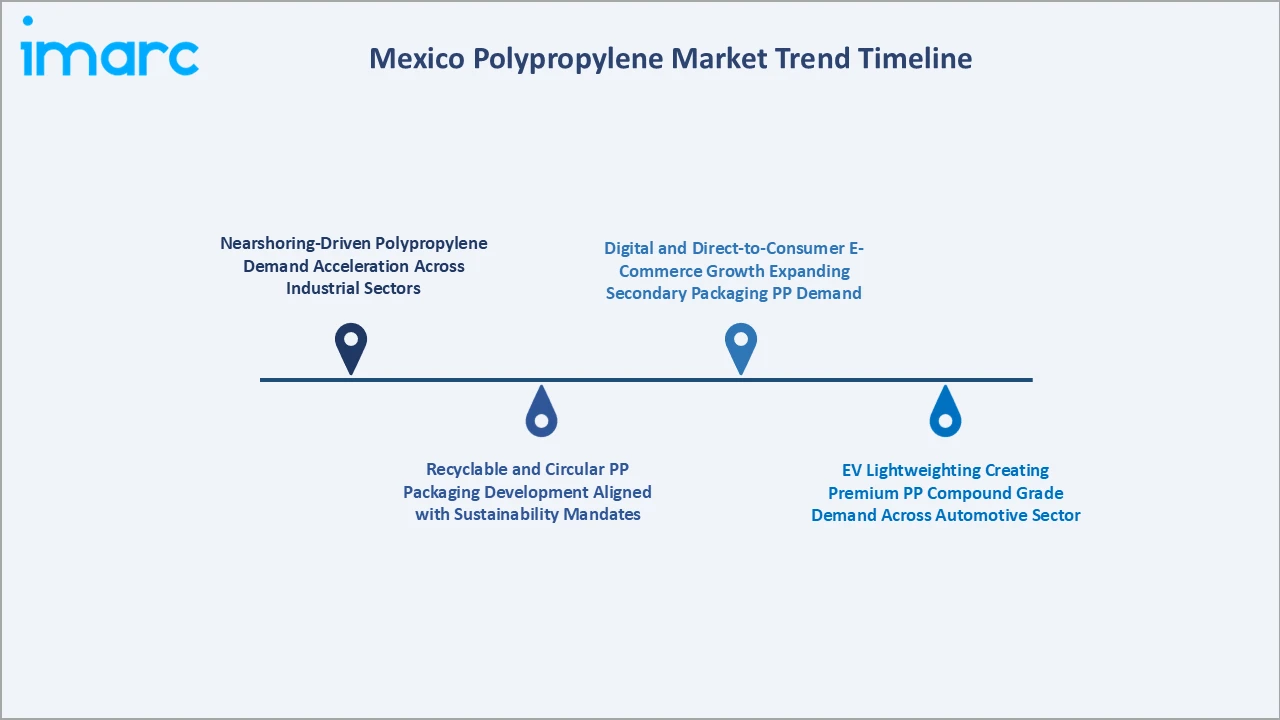
1. Nearshoring-Driven Polypropylene Demand Acceleration Across Industrial Sectors
US and Asian manufacturers relocating production to Mexico are establishing automotive component plants, electronics assembly facilities, and consumer goods factories that require growing volumes of PP compounds and resins. These investments are structurally increasing domestic PP resin consumption above historic trend rates, particularly for injection-molded and extruded grades. Mexico's established trade infrastructure, USMCA advantages, and skilled manufacturing workforce are expected to sustain nearshoring momentum and associated PP demand through 2034.
2. Recyclable and Circular PP Packaging Development Aligned with Sustainability Mandates
Sustainability mandates and export-oriented brand commitments are accelerating adoption of mono-material PP packaging across Mexico's food, beverage, and FMCG sectors. Packaging converters are investing in advanced extrusion and thermoforming technologies for innovative PP-based recyclable formats that maintain performance while meeting circular economy requirements. UFlex's USD 50 Million woven polypropylene bag facility investment in Mexico reflects the commercial viability and growing scale of recyclable PP applications.
3. EV Lightweighting Creating Premium PP Compound Grade Demand Across Automotive Sector
As Mexico's automotive sector transitions toward electric vehicle production, demand for high-performance PP compounds with enhanced thermal stability, impact resistance, and dimensional precision is increasing across tier-1 supplier networks. PP composites and long glass fiber PP grades are gaining adoption for structural EV components, creating a premium PP compound growth segment above commodity resin demand. Global OEMs operating in Mexico are specifying advanced PP compound grades that exceed standard automotive PP specifications.
4. Digital and Direct-to-Consumer E-Commerce Growth Expanding Secondary Packaging PP Demand
Mexico's e-commerce sector growth, representing 15% of retail sales in 2024, is driving sustained demand for durable PP crates, containers, caps, and closures across logistics and last-mile delivery applications. Pharmaceutical e-commerce and direct-to-consumer health product distribution are expanding PP demand in secondary protective packaging formats. This channel shift is creating new PP packaging specification requirements that differ significantly from traditional retail packaging formats.
Industry Value Chain Analysis
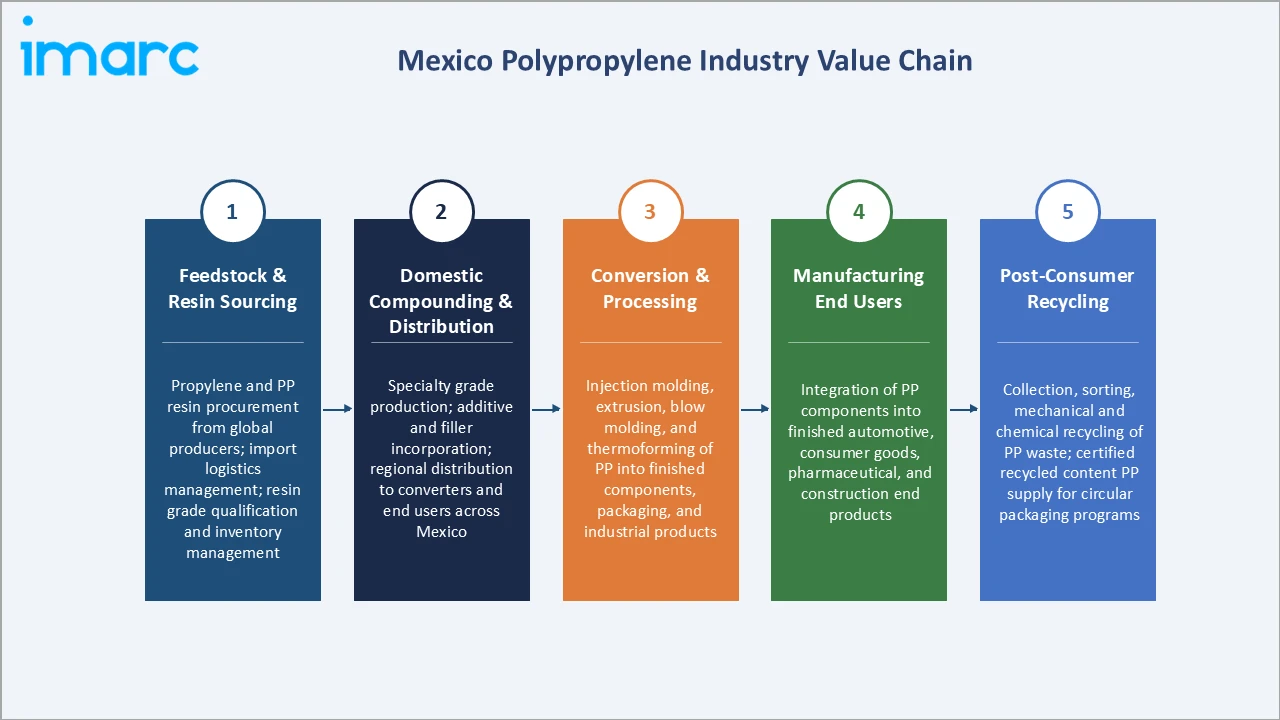
The polypropylene value chain in Mexico integrates feedstock and resin sourcing, domestic compounding and distribution, conversion and processing, manufacturing end-user integration, and post-consumer recycling. The value chain's commercial structure is evolving toward closer integration between resin suppliers and automotive tier-1 compound users as nearshoring intensifies specification requirements.
|
Stage |
Key Activities |
|
Feedstock & Resin Sourcing |
Propylene and PP resin procurement from global producers; import logistics management; resin grade qualification and inventory management |
|
Domestic Compounding & Distribution |
Specialty grade production; additive and filler incorporation; regional distribution to converters and end users across Mexico |
|
Conversion & Processing |
Injection molding, extrusion, blow molding, and thermoforming of PP into finished components, packaging, and industrial products |
|
Manufacturing End Users |
Integration of PP components into finished automotive, consumer goods, pharmaceutical, and construction end products |
|
Post-Consumer Recycling |
Collection, sorting, mechanical and chemical recycling of PP waste; certified recycled content PP supply for circular packaging programs |
The conversion and processing tier is Mexico's highest-value-added PP stage, where resin is transformed into precision automotive parts, packaging, and industrial components. The feedstock and resin sourcing tier remains Mexico's most structurally import-dependent stage, creating systemic exposure to global propylene pricing cycles.
Technology Landscape in the Mexico Polypropylene Industry
Ziegler-Natta Catalysis Technology
Ziegler-Natta catalyst systems remain the primary technology for commercial PP production globally and for the imported resins consumed across Mexico's manufacturing sectors. Fourth and fifth-generation Ziegler-Natta catalysts enable high-productivity, stereoregular PP production with tailored molecular weight distributions, supporting broad application versatility. The technology's cost-effectiveness and process maturity underpin its continued dominance in high-volume commodity PP grades supplying Mexico's automotive and packaging sectors.
Metallocene Catalyst Technology
Metallocene catalyst technology enables production of specialty PP grades with narrow molecular weight distribution, enhanced optical clarity, and superior mechanical properties. Metallocene PP is gaining adoption in premium packaging, medical device, and automotive applications requiring exceptional clarity, flexibility, or sterilization resistance. ExxonMobil's Achieve Advanced PP portfolio and related specialty metallocene grades are creating new performance-differentiated PP segments in Mexico's manufacturing market.
Advanced Compounding and Glass Fiber Reinforcement Technology
Glass fiber reinforcement, mineral filling, and elastomer toughening technologies are increasingly applied to PP compounds for automotive structural applications by tier-1 suppliers operating in Mexico. Long glass fiber PP compounds offer strength-to-weight advantages for instrument panels, door modules, and underbody shields, directly supporting the lightweighting requirements of USMCA-compliant vehicle manufacturing. Growing EV platform production is accelerating adoption of advanced PP compound formulations that combine structural performance with thermal management capability.
Market Segmentation Analysis
The report covers the following segments:
|
Segment Category |
Leading Segment |
Market Share |
Year |
|
Type |
Homopolymer |
64.8% |
2025 |
|
Process |
Injection Molding |
38.6% |
2025 |
|
Application |
🔒 |
🔒 |
2025 |
|
End User |
🔒 |
🔒 |
2025 |
|
Region |
Northern Mexico |
42.6% |
2025 |

By Type
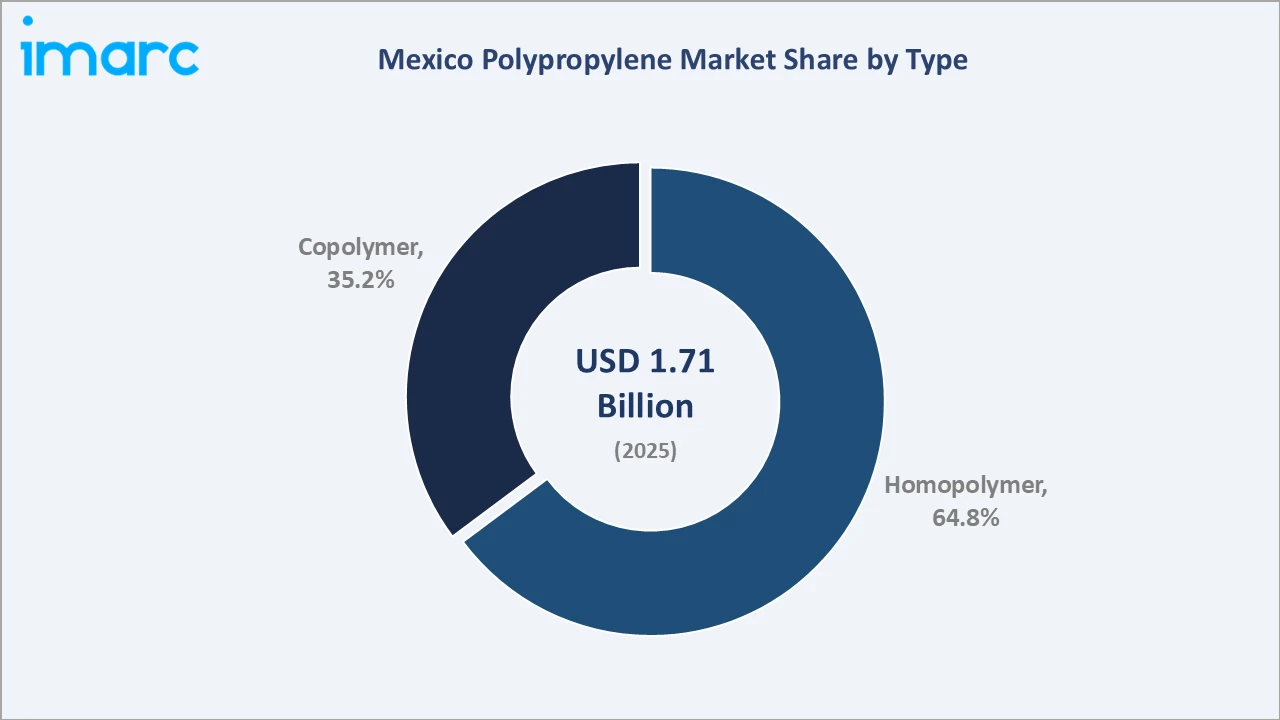
Homopolymer leads at 64.8% in 2025, driven by its dominance across automotive components, rigid packaging, and industrial applications where stiffness, heat resistance, and cost-effective processability are the primary selection criteria.
To access detailed market analysis, Request Sample
Copolymer at 35.2% captures flexible packaging, impact-resistant automotive exterior parts, and specialty consumer goods where enhanced toughness and clarity are required. Random copolymer grades are gaining share in food-grade packaging requiring superior optical clarity, while impact copolymers are increasingly specified for automotive exterior components requiring low-temperature impact performance under USMCA quality standards.
By Process
Injection Molding leads at 38.6% in 2025, reflecting Mexico's dominant automotive and consumer goods manufacturing sectors that require high-precision, high-volume PP part production across a broad range of component geometries.
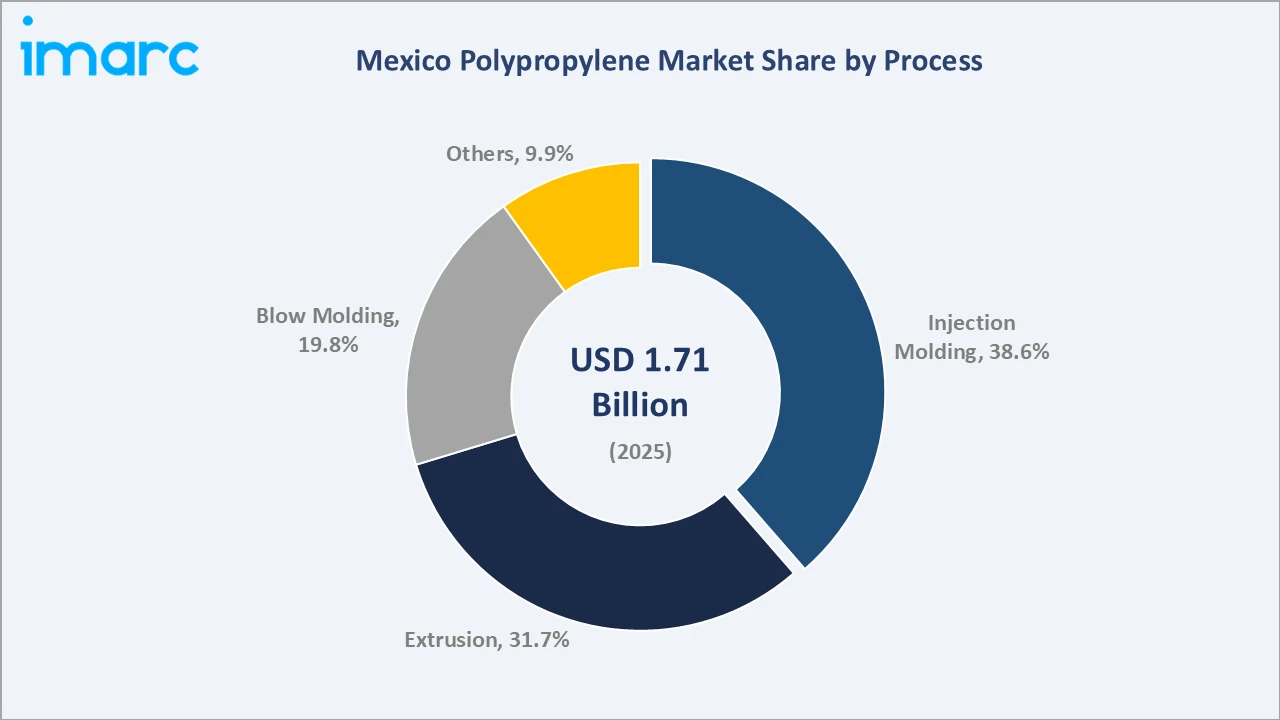
Extrusion at 31.7% serves packaging films, sheets, pipes, profiles, and geomembranes for construction, agriculture, and infrastructure. Blow Molding at 19.8% serves the personal care, household chemicals, and packaging industries, producing bottles, containers, and hollow industrial parts. Others at 9.9% encompasses thermoforming, rotomolding, and fiber and raffia applications across diverse Mexican manufacturing sectors.
Regional Market Insights
| Region | Share (2025) | Key Polypropylene Market Drivers & Characteristics |
|---|---|---|
| Northern Mexico | 42.6% | Driven by high concentration of automotive OEMs, maquiladora industrial zones, and tier-1 automotive suppliers requiring PP compounds for interior and exterior vehicle components |
| Central Mexico | 37.8% | Driven by consumer goods manufacturing, food and beverage packaging, pharmaceutical production, and diversified industrial PP conversion near Mexico City and Guadalajara |
| Southern Mexico | 12.4% | Driven by agriculture, construction, and basic consumer goods PP demand; emerging infrastructure investment creating growth in PP pipe, sheet, and geomembrane applications |
| Others | 7.2% | Includes coastal and border industrial zones with specialized PP demand from electronics, energy, and export-oriented manufacturing sectors |
Northern Mexico, at 42.6%, leads through Nuevo León, Chihuahua, Coahuila, and Sonora's automotive manufacturing concentration. Major vehicle assembly operations by General Motors, Ford, BMW, Toyota, Honda, and Stellantis generate structural PP compound procurement for tier-1 suppliers producing bumper systems, dashboards, trim panels, and under-hood components.
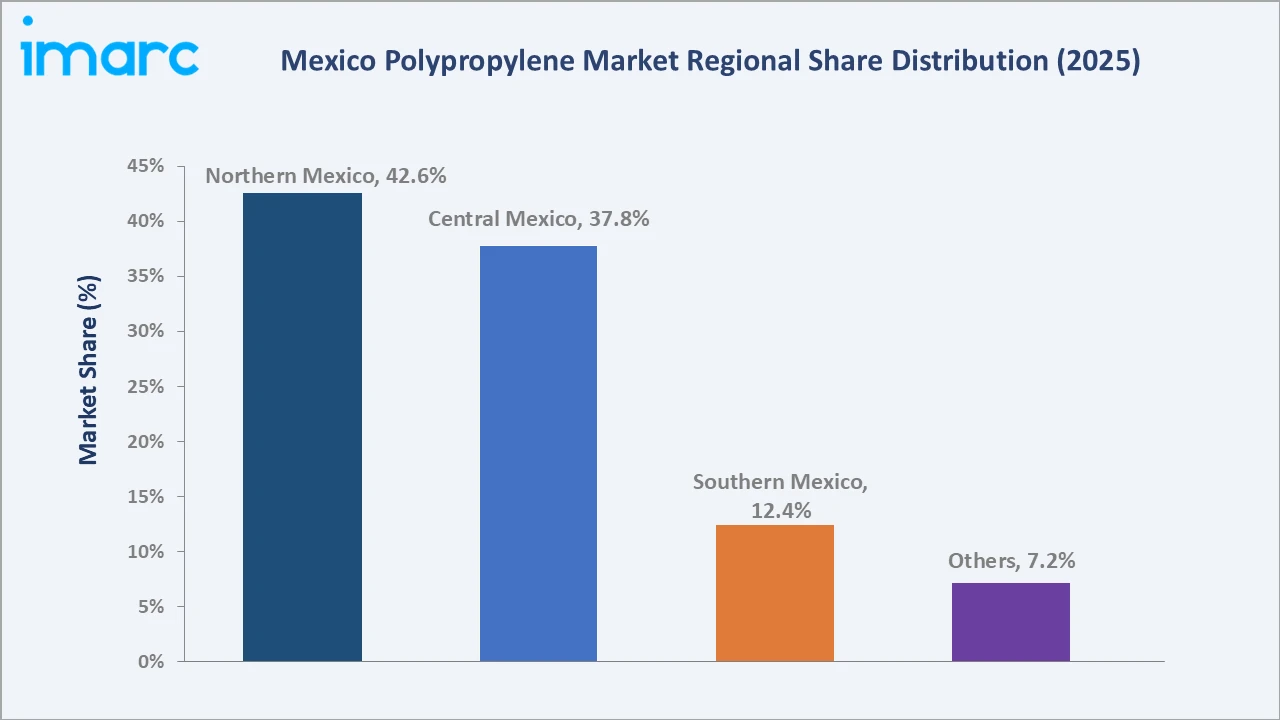
Central Mexico, at 37.8%, reflects the Mexico City metropolitan area, Guadalajara, and Querétaro's concentration of FMCG brands, pharmaceutical manufacturers, and consumer goods producers. Packaging converters, medical device manufacturers, and appliance producers in this region drive substantial injection-molded and extruded PP demand across diverse end-use sectors.
Southern Mexico, at 12.4%, represents an early-growth PP market where infrastructure investment, agricultural applications such as PP raffia bags and irrigation pipe, and basic consumer goods production are the primary demand drivers. Pemex refinery proximity in coastal states, including Veracruz, provides some feedstock adjacency for local PP compounders.
Competitive Landscape
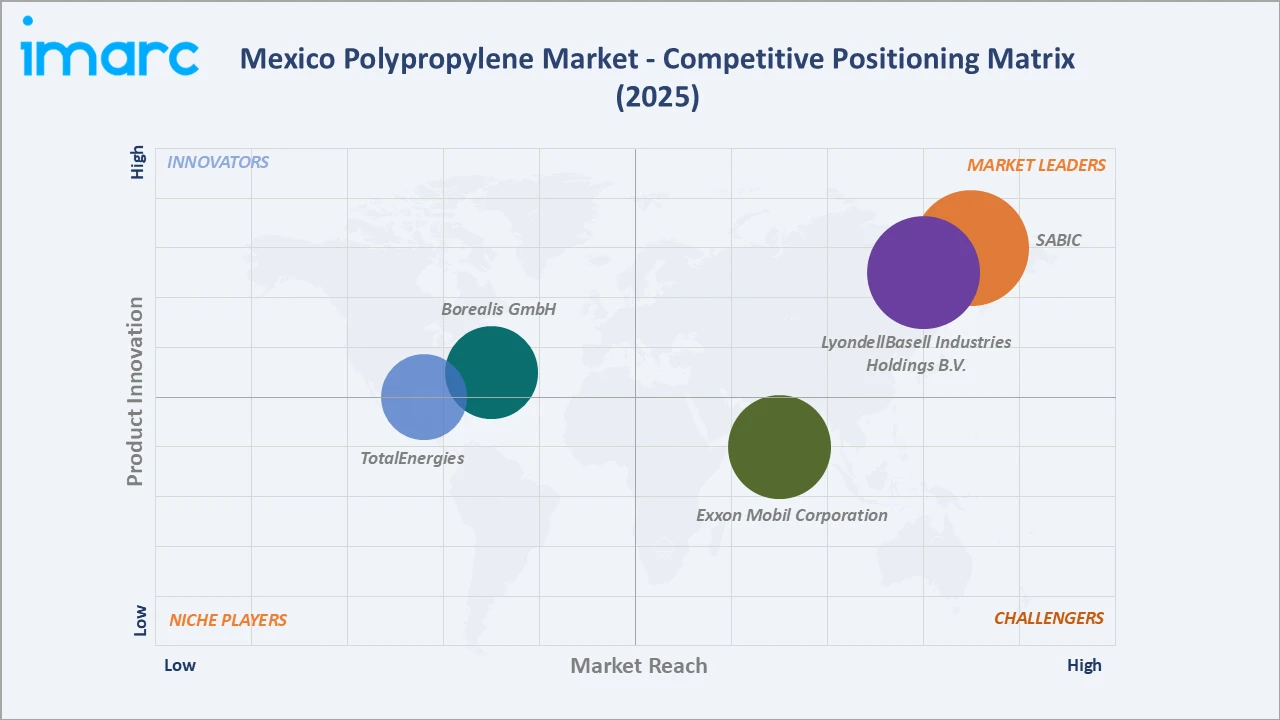
The Mexico polypropylene market competitive landscape is characterized by global PP resin producers supplying through import and distribution networks, regional compounders adding value through specialty grades, and domestic distributors serving SME converters. Market concentration is moderate at the resin supply level, with the key players collectively commanding significant PP import share.
|
Company Name |
Key Products |
Market Position |
Core Strength |
|
LyondellBasell Industries Holdings B.V. |
Moplen HP, Moplen EP, Metocene, Adflex |
Market Leader |
Broadest PP grade portfolio serving automotive, packaging, and medical sectors; global supply reliability for Mexico converters. |
|
SABIC |
SABIC PP Homopolymer, SABIC PP Copolymer, SABIC PPCP grades |
Market Leader |
Diversified automotive, packaging, and medical PP grades; established Mexican distribution network; strong Americas supply chain. |
|
Exxon Mobil Corporation |
Achieve Advanced PP, Escorene PP, Signature Polymers portfolio |
Strong Challenger |
Metallocene PP technology leadership; specialty grades for clarity packaging and medical; US Gulf Coast proximity advantage for Mexico supply. |
|
TotalEnergies |
PPH, PPR, PPC Lumicene metallocene grades |
Established Player |
Specialty metallocene PP grades for demanding packaging and automotive applications; growing commercial presence in Mexico. |
|
Borealis GmbH |
Borpact, Daploy, Fibremod, Borsoft PP grades |
Established Player |
Specialty PP compounds for automotive lightweighting and advanced packaging; strong technical service for tier-1 automotive customers. |
Key players include LyondellBasell Industries Holdings B.V., SABIC, Exxon Mobil Corporation, TotalEnergies, Borealis GmbH, and others.
Key Company Profiles
LyondellBasell Industries Holdings B.V.
LyondellBasell Industries Holdings B.V. is a Netherlands-based multinational chemical company and the world's largest licensor of polyolefin technology, with a strong presence in the Mexico polypropylene market through its extensive Moplen and Metocene PP grade portfolios distributed across the country's major manufacturing regions.
- Key Products: Moplen HP homopolymer grades, Moplen EP random and impact copolymers, Metocene metallocene PP, Adflex elastomeric PP compounds for automotive and packaging.
- Strategic Focus: Expanding specialty automotive PP compound grades, circular and recyclable PP for packaging converters, and advanced metallocene PP for medical and clarity packaging applications across the Americas including Mexico. The company is deepening its technical service engagement with Mexican automotive tier-1 suppliers qualifying advanced compound grades for EV platform applications. LyondellBasell is also strengthening its Americas distribution infrastructure to improve supply reliability and reduce lead times for domestic Mexican converters.
SABIC
SABIC is a Saudi Arabia-based global diversified chemicals company with a significant presence in the Mexico polypropylene market, supplying automotive, packaging, and industrial PP grades through its established Americas distribution network and technical service capabilities.
- Key Products: SABIC PP Homopolymer grades, SABIC PP Copolymer grades, SABIC PPCP impact copolymers for automotive applications.
- Strategic Focus: Strengthening specialty PP supply for automotive and packaging end users in Mexico; expanding certified circular PP program offerings for brand-owner sustainability compliance; deepening technical collaboration with automotive tier-1 suppliers qualifying advanced PP compound grades for EV and conventional vehicle platforms. SABIC is investing in application development support for Mexican converters seeking to expand into specialty packaging and medical PP segments. The company aims to expand its Americas-region distribution capabilities to serve growing demand from nearshoring manufacturers establishing operations in Mexico.
Market Concentration Analysis
The Mexico polypropylene market is moderately concentrated at the resin supply level, with the key players collectively representing a significant share of PP resin imports and domestic supply. Domestic large-scale PP resin production capacity in Mexico remains limited, providing regional production proximity.
Market concentration is higher in specialty and automotive PP grades, where technical service, application development, and regulatory compliance capability create meaningful differentiation. Commodity PP for basic extrusion and blow molding is more competitive, with multiple global and regional suppliers competing on landed cost and delivery reliability for SME converters.
Investment & Growth Opportunities
Highest Growth Segments
Automotive PP compounds for EV platforms (~6–8% CAGR), mono-material recyclable PP packaging (~7–9% CAGR), medical-grade PP for pharmaceutical sector expansion (~5–7% CAGR), and nearshoring-driven industrial PP for construction and logistics (~4–6% CAGR) represent the highest-growth investment vectors through 2034.
Emerging Investment Opportunities
EV lightweighting specialty PP compounds represent a premium emerging opportunity, as Mexico's automotive sector targets growing EV production share under OEM electrification commitments. Advanced PP compounds for battery enclosures, structural components, and thermal management generate 2–3x the per-unit value of standard automotive PP grades, with Mexican tier-1 suppliers actively qualifying specialty PP sources.
Investment Themes
- Nearshoring supply chain localization: Domestic PP compounding capacity investment to serve nearshoring manufacturers with tailored-grade PP supply, reducing import dependency and logistics lead times. Converters establishing integrated compound supply partnerships with automotive OEMs gain structural demand security through long-term procurement agreements.
- Circular PP packaging infrastructure: Investment in post-consumer PP collection, sorting, and mechanical recycling capacity to supply certified recycled content PP grades for food and consumer packaging converters aligned with brand-owner sustainability commitments. This creates differentiated product positioning in export-oriented markets where recycled content certification is becoming a procurement requirement.
Future Market Outlook (2026-2034
The Mexico polypropylene market is projected to grow from USD 1.71 Billion in 2025 to USD 2.51 Billion by 2034, delivering a 4.16% CAGR over the forecast period. The market anchor value of USD 2.10 Billion in 2030 represents a structurally transformed PP demand landscape where nearshoring-linked industrial demand, EV automotive compounds, and sustainable packaging innovations have established new growth trajectories.
Three structural forces define Mexico PP market growth through 2034. The nearshoring investment acceleration creates a self-reinforcing demand cycle where manufacturing investment begets PP consumption growth. The automotive EV platform transition multiplies demand for premium PP compound grades above simple vehicle production volume growth. The packaging sustainability mandate trend drives PP converter investment in recyclable format development that sustains demand while evolving product specifications.
Research Methodology
Primary Research
Primary research comprised structured interviews with 40+ industry stakeholders (2025), including PP resin procurement managers at Mexican automotive tier-1 suppliers; packaging converter R&D leads; domestic PP distributor principals; and pharmaceutical sector sustainability officers.
Secondary Research
Secondary research encompassed PEMEX and INEGI petrochemical data; USMCA trade statistics for PP resin imports; Mexican Automotive Industry Association production data; IMARC PP market forecasting models; corporate reports from LyondellBasell, SABIC, ExxonMobil, and Braskem. Over 45 secondary sources reviewed.
Forecasting Models
Market revenue forecasts developed using end-use demand bottom-up model: (i) automotive PP volume from AMIA vehicle production forecasts; (ii) packaging PP from food, pharma, and e-commerce sector growth models; (iii) construction and industrial PP from infrastructure investment proxies; (iv) blended grade price trajectory from global propylene and PP resin price forecasting models.
Mexico Polypropylene Market Report Coverage:
| Report Features | Details |
|---|---|
| Base Year of the Analysis | 2025 |
| Historical Period | 2020-2025 |
| Forecast Period | 2026-2034 |
| Units | Billion USD |
| Scope of the Report |
Exploration of Historical Trends and Market Outlook, Industry Catalysts and Challenges, Segment-Wise Historical and Future Market Assessment:
|
| Types Covered | Homopolymer, Copolymer |
| Processes Covered | Injection Molding, Blow Molding, Extrusion, Others |
| Applications Covered | Film and Sheet, Fiber, Raffia, Others |
| End Users Covered | Packaging, Automotive, Building and Construction, Medical, Electrical and Electronics, Others |
| Regions Covered | Northern Mexico, Central Mexico, Southern Mexico, Others |
| Companies Covered | LyondellBasell Industries Holdings B.V., SABIC, Exxon Mobil Corporation, TotalEnergies, Borealis GmbH, etc. |
| Customization Scope | 10% Free Customization |
| Post-Sale Analyst Support | 10-12 Weeks |
| Delivery Format | PDF and Excel through Email (We can also provide the editable version of the report in PPT/Word format on special request) |
Key Benefits for Stakeholders:
- IMARC’s industry report offers a comprehensive quantitative analysis of various market segments, historical and current market trends, market forecasts, and dynamics of the Mexico polypropylene market from 2020-2034.
- The research report provides the latest information on the market drivers, challenges, and opportunities in the Mexico polypropylene market.
- Porter's five forces analysis assist stakeholders in assessing the impact of new entrants, competitive rivalry, supplier power, buyer power, and the threat of substitution. It helps stakeholders to analyze the level of competition within the Mexico polypropylene industry and its attractiveness.
- Competitive landscape allows stakeholders to understand their competitive environment and provides an insight into the current positions of key players in the market.
Frequently Asked Questions About the Mexico Polypropylene Market Report
The Mexico polypropylene market reached USD 1.71 Billion in 2025, driven by homopolymer PP dominance at 64.8%, injection molding process leadership at 38.6%, Northern Mexico commanding 42.6% regional share through automotive manufacturing concentration, and expanding nearshoring-linked industrial PP demand.
The Mexico polypropylene market grows at 4.16% CAGR during 2026-2034, reaching USD 2.51 Billion by 2034. This growth reflects nearshoring investment acceleration, EV automotive PP compound demand, packaging sustainability-driven converter investment, and medical-grade PP expansion in Jalisco and Querétaro.
Homopolymer PP leads at 64.8%, capturing the dominant automotive parts, rigid packaging, and industrial component sectors. Copolymer PP at 35.2% serves impact-sensitive automotive applications and specialty flexible packaging.
Injection Molding leads at 38.6% through Mexico's dominant automotive tier-1 supplier and consumer goods manufacturing base. Extrusion at 31.7% serves packaging films and pipes, while Blow Molding at 19.8% serves bottles and containers for personal care and industrial packaging.
Northern Mexico leads at 42.6% through Nuevo León, Chihuahua, Coahuila, and Sonora's concentration of automotive OEMs and tier-1 suppliers. Central Mexico, at 37.8% follows through FMCG, pharmaceutical, and consumer goods PP conversion.
Leading companies include LyondellBasell Industries Holdings B.V., SABIC, Exxon Mobil Corporation, TotalEnergies, Borealis GmbH, and others.
The Mexico polypropylene market is projected to reach approximately USD 2.10 Billion by 2030, with nearshoring industrial PP demand established as a structural growth driver, EV automotive compound grades achieving commercial scale, and recyclable PP packaging gaining mainstream converter adoption.
Three priority investment opportunities: domestic PP compounding capacity for nearshoring manufacturers, circular PP packaging recycling infrastructure for brand-owner sustainability program compliance, and medical-grade PP supply expansion for pharmaceutical sector growth in Jalisco and Querétaro.
Need more help?
- Speak to our experienced analysts for insights on the current market scenarios.
- Include additional segments and countries to customize the report as per your requirement.
- Gain an unparalleled competitive advantage in your domain by understanding how to utilize the report and positively impacting your operations and revenue.
- For further assistance, please connect with our analysts.
 Request Customization
 Speak to an Analyst
 Request Brochure
 Inquire Before Buying
Benefits of Customization
- Personalize this research
- Triangulate with your data
- Get data as per your format and definition
- Gain a deeper dive into a specific application, geography, customer, or competitor
- Any level of personalization
Get in Touch With Us
UNITED STATES
Phone: +1-201-971-6302
INDIA
Phone: +91-120-433-0800
UNITED KINGDOM
Phone: +44-753-714-6104
Email: [email protected]
Client Testimonials




.webp)




.webp)













Related Reports

Choose your plan
*Please note that the prices mentioned below are starting prices for each bundle type. Kindly contact our team for further details.*
Single User License
- 1 User License, Access on 2 Devices
- PDF Report + Excel Dataset (Password Protected)
- Lifetime Access
- No Printing Rights
- 10% Free Report Customization
- 10–12 Weeks of Analyst Support
Five User License
- Access for 5 Users, 2 Devices per User
- PDF Report + Excel Dataset (Password Protected)
- Lifetime Access
- Dedicated Account Manager
- 12–14 Weeks of Analyst Support
- No Printing Rights
- 15% Free Report Customization
- 25% Discount on Your Next Purchase
Corporate User License
- Unlimited User Access (Within Your Organization)
- PDF Report + Excel Dataset
- Lifetime Access
- Dedicated Account Manager
- 14–20 Weeks of Analyst Support
- No Printing Rights
- 20% Free Report Customization
- 30% Discount on Your Next Purchase
Essential Insights
What's included:
3 reports
- Lifetime Access
- PDF Reports
- Excel Datasets
- 2 Weeks of Free Analyst Support
- 2 User Licenses
- Access on 2 Devices
- Printing Rights
- Complimentary PowerPoint (PPT) Version
- Complimentary License Upgrade
Professional Access
What's included:
5 reports
- Lifetime Access
- PDF Reports
- Excel Datasets
- 8 Weeks of Free Analyst Support
- 2 User Licenses
- Access on 2 Devices
- Printing Rights
- Complimentary PowerPoint (PPT) Version
- Complimentary License Upgrade
Business Advantage
What's included:
8 reports
- Lifetime Access
- PDF Reports
- Excel Datasets
- 14 Weeks of Free Analyst Support
- 2 User Licenses
- Access on 2 Devices
- Printing Rights
- Complimentary PowerPoint (PPT) Version
- Complimentary License Upgrade
Enterprise Intelligence
What's included:
10 reports
- Lifetime Access
- PDF Reports
- Excel Datasets
- 20 Weeks of Free Analyst Support
- 2 User Licenses
- Access on 2 Devices
- Printing Rights
- Complimentary PowerPoint (PPT) Version
- Complimentary License Upgrade