
Mexico Pouches Market Size, Share, Trends and Forecast by Material, Treatment Type, Product, Closure Type, End Use, and Region, 2026-2034
Mexico Pouches Market Size, Share, Trends & Forecast (2026-2034)
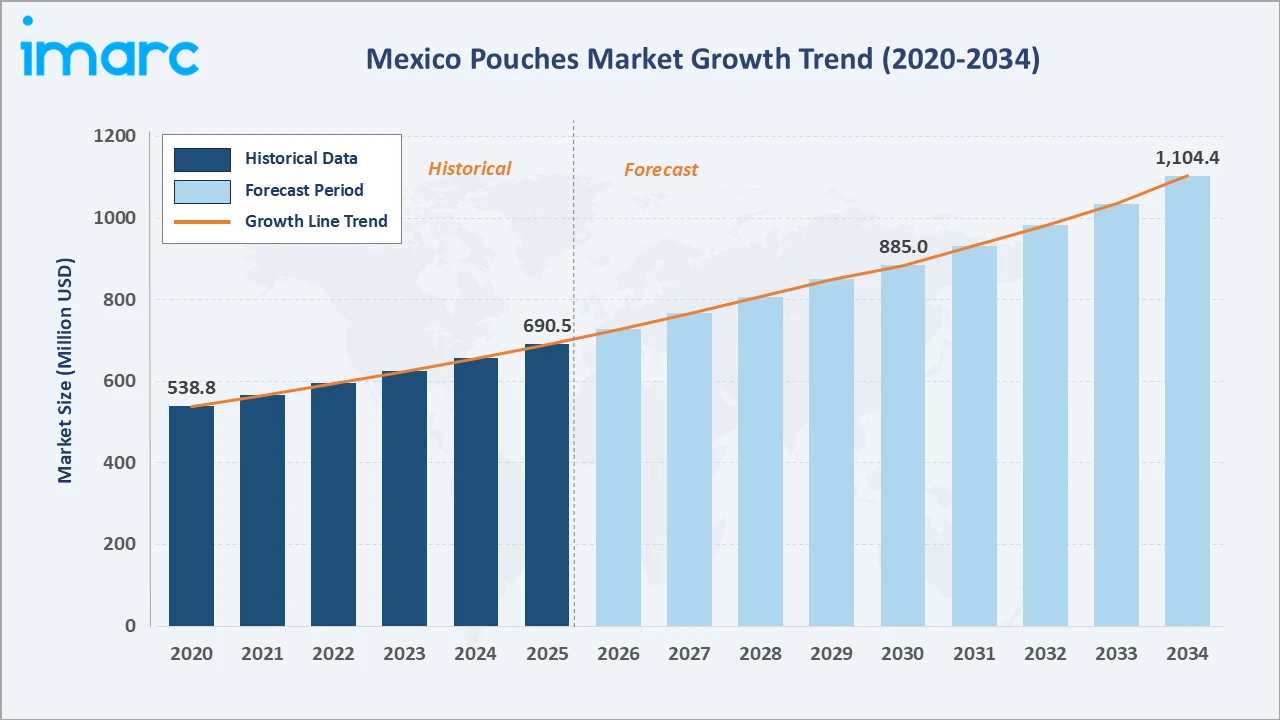
The Mexico pouches market reached USD 690.5 Million in 2025 and is projected to reach USD 1,104.4 Million by 2034, growing at a CAGR of 5.09% during 2026-2034. The near-shoring manufacturing boom attracting global FMCG companies to Mexico, rising consumer demand for ready-to-eat and convenience food products, accelerating adoption of sustainable bioplastic pouch materials under Plan Mexico environmental initiatives, and the growth of e-commerce logistics favoring lightweight pouch formats are the primary growth catalysts.
Market Snapshot
|
Metric |
Value |
|
Market Size (2025) |
USD 690.5 Million |
|
Forecast Market Size (2034) |
USD 1,104.4 Million |
|
CAGR (2026-2034) |
5.09% |
|
Base Year |
2025 |
|
Historical Period |
2020-2025 |
|
Forecast Period |
2026-2034 |
Central Mexico leads with a 41.5% market share in 2025, anchored by Mexico City's major FMCG manufacturing hub concentration and the nearby industrial clusters of Toluca, Puebla, and Querétaro. Plastic commands the dominant material share at 62.8%, while standard treatment type holds the largest treatment segment share at 44.7%, reflecting the established base of general-purpose pouch formats used across food, beverage, and personal care applications in Mexico's mainstream consumer market.
To get more information on this market, Request Sample
The Mexico pouches market is underpinned by three structural forces: Mexico's position as a major nearshoring beneficiary following supply chain diversification trends accelerated by US-China trade tensions attracting FMCG manufacturers; the growth of Mexico's packaged food and beverage sector, now the largest in Latin America by value with the food processing industry represented 17.2% of Mexico’s GDP in 2025; and the USMCA trade framework enabling seamless cross-border pouch supply chains between Mexico's manufacturing base and the US and Canadian consumer markets.
Executive Summary
The Mexico pouches market is experiencing sustained growth driven by the convergence of industrial modernization, evolving consumer preferences for convenient packaging formats, and Mexico's growing strategic importance in North American manufacturing supply chains. The market was valued at USD 690.5 Million in 2025 and is forecast to reach USD 1,104.4 Million by 2034 at a CAGR of 5.09%, reflecting both volume growth in established end-use segments and premiumization toward higher-value aseptic and retort pouch formats.
Plastic pouches command the dominant material share at 62.8% in 2025, encompassing multilayer polyethylene, polypropylene, and PET-based laminated structures that deliver the barrier properties, sealability, and format versatility required across food, beverage, personal care, and household products applications. Among treatment types, standard at 44.7% encompasses general-purpose pouches for non-thermally processed products including snacks, dry goods, personal care products, and household chemicals.
Key Market Insights
|
Insight |
Data |
| Largest Material |
Plastic – 62.8% share (2025) |
| Fastest Growing Material |
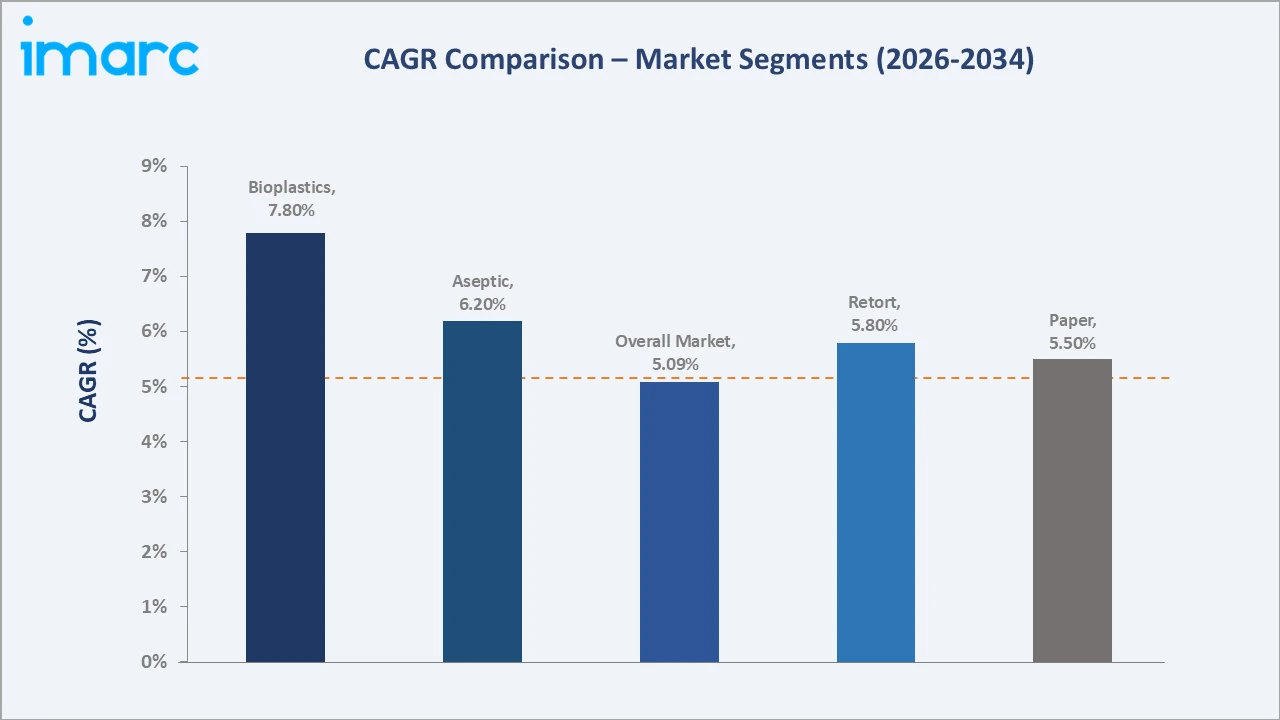
Bioplastics – ~7.8% CAGR (2026-2034) |
|
Largest Treatment Type |
Standard – 44.7% share (2025) |
|
Fastest Growing Treatment |
Aseptic – ~6.2% CAGR (2026-2034) |
| Leading Region |
Central Mexico – 41.5% share (2025) |
| Top Companies |
Amcor plc, Sonoco Products Company, ProAmpac, Sealed Air Corporation |
Key Analytical Observations Supporting The Above Data:
- Plastic pouches' 62.8% (2025) material dominance reflects both the cost-performance advantages of multilayer plastic laminate structures and the structural requirements of pouch formats that demand flexibility, sealability, and puncture resistance unattainable in paper or metal alternatives for most food and beverage applications.
- Standard treatments' 44.7% share (2025) reflects the broad applicability of non-thermally processed pouches across Mexico's largest pouch-consuming categories: snacks, personal care, household products, and pet food dry format packaging.
- Central Mexico's 41.5% market (2025) dominance reflects Mexico City's historical role as the country's largest consumer goods manufacturing and distribution hub, with industrial parks across the State of Mexico, Querétaro, Puebla, and Hidalgo hosting Mexico's densest concentration of FMCG, food processing, personal care, and household product manufacturers that collectively generate the majority of Mexico's pouch packaging demand.
- The 5.09% CAGR reflects Mexico's above-Latin-America-average economic and manufacturing sector growth with nearshoring investments translating into new production facility installations; the Mexican food processing industry represented 17.2% of Mexico’s GDP in 2025; and the USMCA supply chain integration enables US and Canadian brand owners to source packaging from Mexican converters at competitive costs.
Mexico Pouches Market Overview
Flexible pouches encompass a diverse family of packaging formats, including stand-up pouches, flat pouches, spouted pouches, vacuum pouches, zipper-closure pouches, and single-serve sachets, manufactured from laminated flexible substrates comprising plastic films, aluminum foil, paper, and increasingly bioplastic materials.
Mexico’s pouch market occupies a strategic position at the intersection of two major market forces: the USMCA trade framework’s integration of North American food and consumer goods supply chains, which positions Mexican pouch converters as cost-effective suppliers to both domestic and US/Canadian brand owner customers; and the nearshoring manufacturing migration from Asia that is steadily relocating production of FMCG goods, packaged food, and consumer electronics to Mexico, each new manufacturing facility bringing its packaging specification requirements into the Mexican market.
Market Dynamics
To evaluate market opportunities, Request Sample
Market Drivers
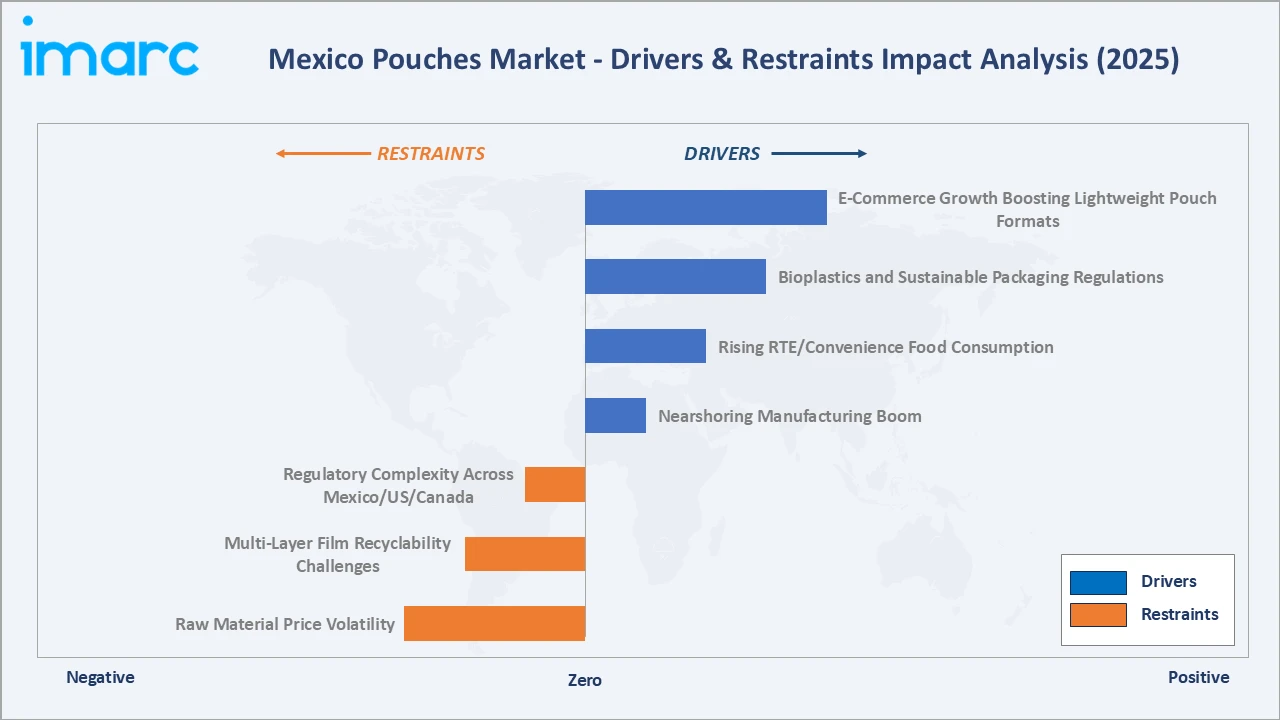
- Nearshoring Manufacturing Boom: Mexico has emerged as the primary beneficiary of North American supply chain restructuring following US-China trade tensions, COVID supply disruptions, and the USMCA framework’s trade preferences.
- Rising RTE/Convenience Food Consumption: Mexico’s food processing industry is experiencing above-average growth in ready-to-eat (RTE) and convenience food categories as urbanization, dual-income households, and extended commute times reduce home cooking time and increase demand for packaged meal solutions.
- Bioplastics and Sustainable Packaging Regulations: Mexico’s regulatory environment is progressively tightening around plastic packaging sustainability: Mexico City’s CDMX Single-Use Plastic Law (effective January 2021) and multiple state-level equivalent regulations are creating commercial pressure on brand owners to transition from conventional plastic to recyclable mono-material or bioplastic pouch alternatives.
- E-Commerce Growth Boosting Lightweight Pouch Formats: Mexico’s e-commerce market is expected to grow at a CAGR of 13.92% from 2026 to 2034. E-commerce logistics favor lightweight, puncture-resistant pouch formats over heavy rigid containers: a 1 kg pouch of protein powder adds minimal dead weight versus an equivalent rigid container, reducing shipping cost per unit and enabling profitable unit economics at Mexico’s e-commerce fulfillment center cost structures.
Market Restraints
- Raw Material Price Volatility: Polyethylene and polypropylene resin prices are subject to significant global commodity price volatility driven by crude oil and natural gas feedstock price movements, global ethylene cracker capacity decisions, and supply disruptions from extreme weather events at US Gulf Coast petrochemical facilities.
- Multi-Layer Film Recyclability Challenges: Mexico’s municipal waste management infrastructure lacks the optical sorters and air-classification equipment needed to recover thin-film flexible plastics from the waste stream at commercial scale. Multi-layer laminated pouches are not recyclable in Mexico’s existing recycling infrastructure, creating a regulatory and ESG liability for brand owners using these materials under emerging extended producer responsibility regulations.
- Regulatory Complexity Across Mexico/US/Canada: Pouches produced in Mexico and sold or exported under USMCA must navigate an increasingly complex and divergent regulatory landscape: Mexico’s NOM (Norma Oficial Mexicana) food contact material regulations, US FDA food packaging regulations, and Canadian CFIA packaging requirements create compliance complexity for converters serving the integrated North American supply chain.
Market Opportunities
- Retort Pouch Adoption in Premium Ready Meal Sector: Mexico’s premium food retail segment is creating demand for retort-processed meal pouches that offer restaurant-quality packaged meals with ambient shelf stability and no preservatives. Premium ready meal brands, international food manufacturers expanding into Mexico under USMCA, and Mexico’s growing food tourism-driven artisanal food sector are driving retort pouch adoption into the premium food tier.
- Aseptic Pouch for Dairy and Beverage Applications: Mexico’s dairy sector is progressively adopting aseptic pouch formats for flavored milk drinks, drinkable yogurts, and dairy-based beverages as ambient shelf-stable pouch formats enable distribution to Mexico’s traditional tienditas (neighborhood stores) that lack refrigeration, dramatically expanding the addressable market for dairy brands beyond refrigerated modern retail.
Market Challenges
- Mono-Material Pouch Reformulation Complexity: Converting existing multi-layer laminated pouch structures to recyclable mono-material alternatives requires significant capital investment in new lamination and converting equipment, reformulation of adhesive and barrier coating systems, and qualification testing to validate that the new mono-material structure delivers equivalent barrier, sealability, and mechanical performance to the incumbent multi-layer construction.
- Competition from Asian and US Pouch Imports: Despite USMCA preferences favoring North American-origin packaging, Mexico’s market remains exposed to competition from Asian pouch converters, and from US-based flexible packaging converters with superior technology access and large-run scale economies that can competitively serve the premium segments where margin is most attractive.
Emerging Market Trends
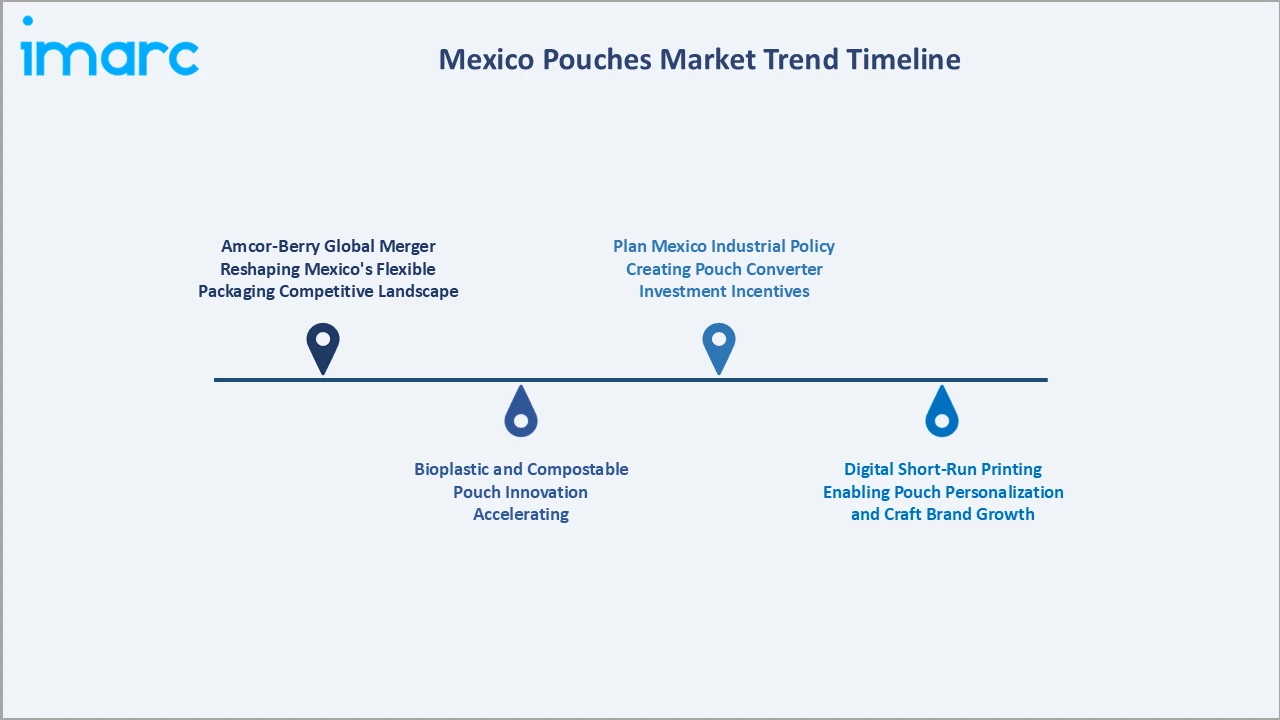
1. Amcor-Berry Global Merger Reshaping Mexico’s Flexible Packaging Competitive Landscape
The April 2025 completion of Amcor’s all-stock combination with Berry Global represents the most significant competitive development in Mexico’s flexible packaging market in decades. The combined entity’s enhanced ability to supply retort pouches, medical barrier films, and recyclable mono-material structures across Amcor Flexibles México’s existing supply relationships with Mexican FMCG manufacturers positions the merged company to capture the premium pouch segments that offer the highest margins in Mexico’s pouch market.
2. Bioplastic and Compostable Pouch Innovation Accelerating
Huhtamaki’s 2023 launch of a mono-material polypropylene pouch containing 35% post-consumer recycled content that meets Mexico City’s recycling labelling standards demonstrates the pace of sustainable pouch material innovation reaching the Mexican market. SigmaQ’s investment in digital printing capability to service craft beer exporters using small-batch printed pouches further illustrates how sustainability and digitization trends are converging in the Mexican pouch market.
3. Digital Short-Run Printing Enabling Pouch Personalization and Craft Brand Growth
Mexico’s craft food and beverage sector is creating demand for short-run, digitally printed pouches that enable brand launch with economically viable minimum order quantities. Traditional CI-flexo pouch printing requires minimum orders of 25,000–50,000 units to amortize set-up costs, while digital print-on-demand pouches enable economical production from 500 units.
4. Plan Mexico Industrial Policy Creating Pouch Converter Investment Incentives
Mexico’s January 2025 presidential decree under Plan Mexico provides accelerated depreciation of 35–91% on new fixed asset investments made between the decree date and September 30, 2030, plus a 25% additional deduction for training and innovation expenses capped at USD 1.5 Billion. For pouch converters, these incentives significantly improve the post-tax economics of capital investments in new 9-colour CI-flexo printing presses, solvent-less lamination lines, and retort pouch qualification testing equipment.
Industry Value Chain Analysis
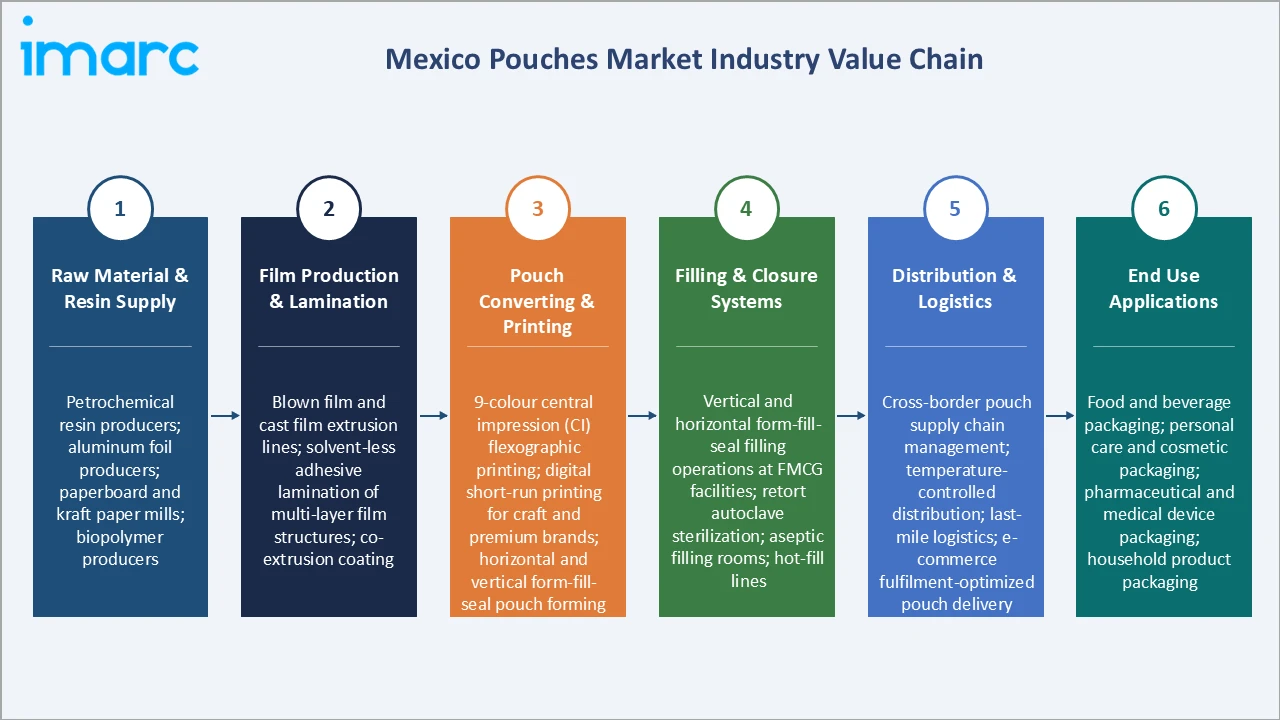
The Mexico pouches market value chain spans petrochemical resin supply through brand owner end-use applications, with pouch converting as the critical value-adding stage where raw film and laminate inputs are transformed into finished functional packaging that delivers the barrier, aesthetics, and format convenience specified by brand owner customers.
|
Stage |
Key Players / Examples |
|
Raw Material & Resin Supply |
Petrochemical resin producers; aluminum foil producers; paperboard and kraft paper mills; biopolymer producers |
|
Film Production & Lamination |
Blown film and cast film extrusion lines; solvent-less adhesive lamination of multi-layer film structures; co-extrusion coating |
|
Pouch Converting & Printing |
9-colour central impression (CI) flexographic printing; digital short-run printing for craft and premium brands; horizontal and vertical form-fill-seal pouch forming |
|
Filling & Closure Systems |
Vertical and horizontal form-fill-seal filling operations at FMCG manufacturing facilities; retort autoclave sterilization; aseptic filling rooms; hot-fill lines |
|
Distribution & Logistics |
Cross-border pouch supply chain management; temperature-controlled distribution; last-mile logistics; e-commerce fulfillment-optimized pouch delivery formats |
| End Use Applications |
Food and beverage packaging; personal care and cosmetic packaging; pharmaceutical and medical device packaging; household product packaging |
Technology Landscape in the Mexico Pouches Industry
Multilayer Barrier Film Technology
Mexico’s pouch manufacturing sector relies heavily on multilayer barrier film laminates that combine 2–7 layers of different materials to achieve the combined barrier, mechanical, and sealability properties required for specific pouch applications. The most technically demanding pouch formats require precisely engineered multilayer laminate structures incorporating high-barrier layers that prevent oxygen and moisture ingress over the product’s intended shelf life.
Retort and Aseptic Processing Technology
Retort pouch technology represents the most technically demanding segment of Mexico’s pouch manufacturing capability. Mexican FMCG manufacturers including pet food processors and ready meal producers are investing in retort autoclave capacity to serve growing demand, while international retort pouch converters supply the premium segments requiring specialized retort laminate structures with proven performance records. Aseptic pouch technology for dairy and beverage applications requires ultra-clean filling rooms, hydrogen peroxide sterilization of pouch surfaces immediately before filling, and hermetic spouted closure systems that maintain sterility from filling through consumer opening.
Sustainable Mono-Material Pouch Technology
The packaging industry’s transition from multi-layer composite structures toward recyclable mono-material pouches represents the most significant technology transformation in Mexico’s flexible packaging sector over the 2025–2034 period. All-polyethylene (all-PE) pouch structures can achieve barrier performance approaching conventional multi-layer composites through advanced co-extrusion and EVOH incorporation while maintaining recyclability in PE film collection systems.
Market Segmentation Analysis
The report covers the following segments:
|
Segment Category |
Leading Segment |
Market Share |
Year |
| Material | Plastic |
62.8% |
2025 |
| Treatment Type | Standard |
44.7% |
2025 |
| Product |
🔒 |
🔒 |
2025 |
| Closure Type |
🔒 |
🔒 |
2025 |
| End Use |
🔒 |
🔒 |
2025 |
|
Region |
Central Mexico |
41.5% |
2025 |

By Material
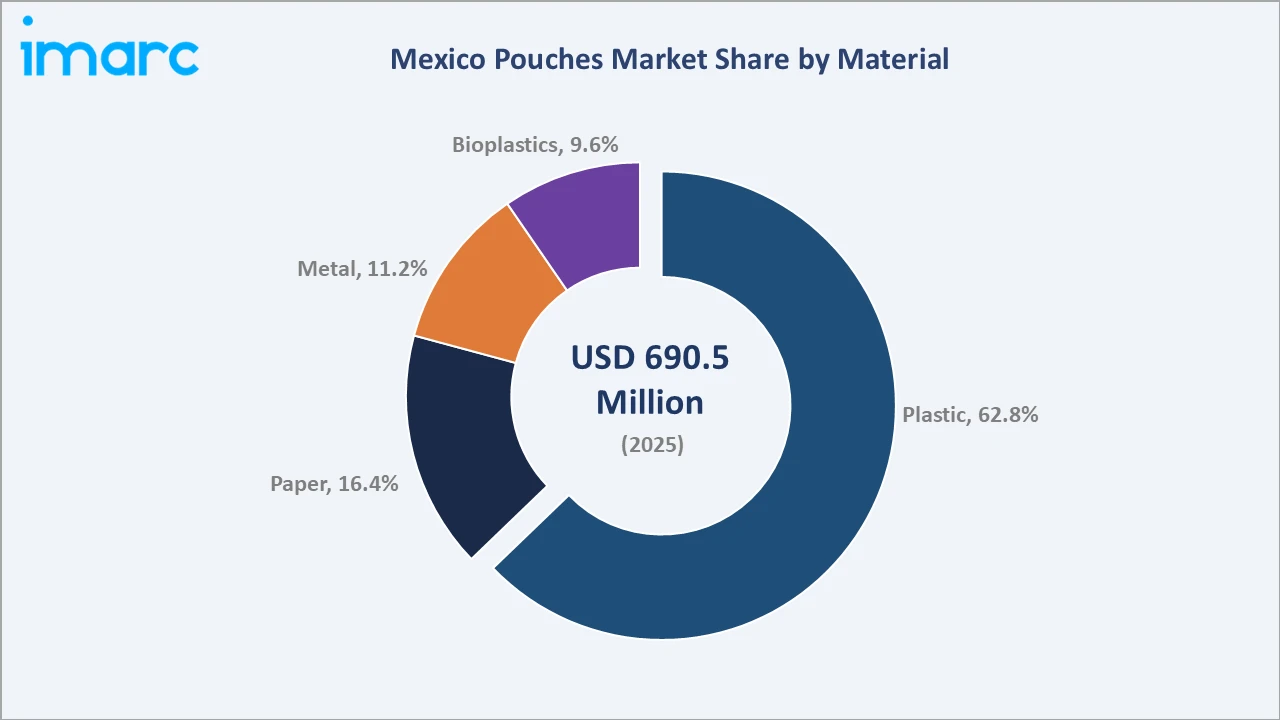
The material segment is analyzed across Plastic (62.8%), paper (16.4%), metal (11.2%), and bioplastics (9.6%). Plastic pouches’ dominance encompasses a broad range of laminate structures: BOPP/PE for snack and dry food pouches, PET/aluminum foil/PE for retort-grade pouches, OPP/PE for vertical form-fill-seal applications, and monolayer LDPE for basic sachets.
To access detailed market analysis, Request Sample
Paper serves premium dry food, e-commerce postal pouches, and sustainable packaging initiatives where kraft paper mono-material or paper/PE laminates communicate environmental responsibility. Metal foil at 11.2% provides maximum oxygen, moisture, and light barrier for retort pouches and pharmaceutical sterile packaging. Bioplastics at 9.6% (projected to grow fastest at approximately 7.8% CAGR) include bio-based PE, PLA, and compostable film materials gaining traction in organic food, premium cosmetics, and sustainability-committed brand packaging programs.
By Treatment Type
The treatment type segment is led by standard (44.7%), retort (26.3%), aseptic (18.5%), and hot-fill (10.5%). Standard treatment pouches encompass general-purpose pouch formats, including flat pouches, stand-up pouches, and pillow pouches, used across Mexico’s largest FMCG packaging applications where high-temperature sterilization is not required.
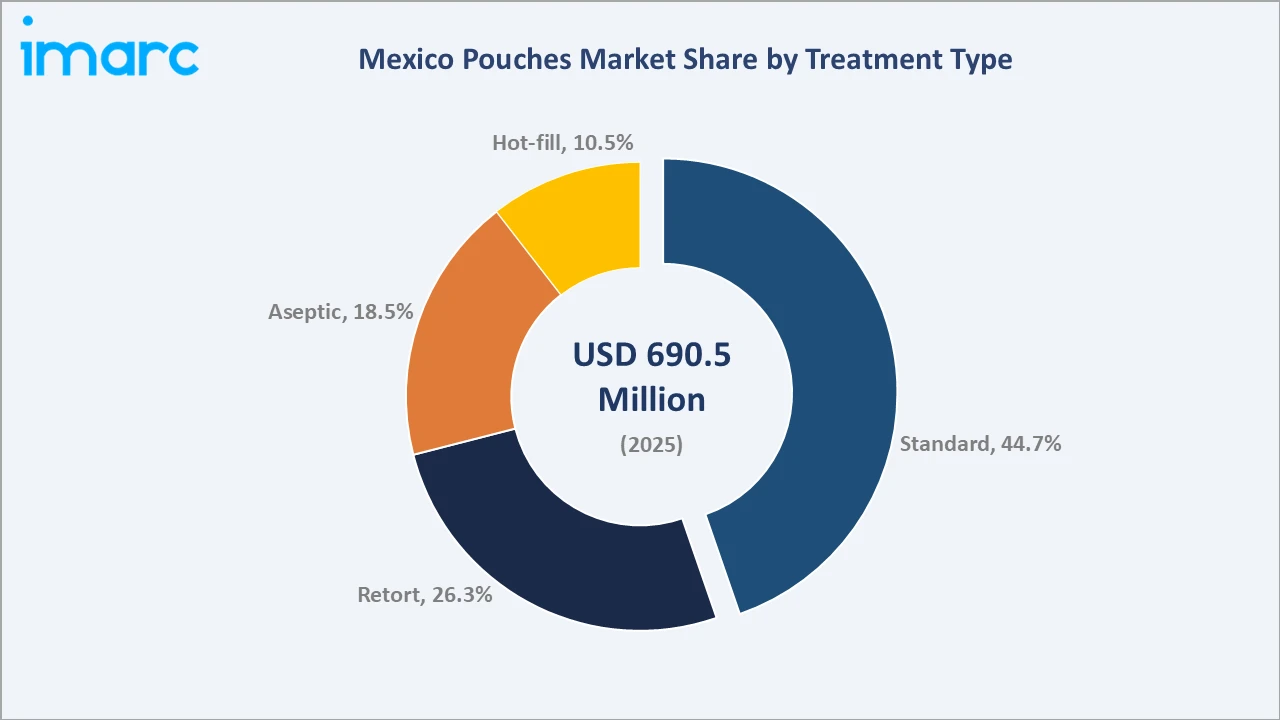
Retort pouches are gaining share within Mexico’s RTE food sector: wet pet food, soups, sauces, marinated proteins, and fully prepared meals all benefit from retort processing’s ability to achieve commercial sterility at ambient temperature storage without refrigeration, enabling distribution through Mexico’s traditional trade channel lacking refrigeration infrastructure.
Regional Market Insights
Central Mexico’s 41.5% market leadership reflects the Mexico City metropolitan area’s historical role as the country’s primary consumer goods manufacturing and logistics hub, combined with the industrial clusters of the surrounding states that collectively form Mexico’s densest FMCG production concentration.
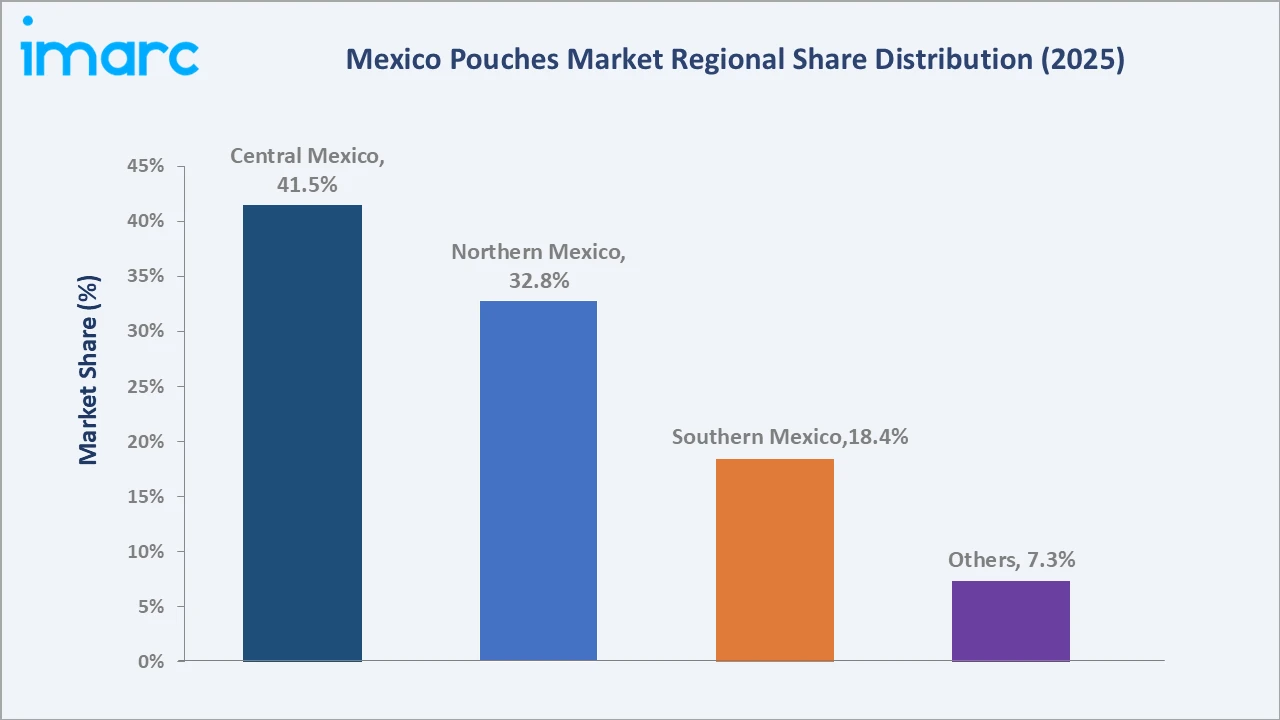
Northern Mexico at 32.8% represents the country’s fastest-growing pouch market, driven by the maquiladora manufacturing sector’s evolution into nearshoring-driven advanced manufacturing and the region’s proximity to the US border, which facilitates cross-border supply chain integration.
|
Region |
Share (2025) |
Key Growth Drivers |
|
Central Mexico |
41.5% |
Highest concentration of FMCG manufacturing facilities generating pouch packaging demand; Mexico City’s large consumer market driving premium food and personal care pouch innovation; industrial park development in State of Mexico, Querétaro, and Puebla |
|
Northern Mexico |
32.8% |
Maquiladora-to-nearshoring manufacturing transition generating new pouch demand from relocated FMCG and food processing facilities; automotive, electronics, and consumer goods manufacturing boom driving non-food industrial pouch applications |
|
Southern Mexico |
18.4% |
Emerging consumer market growth in metropolitan areas; agricultural sector pouch usage for fresh produce and processed food; growing FMCG brand penetration of traditional trade channels |
|
Others |
7.3% |
Regional growth from Plan Mexico industrial development program; peninsula and coastal industrial zone development; growing export-oriented food and fishery product pouch packaging demand |
Competitive Landscape
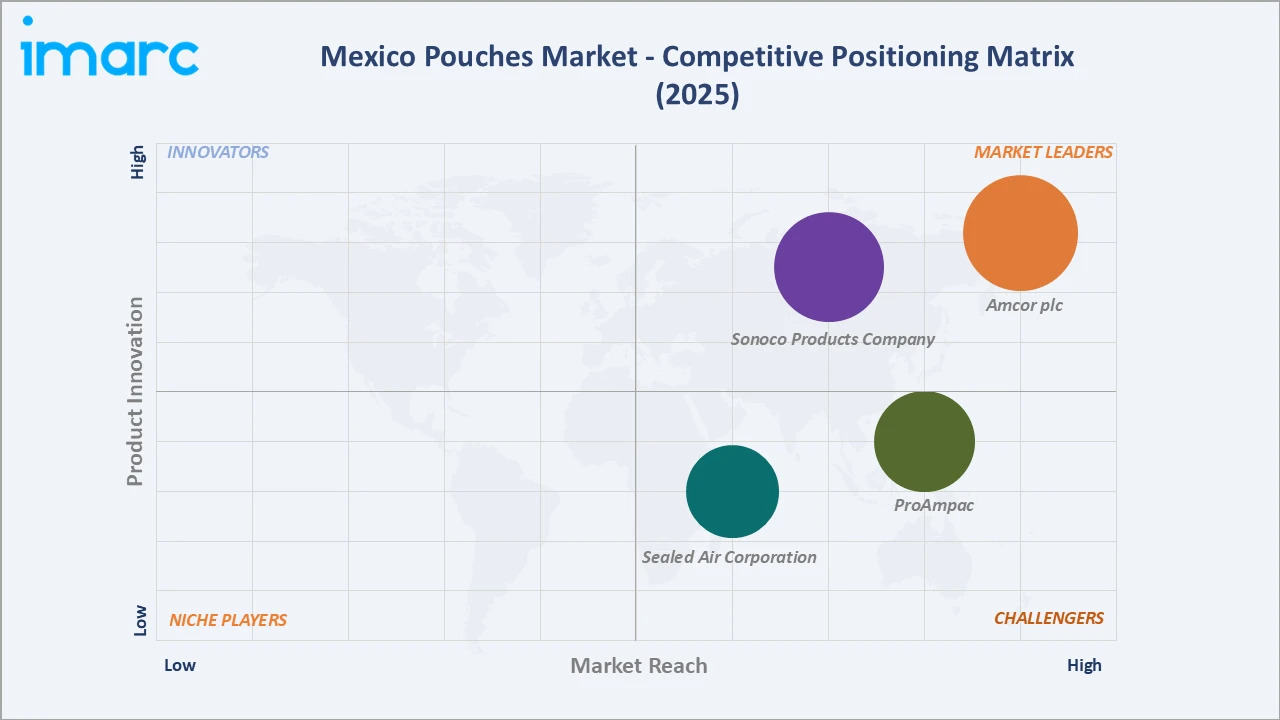
The Mexico pouches market competitive landscape is characterized by the dominance of international flexible packaging majors competing with regional Latin American converters and domestic Mexican flexible packaging companies for the growing volume of pouch business generated by Mexico’s FMCG and nearshoring manufacturing sectors.
|
Company Name |
Brand/Product |
Market Position |
Core Strength |
| Amcor plc |
AmFiber, AmFoil, Plastic based Pouches |
Market Leader |
One of the global flexible packaging leaders; enhanced retort pouch and medical barrier film capability; recyclable mono-material innovation |
| Sonoco Products Company |
Stand-Up Pouch (Plow-bottom), Doyen-Style Pouch, K-Style with Skirt Seal, 3-Side Sealed Pouch |
Market Leader |
Diversified packaging major with established Mexico operations; food safety compliance expertise; strong presence in pet food and RTE meal pouch segments; medical device sterile pouch capability |
| ProAmpac |
PRO-POUCH, Spouted Pouches, Standup Pouches, Pouches – Rollstock & Premade, Drug Delivery Devices, Child Resistant Pouches, PRO-POUCH Med Device, PRO-POUCH -Retort Packaging, among others |
Strong Challenger |
Sustainability-forward ProActive recyclable pouch platform; digital printing and short-run capability serving craft and premium brands; strong pet food and RTE food segment focus |
| Sealed Air Corporation |
Stand-Up Pouch, Stock Pouches, CRYOVAC Brand Vertical Form Fill Seal Pouches, CRYOVAC vacuum pouches, CRYOVAC brand dispenser pouch packaging |
Strong Challenger |
CRYOVAC brand for fresh protein and chilled food sectors; advanced barrier performance enabling extended shelf life; sustainable packaging innovation through lightweight designs reducing material per unit |
International packaging majors compete on technology, quality certification, and sustainability innovation, while domestic and regional converters compete on rapid turnaround, local market knowledge, lower minimum orders, and competitive pricing for standard pouch specifications.
Key Company Profiles
Amcor plc
Amcor plc completed its all-stock combination with Berry Global Inc. in April 2025, creating the world’s largest pure-play flexible and rigid packaging company. In Mexico, Amcor operates as Amcor Flexibles México, S. de R.L. de C.V., with manufacturing and converting operations serving Mexico’s food, pharmaceutical, and personal care pouch markets.
- Product Portfolio: AmFiber, AmFoil, and plastic based pouches.
- Recent Developments: In February 2024, Amcor plc collaborated with Stonyfield Organic and Cheer Pack North America to launch the first all-polyethylene spouted pouch for Stonyfield’s YoBaby refrigerated yogurt. The new AmPrima Plus pouch replaces the previous multi-laminate structure, supports recyclability, removes foil/metallized layers, and reduces plastic use through CPNA’s Vizi cap.
- Strategic Focus: Integration synergy capture in manufacturing, procurement, and customer service across the combined Mexico footprint; sustainable packaging innovation including recyclable mono-material pouches; premium retort and aseptic pouch segment capture from Mexico’s growing RTE food and premium pet food markets.
Sonoco Products Company
Sonoco Products Company is a diversified global packaging company serving the domestic FMCG, food processing, and pharmaceutical packaging markets.
- Product Portfolio: Stand-up pouch (plow-bottom), doyen-style pouch, K-style with skirt seal, and 3-side sealed pouch.
- Recent Developments: In April 2026, Sonoco Products Company reported Q1 2026 net sales of USD 1.7 billion, down 1.9% year over year, while GAAP net income rose to USD 67.6 million. The consumer packaging net sales rose 2.9% to USD 1.10 billion, supported by pricing actions, foreign exchange benefits, and partly offset by softer volumes.
- Strategic Focus: Retort and aseptic pouch technology leadership for Mexico’s premium food and pet food sector; pharmaceutical flexible packaging growth supporting Mexico’s pharmaceutical manufacturing sector; sustainable packaging development including recyclable mono-material structures and recycled content integration.
Market Concentration Analysis
The Mexico pouches market is moderately fragmented at the overall market level, with a mix of global packaging majors, regional Latin American converters, and domestic Mexican flexible packaging companies competing across different market segments and customer tiers.
The Amcor-Berry Global combination has increased the concentration of the premium and technical pouch segments, where advanced technology and quality certifications create competitive barriers that domestically focused smaller converters cannot easily overcome.
Domestic Mexican converters and regional Latin American flexible packaging companies maintain meaningful market share in the standard-grade, commodity pouch segment where local market knowledge, rapid turnaround, lower minimum order requirements, and competitive pricing for straightforward laminate specifications create defensible competitive positions.
Investment & Growth Opportunities
Fastest Growing Segments
Bioplastic and sustainable mono-material pouches (~7.8% CAGR, fastest material segment); Aseptic pouches for dairy and beverage ambient distribution (~6.2% CAGR, fastest treatment type); premium retort pouches for RTE meal and pet food applications; digital short-run pouches for craft food and premium brand sectors; and pharmaceutical sterile flexible pouches for Mexico’s pharmaceutical manufacturing growth represent the highest-growth, highest-margin investment vectors within Mexico’s pouch market through 2034.
Emerging Market Expansion
Mexico’s traditional trade channel represents the most significant volume growth opportunity for pouch packaging in Mexico over the forecast period. The tiendita channel’s lack of refrigeration infrastructure creates structural demand for ambient-stable pouch formats that enable FMCG brand owners to access this enormous distribution channel without cold chain dependency.
Venture and Institutional Investment Trends
- ESG-committed brand owners including international FMCG multinationals and Mexican domestic brands with 2025–2030 sustainable packaging commitments represent committed procurement pipelines for sustainable mono-material and bioplastic pouches that are creating demand certainty enabling pouch converter investment in sustainable film lamination capability.
- Private equity investment in North American flexible packaging converters has accelerated, with ProAmpac itself PE-backed and multiple regional converters attracting growth equity to fund digital printing and sustainable packaging capability upgrades that position them to capture premium market share from Mexico’s nearshoring FMCG wave.
Future Market Outlook (2026-2034)
The Mexico pouches market is positioned for sustained, diversified growth through 2034. From a base of USD 690.5 Million in 2025, the market is projected to reach USD 1,104.4 Million by 2034 at a CAGR of 5.09%, representing total incremental value creation of USD 413.9 Million, a 60% market value increase over the forecast period.
This growth will be driven by the compounding effects of nearshoring manufacturing investment, RTE food market expansion, sustainable packaging transition, and the progressive adoption of premium retort and aseptic pouch formats across Mexico’s food and beverage sector.
By 2034, Bioplastics will have grown from 9.6% to an estimated 15–18% of material share as sustainability regulations and brand owner commitments systematically shift procurement toward recyclable and bio-based pouch materials. Aseptic treatment will have grown from 18.5% to approximately 23–25% as dairy and beverage companies complete their conversion of traditional retail channels from refrigerated to ambient pouch formats.
Research Methodology
Primary Research
Primary research comprised structured interviews with over 65 industry participants in 2024–2025, including flexible pouch converters, laminate film producers, FMCG packaging procurement managers, food and beverage brand marketing directors, retail category managers at major Mexican supermarket chains, pharmaceutical packaging specialists, and packaging material distributor sales teams across Mexico City, Guadalajara, Monterrey, and Querétaro.
Secondary Research
Secondary research encompassed INEGI (Instituto Nacional de Estadística y Geografía) plastics and packaging industry production statistics, Mexican Plastics Industry Association (ANIPAC) market data, USMCA rules of origin documentation for packaging materials, annual reports and Mexico operations data, ADM investment announcements, and trade publication analysis from Packaging Digest, Flexible Packaging, and Packaging World covering Mexico market developments.
Forecasting Models
Market size estimations were derived using top-down and bottom-up forecasting, incorporating INEGI industrial production value trend analysis, FMCG end-market volume and revenue growth projections, pouch material intensity modelling (pouch units per USD million of end-market revenue), nearshoring investment pipeline to pouch demand translation modelling, sustainability regulatory transition scenario analysis, and competitive pricing trend adjustments.
Mexico Pouches Market Report Coverage:
| Report Features | Details |
|---|---|
| Base Year of the Analysis | 2025 |
| Historical Period | 2020-2025 |
| Forecast Period | 2026-2034 |
| Units | Million USD |
| Scope of the Report | Exploration of Historical Trends and Market Outlook, Industry Catalysts and Challenges, Segment-Wise Historical and Future Market Assessment:
|
| Materials Covered | Plastic, Metal, Paper, Bioplastics |
| Treatment Types Covered | Standard, Aseptic, Retort, Hot-fill |
| Products Covered | Flat, Stand-up |
| Closure Types Covered | Tear Notch, Zipper, Spout |
| End Uses Covered | Food and Beverages, Healthcare, Personal Care and Cosmetics, Homecare, Others |
| Regions Covered | Northern Mexico, Central Mexico, Southern Mexico, Others |
| Companies Covered | Amcor plc, Sonoco Products Company, ProAmpac, Sealed Air Corporation, etc. |
| Customization Scope | 10% Free Customization |
| Post-Sale Analyst Support | 10-12 Weeks |
| Delivery Format | PDF and Excel through Email (We can also provide the editable version of the report in PPT/Word format on special request) |
Key Benefits for Stakeholders:
- IMARC’s industry report offers a comprehensive quantitative analysis of various market segments, historical and current market trends, market forecasts, and dynamics of the Mexico pouches market from 2020-2034.
- The research report provides the latest information on the market drivers, challenges, and opportunities in the Mexico pouches market.
- Porter's five forces analysis assist stakeholders in assessing the impact of new entrants, competitive rivalry, supplier power, buyer power, and the threat of substitution. It helps stakeholders to analyze the level of competition within the Mexico pouches industry and its attractiveness.
- Competitive landscape allows stakeholders to understand their competitive environment and provides an insight into the current positions of key players in the market.
Frequently Asked Questions About the Mexico Pouches Market Report
The Mexico pouches market reached USD 690.5 Million in 2025 and is projected to reach USD 1,104.4 Million by 2034.
The market is expected to grow at a CAGR of 5.09% during 2026-2034, driven by nearshoring manufacturing investment generating new packaging demand, rising RTE food consumption, sustainable bioplastic adoption, and growing premium retort and aseptic pouch applications.
Central Mexico leads with a 41.5% market share in 2025, anchored by Mexico City’s FMCG manufacturing concentration and the surrounding industrial cluster states that collectively host Mexico’s largest concentration of pouch packaging-consuming consumer goods manufacturers.
Plastic pouches dominate with a 62.8% share in 2025, reflecting the established laminate film converting infrastructure of Mexican pouch manufacturers and the functional requirements of food, personal care, and household product categories.
Standard treatment holds the largest share at 44.7%, reflecting the broad applicability of non-thermally processed pouches across Mexico’s largest FMCG categories including snacks, dry food, personal care, and household products.
Some of the key players include Amcor plc, Sonoco Products Company, ProAmpac, and Sealed Air Corporation.
Key drivers include the nearshoring manufacturing boom attracting global FMCG companies to Mexico and bringing pouch packaging demand to Mexican domestic converters; rising RTE and convenience food consumption expanding retort and aseptic pouch demand; and e-commerce growth favoring lightweight pouch formats.
Key challenges include raw material (PE and PP resin) price volatility driven by crude oil feedstock cycles; multi-layer film recyclability infrastructure gaps in Mexico’s waste management system; and competition from Asian pouch imports in commodity grade segments.
Need more help?
- Speak to our experienced analysts for insights on the current market scenarios.
- Include additional segments and countries to customize the report as per your requirement.
- Gain an unparalleled competitive advantage in your domain by understanding how to utilize the report and positively impacting your operations and revenue.
- For further assistance, please connect with our analysts.
 Request Customization
 Speak to an Analyst
 Request Brochure
 Inquire Before Buying
Benefits of Customization
- Personalize this research
- Triangulate with your data
- Get data as per your format and definition
- Gain a deeper dive into a specific application, geography, customer, or competitor
- Any level of personalization
Get in Touch With Us
UNITED STATES
Phone: +1-201-971-6302
INDIA
Phone: +91-120-433-0800
UNITED KINGDOM
Phone: +44-753-714-6104
Email: [email protected]
Client Testimonials




.webp)




.webp)













Related Reports

Choose your plan
*Please note that the prices mentioned below are starting prices for each bundle type. Kindly contact our team for further details.*
Single User License
- 1 User License, Access on 2 Devices
- PDF Report + Excel Dataset (Password Protected)
- Lifetime Access
- No Printing Rights
- 10% Free Report Customization
- 10–12 Weeks of Analyst Support
Five User License
- Access for 5 Users, 2 Devices per User
- PDF Report + Excel Dataset (Password Protected)
- Lifetime Access
- Dedicated Account Manager
- 12–14 Weeks of Analyst Support
- No Printing Rights
- 15% Free Report Customization
- 25% Discount on Your Next Purchase
Corporate User License
- Unlimited User Access (Within Your Organization)
- PDF Report + Excel Dataset
- Lifetime Access
- Dedicated Account Manager
- 14–20 Weeks of Analyst Support
- No Printing Rights
- 20% Free Report Customization
- 30% Discount on Your Next Purchase
Essential Insights
What's included:
3 reports
- Lifetime Access
- PDF Reports
- Excel Datasets
- 2 Weeks of Free Analyst Support
- 2 User Licenses
- Access on 2 Devices
- Printing Rights
- Complimentary PowerPoint (PPT) Version
- Complimentary License Upgrade
Professional Access
What's included:
5 reports
- Lifetime Access
- PDF Reports
- Excel Datasets
- 8 Weeks of Free Analyst Support
- 2 User Licenses
- Access on 2 Devices
- Printing Rights
- Complimentary PowerPoint (PPT) Version
- Complimentary License Upgrade
Business Advantage
What's included:
8 reports
- Lifetime Access
- PDF Reports
- Excel Datasets
- 14 Weeks of Free Analyst Support
- 2 User Licenses
- Access on 2 Devices
- Printing Rights
- Complimentary PowerPoint (PPT) Version
- Complimentary License Upgrade
Enterprise Intelligence
What's included:
10 reports
- Lifetime Access
- PDF Reports
- Excel Datasets
- 20 Weeks of Free Analyst Support
- 2 User Licenses
- Access on 2 Devices
- Printing Rights
- Complimentary PowerPoint (PPT) Version
- Complimentary License Upgrade