
Mexico Ready Mix Concrete Market Size, Share, Trends and Forecast by Product, End Use Sector, and Region, 2026-2034
Mexico Ready Mix Concrete Market Size, Share, Trends & Forecast (2026-2034)
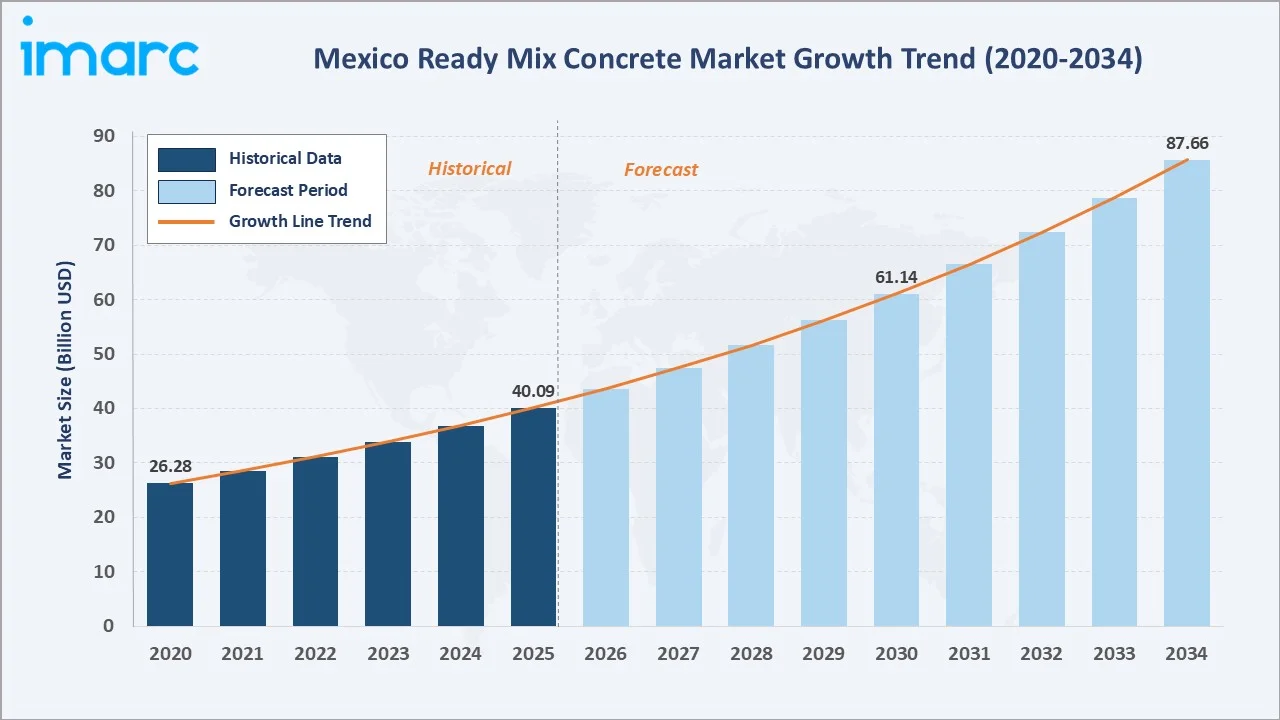
The Mexico ready mix concrete market size increased from USD 40.09 Billion in 2025 to USD 43.62 Billion in 2026 and is projected to reach USD 87.66 Billion by 2034, growing at a CAGR of 8.81% during 2026-2034. The market is driven by rising infrastructure development, urban housing construction, industrial projects, and commercial real estate expansion. In 2024, Mexico’s construction sector was one of the country’s top six economic contributors, generating USD 11.5 Billion and representing 7.2% of national output. As construction activity accelerates, contractors increasingly rely on ready-mix concrete for faster project execution, consistent quality, and large-volume supply. Transit mixed leads product at 49.6%. Infrastructure leads end use at 35.8%. Central Mexico leads regionally at 38.5%.
Market Snapshot
|
Metric |
Value |
|
Base Year Market Size (2025) |
USD 40.09 Billion |
| Market Size (2026) | USD 43.62 Billion |
|
Forecast Market Size (2034) |
USD 87.66 Billion |
|
CAGR (2026-2034) |
8.81% |
|
Base Year |
2025 |
|
Historical Period |
2020-2025 |
|
Forecast Period |
2026-2034 |
|
Dominant Product |
Transit Mixed (49.6%, 2025) |
|
Dominant End Use Sector |
Infrastructure (35.8%, 2025) |
|
Leading Region |
Central Mexico (38.5%, 2025) |
The Mexico ready-mix concrete market expanded from USD 26.28 Billion in 2020 to USD 40.09 Billion in 2025 and an estimated USD 43.62 Billion in 2026, reflecting strong growth supported by infrastructure development, urbanization, and industrial construction. The market is anchored at USD 61.14 Billion by 2030, driven by increasing demand for faster and higher-quality concrete solutions. By 2034, it is forecast to reach USD 87.66 Billion, supported by large-scale public works, housing projects, and commercial real estate expansion. This growth indicates sustained adoption of ready-mix concrete across Mexico’s construction value chain.
To get more information on this market, Request Sample
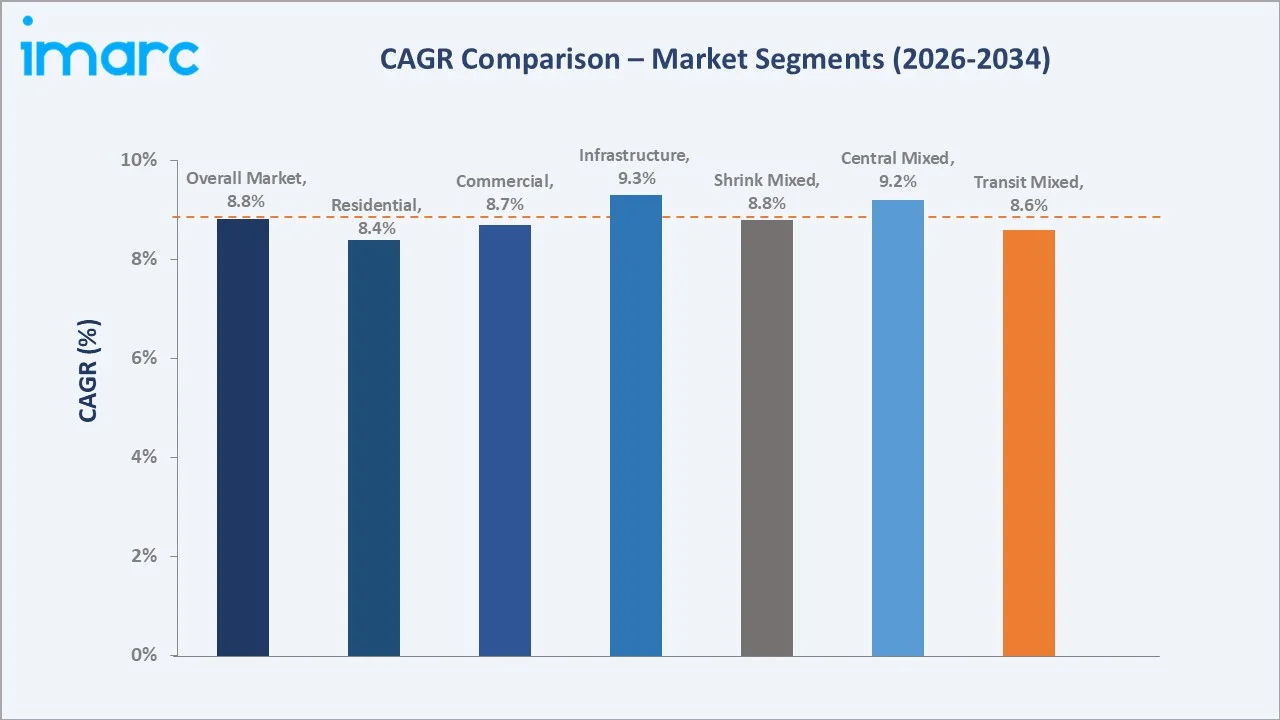
Central mixed grows fastest at ~9.2% CAGR through high-performance concrete specifications for large industrial plants and infrastructure. Infrastructure end use grows at ~9.3% CAGR through federal highway, metro, and bridge investments.
Executive Summary
The Mexico ready-mix concrete market is gaining momentum, supported by rapid construction activity, infrastructure investment, and urban expansion. Demand is rising across residential, commercial, industrial, and transport projects where consistent quality and faster execution are critical. The market is projected to grow from USD 40.09 Billion in 2025 to an estimated USD 43.62 Billion in 2026, reaching USD 87.66 Billion by 2034. Ready-mix concrete adoption is increasing as contractors shift from on-site mixing to efficient, plant-batched solutions. Growth is further supported by Mexico’s industrial corridors, housing demand, and large public infrastructure programs. Transit mixed at 49.6% leads through broad applicability. Infrastructure at 35.8% leads through federal spending. Central Mexico leads regionally at 38.5%.
Key Market Insights
|
Insight |
Data |
|
Dominant Product |
Transit Mixed - 49.6% share (2025) |
|
Dominant End Use Sector |
Infrastructure - 35.8% market share (2025) |
|
Leading Region |
Central Mexico - 38.5% share (2025) |
|
Market Opportunity |
Nearshoring industrial plant concrete; low-carbon green ready-mix concrete; Train tourism infrastructure; housing program |
Key Analytical Observations Supporting The Above Data:
- Transit Mixed at 49.6%: The transit mixed segment dominates as it offers flexible, efficient delivery of ready-mix concrete directly from batching plants to construction sites. It ensures consistent quality, reduces on-site mixing time, and supports large-scale infrastructure and urban construction projects.
- Infrastructure at 35.8%: The infrastructure segment dominates due to substantial investments in highways, bridges, rail networks, airports, ports, and public utilities that require large volumes of high-quality concrete.
- Central Mexico at 38.5%: Central Mexico dominates due to its concentration of major urban centers, infrastructure projects, industrial corridors, and commercial construction activity. High demand from Mexico City and surrounding states supports strong ready-mix concrete consumption.
Mexico Ready Mix Concrete Market Overview
The Mexico ready-mix concrete market encompasses the production, batching, transportation, and delivery of pre-mixed concrete for infrastructure, residential, commercial, and industrial construction projects. It includes transit-mixed, central-mixed, and shrink-mixed concrete solutions used in roads, bridges, buildings, airports, ports, and urban development.
The market serves contractors, developers, government infrastructure agencies, and industrial project owners seeking consistent quality and faster construction timelines. Growth is supported by rising urbanization, public infrastructure spending, industrial expansion, and the shift from on-site mixing to plant-batched concrete solutions. Macroeconomic factors include rising infrastructure expenditure, urbanization, industrial manufacturing growth, and increasing public and private construction investments.
Market Dynamics
To evaluate market opportunities, Request Sample
Market Drivers
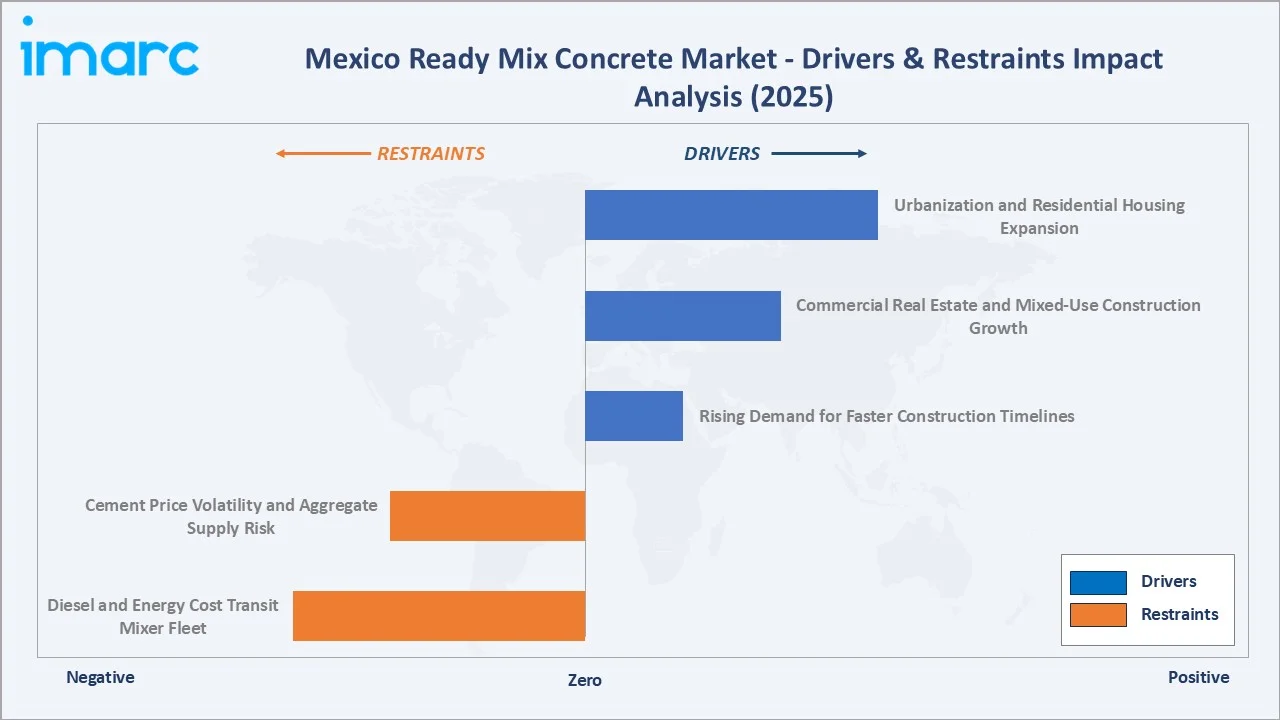
- Urbanization and Residential Housing Expansion: Mexico’s urban population reached 104.37 million in 2024, rising by 1.22% from 2023. In 2023, the country’s urban population stood at 103.11 million, also increasing by 1.22% compared with 2022. Growing urban populations increase demand for new housing developments, apartment complexes, and mixed-use communities. Government-supported affordable housing initiatives and rising residential construction activity are generating substantial concrete consumption. Ready-mix concrete is preferred for its consistent quality, faster construction timelines, and reduced labor requirements. As cities continue to expand and housing demand remains strong, developers are increasingly relying on ready-mix solutions to improve project efficiency and scalability.
- Commercial Real Estate and Mixed-Use Construction Growth: Commercial real estate and mixed-use construction growth are driving the market as demand rises for offices, retail centers, hotels, warehouses, and integrated residential-commercial developments. These projects require large volumes of consistent, high-strength concrete for foundations, slabs, columns, and structural frames. Ready-mix concrete helps developers achieve faster construction cycles, better quality control, and reduced on-site material handling. Expanding urban business districts, logistics parks, and mixed-use communities are therefore increasing reliance on ready-mix concrete across Mexico.
- Rising Demand for Faster Construction Timelines: Rising demand for faster construction timelines is driving the market as contractors seek materials that reduce on-site preparation time and improve project efficiency. Ready-mix concrete is produced in controlled batching plants and delivered directly to construction sites, allowing quicker pouring and smoother scheduling. It minimizes labor requirements, material wastage, and quality inconsistencies compared to traditional on-site mixing. As infrastructure, housing, and commercial projects face tighter deadlines, ready-mix concrete is becoming a preferred solution for timely project completion.
Market Restraints
- Cement Price Volatility and Aggregate Supply Risk: Cement price volatility and aggregate supply risk create uncertainty in production costs and project budgeting. Fluctuations in cement, sand, gravel, and crushed stone prices can compress supplier margins and increase construction expenses for contractors. Supply disruptions caused by transportation bottlenecks, quarry restrictions, or regional shortages may further affect timely concrete production and delivery. These challenges can delay infrastructure and building projects, reducing demand visibility and limiting market growth.
- Diesel and Energy Cost Transit Mixer Fleet: Diesel and energy costs for transit mixer fleets are raising transportation and delivery expenses. Ready-mix concrete must be moved quickly from batching plants to job sites, making fuel prices a major cost factor. Higher diesel and electricity costs increase operating expenses for batching plants, pumps, and mixer trucks. These pressures can reduce supplier margins, raise concrete prices, and affect project affordability, especially for large infrastructure and urban construction works.
Market Opportunities
- Sustainable and Low-Carbon Concrete Solutions: Sustainable and low-carbon concrete solutions are creating strong opportunities as developers and public agencies increasingly prioritize greener construction materials. Ready-mix producers can use supplementary cementitious materials, recycled aggregates, optimized mix designs, and lower-clinker cement blends to reduce carbon emissions. Demand is rising from green buildings, infrastructure projects, and multinational industrial facilities seeking sustainability compliance. This creates room for premium, high-performance concrete products that combine durability, quality, and lower environmental impact.
- Infrastructure Modernization and Mega Projects: For fiscal year 2026, Mexico earmarked 722 billion pesos for priority infrastructure projects across eight key sectors: energy, railways, highways, ports, airports, healthcare, water, and education. These large-scale developments require substantial volumes of high-quality concrete for foundations, bridges, tunnels, and structural works. Ready-mix concrete offers consistent quality, efficient delivery, and faster construction timelines, making it the preferred solution for complex infrastructure projects. As Mexico expands transportation and logistics networks to support economic growth and nearshoring investments, demand for ready-mix concrete is expected to increase substantially.
Market Challenges
- Informality and Quality Counterfeit Cement: Informality and counterfeit cement quality issues are creating unfair competition from unregulated suppliers and low-cost informal operators. Counterfeit or substandard cement can weaken concrete performance, raising safety risks in buildings and infrastructure projects. These practices undermine trust in certified ready-mix suppliers and pressure pricing across the market. They also increase the need for stricter quality checks, traceability, and compliance, adding operational costs for legitimate producers.
- Competition from On-Site Concrete Mixing in Smaller Projects: Competition from on-site concrete mixing in smaller projects remains a challenge, particularly in rural areas and low-volume construction works. Small contractors often perceive on-site mixing as a lower-cost option due to reduced transportation and delivery charges. This can limit ready-mix concrete penetration in price-sensitive segments despite its advantages in quality and consistency. As a result, ready-mix suppliers must focus on cost optimization, flexible delivery models, and customer education to expand adoption among smaller construction projects.
Emerging Market Trends
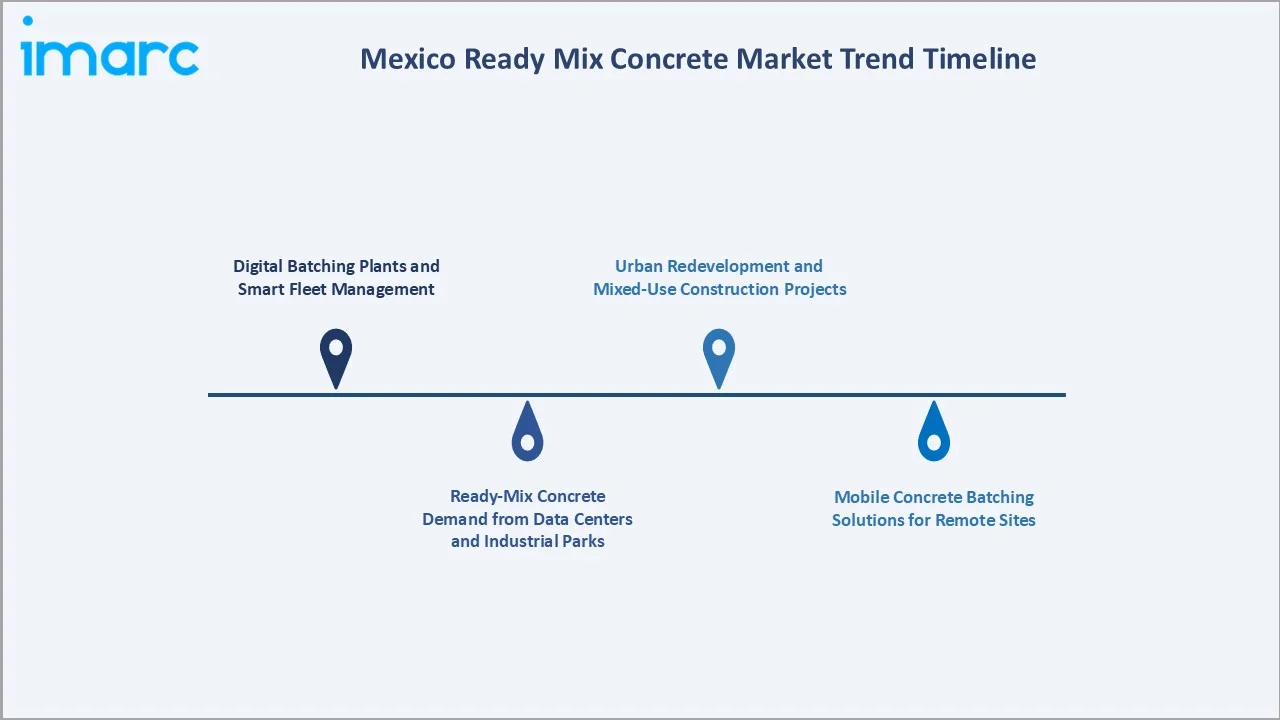
1. Digital Batching Plants and Smart Fleet Management
Digital batching plants and smart fleet management are emerging as producers seek greater operational efficiency and quality control. Advanced batching systems use automation, sensors, and real-time monitoring to optimize mix accuracy, reduce material waste, and improve production consistency. Meanwhile, GPS-enabled fleet management platforms help track transit mixers, optimize delivery routes, and minimize delays caused by traffic congestion. These technologies enhance customer service, lower operating costs, and support timely concrete delivery for large-scale infrastructure and urban construction projects.
2. Ready-Mix Concrete Demand from Data Centers and Industrial Parks
Ready-mix concrete demand from data centers and industrial parks is emerging as a significant trend in Mexico, driven by nearshoring investments and expanding digital infrastructure. According to the Mexican Data Center Association (MEXDC), Mexico is expected to attract more than USD 9.2 Billion in direct investment by 2029 for data center development. These projects prioritize quality consistency, rapid construction schedules, and durable building materials, making ready-mix concrete the preferred choice. As Mexico attracts more technology, automotive, and electronics investments, demand for specialized ready-mix concrete solutions is expected to rise steadily.
3. Urban Redevelopment and Mixed-Use Construction Projects
Urban redevelopment and mixed-use construction projects are emerging as cities modernize aging infrastructure and optimize land use. Developers are increasingly building integrated projects that combine residential, commercial, retail, and office spaces within a single development. These complex structures require large volumes of high-quality ready-mix concrete for foundations, parking facilities, high-rise buildings, and public spaces. The trend is particularly strong in major urban centers, where population growth and demand for modern living and working environments are accelerating construction activity.
4. Mobile Concrete Batching Solutions for Remote Sites
Mobile concrete batching solutions for remote sites are emerging, particularly for infrastructure, mining, energy, and rural development projects located far from urban batching plants. These portable units enable on-site concrete production, reducing transportation costs, delivery delays, and material wastage. They provide greater flexibility in challenging terrains where access to conventional ready-mix supply is limited. As Mexico expands highways, renewable energy facilities, and industrial projects in remote regions, demand for mobile batching technology is expected to grow steadily.
Industry Value Chain Analysis
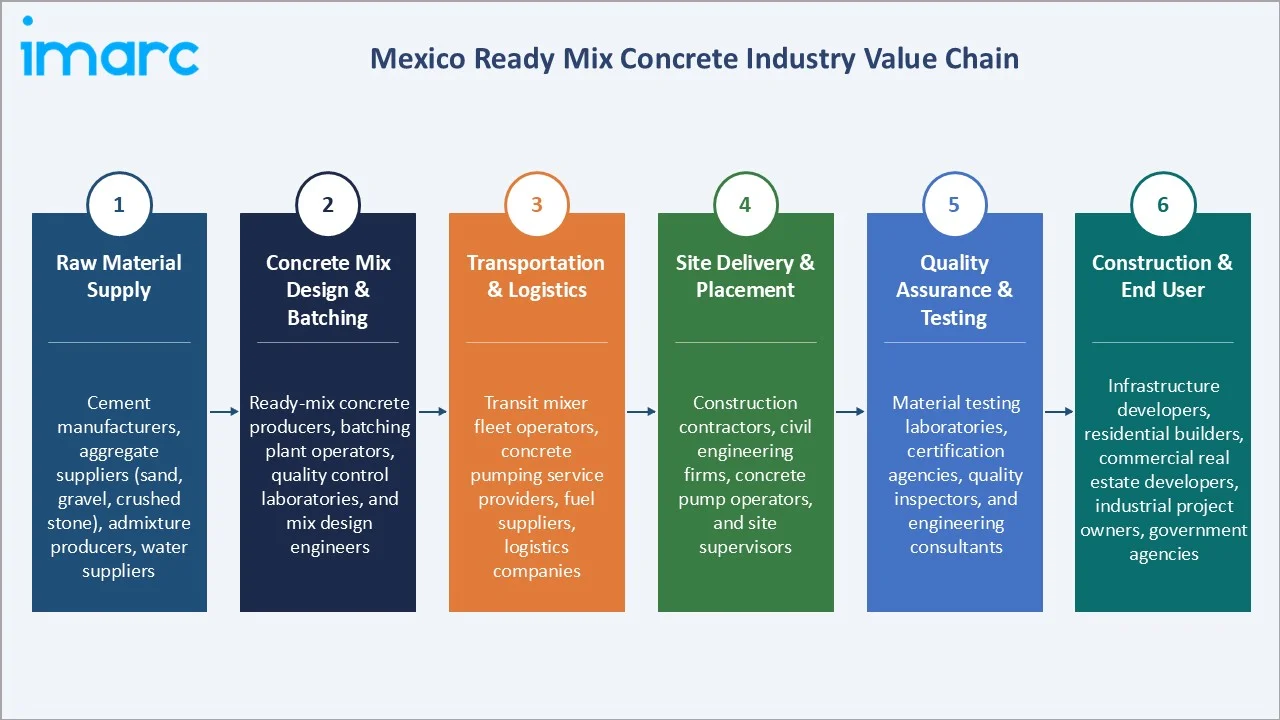
Mexico ready mix concrete value chain integrates raw material supply, concrete mix design & batching, transportation & logistics, site delivery & placement, quality assurance & testing, and construction & end user.
|
Stage |
Key Participants |
|
Raw Material Supply |
Cement manufacturers, aggregate suppliers (sand, gravel, crushed stone), admixture producers, water suppliers |
|
Concrete Mix Design & Batching |
Ready-mix concrete producers, batching plant operators, quality control laboratories, and mix design engineers |
|
Transportation & Logistics |
Transit mixer fleet operators, concrete pumping service providers, fuel suppliers, logistics companies |
|
Site Delivery & Placement |
Construction contractors, civil engineering firms, concrete pump operators, and site supervisors |
|
Quality Assurance & Testing |
Material testing laboratories, certification agencies, quality inspectors, and engineering consultants |
|
Construction & End User |
Infrastructure developers, residential builders, commercial real estate developers, industrial project owners, government agencies |
The concrete mix design & batching stage is the primary value-added stage in the Mexico ready-mix concrete value chain. At this stage, raw materials such as cement, aggregates, water, and admixtures are transformed into customized concrete mixes with specific strength, durability, and performance characteristics. Advanced batching controls, quality assurance, and mix optimization significantly increase product value and differentiate suppliers in the market.
Technology Landscape in the Mexico Ready Mix Concrete Industry
Mix Design and Concrete Technology
Mix design and concrete technology enable producers to develop customized concrete solutions tailored to specific construction requirements. Advanced mix designs incorporate chemical admixtures, supplementary cementitious materials, and optimized aggregate blends to improve strength, durability, workability, and curing performance. These technologies help reduce material consumption, lower carbon emissions, and enhance resistance to harsh environmental conditions. As infrastructure, industrial, and high-rise projects become more complex, demand for high-performance and specialized concrete formulations continues to grow across Mexico.
Chemical Admixtures and Additive Technologies
Chemical admixtures and additive technologies enhance concrete performance, durability, and construction efficiency. Modern admixtures such as superplasticizers, accelerators, retarders, air-entraining agents, and shrinkage-reducing additives enable producers to tailor concrete properties for specific project requirements. These technologies improve workability, reduce water consumption, accelerate curing, and increase resistance to harsh environmental conditions. As infrastructure, industrial, and high-rise construction projects become more demanding, the adoption of advanced admixture technologies is expanding across Mexico's ready-mix concrete sector.
Concrete Pumping and Placement Technology
Concrete pumping and placement technology enables faster, safer, and more precise concrete delivery on construction sites. Modern boom pumps, line pumps, and automated placement systems allow concrete to be transported efficiently to high-rise buildings, bridges, tunnels, and large infrastructure projects. These technologies reduce labor requirements, minimize material wastage, and improve placement accuracy in complex structures. As Mexico experiences growth in urban development, industrial facilities, and mega infrastructure projects, demand for advanced concrete pumping and placement solutions continues to increase.
Market Segmentation Analysis
The report covers the following segments:
|
Segment Category |
Leading Segment |
Market Share |
Year |
|
Product |
Transit Mixed |
49.6% |
2025 |
|
End Use Sector |
Infrastructure |
35.8% |
2025 |
|
Region |
Central Mexico |
38.5% |
2025 |

By Product
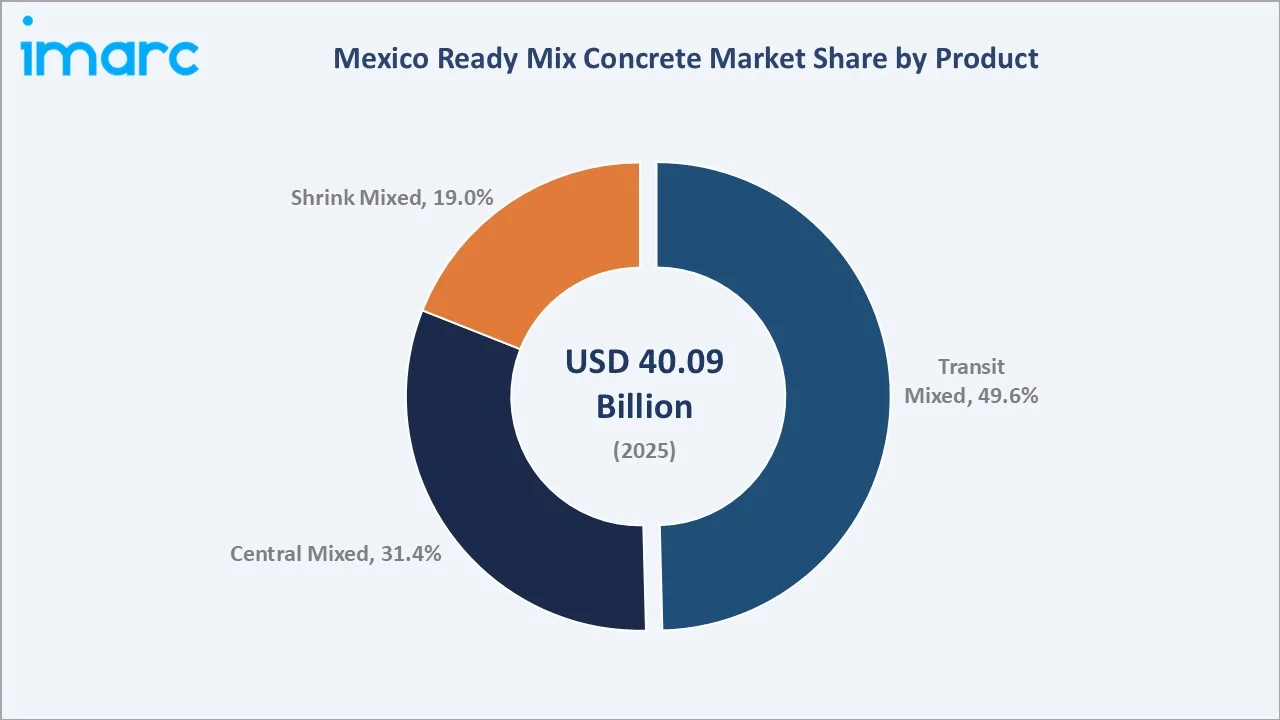
Transit mixed leads at 49.6% (2025), through truck-drum partially or fully mixed concrete delivered across all Mexico construction segments.
To access detailed market analysis, Request Sample
Central mixed at 31.4% grows fastest at ~9.2% CAGR through high-specification industrial plants, infrastructure mega-projects, and quality-controlled batching for bridges and metro. Shrink mixed at 19.0% reflects partial batch-in-transit flexibility for medium-scale projects and semi-remote sites.
By End Use Sector
Infrastructure leads at 35.8% (2025), through federal highway and bridge, Mexico City metro expansion, railway, airport, and port expansion.
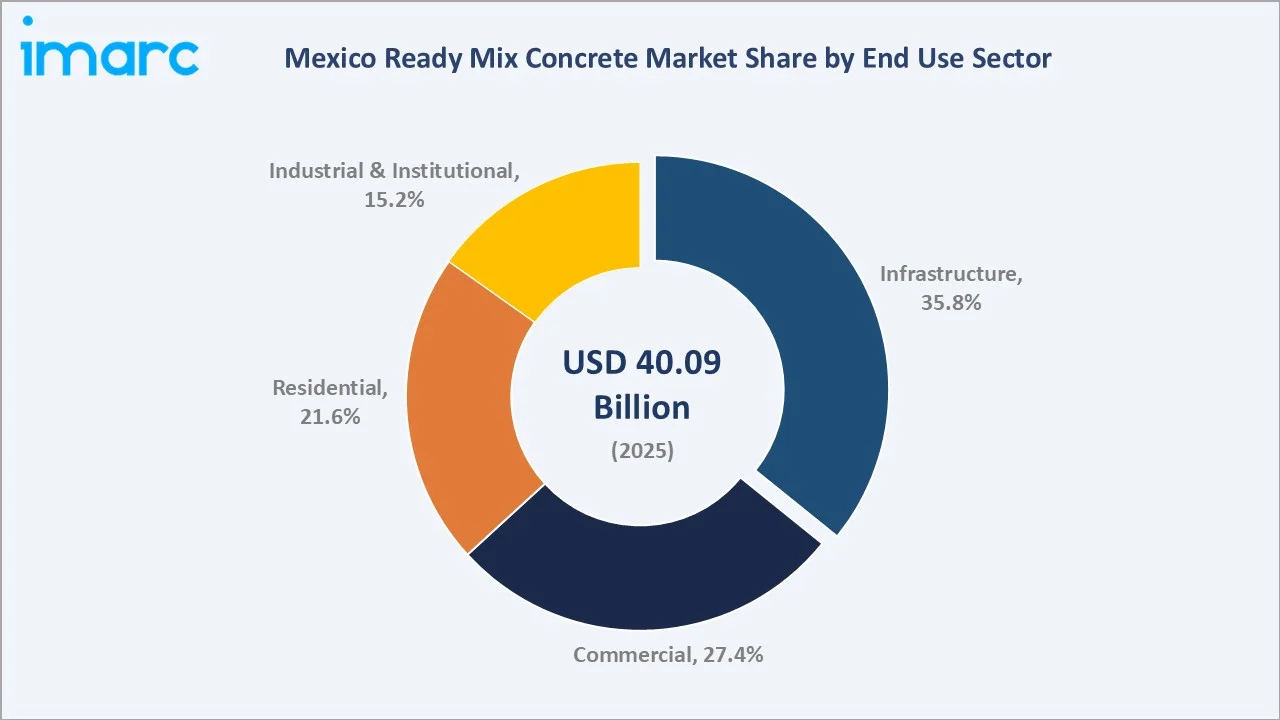
Commercial at 27.4% reflects nearshoring factory and office, tourism hotels, and retail development. Residential at 21.6% reflects housing credit, horizontal housing development, and auto construction formalization. Industrial and institutional at 15.2% reflects industrial parks, hospitals, and university campuses.
Regional Market Insights
|
Region |
Share (2025) |
Key Mexico RMC Market Drivers & Characteristics |
|
Central Mexico |
38.5% |
Reflecting strong demand from large-scale infrastructure projects, commercial developments, residential housing construction, and ongoing urban redevelopment across major metropolitan areas. |
|
Northern Mexico |
34.7% |
Reflects robust industrial construction activity driven by nearshoring investments, manufacturing facilities, logistics parks, warehouses, and cross-border trade infrastructure. |
|
Southern Mexico |
18.6% |
Reflects increasing investment in transportation networks, tourism-related construction, energy projects, and public infrastructure development, supporting steady ready-mix concrete consumption. |
|
Others |
8.2% |
Other regions, including the Bajío, Pacific Coast, and Gulf Coast, are driven by expanding industrial corridors, port modernization projects, residential construction activity, and regional infrastructure upgrades. |
Central Mexico's 38.5% supported by strong construction activity across Mexico City and surrounding urban-industrial corridors. Northern Mexico's 34.7% driven by nearshoring-led manufacturing plants, logistics parks, warehouses, and cross-border infrastructure.
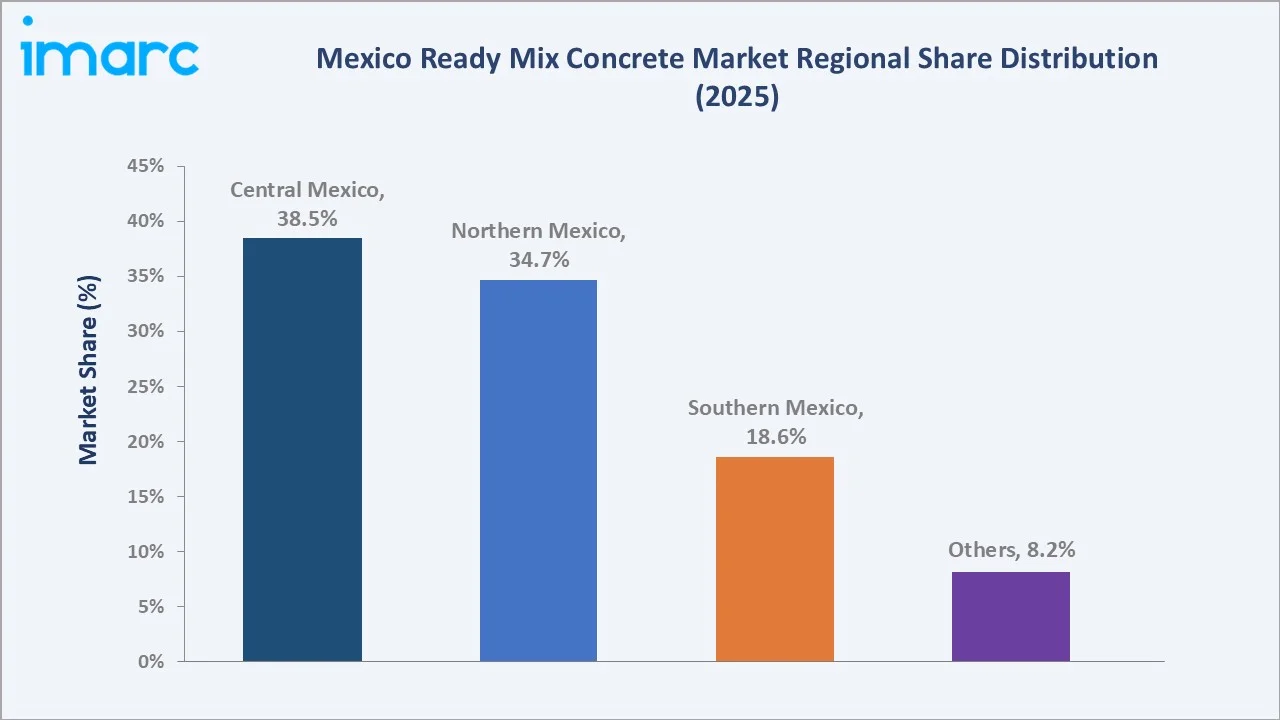
Southern Mexico's 18.6% shows steady growth from tourism projects, public infrastructure, energy developments, and transport connectivity upgrades. Others at 8.2% contribute through regional industrial expansion, port upgrades, and residential construction.
Competitive Landscape
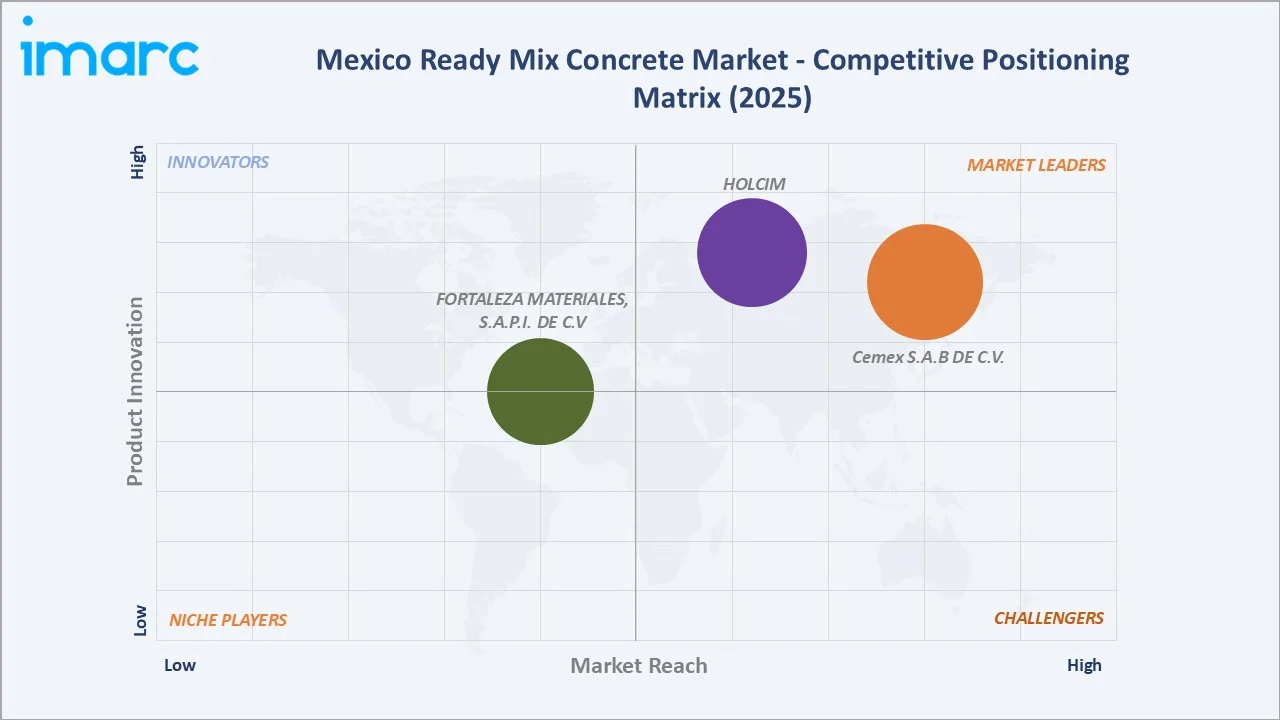
The Mexico ready-mix concrete market is moderately concentrated, with a mix of large multinational cement producers and regional ready-mix suppliers competing across infrastructure, residential, commercial, and industrial projects. Major players leverage extensive batching plant networks, integrated cement operations, strong distribution capabilities, and long-standing contractor relationships to maintain market share. Competition is increasingly focused on product quality, delivery reliability, sustainable concrete solutions, and digital fleet management capabilities.
|
Company |
Key Brands |
Market Position |
Core Strength |
|
Cemex S.A.B DE C.V. |
Cemex |
Market Leader |
Cemex S.A.B DE C.V. is a cornerstone of Mexico's construction sector, serving as a leading manufacturer and supplier of tailor-designed ready-mix concrete. The multinational building materials company drives national infrastructure, commercial, and industrial projects through vast operational density and constant technological innovation. |
|
HOLCIM |
Holcim |
Market Leader |
Holcim drives Mexico's ready-mix concrete sector through sustainable innovation, circular construction, and digital integration. The company delivers ready-mix concrete solutions for major infrastructure and affordable housing, backed by advanced material research. |
|
FORTALEZA MATERIALES, S.A.P.I. DE C.V |
Cementos Fortaleza |
Established Player |
FORTALEZA MATERIALES, S.A.P.I. DE C.V acts as a structural solutions provider in the Mexican construction sector Cementos Fortaleza. |
Nearshoring-driven industrial construction and large infrastructure investments are encouraging capacity expansions and geographic penetration into high-growth regions. Companies are also investing in low-carbon concrete technologies, advanced admixtures, and automated batching systems to differentiate their offerings and meet evolving customer requirements.
Key Company Profiles
Cemex S.A.B DE C.V.
Cemex S.A.B. de C.V. is the leading participant in Mexico’s ready-mix concrete market and one of the largest producers of cement, aggregates, and ready-mix concrete. The company supplies customized ready-mix concrete solutions for infrastructure, residential, commercial, industrial, and energy projects throughout the country. Its strong vertical integration, broad geographic footprint, advanced digital platforms, and focus on sustainable construction materials enable it to maintain a dominant position in the Mexican construction sector.
- Key Brands: Cemex
- Strategic Focus: Strengthening its leadership through vertical integration, digitalization, sustainability, and value-added concrete solutions.
HOLCIM
Holcim is one of the leading participants in Mexico’s ready-mix concrete market, offering a broad portfolio of cement, aggregates, ready-mix concrete, and sustainable construction solutions. The company operates an extensive network of production facilities, aggregates operations, and concrete plants across key construction regions in Mexico. Holcim serves infrastructure, residential, commercial, and industrial projects with a strong emphasis on innovation, operational efficiency, and environmental sustainability.
- Key Brands: Holcim
- Recent Developments: In November 2025, Holcim México opened Mexico’s first fully electric ready-mix concrete plant in Zapopan, Jalisco, with an investment of MX$51 million. The facility marks the start of Holcim’s electrification strategy under its global NextGen Growth 2030 plan and highlights the company’s focus on cleaner, more efficient, and sustainable construction operations.
- Strategic Focus: Centers on sustainable construction, circular economy solutions, digital innovation, and value-added concrete products.
Market Concentration Analysis
The Mexico ready-mix concrete market is moderately concentrated, led by large integrated players such as Cemex S.A.B DE C.V., HOLCIM, and FORTALEZA MATERIALES, S.A.P.I. DE C.V. These companies benefit from nationwide batching networks, cement and aggregate integration, strong logistics fleets, and established contractor relationships. Regional and local suppliers remain active in city-level and small-project demand, creating price competition in fragmented pockets. Market concentration is expected to increase as large players invest in low-carbon concrete, electric plants, digital batching, and fleet optimization. Nearshoring-led industrial projects and infrastructure spending will further favor companies with strong capacity, reliability, and geographic coverage.
Investment & Growth Opportunities
Highest Growth Segments
Infrastructure (~9.3% CAGR), central mixed (~9.2% CAGR), Northern Mexico (~9.5% CAGR through nearshoring boom), low-carbon green ready-mix concrete (~11% CAGR from growing base), self-compacting SCC (~10% CAGR), and Tren Maya Southern Mexico (~12% CAGR from project) represent Mexico ready-mix concrete highest-growth investment vectors through 2034.
Investment Themes
Low-carbon green ready-mix concrete: Low-carbon green ready-mix concrete represents a compelling investment theme in Mexico as developers, industrial operators, and public agencies increasingly prioritize sustainable construction and ESG compliance. Demand is growing for concrete incorporating supplementary cementitious materials, recycled aggregates, and lower-clinker cement blends that reduce carbon emissions without compromising performance. Companies investing in green concrete technologies can benefit from premium pricing, regulatory support, and rising adoption across infrastructure, commercial, and industrial projects.
Future Market Outlook (2026-2034)
Mexico ready mix concrete market grew from USD 40.09 Billion in 2025 to USD 43.62 Billion in 2026 and is projected to reach USD 87.66 Billion by 2034, expanding at a CAGR of 8.81% during the forecast period, driven by the nearshoring industrial construction boom, federal infrastructure, housing deficit and urbanization, informal-to-formal ready mix concrete transition, and emerging low-carbon green ready mix concrete. The market's anchor value of USD 61.14 Billion in 2030 represents Mexico's ready-mix concrete at green inflection.
Three structural forces define Mexico’s ready-mix concrete market growth through 2034. First, sustained government spending on transportation, energy, water, and urban infrastructure projects is generating long-term demand for high-volume concrete supply. Second, rapid urbanization and housing development are driving construction activity across major metropolitan regions, increasing consumption of ready-mix solutions. Third, nearshoring-led investments in manufacturing plants, logistics parks, industrial corridors, and data centers are accelerating demand for high-quality concrete in industrial construction.
Research Methodology
Primary Research
Primary research comprised structured interviews and consultations with ready-mix concrete producers, cement manufacturers, aggregate suppliers, construction contractors, project developers, and industry experts across Mexico. Discussions focused on demand trends, pricing dynamics, production capacity utilization, regional construction activity, and technology adoption. Inputs were also gathered from infrastructure developers, commercial builders, and industrial project stakeholders to validate market sizing and growth assumptions. The findings provided real-time insights into supply-chain conditions, competitive positioning, and future investment priorities within the ready-mix concrete industry.
Secondary Research
Secondary research encompassed reviewing government construction statistics, infrastructure investment plans, industry publications, company annual reports, press releases, trade databases, and construction sector reports. Sources also included cement and concrete industry associations, regulatory documents, and macroeconomic indicators related to housing, industrial activity, and public works. This helped validate market trends, regional demand patterns, competitive developments, and technology adoption. Secondary inputs were cross-checked with primary findings to ensure consistency and reliability in market estimates.
Forecasting Models
Forecasting models combined historical ready-mix concrete consumption, construction output, infrastructure expenditure, housing activity, and industrial investment trends to estimate future market demand. Time-series analysis, regression modeling, and sector-based demand forecasting were used to evaluate growth across residential, commercial, industrial, and infrastructure segments. Macroeconomic indicators such as GDP growth, urbanization rates, and construction spending were incorporated to assess long-term market potential. Scenario analysis and expert validation were applied to refine projections and ensure realistic forecasts through 2034.
Mexico Ready Mix Concrete Market Report Coverage:
| Report Features | Details |
|---|---|
| Base Year of the Analysis | 2025 |
| Historical Period | 2020-2025 |
| Forecast Period | 2026-2034 |
| Units | Billion USD |
| Scope of the Report |
Exploration of Historical Trends and Market Outlook, Industry Catalysts and Challenges, Segment-Wise Historical and Future Market Assessment:
|
| Products Covered | Central Mixed, Shrink Mixed, Transit Mixed |
| End Use Sectors Covered | Commercial, Industrial and Institutional, Infrastructure, Residential |
| Regions Covered | Northern Mexico, Central Mexico, Southern Mexico, Others |
| Companies Covered | Cemex S.A.B DE C.V., HOLCIM, FORTALEZA MATERIALES, S.A.P.I. DE C.V, etc. |
| Customization Scope | 10% Free Customization |
| Post-Sale Analyst Support | 10-12 Weeks |
| Delivery Format | PDF and Excel through Email (We can also provide the editable version of the report in PPT/Word format on special request) |
Key Benefits for Stakeholders:
- IMARC’s industry report offers a comprehensive quantitative analysis of various market segments, historical and current market trends, market forecasts, and dynamics of the Mexico ready mix concrete market from 2020-2034.
- The research report provides the latest information on the market drivers, challenges, and opportunities in the Mexico ready mix concrete market.
- Porter's five forces analysis assist stakeholders in assessing the impact of new entrants, competitive rivalry, supplier power, buyer power, and the threat of substitution. It helps stakeholders to analyze the level of competition within the Mexico ready mix concrete industry and its attractiveness.
- Competitive landscape allows stakeholders to understand their competitive environment and provides an insight into the current positions of key players in the market.
Frequently Asked Questions About the Mexico Ready Mix Concrete Market Report
The Mexico ready mix concrete market size is estimated at USD 43.62 Billion in 2026, driven by rising infrastructure investment, rapid urbanization, and expanding residential, commercial, and industrial construction activity. Nearshoring-led manufacturing plants, logistics parks, and data center projects are further increasing demand for high-quality, plant-batched concrete across major regions.
The Mexico ready mix concrete market grows at 8.81% CAGR during 2026-2034, reaching USD 87.66 Billion by 2034. The CAGR reflects nearshoring, housing deficit, infrastructure, and informal-to-formal ready mix concrete transition.
Transit mixed leads at 49.6% as it allows concrete to be mixed during transportation, ensuring freshness, flexibility, and consistent workability at the job site. It is widely preferred for urban, infrastructure, and large-volume construction projects requiring reliable delivery.
Infrastructure leads at 35.8% due to sustained government investments in highways, railways, airports, ports, water systems, and energy projects that require large volumes of ready-mix concrete. These projects prioritize consistent quality, high-strength materials, and timely delivery, making ready-mix concrete the preferred construction solution.
Central Mexico leads at 38.5% due to dense urban construction, infrastructure upgrades, and strong demand from Mexico City and surrounding industrial corridors. Its concentration of residential, commercial, and public works projects supports high ready-mix concrete consumption.
Leading companies include Cemex S.A.B DE C.V., HOLCIM, and FORTALEZA MATERIALES, S.A.P.I. DE C.V, among others.
The market is projected to reach approximately USD 61.14 Billion by 2030, driven by sustained infrastructure spending, rapid urbanization, and growing residential and commercial construction activity. Rising nearshoring investments, industrial parks, logistics facilities, and data center developments are expected to further strengthen demand for ready-mix concrete across the country.
Three priority investment opportunities stand out in the Mexico ready-mix concrete market. Low-carbon and green concrete solutions offer significant potential as developers increasingly prioritize sustainable construction and ESG compliance. Nearshoring-driven industrial and logistics infrastructure presents strong demand opportunities, supported by new manufacturing plants, warehouses, and industrial parks across Northern and Central Mexico. Additionally, mega infrastructure and urban redevelopment projects, including transportation networks, water systems, and mixed-use developments, are expected to generate sustained demand for high-performance ready-mix concrete through 2034.
Need more help?
- Speak to our experienced analysts for insights on the current market scenarios.
- Include additional segments and countries to customize the report as per your requirement.
- Gain an unparalleled competitive advantage in your domain by understanding how to utilize the report and positively impacting your operations and revenue.
- For further assistance, please connect with our analysts.
 Request Customization
 Speak to an Analyst
 Request Brochure
 Inquire Before Buying
Benefits of Customization
- Personalize this research
- Triangulate with your data
- Get data as per your format and definition
- Gain a deeper dive into a specific application, geography, customer, or competitor
- Any level of personalization
Get in Touch With Us
UNITED STATES
Phone: +1-201-971-6302
INDIA
Phone: +91-120-433-0800
UNITED KINGDOM
Phone: +44-753-714-6104
Email: [email protected]
Client Testimonials




.webp)




.webp)













Related Reports

Choose your plan
*Please note that the prices mentioned below are starting prices for each bundle type. Kindly contact our team for further details.*
Single User License
- 1 User License, Access on 2 Devices
- PDF Report + Excel Dataset (Password Protected)
- Lifetime Access
- No Printing Rights
- 10% Free Report Customization
- 10–12 Weeks of Analyst Support
Five User License
- Access for 5 Users, 2 Devices per User
- PDF Report + Excel Dataset (Password Protected)
- Lifetime Access
- Dedicated Account Manager
- 12–14 Weeks of Analyst Support
- No Printing Rights
- 15% Free Report Customization
- 25% Discount on Your Next Purchase
Corporate User License
- Unlimited User Access (Within Your Organization)
- PDF Report + Excel Dataset
- Lifetime Access
- Dedicated Account Manager
- 14–20 Weeks of Analyst Support
- No Printing Rights
- 20% Free Report Customization
- 30% Discount on Your Next Purchase
Essential Insights
What's included:
3 reports
- Lifetime Access
- PDF Reports
- Excel Datasets
- 2 Weeks of Free Analyst Support
- 2 User Licenses
- Access on 2 Devices
- Printing Rights
- Complimentary PowerPoint (PPT) Version
- Complimentary License Upgrade
Professional Access
What's included:
5 reports
- Lifetime Access
- PDF Reports
- Excel Datasets
- 8 Weeks of Free Analyst Support
- 2 User Licenses
- Access on 2 Devices
- Printing Rights
- Complimentary PowerPoint (PPT) Version
- Complimentary License Upgrade
Business Advantage
What's included:
8 reports
- Lifetime Access
- PDF Reports
- Excel Datasets
- 14 Weeks of Free Analyst Support
- 2 User Licenses
- Access on 2 Devices
- Printing Rights
- Complimentary PowerPoint (PPT) Version
- Complimentary License Upgrade
Enterprise Intelligence
What's included:
10 reports
- Lifetime Access
- PDF Reports
- Excel Datasets
- 20 Weeks of Free Analyst Support
- 2 User Licenses
- Access on 2 Devices
- Printing Rights
- Complimentary PowerPoint (PPT) Version
- Complimentary License Upgrade