
Mexico Recliner Chair Market Size, Share, Trends and Forecast by Product Type, Seating Arrangement, Material, Distribution Channel, End-User, and Region, 2026-2034
Mexico Recliner Chair Market Size, Share, Trends & Forecast (2026-2034)
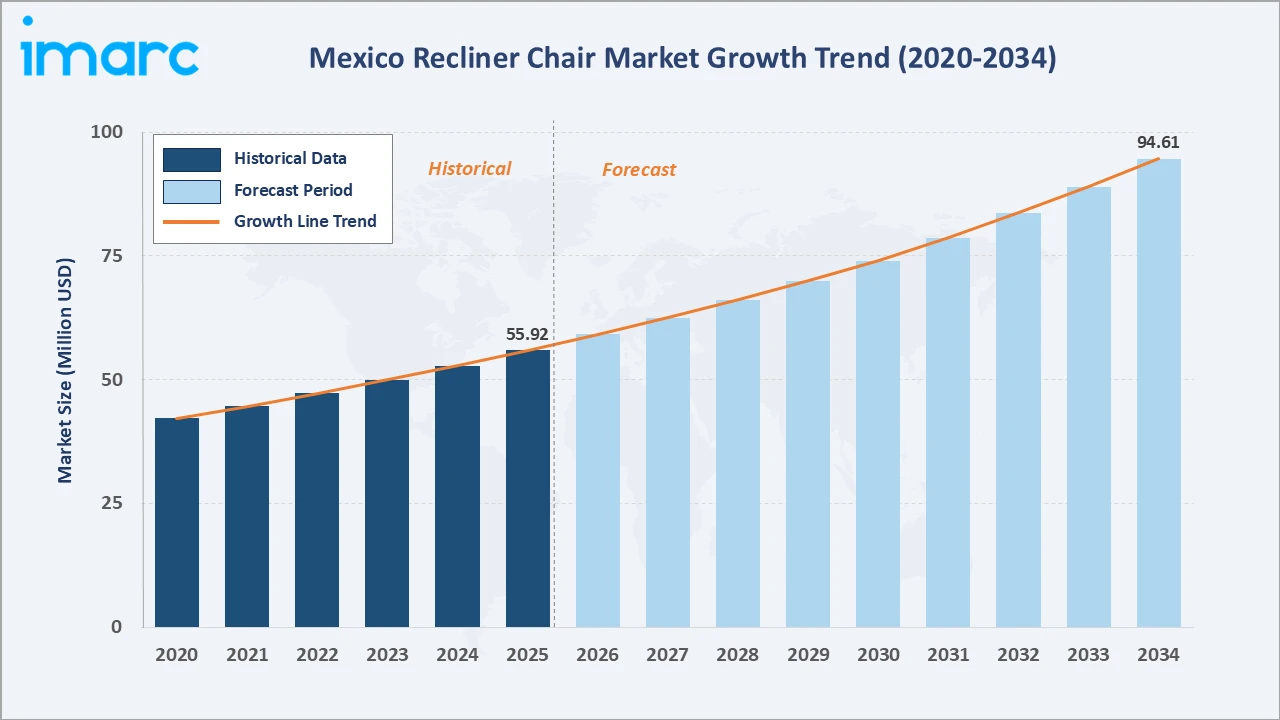
The Mexico recliner chair market grew from USD 55.92 Million in 2025 to USD 59.15 Million in 2026 and is projected to reach USD 94.61 Million by 2034, growing at a CAGR of 5.78% during 2026-2034. Growth is supported by urbanization, rising disposable incomes, and home-centric lifestyles.
Expanding e-commerce, ergonomic awareness, and demand for multifunctional furniture are further supporting market growth. Massage recliner leads product types at 30.0%. Furniture and furnishing stores lead distribution channels at 45.0%. Central Mexico commands 50.0% of the national market share.
Market Snapshot
| Metric | Value |
|---|---|
| Base Year Market Size (2025) | USD 55.92 Million |
| Market Size (2026) | USD 59.15 Million |
| Forecast Market Size (2034) | USD 94.61 Million |
| CAGR (2026-2034) | 5.78% |
| Base Year | 2025 |
| Historical Period | 2020-2025 |
| Forecast Period | 2026-2034 |
| Dominant Product Type | Massage Recliner (30.0%, 2025) |
| Dominant Distribution Channel | Furniture and Furnishing Stores (45.0%, 2025) |
| Leading Region | Central Mexico (50.0%, 2025) |
The Mexico recliner chair market size increased from USD 42.22 Million in 2020 to USD 55.92 Million in 2025 and is estimated to reach USD 59.15 Million in 2026. The market is further expected to grow to USD 74.04 Million by 2030 and USD 94.61 Million by 2034.
To get more information on this market, Request Sample
The Mexico recliner chair market combines a large mid-income household base, expanding urban housing, and a growing premium segment shaped by international furniture brands, domestic manufacturers, and North American production networks concentrated near the US border.
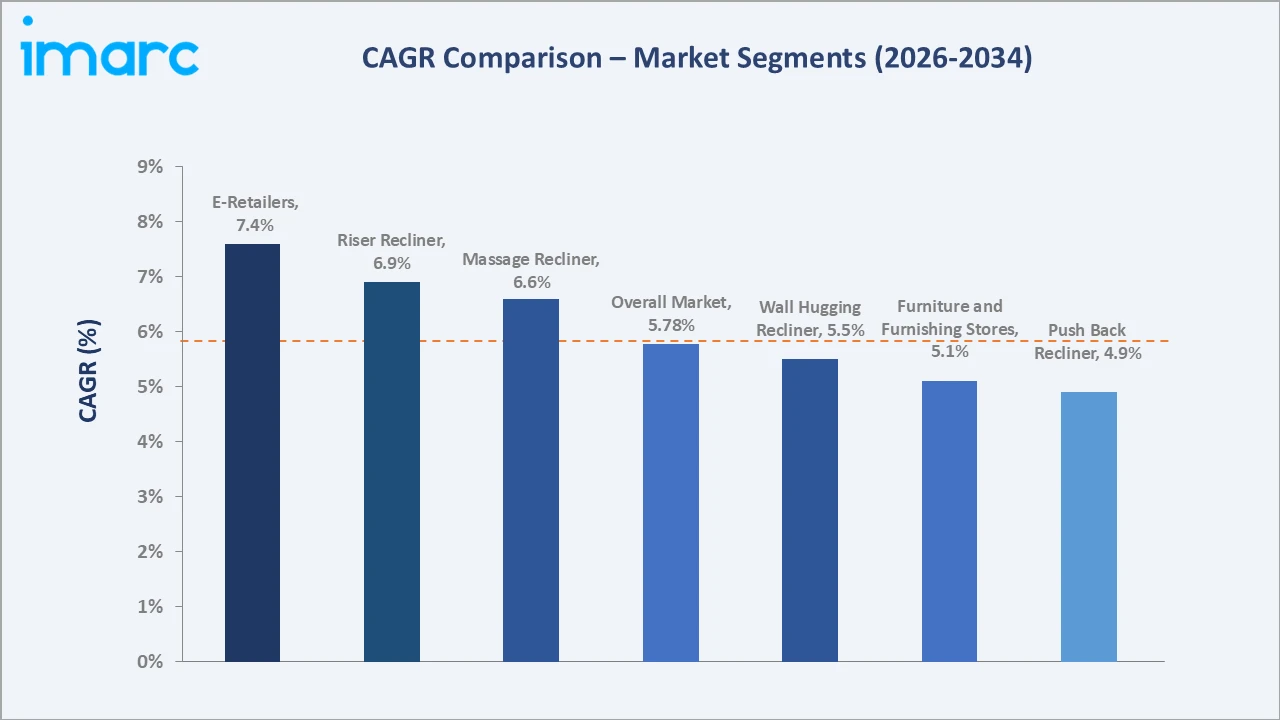
E-retailers grow fastest at ~7.4% CAGR through online marketplace expansion, financing options, and home delivery convenience. Riser recliners grow at ~6.9% CAGR as an ageing population and mobility needs increase, while massage recliners advance at ~6.6% CAGR through wellness-oriented home furniture spending.
Push back and wall hugging recliners grow steadily at ~4.9% and ~5.5% CAGR respectively, supported by affordable pricing and space efficiency, while furniture and furnishing stores maintain ~5.1% CAGR through showroom-led premium recliner sales and financing support.
Executive Summary
The Mexico recliner chair market expanded from USD 55.92 Million in 2025 to an estimated USD 59.15 Million in 2026, reflecting steady demand for comfort-oriented living room furniture across urban households. Recliners have shifted from a premium indulgence to an attainable comfort product for middle-income families.
Market growth is underpinned by urban population expansion, nuclear family formation, real estate development, and greater time spent at home for work, study, and entertainment. Consumers increasingly value ergonomic support, adjustable positions, and multifunctional features such as storage, cup holders, USB charging, and massage.
The market is projected to reach USD 94.61 Million by 2034. Massage recliner at 30.0% leads through wellness-driven spending. Furniture and furnishing stores at 45.0% reflect consumer preference for in-person comfort testing. Central Mexico leads regionally at 50.0%.
Key Market Insights
| Insight | Data |
|---|---|
| Dominant Product Type | Massage Recliner - 30.0% share (2025) |
| Dominant Distribution Channel | Furniture and Furnishing Stores - 45.0% market share (2025) |
| Leading Region | Central Mexico - 50.0% share (2025) |
| Market Opportunity | Riser and lift recliners for senior care; online recliner retail with home delivery; compact wall hugging designs for urban apartments; commercial seating for hospitality and healthcare |
Key Analytical Observations Supporting the Above Data:
- Massage Recliner at 30.0%: The massage recliner segment dominates due to rising focus on stress relief, muscle recovery, and home wellness. Integrated vibration, heat, and multi-zone massage functions offer spa-like experiences at home, attracting working professionals and older consumers seeking therapeutic comfort.
- Furniture and Furnishing Stores at 45.0%: Furniture and furnishing stores dominate as consumers prefer to test seat depth, recline motion, and upholstery before purchase. Showroom assistance, installment financing, assembly support, and after-sales service further strengthen this channel's leadership across Mexico.
- Central Mexico at 50.0%: Central Mexico dominates regionally due to the high population density of Mexico City, the State of Mexico, Puebla, and Querétaro. Concentrated retail infrastructure, higher urban incomes, and active housing development sustain strong recliner demand in the region.
Mexico Recliner Chair Market Overview
The Mexico recliner chair market sits at the intersection of rising urban living standards, evolving interior design preferences, and growing awareness of ergonomic health. Recliners serve households seeking relaxation and media seating, while commercial buyers in hospitality, healthcare, and offices adopt them for comfort-focused environments.
Mexico's recliner ecosystem integrates domestic furniture manufacturing, imported premium brands, component suppliers, organized retail chains, and online marketplaces. Macroeconomic factors include urbanization, a growing middle class, expanding consumer credit, and steady investment in residential construction and home furnishing.
Northern Mexico's furniture manufacturing cluster also links the domestic market with North American supply chains. This proximity supports access to motion mechanisms, upholstery expertise, and contemporary designs, while domestic brands serve price-sensitive consumers through extensive store networks and installment purchase options.
Market Dynamics
To evaluate market opportunities, Request Sample
Market Drivers
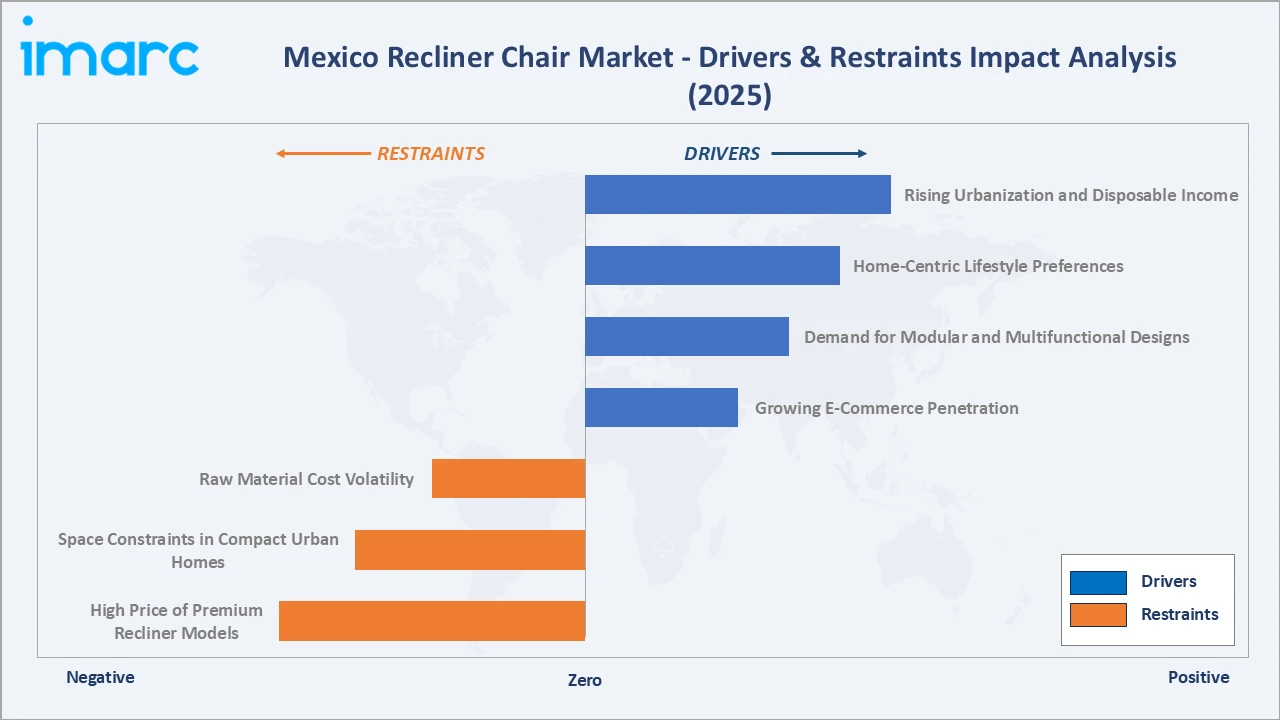
- Rising Urbanization and Disposable Income: Mexico's expanding urban population and growing middle class are increasing demand for modern, comfort-oriented furniture. Higher disposable incomes allow households to prioritize convenience and quality in living room purchases, positioning recliners as attainable upgrades rather than luxury items.
- Home-Centric Lifestyle Preferences: Remote working, distance learning, and home entertainment have increased the time consumers spend indoors. Households are investing in furniture that enhances daily comfort, and recliners suit relaxing, media viewing, and occasional work, making them a preferred living room addition for long-term wellbeing.
- Ageing Population and Ergonomic Awareness: A gradually ageing population and rising awareness of posture, back health, and circulation are supporting demand for ergonomic seating. Riser, power, and lumbar-support recliners help older adults and individuals with mobility issues sit and stand comfortably, broadening the consumer base.
- E-Commerce and Omnichannel Retail Expansion: Online marketplaces and retailer websites are widening access to branded recliners beyond major cities. Detailed product visuals, customer reviews, installment payments, and home delivery reduce purchase barriers, while omnichannel models let consumers research online and test products in physical showrooms.
Market Restraints
- High Cost of Power and Massage Recliners: Advanced recliners with motors, massage modules, and premium leather carry higher prices than conventional sofas and chairs. This limits adoption among price-sensitive households, particularly in semi-urban and rural areas, and lengthens replacement cycles for existing furniture.
- Space Constraints in Compact Urban Housing: Smaller apartments in dense metropolitan areas restrict the use of bulky recliners that require wall clearance and floor space. Consumers in compact homes often choose multifunctional sofas or standard chairs instead, slowing recliner penetration in high-density urban housing.
- Competition from Low-Cost Imports and Unorganized Manufacturers: Inexpensive imported recliners and products from small local workshops create strong price competition for organized brands. Inconsistent quality, limited warranties, and weak after-sales support in low-cost products can also affect consumer confidence in mechanism durability across the category.
Market Opportunities
- Senior Care and Healthcare Seating Demand: Growing demand for supportive seating in senior care homes, clinics, and hospitals creates opportunities for riser and lift recliners. Products with easy-clean upholstery, stable mechanisms, and assisted standing features can address both residential caregivers and institutional buyers.
- Customization and Modular Recliner Designs: Consumers increasingly seek recliners that match personal interiors and space requirements. Customizable fabrics, finishes, sizes, and modular reclining sections allow brands to serve diverse homes, encourage premium upgrades, and differentiate from mass-market alternatives.
Market Challenges
- Mechanism Durability and After-Sales Service Gaps: Reclining mechanisms, motors, and electronic controls require reliable maintenance and spare part availability. Limited service coverage outside major cities can delay repairs and weaken consumer trust, pushing manufacturers to invest in service networks, technician training, and extended warranty programs.
- Raw Material Cost Volatility: Prices of steel, polyurethane foam, leather, and fabric fluctuate with global supply conditions and currency movements. Rising input costs pressure manufacturer margins and retail pricing, making it difficult to keep recliners affordable for middle-income consumers without compromising quality.
Emerging Market Trends
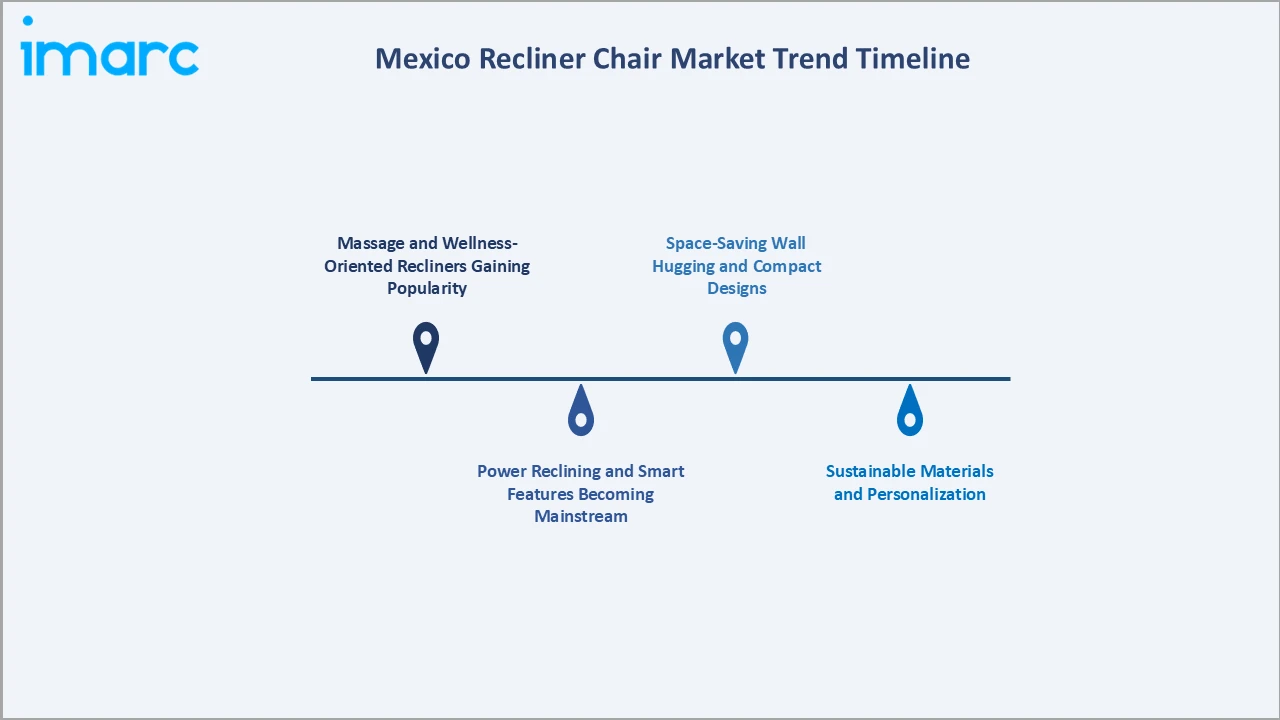
1. Massage and Wellness-Oriented Recliners Gaining Popularity
Consumers are increasingly treating recliners as personal wellness stations. Multi-zone massage, heat therapy, and zero-gravity positions are moving from specialty products into mainstream living room ranges. This trend supports premium pricing, attracts health-conscious buyers, and encourages retailers to dedicate showroom space to wellness seating.
2. Power Reclining and Smart Features Becoming Mainstream
Power recliners with push-button controls, adjustable headrests, USB charging ports, and memory positions are gaining traction. Consumers value effortless operation and integrated convenience features, while falling component costs are bringing motorized functions to mid-priced models across furniture stores and online platforms.
3. Space-Saving Wall Hugging and Compact Designs
Wall hugging recliners that need only a few inches of rear clearance are attracting urban apartment dwellers. Slim profiles, compact footprints, and sofa-integrated reclining seats allow households to enjoy reclining comfort without sacrificing floor space, aligning with minimalist interior design preferences.
4. Sustainable Materials and Personalization
Consumers are showing interest in recliners made with certified wood, recycled fibers, and durable, easy-clean fabrics. Brands are offering wider choices of colors, upholstery, and finishes, enabling buyers to personalize recliners while supporting longer product life and responsible material sourcing.
Industry Value Chain Analysis
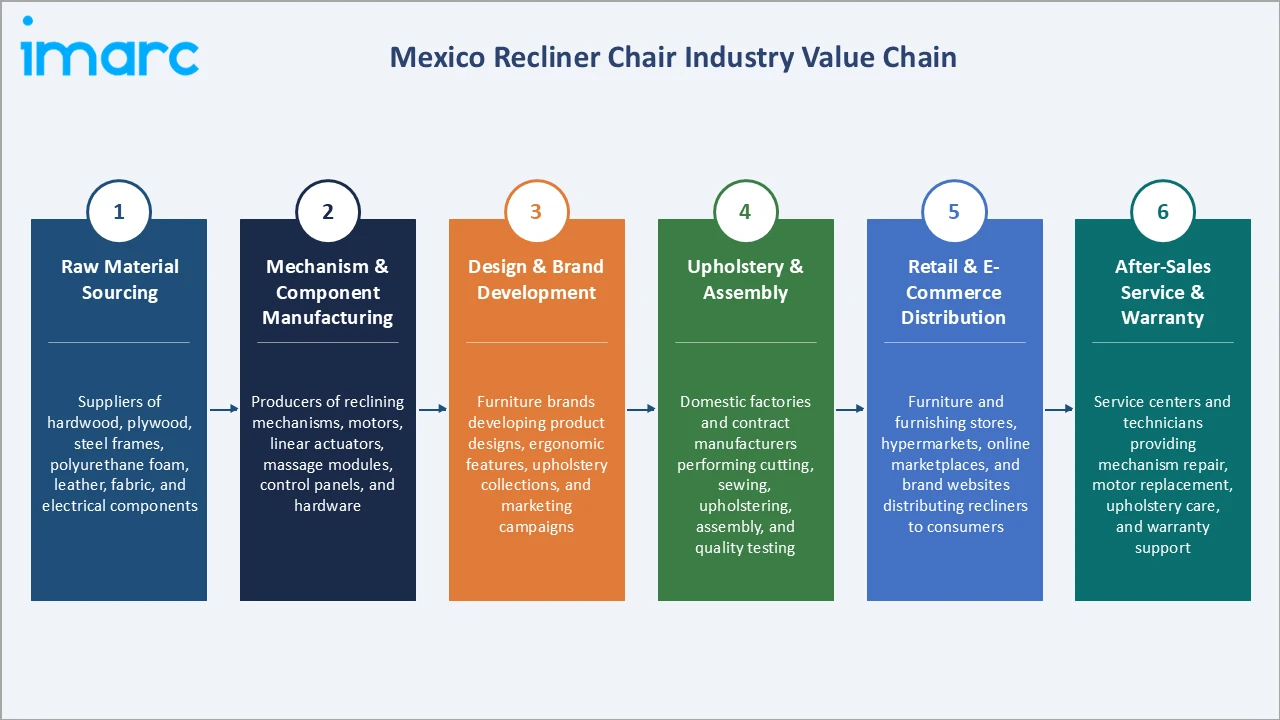
The Mexico recliner chair value chain spans raw material sourcing, mechanism production, design, upholstery, assembly, and multichannel distribution. Domestic manufacturing competes alongside imported premium recliners, while border-region production hubs connect Mexican operations with broader North American furniture supply networks.
| Stage | Key Participants |
|---|---|
| Raw Material Sourcing | Suppliers of hardwood, plywood, steel frames, polyurethane foam, leather, fabric, and electrical components |
| Mechanism & Component Manufacturing | Producers of reclining mechanisms, motors, linear actuators, massage modules, control panels, and hardware |
| Design & Brand Development | Furniture brands developing product designs, ergonomic features, upholstery collections, and marketing campaigns |
| Upholstery & Assembly | Domestic factories and contract manufacturers performing cutting, sewing, upholstering, assembly, and quality testing |
| Retail & E-Commerce Distribution | Furniture and furnishing stores, hypermarkets, online marketplaces, and brand websites distributing recliners to consumers |
| After-Sales Service & Warranty | Service centers and technicians providing mechanism repair, motor replacement, upholstery care, and warranty support |
Mechanism and component manufacturing is the most technically consequential stage, as recline performance, safety, and durability depend on mechanism quality. Upholstery and assembly add significant value through skilled craftsmanship, while retail distribution shapes final pricing through showroom costs, financing programs, and delivery services.
Logistics is another important value chain element, as recliners are bulky, high-value products that require careful handling and protective packaging. Efficient warehousing, last-mile delivery, and in-home assembly services directly influence customer satisfaction, return rates, and the overall cost competitiveness of recliner brands across Mexico.
Technology Landscape in the Mexico Recliner Chair Industry
Power Reclining and Motorized Mechanism Technologies
Power reclining technology uses electric motors and linear actuators to provide smooth, stepless adjustment of the backrest and footrest. Push-button and touch controls, independent headrest adjustment, and battery-operated units improve convenience and placement flexibility, supporting adoption among older consumers and buyers seeking effortless comfort.
Massage, Heat and Zero-Gravity Wellness Technologies
Massage recliners integrate vibration motors, rollers, and air-pressure systems targeting the neck, back, and legs, often combined with lumbar heating. Zero-gravity positioning elevates the legs to reduce spinal pressure. These technologies transform recliners into home wellness devices, supporting premium product differentiation.
Smart Connectivity and Advanced Comfort Materials
Smart recliners increasingly feature app control, memory positions, built-in USB and wireless charging, and integrated audio. High-resilience foam, pocket springs, performance fabrics, and easy-clean leathers improve comfort and durability. Together, these innovations raise product value and extend recliner usage across living rooms and home theaters.
Market Segmentation Analysis
The report covers the following segments:
| Segment Category | Leading Segment | Market Share | Year |
|---|---|---|---|
| Product Type | Massage Recliner | 30.0% | 2025 |
| Seating Arrangement | 🔒 | 🔒 | 2025 |
| Material | 🔒 | 🔒 | 2025 |
| Distribution Channel | Furniture and Furnishing Stores | 45.0% | 2025 |
| End-User | 🔒 | 🔒 | 2025 |
| Region | Central Mexico | 50.0% | 2025 |

By Product Type
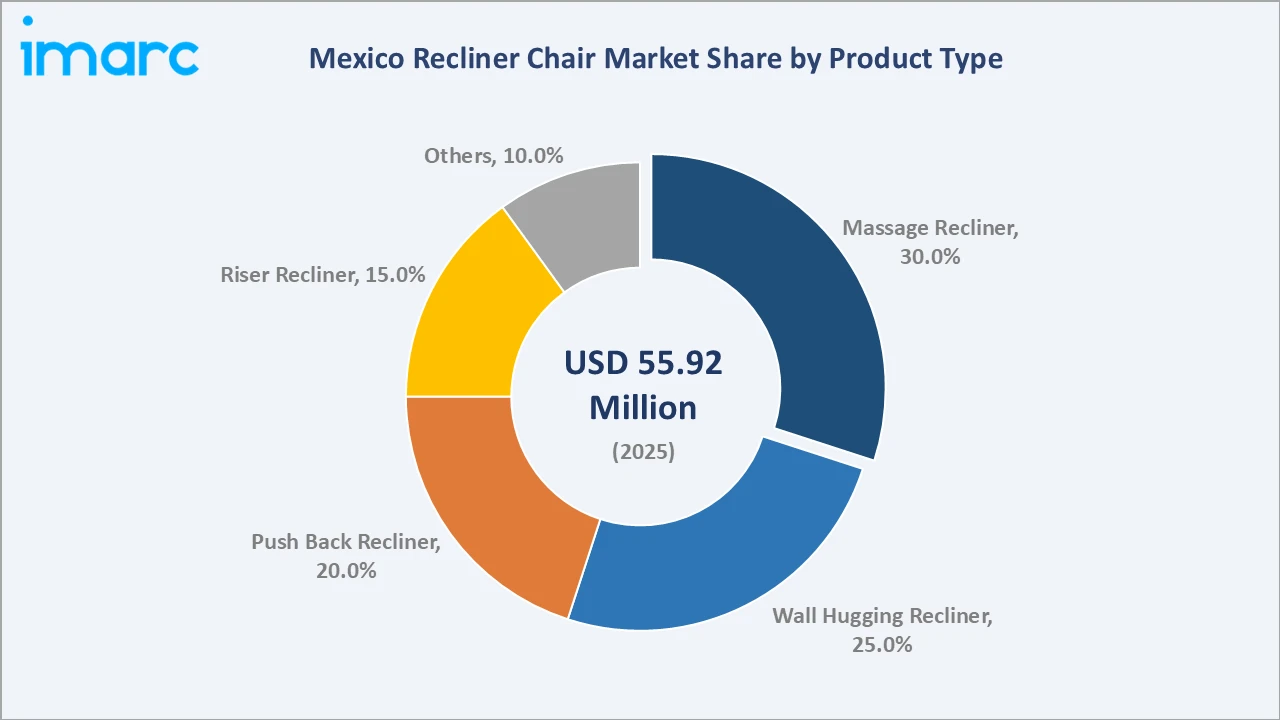
Massage recliner leads at 30.0% (2025). The segment benefits from rising demand for home-based stress relief, therapeutic comfort, and spa-like relaxation. Multi-zone massage, heat therapy, and power reclining features attract working professionals and older consumers seeking wellness benefits without frequent clinic visits.
To access detailed market analysis, Request Sample
Wall hugging recliner at 25.0% follows through space-saving appeal for urban apartments. Push back recliner holds 20.0% through affordable, mechanism-light designs. Riser recliner at 15.0% grows fastest at ~6.9% CAGR as ageing consumers seek assisted standing, while others account for 10.0%.
Product type preferences vary by household profile. Younger urban consumers favor compact wall hugging and push back recliners for small living spaces, while older and affluent households increasingly choose massage and riser recliners that combine therapeutic comfort with ease of use.
By Distribution Channel
Furniture and furnishing stores lead at 45.0% (2025). Consumers prefer testing recline motion, cushioning, and upholstery before purchase. Showroom expertise, in-store financing, delivery, and assembly services strengthen this channel, particularly for premium power and massage recliners that benefit from hands-on demonstration.
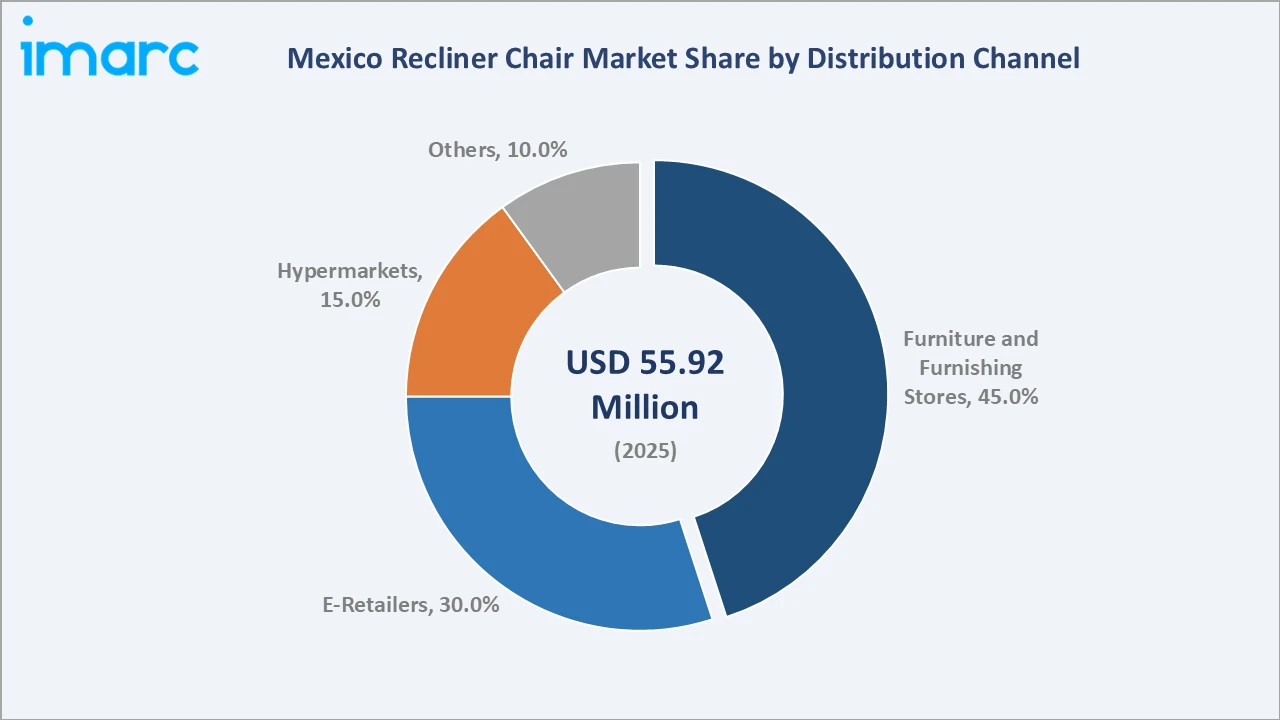
E-retailers at 30.0% grow fastest at ~7.4% CAGR through marketplace expansion, installment payments, and nationwide delivery. Hypermarkets hold 15.0% by offering affordable recliners alongside everyday shopping, while others, including specialty and direct sales channels, account for 10.0%.
Omnichannel integration is reshaping channel dynamics, as furniture retailers increasingly combine physical showrooms with online catalogs, click-and-collect options, and digital financing. This blending allows consumers to compare features online while completing high-value recliner purchases after in-store comfort testing.
Regional Market Insights
| Region | Share (2025) | Key Mexico Recliner Chair Market Drivers & Characteristics |
|---|---|---|
| Central Mexico | 50.0% | Driven by the dense populations of Mexico City, the State of Mexico, Puebla, and Querétaro, concentrated retail networks, and active housing development. |
| Northern Mexico | 30.0% | Supported by higher incomes in Monterrey, Tijuana, and Chihuahua, proximity to US furniture trends, and a strong border manufacturing base. |
| Southern Mexico | 15.0% | Gradual growth supported by tourism-led hospitality demand, urban expansion in Mérida and Cancún, and improving retail access. |
| Others | 5.0% | Smaller urban centers where e-commerce and installment-based retail are expanding access to affordable recliners. |
Central Mexico's 50.0% market leadership reflects the Mexico City metropolitan area's large consumer base, the highest concentration of furniture showrooms and department stores, and strong mid- and high-income household demand. Northern Mexico's 30.0% reflects industrial prosperity, higher purchasing power, and close alignment with North American lifestyle trends.
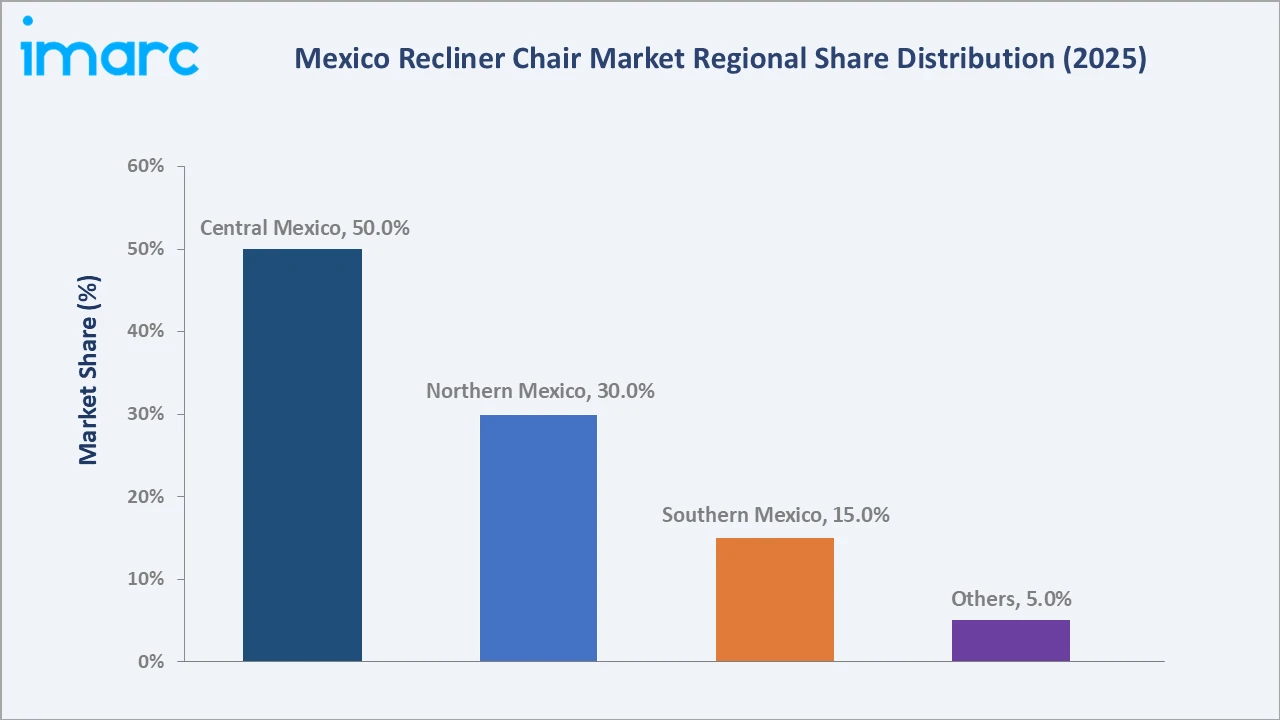
Southern Mexico's 15.0% share is growing as tourism, hotel development, and expanding urban centers create demand for recliners in homes and hospitality settings. Others, at 5.0%, represent emerging markets where online retail and consumer credit are gradually improving access to branded comfort furniture.
Regional demand patterns are also shaped by climate and lifestyle preferences. Breathable fabrics and performance upholstery are gaining popularity in warmer southern and coastal areas, while leather and premium power recliners attract stronger interest among affluent households in major northern and central metropolitan markets.
Competitive Landscape
The Mexico recliner chair market competitive landscape is moderately fragmented, combining international motion furniture brands, global home furnishing retailers, and domestic furniture chains. Competition is intensifying through power and massage feature innovation, omnichannel retail expansion, financing programs, and localized designs suited to Mexican homes.
| Company | Key Brands | Market Position | Core Strength |
|---|---|---|---|
| La-Z-Boy Incorporated | La-Z-Boy, Joybird | Market Leader | Pioneer of the recliner, offering manual, power, and lift recliners with strong customization. |
| Ashley Global Retail, LLC | Ashley, Signature Design by Ashley, Benchcraft | Market Leader | Wide HomeStore network in Mexico offering affordable, stylish power and manual recliners. |
| Natuzzi S.p.A. | Natuzzi Italia, Natuzzi Editions | Innovator | Premium Italian-designed recliners with advanced motion mechanisms. |
| Ekornes AS | Stressless, Ekornes, Svane, IMG | Innovator | Stressless ergonomic recliners with patented glide and head and lumbar support systems. |
| Inter IKEA Systems B.V. | IKEA | Strong Challenger | Affordable, space-efficient seating sold through large-format stores and online in Mexico. |
| Flexsteel Industries, Inc. | Flexsteel | Strong Challenger | Motion furniture maker with Juárez production and durable Blue Steel Spring construction. |
| Dico Furniture | Dico, Dico Concept | Strong Challenger | Leading Mexican furniture retailer with a national store network and flexible financing. |
The competitive landscape's most significant dynamic is the balance between premium motion technology and affordability. International brands compete on ergonomic innovation and design, while domestic chains and global retailers compete on price, accessibility, and financing, pushing participants to broaden assortments across manual, power, and massage recliners.
Strategic priorities across leading participants include expanding power and massage recliner portfolios, strengthening showroom and online presence, offering financing and extended warranties, and localizing designs, fabrics, and sizes to suit Mexican homes and climate conditions.
Key Company Profiles
La-Z-Boy Incorporated
La-Z-Boy Incorporated is a leading manufacturer and retailer of residential furniture and a pioneer of the recliner, recognized for comfort-focused motion seating, broad customization options, and an established presence across North American markets.
- Key Brands: La-Z-Boy, Joybird, among others.
- Recent Developments: In April 2026, La-Z-Boy Incorporated debuted the AudioLuxe by La-Z-Boy premium audio furniture line at High Point Market. Developed in partnership with Klipsch, the line embeds a complete sound system, including headrest speakers and subwoofers, into recliners and motion furniture.
- Strategic Focus: Expanding comfort-led innovation through power reclining, integrated technology, and customization to strengthen leadership in motion furniture.
Ekornes AS
Ekornes AS is a Norwegian furniture manufacturer known for its Stressless brand of ergonomic recliners, sofas, and chairs, offering premium seating distributed internationally through an extensive dealer network.
- Key Brands: Stressless, Ekornes, Svane, IMG.
- Recent Developments: Ekornes AS introduced Stressless Helsinki, the first recliner in its new Stressless Power concept. Built on the Stressless Air Power Platform, it features a Heart Balance position that raises the feet to heart level, a replaceable integrated power unit, and an adjustable headrest.
- Strategic Focus: Advancing ergonomic and power recliner innovation while expanding Stressless collections across Europe, Asia-Pacific, and North America.
Natuzzi S.p.A.
Natuzzi S.p.A. is an Italian designer and manufacturer of upholstered furniture, offering premium leather and fabric sofas, armchairs, and recliners that combine Italian design, craftsmanship, and advanced comfort mechanisms for global markets.
- Key Brands: Natuzzi Italia, Natuzzi Editions, Natuzzi Re-vive.
- Recent Developments: In April 2026, Natuzzi S.p.A. showcased new Natuzzi Editions collections at High Point Market, featuring modular sofas and wellness-focused designs. The Nuvia flagship model introduced a Triple Motion mechanism offering zero-gravity and micromobility benefits for enhanced relaxation.
- Strategic Focus: Strengthening its premium positioning through wellness-oriented reclining collections, design innovation, and international retail expansion.
Market Concentration Analysis
The Mexico recliner chair market is moderately concentrated in the organized branded segment, where international motion furniture specialists and large retail chains hold strong positions. The broader market remains fragmented, with numerous small domestic workshops and unbranded imports competing on price in mass-market and semi-urban channels.
Market concentration is evolving through two opposing forces. Leading brands are expanding showroom networks, online channels, and power recliner portfolios, gradually consolidating the organized segment. At the same time, low-cost imports and new online sellers increase fragmentation by widening consumer choice at entry-level price points.
Entry barriers in the organized segment remain moderate, as success depends on brand recognition, reliable mechanism sourcing, showroom presence, and after-sales service capability. New entrants increasingly use online direct-to-consumer models to reach buyers, while established participants rely on retail partnerships and financing programs to defend their positions.
Investment & Growth Opportunities
Highest Growth Segments
E-retailers (~7.4% CAGR through marketplace expansion and nationwide delivery), riser recliners (~6.9% CAGR through ageing demographics), massage recliners (~6.6% CAGR through wellness spending), and wall hugging recliners (~5.5% CAGR through compact urban housing) represent the highest-growth investment vectors through 2034.
Emerging Investment Opportunities
Senior care and healthcare seating represent an emerging opportunity, as ageing households, caregivers, and institutions seek recliners with assisted standing, stable mechanisms, and hygienic upholstery. Commercial demand from hotels, clinics, cinemas, and offices further broadens opportunities beyond residential living rooms.
Commercial and hospitality applications add further investment potential. Home theaters, cinema lounges, hotel suites, and clinic waiting areas increasingly specify recliners for guest comfort, creating demand for durable, easy-to-maintain designs and offering suppliers opportunities for bulk contracts and long-term institutional relationships.
Investment Themes
- Omnichannel recliner retail expansion in Northern and Central Mexico: Combining online catalogs, augmented reality visualization, installment financing, and experiential showrooms can capture digitally engaged consumers while preserving the in-person testing that recliner buyers value.
- Localized manufacturing of power and massage recliners: Domestic production of motion furniture near Northern Mexico's furniture clusters can shorten lead times, reduce import dependence, and support competitively priced, feature-rich recliners for domestic consumers and North American export markets.
Future Market Outlook (2026-2034)
The Mexico recliner chair market is projected to grow from USD 55.92 Million in 2025 to USD 59.15 Million in 2026, reaching USD 94.61 Million by 2034, registering a CAGR of 5.78% during 2026-2034. The anchor value of USD 74.04 Million in 2030 marks a structural inflection point.
By 2030, power and massage functions are expected to become standard in mid-priced ranges, e-commerce will account for a growing share of recliner sales, and demand from senior care and hospitality buyers will strengthen commercial adoption across major urban regions.
Three structural forces define market growth through 2034 urbanization and rising incomes expanding the consumer base, home-centric and wellness-oriented lifestyles sustaining demand for comfort furniture, and digital retail maturation extending branded recliner access beyond major metropolitan areas.
Over the forecast period, manufacturers that combine affordable pricing with power, massage, and space-saving features are expected to gain share. Investments in digital retail, localized production, and reliable service networks will be critical for capturing demand from both first-time recliner buyers and premium upgrade customers.
Research Methodology
Primary Research
Primary research comprised structured interviews with Mexico recliner chair industry stakeholders, including furniture manufacturers, mechanism suppliers, retail directors, e-commerce category managers, distributors, and interior designers, along with consumer feedback from recliner buyers across Northern, Central, and Southern Mexico.
Secondary Research
Secondary research encompassed national statistical data, furniture trade and import-export records, housing and urbanization statistics, company annual reports, investor presentations, product catalogs, industry association publications, and trade press coverage. Over 50 secondary sources were reviewed.
Forecasting Models
Market revenue forecasts were developed using a household demand model combining urban households by income segment, recliner penetration rates, replacement cycles, and average selling prices by product type. Commercial demand estimates and channel-level sales data were used to validate the aggregated forecast.
Mexico Recliner Chair Market Report Coverage:
| Report Features | Details |
|---|---|
| Base Year of the Analysis | 2025 |
| Historical Period | 2020-2025 |
| Forecast Period | 2026-2034 |
| Units | USD Million |
| Scope of the Report |
Exploration of Historical Trends and Market Outlook, Industry Catalysts and Challenges, Segment-Wise Historical and Future Market Assessment:
|
| Product Types Covered | Wall Hugging Recliner, Push Back Recliner, Massage Recliner, Riser Recliner, Others |
| Seating Arrangements Covered | Single Seater Recliner, Multi Seater Recliner |
| Materials Covered | Leather, Fabric, Others |
| Distribution Channels Covered | Furniture and Furnishing Stores, Hypermarkets, E-Retailers, Others |
| End-Users Covered | Residential, Commercial, Others |
| Regions Covered | Northern Mexico, Central Mexico, Southern Mexico, Others |
| Companies Covered | La-Z-Boy Incorporated, Ashley Global Retail, LLC, Natuzzi S.p.A., Ekornes AS, Inter IKEA Systems B.V., Flexsteel Industries, Inc., Dico Furniture, etc. |
| Customization Scope | 10% Free Customization |
| Post-Sale Analyst Support | 10-12 Weeks |
| Delivery Format | PDF and Excel through Email (We can also provide the editable version of the report in PPT/Word format on special request) |
Key Benefits for Stakeholders:
- IMARC’s industry report offers a comprehensive quantitative analysis of various market segments, historical and current market trends, market forecasts, and dynamics of the Mexico recliner chair market from 2020-2034.
- The research report provides the latest information on the market drivers, challenges, and opportunities in the Mexico recliner chair market.
- Porter's five forces analysis assist stakeholders in assessing the impact of new entrants, competitive rivalry, supplier power, buyer power, and the threat of substitution. It helps stakeholders to analyze the level of competition within the Mexico recliner chair industry and its attractiveness.
- Competitive landscape allows stakeholders to understand their competitive environment and provides an insight into the current positions of key players in the market.
Frequently Asked Questions About the Mexico Recliner Chair Market Report
The Mexico recliner chair market size is estimated at USD 59.15 Million in 2026, driven by urbanization, rising disposable incomes, and home-centric lifestyles. Growing e-commerce adoption, ergonomic awareness, and demand for multifunctional furniture further support market expansion across urban and semi-urban regions.
The Mexico recliner chair market grows at a 5.78% CAGR during 2026-2034, reaching USD 94.61 Million by 2034. Growth is sustained by rising incomes, an ageing population, wellness-oriented purchasing, and expanding online access to branded power and massage recliners.
Massage recliner leads at 30.0% through rising demand for home-based stress relief, therapeutic comfort, and multifunctional wellness seating among working professionals and older consumers.
Furniture and furnishing stores lead at 45.0% as consumers prefer testing comfort and recline motion in person, supported by showroom expertise, installment financing, and delivery services.
Central Mexico leads at 50.0% through the dense population of Mexico City and surrounding states, concentrated furniture retail networks, and strong mid- and high-income household demand.
Leading companies include La-Z-Boy Incorporated, Ashley Global Retail, LLC, Natuzzi S.p.A., Ekornes AS, Inter IKEA Systems B.V., Flexsteel Industries, Inc., and Dico Furniture, among others.
The Mexico recliner chair market is projected to reach approximately USD 74.04 Million by 2030, with power and massage features becoming mainstream, e-retailers gaining share, and senior care and hospitality buyers strengthening commercial demand.
Three priority investment opportunities include omnichannel recliner retail expansion in Northern and Central Mexico, localized manufacturing of power and massage recliners, and riser recliner solutions for senior care and healthcare settings.
Need more help?
- Speak to our experienced analysts for insights on the current market scenarios.
- Include additional segments and countries to customize the report as per your requirement.
- Gain an unparalleled competitive advantage in your domain by understanding how to utilize the report and positively impacting your operations and revenue.
- For further assistance, please connect with our analysts.
 Request Customization
 Speak to an Analyst
 Request Brochure
 Inquire Before Buying
Benefits of Customization
- Personalize this research
- Triangulate with your data
- Get data as per your format and definition
- Gain a deeper dive into a specific application, geography, customer, or competitor
- Any level of personalization
Get in Touch With Us
UNITED STATES
Phone: +1-201-971-6302
INDIA
Phone: +91-120-433-0800
UNITED KINGDOM
Phone: +44-753-714-6104
Email: [email protected]
Client Testimonials






















Related Reports

Choose your plan
*Please note that the prices mentioned below are starting prices for each bundle type. Kindly contact our team for further details.*
Single User License
- 1 User License, Access on 2 Devices
- PDF Report + Excel Dataset (Password Protected)
- Lifetime Access
- No Printing Rights
- 10% Free Report Customization
- 10–12 Weeks of Analyst Support
Five User License
- Access for 5 Users, 2 Devices per User
- PDF Report + Excel Dataset (Password Protected)
- Lifetime Access
- Dedicated Account Manager
- 12–14 Weeks of Analyst Support
- No Printing Rights
- 15% Free Report Customization
- 25% Discount on Your Next Purchase
Corporate User License
- Unlimited User Access (Within Your Organization)
- PDF Report + Excel Dataset
- Lifetime Access
- Dedicated Account Manager
- 14–20 Weeks of Analyst Support
- No Printing Rights
- 20% Free Report Customization
- 30% Discount on Your Next Purchase
Essential Insights
What's included:
3 reports
- Lifetime Access
- PDF Reports
- Excel Datasets
- 2 Weeks of Free Analyst Support
- 2 User Licenses
- Access on 2 Devices
- Printing Rights
- Complimentary PowerPoint (PPT) Version
- Complimentary License Upgrade
Professional Access
What's included:
5 reports
- Lifetime Access
- PDF Reports
- Excel Datasets
- 8 Weeks of Free Analyst Support
- 2 User Licenses
- Access on 2 Devices
- Printing Rights
- Complimentary PowerPoint (PPT) Version
- Complimentary License Upgrade
Business Advantage
What's included:
8 reports
- Lifetime Access
- PDF Reports
- Excel Datasets
- 14 Weeks of Free Analyst Support
- 2 User Licenses
- Access on 2 Devices
- Printing Rights
- Complimentary PowerPoint (PPT) Version
- Complimentary License Upgrade
Enterprise Intelligence
What's included:
10 reports
- Lifetime Access
- PDF Reports
- Excel Datasets
- 20 Weeks of Free Analyst Support
- 2 User Licenses
- Access on 2 Devices
- Printing Rights
- Complimentary PowerPoint (PPT) Version
- Complimentary License Upgrade