
Mexico Rubber Hose Market Size, Share, Trends and Forecast by Product Type, Media, Pressure Rating, Application, and Region, 2026-2034
Mexico Rubber Hose Market Size, Share, Trends & Forecast (2026-2034)
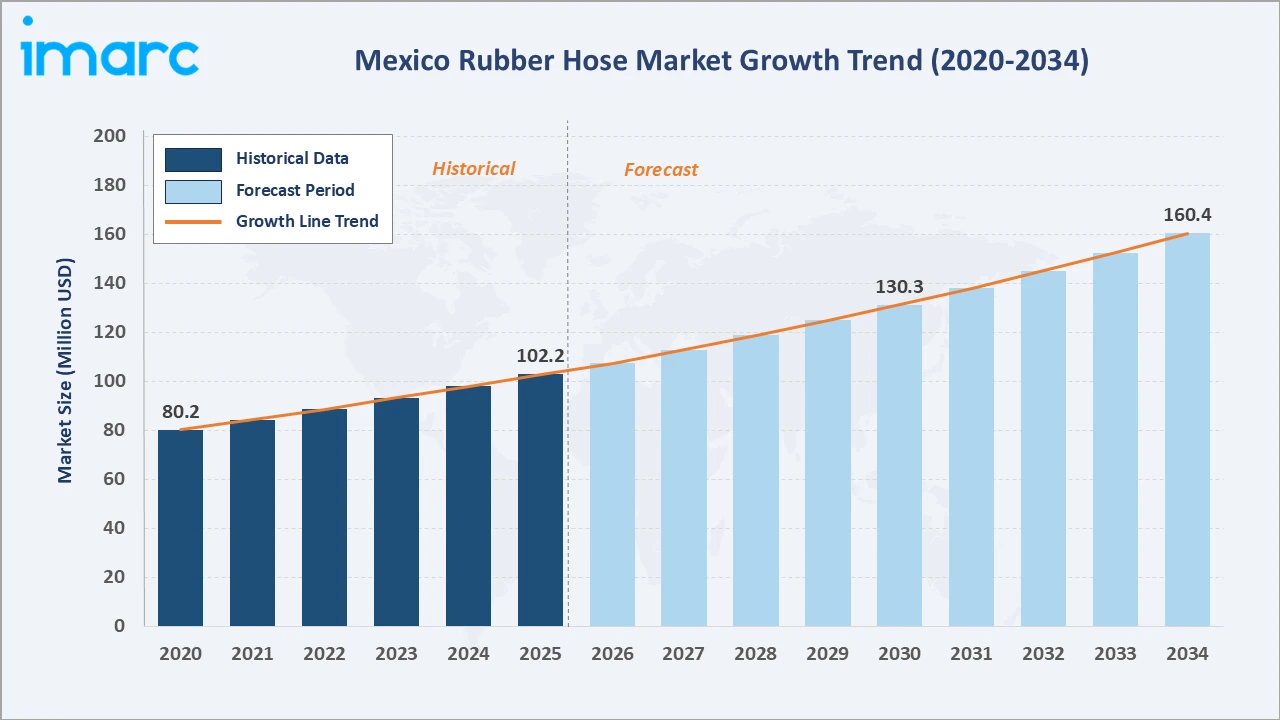
The Mexico rubber hose market reached USD 102.2 Million in 2025 and is projected to reach USD 160.4 Million by 2034, exhibiting a CAGR of 4.97% during 2026-2034. Mexico's nearshoring boom, attracting automotive and industrial manufacturing investments and rising oil and gas sector pipeline infrastructure expenditure, are the primary growth catalysts. From February 1, 2025, to January 30, 2026, Mexico exported approximately 5,200 shipments of rubber hoses, involving 180 domestic companies and 63 international trading partners. This strong export activity is supporting the Mexico rubber hose market by expanding the customer base for local manufacturers, increasing production volumes, and strengthening the country’s position in global supply chains. Synthetic dominates product type at 74.6%, medium pressure rating leads at 46.7%, and Central Mexico accounts for the largest regional share at 39.5%.
Market Snapshot
|
Metric |
Value |
|
Market Size (2025) |
USD 102.2 Million |
|
Forecast Market Size (2034) |
USD 160.4 Million |
|
CAGR (2026-2034) |
4.97% |
|
Base Year |
2025 |
|
Historical Period |
2020-2025 |
|
Forecast Period |
2026-2034 |
|
Dominant Product Type |
Synthetic (74.6%, 2025) |
|
Dominant Pressure Rating |
Medium (46.7%, 2025) |
|
Leading Region |
Central Mexico (39.5%, 2025) |
The Mexico rubber hose market grew steadily from USD 80.2 Million in 2020 to USD 102.2 Million in 2025, driven by Mexico's resilience as a North American manufacturing hub under USMCA, sustained automotive sector output, and expanding oil and gas infrastructure. The market is projected to reach USD 130.3 Million by 2030 and USD 160.4 Million by 2034.
To get more information on this market, Request Sample
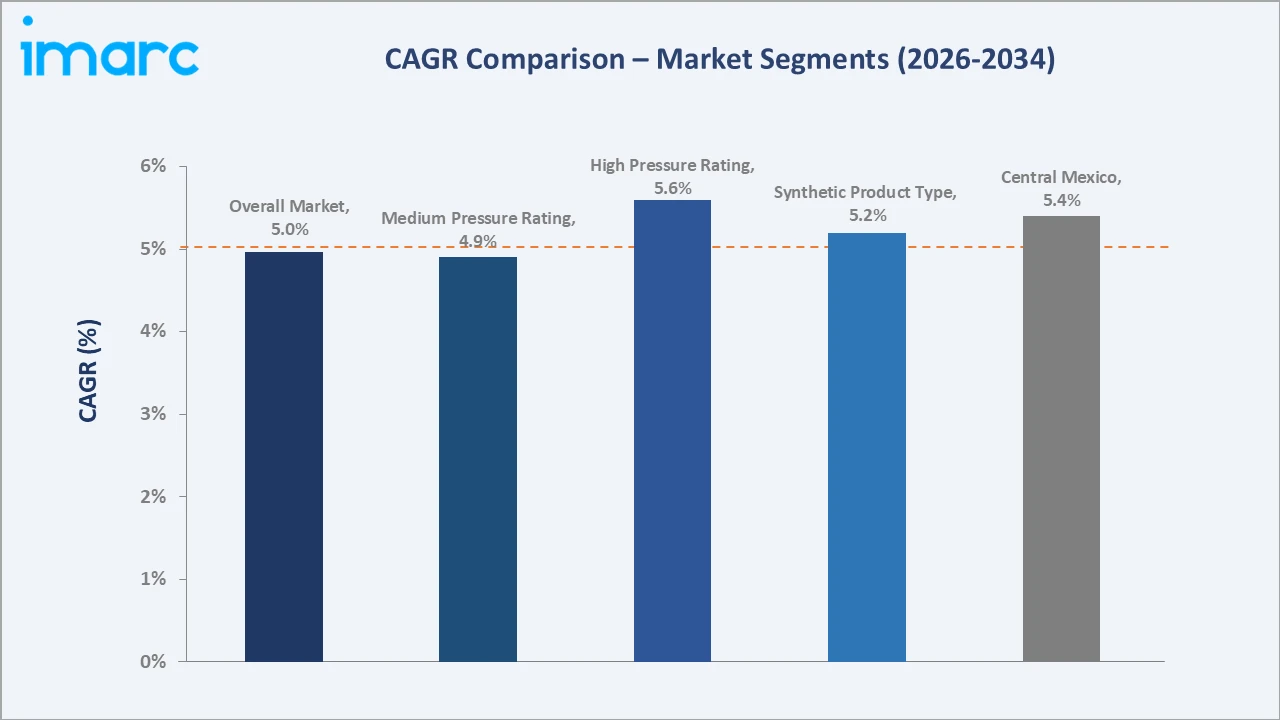
Synthetic rubber product type grows at ~5.2% CAGR through continued demand from automotive OEM programs requiring compound hoses for thermal management, fuel, and hydraulic applications. High-pressure rating grows at ~5.6% CAGR, the fastest segment, driven by oil and gas sector hydraulic hose demand and construction equipment hydraulic systems. Central Mexico leads regional growth at ~5.4% CAGR through Guadalajara's automotive electronics hub and Mexico City's industrial corridor expansion.
Executive Summary
The Mexico rubber hose market occupies a strategically critical position within Mexico's industrial and manufacturing ecosystems, serving the country's world-class automotive manufacturing sector, producing approximately 4 million vehicles annually, of which nearly 3.5 million are exported, alongside growing oil and gas, construction, agriculture, and mining end-use sectors. Market value stood at USD 102.2 Million in 2025 and is forecast to reach USD 160.4 Million by 2034. Mexico's designation as North America's premier manufacturing destination under USMCA rules is the foundational demand driver, attracting OEM automotive assembly programs and Tier 1-2 supplier networks that generate consistent, long-term rubber hose demand across engine cooling, fuel delivery, air conditioning, hydraulic braking, and power steering systems.
Synthetic rubber leads the product type at 74.6% (2025), reflecting the dominance of specialty compound hoses that meet the performance requirements of Mexico's high-temperature automotive, industrial, and oil and gas applications. Medium command 46.7% of pressure rating (2025), serving the broad-spectrum hydraulic and industrial fluid transfer applications that constitute Mexico's largest hose volume segment. Central Mexico commands 39.5% (2025), driven by Guadalajara's automotive electronics manufacturing cluster, Mexico City's industrial distribution hub, and the Bajío region's dense automotive and food processing industrial corridors.
Key Market Insights
|
Insight |
Data |
|
Dominant Product Type |
Synthetic Rubber – 74.6% share (2025) |
|
Dominant Pressure Rating |
Medium – 46.7% share (2025) |
|
Leading Region |
Central Mexico – 39.5% share (2025) |
|
Market Opportunity |
EV thermal management hoses; oil & gas high-pressure hydraulics; nearshoring Tier 1-2 supplier expansion; agricultural irrigation hose demand |
Key Analytical Observations:
- Synthetic Rubber at 74.6% (2025): Synthetic compounds, principally EPDM (ethylene propylene diene monomer), NBR (nitrile butadiene rubber), and SBR (styrene-butadiene rubber), dominate Mexico's rubber hose market due to their superior resistance to heat, oil, ozone, and chemicals that natural latex cannot match in automotive, oil and gas, and industrial applications. EPDM hoses serve automotive coolants, air conditioning, and steam applications; NBR serves fuel and oil line applications; SBR serves general-purpose industrial hose applications.
- Medium Pressure Rating at 46.7% (2025): Medium-pressure hoses represent the broadest application range in Mexico's industrial economy, serving hydraulic systems on construction equipment, agricultural machinery, material handling, and general industrial machinery. Medium-pressure hose adoption tracks Mexico's industrial activity index, which has shown consistent growth driven by nearshoring manufacturing investment.
- Central Mexico at 39.5% (2025): Central Mexico leads the market due to its strong concentration of automotive, industrial, and manufacturing facilities. The region’s well-developed supplier network, transportation infrastructure, and proximity to major domestic and export markets further support demand for rubber hoses.
Mexico Rubber Hose Market Overview
The Mexico rubber hose market encompasses the design, manufacturing, distribution, and sale of flexible rubber tubes used to convey fluids, gases, and slurries across pressure differentials in automotive, industrial, oil and gas, agricultural, and construction applications. Product categories span engine coolant hoses, fuel and oil lines, hydraulic power hoses, air conditioning refrigerant hoses, pneumatic air hoses, suction and discharge hoses, and specialty chemical transfer hoses, differentiated by rubber compound, reinforcement layer, pressure rating, temperature range, and chemical compatibility. Mexico's rubber hose market benefits from USMCA's tariff-preferential treatment for automotive components manufactured within North America, creating structural cost advantages for Mexico-based manufacturing that attract both domestic and international hose producers. Macroeconomic factors include industrial production, automotive output, infrastructure investment, export activity, and overall economic growth. Exchange-rate movements, inflation, raw material prices, interest rates, and trade relations with the United States also affect manufacturing costs and market demand.
Market Dynamics
To evaluate market opportunities, Request Sample
Market Drivers
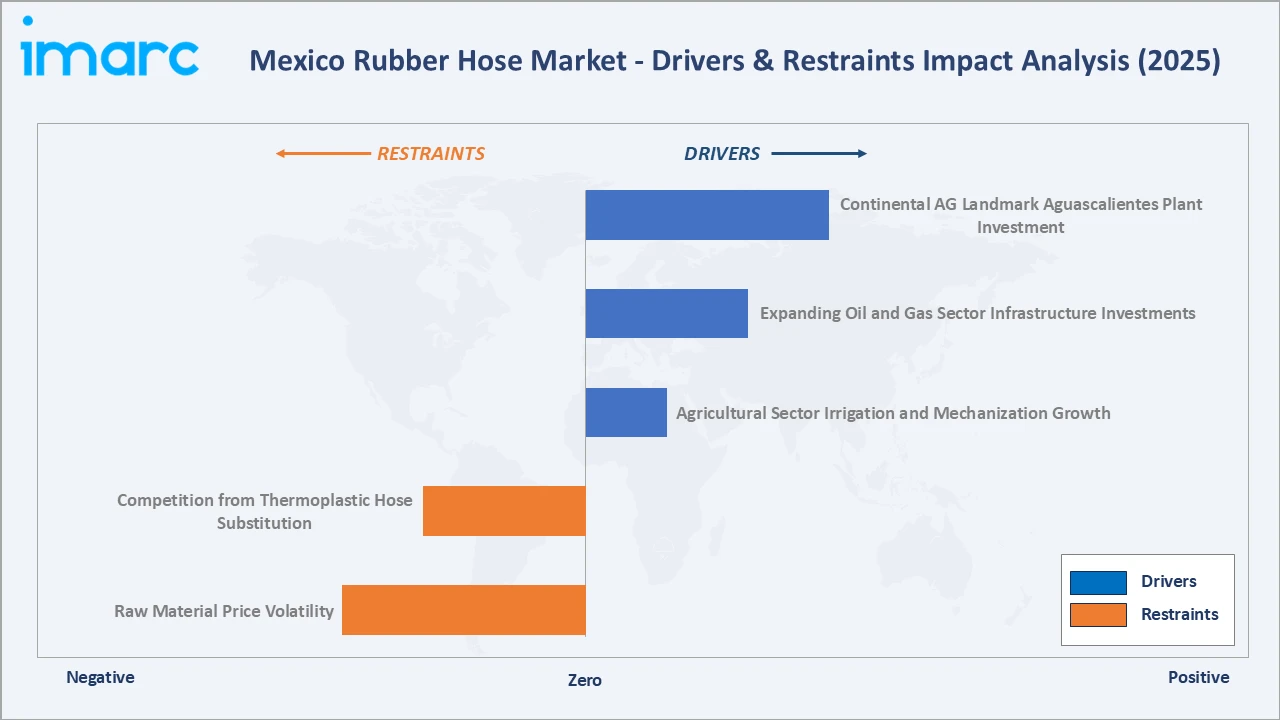
- Continental AG Landmark Aguascalientes Plant Investment: In August 2025, Continental's ContiTech division commenced operations at its new hydraulic hose manufacturing facility in Aguascalientes, Mexico, following a $90 million investment aimed at expanding regional production capacity and strengthening local supply chains. Spanning approximately 900,000 square feet, the facility produces high-performance hydraulic hoses for industrial and mobile applications across the construction, agriculture, mining, and energy sectors. This investment directly validates Mexico's rubber hose demand trajectory, brings world-class hydraulic hose manufacturing technology into Mexico's domestic production base, and creates a supply hub for Continental's OEM automotive customers operating across Mexico's industrial corridors.
- Expanding Oil and Gas Sector Infrastructure Investments: Mexico's oil and gas sector sustains consistent institutional demand for high-pressure hydraulic hoses, flexible pipe connections, suction and discharge hoses, and specialty chemical transfer hoses across upstream exploration, midstream pipeline, and downstream refining operations. Mexico produced about 1.48 million barrels of oil per day in 2024, ranking fourth in the Americas. The hydrocarbons sector remains economically important, while strong US-Mexico energy trade supports Mexico’s demand for refined fuels.
- Agricultural Sector Irrigation and Mechanization Growth: Mexico's agricultural sector is progressively adopting mechanized irrigation systems, pesticide application equipment, and harvesting machinery that require rubber hoses for water delivery, chemical application, and hydraulic system function. Government agricultural modernization programs funding irrigation infrastructure upgrades are creating sustained demand for large-diameter water delivery hoses and medium-pressure hydraulic hoses for agricultural machinery.
Market Restraints
- Raw Material Price Volatility: Mexico's rubber hose manufacturers are exposed to global synthetic rubber commodity price cycles, with SBR, EPDM, and NBR rubber compounds subject to petrochemical feedstock price volatility that compresses manufacturing margins during price spikes. Carbon black similarly follows petroleum price cycles. These input cost dynamics create margin pressure during petrochemical commodity up-cycles and can delay capital investment decisions for smaller domestic hose manufacturers with limited hedging capability.
- Competition from Thermoplastic Hose Substitution: High-performance thermoplastic hoses are progressively capturing market share in applications where synthetic rubber hoses previously dominated, including low-pressure pneumatics, food and beverage transfer, and select hydraulic applications where thermoplastics' lighter weight and superior flex fatigue life provide application advantages. Thermoplastic hose adoption is particularly strong in new OEM automotive EV-related cooling circuits where weight reduction targets drive thermoplastic substitution away from heavier rubber compound hoses.
Market Opportunities
- Electric Vehicle Thermal Management Hose Demand: Mexico's automotive sector is progressively transitioning toward electric vehicle production, requiring specialized thermal management hoses for battery cooling, power electronics cooling, and heat pump systems. Battery electric vehicle sales in Mexico reached 37,000 units in 2025, representing an 85% increase from the 20,000 vehicles sold in 2024. EV thermal management architectures require specialized EPDM and silicone rubber hoses rated for glycol-water coolant with higher thermal cycling requirements than traditional ICE cooling systems, representing a premium hose category that commands higher average selling prices than commodity automotive coolant hoses.
- Construction Sector Hydraulic Hose Demand from Nearshoring Infrastructure: Mexico's nearshoring industrial park and logistics infrastructure buildout is generating sustained demand for construction equipment hydraulic hoses, concrete pumping hoses, and pneumatic tool hoses.
Market Challenges
- Competition from Low-Cost Asian Imports: Mexico's rubber hose market faces competition from Chinese and South Korean rubber hose manufacturers that supply lower-specification applications through Mexico's distribution channels at price points below domestic and global brand manufacturers. While USMCA content rules provide preferential access for compliant North American-produced hoses in automotive OEM applications, the MRO and construction sectors are more price-sensitive and exposed to imported hose competition. Ensuring technical standards compliance and quality certification for imported hoses remains a challenge for Mexico's industrial buyers.
- Skilled Labor Availability for Technical Hose Fabrication: Mexico's rubber hose fabrication sector requires skilled operators for hose assembly, pressure testing, and quality validation, capabilities that are in increasing demand across Northern Mexico's expanding manufacturing base. Labor market tightness in key industrial clusters is creating operational challenges for expanding manufacturers and contributing to above-average wage growth that compresses production cost competitiveness.
Emerging Market Trends
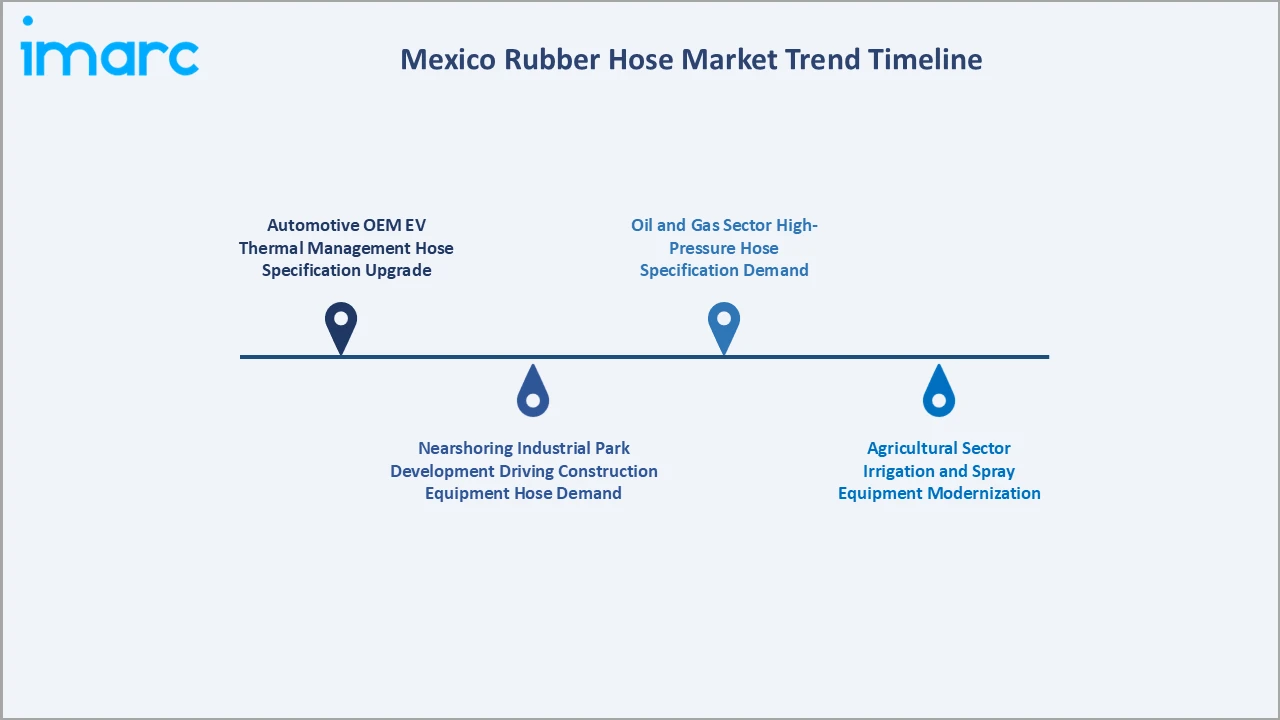
1. Automotive OEM EV Thermal Management Hose Specification Upgrade
The progressive introduction of electric and hybrid vehicle models at Mexico's major assembly plants is creating demand for thermally upgraded rubber hoses capable of managing battery pack cooling, power electronics thermal management, and heat pump refrigerant transfer. In October 2025, Yokohama Rubber announced plans to expand production capacity at its Mexican automotive hose subsidiary, Yokohama Industries Americas de Mexico, S. de R.L. de C.V. (YIA Mexico). The project will add a new facility on approximately 32,000 square meters of adjacent land, more than doubling the current site area. The expansion will strengthen production of air-conditioning and transmission oil-cooling hose assemblies for North America while supporting the growth and profitability of the company’s hoses and couplings business.
2. Oil and Gas Sector High-Pressure Hose Specification Demand
Rising oil and gas exploration, drilling, and refining activities are increasing demand for high-pressure hoses capable of handling extreme temperatures, corrosive fluids, and intense operating conditions. Producers are increasingly developing reinforced, durable, and standard-compliant hoses to improve safety and reliability. This shift toward specialized hose specifications is emerging as a key trend in the Mexico rubber hose market.
3. Nearshoring Industrial Park Development Driving Construction Equipment Hose Demand
Nearshoring is accelerating the development of industrial parks, factories, warehouses, and logistics facilities across Mexico. This construction activity is increasing the use of excavators, loaders, cranes, and other heavy equipment that rely on hydraulic and pneumatic hoses. As a result, demand is rising for durable, high-pressure hoses that can withstand intensive construction conditions.
4. Agricultural Sector Irrigation and Spray Equipment Modernization
Agricultural modernization in Mexico is increasing the adoption of advanced irrigation, spraying, and crop-protection equipment. These systems require flexible, chemical-resistant, and high-pressure hoses for water, fertilizers, and pesticides. As farms invest in efficient mechanization and precision agriculture, demand for specialized rubber hoses is steadily increasing.
Industry Value Chain Analysis
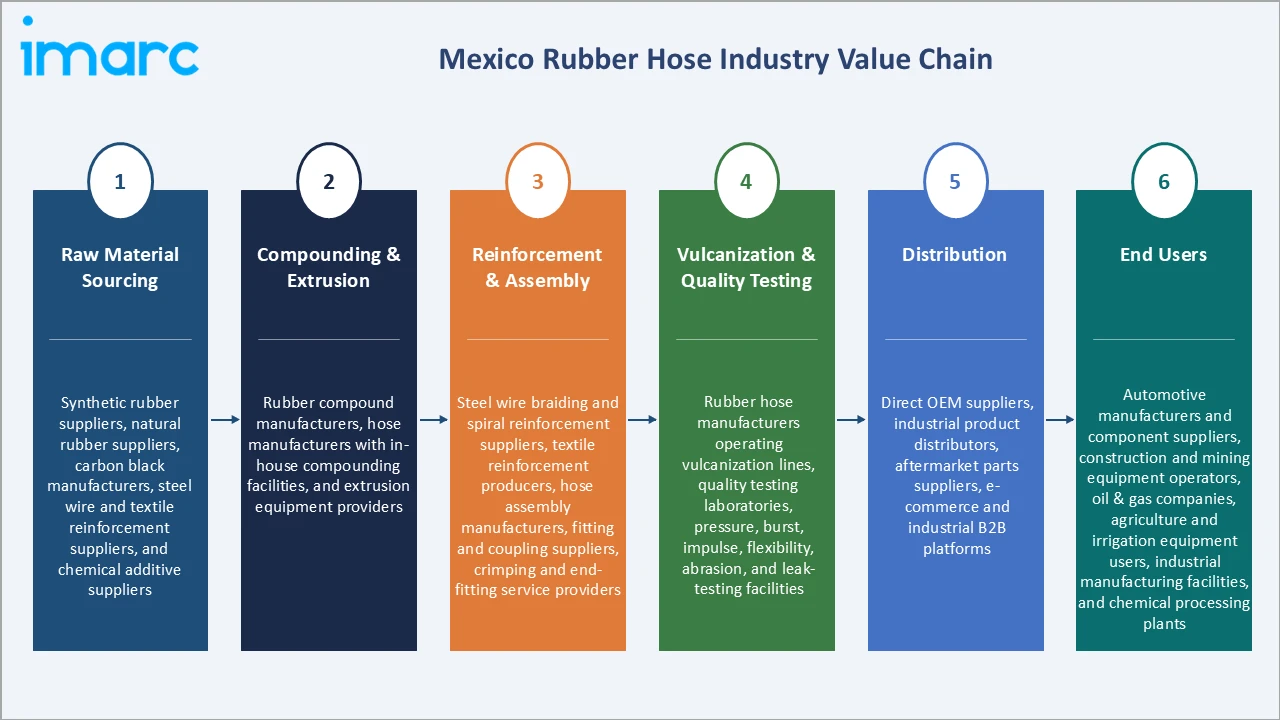
The Mexico rubber hose value chain integrates raw material sourcing, rubber compounding and extrusion, reinforcement and assembly, vulcanization and quality testing, distribution, and end-user application across automotive, industrial, oil and gas, and agricultural sectors.
|
Stage |
Key Participants |
|
Raw Material Sourcing |
Synthetic rubber suppliers, natural rubber suppliers, carbon black manufacturers, steel wire and textile reinforcement suppliers, and chemical additive suppliers |
|
Compounding & Extrusion |
Rubber compound manufacturers, hose manufacturers with in-house compounding facilities, and extrusion equipment providers |
|
Reinforcement & Assembly |
Steel wire braiding and spiral reinforcement suppliers, textile reinforcement producers, hose assembly manufacturers, fitting and coupling suppliers, crimping and end-fitting service providers |
|
Vulcanization & Quality Testing |
Rubber hose manufacturers operating vulcanization lines, quality testing laboratories, pressure, burst, impulse, flexibility, abrasion, and leak-testing facilities |
|
Distribution |
Direct OEM suppliers, industrial product distributors, aftermarket parts suppliers, e-commerce and industrial B2B platforms |
|
End Users |
Automotive manufacturers and component suppliers, construction and mining equipment operators, oil & gas companies, agriculture and irrigation equipment users, industrial manufacturing facilities, and chemical processing plants |
Distribution represents a critical value chain differentiator in Mexico's rubber hose market. The geographic dispersion of end-user demand across automotive clusters in oil and gas operations in the South, agricultural users in the Northwest and construction activity across all regions requires comprehensive distribution networks with regional stocking points and technical service capability.
Technology Landscape in the Mexico Rubber Hose Industry
Advanced Synthetic Rubber Compound Technology
Advanced synthetic rubber compound technology improves resistance to heat, chemicals, abrasion, and high-pressure operating conditions. Manufacturers are increasingly using advanced EPDM, NBR, HNBR, and specialty elastomer formulations to enhance hose durability and extend service life. These innovations support the growing performance requirements of the automotive, oil and gas, construction, and industrial sectors while reducing maintenance and replacement costs.
Multi-Layer Hose Construction and Reinforcement Technologies
Multi-layer hose construction and reinforcement technologies are enhancing the performance of rubber hoses across Mexico’s automotive and industrial sectors. Manufacturers are combining specialized inner tubes, textile braids, steel-wire spirals, and abrasion-resistant outer covers to improve pressure tolerance, flexibility, and durability. These innovations support lighter, more compact hoses capable of operating under severe temperatures and mechanical stress. They also extend service life and reduce failure risks in construction, mining, agriculture, and oil and gas applications.
Smart Hose Technology and Industry 4.0 Integration
Smart hose technology and Industry 4.0 integration are advancing Mexico’s rubber hose industry through embedded sensors that monitor pressure, temperature, leakage, and wear in real time. Connected hoses can transmit operating data to digital maintenance platforms, supporting predictive maintenance and reducing unplanned downtime. Automated manufacturing, digital quality control, and traceability systems are also improving production accuracy and consistency. These technologies are particularly valuable in automotive, oil and gas, mining, and heavy equipment applications.
Market Segmentation Analysis
The report covers the following segments:
|
Segment Category |
Leading Segment |
Market Share |
Year |
|
Product Type |
Synthetic |
74.6% |
2025 |
|
Media |
🔒 |
🔒 |
2025 |
|
Pressure Rating |
Medium |
46.7% |
2025 |
|
Application |
🔒 |
🔒 |
2025 |
|
Region |
Central Mexico |
39.5% |
2025 |

By Product Type
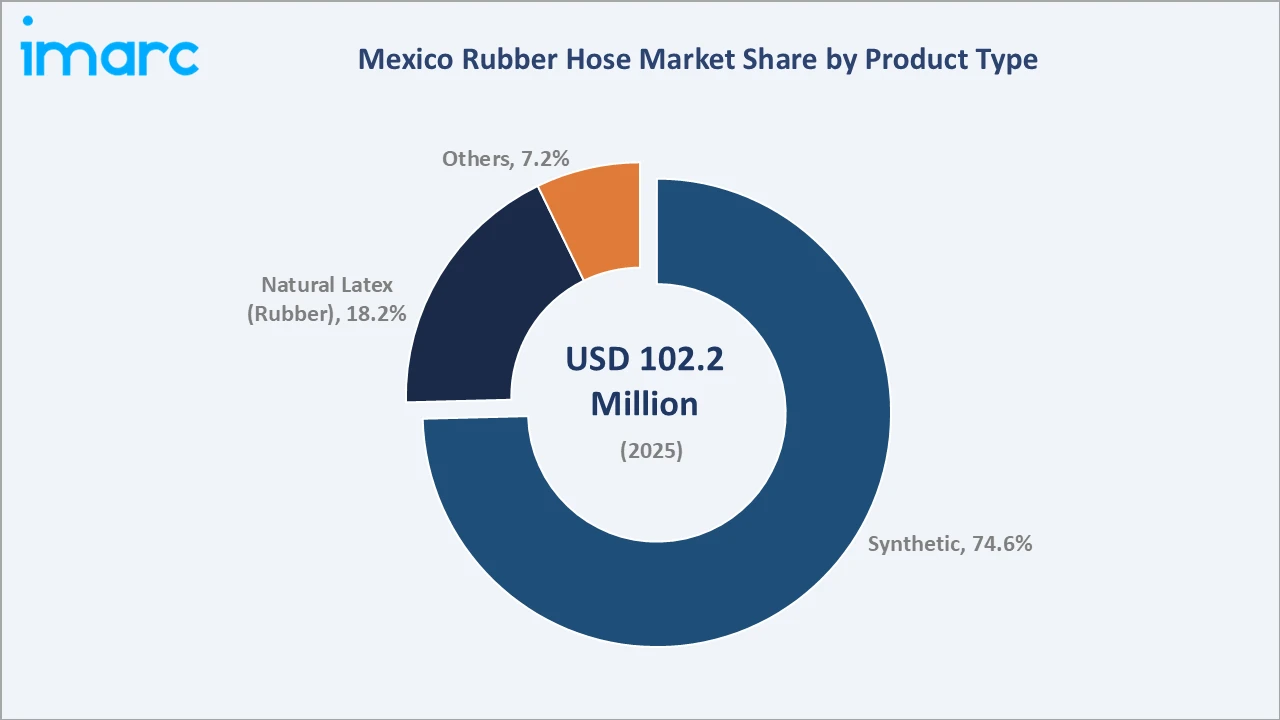
Synthetic dominates at 74.6% (2025), encompassing EPDM, NBR, SBR, HNBR, and specialty fluoroelastomer compounds that provide the oil resistance, heat stability, ozone resistance, and chemical compatibility required for Mexico's principal rubber hose application environments. Synthetic dominance reflects the automotive sector's specification requirements and the industrial sector's need for compound-specific performance in chemical, oil and gas, and food processing applications.
To access detailed market analysis, Request Sample
Natural latex (rubber) at 18.2% (2025) serves agricultural irrigation hose applications, general-purpose low-pressure industrial hoses, and specialty medical grade applications. Natural latex hose demand in Mexico is tied to agricultural sector irrigation modernization programs, where the lower upfront cost of natural rubber garden and irrigation hose supports broad rural adoption. Others at 7.2% include silicone rubber hoses for high-temperature automotive and food processing applications, and specialty fluoropolymer hoses for chemical industry use.
By Pressure Rating
Medium pressure leads at 46.7% (2025) encompass hydraulic hoses rated 50-350 bar working pressure that serve construction equipment, agricultural machinery, material handling, and industrial machinery applications. Medium-pressure hoses represent the largest volume category, and in Mexico, tracking industrial machinery population density and USMCA nearshoring industrial investment expansion.
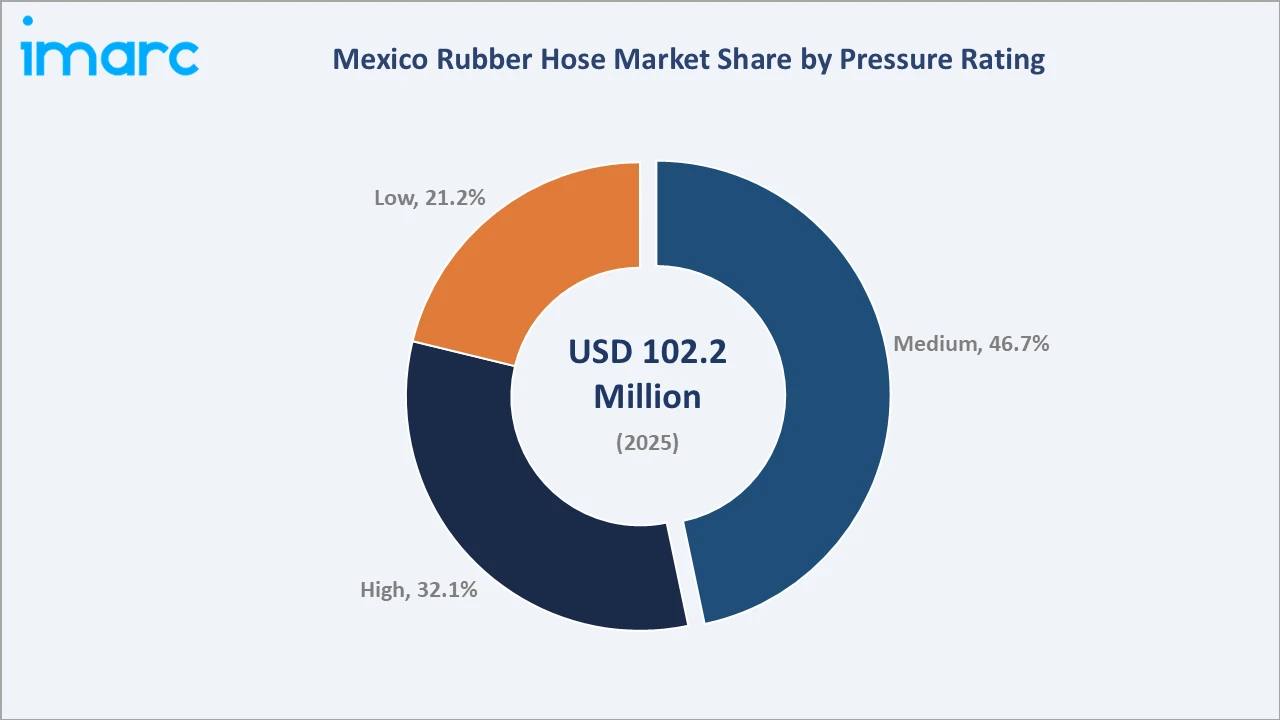
High pressure at 32.1% (2025) serves oil and gas drilling and production operations, heavy construction equipment, and industrial press hydraulic systems. High pressure is the fastest-growing pressure segment at ~5.6% CAGR, driven by offshore platform maintenance and private sector oil and gas operations expanding in Mexico's Southern hydrocarbon basins. Low pressure at 21.2% (2025) serves pneumatic tool hoses, garden and irrigation lines, air compressor connections, and general suction/discharge applications in agricultural and light industrial settings.
Regional Market Insights
|
Region |
Share (2025) |
Key Mexico Rubber Hose Market Drivers & Characteristics |
|
Central Mexico |
39.5% |
Well-developed transportation networks, supplier clusters, and proximity to major consumption centers support demand for automotive, hydraulic, and industrial hoses. |
|
Northern Mexico |
33.7% |
Benefits from extensive export-oriented manufacturing, maquiladora operations, and close integration with the United States. Strong automotive, aerospace, mining, and industrial activity drives demand for high-performance and specialized hose assemblies. |
|
Southern Mexico |
16.9% |
Demand is supported by oil and gas operations, agriculture, construction, and infrastructure development. The region generates significant requirements for high-pressure, chemical-resistant, irrigation, and heavy-equipment hoses. |
|
Others |
9.9% |
Includes smaller regional markets where demand is generated by local manufacturing, transportation, agriculture, maintenance, and replacement activities. Growth is supported by expanding distribution networks and gradual industrial development. |
Central Mexico's 39.5% regional dominance is supported by its dense concentration of automotive plants, industrial facilities, and component suppliers. Northern Mexico at 33.7% benefiting from export-oriented manufacturing, maquiladora operations, and strong trade links with the United States. The region also generates substantial demand from the automotive, aerospace, mining, and heavy equipment industries.
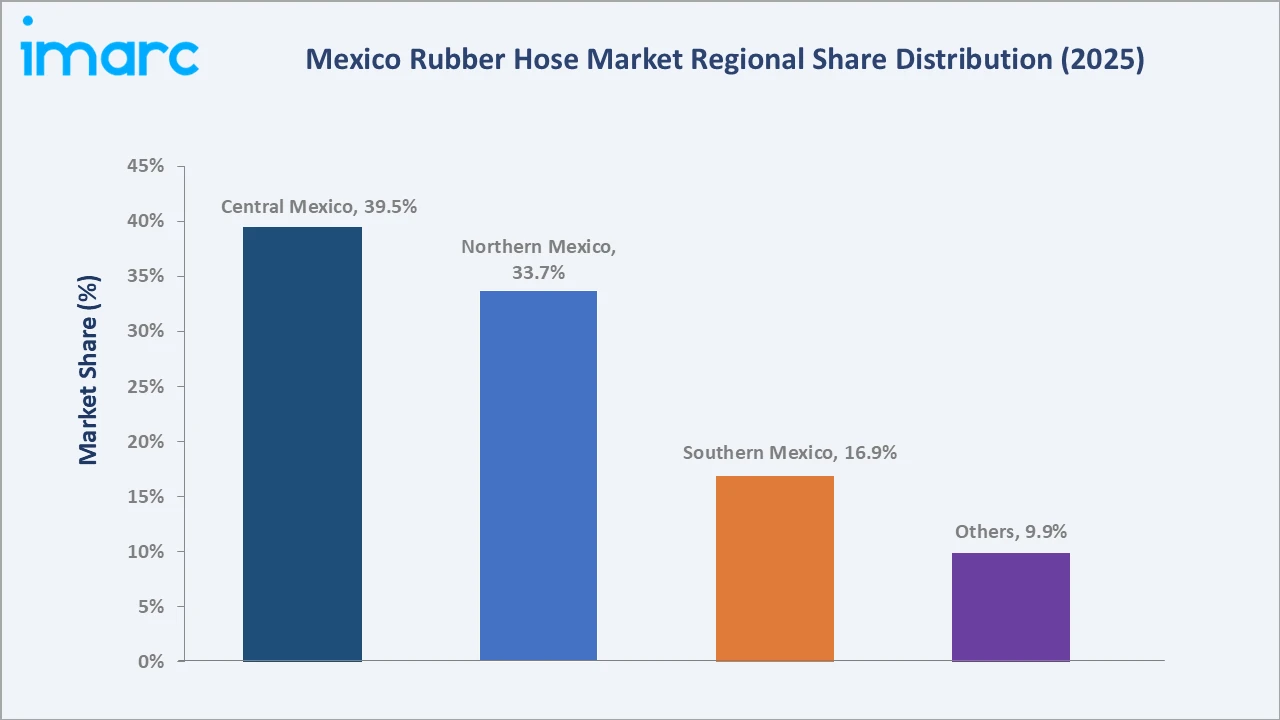
Southern Mexico at 16.9% is driven by oil and gas activities, agriculture, construction, and infrastructure development. Demand in this region is particularly strong for high-pressure, chemical-resistant, and irrigation hoses. Other regions collectively represent 9.9% of the market, supported by local manufacturing, transportation, maintenance, and replacement demand. Expanding distribution networks and gradual industrialization are expected to support further regional market growth.
Competitive Landscape
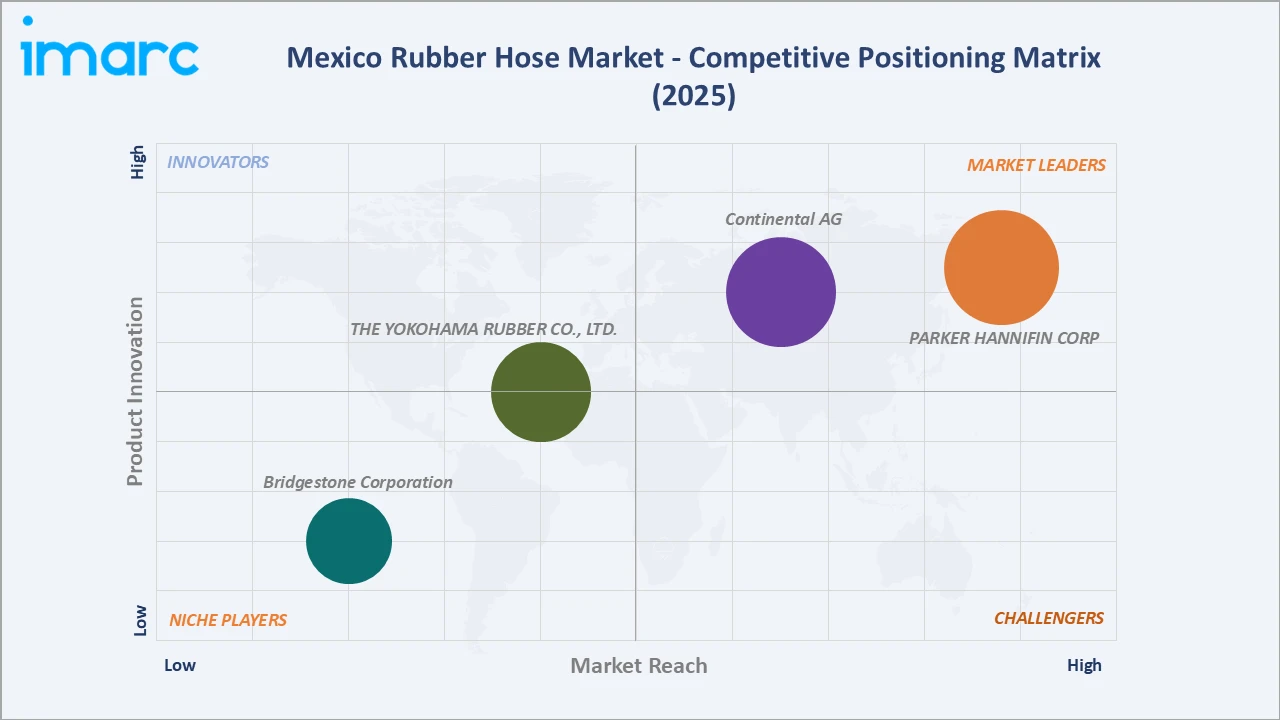
The Mexico rubber hose market features a tiered competitive structure: global hydraulic and industrial hose leaders compete at the top tier through comprehensive product portfolios, OEM qualification credentials, and Mexico-specific manufacturing or distribution investment. Established players compete effectively in targeted application segments through technical specialization and competitive pricing. Niche and regional players serve specific automotive and specialty markets.
|
Company |
Key Products |
Market Position |
Core Strength |
|
PARKER HANNIFIN CORP |
Hydraulic hose, Push-Lok and Push-On Hoses, Transfer hose, Constant operating pressure hose, Fuel hose, Suction hose, Water hose, Coolant hose, Oil hose |
Market Leader |
PARKER HANNIFIN CORP serves as a primary manufacturer and supplier of engineered rubber and polymer hoses in Mexico. Operating a major subsidiary, they supply hydraulic and industrial hoses for automotive manufacturing, oil and gas, and heavy machinery operations. |
|
Continental AG |
Air & Multipurpose Hose, Chemical Transfer Hoses, Dock Hoses, Fuel & Oil Hoses, Industrial Cleaning Hoses, Steam Hoses, Water Hoses, Hydraulic Hoses |
Market Leader |
Continental AG, through its ContiTech group sector, acts as a primary manufacturer of industrial and hydraulic rubber hoses in Mexico, supporting major regional industries like mining, agriculture, construction, and manufacturing. |
|
THE YOKOHAMA RUBBER CO., LTD. |
Hydraulic hoses, Automotive hoses |
Established Player |
THE YOKOHAMA RUBBER CO., LTD. plays a major role in the Mexican rubber hose industry through its subsidiary, Yokohama Industries Americas de Mexico (YIA Mexico). |
|
Bridgestone Corporation |
Hydraulic Hose |
Niche Player |
Bridgestone Corporation operates in the Mexican rubber and industrial hose market through its wholly owned subsidiary, Bridgestone HosePower. |
Competition intensity is increasing as Continental's Aguascalientes plant operational launch introduces significant domestic manufacturing capacity, potentially reshaping the Mexico hydraulic hose competitive landscape for automotive OEM supply by improving lead time and content compliance positioning relative to import-dependent competitors.
Key Company Profiles
PARKER HANNIFIN CORP
PARKER HANNIFIN CORP is one of the leading players in motion and control technologies, with a strong presence in Mexico through its manufacturing facilities, engineering centers, and distribution network. The company offers a broad portfolio of rubber hoses, hydraulic hoses, industrial hoses, thermoplastic hoses, and hose fittings serving the automotive, industrial manufacturing, construction, mining, agriculture, oil and gas, and transportation sectors. Its operations in Mexico benefit from the country's strategic manufacturing base and integration with North American supply chains, enabling efficient support for both domestic customers and export markets.
- Key Products: Hydraulic hose, Push-Lok and Push-On Hoses, Transfer hose, Constant operating pressure hose, Fuel hose, Suction hose, Water hose, Coolant hose, Oil hose.
- Strategic Focus: Centers on expanding localized manufacturing and strengthening its distribution and service network for hydraulic and industrial hose products. The company focuses on supplying high-performance, customized fluid-conveyance solutions to the automotive, construction, mining, agriculture, oil and gas, and manufacturing sectors. It also emphasizes advanced materials, integrated hose-and-fitting systems, digital monitoring, and predictive maintenance technologies.
Continental AG
Continental AG participates in Mexico’s rubber hose market primarily through its ContiTech business, which supplies hydraulic and industrial hose solutions for construction, agriculture, mining, energy, manufacturing, and mobile equipment applications. The company strengthened its local presence with a new hydraulics manufacturing facility in Aguascalientes, designed to increase regional capacity and support North American customers through localized production.
- Key Products: Air & Multipurpose Hose, Chemical Transfer Hoses, Dock Hoses, Fuel & Oil Hoses, Industrial Cleaning Hoses, Steam Hoses, Water Hoses, Hydraulic Hoses.
- Key Developments: In August 2025, Continental’s ContiTech division began production at its new hydraulic hose manufacturing facility in Aguascalientes, Mexico. The $90 million, 900,000-square-foot plant is designed to strengthen local supply chains, expand regional capacity, and deliver advanced fluid power solutions closer to customers. It will produce high-performance hydraulic hoses for construction, agriculture, mining, energy, and other industrial and mobile applications.
- Strategic Focus: Centers on expanding localized hydraulic hose production and strengthening regional supply-chain resilience through its ContiTech business. The company is investing in advanced manufacturing capacity to serve construction, agriculture, mining, energy, and mobile equipment customers across North America. It emphasizes high-performance materials, customized fluid-handling solutions, shorter delivery times, and closer technical support.
Market Concentration Analysis
The Mexico rubber hose market is moderately concentrated at the premium tier, with PARKER HANNIFIN CORP, Continental AG, THE YOKOHAMA RUBBER CO., LTD., and Bridgestone Corporation, collectively accounting for an estimated 45-55% of total market revenue in 2025. Continental's Aguascalientes manufacturing launch is expected to increase its market share meaningfully in the automotive hydraulic hose segment by shifting from import to domestic production. The mid-tier segment is characterized by moderate competition across application-specific hose categories. The market is expected to consolidate marginally through 2034 as Continental's manufacturing scale enables competitive pricing that pressures smaller import-dependent competitors, while maintaining positions through their broader product portfolios and service network advantages.
Investment & Growth Opportunities
Highest Growth Segments
High pressure rating hoses (~5.6% CAGR), synthetic rubber product type (~5.2% CAGR), Central Mexico region (~5.4% CAGR), EV thermal management specialty hoses (~8-10% CAGR niche), and oil and gas sector high-specification hoses (~6% CAGR in Southern Mexico) represent Mexico rubber hose market's highest-growth investment vectors through 2034.
Investment Themes
- EV hose specification development: Mexico's automotive OEM transition toward electric vehicle models creates demand for EPDM and silicone compound hoses with expanded temperature range, enhanced glycol-water coolant compatibility, and lightweight construction. Suppliers investing in EV-specific compound formulation and OEM qualification now will be positioned to capture the premium-priced EV hose segment as Mexico's automotive output mix shifts toward electric models through 2030.
- Northern Mexico nearshoring industrial market development: The industrial park and manufacturing facility construction creates sustained hydraulic and pneumatic hose demand from both construction equipment operation and permanent industrial facility equipment installation. Distributors and manufacturers establishing regional service and stocking capabilities in Northern Mexico's expanding industrial clusters are positioned to capture this structural demand growth ahead of competitors.
Future Market Outlook (2026-2034)
The Mexico rubber hose market is projected to grow from USD 102.2 Million in 2025 to USD 160.4 Million by 2034, delivering a 4.97% CAGR, consistent, demand-driven growth reflecting Mexico's entrenched position as North America's manufacturing hub, the compounding effect of nearshoring investment on industrial output, and the structural shift toward higher-value synthetic compound and high-pressure hose categories. The anchor value of USD 130.3 Million in 2030 marks an expansion from the 2025 base, reflecting the operational impact of Continental’s manufacturing scale-up and the progressive EV hose specification upgrade cycle across Mexico's automotive OEM production programs.
Three structural forces will define Mexico's rubber hose market trajectory through 2034. First, USMCA's enduring trade framework advantage will continue concentrating North American manufacturing investment in Mexico, generating sustained automotive, industrial, and infrastructure rubber hose demand across an expanding geographic and sectoral footprint. Second, the automotive sector's EV transition will create a qualitative upgrade in Mexico's rubber hose demand profile that improves average revenue per vehicle produced even as total vehicle production volumes remain relatively stable. Third, Mexico's oil and gas sector provides a structurally stable and geographically distinct demand stream for high-pressure specification rubber hoses that diversifies the market's revenue foundation beyond the automotive-centric core.
Research Methodology
Primary Research
Primary research comprised in-depth interviews with rubber hose manufacturer Mexico representatives, industrial distributor executives, automotive OEM procurement managers, oil and gas sector MRO managers, and independent industrial market analysts. These discussions validated market size estimates, assessed demand growth drivers across end-use sectors, evaluated competitive dynamics, and provided insights into regional demand patterns, OEM specification requirements, and nearshoring market impact.
Secondary Research
Secondary research encompassed trade and manufacturing statistics, industrial production indices, automotive industry association vehicle production data, capital expenditure reports, technical standards documentation, and credible market intelligence sources.
Forecasting Models
Forecasting models were developed using historical Mexico rubber hose market trends, automotive production growth projections, USMCA nearshoring manufacturing investment flows, oil and gas sector capital expenditure forecasts, construction activity indicators, and agricultural sector mechanization investment data. Both top-down and bottom-up approaches were validated through primary research.
Mexico Rubber Hose Market Report Coverage:
| Report Features | Details |
|---|---|
| Base Year of the Analysis | 2025 |
| Historical Period | 2020-2025 |
| Forecast Period | 2026-2034 |
| Units | Million USD |
| Scope of the Report |
Exploration of Historical Trends and Market Outlook, Industry Catalysts and Challenges, Segment-Wise Historical and Future Market Assessment:
|
| Product Types Covered | Natural Latex (Rubber), Synthetic, Others |
| Medias Covered | Water, Oil, Hot Water and Steam, Air/Gas, Food and Beverage, Chemical |
| Pressure Ratings Covered | Low, Medium, High |
| Applications Covered | Residential, Commercial, Industrial, Municipal, Automotive, Transportation, Others |
| Regions Covered | Northern Mexico, Central Mexico, Southern Mexico, Others |
| Companies Covered | PARKER HANNIFIN CORP, Continental AG, THE YOKOHAMA RUBBER CO. LTD., Bridgestone Corporation, etc. |
| Customization Scope | 10% Free Customization |
| Post-Sale Analyst Support | 10-12 Weeks |
| Delivery Format | PDF and Excel through Email (We can also provide the editable version of the report in PPT/Word format on special request) |
Key Benefits for Stakeholders:
- IMARC’s industry report offers a comprehensive quantitative analysis of various market segments, historical and current market trends, market forecasts, and dynamics of the Mexico rubber hose market from 2020-2034.
- The research report provides the latest information on the market drivers, challenges, and opportunities in the Mexico rubber hose market.
- Porter's five forces analysis assist stakeholders in assessing the impact of new entrants, competitive rivalry, supplier power, buyer power, and the threat of substitution. It helps stakeholders to analyze the level of competition within the Mexico rubber hose industry and its attractiveness.
- Competitive landscape allows stakeholders to understand their competitive environment and provides an insight into the current positions of key players in the market.
Frequently Asked Questions About the Mexico Rubber Hose Market Report
The Mexico rubber hose market reached USD 102.2 Million in 2025, driven by USMCA nearshoring manufacturing investment, Mexico's vehicle production, Continental AG's Aguascalientes hydraulic hose plant investment, and oil and gas sector infrastructure spending.
The market grows at 4.97% CAGR during 2026-2034, reaching USD 160.4 Million by 2034. This reflects compounding USMCA nearshoring demand, EV thermal management hose specification premium uplift, Continental's Aguascalientes capacity scale-up from 2025, and sustained oil and gas high-pressure hose demand.
Synthetic leads at 74.6% (2025), encompassing EPDM, NBR, SBR, and HNBR compounds required for automotive, oil and gas, and industrial applications that demand oil, heat, and chemical resistance beyond natural latex capability.
Medium dominates at 46.7% (2025), serving the broad industrial machinery, construction equipment, and agricultural machinery hydraulic applications that represent Mexico's largest hose volume category.
Central Mexico leads at 39.5% (2025), anchored by the Bajío automotive corridor and Mexico's highest OEM rubber hose demand concentration.
Leading companies include PARKER HANNIFIN CORP, Continental AG, THE YOKOHAMA RUBBER CO., LTD., and Bridgestone Corporation, among others.
The market is projected to reach approximately USD 130.3 Million by 2030, driven by Continental's Aguascalientes production ramp-up serving automotive OEM growth, EV hose specification premiumization, nearshoring industrial park construction completion and equipment installation demand, and oil and gas maintenance program continuity.
Top opportunities include EV thermal management, EPDM and silicone hose development as Mexico's automotive mix transitions, Northern Mexico nearshoring construction equipment and factory hydraulic hose demand, Southern Mexico oil and gas high-pressure hose for private E&P operations, Continental Aguascalientes clustering effects attracting fitting/coupling co-investment, and agricultural irrigation modernization in Northwestern Mexico.
Need more help?
- Speak to our experienced analysts for insights on the current market scenarios.
- Include additional segments and countries to customize the report as per your requirement.
- Gain an unparalleled competitive advantage in your domain by understanding how to utilize the report and positively impacting your operations and revenue.
- For further assistance, please connect with our analysts.
 Request Customization
 Speak to an Analyst
 Request Brochure
 Inquire Before Buying
Benefits of Customization
- Personalize this research
- Triangulate with your data
- Get data as per your format and definition
- Gain a deeper dive into a specific application, geography, customer, or competitor
- Any level of personalization
Get in Touch With Us
UNITED STATES
Phone: +1-201-971-6302
INDIA
Phone: +91-120-433-0800
UNITED KINGDOM
Phone: +44-753-714-6104
Email: [email protected]
Client Testimonials




.webp)




.webp)













Related Reports

Choose your plan
*Please note that the prices mentioned below are starting prices for each bundle type. Kindly contact our team for further details.*
Single User License
- 1 User License, Access on 2 Devices
- PDF Report + Excel Dataset (Password Protected)
- Lifetime Access
- No Printing Rights
- 10% Free Report Customization
- 10–12 Weeks of Analyst Support
Five User License
- Access for 5 Users, 2 Devices per User
- PDF Report + Excel Dataset (Password Protected)
- Lifetime Access
- Dedicated Account Manager
- 12–14 Weeks of Analyst Support
- No Printing Rights
- 15% Free Report Customization
- 25% Discount on Your Next Purchase
Corporate User License
- Unlimited User Access (Within Your Organization)
- PDF Report + Excel Dataset
- Lifetime Access
- Dedicated Account Manager
- 14–20 Weeks of Analyst Support
- No Printing Rights
- 20% Free Report Customization
- 30% Discount on Your Next Purchase
Essential Insights
What's included:
3 reports
- Lifetime Access
- PDF Reports
- Excel Datasets
- 2 Weeks of Free Analyst Support
- 2 User Licenses
- Access on 2 Devices
- Printing Rights
- Complimentary PowerPoint (PPT) Version
- Complimentary License Upgrade
Professional Access
What's included:
5 reports
- Lifetime Access
- PDF Reports
- Excel Datasets
- 8 Weeks of Free Analyst Support
- 2 User Licenses
- Access on 2 Devices
- Printing Rights
- Complimentary PowerPoint (PPT) Version
- Complimentary License Upgrade
Business Advantage
What's included:
8 reports
- Lifetime Access
- PDF Reports
- Excel Datasets
- 14 Weeks of Free Analyst Support
- 2 User Licenses
- Access on 2 Devices
- Printing Rights
- Complimentary PowerPoint (PPT) Version
- Complimentary License Upgrade
Enterprise Intelligence
What's included:
10 reports
- Lifetime Access
- PDF Reports
- Excel Datasets
- 20 Weeks of Free Analyst Support
- 2 User Licenses
- Access on 2 Devices
- Printing Rights
- Complimentary PowerPoint (PPT) Version
- Complimentary License Upgrade