
Mexico School Market Size, Share, Trends and Forecast by Level of Education, Ownership, Board of Affiliation, Fee Structure, and Region, 2026-2034
Mexico School Market Size, Share, Trends & Forecast (2026-2034)
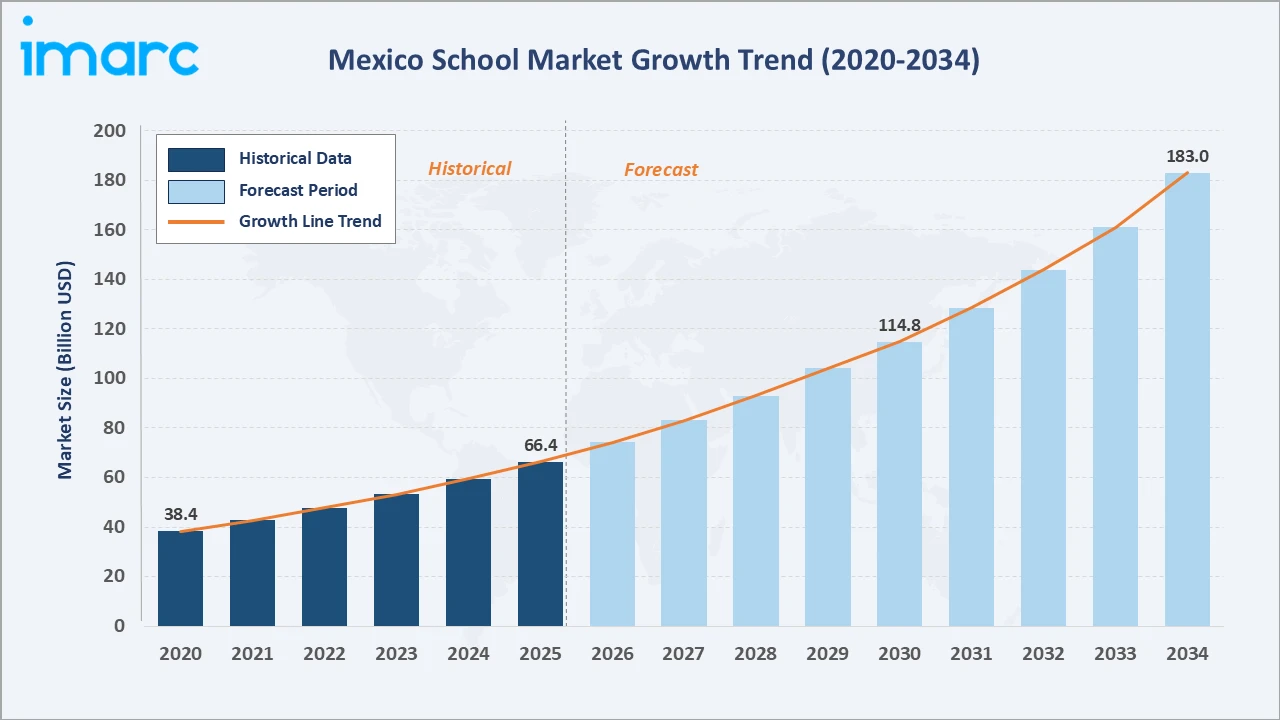
The Mexico school market grew from USD 66.4 Billion in 2025 to USD 76.3 Billion in 2026 and is projected to reach USD 183.0 Billion by 2034, growing at a CAGR of 11.56% during 2026-2034. The market is driven by rising private school enrollment, government education reforms, and expanding digital infrastructure. Mexico has a large and diverse education system, with more than 231,000 schools serving over 21 million basic education students across 32 states, including communities speaking more than 60 languages. This extensive student and institutional base is driving the market by sustaining demand for educational infrastructure, learning materials, digital technologies, classroom equipment, and other academic support services. Primary level leads education type at 35.8%. Government schools dominate ownership at 63.4%. Central Mexico leads regionally at 46.6%.
Market Snapshot
|
Metric |
Value |
|
Base Year Market Size (2025) |
USD 66.4 Billion |
| Market Size (2026) | USD 76.3 Billion |
|
Forecast Market Size (2034) |
USD 183.0 Billion |
|
CAGR (2026-2034) |
11.56% |
|
Base Year |
2025 |
|
Historical Period |
2020-2025 |
|
Forecast Period |
2026-2034 |
|
Dominant Level of Education |
Primary (35.8%, 2025) |
|
Dominant Ownership |
Government (63.4%, 2025) |
|
Leading Region |
Central Mexico (46.6%, 2025) |
The Mexico school market has demonstrated strong and sustained growth, increasing from USD 38.4 Billion in 2020 to USD 66.4 Billion in 2025 and an estimated USD 76.3 Billion in 2026, reflecting expanding enrollment and education investment. The market is projected to reach USD 114.8 Billion by 2030 and further grow to USD 183.0 Billion by 2034, supported by growing middle-class demand for private schooling, government digital education programs, and rising EdTech integration.
To get more information on this market, Request Sample
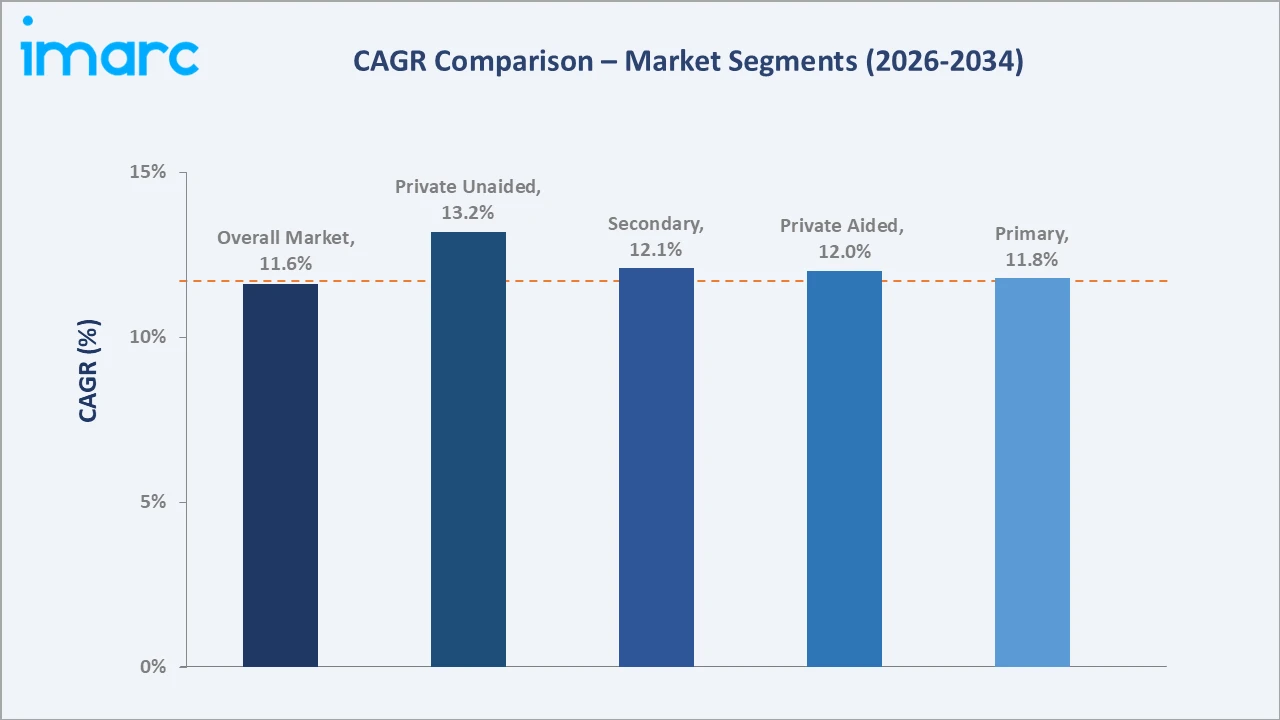
Private unaided schools lead at ~13.2% CAGR through premium bilingual and international curriculum adoption. Secondary grows at ~12.1% CAGR through academic quality upgrades and private school expansion. Private Aided schools grow at ~12.0% CAGR through government grant-supported quality investment. Primary level grows at ~11.8% CAGR through sustained enrollment demand in urban and peri-urban areas.
Executive Summary
The Mexico school market is witnessing robust growth, supported by rising middle-class demand for quality education, significant government investment in school infrastructure, and accelerating adoption of digital learning tools. Growing student enrollment across all education levels from primary through higher secondary is strengthening Mexico's position as one of Latin America's fastest-growing school education markets.
Private school operators are increasingly localizing international curricula and partnering with global education groups to meet demand for premium bilingual schooling. Primary at 35.8% leads through a large enrollment base and universal access mandates. Government at 63.4% leads through a national public-school network. Central Mexico leads regionally at 46.6%.
Key Market Insights
|
Insight |
Data |
|
Dominant Level of Education |
Primary – 35.8% share (2025) |
|
Leading Ownership |
Government – 63.4% market share (2025) |
|
Leading Region |
Central Mexico – 46.6% share (2025) |
|
Market Opportunity |
Private school expansion; EdTech integration; bilingual curriculum; international school partnerships; digital infrastructure for rural schools |
Key Analytical Observations Supporting the Above Data:
- Primary at 35.8%: Primary education dominates due to Mexico's mandatory universal enrollment mandate and the largest student cohort in the K-12 system. The students enrolled at the primary level are supported by both public infrastructure under SEP and a growing private primary school network in urban centers. SEP data confirms primary as the largest enrollment tier nationally.
- Government at 63.4%: Government schools dominate ownership due to Mexico's constitutional mandate for free public basic education. Despite private school growth, government schools remain the primary access point for low- and middle-income families across urban and rural Mexico.
- Central Mexico at 46.6%: Central Mexico dominates regionally due to Mexico City's concentration of residents, highest per-capita income levels, and the largest concentration of private and international schools.
Mexico School Market Overview
The Mexico school market encompasses formal K-12 education institutions offering instruction across primary, upper primary, secondary, and higher secondary levels. It includes government schools (federal, state, and municipal), private aided schools receiving government grants, private unaided schools operating independently, and local body schools. The market covers curriculum delivery, teacher employment, school infrastructure, textbook publishing, EdTech tools, assessment services, and extracurricular programs. Macroeconomic drivers include rising household income, Mexico's young demographics, government infrastructure spending, and increasing private investment in premium bilingual and international schools.
Market Dynamics
To evaluate market opportunities, Request Sample
Market Drivers
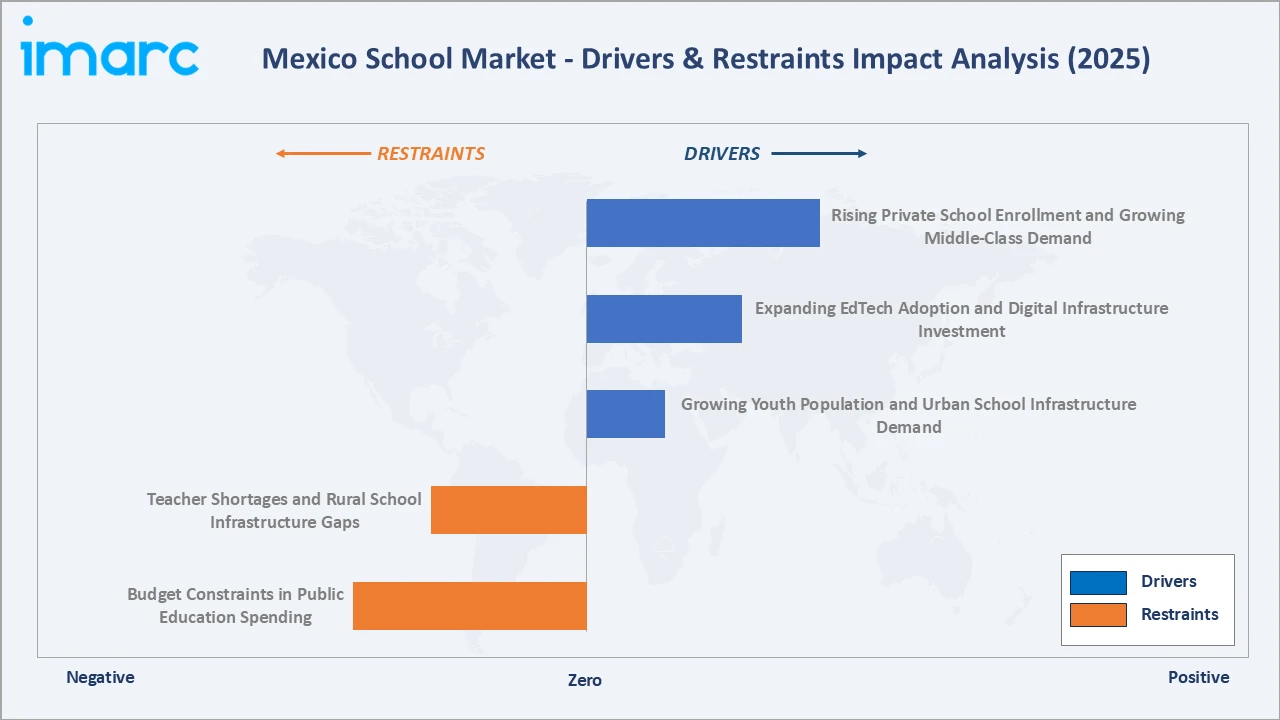
- Rising Private School Enrollment and Growing Middle-Class Demand: During the 2024–2025 academic year, private school enrollment in Mexico increased modestly from 5.57 million to 5.60 million students, representing a 0.5% year-over-year rise, driven by expanding middle-class households seeking bilingual, international, and vocationally oriented education. Mexico's K-12 student population and rising disposable income in urban centers are sustaining strong demand for premium private schooling alternatives to government institutions.
- Expanding EdTech Adoption and Digital Infrastructure Investment: Mexico's education technology market is growing rapidly, with platforms including Google Classroom, Microsoft Education, and domestic tools serving millions of students. Investment in school internet connectivity, digital devices, and teacher training in technology-enhanced instruction is increasing from both government and private school budgets.
- Growing Youth Population and Urban School Infrastructure Demand: Mexico's demographic profile, with 24.1% of the population under 15 years old, ensures sustained demand for school enrollment capacity. Rapid urbanization, particularly in metropolitan areas, is driving investment in new school construction, renovation of existing facilities, and expansion of private school campus networks.
Market Restraints
- Teacher Shortages and Rural School Infrastructure Gaps: Mexico faces a significant teacher shortage, particularly in STEM subjects and English-language instruction at secondary and higher secondary levels. Rural schools often operate with inadequate physical infrastructure, limited internet connectivity, and high student-to-teacher ratios, constraining education quality and enrollment growth.
- Budget Constraints in Public Education Spending: Despite constitutional mandates, Mexico's public education spending as a percentage of GDP has been constrained by broader fiscal pressures. School infrastructure maintenance backlogs, limited textbook budgets, and restricted teacher salary growth in government schools have created quality gaps between public and private education, while limiting the government sector's capacity to serve rising enrollment demand.
Market Opportunities
- Bilingual and International School Expansion: Demand for English-Spanish bilingual programs and internationally accredited curricula is growing rapidly among Mexico's upper-middle and high-income families. International education groups are expanding operations in Mexico, creating opportunities for curriculum partnerships, franchise models, and premium campus development across major urban centers.
- EdTech Platform Integration and Digital Learning Tools: In November 2025, President Claudia Sheinbaum Pardo introduced SaberesMX, a free nationwide digital learning platform aimed at expanding access to education and supporting lifelong learning across Mexico. The platform enables students and the wider public to enroll in courses offered and certified by public universities and the federal Subsecretariat of Higher Education, with participants receiving official certification upon successful completion. Government-led programs targeting digital device distribution and school connectivity, combined with private school technology investment, are creating large addressable markets for domestic and international EdTech providers.
Market Challenges
- Socioeconomic Disparities in Education Access and Quality: Significant disparities persist between urban private schools and rural government schools in terms of infrastructure quality, teacher credentials, curriculum resources, and student outcomes. Standardized assessment data confirm persistent achievement gaps between regions and school types, creating challenges for market participants seeking to serve diverse student populations equitably.
- Teacher Union Dynamics and Educational Reform Implementation: Mexico's teachers' union and the dissident union have historically resisted education reforms affecting teacher evaluation, curriculum changes, and school management autonomy. Navigating union relations while implementing curriculum reforms and accountability frameworks represents a significant operational challenge for government and private school operators.
Emerging Market Trends
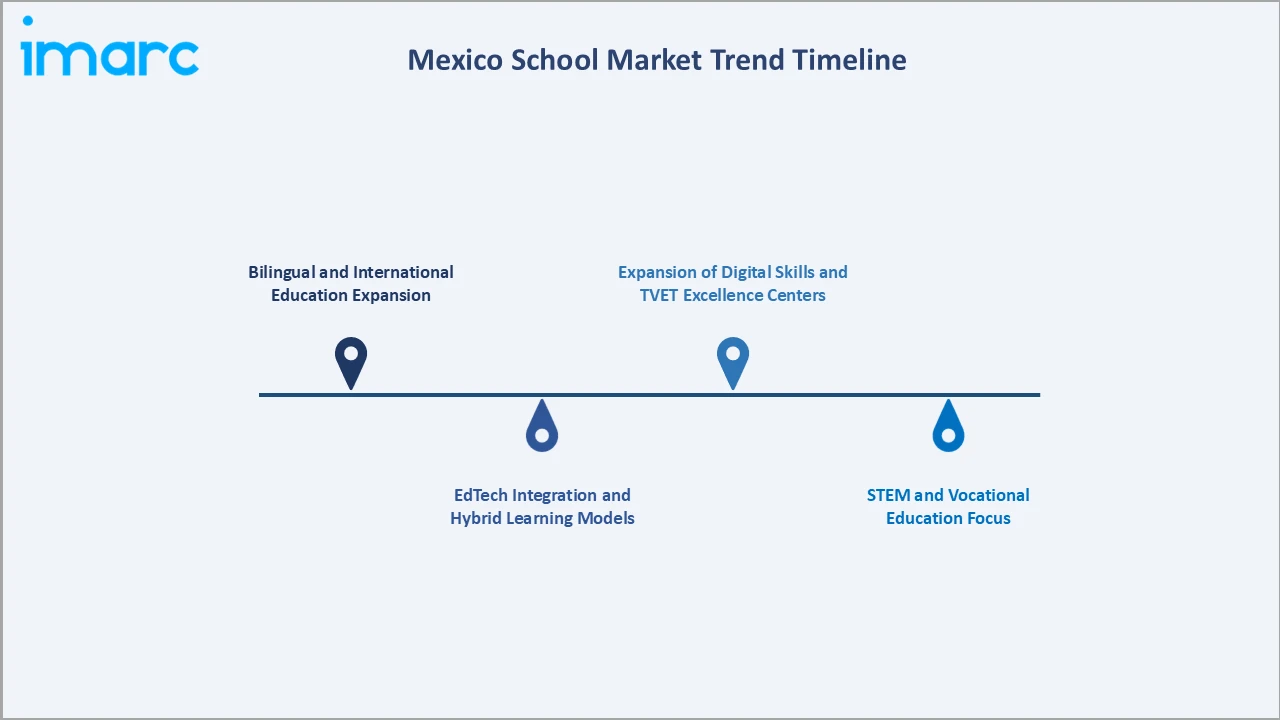
1. Bilingual and International Education Expansion
Demand for bilingual and internationally accredited curricula is accelerating among Mexico's upper-middle and high-income families. International education groups are actively expanding Mexico networks, while domestic private schools are increasingly seeking international accreditation to differentiate their offerings and justify premium tuition structures.
2. EdTech Integration and Hybrid Learning Models
Post-pandemic, Mexico's schools have accelerated digital tool adoption, with platforms including Google Workspace for Education, Microsoft Teams for Education, and domestic tools serving millions of students. Private schools are investing in LMS platforms, smart classrooms, and AI-powered tutoring tools.
3. Expansion of Digital Skills and TVET Excellence Centers
In August 2026, UNESCO launched a pilot program in Mexico to develop a new model of Centres of Excellence for technical and vocational education and training (TVET) in partnership with CONALEP and DGETI. Running during the 2026–2027 academic year across eight campuses in the Valley of Mexico Metropolitan Area, the initiative focuses on improving education quality, strengthening digital skills, supporting community engagement, and better preparing students for employment. By positioning participating campuses as innovation hubs, the initiative is encouraging schools to adopt stronger digital learning tools, industry-relevant training, and employment-focused education models.
4. STEM and Vocational Education Focus
Growing emphasis on STEM and vocational education is emerging as a key trend as institutions increasingly align curricula with digitalization and future workforce requirements. Schools are expanding programs in science, technology, engineering, mathematics, technical training, and digital skills to improve student employability. This shift is also supporting greater adoption of laboratories, smart classrooms, coding tools, and industry-oriented learning platforms.
Industry Value Chain Analysis
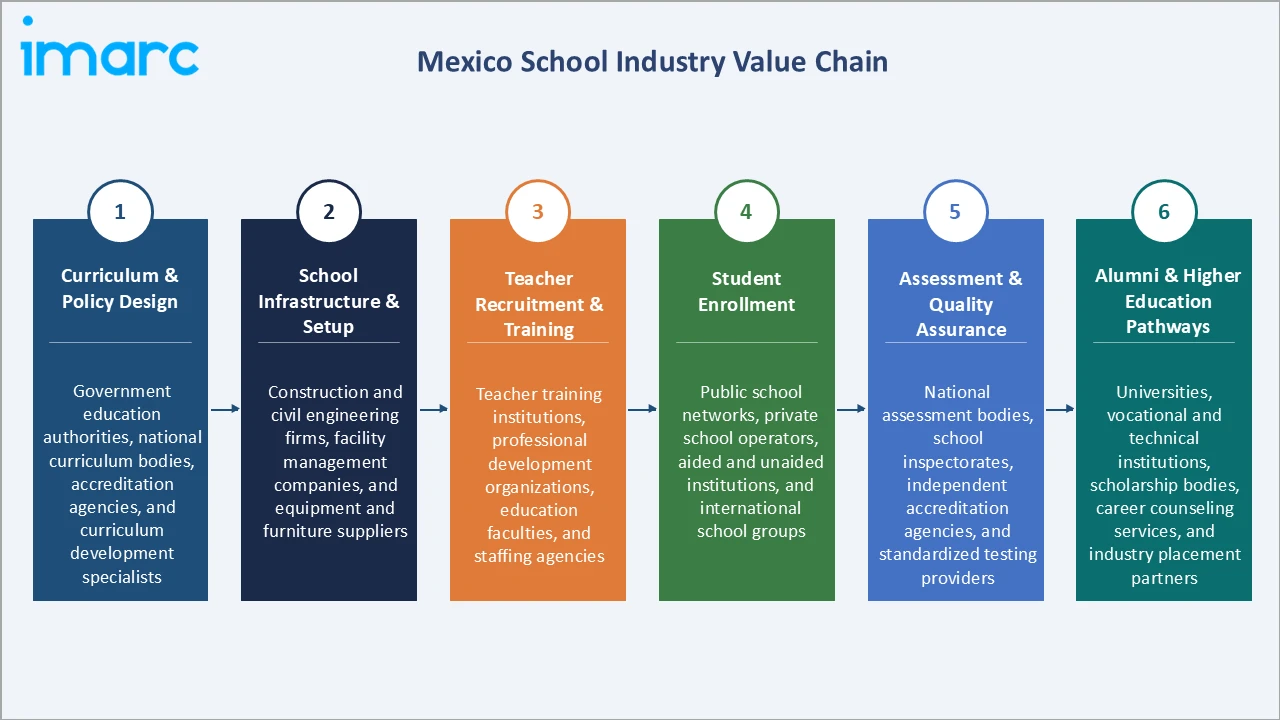
The Mexico school market value chain integrates curriculum and policy design, school infrastructure development, teacher recruitment and training, student enrollment and instruction delivery, assessment and quality assurance, and alumni progression to higher education.
|
Stage |
Key Participants |
|
Curriculum & Policy Design |
Government education authorities, national curriculum bodies, accreditation agencies, and curriculum development specialists. |
|
School Infrastructure & Setup |
Construction and civil engineering firms, facility management companies, and equipment and furniture suppliers. |
|
Teacher Recruitment & Training |
Teacher training institutions, professional development organizations, education faculties, and staffing agencies. |
|
Student Enrollment |
Public school networks, private school operators, aided and unaided institutions, and international school groups. |
|
Assessment & Quality Assurance |
National assessment bodies, school inspectorates, independent accreditation agencies, and standardized testing providers. |
|
Alumni & Higher Education Pathways |
Universities, vocational and technical institutions, scholarship bodies, career counseling services, and industry placement partners. |
Student enrollment represents the most value-added stage in the school market value chain, as it directly determines learning outcomes, institutional reputation, and long-term enrollment retention. This phase integrates teacher instruction, digital learning tools, student support services, and curriculum delivery, making it the most resource-intensive and quality-determining stage across both public and private school operators.
Technology Landscape in the Mexico School Industry
Digital Learning Platforms and LMS
Learning management systems including Google Classroom and Microsoft Teams for Education serve millions of K-12 students across Mexico's private and public-school networks. Federal programs extend digital learning access to secondary students in remote areas. Private schools are increasingly investing in premium LMS platforms that integrate adaptive learning, real-time progress tracking, and parent-teacher communication tools.
AI-Powered Assessment and Personalized Learning
Artificial intelligence is beginning to transform student assessment and personalized instruction in Mexico's higher-fee private school segment. Adaptive learning platforms that adjust content difficulty based on individual student performance data, combined with AI-powered grading and feedback tools, are improving teacher efficiency and student outcomes. Early adoption is concentrated among international schools and premium private school networks in Mexico City, Guadalajara, and Monterrey.
School Management and Administrative Technology
Enterprise resource planning systems tailored for school administration, covering enrollment management, fee collection, teacher payroll, and parent communication, are gaining adoption across mid-to-large private school networks. Digital fee payment systems integrated with Mexican banking platforms are improving revenue collection efficiency, while cloud-based student information systems are enabling multi-campus school groups to standardize administrative operations across networks.
Market Segmentation Analysis
The report covers the following segments:
|
Segment Category |
Leading Segment |
Market Share |
Year |
|
Level of Education |
Primary |
35.8% |
2025 |
|
Ownership |
Government |
63.4% |
2025 |
|
Board of Affiliation |
🔒 |
🔒 |
2025 |
|
Fee Structure |
🔒 |
🔒 |
2025 |
|
Region |
Central Mexico |
46.6% |
2025 |

By Level of Education
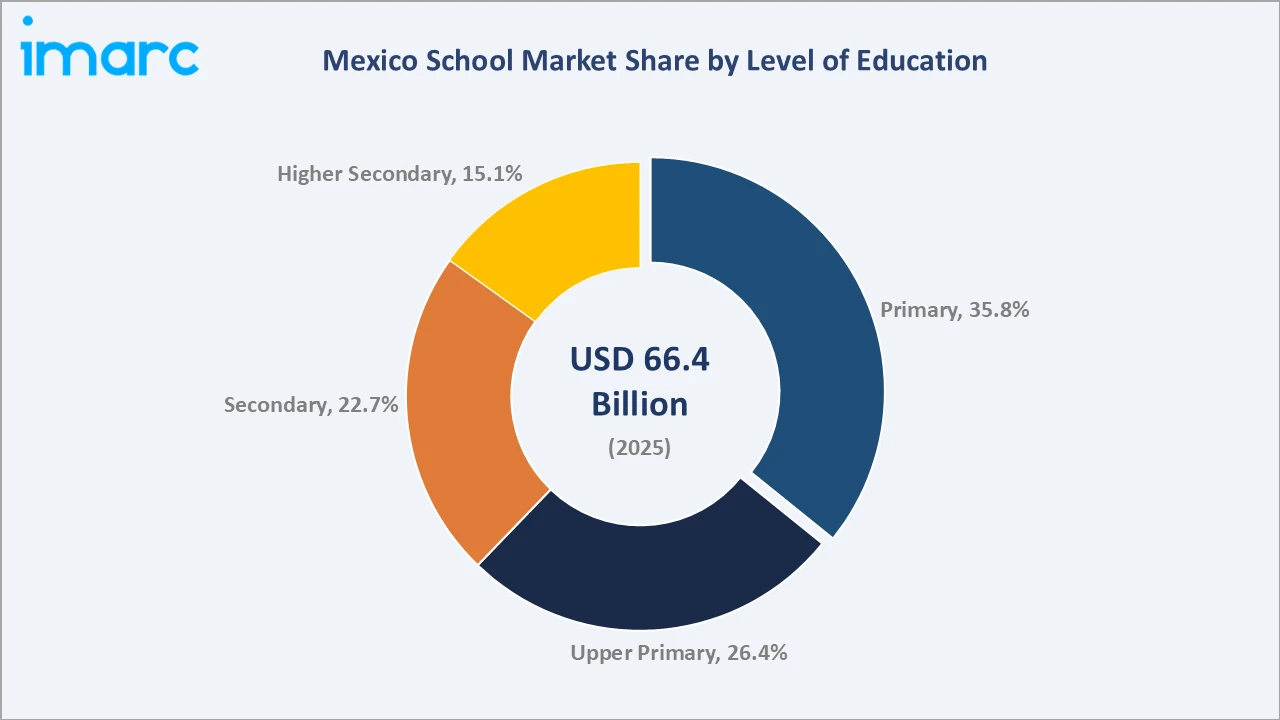
Primary education leads at 35.8% (2025), reflecting Mexico's largest student cohort with primary-level students and mandatory universal enrollment. Both public and private school operators maintain their largest campus networks and enrollment volumes at the primary level, making it the anchor segment of the market.
To access detailed market analysis, Request Sample
Upper primary accounts for 26.4% (2025), serving grades 4-6 with growing enrollment supported by improved primary completion rates. Secondary holds 22.7% (2025), driven by compulsory secondary education mandates and private school expansion. Higher secondary represents 15.1% (2025), growing through vocational programs and private preparatory expansion.
By Ownership
Government schools dominate at 63.4% (2025), reflecting Mexico's constitutional mandate for free public basic education and the federal-state school network. Government schools serve the majority of Mexico's K-12 students and remain the primary access point for low- and middle-income families, particularly in rural and semi-urban areas.
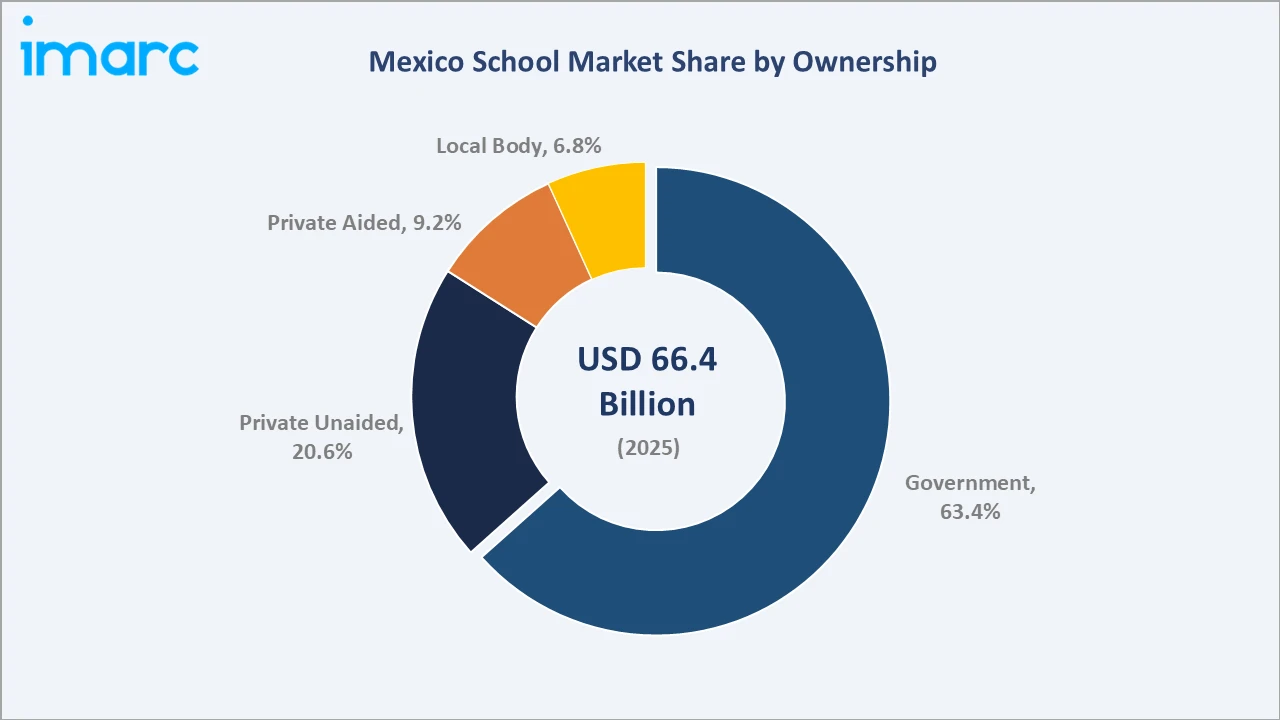
Private unaided schools account for 20.6% (2025), representing the fastest-growing segment driven by demand for bilingual, international, and premium academic programs. Private aided schools represent 9.2% (2025), receiving government grants while maintaining private management. Local body schools account for 6.8% (2025), operated by municipal and local authorities primarily in urban areas.
Regional Market Insights
|
Region |
Share (2025) |
Key Mexico School Market Drivers & Characteristics |
|
Central Mexico |
46.6% |
Largest metropolitan concentration of school-age population, highest density of private, aided, and international institutions, above-average household expenditure on education, advanced digital learning infrastructure and premium curriculum adoption. |
|
Northern Mexico |
31.8% |
Strong economic base and elevated household income levels supporting private school enrolment, growing demand for English-medium and internationally aligned curricula, expanding urban school infrastructure driven by industrial and commercial sector growth. |
|
Southern Mexico |
14.1% |
Predominantly served by government school networks with large enrollment in primary and upper primary levels, increasing public investment in school infrastructure, gradual private school entry in urban centers supported by rising middle-income household formation. |
|
Others |
7.5% |
Diverse mix of urban and rural school markets across coastal and peripheral regions, growing demand for private schooling in secondary cities, seasonal and demographic factors influencing enrollment patterns and school investment priorities. |
Central Mexico's 46.6% dominance reflects the region's large and concentrated school-age population, highest per-capita education expenditure, and the greatest density of private and internationally accredited school institutions. Northern Mexico's 31.8% is supported by a strong economic base, elevated household income levels, and growing demand for premium and internationally aligned school curricula across its major urban centers.
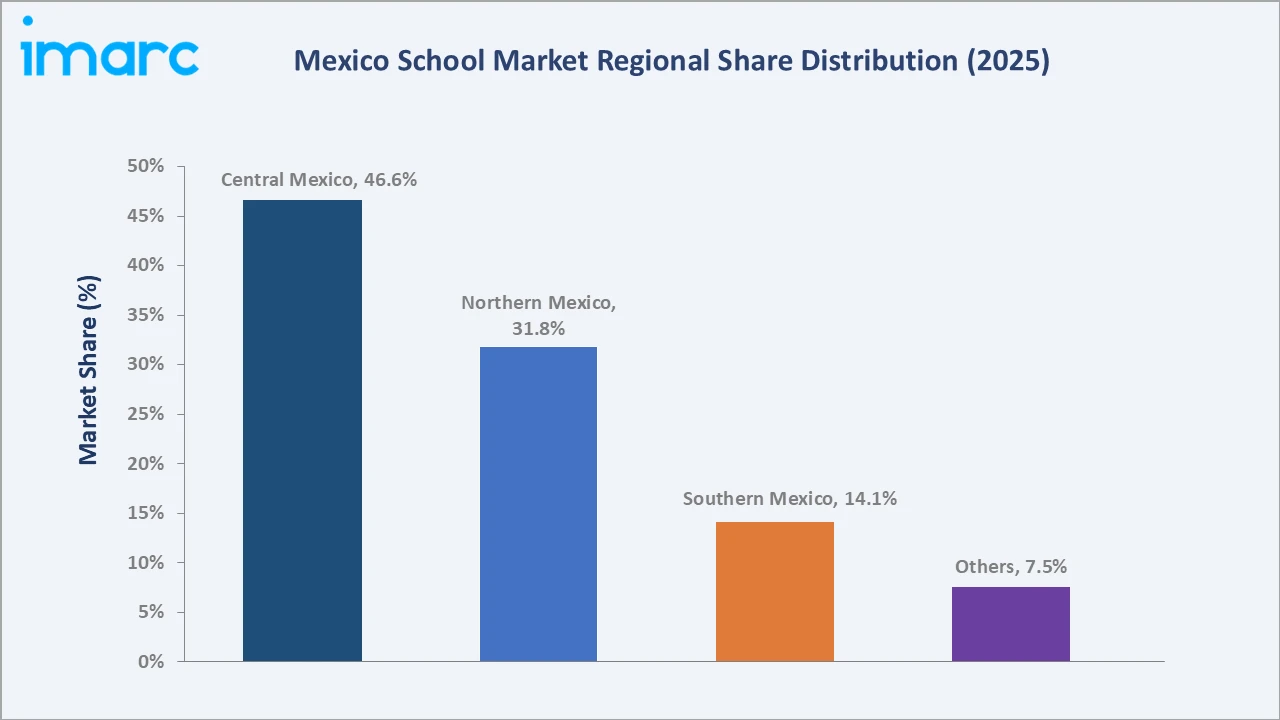
Southern Mexico's 14.1% is characterized by a predominantly public school enrollment base, with private school development concentrated in larger urban areas. Ongoing public investment in school infrastructure and connectivity is gradually expanding education quality and access across the region. The Others segment at 7.5% encompasses peripheral and coastal regions with diverse urban-rural school market dynamics and steadily growing private enrollment in secondary cities.
Competitive Landscape
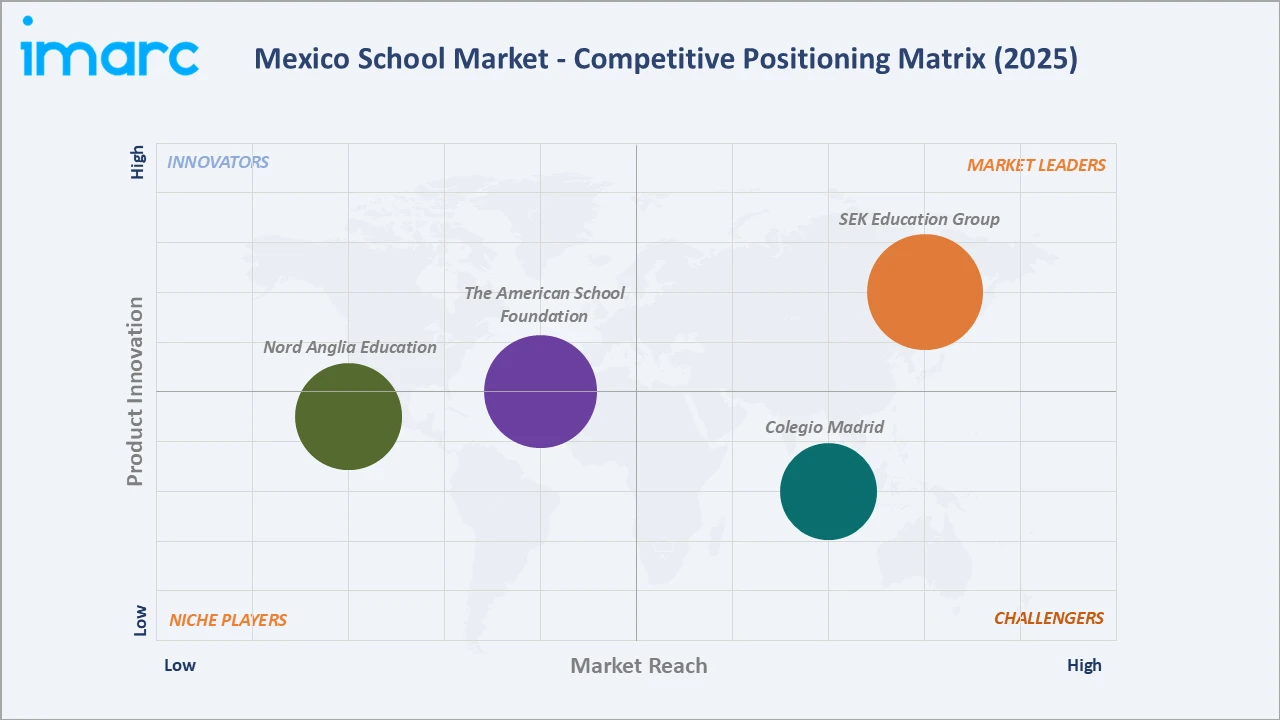
The Mexico school market is moderately fragmented, with competition among government school networks, domestic private school operators, international education groups, and specialized curriculum schools. Private market participants compete on curriculum quality, language instruction, international accreditation, school facilities, teacher credentials, and tuition structures. International education group partnerships, curriculum accreditation, and digital learning infrastructure are key competitive differentiators in the premium private school segment.
|
Company |
Key Offerings |
Market Position |
Core Strength |
|
SEK Education Group |
SEK Guadalajara International School |
Market Leader |
The SEK Education Group operates and manages Colegio Internacional SEK-Guadalajara, the primary representative of this international network in Mexico. |
|
The American School Foundation |
The American School Foundation |
Established Player |
The American School Foundation (ASF) in Mexico City is a prestigious, non-profit, independent school that serves as a vital educational and cultural bridge between the United States and Mexico. |
|
Nord Anglia Education |
Greengates School, Eton School, Kipling School |
Established Player |
Nord Anglia Education operates as the parent network and governing body for several premier international and bilingual schools in Mexico, including Greengates School, Eton School, and Kipling School in Mexico City. |
|
Colegio Madrid |
Colegio Madrid |
Challenger |
It serves as a vital bridge between Mexican and Spanish cultures, emphasizing humanist, secular, and democratic education. |
Companies are also investing in campus expansion, teacher professional development, EdTech platform integration, and international curriculum accreditation to differentiate their offerings in Mexico's competitive private school market. The market is expected to see further consolidation through international education group acquisitions and domestic school network mergers as operators seek scale economies and brand recognition advantages.
Key Company Profiles
SEK Education Group
SEK Education Group operates an internationally recognized school network with a strong Mexico City presence. SEK schools offer innovation-focused pedagogy, multilingual instruction, and IB curriculum delivery within a values-driven educational framework. The group emphasizes project-based learning, entrepreneurship education, and international student exchange programs as differentiators in Mexico's premium private school market.
- Key Offerings: SEK Guadalajara International School.
- Strategic Focus: Digital learning integration within IB curriculum delivery, expansion of innovation and entrepreneurship-focused learning environments, strengthening alumni university placement outcomes in European and US institutions.
Nord Anglia Education
Nord Anglia Education is a provider of premium international education, operating schools across multiple countries and serving students from early years through secondary education. Its schools typically offer internationally recognized curricula, multilingual learning environments, and technology-supported teaching. The organization emphasizes academic quality, global learning opportunities, and student development through a broad range of curricular and extracurricular programs.
- Key Offerings: Greengates School, Eton School, Kipling School.
- Strategic Focus: Strategically focuses on delivering premium international education through globally recognized curricula, personalized learning, and technology-enabled teaching. The organization also emphasizes teacher development, global student collaboration, and partnerships that strengthen academic and extracurricular learning.
Market Concentration Analysis
The Mexico school market is moderately fragmented. International education groups hold the largest revenue share within the premium private segment, while domestic operators compete across mid-tier and budget-private segments. Fragmentation persists across curriculum types, tuition structures, geographic regions, and education levels, creating a competitive landscape where curriculum accreditation, language of instruction, and international university placement outcomes determine private school positioning. The market is expected to see further consolidation through international group acquisitions of established domestic schools, curriculum franchise arrangements, and campus network expansion by multi-school operators.
Investment & Growth Opportunities
Highest Growth Segments
Private unaided schools (~13.2% CAGR), secondary level (~12.1% CAGR), bilingual international curriculum schools (~14%+ CAGR from premium base), Central Mexico private school expansion, and EdTech platform integration represent Mexico's highest-growth investment vectors through 2034.
Investment Themes
- EdTech integration and digital infrastructure: Investing in LMS platforms, AI-powered adaptive learning tools, and smart classroom infrastructure positions schools for the growing segment of technology-forward families.
- Multi-campus school network development: Building or acquiring multi-campus school networks in Mexico City, Guadalajara, and Monterrey enables operational efficiencies, curriculum standardization, and brand building that individual campus operators cannot achieve. International education groups are actively pursuing this strategy, creating acquisition targets among established single-campus private schools.
Future Market Outlook (2026-2034)
The Mexico school market is expected to increase from USD 66.4 Billion in 2025 to USD 76.3 Billion in 2026 and further to USD 183.0 Billion by 2034, delivering an 11.56% CAGR over the forecast period through rising private school enrollment, curriculum reform implementation, EdTech integration, and expanding international school networks. The market's anchor value of USD 114.8 Billion in 2030 represents Mexico's school education ecosystem at private sector expansion inflection and digital learning mainstream adoption.
Three structural forces are expected to define the growth of the Mexico school market through 2034. First, Mexico's large youth demographic ensures sustained enrollment demand across all education levels, while the expanding middle class will increasingly choose private schools over government alternatives, accelerating private market revenue growth. Second, the curriculum reform implementation, expanding EdTech adoption, and government digital infrastructure investment will improve education quality across both public and private segments, raising standards and stimulating competitive investment in school improvement. Third, international education group expansion, growing bilingual curriculum demand, and Mexico's attractiveness as a Latin American hub for premium education investment will attract FDI into the private school sector, driving consolidation, curriculum innovation, and campus network growth through 2034.
Research Methodology
Primary Research
Primary research comprised in-depth interviews with senior executives from private school operators, international education groups, government education officials, EdTech providers, curriculum consultants, and education sector investors operating in Mexico. Discussions validated market size estimates, assessed enrollment trends, evaluated competitive dynamics, and provided insights into regulatory developments, technology investment priorities, and long-term growth opportunities in the Mexico school market.
Secondary Research
Secondary research encompassed enrollment statistics, assessment data, demographic reports, private school association publications, international education group annual reports, EdTech market data, and credible education sector publications. These sources supported market trend analysis, competitive positioning, regulatory assessment, and enrollment data across Mexico's regional and institutional segments.
Forecasting Models
Forecasting models were developed using historical enrollment data, private school revenue growth rates, demographic projections, household income trends, and macroeconomic indicators. Both top-down and bottom-up approaches were applied and validated through primary expert consultations. Curriculum reform implementation timelines, government education budget projections, and international education group expansion strategies were incorporated to generate reliable forecasts through 2034.
Mexico School Market Report Coverage:
| Report Features | Details |
|---|---|
| Base Year of the Analysis | 2025 |
| Historical Period | 2020-2025 |
| Forecast Period | 2026-2034 |
| Units | Billion USD |
| Scope of the Report |
Exploration of Historical Trends and Market Outlook, Industry Catalysts and Challenges, Segment-Wise Historical and Future Market Assessment:
|
| Levels of Education Covered | Primary, Upper Primary, Secondary, Higher Secondary |
| Ownerships Covered | Government, Local Body, Private Aided, Private Unaided |
| Boards of Affiliation Covered | Central Board of Secondary Education (CBSE), Council for the Indian School Certificate Examinations (CISCE), State Government Boards, Others |
| Fee Structures Covered | Low-Income, Medium-Income, High-Income |
| Regions Covered | Northern Mexico, Central Mexico, Southern Mexico, Others |
| Companies Covered | SEK Education Group, The American School Foundation, Nord Anglia Education, Colegio Madrid, etc. |
| Customization Scope | 10% Free Customization |
| Post-Sale Analyst Support | 10-12 Weeks |
| Delivery Format | PDF and Excel through Email (We can also provide the editable version of the report in PPT/Word format on special request) |
Key Benefits for Stakeholders:
- IMARC’s industry report offers a comprehensive quantitative analysis of various market segments, historical and current market trends, market forecasts, and dynamics of the Mexico school market from 2020-2034.
- The research report provides the latest information on the market drivers, challenges, and opportunities in the Mexico school market.
- Porter's five forces analysis assist stakeholders in assessing the impact of new entrants, competitive rivalry, supplier power, buyer power, and the threat of substitution. It helps stakeholders to analyze the level of competition within the Mexico school industry and its attractiveness.
- Competitive landscape allows stakeholders to understand their competitive environment and provides an insight into the current positions of key players in the market.
Frequently Asked Questions About the Mexico School Market Report
The Mexico school market size is estimated at USD 76.3 Billion in 2026, driven by rising private school enrollment, government education investment, and expanding EdTech adoption. Growing middle-class demand for bilingual and internationally accredited programs and Mexico's large K-12 student population are further supporting near-term market growth.
The Mexico school market grows at 11.56% CAGR during 2026-2034, reaching USD 183.0 Billion by 2034. The CAGR reflects Mexico's large and growing youth demographic, rising private school penetration, and accelerating government and private investment in education quality and infrastructure.
Primary education leads at 35.8% (2025), driven by Mexico's largest student enrollment cohort of primary-level students and mandatory universal enrollment mandates, supported by both public infrastructure and growing private primary school networks.
Government schools dominate at 63.4% (2025), reflecting Mexico's constitutional mandate for free public basic education and the federal-state school network. Government schools remain the primary access point for low- and middle-income families across urban and rural Mexico.
Central Mexico leads at 46.6% (2025), anchored by Mexico City's concentration of private and international schools, highest per-capita income levels, and largest premium private school tuition revenues nationally. The metropolitan area commands the highest average tuition fees and the most international curriculum institutions in Mexico.
Leading companies include SEK Education Group, The American School Foundation, Nord Anglia Education, and Colegio Madrid, among others.
The market is projected to reach approximately USD 114.8 Billion by 2030, driven by expanding private school enrollment, curriculum reform impact on government school quality, and international education group campus network expansion across Mexico's major metropolitan areas.
Priority investment opportunities include international curriculum school expansion, EdTech platform integration targeting both private and public school networks, multi-campus school network development in Mexico City and northern metropolitan areas, and rural school infrastructure partnerships under government connectivity programs.
Need more help?
- Speak to our experienced analysts for insights on the current market scenarios.
- Include additional segments and countries to customize the report as per your requirement.
- Gain an unparalleled competitive advantage in your domain by understanding how to utilize the report and positively impacting your operations and revenue.
- For further assistance, please connect with our analysts.
 Request Customization
 Speak to an Analyst
 Request Brochure
 Inquire Before Buying
Benefits of Customization
- Personalize this research
- Triangulate with your data
- Get data as per your format and definition
- Gain a deeper dive into a specific application, geography, customer, or competitor
- Any level of personalization
Get in Touch With Us
UNITED STATES
Phone: +1-201-971-6302
INDIA
Phone: +91-120-433-0800
UNITED KINGDOM
Phone: +44-753-714-6104
Email: [email protected]
Client Testimonials




.webp)




.webp)













Related Reports

Choose your plan
*Please note that the prices mentioned below are starting prices for each bundle type. Kindly contact our team for further details.*
Single User License
- 1 User License, Access on 2 Devices
- PDF Report + Excel Dataset (Password Protected)
- Lifetime Access
- No Printing Rights
- 10% Free Report Customization
- 10–12 Weeks of Analyst Support
Five User License
- Access for 5 Users, 2 Devices per User
- PDF Report + Excel Dataset (Password Protected)
- Lifetime Access
- Dedicated Account Manager
- 12–14 Weeks of Analyst Support
- No Printing Rights
- 15% Free Report Customization
- 25% Discount on Your Next Purchase
Corporate User License
- Unlimited User Access (Within Your Organization)
- PDF Report + Excel Dataset
- Lifetime Access
- Dedicated Account Manager
- 14–20 Weeks of Analyst Support
- No Printing Rights
- 20% Free Report Customization
- 30% Discount on Your Next Purchase
Essential Insights
What's included:
3 reports
- Lifetime Access
- PDF Reports
- Excel Datasets
- 2 Weeks of Free Analyst Support
- 2 User Licenses
- Access on 2 Devices
- Printing Rights
- Complimentary PowerPoint (PPT) Version
- Complimentary License Upgrade
Professional Access
What's included:
5 reports
- Lifetime Access
- PDF Reports
- Excel Datasets
- 8 Weeks of Free Analyst Support
- 2 User Licenses
- Access on 2 Devices
- Printing Rights
- Complimentary PowerPoint (PPT) Version
- Complimentary License Upgrade
Business Advantage
What's included:
8 reports
- Lifetime Access
- PDF Reports
- Excel Datasets
- 14 Weeks of Free Analyst Support
- 2 User Licenses
- Access on 2 Devices
- Printing Rights
- Complimentary PowerPoint (PPT) Version
- Complimentary License Upgrade
Enterprise Intelligence
What's included:
10 reports
- Lifetime Access
- PDF Reports
- Excel Datasets
- 20 Weeks of Free Analyst Support
- 2 User Licenses
- Access on 2 Devices
- Printing Rights
- Complimentary PowerPoint (PPT) Version
- Complimentary License Upgrade