
Mexico Ship Repairing Market Size, Share, Trends and Forecast by Vessel Type, Application, End User, and Region, 2026-2034
Mexico Ship Repairing Market Size, Share, Trends & Forecast (2026-2034)
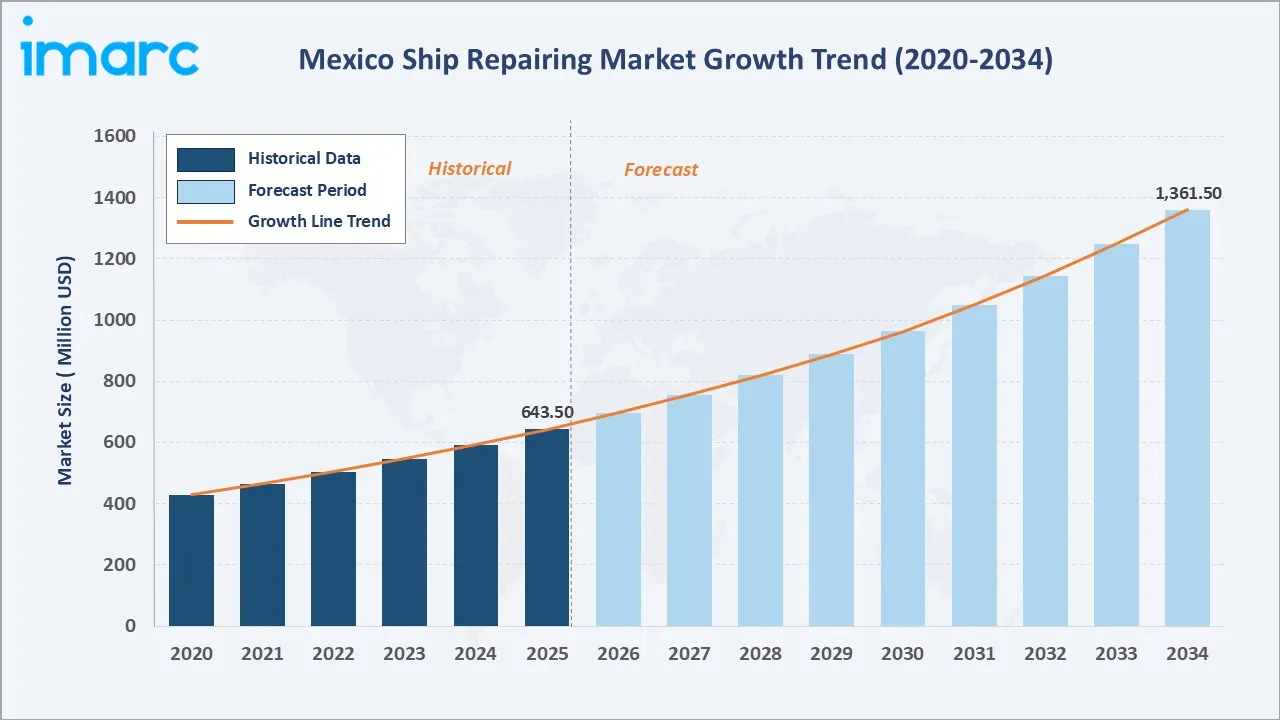
The Mexico ship repairing market grew from USD 643.5 Million in 2025 to USD 697.7 Million in 2026 and is projected to reach USD 1,361.5 Million by 2034, growing at a CAGR of 8.42% during 2026-2034. Demand is widening as commercial operators, offshore service fleets and naval programmes keep more hulls in active service along a coastline that hosts more than 100 ports across two oceans. Rising cargo and energy throughput is lifting dry-docking frequency, while fleet renewal and an ageing tonnage profile push owners toward scheduled maintenance instead of deferral. Yard modernisation, mechanised blasting and coating lines, and the adoption of digital survey and condition-monitoring tools are shortening turnaround times and raising dock throughput. Supportive port policy, customs facilitation for repair imports and public investment in coastal infrastructure are expanding usable capacity. Structural shifts in supply, including the nearshoring of manufacturing and the rebalancing of Gulf and Pacific trade lanes, are concentrating tonnage in Mexican waters and deepening recurring demand for vessel repair services.
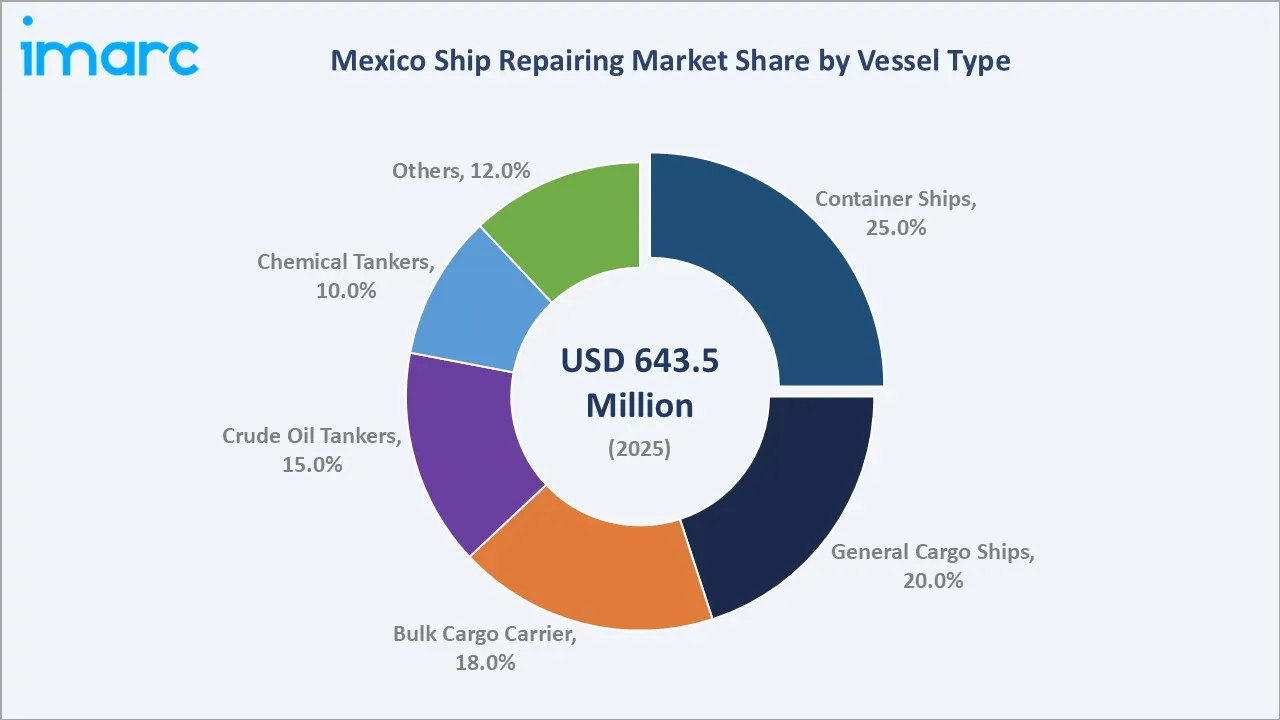
Supporting growth factors include sustained fleet utilisation, offshore energy maintenance cycles and rising naval upkeep budgets. Container ships dominate at 25.0%. Transport companies lead at 65.0%. Southern Mexico commands 45.0% of the regional market share.
Market Snapshot
|
Metric |
Value |
|
Base Year Market Size (2025) |
USD 643.5 Million |
|
Market Size (2026) |
USD 697.7 Million |
|
Forecast Market Size (2034) |
USD 1,361.5 Million |
|
CAGR (2026-2034) |
8.42% |
|
Base Year |
2025 |
|
Historical Period |
2020-2025 |
|
Forecast Period |
2026-2034 |
|
Dominant Vessel Type |
Container Ships (25.0%, 2025) |
|
Dominant End User |
Transport Companies (65.0%, 2025) |
|
Leading Region |
Southern Mexico (45.0%, 2025) |
The market size increased from USD 429.5 Million in 2020 to USD 643.5 Million in 2025 and is estimated to reach USD 697.7 Million in 2026. The market is further expected to grow to USD 964.2 Million by 2030 and USD 1,361.5 Million by 2034. Its commercial distinctiveness rests on two-ocean access, a state naval yard network and offshore energy demand that generate hull, machinery and electrical work inside a single repair cycle.
To get more information on this market, Request Sample
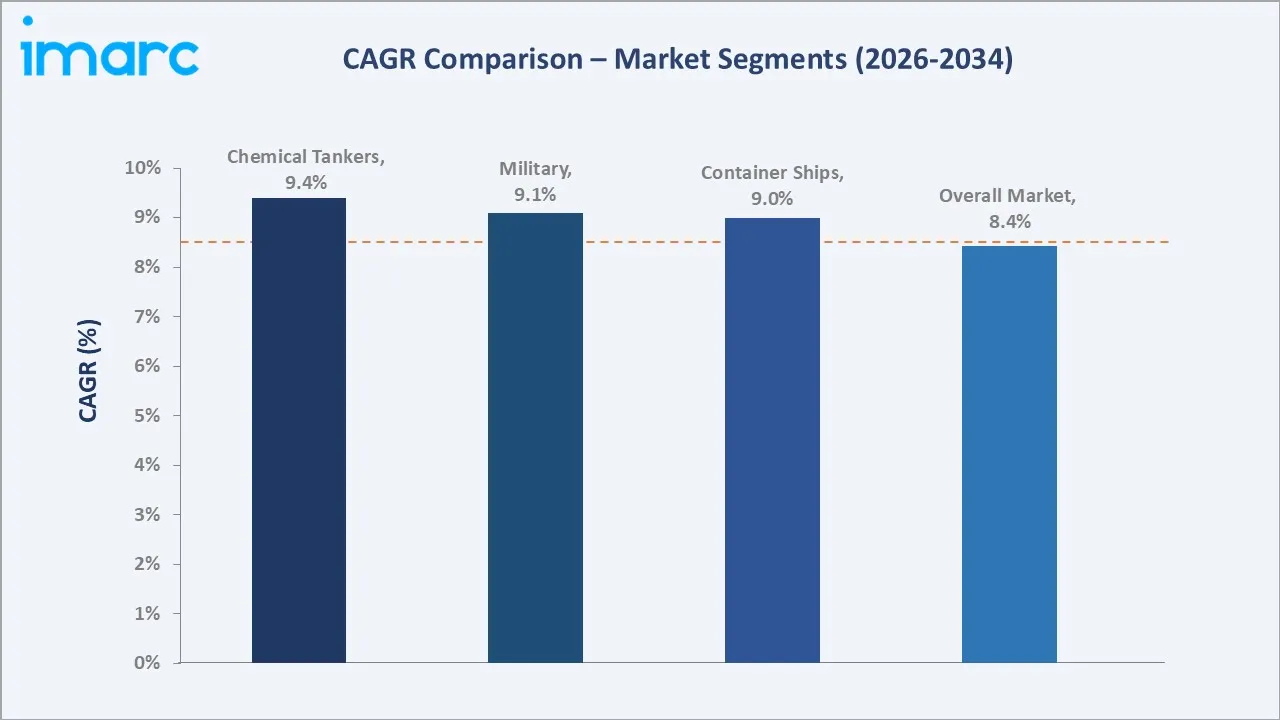
Chemical tankers at ~9.4% CAGR and container ships at ~9.0% CAGR are the fastest-growing vessel types, supported by stricter cargo-containment survey rules on chemical carriers and by rising container throughput that compresses available berth windows for repair. Both sub-segments also carry higher coating and machinery content per docking.
Executive Summary
The market expanded from USD 643.5 Million in 2025 to an estimated USD 697.7 Million in 2026, with demand anchored in scheduled dry-docking of commercial tonnage, offshore support vessel maintenance and naval fleet upkeep across the Gulf of Mexico, the Pacific and the Caribbean coast. The fastest-developing areas are container ship repair, chemical tanker survey and coating work, and military refit activity linked to national fleet programmes, each outpacing the overall market because they combine higher engineering content with shorter acceptable turnaround windows. The market is projected to reach USD 1,361.5 Million by 2034. Container ships at 25.0% lead through high call volumes and tight schedules that favour yards holding berth and dock availability. Transport companies at 65.0% supply recurring commercial volume across hull, machinery and electrical disciplines. Southern Mexico leads regionally at 45.0% on the strength of yard concentration and offshore energy traffic.
Key Market Insights
|
Insight |
Data |
|
Dominant Vessel Type |
Container Ships - 25.0% share (2025) |
|
Dominant End User |
Transport Companies - 65.0% market share (2025) |
|
Leading Region |
Southern Mexico - 45.0% share (2025) |
|
Market Opportunity |
Dry-dock capacity expansion, offshore vessel maintenance, naval refit programmes, compliance retrofit and coating renewal |
Key Analytical Observations Supporting the Above Data:
- Container ships at 25.0%: Liner call density at Gulf and Pacific terminals keeps box tonnage in Mexican waters and generates voyage repair, coating and lashing equipment work that rewards yards with fast berth access and dependable turnaround.
- Transport companies at 65.0%: Commercial operators treat docking as non-discretionary spending, so repair volume tracks fleet size and utilisation rather than freight sentiment, giving yards a comparatively stable demand base across cycles.
- Southern Mexico at 45.0%: Yard concentration, offshore energy activity and the isthmus corridor create overlapping commercial and naval demand, supporting higher dock utilisation than other parts of the country.
Mexico Ship Repairing Market Overview
The Mexico ship repairing market is organised around a small number of coastal yard clusters serving three distinct customer pools: commercial operators on liner and tramp trades, offshore service fleets working the Campeche Sound and Pacific shallow-water fields, and naval and government vessels. Yards combine graving docks, floating docks, slipways and afloat repair berths, and most revenue comes from scheduled docking plus voyage repair for ships calling at Mexican ports. The ship repairing industry is labour-intensive in steel, coating and scaffolding trades and capital-intensive in docking infrastructure, so utilisation of dock space determines profitability more than headline pricing. Classification societies, flag administrations and port state control shape work scope, while equipment makers supply engines, propulsion, separators and automation. Demand is recurring and effectively non-discretionary once a vessel reaches its survey window.
Market Dynamics
To evaluate market opportunities, Request Sample
Market Drivers
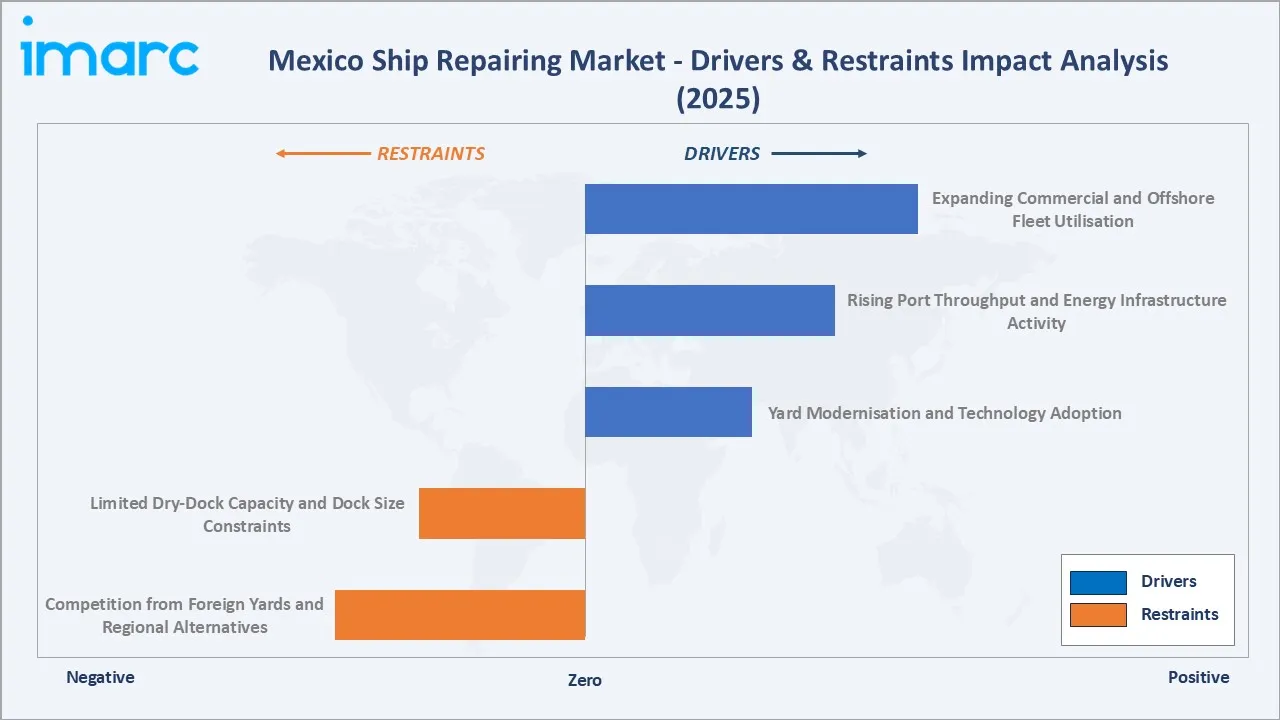
- Expanding Commercial and Offshore Fleet Utilisation: Mexican waters carry a dense mix of container, tanker, bulk and offshore support traffic, and every hull must complete scheduled dry-docking at fixed survey intervals. Higher utilisation shortens idle windows and raises the number of docking events per year across the vessel repair services base. Offshore operators in the Campeche Sound run continuous maintenance cycles on crew boats, supply vessels and platform support units, sustaining afloat repair and machinery overhaul demand between dockings. Naval and government fleets add a further layer of scheduled upkeep. Because repair is triggered by regulation and class requirements rather than discretionary spending, fleet growth converts into repair volume with a predictable lag.
- Rising Port Throughput and Energy Infrastructure Activity: Cargo volumes through Gulf and Pacific terminals, together with refinery, terminal and offshore infrastructure work, increase the number of vessels calling at Mexican ports and the frequency of voyage repairs. Ships that load and discharge locally often schedule coating touch-ups, machinery overhauls and steel renewals to coincide with port calls, which lifts demand for afloat repair teams. Energy sector maintenance campaigns also mobilise tugs, barges and support craft that require periodic docking. Growth in port capacity and logistics investment therefore translates directly into repair workload for yards positioned near high-traffic terminals.
- Yard Modernisation and Technology Adoption: Investment in blasting and coating automation, ultrasonic thickness measurement, robotic hull inspection and digital project management is raising throughput per dock and cutting turnaround days. Modern yards compress a docking by sequencing steel, coating and machinery work in parallel, which improves economics for operators who pay for off-hire time. Condition monitoring and predictive maintenance platforms let repair planners scope work before a vessel arrives, reducing unplanned growth in the work list. Technology adoption also improves safety performance and coating warranty outcomes, both of which increasingly influence owner yard selection in the marine maintenance market.
- Supportive Port, Trade and Naval Policy: Mexico's port modernisation programme, customs facilitation for temporary repair imports and cabotage rules that keep coastal trade in nationally flagged vessels all support domestic repair demand. Public investment in naval yards and fleet renewal programmes adds state work to commercial backlogs, cushioning yards during soft freight cycles. Trade policy that encourages nearshoring of manufacturing increases vessel calls on both coasts, and the Interoceanic Corridor across the Isthmus of Tehuantepec is adding port and rail infrastructure that will require marine service capacity. Together these measures widen the addressable base for ship repairing industry capacity.
Market Restraints
- Limited Dry-Dock Capacity and Dock Size Constraints: The number of graving docks and floating docks able to handle larger container ships, tankers and cruise vessels is small relative to demand, and several facilities operate near full utilisation during peak survey seasons. Dock size limits push larger vessels toward foreign yards, removing high-value work from the domestic base. Capacity additions require long permitting and construction cycles and heavy capital outlay, so shortage conditions persist through the forecast period and constrain how much of the addressable repair demand the ship repairing industry can capture.
- Competition from Foreign Yards and Regional Alternatives: Operators compare Mexican yards with facilities in the United States Gulf, the Caribbean, Panama and Asia on price, turnaround and position along the trade route. United States yards benefit from proximity for offshore and naval work, while Asian yards offer scale economics on major steel renewals and conversions. Freight economics matter too, because any deviation to a repair yard consumes bunkers and trading time. Mexican yards therefore compete on turnaround speed and on serving vessels already trading in the Gulf and Pacific rather than on price alone.
- Skilled Labour Availability and Cost Inflation: Welding, coating, rigging and marine electrical trades require certification and experience, and the pool of qualified technicians is limited relative to peak demand. Wage pressure and competition from other industrial sectors raise labour costs, while training pipelines take years to mature. Steel and coating material prices add further volatility to project margins because repair contracts are frequently quoted before the full scope is known. Labour intensity also limits how quickly yards can scale output when several large dockings overlap in the same season.
Market Opportunities
- Compliance-Driven Retrofit and Coating Work: Ballast water treatment, sulphur and nitrogen oxide limits, and hull efficiency rules are generating retrofit and re-coating work that fits well within yard capability. Retrofits typically require docking, steel modification, piping and electrical installation, which raises revenue per docking event and improves margin compared with routine maintenance. Energy efficiency requirements also create recurring demand for propeller polishing, hull coating renewal and waste heat recovery installation. Yards that build engineering capability around compliance packages can capture higher-value work and separate themselves from competitors that compete only on day rates.
- Offshore and Naval Maintenance Programmes: Offshore service fleets, port craft and naval vessels require predictable, recurring maintenance that yards can schedule well in advance. Framework agreements with operators and government fleets stabilise backlog and reduce exposure to volatile merchant shipping cycles. Naval refit work adds complexity and value, including systems integration and structural modification. Developing dual-use capability lets a yard serve both commercial and government customers with the same dock and workforce, improving utilisation across the year and supporting investment in specialised trades.
- Nearshoring and Interoceanic Corridor Development: Manufacturing relocation to Mexico is increasing container and bulk movements through Gulf and Pacific ports, and the Interoceanic Corridor is adding rail and port capacity that will attract additional tonnage to southern coasts. New terminal and industrial projects require tugs, barges and support vessels that need local repair capacity. Yards that establish service points near emerging corridors can capture voyage repair and afloat maintenance before larger docking demand materialises, building relationships that later convert into scheduled dockings and multi-year service agreements.
Market Challenges
- Classification and Regulatory Compliance Complexity: Repair work must satisfy classification society rules, flag state requirements and port state control expectations, and scope changes during a docking often require re-approval. Documentation, traceability and welder qualification requirements add administrative load and can extend turnaround. Yards without in-house engineering and survey coordination depend on external support, which raises cost and slows decision-making. Keeping pace with changing environmental rules adds further complexity to repair specifications and to the planning of coating and machinery work.
- Cyclical Demand from Shipping and Energy Sectors: Repair demand tracks fleet utilisation, freight rates and offshore investment, all of which are cyclical. When operators defer maintenance during weak freight markets, yards face sudden backlog gaps that are difficult to fill because docking slots cannot be stored. Energy sector capital spending cycles add a second source of volatility, particularly for yards serving offshore support fleets. Managing workforce levels and dock scheduling across these swings without losing skilled staff is a persistent operational problem for the ship repairing industry.
- Capital Intensity and Long Payback on Dock Assets: New dry-dock capacity, cranes and coating facilities require large, long-lived investment with payback periods that extend beyond a single market cycle. Permitting, dredging and waterfront land access add cost and delay. Lenders price in shipping cyclicality, raising the cost of capital for yard expansion. The result is incremental rather than step-change capacity growth, which keeps supply tight and limits how quickly the sector can respond to rising repair demand.
Emerging Market Trends
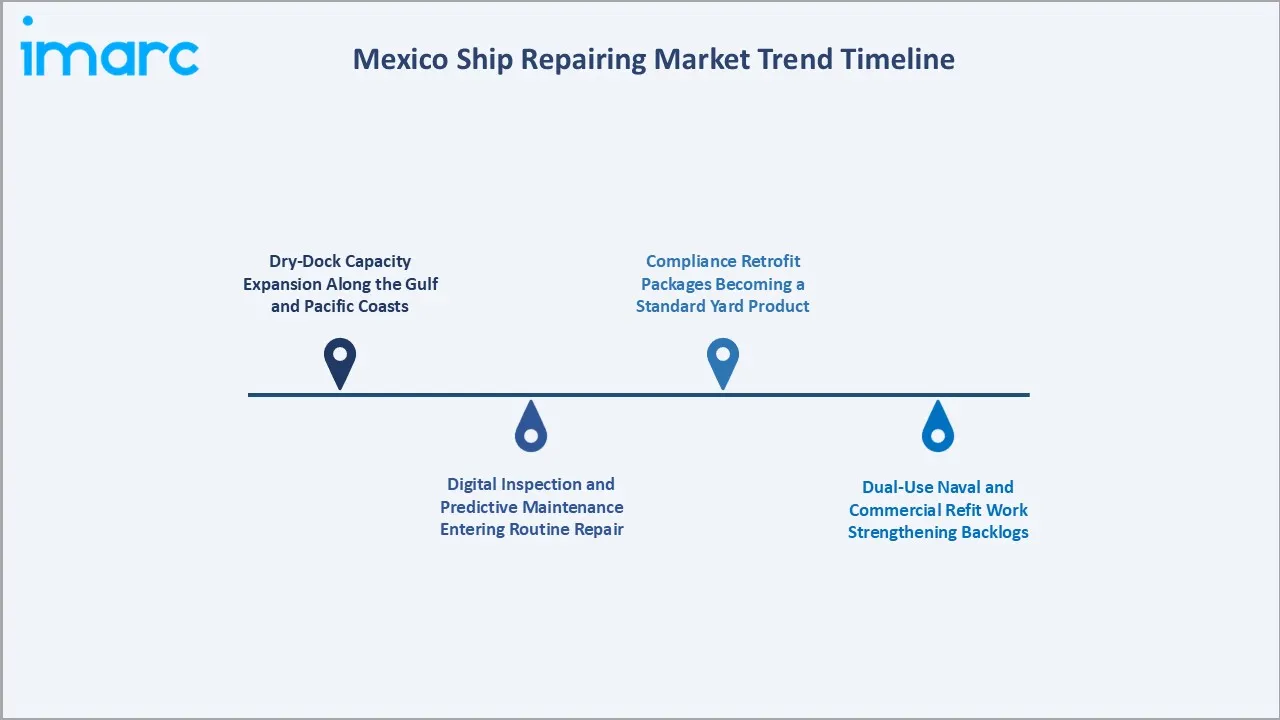
1. Dry-Dock Capacity Expansion Along the Gulf and Pacific Coasts
Yard operators are adding floating dock capacity, lengthening slipways and upgrading crane capacity to accept larger vessel classes that currently divert to foreign facilities. Expansion is concentrated where waterfront land and draft already support docking, so projects tend to be brownfield upgrades rather than new greenfield yards. The economics favour floating docks, which can be relocated between ports and commissioned faster than graving docks. For operators, additional domestic capacity shortens waiting time during peak survey seasons and reduces the cost of positioning a vessel to a distant yard. This trend is the single largest structural change underway in the Mexico ship repairing market.
2. Digital Inspection and Predictive Maintenance Entering Routine Repair
Robotic hull inspection, drone surveys of tanks and ultrasonic thickness mapping are moving from specialty trials into routine docking specifications. Digital capture produces a condition record that owners can compare across docking cycles, which makes repair scope more predictable and reduces the growth of unplanned work items discovered after blasting. Condition monitoring on engines and propulsion lets yards plan overhaul work before a vessel arrives, cutting dock days. The commercial effect is a shift from reactive voyage repair toward planned maintenance packages sold on predictability rather than on price per tonne of steel renewed.
3. Compliance Retrofit Packages Becoming a Standard Yard Product
Ballast water treatment installation, hull coating renewal for efficiency, and exhaust treatment retrofits are increasingly sold as bundled packages rather than separate jobs. Bundling lets a yard use one docking to complete structural, piping, electrical and coating work, which spreads fixed docking costs across more scope and improves the owner's return. Yards are building in-house engineering teams to produce retrofit drawings and to coordinate with equipment vendors, since the engineering content rather than the steelwork now differentiates bids. This trend lifts revenue per docking and supports margin expansion even when hull repair volumes are flat.
4. Dual-Use Naval and Commercial Refit Work Strengthening Backlogs
Naval construction and refit programmes are absorbing yard capacity that would otherwise depend entirely on merchant shipping cycles. State work brings longer contract horizons, stricter quality requirements and higher engineering content, and it keeps skilled trades employed between commercial docking peaks. Yards that hold both commercial and government approvals can balance schedules across the year, which improves labour retention and asset utilisation. The trend is reinforced by domestic fleet renewal ambitions that favour local content, and it is gradually shifting the competitive hierarchy toward yards with certified processes, security protocols and engineering depth.
Industry Value Chain Analysis
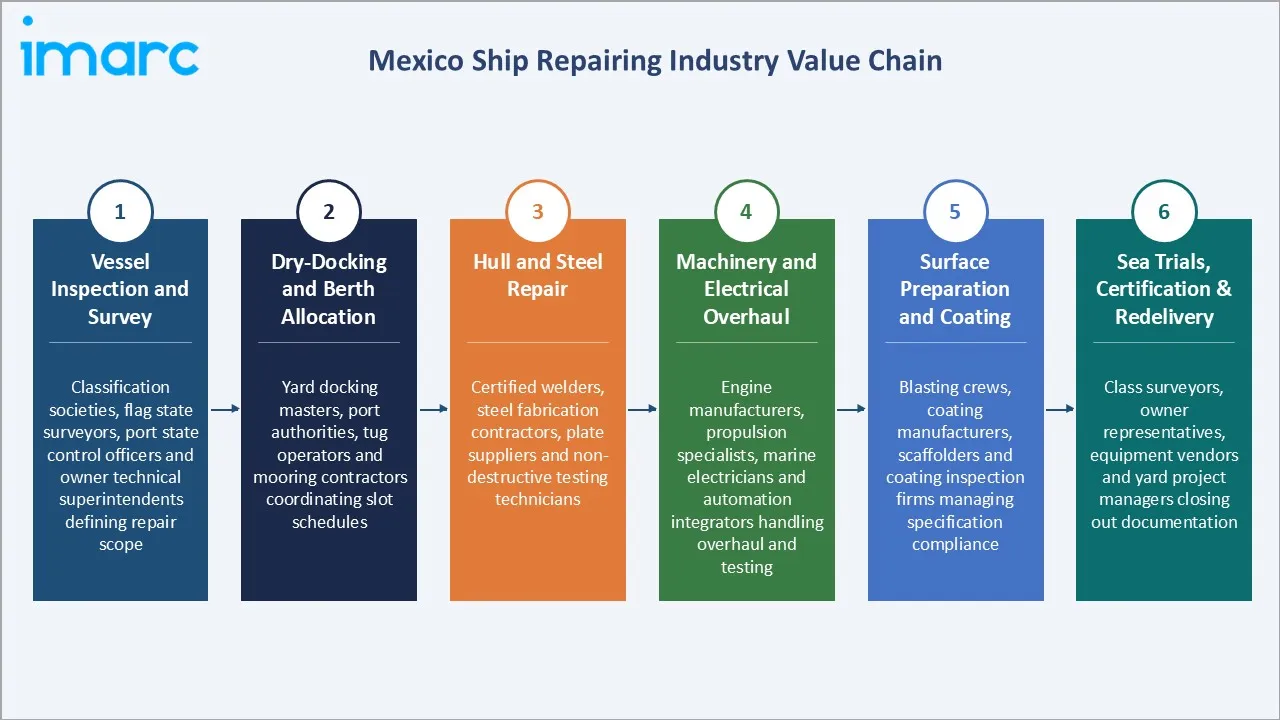
The industry value chain spans vessel inspection and survey, dry-docking and berth allocation, hull and steel repair, machinery and electrical overhaul, surface preparation and coating, and certification and redelivery. Value accumulates as inspection findings are converted into executed work, with engineering and project control determining how efficiently dock time is used.
| Stage | Key Participants |
|---|---|
| Vessel Inspection and Survey | Classification societies, flag state surveyors, port state control officers and owner technical superintendents defining repair scope |
| Dry-Docking and Berth Allocation | Yard docking masters, port authorities, tug operators and mooring contractors coordinating slot schedules |
| Hull and Steel Repair | Certified welders, steel fabrication contractors, plate suppliers and non-destructive testing technicians |
| Machinery and Electrical Overhaul | Engine manufacturers, propulsion specialists, marine electricians and automation integrators handling overhaul and testing |
| Surface Preparation and Coating | Blasting crews, coating manufacturers, scaffolders and coating inspection firms managing specification compliance |
| Sea Trials, Certification and Redelivery | Class surveyors, owner representatives, equipment vendors and yard project managers closing out documentation |
Dry-docking and berth allocation is the most commercially critical stage, because dock time is the scarcest input and every later trade depends on its schedule. Yards that control slot planning convert demand into revenue far more reliably.
Technology Landscape in the Industry
Ultrasonic Thickness Measurement and Robotic Hull Inspection
Ultrasonic thickness gauging has moved from manual spot checks to mapped surveys that produce a full digital record of hull and tank condition. Robotic crawlers and drones extend inspection into ballast tanks, cargo holds and confined spaces without scaffolding, which reduces preparation cost and improves safety. The resulting data allows owners and yards to agree steel renewal scope before docking begins, shortening the work list growth that traditionally extends turnaround. Yards that maintain their own inspection teams capture the first commercial advantage, because the survey itself becomes the entry point for a repair order.
Automated Blasting, Coating and Surface Preparation Systems
Automated blasting units, enclosed grit recovery systems and controlled-climate coating bays improve surface preparation quality and reduce rework. Coating manufacturers now specify application windows for humidity and temperature that require monitoring instrumentation, and yards that invest in climate control can offer extended coating warranties. Faster blasting cycles raise throughput per dock and reduce the labour content of a docking, which matters where certified blasting crews are scarce. The technology also lowers environmental emissions and waste disposal cost, an increasingly relevant factor in permitting and community relations for waterfront facilities.
Digital Twin and Predictive Maintenance Platforms
Digital twins of hull, machinery and piping systems allow yards to simulate repair sequences and to test retrofit designs before steel is cut. Combined with vibration, temperature and performance monitoring on engines and propulsion, these platforms support condition-based maintenance that shifts work from reactive repair to planned intervention. For operators, the benefit is fewer unplanned off-hire events; for yards, it is a more predictable and better-documented scope that can be quoted with confidence. Adoption is strongest among larger operators and equipment service specialists with existing fleet data.
Alternative Fuel Retrofit and Emissions Compliance Engineering
Engineering capability around methanol, LNG and hybrid propulsion retrofits is becoming a competitive differentiator, since these projects combine structural modification, fuel piping, automation and safety system changes inside one docking. Yards without in-house engineering partner with equipment makers to bid for the work. The technology stack includes fuel handling systems, inert gas and safety controls, and upgraded electrical distribution. Even where the propulsion change is deferred, preparatory work such as tank coating, piping routing and space allocation is being specified now, creating a pipeline of staged retrofit revenue.
Market Segmentation Analysis
The report covers the following segments:
|
Segment Category |
Leading Segment |
Market Share |
Year |
|
Vessel Type |
Container Ships |
25.0% |
2025 |
|
Application |
🔒 |
🔒 |
2025 |
|
End User |
Transport Companies |
65.0% |
2025 |
|
Region |
Southern Mexico |
45.0% |
2025 |

By Vessel Type
Container ships lead at 25.0% (2025). The segment is anchored by high call volumes at Gulf and Pacific terminals, short port windows that favour yards able to absorb voyage repair at short notice, and dense coating and lashing equipment work generated by box traffic. Liner schedules also reward turnaround reliability ahead of price.
To access detailed market analysis, Request Sample
Chemical tankers are the fastest-growing vessel type at ~9.4% CAGR, driven by stricter cargo-containment and coating survey requirements, expanding chemical trade through Gulf ports and higher revenue per docking from specialized stainless steel, tank coating and piping work that fewer yards are qualified to perform.
By End User
Transport companies lead at 65.0% (2025). Commercial operators dominate because liner, tanker and bulk fleets must meet fixed survey intervals, and repair spending is treated as a non-discretionary operating cost that scales with fleet size, trading pattern and utilisation rather than with discretionary budgets.
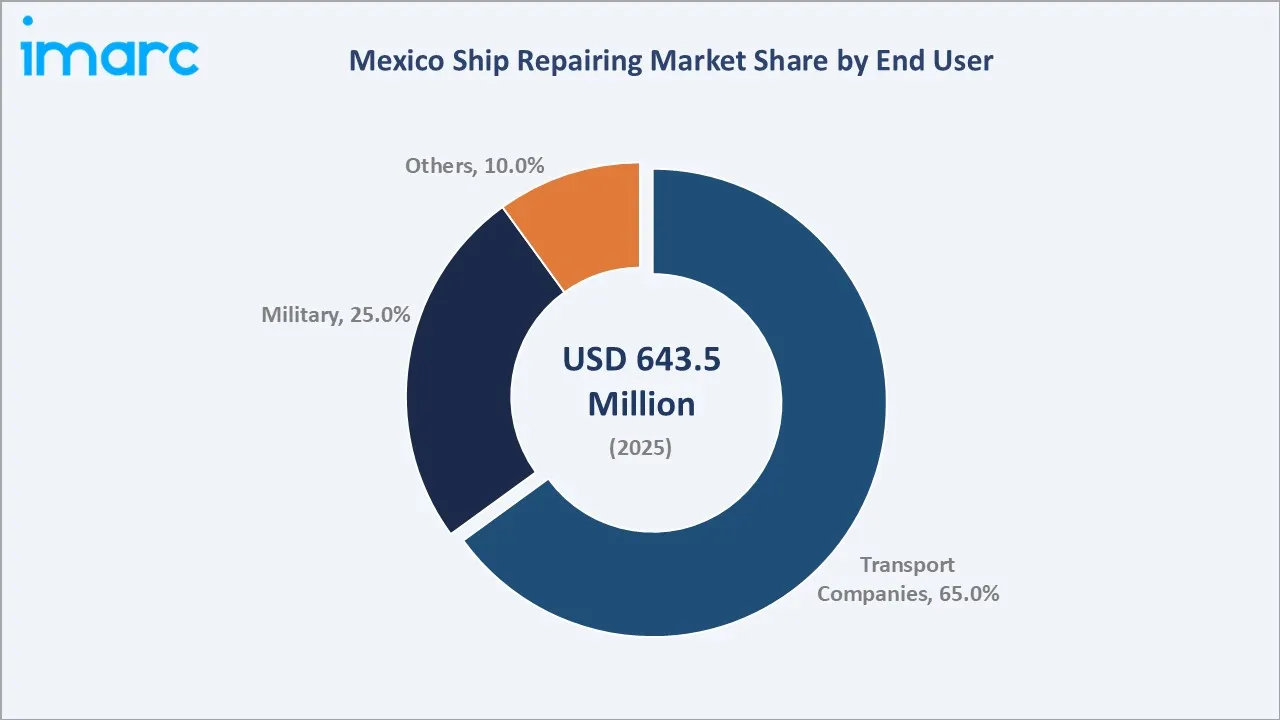
Military work is the fastest-growing end user segment at ~9.1% CAGR, supported by naval fleet renewal, domestic construction programmes and refit requirements that carry higher engineering content, longer contract horizons and stricter quality standards than routine commercial maintenance work.
Regional Market Insights
|
Region |
Share (2025) |
Key Drivers & Characteristics |
|
Southern Mexico |
45.0% |
Largest yard concentration, Campeche Sound offshore energy traffic and the Coatzacoalcos to Salina Cruz corridor serving two oceans |
|
Northern Mexico |
25.0% |
Gulf terminals at Altamira and Tampico, cross-border United States trade and Pacific naval facilities generating steady docking work |
|
Central Mexico |
20.0% |
Industrial heartland engineering and machinery workshops supporting coastal yards, plus Pacific gateway port maintenance demand |
|
Others |
10.0% |
Secondary ports and mobile afloat repair teams handling voyage damage and small maintenance jobs outside main clusters |
Southern Mexico accounts for 45.0% of the market, supported by the densest concentration of repair yards, offshore energy activity in the Campeche Sound and the Coatzacoalcos to Salina Cruz corridor that anchors vessel repair services on both coasts. Northern Mexico holds 25.0%, driven by Gulf terminals, cross-border trade with the United States and Pacific naval facilities that generate dependable docking work.
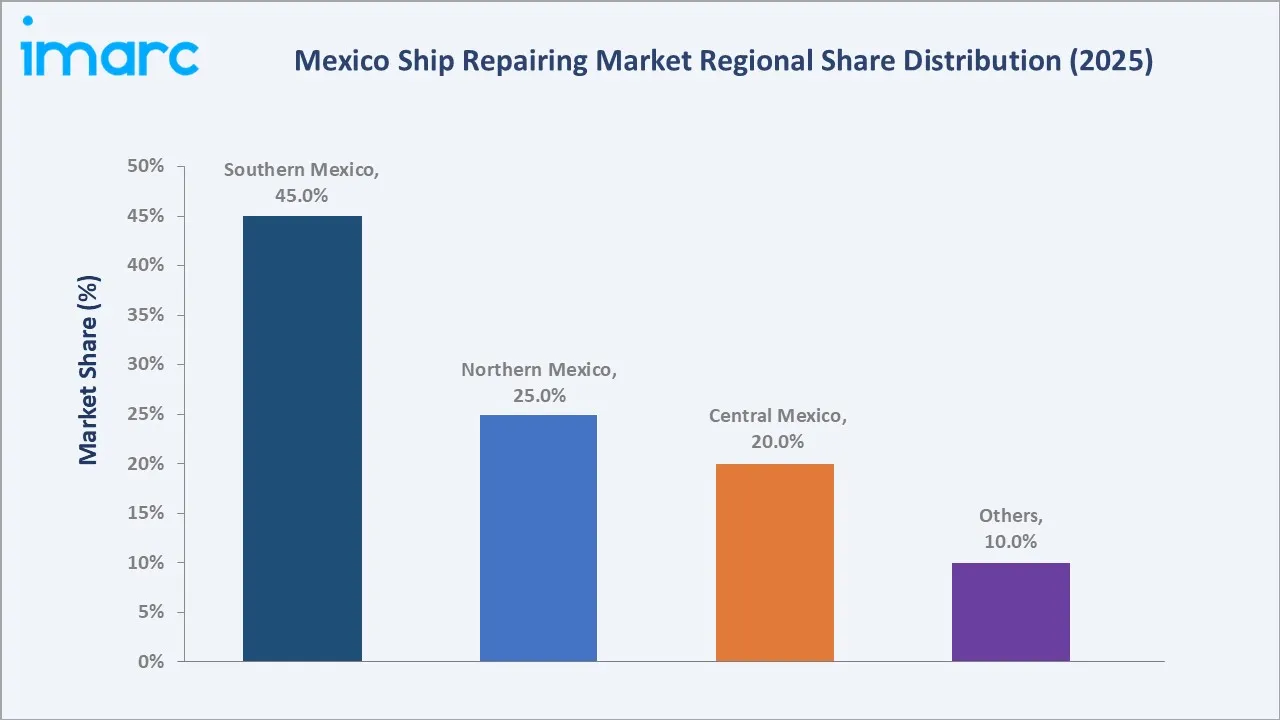
Central Mexico contributes 20.0% through industrial engineering support, machinery and electrical workshops and terminal maintenance tied to Pacific gateway ports and the country's manufacturing belt. Others account for 10.0%, covering secondary ports and mobile afloat repair teams that handle voyage damage and small maintenance jobs outside the main yard clusters.
Competitive Landscape
The competitive landscape is moderately concentrated and segmented by capability rather than by geography alone. Dock-owning yards compete for scarce dry-docking slots and scheduled maintenance campaigns, equipment service specialists compete for engine, separator and automation work tied to manufacturer franchises, and offshore service groups compete for afloat maintenance on support fleets. Competition turns on turnaround reliability, engineering depth and dock availability.
|
Company |
Key Brands |
Market Position |
Core Strength |
| Hutchison Ports TNG | TNG Veracruz yard, afloat repair services |
Market Leader |
Veracruz dock access with integrated hull, machinery and coating capability |
| Wärtsilä México, S. de R.L. de C.V. | Maintenance and repair | Innovator | Engine, propulsion and hybrid retrofit engineering with regional field service coverage |
| MAN Energy Solutions México, S.A. de C.V. (Everllence) | MAN B&W engines, MAN PrimeServ | Established Player | Two-stroke and four-stroke overhaul expertise backed by a global service network |
The most commercially significant dynamic is the structural split between dock-owning yards that control scarce dry-docking slots and equipment specialists that hold engine, separator and automation franchises. Dock owners can price on availability during peak survey seasons, while service specialists capture higher-margin work with less capital exposure. Both groups are moving toward packaged offerings that bundle steel, coating, machinery and compliance scope into a single order, which raises the engineering threshold for smaller yards and pushes sub-scale competitors toward subcontracting roles. Government and naval work adds a third axis of competition, because yards holding security clearances and certified processes face less price pressure than purely commercial facilities.
Key Company Profiles
Hutchison Ports TNG
Talleres Navales del Golfo is a Veracruz-based ship repair yard and the most visible commercial docking facility on Mexico's Gulf coast, handling scheduled dry-docking, afloat repair and voyage damage work for tanker, container and offshore support tonnage. Its position rests on dock access inside a high-traffic port estate.
- Key Brands: TNG Veracruz repair yard, TNG afloat repair services.
- Recent Developments: In January 2026, Talleres Navales del Golfo reported a recovery in ship repair activity at its Veracruz shipyard, with the facility operating at approximately 90% of its capacity and employing around 900 workers. The yard completed maintenance work on the US-flagged vessel Tampa and received two additional vessels from the United States for repair, with the increased docking activity expected to support operations over the following three months.
- Strategic Focus: The yard is prioritising scheduled maintenance campaigns over one-off voyage repair, deepening coating and steel renewal capability, and building project management capacity so that multiple dockings can run in parallel without extending turnaround. It is also positioning for compliance retrofit work as a route to higher revenue per docking.
Wärtsilä México, S. de R.L. de C.V.
Wärtsilä México is the Mexican marine services arm of Wärtsilä Corporation , providing marine engine maintenance, propulsion system repairs, equipment overhauls and lifecycle support for commercial vessels and offshore assets. Its Veracruz workshop supports engine component repairs, fuel systems, turbochargers and machining operations, positioning the company as a specialised marine equipment repair and maintenance provider rather than a conventional shipyard.
- Key Brands: Wärtsilä, Sulzer, Stork, Deutz, ABB, KBB and Napier (across its workshop service portfolio).
- Strategic Focus: The company focuses on extending vessel operating life through preventive maintenance, engine overhauls, propulsion system upgrades, component refurbishment and technical support. Its service capabilities target reduced equipment downtime, improved vessel reliability and operational efficiency across commercial shipping and offshore marine operations.
Market Concentration Analysis
The market is moderately concentrated. A small group of dock-owning yards controls most usable dry-docking capacity on the Gulf and Pacific coasts, and the leading commercial facility holds an estimated 12% to 18% share of repair revenue, with the state naval network accounting for a further significant block through government work. Control of dock slots, rather than pricing power alone, determines influence, because capacity cannot be expanded quickly and operators cannot store a docking.
Two opposing forces are reshaping concentration. Incumbents are consolidating scope by bundling steel, coating, machinery and compliance work into single contracts, which raises capital and engineering barriers. At the same time, equipment specialists and mobile afloat repair teams are capturing discrete high-margin jobs without owning docks, fragmenting value at the top of the work list.
Investment Growth Opportunities
Highest Growth Segments
Chemical tankers at ~9.4% CAGR, military refit work at ~9.1%, container ships at ~9.0%, crude oil tankers at ~8.4% and transport company demand at ~8.3% form the primary investment vectors through 2034, with general cargo ships at ~8.1%, bulk cargo carriers at ~8.0% and the residual vessel type and end user categories at ~7.6% and ~7.5% trailing the overall market. These segments grow faster because demand pull concentrates where compliance, coating and machinery content per docking is highest, and because capacity and productivity gains from mechanised blasting, parallel work sequencing and digital scoping raise revenue per dock day. Modernisation support and public investment in port and naval infrastructure shorten project lead times and expand usable capacity. Capital is therefore concentrating in coating, steel renewal and retrofit engineering, where utilisation gains convert most directly into returns through 2034.
Emerging Investment Opportunities
The most dynamic emerging opportunity is compliance retrofit packaging that bundles ballast water systems, hull coating renewal and efficiency upgrades into a single docking scope. It scales fastest at yards serving chemical tankers and container tonnage on the Gulf coast and along the isthmus corridor, where docking frequency is highest.
Investment Themes
- Floating dock and coating bay capacity: Additional docking capacity commands premium pricing during peak survey seasons, and floating assets can be commissioned faster than graving docks with lower waterfront construction risk.
- Retrofit engineering capability: In-house design and vendor coordination for compliance and efficiency packages lifts revenue per docking and defends margin against yards competing purely on steel renewal rates.
- Dual-use naval and commercial positioning: Certified processes and security approvals open government contracts that stabilise backlog across freight cycles and support sustained investment in skilled trades.
Future Market Outlook (2026-2034)
The market is projected to grow from USD 643.5 Million in 2025 to USD 697.7 Million in 2026, reaching USD 1,361.5 Million by 2034, registering a CAGR of 8.42% during 2026-2034. The market's anchor value of USD 964.2 Million in 2030 reflects compliance-led and maintenance-led demand rather than a cyclical spike, with Southern Mexico and Northern Mexico sustaining leadership as throughput, fleet renewal and yard mechanisation lift docking volumes.
Three structural forces define market growth through 2034 tightening survey and environmental compliance that makes repair non-deferrable; scarce dry-dock capacity that keeps utilisation and pricing firm; and the shift of Gulf and Pacific trade toward Mexican ports that concentrates tonnage close to domestic yards.
Research Methodology
Primary Research
Primary research covered interviews with yard managers, marine superintendents, equipment service specialists and port officials across Mexico's Gulf and Pacific coasts, focused on dock capacity, turnaround performance, labour availability and the sequencing of compliance retrofit work.
Secondary Research
Secondary research drew on port and terminal disclosures, classification and survey documentation, naval procurement records and company publications, triangulated to establish vessel type and end user splits and the regional distribution of repair activity.
Forecasting Models
Forecasting combined docking-frequency modelling by vessel class with dock capacity constraints and compliance timelines for Mexico, producing year-wise values from 2026 to 2034 and segment growth paths reconciled to the overall market CAGR.
Mexico Ship Repairing Market Report Coverage:
| Report Features | Details |
|---|---|
| Base Year of the Analysis | 2025 |
| Historical Period | 2020-2025 |
| Forecast Period | 2026-2034 |
| Units | Million USD |
| Scope of the Report |
Exploration of Historical Trends and Market Outlook, Industry Catalysts and Challenges, Segment-Wise Historical and Future Market Assessment:
|
| Vessel Types Covered | General Cargo Ships, Bulk Cargo Carrier, Crude Oil Tankers, Chemical Tankers, Container Ships, Others |
| Applications Covered | General Services, Dockage, Hull Part, Engine Parts, Electric Works, Auxiliary Services |
| End Users Covered | Transport Companies, Military, Others |
| Regions Covered | Northern Mexico, Central Mexico, Southern Mexico, Others |
| Companies Covered | Hutchison Ports TNG, Wärtsilä México, S. de R.L. de C.V., MAN Energy Solutions México, S.A. de C.V. (Everllence), etc. |
| Customization Scope | 10% Free Customization |
| Post-Sale Analyst Support | 10-12 Weeks |
| Delivery Format | PDF and Excel through Email (We can also provide the editable version of the report in PPT/Word format on special request) |
Key Benefits for Stakeholders:
- IMARC’s industry report offers a comprehensive quantitative analysis of various market segments, historical and current market trends, market forecasts, and dynamics of the Mexico ship repairing market from 2020-2034.
- The research report provides the latest information on the market drivers, challenges, and opportunities in the Mexico ship repairing market.
- Porter's Five Forces analysis assists stakeholders in assessing the impact of new entrants, competitive rivalry, supplier power, buyer power, and the threat of substitution. It helps stakeholders to analyze the level of competition within the Mexico ship repairing industry and its attractiveness.
- Competitive landscape allows stakeholders to understand their competitive environment and provides an insight into the current positions of key players in the market.
Frequently Asked Questions About the Mexico Ship Repairing Market Report
The market reached USD 643.5 Million in 2025 and an estimated USD 697.7 Million in 2026, supported by scheduled dry-docking demand, offshore vessel maintenance and naval refit programmes across Gulf and Pacific coasts.
The market is expected to register a CAGR of 8.42% during 2026-2034, rising from USD 697.7 Million in 2026 to reach USD 1,361.5 Million by 2034 on compliance and capacity-led demand.
Container ships lead the vessel type segment with a 25.0% share in 2025, reflecting high call volumes at Gulf and Pacific terminals and short port windows that favour yards able to absorb voyage repair quickly.
Transport companies lead the end user segment with a 65.0% market share in 2025, driven by recurring commercial maintenance across liner, tanker, bulk and offshore support operators that must meet fixed survey intervals.
Southern Mexico leads with a 45.0% regional share in 2025, supported by the densest yard concentration, offshore energy traffic in the Campeche Sound and the Coatzacoalcos to Salina Cruz corridor serving both coasts.
Leading companies include Hutchison Ports TNG, Wärtsilä México, S. de R.L. de C.V., and MAN Energy Solutions México, S.A. de C.V. (Everllence), among others.
The market is projected to reach USD 964.2 Million by 2030, driven by compliance retrofits, rising dock utilisation and expanding container, chemical tanker and offshore support vessel repair demand.
Chemical tankers at ~9.4% CAGR, military refit work at ~9.1% CAGR and container ship repair at ~9.0% CAGR are the fastest-growing segments, alongside compliance retrofit packaging and floating dock capacity expansion.
Need more help?
- Speak to our experienced analysts for insights on the current market scenarios.
- Include additional segments and countries to customize the report as per your requirement.
- Gain an unparalleled competitive advantage in your domain by understanding how to utilize the report and positively impacting your operations and revenue.
- For further assistance, please connect with our analysts.
 Request Customization
 Speak to an Analyst
 Request Brochure
 Inquire Before Buying
Benefits of Customization
- Personalize this research
- Triangulate with your data
- Get data as per your format and definition
- Gain a deeper dive into a specific application, geography, customer, or competitor
- Any level of personalization
Get in Touch With Us
UNITED STATES
Phone: +1-201-971-6302
INDIA
Phone: +91-120-433-0800
UNITED KINGDOM
Phone: +44-753-714-6104
Email: [email protected]
Client Testimonials























Related Reports

Choose your plan
*Please note that the prices mentioned below are starting prices for each bundle type. Kindly contact our team for further details.*
Single User License
- 1 User License, Access on 2 Devices
- PDF Report + Excel Dataset (Password Protected)
- Lifetime Access
- No Printing Rights
- 10% Free Report Customization
- 10–12 Weeks of Analyst Support
Five User License
- Access for 5 Users, 2 Devices per User
- PDF Report + Excel Dataset (Password Protected)
- Lifetime Access
- Dedicated Account Manager
- 12–14 Weeks of Analyst Support
- No Printing Rights
- 15% Free Report Customization
- 25% Discount on Your Next Purchase
Corporate User License
- Unlimited User Access (Within Your Organization)
- PDF Report + Excel Dataset
- Lifetime Access
- Dedicated Account Manager
- 14–20 Weeks of Analyst Support
- No Printing Rights
- 20% Free Report Customization
- 30% Discount on Your Next Purchase
Essential Insights
What's included:
3 reports
- Lifetime Access
- PDF Reports
- Excel Datasets
- 2 Weeks of Free Analyst Support
- 2 User Licenses
- Access on 2 Devices
- Printing Rights
- Complimentary PowerPoint (PPT) Version
- Complimentary License Upgrade
Professional Access
What's included:
5 reports
- Lifetime Access
- PDF Reports
- Excel Datasets
- 8 Weeks of Free Analyst Support
- 2 User Licenses
- Access on 2 Devices
- Printing Rights
- Complimentary PowerPoint (PPT) Version
- Complimentary License Upgrade
Business Advantage
What's included:
8 reports
- Lifetime Access
- PDF Reports
- Excel Datasets
- 14 Weeks of Free Analyst Support
- 2 User Licenses
- Access on 2 Devices
- Printing Rights
- Complimentary PowerPoint (PPT) Version
- Complimentary License Upgrade
Enterprise Intelligence
What's included:
10 reports
- Lifetime Access
- PDF Reports
- Excel Datasets
- 20 Weeks of Free Analyst Support
- 2 User Licenses
- Access on 2 Devices
- Printing Rights
- Complimentary PowerPoint (PPT) Version
- Complimentary License Upgrade