
Mexico Skincare Market Size, Share, Trends and Forecast by Category, Ingredient Type, Gender, Distribution Channel, and Region, 2026-2034
Mexico Skincare Market Size, Share, Trends & Forecast (2026-2034)
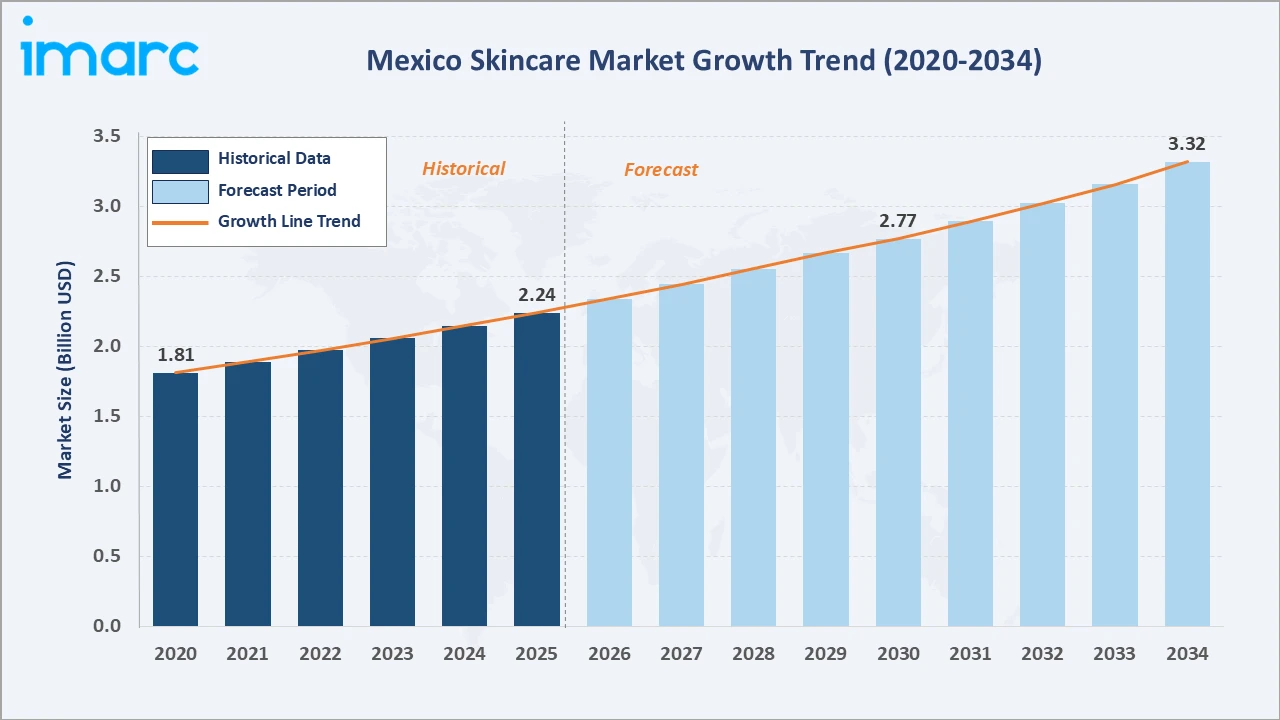
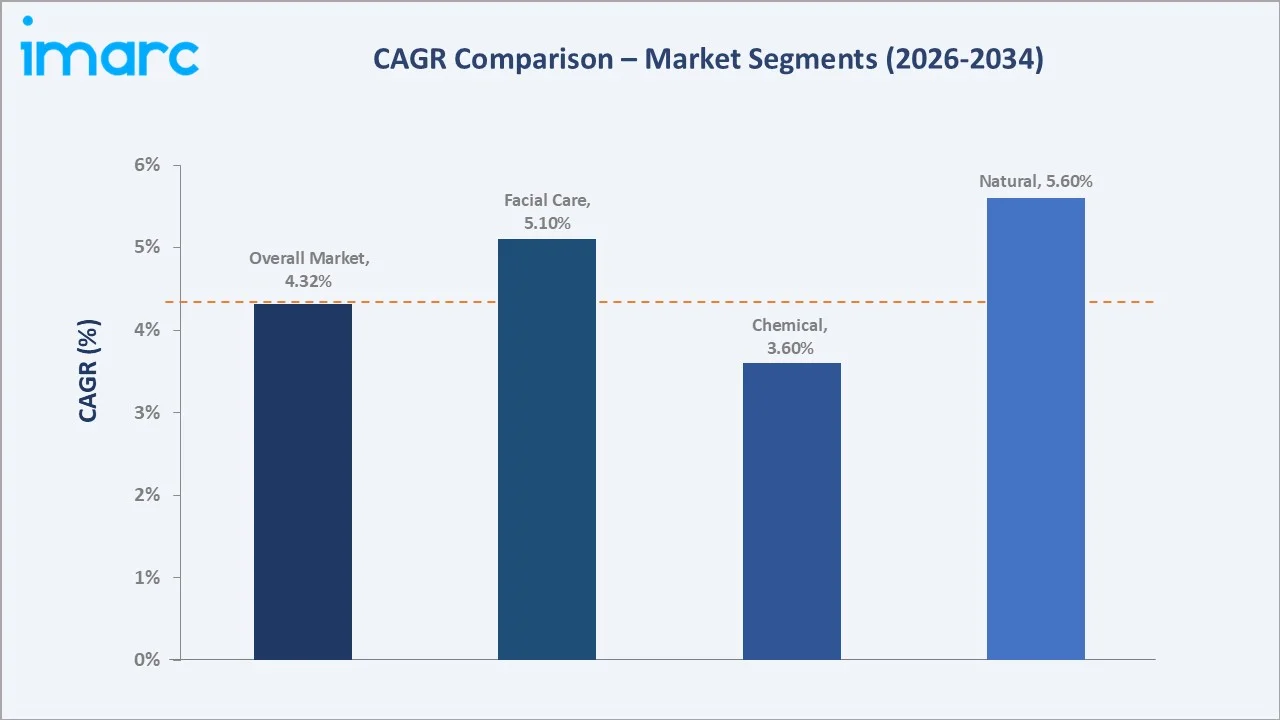
The Mexico skincare market reached USD 2.24 Billion in 2025 and is projected to reach USD 3.32 Billion by 2034, growing at a CAGR of 4.32% during 2026-2034. Growth is driven by rising dermocosmetics demand, expanding manufacturing investment, and lengthening skincare routines among Mexico's urban consumers. Facial care leads the category mix at 46.8% share, while chemical-based formulations hold 58.7% of the ingredient-type breakup. Central Mexico dominates regionally with 42.6% share, supported by dense pharmacy and department-store networks. Natural-ingredient and premium dermocosmetic lines are expanding fastest across the forecast period, reshaping Mexico's skincare industry analysis and competitive landscape.
Market Snapshot
|
Metric |
Value |
|
Market Size (2025) |
USD 2.24 Billion |
|
Forecast Market Size (2034) |
USD 3.32 Billion |
|
CAGR (2026-2034) |
4.32% |
|
Base Year |
2025 |
|
Historical Period |
2020-2025 |
|
Forecast Period |
2026-2034 |
|
Dominant Category |
Facial Care (46.8%, 2025) |
|
Dominant Ingredient Type |
Chemical (58.7%, 2025) |
|
Leading Region |
Central Mexico (42.6%, 2025) |
The Mexico skincare market grew from USD 1.81 Billion in 2020 to USD 2.24 Billion in 2025, reflecting steady demand from urban skincare routines, pharmacy-led retail, and rising dermocosmetics adoption. It is expected to reach USD 2.77 Billion by 2030, supported by premiumization, natural-ingredient formulations, and expanding e-commerce access. By 2034, the market is forecast to reach USD 3.32 Billion, driven by continued near-shoring investment, dermatologist-recommended product lines, and beauty-tech adoption. Overall, the market shows consistent long-term growth as Mexico strengthens its position among Latin America's leading skincare markets.
To get more information on this market, Request Sample
Category-level growth diverges across the forecast period. Facial care advances fastest among categories at an estimated 5.1% CAGR, supported by anti-aging serums and dermatologist-backed formulations. Natural-ingredient products are expanding even faster at approximately 5.6% CAGR as consumers shift toward clean-label, sustainable formulations over the 2026-2034 forecast period.
Executive Summary
The Mexico skincare market is expanding steadily, underpinned by rising self-care awareness, a young urban population, and growing dermocosmetics demand. Facial and body care routines are lengthening as consumers seek anti-aging, sun-protection, and barrier-repair solutions suited to Mexico's high year-round UV exposure and dense urban lifestyles.
Multinational leaders including L’Oréal S.A. and Beiersdorf AG continue to expand local manufacturing capacity, reinforcing Mexico's role as a production and export hub under USMCA. Domestic players such as Genomma Lab Internacional leverage pharmacy-led distribution and brand loyalty to defend share in the mass segment, while franchise and direct-to-consumer models reshape retail alongside sustainable packaging and beauty-tech devices. Regulatory modernization under COFEPRIS is also streamlining product registration timelines.
Facial care leads the category mix at 46.8% share, chemical formulations dominate ingredient type at 58.7%, and Central Mexico leads regionally at 42.6% share. Looking ahead, natural formulations, premium dermocosmetics, and social-commerce channels are set to outpace the broader market through 2034, supported by rising investment and consumer demand for clean-label products.
Key Market Insights
|
Insight |
Data |
|
Dominant Category |
Facial Care - 46.8% share (2025) |
|
Dominant Ingredient Type |
Chemical - 58.7% share (2025) |
|
Leading Region |
Central Mexico - 42.6% share (2025) |
|
Market Opportunity |
Franchise retail conversion; plastic-free packaging; dermocosmetics premiumization; men's grooming expansion; beauty-tech devices; natural-ingredient reformulation |
Key Analytical Observations Supporting The Above Data:
- Facial Care at 46.8%: Facial care leads through rising anti-aging, brightening, and sun-protection routines, supported by dermatologist-recommended lines and Mexico's high year-round UV exposure across urban centers.
- Chemical Formulations at 58.7%: Chemical-based skincare dominates through proven efficacy, lower cost, and broad retail availability, though natural formulations are gaining share as clean-label preferences accelerate among younger consumers.
- Central Mexico at 42.6%: Central Mexico dominates regionally through dense pharmacy and department-store networks, high urban population concentration, and proximity to manufacturing hubs in Guanajuato and San Luis Potosí.
- Manufacturing Investment: L’Oréal S.A. and Beiersdorf AG are together committing well over USD 400+ Million toward Mexican plant expansions through 2026, reinforcing the country's role as a regional export hub.
- Premiumization Momentum: Dermocosmetics and Korean-inspired skincare lines are growing faster than the mass segment, aided by rising disposable income and pharmacy-based dermatological consultations.
Mexico Skincare Market Overview
The Mexico skincare market covers facial, body, and hand care products formulated with chemical or natural active ingredients, sold through pharmacies, supermarkets, specialty stores, and e-commerce platforms. The industry serves a population of roughly 132 million, of which 88% is urban, supporting dense retail and pharmacy-led distribution nationwide. Skincare is regulated by COFEPRIS under NOM-259-SSA1-2022 good manufacturing practices and NOM-141 labeling standards, with the National Chamber of the Cosmetics Industry (CANIPEC) representing the majority of formal-sector output. Macroeconomic support comes from USMCA trade access, near-shoring manufacturing investment, and Mexico's position as a top-ten global cosmetics market.
Market Dynamics
To evaluate market opportunities, Request Sample
Market Drivers
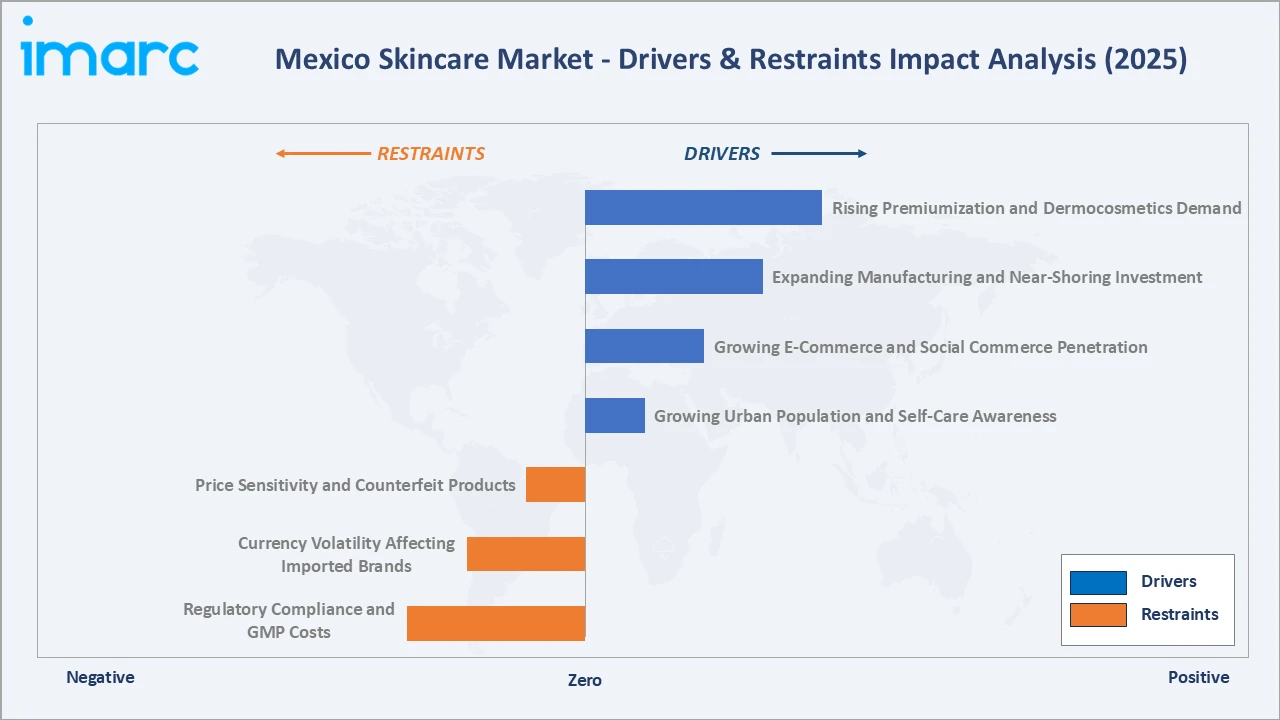
- Rising Premiumization and Dermocosmetics Demand: L’Oréal S.A. is investing over USD 80 Million through 2026 to expand its San Luis Potosí and Mexico City plants, backing 23 brands across dermatological, professional, mass-market, and luxury tiers. Rising demand for Korean and dermatological skincare lines is reinforcing premium category growth.
- Expanding Manufacturing and Near-Shoring Investment: Beiersdorf AG is investing approximately EUR 350 Million to expand its Silao, Guanajuato plant, with about 70% of output exported. Unilever has committed USD 1.5 Billion toward Mexico through 2028, with over half allocated to Nuevo León, reinforcing USMCA-linked near-shoring momentum.
- Growing E-Commerce and Social Commerce Penetration: TikTok Shop and Instagram Checkout are shortening the path from discovery to purchase, while direct-to-consumer players such as Betterware/JAFRA reported strong post-acquisition performance, including an MXN 250 Million dividend announced in 2024.
- Growing Urban Population and Self-Care Awareness: With roughly 132 million people and 88% urban concentration, Mexico's skincare routines are lengthening as consumers seek anti-aging and barrier-repair solutions suited to high year-round UV exposure.
Market Restraints
- Price Sensitivity and Counterfeit Products: Mexico remains a price-driven market where counterfeit and grey-market products create pricing pressure for authorized suppliers, weakening demand for legitimately registered branded formulations.
- Currency Volatility Affecting Imported Brands: Peso fluctuations against the US dollar inflate landed costs for imported skincare brands, forcing selective price increases and smaller pack formats to preserve sales volume.
Market Opportunities
- Shift Toward Franchise and Direct-to-Consumer Retail: Natura announced in December 2024 that it would phase out its direct-selling model in Mexico in favor of a franchise-based system starting in 2025, opening opportunities for franchise operators and retail-format investors.
- Rising Demand for Sustainable and Plastic-Free Packaging: In February 2025, Aora Mexico partnered with RePurpose Global to launch plastic-negative skincare packaging using tin, aluminum, and wood materials, reflecting growing opportunity for sustainable packaging suppliers.
- Men's Grooming and Niche Segment Expansion: CANIPEC identifies men's grooming as a priority niche, citing social-media influence and shifting cultural norms that are normalizing male skincare routines across Mexico's urban centers.
Market Challenges
- Regulatory Compliance and GMP Costs: NOM-259-SSA1-2022 good manufacturing practice requirements and natural-colorant testing standards raise compliance costs and lengthen time-to-market, particularly for smaller and local formulators.
- Water Scarcity and Sustainability Compliance: Water-scarcity regulations and sustainability compliance costs are emerging as margin headwinds for manufacturers operating production facilities across Mexico's central and northern states.
- Rising Competitive Intensity from Beauty-Tech Entrants: The 2024 entry of SharkNinja's CryoGlow LED facemask device into Mexico illustrates rising competitive intensity from beauty-tech entrants, raising the innovation bar for incumbent skincare brands.
Emerging Market Trends
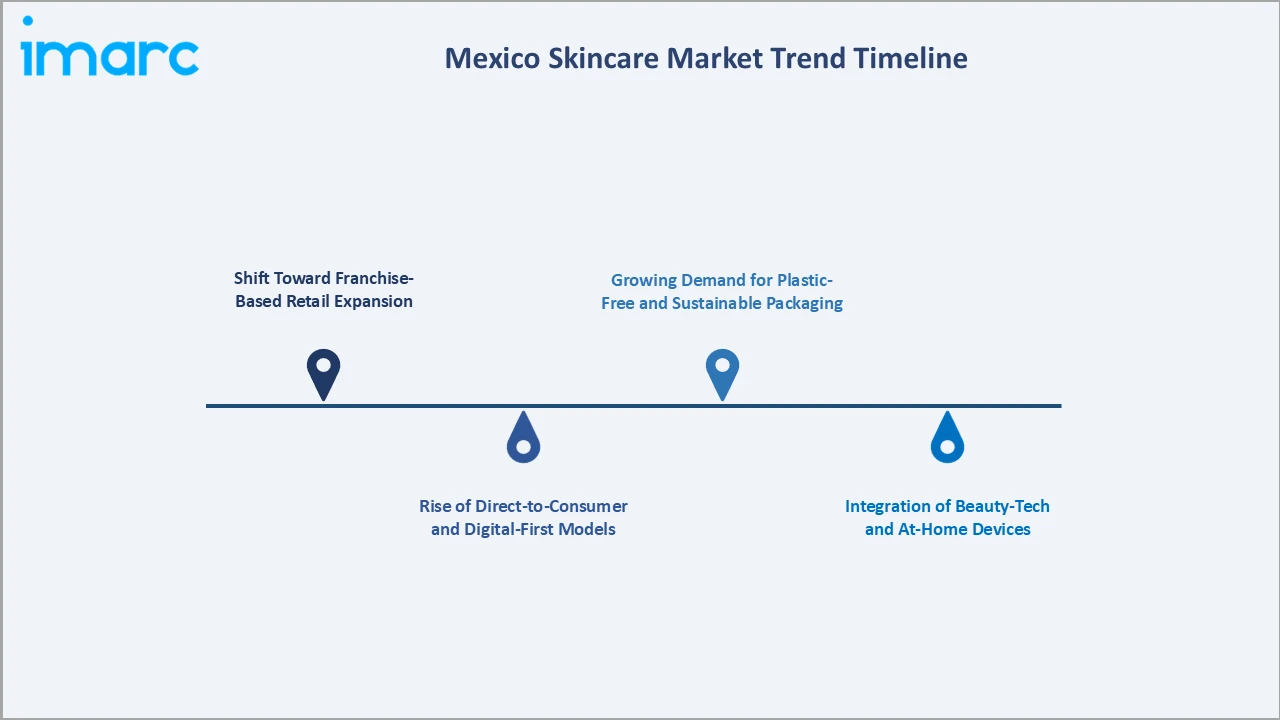
1. Shift Toward Franchise-Based Retail Expansion
Franchise-based retail expansion is emerging as direct-selling companies restructure their go-to-market models. Natura announced in December 2024 that it would phase out its traditional direct-selling structure in Mexico in favor of a franchise-based system beginning in 2025. This shift is creating opportunities for franchise operators and reshaping how skincare brands reach consumers outside conventional retail.
2. Rise of Direct-to-Consumer and Digital-First Models
Direct-to-consumer skincare distribution is gaining momentum as companies strengthen digital-first sales channels. Betterware de Mexico, following its JAFRA acquisition, announced an MXN 250 Million dividend in 2024, reflecting strong performance of its direct-to-consumer model. This trend is encouraging further investment in digital-first brand infrastructure and personalized outreach.
3. Growing Demand for Plastic-Free and Sustainable Packaging
Plastic-free and sustainable packaging is emerging as environmentally conscious consumers seek lower-impact skincare options. In February 2025, Aora Mexico partnered with RePurpose Global to launch plastic-negative skincare packaging using tin, aluminum, and wood materials. This trend is creating opportunities for sustainable packaging suppliers and reinforcing brand differentiation around environmental credentials.
4. Integration of Beauty-Tech and At-Home Devices
Beauty-tech integration is emerging as at-home skincare devices gain traction among Mexican consumers. SharkNinja entered the Mexico skincare market in 2024 with its CryoGlow LED facemask device, signaling growing consumer appetite for technology-enabled skincare routines. This trend is raising the innovation bar for incumbent skincare brands and encouraging device-linked product ecosystems.
Industry Value Chain Analysis
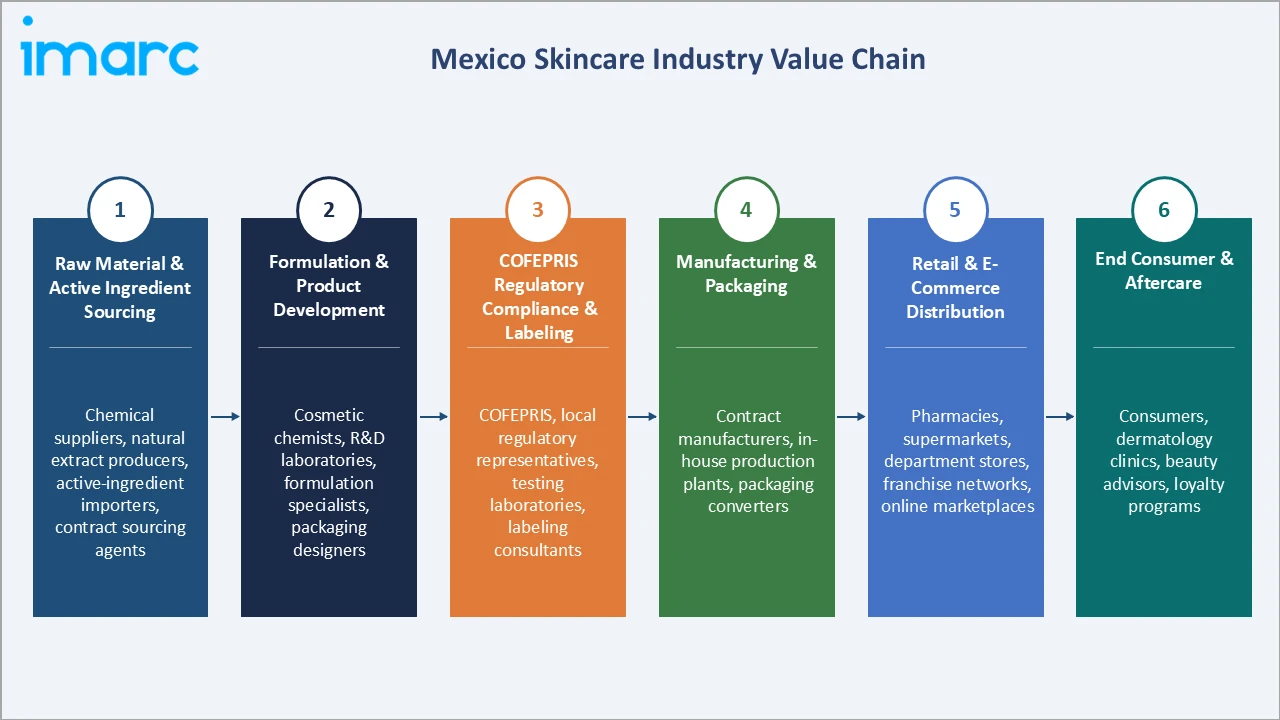
Mexico's skincare value chain integrates raw material and active ingredient sourcing, formulation and product development, COFEPRIS regulatory compliance and labeling, manufacturing and packaging, retail and e-commerce distribution, and end-consumer aftercare.
|
Stage |
Key Participants |
|
Raw Material & Active Ingredient Sourcing |
Chemical suppliers, natural extract producers, active-ingredient importers, contract sourcing agents |
|
Formulation & Product Development |
Cosmetic chemists, R&D laboratories, formulation specialists, packaging designers |
|
COFEPRIS Regulatory Compliance & Labeling |
COFEPRIS, local regulatory representatives, testing laboratories, labeling consultants |
|
Manufacturing & Packaging |
Contract manufacturers, in-house production plants, packaging converters |
|
Retail & E-Commerce Distribution |
Pharmacies, supermarkets, department stores, franchise networks, online marketplaces |
|
End Consumer & Aftercare |
Consumers, dermatology clinics, beauty advisors, loyalty programs |
Formulation and product development is the most value-added stage in Mexico's skincare value chain. This stage differentiates products through active-ingredient efficacy, dermatological positioning, and sensory experience, allowing brands to command premium pricing. Companies investing in biotech actives, personalized formulations, and clinically validated claims capture disproportionate value relative to manufacturing or distribution.
Technology Landscape in the Mexico Skincare Industry
AI-Enabled Skin Diagnostics and Personalization
AI-enabled skin diagnostics are helping consumers and dermatologists identify concerns such as pigmentation, dehydration, and early signs of aging. Department-store beauty halls increasingly feature virtual-skin diagnostic tools and personalized serum mixers, allowing brands to justify premium pricing through tailored recommendations and improving conversion for facial care lines.
Advanced Formulation and Biotech Actives
Biotech-derived active ingredients, including epigenetic and peptide-based actives, are improving anti-aging efficacy claims across premium dermocosmetic lines. Domestic natural-formulation brands are pursuing COSMOS-style certification to substantiate clean-label positioning, supporting the natural-ingredient segment's above-average growth relative to conventional chemical formulations.
Smart Beauty Devices and At-Home Technology
Smart beauty devices, including LED facemasks and at-home cryotherapy tools, are expanding the skincare category beyond topical products. The entry of technology-led players alongside traditional skincare brands is encouraging device-linked product ecosystems and deeper digital engagement with Mexican consumers through subscription and app-based routines.
Market Segmentation Analysis
The report covers the following segments:
|
Segment Category |
Leading Segment |
Market Share |
Year |
|
Category |
Facial Care |
46.8% |
2025 |
|
Ingredient Type |
Chemical |
58.7% |
2025 |
|
Gender |
🔒 |
🔒 |
2025 |
|
Distribution Channel |
🔒 |
🔒 |
2025 |
|
Region |
Central Mexico |
42.6% |
2025 |

By Category
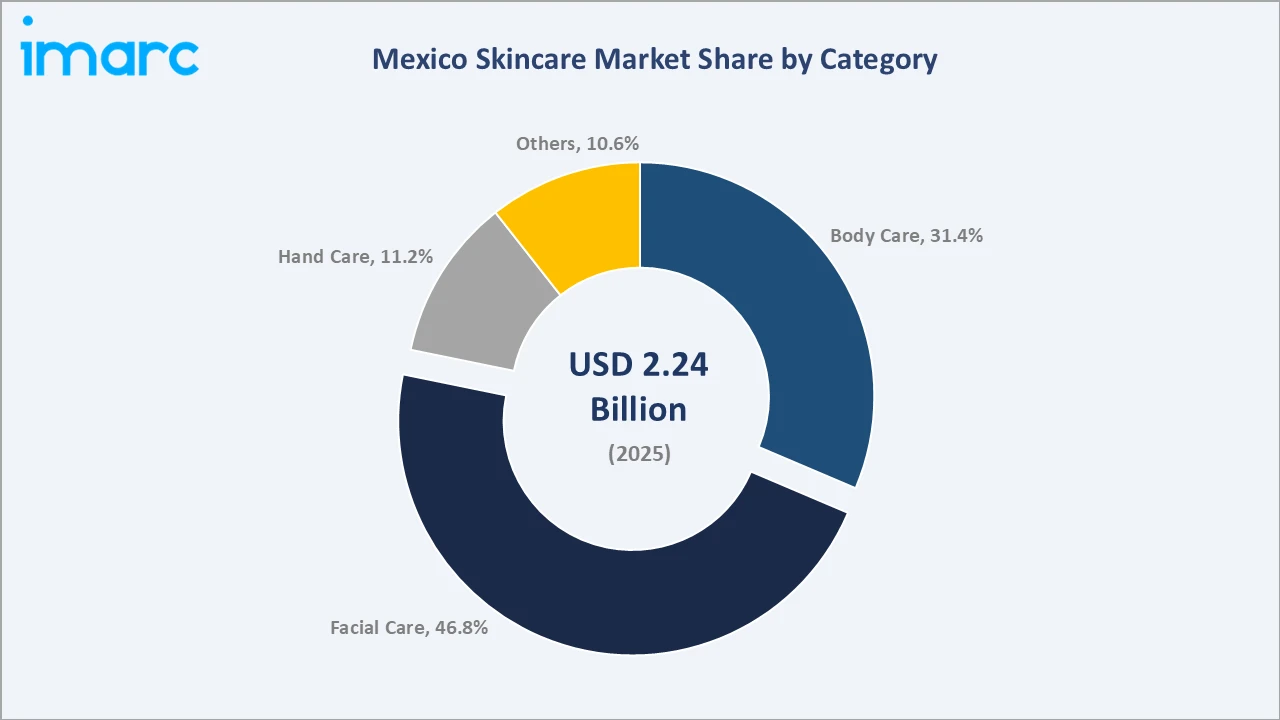
Facial care leads at 46.8% (2025), driven by anti-aging serums, brightening treatments, and dermatologist-recommended moisturizers suited to Mexico's high UV exposure and growing premiumization.
To access detailed market analysis, Request Sample
Body care follows at 31.4%, supported by body lotions and sun-care products, while hand care holds 11.2% share through hygiene-driven demand. Others, including lip and foot care, account for the remaining 10.6% of category share.
By Ingredient Type
Chemical formulations lead at 58.7% (2025), reflecting proven efficacy, established manufacturing scale, and broad retail availability across mass and premium tiers of Mexico's skincare industry.
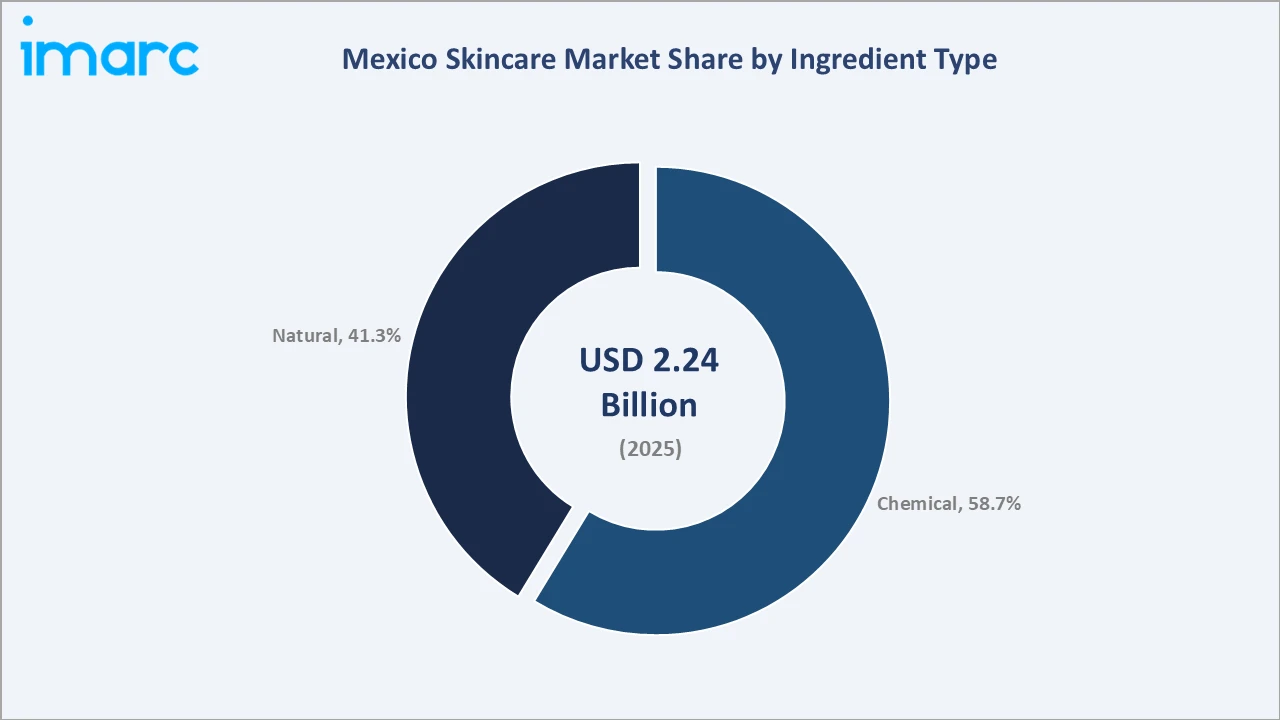
Natural ingredients hold 41.3% share and are growing fastest at an estimated 5.6% CAGR, as clean-label preferences, COSMOS-oriented local brands, and sustainable packaging gain traction among younger Mexican consumers.
Regional Market Insights
|
Region |
Share (2025) |
Key Mexico Skincare Market Drivers & Characteristics |
|
Central Mexico |
42.6% |
Reflecting dense urban population, strong pharmacy and department-store networks, and proximity to major manufacturing hubs in Guanajuato and San Luis Potosí. |
|
Northern Mexico |
27.8% |
Reflects nearshoring-driven manufacturing investment, cross-border retail access, and rising disposable incomes across Monterrey and border cities. |
|
Southern Mexico |
18.4% |
Supported by growing tourism-driven demand, expanding pharmacy chains, and rising adoption of sun-care and body-care products in tropical climates. |
|
Others |
11.2% |
Other regions, including the Yucatán Peninsula and Pacific Coast, were supported through tourism retail, resort-area pharmacies, and localized distribution. |
Central Mexico's 42.6% dominance is supported by Mexico City's dense retail infrastructure and nearby manufacturing clusters in Guanajuato and San Luis Potosí. Northern Mexico's 27.8% follows, driven by nearshoring investment and cross-border consumer access to premium brands.
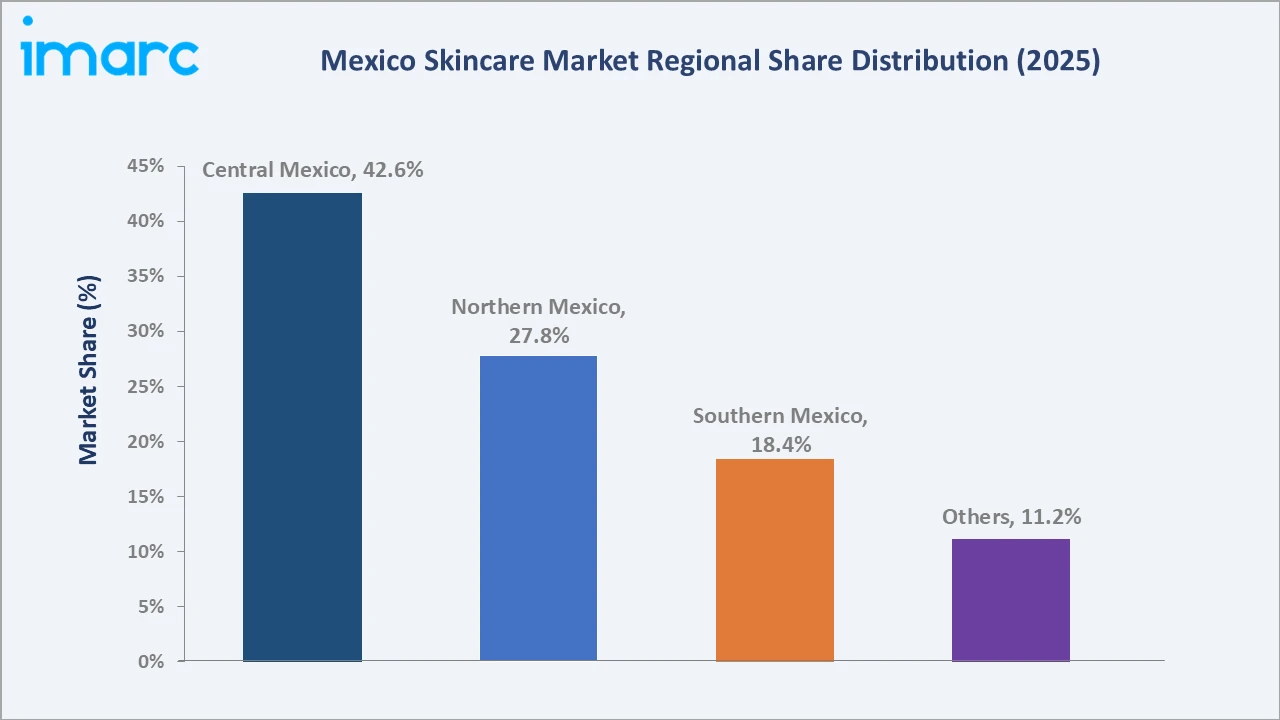
Southern Mexico's 18.4% share reflects growing tourism-linked demand and expanding pharmacy penetration across coastal and tropical states. Others at 11.2%, including the Yucatán Peninsula and Pacific Coast resort areas, contribute through tourism retail and localized distribution networks.
Competitive Landscape
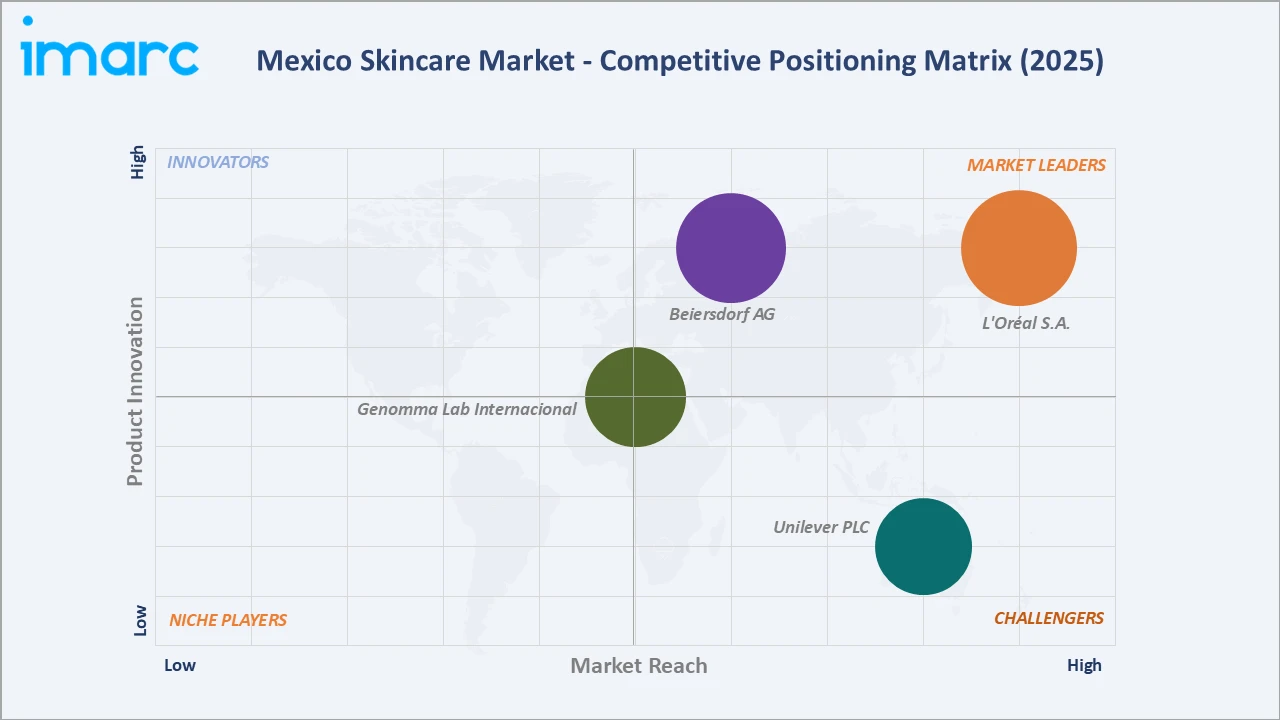
The Mexico skincare market is moderately consolidated, with multinational leaders competing alongside strong domestic players and emerging direct-to-consumer brands. Competition is shaped by manufacturing scale, dermatological credibility, distribution reach, and packaging sustainability.
|
Company |
Brand Name |
Market Position |
Core Strength |
|
L'Oréal S.A. |
L'Oréal Paris, Garnier, La Roche-Posay, Lancôme |
Market Leader |
Broad portfolio spanning mass, dermatological, and luxury tiers, backed by expanding local manufacturing capacity. |
|
Beiersdorf AG |
NIVEA, Eucerin |
Market Leader |
Century-long heritage brand equity paired with major export-oriented manufacturing investment in Guanajuato. |
|
Unilever PLC |
Dove, Pond's, Vaseline |
Strong Challenger |
Operates Unilever de Mexico, S. de R.L. de C.V., digital-first product lines backed by a USD 1.5 Billion regional investment commitment through 2028. |
|
Genomma Lab Internacional |
Cicatricure, Asepxia |
Established Player |
Deep pharmacy-channel penetration and strong brand recall across Mexico's mass dermocosmetics segment. |
Companies are increasingly investing in dermocosmetic innovation, sustainable packaging, and franchise or direct-to-consumer retail formats to defend share against emerging niche brands. Beauty-tech entrants and Korean-inspired formulations are adding further competitive intensity across premium categories.
Key Company Profiles
L'Oréal S.A.
L'Oréal S.A., which holds L'Oreal Mexico, S.A. De C.V., has operated in the country for more than six decades and ranks among the company's top ten global markets. The subsidiary sells 23 brands spanning dermatological, professional, mass-market, and luxury tiers, serving more than 56 million households nationwide through its San Luis Potosí and Mexico City (Xochimilco) manufacturing plants.
- Key Brands: L'Oréal Paris, Garnier, La Roche-Posay, Lancôme, and others.
- Strategic Focus: Expanding local manufacturing capacity through a USD 80 Million investment across its San Luis Potosí and Mexico City plants by 2026, positioning Mexico as both a growth market and an export hub for the Americas.
Beiersdorf AG
Beiersdorf AG, which holds BDF México, S.A. de C.V. and Beiersdorf Manufacturing México, S.A. de C.V., has operated in Mexico for over a century, with NIVEA regarded by many Mexican consumers as a domestic heritage brand. The company's Silao, Guanajuato facility manufactures creams, lotions, and lip-care products for Mexico, Central America, and North America, with roughly 70% of output exported to regional markets.
- Key Brands: NIVEA, Eucerin, and others.
- Strategic Focus: Investing approximately EUR 350 Million (around USD 405 Million) to expand the Silao plant, reinforcing Mexico's role as a strategic export hub while advancing the company's global carbon-neutrality target for 2045.
Market Concentration Analysis
The Mexico skincare market shows moderate concentration, with global majors L’Oréal S.A. and Beiersdorf AG holding strong positions across dermocosmetics and mass-premium tiers, while Unilever PLC and Genomma Lab Internacional compete through digital-first and pharmacy-channel strategies respectively.
The market remains fragmented at the distribution level, with independent pharmacies, direct-selling networks, and emerging franchise brands accounting for meaningful share. Rising direct-to-consumer and franchise models are opening space for mid-sized domestic brands, while sustainability-focused entrants such as Aora Mexico challenge incumbents on packaging credentials. Overall, competitive intensity is shifting from price-based selling toward dermatological credibility, sustainability, and digital engagement.
Investment & Growth Opportunities
Highest Growth Segments
Natural ingredients (~5.6% CAGR), facial care (~5.1% CAGR), Northern Mexico (~5.2% CAGR), and dermocosmetics-linked premium formulations represent Mexico's skincare highest-growth investment vectors through 2034.
Investment Themes
- Sustainable and Plastic-Free Packaging: Growing consumer and regulatory focus on packaging sustainability is creating opportunities for suppliers of tin, aluminum, wood, and biodegradable packaging formats, building on partnerships such as Aora Mexico's plastic-negative packaging launch with RePurpose Global.
- Direct-to-Consumer and Franchise Retail Infrastructure: The shift toward franchise-based and direct-to-consumer retail, illustrated by Natura's franchise conversion and Betterware/JAFRA's direct-to-consumer performance, is opening investment opportunities in retail-format infrastructure and digital sales enablement.
Future Market Outlook (2026-2034)
Mexico's skincare market is projected to grow from USD 2.24 Billion in 2025 to USD 3.32 Billion by 2034, delivering a 4.32% CAGR through rising dermocosmetics adoption, manufacturing near-shoring, and sustainable packaging transition. The market's anchor value of USD 2.77 Billion in 2030 represents the midpoint of premiumization and franchise-retail mainstreaming.
Three structural forces define growth through 2034. First, continued expansion of dermocosmetics and Korean-inspired formulations is raising average price points across facial care. Second, manufacturing investment from L'Oréal S.A., Beiersdorf AG, and Unilever PLC is reinforcing Mexico's role as a regional export hub under USMCA. Third, the shift toward franchise, direct-to-consumer, and social-commerce retail formats is reshaping how skincare reaches Mexican consumers, supporting broader category penetration.
Research Methodology
Primary Research
Primary research comprised interviews with skincare manufacturers, pharmacy chains, dermatologists, and distribution partners across Mexico. Discussions also covered franchise operators and direct-to-consumer brand representatives active in facial, body, and hand care categories. Inputs were gathered on product demand, pricing, ingredient preference, and adoption of natural and dermocosmetic formulations.
Secondary Research
Secondary research encompassed COFEPRIS regulatory filings, CANIPEC industry statistics, company disclosures, and trade publications. It also included reviews of manufacturing investment announcements, e-commerce trends, and packaging sustainability initiatives across facial, body, and hand care demand to map regional consumption patterns.
Forecasting Models
Forecasting models combined historical market performance, manufacturing investment trends, and macroeconomic indicators to project future demand. The analysis incorporated expected growth in dermocosmetics, natural formulations, and franchise or direct-to-consumer retail penetration. Market estimates were validated through triangulation of primary insights, secondary research, and segment-level demand analysis to ensure robust long-term projections through 2034.
Mexico Skincare Market Report Coverage:
| Report Features | Details |
|---|---|
| Base Year of the Analysis | 2025 |
| Historical Period | 2020-2025 |
| Forecast Period | 2026-2034 |
| Units | Billion USD |
| Scope of the Report |
Exploration of Historical Trends and Market Outlook, Industry Catalysts and Challenges, Segment-Wise Historical and Future Market Assessment:
|
| Categories Covered | Body Care, Facial Care, Hand Care, Others |
| Ingredient Types Covered | Natural, Chemical |
| Genders Covered | Male, Female, Unisex |
| Distribution Channels Covered | Offline, Online |
| Regions Covered | Northern Mexico, Central Mexico, Southern Mexico, Others |
| Companies Covered | L'Oréal S.A., Beiersdorf AG, Unilever PLC, Genomma Lab Internacional, etc. |
| Customization Scope | 10% Free Customization |
| Post-Sale Analyst Support | 10-12 Weeks |
| Delivery Format | PDF and Excel through Email (We can also provide the editable version of the report in PPT/Word format on special request) |
Key Benefits for Stakeholders:
- IMARC’s industry report offers a comprehensive quantitative analysis of various market segments, historical and current market trends, market forecasts, and dynamics of the Mexico skincare market from 2020-2034.
- The research report provides the latest information on the market drivers, challenges, and opportunities in the Mexico skincare market.
- Porter's Five Forces analysis assists stakeholders in assessing the impact of new entrants, competitive rivalry, supplier power, buyer power, and the threat of substitution. It helps stakeholders to analyze the level of competition within the Mexico skincare industry and its attractiveness.
- Competitive landscape allows stakeholders to understand their competitive environment and provides an insight into the current positions of key players in the market.
Frequently Asked Questions About the Mexico Skincare Market Report
The Mexico skincare market reached USD 2.24 Billion in 2025, driven by rising dermocosmetics demand, urban self-care routines, and expanding manufacturing investment from global and domestic skincare producers across facial, body, and hand care categories.
The Mexico skincare market grows at a 4.32% CAGR during 2026-2034, reaching USD 3.32 Billion by 2034. Growth reflects premiumization, natural-ingredient adoption, and expanding franchise and direct-to-consumer retail formats.
Facial care leads at 46.8% share, supported by anti-aging, brightening, and sun-protection routines. Rising dermatologist-recommended and Korean-inspired formulations continue to reinforce facial care's dominance across Mexico's urban consumer base.
Chemical formulations lead at 58.7% share due to proven efficacy, established manufacturing scale, and broad retail availability. However, natural ingredients are growing faster, at an estimated 5.6% CAGR through 2034.
Central Mexico leads at 42.6% share, supported by dense pharmacy and department-store networks, high urban population concentration, and proximity to manufacturing hubs in Guanajuato and San Luis Potosí.
Leading companies include L'Oréal S.A., Beiersdorf AG, Unilever PLC, and Genomma Lab Internacional, among others, competing across dermocosmetic, mass-market, and pharmacy-channel skincare segments.
The market is projected to reach approximately USD 2.77 Billion by 2030, supported by continued premiumization, natural-ingredient adoption, and manufacturing near-shoring investment from multinational skincare producers operating in Mexico.
Three priority opportunities stand out: sustainable and plastic-free packaging solutions, franchise and direct-to-consumer retail infrastructure, and dermocosmetic formulations targeting Mexico's growing premiumization and natural-ingredient demand trends.
Need more help?
- Speak to our experienced analysts for insights on the current market scenarios.
- Include additional segments and countries to customize the report as per your requirement.
- Gain an unparalleled competitive advantage in your domain by understanding how to utilize the report and positively impacting your operations and revenue.
- For further assistance, please connect with our analysts.
 Request Customization
 Speak to an Analyst
 Request Brochure
 Inquire Before Buying
Benefits of Customization
- Personalize this research
- Triangulate with your data
- Get data as per your format and definition
- Gain a deeper dive into a specific application, geography, customer, or competitor
- Any level of personalization
Get in Touch With Us
UNITED STATES
Phone: +1-201-971-6302
INDIA
Phone: +91-120-433-0800
UNITED KINGDOM
Phone: +44-753-714-6104
Email: [email protected]
Client Testimonials




.webp)




.webp)













Related Reports

Choose your plan
*Please note that the prices mentioned below are starting prices for each bundle type. Kindly contact our team for further details.*
Single User License
- 1 User License, Access on 2 Devices
- PDF Report + Excel Dataset (Password Protected)
- Lifetime Access
- No Printing Rights
- 10% Free Report Customization
- 10–12 Weeks of Analyst Support
Five User License
- Access for 5 Users, 2 Devices per User
- PDF Report + Excel Dataset (Password Protected)
- Lifetime Access
- Dedicated Account Manager
- 12–14 Weeks of Analyst Support
- No Printing Rights
- 15% Free Report Customization
- 25% Discount on Your Next Purchase
Corporate User License
- Unlimited User Access (Within Your Organization)
- PDF Report + Excel Dataset
- Lifetime Access
- Dedicated Account Manager
- 14–20 Weeks of Analyst Support
- No Printing Rights
- 20% Free Report Customization
- 30% Discount on Your Next Purchase
Essential Insights
What's included:
3 reports
- Lifetime Access
- PDF Reports
- Excel Datasets
- 2 Weeks of Free Analyst Support
- 2 User Licenses
- Access on 2 Devices
- Printing Rights
- Complimentary PowerPoint (PPT) Version
- Complimentary License Upgrade
Professional Access
What's included:
5 reports
- Lifetime Access
- PDF Reports
- Excel Datasets
- 8 Weeks of Free Analyst Support
- 2 User Licenses
- Access on 2 Devices
- Printing Rights
- Complimentary PowerPoint (PPT) Version
- Complimentary License Upgrade
Business Advantage
What's included:
8 reports
- Lifetime Access
- PDF Reports
- Excel Datasets
- 14 Weeks of Free Analyst Support
- 2 User Licenses
- Access on 2 Devices
- Printing Rights
- Complimentary PowerPoint (PPT) Version
- Complimentary License Upgrade
Enterprise Intelligence
What's included:
10 reports
- Lifetime Access
- PDF Reports
- Excel Datasets
- 20 Weeks of Free Analyst Support
- 2 User Licenses
- Access on 2 Devices
- Printing Rights
- Complimentary PowerPoint (PPT) Version
- Complimentary License Upgrade