
Mexico Smart Home Devices Market Size, Share, Trends and Forecast by Component, Type, and Region, 2026-2034
Mexico Smart Home Devices Market Summary:
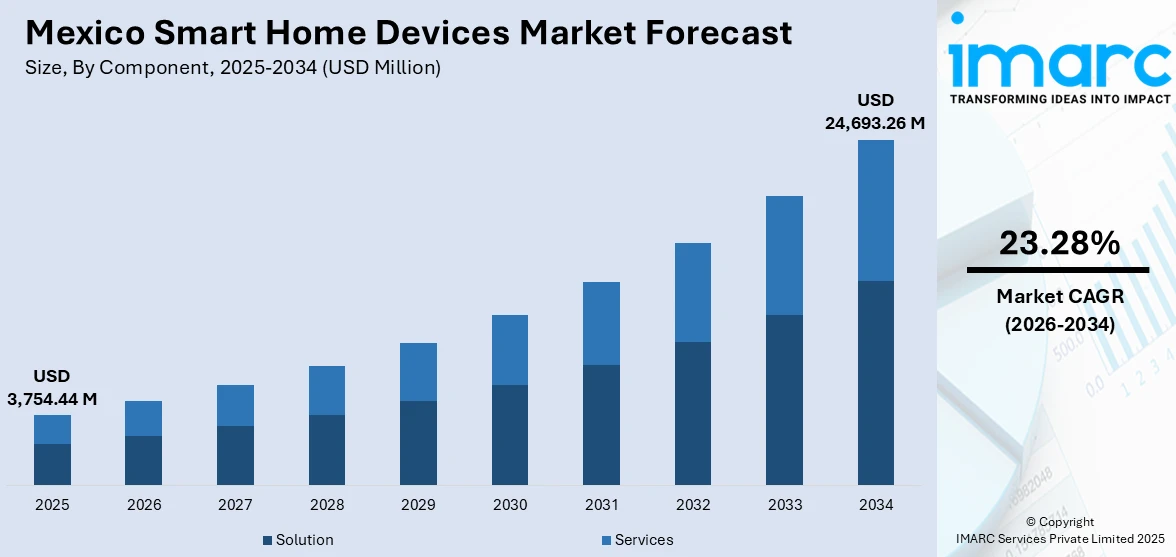
The Mexico smart home devices market size was valued at USD 3,754.44 Million in 2025 and is projected to reach USD 24,693.26 Million by 2034, growing at a compound annual growth rate of 23.28% from 2026-2034.
The Mexico smart home devices market is experiencing robust expansion driven by rapid urbanization, increasing digital connectivity, and growing consumer preference for automated living solutions. Rising disposable incomes among the middle-class population, coupled with heightened security concerns and energy efficiency awareness, are accelerating adoption. Enhanced telecommunications infrastructure and expanding e-commerce channels are further strengthening the Mexico smart home devices market share.
Key Takeaways and Insights:
- By Component: Solution dominates the market with a share of 75.6% in 2025, owing to its comprehensive integration capabilities and seamless connectivity features. Advanced software platforms enable centralized control of diverse household systems, driving widespread consumer adoption.
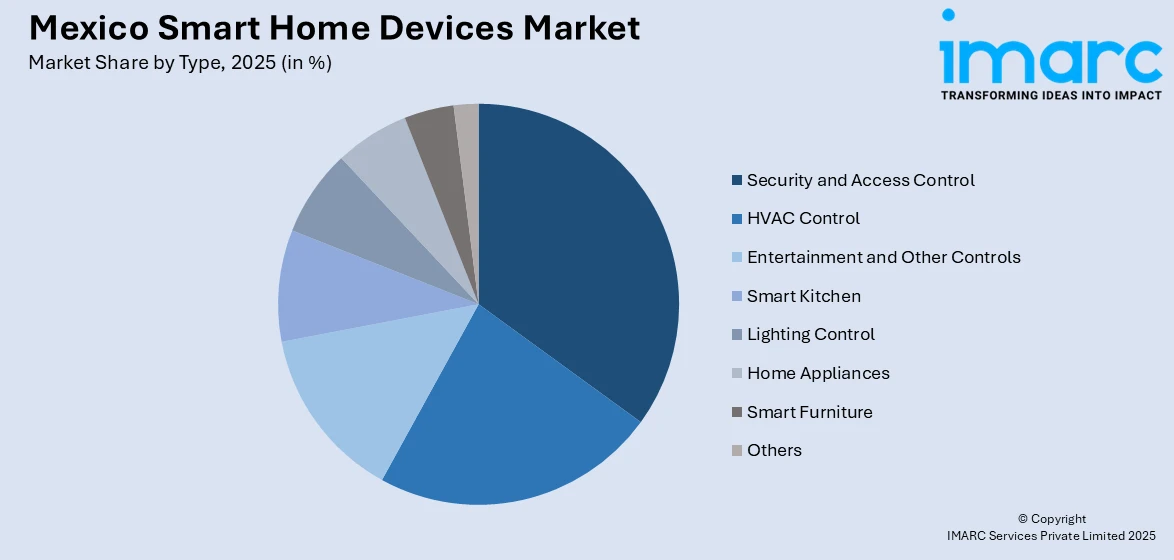
- By Type: Security and access control leads the market with a share of 34.8% in 2025. This dominance is driven by escalating safety concerns among urban residents, technological advancements in surveillance systems, and growing demand for real-time monitoring capabilities.
- By Region: Central Mexico represents the largest region with 45% share in 2025, driven by the concentration of economic activity in Mexico City metropolitan area, superior digital infrastructure, and higher purchasing power enabling premium technology investments.
- Key Players: Key players drive the Mexico smart home devices market by expanding product portfolios, enhancing interoperability standards, and strengthening distribution networks. Their investments in artificial intelligence integration, voice assistant compatibility, and energy management solutions boost consumer awareness, accelerate adoption, and ensure consistent product availability across diverse market segments.
To get more information on this market Request Sample
The Mexico smart home devices market is advancing rapidly as consumers, developers, and technology providers embrace connected living solutions. The integration of Internet of Things technology has transformed residential environments, enabling homeowners to manage lighting, climate control, security systems, and entertainment through unified platforms accessible via smartphones and voice commands. According to the 2024 National Survey on Availability and Use of Information Technologies in Households, more than 25% of Mexican households have smart gadgets. Urban areas demonstrate particularly strong adoption rates, with metropolitan regions leading technology integration efforts. The growing availability of affordable smart devices through expanded e-commerce channels has democratized access to home automation technologies. Energy management capabilities remain a significant attraction, as consumers seek solutions that optimize electricity consumption and reduce utility expenses. The convergence of enhanced security features, convenience-oriented automation, and energy efficiency benefits continues strengthening the Mexico smart home devices market growth trajectory.
Mexico Smart Home Devices Market Trends:
Rising Integration of Artificial Intelligence and Voice Assistants
The Mexico smart home devices market is witnessing accelerated adoption of artificial intelligence-powered systems and voice-controlled assistants. Homeowners increasingly prefer devices that respond to natural language commands, enabling hands-free operation of lighting, thermostats, and security systems. Advanced machine learning algorithms personalize user experiences by learning household routines and automatically adjusting settings. This technological evolution enhances convenience while reducing manual intervention requirements across residential environments. According to Amazon's official announcement in February 2025, the company launched Alexa+, its next-generation AI assistant powered by generative AI, with early access users talking to Alexa over two times more and having deeper conversations on various topics while relying on the assistant to complete more tasks including controlling smart home devices.
Expansion of Interconnected Home Ecosystems
Ecosystems of connected home solutions in Mexico are growing, driven by the need for integrated systems that combine different types of products in a seamless way. Interoperability allows connectivity between different devices in a house, including security devices, home appliances, and other electronic devices from various manufacturers. With an integrated control system for connected home solutions, users can control various aspects of their homes easily with their smartphones or other control hubs. This not only improves the consumer experience but also justifies the cost of different connected devices in a home.
Growing Emphasis on Energy Management Solutions
Energy management capabilities are becoming increasingly central to smart home adoption in Mexico. Rising electricity costs motivate homeowners to invest in technologies that monitor and optimize power consumption patterns. Smart thermostats, automated lighting systems, and energy-aware appliances enable significant reductions in utility expenses while providing detailed consumption analytics. Environmental consciousness among younger demographics further accelerates demand for sustainable solutions that minimize carbon footprints while maintaining optimal comfort and convenience levels throughout residential properties nationwide.
Market Outlook 2026-2034:
The outlook for the smart home devices market in Mexico is extremely robust. The growth in the smart home devices market in Mexico is expected to continue during the forecast period, due to the presence of a conducive environment characterized by technological advancements, increased digital infrastructure, and changing consumer behavior. Real estate developers have been widely adopting smart home devices in new construction projects, attributed to their high demand among tech-savvy individuals. The government has also been spearheading Initiatives aimed at encouraging efficiency in energy consumption in homes, creating a conducive environment in which the market will continue to grow in the future. The market generated a revenue of USD 3,754.44 Million in 2025 and is projected to reach a revenue of USD 24,693.26 Million by 2034, growing at a compound annual growth rate of 23.28% from 2026-2034.
Mexico Smart Home Devices Market Report Segmentation:
|
Segment Category |
Leading Segment |
Market Share |
|
Component |
Solution |
75.6% |
|
Type |
Security and Access Control |
34.8% |
|
Region |
Central Mexico |
45.0% |
Component Insights:
- Solution
- Services
Solution dominates with a market share of 75.6% of the total Mexico smart home devices market in 2025.
Solution components encompass integrated software platforms, device management systems, and automation protocols that enable seamless connectivity across diverse household appliances and security equipment. These comprehensive solutions facilitate centralized control through intuitive interfaces, allowing homeowners to monitor and manage lighting, climate systems, entertainment units, and safety devices from unified dashboards. Mexico's expanding digital infrastructure, characterized by widespread internet connectivity and growing broadband access, creates a robust technological foundation that supports smart solution deployment across residential environments throughout the country.
The importance of solution components indicates that consumers prefer to have ecosystems rather than devices. Modern smart home systems come with many features that are highly customizable, allowing users to create different automation schemes that are highly personalized. Thus, the major features provide an enhanced sense of accessibility via voice assistant devices. Moreover, the use of a cloud-based system enhances the general software upgrade and extension options. Such high analysis capabilities are beneficial to consumers by assisting them in maximizing the benefits of smart home technology.
Type Insights:
Access the comprehensive market breakdown Request Sample
- Security and Access Control
- HVAC Control
- Entertainment and Other Controls
- Smart Kitchen
- Lighting Control
- Home Appliances
- Smart Furniture
- Others
Security and access control leads with a share of 34.8% of the total Mexico smart home devices market in 2025.
Security and access control systems encompass smart cameras, video doorbells, electronic locks, motion sensors, and alarm systems that provide comprehensive property protection. These devices enable real-time monitoring through smartphone applications, allowing homeowners to observe their premises remotely and receive instant alerts regarding suspicious activities. The Mexico home security systems market size is expected to reach USD 2,133.50 Million by 2033, reflecting substantial consumer investment in protective technologies. Integration with broader smart home ecosystems enhances security effectiveness through automated responses and coordinated device operation.
The segment's leadership position reflects heightened safety consciousness among Mexican households, particularly in densely populated urban centers where property crime concerns motivate technology investments. Advanced features including facial recognition, package detection, and two-way audio communication enhance security system functionality. Cloud storage capabilities enable homeowners to review footage remotely, while artificial intelligence-powered analytics reduce false alarms and improve threat detection accuracy. The convergence of affordability improvements and feature enhancements continues driving adoption across residential and commercial applications throughout Mexico.
Regional Insights:
- Northern Mexico
- Central Mexico
- Southern Mexico
- Others
Central Mexico exhibits a clear dominance with a 45% share of the total Mexico smart home devices market in 2025.
Central Mexico's market leadership stems from the concentration of economic activity, population density, and technological infrastructure within the Mexico City metropolitan region. Greater Mexico City alone contributes approximately 22 percent to the national gross domestic product, supporting substantial consumer purchasing power for premium technology products. Superior fiber optic and broadband coverage enable reliable smart device connectivity, facilitating widespread adoption across residential and commercial properties throughout the region.
The region offers superior telecommunication infrastructure, strong retail reach, and high concentration of tech service providers that facilitate the development of smart home ecosystems. Urban development initiatives include smart home systems, whereas renovation undertakings in established neighborhoods contribute to smart home device installations. The level of education and increased awareness regarding technology among Central Mexico inhabitants create a lucrative scenario for smart home device adoption, acting as a primary driver for the national market.
Market Dynamics:
Growth Drivers:
Why is the Mexico Smart Home Devices Market Growing?
Expanding Digital Infrastructure and Connectivity
The rapid expansion of digital infrastructure throughout Mexico is fundamentally enabling smart home devices market growth. Telecommunications operators are investing substantially in fiber optic network deployment, transitioning households from legacy copper connections to high-speed broadband capable of supporting multiple connected devices simultaneously. Mobile network enhancements, including expanded coverage and improved bandwidth, provide alternative connectivity pathways for smart home systems in areas where fixed broadband remains limited. Government initiatives promoting digital inclusion have accelerated connectivity improvements in previously underserved communities, broadening the addressable market for smart home technologies. The proliferation of affordable smartphones with advanced capabilities enables consumers to control and monitor smart home devices remotely, enhancing the value proposition of home automation investments. Enhanced network reliability and reduced latency support real-time applications critical for security monitoring and home management, strengthening consumer confidence in connected device performance across residential environments. According to the Federal Telecommunications Institute (IFT), Mexico experienced the highest annual growth in fiber-optic broadband penetration among OECD member countries between December 2022 and December 2023, increasing from 41.1% to 64.5%, demonstrating the country's accelerating digital infrastructure development.
Rising Security Concerns and Safety Awareness
The rising security concerns of families in Mexico have a significant influence on the smart security and access solutions. Urban dwellers want solutions that provide real-time monitoring of security. Smart security solutions have helped them identify who is at the gate before granting access. It has also helped them monitor the actions of those around their homes in their absence. Moreover, smart security solutions have provided the psychological benefits required for investment, especially among the early technology skeptics. The integration of security solutions into smart homes has given families the benefit of full security through automated responses, such as lighting up the compound upon the movement of any suspicious activity. Smart security has also encouraged safety awareness in the neighborhood through the smart security solutions adopted. The uptake of smart security solutions has been rewarded by insurance companies, who give discounts on installations. This will lead to high returns on investment for those who install smart security solutions and will increase investment in smart security solutions.
Growing Middle Class and Increasing Disposable Incomes
In addition, Mexico's expanding middle-class population is developing increasing disposable incomes, which is driving significant demand for smart home technologies that raise the quality and convenience of living. Economic development has raised purchasing power among urban professionals and suburban families, who increasingly invest in home automation as an improvement to lifestyle. These consumers are willing to invest in simplify daily routines, optimize energy consumption, and modernize residential environments. Smart home devices have moved from luxury products into accessible technologies, with manufacturing efficiencies reducing their prices across product categories. Younger demographics entering into homeownership show strong technology orientation and expectation for connected living features. Real estate market dynamics increasingly favor properties equipped with smart home capabilities, creating investment incentives beyond immediate utility benefits. E-commerce platform expansion improves the access of smart devices, allowing price comparisons and convenient purchases that accelerate market penetration across income segments throughout Mexico.
Market Restraints:
What Challenges is the Mexico Smart Home Devices Market Facing?
High Initial Investment Costs
The substantial upfront costs associated with comprehensive smart home system installation remain a significant barrier to broader market adoption in Mexico. Complete home automation solutions require considerable investment in devices, installation services, and potentially infrastructure upgrades that exceed budgetary constraints for many households. While long-term operational savings from energy efficiency and reduced maintenance exist, immediate financial outlays deter price-sensitive consumers who prioritize essential expenditures. Limited availability of financing options specifically designed for smart home purchases compounds affordability challenges across middle-income demographics.
Data Privacy and Cybersecurity Concerns
Persistent concerns regarding data privacy and cybersecurity vulnerabilities impede smart home adoption among security-conscious consumers in Mexico. Connected devices collect substantial personal information including daily routines, occupancy patterns, and access credentials that present attractive targets for malicious actors. Reports of device hacking, unauthorized surveillance access, and data breaches heighten consumer apprehension about entrusting home security to networked systems. Insufficient consumer awareness regarding proper security configurations and password management practices compounds vulnerability risks across installed smart home ecosystems.
Infrastructure Disparities in Rural and Underserved Areas
Significant disparities in telecommunications infrastructure between urban centers and rural communities limit smart home devices market expansion across substantial portions of Mexico. Unreliable internet connectivity, inconsistent electricity supply, and limited technical support availability in remote regions prevent effective smart device deployment and operation. Households in underserved areas lack the foundational infrastructure necessary for connected home ecosystems, excluding them from market participation regardless of interest or purchasing capability. Addressing these infrastructure gaps requires substantial public and private investment over extended implementation timelines.
Competitive Landscape:
The unstructured landscape of the Mexico smart home devices market is moderately fragmented, with a mix of multinational technology corporations, electronics manufacturers, and automation solution providers. Market players are competing with each other on multiple parameters, for example, innovative products, compatibility, pricing, and after-sales support. Major market players are focusing on broadening their product offerings to meet varied customer demands for innovative applications such as security, entertainment, climate control, and energy management. The strategic partnerships between the manufacturers of smart home devices and telecom service providers also play an important role in driving the market. Optimum use of distribution channels is another important aspect for market players to enhance ties with electronics, home improvement, and online retailing channels. Investment in customer support services helps to build customer loyalty and minimize issues for newcomers to the market.
Mexico Smart Home Devices Market Report Coverage:
|
Report Features |
Details |
|
Base Year of the Analysis |
2025 |
|
Historical Period |
2020-2025 |
|
Forecast Period |
2026-2034 |
|
Units |
Million USD |
|
Scope of the Report |
Exploration of Historical Trends and Market Outlook, Industry Catalysts and Challenges, Segment-Wise Historical and Future Market Assessment:
|
|
Components Covered |
Solution, Services |
|
Types Covered |
Security and Access Control, HVAC Control, Entertainment and Other Controls, Smart Kitchen, Lighting Control, Home Appliances, Smart Furniture, Others |
|
Regions Covered |
Northern Mexico, Central Mexico, Southern Mexico, Others |
|
Customization Scope |
10% Free Customization |
|
Post-Sale Analyst Support |
10-12 Weeks |
|
Delivery Format |
PDF and Excel through Email (We can also provide the editable version of the report in PPT/Word format on special request) |
Frequently Asked Questions About the Mexico Smart Home Devices Market Report
The Mexico smart home devices market size was valued at USD 3,754.44 Million in 2025.
The Mexico smart home devices market is expected to grow at a compound annual growth rate of 23.28% from 2026-2034 to reach USD 24,693.26 Million by 2034.
Security and access control dominated the market with a share of 34.8%, driven by escalating safety concerns among urban households, advancing surveillance technologies, and growing demand for real-time remote monitoring capabilities across residential properties.
Key factors driving the Mexico smart home devices market include expanding digital infrastructure and broadband connectivity, rising security concerns among urban populations, growing middle-class purchasing power, and increasing consumer awareness of energy efficiency benefits.
Major challenges include high initial investment costs limiting adoption among price-sensitive consumers, data privacy and cybersecurity vulnerabilities concerns, infrastructure disparities between urban and rural areas, interoperability limitations across different manufacturers, and insufficient consumer awareness regarding installation and configuration requirements.
Need more help?
- Speak to our experienced analysts for insights on the current market scenarios.
- Include additional segments and countries to customize the report as per your requirement.
- Gain an unparalleled competitive advantage in your domain by understanding how to utilize the report and positively impacting your operations and revenue.
- For further assistance, please connect with our analysts.
 Request Customization
 Speak to an Analyst
 Request Brochure
 Inquire Before Buying
Benefits of Customization
- Personalize this research
- Triangulate with your data
- Get data as per your format and definition
- Gain a deeper dive into a specific application, geography, customer, or competitor
- Any level of personalization
Get in Touch With Us
UNITED STATES
Phone: +1-201-971-6302
INDIA
Phone: +91-120-433-0800
UNITED KINGDOM
Phone: +44-753-714-6104
Email: [email protected]
Client Testimonials




.webp)




.webp)













Related Reports

Choose your plan
*Please note that the prices mentioned below are starting prices for each bundle type. Kindly contact our team for further details.*
Single User License
- 1 User License, Access on 2 Devices
- PDF Report + Excel Dataset (Password Protected)
- Lifetime Access
- No Printing Rights
- 10% Free Report Customization
- 10–12 Weeks of Analyst Support
Five User License
- Access for 5 Users, 2 Devices per User
- PDF Report + Excel Dataset (Password Protected)
- Lifetime Access
- Dedicated Account Manager
- 12–14 Weeks of Analyst Support
- No Printing Rights
- 15% Free Report Customization
- 25% Discount on Your Next Purchase
Corporate User License
- Unlimited User Access (Within Your Organization)
- PDF Report + Excel Dataset
- Lifetime Access
- Dedicated Account Manager
- 14–20 Weeks of Analyst Support
- No Printing Rights
- 20% Free Report Customization
- 30% Discount on Your Next Purchase
Essential Insights
What's included:
3 reports
- Lifetime Access
- PDF Reports
- Excel Datasets
- 2 Weeks of Free Analyst Support
- 2 User Licenses
- Access on 2 Devices
- Printing Rights
- Complimentary PowerPoint (PPT) Version
- Complimentary License Upgrade
Professional Access
What's included:
5 reports
- Lifetime Access
- PDF Reports
- Excel Datasets
- 8 Weeks of Free Analyst Support
- 2 User Licenses
- Access on 2 Devices
- Printing Rights
- Complimentary PowerPoint (PPT) Version
- Complimentary License Upgrade
Business Advantage
What's included:
8 reports
- Lifetime Access
- PDF Reports
- Excel Datasets
- 14 Weeks of Free Analyst Support
- 2 User Licenses
- Access on 2 Devices
- Printing Rights
- Complimentary PowerPoint (PPT) Version
- Complimentary License Upgrade
Enterprise Intelligence
What's included:
10 reports
- Lifetime Access
- PDF Reports
- Excel Datasets
- 20 Weeks of Free Analyst Support
- 2 User Licenses
- Access on 2 Devices
- Printing Rights
- Complimentary PowerPoint (PPT) Version
- Complimentary License Upgrade