
Mexico Smart TV Market Size, Share, Trends and Forecast by Resolution Type, Technology, Screen Size, Screen Type, Platform, Application, and Distribution Channel, 2026-2034
Mexico Smart TV Market Size, Share, Trends & Forecast (2026-2034)
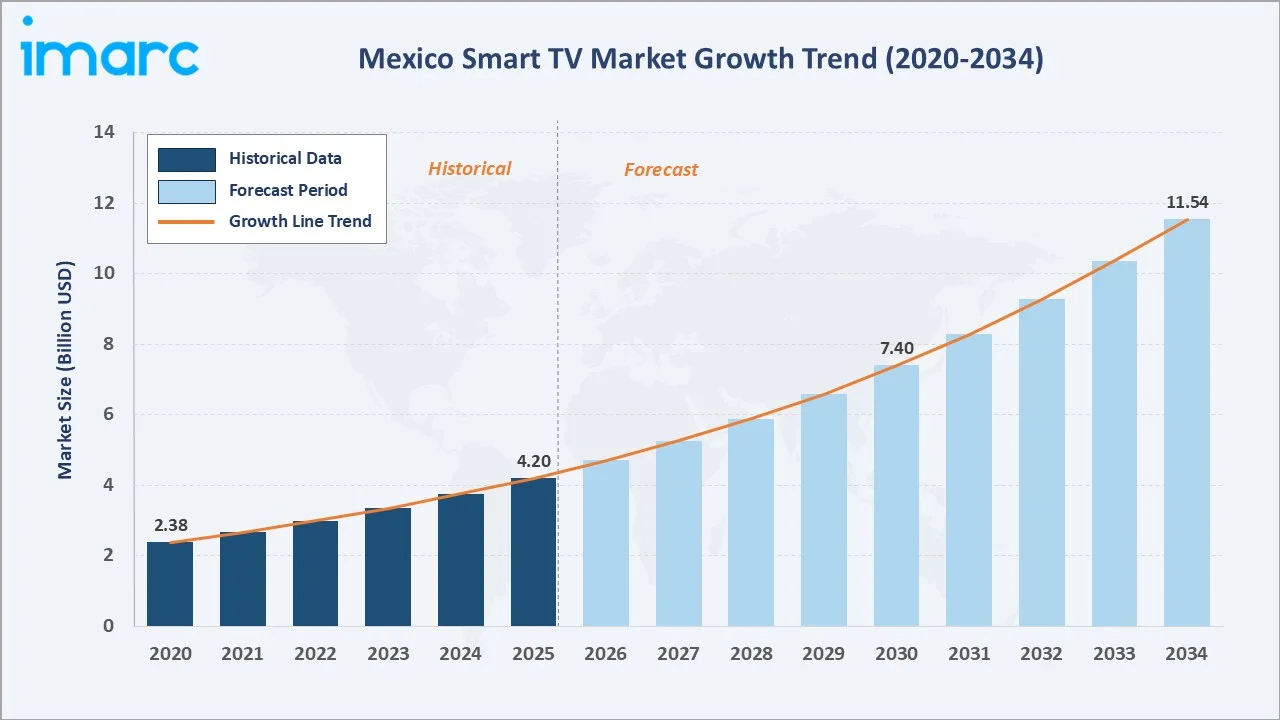
The Mexico smart TV market size increased from USD 4.20 Billion in 2025 to USD 4.70 Billion in 2026 and is projected to reach USD 11.54 Billion by 2034, growing at a CAGR of 12.00% during 2026-2034. The market is driven by rising internet penetration, expanding OTT streaming consumption, and growing demand for connected home entertainment. In Mexico, smartphones remain the leading device for internet access, while smart TVs have emerged as the second major connectivity device, with adoption rising sharply from 5.4% in 2015 to 50% in 2025. This rapid uptake is driving the market by expanding the connected-viewing base, increasing OTT and streaming consumption, and encouraging households to upgrade from conventional televisions to internet-enabled models. Residential leads application at 87.4%. Offline leads distribution at 66.8%.
Market Snapshot
|
Metric |
Value |
|
Base Year Market Size (2025) |
USD 4.20 Billion |
| Market Size (2026) | USD 4.70 Billion |
|
Forecast Market Size (2034) |
USD 11.54 Billion |
|
CAGR (2026-2034) |
12.00% |
|
Base Year |
2025 |
|
Historical Period |
2020-2025 |
|
Forecast Period |
2026-2034 |
|
Dominant Application |
Residential (87.4%, 2025) |
|
Dominant Distribution Channel |
Offline (66.8%, 2025) |
The Mexico smart TV market has shown strong growth, rising from USD 2.38 Billion in 2020 to USD 4.20 Billion in 2025, reaching an estimated USD 4.70 Billion in 2026. The market is expected to maintain this momentum, reaching USD 7.40 Billion by 2030. By 2034, it is forecast to expand further to USD 11.54 Billion, supported by rising OTT adoption, faster internet access, and increasing consumer preference for connected entertainment devices. This reflects sustained demand across both replacement and first-time smart TV purchases.
To get more information on this market, Request Sample
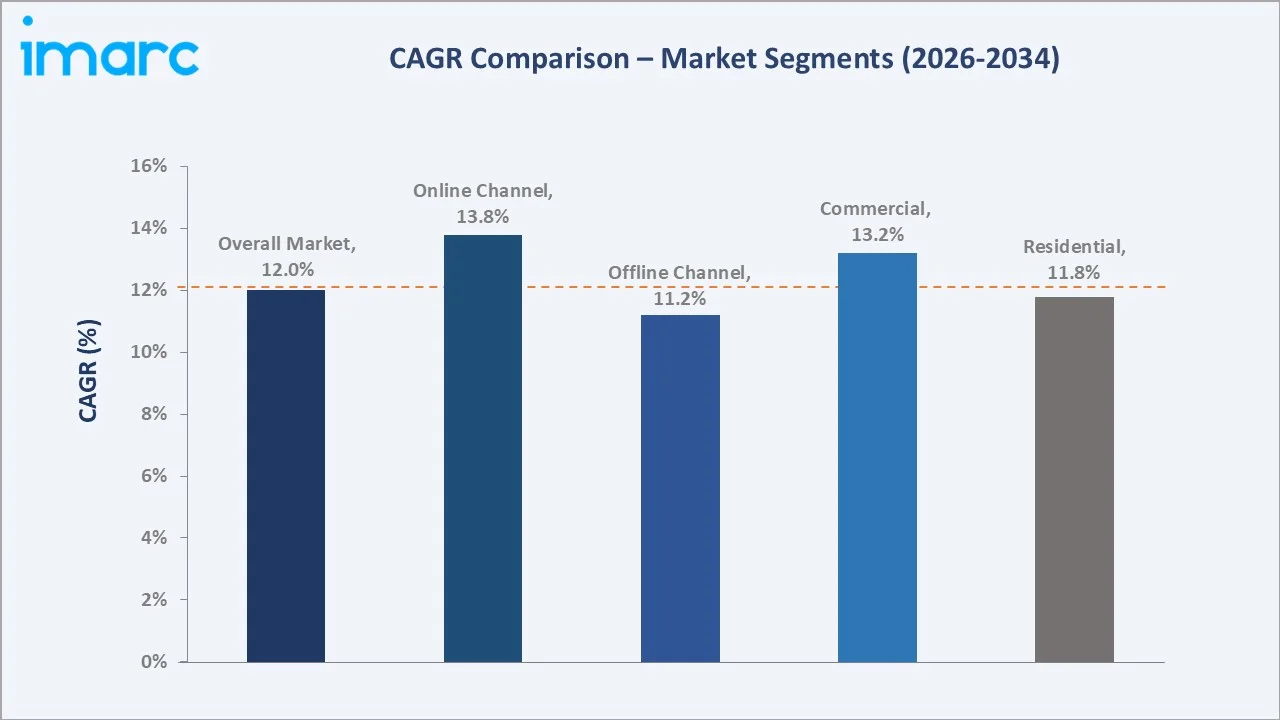
Online distribution grows fastest at ~13.8% CAGR through Amazon Mexico and brand DTC e-commerce. Commercial application grows at ~13.2% CAGR through hotel, hospitality, and digital signage. Residential grows at ~11.8% CAGR driven by OTT streaming household penetration.
Executive Summary
Mexico’s smart TV market is evolving from a premium product segment into a mainstream household entertainment category. Growth is supported by expanding broadband access, rising OTT consumption, and increasing preference for app-based digital viewing. Affordable models, larger screen options, and improved retail availability are encouraging consumers to replace conventional TVs. Manufacturers are focusing on 4K displays, voice control, streaming partnerships, and competitive pricing. Overall, the market is set for steady expansion as connected entertainment becomes central to Mexican households. Residential at 87.4% leads through household OTT streaming. Offline at 66.8% leads through Walmart, Liverpool, Coppel, Elektra, Costco, and department/electronics retailers.
Key Market Insights
|
Insight |
Data |
|
Dominant Application |
Residential - 87.4% share (2025) |
|
Dominant Distribution Channel |
Offline - 66.8% market share (2025) |
|
Market Opportunity |
OLED and MiniLED premium tier growing; Google TV and Android TV OS Mexico; commercial hotel/hospitality smart display; gaming smart TV; online e-commerce growth; rural Mexico internet expanding |
Key Analytical Observations Supporting The Above Data:
- Residential at 87.4%: The residential segment dominates as households increasingly prefer connected devices for OTT streaming, gaming, and app-based entertainment. Rising disposable incomes, affordable smart TV models, and the replacement of conventional TVs further support strong residential demand.
- Offline at 66.8%: The offline segment dominates as consumers prefer physical stores to compare screen sizes, picture quality, prices, and after-sales support before purchase. Retail chains also drive sales through discounts, financing options, installation support, and bundled offers.
Mexico Smart TV Market Overview
The Mexico smart TV market encompasses internet-enabled television sets integrated with operating systems, streaming applications, voice control, and wireless connectivity. It includes various screen sizes, display technologies, and resolution formats such as HD, Full HD, 4K, and premium models. The market covers residential and commercial usage across homes, hotels, offices, and entertainment venues. It also includes sales through offline retail chains, electronics stores, e-commerce platforms, and brand websites. Overall, the market reflects the growing shift from traditional television viewing to connected, app-based digital entertainment. Macroeconomic factors influencing the Mexico smart TV market include rising disposable incomes, increasing urbanization, and expanding broadband infrastructure.
Market Dynamics
To evaluate market opportunities, Request Sample
Market Drivers
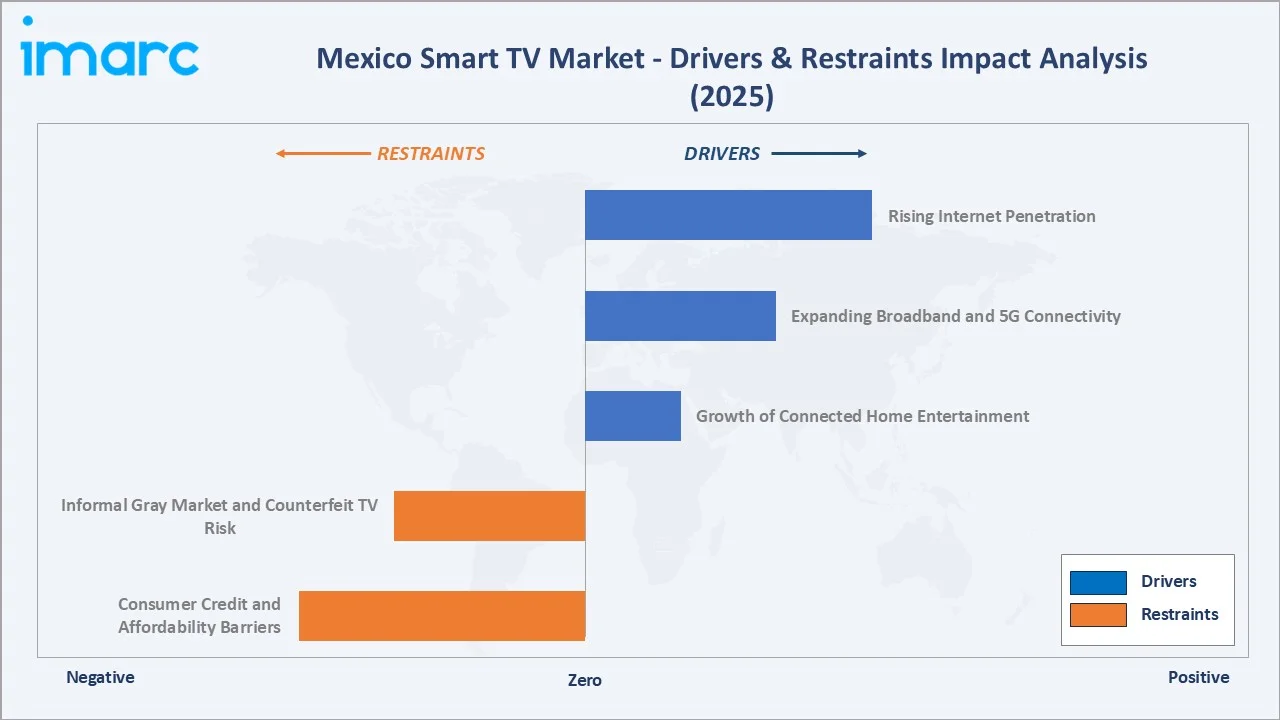
- Rising Internet Penetration: By late 2025, Mexico had around 110 million internet users, equal to 83.5% of the total population. This rising internet penetration is a major growth driver, as greater household connectivity increases access to streaming platforms, online content, and smart home applications. Expanding broadband and mobile internet coverage encourages consumers to adopt internet-enabled televisions for on-demand entertainment. As more households gain reliable high-speed connectivity, smart TVs become a practical alternative to traditional broadcasting. This trend is further strengthening demand for connected and feature-rich television devices across the country.
- Expanding Broadband and 5G Connectivity: As of Q4 2024, Mexico ranks third in Latin America for the share of 5G connections per market (9.4%). Expanding broadband and 5G connectivity, enabling faster, smoother, and more reliable access to streaming platforms and online content. Better network speeds support HD, 4K, cloud gaming, and app-based viewing, making smart TVs more valuable for households. As connectivity improves beyond major cities, adoption is also rising in smaller urban and semi-urban areas. This strengthens replacement demand for traditional TVs with internet-enabled models.
- Growth of Connected Home Entertainment: The growth of connected home entertainment is driving the market as households increasingly use TVs as central hubs for streaming, gaming, music, casting, and smart device integration. Consumers prefer smart TVs that offer seamless access to OTT apps, voice assistants, and wireless connectivity. This shift is increasing demand for larger, feature-rich screens that support multi-purpose entertainment. As digital lifestyles expand, smart TVs are becoming an essential part of modern Mexican homes.
Market Restraints
- Informal Gray Market and Counterfeit TV Risk: Informal gray-market sales and counterfeit TV risks undercut authorized brands with cheaper, unverified products. These devices often lack warranty coverage, quality assurance, software updates, and after-sales support, reducing consumer trust. Counterfeit or non-certified models can also create performance, safety, and compatibility issues. This pressures legitimate retailers and brands, while weakening formal market revenues and premium product adoption.
- Consumer Credit and Affordability Barriers: Consumer credit and affordability barriers are limiting purchases of higher-priced 4K, OLED, and large-screen models. Many households remain sensitive to upfront costs, especially during periods of inflation or tighter credit conditions. Limited access to easy financing can delay replacement cycles and push consumers toward entry-level or second-hand TVs. This restricts premium product adoption and slows overall market value growth.
Market Opportunities
- Integration of AI and Voice-Controlled Smart TVs: Integration of AI and voice-controlled smart TVs enhances user convenience and personalization. AI-powered features such as content recommendations, picture optimization, and multilingual voice assistants improve the viewing experience and increase consumer engagement. Growing adoption of smart home ecosystems is also encouraging demand for TVs that can control connected devices through voice commands. As consumers seek more intuitive and interactive entertainment solutions, AI-enabled smart TVs are expected to drive premium product sales and market value growth.
- Expansion of Ad-Free Premium Viewing Experiences: Expansion of ad-free premium viewing experiences represents a strong opportunity as consumers increasingly seek uninterrupted, high-quality digital entertainment. In April 2026, Roku, the leading TV streaming platform, introduced Howdy in Mexico, a new ad-free SVOD service priced at MXN 39 per month. The platform offers unlimited access to a growing content library, including thousands of titles and viewing hours from partners such as Lionsgate, Sony, and TV Azteca, along with selected Roku Originals. The launch of affordable ad-free streaming services encourages greater engagement with connected TV platforms and increases the value of smart TVs within households.
Market Challenges
- Rapid Technology Obsolescence and Short Product Cycles: Rapid technology obsolescence and short product cycles make devices outdated quickly as new display technologies, operating systems, and AI-powered features are introduced. Consumers often delay purchases in anticipation of newer models, which can slow replacement demand. Manufacturers and retailers also face inventory management risks as unsold products lose value rapidly. Additionally, frequent product upgrades increase pricing pressure and compress profit margins across the value chain.
- Cybersecurity and Data Privacy Concerns in Connected Devices: Cybersecurity and data privacy concerns challenge the market as connected TVs collect user data, viewing habits, app activity, and voice-command inputs. Any risk of unauthorized access, data misuse, or weak device security can reduce consumer confidence in smart TV adoption. These concerns also increase compliance pressure on manufacturers to provide secure software updates, privacy controls, and transparent data practices. As smart TVs become part of connected home ecosystems, security risks may slow adoption among privacy-conscious consumers.
Emerging Market Trends
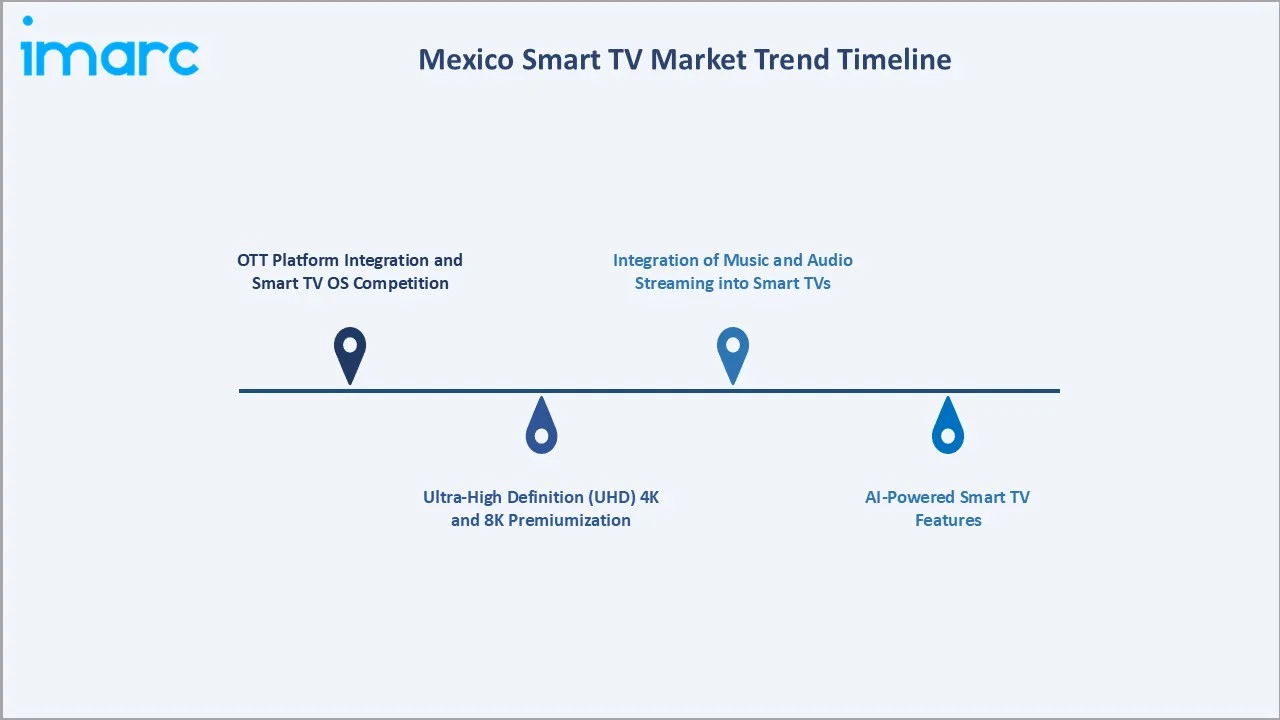
1. OTT Platform Integration and Smart TV OS Competition
OTT platform integration and smart TV OS competition are emerging as brands compete to offer smoother access to Netflix, YouTube, Roku, Prime Video, Disney+, and local content apps. Operating systems such as Roku TV, Google TV, Android TV, Tizen, and webOS are becoming important purchase factors. Consumers increasingly prefer TVs with faster interfaces, app availability, voice search, and personalized recommendations. This is pushing manufacturers to strengthen software ecosystems, content partnerships, and user experience differentiation.
2. Ultra-High Definition (UHD) 4K and 8K Premiumization
Ultra-high definition 4K and 8K premiumization is emerging as consumers increasingly seek sharper picture quality, larger screens, and cinema-like home viewing. Growing OTT content in HD and 4K is encouraging households to upgrade from basic smart TVs to premium UHD models. Brands are also promoting QLED, OLED, HDR, and high-refresh-rate displays to differentiate products. This trend is raising average selling prices and supporting value growth in the market.
3. AI-Powered Smart TV Features
AI-powered smart TV features are emerging as brands add personalized content recommendations, voice search, automatic picture optimization, and smart home controls. These features improve convenience and make content discovery easier across multiple OTT platforms. AI also supports better viewing quality by adjusting brightness, sound, and resolution based on content and room conditions. As consumers seek more interactive and premium entertainment experiences, AI-enabled TVs are becoming an important product differentiator.
4. Integration of Music and Audio Streaming into Smart TVs
Integration of music and audio streaming into smart TVs is emerging as smart TVs evolve beyond video viewing into complete home entertainment hubs. Channels offering regional music, classic cinema audio, retro hits, and social media-driven music content increase daily engagement on smart TV platforms. In August 2025, Stingray launched several new channels on LG Channels, expanding its music and video entertainment portfolio in Brazil and Mexico. In Mexico, LG smart TV users can access new audio channels featuring regional Mexican music, Golden Age Mexican cinema content, 1980s Mexican pop hits, and Spanish-language TikTok Radio with trending songs and popular video clips. This trend supports partnerships between TV brands, FAST platforms, and music-content providers.
Industry Value Chain Analysis
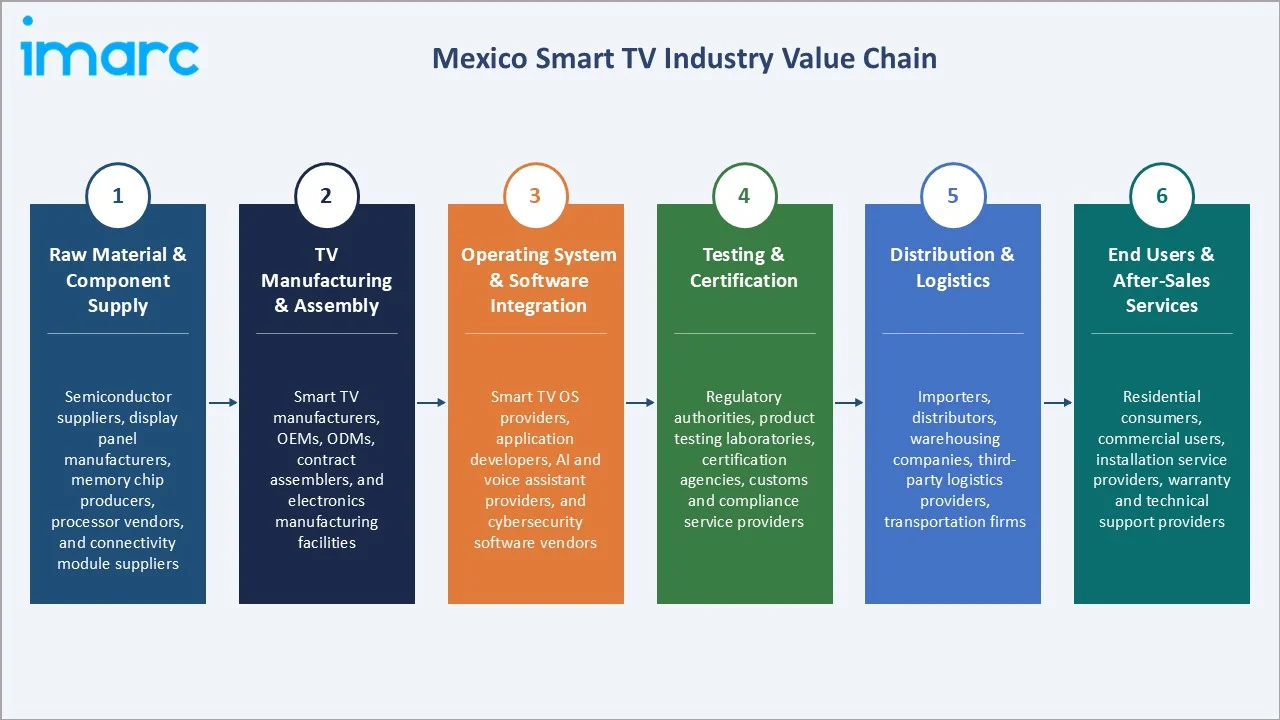
Mexico smart TV value chain integrates raw material & component supply, TV manufacturing & assembly, operating system & software integration, testing & certification, distribution & logistics, and end users & after-sales services.
|
Stage |
Key Participants |
|
Raw Material & Component Supply |
Semiconductor suppliers, display panel manufacturers, memory chip producers, processor vendors, and connectivity module suppliers |
|
TV Manufacturing & Assembly |
Smart TV manufacturers, OEMs, ODMs, contract assemblers, and electronics manufacturing facilities |
|
Operating System & Software Integration |
Smart TV OS providers, application developers, AI and voice assistant providers, and cybersecurity software vendors |
|
Testing & Certification |
Regulatory authorities, product testing laboratories, certification agencies, customs and compliance service providers |
|
Distribution & Logistics |
Importers, distributors, warehousing companies, third-party logistics providers, transportation firms |
|
End Users & After-Sales Services |
Residential consumers, commercial users, installation service providers, warranty and technical support providers |
The operating system & software integration stage is the most value-added part of the Mexico smart TV value chain. This stage creates differentiation through app availability, OTT integration, AI features, voice control, personalization, and user interface quality. It also supports recurring engagement and partnerships with streaming platforms, making the smart TV more than just hardware.
Technology Landscape in the Mexico Smart TV Industry
Display Panel Technology
Display panel technology is shaping the technology landscape as manufacturers compete through advancements in LED, QLED, OLED, Mini-LED, and emerging 8K display solutions. Consumers are increasingly demanding better picture quality, higher brightness, deeper contrast, and enhanced color accuracy for streaming and gaming applications. The growing availability of premium content in 4K UHD is accelerating the adoption of advanced display technologies. As a result, panel innovation has become a key differentiator influencing product positioning, pricing, and brand competitiveness in the market.
HDR and Picture Enhancement Technologies
HDR and picture enhancement technologies are significantly improving image quality, color accuracy, contrast, and brightness. Technologies such as HDR10, HDR10+, Dolby Vision, AI upscaling, and local dimming are enabling a more immersive viewing experience for streaming, sports, and gaming content. As OTT platforms increasingly offer HDR-enabled content, consumers are showing greater preference for TVs equipped with advanced picture-processing capabilities. This trend is accelerating the shift toward premium smart TV models and strengthening competition based on visual performance.
Cloud Gaming and Low-Latency Gaming Technology
Cloud gaming and low-latency gaming technologies are turning smart TVs into gaming-ready entertainment devices without requiring dedicated consoles. Features such as low input lag, high refresh rates, HDMI 2.1, game mode, and cloud gaming app support improve the gaming experience. As broadband and 5G connectivity expand, users can stream games directly on smart TVs with smoother performance. This is encouraging brands to position premium smart TVs as multipurpose devices for streaming, gaming, and connected entertainment.
Market Segmentation Analysis
The report covers the following segments:
|
Segment Category |
Leading Segment |
Market Share |
Year |
|
Resolution Type |
4K UHD TV |
🔒 |
2025 |
|
Technology |
LED |
🔒 |
2025 |
|
Screen Size |
32 to 45 Inches |
🔒 |
2025 |
|
Screen Type |
Flat |
🔒 |
2025 |
|
Platform |
Android |
🔒 |
2025 |
|
Application |
Residential |
87.4% |
2025 |
|
Distribution Channel |
Offline |
66.8% |
2025 |

By Application
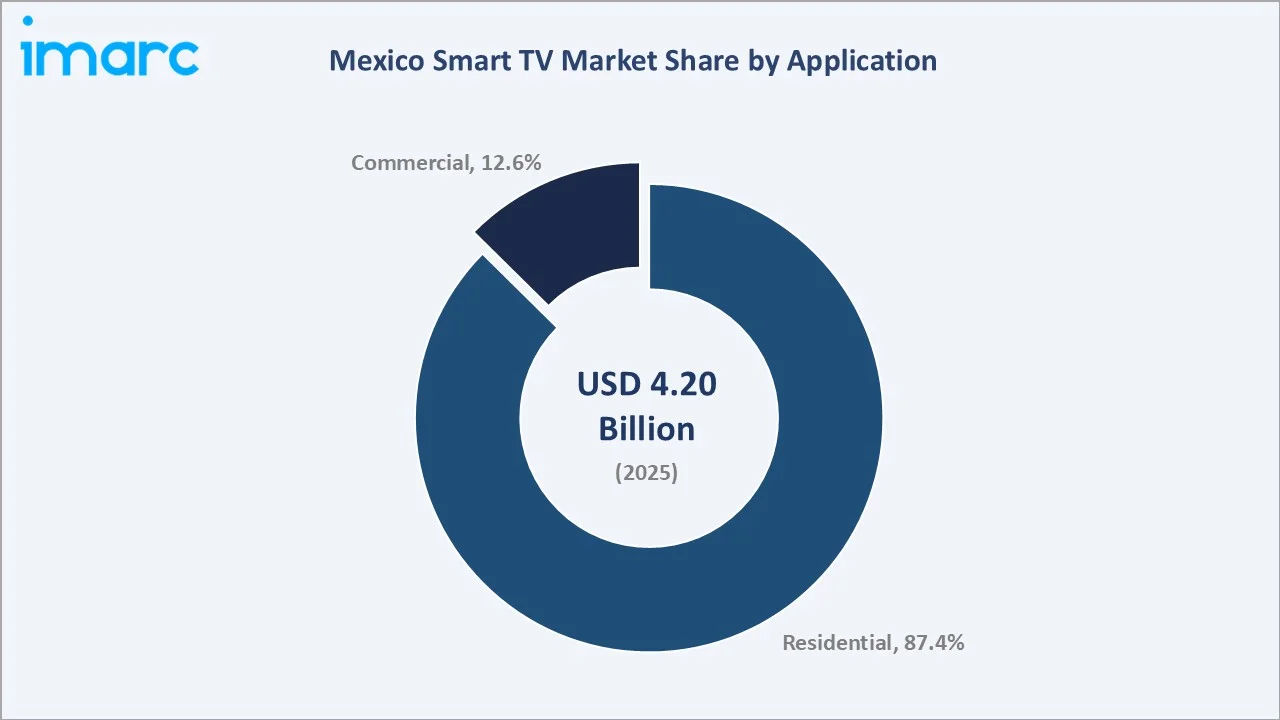
Residential leads at 87.4% (2025), through household living room smart TV driven by OTT streaming, household smart TV penetration, and TV upgrade cycle from flat to smart and HD to UHD.
To access detailed market analysis, Request Sample
Commercial at 12.6% grows fastest at ~13.2% CAGR through hotel and hospitality smart TV, retail digital signage, corporate conference display, and nearshoring office smart display.
By Distribution Channel
Offline leads at 66.8% (2025), as consumers prefer in-store evaluation of screen size, picture quality, sound performance, and design before purchase. Electronics retailers also offer financing options, discounts, installation support, and warranty assistance. This makes offline stores especially important for high-value and premium smart TV purchases.
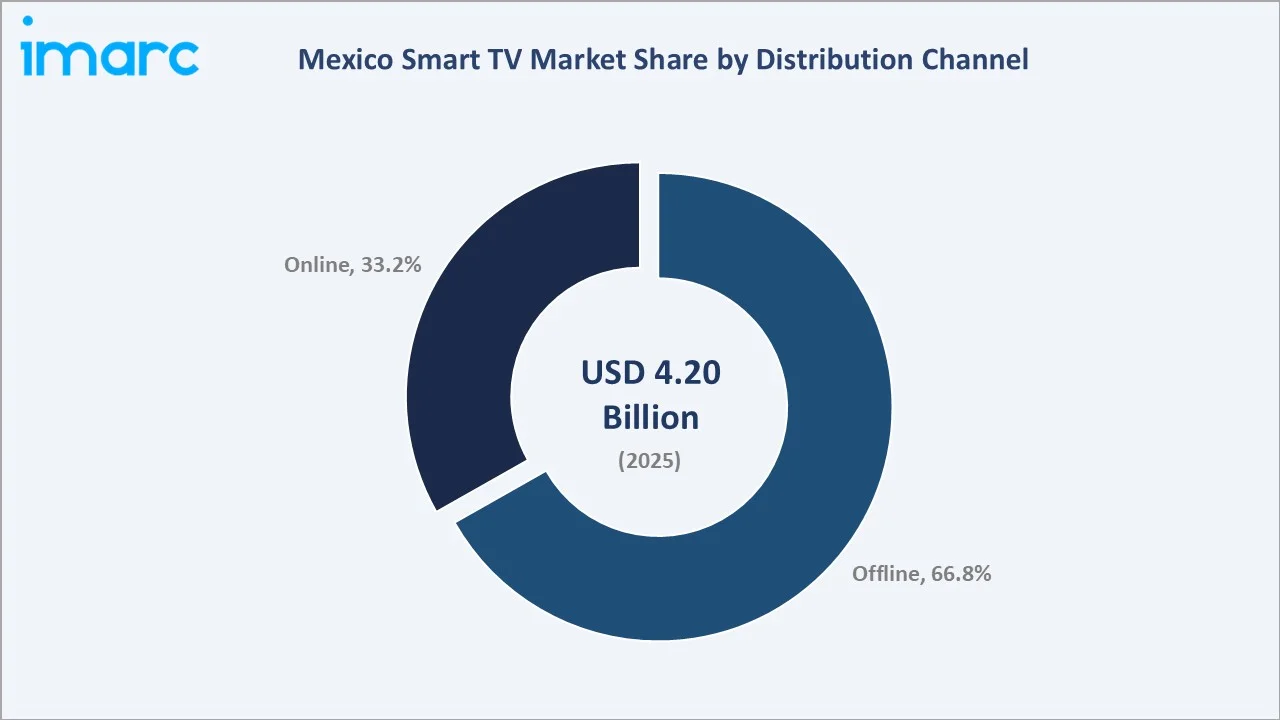
Online at 33.2% grows fastest at ~13.8% CAGR, gaining strong traction as consumers increasingly compare models, prices, reviews, and specifications through e-commerce platforms. Online sales are supported by discounts, doorstep delivery, easy financing, and wider product availability. This channel is especially attractive for tech-savvy buyers seeking convenience and competitive pricing.
Competitive Landscape
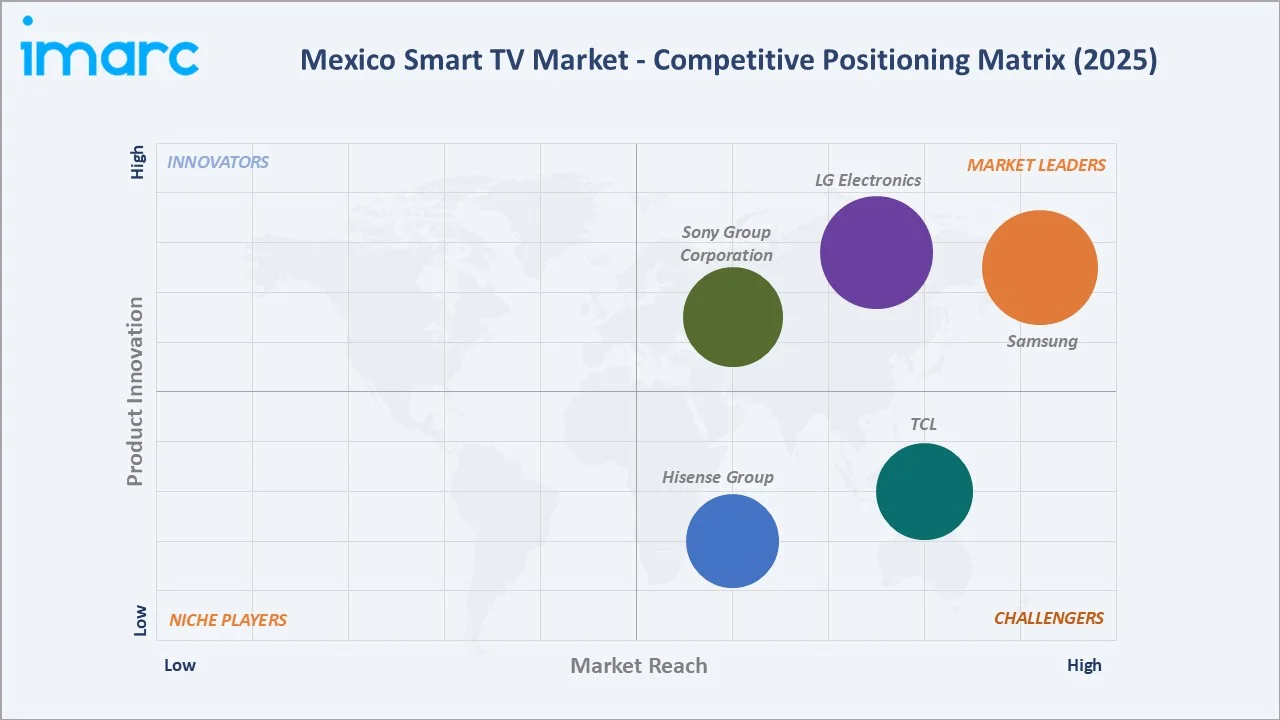
The Mexico smart TV market is moderately concentrated. Competition is increasingly centered on display technology, operating systems, AI-enabled features, and content ecosystem integration rather than hardware specifications alone. Manufacturers are strengthening partnerships with streaming platforms, FAST channels, and operating system providers to enhance user engagement.
|
Company |
Key Brands |
Market Position |
Core Strength |
|
Samsung |
Samsung |
Market Leader |
Samsung is the dominant market leader in Mexico's smart TV industry, shaping the market through domestic manufacturing, localized streaming services, and the integration of smart home ecosystems. |
|
LG Electronics |
LG |
Market Leader |
LG Electronics plays a foundational role in Mexico's smart TV market as both a top-tier consumer brand and a major local manufacturer. In addition to producing its premium OLED and QNED TVs within the country, LG anchors its smart TV experience around the webOS platform, which offers extensive localization for Mexican viewers. |
|
Sony Group Corporation |
Sony |
Market Leader |
Sony Group Corporation operates in the Mexican smart TV market as a premium, high-end innovator rather than a volume leader. It primarily targets the luxury segment, focusing on advanced display panels (OLED, Mini LED), high-resolution (4K/8K) picture quality, and integrated smart ecosystems. |
|
TCL |
TCL |
Strong Challenger |
TCL serves as a powerhouse in the Mexican smart TV market, functioning as a major manufacturer, a fast-growing consumer brand, and a key supplier of display panels. |
|
Hisense Group |
Hisense |
Strong Challenger |
The Hisense Group plays a major role in Mexico's smart TV industry through large-scale local manufacturing and rapid market expansion. It is one of the dominant brands in the country, leveraging strategic retail presence and competitive pricing to secure a top position in Mexico's consumer electronics market. |
Chinese brands continue to gain market share through aggressive pricing and feature-rich offerings, intensifying competition in the mid-range segment. Meanwhile, premium brands are focusing on OLED, QLED, AI-powered features, and gaming capabilities to differentiate their portfolios and maintain profitability.
Key Company Profiles
Samsung
Samsung is one of the leading participants in the Mexico smart TV market, offering a broad portfolio ranging from entry-level LED televisions to premium QLED, Neo QLED, OLED, and 8K smart TVs. The company leverages its strong brand recognition, extensive retail presence, and advanced display technologies to maintain a significant market position. The company benefits from Mexico's growing demand for connected entertainment, premium viewing experiences, and large-screen televisions.
- Key Brands: Samsung
- Strategic Focus: Strengthening its premium leadership through QLED, Neo QLED, OLED, and AI-powered television portfolios. Samsung is also expanding partnerships with streaming platforms and content providers to improve access to OTT services and localized entertainment content.
LG Electronics
LG Electronics is a prominent player in the Mexico smart TV market, recognized for its strong presence across both premium and mass-market television segments. The company offers a diverse portfolio that includes LED, NanoCell, QNED, OLED, and 4K/8K smart TVs, catering to a wide range of consumer preferences and price points. LG's televisions operate on the webOS platform, providing seamless access to streaming services, AI-powered recommendations, voice control, and smart home integration. The company benefits from its established distribution network across electronics retailers, e-commerce channels, and brand stores throughout Mexico.
- Key Brands: LG
- Strategic Focus: Strengthening its position in Mexico through premium display technologies such as OLED, QNED, and 4K/8K UHD televisions. The company emphasizes enhancing the user experience via its webOS platform, AI-powered content recommendations, voice-enabled controls, and seamless smart home integration.
Market Concentration Analysis
The Mexico smart TV market exhibits a moderately concentrated competitive structure, with a handful of global brands accounting for a substantial share of total sales. Leading players such as Samsung, LG Electronics, Sony Group Corporation, TCL, and Hisense Group compete across premium, mid-range, and entry-level segments. Competition is increasingly driven by display technology, operating system ecosystems, AI-enabled features, and content partnerships rather than price alone. Chinese manufacturers continue to strengthen their presence through aggressive pricing and feature-rich offerings, intensifying competition in the value segment. Meanwhile, established brands leverage strong distribution networks, brand loyalty, and premium innovations such as OLED, QLED, and gaming-focused TVs to maintain market leadership. Overall, the market remains competitive, with continuous product innovation and ecosystem development shaping differentiation strategies.
Investment & Growth Opportunities
Highest Growth Segments
Online distribution (~13.8% CAGR), commercial application (~13.2% CAGR through hotel and signage), OLED premium (~14% CAGR from growing base), gaming smart TV 4K HDR (~13% CAGR), Southern Mexico (~15% CAGR), and 8K premium (~12% CAGR from emerging base) represent Mexico smart TV highest-growth investment vectors through 2034.
Investment Themes
- Commercial hotel and hospitality smart TV: Rising hotel modernization, tourism growth, and demand for in-room OTT, screen casting, and personalized guest entertainment create opportunities for hospitality-grade smart TVs with centralized content management.
- OLED and MiniLED premium upgrade: Growing consumer preference for larger screens, superior contrast, high brightness, and cinema-like viewing supports investment in OLED and MiniLED smart TVs targeting premium households and high-income urban consumers.
Future Market Outlook (2026-2034)
Mexico smart TV market grew from USD 4.20 Billion in 2025 to an estimated USD 4.70 Billion in 2026 and is projected to reach USD 11.54 Billion by 2034, delivering a 12.00% CAGR over the forecast period through rising middle-class OTT streaming demand, broadband fiber penetration expanding, OLED and MiniLED premiumization, e-commerce disruption, commercial hotel and hospitality growth, and emerging AI-powered TV features. The market's anchor value of USD 7.40 Billion in 2030 represents Mexico smart TV at OTT mainstream and OLED accessible inflection.
Three structural forces define Mexico’s smart TV growth through 2034: rapid digital entertainment adoption, broader household connectivity, and premiumization of viewing experiences. Rising OTT usage and FAST channel expansion are making smart TVs the center of home entertainment. Expanding broadband, 5G, and connected-home adoption are improving the usability of internet-enabled TVs across urban and semi-urban households. At the same time, demand for 4K/8K, OLED, MiniLED, AI features, and gaming-ready models is lifting market value beyond basic replacement sales.
Research Methodology
Primary Research
Primary research comprised interviews with smart TV manufacturers, distributors, electronics retailers, and e-commerce channel partners. It also included discussions with OTT platform providers, hospitality buyers, and after-sales service providers. Consumer feedback was assessed to understand purchase preferences, screen-size demand, pricing sensitivity, and feature adoption.
Secondary Research
Secondary research encompassed company websites, product catalogues, annual reports, press releases, and retail/e-commerce listings. It also included government digital connectivity data, telecom reports, OTT usage trends, and consumer electronics industry publications. Competitive benchmarking covered leading brands, display technologies, operating systems, and pricing tiers.
Forecasting Models
Forecasting models combined historical smart TV sales trends, replacement cycles, household income growth, internet penetration, and connected-device adoption patterns. Market projections incorporated the impact of OTT consumption, broadband and 5G expansion, and premium display technology uptake. A mix of time-series analysis, adoption-curve modeling, and demand-side scenario forecasting was used to estimate future growth. The models were validated through primary industry inputs, competitive developments, and macroeconomic indicators to ensure forecast reliability through 2034.
Report Coverage:
| Report Features | Details |
|---|---|
| Base Year of the Analysis | 2025 |
| Historical Period | 2020-2025 |
| Forecast Period | 2026-2034 |
| Units | Billion USD |
| Scope of the Report | Exploration of Historical Trends and Market Outlook, Industry Catalysts and Challenges, Segment-Wise Historical and Future Market Assessment:
|
| Resolution Types | 4K UHD TV, Full HD TV, HD TV, 8K TV |
| Technologyies | LCD, LED, OLED, QLED |
| Screen Sizes | Below 32 Inches, 32 to 45 Inches, 46 to 55 inches, 56 to 65 Inches, Above 65 Inches |
| Screen Types | Flat, Curved |
| Platforms | Android, Roku, WebOS, Tizen OS, iOS, My Home Screen, Others |
| Applications | Residential, Commercial |
| Distribution Channels | Offline, Online |
| Companies Covered | Samsung, LG Electronics, Sony Group Corporation, TCL, Hisense Group, etc. |
| Customization Scope | 10% Free Customization |
| Post-Sale Analyst Support | 10-12 Weeks |
| Delivery Format | PDF and Excel through Email (We can also provide the editable version of the report in PPT/Word format on special request) |
Frequently Asked Questions About the Mexico Smart TV Market Report
The Mexico smart TV market size is estimated at USD 4.70 Billion in 2026, driven by rising internet penetration, expanding broadband and 5G connectivity, and rapid growth in OTT and FAST streaming platforms. Increasing demand for connected home entertainment, larger screens, 4K/UHD displays, AI-enabled features, and affordable smart TV models is further accelerating household adoption.
The Mexico smart TV market grows at 12.00% CAGR during 2026-2034, reaching USD 11.54 Billion by 2034. Online grows fastest at ~13.8% CAGR. The CAGR reflects OTT streaming adoption, rising middle-class income, broadband expansion, falling ASP entry-level, and e-commerce disruption.
Residential leads at 87.4% as households increasingly use smart TVs for OTT streaming, gaming, music, and connected home entertainment. Rising internet access, affordable models, and the replacement of conventional TVs are strengthening adoption across urban and semi-urban homes.
Offline leads at 66.8% as consumers prefer checking screen size, display quality, sound, and design in-store before buying. Retail outlets also support sales through financing plans, discounts, installation assistance, and warranty services.
Leading companies include Samsung, LG Electronics, Sony Group Corporation, TCL, and Hisense Group, among others.
The market is projected to reach approximately USD 7.40 Billion by 2030, reflecting strong demand for connected entertainment devices. Growth will be supported by rising OTT usage, expanding internet access, and increasing replacement of conventional TVs. Premium features such as 4K displays, AI integration, and larger screen sizes will further lift market value.
Three priority investment opportunities in the Mexico smart TV market include premium OLED and MiniLED televisions, AI-powered smart TV ecosystems, and commercial hospitality display solutions. Growing consumer demand for superior picture quality and larger screens is supporting investment in premium display technologies. AI-enabled features such as voice control, personalized content recommendations, and smart home integration are creating differentiation opportunities for manufacturers. Additionally, hotels, resorts, and serviced apartments are increasingly adopting connected smart TVs to enhance guest experiences, opening a high-growth commercial segment beyond residential demand.
Need more help?
- Speak to our experienced analysts for insights on the current market scenarios.
- Include additional segments and countries to customize the report as per your requirement.
- Gain an unparalleled competitive advantage in your domain by understanding how to utilize the report and positively impacting your operations and revenue.
- For further assistance, please connect with our analysts.
 Request Customization
 Speak to an Analyst
 Request Brochure
 Inquire Before Buying
Benefits of Customization
- Personalize this research
- Triangulate with your data
- Get data as per your format and definition
- Gain a deeper dive into a specific application, geography, customer, or competitor
- Any level of personalization
Get in Touch With Us
UNITED STATES
Phone: +1-201-971-6302
INDIA
Phone: +91-120-433-0800
UNITED KINGDOM
Phone: +44-753-714-6104
Email: [email protected]
Client Testimonials




.webp)




.webp)













Related Reports

Choose your plan
*Please note that the prices mentioned below are starting prices for each bundle type. Kindly contact our team for further details.*
Single User License
- 1 User License, Access on 2 Devices
- PDF Report + Excel Dataset (Password Protected)
- Lifetime Access
- No Printing Rights
- 10% Free Report Customization
- 10–12 Weeks of Analyst Support
Five User License
- Access for 5 Users, 2 Devices per User
- PDF Report + Excel Dataset (Password Protected)
- Lifetime Access
- Dedicated Account Manager
- 12–14 Weeks of Analyst Support
- No Printing Rights
- 15% Free Report Customization
- 25% Discount on Your Next Purchase
Corporate User License
- Unlimited User Access (Within Your Organization)
- PDF Report + Excel Dataset
- Lifetime Access
- Dedicated Account Manager
- 14–20 Weeks of Analyst Support
- No Printing Rights
- 20% Free Report Customization
- 30% Discount on Your Next Purchase
Essential Insights
What's included:
3 reports
- Lifetime Access
- PDF Reports
- Excel Datasets
- 2 Weeks of Free Analyst Support
- 2 User Licenses
- Access on 2 Devices
- Printing Rights
- Complimentary PowerPoint (PPT) Version
- Complimentary License Upgrade
Professional Access
What's included:
5 reports
- Lifetime Access
- PDF Reports
- Excel Datasets
- 8 Weeks of Free Analyst Support
- 2 User Licenses
- Access on 2 Devices
- Printing Rights
- Complimentary PowerPoint (PPT) Version
- Complimentary License Upgrade
Business Advantage
What's included:
8 reports
- Lifetime Access
- PDF Reports
- Excel Datasets
- 14 Weeks of Free Analyst Support
- 2 User Licenses
- Access on 2 Devices
- Printing Rights
- Complimentary PowerPoint (PPT) Version
- Complimentary License Upgrade
Enterprise Intelligence
What's included:
10 reports
- Lifetime Access
- PDF Reports
- Excel Datasets
- 20 Weeks of Free Analyst Support
- 2 User Licenses
- Access on 2 Devices
- Printing Rights
- Complimentary PowerPoint (PPT) Version
- Complimentary License Upgrade