
Mexico Vending Machine Market Size, Share, Trends and Forecast by Type, Technology, Payment Mode, Application, and Region, 2026-2034
Mexico Vending Machine Market Summary:
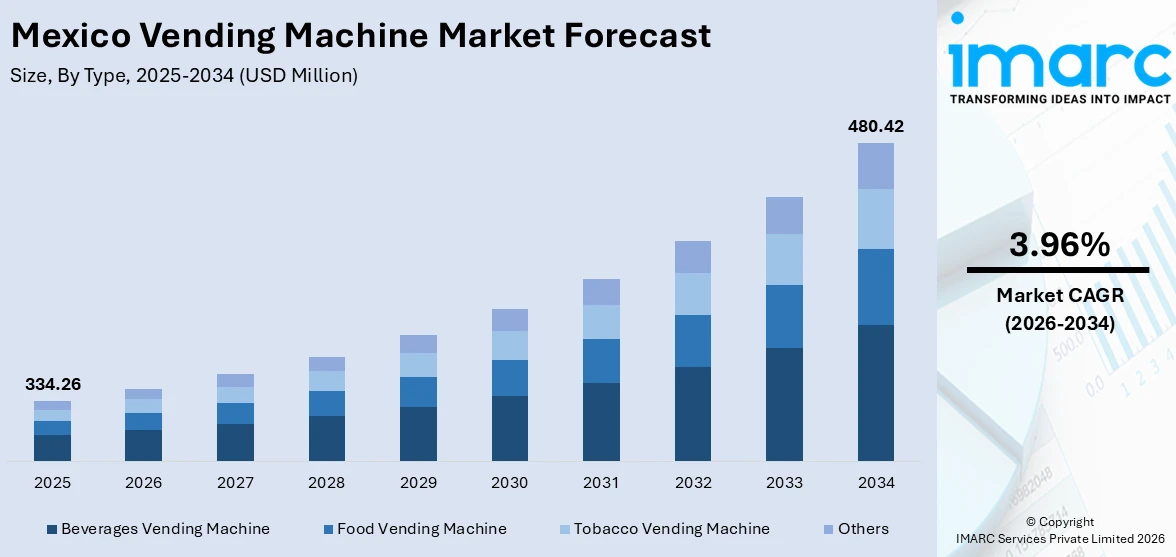
The Mexico vending machine market grew from USD 334.26 Million in 2025 to USD 351.99 Million in 2026 and is projected to reach USD 480.42 Million by 2034, growing at a compound annual growth rate of 3.96% from 2026-2034.
The Mexico vending machine market is experiencing steady growth as rapid urbanization reshapes consumer behavior and boosts demand for convenient, round-the-clock access to food and beverages. Expanding middle-class populations, rising disposable incomes, and increasing adoption of digital payment technologies are broadening machine deployment across diverse locations. Improvements in machine intelligence and product diversification are further widening the Mexico vending machine market share.
Key Takeaways and Insights:
- By Type: Beverages vending machine dominates the market with a share of 38.5% in 2025, owing to the persistent demand for ready-to-drink beverages across transit points, offices, and shopping complexes throughout the country.
- By Technology: Automatic machine leads the market with a share of 62.5% in 2025, reflecting strong operator preference for fully automated dispensing systems that require minimal staff intervention.
- By Payment Mode: Cash holds the largest segment with a share of 58.5% in 2025, underpinned by Mexico's large unbanked population and wide preference for physical currency in everyday transactions.
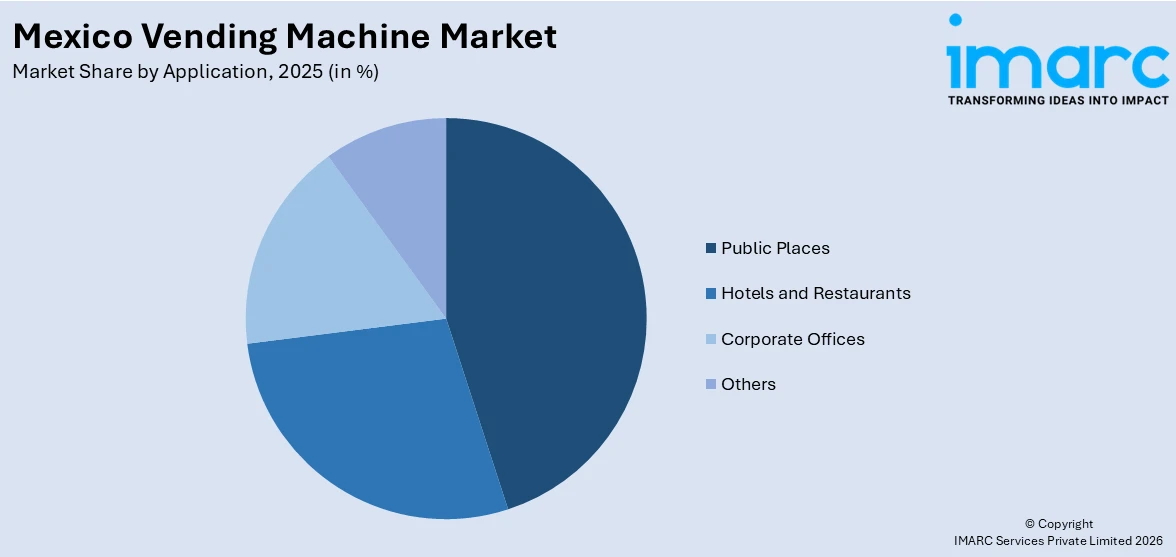
- By Application: Public places represent the leading segment with a share of 42.5% in 2025, capitalizing on the high foot traffic at airports, transit hubs, shopping malls, and recreational centers.
- By Region: Central Mexico exhibits a clear dominance in the market with 54.5% share in 2025, driven by its dense urban population, robust commercial infrastructure, and concentration of corporate offices and public transport networks.
- Key Players: Key players drive the Mexico vending machine market by diversifying product offerings, integrating smart payment technologies, and expanding installation networks across high-traffic locations. Investments in energy-efficient machines and remote monitoring capabilities strengthen competitive positioning, broaden consumer reach, and improve operational efficiency across corporate, public, and hospitality environments.
To get more information on this market Request Sample
The Mexico vending machine market is advancing as urbanization intensifies and consumer lifestyles become increasingly fast-paced. The steady expansion of urban populations across the country is driving demand for convenient, self-service retail solutions in commercial hubs, transportation networks, and educational institutions. The beverage segment continues to anchor overall market performance, benefiting from consistent consumer demand for ready-to-drink options at any time of the day. At the same time, technology integration is reshaping the operational landscape, with automatic machines and smart inventory management systems enabling operators to reduce waste and improve restocking efficiency. Although cash transactions remain prevalent, the incremental adoption of cashless payment methods among younger, tech-savvy consumers is gradually transforming purchasing patterns. Supportive retail expansion, increasing foot traffic at public venues, and evolving consumer preferences for healthier, more diverse product ranges are collectively reinforcing the long-term growth prospects of the Mexico vending machine market.
Mexico Vending Machine Market Trends:
Growing Demand for Healthier Product Options
Consumer preferences in Mexico are evolving, with greater emphasis on nutritional value and dietary consciousness influencing vending purchases. The shift toward low-calorie snacks, functional beverages, fresh foods, and allergen-friendly options is reshaping product assortments across the vending channel. Operators are responding by curating diverse product mixes that cater to health-aware consumers, particularly in corporate campuses, fitness centers, and educational institutions. This transition is encouraging continuous innovation in machine design and refrigeration technology to accommodate perishable goods efficiently.
Integration of Smart Technology and Cashless Payment Systems
The rapid integration of touchless interfaces, interactive displays, and remote inventory monitoring is transforming traditional vending machine operations in Mexico. Digital payment capabilities, including mobile wallets and contactless card readers, are being adopted more widely to meet the expectations of tech-savvy urban consumers. These technological enhancements streamline transactions, reduce service downtime, and improve the customer experience in high-traffic locations such as airports, shopping centers, and corporate offices, supporting the Mexico vending machine market growth.
Expansion into Diverse High-Traffic Public Locations
Vending machine operators are increasingly targeting a broader range of public settings beyond traditional food service environments in Mexico. Transit hubs, healthcare facilities, university campuses, government buildings, and leisure facilities are emerging as high-value installation sites that guarantee consistent consumer exposure. This geographic diversification of machine placement enhances revenue stability and ensures round-the-clock product accessibility. Growing urbanization and infrastructure development are creating new footprint opportunities, attracting operators to invest in location-specific machine customization and product curation strategies.
Market Outlook 2026-2034:
The Mexico vending machine market is poised for steady and sustained expansion over the forecast period, underpinned by the convergence of favorable demographic trends, advancing technology, and evolving consumer lifestyles. Rapid urbanization continues to generate new deployment opportunities in high-density residential and commercial areas, while the progressive expansion of retail and hospitality infrastructure is opening access to previously underserved locations. The gradual shift toward healthier product categories and premium beverage offerings is anticipated to elevate average transaction values and encourage operator reinvestment in upgraded machine capabilities. Technological modernization, including the integration of IoT-enabled inventory systems and cashless payment interfaces, will remain central to market differentiation. Increasing consumer acceptance of self-service retail models, particularly among younger urban demographics, is expected to sustain demand momentum and attract new entrants to the market. The market generated a revenue of USD 334.26 Million in 2025 which is expected to reach USD 351.99 Million in 2026 and further grow to USD 480.42 Million by 2034, at a compound annual growth rate (CAGR) of 3.96% during 2026-2034.
Mexico Vending Machine Market Report Segmentation:
| Segment Category | Leading Segment | Market Share |
|---|---|---|
| Type | Beverages Vending Machine | 38.5% |
| Technology | Automatic Machine | 62.5% |
| Payment Mode | Cash | 58.5% |
| Application | Public Places | 42.5% |
| Region | Central Mexico | 54.5% |
Type Insights:
- Food Vending Machine
- Beverages Vending Machine
- Tobacco Vending Machine
- Others
Beverages vending machine dominates with a market share of 38.5% of the total Mexico vending machine market in 2025.
Beverages vending machines hold a commanding position in Mexico's vending landscape, driven by the persistent demand for ready-to-drink options across a wide range of settings. Cold soft drinks, bottled water, energy drinks, and freshly brewed coffee have become staple offerings at transit hubs, shopping centers, and workplace environments. The ability to deliver chilled and hot beverages at consistent quality levels, combined with compact machine footprints that fit high-footfall spaces, makes beverage vending a commercially attractive category. Consumers across age groups gravitate toward beverage machines for their speed, convenience, and product consistency during busy daily routines.
The dominance of beverages vending machines is further reinforced by continuous product portfolio expansion within the category. Operators are increasingly offering premium options such as freshly ground coffee, vitamin-infused waters, and specialty soft drinks to capture higher-spending consumer segments. The growing café culture in Mexican cities has elevated consumer expectations around beverage quality, encouraging machine manufacturers to develop advanced brewing and dispensing capabilities. Placement strategies focused on high-visibility, high-traffic locations, including airports, metro stations, and university corridors, further sustain the category's revenue leadership within the broader Mexico vending machine market.
Technology Insights:
- Automatic Machine
- Semi-Automatic Machine
- Smart Machine
Automatic machine leads with a share of 62.5% of the total Mexico vending machine market in 2025.
Automatic machines hold the largest share in the Mexico vending machine market due to their operational simplicity, consistent product delivery, and minimal staffing requirements. These fully mechanized systems enable seamless dispensing of beverages, snacks, and other consumer goods with minimal human intervention, making them ideal for environments where operational continuity is paramount. Their proven reliability, combined with relatively lower maintenance frequency compared to more complex systems, makes automatic machines the preferred choice for operators seeking cost-effective deployment across high-volume locations such as airports, corporate offices, and transport terminals.
The sustained adoption of automatic machines is also driven by their compatibility with a wide range of product types and their ability to accommodate both cash and digital payment systems simultaneously. Operators value their straightforward refilling and servicing process, which reduces downtime and maximizes revenue continuity. As Mexico's vending market matures, automatic machines continue to serve as the dependable backbone of operator fleets, providing a scalable foundation for expanding vending networks across new commercial and public-facing locations throughout the country.

Payment Mode Insights:
- Cash
- Cashless
Cash exhibits a clear dominance with a 58.5% share of the total Mexico vending machine market in 2025.
Cash-based vending transactions remain deeply entrenched in Mexico, reflecting the country's broader reliance on physical currency in everyday commerce. A significant portion of the population remains either unbanked or underbanked, limiting their access to digital payment tools and reinforcing the importance of cash-accepting machines across lower-income and semi-urban areas. Vending operators targeting diverse demographic segments continue to prioritize cash compatibility to ensure maximum product accessibility. The familiarity and immediacy of cash transactions also resonate strongly with older consumer groups who prefer traditional purchasing methods in self-service environments.
Despite the dominance of cash, the vending payment landscape is gradually diversifying as younger, digitally engaged consumers increasingly seek contactless and mobile wallet-enabled machines. Operators are progressively equipping machines with multi-payment capabilities to cater to both cash-reliant and cashless consumer segments simultaneously. The expansion of smartphone penetration and mobile banking adoption among urban populations is creating favorable conditions for this transition. As financial inclusion initiatives broaden access to digital payment tools, the cashless segment is expected to gain share incrementally within the Mexico vending machine market.
Application Insights:
Access the comprehensive market breakdown Request Sample
- Hotels and Restaurants
- Corporate Offices
- Public Places
- Others
Public places represent the leading segment with a 42.5% share of the total Mexico vending machine market in 2025.
Public places serve as the most strategically valuable deployment environment for vending machines in Mexico, offering consistently high consumer footfall and extended operating hours. Locations such as airports, bus terminals, metro stations, shopping malls, and recreational centers attract a diverse cross-section of consumers throughout the day and night, ensuring steady purchase frequency. The accessibility and round-the-clock availability of vending machines in these environments directly addresses the convenience needs of commuters, travelers, and shoppers who may have limited access to traditional retail or food service alternatives.
The performance of vending machines in public places is further reinforced by ongoing investments in urban infrastructure, which are expanding the volume and variety of suitable high-traffic locations across Mexican cities. Transit network expansions, new commercial developments, and entertainment venue growth are continuously generating fresh placement opportunities. Operators are responding by deploying customized machine configurations tailored to the specific consumer needs of each public setting, whether offering quick beverage options at transport hubs or diverse snack assortments at leisure and tourism destinations, strengthening the segment's market leadership position.
Regional Insights:
- Northern Mexico
- Central Mexico
- Southern Mexico
- Others
Central Mexico exhibits a clear dominance in the market with 54.5% of the total Mexico vending machine market in 2025.
The major regional market for vending machines in Mexico is Central Mexico, with the presence of the largest metropolitan cities in the country, including Mexico and Guadalajara. Central Mexico has the most conducive environment for the installation of vending machines due to the high density of the population in the metropolitan cities and the presence of numerous commercial establishments and transportation networks. The high standard of living and fast pace of life in the metropolitan cities have resulted in the development of high demand for vending machines in the region.
Central Mexico is the most significant regional market for the vending machine industry in the country due to the high level of economic activity and the presence of multinational corporations and educational and entertainment establishments, which are the target clients for the placement of vending machines. Central Mexico is expected to be the most significant regional market for the vending machine industry in the country due to the high level of economic activity and the presence of numerous educational and entertainment establishments.
Market Dynamics:
Growth Drivers:
Why is the Mexico Vending Machine Market Growing?
Rising Urbanization and Population Concentration in High-Traffic Areas
Mexico's rapid urban growth is one of the most powerful forces behind the expansion of the vending machine market. As millions of residents migrate to city centers and metropolitan areas, the concentration of consumers in high-density locations creates ideal conditions for vending machine deployment. Urban areas naturally generate the foot traffic and consumer urgency that make self-service retail formats highly effective, particularly in fast-paced environments where convenience is a primary concern. Transit hubs, business districts, educational campuses, and shopping complexes continuously attract large volumes of people who seek quick and reliable access to snacks, beverages, and essential items throughout the day. This demographic shift is particularly significant given the scale of Mexico's urban expansion. As of 2023, 81.58% of the population lived in urban areas, reflecting the country's longstanding trend toward city living that has more than doubled the urban share of the population since 1980. This trajectory shows no signs of reversing, with continued migration from rural regions expected to intensify urban density in major metropolitan areas. As urban infrastructure expands and new commercial developments emerge in response to population growth, the number of viable high-traffic vending machine locations continues to grow, presenting operators with expanding opportunities across a broadening geographic footprint.
Expanding Middle-Class Population and Rising Disposable Incomes
Mexico's growing middle-class population is playing a decisive role in shaping consumer behavior and expanding the addressable market for vending machines. As disposable incomes rise among an increasingly prosperous segment, consumers demonstrate greater willingness to spend on convenience-oriented retail formats. This shift in spending capacity is manifesting in higher purchase frequency at vending points and increased acceptance of premium product categories, including specialty beverages, fresh snacks, and branded food items. Middle-class consumers tend to be particularly receptive to innovative vending solutions that offer speed, product variety, and a superior user experience. Their preference for time-saving options that fit busy professional and social schedules creates consistent demand across diverse vending environments. Retail modernization across Mexican cities, including the proliferation of commercial complexes, office parks, and transit-oriented developments, is further directing middle-class consumers toward locations where vending machines are increasingly prevalent. Additionally, heightened awareness about global food trends and greater exposure to international retail concepts are encouraging consumers to engage with vending formats that offer healthier, more diverse, and higher-quality products. This evolving expectation is incentivizing operators to invest in upgraded machine capabilities and curated product portfolios designed to satisfy the preferences of this expanding consumer cohort within the Mexico vending machine market.
Technological Advancements in Machine Design and Payment Systems
Technological innovation is fundamentally reshaping the vending machine industry in Mexico, making machines more efficient, user-friendly, and commercially viable across diverse locations. Modern vending systems are increasingly equipped with touchless interfaces, interactive digital displays, and IoT-enabled remote monitoring capabilities that allow operators to track inventory levels, diagnose technical issues, and optimize restocking schedules in real time. These advancements significantly reduce operational downtime and enable more responsive, data-driven machine management, giving operators a stronger return on their deployment investment. The integration of diverse payment options, including mobile wallets, NFC-enabled contactless cards, and QR code-based systems, is broadening consumer accessibility and reducing friction in the purchasing experience. As smartphone penetration deepens across Mexico's urban population, the availability of mobile payment-compatible vending machines is becoming an increasingly important factor in consumer adoption and repeat usage. Furthermore, advances in refrigeration technology, energy efficiency systems, and product freshness monitoring are expanding the range of viable product categories. The ability to offer chilled dairy products, fresh sandwiches, and perishable beverages through temperature-controlled machines is elevating vending from a simple snack channel into a comprehensive self-service retail format within the Mexico vending machine market.
Market Restraints:
What Challenges the Mexico Vending Machine Market is Facing?
High Initial Investment and Maintenance Costs
The capital outlay required to purchase, install, and maintain vending machines represents a significant barrier for smaller operators and new market entrants in Mexico. Advanced machines equipped with smart technology, refrigeration systems, and multi-payment interfaces command substantially higher upfront costs. Ongoing maintenance, technical servicing, and periodic hardware upgrades further increase the total cost of ownership, limiting scalability for operators with constrained capital budgets and reducing the pace of fleet expansion across new locations.
Security Concerns and Risk of Vandalism and Theft
Vending machines deployed in public spaces across Mexico face elevated exposure to vandalism, theft, and tampering, particularly in areas with lower levels of public surveillance. Damage to machines results in repair costs, product loss, and extended operational downtime that directly reduces revenue potential. The threat of theft also prompts operators to avoid deploying machines in high-potential but lower-security locations, limiting market penetration in suburban and semi-urban areas with considerable unmet consumer demand for self-service retail solutions.
Competition from Quick-Commerce and E-Commerce Platforms
The rapid expansion of fast-delivery platforms and quick-commerce services in Mexican cities is eroding the convenience advantage traditionally associated with vending machines. Consumers can now receive food and beverage deliveries within minutes through mobile apps, often with access to a far broader product range and greater price competitiveness than vending machines typically offer. This intensifying digital retail competition challenges the sector's traditional value proposition and places pressure on operators to continuously differentiate through location strategy, product novelty, and technology integration.
Competitive Landscape:
The competitive landscape of the Mexico vending machine market is dominated by the co-existence of international machine manufacturers and local service providers. The participants in the market are currently focusing on developing differentiated products, strategic location selection, and investment in technology upgrade as key drivers for developing competitive advantage. The development of smart payment systems, energy-efficient vending machines, and inventory management solutions is becoming a key pillar of competition in the market. The participants in the market are also developing partnerships with food and beverage companies to diversify their products, thereby increasing their revenue potential in deployment locations.
Mexico Vending Machine Market Report Coverage:
| Report Features | Details |
|---|---|
| Base Year of the Analysis | 2025 |
| Historical Period | 2020-2025 |
| Forecast Period | 2026-2034 |
| Units | Million USD |
| Scope of the Report |
Exploration of Historical Trends and Market Outlook, Industry Catalysts and Challenges, Segment-Wise Historical and Future Market Assessment:
|
| Types Covered | Food vending machine, Beverages vending machine, Tobacco vending machine, Others |
| Technologies Covered | Automatic machine, Semi-automatic machine, Smart machine |
| Payment Modes Covered | Cash, Cashless |
| Applications Covered | Hotels and restaurants, Corporate offices, Public places, Others |
| Regions Covered | Northern Mexico, Central Mexico, Southern Mexico, Others |
| Customization Scope | 10% Free Customization |
| Post-Sale Analyst Support | 10-12 Weeks |
| Delivery Format | PDF and Excel through Email (We can also provide the editable version of the report in PPT/Word format on special request) |
Frequently Asked Questions About the Mexico Vending Machine Market Report
The Mexico vending machine market size increased from USD 334.26 Million in 2025 to USD 351.99 Million in 2026.
The Mexico vending machine market is expected to grow at a compound annual growth rate of 3.96% from 2026-2034 to reach USD 480.42 Million by 2034.
Beverages vending machine dominated the market with a share of 38.5%, driven by sustained consumer demand for ready-to-drink beverages across transit hubs, corporate offices, and public venues throughout Mexico.
Key factors driving the Mexico vending machine market include rapid urbanization, rising middle-class disposable incomes, technological advancements in machine design, growing adoption of digital payment systems, and expanding consumer demand for convenient, round-the-clock product access.
Major challenges include high initial investment and maintenance costs, security risks such as vandalism and theft in public spaces, and intensifying competition from quick-commerce and fast-delivery platforms that erode the traditional convenience advantage of vending machines.
Need more help?
- Speak to our experienced analysts for insights on the current market scenarios.
- Include additional segments and countries to customize the report as per your requirement.
- Gain an unparalleled competitive advantage in your domain by understanding how to utilize the report and positively impacting your operations and revenue.
- For further assistance, please connect with our analysts.
 Request Customization
 Speak to an Analyst
 Request Brochure
 Inquire Before Buying
Benefits of Customization
- Personalize this research
- Triangulate with your data
- Get data as per your format and definition
- Gain a deeper dive into a specific application, geography, customer, or competitor
- Any level of personalization
Get in Touch With Us
UNITED STATES
Phone: +1-201-971-6302
INDIA
Phone: +91-120-433-0800
UNITED KINGDOM
Phone: +44-753-714-6104
Email: [email protected]
Client Testimonials




.webp)




.webp)













Related Reports

Choose your plan
*Please note that the prices mentioned below are starting prices for each bundle type. Kindly contact our team for further details.*
Single User License
- 1 User License, Access on 2 Devices
- PDF Report + Excel Dataset (Password Protected)
- Lifetime Access
- No Printing Rights
- 10% Free Report Customization
- 10–12 Weeks of Analyst Support
Five User License
- Access for 5 Users, 2 Devices per User
- PDF Report + Excel Dataset (Password Protected)
- Lifetime Access
- Dedicated Account Manager
- 12–14 Weeks of Analyst Support
- No Printing Rights
- 15% Free Report Customization
- 25% Discount on Your Next Purchase
Corporate User License
- Unlimited User Access (Within Your Organization)
- PDF Report + Excel Dataset
- Lifetime Access
- Dedicated Account Manager
- 14–20 Weeks of Analyst Support
- No Printing Rights
- 20% Free Report Customization
- 30% Discount on Your Next Purchase
Essential Insights
What's included:
3 reports
- Lifetime Access
- PDF Reports
- Excel Datasets
- 2 Weeks of Free Analyst Support
- 2 User Licenses
- Access on 2 Devices
- Printing Rights
- Complimentary PowerPoint (PPT) Version
- Complimentary License Upgrade
Professional Access
What's included:
5 reports
- Lifetime Access
- PDF Reports
- Excel Datasets
- 8 Weeks of Free Analyst Support
- 2 User Licenses
- Access on 2 Devices
- Printing Rights
- Complimentary PowerPoint (PPT) Version
- Complimentary License Upgrade
Business Advantage
What's included:
8 reports
- Lifetime Access
- PDF Reports
- Excel Datasets
- 14 Weeks of Free Analyst Support
- 2 User Licenses
- Access on 2 Devices
- Printing Rights
- Complimentary PowerPoint (PPT) Version
- Complimentary License Upgrade
Enterprise Intelligence
What's included:
10 reports
- Lifetime Access
- PDF Reports
- Excel Datasets
- 20 Weeks of Free Analyst Support
- 2 User Licenses
- Access on 2 Devices
- Printing Rights
- Complimentary PowerPoint (PPT) Version
- Complimentary License Upgrade