
Mexico Video Surveillance Systems Market Size, Share, Trends and Forecast by System Type, Component, Application, Enterprise Size, Customer Type, and Region, 2026-2034
Mexico Video Surveillance Systems Market Size, Share, Trends & Forecast (2026-2034)
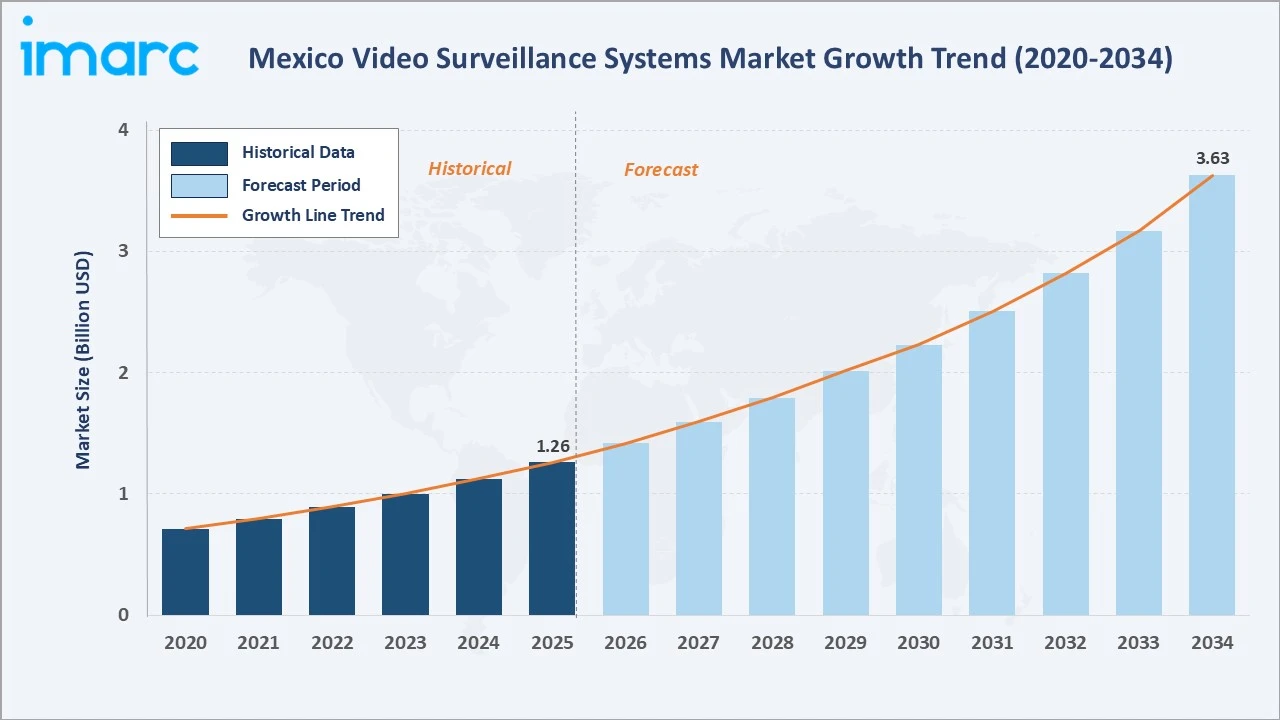
The Mexico video surveillance systems market grew from USD 1.26 Billion in 2025 to USD 1.41 Billion in 2026 and is projected to reach USD 3.63 Billion by 2034, growing at a CAGR of 12.08% during 2026-2034. Mexico City has the largest network of government-operated public surveillance cameras in the Americas, with more than 83,000 cameras monitoring activity across the densely populated city, reflecting the scale of public safety infrastructure investment. IP-based systems dominate with a 55.0% share in 2025, hardware component leads with 58.0%, while Central Mexico leads regionally at 50.0%.
Market Snapshot
|
Metric |
Value |
|
Base Year Market Size (2025) |
USD 1.26 Billion |
|
Market Size (2026) |
USD 1.41 Billion |
|
Forecast Market Size (2034) |
USD 3.63 Billion |
|
CAGR (2026-2034) |
12.08% |
|
Base Year |
2025 |
|
Historical Period |
2020-2025 |
|
Forecast Period |
2026-2034 |
| Dominant System Type |
IP Surveillance (55.0%, 2025) |
|
Dominant Component |
Hardware (58.0%, 2025) |
|
Leading Region |
Central Mexico (50.0%, 2025) |
The Mexico video surveillance systems market expanded from USD 0.71 Billion in 2020 to USD 1.26 Billion in 2025, registering consistent double-digit annual growth. The market is projected to reach USD 2.23 Billion by 2030 and USD 3.63 Billion by 2034, driven by ongoing technology upgrades and sustained public safety investment.
To get more information on this market, Request Sample
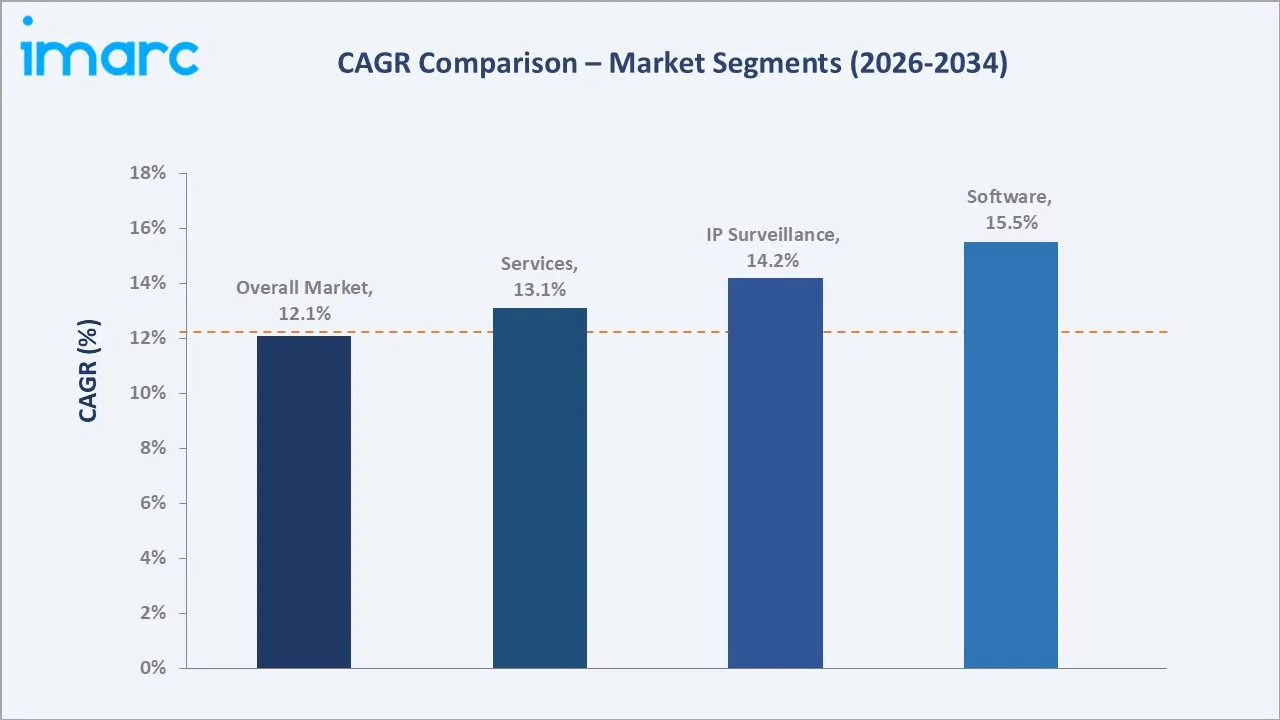
Software commands the highest growth among segments at approximately 15.5% CAGR, driven by cloud-based VMS and AI analytics adoption. IP surveillance follows at an estimated 14.2% CAGR as enterprises transition to network-based platforms. Services grow at around 13.1% CAGR, reflecting rising managed security and system integration demand.
Executive Summary
The Mexico video surveillance systems market is on a sustained high-growth trajectory, underpinned by heightened security priorities, broad government surveillance investment, and accelerating adoption of AI-powered and cloud-based platforms. The market outlook through 2034 remains highly favorable, driven by smart city programs, rising SME security spending, and cloud infrastructure expansion.
IP surveillance leads at a 55.0% share in 2025, displacing analog systems as enterprises and municipalities migrate to networked, AI-capable platforms. Hardware commands 58.0% of component demand, driven by ongoing camera infrastructure rollouts, while Software and Services grow at accelerating rates. Central Mexico dominates regionally at 50.0%, anchored by Mexico City's camera network.
Key Market Insights
|
Insight |
Data |
|
Dominant System Type |
IP Surveillance – 55.0% share (2025) |
|
Dominant Component |
Hardware – 58.0% share (2025) |
|
Leading Region |
Central Mexico – 50.0% (2025) |
| Key Market Opportunity | AI-driven smart surveillance and cloud-based VSaaS platforms are creating high-margin growth across government and commercial sectors in Mexico. |
Key Analytical Observations Supporting the Above Data:
- IP Surveillance at 55.0%: IP-based systems lead because they enable remote monitoring, AI-based analytics, and cloud integration, capabilities that analog systems cannot provide at scale. Enterprises and government agencies are actively decommissioning legacy analog networks in favor of full IP architecture.
- Hardware at 58.0%: Hardware commands the largest component share because large-scale surveillance rollouts require extensive physical camera deployments, NVRs, and storage infrastructure as the foundational deployment layer before software and services are added.
- Central Mexico at 50.0%: Central Mexico's dominance reflects Mexico City's outsized role as the primary government surveillance investment hub, housing the Americas' largest urban CCTV network. Commercial and financial sector security spending in the metropolitan area further consolidates Central Mexico's market leadership.
Mexico Video Surveillance Systems Market Overview
The Mexico video surveillance systems market encompasses the design, supply, installation, and management of hardware, software, and service solutions for monitoring and securing commercial, governmental, residential, and infrastructure facilities nationwide. Core product categories include IP and analog cameras, digital video recorders, network video recorders, video management software, AI-powered analytics platforms, and managed security services.
The ecosystem spans semiconductor and sensor manufacturers, camera OEMs, software developers, cloud service providers, national distributors, and professional installation and managed service firms. The market is shaped by rising crime rates, expanding government smart city programs, and growing cloud infrastructure availability following major hyperscaler investments in Mexico.
Market Dynamics
To evaluate market opportunities, Request Sample
Market Drivers
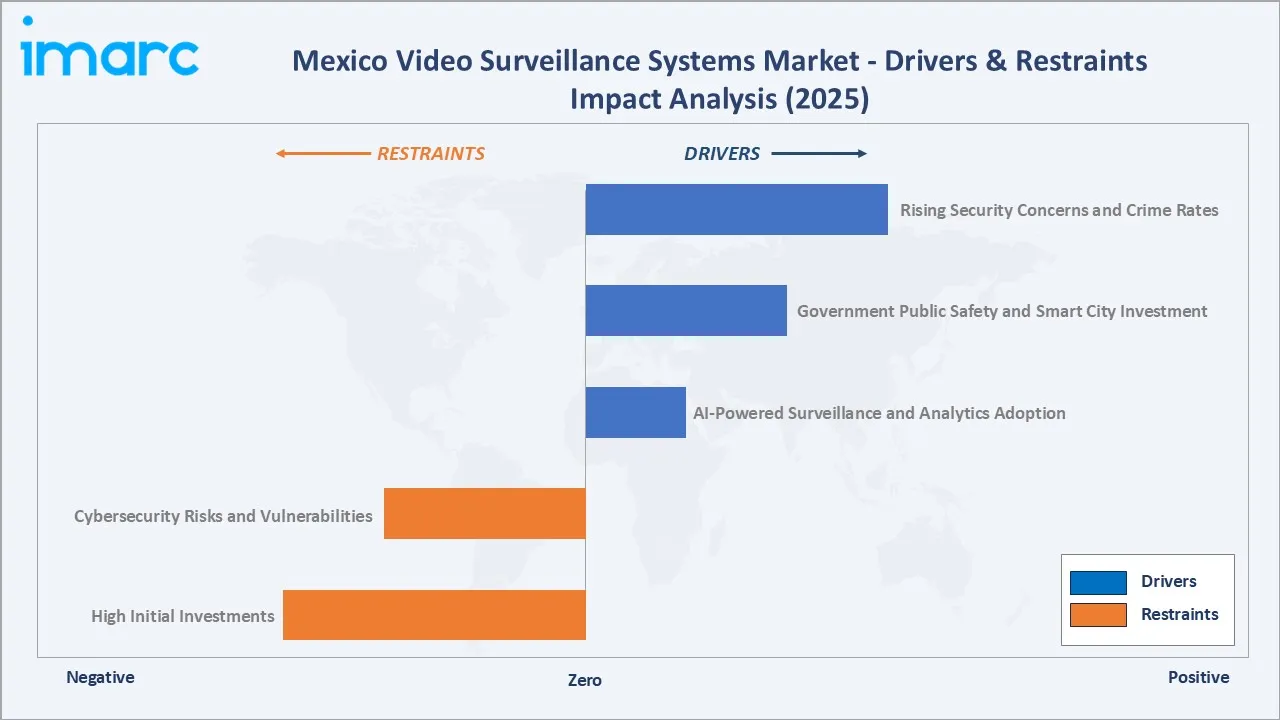
- Rising Security Concerns and Crime Rates: According to Mexico’s SESNSP, reported cargo theft incidents increased by 9.7% in September 2025, driving sustained investment in surveillance across government agencies, logistics firms, and commercial enterprises seeking to protect assets and personnel.
- Government Public Safety and Smart City Investment: Mexico City has over 83,000 government-operated public surveillance cameras, making it the city with the largest such network in the Americas. Federal and state government commitments to public security infrastructure are creating durable demand for surveillance systems nationwide.
- AI-Powered Surveillance and Analytics Adoption: Advanced AI-enabled features, including facial recognition, license plate identification, and behavioral analytics, are elevating the value proposition of modern surveillance systems. Enterprises are investing in AI-enhanced platforms to shift from reactive monitoring toward proactive threat detection.
Market Restraints
- High Initial Investments: High initial capital expenditure requirements for large-scale surveillance infrastructure deployments can limit adoption, particularly among smaller enterprises and municipalities with constrained security budgets.
- Cybersecurity Risks and Vulnerabilities: Cybersecurity vulnerabilities in networked IP surveillance systems pose systemic risks. Inadequately secured camera networks can be exploited as entry points for broader network intrusions, creating hesitancy in regulated industries.
Market Opportunities
- Cloud-Based VSaaS Platforms: The transition toward cloud-hosted surveillance creates a large recurring revenue opportunity. VSaaS eliminates significant upfront hardware investment while providing scalability, remote access, and software update capabilities, particularly compelling for multi-site commercial and logistics operators.
- SME Security Adoption: Approximately 95% of businesses in Mexico are small and medium enterprises. Rising crime awareness and increasingly affordable IP camera systems are driving this large, underserved segment toward structured video surveillance adoption, representing a substantial greenfield growth opportunity.
Market Challenges
- Shortage of Skilled Technical Workforce: Skilled technical workforce shortages in surveillance system design, installation, and cybersecurity management limit the pace of complex enterprise and government surveillance deployments, particularly outside major metropolitan areas.
- Budgetary Constraints and Delays: Budgetary constraints at the state and municipal government level can delay or scale back planned surveillance infrastructure investments, creating execution risks for projects dependent on public sector procurement cycles.
Emerging Market Trends
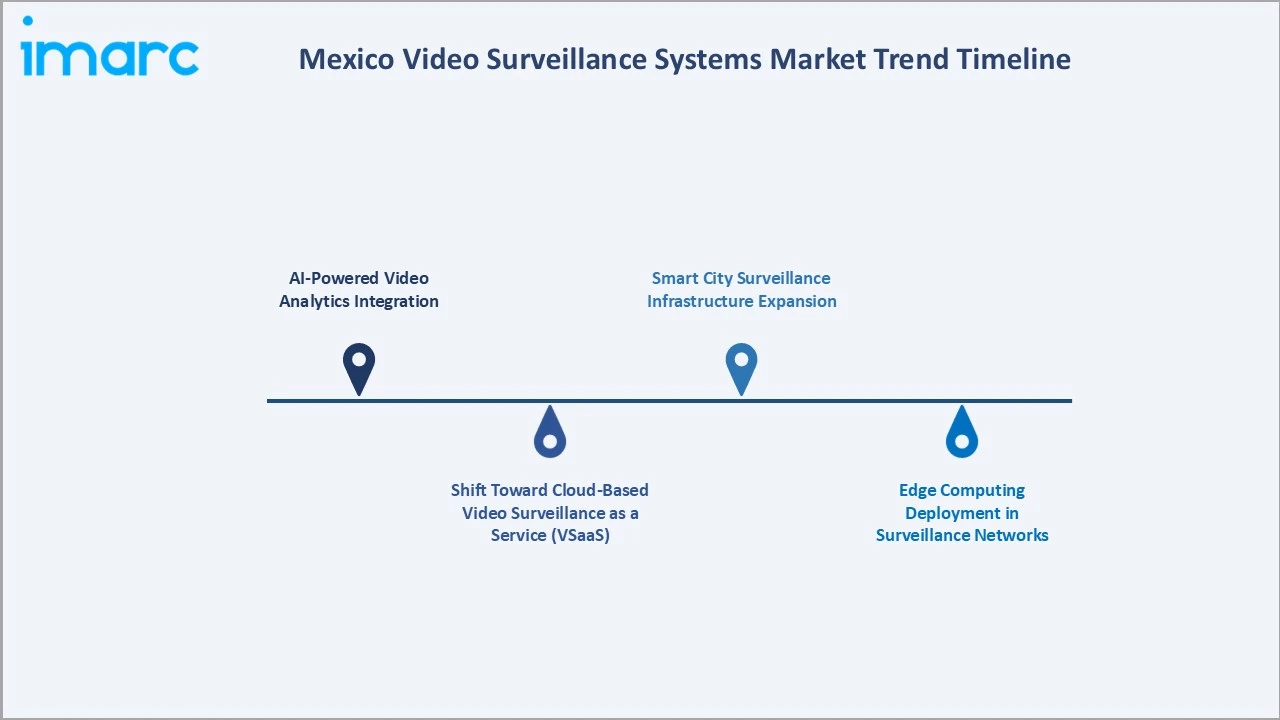
1. AI-Powered Video Analytics Integration
Surveillance systems are increasingly embedding AI-driven capabilities, including facial identification, license plate recognition, crowd density monitoring, and anomaly detection directly into cameras and VMS platforms. These capabilities are transforming surveillance from passive recording toward active, real-time threat intelligence. Mexican government agencies and large commercial enterprises are prioritizing AI-enabled platforms in new procurement cycles, with AI-enhanced camera deployments growing at an estimated premium over standard IP camera deployments.
2. Shift Toward Cloud-Based Video Surveillance as a Service (VSaaS)
Cloud-hosted surveillance solutions are gaining rapid traction across Mexico's commercial and industrial sectors, driven by scalability advantages, reduced on-premises infrastructure requirements, and remote accessibility. The expansion of hyperscaler cloud regions in Mexico is significantly improving connectivity infrastructure needed to support high-definition video streaming.
3. Smart City Surveillance Infrastructure Expansion
Mexico's urban centers are embedding video surveillance as a core component of broader smart city programs, integrating camera networks with traffic management, emergency response, and public safety command centers. Mexico City’s government allocated MXN 345 Million (USD 18.5 Million) to procure 30,400 additional surveillance cameras under its “Eyes that Take Care of You” program to strengthen public security, representing a major infrastructure investment influencing surveillance architecture decisions in other Mexican cities seeking comparable public safety infrastructure.
4. Edge Computing Deployment in Surveillance Networks
Edge computing architecture enables real-time video processing and AI inference at the camera level, reducing dependence on centralized server infrastructure and cloud bandwidth. This is particularly relevant for remote industrial and logistics facilities across Northern Mexico where reliable high-bandwidth connectivity remains limited. Edge-enabled cameras can operate autonomously, triggering alerts and storing critical footage locally even during network disruptions.
Industry Value Chain Analysis
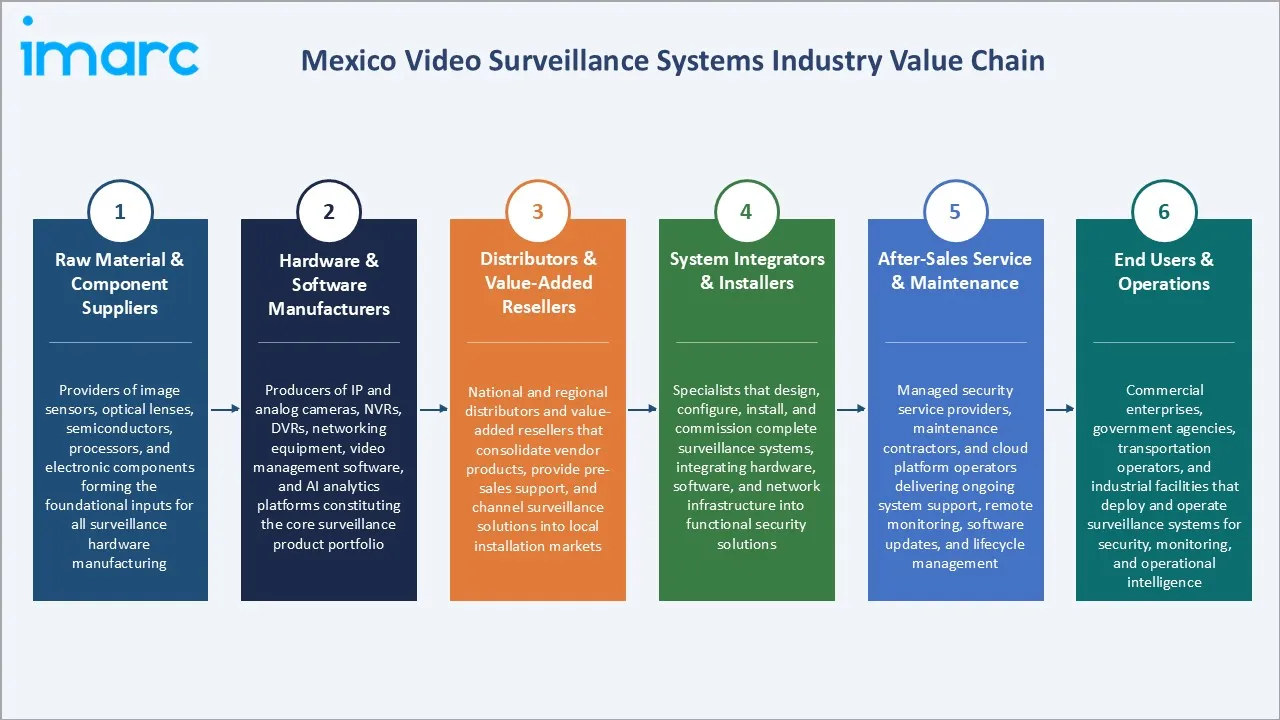
The Mexico video surveillance systems value chain spans six integrated stages from fundamental input supply through end-user operation. Each stage delivers distinct value through manufacturing precision, software development, distribution efficiency, integration expertise, and operational management, with the highest value addition occurring at the system integration stage where technical expertise and platform knowledge create durable competitive differentiation.
|
Stage |
Description |
| Raw Material & Component Suppliers | Providers of image sensors, optical lenses, semiconductors, processors, and electronic components forming the foundational inputs for all surveillance hardware manufacturing. |
| Hardware & Software Manufacturers | Producers of IP and analog cameras, NVRs, DVRs, networking equipment, video management software, and AI analytics platforms constituting the core surveillance product portfolio. |
| Distributors & Value-Added Resellers | National and regional distributors and value-added resellers that consolidate vendor products, provide pre-sales support, and channel surveillance solutions into local installation markets. |
| System Integrators & Installers | Specialists that design, configure, install, and commission complete surveillance systems, integrating hardware, software, and network infrastructure into functional security solutions. |
| After-Sales Service & Maintenance | Managed security service providers, maintenance contractors, and cloud platform operators delivering ongoing system support, remote monitoring, software updates, and lifecycle management. |
| End Users & Operations | Commercial enterprises, government agencies, transportation operators, and industrial facilities that deploy and operate surveillance systems for security, monitoring, and operational intelligence. |
The system integration and installation stage holds the highest strategic significance in this value chain. Integrators differentiate through deep technical expertise, vendor-agnostic platform experience, and the ability to design scalable architecture, capabilities that create durable competitive positioning.
Technology Landscape in the Mexico Video Surveillance Systems Industry
AI and Deep Learning Analytics
Deep learning-powered analytics are transforming surveillance from passive recording systems into proactive security platforms. AI algorithms trained on large video datasets enable real-time object classification, behavioral anomaly detection, and predictive security event identification across large camera networks, with facial recognition and license plate analytics increasingly standard in commercial and government deployments.
Cloud and Video Surveillance as a Service (VSaaS)
Cloud-based surveillance platforms eliminate on-premises server infrastructure requirements while enabling remote multi-site monitoring, automated software updates, and scalable storage. The expansion of Mexican cloud availability zones is enabling enterprise-grade VSaaS adoption across commercial and government clients at competitive cost points, with an increase in cloud surveillance adoption reported across enterprises in the last three years.
Edge Computing and On-Camera Processing
Modern IP cameras increasingly incorporate dedicated AI processor chips capable of running computer vision algorithms locally, reducing network bandwidth demands and enabling real-time response without cloud round-trip latency. Edge-enabled cameras provide autonomous security intelligence, a critical capability for remote and bandwidth-constrained deployment environments across industrial and logistics facilities.
Cybersecurity and Encrypted Surveillance Networks
End-to-end video stream encryption, certificate-based device authentication, and automated firmware update protocols are increasingly standard requirements in enterprise and government surveillance procurement specifications. Mature security-by-design product architectures create differentiation opportunities for vendors as cybersecurity becomes a primary evaluation criterion in large-scale procurement programs.
Market Segmentation Analysis
The report covers the following segments:
|
Segment Category |
Leading Segment |
Market Share |
Year |
|
System Type |
IP Surveillance |
55.0% |
2025 |
|
Component |
Hardware |
58.0% |
2025 |
|
Application |
🔒 |
🔒 |
2025 |
|
Enterprise Size |
🔒 |
🔒 |
2025 |
|
Customer Type |
🔒 |
🔒 |
2025 |
|
Region |
Central Mexico |
50.0% |
2025 |

By System Type
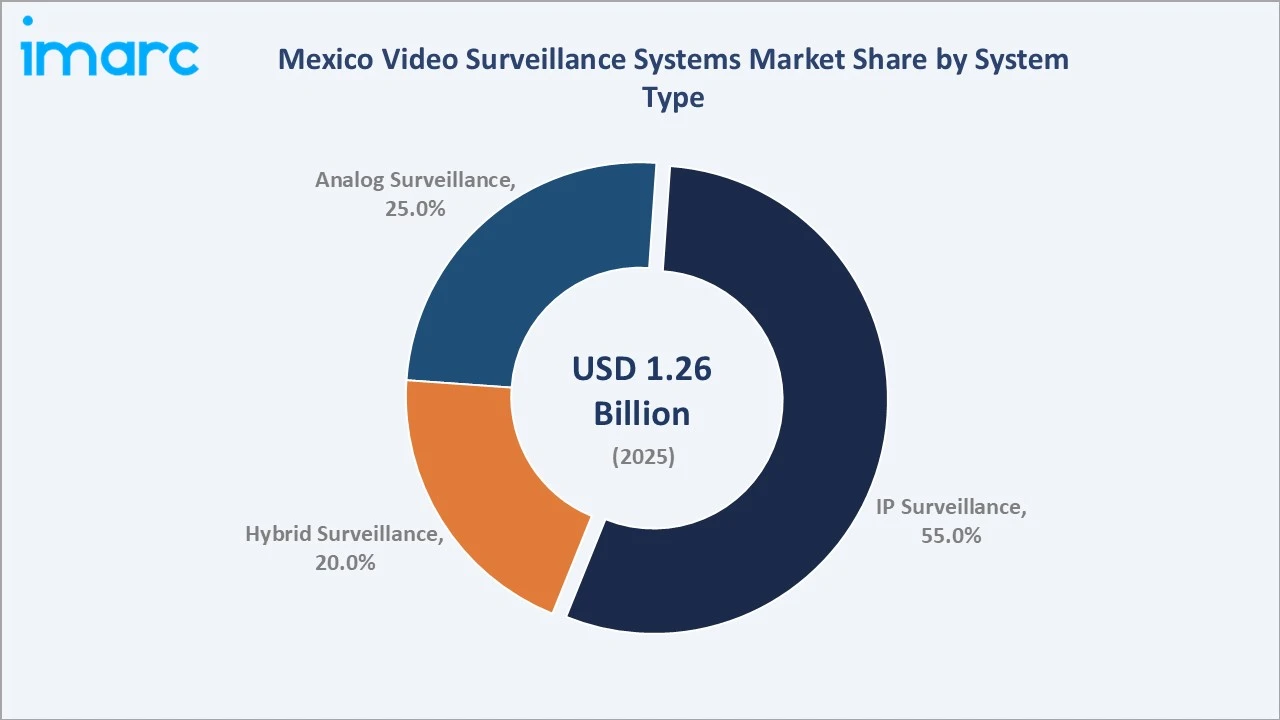
IP surveillance leads with a 55.0% share in 2025, reflecting the market's structural shift from analog to networked, AI-capable platforms. IP systems enable integration with cloud platforms, remote management, and advanced analytics that analog systems cannot support, driving active analog decommissioning across enterprise and government clients.
To access detailed market analysis, Request Sample
Analog surveillance retains a 25.0% share in 2025, primarily in cost-sensitive residential and small-business applications where basic monitoring without network integration suffices. Hybrid surveillance at 20.0% serves the transition market, enabling organizations to integrate existing analog camera investments with new IP management platforms without full hardware replacement, reducing upgrading capital expenditure.
By Component
Hardware commands a 58.0% share in 2025, encompassing cameras, NVRs, DVRs, storage systems, and networking infrastructure. Physical camera rollouts across government, commercial, and industrial applications require large hardware investment as the foundational deployment layer.
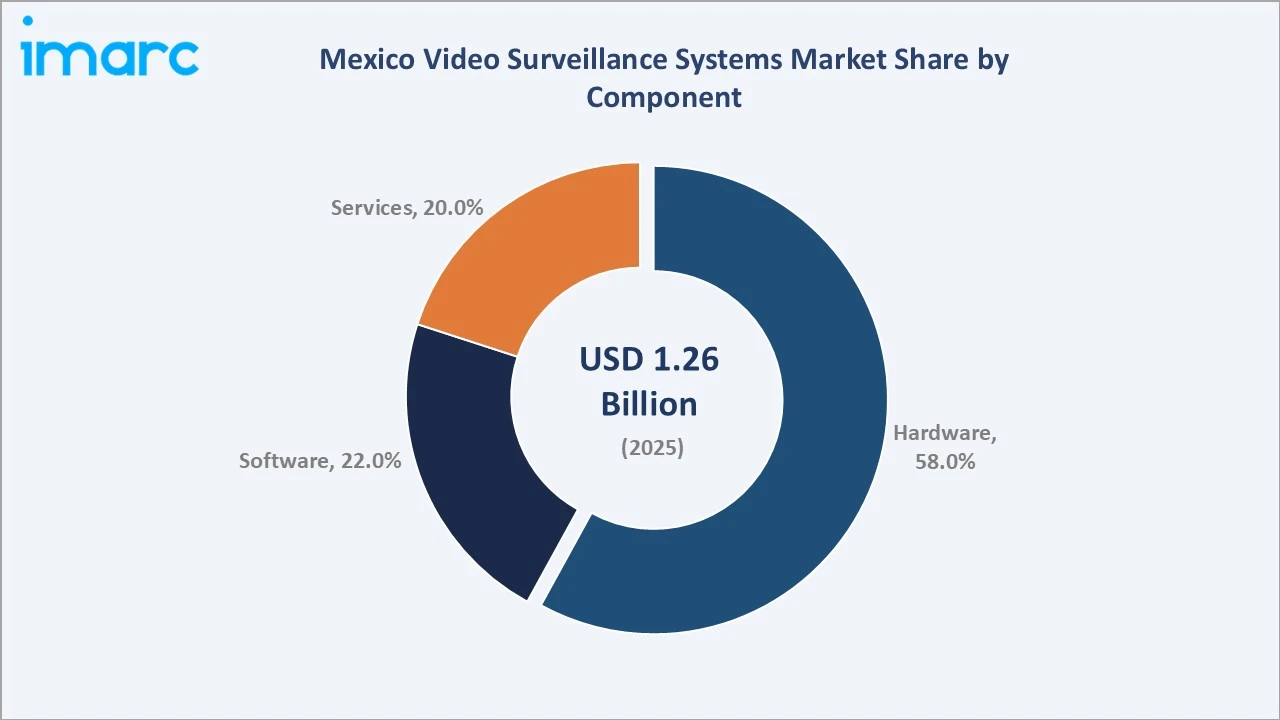
Software at 22.0% encompasses video management platforms, AI analytics applications, and cloud-hosted VSaaS solutions, projected to grow at approximately 15.5% CAGR, the fastest among all components. Services at 20.0% include installation, maintenance, managed security monitoring, and cloud service subscriptions, growing steadily at around 13.1% CAGR as organizations outsource operational complexity to specialist providers.
Regional Market Insights
|
Region |
Share (2025) |
Key Drivers & Characteristics |
| Central Mexico |
50.0% |
High-density government and commercial surveillance demand; Mexico City's large-scale urban camera network drives the majority of regional market activity. Financial sector and retail commercial investments further consolidate this region's leadership. |
| Northern Mexico |
30.0% |
Industrial zone security, cargo theft prevention, and border infrastructure needs sustain consistent surveillance hardware and service demand. The region's extensive manufacturing and logistics corridors are primary investment drivers, with managed security services gaining traction. |
| Southern Mexico |
15.0% |
Commercial, tourism, and infrastructure surveillance demand is expanding. Urban security programs in secondary cities are gaining government funding, and transportation network protection is a growing priority across this developing regional market. |
| Others | 5.0% | Lower-density markets at earlier surveillance adoption stages, primarily served by entry-level analog and basic IP solutions. Long-term greenfield growth opportunity exists as adoption broadens and connectivity infrastructure improves across smaller urban and rural areas. |
Central Mexico holds the largest regional share at 50.0% in 2025, underpinned by Mexico City's government-led public safety infrastructure combined with high-density commercial and financial sector security spending. Northern Mexico accounts for 30.0% of the market in 2025, driven by the region's extensive industrial corridors, cross-border logistics operations, and persistent cargo theft risk.
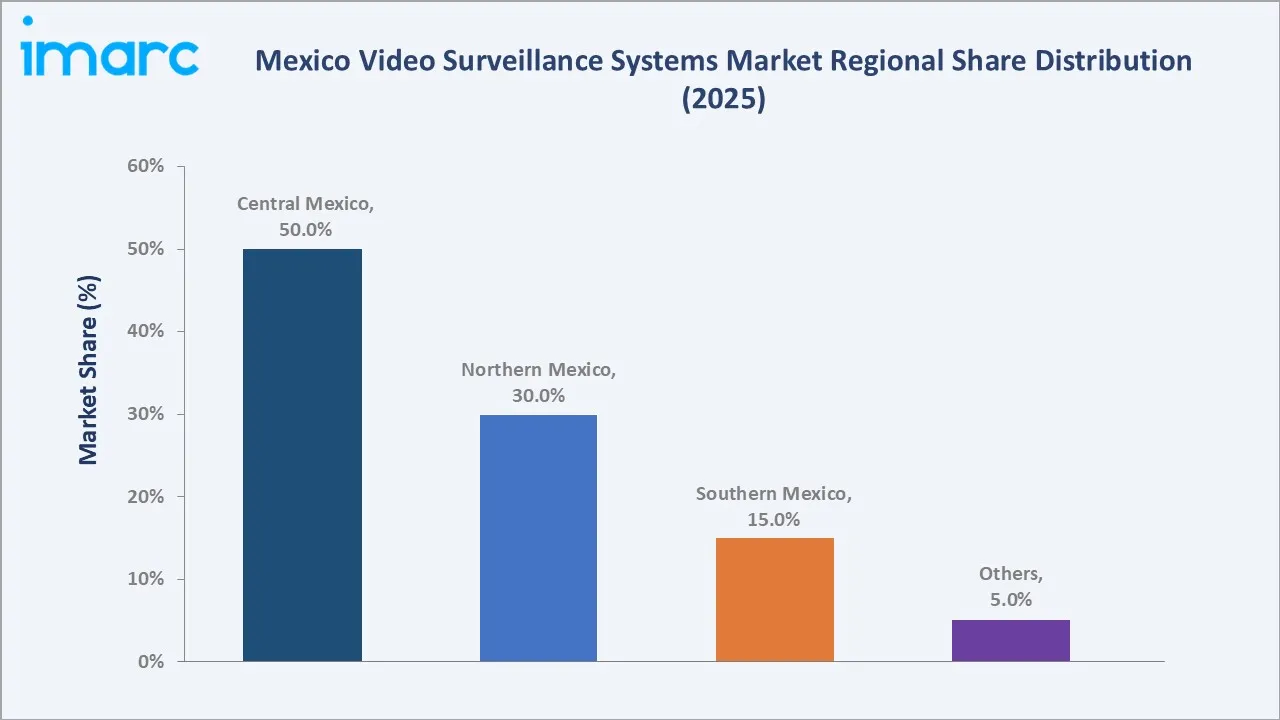
Southern Mexico represents 15.0% of market share in 2025 and is an emerging growth region. Expanding commercial activity, growing tourism infrastructure, and increasing state government commitment to urban security programs are progressively driving surveillance investment. The others segment, comprising remaining lower-density states and rural markets, accounts for 5.0% of the market in 2025.
Competitive Landscape
The Mexico video surveillance systems market is moderately concentrated among global technology leaders at the enterprise and government segment level.
|
Company |
Key Offerings |
Market Position |
Core Strength |
| Hangzhou Hikvision Digital Technology Co., Ltd. | Network camera, Network video recorder, PTZ Camera, Explosion-proof and corrosion-resistant security cameras | Market Leader | Hikvision México serves as a primary equipment and technology provider in Mexico’s commercial, industrial, and public safety video surveillance sectors |
| Dahua Technology Co., Ltd | Network cameras, PTZ cameras, PT cameras, Explosion-proof and corrosion-resistant |
Market Leader |
Dahua Technology Co., Ltd. serves as a major video-centric AIoT and electronic security solution provider across Mexico. |
| Hanwha Group | Video surveillance cameras | Established Player | Hanwha Group plays a growing role in Mexico's video surveillance and security technology market through its dedicated subsidiary, Hanwha Vision Mexico. |
| Honeywell International Inc. | 35 Series, 60 Series, 70 Series, BI-Spectrum Thermal Cameras | Established Player | Honeywell International Inc. provides integrated video surveillance and security platforms in Mexico for industrial, energy, and commercial sectors. |
| Genetec Inc. | Omnicast Video Management System | Innovator | Genetec Inc. serves as a leading software and solutions vendor for unified physical security, video surveillance (via its Omnicast system), access control, and automatic license plate recognition across Mexico. |
The broader market, particularly SME and residential segments, is more fragmented, with numerous regional distributors and domestic integrators serving localized demand.
Key Company Profiles
Hangzhou Hikvision Digital Technology Co., Ltd.
Hangzhou Hikvision Digital Technology Co., Ltd. is a leader in innovative security products and solutions, with a comprehensive portfolio spanning network cameras, DVRs, NVRs, and intelligent video analytics platforms. The company serves a broad spectrum of end markets, including commercial enterprises, government agencies, transportation infrastructure, and residential security, with a significant and growing presence in Latin American markets, including Mexico.
- Key Offerings: Network camera, Network video recorder, PTZ Camera, Explosion-proof and corrosion-resistant security cameras.
- Strategic Focus: Expanding AI-powered product capabilities across the full camera portfolio, strengthening cloud connectivity offerings, and broadening managed services in emerging markets including Latin America.
Dahua Technology Co., Ltd
Dahua Technology Co., Ltd is a leading solution provider in the global video-centric smart IoT industry, offering a broad portfolio encompassing security cameras, NVRs, access control, and AI analytics platforms. The company serves government, transportation, finance, energy, and commercial enterprise clients across global markets, with a growing presence in Latin American government and infrastructure surveillance projects.
- Key Offerings: Network cameras, PTZ cameras, PT cameras, Explosion-proof and corrosion-resistant.
- Strategic Focus: Deepening AI integration across the product portfolio, expanding cloud-based platform capabilities, and strengthening solution coverage across smart city, transportation, and industrial end markets.
Market Concentration Analysis
The Mexico video surveillance systems market is moderately concentrated among global technology leaders at the enterprise and government segment level, where technical expertise, product reliability, and long-term service capability are critical procurement criteria that favor established vendors with proven large-scale deployment experience. The top vendors collectively account for a significant portion of enterprise and government segment revenues, reflecting the preference for globally recognized brands in high-value and security-critical applications.
The SME, residential, and entry-level commercial segments remain significantly more fragmented, served by a broad range of regional distributors, value-added resellers, and domestic integrators. This fragmentation creates ongoing market penetration opportunities for organized players seeking to expand through channel development, competitive pricing, and scalable cloud-based subscription offerings that lower the initial investment barrier for smaller end users.
Investment & Growth Opportunities
Fastest Growing Segments
Software and AI analytics platforms represent the highest-growth investment opportunity within the Mexico video surveillance market, projected to grow at approximately 15.5% CAGR through 2034. The transition from hardware-centric to intelligence-driven surveillance architecture is driving rapid expansion in video management software, cloud platform subscriptions, and AI analytics module deployments.
Emerging Markets and Investment Themes
- VSaaS and Cloud Platform Subscription Models: Cloud-hosted surveillance eliminates significant capital expenditure barriers, enabling rapid SME adoption and creating recurring revenue streams for technology vendors. Investment in scalable, multi-tenant VSaaS platform architectures offers superior long-term revenue visibility compared to one-time hardware sales models.
- Industrial and Logistics Security: Northern Mexico's extensive industrial corridor and cross-border logistics operations represent a structurally high-demand market for sophisticated cargo tracking, perimeter security, and facility monitoring solutions. Industrial surveillance deployments typically support premium service and software margins.
- Government Smart City Contracts: Mexico City's large-scale surveillance network is influencing procurement decisions in secondary cities seeking comparable public safety infrastructure. Government surveillance contracts offer long contract durations and large camera-count deployments that create sustained revenue opportunities for qualified vendors.
Future Market Outlook (2026-2034)
The Mexico video surveillance systems market grew from USD 1.26 Billion in 2025 to USD 1.41 Billion in 2026 and is projected to reach USD 3.63 Billion by 2034, exhibiting a CAGR of 12.08% during 2026-2034. The market is expected to reach an intermediate milestone of approximately USD 2.23 Billion by 2030, as the convergence of AI-powered surveillance, cloud infrastructure expansion, and sustained government public safety investment creates compounding demand across all major market segments.
Three structural forces will define the Mexico video surveillance systems market through 2034. First, sustained government investment in urban surveillance infrastructure will provide a policy-backed demand floor insulating the market from cyclical private sector spending slowdowns. Second, the progressive transition from analog and legacy IP hardware toward AI-embedded, cloud-connected surveillance architectures will drive consistent hardware upgrade cycles and accelerate software and services revenue growth. Third, the structural growth of Mexico's SME sector will generate a large wave of first-time and upgrade surveillance adoption as IP camera price points decline and cloud-based subscription models reduce upfront investment barriers.
Research Methodology
Primary Research
Primary research comprised structured consultations with video surveillance technology executives, government procurement officials, enterprise security directors, system integration specialists, and regional distributor representatives. These discussions validated market sizing estimates, assessed technology adoption trajectories, and provided competitive positioning insights across the Mexico video surveillance systems market.
Secondary Research
Secondary research drew on published government procurement data, smart city program announcements, vendor investor presentations and annual reports, technology analyst publications, industry association data, news databases, and regulatory documents. Historical market data spanning 2020 through 2025 was cross-validated across primary and secondary sources to ensure statistical reliability.
Forecasting Models
Market forecasts were developed using bottom-up and top-down modeling approaches incorporating historical market growth rates, government infrastructure investment projections, technology adoption curves for AI and cloud platforms, end-user segment demand models, vendor capacity expansion plans, and cross-country Latin America comparable surveillance market benchmarks.
Mexico Video Surveillance Systems Market Report Coverage:
| Report Features | Details |
|---|---|
| Base Year of the Analysis | 2025 |
| Historical Period | 2020-2025 |
| Forecast Period | 2026-2034 |
| Units | Billion USD |
| Scope of the Report |
Exploration of Historical Trends and Market Outlook, Industry Catalysts and Challenges, Segment-Wise Historical and Future Market Assessment:
|
| System Types Covered | Analog Surveillance, IP Surveillance, Hybrid Surveillance |
| Components Covered | Hardware, Software, Services |
| Applications Covered | Commercial, Military and Defense, Infrastructure, Residential, Others |
| Enterprise Sizes Covered | Small Scale Enterprise, Medium Scale Enterprise, Large Scale Enterprise |
| Customer Types Covered | B2B, B2C |
| Regions Covered | Northern Mexico, Central Mexico, Southern Mexico, Others |
| Companies Covered | Hangzhou Hikvision Digital Technology Co., Ltd., Dahua Technology Co., Ltd, Hanwha Group, Honeywell International Inc., Genetec Inc., etc. |
| Customization Scope | 10% Free Customization |
| Post-Sale Analyst Support | 10-12 Weeks |
| Delivery Format | PDF and Excel through Email (We can also provide the editable version of the report in PPT/Word format on special request) |
Key Benefits for Stakeholders:
- IMARC’s industry report offers a comprehensive quantitative analysis of various market segments, historical and current market trends, market forecasts, and dynamics of the Mexico video surveillance systems market from 2020-2034.
- The research report provides the latest information on the market drivers, challenges, and opportunities in the Mexico video surveillance systems market.
- Porter's five forces analysis assist stakeholders in assessing the impact of new entrants, competitive rivalry, supplier power, buyer power, and the threat of substitution. It helps stakeholders to analyze the level of competition within the Mexico video surveillance systems industry and its attractiveness.
- Competitive landscape allows stakeholders to understand their competitive environment and provides an insight into the current positions of key players in the market.
Frequently Asked Questions About the Mexico Video Surveillance Systems Market Report
The Mexico video surveillance systems market reached USD 1.41 Billion in 2026, driven by government public safety investment, smart city programs, and rising AI-powered surveillance platform adoption.
The market is projected to grow at a CAGR of 12.08% during 2026-2034, supported by AI platform adoption, VSaaS growth, government surveillance investment, and expanding SME security spending.
The market is projected to reach approximately USD 2.23 Billion by 2030, driven by smart city expansion, cloud surveillance adoption, and industrial security investment across Northern Mexico.
IP surveillance leads with a 55.0% share in 2025, reflecting the market's ongoing migration from analog to networked, AI-capable, and cloud-integrated surveillance architectures.
Hardware leads with a 58.0% share in 2025. Software is the fastest-growing component at approximately 15.5% CAGR, driven by cloud VMS and AI analytics platform adoption.
Central Mexico leads with a 50.0% share in 2025, anchored by Mexico City's large-scale government surveillance network, the largest urban CCTV deployment in the Americas.
Key players include Hangzhou Hikvision Digital Technology Co., Ltd., Dahua Technology Co., Ltd, Hanwha Group, Honeywell International Inc., and Genetec Inc., among others.
The market is projected to reach USD 3.63 Billion by 2034, driven by AI surveillance adoption, cloud expansion, smart city programs, and broad SME security market penetration.
Need more help?
- Speak to our experienced analysts for insights on the current market scenarios.
- Include additional segments and countries to customize the report as per your requirement.
- Gain an unparalleled competitive advantage in your domain by understanding how to utilize the report and positively impacting your operations and revenue.
- For further assistance, please connect with our analysts.
 Request Customization
 Speak to an Analyst
 Request Brochure
 Inquire Before Buying
Benefits of Customization
- Personalize this research
- Triangulate with your data
- Get data as per your format and definition
- Gain a deeper dive into a specific application, geography, customer, or competitor
- Any level of personalization
Get in Touch With Us
UNITED STATES
Phone: +1-201-971-6302
INDIA
Phone: +91-120-433-0800
UNITED KINGDOM
Phone: +44-753-714-6104
Email: [email protected]
Client Testimonials























Related Reports

Choose your plan
*Please note that the prices mentioned below are starting prices for each bundle type. Kindly contact our team for further details.*
Single User License
- 1 User License, Access on 2 Devices
- PDF Report + Excel Dataset (Password Protected)
- Lifetime Access
- No Printing Rights
- 10% Free Report Customization
- 10–12 Weeks of Analyst Support
Five User License
- Access for 5 Users, 2 Devices per User
- PDF Report + Excel Dataset (Password Protected)
- Lifetime Access
- Dedicated Account Manager
- 12–14 Weeks of Analyst Support
- No Printing Rights
- 15% Free Report Customization
- 25% Discount on Your Next Purchase
Corporate User License
- Unlimited User Access (Within Your Organization)
- PDF Report + Excel Dataset
- Lifetime Access
- Dedicated Account Manager
- 14–20 Weeks of Analyst Support
- No Printing Rights
- 20% Free Report Customization
- 30% Discount on Your Next Purchase
Essential Insights
What's included:
3 reports
- Lifetime Access
- PDF Reports
- Excel Datasets
- 2 Weeks of Free Analyst Support
- 2 User Licenses
- Access on 2 Devices
- Printing Rights
- Complimentary PowerPoint (PPT) Version
- Complimentary License Upgrade
Professional Access
What's included:
5 reports
- Lifetime Access
- PDF Reports
- Excel Datasets
- 8 Weeks of Free Analyst Support
- 2 User Licenses
- Access on 2 Devices
- Printing Rights
- Complimentary PowerPoint (PPT) Version
- Complimentary License Upgrade
Business Advantage
What's included:
8 reports
- Lifetime Access
- PDF Reports
- Excel Datasets
- 14 Weeks of Free Analyst Support
- 2 User Licenses
- Access on 2 Devices
- Printing Rights
- Complimentary PowerPoint (PPT) Version
- Complimentary License Upgrade
Enterprise Intelligence
What's included:
10 reports
- Lifetime Access
- PDF Reports
- Excel Datasets
- 20 Weeks of Free Analyst Support
- 2 User Licenses
- Access on 2 Devices
- Printing Rights
- Complimentary PowerPoint (PPT) Version
- Complimentary License Upgrade