
Mexico Warehouse Market Size, Share, Trends and Forecast by Sector, Ownership, Type of Commodities Stored, and Region, 2026-2034
Mexico Warehouse Market Size, Share, Trends & Forecast (2026-2034)
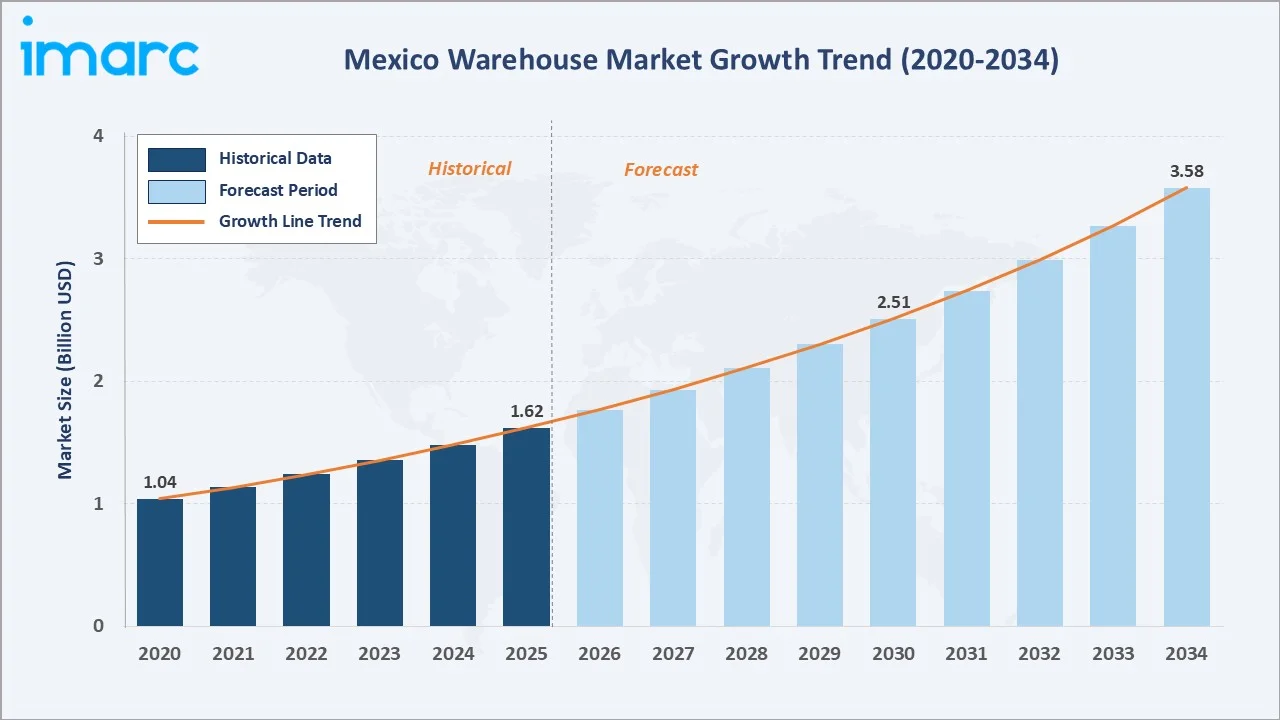
The Mexico warehouse market reached USD 1.62 Billion in 2025 and is projected to reach USD 3.58 Billion by 2034, growing at a CAGR of 9.23% during 2026-2034. The market is driven by nearshoring, USMCA trade integration, e-commerce expansion, and rising foreign direct investment in industrial real estate. Robust manufacturing relocation from Asia is accelerating demand for modern Class-A warehouse space across northern and central corridors.
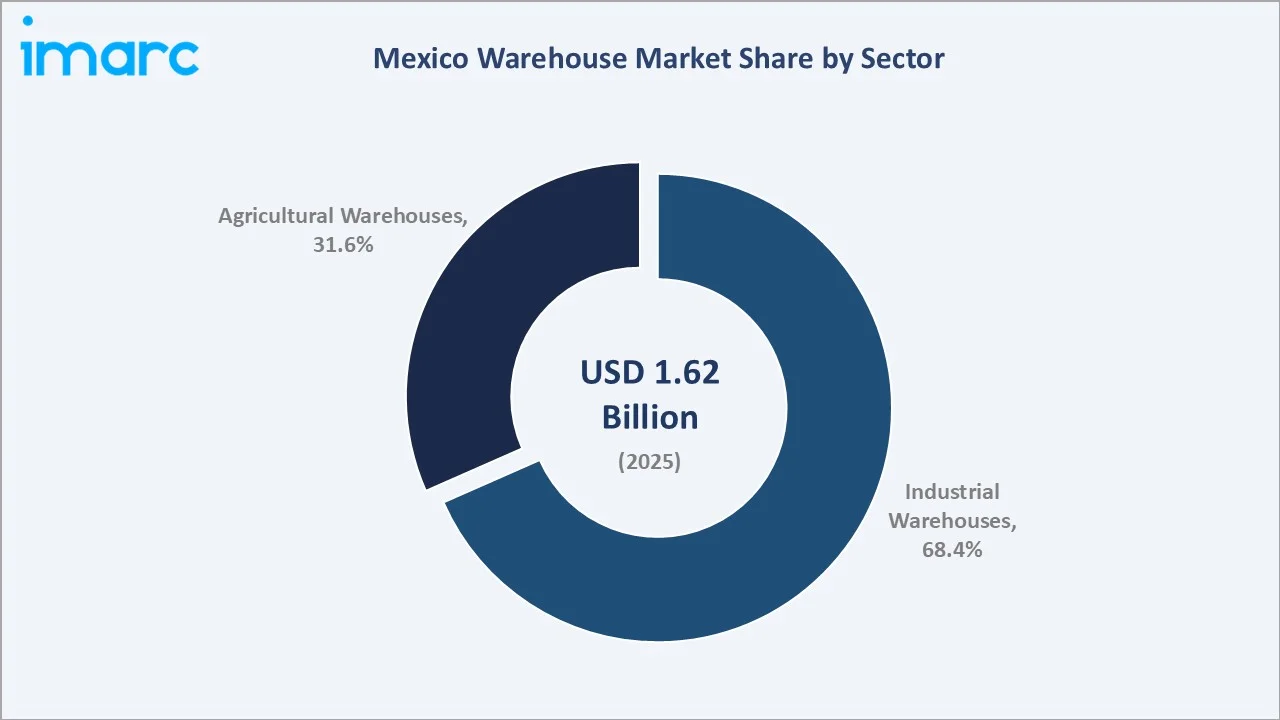
Industrial warehouses dominate the sector at 68.4%. Private warehouses lead ownership at 62.3%. Central Mexico commands 41.8% of the market share.
Market Snapshot
|
Metric |
Value |
|
Market Size (2025) |
USD 1.62 Billion |
|
Forecast Market Size (2034) |
USD 3.58 Billion |
|
CAGR (2026-2034) |
9.23% |
|
Base Year |
2025 |
|
Historical Period |
2020-2025 |
|
Forecast Period |
2026-2034 |
|
Dominant Sector |
Industrial Warehouses (68.4%, 2025) |
|
Dominant Ownership |
Private Warehouses (62.3%, 2025) |
|
Leading Region |
Central Mexico (41.8%, 2025) |
The market expanded from USD 1.04 Billion in 2020 to USD 1.62 Billion in 2025, anchored at USD 2.51 Billion in 2030 and forecast to reach USD 3.58 Billion by 2034. Pandemic-era supply chain disruptions briefly slowed industrial construction, but did not reverse the structural demand trajectory, which accelerated sharply through 2023-2025 as nearshoring investment and e-commerce fulfillment requirements intensified across Mexico.
To get more information on this market, Request Sample
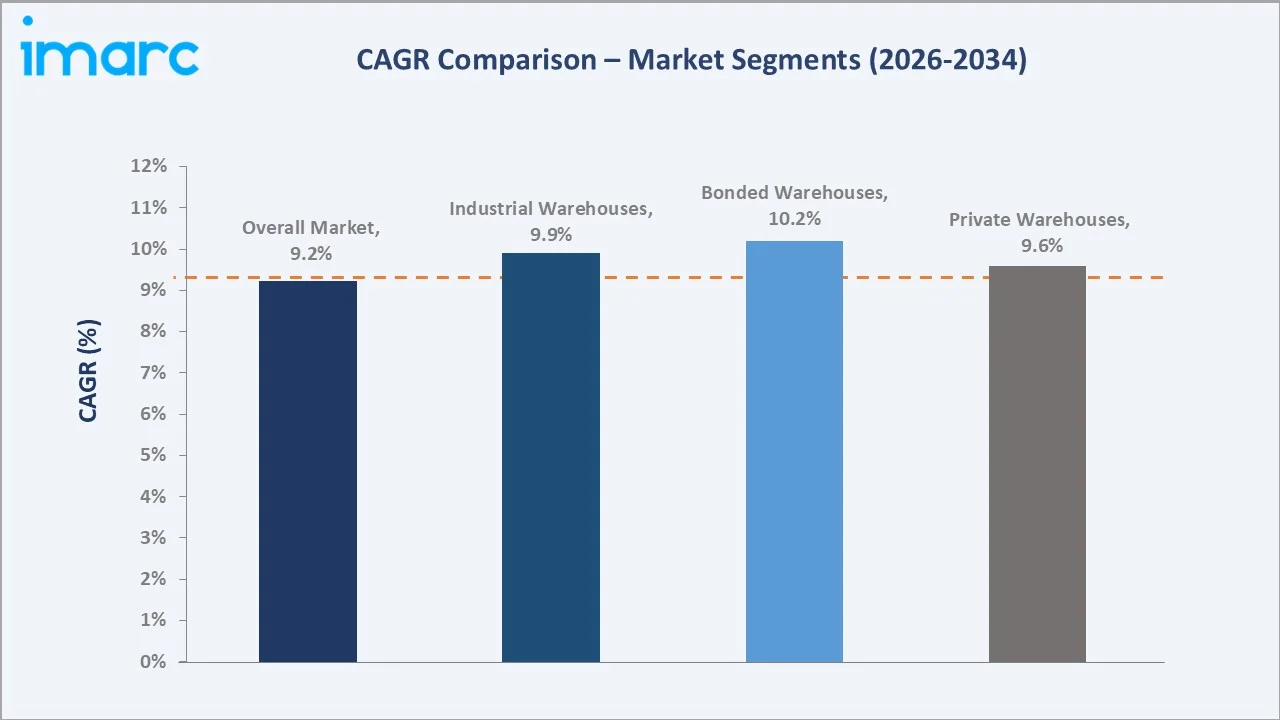
Bonded warehouses grow fastest at ~10.2% CAGR as cross-border trade volumes and IMMEX manufacturing expand customs-controlled storage requirements. Industrial warehouses grow at ~9.9% CAGR as nearshoring-driven manufacturing and distribution demand sustains the highest-volume warehouse procurement category in the country.
Executive Summary
The Mexico warehouse market reached USD 1.62 Billion in 2025, representing one of Latin America's highest-growth industrial real estate segments, driven by the structural relocation of manufacturing supply chains closer to the United States. The warehouse is the defining infrastructure asset of Mexico's nearshoring transformation, enabling distribution, storage, and cross-border logistics flows. The market is projected to reach USD 3.58 Billion by 2034.
Industrial warehouses at 68.4% dominate by capturing manufacturing, distribution, and e-commerce fulfillment demand. Private warehouses at 62.3% lead through captive corporate and 3PL-operated facilities. Central Mexico at 41.8% leads through Mexico City's consumption base, the Bajio manufacturing cluster, and dense population-driven distribution requirements concentrated around the capital region.
Key Market Insights
|
Insight |
Data |
|
Dominant Sector |
Industrial Warehouses - 68.4% share (2025) |
|
Dominant Ownership |
Private Warehouses - 62.3% market share (2025) |
|
Leading Region |
Central Mexico - 41.8% market share (2025) |
|
Market Opportunity |
Bonded warehousing on trade corridors; cold-chain storage; automated fulfillment centers; Bajio industrial parks; multimodal logistics hubs |
Key Analytical Observations Supporting The Above Data:
- Industrial Warehouses at 68.4%: The industrial warehouse segment dominates as nearshoring relocates manufacturing operations to Mexico, generating sustained demand for distribution centers, fulfillment facilities, and storage space. Class-A logistics inventory in northern and central hubs is being absorbed rapidly by automotive, electronics, and e-commerce tenants.
- Private Warehouses at 62.3%: The private warehouse segment dominates due to captive corporate facilities and dedicated 3PL-operated centers serving multinational tenants. Dollar-denominated long-term leases and build-to-suit demand from manufacturers further strengthen segment share across major industrial parks.
- Central Mexico at 41.8%: The Central Mexico region dominates the warehouse market due to its large consumption base anchored by Mexico City, alongside the Bajio manufacturing corridor. In 2025, the region absorbed substantial new logistics inventory, thereby generating significant demand for modern warehouse space.
Mexico Warehouse Market Overview
The Mexico warehouse market encompasses the development, ownership, leasing, and operation of all warehouse and distribution facilities across the country, including industrial warehouses, agricultural warehouses, private and public storage, and bonded customs-controlled facilities serving manufacturing, retail, e-commerce, and agricultural end users.
The ecosystem integrates warehouse developers and FIBRAs, 3PL and logistics operators, construction and fit-out firms, warehouse management technology providers, end-user industries, and regulatory bodies governing customs and trade. Macroeconomic factors include nearshoring investment, USMCA trade flows, rising domestic consumption, e-commerce penetration, and industrial park development across key corridors.
Market Dynamics
To evaluate market opportunities, Request Sample
Market Drivers
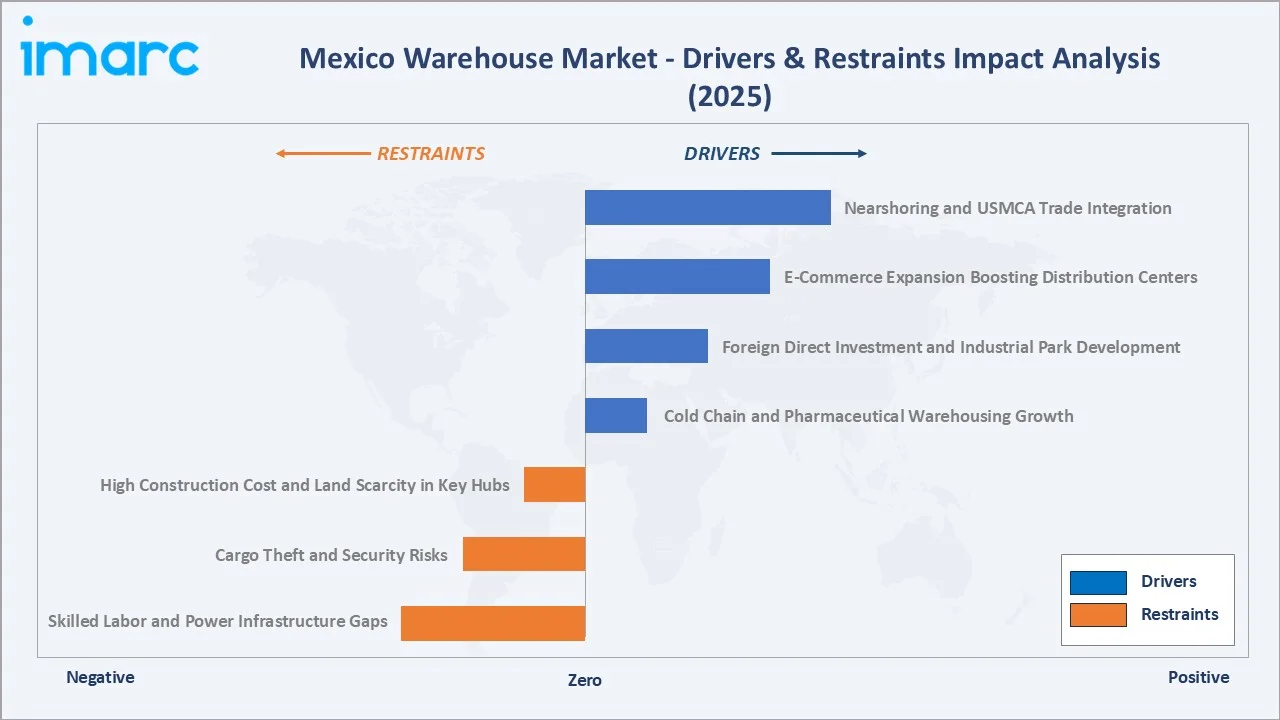
- Nearshoring and USMCA Trade Integration: Nearshoring is relocating manufacturing operations from Asia to Mexico, driving sustained demand for warehouse and distribution space near the United States border. The USMCA trade framework supports seamless cross-border commerce, encouraging multinationals to establish logistics footprints. This structural shift is generating record absorption of Class-A warehouse inventory across northern and central industrial corridors.
- E-Commerce Expansion Boosting Distribution Centers: Rapid e-commerce growth is increasing demand for fulfillment centers, last-mile delivery hubs, and dark stores across Mexico. Mexico's e-commerce sector continues to expand at strong double-digit rates, requiring modern warehouse infrastructure for sorting, storage, and returns processing. Retailers and logistics providers are leasing scalable facilities in urban outskirts and major transportation corridors.
- Foreign Direct Investment and Industrial Park Development: Rising foreign direct investment is funding new industrial parks and build-to-suit warehouse projects across Mexico. Developers are expanding Class-A logistics inventory in Monterrey, Tijuana, Ciudad Juarez, and the Bajio region. Falling vacancy rates and rising rents are encouraging further speculative and pre-leased warehouse development through the forecast period.
- Cold Chain and Pharmaceutical Warehousing Growth: Demand for temperature-controlled and GDP-certified warehousing is rising with pharmaceutical nearshoring, food distribution, and quick-commerce expansion. Cold-storage operators are scaling pallet capacity and adopting energy-efficient refrigeration. This specialized segment commands premium lease rates and is attracting dedicated investment from logistics specialists and developers.
Market Restraints
- High Construction Cost and Land Scarcity in Key Hubs: Rising construction costs and limited developable land in prime logistics markets are constraining warehouse supply. Land scarcity near border cities and Mexico City is driving up development costs and lease rates. These pressures can slow new project delivery, limit absorption, and challenge developers seeking to meet rapidly growing tenant demand.
- Cargo Theft and Security Risks: High rates of cargo theft along major highways increase insurance premiums and operational risks for warehouse and logistics operators. Security concerns influence facility location decisions, site design, and tenant confidence. Elevated security costs and route-planning constraints can reduce operational efficiency and raise the total cost of warehouse-based distribution.
- Skilled Labor and Power Infrastructure Gaps: Shortages of automation-skilled labor and constraints in power and grid infrastructure are limiting modern warehouse expansion in some regions. Inadequate electricity supply and skilled workforce gaps delay automation deployment and facility commissioning. These limitations can slow the adoption of advanced warehouse management systems and high throughput fulfillment operations.
Market Opportunities
- Bonded Warehousing on Trade Corridors: Bonded and customs-controlled warehousing along the Interoceanic Corridor and border crossings represents a high-growth opportunity. Expanding IMMEX manufacturing and cross-border trade volumes require duty-deferred storage facilities. Operators offering bonded warehouse capacity can capture rising demand from import-export tenants and manufacturers managing complex supply chains.
- Automated and Multi-Temperature Fulfillment Centers: Automated case-handling, robotics, and multi-temperature cross-docks present new growth avenues as operators contend with labor shortages and quick-commerce demand. Investment in smart warehousing improves dock efficiency and inventory accuracy. Developers and 3PLs offering technology-enabled facilities can secure long-term contracts and premium positioning.
Market Challenges
- Market Fragmentation and Unorganized Operators: A large share of the warehouse market remains fragmented, with small and unorganized operators lacking advanced technology or scalability. This fragmentation reduces transparency and service standardization. Organized developers must differentiate through Class-A inventory, technology integration, and reliability to consolidate share in a competitive and dispersed market environment.
- Infrastructure Bottlenecks and Modal Imbalance: Heavy dependence on road freight and aging highway infrastructure create bottlenecks that affect warehouse-based distribution efficiency. Delayed rail and port modernization projects limit multimodal connectivity. These infrastructure gaps increase logistics costs and complicate the positioning and throughput of warehouse facilities across regional corridors.
Emerging Market Trends
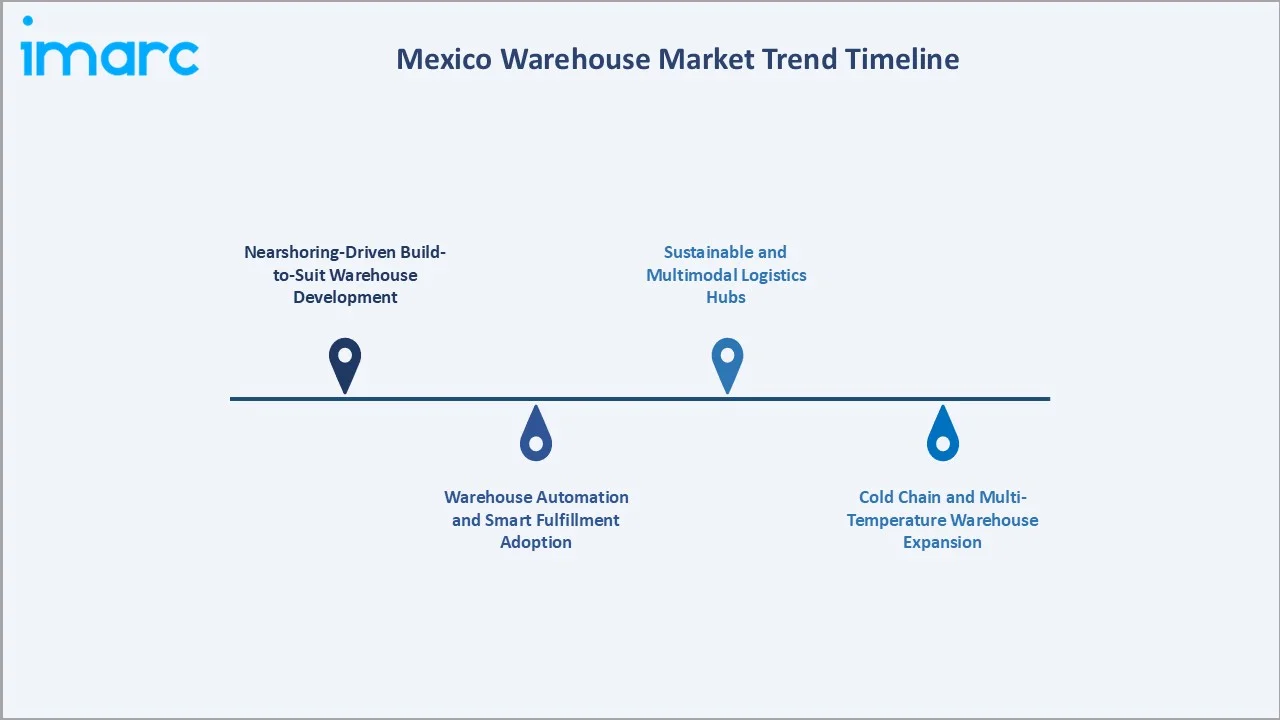
1. Nearshoring-Driven Build-to-Suit Warehouse Development
Nearshoring is accelerating build-to-suit warehouse development as multinationals relocate manufacturing and distribution to Mexico. Developers are constructing custom Class-A facilities pre-leased to automotive, electronics, and consumer goods tenants. This trend reduces vacancy and supports record rent growth in border and central markets, anchoring sustained investment in modern logistics inventory through the forecast period.
2. Warehouse Automation and Smart Fulfillment Adoption
Warehouse automation, including autonomous mobile robots, automated storage and retrieval systems, and IoT-enabled inventory tracking, is transforming Mexican fulfillment operations. Operators are deploying technology to overcome labor shortages and lift dock efficiency. As e-commerce volumes rise, smart fulfillment centers offering predictive slotting and labor orchestration are gaining a competitive edge in major urban hubs.
3. Cold Chain and Multi-Temperature Warehouse Expansion
Cold chain and multi-temperature warehousing is expanding to serve pharmaceutical nearshoring, food distribution, and quick-commerce demand. Operators are scaling refrigerated pallet capacity and integrating solar-powered systems to meet sustainability mandates. As temperature-sensitive supply chains grow, demand is rising for GDP-certified and multi-temperature cross-dock facilities across consumption-driven markets.
4. Sustainable and Multimodal Logistics Hubs
Sustainable and multimodal logistics hubs are emerging as developers integrate rail, road, and port connectivity with energy-efficient warehouse design. These hubs anchor USMCA trade flows and reduce transportation costs. As tenants prioritize ESG performance and supply chain resilience, demand is rising for green-certified, well-connected logistics parks across strategic corridors.
Industry Value Chain Analysis
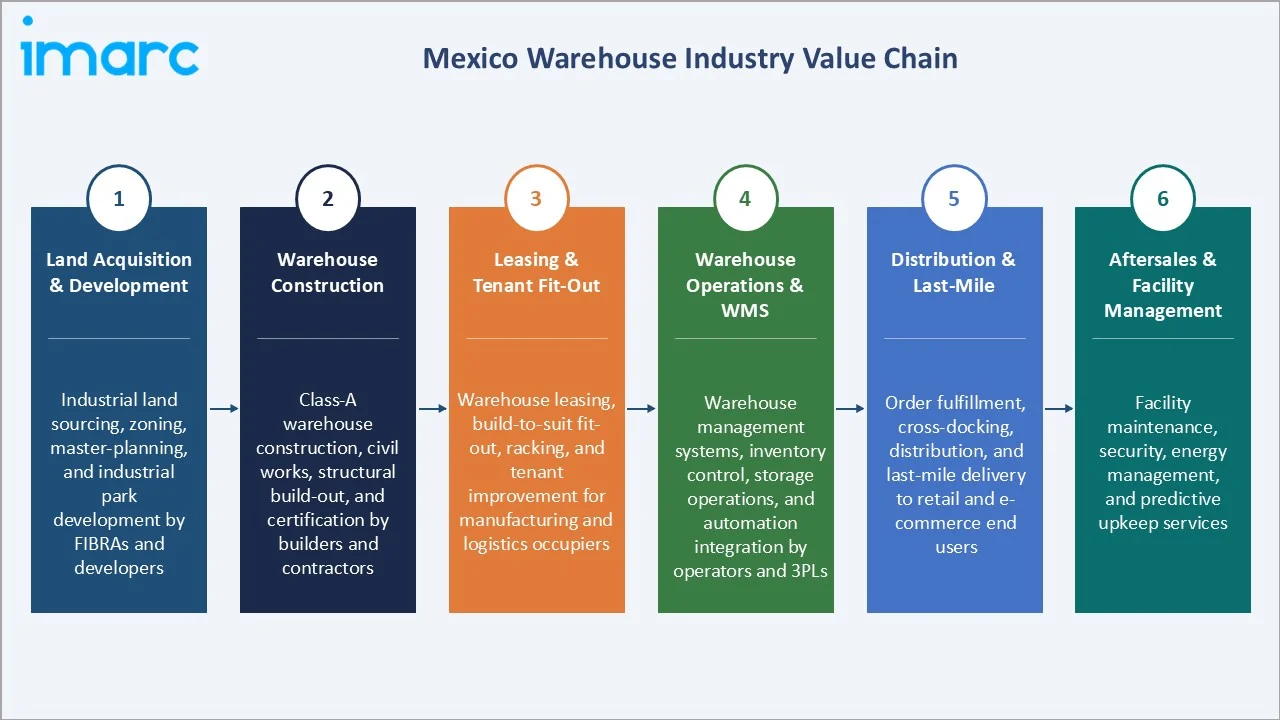
The Mexico warehouse value chain integrates land acquisition and development, warehouse construction, leasing and tenant fit-out, warehouse operations and management systems, distribution and last-mile delivery, and aftersales facility management. The value chain's commercial architecture is consolidating toward integrated logistics-park development as the primary format, combining development, leasing, and operations under institutional FIBRA and developer platforms.
|
Stage |
Key Participants |
|
Land Acquisition & Development |
Industrial land sourcing, zoning, master-planning, and industrial park development by FIBRAs and developers |
|
Warehouse Construction |
Class-A warehouse construction, civil works, structural build-out, and certification by builders and contractors |
|
Leasing & Tenant Fit-Out |
Warehouse leasing, build-to-suit fit-out, racking, and tenant improvement for manufacturing and logistics occupiers |
|
Warehouse Operations & WMS |
Warehouse management systems, inventory control, storage operations, and automation integration by operators and 3PLs |
|
Distribution & Last-Mile |
Order fulfillment, cross-docking, distribution, and last-mile delivery to retail and e-commerce end users |
|
Aftersales & Facility Management |
Facility maintenance, security, energy management, and predictive upkeep services |
The land acquisition and development tier is the warehouse value chain's most capital-intensive and strategically critical stage given land scarcity in prime hubs. The warehouse operations tier is experiencing the most rapid technology transition as manual operations are progressively displaced by automated and WMS-enabled fulfillment for high-volume tenants.
Technology Landscape in the Mexico Warehouse Industry
Warehouse Management Systems (WMS) Technology
Warehouse management system (WMS) technology offers real-time inventory visibility, order accuracy, and operational efficiency. WMS platforms enable predictive slotting, labor orchestration, and seamless integration with transportation systems, making them essential for modern fulfillment. Their adoption by 3PLs and large tenants is accelerating digital transformation across Mexican warehouse operations.
Automation and Robotics Technology
Automation and robotics technology, including autonomous mobile robots and automated storage and retrieval systems, offers high throughput, lower labor dependence, and improved accuracy. These systems support fast, error-free order fulfillment, making them suitable for e-commerce and high-volume distribution centers. Their adoption is rising as operators address labor shortages and productivity demands.
IoT and Smart Warehouse Technology
Internet of Things (IoT) and smart warehouse technology enable real-time asset tracking, predictive analytics, and energy optimization. Sensor-driven monitoring improves inventory control, security, and facility performance. As operators pursue efficiency and sustainability, IoT-enabled smart warehouses are becoming central to next-generation logistics operations across consumption and manufacturing hubs in Mexico.
Market Segmentation Analysis
The report covers the following segments:
|
Segment Category |
Leading Segment |
Market Share |
Year |
|
Sector |
Industrial Warehouses |
68.4% |
2025 |
|
Ownership |
Private Warehouses |
62.3% |
2025 |
|
Type of Commodities Stored |
🔒 |
🔒 |
2025 |
|
Region |
Central Mexico |
41.8% |
2025 |

By Sector
The industrial warehouse segment leads at 68.4% in 2025, encompassing manufacturing, distribution, and e-commerce fulfillment facilities, the most commercially significant and highest-revenue category in the Mexico warehouse market.
To access detailed market analysis, Request Sample
The agricultural warehouse segment at 31.6% serves grain storage, cold-chain agricultural produce, and food distribution requirements across rural and consumption regions. While smaller in revenue share, agricultural warehousing supports Mexico's substantial agro-export sector and is benefiting from cold-chain modernization investment.
By Ownership
Private warehouses lead at 62.3% through captive corporate facilities and dedicated 3PL-operated distribution centers serving multinational tenants under long-term leases. Public warehouses at 24.1% provide shared, multi-tenant storage for smaller occupiers and seasonal demand.
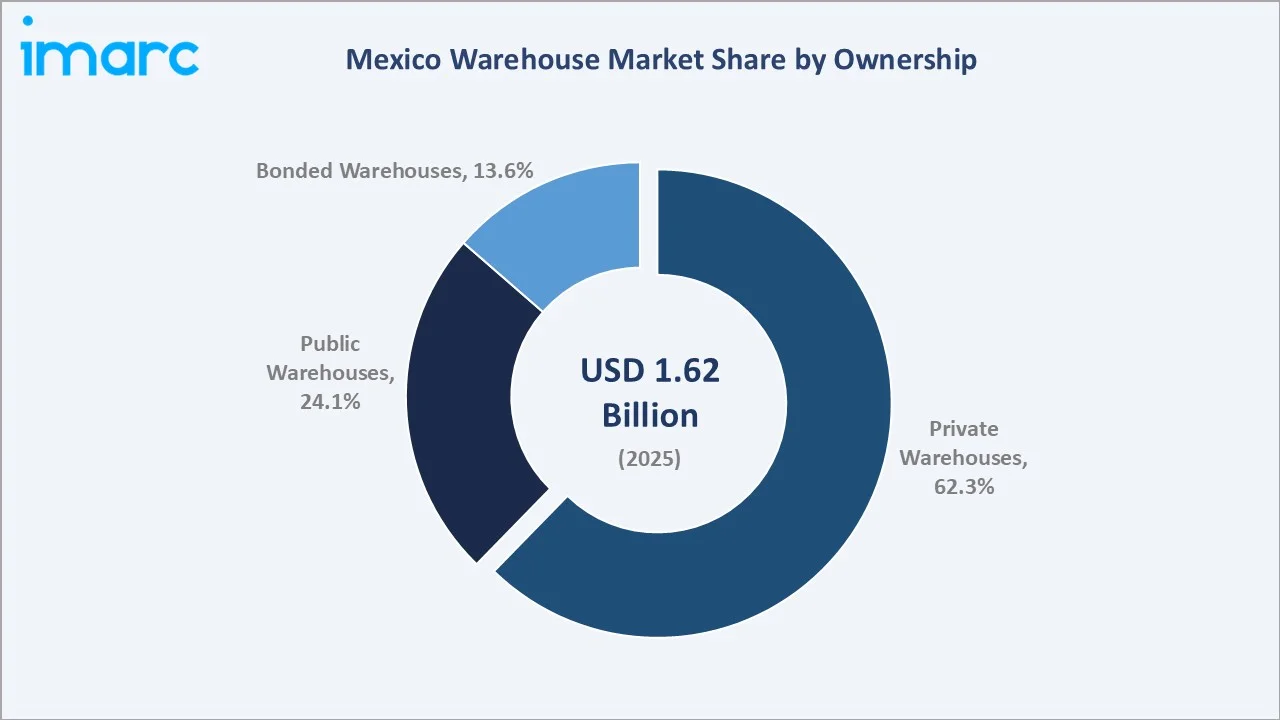
Bonded warehouses at 13.6% serve customs-controlled, duty-deferred storage for import-export and IMMEX manufacturing tenants. The bonded segment is experiencing above-market growth as cross-border trade volumes, and the Interoceanic Corridor expand demand for customs-controlled facilities along key trade routes.
Regional Market Insights
|
Region |
Share (2025) |
Key Warehouse Market Drivers & Characteristics |
|
Central Mexico |
41.8% |
Driven by Mexico City's large consumption base, the Bajio manufacturing corridor, dense population, and concentrated distribution demand |
|
Northern Mexico |
27.6% |
Driven by nearshoring, US border proximity, automotive and electronics manufacturing clusters, and strong cross-border warehouse demand |
|
Southern Mexico |
18.9% |
Supported by the Interoceanic Corridor, port-linked logistics, agricultural storage, and emerging industrial development |
|
Others |
11.7% |
Driven by regional consumption centers, secondary cities, and growing logistics and warehousing investment |
Central Mexico, at 41.8%, leads through Mexico City's consumption density, the Bajio industrial cluster, and concentrated distribution requirements. Northern Mexico, at 27.6%, reflects nearshoring-driven manufacturing and cross-border warehouse demand in Monterrey, Tijuana, and Ciudad Juarez.
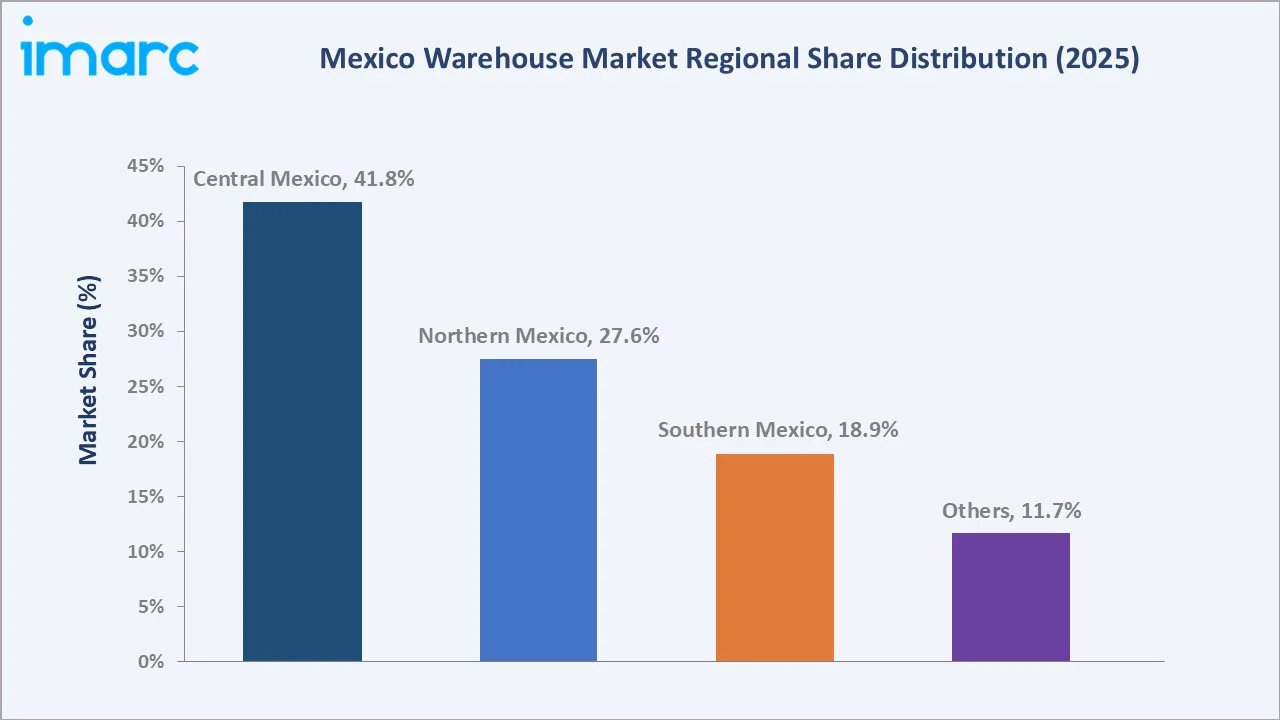
Southern Mexico, at 18.9%, reflects port-linked logistics and the Interoceanic Corridor's emerging role. Others, at 11.7%, represent secondary cities and regional consumption centers, both early-stage but growing warehouse markets driven by domestic consumption and regional industrial development, respectively.
Competitive Landscape
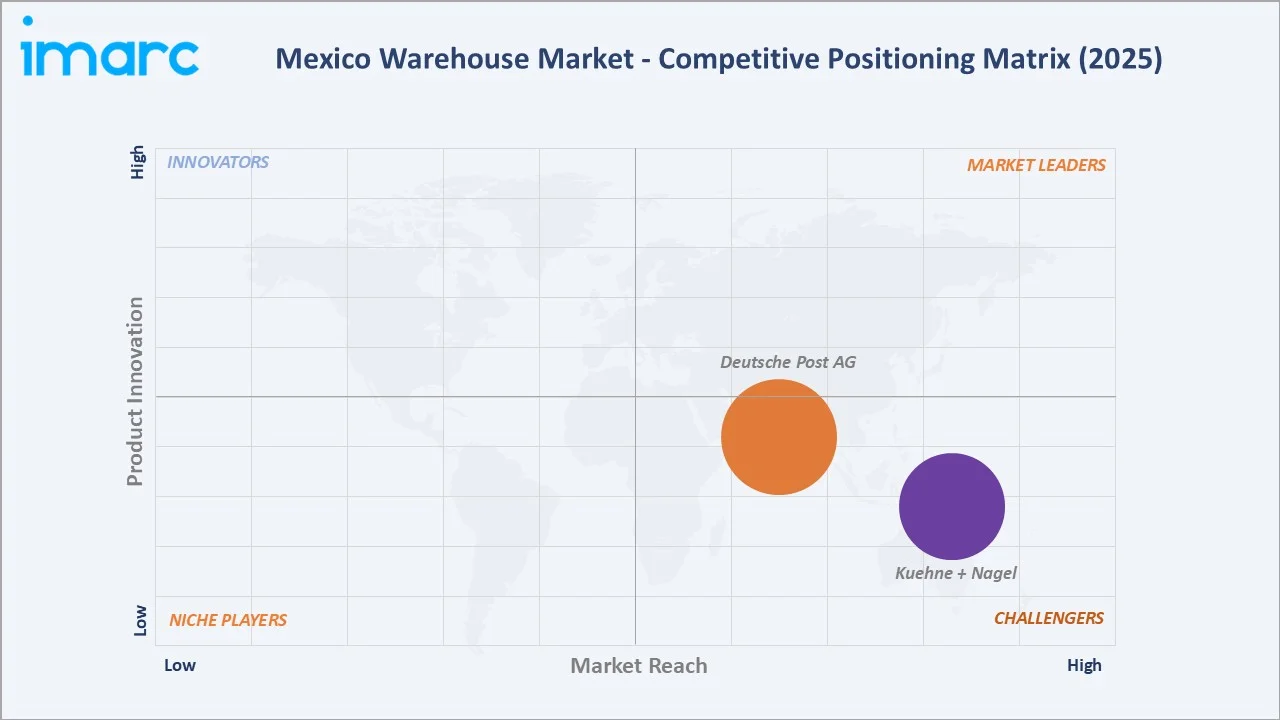
The Mexico warehouse market competitive landscape is moderately fragmented with three distinct tiers: institutional Class-A developers and FIBRAs, global 3PL and logistics operators, and regional and domestic warehouse providers competing primarily in secondary markets and unorganized storage.
|
Company Name |
Key Offerings |
Market Position |
Core Strength |
|
Deutsche Post AG |
Contract logistics, warehousing, distribution, fulfillment |
Strong Challenger |
Deutsche Post AG specializes in operating warehousing, contract logistics, and distribution services for multinational and domestic clients. |
|
Kuehne + Nagel |
Contract logistics, warehousing, freight, distribution |
Challenger |
Kuehne + Nagel specializes in integrated logistics, warehousing, and supply chain solutions across Mexican industrial corridors. |
Key players include Deutsche Post AG, Kuehne + Nagel, and others.
Key Company Profiles
Deutsche Post AG
Deutsche Post AG, operating its contract logistics business as DHL Supply Chain, is a Germany-based logistics company with a strong presence in the Mexico warehouse market through its warehousing, contract logistics, and distribution operations for multinational and domestic clients.
- Key Offerings: Contract logistics, warehousing, distribution, fulfillment, and integrated supply chain services.
- Strategic Focus: Expanding technology-enabled warehousing and contract logistics across Mexico, with emphasis on robotics, automation, WMS integration, and scalable fulfillment solutions for nearshoring-driven demand.
Kuehne + Nagel
Kuehne + Nagel is a Switzerland-based logistics company with a strong presence in the Mexico warehouse market through its contract logistics, warehousing, and cross-border distribution solutions across Mexican industrial corridors.
- Key Offerings: Contract logistics, warehousing, freight forwarding, distribution, and bonded cross-border storage.
- Strategic Focus: Strengthening its cross-border warehouse footprint and contract logistics network, with emphasis on bonded warehousing, nearshoring-driven capacity expansion, and integrated supply chain solutions.
Market Concentration Analysis
The Mexico warehouse market is moderately fragmented at the institutional Class-A level, with the top four key players collectively accounting for a significant share of institutional-grade logistics inventory. The top developers control an estimated 35-40% of Class-A gross leasable area, while a large base of regional and unorganized operators serves secondary markets.
Market concentration is gradually increasing at the institutional tier as nearshoring drives consolidation and capital inflows, even as the overall market remains dispersed across smaller providers.
Investment & Growth Opportunities
Highest Growth Segments
Bonded warehousing (~10.2% CAGR), industrial warehouses (~9.9% CAGR), private build-to-suit facilities (~9.6% CAGR), cold-chain and multi-temperature storage (~11-13% CAGR from a smaller base), automated fulfillment centers (~12% CAGR), and multimodal logistics hubs along trade corridors represent the highest-growth investment vectors through 2034.
Emerging Investment Opportunities
Cold-chain and bonded warehousing represent the warehouse market's highest-value emerging opportunities. Temperature-controlled and customs-controlled facilities command premium lease rates and serve structurally growing pharmaceutical, food, and cross-border trade demand, creating an attractive investment pool through 2034 as nearshoring and quick-commerce expand.
Investment Themes
- Class-A logistics development in nearshoring corridors as a structural growth advantage through 2034: Institutional Class-A warehouse development in northern and central markets captures record nearshoring absorption. Developers achieving scale and prime land positions create a durable competitive advantage that smaller and unorganized operators cannot replicate in supply-constrained prime hubs.
- Cold-chain and automated fulfillment infrastructure, capturing high-value specialized warehouse demand: Investment in temperature-controlled and automated facilities captures the fastest-growing, highest-margin warehouse segments. Operators offering GDP-certified cold storage and technology-enabled fulfillment can secure long-term contracts and premium positioning as pharmaceutical nearshoring and e-commerce expand.
Future Market Outlook (2026-2034)
The Mexico warehouse market is projected to grow from USD 1.62 Billion in 2025 to USD 3.58 Billion by 2034, delivering a 9.23% CAGR over the forecast period. The market's anchor value of USD 2.51 Billion in 2030 represents an industrial real estate sector at its most transformative inflection. Class-A logistics development will have consolidated as the dominant format, automation and WMS adoption are expected to expand across high-volume fulfillment, bonded warehousing will scale along trade corridors, and cold-chain capacity will achieve broader penetration.
Three structural forces define warehouse market growth through 2034. Nearshoring creates a self-reinforcing demand cycle where warehouse investment supports manufacturing relocation, which generates further storage demand. E-commerce expansion multiplies fulfillment and last-mile facility requirements above general distribution growth. The convergence of cold-chain, bonded, and multimodal logistics demand creates additive growth above the already rapid core industrial warehouse expansion.
Research Methodology
Primary Research
Primary research comprised structured interviews with 50+ industry stakeholders (2025), including warehouse developers; FIBRA executives; 3PL and logistics operations leads; industrial real estate brokers; and supply chain managers across manufacturing, retail, and e-commerce sectors.
Secondary Research
Secondary research encompassed company annual reports; FIBRA investor presentations; Mexican government trade and customs data; industrial real estate market reports; nearshoring and FDI statistics; e-commerce growth forecasts; and logistics infrastructure studies. Over 60 secondary sources were reviewed and triangulated.
Forecasting Models
Market revenue forecasts were developed using a demand-based bottom-up model: (i) warehouse inventory and absorption forecast by region and sector; (ii) average lease rates by warehouse type and ownership; (iii) revenue per facility by sector and region multiplied by total leasable area; and (iv) premium adjustment for Class-A, cold-chain, and bonded facilities versus standard storage.
Mexico Warehouse Market Report Coverage:
| Report Features | Details |
|---|---|
| Base Year of the Analysis | 2025 |
| Historical Period | 2020-2025 |
| Forecast Period | 2026-2034 |
| Units | Billion USD |
| Scope of the Report |
Exploration of Historical Trends and Market Outlook, Industry Catalysts and Challenges, Segment-Wise Historical and Future Market Assessment:
|
| Sectors Covered | Industrial Warehouses, Agricultural Warehouses |
| Ownerships Covered | Private Warehouses, Public Warehouses, Bonded Warehouses |
| Types of Commodities Stored Covered | General Warehouses, Speciality Warehouses, Refrigerated Warehouses |
| Regions Covered | Northern Mexico, Central Mexico, Southern Mexico, Others |
| Companies Covered | Deutsche Post AG, Kuehne + Nagel, etc. |
| Customization Scope | 10% Free Customization |
| Post-Sale Analyst Support | 10-12 Weeks |
| Delivery Format | PDF and Excel through Email (We can also provide the editable version of the report in PPT/Word format on special request) |
Key Benefits for Stakeholders:
- IMARC’s industry report offers a comprehensive quantitative analysis of various market segments, historical and current market trends, market forecasts, and dynamics of the Mexico warehouse market from 2020-2034.
- The research report provides the latest information on the market drivers, challenges, and opportunities in the Mexico warehouse market.
- Porter's five forces analysis assist stakeholders in assessing the impact of new entrants, competitive rivalry, supplier power, buyer power, and the threat of substitution. It helps stakeholders to analyze the level of competition within the Mexico warehouse industry and its attractiveness.
- Competitive landscape allows stakeholders to understand their competitive environment and provides an insight into the current positions of key players in the market.
Frequently Asked Questions About the Mexico Warehouse Market Report
The Mexico warehouse market reached USD 1.62 Billion in 2025, driven by industrial warehouses dominant at 68.4%, private warehouses leading ownership at 62.3%, nearshoring-driven manufacturing relocation, Central Mexico commanding 41.8% market share through Mexico City's consumption base and the Bajio cluster, and rising e-commerce fulfillment demand across the country.
The Mexico warehouse market grows at a 9.23% CAGR during 2026-2034, reaching USD 3.58 Billion by 2034. This growth reflects nearshoring investment, USMCA trade integration, e-commerce expansion, cold-chain and bonded warehousing growth, and rising foreign direct investment in industrial real estate.
Industrial warehouses lead at 68.4%, capturing manufacturing, distribution, and e-commerce fulfillment demand. This segment grows at ~9.9% CAGR through nearshoring-driven absorption and continued expansion of Class-A logistics inventory across key corridors.
Private warehouses lead at 62.3% through captive corporate facilities and dedicated 3PL-operated distribution centers under long-term leases. Bonded warehouses grow fastest at ~10.2% CAGR as cross-border trade and IMMEX manufacturing expand customs-controlled storage demand.
Central Mexico leads at 41.8% through Mexico City's consumption density, the Bajio manufacturing corridor, and concentrated distribution demand around the capital region.
Leading companies include Deutsche Post AG, Kuehne + Nagel, and others.
The Mexico warehouse market is projected to reach approximately USD 2.51 Billion by 2030, with Class-A logistics development consolidating, automation and WMS adoption expanding, bonded warehousing scaling along trade corridors, and cold-chain capacity achieving broader penetration.
Need more help?
- Speak to our experienced analysts for insights on the current market scenarios.
- Include additional segments and countries to customize the report as per your requirement.
- Gain an unparalleled competitive advantage in your domain by understanding how to utilize the report and positively impacting your operations and revenue.
- For further assistance, please connect with our analysts.
 Request Customization
 Speak to an Analyst
 Request Brochure
 Inquire Before Buying
Benefits of Customization
- Personalize this research
- Triangulate with your data
- Get data as per your format and definition
- Gain a deeper dive into a specific application, geography, customer, or competitor
- Any level of personalization
Get in Touch With Us
UNITED STATES
Phone: +1-201-971-6302
INDIA
Phone: +91-120-433-0800
UNITED KINGDOM
Phone: +44-753-714-6104
Email: [email protected]
Client Testimonials




.webp)




.webp)













Related Reports

Choose your plan
*Please note that the prices mentioned below are starting prices for each bundle type. Kindly contact our team for further details.*
Single User License
- 1 User License, Access on 2 Devices
- PDF Report + Excel Dataset (Password Protected)
- Lifetime Access
- No Printing Rights
- 10% Free Report Customization
- 10–12 Weeks of Analyst Support
Five User License
- Access for 5 Users, 2 Devices per User
- PDF Report + Excel Dataset (Password Protected)
- Lifetime Access
- Dedicated Account Manager
- 12–14 Weeks of Analyst Support
- No Printing Rights
- 15% Free Report Customization
- 25% Discount on Your Next Purchase
Corporate User License
- Unlimited User Access (Within Your Organization)
- PDF Report + Excel Dataset
- Lifetime Access
- Dedicated Account Manager
- 14–20 Weeks of Analyst Support
- No Printing Rights
- 20% Free Report Customization
- 30% Discount on Your Next Purchase
Essential Insights
What's included:
3 reports
- Lifetime Access
- PDF Reports
- Excel Datasets
- 2 Weeks of Free Analyst Support
- 2 User Licenses
- Access on 2 Devices
- Printing Rights
- Complimentary PowerPoint (PPT) Version
- Complimentary License Upgrade
Professional Access
What's included:
5 reports
- Lifetime Access
- PDF Reports
- Excel Datasets
- 8 Weeks of Free Analyst Support
- 2 User Licenses
- Access on 2 Devices
- Printing Rights
- Complimentary PowerPoint (PPT) Version
- Complimentary License Upgrade
Business Advantage
What's included:
8 reports
- Lifetime Access
- PDF Reports
- Excel Datasets
- 14 Weeks of Free Analyst Support
- 2 User Licenses
- Access on 2 Devices
- Printing Rights
- Complimentary PowerPoint (PPT) Version
- Complimentary License Upgrade
Enterprise Intelligence
What's included:
10 reports
- Lifetime Access
- PDF Reports
- Excel Datasets
- 20 Weeks of Free Analyst Support
- 2 User Licenses
- Access on 2 Devices
- Printing Rights
- Complimentary PowerPoint (PPT) Version
- Complimentary License Upgrade