
Military Load Carriage Systems Market Size, Share, Trends and Forecast by Type, Configuration, and Region, 2026-2034
Military Load Carriage Systems Market Size and Share:
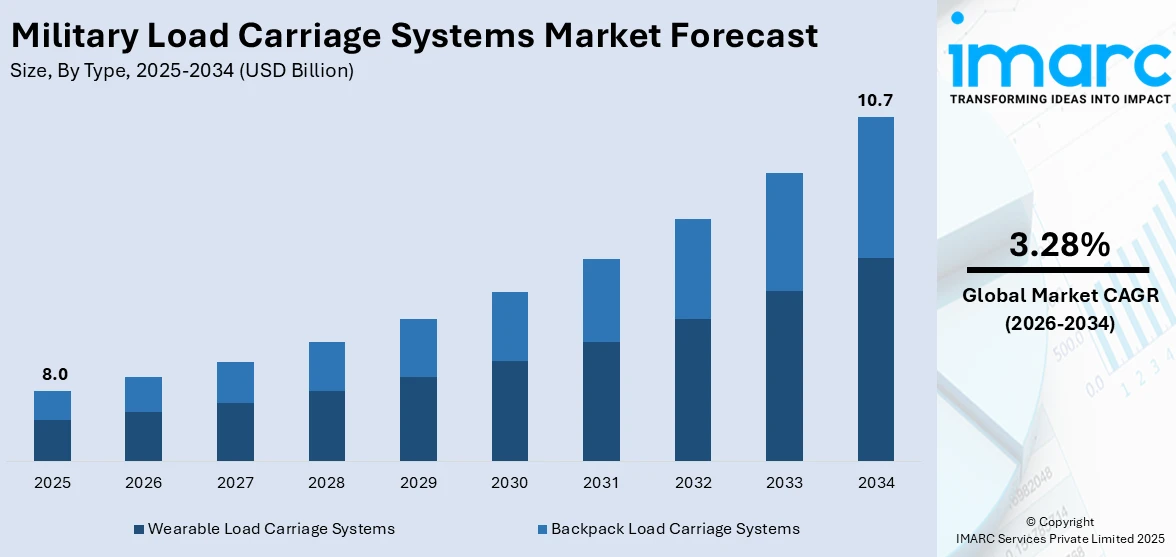
The global military load carriage systems market size was valued at USD 8.00 Billion in 2025. Looking forward, IMARC Group estimates the market to reach USD 10.71 Billion by 2034, exhibiting a CAGR of 3.28% from 2026-2034. Asia Pacific currently dominates the market, holding a market share of 30% in 2025. The region benefits from escalating territorial conflicts, substantial defense expenditures by countries such as China, Japan, and India, and active government-led military modernization programs focused on upgrading soldier equipment, contributing to the military load carriage systems market share.
The growing instances of cross-border conflicts and escalating geopolitical tensions across various regions have substantially fueled demand for advanced military load carriage systems. Armed forces worldwide are prioritizing the modernization of soldier equipment to improve operational effectiveness and physical endurance in diverse combat environments. Governments are allocating increasing portions of their defense budgets toward soldier-centric programs, recognizing that enhanced load distribution and ergonomic design directly impact mission success. The integration of advanced materials such as lightweight composites, nylon blends, and high-strength synthetic fabrics into military load carriage systems has transformed the way soldiers manage equipment weight during prolonged field operations. Additionally, as per the military load carriage systems market forecast, the growing adoption of modular and customizable load carriage architectures are expected to enable military personnel to configure their equipment based on mission-specific requirements, enhancing flexibility across varied operational landscapes.
The United States has emerged as a major region in the military load carriage systems market owing to many factors. The country's defense establishment places significant emphasis on equipping ground forces with advanced, ergonomic, and mission-adaptable load carriage systems. The US military's Soldier Lethality program, one of six key modernization priorities, directly drives demand for lightweight, modular, and technologically integrated load-bearing solutions. Government procurement initiatives are supported by the US Army's fiscal year 2025 budget request of USD 185.9 billion, which funds continued modernization of soldier systems including load-bearing equipment with MOLLE compatibility and integrated hydration and communication capabilities. The widespread adoption of GPS-enabled and sensor-equipped load carriage systems across infantry and special operations forces underscores the country's commitment to advancing soldier performance. Strategic alliances with allied defense manufacturers further reinforce the domestic supply chain and innovation pipeline.
To get more information on this market Request Sample
Military Load Carriage Systems Market Trends:
Integration of Smart Technologies and Electronic Systems
Armed forces globally are driving significant changes in the design and functionality of military load carriage systems through the growing incorporation of smart technologies. Governments and defense contractors are increasingly embedding sensors, GPS tracking modules, augmented reality interfaces, and real-time health monitoring systems directly into load-bearing equipment to enhance situational awareness and reduce soldier fatigue in complex operational environments. Communication-compatible harnesses and backpacks now allow infantry units to remain connected to command networks without relying on separate communication devices, streamlining data flow in the field. Hydration system integration and biometric feedback mechanisms are also gaining traction as militaries prioritize soldier wellness during extended missions. Defense procurement programs are actively funding research into smart textiles and wearable electronics, as these technologies are expected to substantially elevate tactical performance across both conventional and special forces applications. For instance, Japan's Defense Buildup Plan commits JPY 43 trillion, equivalent to approximately USD 300 billion, from 2023 to 2027, with significant allocations toward the modernization of soldier systems including smart load carriage platforms, reinforcing a global trend toward technologically augmented personal military equipment.
Adoption of Lightweight and Ergonomic Design Principles
Military forces globally are placing increasing emphasis on reducing the physical burden on soldiers by adopting lightweight and ergonomically optimized load carriage systems. Advances in materials science have enabled manufacturers to develop systems using ultra-lightweight composites, carbon fiber frames, and high-denier synthetic fabrics that provide exceptional durability without adding unnecessary weight. Ergonomic enhancements are being systematically incorporated into new-generation military backpacks and wearable carriage platforms to reduce musculoskeletal injuries. These design innovations align with military health and wellness priorities that recognize soldier fatigue as a key operational risk factor. Growing interest in load carriage systems compatible with body armor and tactical vests has further accelerated the development of slim-profile designs suited to high-intensity operations. The evolving military load carriage systems market trends point toward a future where lightweight ergonomic solutions dominate infantry and special operations procurement. For instance, South Korea plans to invest USD 73.5 billion in defense spending between 2024 and 2028, increasing procurement of advanced soldier systems including modernized load carriage platforms as part of its comprehensive military capability enhancement program.
Rising Global Defense Expenditure and Modernization Programs
Rising defense budgets across multiple regions are generating consistent and expanding demand for advanced military load carriage systems. Governments worldwide are channeling record allocations into military modernization programs that encompass soldier equipment upgrades as a strategic priority. Nations in Asia Pacific, the Middle East, and Europe are significantly increasing their annual defense budgets in response to evolving security landscapes characterized by asymmetric warfare, border disputes, and counterterrorism operations. As defense expenditures climb, procurement agencies are placing larger orders for modular, technologically advanced load carriage systems capable of addressing diverse mission requirements. The military load carriage systems market outlook remains positive, supported by long-term procurement frameworks established by multiple governments to standardize and upgrade infantry equipment across entire armed forces. For instance, the Philippines' Department of National Defense received an allocation of USD 4.65 billion in the 2025 national budget, representing a 12.3% increase compared to the prior year, underscoring the broader regional commitment to comprehensive military modernization that includes advanced soldier load carriage capabilities.
Military Load Carriage Systems Industry Segmentation:
IMARC Group provides an analysis of the key trends in each segment of the global military load carriage systems market, along with forecast at the global, regional, and country levels from 2026-2034. The market has been categorized based on type and configuration.

Analysis by Type:
- Backpack Load Carriage Systems
- Wearable Load Carriage Systems
Backpack load carriage systems hold 60% of the market share. Backpack load carriage systems represent the foundational load-bearing solution for ground forces, providing infantry personnel with the capacity to carry large quantities of essential equipment, including weapons, rations, medical supplies, and communication devices, over extended operational distances. These systems have evolved through the incorporation of MOLLE attachment systems, integrated hydration bladder compatibility, and reinforced ergonomic suspension frames that distribute weight evenly across the back and shoulders. Apart from this, their ability to accommodate heavy loads while maintaining soldier mobility makes them the preferred choice for long-range patrols, logistics support, and humanitarian operations. The versatility of backpack systems allows configurations ranging from compact assault packs to large-capacity rucksacks suited for multi-day missions.
Analysis by Configuration:
Access the comprehensive market breakdown Request Sample
- Shoulder Mounted
- Waist Mounted
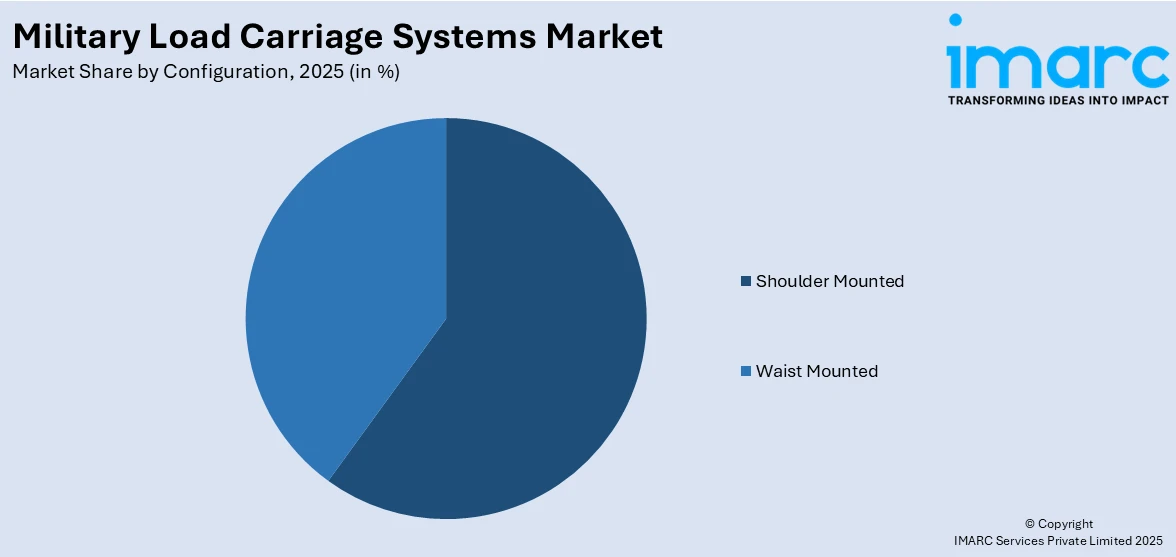
Shoulder mounted leads the market with a share of 55%. Shoulder mounted load carriage systems dominate the global market, owing to their superior weight distribution capabilities and adaptability across varied military operational environments. These systems primarily channel load weight across the shoulders and upper torso, enabling soldiers to carry heavier equipment loads without imposing excessive stress on the lower back or reducing lower-body mobility. The proliferation of shoulder-mounted tactical vests, plate carriers with MOLLE integration, and modular torso harnesses has expanded the product portfolio substantially, catering to diverse mission requirements from close-quarters combat to long-range infantry patrols. Shoulder-mounted designs are compatible with a wide range of military accessories, including radio pouches, ammunition holders, hydration systems, and medical kits, making them highly valued across all branches of the armed forces.
Regional Analysis:
- North America
- United States
- Canada
- Asia Pacific
- China
- Japan
- India
- South Korea
- Australia
- Indonesia
- Others
- Europe
- Germany
- France
- United Kingdom
- Italy
- Spain
- Russia
- Others
- Latin America
- Brazil
- Mexico
- Others
- Middle East and Africa
Asia Pacific, accounting for 30% of the share, enjoys the leading position in the market. The region's prominence is driven by escalating geopolitical tensions in the South China Sea and the broader Indo-Pacific, prompting governments to substantially increase defense expenditures and accelerate infantry modernization programs. Countries such as China, India, Japan, South Korea, and Australia are actively procuring advanced load carriage systems as part of comprehensive soldier modernization initiatives aimed at enhancing ground force mobility and operational effectiveness in diverse terrains. The region hosts an expanding domestic defense manufacturing base, particularly in India and South Korea, which reduces dependence on foreign suppliers and enables faster procurement cycles for modernized load carriage equipment. Additionally, the presence of active territorial disputes and border conflicts creates sustained near-term demand for military equipment upgrades. For instance, Indonesia announced a USD 125 billion military modernization plan encompassing the procurement of advanced soldier systems and load-bearing equipment as part of its comprehensive defense capability enhancement program for its ground forces.
Key Regional Takeaways:
United States Military Load Carriage Systems Market Analysis
The United States military load carriage systems market is driven by several pivotal factors, including the country's substantial defense budget, longstanding commitment to soldier modernization, and a highly developed domestic defense industrial base. The US Army's focus on six modernization priorities, including Soldier Lethality, which directly encompasses advanced load carriage solutions, has ensured consistent procurement and development of next-generation load-bearing equipment. Investments in MOLLE-compatible systems, ergonomic suspension platforms, and smart-enabled carriage solutions reflect the US military's emphasis on reducing soldier fatigue while enhancing mission effectiveness in multi-domain operations. Special operations forces drive demand for specialized, ultra-lightweight, and mission-configurable load carriage systems that prioritize mobility and stealth over maximum carry capacity. The country's procurement framework supports both large-scale contracts for standardized infantry equipment and specialized orders for elite units. Close collaboration between military procurement agencies, defense contractors, and research institutions ensures a steady pipeline of innovations. The United States, being the world's top spender on military combat abilities, continues to foster growth, he stated in a webinar. From 2021 to 2025, North America represented the most significant rise in worldwide defense expenditures with approximately $162 billion in extra funding during that five-year period. Most of that expansion originated from the United States.
Europe Military Load Carriage Systems Market Analysis
The European military load carriage systems market benefits from a combination of NATO interoperability standards, rising defense budgets across member states, and a growing emphasis on soldier welfare and ergonomics. European armed forces are modernizing their infantry equipment to align with NATO's evolving capability targets, which in June 2025 included expanded priorities for logistics and large land manoeuvre formations, directly influencing procurement of advanced load carriage solutions. Countries such as Germany, France, the United Kingdom, and Poland are driving significant demand for modular and standardized load carriage platforms that can interoperate across NATO formations in joint operations. The region's focus on sustainability and the use of recyclable materials in defense procurement is also influencing product development. Military forces across the continent require systems compatible with ballistic protection layers, communication modules, and hydration platforms, driving demand for integrated and versatile designs.
Asia-Pacific Military Load Carriage Systems Market Analysis
The Asia-Pacific military load carriage systems market is driven by rapid military modernization programs, escalating territorial disputes, and rising defense expenditures across the region's leading economies. Japan's commitment to its Defense Buildup Plan, which allocates JPY 43 trillion from 2023 to 2027, encompasses comprehensive soldier modernization including the procurement of advanced load carriage platforms. Meanwhile, India's Future Infantry Soldier as a System program and China's ongoing People's Liberation Army modernization drives are generating sustained demand for technologically integrated and lightweight load carriage solutions. The region's growing domestic defense manufacturing capabilities, especially in India and South Korea, are reducing procurement timelines and enabling governments to field next-generation soldier equipment more rapidly. For instance, Japan broke its defense spending record in 2024 with a budget of USD 55.9 billion, reinforcing significant allocations toward soldier equipment modernization including advanced load carriage systems.
Latin America Military Load Carriage Systems Market Analysis
The Latin American military load carriage systems market is supported by ongoing military modernization efforts in key countries such as Brazil and Mexico, driven by internal security concerns, border protection imperatives, and increasing participation in regional defense cooperation programs. Governments in the region are channeling greater shares of their defense budgets toward upgrading soldier equipment, including lightweight and modular load carriage solutions suited to diverse terrains ranging from dense jungle to arid highland environments.
Middle East and Africa Military Load Carriage Systems Market Analysis
The Middle East and Africa military load carriage systems market benefits from the region's sustained focus on military capability enhancement, driven by territorial security concerns, counterterrorism operations, and rising defense budgets among Gulf Cooperation Council nations. Apart from this, countries including Saudi Arabia, the UAE, and Israel are investing significantly in modernizing their ground forces, encompassing procurement of advanced load carriage solutions suited to desert and urban warfare environments.
Competitive Landscape:
The global military load carriage systems market is characterized by a moderately fragmented competitive landscape, with established defense contractors and specialized tactical gear manufacturers competing for long-term government procurement contracts. Leading players are actively investing in research and development to integrate smart technologies, lightweight materials, and ergonomic innovations into their product portfolios to maintain competitive differentiation. Companies are pursuing strategic alliances, teaming arrangements, and acquisitions to expand their geographic reach and technical capabilities, particularly in the growing Asia-Pacific and European markets. Manufacturers are also increasingly focusing on modularity and customization, offering defense agencies adaptable solutions that can be tailored to specific mission profiles, operational environments, and soldier anthropometry. Supply chain resilience and local manufacturing capabilities are emerging as key competitive differentiators, particularly in the context of growing defense procurement regulations that prioritize domestic or allied-nation sourcing for critical soldier equipment.
The report provides a comprehensive analysis of the competitive landscape in the military load carriage systems market with detailed profiles of all major companies, including:
- ADS Inc.
- Australian Defence Apparel (Logistik Unicorp Holdings Inc.)
- CQC
- Sarkar Defense Inc.
- Stedfast Inc
Latest News and Developments:
- May 2025: NP Aerospace and Logistik Unicorp announced a strategic teaming arrangement to co-develop next-generation integrated soldier system solutions for international customers, combining NP Aerospace's combat-proven armour technology with Logistik Unicorp's military apparel and load carriage expertise.
Military Load Carriage Systems Market Report Scope:
| Report Features | Details |
|---|---|
| Base Year of the Analysis | 2025 |
| Historical Period | 2020-2025 |
| Forecast Period | 2026-2034 |
| Units | Billion USD |
| Scope of the Report |
Exploration of Historical Trends and Market Outlook, Industry Catalysts and Challenges, Segment-Wise Historical and Future Market Assessment:
|
| Types Covered | Backpack Load Carriage Systems, Wearable Load Carriage Systems |
| Configurations Covered | Shoulder Mounted, Waist Mounted |
| Regions Covered | Asia Pacific, Europe, North America, Latin America, Middle East and Africa |
| Countries Covered | United States, Canada, Germany, France, United Kingdom, Italy, Spain, Russia, China, Japan, India, South Korea, Australia, Indonesia, Brazil, Mexico |
| Companies Covered | ADS Inc., Australian Defence Apparel (Logistik Unicorp Holdings Inc.), CQC, Sarkar Defense Inc., Stedfast Inc, etc. |
| Customization Scope | 10% Free Customization |
| Post-Sale Analyst Support | 10-12 Weeks |
| Delivery Format | PDF and Excel through Email (We can also provide the editable version of the report in PPT/Word format on special request) |
Key Benefits for Stakeholders:
- IMARC’s report offers a comprehensive quantitative analysis of various market segments, historical and current market trends, market forecasts, and dynamics of the military load carriage systems market from 2020-2034.
- The research study provides the latest information on the market drivers, challenges, and opportunities in the global military load carriage systems market.
- The study maps the leading, as well as the fastest-growing, regional markets. It further enables stakeholders to identify the key country-level markets within each region.
- Porter's Five Forces analysis assists stakeholders in assessing the impact of new entrants, competitive rivalry, supplier power, buyer power, and the threat of substitution. It helps stakeholders to analyze the level of competition within the military load carriage systems industry and its attractiveness.
- Competitive landscape allows stakeholders to understand their competitive environment and provides an insight into the current positions of key players in the market.
Frequently Asked Questions About the Military Load Carriage Systems Market Report
The military load carriage systems market was valued at USD 8.00 Billion in 2025.
The military load carriage systems market is projected to exhibit a CAGR of 3.28% during 2026-2034, reaching a value of USD 10.71 Billion by 2034.
The military load carriage systems market is driven by escalating cross-border conflicts and geopolitical tensions that compel governments to upgrade soldier equipment. Rising global defense budgets, military modernization programs, and increasing adoption of smart technologies, lightweight materials, and modular designs that enhance soldier mobility and operational effectiveness are key market catalysts.
Asia Pacific currently dominates the military load carriage systems market, accounting for a share of 30%. The region benefits from escalating territorial disputes across the Indo-Pacific, substantial defense expenditures by China, Japan, and India, and active government-led military modernization programs focused on upgrading soldier load-bearing capabilities.
Some of the major players in the military load carriage systems market include ADS Inc., Australian Defence Apparel (Logistik Unicorp Holdings Inc.), CQC, Sarkar Defense Inc., Stedfast Inc, etc.
Need more help?
- Speak to our experienced analysts for insights on the current market scenarios.
- Include additional segments and countries to customize the report as per your requirement.
- Gain an unparalleled competitive advantage in your domain by understanding how to utilize the report and positively impacting your operations and revenue.
- For further assistance, please connect with our analysts.
 Request Customization
 Speak to an Analyst
 Request Brochure
 Inquire Before Buying
Benefits of Customization
- Personalize this research
- Triangulate with your data
- Get data as per your format and definition
- Gain a deeper dive into a specific application, geography, customer, or competitor
- Any level of personalization
Get in Touch With Us
UNITED STATES
Phone: +1-201-971-6302
INDIA
Phone: +91-120-433-0800
UNITED KINGDOM
Phone: +44-753-714-6104
Email: [email protected]
Client Testimonials




.webp)




.webp)













Related Reports

Choose your plan
*Please note that the prices mentioned below are starting prices for each bundle type. Kindly contact our team for further details.*
Single User License
- 1 User License, Access on 2 Devices
- PDF Report + Excel Dataset (Password Protected)
- Lifetime Access
- No Printing Rights
- 10% Free Report Customization
- 10–12 Weeks of Analyst Support
Five User License
- Access for 5 Users, 2 Devices per User
- PDF Report + Excel Dataset (Password Protected)
- Lifetime Access
- Dedicated Account Manager
- 12–14 Weeks of Analyst Support
- No Printing Rights
- 15% Free Report Customization
- 25% Discount on Your Next Purchase
Corporate User License
- Unlimited User Access (Within Your Organization)
- PDF Report + Excel Dataset
- Lifetime Access
- Dedicated Account Manager
- 14–20 Weeks of Analyst Support
- No Printing Rights
- 20% Free Report Customization
- 30% Discount on Your Next Purchase
Essential Insights
What's included:
3 reports
- Lifetime Access
- PDF Reports
- Excel Datasets
- 2 Weeks of Free Analyst Support
- 2 User Licenses
- Access on 2 Devices
- Printing Rights
- Complimentary PowerPoint (PPT) Version
- Complimentary License Upgrade
Professional Access
What's included:
5 reports
- Lifetime Access
- PDF Reports
- Excel Datasets
- 8 Weeks of Free Analyst Support
- 2 User Licenses
- Access on 2 Devices
- Printing Rights
- Complimentary PowerPoint (PPT) Version
- Complimentary License Upgrade
Business Advantage
What's included:
8 reports
- Lifetime Access
- PDF Reports
- Excel Datasets
- 14 Weeks of Free Analyst Support
- 2 User Licenses
- Access on 2 Devices
- Printing Rights
- Complimentary PowerPoint (PPT) Version
- Complimentary License Upgrade
Enterprise Intelligence
What's included:
10 reports
- Lifetime Access
- PDF Reports
- Excel Datasets
- 20 Weeks of Free Analyst Support
- 2 User Licenses
- Access on 2 Devices
- Printing Rights
- Complimentary PowerPoint (PPT) Version
- Complimentary License Upgrade