
Milk Protein Concentrate Market Size, Share, Trends and Forecast by Nature, Form, Concentration, Application, Distribution Channel, and Region, 2026-2034
Milk Protein Concentrate Market Size, Share, Trends & Forecast (2026-2034)
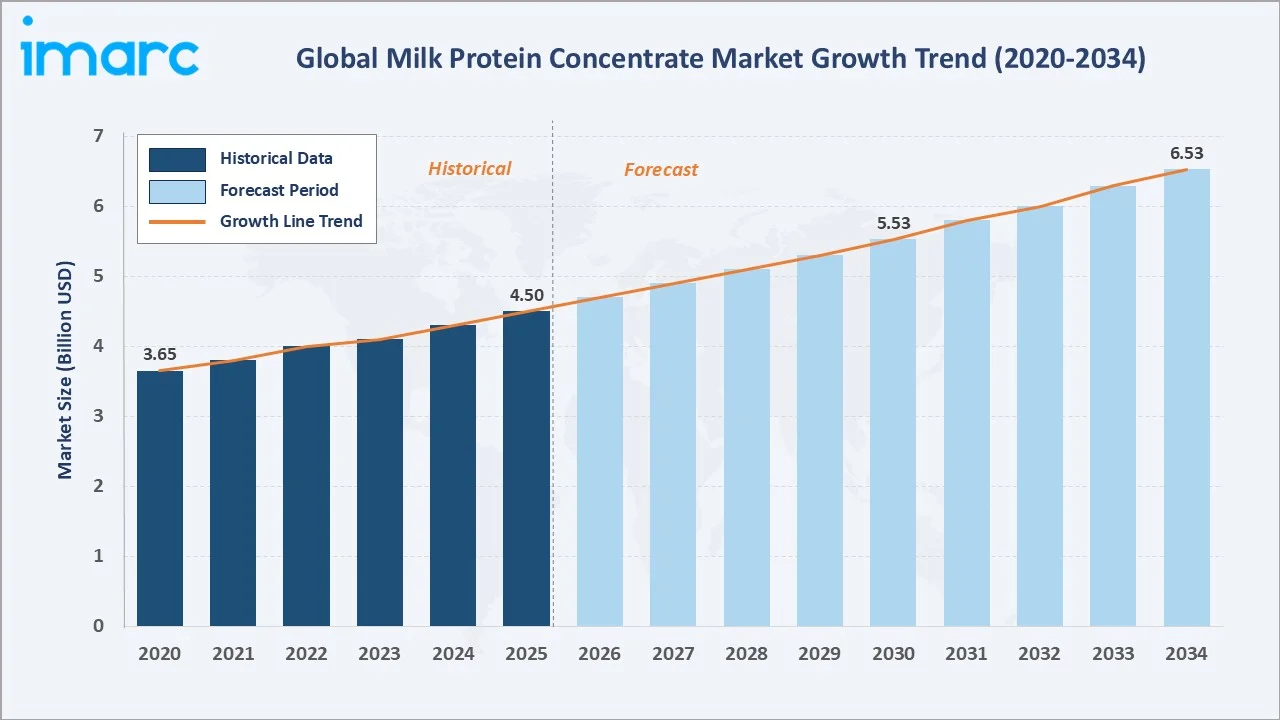
The global milk protein concentrate (MPC) market reached USD 4.50 Billion in 2025 and is projected to reach USD 6.53 Billion by 2034, expanding at a CAGR of 4.23% during 2026-2034. Rising health and wellness awareness, growing demand for obesity and diabetes prevention nutrition, and expanding infant nutrition formula adoption are the primary growth catalysts.
Market Snapshot
|
Metric |
Value |
|
Market Size (2025) |
USD 4.50 Billion |
|
Forecast Market Size (2034) |
USD 6.53 Billion |
|
CAGR (2026-2034) |
4.23% |
|
Base Year |
2025 |
|
Historical Period |
2020-2025 |
|
Forecast Period |
2026-2034 |
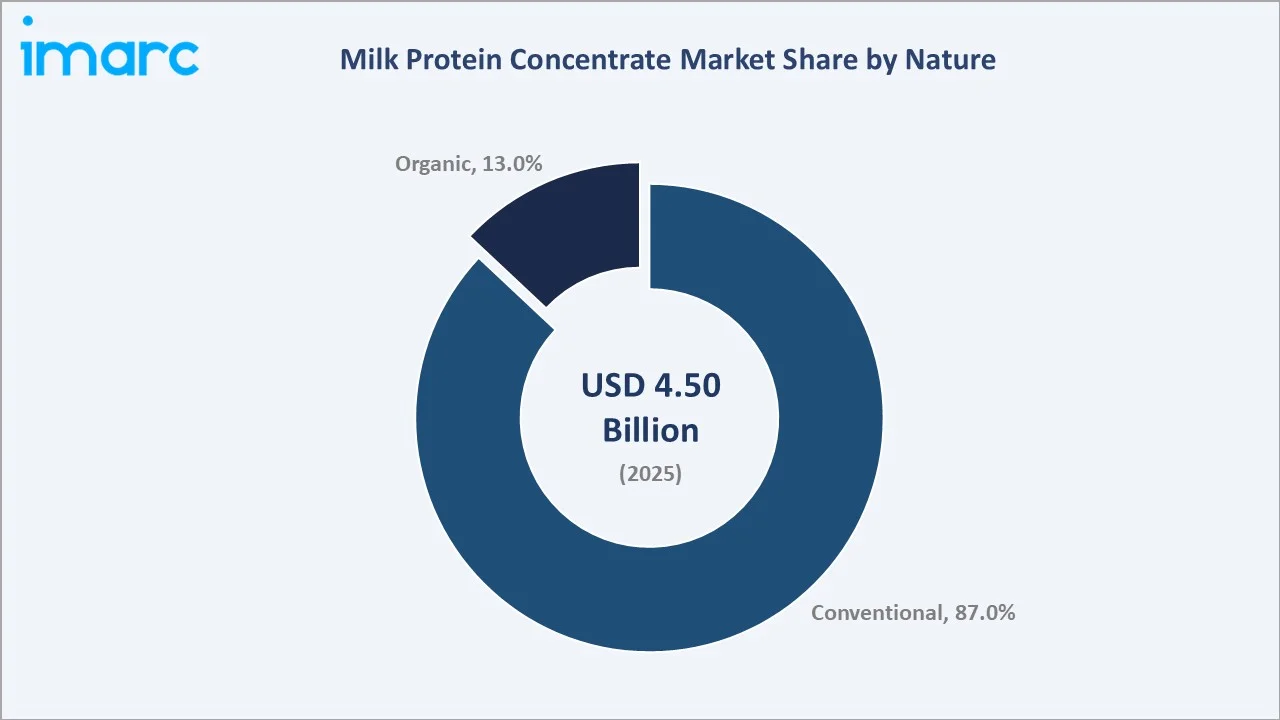
North America leads the global milk protein concentrate landscape, holding a 40.0% share in 2025, anchored by the region's expansive dairy processing infrastructure and rising sports nutrition demand. Conventional commands the largest share of the nature segment at 87.0%, reflecting sustained demand for cost-effective, widely available protein ingredients across dairy, nutrition, and food processing applications.
To get more information on this market, Request Sample
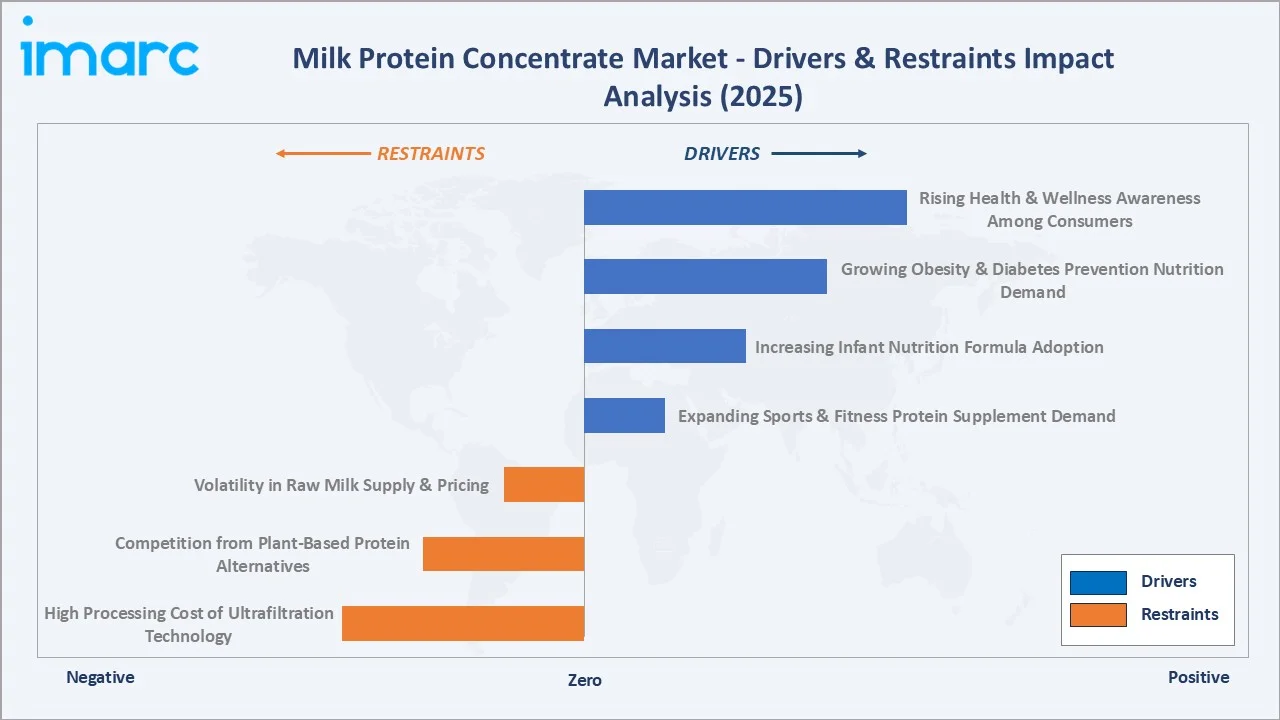
The global milk protein concentrate market is underpinned by three structural forces: rising health and wellness awareness, growing obesity and diabetes prevention nutrition demand, and increasing infant nutrition formula adoption. Each force independently reinforces category growth, sustaining steady CAGR expansion through 2034 despite volatility in raw milk supply and pricing.
Executive Summary
The global milk protein concentrate market is experiencing steady expansion, driven by rising health and wellness awareness, growing obesity and diabetes prevention nutrition demand, and expanding infant nutrition formula adoption. The market was valued at USD 4.50 Billion in 2025 and is forecast to reach USD 6.53 Billion by 2034, growing at a CAGR of 4.23%.
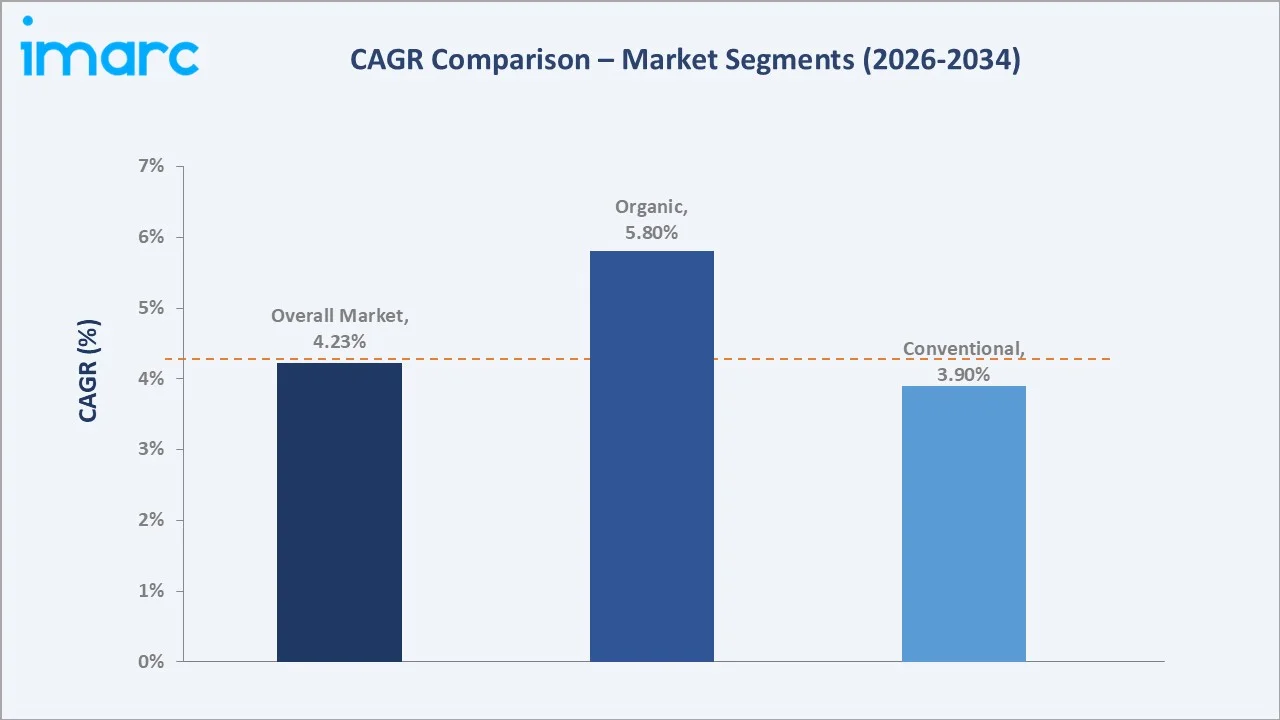
Conventional dominates the nature segment with an 87.0% share in 2025, encompassing cost-effective protein ingredients across dairy, nutrition, and food processing applications, while Organic accounts for 13.0%, reflecting rising consumer preference for clean-label and premium-positioned nutrition products.
Powder leads the form segment at 68.0% share, supported by sustained demand for shelf-stable, easy-to-transport protein ingredients, while liquid form accounts for the remaining 32.0%, serving ready-to-drink and beverage application needs. North America leads regionally at 40.0%, anchored by the region's expansive dairy processing infrastructure.
Key Market Insights
|
Insight |
Data |
|
Largest Nature Segment |
Conventional – 87.0% share (2025) |
|
Fastest Growing Nature Segment |
Organic – ~5.8% CAGR (2026-2034) |
|
Largest Form Segment |
Powder – 68.0% share (2025) |
|
Leading Region |
North America – 40.0% share (2025) |
|
Top Companies |
Fonterra Co-operative Group Limited, Royal FrieslandCampina N.V., Glanbia PLC, Hoogwegt, Idaho Milk Products |
Key Analytical Observations Supporting The Above Data:
- Conventional accounts for 87.0% of the global milk protein concentrate market in 2025. This dominance reflects sustained demand for cost-effective, widely available protein ingredients across mainstream dairy and nutrition applications.
- Powder form remains the leading segment at 68.0% share (2025), supported by sustained demand for shelf-stable, easy-to-transport protein ingredients across food and beverage manufacturing.
- Liquid form applications are expanding steadily at 32.0% share (2025), as ready-to-drink protein beverage manufacturers increasingly incorporate MPC into formulations.
- North America's 40.0% share (2025) reflects the region's expansive dairy processing infrastructure and rising sports nutrition demand.
- Rising R&D investment in flavor and product variant innovation is broadening the addressable market across protein drinks, energy bars, and packaged dairy applications.
Milk Protein Concentrate Market Overview
The global milk protein concentrate market encompasses conventional and organic MPC available in powder and liquid forms, offering high-protein nutritional ingredients for dairy, infant nutrition, sports nutrition, and food processing applications. The milk protein concentrate ecosystem spans raw milk suppliers, membrane filtration and processing specialists, and an expanding distribution network across distributors, direct sales, and B2B ingredient contracts.
Macroeconomic drivers include rising health and wellness awareness among consumers, growing obesity and diabetes prevention nutrition demand, and expanding infant nutrition formula adoption. Manufacturers are simultaneously investing in flavor innovation and product variant development to improve consumer appeal, positioning the global milk protein concentrate sector for continued innovation-led growth through 2034 despite volatility in raw milk supply and pricing.
Market Dynamics
To evaluate market opportunities, Request Sample
Market Drivers
- Rising Health & Wellness Awareness Among Consumers: Growing consciousness about balanced diets and healthy lifestyles is boosting adoption of milk protein concentrate across nutrition and functional food applications. Research indicates that over 40% of health-conscious consumers choose dairy products to increase their protein intake.
- Growing Obesity & Diabetes Prevention Nutrition Demand: Rising prevalence of obesity and diabetes is driving demand for high-protein, nutritionally balanced food products incorporating MPC. By 2050, an estimated 853 million adults, approximately 1 in 8 worldwide, are projected to be living with diabetes, representing a 46% increase.
- Increasing Infant Nutrition Formula Adoption: Growing parental awareness about infant formula benefits is fueling sustained demand for milk protein concentrate as a key formulation ingredient.
- Expanding Sports & Fitness Protein Supplement Demand: Rising participation in sports and fitness activities requires protein supplementation, strengthening market expansion for MPC-based products. The global protein supplements market was valued at USD 28.0 billion in 2025 and is projected to reach USD 49.6 billion by 2034, growing at a CAGR of 6.37% during 2026–2034.
Market Restraints
- Volatility in Raw Milk Supply & Pricing: Fluctuations in raw milk availability and pricing can impact manufacturing costs and profit margins across the value chain. Global milk production increased by 2.6% in 2025, while the IFCN World Milk Price Indicator rose 11%; however, regional prices and farm margins varied due to uneven supply growth and local cost conditions.
- Competition from Plant-Based Protein Alternatives: Growing consumer interest in plant-based protein sources creates pricing and positioning competition for dairy-derived MPC. In July 2026, Silk launched new plant-based Protein Yogurt containing at least 12 grams of complete protein and Protein Shakes offering 30 grams of protein per serving.
- High Processing Cost of Ultrafiltration Technology: Significant capital investment required for advanced membrane filtration and processing systems can limit adoption among smaller manufacturers.
Market Opportunities
- Product Variant & Flavor Innovation: Rising investments by leading market players in R&D activities to launch new product variants with enhanced flavors present opportunities for differentiation. In July 2026, Nurri launched Ultra-Filtered Protein Milk nationwide, offering 20 grams of complete protein per serving in a lactose-free formulation made with Grade A ultra-filtered milk.
- Packaged Dairy Application Expansion: Growing use of MPC in packaged dairy products including lassi, dahi, paneer, and cheese slices creates opportunities for ingredient suppliers.
- Online Retail Channel Growth: Rising shift toward online purchasing channels offers manufacturers new opportunities for direct-to-consumer distribution.
Market Challenges
- Balancing Cost and Nutritional Quality: Manufacturers must balance raw material and processing costs with the need to deliver high-protein, nutritionally consistent products.
- Addressing Supply Chain Consistency: Ensuring consistent raw milk supply and quality across regions requires ongoing supply chain coordination and dairy farm partnerships.
Emerging Market Trends
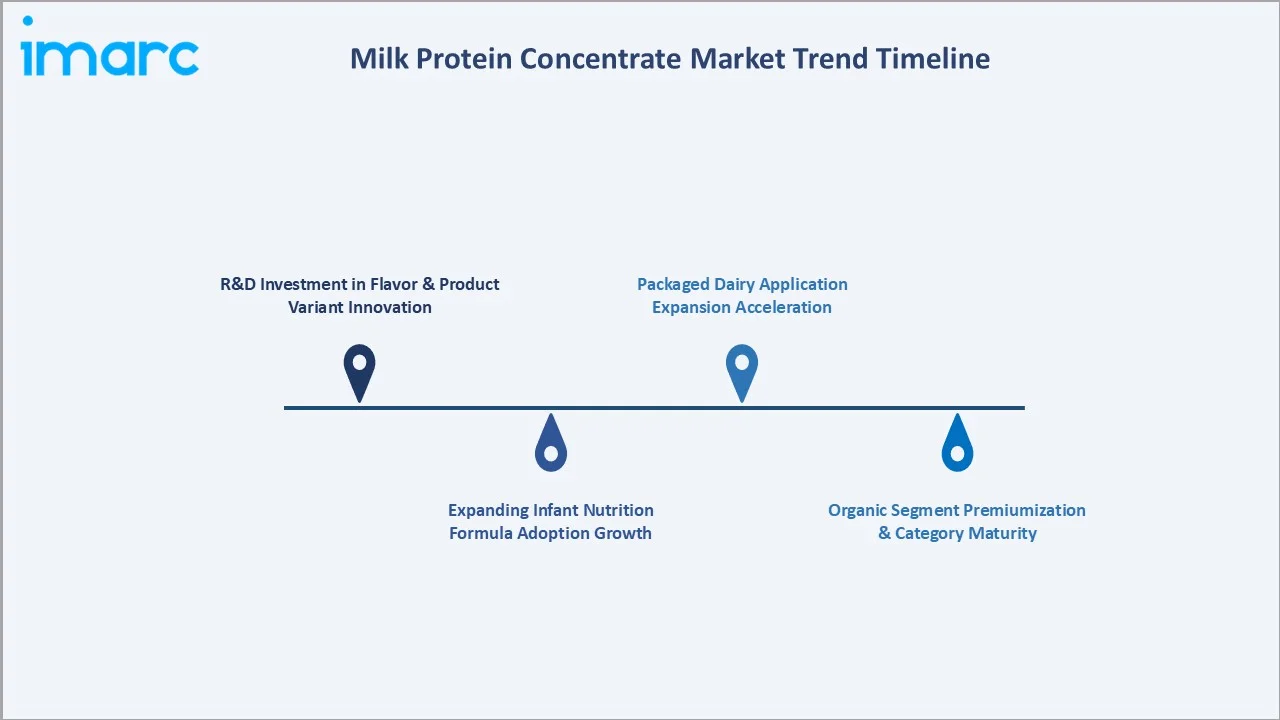
1. R&D Investment in Flavor & Product Variant Innovation
Manufacturers are increasingly investing in R&D activities to launch new product variants with enhanced flavors, expanding consumer appeal across nutrition and functional food applications. In May 2026, Muscle Milk reformulated its ready-to-drink protein shakes with real ultra-filtered milk, offering 26–42 grams of complete protein per serving and fewer ingredients. The nationwide lineup contains no artificial sweeteners, flavors, or added colors and is available in multiple flavors, sizes, and multipack formats.
2. Expanding Infant Nutrition Formula Adoption Growth
Growing parental awareness about infant formula benefits is driving sustained adoption of milk protein concentrate as a critical ingredient in infant nutrition formulations. Its high protein content, digestibility, and functional properties support the development of nutritionally balanced and premium infant formula products.
3. Packaged Dairy Application Expansion Acceleration
Rising incorporation of milk protein concentrates in packaged dairy products such as lassi, dahi, paneer, and cheese slices is expanding application scope across mainstream dairy manufacturing. Godrej Jersey is positioning protein-led, value-added dairy as a key growth driver, led by its INR 99 High Protein Paneer offering 30 grams of protein per pack. Its INR 1,000 crore ambition extends across paneer, curd, and dairy beverages, supported by affordable nutrition formats and planned protein-rich dairy manufacturing capacity.
4. Organic Segment Premiumization & Category Maturity
Growing consumer preference for clean-label and premium-positioned nutrition products is driving steady expansion of the organic milk protein concentrate segment. Rising demand for traceable sourcing, minimal processing, and certified organic ingredients is further strengthening product differentiation and premium pricing.
Industry Value Chain Analysis
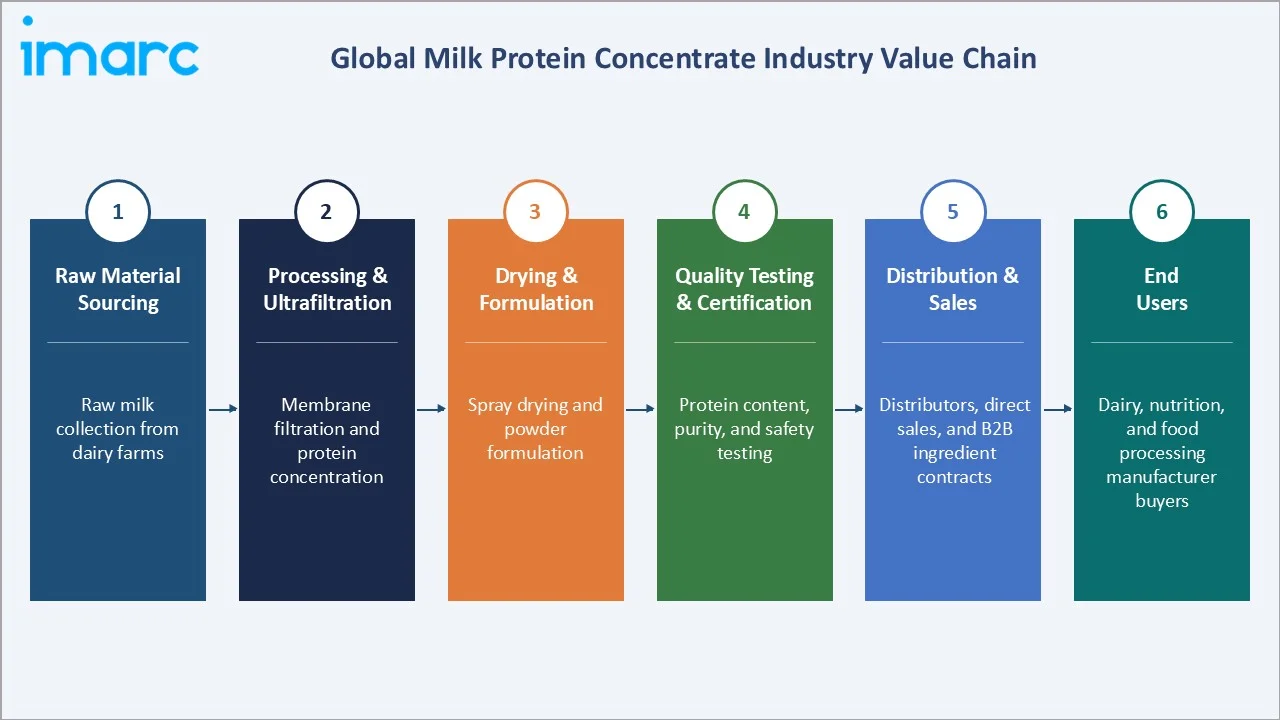
The global milk protein concentrate value chain spans raw material sourcing through end-user delivery, with each stage occupied by specialized raw milk suppliers, processing and filtration specialists, and distribution partners whose performance directly influences product quality, protein content, and cost efficiency.
|
Stage |
Key Activities |
|
Raw Material Sourcing |
Raw milk collection from dairy farms |
|
Processing & Ultrafiltration |
Membrane filtration and protein concentration |
|
Drying & Formulation |
Spray drying and powder formulation |
|
Quality Testing & Certification |
Protein content, purity, and safety testing |
|
Distribution & Sales |
Distributors, direct sales, and B2B ingredient contracts |
|
End Users |
Dairy, nutrition, and food processing manufacturer buyers |
Technology Landscape in the Milk Protein Concentrate Industry
Advanced Ultrafiltration & Membrane Technology
Manufacturers are advancing membrane filtration technology to improve protein yield and purity, supporting broader adoption among nutrition and dairy processing applications. Ceramic and polymeric ultrafiltration membrane systems operating at precisely controlled transmembrane pressures are being optimized to achieve MPC protein concentrations ranging from 42% to 85% with minimal lactose and ash co-concentration.
Flavor & Formulation Variant Development
Growing investment in flavor innovation and formulation variants is expanding consumer appeal, addressing rising demand for palatable, functional protein products. Masking agent technology, enzymatic debittering treatments, and microencapsulation of flavor compounds are being applied to MPC-based product formulations to neutralize the chalky, astringent, and cooked-off notes characteristic of high-protein concentrations.
Organic & Clean-Label Product Innovation
Providers are engineering organic and clean-label MPC formulations to extend adoption across demanding premium nutrition and health-conscious consumer segments. USDA Organic and EU Organic certified MPC ingredients sourced from pasture-raised dairy herds are being developed with minimal additive declarations, enabling premium protein supplement and functional food brands to substantiate clean-label positioning with full ingredient transparency.
Ready-to-Drink & Liquid Format Innovation
Expanding research into liquid format stability and formulation is strengthening ready-to-drink protein beverage performance, supporting premium positioning across sports nutrition use cases. Heat-stable MPC ingredient grades engineered for UHT and retort processing compatibility are being developed to prevent protein aggregation, viscosity build-up, and sedimentation during high-temperature sterilization and extended ambient shelf-life storage.
Market Segmentation Analysis
The report covers the following segments:
|
Segment Category |
Leading Segment |
Market Share |
Year |
|
Nature |
Conventional |
87.0% |
2025 |
|
Form |
Powder |
68.0% |
2025 |
|
Concentration |
Medium |
29.0% |
2025 |
|
Distribution Channel |
Hypermarkets and Supermarkets |
52.0% |
2025 |
|
Application |
Packaged Products |
44.0% |
2025 |
|
Region |
North America |
40.0% |
2025 |

By Nature
Conventional dominates with an 87.0% share in 2025. This segment encompasses cost-effective protein ingredients across dairy, nutrition, and food processing applications, supported by sustained demand for widely available, economical formulation solutions.
To access detailed market analysis, Request Sample
Organic represents 13.0% of the market (2025), reflecting rising consumer preference for clean-label and premium-positioned nutrition products, a segment expected to expand steadily as health-conscious consumption grows.
By Form
Powder leads the form segment at 68.0% share (2025), supported by sustained demand for shelf-stable, easy-to-transport protein ingredients across food and beverage manufacturing.
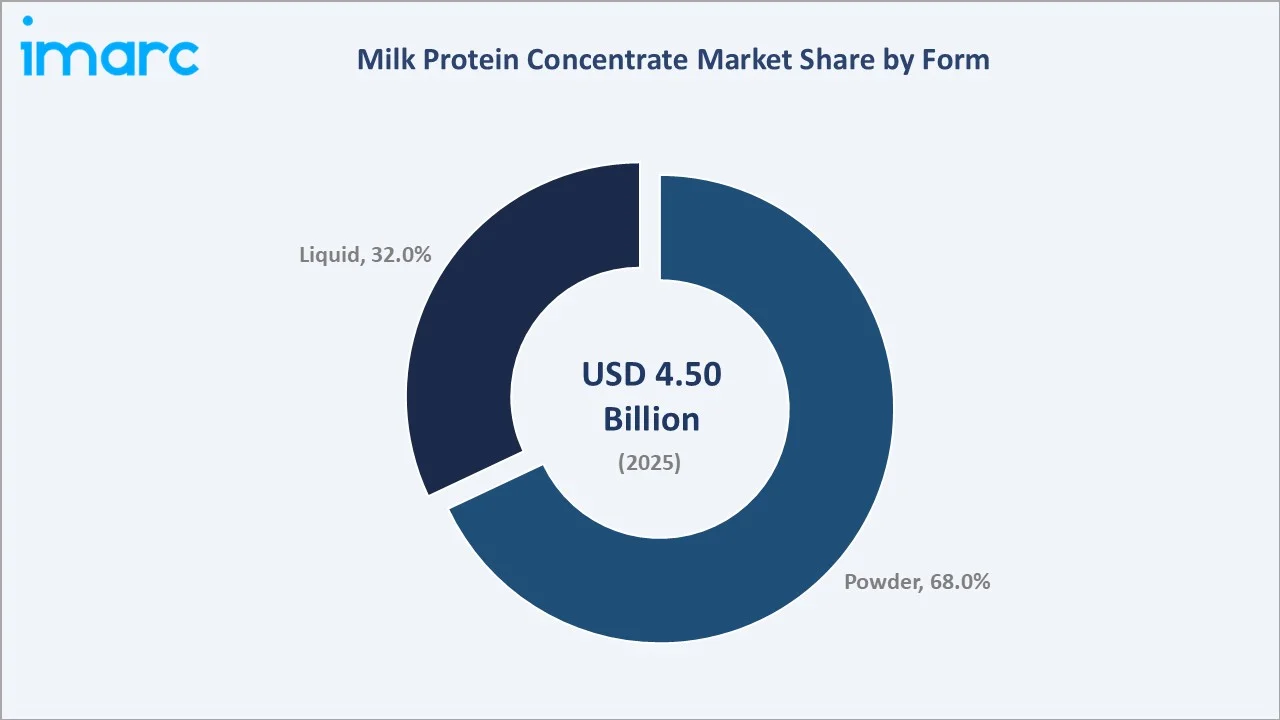
Liquid form accounts for the remaining 32.0% (2025), serving ready-to-drink protein beverage and functional dairy application needs, with growing adoption as consumers increasingly seek convenient, on-the-go nutrition options.
Regional Market Insights
North America's market leadership (40.0%, 2025) reflects the region's expansive dairy processing infrastructure and rising sports nutrition and infant formula demand. Growing R&D investment and expanding functional nutrition innovation combine to sustain its dominant position through 2034.
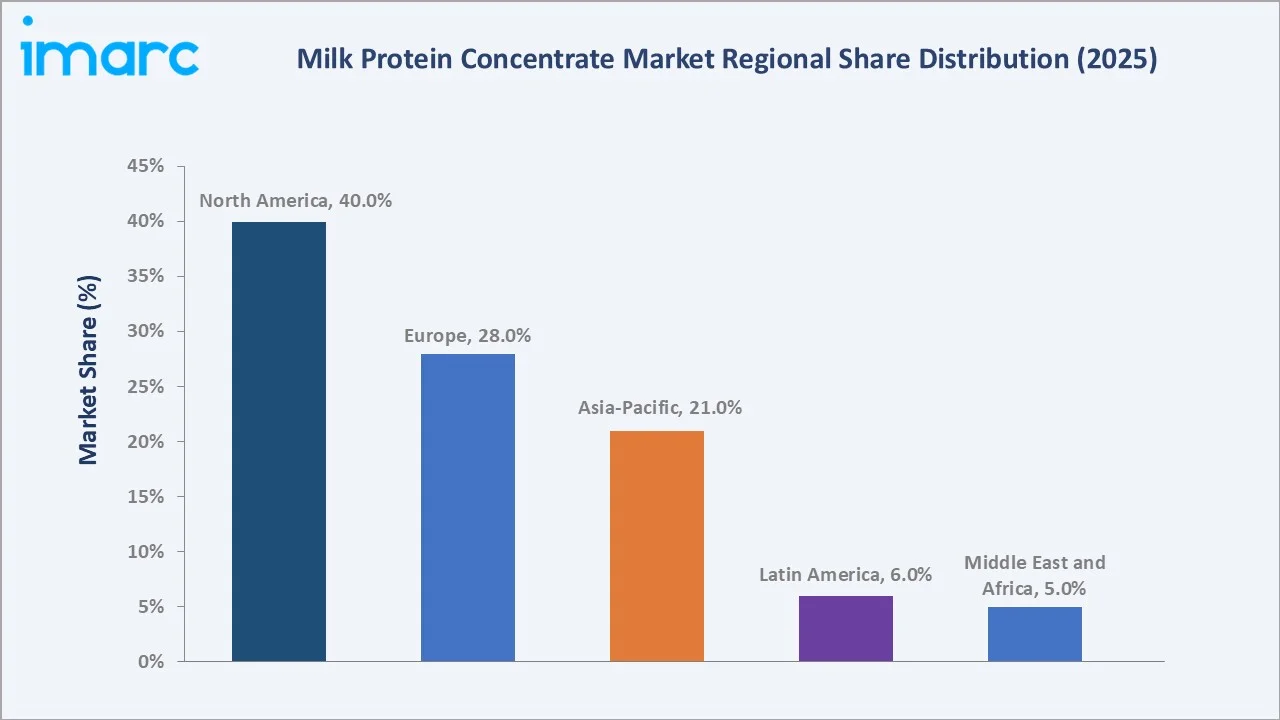
Europe at 28.0% (2025) represents the second-largest milk protein concentrate market globally. A strong dairy manufacturing base and sustained infant nutrition formula demand are supporting steady growth, positioning the region as a key contributor alongside North America through the forecast period.
|
Region |
Share (2025) |
Key Growth Drivers |
|
North America |
40.0% |
Expansive dairy processing infrastructure and sports nutrition demand |
|
Europe |
28.0% |
Strong dairy manufacturing base and infant nutrition formula demand |
|
Asia-Pacific |
21.0% |
Rising health awareness and expanding packaged dairy consumption |
|
Latin America |
6.0% |
Emerging dairy processing capacity and expanding nutrition markets |
|
Middle East and Africa |
5.0% |
Growing infant nutrition demand and expanding dairy import activity |
Competitive Landscape
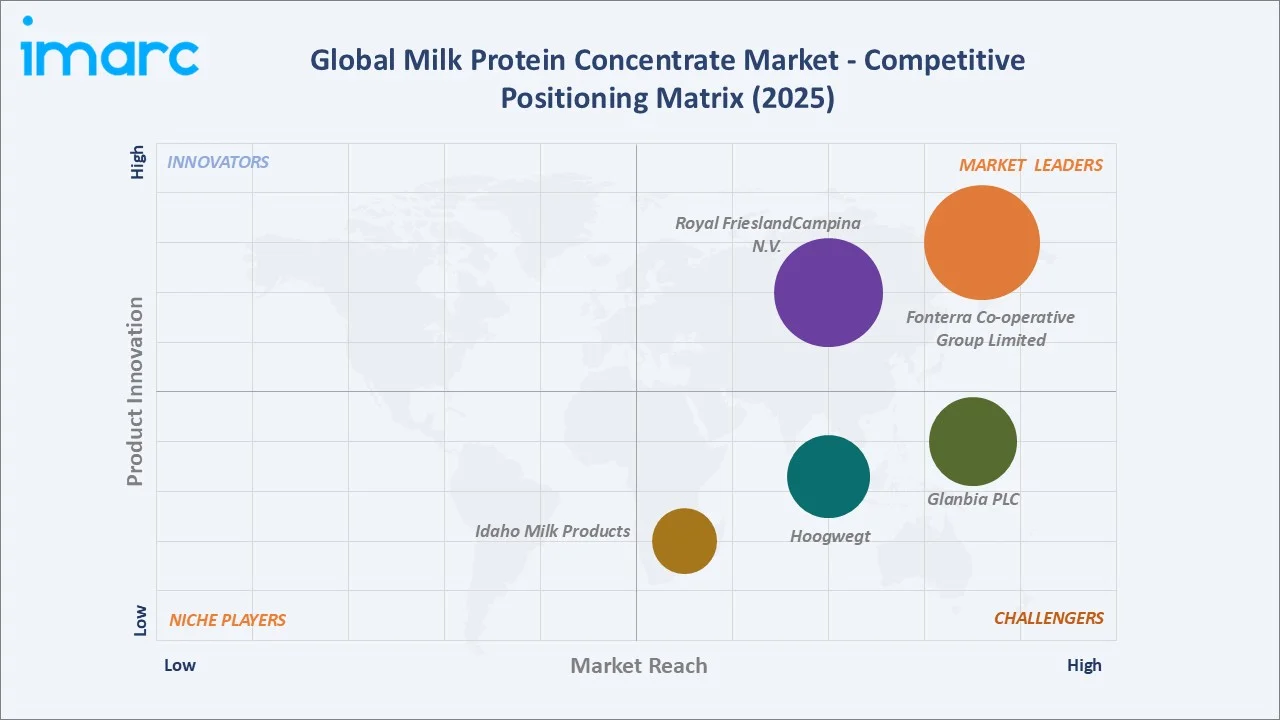
The global milk protein concentrate market exhibits moderate concentration, with leading manufacturers collectively holding a significant share of market revenue in 2025, reflecting sustained investment in product innovation and distribution reach.
|
Company Name |
Brand Name |
Market Position |
Core Strength |
|
Fonterra Co-operative Group Limited |
NZMP
|
Market Leader |
Global dairy cooperative scale and extensive protein ingredient portfolio |
|
Royal FrieslandCampina N.V. |
|
Market Leader |
Diversified dairy ingredients platform and integrated supply capabilities |
|
Glanbia PLC |
Glanbia |
Strong Challenger |
Advanced nutrition ingredient technology and sports nutrition expertise |
|
Hoogwegt |
Hoogwegt |
Strong Challenger |
Global dairy ingredient trading network and distribution strength |
|
Idaho Milk Products |
IdaPro, IdaPlus |
Challenger |
Specialty MPC manufacturing and North American market presence |
Fonterra Co-operative Group Limited and Royal FrieslandCampina N.V. dominate through comprehensive global product portfolios and extensive dairy processing capacity, supported by continuous R&D investment. Glanbia PLC, Hoogwegt, and Idaho Milk Products compete through targeted premium positioning, global trading networks, and specialty formulation differentiation, respectively.
Key Company Profiles
Fonterra Co-operative Group Limited
Fonterra Co-operative Group Limited is one of the leading global dairy cooperatives with an extensive milk protein concentrate portfolio spanning conventional and specialty formulations distributed across a vast global customer base.
- Product Portfolio: Milk protein concentrates, dairy ingredients, and specialty nutrition formulations under the NZMP brand.
- Recent Developments: In September 2024, Fonterra Co-operative Group Limited announced an investment of approximately NZD 150 million to build a new cool store at its Whareroa site, increasing cheese storage capacity and strengthening supply-chain resilience. The investment follows planned protein and UHT cream plants and supports the company’s strategy to expand its higher-value ingredients and foodservice businesses.
- Strategic Focus: Strengthening dairy ingredient innovation; expanding specialty protein capacity across emerging application segments.
Royal FrieslandCampina N.V.
Royal FrieslandCampina N.V.’s subsidiary, FrieslandCampina Ingredients, is one of the leading diversified dairy ingredients providers, with a strong integrated supply platform serving the milk protein concentrate, infant nutrition, and functional food markets across the globe.
- Product Portfolio: Milk protein concentrates, dairy proteins, and integrated nutrition ingredient solutions.
- Recent Developments: In February 2021, FrieslandCampina Ingredients partnered with Cayuga Milk Ingredients to produce Refit MPC 85 milk protein concentrate and MPI 90 in the United States. The partnership provides locally sourced, traceable milk proteins for sports and active nutrition products, including powders, bars, shakes, and recovery formulations.
- Strategic Focus: Scaling integrated dairy ingredient capabilities; deepening infant nutrition and sports nutrition distribution partnerships.
Market Concentration Analysis
The global milk protein concentrate market exhibits moderate concentration, with Fonterra Co-operative Group Limited, Royal FrieslandCampina N.V., and Glanbia PLC collectively accounting for a significant share of total category revenue in 2025, reflecting sustained R&D investment, brand loyalty, and extensive dairy processing infrastructure worldwide.
Consolidation pressure remains limited as leading manufacturers maintain distinct strategic positioning: Fonterra Co-operative Group Limited and Royal FrieslandCampina N.V. through comprehensive multi-category portfolios, Glanbia PLC and Hoogwegt through nutrition technology and global trading positioning, and Idaho Milk Products through specialty and regional differentiation, rather than pursuing direct M&A consolidation.
Investment & Growth Opportunities
Fastest Growing Segments
Organic MPC (~5.8% CAGR) represents the highest-growth investment vector through 2034, driven by rising consumer preference for clean-label nutrition products and continuous innovation across organic dairy sourcing technologies. This subcategory addresses a rapidly expanding addressable market within the global milk protein concentrate ecosystem.
Emerging Market Expansion
Latin America and the Middle East and Africa collectively represent an incremental growth opportunity beyond North America, Europe, and Asia-Pacific by 2034, as rising dairy processing capacity and expanding nutrition markets accelerate category penetration in these regional markets.
Venture and Institutional Investment Trends
- Manufacturer investment toward flavor and product variant innovation is creating opportunities for ingredient technology vendors serving the milk protein concentrate sector.
- Growing infant nutrition and sports nutrition demand is sustaining institutional interest in specialty MPC manufacturing platforms.
- Organic and clean-label formulation innovation, led by major manufacturers, is opening opportunities for ingredient and processing technology vendors serving the global dairy protein industry.
Future Market Outlook (2026-2034)
The global milk protein concentrate market is positioned for steady, nutrition-driven expansion through 2034. From a base of USD 4.50 Billion in 2025, the market is projected to reach USD 6.53 Billion by 2034, representing substantial incremental value creation at a CAGR of 4.23%. This growth is underpinned by rising health and wellness awareness, growing obesity and diabetes prevention nutrition demand, and expanding infant nutrition formula adoption.
The nature segment will continue evolving through 2034, with Organic MPC gaining further share as clean-label consumer preference accelerates. This shift creates opportunities for manufacturers investing in organic dairy sourcing, flavor and formulation innovation, and liquid format development to capture the next phase of the global milk protein concentrate market growth.
Research Methodology
Primary Research
Primary research comprised structured interviews with industry participants across 2024-2025, including dairy ingredient manufacturer executives, nutrition brand procurement managers, food processing specialists, and dairy industry analysts across major global markets. Expert input validated market sizing, segmentation trends, and regional consumption patterns.
Secondary Research
Secondary research encompassed manufacturer annual reports, milk protein concentrate industry association publications, and dairy trade press covering formulation innovation, regulatory trends, and regional market dynamics across major markets.
Forecasting Models
Market size estimations were derived using top-down and bottom-up forecasting, incorporating nature and form segment transitions and manufacturer capacity disclosures. A base-case CAGR of 4.23% reflects consensus estimates validated against announced dairy production expansion timelines and manufacturer strategic investment plans.
Report Coverage:
| Report Features | Details |
|---|---|
| Base Year of the Analysis | 2025 |
| Historical Period | 2020-2025 |
| Forecast Period | 2026-2034 |
| Units | Billion USD |
| Scope of the Report | Exploration of Historical Trends and Market Outlook, Industry Catalysts and Challenges, Segment-Wise Historical and Predictive Market Assessment:
|
| Natures Covered | Organic, Conventional |
| Forms Covered | Powder, Liquid |
| Concentrations Covered | Low, Medium, High |
| Applications Covered | Packaged Products, Nutritional Products, Infant Formula, Others |
| Distribution Channels Covered | Hypermarkets and Supermarkets, Convenience Stores, Specialty Stores, Online Stores, Others |
| Regions Covered | Asia Pacific, Europe, North America, Latin America, Middle East and Africa |
| Countries Covered | United States, Canada, Germany, France, United Kingdom, Italy, Spain, Russia, China, Japan, India, South Korea, Australia, Indonesia, Brazil, Mexico |
| Companies Covered | Fonterra Co-operative Group Limited, Royal FrieslandCampina N.V., Glanbia PLC, Hoogwegt, Idaho Milk Products, etc. |
| Customization Scope | 10% Free Customization |
| Post-Sale Analyst Support | 10-12 Weeks |
| Delivery Format | PDF and Excel through Email (We can also provide the editable version of the report in PPT/Word format on special request) |
Frequently Asked Questions About the Milk Protein Concentrate Market Report
The global milk protein concentrate market reached USD 4.50 Billion in 2025 and is projected to reach USD 6.53 Billion by 2034.
The market is expected to grow at a CAGR of 4.23% during 2026-2034, driven by rising health and wellness awareness and growing obesity and diabetes prevention nutrition demand.
North America leads with a 40.0% share in 2025, anchored by the region's expansive dairy processing infrastructure.
Conventional dominates with an 87.0% share in 2025, driven by sustained demand for cost-effective, widely available protein ingredients.
Powder leads with a 68.0% share in 2025, supported by sustained demand for shelf-stable, easy-to-transport protein ingredients.
Some of the key players include Fonterra Co-operative Group Limited, Royal FrieslandCampina N.V., Glanbia PLC, Hoogwegt, and Idaho Milk Products.
Organic is growing fastest at an estimated 5.8% CAGR as consumer preference for clean-label nutrition products accelerates.
Key challenges include volatility in raw milk supply and pricing, competition from plant-based protein alternatives, and high processing costs of ultrafiltration technology.
Product variant and flavor innovation, packaged dairy application expansion, and online retail channel growth represent leading investment opportunities.
Liquid form, at 32.0% share, is expanding steadily as consumers increasingly seek convenient, ready-to-drink protein beverage options.
Need more help?
- Speak to our experienced analysts for insights on the current market scenarios.
- Include additional segments and countries to customize the report as per your requirement.
- Gain an unparalleled competitive advantage in your domain by understanding how to utilize the report and positively impacting your operations and revenue.
- For further assistance, please connect with our analysts.
 Request Customization
 Speak to an Analyst
 Request Brochure
 Inquire Before Buying
Benefits of Customization
- Personalize this research
- Triangulate with your data
- Get data as per your format and definition
- Gain a deeper dive into a specific application, geography, customer, or competitor
- Any level of personalization
Get in Touch With Us
UNITED STATES
Phone: +1-201-971-6302
INDIA
Phone: +91-120-433-0800
UNITED KINGDOM
Phone: +44-753-714-6104
Email: sales@imarcgroup.com
Client Testimonials




.webp)




.webp)













Related Reports

Choose your plan
*Please note that the prices mentioned below are starting prices for each bundle type. Kindly contact our team for further details.*
Single User License
- 1 User License, Access on 2 Devices
- PDF Report + Excel Dataset (Password Protected)
- Lifetime Access
- No Printing Rights
- 10% Free Report Customization
- 10–12 Weeks of Analyst Support
Five User License
- Access for 5 Users, 2 Devices per User
- PDF Report + Excel Dataset (Password Protected)
- Lifetime Access
- Dedicated Account Manager
- 12–14 Weeks of Analyst Support
- No Printing Rights
- 15% Free Report Customization
- 25% Discount on Your Next Purchase
Corporate User License
- Unlimited User Access (Within Your Organization)
- PDF Report + Excel Dataset
- Lifetime Access
- Dedicated Account Manager
- 14–20 Weeks of Analyst Support
- No Printing Rights
- 20% Free Report Customization
- 30% Discount on Your Next Purchase
Essential Insights
What's included:
3 reports
- Lifetime Access
- PDF Reports
- Excel Datasets
- 2 Weeks of Free Analyst Support
- 2 User Licenses
- Access on 2 Devices
- Printing Rights
- Complimentary PowerPoint (PPT) Version
- Complimentary License Upgrade
Professional Access
What's included:
5 reports
- Lifetime Access
- PDF Reports
- Excel Datasets
- 8 Weeks of Free Analyst Support
- 2 User Licenses
- Access on 2 Devices
- Printing Rights
- Complimentary PowerPoint (PPT) Version
- Complimentary License Upgrade
Business Advantage
What's included:
8 reports
- Lifetime Access
- PDF Reports
- Excel Datasets
- 14 Weeks of Free Analyst Support
- 2 User Licenses
- Access on 2 Devices
- Printing Rights
- Complimentary PowerPoint (PPT) Version
- Complimentary License Upgrade
Enterprise Intelligence
What's included:
10 reports
- Lifetime Access
- PDF Reports
- Excel Datasets
- 20 Weeks of Free Analyst Support
- 2 User Licenses
- Access on 2 Devices
- Printing Rights
- Complimentary PowerPoint (PPT) Version
- Complimentary License Upgrade