
Movable Walls Market Size, Share, Trends and Forecast by Operation, Product Type, Material, Application, and Region, 2026-2034
Movable Walls Market Size and Share:
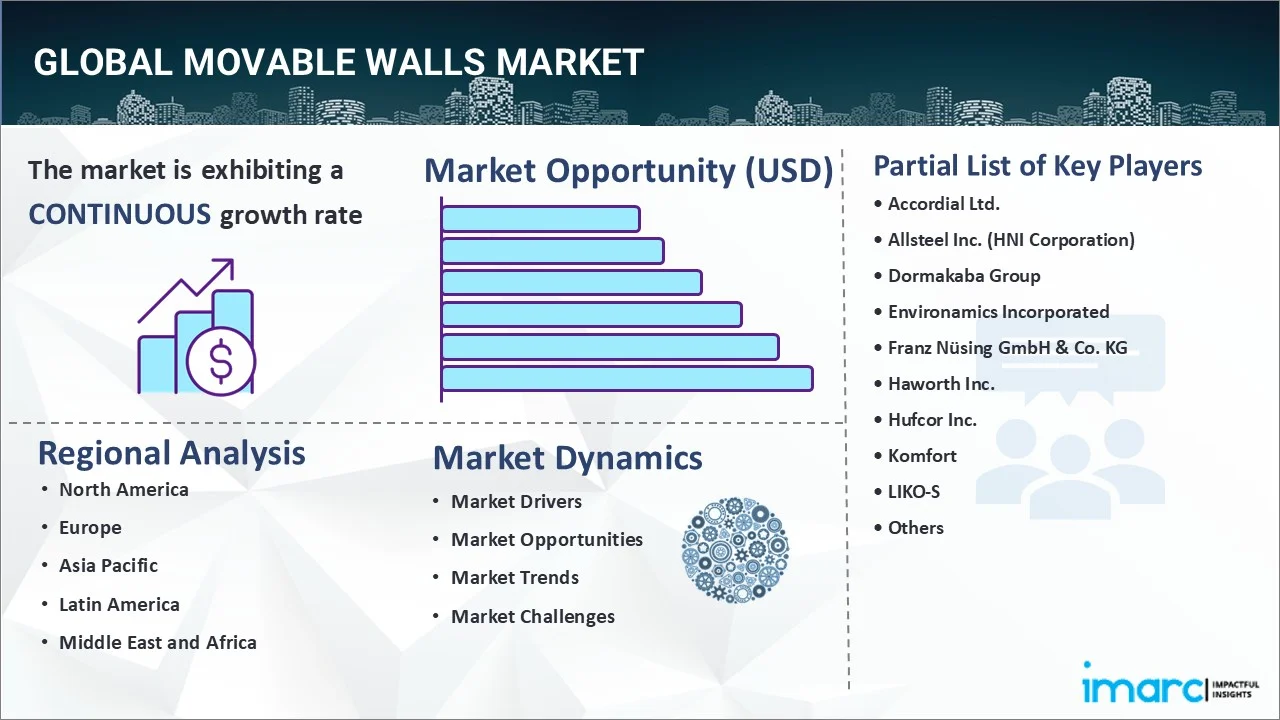
The global movable walls market grew from USD 4.75 Billion in 2025 to USD 5.06 Billion in 2026. Looking forward, IMARC Group estimates the market to reach USD 8.37 Billion by 2034, exhibiting a CAGR of 6.49% from 2026-2034. Asia Pacific currently dominates the market, holding a market share of 22%. The market continues to evolve as modern architecture embraces flexible spatial configurations. These modular partition systems enable seamless transformation of interior environments across hospitality, education, healthcare, and corporate sectors. Growing urbanization and the transition toward adaptive workspaces drive adoption of these reconfigurable solutions. Sustainable construction practices further accelerate implementation as these systems offer reusability and minimal waste generation. Smart automation integration enhances operational efficiency while acoustic performance improvements address privacy requirements. The expanding emphasis on optimized space utilization positions this sector favorably for sustained expansion, reflecting increasing movable walls market share globally.
|
Report Attribute
|
Key Statistics
|
|---|---|
|
Base Year
|
2025
|
|
Forecast Years
|
2026-2034
|
|
Historical Years
|
2020-2025
|
|
Base Year Market Size (2025)
|
USD 4.75 Billion |
| Market Size (2026) | USD 5.06 Billion |
|
Forecast Market Size (2034)
|
USD 8.37 Billion |
| CAGR (2026-2034) | 6.49% |
The global transition toward flexible and adaptable spatial configurations represents a fundamental driver reshaping interior architecture across multiple sectors. Modern commercial environments require dynamic spaces that can transform throughout the day to accommodate varying functions from collaborative meetings to focused individual work. Educational institutions increasingly adopt these systems to create versatile learning environments that support diverse teaching methodologies and class sizes. Healthcare facilities utilize reconfigurable spaces to adapt patient flow and privacy requirements efficiently. The hospitality sector benefits from the ability to subdivide event venues and conference halls based on gathering sizes and purposes. Residential applications in urban apartments address the growing need for multipurpose living spaces. This widespread demand stems from the recognition that traditional fixed walls cannot provide the agility modern building occupants require. As per sources, in May 2025, dormakaba reported that its Skyfold vertically retractable wall system surpassed 10,000 global installations, reinforcing its position as a leading acoustic space-optimization solution. Moreover, the cost savings associated with space reconfiguration compared to permanent construction further amplifies adoption across industries seeking operational flexibility without major capital expenditure.
To get more information on this market Request Sample
The United States leads movable walls market growth with 83% share, driven by robust commercial real estate development and workplace transformation initiatives. Corporate headquarters across major metropolitan areas increasingly implement open-plan designs complemented by flexible partition systems that balance collaboration and privacy. The coworking sector expansion significantly contributes to domestic market growth as these facilities require constant spatial reconfiguration to accommodate varying membership levels and tenant requirements. Technology companies pioneering activity-based working models extensively deploy movable wall systems to create agile environments supporting diverse work modes. Healthcare modernization initiatives focus on patient-centered care models requiring adaptable treatment and consultation spaces. Educational institutions renovating campus facilities prioritize flexibility to support evolving pedagogical approaches and interdisciplinary programs. Government buildings undergoing retrofits incorporate these systems to optimize underutilized space and improve operational efficiency. The strong emphasis on sustainable building practices in domestic construction aligns with the reusability and minimal waste characteristics of movable partition systems.
Movable Walls Market Trends:
Smart Automation Integration
The incorporation of intelligent automation technologies transforms traditional partition systems into sophisticated architectural elements. Sensor-enabled walls detect occupancy patterns and automatically adjust configurations based on space utilization data. In 2024, Dorma Hüppe announced upgrades to its Variflex ComfortDrive fully automatic movable wall system, integrating enhanced sensors and IoT-ready controls to support smart-building connectivity. Integration with building management systems enables centralized control of partition positioning coordinated with lighting and climate settings. Voice-activated controls provide intuitive operation, allowing occupants to reconfigure spaces without physical manipulation. Programmable scheduling features automatically prepare environments for planned activities from morning presentations to afternoon workshops. Mobile applications give facility managers remote monitoring and control capabilities for real-time space optimization. Energy management systems coordinate partition positioning with heating and cooling zones, reducing operational costs. Touch-screen interfaces simplify operation for users unfamiliar with mechanical systems. Predictive maintenance algorithms monitor system performance, identifying potential issues before failures occur. The convergence of partition technology with Internet of Things infrastructure creates intelligent environments that respond dynamically to occupant needs and organizational requirements.
Enhanced Acoustic Performance
Advancing sound insulation capabilities addresses a central challenge highlighted across movable walls market trends, particularly as modern spaces require greater acoustic control without sacrificing flexibility. Sophisticated material compositions incorporating multiple density layers achieve superior noise-reduction ratings comparable to permanent construction. Acoustic panels integrate seamlessly into partition designs, maintaining aesthetic appeal while delivering functional performance. Specialized sealing systems eliminate sound transmission pathways along ceiling, floor, and wall junctions. Testing protocols verify acoustic ratings, ensuring compliance with building standards for various applications from concert halls to medical consultation rooms. Absorption materials incorporated into panel cores reduce sound reflection within divided spaces, improving speech intelligibility. Frequency-specific attenuation technologies target problematic sound ranges in different environments. Transparent acoustic glass options provide visual connectivity while maintaining sound separation for applications requiring both openness and privacy. Modular acoustic treatment components allow customization of sound control levels based on specific usage requirements. These performance improvements eliminate the acoustic compromise traditionally associated with movable partitions, enabling their deployment in sound-critical applications.
Sustainable Material Innovation
Environmental responsibility increasingly influences material selection and manufacturing processes throughout the industry. Recycled content utilization reduces virgin material consumption while maintaining structural integrity and aesthetic quality. Low-emission adhesives and finishes minimize volatile organic compound release supporting healthy indoor environments. Biodegradable components facilitate end-of-life disposal reducing landfill burden from renovation and decommissioning activities. Local sourcing strategies decrease transportation emissions and support regional manufacturing economies. Circular economy principles guide product design enabling component recovery and reuse across multiple installation cycles. Energy-efficient production methods reduce manufacturing carbon footprints while maintaining quality standards. Certification programs verify environmental claims providing transparency for specification decisions. Lightweight construction reduces structural loading requirements and transportation energy consumption. Material passports document component composition facilitating future recycling and material recovery. These sustainability initiatives respond to growing demand from environmentally conscious developers and occupants seeking reduced environmental impact from building systems without compromising functionality or durability.
Movable Walls Industry Segmentation:
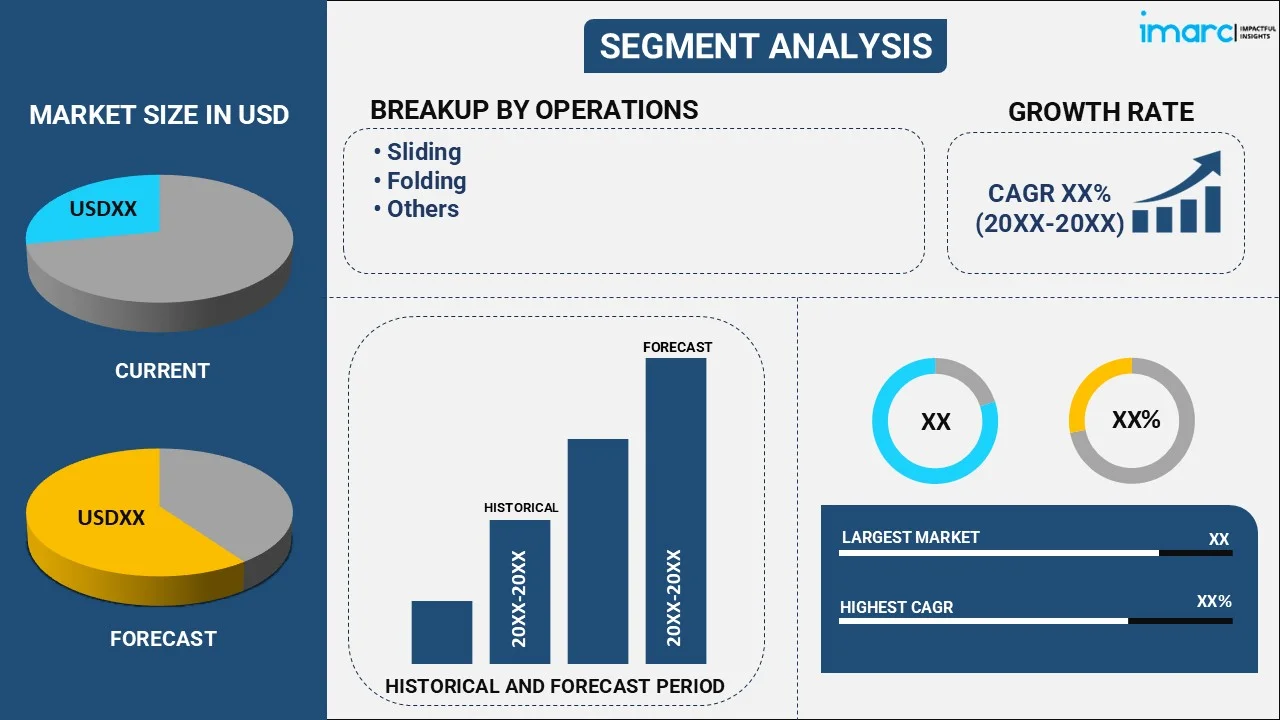
IMARC Group provides an analysis of the key trends in each segment of the global movable walls market, along with forecast at the global, regional, and country levels from 2026-2034. The market has been categorized based on operation, product type, material, and application.
Analysis by Operation:
To get detailed segment analysis of this market Request Sample
- Sliding
- Folding
- Others
Sliding operation represents 63% share driven by space efficiency and operational simplicity. Ceiling-mounted track systems eliminate floor obstructions maintaining uninterrupted surfaces for accessibility and cleaning. Smooth gliding action enables effortless repositioning even for large partition sections. Stacking configurations allow complete spatial openness when partitions retract into storage pockets. Minimal floor area requirements during operation preserve usable space compared to folding alternatives. Acoustic seal integration achieves superior sound isolation performance critical for meeting rooms and educational spaces. Concealed hardware maintains clean aesthetic presentation without visible mechanical components. Vertical suspension systems accommodate irregular floor profiles without compromising functionality. Multiple panel coupling enables extended partition lengths for large venue subdivision. The operational characteristics align with diverse application requirements from corporate environments to hospitality venues requiring frequent reconfiguration. Superior weight distribution through overhead support allows larger panel dimensions without operational difficulty.
Analysis by Product Type:
- Manual
- Automated
Manual product type commands 70% share of movable walls market outlook reflecting widespread preference for cost-effective and reliable operation. These systems operate through straightforward mechanical principles requiring minimal maintenance and no electrical infrastructure. Installation simplicity enables rapid deployment without specialized technical expertise or complex integration requirements. The absence of electronic components eliminates vulnerability to power failures ensuring continuous functionality during emergencies. Lower initial investment costs make these solutions accessible for budget-conscious projects across educational and small commercial applications. Intuitive operation requires no user training as sliding or folding mechanisms follow familiar physical principles. Durability characteristics withstand frequent repositioning in high-traffic environments from convention centers to multipurpose halls. Retrofit applications benefit from simplified installation without electrical system modifications. The mechanical reliability eliminates dependency on software updates or electronic component replacement. These attributes sustain strong demand despite automated alternatives gaining market presence in premium applications requiring enhanced convenience and integration capabilities.

Analysis by Material:
- Glass
- Wood
- Others
Glass accounts for 72% share reflecting design preferences emphasizing transparency and natural light penetration. Visual connectivity maintains spatial awareness across divided areas supporting collaborative workplace cultures. Daylight distribution throughout interior zones reduces artificial lighting requirements and associated energy consumption. Contemporary aesthetic appeal aligns with modern architectural language emphasizing minimalism and material honesty. Acoustic lamination technologies deliver sound control performance without sacrificing transparency. Surface treatment options provide graduated privacy levels from fully transparent to frosted or patterned finishes. Frameless systems maximize glass area creating seamless visual continuity. Easy maintenance through simple cleaning procedures maintains appearance with minimal ongoing effort. Fire-rated compositions meet safety requirements for various building codes. The psychological benefits of transparency including reduced claustrophobia and enhanced spatial perception drive specification in healthcare and educational environments. Sustainability credentials through recyclability and manufacturing efficiency support environmental building objectives.
Analysis by Application:
- Residential
- Commercial
Commercial dominates with 76% share reflecting concentrated demand from office, hospitality, healthcare, and educational sectors. Corporate environments utilize these systems extensively for conference rooms, training facilities, and collaborative workspaces. Hotels require flexible event spaces accommodating varying function sizes from intimate gatherings to large conferences. Healthcare facilities implement reconfigurable treatment areas, consultation rooms, and patient spaces. Educational institutions deploy adaptable classrooms and multipurpose facilities supporting diverse pedagogical approaches. Convention centers and exhibition venues depend on rapid space reconfiguration between events. Places of worship create flexible gathering spaces for varying congregation sizes and activities. Recreational facilities subdivide gymnasiums and activity areas for simultaneous programming. Government buildings optimize limited space for multiple departmental functions. The commercial sector's emphasis on space utilization efficiency, operational flexibility, and return on investment drives sustained adoption. Regulatory requirements for accessible and safe space division further support implementation across these applications.
Regional Analysis:
To get more information on the regional analysis of this market Request Sample
- North America
- United States
- Canada
- Asia-Pacific
- China
- Japan
- India
- South Korea
- Australia
- Indonesia
- Others
- Europe
- Germany
- France
- United Kingdom
- Italy
- Spain
- Russia
- Others
- Latin America
- Brazil
- Mexico
- Others
- Middle East and Africa
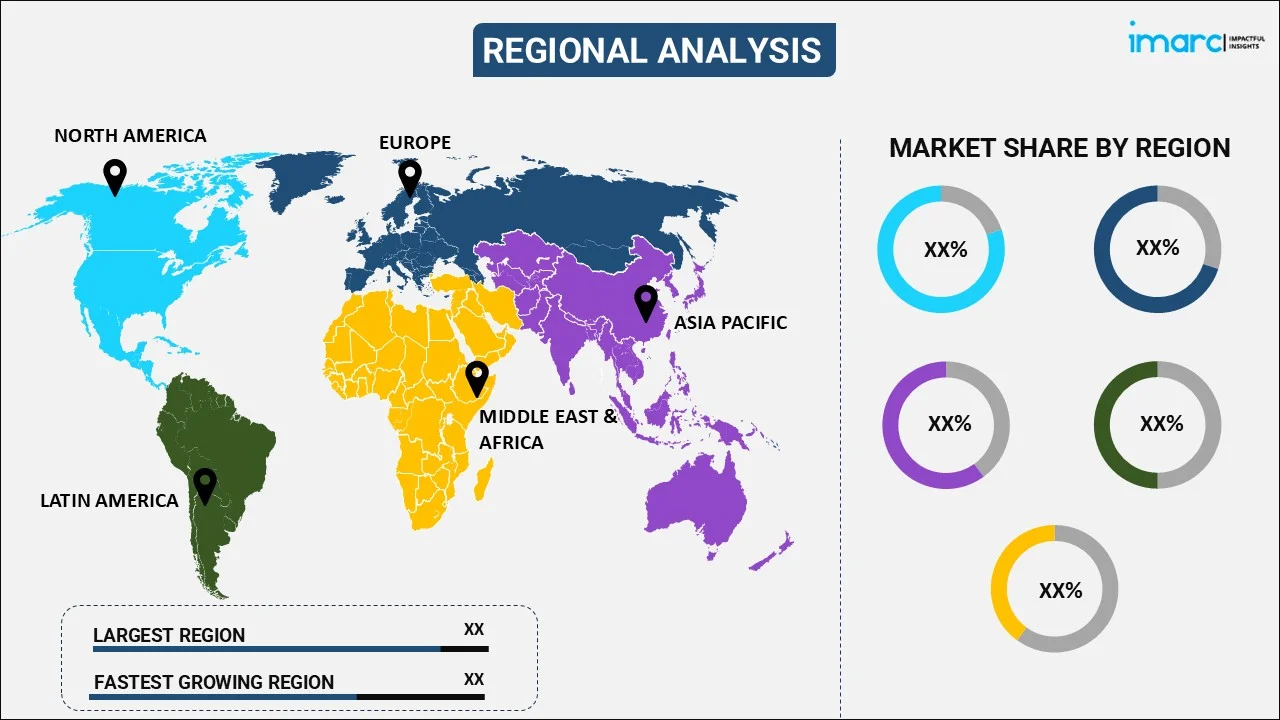
Asia Pacific region holds 22% share propelled by rapid urbanization and construction expansion. Dense urban development in major metropolitan centers creates acute space optimization requirements. Expanding middle class populations drive commercial real estate development from offices to retail facilities. Educational infrastructure expansion to accommodate growing student populations requires flexible learning environments. Hospitality sector growth serving domestic and international tourism demands adaptable event and conference spaces. Healthcare modernization initiatives incorporate Western spatial planning principles including flexible treatment areas. Government infrastructure projects prioritize efficient space utilization in public buildings. Cultural centers and performing arts venues require sophisticated space division capabilities. Manufacturing facility offices adopt collaborative workspace models requiring partition systems. The region's construction boom combined with increasing adoption of contemporary architectural practices positions it for sustained market leadership. Local manufacturing capabilities provide cost advantages supporting broad implementation across price-sensitive market segments.
Key Regional Takeaways:
United States Movable Walls Market Analysis
Domestic market leadership stems from mature commercial real estate sector and workplace innovation adoption. Technology industry concentration drives implementation of flexible workspace models requiring sophisticated space management solutions. Financial services sector headquarters in major urban centers implement these systems for trading floors and client meeting facilities. Healthcare consolidation creates large medical campuses requiring adaptable clinical and administrative spaces. University campus modernization programs prioritize flexible learning environments supporting interdisciplinary education. Convention center renovations upgrade aging facilities with contemporary space division capabilities. Government efficiency initiatives promote space optimization in federal and municipal buildings. Sustainable building certification requirements favor demountable and reusable construction systems. Strong architectural design community specifies innovative solutions for high-profile projects. Robust distribution networks and service infrastructure support implementation across diverse geographic markets. Advanced manufacturing capabilities enable customization for specialized applications. The combination of sophisticated end-user requirements and mature supply chains sustains market development.
North America Movable Walls Market Analysis
Regional market strength reflects continental construction activity and workplace transformation trends. Canadian commercial development in Toronto and Vancouver incorporates flexible spatial planning principles. Cross-border architectural practices promote consistent specification standards. Hospitality sector expansion across resort destinations requires adaptable event facilities. Healthcare system modernization addresses patient experience through spatial flexibility. Educational infrastructure investment supports population growth and immigration. Energy sector offices adopt collaborative workspace models despite traditional industry conservatism. Technology corridors beyond traditional hubs embrace flexible workplace design. Indigenous cultural centers incorporate adaptable gathering spaces respecting traditional practices. Bilingual product documentation and support services address diverse market requirements. Environmental regulations increasingly favor sustainable construction methods. Trade agreements facilitate supply chain efficiency across borders. Regional economic integration supports consistent product standards and specification practices. The continental scale enables manufacturing optimization and distribution efficiency. Growing design sophistication in secondary markets expands addressable opportunities beyond primary metropolitan areas.
Asia Pacific Movable Walls Market Analysis
Regional dominance emerges from unprecedented construction volumes and urban development pace. Chinese metropolitan expansion creates massive demand for commercial and institutional infrastructure. Indian technology sector growth drives corporate workspace development. Southeast Asian hospitality expansion serves growing tourism and business travel. Japanese architectural sophistication demands high-performance solutions. Australian education sector modernization adopts flexible learning environment principles. South Korean convention center development positions cities as international meeting destinations. Dense urban environments necessitate extreme space utilization efficiency. Growing middle class aspirations drive commercial development quality expectations. Government smart city initiatives prioritize efficient public infrastructure. Cultural exhibition spaces require adaptable configurations for diverse programming. Manufacturing facility consolidation creates demand for flexible industrial office spaces. Local production capabilities develop responding to regional demand. International architectural influence introduces Western spatial planning concepts. Rapid technology adoption enables sophisticated building management integration. The demographic scale and economic dynamism position the region for sustained market leadership.
Europe Movable Walls Market Analysis
Established architectural tradition combines with contemporary sustainability imperatives driving adoption. Historic building renovations require reversible spatial modifications preserving architectural integrity. Stringent environmental regulations favor demountable construction systems. Nordic design philosophy emphasizing flexibility influences specification practices. German engineering standards drive performance expectations. UK commercial property sector adapts to changing workplace requirements. French hospitality industry maintains sophisticated event facility standards. Italian design leadership influences aesthetic expectations. Swiss institutional sector prioritizes quality and longevity. Iberian market recovery stimulates construction activity. Eastern European development increasingly adopts Western building practices. Cross-border professional mobility promotes consistent specification standards. Cultural venue requirements for adaptable performance spaces. Educational facility standards emphasize flexible learning environments. Green building certification programs drive sustainable construction practices. The combination of design sophistication and environmental consciousness sustains market development across diverse national markets.
Latin America Movable Walls Market Analysis
Emerging market dynamics combine with growing construction sophistication driving gradual adoption. Brazilian commercial development in major metropolitan centers incorporates contemporary spatial planning. Mexican border region industrial facility growth creates corporate office demand. Chilean mining sector headquarters adopt flexible workspace concepts. Colombian hospitality sector expansion serves growing tourism. Argentine educational institutions modernize aging infrastructure. Caribbean resort development requires adaptable event facilities. Convention center construction positions cities for international business events. Government efficiency programs optimize public building utilization. Retail sector evolution incorporates flexible format stores. Healthcare private sector development adopts patient-centered design principles. Growing architectural profession sophistication increases specification of advanced systems. Economic development increases affordability for quality construction solutions. Cultural centers require adaptable performance and exhibition spaces. The region's economic growth trajectory and increasing construction standards indicate expanding opportunities despite current market size limitations.
Middle East and Africa Movable Walls Market Analysis
Resource wealth concentration funds ambitious construction projects incorporating sophisticated building systems. Gulf state hospitality development creates world-class conference and event facilities. Exhibition center construction positions cities as international trade show destinations. Educational institution development attracts international student populations. Healthcare private sector growth adopts Western facility planning principles. Government administrative facility modernization improves public service delivery. Cultural diplomacy initiatives create museum and performance spaces. Religious facility construction serves growing populations while accommodating diverse gathering requirements. South African commercial development leads continental adoption patterns. North African tourism infrastructure incorporates adaptable venue spaces. Corporate headquarters for resource extraction industries adopt contemporary workplace models. Free zone development attracts multinational corporations specifying international standards. African urbanization creates infrastructure development opportunities. Sovereign wealth fund investment prioritizes lasting quality in constructed assets. The region's development aspirations and capital availability support adoption despite geographic market fragmentation and varying economic conditions.
Competitive Landscape:
The industry demonstrates moderate concentration with established manufacturers maintaining technological leadership through continuous innovation. Global players leverage extensive distribution networks and comprehensive product portfolios addressing diverse application requirements. Regional specialists serve local markets with customized solutions and responsive service capabilities. Manufacturing expertise accumulated over decades creates formidable barriers for new entrants. Intellectual property protection around mechanical systems and material compositions limits competitive imitation. Vertical integration strategies control critical supply chain elements ensuring quality and delivery reliability. Strategic partnerships with architectural firms and construction companies secure specification preference. Investment in research and development activities introduces enhanced performance characteristics and new application capabilities. Sustainability initiatives differentiate offerings aligned with evolving environmental expectations. Digital integration capabilities position products for smart building ecosystem participation. The movable walls market forecast suggests continued innovation competition focusing on automation, acoustic performance, and environmental credentials as key differentiation vectors.
The report provides a comprehensive analysis of the competitive landscape in the movable walls market with detailed profiles of all major companies, including:
- Accordial Ltd.
- Allsteel Inc. (HNI Corporation)
- Dormakaba Group
- Environamics Incorporated
- Franz Nüsing GmbH & Co. KG
- Haworth Inc.
- Hufcor Inc.
- Komfort
- LIKO-S
- Movawall System
- Parthos
- Style Partitions
- Transwall
- Trendway Corporation (Fellowes Brands)
Latest News and Developments:
- February 2024: Kwik-Wall relaunched its Unispan® overhead partition support system after acquiring the product’s intellectual property in June 2023. Now manufactured in Springfield, IL, Unispan enables operable partitions and Luminous glass walls to be installed in buildings lacking traditional overhead structural support.”
Movable Walls Market Report Scope:
|
Report Features |
Details |
|
Base Year of the Analysis |
2025 |
|
Historical Period |
2020-2025 |
|
Forecast Period |
2026-2034 |
|
Units |
Billion USD |
|
Scope of the Report |
Exploration of Historical Trends and Market Outlook, Industry Catalysts and Challenges, Segment-Wise Historical and Future Market Assessment:
|
|
Operations Covered |
Sliding, Folding, Others |
|
Product Types Covered |
Manual, Automated |
| Materials Covered | Glass, Wood, Others |
|
Applications Covered |
Residential, Commercial |
|
Regions Covered |
Asia Pacific, Europe, North America, Latin America, Middle East and Africa |
|
Countries Covered |
United States, Canada, Germany, France, United Kingdom, Italy, Spain, Russia, China, Japan, India, South Korea, Australia, Indonesia, Brazil, Mexico |
|
Companies Covered |
Accordial Ltd., Allsteel Inc (HNI Corporation), Dormakaba Group, Environamics Incorporated, Franz Nusing GmbH & Co KG, Haworth Inc., Hufcor Inc., Komfort, LIKO-S, Movawall System, Parthos, Style Partitions, Transwall, Trendway Corporation (Fellows Brands), etc. |
|
Customization Scope |
10% Free Customization |
|
Post-Sale Analyst Support |
10-12 Weeks |
|
Delivery Format |
PDF and Excel through Email (We can also provide the editable version of the report in PPT/Word format on special request) |
Key Benefits for Stakeholders:
- IMARC’s report offers a comprehensive quantitative analysis of various market segments, historical and current market trends, market forecasts, and dynamics of the movable walls market from 2020-2034.
- The research study provides the latest information on the market drivers, challenges, and opportunities in the global movable walls market.
- The study maps the leading, as well as the fastest-growing, regional markets. It further enables stakeholders to identify the key country-level markets within each region.
- Porter's Five Forces analysis assists stakeholders in assessing the impact of new entrants, competitive rivalry, supplier power, buyer power, and the threat of substitution. It helps stakeholders to analyze the level of competition within the movable walls industry and its attractiveness.
- Competitive landscape allows stakeholders to understand their competitive environment and provides an insight into the current positions of key players in the market.
Frequently Asked Questions About the Movable Walls Market Report
The movable walls market size increased from USD 4.75 Billion in 2025 to USD 5.06 Billion in 2026.
The movable walls market is projected to exhibit a CAGR of 6.49% during 2026-2034, reaching a value of USD 8.37 Billion by 2034.
Key drivers include escalating demand for flexible and reconfigurable spaces in offices, coworking hubs, healthcare, education, and residential sectors; sustainability through reusable materials; rising acoustic and privacy solutions; smart automation integration; cost-effective rapid installation and renovations; and booming global construction and coworking trends.
Asia Pacific currently dominates the movable walls market, accounting for a share of 22%. Growth is supported by expanding commercial real estate, rising investments in corporate interiors, rapid urban development, and strong demand for flexible, technology-enabled partition systems across offices, education, hospitality, and institutional buildings.
Some of the major players in the movable walls market include Accordial Ltd., Allsteel Inc (HNI Corporation), Dormakaba Group, Environamics Incorporated, Franz Nusing GmbH & Co KG, Haworth Inc., Hufcor Inc., Komfort, LIKO-S, Movawall System, Parthos, Style Partitions, Transwall, Trendway Corporation (Fellows Brands), etc.
Need more help?
- Speak to our experienced analysts for insights on the current market scenarios.
- Include additional segments and countries to customize the report as per your requirement.
- Gain an unparalleled competitive advantage in your domain by understanding how to utilize the report and positively impacting your operations and revenue.
- For further assistance, please connect with our analysts.
 Request Customization
 Speak to an Analyst
 Request Brochure
 Inquire Before Buying
Benefits of Customization
- Personalize this research
- Triangulate with your data
- Get data as per your format and definition
- Gain a deeper dive into a specific application, geography, customer, or competitor
- Any level of personalization
Get in Touch With Us
UNITED STATES
Phone: +1-201-971-6302
INDIA
Phone: +91-120-433-0800
UNITED KINGDOM
Phone: +44-753-714-6104
Email: [email protected]
Client Testimonials




.webp)




.webp)













Related Reports

Choose your plan
*Please note that the prices mentioned below are starting prices for each bundle type. Kindly contact our team for further details.*
Single User License
- 1 User License, Access on 2 Devices
- PDF Report + Excel Dataset (Password Protected)
- Lifetime Access
- No Printing Rights
- 10% Free Report Customization
- 10–12 Weeks of Analyst Support
Five User License
- Access for 5 Users, 2 Devices per User
- PDF Report + Excel Dataset (Password Protected)
- Lifetime Access
- Dedicated Account Manager
- 12–14 Weeks of Analyst Support
- No Printing Rights
- 15% Free Report Customization
- 25% Discount on Your Next Purchase
Corporate User License
- Unlimited User Access (Within Your Organization)
- PDF Report + Excel Dataset
- Lifetime Access
- Dedicated Account Manager
- 14–20 Weeks of Analyst Support
- No Printing Rights
- 20% Free Report Customization
- 30% Discount on Your Next Purchase
Essential Insights
What's included:
3 reports
- Lifetime Access
- PDF Reports
- Excel Datasets
- 2 Weeks of Free Analyst Support
- 2 User Licenses
- Access on 2 Devices
- Printing Rights
- Complimentary PowerPoint (PPT) Version
- Complimentary License Upgrade
Professional Access
What's included:
5 reports
- Lifetime Access
- PDF Reports
- Excel Datasets
- 8 Weeks of Free Analyst Support
- 2 User Licenses
- Access on 2 Devices
- Printing Rights
- Complimentary PowerPoint (PPT) Version
- Complimentary License Upgrade
Business Advantage
What's included:
8 reports
- Lifetime Access
- PDF Reports
- Excel Datasets
- 14 Weeks of Free Analyst Support
- 2 User Licenses
- Access on 2 Devices
- Printing Rights
- Complimentary PowerPoint (PPT) Version
- Complimentary License Upgrade
Enterprise Intelligence
What's included:
10 reports
- Lifetime Access
- PDF Reports
- Excel Datasets
- 20 Weeks of Free Analyst Support
- 2 User Licenses
- Access on 2 Devices
- Printing Rights
- Complimentary PowerPoint (PPT) Version
- Complimentary License Upgrade