
New Zealand Leisure Travel Market Size, Share, Trends and Forecast by Traveler Type, Age Group, Expenditure Type, Sales Channel, and Region, 2026-2034
New Zealand Leisure Travel Market Summary:
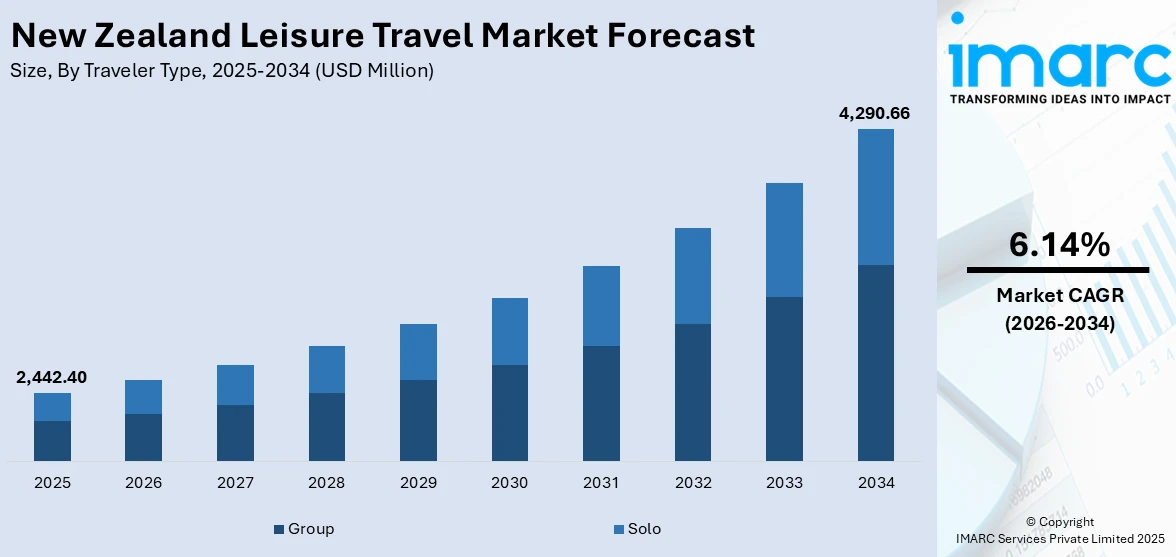
The New Zealand leisure travel market size was valued at USD 2,442.40 Million in 2025 and is projected to reach USD 4,290.66 Million by 2034, growing at a compound annual growth rate of 6.14% from 2026-2034.
The New Zealand leisure travel market is experiencing robust expansion as international visitor arrivals rebound strongly and domestic tourism maintains steady momentum. Rising demand for authentic nature-based experiences, adventure tourism, and Maori cultural immersion is reshaping traveler preferences across the country. Government-backed sustainability initiatives, improved aviation connectivity, digital transformation in travel booking, and growing off-peak visitation strategies are reinforcing the competitive appeal of New Zealand as a premier leisure destination. Continued investment in regional tourism infrastructure, the emergence of eco-conscious travel practices, and expanding international marketing campaigns are collectively strengthening the New Zealand leisure travel market share.
Key Takeaways and Insights:
- By Traveler Type: Group dominates the market with a share of 54.6% in 2025, driven by the enduring appeal of organized group tours, multi-generational family vacations, and social travel experiences that enable cost sharing on accommodations and transport across New Zealand's scenic destinations.
- By Age Group: Millennials lead the market with a share of 36.8% in 2025, reflecting their strong preference for experiential travel, digital-first booking habits, and growing interest in sustainable and adventure-focused leisure activities across the country.
- By Expenditure Type: Lodging represents the biggest segment with a market share of 42.1% in 2025, underpinned by significant investment in premium hotel brands, the rise of eco-lodges, and growing demand for boutique and experiential accommodation options.
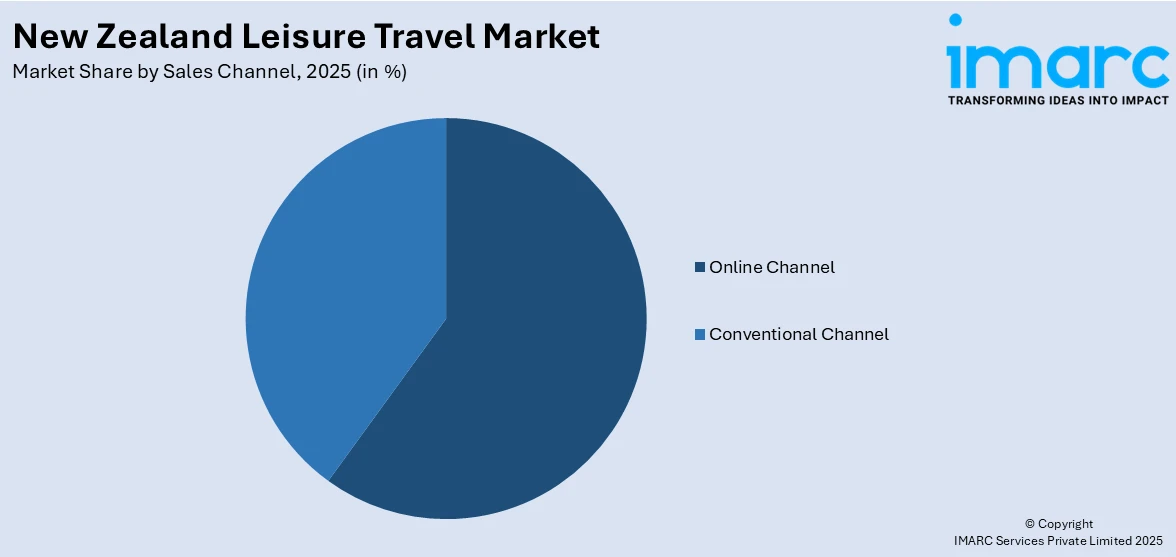
- By Sales Channel: Online channel exhibits a clear dominance in the market with 58.4% share in 2025, fueled by widespread smartphone adoption, mobile-first booking platforms, and increasing consumer preference for seamless digital travel planning and personalized recommendations.
- By Region: Auckland is the largest region with 34.7% share in 2025, driven by its status as New Zealand's primary international gateway, accounting for over 70% of all overseas arrivals, and its diverse urban attractions, cultural events, and proximity to scenic destinations.
- Key Players: Key players drive the New Zealand leisure travel market by expanding service portfolios, enhancing digital booking capabilities, strengthening sustainable tourism offerings, and deepening partnerships with regional tourism organizations to boost visitor engagement and market penetration across diverse traveler segments.
To get more information on this market Request Sample
The New Zealand leisure travel market is advancing as the country positions itself as a globally recognized destination for high-value, nature-driven, and culturally immersive tourism experiences. Government efforts to double tourism export value over the coming decade are catalyzing strategic investments in international marketing, aviation connectivity, and regional tourism infrastructure. The growing embrace of sustainable travel practices, with a significant majority of New Zealand travelers now prioritizing environmentally responsible tourism, is reshaping the competitive landscape and encouraging tourism operators to adopt eco-certified offerings. The expansion of digital and mobile-first booking platforms is enabling seamless trip planning and enhancing traveler convenience, while the emergence of off-peak visitation strategies is distributing economic benefits more evenly across regions. Additionally, the revival of adventure tourism, cultural heritage experiences, and food and wine tourism is attracting diverse traveler demographics. The steady recovery and growth of international visitor arrivals, approaching pre-pandemic levels, underscores the sustained momentum and resilience of the leisure travel sector as New Zealand strengthens its position among the world's most sought-after leisure destinations.
New Zealand Leisure Travel Market Trends:
Rising Demand for Sustainable and Eco-Conscious Travel Experiences
Sustainability has become a defining factor in leisure travel decisions across New Zealand, with travelers increasingly seeking eco-friendly accommodations, lower-carbon transport options, and nature-positive experiences. The government's Tourism Industry Transformation Plan emphasizes low-impact, high-value tourism, encouraging operators to integrate conservation and community engagement into their offerings. Tourism businesses are increasingly adopting sustainability certifications and environmentally responsible practices, reinforcing quality, safety, and ecological standards across leisure travel partnerships and setting new benchmarks for responsible tourism across the New Zealand leisure travel market growth.
Expansion of Digital and Mobile-First Booking Platforms
The accelerating shift toward digital and mobile-first travel booking platforms is transforming how leisure travelers plan and purchase trips in New Zealand. Travelers increasingly value seamless online experiences, flexible cancellation policies, and personalized recommendations powered by artificial intelligence. Domestic technology companies are investing heavily in advanced booking solutions that integrate itinerary management, expense tracking, and intelligent content curation into unified platforms. This broader digitalization trend is reshaping travel commerce across the country, enabling operators to reach wider audiences and convert online interest into confirmed leisure travel bookings more efficiently.
Growth of Adventure Tourism and Cultural Immersion Experiences
New Zealand's unique geographical features and rich Maori heritage are driving significant growth in adventure tourism and cultural immersion experiences. Both domestic and foreign leisure visitors looking for genuine and unforgettable experiences continue to be drawn to activities like hiking, bungee jumping, skydiving, and geothermal site excursions. At the TRENZ 2025 trade show held in Rotorua in May 2025, 305 leading New Zealand tourism businesses showcased innovative adventure and cultural experience offerings to international travel buyers, underscoring the country's commitment to diversifying its leisure tourism product portfolio.
Market Outlook 2026-2034:
The New Zealand leisure travel market is poised for sustained expansion as strategic government investments, improving aviation connectivity, and evolving traveler preferences converge to drive long-term growth. The government's Tourism Growth Roadmap aims to restore international visitor arrivals to pre-pandemic levels within the near term and double tourism export value over the coming decade through targeted marketing campaigns, enhanced infrastructure development, and strengthened regional tourism offerings. The market generated a revenue of USD 2,442.40 Million in 2025 and is projected to reach a revenue of USD 4,290.66 Million by 2034, growing at a compound annual growth rate of 6.14% from 2026-2034. The increasing adoption of digital booking technologies, the expansion of eco-tourism and adventure travel offerings, and growing focus on regional tourism development and off-peak visitation are expected to strengthen market trajectories in the coming years.
New Zealand Leisure Travel Market Report Segmentation:
|
Segment Category |
Leading Segment |
Market Share |
|
Traveler Type |
Group |
54.6% |
|
Age Group |
Millennials |
36.8% |
|
Expenditure Type |
Lodging |
42.1% |
|
Sales Channel |
Online Channel |
58.4% |
|
Region |
Auckland |
34.7% |
Traveler Type Insights:
- Solo
- Group
Group dominates with a market share of 54.6% of the total New Zealand leisure travel market in 2025.
As more and more tourists choose planned tours, family getaways, and social travel experiences that provide convenience, cost-sharing advantages, and carefully planned itineraries, group travel continues to hold its top spot in the New Zealand leisure travel industry. The demand for group packages that incorporate adventure activities, cultural outings, and scenic tours around New Zealand's North and South Islands has increased due to the popularity of multigenerational travel, in which families of all ages visit places together. In response, tour operators are creating adaptable group itineraries that accommodate a diversity of age groups and interests within a single travel party.
The rising business events industry, which continues to draw large visitor expenditure nationwide, provides additional support for the growth of group travel. The symbiotic link between group-oriented business tourism and leisure exploration is further reinforced by the fact that attendees of business events tend to spend significantly more per day than regular tourists and that their activities frequently carry over into leisure travel. It is anticipated that the country's strong demand for group travel services would be maintained by the construction of new convention and event facilities in strategic cities.
Age Group Insights:
- Baby Boomers
- Generation X
- Millennial
- Generation Z
Millennials lead with a share of 36.8% of the total New Zealand leisure travel market in 2025.
Due to their desire for adventure and cultural immersion, their choice for authentic and experienced travel, and their digital-first booking habits, millennials make up the largest demographic group in the New Zealand leisure travel industry. In addition to prioritizing distinctive experiences like Maori cultural experiences, food and wine tourism, and outdoor adventure activities that define New Zealand's tourist character, this generation actively seeks out off-the-beaten-path places. In addition to supporting balanced tourism growth nationwide, they are willing to go during off-peak seasons and discover new regional attractions outside of the conventional hotspots.
The influence of millennials on the market is further reinforced by their embrace of sustainable tourism practices, with over 56% of millennial and Gen Z travelers willing to pay more for eco-friendly travel options according to a 2024 EF Ultimate Break survey. Their reliance on digital platforms for trip planning, booking, and sharing travel experiences on social media amplifies New Zealand's global visibility as a leisure destination and accelerates conversion from online consideration to confirmed bookings across the country.
Expenditure Type Insights:
- Lodging
- Transportation
- Food and Beverage
- Events and Entertainment
- Others
Lodging is the largest segment with 42.1% share of the total New Zealand leisure travel market in 2025.
In the New Zealand leisure travel industry, lodging is the largest category of expenditure, indicating the vital importance that availability and quality of lodging play in determining total traveler happiness and destination competitiveness. Significant investments in high-end and luxury hotel brands opening in popular locations have revolutionized the nation's lodging market by raising the general caliber and variety of lodging choices accessible to leisure tourists. The arrival of globally renowned boutique and premium hospitality businesses has increased the appeal of New Zealand's top tourist destinations and boosted average daily rate performance.
Record-level hotel investment activity, with transaction volumes exceeding previous years as both domestic and foreign investors show renewed confidence in the industry, highlights the momentum in lodging expenditure. New generations of leisure travelers that value distinctive stays and social connectedness are drawn to the advent of design-driven and community-minded lodging ideas. In addition to increasingly broadening the housing mix, the rising popularity of eco-lodges, historical lodging, and experience lodging formats is fostering a steady increase in tourist expenditure on lodging nationwide.
Sales Channel Insights:
Access the comprehensive market breakdown Request Sample
- Conventional Channel
- Online Channel
Online channel holds the largest share with 58.4% of the total New Zealand leisure travel market in 2025.
Due to strong internet penetration rates, extensive smartphone use, and passengers' increasing desire for self-service digital booking experiences, the online channel has become the main sales platform in the New Zealand leisure travel sector. For millennial and Generation Z travelers, who place a higher value on price comparison, convenience, and tailored suggestions when organizing leisure travel, the trend toward mobile-first platforms has been especially noticeable. Artificial intelligence is being incorporated into booking systems to improve the whole digital travel buying experience by providing more user-friendly search, personalized itinerary recommendations, and dynamic pricing.
The growth of local technology companies that have made significant investments in cutting-edge booking systems and global platform collaborations is another example of how travel commerce in New Zealand has undergone a digital shift. The importance of online platforms in turning travel interest into confirmed reservations is being emphasized by national tourism marketing efforts that increasingly use digital media to direct potential tourists to official destination websites. The nation's leisure travel buying process is becoming more efficient because of the ongoing development of packaged travel packages that include lodging, flights, and activities through unified digital interfaces.
Regional Insights:
- Auckland
- Waikato
- Bay of Plenty
- Wellington
- Canterbury
- Others
Auckland represents the leading segment with 34.7% share of the total New Zealand leisure travel market in 2025.
Auckland has the largest regional proportion of the New Zealand leisure travel market as it is the country's primary international gateway and receives the vast majority of all foreign visitor arrivals. Benefits for the region include top-notch dining and entertainment options, a robust tourist sector, a range of city attractions, and convenient access to charming island retreats in the Hauraki Gulf. Auckland's accommodation sector has attracted substantial investment due to the establishment of flagship locations by upmarket international hotel chains in the city center, which has increased the area's appeal to wealthy leisure travelers seeking upscale urban experiences.
The infrastructure for leisure travel in the area is still growing, and the upcoming inauguration of significant convention and event venues is anticipated to boost tourism and the local economy. As trust in Auckland's tourist sector grows, major international tour operators have set up regional offices in Auckland to concentrate outward travel, guided nature experiences, and domestic adventure. Auckland's attractiveness as a destination for international leisure and events-based tourism is anticipated to be further enhanced by government investment in events and tourist infrastructure, solidifying its leading position in the national market.
Market Dynamics:
Growth Drivers:
Why is the New Zealand Leisure Travel Market Growing?
Strategic Government Investment in Tourism Growth and International Marketing
The New Zealand government has made tourism growth a central economic priority, committing substantial financial resources to boost international visitor numbers, enhance destination marketing, and support regional tourism development. The national tourism growth roadmap sets ambitious targets to restore international visitor arrivals to pre-pandemic levels and to significantly increase tourism export revenues over the coming decade. These targets are backed by dedicated funding allocations across consecutive financial years, supplementing earlier investment packages funded through international visitor levies. The government has directed significant resources specifically toward amplifying international marketing efforts in established core source markets, alongside dedicated funding for emerging markets with high growth potential. This strategic marketing push is designed to attract a meaningful increase in visitor arrivals and generate substantial gains in international visitor spending. The coordinated approach integrates destination branding, digital marketing campaigns, and trade partnerships to strengthen New Zealand's competitive positioning against rival long-haul leisure destinations. Regional tourism organizations are receiving targeted support to develop and promote unique local experiences that encourage visitors to travel beyond traditional gateway cities and distribute economic benefits more evenly across the country.
Expanding Aviation Connectivity and Improving Accessibility
The expansion of leisure travel in New Zealand is being strongly stimulated by the development in air connectivity, which makes it easier and more affordable for more visitors from important source markets to get to the nation. Air capacity is gradually returning to pre-pandemic levels, and airlines are quickly rebuilding and growing their route networks. New Zealand is becoming more accessible while maintaining cheap airfares because to the growth of competitive seat capacity on long-haul and trans-Tasman flights. Large full-service and low-cost airlines have announced major expansions of their trans-Tasman and New Zealand networks, adding new flights that link major Australian cities with well-liked vacation spots in the North and South Islands. By lowering cost barriers for visitors from Australia, the United States, and Asia, the main source markets for New Zealand's leisure tourism industry. In addition to dispersing visitor traffic outside conventional gateway hubs, the launch of new direct routes to rural airports is enticing tourists to visit new places. Improved pricing, increased demand from budget-conscious leisure groups, and the possibility to take shorter, more frequent vacations are all benefits of increased rivalry among airlines on popular routes, which boosts year-round tourism.
Rising Demand for Sustainable and Experiential Tourism Offerings
Given New Zealand's well-established reputation as a clean, green destination with outstanding natural and cultural heritage, the country's leisure travel business is greatly benefiting from the increased emphasis on sustainable and experience tourism across the world. More and more tourists are looking for eco-friendly lodging, less carbon-intensive modes of transportation, and immersive experiences that put an emphasis on community involvement and environmental preservation. Investments in eco-friendly infrastructure, biodiversity projects, and cultural heritage preservation are being funded by the New Zealand government's tourist industry transformation efforts and foreign visitor tax programs. Studies constantly show that a sizable and expanding majority of New Zealand tourists are now giving sustainable practices, such as choosing transportation alternatives with fewer carbon emissions, priority when visiting new places. With a growing percentage of hotel rooms fulfilling acknowledged environmental standards, this changing consumer behavior is pushing travel agencies to obtain sustainability certifications and bolstering the expansion of tourism product offerings toward leisure activities that are rooted in nature and cultural authenticity. Indigenous cultural tourism, especially Maori-led experiences that blend traditional arts, storytelling, and interpretation of the country's natural heritage, is becoming more and more well-known as a unique aspect of New Zealand's leisure travel offering and enhancing the nation's appeal to tourists from around the world who care about the environment and society.
Market Restraints:
What Challenges the New Zealand Leisure Travel Market is Facing?
Geographic Remoteness and High Travel Costs
A recurring obstacle to drawing tourists from important foreign source markets in Europe, Asia, and North America is New Zealand's remote location as a long-haul travel destination. The considerable distance from major population centers results in lengthier travel times and higher flight prices, which might put off budget-conscious vacationers and reduce New Zealand's competitiveness in comparison to nearby options. Cost pressure has increased due to the significant rise in the International Visitor Conservation and Tourism Levy, especially for families and groups traveling on a tight budget.
Seasonal Concentration and Infrastructure Strain
In well-known locations like Queenstown, Rotorua, and Auckland, the concentration of demand for leisure travel during the hottest summer months places a heavy burden on the capacity of the tourist infrastructure, lodging, transportation, and natural attractions. This seasonal mismatch threatens the sustainability and financial viability of towns and companies that depend on tourism all year long by causing congestion at famous locations, inflated costs during peak times, and unused capacity during off-peak months.
Workforce Shortages in Tourism and Hospitality
Persistent labor shortages in New Zealand's tourism and hospitality industry limit the ability to provide services and lower the standard of tourist experiences. Accommodation providers, tour operators, and food and beverage establishments nationwide are facing recruitment and retention challenges as a result of the pandemic-induced exodus of skilled workers, competitive employment markets in other sectors, and ongoing immigration policy adjustments.
Competitive Landscape:
With a wide range of domestic tour operators, internet travel agencies, multinational hotel chains, and niche experience providers vying for travelers' money, the leisure travel industry in New Zealand is extremely competitive and fragmented. As international hospitality companies increase their footprint in strategic locations, internet platforms reduce entry barriers, and tourists' demands for sustainable and individualized experiences grow, competition is getting fiercer. Through investments in sustainability certifications, cultural experience collaborations, technology-driven booking solutions, and regional tourist product diversification, market participants are setting themselves apart. The industry is experiencing new competitive dynamics as a result of the increased focus on off-peak visitation tactics and the growth of new locations outside of conventional tourist attractions.
New Zealand Leisure Travel Market Report Coverage:
|
Report Features |
Details |
|
Base Year of the Analysis |
2025 |
|
Historical Period |
2020-2025 |
|
Forecast Period |
2026-2034 |
|
Units |
Million USD |
|
Scope of the Report |
Exploration of Historical Trends and Market Outlook, Industry Catalysts and Challenges, Segment-Wise Historical and Future Market Assessment:
|
|
Traveler Types Covered |
Solo, Group |
|
Age Groups Covered |
Baby Boomers, Generation X, Millennial, Generation Z |
|
Expenditure Types Covered |
Lodging, Transportation, Food and Beverage, Events and Entertainment, Others |
|
Sales Channels Covered |
Conventional Channel, Online Channel |
|
Regions Covered |
Auckland, Waikato, Bay of Plenty, Wellington, Canterbury, Others |
|
Customization Scope |
10% Free Customization |
|
Post-Sale Analyst Support |
10-12 Weeks |
|
Delivery Format |
PDF and Excel through Email (We can also provide the editable version of the report in PPT/Word format on special request) |
Frequently Asked Questions About the New Zealand Leisure Travel Market Report
The New Zealand leisure travel market size was valued at USD 2,442.40 Million in 2025.
The New Zealand leisure travel market is expected to grow at a compound annual growth rate of 6.14% from 2026-2034 to reach USD 4,290.66 Million by 2034.
Group dominated the market with a share of 54.6%, reflecting the strong demand for organized tours, multi-generational family vacations, and social travel experiences that enable cost sharing and curated itineraries across scenic destinations.
Key factors driving the New Zealand leisure travel market include strategic government investment in tourism infrastructure, expanding aviation connectivity, growing demand for sustainable and experiential tourism, digital transformation in travel booking, and rising international visitor arrivals.
Major challenges include geographic remoteness and high travel costs, seasonal concentration of demand straining infrastructure at popular destinations, workforce shortages in tourism and hospitality, increased visitor levy costs, and competitive pressure from closer alternative destinations.
Need more help?
- Speak to our experienced analysts for insights on the current market scenarios.
- Include additional segments and countries to customize the report as per your requirement.
- Gain an unparalleled competitive advantage in your domain by understanding how to utilize the report and positively impacting your operations and revenue.
- For further assistance, please connect with our analysts.
 Request Customization
 Speak to an Analyst
 Request Brochure
 Inquire Before Buying
Benefits of Customization
- Personalize this research
- Triangulate with your data
- Get data as per your format and definition
- Gain a deeper dive into a specific application, geography, customer, or competitor
- Any level of personalization
Get in Touch With Us
UNITED STATES
Phone: +1-201-971-6302
INDIA
Phone: +91-120-433-0800
UNITED KINGDOM
Phone: +44-753-714-6104
Email: [email protected]
Client Testimonials




.webp)




.webp)













Related Reports

Choose your plan
*Please note that the prices mentioned below are starting prices for each bundle type. Kindly contact our team for further details.*
Single User License
- 1 User License, Access on 2 Devices
- PDF Report + Excel Dataset (Password Protected)
- Lifetime Access
- No Printing Rights
- 10% Free Report Customization
- 10–12 Weeks of Analyst Support
Five User License
- Access for 5 Users, 2 Devices per User
- PDF Report + Excel Dataset (Password Protected)
- Lifetime Access
- Dedicated Account Manager
- 12–14 Weeks of Analyst Support
- No Printing Rights
- 15% Free Report Customization
- 25% Discount on Your Next Purchase
Corporate User License
- Unlimited User Access (Within Your Organization)
- PDF Report + Excel Dataset
- Lifetime Access
- Dedicated Account Manager
- 14–20 Weeks of Analyst Support
- No Printing Rights
- 20% Free Report Customization
- 30% Discount on Your Next Purchase
Essential Insights
What's included:
3 reports
- Lifetime Access
- PDF Reports
- Excel Datasets
- 2 Weeks of Free Analyst Support
- 2 User Licenses
- Access on 2 Devices
- Printing Rights
- Complimentary PowerPoint (PPT) Version
- Complimentary License Upgrade
Professional Access
What's included:
5 reports
- Lifetime Access
- PDF Reports
- Excel Datasets
- 8 Weeks of Free Analyst Support
- 2 User Licenses
- Access on 2 Devices
- Printing Rights
- Complimentary PowerPoint (PPT) Version
- Complimentary License Upgrade
Business Advantage
What's included:
8 reports
- Lifetime Access
- PDF Reports
- Excel Datasets
- 14 Weeks of Free Analyst Support
- 2 User Licenses
- Access on 2 Devices
- Printing Rights
- Complimentary PowerPoint (PPT) Version
- Complimentary License Upgrade
Enterprise Intelligence
What's included:
10 reports
- Lifetime Access
- PDF Reports
- Excel Datasets
- 20 Weeks of Free Analyst Support
- 2 User Licenses
- Access on 2 Devices
- Printing Rights
- Complimentary PowerPoint (PPT) Version
- Complimentary License Upgrade