Barite Price Update: Sustained Growth Across Key Markets in Q3 2026
09-Oct-2026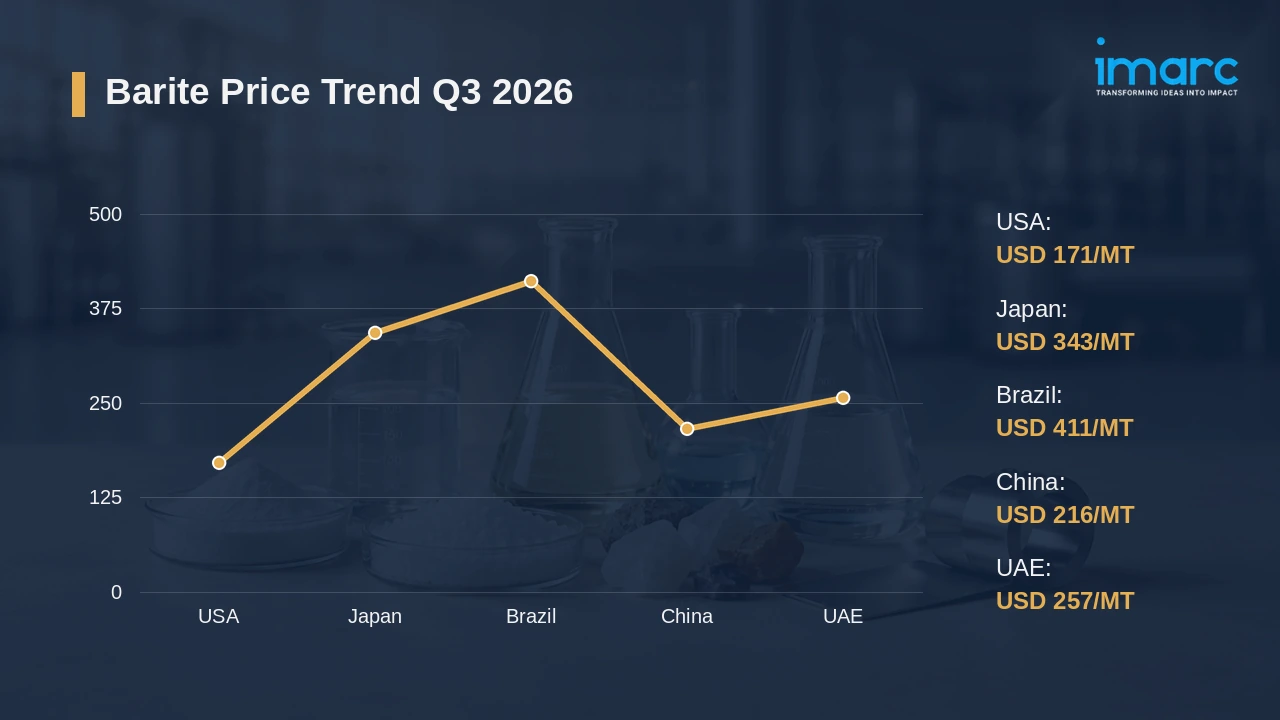
Barite is a dense, chemically inert mineral composed primarily of barium sulfate, valued for its high specific gravity and very low solubility in water. Across the energy sector, drillers absorb most global output, using ground barite to weight drilling muds and control well pressure. Barite prices also respond to filler demand from paints, plastics, rubber, and radiation-shielding concrete. Beyond demand, ore supply, freight, energy, and drilling cycles shape pricing sensitivity.
Global Market Overview:
Globally, the barite industry was valued at USD 2.0 Billion in 2025. Market projections indicate steady growth, with the industry expected to reach USD 2.8 Billion by 2034, with a compound annual growth rate (CAGR) of 3.50% during 2026-2034. Driven by deeper wells that consume more barite per rig, upstream drilling sustains the barite price trend, while coatings and filler applications broaden the demand base. Energy exploration spending remains the dominant growth lever.
Barite Price Trend Q3 2026:
Regional prices (USD per MT) and QoQ changes Q3 2026 vs Q2 2026:
| Region | Price (USD/MT) | QoQ Change | Direction |
|---|---|---|---|
| USA | 171 | +2.44% | ↑ |
| Japan | 343 | +3.34% | ↑ |
| Brazil | 411 | +4.10% | ↑ |
| China | 216 | +4.42% | ↑ |
| UAE | 257 | +6.21% | ↑ |
To access real-time prices Request Sample
What Moved Prices:
USA:
- In Q3 2026, barite prices in the USA rose 2.44% quarter-on-quarter to USD 171/MT as Permian and Eagle Ford operators lifted rig activity and drilling fluid blenders accelerated procurement. Nevada grinding operations ran steadily through the quarter. With Gulf Coast offshore programs also drawing on imported material, buyers secured cargoes ahead of autumn drilling schedules.
- Reliant on Indian, Chinese, and Moroccan ore for most of its supply, the US market absorbed firmer origin offers alongside higher inland trucking costs to drilling basins. The barite price chart for the USA tracked a steady climb across the period. Holding leaner inventories, distributors made more frequent spot purchases.
Japan:
- During Q3 2026, barite prices in Japan climbed to USD 343/MT, a 3.34% QoQ gain, as paint, coatings, and friction-material producers maintained steady filler consumption across automotive supply chains. Japan's domestic ore resources remain negligible in commercial terms. Consequently, importers in Yokohama and Kobe paid firmer offers from Chinese and Indian suppliers to secure quarterly volumes.
- Priced on CIF terms, most Japanese contracts passed freight and currency adjustments directly to buyers during the quarter. Stocks held by trading houses stayed thin through September. Against this backdrop, electronics and automotive coating formulators favored longer contract cover over spot exposure, which reduced the volume of discounted material available to smaller purchasers.
Brazil:
- In the third quarter of 2026, barite prices in Brazil advanced 4.10% QoQ to USD 411/MT, the highest level among tracked regions. Offshore pre-salt drilling campaigns lifted weighting-agent demand. Supported by sustained deepwater activity in the Santos and Campos basins, service companies expanded drilling fluid inventories well ahead of scheduled well programs through late 2026.
- Import parity pricing tied local offers closely to Chinese and Moroccan cargoes, while BRL fluctuations against the dollar complicated settlement for distributors in São Paulo and Rio de Janeiro. On the supply side, domestic mine output stayed constrained. Periodic vessel congestion at Brazilian bulk terminals also stretched delivery windows, encouraging buyers to place orders earlier.
China:
- In Q3 2026, barite prices in China rose 4.42% QoQ to USD 216/MT as Guizhou and Hunan producers faced tighter mining controls and periodic environmental inspections. Export inquiries from Gulf and Southeast Asian buyers stayed firm. Throughout the quarter, chemical-grade buyers producing barium carbonate and lithopone competed with drilling-grade exporters for limited high-specific-gravity ore.
- Coatings and plastics converters absorbed steady filler volumes domestically, though drilling-fluid exports to Middle Eastern buyers captured a larger share of available output during the period. At Qingdao and Tianjin, port inventories thinned through September. Facing higher grinding and haulage costs, mid-sized processors raised offers as exporters prioritized better-margin overseas contracts over domestic sales.
UAE:
- During Q3 2026, barite prices in the UAE rose 6.21% QoQ to USD 257/MT, the sharpest gain among tracked regions. Expanding offshore and onshore drilling programs across Abu Dhabi and neighboring Gulf producing states kept mud-weighting demand elevated throughout the summer months and well into September. At Jebel Ali, distributors replenished stocks at an accelerated pace.
- Operating under the dirham's dollar peg, importers faced no currency drag, so price gains reflected firmer origin offers from Indian and Chinese suppliers rather than exchange-rate effects. Free-zone blenders absorbed the majority of incoming cargoes. Adding modest costs per ton, port dwell charges edged higher as berth scheduling tightened during peak import weeks.
Drivers Influencing the Market:
Several factors continue to shape barite pricing and market behavior:
- Oil and Gas Drilling Demand: Drilling fluids account for the large majority of barite consumption, so rig activity sets the demand baseline. According to Reuters, the Baker Hughes tally of US oil and gas rigs reached 595 in the week to September 18, 2026, up 10% from a year earlier. With wells growing deeper and laterals longer, barite usage per rig keeps rising. Offshore programs in Brazil and the Gulf amplify that effect.
- Ore Supply and Mining Output: Per the USGS Mineral Commodity Summaries, an estimated 8,700 Thousand Metric Tons of barite was mined outside the US in 2025, against 8,000 Thousand Metric Tons the prior year. India and China contributed 3,000 and 2,200 Thousand Metric Tons, respectively. Because sourcing is so concentrated, importers stay exposed whenever mine inspections, lease suspensions, or monsoon disruptions curb shipments from either origin.
- Energy Expenditure in Grinding and Beneficiation: Crushing, jigging, and fine grinding to API drilling-grade specifications consume substantial electricity, while diesel powers haul trucks at open-pit operations. As a result, fuel cost swings move straight into ex-works offers. Where producers rely on grid power in India and China, tariff revisions shift processing economics and can narrow the spread between domestic and export quotations across key origins.
- Ocean Freight and Logistics Economics: Barite is a low-value bulk cargo, so ocean freight often represents a large share of delivered cost. Along the US Gulf Coast, drillers import most of their supply because seaborne shipping undercuts rail and truck haulage from Nevada. Reflecting this exposure, shifts in Supramax and Handysize charter rates ripple quickly through the barite price index, particularly on the busy India-USA and China-Middle East lanes. Port congestion at discharge terminals adds further cost.
- Environmental and Regulatory Compliance: Mine permitting, tailings management, and water-discharge rules add operating costs that producers recover through higher offers. In India, state-level lease reviews periodically interrupt output from major Andhra Pradesh deposits. Within China, provincial environmental inspections have repeatedly curtailed small-scale mines, consolidating supply among larger, better-capitalized operators that maintain firmer pricing discipline in both domestic and export markets. Compliance costs rarely reverse once embedded.
- Trade Policy and Currency Dynamics: Export licensing, tariff adjustments, and anti-dumping reviews at origin determine how freely barite moves between producing and consuming regions. On top of trade rules, currency swings add a second cost layer. When the rupee or yuan weakens against the dollar, Indian and Chinese exporters gain room to discount, while softer reals and yen inflate import bills in Brazil and Japan.
Recent Highlights & Strategic Developments:
Recent strategic moves within the industry further illustrate evolving dynamics:
- In November 2025, the US Bureau of Land Management approved expanding Nevada's Coyote Mine by 47 acres, potentially adding 40,000 to 100,000 Tons of annual barite output. Operator Progressive Contracting Inc. gained capacity to serve domestic drilling demand.
Outlook & Strategic Takeaways:
Looking ahead, the barite market is expected to expand steadily through 2034, anchored by deeper drilling programs, offshore exploration, and widening use in coatings, plastics, and radiation-shielding concrete. Concentrated Indian and Chinese ore supply will steer the barite price forecast.
To navigate this complex landscape, stakeholders should:
- Track Drilling Activity Indicators: Track weekly rig counts, well permits, and offshore tender schedules across North America, Brazil, and the Gulf to anticipate shifts in weighting-agent demand before they reach contract negotiations. Rising counts typically precede firmer quarterly offers.
- Assess Freight Market Developments: Assess dry bulk charter rates on India-USA, China-Gulf, and Morocco-Atlantic lanes, since ocean freight forms a large share of delivered barite costs for most import-reliant buyers. Where possible, negotiate freight clauses linked to published indices.
- Monitor Regional Price Differentials: Benchmark barite price per MT across the USA, Japan, Brazil, China, and the UAE each quarter, comparing spreads against freight parity to spot cost-saving sourcing windows. Wide spreads often justify switching origin suppliers.
- Review Supplier Compliance Exposure: Review supplier exposure to mine lease audits, tailings rules, and environmental inspections in India and China, since enforcement actions can abruptly remove volumes from export channels. Qualifying backup producers in Morocco and Mexico reduces that risk.
- Strengthen Currency Exposure Management: Strengthen hedging on dollar-denominated barite purchases where local currencies such as the real, yen, or rupee carry elevated volatility against the US dollar over contract periods. Align treasury coverage with scheduled cargo payment dates.
- Explore Emerging Application Segments: Explore demand from medical imaging contrast media, automotive friction materials, and specialty rubber compounds, where purity requirements support premium pricing and reduce dependence on the cyclical drilling sector. Engage specialty grinders to assess commercial viability.
Subscription Plans & Customization:
IMARC offers flexible subscription models to suit varying needs:
- Monthly Updates: 12 deliverables/year
- Quarterly Updates: 4 deliverables/year
- Biannual Updates: 2 deliverables/year
Each includes detailed datasets (Excel + PDF) and post-report analyst support.
Get in Touch With Us
UNITED STATES
Phone: +1-201-971-6302
INDIA
Phone: +91-120-433-0800
UNITED KINGDOM
Phone: +44-753-714-6104
Email: [email protected]
Client Testimonials




.webp)




.webp)












