Base Oil Price Update: Sustained Growth Across Key Markets in Q3 2026
14-Oct-2026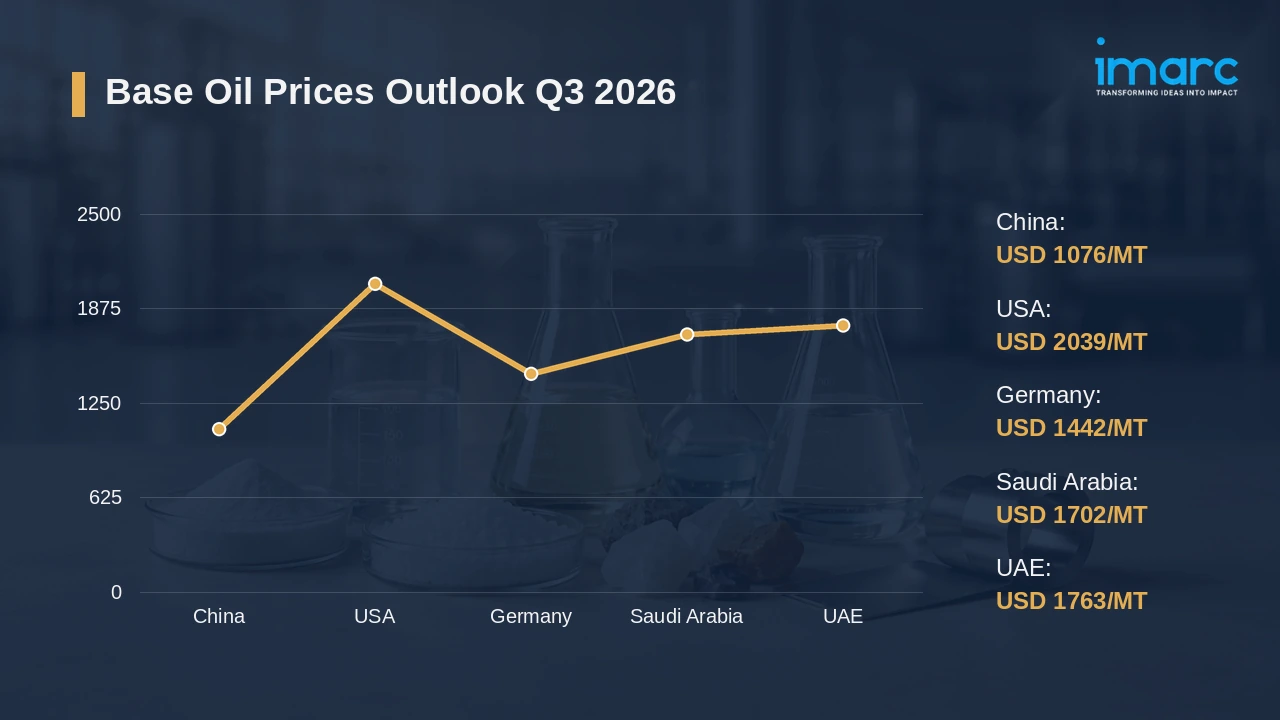
Base oil forms the fluid phase of finished lubricants, refined from petroleum feedstocks or synthesized chemically. Across grades, viscosity and thermal stability determine suitability for a given formulation. Base oil prices move with crude and vacuum gas oil costs, refinery run rates, energy expenditure, and export freight economics. Drawn on by engine oils, industrial lubricants, greases, and metalworking fluids, the product ties closely to automotive production volumes and the broader pace of manufacturing activity.
Global Market Overview:
Globally, the base oil industry reached a volume of 34.5 Million Tons in 2025. Market projections indicate steady growth, with the industry expected to reach a volume of 40.7 Million Tons by 2034, with a compound annual growth rate (CAGR) of 1.82% during 2026-2034. Expanding Group II and Group III adoption in high performance formulations anchors the base oil price trend. Across the lubricant chain, emission regulations continue reshaping formulation choices.
Base Oil Price Trend Q3 2026:
Regional prices (USD per MT) and QoQ changes Q3 2026 vs Q2 2026:
| Region | Price (USD/MT) | QoQ Change | Direction |
|---|---|---|---|
| China | 1,076 | +14.47% | ↑ |
| USA | 2,039 | +12.34% | ↑ |
| Germany | 1,442 | +13.82% | ↑ |
| Saudi Arabia | 1,702 | +18.21% | ↑ |
| UAE | 1,763 | +19.23% | ↑ |
To access real-time prices Request Sample
What Moved Prices:
China:
- During Q3 2026, base oil prices in China climbed to USD 1,076/MT as refiners lifted offers against firmer vacuum gas oil and crude feedstock costs through the quarter. Domestic lubricant blenders held steady procurement to support automotive and industrial oil production across major manufacturing hubs. Within distribution channels, spot availability stayed adequate.
- Rising freight costs on inbound feedstock cargoes added pressure to delivered values at eastern coastal refineries. Grease and additive formulators absorbed consistent volumes. Across the region, export competition among suppliers shaped the tonnage offered into importing markets, while the base oil price chart tracked a steady upward slope through the quarter.
USA:
- In Q3 2026, base oil prices in the USA advanced to USD 2,039/MT as Gulf Coast refiners absorbed firmer feedstock crude costs while holding operating rates near plan. Automotive lubricant blenders and industrial grease producers took up available volumes. At selected plants, maintenance work trimmed prompt availability of premium grades.
- Lean distributor inventories across the Gulf Coast and inland hubs reduced flexibility for buyers chasing prompt deliveries. Through the period, contract renewals favored sellers. Export enquiries from overseas lubricant blenders absorbed a meaningful share of exportable tonnage, which thinned the volume offered into the domestic spot market through late September.
Germany:
- During Q3 2026, base oil prices in Germany rose to USD 1,442/MT as buyers faced firmer replacement costs on Group III cargoes arriving from Gulf refineries. Automotive original equipment formulators and industrial oil blenders sustained consistent offtake. Maintained intentionally lean, supplier stocks restricted immediate resources for opportunistic purchasers.
- At blending and packaging facilities, elevated energy tariffs kept processing economics tight for European distributors. Import dependence on Group III grades left the region exposed to freight and port handling charges, both of which lifted landed values across the full quarter. Shaped by sustainability rules, procurement choices narrowed among lubricant manufacturers.
Saudi Arabia:
- In the third quarter of 2026, base oil prices in Saudi Arabia climbed to USD 1,702/MT as export demand from Asian and European blenders absorbed much of available output. Feedstock crude availability stayed comfortable across domestic refineries. Within the refining slate, a greater proportion of vacuum gas oil moved toward premium grades.
- Steady utilization at domestic blending and packaging plants supported consistent offtake inside the local market. Expanding Gulf refining capacity continued attracting long term supply commitments from overseas buyers, while port congestion at major export terminals periodically slowed cargo movement and encouraged forward purchasing. On Asia bound lanes, freight costs firmed further.
UAE:
- In Q3 2026, base oil prices in the UAE rose to USD 1,763/MT as local refiners maintained steady operating rates and focused production on Asian and African export markets. Firmer crude values lifted production expenses at domestic refineries. Across the trading hub, lean stock positions limited prompt material for spot buyers.
- Re export flows through free zone terminals shaped the timing of regional availability, with port dwell charges and vessel scheduling feeding directly into delivered cost structures. In pegged currency systems, fluctuations in exchange rates were absent from contract negotiations. Facing firmer offers, buyers secured forward cover earlier than usual.
Drivers Influencing the Market:
Several factors continue to shape base oil pricing and market behavior:
- Automotive and Industrial Lubricant Demand: Finished lubricant consumption anchors baseline procurement volumes for refiners and blenders worldwide. Per ACEA, new car registrations across the European Union rose 5.3% year to date through August 2026, widening the serviceable vehicle parc. Industrial machinery output and metalworking fluid production add a second layer of demand that moves with manufacturing cycles.
- Upstream Crude and Vacuum Gas Oil Costs: Within refinery cost stacks, crude and vacuum gas oil dominate base oil production economics. Margins compress quickly when crude firms. According to the EIA, Brent crude averaged USD 91 per barrel in August 2026, and the agency expects roughly USD 90 per barrel across the second half. Refiners facing richer feedstock bills reset offers upward, which filters into the base oil price index across producing regions.
- Energy Expenditure in Refining and Hydroprocessing: Hydroprocessing, dewaxing, and distillation all consume substantial electricity and natural gas at producing refineries. Where industrial power tariffs sit high, unit conversion costs climb and narrow the margin available to absorb feedstock swings. Energy intensity also varies sharply by grade. Operating with cheaper gas feed, Gulf producers hold a structural cost advantage over European and Northeast Asian competitors.
- Ocean Freight and Logistics Economics: Base oil moves largely in flexitanks, ISO tanks, and parcel chemical tankers. Because voyage economics feed straight into landed cost, rising bunker values and tight parcel tanker availability lift delivered prices across import dependent markets such as Germany. Port congestion at Gulf export terminals lengthens lead times and drives buyers to seek forward cover.
- Environmental and Regulatory Compliance: Emission limits, waste oil handling rules, and chemical registration requirements raise the operating cost base for refiners and blenders alike. Under tightening specifications, Group I capacity continues retiring across several regions, which concentrates available supply in higher grade units and firms the floor beneath premium offers. Compliance spending rarely reverses once committed.
- Trade Policy and Currency Dynamics: Tariff schedules, import licensing, and preferential trade arrangements redirect cargo flows between producing and consuming regions. Against the euro, yuan, and rupee, dollar strength changes the effective cost of imported barrels for blenders operating outside the dollar bloc. Hedging windows narrow when volatility rises. Pricing in dollars, Gulf exporters avoid that friction entirely.
Recent Highlights & Strategic Developments:
Recent strategic moves within the industry further illustrate evolving dynamics:
- In March 2026, Re Sustainability and Indian Oil Corporation Limited signed a memorandum of understanding to build India's first national used lubricating oil collection and recycling program. Operating through a special purpose vehicle, the venture converts waste oil into re refined base oil and trims dependence on imported crude.
- In August 2025, ExxonMobil confirmed an 8,000 barrel per day expansion of Group III capacity at its Baytown refinery complex in Texas. The added volume targets rising North American demand for 4cSt and 6cSt grades.
- In March 2025, Chevron set out plans to begin full scale Group III+ production at its Pascagoula site in Mississippi during Q4 2026. A NEXBASE 4 XP extra performance grade joined the existing slate to strengthen its position in high performance lubricants.
- In January 2025, Indian Oil Corporation Limited started trial operations at its integrated lube complex in Manali, Chennai, backed by INR 1,400 Crore (USD 169 Million) of investment. Rated at 672 TMTPA, the plant draws base oil from the CPCL refinery and Chennai Port.
Outlook & Strategic Takeaways:
Looking ahead, the base oil market is expected to expand steadily through 2034, with automotive and industrial lubricant consumption alongside wider Group II and Group III adoption carrying growth. Feedstock crude trajectories will stay the pivotal variable shaping the base oil price forecast across supplier margin structures.
To navigate this complex landscape, stakeholders should:
- Monitor Regional Price Differentials: Track quarterly spreads between Gulf, Asian, and European assessments to identify cost saving procurement windows. Compare landed costs against prevailing contract rates before committing to term volumes in any single sourcing region.
- Assess Freight and Parcel Tanker Markets: Monitor bunker values and parcel tanker availability on Gulf to Asia and Gulf to Europe lanes. Negotiate logistics contracts carrying rate adjustment mechanisms tied to prevailing spot market conditions across each corridor.
- Evaluate Downstream Lubricant Demand: Track vehicle registration data, industrial output indices, and blender order books across principal consumption regions. Align purchasing cycles with base oil price per MT movements to avoid overstocking during firm markets.
- Review Regulatory Compliance Expenditures: Audit handling, storage, and waste oil disposal costs against current specification requirements. Identify operational efficiencies that trim regulatory burden without weakening environmental or product quality obligations.
- Strengthen Currency Exposure Management: Implement hedging for procurement denominated in volatile currencies to stabilize landed cost projections. Coordinate treasury and procurement so foreign exchange coverage matches anticipated import payment timelines.
- Explore Group III and Re Refined Supply: Investigate qualification pathways for higher grade and re refined base oils within existing formulations. Engage technical partners to assess commercial viability before specification changes reach production scale.
Subscription Plans & Customization:
IMARC offers flexible subscription models to suit varying needs:
- Monthly Updates: 12 deliverables/year
- Quarterly Updates: 4 deliverables/year
- Biannual Updates: 2 deliverables/year
Each includes detailed datasets (Excel + PDF) and post-report analyst support.

Get in Touch With Us
UNITED STATES
Phone: +1-201-971-6302
INDIA
Phone: +91-120-433-0800
UNITED KINGDOM
Phone: +44-753-714-6104
Email: [email protected]
Client Testimonials




.webp)




.webp)