BOPP Film Price Update: Sustained Growth Across Key Markets in Q3 2026
07-Oct-2026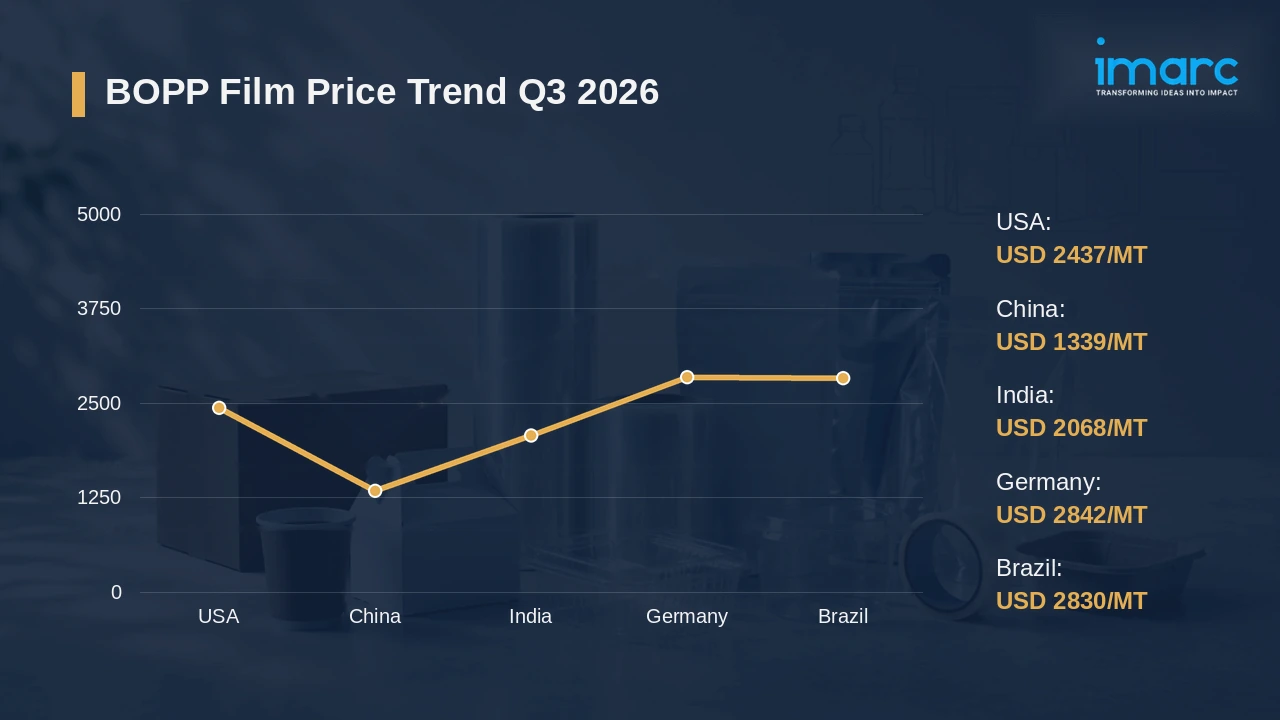
BOPP film is a biaxially oriented polypropylene film, stretched in machine and cross directions for strength, gloss, and sealability. Converters cut it into snack wrappers, labels, adhesive tape, and lamination structures for packaged goods. Rising polypropylene resin costs, energy used in tenter frame stretching, and ocean freight move BOPP film prices most directly in the short term. Packaging demand cycles and converting capacity utilization add a second influence.
Global Market Overview:
Globally, the BOPP film industry was valued at USD 23.0 Billion in 2025. Market projections indicate steady growth, with the industry expected to reach USD 33.8 Billion by 2034, with a compound annual growth rate (CAGR) of 4.14% during 2026-2034. Packed food, beverage, and e-commerce distribution channels keep flexible packaging consumption expanding across Asia and Latin America, which supports the BOPP film price trend. Converter capacity additions in India and China keep regional supply ample.
BOPP Film Price Trend Q3 2026:
Regional prices (USD per MT) and QoQ changes Q3 2026 vs Q2 2026:
| Region | Price (USD/MT) | QoQ Change | Direction |
|---|---|---|---|
| USA | 2,437 | +3.86% | ↑ |
| China | 1,339 | +6.21% | ↑ |
| India | 2,068 | +4.98% | ↑ |
| Germany | 2,842 | +3.11% | ↑ |
| Brazil | 2,830 | +4.97% | ↑ |
To access real-time prices Request Sample
What Moved Prices:
USA:
- In Q3 2026, BOPP film values in the USA rose to USD 2,437/MT, a 3.86% QoQ gain, as Gulf Coast resin contracts settled higher. Snack and beverage packaging lines ran steadily through the quarter on annual supply agreements. Label and tape demand added steady volume at firm offers.
- Domestic converter capacity stayed fully committed across the Midwest and Southeast, leaving little room for spot discounting. Freight from resin producers into film plants held near contract levels, while rail availability out of the Gulf kept delivered costs stable. The BOPP film price chart traced a firm upward slope through September.
China:
- During Q3 2026, BOPP film values in China climbed to USD 1,339/MT, a 6.21% QoQ gain and the steepest among tracked regions, as domestic resin offers firmed. FMCG packaging plants in Guangdong and Zhejiang kept run rates high. Export offers rose with domestic quotations.
- Domestic producers kept lines running near capacity while imported film from Southeast Asia continued to price above local offers. A stable yuan against the dollar supported export competitiveness through the quarter. Buyers across the Yiwu and Guangzhou trading hubs booked forward volumes early, ahead of the year-end peak season.
India:
- In Q3 2026, BOPP film values in India advanced to USD 2,068/MT, a 4.98% QoQ rise, as post-monsoon packaging orders returned and domestic producers held firm offers. Imported resin costs climbed with firmer Asian offers into Mundra. Converters across Gujarat and Maharashtra ran fuller schedules.
- Freight into Nhava Sheva and Mundra stayed manageable through the quarter, so landed costs tracked resin movements rather than shipping rates. FMCG and snack producers across northern India kept procurement steady on monthly contracts. Distributors rebuilt stock earlier than usual ahead of festive-season dispatches, lifting offtake in September.
Germany:
- During Q3 2026, BOPP film values in Germany increased to USD 2,842/MT, a 3.11% QoQ rise and the highest absolute level among tracked regions, on firm European polypropylene contracts. Food and confectionery packaging demand held steady across Bavaria and North Rhine-Westphalia.
- Higher energy costs across the German converter base kept production economics tight, which supported firmer offers from domestic suppliers. Imported film from Asia arrived at Rotterdam and Antwerp with competitive landed costs and shorter lead times. Retail brand owners, working against steady shelf demand, accepted the increase without switching suppliers.
Brazil:
- In Q3 2026, BOPP film values in Brazil rose to USD 2,830/MT, a 4.97% QoQ gain, as imported film landed costlier and BRL movements lifted replacement values. Local producers followed import parity pricing on every contract reset. Food and beverage packaging demand stayed firm through the quarter.
- Cargoes arriving through Santos carried higher freight and handling charges, adding to delivered costs across São Paulo's industrial belt. Distributors held lean inventories and bought only against confirmed converter orders. Currency hedging covered only part of the import exposure, so buyers carried residual currency risk.
Drivers Influencing the Market:
Several factors continue to shape BOPP film pricing and market behavior:
- Flexible Packaging and FMCG Demand: Food, beverage, and personal care packaging absorbs the bulk of global BOPP film output, anchoring baseline procurement volumes. Beyond packaging, label and tape converters form a second demand layer. As e-commerce fulfillment and convenience food formats expand, converters place more frequent and smaller orders, which shortens restocking cycles and transmits retail consumption swings into film procurement faster.
- Polypropylene Resin Feedstock Costs: Polypropylene resin represents a major raw material cost for BOPP film production, linking film pricing closely to polymer market movements. Changes in propylene availability, crude oil and natural gas prices, and regional resin supply-demand conditions can influence resin procurement costs and, in turn, affect BOPP film pricing and producer margins.
- Energy Expenditure in Film Extrusion: Electricity powers the extruders, tenter frames, and chill rolls on every BOPP line, making power tariffs a recurring operating expense. Among regional producers, European mills carry the heaviest exposure. Where industrial gas and electricity rates stay elevated, sequential stretching lines operate on thinner margins, and producers tend to defend price floors rather than chase incremental volume.
- Ocean Freight and Logistics Economics: Import-dependent markets such as Brazil and India price BOPP film partly on landed cost, which leaves freight as a swing variable. In its September 17, 2026 assessment, Drewry's World Container Index rose 1% to USD 4,500 per 40ft container, with Shanghai to Los Angeles rates climbing 5% to USD 7,712. Repeated blank sailings by carriers kept transpacific capacity tight.
- Environmental and Regulatory Compliance: Extended producer responsibility frameworks in India and Europe push packaging end-of-life costs toward brand owners and their film suppliers. As a result, mono-material packaging designs are gaining favor. Reformulating multilayer laminates into recyclable all-PP structures requires coating upgrades and qualification trials, and these outlays gradually feed into the BOPP film price index across regulated markets.
- Trade Policy and Currency Dynamics: Anti-dumping duties and import tariffs on Asian-origin film limit arbitrage between regions, helping explain how Chinese prices sit far below German and Brazilian levels. For importers, currency swings carry comparable weight. When the BRL or INR weakens against the dollar, import parity values rise in local terms, and domestic producers typically lift offers to match, regardless of underlying demand.
Recent Highlights & Strategic Developments:
Recent strategic moves within the industry further illustrate evolving dynamics:
- In November 2025, TOPPAN Inc., operating with its India-based subsidiary TOPPAN Speciality Films Private Limited, introduced a hybrid production line designed to manufacture both BOPP films and biaxially oriented polyethylene on a single system. The dual-substrate design lets the group switch output between packaging formats as regional demand shifts, strengthening its film position across Asian markets.
- In June 2025, Cosmo First, an important participant in packaging films, lamination, labeling, and synthetic paper, revealed the successful launch of a new BOPP Film Line with a Capex exceeding Rs 400 Crores at the Company’s current manufacturing facility in Aurangabad, Maharashtra.
- In June 2025, Dhunseri Ventures Limited revealed the launch of a BOPP film manufacturing plant in Kathua, Jammu. The facility was designed to enhance the group's capacity for BOPP films, an essential raw material used in the laminating, labeling, and flexible packaging sectors.
Outlook & Strategic Takeaways:
Looking ahead, the BOPP film market is expected to grow steadily through 2034, carried by packaged food consumption and e-commerce fulfillment demand across Asia and Latin America. Resin contract settlements, freight rates, and converter capacity additions will remain the pivotal variables behind the BOPP film price forecast through the forecast period.
To navigate this complex landscape, stakeholders should:
- Track Flexible Packaging Order Books: Monitor snack, confectionery, and e-commerce packaging order books across the USA, China, and India every month. Aligning resin cover with those signals avoids inventory build ahead of slower converting periods and reduces working capital tied up in film stock.
- Assess Freight on Core Trade Lanes: Track container rates on Asia-Europe, transatlantic, and Asia-Latin America lanes, since Brazil and Germany price film largely on landed cost. Building rate adjustment clauses into quarterly logistics contracts shares spot volatility more evenly between buyer and supplier.
- Monitor Regional Price Differentials: Compare quarterly assessed values across the USA, China, India, Germany, and Brazil to identify favorable sourcing windows before contract renewals. Benchmarking BOPP film price per MT against prevailing contract rates shows where switching origin genuinely lowers delivered cost for converters.
- Review Compliance and Recycling Costs: Audit registration, food-contact testing, and extended producer responsibility reporting across every converting site before annual budgets are set. Consolidating shared laboratory testing and supplier audits trims duplicated spending while keeping food-safe certification intact for brand-owner customers in Europe and India.
- Strengthen Currency Exposure Management: Hedge dollar-denominated resin and film purchases where payments settle in BRL, INR, or CNY under quarterly contract terms. Aligning hedge tenors with confirmed shipment dates prevents cover lapsing before cargo clears customs at Santos or Mundra, where delays are frequent.
- Explore Emerging Application Segments: Investigate high-barrier and mono-material BOPP structures for recyclable flexible packaging, alongside emerging capacitor and battery film grades. Pilot trials with brand owners and converters validate commercial viability, print performance, and seal integrity before capacity commitments are made.
Subscription Plans & Customization:
IMARC offers flexible subscription models to suit varying needs:
- Monthly Updates: 12 deliverables/year
- Quarterly Updates: 4 deliverables/year
- Biannual Updates: 2 deliverables/year
Each includes detailed datasets (Excel + PDF) and post-report analyst support.

Get in Touch With Us
UNITED STATES
Phone: +1-201-971-6302
INDIA
Phone: +91-120-433-0800
UNITED KINGDOM
Phone: +44-753-714-6104
Email: [email protected]
Client Testimonials




.webp)




.webp)












